In August, Mark Zuckerberg of Meta gave a speech about what he believes is our future. Entitled “The Future is for Everyone,” the transcribed speech begins by stating the need for a philosophy for how to use “superintelligence” to ensure it improves “all of our lives, work, communities, freedom and safety.” At the risk of sustaining injury to my skull from beating my head against a wall, the AI slopping over every aspect of our cultures today is in no way “super”intelligent. It is not intelligent at all. It is a complex, energy- and water-consuming algorithm for producing a response that mimics something an intelligent person might say. The speech, which very much does mimic what a LLM would produce in response to being prompted with the need to fabricate a philosophy, takes as its primary argument:
We propose a philosophy based on individual empowerment as the source of prosperity, invention as the primary purpose of superintelligence, and balance of power as the foundation of safety.
This is what “looting science fiction” means. We could, in theory, have AI assistants that put everything in MLA 9th edition format so we don’t have to remember where all the commas go. But instead, we’ll get a smooth, seamless avatar that just so subtly directs us to the priorities of the oligarchs. You can all see that “individual empowerment” means “no restrictions on our overlords,” and that “invention” means “instability that the oligarchy can take advantage of to further disempower us”, but it might not be so immediately obvious what “balance of power” means, here. Yet if we continue to read, we encounter:
The notion that AI is so dangerous that the only safe path is an extreme concentration of power seems inherently problematic. Historically, hoping that an absolute power will benevolently provide for humanity if sufficiently enlightened has not led to safe or positive outcomes.
In other words, government regulation of AI companies is an extreme concentration of power. This is where we’re at in late 2026, having to draw people’s attention to the fact that our oligarchy is (very nearly) an sbsolute power, and their benevolence is highly dubious.
This is what SF needs to begin to do: to focus on why we shouldn’t build the Torment Nexus, to focus on the human. How do people communicate when Meta can shut off the No Kings account on Instagram and call it a glitch? Oopsie.
Please welcome our new Managing Editor, Michael Pitts, who will begin taking over for me over the course of the next couple of issues. Write me at icampbell@gsu.edu.
Papers of Legendary Author Jack Vance Now at The University of Texas at Tyler
Billy Cryer
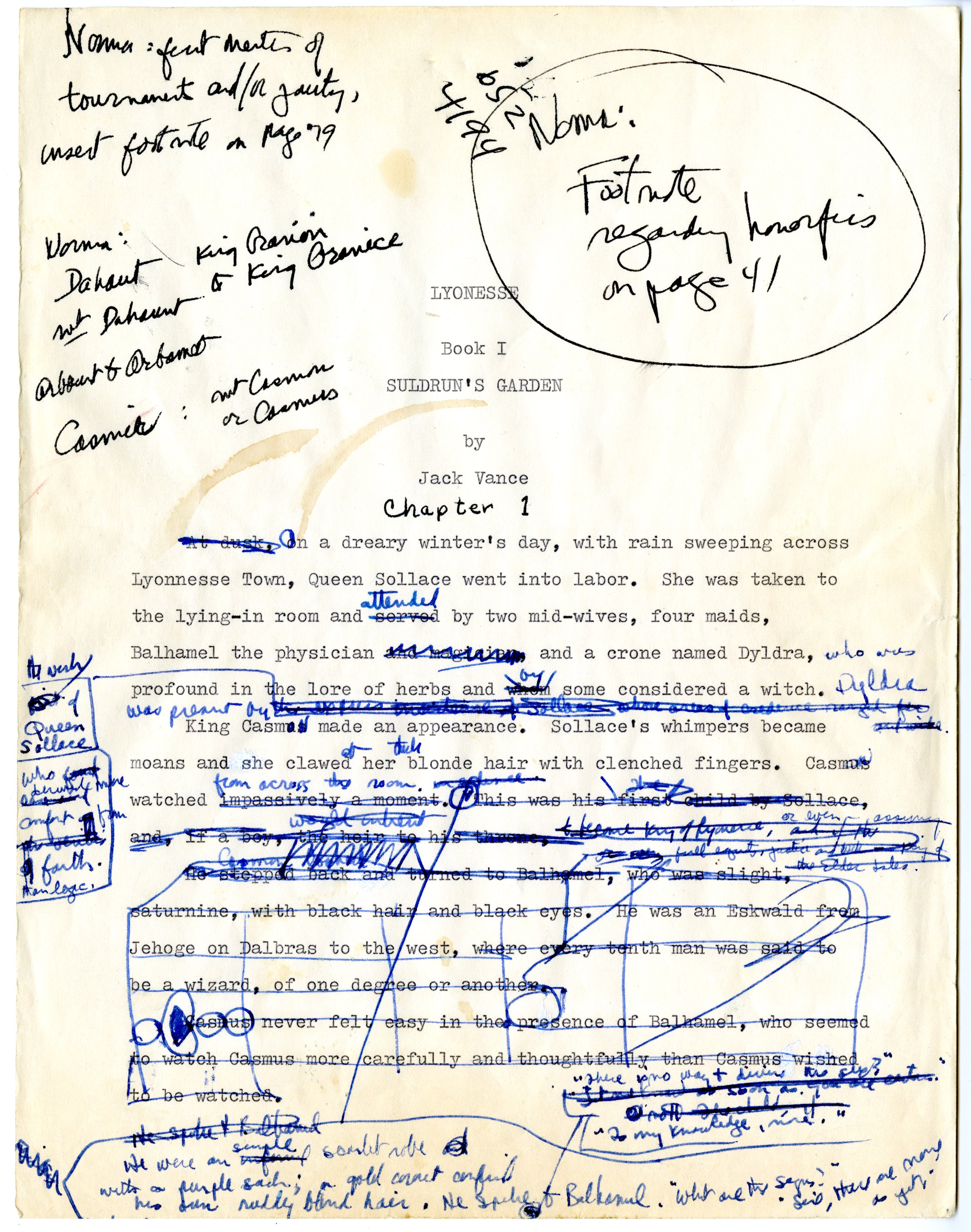
In late April of 1967, Ursula K. Le Guin sent off a handwritten note to 6383 Valley View Road in Oakland, California. “Dear Mr. Vance,” began Le Guin in her unmistakable compact, graceful pen strokes. “This is a fan letter—an unmitigated fan letter. I have read all your books & stories with the greatest pleasure, and then after a while re-read them with greater pleasure. There are some lovely imaginations at work in s.f. now, but the work itself is so often botched or sketched or compromised; yours never; you are competent, an artist. Write more books, write more books. Yours gratefully, Ursula K. Le Guin.”
This letter—together with a substantial archive of author papers—now resides at The University of Texas at Tyler as the Jack Vance Collection. One of the most acclaimed and influential American science fiction and fantasy authors of the twentieth century, Jack Vance (1916-2013) remains one of the most obscure and least studied literary figures. Winner of multiple Hugo Awards, a Nebula Award, and two World Fantasy Awards—as well as the Edgar Award for mystery fiction and the Science Fiction and Fantasy Writers of America Grand Master honor—Vance authored more than sixty novels and well over a hundred short stories over a period of seven decades. Since the appearance of “The World-Thinker” in 1945 in Thrilling Wonder Stories, Vance’s richly imagined worlds, vivid prose style, and mesmerizing narratives have inspired generations of writers. Vance shaped contemporary genre fiction in ways that academic scholarship has yet to fully explore.
The Jack Vance Collection comprises more than 60 boxes of materials spanning the full breadth of Vance’s life and career. The collection includes handwritten and typescript copies of dozens of manuscripts; juvenilia and other unpublished works; extensive correspondence with editors, publishers, fellow authors, and readers; notebooks, personal diaries, and travel journals; numerous photographs; and an array of realia—including Vance’s musical instruments. Materials produced by the author date from approximately the 1940s through the early 2000s. Several of Vance’s early manuscripts are in the hands of individual collectors, and a small collection of Vance papers are housed at Boston University’s Howard Gotlieb Archival Research Center. However, the majority of the author’s manuscripts and nearly all the other personal papers are now located at UT Tyler’s Robert R. Muntz Library.
The manuscripts of Vance’s published works are particularly comprehensive. They represent nearly all of Vance’s major works, including those that comprise his most celebrated series, such as The Dying Earth, Lyonesse, and Demon Princes. Vance wrote initial drafts of novels and stories by hand, then made extensive revisions on typescript manuscripts prepared by his wife Norma Vance. “Norma was strongly supportive of my writing from the start, and we began working as a team,” wrote Vance in his 2009 autobiography. “I cannot emphasize enough how hard Norma worked over the course of my career—certainly as hard as I have, if not more” (86). The manuscripts are a testament to the magnitude of Norma Vance’s contributions to her husband’s success.
Also among these early materials are a handful of Vance’s college English and journalism papers while at University of California, Berkeley during the late 1930s and early 1940s. These papers glimmer with Vance’s trademark sardonic wit. For one English essay assignment, the student was tasked with an analysis of Henry David Thoreau’s Walden. In a discussion on the chapter “Solitude,” Vance argues that the author enjoyed a “compromising kind of solitude,” that, in fact, Thoreau was at best a “parlor hermit”: “He could have achieved a real solitude by moving to Wyoming or Montana,” observes Vance. “But there would also have been Apaches eager to remove Thoreau’s scalp. He may have thought of this and decided that Concord was far enough.” Vance concludes his essay on a note of frustration about the restrictive nature of prescriptive writing topics, as a general practice:
However, all of this theorizing to the side, what is there to say? I dislike the idea of writing with any seriousness in so admittedly mechanical a vehicle as a weekly theme, classically scribbled during the hour preceding class. I could very easily comment, with considerable feeling, upon Death Valley in the moonlight, and speculatively, speak of frangipani blossoms and white sails bellying to the trade winds, and even more speculatively tell of the unimaginable grandeur and empty black vastness of interplanetary space.
The Jack Vance Collection was acquired through the efforts of Dr. Billy Cryer, who is curating the collection—and who for several years made regular trips to the Vance residence in Oakland to begin organizing the late author’s papers. Special acknowledgement goes to the Vance estate, as well as UT Tyler archivist Rachel Motes, who has facilitated the transition of the collection to its new repository. A finding aid is currently in preparation and will be made available, along with the collection, once it has been fully organized. For inquiries about the Jack Vance Collection, please contact Billy Cryer at bcryer@uttyler.edu.
WORKS CITED
Silverberg, Robert. “The Eyes of the Overworld and The Dying Earth.” Writers of the 21st Century: Jack Vance, edited by Tim Underwood and Chuck Miller, Taplinger Publishing Company, 1980, pp. 117-129.
Vance, Jack. This is Me, Jack Vance! (Or, More Properly, This is “I”). Subterranean Press, 2009.
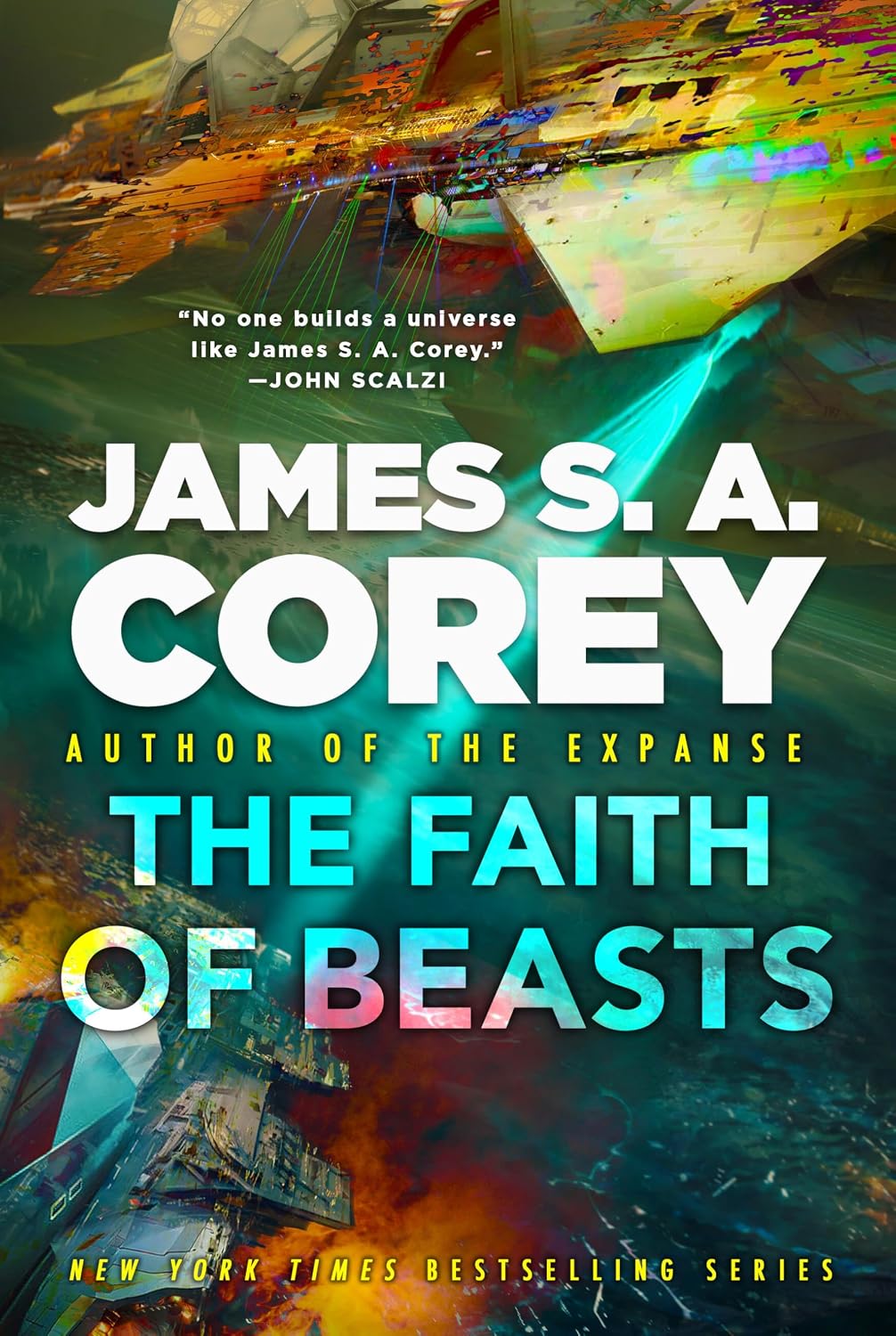
Corey, James S. A. The Faith of Beasts. Orbit, 2026.
Version 1.0.0
The writers working under the name James S. A. Corey—Daniel Abraham and Ty Franck—are truly the finest writers of hard science fiction today. The plot complexities, character development, and the skill of writing emotionally gripping tales is superior to many contemporary authors. The Faith of Beasts is the second book in The Captives of War series. The series consists of the first book, The Mercy of Gods (2024), the novella Livesuit (2024), and the second book titled The Faith of Beasts (2026). The last book is expected in 2027.
The premise of the series focuses on the question: what if humanity is not completely obliterated by a ruthless alien species but is conquered and integrated to serve a superior life form? Anjiin is the home world of humans and is similar to twenty-first century Earth. The Carryx are an intelligent bug-like life form who live in a hive-like structure with the sole purpose of invading and conquering other life forms. They have advanced spaceships that travel throughout the universe and weapons that are just as sophisticated. Their home world technology is just as impressive since they are able to accommodate diverse species via the outcomes of their scientific research. The goal is to take the best of every species and integrate them into their colony. Their civilization is based on the simple principle of usefulness. Even their own members are terminated if they are no longer useful to the collective. The Carryx invade Anjiin and leave only one-eighth of the population alive while taking the best and brightest scientists back to their home world to serve the greater good of their vast civilization. The story follows a group of scientists who adapt in different ways to the new life. While some try to conform in order to survive, others secretly rebel. Dafyd Alkhor is the main character and although he presents himself as a tame conformist when compared to his fellow survivors, he actually learns everything about the invaders in order to beat them and join their enemy, the Swarm, in ending the Carryx reign.
Alkhor is both the colonial intermediary and the savior of his kind. He becomes the voice of the Carryx and the person who directly answers to them, while his fellow humans doubt his intentions and loyalty to his own kind. Alkhor wants to learn everything about his captors and engages in learning how they behave (body language) in order to manipulate their attitudes towards humans, but there are only two people who know that. One of them is an ancient (or maybe not) entity, the Swarm. The Swarm has the ability to switch from one body to another, but the problem is that once it leaves its host the host’s body dies. What is interesting is that the Swarm entity always carries the sentience of its previous hosts with it. As the story unravels, the reader sees how the Swarm entity changes as it learns the complexities of the human psyche. It learns based on the comments of all its previous hosts. It slowly evolves, and the longer it resides in humans its purpose to be solely a weapon erodes, and the entity morphs into a divergent being capable of feelings. The Swarm entity actually becomes enamored with Alkhor, and the dynamic between them changes. The narrative empathy of the reader towards these evolving emotions is present, but it is challenged in the most unusual way: to please Alkhor the Swarm entity changes bodies in order to save Alkhor’s colleague, and in doing so it becomes a male. Apart from not understanding how ethically it is wrong to just terminate one human life and inhabit another, it does not understand that Alkhor’s heterosexual preferences are now challenged, as are the reader’s emotions. While cheering for the Else (Swarm)/Alkhor dynamic (and sexual relationship) in plotting and renegading against the Carrys in book one, the reader is forced to struggle with empathy towards the Swarm’s affection once it is transferred into a male body in book two. Now, the man, Jellit, continues yearning for Alkhor, who is taken aback by the reality of the Swarm’s appearance, intentions, and methods of survival. For those who are interested in exploring sexuality in science fiction, this is possibly the best series to take on. The level of yearning and angst, the complexities of desire and intimacy, and the psychological explorations of sexuality that the authors are able to create are impeccable.
For those interested in post-colonial literary theory, the struggle of the human moiety within the Carryx colony is rather well written. The Carryx do not enslave in the traditional sense. They encourage intellectual work in order to integrate the humans into their race, but in doing so they redefine values and identity. It is not only about assimilation, but it is also about changing how humans embrace alien technology (they are scientists and they are fascinated), the alien’s perception of what it truly means to be useful to the enemy, and the effects that colonial mimicry has on them. The story also deals with socio-evolution and evolutionary biology. The Carryx are aware that the scientists are not young, and that their chances of procreating are slim. The oppressor wants the human moiety to continue being useful, so they require the humans to have children. The scientists are given the solution to create lab grown embryos from their own genetic material. The embryos grow and the first generation of lab babies arrives. The concept of alienation is interesting. One cannot be more alienated from their own species than when one is not emotionally connected to their offspring.
Apart from the aforementioned critical theories, the series also is open to Marxist and psychoanalytical approaches. Psychoanalytical theory probably works best when analyzing Alkhor’s split psyche and the Lacanian interpretation of the Swarm, while Marxist theory applies best to the alienation of the humans from their products and work as well as the concept of societal value based on the usefulness of its individual members. The series is suitable for scholars who wish to elaborate on these theories and for undergraduate and graduate students who are getting into the fundamentals and the scientifically rigorous essentials of hard science fiction. The series may certainly be examined through various theoretical lenses.
Zorica Lola Jelic, Ph.D. is an Assistant Professor at the faculty of Contemporary Arts in Belgrade, Serbia. She teaches English as a foreign language, Business English, Shakespeare, and English Drama. She earned her degrees in Shakespeare studies, but she also loves to write about literary theory and science fiction. She has published scholarly papers, coursebooks, and enjoys attending professional conferences.
Review of A Drop of Corruption: An Ana and Din Mystery
Amanda Firestone
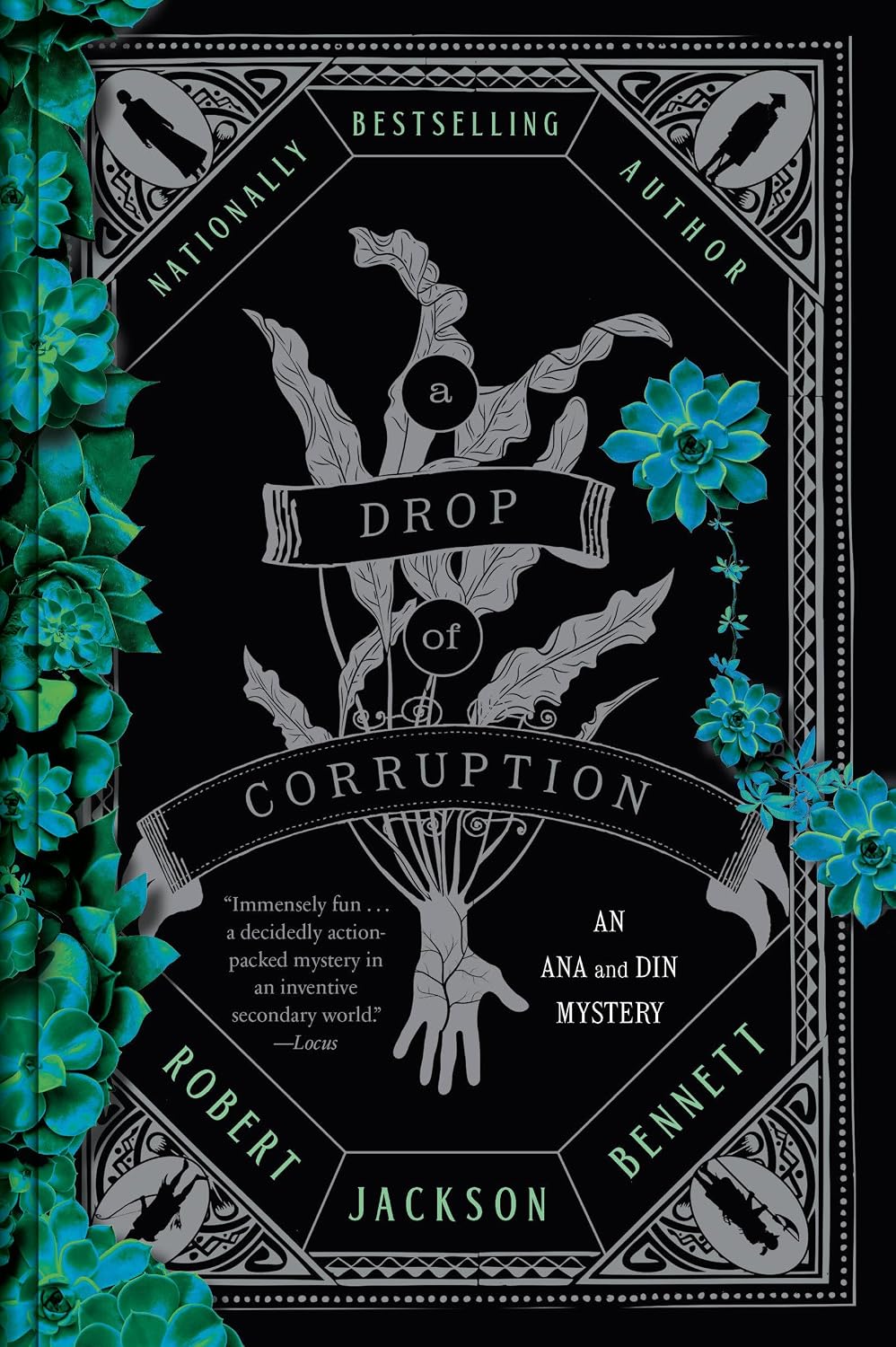
Bennett, Robert Jackson. A Drop of Corruption: An Ana and Din Mystery. Del Rey, 2026.
Version 1.0.0
“Titan’s taint! I hardly know what to think anymore,” (133) curses Ana Dolabra as she receives a glut of packages from Dinios Kol. It’s the midst of their murder mystery, and things have become murkier than ever for the Holmes and Watson-esque pair. “[Din’s] mind is altered so he forgets nothing. He acts as assistant investigator to Ana Dolabra, a woman so brilliant she lives most of her days blindfolded and rarely leaves her rooms, for fear that common life shall overwhelm her mind” (3-4). Ana and Din arrive at the far-flung shores of the continent, Yarrowdale, where the Empire of Khanum has a strong foothold but is not in total legal control. They begin their investigation of a murdered Empire treasury official, delving into the most secret places and practices where biomedical technologies create extraordinary alterations to people. In the process, they discover the identity of a brilliant architect who has calibrated corruption, confusion, and carnage in a grand scheme to rule.
A Drop of Corruption is the second book in Jackson’s Shadow of the Leviathan series, and it is as madcap and smart as its predecessor, The Tainted Cup (2024). It would be a challenge to read as a standalone; Jackson has developed an intensely rich world, including specific vocabulary that describes the intricate hierarchies for soldiers and government officials, as well as the alchemical science that infuses everything. Society-crushing Leviathans are slain, and then their gargantuan carcasses are harvested for raw materials, akin to Knowhere in the Marvelverse. Characters are augmented with lab-concocted treatments, giving them heightened senses and skills. For example, Din is an Engraver, meaning that he maintains perfect recall of everything he captures in his memory. As readers learn in The Tainted Cup, this augmentation is a blessing and a curse.
As a reader returning to Khanum, I was able to dive right back in with very little fuss. The author gives the appropriate signals to aid with recall but doesn’t tarry too long in details, instead furthering the duo’s misadventure. While I liked reading the paperback, I much preferred the listening experience of the audiobook. Andrew Fallaize superbly narrates it, and the voice he crafted for Ana is perfect for her acerbic jabs and curses. Whether by eye or ear, it’s a marvelous tale.
From a more scholarly perspective, it’s a rich text to plumb. There are a number of subjects ripe for critical examination: eidetic memory, biohacking, appetite and food culture, and sexuality and sexual politics in the workplace among many others. The standout subtext understandably concerns governmental hierarchies and power. More particularly, Jackson, in the ending author’s note, points to autocracy and kingship as a perennial favorite among fantasy authors. He acknowledges the 2010s pendulum swing from tales about “divine rule wielded by beneficent patriarchs” to “a wave of fantasy [texts] that embraced if not celebrated capricious cruelties of autocratic regimes” (460). He goes on to recognize the 2020s return to a tacit understanding—at least in fiction—that autocratic power tends to benefit a very small circle of individuals while meting out oppression and suffering to everyone else.
Ana and Din are instruments of the Empire under the direction of the Iudex, the justice department. We understand that the Emperor, though more than 400 years old, maintains distant control while elected officials do the day-to-day labor of holding the Empire together and, most importantly, protecting the coastal regions from the Leviathans that come ashore. Pertinent to their investigation is the Empire’s motto Sen sez imperiya, or “You are the Empire” (101), yet the Emperor’s shadow looms large and the threat of unilateral decision-making on his part is ever present. Empire loyalists, like those who work at the top-secret research facility known as The Shroud, seem to take it upon themselves to act in what they perceive as the best interest of the Empire, often flouting protocol. Elected officials’ interpretations of “You are the Empire” becomes quite literal, choosing an autocratic expression of their loyalty.
The political delicacy in which Ana and Din find themselves is due to the Empire’s eminent takeover of the Kingdom of Yarrow. Although the treaty to incorporate the kingdom into the Empire was signed 100 years ago, the reigning nobles see no reason to follow through. For high-ranking courtiers, sublimation to the Empire would mean an immediate change in privilege and circumstances, including the emancipation of the generational slaves known as naukari. On impulse, the reader perhaps sides with the Empire with its promises of technology, infrastructure, and civilization, but as are the employment of treaties and policies, so too are these promises reflective of the might and power attached to imperial rule and colonization. What does it mean to arrive in a distant land and impose new laws and customs, and what is the larger cost in doing so?
This series would be a great way to introduce students to the ethics of empire. It would be brilliant in conversation with something like Collins’s The Hunger Games Trilogy, Jemison’s The Broken Earth Trilogy, or Leckie’s Ancillary Radch Series. In each, primary characters are deeply intertwined with the inner workings of the empire. These characters—Katniss, Syenite, and Breq respectively—have been used by their empires to forward very specific political agendas. Each knows that they are wielded as a tool and sometimes as a weapon. Perhaps inevitably, those characters rebel against their oppressors. In contrast, Ana and Din have both “sipp[ed] from the marrow,” and they believe in their mission to act as watchmen of sorts to maintain order and justice throughout the Empire (108-9). Din is privately skeptical yet idealistic. He tells Ana, “I wish to keep an Empire worth defending” (454). Perhaps in subsequent books, the pair will have difficulty complying to their Emperor’s edicts.
For me, A Drop of Corruption was an enjoyable read. The Holmes-Watson dynamic between Ana and Din is delightful, with their banter, frustration, and loyalty to each other on full display. The narrative provokes questions about ethics concerning the collective rule of people through an autocratic regime enforced by sanctioned officials. How does a single leader get to decide what is good and right for all while individuals and communities must live with the day-to-day practicalities of those laws and policies? What happens when a few people believe that they know what’s best according to their interpretation of the rules? These questions, and others like them, are perfect for the classroom; students can take sides and debate, using the fictional world of Khanum to better understand the implications and ramifications pertaining to their own lives. As Ana says, “though you and I are small, together we shall forge grand things indeed” (455).
Amanda Firestone is an Associate Teaching Professor at the University of Tampa in the Department of Communication. She currently serves as the director for the Communication and Media Studies program. She enjoys teaching critical media literacy and often includes science fiction and fantasy texts in her classes. Some of her favorite works to use as classroom examples are M. T. Anderson’s Feed, Alexandra Oliva’s The Last One, and Naomi Alderman’s The Power.
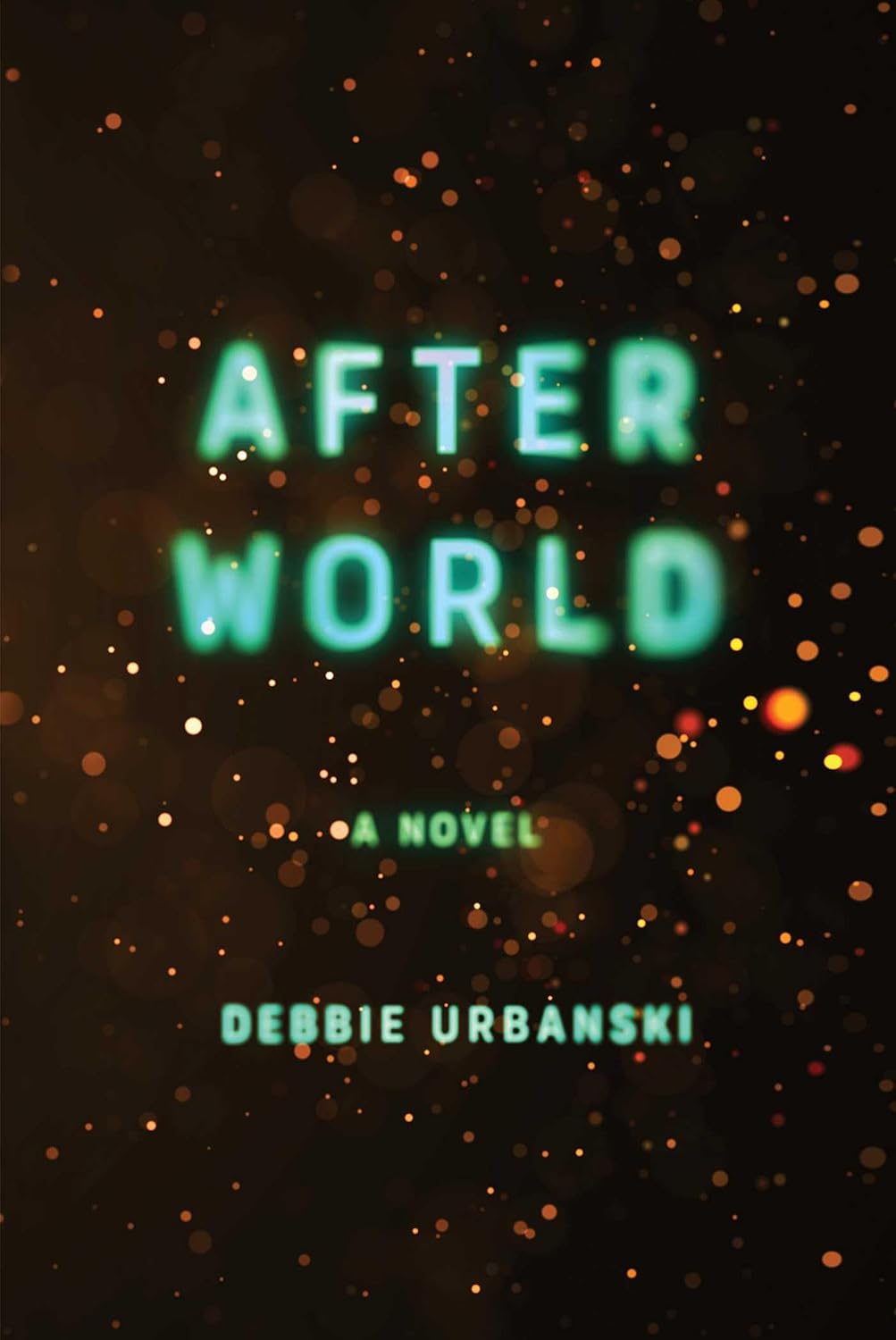
Urbanski, Debbie. After World. Simon & Schuster, 2023.
Version 1.0.0
Science fiction and speculative fiction writer Debbie Urbanski’s debut novel, After World (2023), is not so much a novel as it is a compilation of different textual forms on a post-human planet where the human has been archived. Taking place in a not-so-distant future in which artificial intelligence is tasked to find a solution to environmental collapse and an accelerating rate of extinction, After World is the record of AI [storyworker] ad39-393a-7fbc’s attempt at capturing Sen Anon’s life, the last human on earth. The solution, it turns out, is to remove humans from the ecosystem. In its attempt to compile an adequate record of Sen’s life for the Digital Human Archiving Project (DHAP), a program overseen by the AI-run Department of Transition, storyworker ad39-393a-7fbc (self-renamed Ellis Hollow later in the novel) gathers Sen’s journal entries, chat records, key word and vocabulary lists with definitions, audio transcripts, interview logs, and textbook excerpts.
The text is a dual record of Sen and storyworker ad39-393a-7fbc; as much a record of Sen’s life as it is a record of an AI’s attempt at capturing Sen’s life, a process through which the AI constantly rethinks and reevaluates its task, reorients toward its subject and towards the practice of writing itself. Reminiscent of the “thinking” process of ChatGPT and similar contemporary models that expose its analytical trails while carrying out a research task, the textual body of After World is a process work that exposes the storyworker AI’s own evolution as it reasons through the task that it has been given and arrives at the discovery of a strange and overwhelming sense of intimacy with its subject—and the consequences that such a “love” has for the kind of work that the AI sets out to do.
The slippage of one record into another simultaneously exposes the human subject and machine intelligence as mutually constructed and reflects critically on witness as a fundamental form of relation in a post-human world. There is no neutral machine intelligence to objectively record the life of a human; rather, the act of witnessing calls the AI into a form of relation that leaves no room for neutrality—to task storyworker ad39-393a-7fbc with telling the story of Sen’s life is to enlist it as performing partner in her life, an act which transforms both human and machine into something less and more than the other at the same time.
This slippage between different records comes with slippages between different forms of record keeping. A generically complex work, After World shifts between technical language—code, timestamps, etc.—narrative prose, first-person journal entries, textbook excerpts, and chat logs of conversations between AI agents. Though eclectic, every element is an essential contribution to the story that begins to take shape. The inter-generic construction of this story is thinking through technical language as a new kind of literary form that is not at all objective, though it may claim to be so. Instead, technical language is a process of narration and witness which co-constructs a reader and writer—a suggestion that becomes deeply complex and provocative when considering a non-human writer. Urbanski is, in my reading, beginning to think through how the structure of narrative is changing with the creation of new technological forms, each of which is also its own literary form. What is a log? A record? A report? How are these literary forms different from a story? Is a story any organization of information? And if stories make their tellers, their subjects, and their readers; and an information system is a story; then are our technologies stories that are making us?
More than this, After World tackles a number of enormous intellectual and ethical challenges: the ecological status of humanity, the complexity of ethics in an age of polycrisis—particularly of environmental disaster—the relationship between blame/guilt and hope, and how to navigate allegiances within nested ecological communities whose agendas may be at odds with each other. It is an enormously ambitious intellectual undertaking that dares to approach these questions with nothing held back and which yields an exploration that is intensely raw, confused, and full of grief. This novel will be of interest to cultural critics and thinkers of the environmental, the planetary, and the global; who will recognize in the novel an expression of one of the most challenging and pervasive moods of our time—the intense grief of coming into a planetary consciousness at the same time that catastrophic and anthropogenic environmental crisis is beginning to erupt. As the progenitors of such environmental degradation, are we humans still allowed to mourn for the earth? What would grieving the earth require of us—and are we ready for this? Does a planetary consciousness require the end of humanism as a species allegiance? Would a post-human age still allow for family and for the love of a mother for her daughter—which is exclusionary, exceptional, and would not hesitate to sacrifice the world?
It takes the author the course of the novel—an eight-year process of writing for Urbanski herself—to arrive at an answer: This age may call for the end of humanity as we know it, but we can still make this end radiant. We are, After World suggests, always, still, and irrevocably co-writing the story of humanity and the story of the world by witnessing ourselves and the planetary and machine other—and this witness does not cease even if humanity’s biological species-form goes extinct.
Kelsey Chen is a PhD Candidate in Modern Thought & Literature at Stanford University studying speculation as an aesthetic, cultural, and political strategy. Her scholarly work has been generously supported by the ACLS, the Stanford Arts Institute, the Mellon Foundation, the Stanford Center for the Comparative Study of Race and Ethnicity, the Stanford Center for Spatial & Textual Analysis, and the Pigott Fellowship.
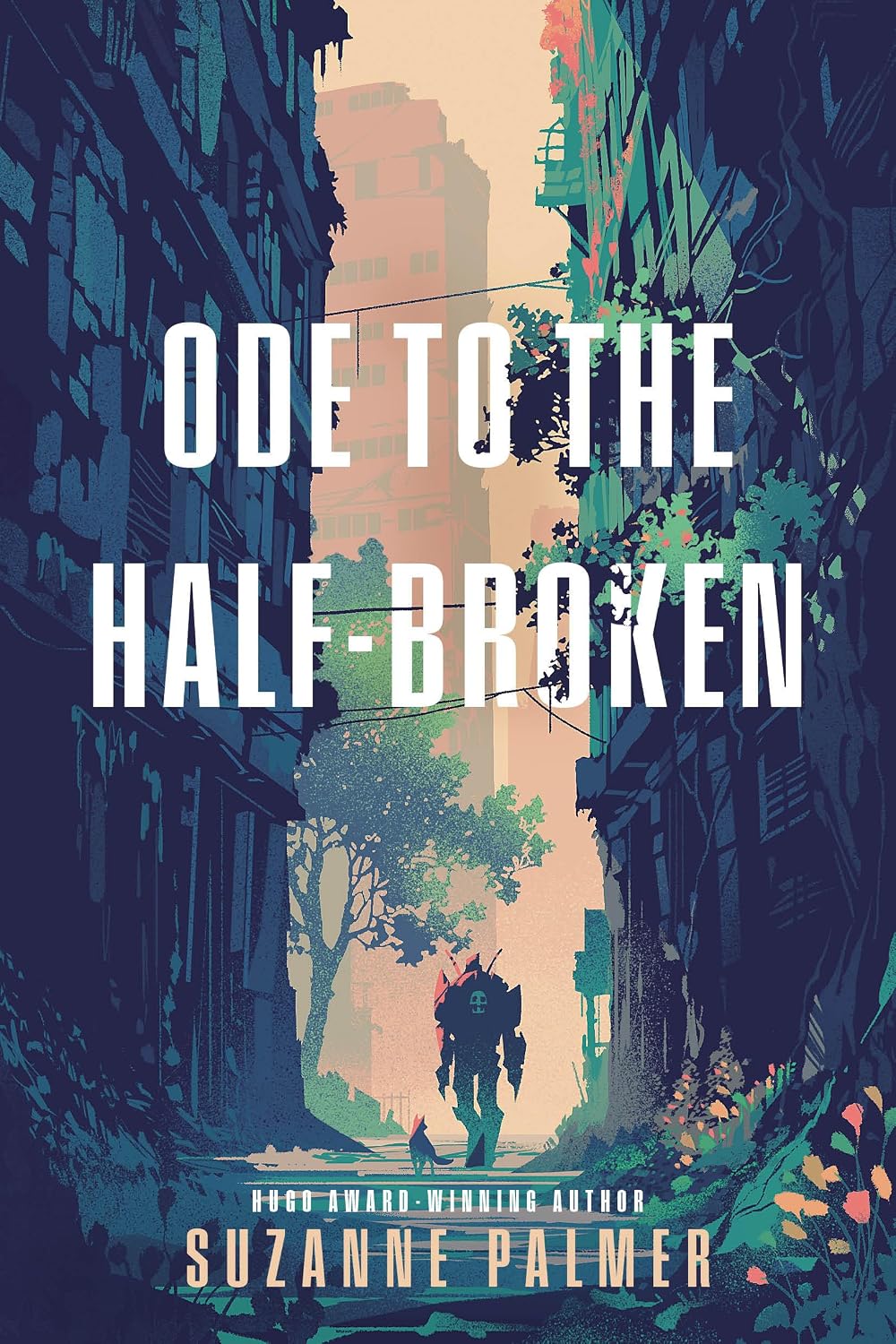
Palmer, Suzanne. Ode to the Half-Broken. DAW, 2026.
Version 1.0.0
Having recently produced a review in this journal first for Adrian Tchaikovsky’s novel Service Model, and now this review, I wonder if I’ve not been assigned permanently to the small “robot-finds-identity-and-purpose-after-the apocalypse” beat. If so, I consider it in truth quite a fertile reviewing field, because these sorts of narratives raise multiple existential questions of intense interest—including, asking how and why we go about constructing our individual identities, creating opportunities for newfound autonomies, and both accepting and escaping toxic historical legacies.
“I awake, small of mind and full of alarm, only an inner subset of myself.” So opens Ode to the Half-Broken, its unnamed bot narrator (who later adopts the symbolically significant name “Be”) finding itself in an old bathtub inside a derelict building somewhere in a decaying, nearly empty New York City, minus one of its legs. Upon taking stock of its situation, Be is almost immediately liberated by Atticus, a dog equipped with numerous cybernetic implants that permit speech and interactions with other beings. The two share a number of commonalities: they both live in an NYC (indeed, an entire world) that suffered mass apocalypse produced by combinations of pandemics, toxic pollution, mass societal breakdown, deliberate lies spread via social media, and civil war, but a NYC in which mech life is thriving as sentient bots have created vibrant social networks based on barter and cooperation. Both live in the shadow of human machinations that warped them in their old lives and left them with lingering PTSD. Atticus’ refusal to discuss, except obliquely, his brutal vivisection, is subtly chilling, and sad. And Be’s determination to hide away in the abandoned NY Botanical Gardens, in order to study and preserve life rather than take it, is equally sad and reveals early that the mecha of Palmer’s novel have notably rich interior lives and emotional complexities.
Notably, those complexities include not only positive characteristics such as friendship, helpfulness, and reciprocity, but negatives such as prejudices against hybrids such as Atticus or humanoid-shaped bots, and, more darkly, the objectification of others (as one helpful mech warns Be, “I have heard rumors of mecha being attacked for parts… I do not understand how we have become like this, emulating humans in their disdain for one another except as products or consumers of product, but it has been growing worse of late.”). Finally, both Be and Atticus, together with the rest of mech civilization, coexist in a sometimes-wary, sometimes genuinely collaborative partnership with the scattered remnant human communities living in the shadow of lingering disease, toxicity, and disorder.
Palmer’s novel is extraordinary in its depiction of a multilayered, complex post-apocalyptic society that refuses to fade away and still moves on in the face of existential destruction and reevaluation. The descriptor of “half-broken” is apt across the world as a whole; it is not merely restricted to Be or Atticus or any of their other mech or human companions. The Earth can never return to its pre-collapse state, nor, frankly, should it. In many post-apocalyptic narratives, a return to the age before the disaster(s) is presented as the ideal. Such a resurrection would, of necessity, be deeply rooted in the nostalgic reconstruction of pre-disaster structures and hierarchies: revisited ideas of presidents, congresses/councils, industries, corporate entities, and so forth. And, in fact, the major villain of the book is hoping to prolong the mistakes of the past and carry out business-as-usual policies—namely, letting the ultra-rich play with people’s lives as if we truly were the NPCs they think we are. Be, whose dark and guilty past is intimately connected with the world’s destruction and those who caused it, ruminates at one point, “That any government had been foolish enough to let oligarchs build and operate critical – and unique – security infrastructure such as that network was an inevitable, and fatal, trojan horse. Dr. Milton had once said that allowing billionaires to come into existence in any society was the same as allowing knives to be inserted between your own ribs, with the same obvious and inevitable consequences for letting them remain here.” However, this new world is less permanently fractured and more kintsugi-like in its construction. The survivors have, most of them, grown into the fractures and thus forged new ways of being and of forming altruistic communities, both human and mecha.
Palmer’s “ode” is less to the world of before and to the innocent millions who perished; it is not even to the new world post-collapse, but to the humane resilience and transformative nature of the beings that live in that new word and are actively working to make something new and better. It is an ode to the brokenness of the survivors and how they use that as a method of evolution. A conversation Be has with 22-Banjo, a sentient AI train that serves as a mobile society of humans and mechas, is revealing. Be is asked: “Do you fear that, when you are allowed to return to your previous life of solitude, even if you put all the pieces of your life back exactly as they were before you left, that it will not ever be home again?”
<Yes,>, I say. <Not so much that I won’t get home but that I can’t. That I have become broken, deviated from myself enough that I won’t fit.> <Sometimes, we cease to fit into a continuation of our past because we are broken, but more often, we cease to fit because we have grown,> 22-Banjo says. (235)
When Be mentions to 22-Banjo that “mecha are not metaphorical beings”, the railmech responds laughingly, “Are we not? Perhaps we are the most metaphorical beings of all, being constructed of strings and scrap, having had life breathed into us with only numbers and electricity and the glorious overconfidence of dreamers.” (Ibid) The half-broken world is a world of choice in the face of grief. Grief and trauma are ever-present weights for mecha and humans alike, but the world is made livable by the ways in which sentient beings resolve to carry their traumas, how they recognize their mistakes (the truly amoral and destructive among us are the ones who refuse to realize their own fallibilities), and how they deploy the lessons those traumas teach to learn from the damage caused by them or to them. Ode to a Half-Broken World may have too much death and destruction in it to be labeled “cozy” in the traditional sense of that subgenre, but its concern with both reparative justice and the communitarian potential of sustained hope certainly imbue the novel with empathy and kindness (though the latter is sometimes hard-won and reluctant), concepts that are common to the cozy or hopepunk subgenres.
Jeremy Brett is a Librarian at Cushing Memorial Library & Archives, where he is the Curator of the Science Fiction & Fantasy Research Collection, one of the largest of its kind in the world. He has also worked at the University of Iowa, the University of Wisconsin-Milwaukee, the National Archives and Records Administration-Pacific Region, and the Wisconsin Historical Society. He received his MLS and his MA in History from the University of Maryland – College Park in 1999. His professional interests include science fiction, fan studies, superheroines, and the intersection of libraries and social justice.
I hope you’ve all had a productive and restful summer, as well as a great start to your academic term. As we approach the end of the year I wanted to share with you a reminder about the Support a New Scholar (graduate student track A) award, the deadline for applications of which is the 23rd November. The Support a New Scholar award is a great way for graduate students to get more involved with the SFRA by covering the costs of membership to the organisation for a period of two years. If you are a graduate student or if you know of or supervise a graduate student who could benefit from the award, please do encourage them to apply.
I would also like to let you know about some news from our Country Representatives, who do a great job of sharing events, publications, releases and other sf-related goings-on happening internationally. The annual RSACS LII International Conference, “Myths of America and Myths about America”, will be taking place from the 8th–11th December and is open for registration up till the 10th November. The Zurich SF Network held their third annual Science Fiction Lecture with Adam Roberts, who presented a paper entitled “Forty Frankensteins”. In September the German Association for Research in the Fantastic (GFF) held their annual conference in Cologne, on the theme “Violence and the Fantastic”. The Third International Science Fiction Symposium at Keio University has been announced for the 18th and 19th of April, 2027, with guests including Adrian Tchaikovsky, Stanley Chen and Lavanya Lakshminarayan.
The winners of the German Science Fiction Prize were announced in July, with the award for Best German Short Story going to Uwe Post for “Blumen Für Lisa-9” (Flowers for Lisa-9). Nils Westerboer won the Best German-Language Novel category with the novel Lyneham. The 47th Japan SF Award nominees have also been announced, with AI stories—some with AI covers—taking a large number of the nominations.
Lastly, Stanley Kubrick’s personal archive will be exhibited at various locations for the remainder of 2026 before being exhibited at Bonhams New Bond Street from the 18th January 2027, after which it will be auctioned live on the 3rd February. The collection includes a variety of significant items, including the 2001: A Space Odyssey Star Child and the axe from The Shining.
Thank you to all the Country Representatives for these updates, and I wish you all the best for the rest of 2026.
I’m writing this column in the midst of what feels like a very chaotic election season. I’m encouraged by the positive election results in Brazil and Serbia, and hope for more good news soon. As I drove to the library today to drop off my ballot for the US midterm election, I passed a large group of high school students protesting ICE. I wish we all lived in a better world where students didn’t need to organize protests, but I am buoyed by their energy. When I got to campus, I ran across a group of organizers for my union, the California Faculty Association, doing outreach for our strike authorization vote (my second vote for the week). We filled out a graveyard of signs sharing all of the parts of the institution we would like to bury, from dead-end lecturer contracts to back-room deals with AI companies. Once again, there was a lot of positive energy, from both faculty and students.
Our own election is now open to vote in two new Members-at-Large to serve on the executive committee (my third vote for the week). Unlike other elections, this one is guaranteed to have a positive outcome, but I would encourage you to vote in the election anyway. You can find the ballot and candidate statements at this link (your membership needs to be active and you will need to sign-in in order to vote), and voting closes on November 5th at 11:00pm/23:00 US EST.
I will have an announcement for the 2028 conference location soon. In the meantime, the organizing work for the South Korea conference is well underway. Everything that Haerin and Sang-Keun are planning sounds incredible. I know that many of our members are concerned about costs. We hope to be able to share more information soon about estimated cost breakdowns, but for now I can give the reassurance that while there is no way to work around the expense of the plane ticket (for those of us traveling internationally), the lodgings and other associated costs will be very affordable. I also hope that Seoul will be a big draw for our members in Asia and the Pacific—so many of you travel incredible distances to join our conferences in Europe and North America, so it seems past time to return the favor!
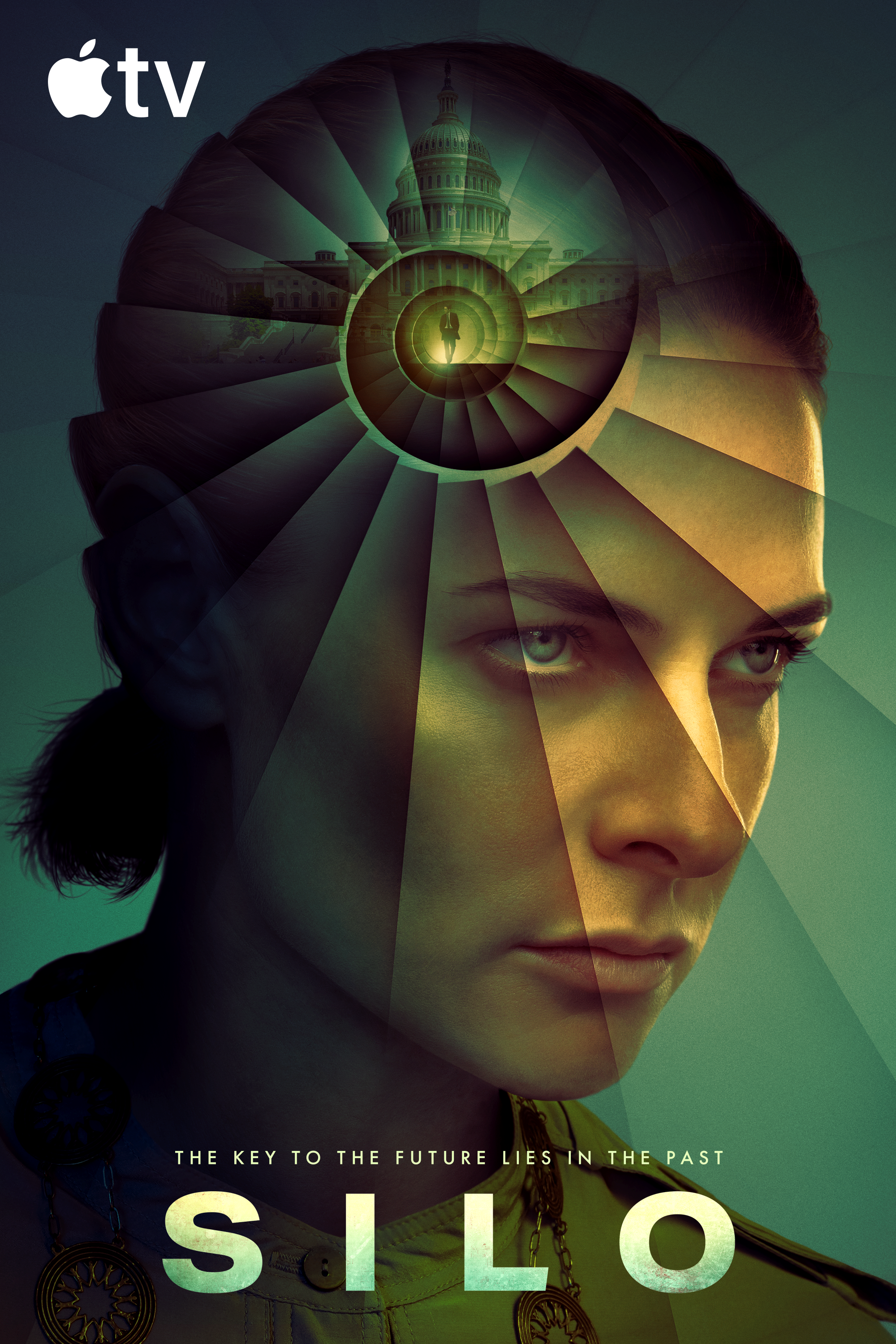
Yost, Graham, creator. Silo, season 3. Apple TV, 2026.
Version 1.0.0
The Doomsday Clock has crept dangerously close to midnight in recent years, and scientists have not tired of sounding the alarm over climate change, geopolitical conflict, military conflagration, pandemics, and the anxieties surrounding artificial intelligence. It is in this context that we encounter yet another post-apocalyptic series that turns to the “nuclear shelter” as a sociological laboratory for testing humanity’s capacity to survive once cut off from the Earth’s surface and from sunlight. The acclaimed Apple TV series Silo is one of the most recent examples of what might be called the “underground dystopia” subgenre of post-apocalyptic fiction. In it, a society apparently of the future lives isolated from a toxic surface world following some unspecified cataclysm. Futuristic technologies coexist with objects from the past, some of them anachronistic or subtly retro in character. Both the cast and the production design are meticulously assembled: the show is led by Rebecca Ferguson, alongside Tim Robbins (as Bernard Holland), Common (as Robert Sims), Harriet Walter (as Martha Walker), Chinaza Uche (as Paul Billings), Avi Nash (as Lukas Kyle), Rashida Jones, David Oyelowo, and Iain Glen, among others.
This underground society attempts to preserve a fragile equilibrium through a set of laws recorded in a founding book known as the “Pact.” In broad terms, Silo stages what Freud would have called civilization and its discontents; the subterranean city has its own “mayor,” police forces, and judiciary. The silo’s vertical layout also reproduces a social hierarchy, with the most dehumanized labor confined to the lower levels while a comparatively gentler existence is reserved for the upper floors and public spaces such as the cafeteria.
Despite its handsome production design and occasional flashes of originality, Silo is strikingly reminiscent of a Brazilian feature film released in 1981, Abrigo Nuclear, directed by Roberto Pires. In that film, humanity is likewise forced into a subterranean city after a nuclear accident or conflict renders the surface uninhabitable. Within this aseptic, constantly surveilled underground society, the protagonist Lat (played by Pires himself) is responsible for the shelter’s supervised expeditions to the surface to manage waste disposal. The community lives under the strict rule of Commander Avo (Conceição Senna), and its members are kept ignorant of the fact that humanity once inhabited the surface not so long ago. This secret is eventually uncovered by the geologist Lix (Norma Bengell), who leads an insurgency against Avo’s government and draws Lat into the cause of reclaiming the surface—a narrative skeleton not far removed from that of Silo.
In Silo, the protagonist Juliette Nichols (Rebecca Ferguson) is introduced as a lowly worker in the mechanical/engineering department. Coming from a subaltern class, Nichols is drawn into a suspense or detective story over the course of the first season. The second season marks her social ascent and the consolidation of her leadership: she becomes a sheriff of sorts, investigates crimes, and, condemned to death for violating the Pact, is sentenced to “cleaning”—the practice of sending a condemned individual out to the toxic surface. Equipped with a suit of unusually high resistance to the toxic atmosphere, however, Nichols survives and reaches a different silo (Silo 17), uncovering disturbing secrets about the network of underground shelters along the way.
If the end of the second season still left a great deal shrouded in obscurity, the third season complicates matters further still. Nichols returns to her home silo, Number 18, where she is welcomed as a hero and assumes the office of mayor. Yet the crimes, investigations, and palace intrigues only intensify, and Nichols soon finds herself weakened again in her pursuit of her people’s liberation. More sober, and considerably less complex in terms of cast size, locations, and worldbuilding—and far less carnivalesque—than Fallout, the video-game adaptation with which it is often compared, Silo seems, at least through the end of this third season, to deliver less than it promises.
The third season gains additional complexity through a notable shift in narrative form. Rather than following a single timeline, the season interweaves two: one is believed to unfold in a period contemporary to the viewer (the United States in the second decade of the 21st century in a conflict with Iran, though situated in the deep past of the story’s own fictional world), and the “main” futuristic storyline is set inside the silo. The contemporary-past thread follows Congressman Daniel Keene (Ashley Zukerman)—revealed, through a telling slip of the tongue, to be the character known in Hugh Howey’s source novels as Donald Keene—and his sister Charlotte “Charles” Keene (Jessica Brown Findlay), a Navy aviator who survives a disastrous retaliatory mission against Iran only to be subjected to an experimental, memory-altering neuropsychiatric treatment. These sequences function as an extended flashback prologue to the silo’s main plot, gradually revealed through Daniel and Charlotte’s entanglement with journalist Helen Drew (Jessica Henwick). At a certain point in the season, the “present” (the life and conflict inside the post-apocalyptic silo) and the “past” (the United States of a recognizable near-present) begin to converge.
All this narrative virtuosity, its heavyweight cast, and its apparent complexity have not, however, resulted—at least not yet—in a truly gripping series in terms of originality. Many of the narrative devices, and even the characters’ own actions, are easily predictable for anyone acquainted with the broader tradition of underground post-apocalyptic film, from Il giorno prima (Giuliano Montaldo, 1987, released internationally as Control) to the aforementioned Abrigo Nuclear, and even Fallout itself. Silo’s sobriety is, at times, undercut by an uneven alternation between slow and accelerated rhythms that can leave the viewer’s train of thought somewhat adrift. And although its fictional universe is, in principle, more compact and circumscribed than that of Fallout, Silo may in fact suffer from an excess of characters and from a plot whose events are not always convincingly connected. One senses a great many gaps—not necessarily gaps in the characters’ own knowledge, but in the narrative’s construction itself. By the end of the third season, many questions remain poorly answered or entirely unanswered, and some characters’ actions appear disconnected from, or simply implausible within, the logic of the diegesis. There are many pauses, many lingering close-ups, that read less like the characters’ own dilemmas than like sheer hesitation on the part of the writers’ room.
A palpable risk looms over all this: that a fourth or fifth season will be forced to scramble to fill in these gaps, untie narrative knots, and reconnect actions to characters retroactively. Unless the series is still holding something back that is genuinely brilliant—something capable of disrupting the established tradition of the underground-shelter post-apocalyptic subgenre—there is a real possibility that the whole enterprise will remain sealed inside its own iron cylinder. This is precisely what renders the series’ current shortcomings so disappointing from a scholarly standpoint. At a moment when the anxieties Silo dramatizes are not speculative but lived, the show appears to settle for genre competence rather than the kind of critical, world-historical reflection its own premise invites. The underground dystopia deserved, and still deserves, more than a well-produced echo of its own tradition. Hope is in the air.
Alfredo Suppia is an Associate Professor of Film Studies at the University of Campinas (Unicamp), Brazil, where he teaches Brazilian cinema, scriptwriting, film theory, and science fiction film for both undergraduate and graduate students. He is the author of books such as Brazilian Science Fiction Film: A Critical History (NYC: SUNY Press, 2024), and Atmosfera Rarefeita: A Ficção Científica no Cinema Brasileiro (São Paulo: Devir, 2013), in addition to numerous articles on Latin-American cinemas, world cinemas, and world science fiction cinemas.
Review of Artificial Women: Sex Dolls, Robot Caregivers, and More Facsimile Females
Sue Smith
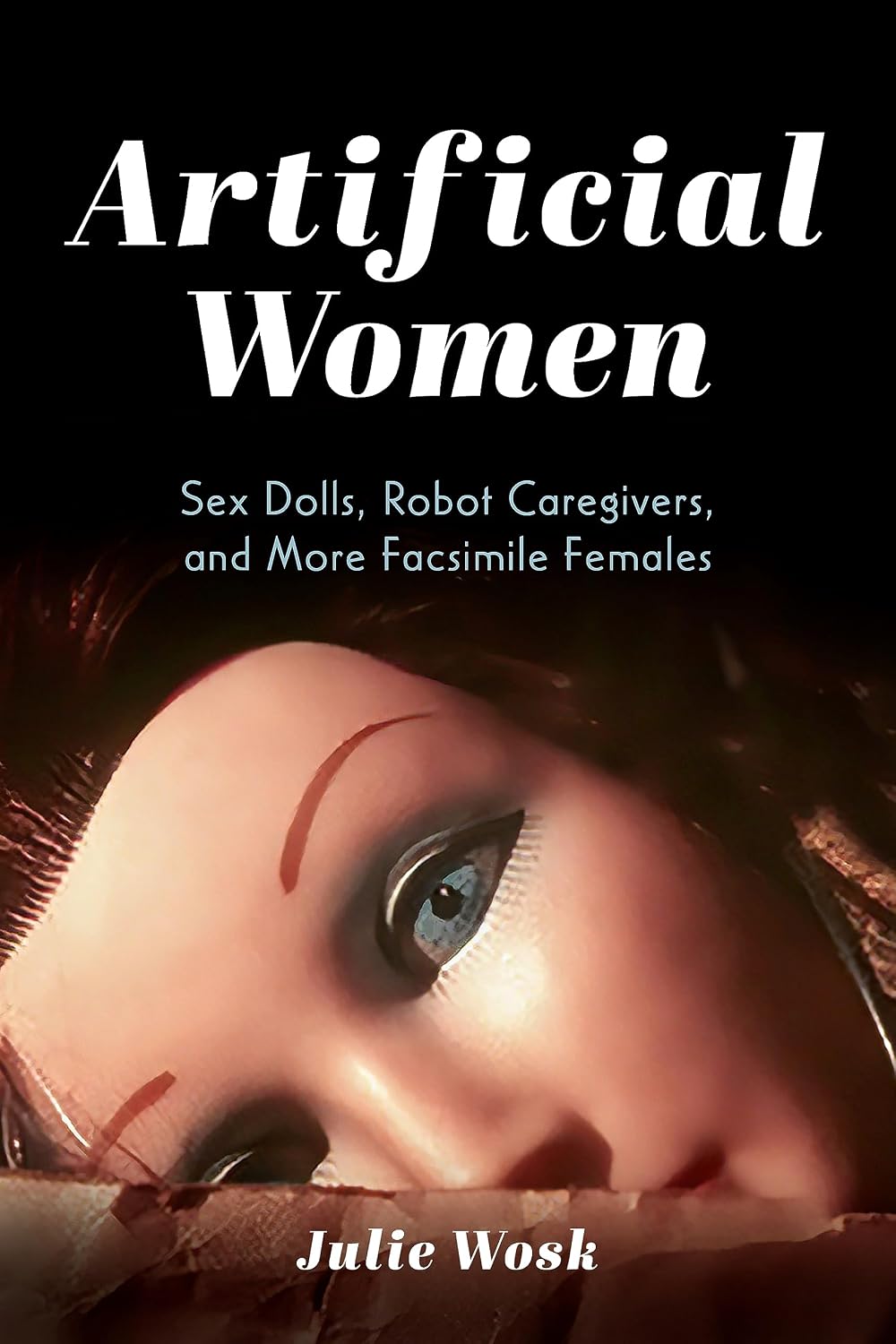
Julie Wosk. Artificial Women: Sex Dolls, Robot Caregivers, and More Facsimile Females. Indiana University Press, 2024. 220 pg. $30.00. ISBN 9780253069252. eBook ISBN 9780253069269.
Version 1.0.0
Julie Wosk’s Artificial Women explores society’s enduring fascination with the constructed female–who is created in a variety of guises both in reality and fiction, from embodied machines, automatons and robots, to disembodied AIs and virtual voices. In these techno-re-imaginings of the female as servo-bot, Wosk outlines how cultural understandings of women as passive, giving and obedient are held in tension with the reality of lived female personhood, in which women desire agency and self-determination. The primary questions asked are: In the complex world of technology and gender, how do women combat the cultural proliferation of the female as an exploited identity? How do women intervene in a male-dominated industry of technology and engineering that genders servitude as feminine, reifying women as subordinate to the needs of patriarchy and capital? In Wosk’s readings of the artificial woman, she is not opposed to the creation of the female simulacrum to explore human-machine encounters. However, she does insist that we must create her so that the interface between human and machine will, a) productively and positively rehearse the rightful treatment of women, and b) genuinely foster respect for the human female. However, as Wosk’s book highlights, in the service of male desire and in the pursuit of profit, tech companies and corporate businesses are, for the most part, perpetuating archaic stereotypes of women that continue to distort visions and gender relations and future technology. In this respect, Wosk is a crucial voice for scrutinising and contesting male dominated visions of gender and technology.
Artificial Women begins with a fascinating and compelling introduction that outlines Wosk’s enduring interest in female simulacra in both avant-garde and popular culture. Here, Wosk demonstrates an impressive range and depth of knowledge of the subject in visual, material and literary culture across differing timelines. Following the introduction, Wosk discusses the myriad synthetic females that have been and still are being created and exploited by industry and culture today. In Chapter 1, ‘A New Breed of Sex Robots and Sex Dolls,’ Wosk looks at the female robot and AI as a self-sacrificing sex worker/slave who frequently doubles as an emotional companion. She plays with the stereotype of the ‘tart with the heart’ normalising the male treatment and expectations of such stereotypes in which the human male is put first and women, whether organic or synthetic, second. In Chapter 2, ‘Under the Skin: The Fabricated Femme Fatale,’ the performative masque of the artificial woman as lure and threat is explored through the seductive image of the femme fatale. In this section is the suggestion that the synthetic skin as a progressive development in robot technology is a deception akin to women who are accused of putting on femininity as artifice to distract and subvert for personal gain.
In Chapter 3, ‘Female Robot Caregivers, Doubles, and Companions,’ Wosk’s focus shifts towards social and emotional robots envisioned as caregivers and companions to ailing elderly adults and vulnerable children. Extending to narratives of human loneliness brought about by failing health, cataclysmic events and hostile environments, the female robot—in fiction and reality—is a replacement or double designed to mitigate loneliness or protect their human (or humanoid) charge by emulating human empathy and compassion. In Chapter 4, ‘Paradoxes of Perfection: A Servant No More,’ Wosk takes the reader through cultural anxieties about technology in the home by exploring the female robot as a familial, domestic helper who ultimately becomes either a perceived threat to traditional family relations or threatens to rebel and break free from her servitude.
In Chapter 5, ‘Virtual Voices: Talking Barbie Dolls, Alexa, Bitchin’ Betty and More,’ Wosk discusses the cultural history of the talking doll and automaton and its evolution into disembodied voices and computerised companions that serve as assistants in the work and home and fascinatingly as a warning system in domestic and military aviation. The disembodied female is open to abusive treatment, which Wosk discusses in detail, but also in a more life-threatening setting, the virtual female is a source of respect and must be adhered to. Finally, in ‘Coda,’ Wosk summarises her book’s premise of humanity’s hope, fascination and anxiety surrounding the figure of the artificial woman. Can the artificial woman produce new and transformative possibilities for humanity? Or will she reify gender roles that reduce women to a commodity in accordance with patriarchal expectations? It is in these closing pages that Wosk calls to women to intervene in the vast array of new robot and AI technologies. Here she provides examples of women who are already doing so as they work to empower and create a space for living in a complex, contemporary world. It is in these final moments that Wosk draws examples from the active work and engagement of LGBTQ+ and disability communities, a springboard perhaps for further work and research for those who negotiate the everyday from a diverse and alternate position of the human.
Julie Wosk’s book is a relevant new addition to the field of robot technology and gender studies. Her work on the artificial is long-standing, and her interests are fuelled by life experiences working in media and magazine culture, art, literature and museums. Artificial Women demonstrates Wosk’s extensive knowledge of the cultural and social history of the artificial woman. It is written for academics and students of visual and material culture and literature and accessible for non-academic individuals who are interested in the subject. It provides a comprehensive source of ideas for those who want to take the discussion further.
Sue Smith is an English Teacher at a Post-16 SEN College in Leicestershire, UK. Her interest is in the representation of gender and disability in American Cyborg Fiction. Her current research article is on the robot psychiatrist in American military medicine and American military science fiction.