
Fiction Reviews
Review of A Drop of Corruption: An Ana and Din Mystery
Amanda Firestone
Bennett, Robert Jackson. A Drop of Corruption: An Ana and Din Mystery. Del Rey, 2026.
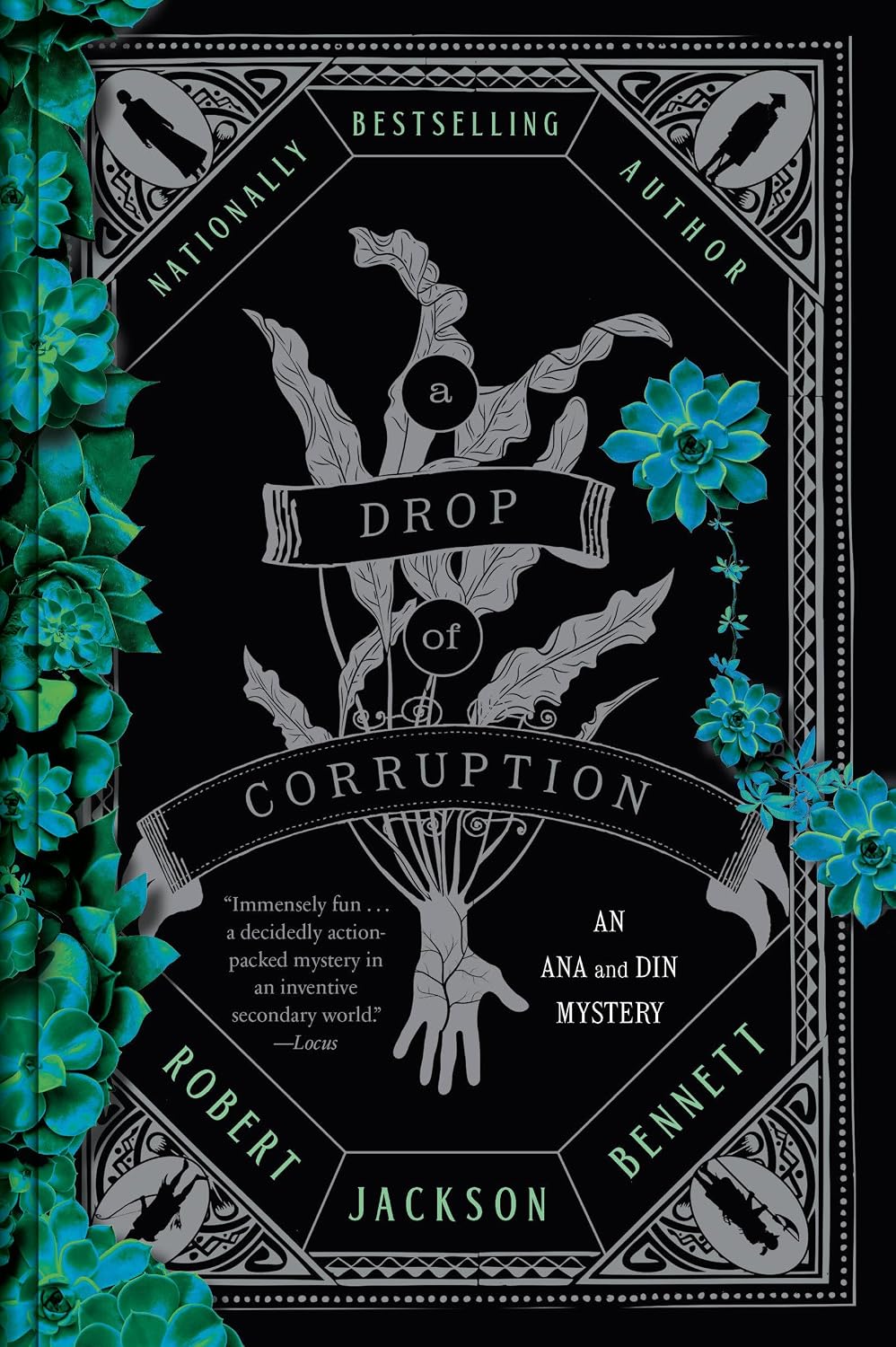
“Titan’s taint! I hardly know what to think anymore,” (133) curses Ana Dolabra as she receives a glut of packages from Dinios Kol. It’s the midst of their murder mystery, and things have become murkier than ever for the Holmes and Watson-esque pair. “[Din’s] mind is altered so he forgets nothing. He acts as assistant investigator to Ana Dolabra, a woman so brilliant she lives most of her days blindfolded and rarely leaves her rooms, for fear that common life shall overwhelm her mind” (3-4). Ana and Din arrive at the far-flung shores of the continent, Yarrowdale, where the Empire of Khanum has a strong foothold but is not in total legal control. They begin their investigation of a murdered Empire treasury official, delving into the most secret places and practices where biomedical technologies create extraordinary alterations to people. In the process, they discover the identity of a brilliant architect who has calibrated corruption, confusion, and carnage in a grand scheme to rule.
A Drop of Corruption is the second book in Jackson’s Shadow of the Leviathan series, and it is as madcap and smart as its predecessor, The Tainted Cup (2024). It would be a challenge to read as a standalone; Jackson has developed an intensely rich world, including specific vocabulary that describes the intricate hierarchies for soldiers and government officials, as well as the alchemical science that infuses everything. Society-crushing Leviathans are slain, and then their gargantuan carcasses are harvested for raw materials, akin to Knowhere in the Marvelverse. Characters are augmented with lab-concocted treatments, giving them heightened senses and skills. For example, Din is an Engraver, meaning that he maintains perfect recall of everything he captures in his memory. As readers learn in The Tainted Cup, this augmentation is a blessing and a curse.
As a reader returning to Khanum, I was able to dive right back in with very little fuss. The author gives the appropriate signals to aid with recall but doesn’t tarry too long in details, instead furthering the duo’s misadventure. While I liked reading the paperback, I much preferred the listening experience of the audiobook. Andrew Fallaize superbly narrates it, and the voice he crafted for Ana is perfect for her acerbic jabs and curses. Whether by eye or ear, it’s a marvelous tale.
From a more scholarly perspective, it’s a rich text to plumb. There are a number of subjects ripe for critical examination: eidetic memory, biohacking, appetite and food culture, and sexuality and sexual politics in the workplace among many others. The standout subtext understandably concerns governmental hierarchies and power. More particularly, Jackson, in the ending author’s note, points to autocracy and kingship as a perennial favorite among fantasy authors. He acknowledges the 2010s pendulum swing from tales about “divine rule wielded by beneficent patriarchs” to “a wave of fantasy [texts] that embraced if not celebrated capricious cruelties of autocratic regimes” (460). He goes on to recognize the 2020s return to a tacit understanding—at least in fiction—that autocratic power tends to benefit a very small circle of individuals while meting out oppression and suffering to everyone else.
Ana and Din are instruments of the Empire under the direction of the Iudex, the justice department. We understand that the Emperor, though more than 400 years old, maintains distant control while elected officials do the day-to-day labor of holding the Empire together and, most importantly, protecting the coastal regions from the Leviathans that come ashore. Pertinent to their investigation is the Empire’s motto Sen sez imperiya, or “You are the Empire” (101), yet the Emperor’s shadow looms large and the threat of unilateral decision-making on his part is ever present. Empire loyalists, like those who work at the top-secret research facility known as The Shroud, seem to take it upon themselves to act in what they perceive as the best interest of the Empire, often flouting protocol. Elected officials’ interpretations of “You are the Empire” becomes quite literal, choosing an autocratic expression of their loyalty.
The political delicacy in which Ana and Din find themselves is due to the Empire’s eminent takeover of the Kingdom of Yarrow. Although the treaty to incorporate the kingdom into the Empire was signed 100 years ago, the reigning nobles see no reason to follow through. For high-ranking courtiers, sublimation to the Empire would mean an immediate change in privilege and circumstances, including the emancipation of the generational slaves known as naukari. On impulse, the reader perhaps sides with the Empire with its promises of technology, infrastructure, and civilization, but as are the employment of treaties and policies, so too are these promises reflective of the might and power attached to imperial rule and colonization. What does it mean to arrive in a distant land and impose new laws and customs, and what is the larger cost in doing so?
This series would be a great way to introduce students to the ethics of empire. It would be brilliant in conversation with something like Collins’s The Hunger Games Trilogy, Jemison’s The Broken Earth Trilogy, or Leckie’s Ancillary Radch Series. In each, primary characters are deeply intertwined with the inner workings of the empire. These characters—Katniss, Syenite, and Breq respectively—have been used by their empires to forward very specific political agendas. Each knows that they are wielded as a tool and sometimes as a weapon. Perhaps inevitably, those characters rebel against their oppressors. In contrast, Ana and Din have both “sipp[ed] from the marrow,” and they believe in their mission to act as watchmen of sorts to maintain order and justice throughout the Empire (108-9). Din is privately skeptical yet idealistic. He tells Ana, “I wish to keep an Empire worth defending” (454). Perhaps in subsequent books, the pair will have difficulty complying to their Emperor’s edicts.
For me, A Drop of Corruption was an enjoyable read. The Holmes-Watson dynamic between Ana and Din is delightful, with their banter, frustration, and loyalty to each other on full display. The narrative provokes questions about ethics concerning the collective rule of people through an autocratic regime enforced by sanctioned officials. How does a single leader get to decide what is good and right for all while individuals and communities must live with the day-to-day practicalities of those laws and policies? What happens when a few people believe that they know what’s best according to their interpretation of the rules? These questions, and others like them, are perfect for the classroom; students can take sides and debate, using the fictional world of Khanum to better understand the implications and ramifications pertaining to their own lives. As Ana says, “though you and I are small, together we shall forge grand things indeed” (455).
Amanda Firestone is an Associate Teaching Professor at the University of Tampa in the Department of Communication. She currently serves as the director for the Communication and Media Studies program. She enjoys teaching critical media literacy and often includes science fiction and fantasy texts in her classes. Some of her favorite works to use as classroom examples are M. T. Anderson’s Feed, Alexandra Oliva’s The Last One, and Naomi Alderman’s The Power.


