
Fiction Reviews
Review of The Faith of Beasts
Zorica Lola Jelic
Corey, James S. A. The Faith of Beasts. Orbit, 2026.
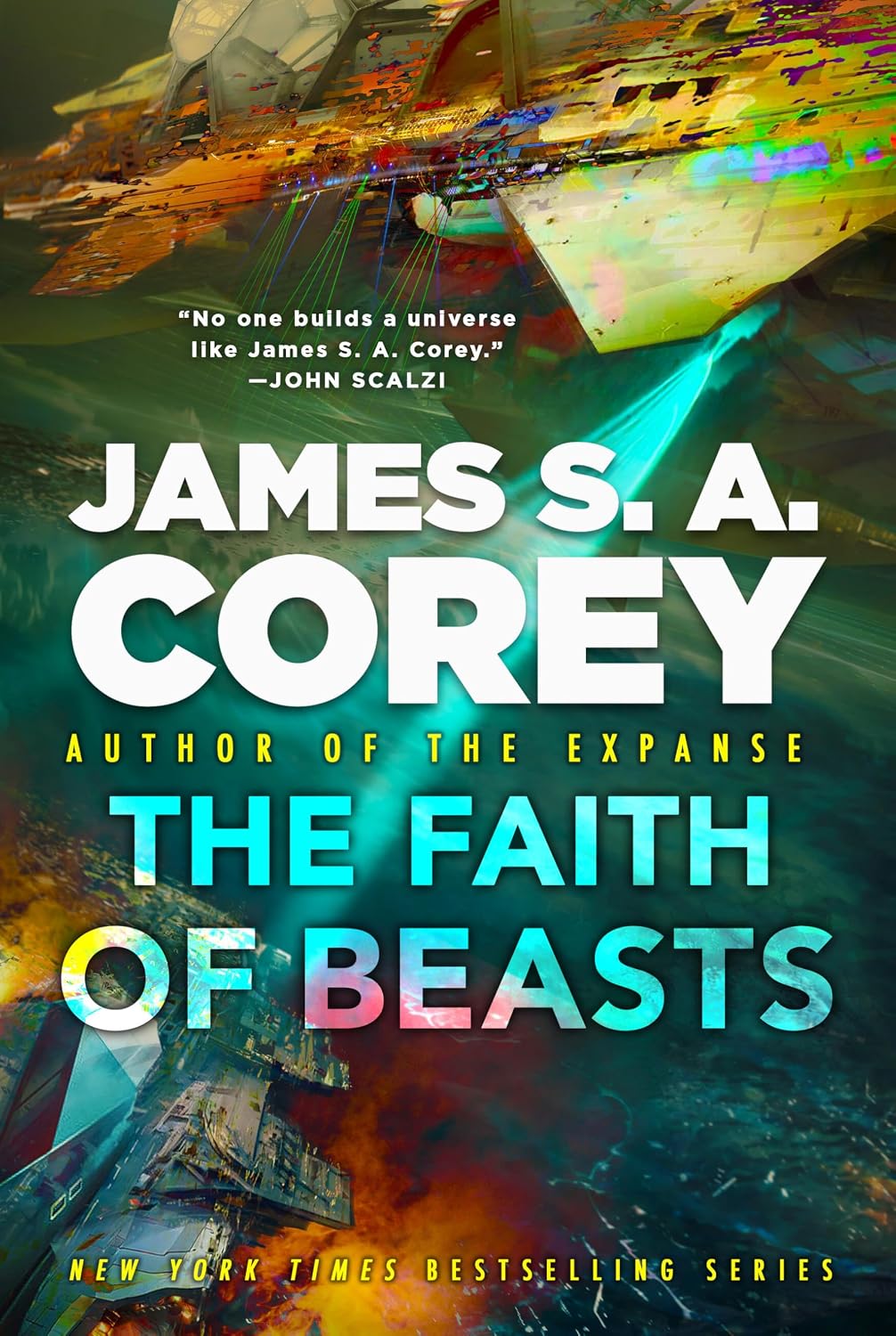
The writers working under the name James S. A. Corey—Daniel Abraham and Ty Franck—are truly the finest writers of hard science fiction today. The plot complexities, character development, and the skill of writing emotionally gripping tales is superior to many contemporary authors. The Faith of Beasts is the second book in The Captives of War series. The series consists of the first book, The Mercy of Gods (2024), the novella Livesuit (2024), and the second book titled The Faith of Beasts (2026). The last book is expected in 2027.
The premise of the series focuses on the question: what if humanity is not completely obliterated by a ruthless alien species but is conquered and integrated to serve a superior life form? Anjiin is the home world of humans and is similar to twenty-first century Earth. The Carryx are an intelligent bug-like life form who live in a hive-like structure with the sole purpose of invading and conquering other life forms. They have advanced spaceships that travel throughout the universe and weapons that are just as sophisticated. Their home world technology is just as impressive since they are able to accommodate diverse species via the outcomes of their scientific research. The goal is to take the best of every species and integrate them into their colony. Their civilization is based on the simple principle of usefulness. Even their own members are terminated if they are no longer useful to the collective. The Carryx invade Anjiin and leave only one-eighth of the population alive while taking the best and brightest scientists back to their home world to serve the greater good of their vast civilization. The story follows a group of scientists who adapt in different ways to the new life. While some try to conform in order to survive, others secretly rebel. Dafyd Alkhor is the main character and although he presents himself as a tame conformist when compared to his fellow survivors, he actually learns everything about the invaders in order to beat them and join their enemy, the Swarm, in ending the Carryx reign.
Alkhor is both the colonial intermediary and the savior of his kind. He becomes the voice of the Carryx and the person who directly answers to them, while his fellow humans doubt his intentions and loyalty to his own kind. Alkhor wants to learn everything about his captors and engages in learning how they behave (body language) in order to manipulate their attitudes towards humans, but there are only two people who know that. One of them is an ancient (or maybe not) entity, the Swarm. The Swarm has the ability to switch from one body to another, but the problem is that once it leaves its host the host’s body dies. What is interesting is that the Swarm entity always carries the sentience of its previous hosts with it. As the story unravels, the reader sees how the Swarm entity changes as it learns the complexities of the human psyche. It learns based on the comments of all its previous hosts. It slowly evolves, and the longer it resides in humans its purpose to be solely a weapon erodes, and the entity morphs into a divergent being capable of feelings. The Swarm entity actually becomes enamored with Alkhor, and the dynamic between them changes. The narrative empathy of the reader towards these evolving emotions is present, but it is challenged in the most unusual way: to please Alkhor the Swarm entity changes bodies in order to save Alkhor’s colleague, and in doing so it becomes a male. Apart from not understanding how ethically it is wrong to just terminate one human life and inhabit another, it does not understand that Alkhor’s heterosexual preferences are now challenged, as are the reader’s emotions. While cheering for the Else (Swarm)/Alkhor dynamic (and sexual relationship) in plotting and renegading against the Carrys in book one, the reader is forced to struggle with empathy towards the Swarm’s affection once it is transferred into a male body in book two. Now, the man, Jellit, continues yearning for Alkhor, who is taken aback by the reality of the Swarm’s appearance, intentions, and methods of survival. For those who are interested in exploring sexuality in science fiction, this is possibly the best series to take on. The level of yearning and angst, the complexities of desire and intimacy, and the psychological explorations of sexuality that the authors are able to create are impeccable.
For those interested in post-colonial literary theory, the struggle of the human moiety within the Carryx colony is rather well written. The Carryx do not enslave in the traditional sense. They encourage intellectual work in order to integrate the humans into their race, but in doing so they redefine values and identity. It is not only about assimilation, but it is also about changing how humans embrace alien technology (they are scientists and they are fascinated), the alien’s perception of what it truly means to be useful to the enemy, and the effects that colonial mimicry has on them. The story also deals with socio-evolution and evolutionary biology. The Carryx are aware that the scientists are not young, and that their chances of procreating are slim. The oppressor wants the human moiety to continue being useful, so they require the humans to have children. The scientists are given the solution to create lab grown embryos from their own genetic material. The embryos grow and the first generation of lab babies arrives. The concept of alienation is interesting. One cannot be more alienated from their own species than when one is not emotionally connected to their offspring.
Apart from the aforementioned critical theories, the series also is open to Marxist and psychoanalytical approaches. Psychoanalytical theory probably works best when analyzing Alkhor’s split psyche and the Lacanian interpretation of the Swarm, while Marxist theory applies best to the alienation of the humans from their products and work as well as the concept of societal value based on the usefulness of its individual members. The series is suitable for scholars who wish to elaborate on these theories and for undergraduate and graduate students who are getting into the fundamentals and the scientifically rigorous essentials of hard science fiction. The series may certainly be examined through various theoretical lenses.
Zorica Lola Jelic, Ph.D. is an Assistant Professor at the faculty of Contemporary Arts in Belgrade, Serbia. She teaches English as a foreign language, Business English, Shakespeare, and English Drama. She earned her degrees in Shakespeare studies, but she also loves to write about literary theory and science fiction. She has published scholarly papers, coursebooks, and enjoys attending professional conferences.


