
Features
Papers of Legendary Author Jack Vance Now at The University of Texas at Tyler
Billy Cryer
In late April of 1967, Ursula K. Le Guin sent off a handwritten note to 6383 Valley View Road in Oakland, California. “Dear Mr. Vance,” began Le Guin in her unmistakable compact, graceful pen strokes. “This is a fan letter—an unmitigated fan letter. I have read all your books & stories with the greatest pleasure, and then after a while re-read them with greater pleasure. There are some lovely imaginations at work in s.f. now, but the work itself is so often botched or sketched or compromised; yours never; you are competent, an artist. Write more books, write more books. Yours gratefully, Ursula K. Le Guin.”
This letter—together with a substantial archive of author papers—now resides at The University of Texas at Tyler as the Jack Vance Collection. One of the most acclaimed and influential American science fiction and fantasy authors of the twentieth century, Jack Vance (1916-2013) remains one of the most obscure and least studied literary figures. Winner of multiple Hugo Awards, a Nebula Award, and two World Fantasy Awards—as well as the Edgar Award for mystery fiction and the Science Fiction and Fantasy Writers of America Grand Master honor—Vance authored more than sixty novels and well over a hundred short stories over a period of seven decades. Since the appearance of “The World-Thinker” in 1945 in Thrilling Wonder Stories, Vance’s richly imagined worlds, vivid prose style, and mesmerizing narratives have inspired generations of writers. Vance shaped contemporary genre fiction in ways that academic scholarship has yet to fully explore.
The Jack Vance Collection comprises more than 60 boxes of materials spanning the full breadth of Vance’s life and career. The collection includes handwritten and typescript copies of dozens of manuscripts; juvenilia and other unpublished works; extensive correspondence with editors, publishers, fellow authors, and readers; notebooks, personal diaries, and travel journals; numerous photographs; and an array of realia—including Vance’s musical instruments. Materials produced by the author date from approximately the 1940s through the early 2000s. Several of Vance’s early manuscripts are in the hands of individual collectors, and a small collection of Vance papers are housed at Boston University’s Howard Gotlieb Archival Research Center. However, the majority of the author’s manuscripts and nearly all the other personal papers are now located at UT Tyler’s Robert R. Muntz Library.
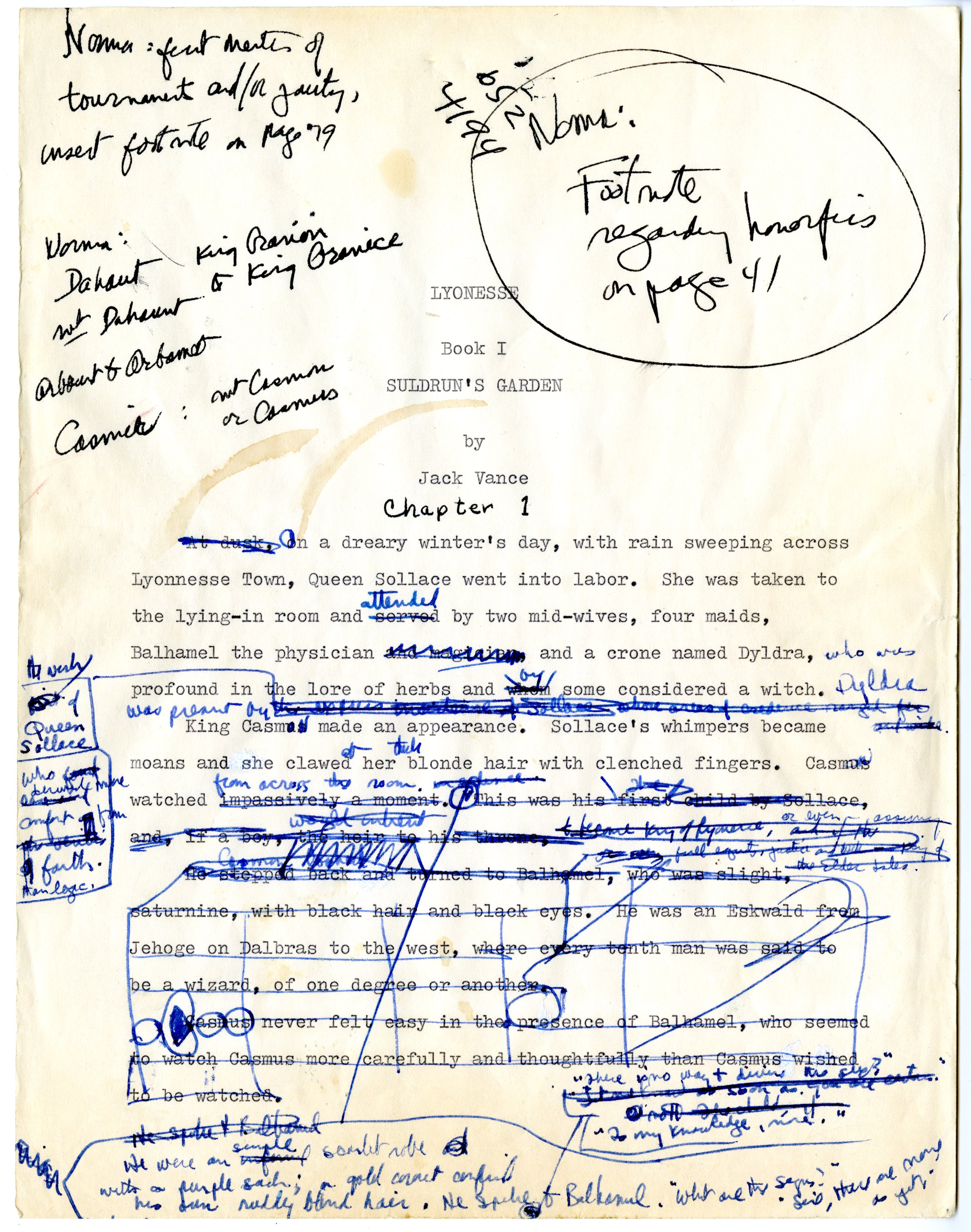
The manuscripts of Vance’s published works are particularly comprehensive. They represent nearly all of Vance’s major works, including those that comprise his most celebrated series, such as The Dying Earth, Lyonesse, and Demon Princes. Vance wrote initial drafts of novels and stories by hand, then made extensive revisions on typescript manuscripts prepared by his wife Norma Vance. “Norma was strongly supportive of my writing from the start, and we began working as a team,” wrote Vance in his 2009 autobiography. “I cannot emphasize enough how hard Norma worked over the course of my career—certainly as hard as I have, if not more” (86). The manuscripts are a testament to the magnitude of Norma Vance’s contributions to her husband’s success.
Also among these early materials are a handful of Vance’s college English and journalism papers while at University of California, Berkeley during the late 1930s and early 1940s. These papers glimmer with Vance’s trademark sardonic wit. For one English essay assignment, the student was tasked with an analysis of Henry David Thoreau’s Walden. In a discussion on the chapter “Solitude,” Vance argues that the author enjoyed a “compromising kind of solitude,” that, in fact, Thoreau was at best a “parlor hermit”: “He could have achieved a real solitude by moving to Wyoming or Montana,” observes Vance. “But there would also have been Apaches eager to remove Thoreau’s scalp. He may have thought of this and decided that Concord was far enough.” Vance concludes his essay on a note of frustration about the restrictive nature of prescriptive writing topics, as a general practice:
However, all of this theorizing to the side, what is there to say? I dislike the idea of writing with any seriousness in so admittedly mechanical a vehicle as a weekly theme, classically scribbled during the hour preceding class. I could very easily comment, with considerable feeling, upon Death Valley in the moonlight, and speculatively, speak of frangipani blossoms and white sails bellying to the trade winds, and even more speculatively tell of the unimaginable grandeur and empty black vastness of interplanetary space.
The Jack Vance Collection was acquired through the efforts of Dr. Billy Cryer, who is curating the collection—and who for several years made regular trips to the Vance residence in Oakland to begin organizing the late author’s papers. Special acknowledgement goes to the Vance estate, as well as UT Tyler archivist Rachel Motes, who has facilitated the transition of the collection to its new repository. A finding aid is currently in preparation and will be made available, along with the collection, once it has been fully organized. For inquiries about the Jack Vance Collection, please contact Billy Cryer at bcryer@uttyler.edu.
WORKS CITED
Silverberg, Robert. “The Eyes of the Overworld and The Dying Earth.” Writers of the 21st Century: Jack Vance, edited by Tim Underwood and Chuck Miller, Taplinger Publishing Company, 1980, pp. 117-129.
Vance, Jack. This is Me, Jack Vance! (Or, More Properly, This is “I”). Subterranean Press, 2009.


