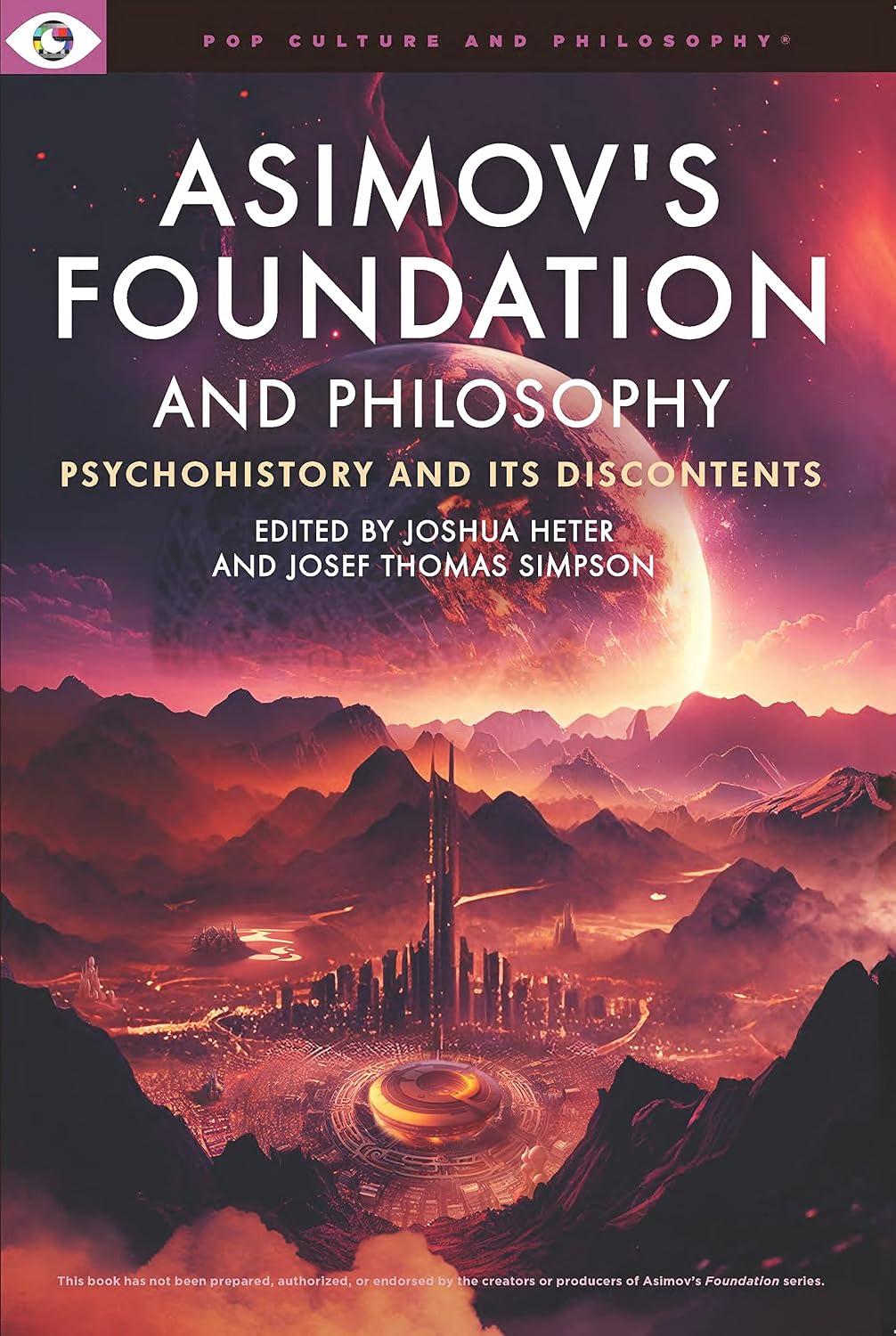
Review of Asimov’s Foundation and Philosophy: Psychohistory and Its Discontents
Zachary Reger
Joshua Heter and Josef Thomas Simpson, eds. Asimov’s Foundation and Philosophy: Psychohistory and Its Discontents. Carus Books, 2023. Paperback. 262 pg. $26.95. ISBN 9781637700303.
Version 1.0.0
Isaac Asimov’s Foundation series is a cornerstone of science fiction. It also represents a lifetime of work from one of the genre’s most prolific authors. Asimov began Foundation at the age of 21, as a series of short stories for Astounding Science Fiction during what would become known as the ‘Golden Age’ of science fiction. Over the succeeding decades, the series grew into an empire of material: the original Foundation trilogy, consisting of three books collecting nine short stories; two sequel novels; two prequel novels (including one published posthumously); dozens of other novels and short stories not originally intended as precursors to Foundation, but which Asimov later drew into the larger Foundation continuity; works by other authors, both authorized and unauthorized; and a television series on Apple TV Plus, which aired its third season in summer 2025. The series is expansive, exploring Asimov’s thoughts on philosophy, history, psychology, politics, religion, and more. When it comes to Foundation, there’s no shortage of topics to discuss.
Asimov’s Foundation and Philosophy dives headfirst into this tangled web. The book collects twenty-one essays across six overarching subjects: “Foundation and Reason,” “Foundation and History,” “Foundation and Faith,” “Foundation and Science,” “Foundation and Morality,” and “Foundation and Being.” The essays examine different aspects of Asimov’s seven Foundation books and the first season of the television show (at the time of the book’s publication, further seasons had yet to air). They are mostly written by professors, researchers, and those with academic experience, but target a lay audience. Despite the authors’ pedigree, I was happy to discover that advanced scientific or mathematical knowledge is not a prerequisite for understanding. All is explained within.
Although the title of the book indicates a focus on philosophical analysis, the term ‘philosophy’ should be understood loosely. Philosophical classics such as Plato’s Republic, Immanuel Kant’s Critique of Pure Reason, and David Hume’s A Treatise on Human Nature are given their fair due, but many philosophy-adjacent concepts are also broached. The third essay examines the use of symbolic logic in one of the Foundation series’ early stories, and the twentieth essay examines the nature of mathematics, a core theme of the television show’s first season. The fourth through seventh essays examine the role of history in the Foundation saga, which Asimov noted as being heavily inspired by Edward Gibbon’s The Decline and Fall of the Roman Empire. And the eighth through thirteenth essays explore the religious themes of the stories and television show.
The breadth of topics in this collection is remarkable, but there are a few instances of repetition. For example, two essays compare the thought experiment of Laplace’s Demon (an omniscient being who can, in a deterministic universe, perfectly predict the future) to the fictional science of psychohistory (which predicts the fall of the Galactic Empire through advanced mathematics). Two essays compare the tripartite organization of the kallipolis in Plato’s Republic to the organization of Asimov’s galaxy into First Foundationers, Second Foundationers, and ordinary citizens. And three essays highlight the real-world science that formed the foundation for Asimov’s fictional field of psychohistory, the kinetic theory of gases, in which individual atoms behave randomly but the movement of the whole can be explained by defined laws.
Nevertheless, it is interesting to see the authors begin with similar concepts, but take them in different directions. One essay uses Laplace’s Demon in aid of a historical analysis while another considers the mathematical consequences. The tripartite structure of kallipolis is itself the focus of one essay, but the ‘noble lie’ undergirding that tripartite structure (and how it compares to the ‘noble lies’ of a few Foundation characters) is the focus of another. And the parallel of psychohistory to the kinetic theory of gases is used by two essays to examine population dynamics and historical events, but by a third essay to examine the impact of determinism and random movement on the philosophical justification for individual free will. Perhaps in this case we should accept the Latin maxim repetitio est mater studiorum (’repetition is the mother of learning’).
In summary, Asimov’s Foundation and Philosophy is a thought-provoking read for fans of the Foundation series. As a collection of essays by separate authors, the philosophical concepts at times overlap, but the diversity of viewpoints is well worth the occasional repetition. Prior philosophic, scientific, and mathematical knowledge is not necessary, given the book’s focus on a lay readership. However, a passing understanding of Asimov’s stories and the plot of the first season of the television show is beneficial. Readers are warned that spoilers for the Foundation series abound. While some essays focus on the early Foundation stories, others examine concepts from the later books, including the rise and fall of the Mule, the nature and existence of the Second Foundation, the planet-sized collective-consciousness of Gaia, the revelation of R. Daneel Olivaw’s millenia-spanning tinkering with human history, and the birth of psychohistory described in the two prequel books. Before starting Asimov’s Foundation and Philosophy, a detour to Terminus is advised. But there’s no need to head to the edge of the galaxy; a trip to the science-fiction section of one’s local library will do.
Zachary Reger is an attorney in Washington, D.C. His legal scholarship has appeared in the Missouri Law Review, the University of Chicago Law Review, and the University of Chicago Law Review Online. His speculative fiction has appeared in Bewildering Stories and the Sci Phi Journal.
Review of J.R.R. Tolkien’sThe Hobbit: Realizing History Through Fantasy
Sara Brown
Robert T. Tally, Jr. J.R.R. Tolkien’s The Hobbit: Realizing History Through Fantasy. Palgrave Macmillan, 2022. Paperback. 124 pg. $27.99. ISBN 9783031112652.
Version 1.0.0
Robert T. Tally Jr.’s approach to analysing J.R.R. Tolkien’s The Hobbit in his critical companion J.R.R. Tolkien’s The Hobbit: Realizing History Through Fantasy focuses on positioning the novel as a work that uses fantasy to explore historical themes. Tally argues that The Hobbit can be considered a historical novel despite its fantasy genre, examining how Tolkien bridges the gap between myth and reality. He delves into Tolkien’s narrative style, world-building techniques, and presentation of different races and cultures within Middle-earth. Tally pays particular attention to the character of Bilbo Baggins, viewing him as an ordinary person involved in world-historical events, which reflects on how individuals can unexpectedly shape history. The analysis also covers Tolkien’s use of anachronisms, the hierarchies and social structures within Middle-earth, and how these elements contribute to the novel’s enduring appeal and immersive quality. Through this multifaceted examination, Tally provides insights into how Tolkien’s storytelling techniques have established The Hobbit as a cornerstone of fantasy literature.
Chapter 1, ‘Introduction: In a Hole in the Ground…,’ describes the accidental creation and unexpected success of this classic novel, and how Tolkien’s famous anecdote about writing “In a hole in the ground there lived a hobbit” while grading papers marks the spontaneous birth of the story. The chapter presents Bilbo Baggins as an ‘intruder’ into Tolkien’s established Middle-earth mythology, highlighting the unplanned nature of The Hobbit‘s emergence as a bestselling work of children’s literature. Interestingly, Tolkien later regretted writing it specifically for children, lamenting his use of a “silliness of manner” (Letters 215) he deemed unnecessary.
The introduction also explores The Hobbit‘s evolving place in Tolkien’s broader work, including how the book is now often viewed as a prequel to The Lord of the Rings (1954-55), despite this not being Tolkien’s original intention, and notes the revisions Tolkien made to align it with his later work. Tally presents an intriguing perspective, arguing that The Hobbit can be seen as a historical novel using fantasy to explore themes of history and individual agency. The chapter concludes by touching on the cultural impact of Tolkien’s work, including its adaptations and enduring popularity, setting the stage for a deeper analysis of The Hobbit as a cornerstone of fantasy literature.
Chapter 2, “The Way to Talk to Dragons: Interpellation, Style, and Narrative Form,” explores Tolkien’s distinctive narrative style, focusing on how the author engages the reader through a voice that is both authoritative and familiar. Tally uses Bilbo’s encounter with Smaug as a prime example of this technique, highlighting the narrator’s intrusive yet instructive style. The chapter explores how this narrative approach bridges the gap between modern readers and the mythic world of Middle-earth, effectively positioning the reader within the story and creating a sense of historical depth.
Tally argues that Tolkien’s storytelling method is crucial in making the fantasy world feel real and accessible. He examines how the narrative voice contributes to the overall world-building of Middle-earth, enhancing the reader’s experience and immersion in the story. As Tally notes, “The narrative voice in The Hobbit is quite striking. It is at once authoritative, belonging to one who so thoroughly knows this otherworldly world as to be able to speak with confidence—but also in a rather matter-of-fact way—about dealings with dragons, but it is also familiar and friendly, implicitly admitting the audience into the same sphere of authoritative knowledge” (16). This analysis provides insight into how Tolkien’s techniques contribute to what Tally describes as the enduring appeal and immersive quality of The Hobbit.
Chapter 3, “Nasty Disturbing Uncomfortable Things: The Intrusions of History,” explores the historical aspects of The Hobbit and its place within Tolkien’s broader literary project. The chapter argues that The Hobbit can be considered a historical novel, despite being a work of fantasy, and here Tally emphasizes Tolkien’s concept of Middle-earth as a version of our own world with a different history, not an entirely imaginary realm. Chapter 3 examines how Tolkien uses fantasy to explore themes of history and the role of ordinary individuals in shaping it. It also discusses Tolkien’s use of anachronisms, particularly through Bilbo’s character, as a crucial element in bridging the gap between the modern reader and the mythic past.
The chapter delves into how Tolkien’s revisions of The Hobbit were intended to align it better with The Lord of the Rings, highlighting his efforts to create a cohesive historical narrative within his fictional universe. Tally also explores how Bilbo, as an ordinary hobbit, becomes involved in world-historical events, reflecting on how individuals can unexpectedly find themselves shaping history. As Tally notes, “The Hobbit is, in part, a story about an ordinary person who ‘makes history,’ but it is also very much a tale about history, about our situatedness in history, and about the emergence of a historical consciousness” (29).
Chapter 4, “Show Me Now Your Map: Toward a Literary Cartography of Middle-earth,” explores the significance of maps in The Hobbit in particular, as well as their role in fantasy literature in general. The chapter begins by discussing the prominence of Thrór’s Map at the beginning of The Hobbit, highlighting how maps have been an integral part of books throughout literary history. Tally examines the importance of maps in fantasy literature, noting that they have now become an expected feature of the genre.
The chapter argues that Tolkien’s use of maps goes beyond mere illustration, becoming an integral part of the narrative and contributing significantly to the depth and believability of his fantasy world. Tally introduces the concept of literary cartography, noting that “No matter how vividly places and spaces are depicted within the language of the text, writers and readers have frequently also desired figural or pictographic representations of those places and spaces” (49). Here, Tally is suggesting that Tolkien’s approach to mapping Middle-earth not only enhances the reader’s experience but also plays a crucial role in the storytelling process itself.
Chapter 5, “More Dangerous and Less Wise: Race, Class, and the Geopolitical Order,” examines the hierarchies and social structures within Middle-earth as presented in The Hobbit. The chapter begins by discussing the introduction of Wood-elves in Mirkwood, who are described as “more dangerous and less wise” than the High Elves of the West, but still considered “Good People” (76).
The chapter explores how Tolkien introduces different races and cultures throughout the novel, noting that “a new creature, culture, or ‘race’ is introduced in almost every chapter of The Hobbit, at least until Bilbo and the dwarves arrive at the Lonely Mountain and meet the dragon” (66). It argues that Tolkien’s world-building includes not just diversity, but also a hierarchical system within and among these groups. Tally proposes that this racial hierarchy in Tolkien’s work functions as a form of class system, which “structures the geopolitical order of Middle-earth as a whole” (66). The chapter examines how these distinctions are portrayed through the encounters Bilbo and the dwarves have during their journey, contributing to the overall narrative and the development of Tolkien’s fictional world.
Chapter 6, “Conclusion: Quite a Little Fellow in a Wide World,” begins by comparing Tolkien’s perspective on heroism with that of Bertolt Brecht, noting that both writers were sceptical of hero-worship in modern culture, despite their different political and aesthetic views. Tally discusses Tolkien’s love for heroic romance and myth, quoting Tolkien’s statement that a “basic passion of mine ab initio was for myth […] and for fairy-story, and above all for heroic legend on the brink of fairy-story and history” (Letters 144, qtd. Tally 85). However, Tally argues that The Hobbit presents a form of anti-heroic heroism through its protagonist, Bilbo Baggins.
Tally points out that early in the novel, Gandalf notes the scarcity of traditional heroes, leading him to choose Bilbo as a burglar instead. As Tally states, “The Hobbit is fundamentally a tale of the anti-heroic heroism to be found in regular people’s efforts to deal with the exigencies of their time” (86). The chapter examines how Bilbo’s character development throughout the novel represents this idea of everyday heroism. It concludes by reinforcing the idea that The Hobbit serves as both a captivating fantasy adventure and an exploration of the role of ordinary individuals in larger historical events.
Sara Brown is Chair of the Language and Literature Faculty at Signum University, USA. She currently serves on the editorial board of Mallorn, the academic journal of the Tolkien Society, and is co-presenter on podcasts such as The Tolkien Experience, The Rings of Power Wrap-Up, Rings and Rituals, and The Prancing Pony. She won the Tolkien Society Award for Best Article in both 2023 and 2024, and is currently working on a book, Transgressive Tolkien, with Christopher Vaccaro.
Timothy Jenkins. Religion and Science Fiction. Peter Lang, 2025. Images of Elsewhere vol. 2. Paperback. 156 pg. $30.95. ISBN 9781803741703.
Version 1.0.0
As I am interested in the intersection between religion and science fiction, I opted to review this book based on its title. The title suggested to me something along the lines of the identically-titled books by McGrath (2011) and Thrall (2024), or something like the other books that have grappled with this intersection. I should have sought further information before my decision, so it is perhaps not entirely the book’s fault that I will be giving it a negative review. That said, the title does not provide prospective readers with anything like a clear idea of what to expect. First off, the “religion” in question is Theosophy, the status of which as a religion, I would submit, is debatable, especially since it was promulgated by a charlatan. (I know one can assert that all religions are invented, but somehow the more recent ones—Theosophy is less than 150 years old, despite cadging from numerous ancient texts and traditions—seem less valid to me than the ones with longer histories.) Second, the book explicitly says it “is concerned with reading a single story drawn from 1940s pulp science fiction [the classic “I Remember Lemuria,” by Richard S. Shaver—with modifications to make what Shaver claimed was a factual account into a putative fact/fiction blend by an uncredited Ray Palmer], together with exploring the images upon which it draws, which are to be found in the writings of a movement known as Theosophy” (1). So, the focus is on one SF story that channels a movement only dubiously classifiable as a religion, thereby bringing into SF many key tropes that subsequently informed the genre. The sacredtexts.com website actually offers a more concise and cogent indication of the SF elements one can trace from Shaver than does this book: “vast caves under the earth, where lurk the dero: prehistoric, devolved cannibals who prey on our minds with ancient super-science. Also in the mix: lost continents, hollow planets, starships the size of a moon, titanic god-like races of beings, and … sexy aliens. A heady combination of pre-fabricated sci-fi memes” (https://sacred-texts.com/ufo/irl/index.htm). Needless to say, most of these don’t need Theosophy to be explained, and some appeared in earlier texts and traditions.
Jenkins’s claim that the “Shaver Mystery,” as the series of stories that followed “Lemuria” is known, influenced 1940s and 1950s SF is not new, nor is the notion that Shaver’s work channelled Theosophical thought into SF. However, Jenkins’s book does not really address this in convincing detail. Jenkins seems far more interested in providing detailed information about Theosophy than in exploring its SF manifestations. About 20% of the book takes readers through the story, noting elements that can be seen as derived from, or at least analogous to, Theosophical concepts. The rest of the book—including an “Appendix: A Study of Alfred Sinnett’s Esoteric Buddhism (1883),” which takes up about a third of the text—rarely references SF at all. Indeed, other than Shaver, only a literal handful of other SF writers are even mentioned, and them mostly in passing; Bulwer-Lytton’s The Coming Race (1871) gets some attention, but probably less than it deserves, given that at least some of the SF elements Jenkins wants to trace to Theosophy (e.g. the underground people, advanced super-science, idealized humanesque figures) appear in The Coming Race, a pre-Theosophy text that also was massively popular for some time in the late nineteenth and early twentieth centuries (Bovril’s[1] name derives from “Vril,” the vital force invented for this book). Also mentioned briefly: Wells, Orwell, Lovecraft, Huxley, Gernsback, as well as, in one sentence, “Stapledon, Smith, Van Vogt, Heinlein, Asimov, Herbert and Le Guin” as “Classic instances” of the Theosophical ‘mind over matter’ ideology in SF (36). None of these authors are dealt with in any detailed way to demonstrate how their particular invocation of a trope can be seen as Theosophical (indeed, in most cases, Jenkins does not even name their work). Not mentioned at all: L. Ron Hubbard, whose own invented “religion,” Scientology, not to mention his SF, might more credibly be linked to Theosophy than can at least some of the SF authors Jenkins name-checks.
Instead of making his case about the pathway from Theosophy to the depiction of alien life in SF, Jenkins seems rather more interested in making a case for Theosophy itself. While he does acknowledge that Blavatsky has credibly been accused of plagiarism, invention, and fraud, he also seems to think that “Whether it [the documents she claimed to have received via spirit communication and transcribed] was her conscious self at work, or evidence of multiple personalities (an emerging trope of the period), or the sources she channelled, seems of minor importance” (103-104). One can make a case that whether Blavatsky was a charlatan, mentally ill, or a genuine seer is “of minor importance” to how her ideas influenced SF, but the question does not seem to me to be “of minor importance” to how Theosophy should be viewed. Jenkins fails to demonstrate his case for the influence of Theosophy on SF via Shaver, and he fails to make a compelling case for Theosophy as a valid “religious” movement.
NOTES
[1] Bovril is a concentrated beef extract paste created in the late 19th century that can be diluted in liquid to make a drink, used as a flavouring, or as a toast spread. The “Bo” part of the name derives from the Latin for ox, basically making the name mean something like “ox energy.” Never having tasted it, I have no idea whether it is as appetizing as it sounds.
Dominick Grace is the non-fiction reviews editor of the SFRA Review. His primary research interests are pop-culture and genre literature and art, with the occasional canonical text thrown in, for variety
Africanfuturism and Francophone Fiction: Science, Spiritualism, and Speculation
Isaac Joslin
Differences in worldviews are the result of culturally specific language, which when examined more closely, often reveals an underlying commonality between human societies. A line from Nnedi Okorafor’s novel, Noor (2021) highlights the examination of science and spiritualism within Africanfuturist francophone fiction. In Okorafor’s story, a stranger named DNA who accompanies AO, the protagonist explains: “‘Science is mostly witchcraft… See what it has done to humanity, and the more science there is, the more there is to see. You are a spirit.’” (Okorafor, 2021 46). Although AO is a hybrid machine-human cyborg, DNA’s assertion that she is above all, a spirit, which is something beyond the scope of scientific rationalism, is a clear acknowledgment of its limits. This personal recognition of the spiritual quality of a human body whose life is nonetheless intertwined with the science of supporting cybernetic technologies serves to further reinforce his equation of science to witchcraft, indicating the presence of two distinct yet functionally similar systems of engaging the world. The implications of the above quotation, therefore, are that science has expanded to the point that it has enveloped humanity, which must be reminded that it is not merely material, but also spiritual. From a postcolonial African perspective, the application of “scientific” knowledge, reason, and rationality, were the premises upon which European colonial projects posited their objectives to discover and “civilize” other cultures around the globe. Through theorizations of African cultures and spiritual traditions in the writings of John Mbiti, Felwine Sarr, and Achille Mbembe, this article will explore indigenous African conceptions of temporality and existence through an Africanfuturist reading of select Francophone African texts by Boubacar Boris Diop and Jean-Marie Adiaffi.
“Every Mukamba is a story-teller,” writes the late John Mbiti (1983, 3) in the introduction to his collection of Akamba Stories, a Bantu indigenous people group inhabiting the Kenyan and Tanzanian borderlands. This perception of human beings as fundamentally narrative in nature resonates with the theoretical concept of ecolinguistics, which Arran Stibbe (2015) defines as such: “The stories are important because they influence how individuals think, and if they are spread widely across a culture then they can become stories-we-live-by and influence prevailing modes of thought in the whole society” (16). The stories that comprise the worldviews of many indigenous African cultures, like the Akamba depict a world that is infused with spiritual significance, as Mbiti further clarifies: “To speak of Akamba religion is almost misleading, since religious beliefs and practices are interwoven in the whole of life and do not constitute a department of their own.” (1983, 14). In his essay on “African traditional religion,” Kofi Asare Opoku (1993) expounds on this worldview while also invoking Yoruba and Akan spiritual traditions from West Africa, saying that “[e]verything begins with God” (71). Opoku argues that “God created man and placed him at the centre of the cosmos, not as its master but as a caretaker in a dependent role, and man is expected to remain in harmony with the universe since he is part of it” (73). The key point in this religious worldview that infuses all aspects of life is that of connection and relationship, such that Opoku continues by proposing that “[t]o be human means to belong to a family or community [… and] community is not restricted to relations with human beings along. There is community with nature since man is part of nature and is expected to cooperate with it” (1993, 76-77). One can therefore read in the stories of many indigenous African cultures, a worldview in which humans participate in the natural and spiritual world, both of which are intertwined through a divine presence-in-absence that animates the existential fabrics of the natural and spiritual worlds together. The kind of spiritualism embodied by traditional African cultures has strong implications for understanding temporality, science, and human subjectivity in ways that contrast starkly with predominantly Eurocentric modes of thought. These notions are explored further in this essay by a concerted readings of fictional African texts—stories—analyzed through the theoretical lens of Africanfuturism.
Africanfururism is distinct from Afrofuturism, although the two share many salient features. Ytasha Womack describes Afrofuturist mixing of science-fiction and fantasy as a means of “imagining possible futures through a black cultural lens” (2013, 9). Reynaldo Anderson articulates Afrofuturism 2.0 as a project for “humanity that is not bound up with the ideals of white Enlightenment universalism, critical theory, science, or technology” (2016, 231). Interestingly, however, Afrofuturism operates through a fundamentally diasporic lens in that its constructions of science-fiction and fantasy remain entrenched within a particularly Western, if not uniquely African American perspective. For this reason, Nnedi Okorafor (2019) coined the term, “Africanfuturism,” which like Afrofuturism is an artistic movement that challenges dominant narratives about Africa, though from an explicitly non-Western perspective, emphasizing the centrality of the African continent and its diverse indigenous cultures. Africanfuturism, as such, promotes visions of, “a technologically advanced Africa that has overcome many of its currently daunting challenges and is enjoying the benefits of socio-economic and political development…” (Oku 2021, 76). Kimberly Cleveland’s recent book (2024), Africanfuturism, highlights many interesting works of art, although predominantly from anglophone Africa. This essay will apply Africanfuturism as a framework for investigating francophone African stories, as well as the manners in which they are told, in order to articulate alternative constructs of time, spirits, and science from an open plurality of cultural perspectives steeped in indigenous African practices, philosophies, and cosmographies.
Although anglophone fiction has typically dominated the field of Afrofuturist discourse—for example the recent anthology edited by Sheree Renée Thomas, Oghenechovwe Donald Ekpeki, and Zelda Knight, Africa Risen: A New Era of Speculative Fiction (2022)—the globalization and popularity of the genre and its constitutive sub-genres, as well as the evolution of the theoretical perspectives outlined above, have led to the emergence of a discourse on francophone Afrofuturist artworks. For example, in the introduction to a special issue of the journal, Oeuvres et Critiques dedicated to French language science fiction, editors Paul Scott and Antje Ziethen (2019) explore the concepts of futurist fiction and Afrofuturism in francophone textual traditions, including an invitation to “apprehend science-fiction from a particularly African perspective” (Scott and Ziethen 2019, 12).1 This notion, alluded to in the differentiation of Africanfuturism, takes its theoretical and cultural distance from European enlightenment ideal of linear time, singular narratives, and mechanization as the ultimate form of technological progress. More recently, still, the journal, Études Littéraires Africaines published a special issue on “Futurs africains: utopies et dystopies” [African futures: utopias and dystopias] in which works by francophone authors, including Thierno Monénembo, Léonora Miano, Abdelaziz Belkhodja, and Sony Labou Tansi are analyzed as representative examples of what Ninon Chavoz and Anthnoy Mangeon, author of L’Afrique au future: le renversement des mondes (2022), articulate the particularities of francophone Africanfuturist fiction vis-à-vis the dominant anglophone productions within the genre. They argue that because of French assimilationist policies throughout the African continent, francophone writers are invariably more concerned with, “la thématique de l’inversion et du renversement des mondes” [a thematic of inversion and reversal of worlds] (Chavoz and Mangeon 2022, 14). Not only has Afrofuturism gained traction in francophone literary and critical discourse, the popular French publication, Usbek&Rica released its 38th issue in print in January of 2023,2 which includes a 40-page dossier on Afrofuturism and a reference to the book, Afrofuturisms: Ecology, Humanity, and Francophone Cultural Expressions (Kloetzli 2023, 158). The uptick in academic and popular publications on Afrofuturist francophone productions signals an important moment to investigate further the themes of progress and technology, as well as the languages and temporalities employed in the articulation of such concepts, from a critical postcolonial perspective.
In a particularly salient article on the early theatre of Sony Labou Tansi, Céline Gahungu explains some of the particularities of francophone Africanfuturist fiction by marking a distinction between science-fiction and political-fiction (2022). Her analysis of four plays from the early 1970’s, all of which are set at the fin-de-siècle of the late 1990’s, illuminates not only the differences between these two anticipatory forms of storytelling, but also some striking commonalities. Political-fiction poses the futurist hypothesis with regard to “the polemic and political question of ‘development’” and its concomitant values of “personal enrichment, productivity, and global competitiveness” constitute the fundamental axes of a worldview hinging upon disaster (Gahungu 2022, 65). The significant difference between this perspective and that of science-fiction is that the projected societal or planetary cataclysm is predicated upon the slow and steady accumulation of toxicities resulting from the unfettered continuation of globalist extractive development practices rather than the result of some advanced technological weapon or of “a scientific discourse gone crazy” (Gahungu 2022, 67). In both cases, the science and politics of societal and planetary decomposition in Sony Labou Tansi’s works depict a future in which the dehumanizing logics inherent in colonialism and in its postcolonial reconfigurations that continue to prioritize profit margins above any other forms of perceived progress, are called into question through the revelation of their ultimately destructive consequences.3 These logics that dominate global discourses of development described by Senegalese political economist Felwine Sarr in his book, Afrotopia, through an ecolinguistic configuration. Sarr points out that “[k]ey words such as development, economic emergence, growth, and struggles against poverty are, for some, the principal concepts of the dominant episteme of the era.” (2019, xiii). Sarr concludes that contemporary global society operates according to predetermined rules and that “[p]rogress, reason, growth, order—these will become the keywords of the episteme of modernity in the West” (2019, 6). By contrast, one can posit alternative notions of progress and development through the telling of future stories in which alternative political, scientific, and epistemological orientations enter into the realm of possibility through the speculative turn.
Boubacar Boris Diop’s novel, Le Temps de Tamango, first published in 1981, constitutes one such narrative example of futurist francophone political-fiction. The fracturing of time and narrative identities are multiplied in ways that defy the singular and linear logics that define commonly accepted notions of time and subjectivity. In this novel, which refuses to be a novel, the main character, N’Dongo Thiam, is an engineer educated in Germany who, having returned to Senegal, also dabbles in the literary arts as well as subversive political activities. N’Dongo’s identity is intertwined with Tamango, an alias devised by the dissident political group M.A.R.S. for the person whose intended task was to carry out an assassination plot on the State’s military counselor, the Frenchman, François Navarro.4 Interestingly, Tamango is also the name of the fictional slave rebel invented by Prosper Mérimée in the 1929 novella by that name but modeled on an actual historical figure. When a bullet strikes Mamba, the fictional leader of the general strike of 1968 in Dakar, the protest errs aimlessly through the streets before petering out, much like the aftermath of Tamango’s rebellion, as N’Dongo reflects on the tragic irony: “After the revolt and the victory he must have had to let the ship float about at random. That’s what got him lost. He did not know how to steer a ship. Nice topic for a novel” (Diop 2010, 42).5 A piece of literary deconstruction, the text mixes facts and fictions with pasts and futures and can be likened to a meta-narrative of the detective genre of “polar,” as an intellectual is interested in uncovering what the informed reader can interpret to be the fictionalized events that transpired around the actual popular uprisings of May 1968 in Dakar. The resultant text of Diop’s novel is what this anonymous researcher has uncovered in the projected future of 2063, one hundred and three years after Senegalese national independence in 1960. His narrative, which is broken up into three parts, each one supplanted with a section of “notes” compiled by the Narrator6 in his efforts to reconstruct the time and space of Dakar in 1968, which has seemingly vanished from memory after a successful socialist revolution that is to have taken place in 2015 and drastically altered the national landscape (Diop 2010, 60). In particular, the narrator is interested in uncovering the story of N’Dongo Thiam whose implication in the events remains sufficiently occult and ambiguous.
Taken as an example of a futuristic “Afrotopian” imaginary, Boubacar Boris Diop’s novel Le Temps de Tamango is particularly salient for its time-traveling temporal distortions. Although the specific setting is the 1968 Dakar demonstrations,7 which the Narrator portrays in his descriptions of the protesters and the revolutionary group M.A.R.S. The protagonist, N’Dongo Thiam, is an integral member of this group. Over the course of his reconstruction of events, the Narrator who had previously known and had some correspondence with N’Dongo while the latter was studying in Germany, reencounters N’Dongo at a Christmas party after many years. He recalls that in one of his letters to N’Dongo he had spoken of Samba Diallo, the protagonist of Cheikh Hamidou Kane’s L’Aventure ambiguë (1961), and how he had remained unchanged, true to his origins, even when in France. (Diop 2010, 69) Unlike Samba Diallo, however, N’Dongo had never replied to his letter. In some ways, one can read N’Dongo as a specific type: the European-educated African intellectual who has taken up the novelistic project as means to express longing and homesickness while simultaneously composing a discourse critical of Franco-African relations. N’Dongo’s particular project was entitled Les Fenêtres de Lauchammer, which he describes thusly: “So you sat down by your window and you described Africa from the other side of Lauchammer. And after ten years you realized you were telling stories to fall asleep to” (Diop 2010, 70, my translation). N’Dongo describes how he tore up the manuscript and threw it to the fire, an act that recalls how Rimbaud would have done the same with his Une saison en enfer, wherein the narrator wishes to express to N’Dongo how his having thrown the manuscript in the fire may very well have been his very own way of writing his Windows of Lauchammer. Destruction and production are conflated in the creative act. A narrator refusing to be a novelist and an impossible novel are only the first layer of estrangement. N’Dongo as a reprisal of Tamango and perhaps also as a double of Kane’s fictional protagonist, Samba Diallo. Furthermore, there is an alternate narrator whose story is reconstructed through the commentary of the Narrator’s “notes” and who is revealed at the very end of the story to be N’Dongo’s friend Kader (Diop 2010, 162). The multilayered identities and temporalities in Diop’s novel are indicative of an Africanfuturist worldview that articulates numerous possibilities for what can be.
In essence, the novel’s fractured and refabricated narrative threads create the effect of a literary time machine, demonstrating how past, present, and future, are all related and relative to one another. This notion of interrelated temporalities corresponds to what John Biti argues in terms of time, explaining how for the Akamba “time is divided into two main sections: Tene (the Past), and Mituki (the immediate Present). Everything moves back into the Tene period, and past events constitute Time” (Mbiti 1983, 17). Although there is a great geographical distance between Kenya and Senegal, the temporal vision presented in Boubacar Boris Diop’s novel reflects a similar understanding of the present time feeding into the past. Writing about the 1960’s during the 1980’s, but projecting another 80 years into the future, as Diop does, reveals the ways in which past histories are reconstructed through present perspectives, and also that present perspectives will become those reconstructed histories of yet-to-be-realized future perspectives. To this point, Sarr defines the concept of Afro-contemporaneity as “[t]o name one’s own contemporaneity is to inscribe it within a project: to give it meaning, indicating the values it must accomplish, and to create a space and an environment where these values can be accomplished. Afro-contemporaneity is this present time, this psychological continuum of the lived experience of Africans…” (2019, 22). The project of making one’s own time and giving it meaning is inherently linked to the notion of occupying time, which implies the articulation of activity in the world of individual and collective agency. This very notion of temporal agency, or being in time within a particularly African worldview will be explored further through an examination of culturally determined thought processes and worldviews in relation to specific cultural ideologies—spiritual or scientific—that are in turn informed by a unique cultural orientation toward existence.
A scientific understanding of time, agency, and the world rests at the base of human cultures, as it precipitates a common understanding of narratological identity construction, the capacity to envision and engage in useful and beneficial activities, and to do so in a manner that corresponds with the environmental orderliness of a given population. In her book, Yurugu: An Afrikan-Centered Critique of European Thought and Behavior, Marimba Ani employs the concept of utamawazo, which is like the concept of a worldview, but differs in that as it “places more emphasis on conscious mental operations and refers to the way in which both speculative and nonspeculative thought is structured by ideology and bio-cultural experience” (Ani 1994, 15). Furthermore, Ani argues that the thought processes of a culture are dependent upon what she terms the asili or “the germinal principle of the being of a culture, its essence (Ani 1994, 12). Accordingly, there is a certain worldview or conglomerate of thought processes resulting from a cultural essence, which indicate how the world is thought and experienced. Furthermore, she delineates the collective affect of a culture’s asili, which she defines as concept of utamahoro, which is “the vitality of a culture . . . a force made powerful through its collectiveness” (Ani 1994, 16-17). The central question for our analysis here is what precisely constitutes the cultural essence of a culture —African or European—and how does this essence manifest itself in thought, worldview, and vitality, paying particular attention to the concepts of science and spirituality within a temporal framework.
In terms of time and temporality, Ivoirian poet, philosopher and novelist Jean-Marie Adé Adiaffi’s novel La carte d’identité, translated as The Identity Card (1983), provides us with an example of the ways in which a linear temporality is insufficient for characterizing the “continuum of lived experience of Africans” that Sarr alludes to above.8 This alternate conception of time, as well as a corresponding vision of the world and human agency resides at the core of Adiaffi’s novel, which traces the surreal journey of the protagonist Mélédouman, a name that paradoxically means “‘I have no name’ or more precisely, ‘they falsified my name’” (Adiaffi 1983, 1), as he seeks to uncover his missing identity card for the colonial authorities. However, the novel subverts the conventions of space, time and subjectivity, suspending reality within the time of a sacred week, at the end of which he discovers an embodied identity with cultural and spiritual significance far beyond the facts and statistics of the material circumstances of one’s birth, parents, given name, and so forth. Mélédouman’s journey to discover himself in relation to the world and its “deep time” of a continuous present retreating into an infinite past tense is punctuated by a transcendent spiritualism that infuses the world with significance.
It is important to note, first and foremost, that Adiaffi’s text defies the conventional rules of novelistic forms, combining theatrical dialogue, poetic interludes, and prose in a fashion that seeks to embody the orality of storytelling that is fundamental to many indigenous African cultures. Adiaffi refers to his writing style as n’zassa, or “genre without genre,” and by privileging multiple modes of expression, the text itself undermines the primacy of written documentation, which undergirds all of Western imperialism. Whether in the form of maps, identification cards, land deeds or contracts, all of which operate to divide and differentiate the totality of the world and humanity, singularity and documentation are the modus operandi of global rationalist capitalist civilization. This fact is further reinforced by Mélédouman’s blindness in the text, which is the result of his imprisonment and torture by colonial authorities. Beginning his journey the sacred week, Mélédouman demands to be taught “your science, the knowledge of primeval, original time” (Adiaffi 1983, 49). There is an expressed desire to understand the past, the (Tene) into which all presents (Mituki) flow, beyond the linear, written histories of Western European superpowers. This task to uncover the past or “play the Sherlock Holmes of history” (Adiaffi 1983, 49) marks a thematic link between Adiaffi and Diop’s work, although the latter is more focused on the time of twentieth-century political histories from that present’s future, whereas the former looks to the deep past of indigenous knowledge systems and traditions from the present’s past.
Jean-Marie Adiaffi was a descendent of indigenous Agni ruling elite (his father) as well as an animist priestesses (his grandmother) and following his philosophical studies at the Sorbonne in Paris during the late 1960’s, he returned to Côte d’Ivoire intent upon expositing the indigenous philosophies and religions of his people while working to fight against primitivist prejudices, thereby proposing Bossonism as a modern indigenous African religion. Véronique Duchesne (2000) describes Adiaffi’s project as such:
“Le Bossonisme affirme l’existence, dans la conception africaine, d’un dieu unique créateur du monde et des hommes. […] Ce Dieu suprême se tient loin des hommes avec lesquels il n’a aucune relation. Il a créé des puissances intermédiaires, envoyées comme des messagers, les Bossons.” (Duchesne 2000, 304)
[Bossonism affirms the existence, within African conceptuality, of a god which is the sole creator of the world and of humanity … This supreme being is distanced from humanity and has no relation with it, and so created intermediary powers which are sent as messengers, the Bossons.]
Much like the Aimu, which is the name given to the spirits that inhabit the world of the Akamba (Mbiti 1983, 15), Bossons are, like the orisha in the Yoruba spiritual tradition (Opoku 1993, 71), distinct divinities that inhabit the earth and animate existence through their presence. Between the Agni, Yoruba, and Akamba religious traditions, we see a striking similarity in the role that intermediary spiritual entities play in relation to an absent creator God and the existential functioning of human societies across the African continent. The resultant worldview as it pertains to the natural environment is one in which the material and the metaphysical intermingle, where the juxtaposition between the spiritual and the scientific is harmonically intertwined through a temporality that continually re-presents the past. Birago Diop’s poem “Souffles” [“Breaths”], articulates this vision through the imperative: “Listen more often / to things than to beings / the voice of the fire / the water that speaks / the voice of the wind / the bush that weeps / this is the ancestor’s breathing” (Diop 1960). The voices of the wind, the fire, the water, the flora are all infused with the breath of the ancestors, animating the world with their past-time, breathing the significance of deep time into the objects that make up the world, animating them with spirit and significance.
Scientifically speaking, linear economic humanism marks the current societal understanding of these elemental forces, in that human nature constitutes the dominant environmental component of the Anthropocene. The active and animating power that provides the framework for human and non-human activity on a planetary scale is that which operates according to the laws and logics of economics, all of which rests upon the premise that seconds, minutes, hours, days, months, and years accumulate according to a steady and constant fixed progression. This worldview is limited by a culturally specific set of logics encoded in language, as Sarr proposes that “[i]n this context, economic discourse functions as a language that ensures the establishment of a common symbolic code through which the group’s ability to name, think, and experience the real develops” (2019, 49). If the human experience of reality is governed by laws of economics, constituting the cultural essence or asili of a globalized Western European culture, then the worldview (utamawazo) and vitality (utamahoro) will be a reflection of those particular cultural values. The condition of being confronted with antagonistic cultural values inherent in (post)colonial societies is what drives Mélédouman to seek to reconstruct his own cultural identification in order to better apprehend ways in which to interact with the world around him. He declares: “Forgotten science of our forefathers, science of power and strength” (Adiaffi 1983, 99). Mélédouman is not concerned with the science of West, but with a different science, one which seeks not only to “stud[y] nature […] to penetrate its laws in order to own it and master it,” but also “to understand the laws of the supernatural, in order to own and master it too” (Adiaffi 1983, 100). The recognition of a supernatural reality that is superimposed upon and infuses itself in and through the natural order of things yields an alternative understanding of human relationships with these worlds, resulting in a different ethos and affective modality of existence. He goes on to articulate this vision further:
“The science of nature is still too young to face such a new challenge. The question has to be put scientifically. If we consider science according to its results and not its methods, it certainly has gone beyond the wildest magician’s dreams. Its results can indeed be seen as more magical than magic itself – but a different kind of magic, a magic which can prove, explain. That is the major difference. Who knows whether all unexplained facts are not simply the results of unknown methods, methods we have yet to discover from their very results?” (Adiaffi 1983, 100)
Recalling the quotation from Nnedi Okorafor from the beginning of the essay, once again, one observes that magic and science operate to serve a similar function, which is to explain unexplainable phenomena. Within indigenous African imaginaries, time and matter are infused with spiritual significance, unlike the purely scientific rationalism of a global economic system that operates primarily through the destruction and exploitation of people, their time, and their material environments. While science is the logic that vehicles such a system, Mélédouman’s observation insinuates that the scientific worldview is itself more magical than magic; its realities often times border on the realms of the impossible within human imagination and experience. Furthermore, he seems to imply that a magical worldview may be equally valid as a way to approach nature, a notion that is echoed by Sarr who argues that “[t]he legitimacy of this method, which consists of attempting to grasp the African real or reality [le réel Africain] through the tool we call science, has not been called into question” (Sarr 2019, 81). Since scientific inquiry has been the privileged method of knowledge production in most societies, one must wonder if knowledge and experience could be enriched by considering the value of different methods of inquiry, including but not limited to the spiritual and the speculative.
If, for example, science, or magic as it were, explained temporality differently, like those conceptions explored earlier in Diop’s novel, then one can begin to articulate alternative models to linear progress. For example, in their article, “Inviting a decolonial practice of future imaginaries of nature: Introducing the Entangled Time Tree,” Terry and her co-authors describe multiple alternative formulations of time, “including perspectives that are not linear in their conceptualization of time and that connect to the multi-layered place-based futures found in African storytelling” (2024, 3). Rather than avaricious competition against the notion of time running out, or what is often referred to as “apocalyptic time,” one might imagine that alternative modes of engagement with time and space can foster more inclusive relationships between humans and nature, as Terry et al. suggest: “[African speculative] fiction embodies animist folktales, and highlights the moral value placed on multi-species interactions and reciprocity […] as a way to re-emphasize the human-nature-culture interdependencies that disciplinary science turned away from during the Enlightenment” (7). Accordingly, the entangled temporalities of animism-infused storytelling might also yield an understanding of nature that consists of the entirety of beings, both human and non-human, both living and non-living that occupy the terrestrial, cosmic, and psychic spaces of experience. Just as entangled temporalities foreground the relation between human and non-human communicative agencies that allow for humanity and its constituent relationships to appear and function according to different sets of ideological and practical principles.
Interestingly, the same kind of animist logic that informs the entanglement of human and natural forces within time, can also be applied to contemporary capitalist society, as Achille Mbembe writes in Necropolitics, “the Afrofuturist critique of humanism can only be deepened by combining it with an equivalent critique of capitalism” (2019, 177). He further expounds upon this notion, stating, “capitalism is establishing itself in the modality of an animist religion” (178). In the complex nexus of competing worldviews, such as those that persist in postcolonial contexts, one sees nonetheless some underlying similarities. In the indigenous and Africanfuturist perspective, time moves steadily into the past as do the spirits of the ancestors, animating the world with invisible forces, which in turn precipitate actions and reactions among human and non-human beings in the material sphere. Similarly, one might build upon Mbembe’s Afrofuturist critique of the global capitalist perspective, which depicts time as an accumulating forward momentum containing the traces of past transactions and exchanges, the invisible forces of which animate the material world through designations of value, precipitating conscious orientations and actions within human societies. Understanding that languages, logics and beliefs are culturally contingent affords the opportunity to critique the nature of the real, as the narrator in Diop’s novel states: “I really feel like asking myself if reality exists. Since it never is what it is, it ends up inspiring doubt in even the best intentioned of minds” (2010, 123). This observation reveals that reality is always subject to narration; it is always interpreted through human and non-human frameworks, and therefore never perceived in its absolute totality. The question that remains is which stories we choose to tell as societies in order to ascertain what reality is. Is it pure economic abstraction, linear temporality, and technological development? Or, are there other stories to tell about reality, such as those that reveal a transcendent spiritual realm that imbues the natural world with power and significance within a perpetually receding past-time made up of infinite presents? Okorafor exemplifies the importance of storytelling when she admonishes the younger generations that have, “lost the art of the proverb, the gift of wordplay, the science of fiction, the jujuism of the African’” (2021, 100-101). Telling stories that create and disseminate new, improvised meanings for the world beyond the purely logical constraints of rationalism constitutes a valuable contribution of oral cultures for imagining alternative worldviews for human cultural development.
Let us therefore presume that there are infinite possibilities for developing through storytelling, new magical and scientific conceptions of time, animating forces, and nature which will determine the qualities and characters of human and non-human cultures. One can immediately perceive the consequences of scientific rationalism that promotes a singular worldview and corresponding value system, as Okorafor notes, again through the character, DNA:
“We let them convince us that we had nothing and our lands were useless. If it cannot make money, then it is worthless. That is not our culture, that is capitalism. Yet we still listened. We saw their big cities, we wanted all their nonsense things, we respected their big talk. We learned to prize money over things far more valuable.” (2021, 61)
[1] Translations of French texts are my own: “apprehender la science-fiction d’une perspective proprement africaine.”
[3] See also, Joslin (2018). “Sony Labou Tansi: Une écocritique équatoriale égalitaire,” Nouvelles Études Francophones 33:1, pp. 210-225.
[4] For more on N’Dongo and Tamango, see the “notes” from the third part of Diop’s novel, specifically, p. 178.
[5] This passage is also reminiscent of Rimbaud’s celebrated poem, Le bâteau îvre, or “The drunken boat.”
[6] He insists, “Je ne suis pas un romancier, moi. Je ne suis qu’un Narrateur” (Diop 125) [I am not a novelist, myself. I am only a Narrator].
[7] Abdoulaye Bathily describes these events in his study, Mai 1968 à Dakar ou la révolte universitaire et la démocratie (Chaka, 1992).
[8] For more on Adiaffi’s novel, see also, Joslin (2019). “Futurité en francosphère: enjeux du fantastic et de la science-fiction.” Oeuvres & Critiques 44:2, pp. 101-118.
WORKS CITED
Adiaffi, Jean-Marie (1983). The Identity Card. Translated by Brigitte Katiyo. Zimbabwe Publishing House.
Anderson, Reynaldo (2016). “Afrofuturism 2.0 & The Black Speculative Art Movement.” Obsidian, vol. 42, no. 1 and 2, pp. 230-38.
Ani, Marimba (1994). Yurugu: An Afrikan-Centered Critique of European Thought andBehavior. Afrikan World Books.
Bathily, Abdoulaye (1992). Mai 1968 à Dakar ou la révolte universitaire et la démocratie. Éditions Chaka.
Chavoz, Ninon and Anthony Mangeon (2022). “Narrer les futurs africains,” Études LittérairesAfricaines No. 54, pp. 7-15.
Cleveland, Kimberly (2024). Africanfuturism: African Imaginings of other Times, Spaces, andWorlds. Ohio University Press.
Diop, Birago (1960). “Souffles” Leurres et lueurs. Présence Africaine.
Diop, Boubacar Boris (2010). Le Temps de Tamango. Éditions du Rocher.
Duchesne, Véronique (2000). “Le Bossonisme ou comment être ‘moderne’ et de religion africaine,” Présence africaine, n°161/162, pp.299-314.
Gashungu, Céline (2022). Le future dans le premier théâtre de Sony Labou Tansi,” ÉtudesLittéraires Africaines No. 54, pp. 57-73.
Joslin, Isaac (2018). “Sony Labou Tansi: Une écocritique équatoriale égalitaire,” NouvellesÉtudes Francophones 33:1, pp. 210-225.
Joslin, Isaac (2019). “Futurité en francosphère: enjeux du fantastic et de la science-fiction” Œuvres & Critiques 44:2, pp. 101-118.
Kloetzli, Sophie (2023) “‘Cosmo-écologie’: dans les angles morts de l’anthropocène,” Usbek&Rica, No 38, pp. 157-158.
Mangeon, Anthony (2022). L’Afrique au futur: Le renversement des mondes. Éditions Hermann.
Mbembe, Achille (2019). Necropolitics. Translated by Steven Corcoran. Duke University Press.
Mbiti, John S (1983). Akamba Stories. Oxford University Press.
Oku, Arit (2021). “Africanfuturism and the Reframing of Gender in the Fiction of Nnedi Okorafor.” Feminist Africa 2:2, pp.75-89.
Opoku, Kofi Asare (1993). “African traditional religion: An enduring heritage,” in ReligiousPlurality in Africa: Essays in Honour of John S. Mbiti, edited by Jacob K. Olupona and Sulayman S. Nyang. Mouton de Gruyter, pp. 67-82.
Scott, Paul and Antje Ziethen (2019). “La science-fiction en langue française: du merveilleux scientifique à l’afrofuturisme.” Œuvres & Critiques 44:2, pp. 5-14.
Stibbe, Arran (2015). Ecolinguistics: Language, Ecology, and the Stories We Live by. Routledge.
Terry, Naomi, et al. (2024). “Inviting a decolonial practice for future imaginaries of nature: Introducing the Entangled Time Tree,” Environmental Science and Policy 151:103615, pp. 1-11.
Thomas, Sheree Renée, Oghenechovwe Donald Ekpeki, and Zelda Knight, eds (2022). AfricaRisen: A New Era of Speculative Fiction. A Tom Doherty Associates Book.
Womack, Ytasha L (2013). Afrofuturism: The World of Black Sci-fi and Fantasy Culture. Lawrence Hill Books.
Isaac Joslin holds a PhD from the University of Minnesota in Francophone Studies. Currently Associate Professor of Francophone Studies and Global Futures Scholar at Arizona State University, he has travelled extensively for research in Francophone Africa in Côte d’Ivoire, Senegal, Cameroon, Togo, Burkina Faso, Rwanda, and Burundi. His research interests include Postcolonial Francophone African literatures and cinemas, aesthetics and theories of representation, theories of cultural hybridity, ecocriticism, Afrofuturism and Africanfuturism, as well as pedagogical approaches for teaching African literatures and cultures. He has published scholarly articles on African literature and culture in the International Journal of Francophone Studies, Contemporary French and Francophone Studies, African Literature Today, The French Review, Critical African Studies, Nouvelles Études Francophones, Œuvres et Critiques, and others. His first monograph from Ohio University Press (2023) is entitled, Afrofuturisms: Ecology, Humanity, and Francophone Cultural Expressions.
The Picture Is Right, the Scale Is Wrong: Scalar Calibration in Katherine MacLean’s “Pictures Don’t Lie”
George Kaldis
The Picture Is Right
Katherine MacLean’s “Pictures Don’t Lie” begins from an apparent triumph of first contact. A terrestrial scientist receives extraterrestrial broadcasts, reconstructs them into intelligible images, identifies humanlike bodies, recognizes gestures and emotional expression, and eventually establishes two-way communication. The alien visitors are not mute, unknowable, or resistant to interpretation. Their signals can be decoded; their appearance can be seen; their intentions can be inferred; their arrival can be coordinated. Yet the encounter ends catastrophically. MacLean’s story stages an unusually precise failure. The problem is not that the alien cannot be understood, but that successful understanding has omitted one relation necessary for material contact. The humans know what the visitors look like, what they intend, where they believe themselves to be, and when they have landed. What they do not know is the scale at which any of that information becomes physically commensurable with their own world.
Brian Stableford already identifies “Pictures Don’t Lie” as one of the exemplary puzzle structures of MacLean’s early fiction. He describes her method as embedding a striking idea within a problem whose solution the protagonists must discover, calling “Pictures Don’t Lie” a classic instance and noting that the scientists’ otherwise successful analysis depends upon an “entirely understandable but ultimately disastrous assumption.” Stableford correctly identifies the story’s architecture, but his phrase “entirely understandable but ultimately disastrous assumption” names rather than theorizes the mechanism (Stableford 489). The assumption itself deserves greater precision. The fatal error is not simply a mistaken guess about the aliens’ bodily dimensions. It is the tacit conversion of representational resemblance into material commensurability: because the visitors look human, move intelligibly, use recognizable technology, and communicate successfully, human magnitude silently becomes the standard against which their physical existence is interpreted. The story’s puzzle is not that the aliens are unexpectedly small; it is that no one recognizes scale as something requiring calibration until every other interpretive procedure has already succeeded.
That concern is consistent with what Jane Donawerth identifies as the structural role of scientific knowledge in MacLean’s fiction. Donawerth notes both the relative critical neglect of MacLean’s scientifically grounded fiction and the structural force of its science: scientific information organizes the problem-and-solution logic rather than merely decorating it (“Katherine MacLean” 53–54, 58). Her account of women in Golden Age SF likewise situates MacLean within a magazine culture whose conventions women writers appropriated and revised; here, the familiar technoscientific first-contact scenario becomes the very machinery of miscalibration (“Women” 232). “Pictures Don’t Lie” makes calibration perform precisely this structural function. The story repeatedly foregrounds technical adjustments (signal speed, scanning, color, sound, motion, ratios) before the final revelation makes clear that magnitude has escaped the same scrutiny. MacLean thus distributes the eventual error throughout the process by which the alien becomes visible and intelligible. The ending does not suddenly introduce scale into an otherwise unrelated narrative. It reveals that scale has been the unexamined condition under which every prior act of interpretation has taken place.
I use scalar calibration to name that missing operation: the establishment of a relation through which represented magnitude becomes materially commensurable with an observer’s frame of reference. Scale names the relation; calibration names the epistemic procedure by which that relation is established across representational systems. Miscalibration names the failure of that procedure: not a missing measurement but a misapplied one, a scale imported from elsewhere and treated as given. As a critical term, scalar calibration identifies not measurement alone but the transfer of scale across representational systems. It marks the point at which internally coherent relations are converted into assumptions about material commensurability.
In “Pictures Don’t Lie,” first contact succeeds at familiar first-contact coordinates (signal reception, visual reconstruction, recognition of intelligence, linguistic exchange) and fails at the point where those successful representations must be translated into shared physical space. MacLean’s human observers repeatedly confront the need to calibrate the information they receive, but they mistake the relational consistency of their reconstructed alien world for evidence that this world already shares their own material scale. The story’s title is more exact than its twist initially suggests. The pictures do not need to deceive anyone. Their observers need only treat what the pictures preserve as though it included what they never establish. The failure of first contact occurs not because alien difference remains inaccessible, but because similarity conceals the ruler by which difference has already been measured.
Relations Without Scale
Nathen’s confidence in the universality of pictures is immediately complicated by the labor required to make the alien transmission visible at all. The image does not arrive as an image. It must be extracted from a signal whose scanning rhythm has to be discovered, synchronized, and converted into a display; even after this procedure succeeds, the colors on the screen are assignments rather than recovered properties. MacLean therefore places a technical contradiction beneath Nathen’s claim that pictures are “understandable in any language” (MacLean 105). The visual field that appears to escape translation is itself the product of translation-like operations. Ronald Giere’s account of scientific observation clarifies the point without reducing it to skepticism: an instrument responds selectively to its input, and its output depends upon both the phenomenon and the configuration through which that phenomenon is detected. As Giere puts it, “no instrument is perfectly transparent,” and careful calibration can reduce but never eliminate the instrument’s contribution to its output (13–14). Calibration can constrain mediation; it cannot turn technologically produced observation into an unmediated copy of the world. MacLean dramatizes that danger when the laboriously reconstructed display comes to function as an apparently immediate “window,” making the distant figures seem present and readable (107–09). Nathen’s screen is reliable because it has been calibrated, not because mediation has disappeared.
Donna Haraway sharpens this distinction through technologically extended vision. Scientific images do not become objective by escaping apparatus: technological “eyes” build “translations and specific ways of seeing,” not an “unmediated photograph” (Haraway 583). MacLean’s receiver literalizes that problem. Its reconstructed pictures remain usable even though scanning speed, color, and sound are technically imposed. The issue is therefore not whether mediation falsifies the image, but which relations survive mediation and which properties remain uncalibrated. Nathen’s confidence also recalls the historical authority Daston and Galison associate with mechanically produced scientific images: mechanical objectivity made the minimization of human intervention central to evidentiary authority even though artifacts, incidental oddities, and atypical specimens could remain (41–44). Their account functions here as an analogue rather than a genealogy of MacLean’s fictional apparatus.
Jacob exposes that mistake most clearly when he asks Nathen how the colors were established. Nathen has not decoded an alien equivalent of terrestrial color; he has selected values that make the image look plausible. Yet this does not render the display arbitrary. The dependable information lies in the relations among the values: gradations, contrasts, and similarities persist even when the absolute color assigned to any one band remains uncertain. Jacob immediately recognizes that sound may pose the same problem. The pitch produced by the receiver can preserve differences within the signal without establishing the pitch at which an alien would hear or produce it. MacLean has separated two epistemic achievements that Nathen initially treats as one. A representation may preserve an ordered system of differences while failing to establish how that system maps onto an external standard. The distinction is crucial because it makes the later error about size continuous with, rather than exceptional to, the story’s earlier scientific work. Color and pitch already teach the scientists that internally coherent relations do not automatically determine absolute values.
Bas van Fraassen supplies a precise vocabulary for this distinction. Pictorial representation is selective: a picture can represent an object successfully with respect to some features without determining every property of what it depicts. Accuracy in one respect therefore does not imply exhaustive specification. That principle matters in “Pictures Don’t Lie” because the alien image preserves enough structure to sustain recognition. Bodily proportions remain coherent; figures occupy stable positions relative to one another; gestures can be followed; visual contrasts persist. None of those achievements requires the screen to establish the absolute magnitude of the bodies represented on it. The error is consequently not that Nathen trusts an inaccurate image. It is that he treats accuracy with respect to preserved relations as though it also supplied a conversion between the image and human material scale. What the screen gives him is relationally adequate representation. What he silently adds is commensurability. Van Fraassen’s later account of scaling makes the point still sharper: what can remain significant across a scale transformation is precisely what is invariant under rescaling (160–61). MacLean’s image preserves relations well enough to support recognition while leaving the conversion to absolute magnitude unspecified.
MacLean makes the omission harder to dismiss as accidental by placing ratio explicitly inside the scientists’ conceptual world. Their discussion turns to “universal constants as ratio” (MacLean 111), a formulation that foregrounds the very logic necessary to recognize the problem. Ratios permit relations to remain stable across changes in absolute value; they make comparison possible without requiring identity of magnitude. The scientists possess the conceptual machinery needed to distinguish relational regularity from absolute equivalence. They apply that machinery to the signal, to color, to sound, and to physical behavior. What they do not ask is which ratio would connect the represented alien body to a terrestrial standard of length. Perspective identifies a position from which something is represented; scalar calibration establishes how represented quantities become commensurable with an external standard. MacLean’s scientists repeatedly correct the former while leaving the latter implicit.
The story begins applying pressure to that omission before the landing. Jacob notices that something is wrong with the visitors’ “weight-to-speed-to-momentum ratio” (MacLean 112), while Nathen experiments with playback rate. Neither faster nor slower reproduction restores the expected physical coherence. MacLean is not simply withholding the one fact needed for a surprise ending. By this point the story has already taught Nathen that Earth-likeness is true only “in relative terms” (103), that color and pitch can preserve relations without fixing absolute values (110–11), and that ratio itself is a universal comparative form (111). After scan rate, color, pitch, playback speed, and ratio have all been tested or revised, magnitude remains the conspicuous variable that never enters the calibration sequence. The failure is not a refusal to revise (Nathen revises repeatedly) but a failure to recognize the human body as part of the measuring system, a standard so familiar that it remains invisible while everything around it is adjusted. The final revelation does not introduce scale as the solution to the puzzle; it identifies scale as the variable the story has taught its observers to test everywhere else.
“Very Human”
The scalar assumption that survives these repeated recalibrations has already been installed before Nathen begins testing the transmission. When the first stable image appears, the judgment is immediate: “Very human” (MacLean 102). Yet MacLean almost immediately qualifies the apparent Earth-likeness as true “only in relative terms” (103), planting relationality before its scalar consequence can be recognized. Read retrospectively, “Very human” does more than register morphological resemblance. It begins a chain of mutually reinforcing inferences through which bodily similarity, recognizable gesture, technological activity, terrestrial-looking surroundings, and the expectation of a “huge spaceship” become mutually confirming signs of a shared material world (103). None of these observations establishe the visitors’ magnitude. Yet together they make such a measurement seem unnecessary. Human appearance does not logically entail equivalent magnitude, but MacLean arranges the representational field so that the distinction never initially presents itself as a problem. The force of “Very human” lies precisely in this compression: likeness supplies a familiar body, while terrestrial landscape, gesture, motion, and technological expectation make that familiarity scalar.
Zachary Horton’s account of scale clarifies why that inference can remain unnoticed. Scale is not merely another measurable property attached to an otherwise stable object; it emerges through relations among bodies, environments, and the mediating systems through which they become knowable. Horton argues that knowledge practices stabilize domains around the “unmarked scale of the human” (7), while scalar mediation can itself obscure the seams between distinct scalar milieus. The importance of the unmarked standard is that it does not ordinarily appear as a standard at all. Nathen never explicitly decides that the figures on his screen must possess terrestrial human dimensions. Had he done so, magnitude would become a hypothesis and therefore something available for testing. Instead, human scale enters as the default against which the rest of the representation becomes intelligible. MacLean’s puzzle depends on that asymmetry. Signal speed, color, pitch, and motion appear as variables because their mediation is perceptible; the human body does not, because its magnitude has been naturalized as the background from which those variables are judged.
Timothy Clark makes the consequences of that naturalization more explicit. Clark defines “scale critique” as attention to how a situation alters with the scale at which it is considered; norms that seem coherent may operate only under “usually unexamined assumptions about their scale” (40–41). He later stresses the “contingency of the scale that seems ‘natural’ to human beings” (51). MacLean turns that principle into narrative procedure. The mistake in “Pictures Don’t Lie” is not adequately described by saying that the aliens are smaller than expected, as though size were simply one concealed attribute among others. Changing their magnitude changes the significance of the relations surrounding them. Velocity no longer means what Nathen expects it to mean; atmosphere presents different resistance; terrestrial vegetation acquires different dimensions; a puddle can constitute a major body of water. Size names a property of an object. Scale names the relational frame within which that property reorganizes an environment. What the observers have assumed is not a bodily dimension but a whole field of material commensurability.
This is why successful recognition intensifies rather than corrects the error. The visitors do not merely resemble human silhouettes. Their gestures can be interpreted as gestures; their behavior appears purposeful; their technological activity is recognizable; communication confirms intelligence and intention. Each success makes the reconstructed world more coherent within the frame already established by “Very human.” Malmgren’s account of alien encounter helps expose the reversal. If alien difference becomes intelligible against a human background, greater resemblance might ordinarily seem to reduce the interpretive difficulty of contact. MacLean makes it increase a different difficulty. The visitors become progressively easier to recognize as subjects at exactly the moment their material difference becomes harder to perceive. Recognition and calibration move in opposite directions: every additional sign of humanlike intelligibility strengthens the assumption that the bodies being recognized inhabit the same scalar order as their observers.
The resulting anthropocentrism is more specific than simple projection. Nathen does not imagine that the aliens share human values, psychology, or culture merely because they look familiar, nor does the story depend upon their remaining radically unknowable. The crucial projection is metrological: the body functions as an implicit measuring instrument, converting morphological resemblance into an expectation of dimensional equivalence without announcing that conversion as an interpretive act. That is why the error can survive increasingly conspicuous anomalies. A visible instrument can be recalibrated; an explicit hypothesis can be revised. An unmarked standard is more difficult to correct because it organizes what counts as an anomaly in the first place. Until the visitors attempt to occupy the same physical environment as their observers, human magnitude remains the ruler that measures everything while escaping measurement itself. The landing does not introduce the problem of scale. It forces the standard that has governed the encounter from the beginning to become visible.
Earth at the Wrong Scale
The consequences of that unmarked standard become material when the visitors announce that they have landed. Until this point, discrepancies can still be treated as problems internal to transmission or representation. The landing removes that refuge. Communication continues to function: the visitors report their progress, Nathen understands their statements, and the receiving equipment places the source of the transmission at the airfield. Yet when the message “We’ve landed” arrives, the expected spacecraft is nowhere to be seen (MacLean 117). The landing severs two processes conventionally bundled together as successful contact. Linguistic contact has succeeded, and spatial coordination has succeeded, but the bodies supposedly coordinated within that shared space remain mutually inaccessible. The empty field is not evidence that the visitors have lied or that their message has been mistranslated. It is evidence that the same location can fail to constitute the same environment when observers occupy radically different scalar relations to it.
The visitors’ descriptions initially seem to make their claim even less credible. Their planet of arrival is dark and murky; its atmosphere appears oppressively dense, “thick as glue,” while its gravity and surrounding physical conditions do not match the Earth Nathen believes he is observing (MacLean 117). Read from terrestrial human scale, these reports sound like contradictions. Read from the visitors’ scale, they become observations whose apparent impossibility is produced by the frame through which Nathen evaluates them. MacLean does not solve the contradiction by revealing that one party has been describing a different planet. Both the radio fix and the landing site remain correct; what changes is the relation between the bodies making the observations and the material features they encounter. Environmental description thus becomes evidence of scale, since the same physical world generates different practical conditions once the magnitude of the perceiving and moving body changes. That explanatory economy is formal rather than physically exhaustive, retrospectively coordinating observations that had appeared mutually incompatible.
The “lake” makes this transformation especially clear. Nothing in the terrestrial landscape needs to become physically larger for a puddle to function as a substantial body of water to the visitors. Nor is the alien description simply a mistaken name imposed upon an objectively tiny feature. The relevant relation is environmental rather than lexical. A body of water that is negligible to a human observer can obstruct movement, dominate a field of vision, and organize surrounding terrain for an organism many orders of magnitude smaller. Horton’s insistence that changes of scale alter an entity’s perspective on and relationship to its environment gives the episode its conceptual force. MacLean is not asking the reader to choose between a true human description and a false alien one. “Puddle” and “lake” register different relations between bodies and the same material feature. The eventual revelation corrects the human assumption of commensurability without invalidating the visitors’ report.
Scalar relation likewise reorganizes the rest of the airfield. Grass and ordinary vegetation become enormous growths; commonplace terrestrial organisms acquire monstrous proportions; atmospheric resistance and surface conditions take on consequences invisible at human magnitude. Clark’s account of scale critique is useful here because the change does not merely enlarge or diminish an otherwise stable scene. A shift in scale alters which relations become salient and which material processes determine experience. MacLean’s Earth is consequently made alien without being spatially displaced. The visitors have reached the correct planet and the correct location, yet the world disclosed by their descriptions initially seems incompatible with Earth because the humans assume that spatial coincidence guarantees environmental equivalence. It does not. Shared coordinates establish where bodies are; they do not establish the scalar relations through which those bodies inhabit what is there. The story’s alien landscape is thus produced from ordinary terrestrial matter by changing the bodily standard against which that matter becomes an environment.
The earlier problem of motion now acquires the same explanation. Nathen has treated the apparent speed of the visitors and the rate of their transmissions as variables introduced by broadcasting. He can therefore experiment with playback speed while leaving the represented bodies themselves unchanged. The final realization, “They don’t speed up their broadcasts” (MacLean 120), reverses that procedure. What appeared to be a technical acceleration belongs instead to the physical relations generated by the visitors’ magnitude. MacLean does not require an extended lesson in miniature physics for the narrative point to register. Temporal and kinetic expectations have been calibrated against bodies assumed to occupy a human scalar order. Once that assumption changes, the anomalous “weight-to-speed-to-momentum ratio” encountered earlier no longer stands apart from the environmental contradictions (MacLean 112). It becomes retrospective evidence that the wrong variable had been held constant. The scientists kept adjusting the representation because they never considered recalibrating the body to which the representation referred.
John Rieder’s account of science fiction as a recurrent movement between disorientation and explanation helps distinguish what MacLean accomplishes here from a more general encounter with radical alterity. Rieder identifies a genre pattern in which apparently impossible facts disrupt an existing interpretive order and demand incorporation into a new explanatory frame (89). MacLean follows that movement but makes its resolution unusually exact. Nothing essential about the visitors’ intelligence, language, intentions, or subjective interiority must finally be decoded to explain the impossible airfield. The decisive new information concerns a relation of magnitude. Once that relation changes, observations previously classified as mutually incompatible become mutually supporting. The alien does not retreat into unknowability; the human model becomes revisable. MacLean thereby locates the difficulty of encounter not in an irreducible otherness beyond representation but in the observer’s failure to identify which apparently neutral feature of the representational frame has been supplied from home. Suvin’s definition of SF as “cognitive estrangement” helps name the operation, but MacLean makes it unusually literal: ordinary Earth becomes strange when cognition must revise the scalar relation through which the familiar world had been organized (Suvin 4).
The magnifying glass at the story’s end makes that correction materially visible. It identifies what the receiver could not establish and what the observers never thought to ask: the conversion between the dimensions represented on the screen and the dimensions of the bodies occupying the airfield. The revelation retrospectively reorganizes the evidence without requiring most of it to become false. The visitors did land, and the directional fix did locate them. Their strange terrain is simply the terrain surrounding the station. Their apparent lake, gigantic vegetation, oppressive atmosphere, and extraordinary creatures belong to Earth as encountered through a radically different bodily magnitude. Even the transmission anomaly participates in the same scalar system. The final discovery does more than disclose that the visitors are tiny. It demonstrates why a long sequence of successful observations could converge on a materially disastrous conclusion. The humans possessed enough information to establish relations within the alien world, but not the calibration required to place that world beside their own. When the missing relation is finally supplied, the alien planet does not disappear. It becomes Earth seen from a scale the human observers had never recognized as absent. The remaining question is why the reader, who has access to MacLean’s narration rather than Nathen’s apparatus, has made the same omission.
The Reader’s Missing Ruler
The scalar error exposed at the airfield does not belong only to Nathen and his colleagues. MacLean has withheld the same measurement from the reader while surrounding its absence with information that makes the represented world appear dimensionally complete. The opening image offers bodies that are “Very human,” an Earth-like landscape, recognizable weather, grass, puddles, an airfield, and the anticipation of a “huge spaceship” (MacLean 102–03). These descriptions establish relations of appearance and environment, but none fixes the visitors’ magnitude. The omission is easy to overlook because the narration does not present magnitude as missing data. Human likeness, familiar terrestrial reference points, and the conventional vocabulary of first contact make the scene feel already scaled. MacLean does something more exact than concealing the size of the aliens until the final pages. She supplies enough conventional information that the absence of measurement does not register as an absence.
Marie-Laure Ryan’s principle of minimal departure explains how such an omission can nevertheless generate a determinate storyworld (52). Because fictional texts cannot specify every property of the worlds they evoke, readers ordinarily supplement what is stated with assumptions derived from their knowledge of the actual world unless the text gives them reason to depart from those assumptions. In MacLean’s story, no explicit measurement initially forces such a departure. A body described as humanlike is positioned to inherit the dimensional expectations attached to ordinary human bodies rather than remain radically indeterminate in magnitude. The crucial point is that this inference does not feel like an inference. Human scale enters as default information precisely because the narration has not marked it as information requiring construction. Ryan’s account thus identifies the readerly analogue of Nathen’s scientific error: both systems complete an incomplete representation by importing a familiar relation that subsequently becomes difficult to distinguish from what was given. Minimal departure does not simply explain why readers tolerate unspecified details; it explains why the missing measurement arrives already filled. The default is powerful because it is not experienced as an interpretive choice.
Science-fictional competence intensifies that process. Brian Attebery argues that SF readers fill textual gaps from both scientific and generic megatexts; “the less explicit the information, the more need for the reader to be immersed in the genre itself” (8). MacLean can consequently write “spaceship” without rebuilding the concept from first principles. “Huge” appears to supply scale, but it names only a relation whose reference standard remains unstated. Huge compared to what? Alien transmission, landing, airfield, and humanlike visitor similarly belong to an established first-contact vocabulary whose familiarity accelerates world construction. The story turns that competence against the reader. Genre knowledge makes the sparse description efficient, but efficiency has a cost. The reader imports a scalar model along with the icon. The very protocols that make the fictional world rapidly intelligible help conceal which of its properties have been supplied by convention rather than established by the text. Attebery’s discussion of Gary Wolfe’s icon concept sharpens the trap: familiar SF icons such as spaceships and aliens carry inherited information while leaving much unstated, so familiarity accelerates inference (9).
The parallel between Nathen and the reader is structural rather than psychological: narrative representation reproduces the same incompleteness already established in Nathen’s technical representation. Nathen receives an incomplete technologically mediated representation and supplies human scale; MacLean places the reader within narrative conditions that solicit the same completion. MacLean thus makes the reader perform the very miscalibration the plot diagnoses. In each case, the resulting model is coherent enough to absorb contradictory evidence: Nathen treats anomalous motion and environmental description as local technical problems, while the reader treats those anomalies as mysteries within a human-scaled first-contact scenario. The final revelation does not simply disclose withheld information. It exposes what both interpretive systems added to the information they possessed.
This formal symmetry returns the title to the center of the argument. To read “Pictures Don’t Lie” as straightforwardly ironic would imply that visual evidence has betrayed its observers; to read it as a defense of transparent pictorial truth would ignore the layers of scanning, assignment, playback, and inference through which the images become legible. MacLean sustains a more difficult position. Representations can preserve truthful relations without specifying every condition necessary for their material interpretation. The visitors’ bodily proportions, gestures, surroundings, and relative differences can remain intelligible even while absolute color, pitch, temporal rate, and magnitude require further calibration. The picture need not lie for the observer to be wrong. Error enters when the absence of a represented relation is mistaken for evidence that the relation has already been established.
MacLean’s first contact fails not at recognition or communication but at the conversion of successful representation into a supposedly shared material frame. That unmarked magnitude governs the conversion, organizing expectations about bodies, motion, atmosphere, landscape, and technology while escaping the calibrations applied elsewhere. By making the reader reproduce the same mistake, “Pictures Don’t Lie” turns scalar assumption into narrative form. The story suggests that first contact may fail not where difference becomes too radical to understand, but where similarity makes one consequential difference disappear. Scalar calibration names that prior problem: whether observers can identify the human measures already structuring what counts as intelligible contact.
WORKS CITED
Attebery, Brian. “Science Fictional Parabolas: Jazz, Geometry, and Generation Starships.” Parabolas of Science Fiction, edited by Brian Attebery and Veronica Hollinger, Wesleyan UP, 2013, pp. 3–23.
Clark, Timothy. The Value of Ecocriticism. Cambridge UP, 2019.
Daston, Lorraine, and Peter Galison. Objectivity. Zone Books, 2007.
Donawerth, Jane. “Katherine MacLean’s Short Science Fiction and Cytology: Science as Parabola.” Attebery and Hollinger, pp. 53–69.
Donawerth, Jane. “Women in the Golden Age of Science Fiction.” The Cambridge History of Science Fiction, edited by Gerry Canavan and Eric Carl Link, Cambridge UP, 2019, pp. 232–46.
Giere, Ronald N. Scientific Perspectivism. U of Chicago P, 2006.
Haraway, Donna. “Situated Knowledges: The Science Question in Feminism and the Privilege of Partial Perspective.” Feminist Studies, vol. 14, no. 3, 1988, pp. 575–99.
Horton, Zachary. The Cosmic Zoom: Scale, Knowledge, and Mediation. U of Chicago P, 2021.
MacLean, Katherine. “Pictures Don’t Lie.” Galaxy Science Fiction, vol. 2, no. 5, Aug. 1951, pp. 102–21.
Malmgren, Carl D. “Self and Other in SF: Alien Encounters.” Science Fiction Studies, vol. 20, no. 1, 1993, pp. 15–33.
Rieder, John. Colonialism and the Emergence of Science Fiction. Wesleyan UP, 2008.
Ryan, Marie-Laure. Possible Worlds, Artificial Intelligence, and Narrative Theory. Indiana UP, 1991.
Stableford, Brian. “Katherine MacLean.” Science Fiction Writers: Critical Studies of the Major Authors from the Early Nineteenth Century to the Present Day, 2nd ed., edited by Richard Bleiler, Charles Scribner’s Sons, 1999, pp. 487–95.
Suvin, Darko. Metamorphoses of Science Fiction: On the Poetics and History of a Literary Genre. Yale UP, 1979.
van Fraassen, Bas C. Scientific Representation: Paradoxes of Perspective. Oxford UP, 2008.
Fontaine Lien received her Ph.D. in comparative literature from the University of California, Riverside and has taught language, literature, and culture across many institutions. Currently, she is assistant professor of Chinese in the Department of Languages and Cultures at the U.S. Naval Academy. She is the author of Reading Chinese Science Fiction in the Age of Techno-Nationalism (2025, Liverpool University Press). Her research interests include speculative fiction, film and media studies, and the scholarship of teaching and learning. The views expressed in this article are those of the author and do not reflect the official policy or position of the U.S. Naval Academy, Department of the Navy, the Department of War, or the U.S. Government.
Banality, Absurdity, and Liang Qingsan’s Science-Fictional Counter-Narratives
Fontaine Lien
Although the genre has advanced far beyond its pulp days, much of science fiction and speculative fiction has retained elements of escapism and wish fulfillment—it is just that the precise desires have changed along with cultural norms and societal circumstances. To list just one example, whereas past adventures might have imagined heroic and handsome men conquering Mars and rescuing alien princesses (A Princess of Mars) as an obvious replacement for colonialist adventures, recent fiction is more likely to depict a marginalized outcast surviving the apocalypse using their unique gifts. Examples of more relatable protagonists abound in contemporary Chinese science fiction (SF) as well, perhaps because many Chinese SF writers also hold professional day jobs that do not allow them to commit wholesale to imagining fantastical worlds. Few, however, have incorporated the banal and the everyday as Liang Qingsan (né Liang Hua) has, and to great effect.
Liang Qingsan’s two distinctive types of SF writing can be described on the one hand as fantastical steampunk techno-orientalism, and on the other as a genre that mobilizes banality and humorous absurdity, as opposed to novelty and graveness, that forcefully confront us with our quotidian realities. While other scholars have highlighted the serious sociological and environmental concerns of authors such as Liu Cixin, Xia Jia, and Chen Qiufan, I argue that their contemporary Liang’s “minor” science fiction better reflects a particular subset of attitudes within his generational cohort, those who choose to “lie flat” over pursuing wealth or career accomplishments as with previous generations. On the surface writing about trivial situations, Liang’s SF nonetheless utilizes scientific nova in a noteworthy and interesting way, and is an important voice that has heretofore been missing in the consideration of contemporary Chinese SF. Recognizing this voice forces a re-consideration of Chinese SF as world literature: it does not necessarily “speak for the subaltern” (Spivak) or represent any kind of national allegory (Jameson). It can, as Liang’s work demonstrates, speak to the humor and exasperation that pervades everyday life in an era of absurd technological saturation, a problem shared across much of the world.
Liang Qingsan’s Unique Brand of Millennial Science Fiction
Like many of his generational cohort, Liang is an SF writer but also somewhat of a hobbyist SF scholar. Though his primary field of study is in the STEM disciplines, he is an amateur researcher of Qing dynasty history and culture and has taken classes on late-Qing science fiction with the prominent Chinese SF scholar, Wu Yan (Liang, “Boredom” 3). Although he modestly claims to not be able to make a living from writing SF, he is a contracted author with a Shanghai publishing company. A recent book jacket blurb enumerates his hobbies as research, reading manhwa, playing video games, and daydreaming (Liang, Mechanical Wonders). This testimony is representative of the humble self-effacing impression Liang usually gives in his publicity interviews, a good indication of the approachable “ordinariness” of some of his SF.
There is room for debate when it comes to considering Liang’s work as SF. While many of his stories are typically futuristic in either their setting (outer space) or theme (introduction of new technology), Liang’s interest in scholarly research into the late-Qing era means that on the other hand, he is also dedicated to writing about technology and wonder in the steampunk mode, set in the late 19th century, and what role these elements played in the issues that China faced at the time. While the prototypical SF written during the late Qing is characterized as utopian and self-justifying (Wang 39), as well as ambivalent with respect to science and technology (Isaacson 2–3), more than a hundred years later, why would a contemporary SF writer be interested in exploring the role of science in that historical setting? At least based on my own personal consumption of Chinese and sinophone SF, his interest in writing SF-adjacent stories set in that time period makes him a minority among contemporary writers.
A relevant critical term here may be Ken Liu’s “silkpunk,” which he very explicitly defines as “not ‘Asian-flavored steampunk’” and “not ‘Asian-influenced fantasy.’” Instead, in his own work, silkpunk is an emphasis technology that “relies on materials of historical importance to the people of East Asia and the Pacific islands: bamboo, shells, coral, paper, silk, feathers, sinew.” He also takes pains to highlight the “punk” aspect of his novels, which are about “rebellion, resistance, re-appropriation and rejuvenation of tradition, and defiance of authority” (Liu). Peng Chao (a scholar as well as fellow SF writer) mentions that readers have likened Liang’s work to silkpunk but does not elaborate on specifics (28). In my view, Liang’s Qing dynasty fiction does contain a healthy dose of rebellious spirit, which not only provides his usually marginalized cast characters with an excuse for adventure, but also speaks to prevailing sentiments of deprivation and turmoil experienced by many citizens at the time.
Peng has also described Liang’s work in this category as “history-based sci-fi” (28), with a unique aesthetic style that is a combination of nostalgia and technology. If I grasp Peng’s argument correctly, he is saying that the ways in which these works re-imagine the process of technological development in China both represents a nostalgia for that period in history and a way to instill a newfound sense of national pride and cultural confidence.
The second category within Liang’s work, SF based on contemporary settings, is more closely related (though not as much so compared to other writers, as we shall see) to science-fictional realism. Wei Lu points out that the term “sci-fi realism” (kehuan xianshi zhuyi) was largely coined by Chinese SF writers and scholars who needed to find some way to use sci-fi to describe their daily realities. According to Lu and others, because of China’s dramatically accelerated technological development timeline since the late-20th century, there was an urgent need for fiction to address the possible dangers of technology (Lu 706–09). Happily, realism and social realism have long been the privileged literary genres in China, so “the combination of [SF and realism] proves to be surprisingly successful in the complicated Chinese social context” (Lu 707). In this critical formulation, Chinese SF is largely reactive, written in response to dramatic societal changes wrought by technological pursuits undertaken in competition with the West. The scenarios described in these SF stories also tend to be dramatically larger than life: be they the cyborg adventures of Chen Qiufan, an entire folding city in Hao Jingfang’s Folding Beijing, alien invasion in Liu Cixin’s Three-Body Problem, or the apocalyptic scenarios precipitated by modern transportation in Han Song’s various works.
So how can we categorize Liang’s unique brand of “mundane” SF, and how does it cohere with his more dramatic re-imagining of late imperial China? With respect to mobilizing the concept of quotidian reality in the analysis of science fiction, we have as precedent Sunyoung Ahn’s “The Everyday Life of Artificial Intelligence” and Jonathan Hay’s “Quotidian Science Fiction: Posthuman Dreams of Emancipation.” Citing theorists such as Henri Lefebvre and Raymond Williams, Ahn points out the “inherently utopian quality to thinking about the everyday” (73) which Ted Chiang uses to great effect in The Lifecycle of Software Objects (2010), a novella that critiques the dehumanizing forces of market and technology through “objects” that have infiltrated the everyday lives of characters in the novella: digients, or virtual pets. The humans in the story develop affection for these “pets” through sustained everyday interaction with them on a digital platform, but eventually realize just how much the digients’ existence–and by extension their lives which are affectionately bonded to the digients–depend on the whims of capitalist logic that sustain the digital platform. Though the digients of the story are “things,” their thing-ness falls by the wayside as humans come to see them as important entities in their own right. Ultimately, the characters in this story come to appreciate what is essentially another life form, but also gain an understanding of the precarity of their shared existence, specifically due to sustained interaction through everyday life.
Hay analyzes SF texts that are more optimistic about positive and productive change, arguing that certain texts use the mundanity of everyday life to help readers imagine and accept possible posthuman realities. Through the depiction of banal and repetitive fictional lives, these texts help us imagine gradual social progress, alternatives to capitalism, and posthuman ecosystems, respectively, all of which would be more difficult to accept as possible and relatable without the grounding of mundane reality (Hay 43–44).
In Anthropocene Unseen: A Lexicon, Eli Elinoff and Tyson Vaughan also discuss how the quotidian can be a powerful way to make aspects of the Anthropocene relevant to regular people, who may not be familiar with the concept. The quotidian—in other words, the everyday experiences of regular people—can offer a way to understand “statistical” and overwhelming concepts such as climate change and space for individual action and agency (Elinoff and Vaughan 371–72). It can be a “grounding antidote to the apocalyptic” (Elinoff and Vaughan 371). While Liang’s science fiction does not primarily focus on apocalyptic scenarios, its primary subject matter does fall into two categories: contemplating the roles of scientific and Western influence during a cataclysmic time in Chinese history, i.e. the latter days of the Qing dynasty, and contemplating the role of technology in our lives today. In contrast to his exciting, adventurous work depicting a Steampunk-oriented Qing dynasty, the banality and normality of his work on contemporary lives is fascinating in comparison, and this article seeks to locate the shared concerns of these two sectors of Liang’s interest.
In Anthropocene Unseen: A Lexicon, Eli Elinoff and Tyson Vaughan also discuss how the quotidian can be a powerful way to make aspects of the Anthropocene relevant to regular people, who may not be familiar with the concept. The quotidian—in other words, the everyday experiences of regular people—can offer a way to understand “statistical” and overwhelming concepts such as climate change and space for individual action and agency (Elinoff and Vaughan 371–72). It can be a “grounding antidote to the apocalyptic” (Elinoff and Vaughan 371). While Liang’s science fiction does not primarily focus on apocalyptic scenarios, its primary subject matter does fall into two categories: contemplating the roles of scientific and Western influence during a cataclysmic time in Chinese history, i.e. the latter days of the Qing dynasty, and contemplating the role of technology in our lives today. In contrast to his exciting, adventurous work depicting a Steampunk-oriented Qing dynasty, the banality and normality of his work on contemporary lives is fascinating in comparison, and this article seeks to locate the shared concerns of these two sectors of Liang’s interest.
While one can definitely argue that the more quotidian aspects of Liang’s work perhaps reflect his own life as a young man trying to make his way in 21st century China, I argue that banality figured with a humorous lens is key to his vision of our near-future. His steampunk Qing dynasty fiction is colored with a nostalgic adventurousness that nearly obscures the fact that all of its characters are grappling with threatening new technology. When writing about the present, Liang transmogrifies this obscuring nostalgia into banality and absurdity, but in essence still depicts a skeptical attitude toward omnipresent new technology.
The Resolutely Mundane Protagonists of Liang Qingsan’s SF
Few scholars have written about banality in SF other than with respect to the specific texts cited above, though the stylistic feature is occasionally highlighted in the analysis of literature. More well known is Hannah Arendt’s “banality of evil” concept, famously characterizing the cluster of seemingly inane characteristics in a single individual (Adolf Eichmann) which gave rise to a great evil, an agent of the Nazi Regime and its innumerable crimes (Arendt). In contrast, I wish to consider a banality that is close to its dictionary definition, something that is unremarkable, mundane, even boring. A closely related idea is the everyday, which is akin to boredom but not quite the same. The everyday in fiction resembles so closely our reality that one wonders how it can be interesting enough to write about: protagonists go to uninteresting jobs, possess uninteresting personalities, and muse about their lives in an uninteresting way. Even when the dramatic or the novel intrudes upon their lives, these characters seem unable to resist the pull of their formerly boring lives, trying everything to maintain the status quo and their sense of normality.
The combination of banality and the everyday is essential to the particular worldview and purpose of Liang Qingsan’s near-future SF: not an expression of sublimity, a consideration of great philosophical and ethical conundrums, or an allegorization of geo-political circumstances. What it primarily evokes is simply boredom, banality, and the feeling that the supposedly transformative technologies of the near-future are simply useless ornamentations in our mundane lives. In other words, a remarkably different outlook on technology compared to other SF works: technology not as savior or harbinger of doom, but a reflection of our current problems that require more fundamental solutions.
The characters in this type of Liang Qingsan story typically begin as and remain everyday people going about their jobs and mundane lives, despite their potentially exciting circumstances. The initial paragraphs of “Planet BBQ” (2011),1 for example, depict the exciting “discovery” of a new planet under dangerous circumstances, a procedure called “leaping.” But the story soon reveals that its protagonist is no pioneering hero but a regular traveler, obsessed with his reputation as a “planet exploration strategist,” thinking always of his reputation and how he is perceived by friends and fellow travelers, and not in any way about what it means to discover or visit other planets and what it might mean for their native inhabitants or humanity’s interactions with them. In other words, space travel and contact with other species has become banal.
In “My Happy Pastry Life” (2015),2 there is a similarly blasé reaction to marvelous events. When the narrator’s bread machine somehow creates a human doppelgänger of himself, which then attempts to usurp his life entirely, his internal response is:
I’ve indeed seen many strange things. When I check out at the supermarket, there’s always somebody cutting in line in front of me. When I order beef tendon rice noodles, they always give me fish balls instead. At the subway, I always end up waiting for a train that passes without stopping. And so on. I am indeed a seasoned warrior! (Liang, “Pastry Life” 21)
Firstly, the miraculous technological incident—the creation of a sentient human being from a machine!—in this story is already associated with something utterly banal: a bread machine, an everyday appliance that appears in many households. It is not the outcome of serious scientific inquiry taking place in an ultra-secret government or corporate lab, just something that is discovered by an ordinary office worker upon his return home one day. The examples given above directly after the narrator’s recounting of the miraculous technological incident is an additional layer of banalization, while simultaneously displacing impressions of the fresh incident to remind the reader of the narrator’s everyday concerns and minor inconveniences, none of which have anything to do with the technology of the bread machine, which thus seems irrelevant.
Already, we see that the difference between this type of story and Liang’s Qing-dynasty steampunk adventures is instructive. The banality with which technology is introduced in the story—and the way it is subsequently trivialized—hints that Liang does not believe that speculative technology can produce meaningful change in the present, instead consigning his wildest adventures to a fantastical past. (Even then, whether technology ultimately has a positive impact with respect to China’s ultimate fate is debatable – but that is the subject of another scholarly inquiry.)
Additionally, in stories like “Planet BBQ” and “The Door Leads to the Hallway” (2013),3 Liang combines futuristic technology with the banality, and even irritation, of familiar phenomena in our contemporary society to great effect. “Planet BBQ,” for example, takes place in a time where space travel and the discovery of new planets has been commodified as luxury tourism, instead of the domain of scientific discovery. The industry’s companies thus compete to offer the best equipment for these endeavors: oxygen tanks with the largest life-saving reserves, and the most protective spacesuits, for example – an advantage that ironically becomes a disadvantage. It is an industry that has generated entertainment publications and forums full of “strategy guides” dedicated to high-level (attractive to tourists or commercial interests) planets, mirroring our planetary tourism industry. When “Planet BBQ’s” narrator Zhang Xiaobai crash lands on the titular planet, his first reaction is to marvel at a planet seemingly full of sentient beings that happen to take the form of foods that human beings are interested in eating, and his second reaction is that he will now be able to write a new strategy guide as a claim to fame.
In the midst of starvation and unable to access the plentiful amounts of food items that are seemingly ripe for the taking, he exhausts his options of attempting to pass the food through his airtight spacesuit, cursing the fact that some manufacturers offer suits with an “interior and exterior exchange port,” but his does not. Then, he fantasizes about having a spacesuit that is light as a bubble, allowing exterior objects to enter when necessary. He muses, “Can’t reality be more science-fictional?,” underscoring—despite its setting—the felt banality of his existence (Liang, “Planet BBQ” 7).
Both “Planet BBQ” and “My Happy Pastry Life” thus utilize the unexpected preeminence of banality to great effect. While “BBQ” has the most obvious science-fictional topic of space travel, many SF stories feature sudden and marvelous scientific discoveries like that which the narrator encounters in “Pastry Life.” In either case, the sense of wonder that could be engendered by these nova are quickly set aside for more pedestrian concerns such as the narrator’s ability to maintain his usual routine in “Pastry,” and Zhang’s concerns over his influencer credibility in “BBQ.”
A Future Made Out of Meat and Pastry: The Deflating Effects of Humor and Absurdity
While the circumstances in the two stories quickly settle into a pedestrian rhythm, Liang applies a liberal dose of humor and absurdity to both enhance the readability of his stories and underscore the exasperating contrast between amazing technology and attitudes or circumstances that negate its supposedly wondrous utility. In “My Happy Pastry Life,” the mixture of pathos, existential despair, and quirky humor creates just such cognitive dissonance. In a society where workers feel disposable, Liang’s narrator fittingly finds himself easily replaced by a pastry doppelgänger. The narrator’s internal monologue as he realizes what has happened perfectly encapsulates the story’s combination of ontological anxiety and absurdist humor:
All my hard work, my struggles, the respect I’ve wanted to earn, or should I say that I wanted to demonstrate the unique qualities that only I possess? But I was so easily replaced by pastries! And they so easily out-performed me after they replaced me… (Liang, “Pastry Life” 32)
In a more typical SF story, one could imagine a similar narrative, but centered around being replaced by automation or by artificial intelligence — the typical boogeymen of SF existential anxiety. But bread and pastries are traditionally sustenance and comfort for human beings, not to mention devices such as the bread machine are usually embraced because they enable convenience and efficiency in one small aspect of the modern middle-class lifestyle, but are not essential or revolutionary enough to be threatening as a piece of technology. Here, suddenly, what is usually comforting is transformed into something absurdly threatening. But the narrator does not have a typical response to the threat, either. Because he sees that the pastry versions of himself perform so well both in terms of career and romantic endeavors, instead of investing in these areas himself, he redoubles his effort in the creation of pastries – as his creations seem have guaranteed success, but he himself does not, at least through the way he used to live his life. Here, Liang emphasizes the very absurdity of the situation by describing, in a comically serious manner, the deliberation and zeal with which the narrator creates pastry after pastry that have essentially replaced his own function in society:
As long as the pastries are made in the bread machine, they should become people…. To make apple pie pastry, one needs not just fresh apples and butter for the filling, but a crust that will accentuate these characteristics. The flour requires large amounts of butter, and the baking time and temperature must be exact… [The apple pastry] was steaming hot, but flaky and tender. Each bite contained the juiciness of fruit but also the delicious decadence of butter… Everything was proceeding smoothly! My happiness—I had a feeling that my happiness had finally arrived! (Liang, “Pastry Life” 30)
The narrator does not exactly describe or investigate how or why his bread machine is able to produce sentient human beings, much less how these human beings emerge as exact replicas of himself, only better. Through the magic of literary narrative, the reader gradually comes to accept these absurdities as we realize that the narrator has accepted it, too. The mystery is how and why the narrator’s pastry selves seem to perform their functions far more admirably. Eventually, we come to understand that the narrator’s inability to “read” the blurry faces of his pastry selves amounts to a kind of literal and psychic misrecognition – the narrator has heretofore not realized that in society, he has never had an authentic self or an ego properly identified as his own; his life and dreams have in some way been shaped by the expectations of work and productivity, and by the expectations of others. Thus, when the narrator ultimately realizes that he himself may also be a bread machine creation, created to continue baking pastry selves ad infinitum, this realization is not surprising because it is in line with how the narrator views his function and work in society: deliciously individual, but ultimately utilitarian, disposable, and replaceable. The reason that the narrator so readily accepted the absurd situation in which he found himself baking pastry replacements, is because he himself was already one: he was not the individual, self-actuating entity that he supposed himself to be, but an interchangeable one in an endless series.
On “Planet BBQ,” the author’s skillful description of the protagonist’s increasingly acute hunger—a mundane reality that all readers must have encountered in their lives—gradually acclimates us to the story’s outrageous premise: that Zhang has crash landed on a planet where the biosphere is teaming with various grilled meats and organs, steaks and lamb chops, rotisserie ducks, and fully-cooked pigs, etc., ready to eat but somehow also alive and seemingly sentient, and bodies of water that are essentially barbecue sauce. The “sauce oceans” even contain bits of vegetation, aromatics such as scallions and cilantro. Having accepted this textual reality, we root for the protagonist and laugh wordlessly with him as he painstakingly finds a way to pass one of the pieces of meat through a valve, all the while getting ever more desperately ravenous. When Zhang finally succeeds in obtaining the piece of meat, he is scalded by his prize because it has just come from an environment where the temperature is apparently 800 degrees Celsius.4 Humorously, because the meat was forced through the oxygen tank one-way valve, it arrives almost shredded into pieces. After this painstaking process that takes up approximately eighty percent of the story, Zhang’s verdict is, humorously and anticlimactically, “It turns out that ground-up pork belly was quite unappetizing… [he] silently swore that he would never eat grilled meat again” (Liang, “Planet BBQ” 13).
The ending of “Planet BBQ” adds to the absurdity that at this point we have come to accept, and also provides an ironic commentary to what the protagonist has just experienced. Mistaking an inbound spacecraft for a rescue vessel, Zhang fantasizes about capitalizing on this adventure on his blog. He feels smug self-satisfied about being a “pioneer,” about having a near-death experience (he will naturally not mention the bathos of spending hours to acquire a piece of meat that ends up being unsatisfying), and imagines being able to bring groups of his admiring followers back to revisit this planet with him. It is at this juncture that Zhang realizes that the spacecraft has flown over his head to land directly next to a clearly man-made structure, a restaurant called “Planet BBQ Premiere Restaurant, Branch No. 4.” These words are the final ones of the story. My somewhat inelegant translation aside, this signage immediately reveals the true nature of the fascinating planet that Zhang has landed on. Not only has it been “populated” (destroying who knows what kind of native ecosystems once in existence) as a commercial venture, it has been done to satisfy an outrageous whim: that of creating an entire planet where grilled meats and its accoutrements are readily available for consumption. The adventurous pioneering spirit and wonder of discovery that one is accustomed to in sublime SF is doubly pierced: by Zhang’s comic episode with the meat, and the final blow of the planet’s real purpose.
Conceptual Frameworks for Liang’s SF and Their Applications
While the depiction of the banal and the absurd risk becoming just that and no more, Liang’s SF is important precisely because of the counterbalance it offers to most popular Chinese SF. While myself and others have identified elsewhere that Chinese SF is largely concerned with social and environmental justice (Luo; Song; Zhou and Liu), Liang’s work is unique in approaching these topics through the lens of banality and absurdity. There are two important advantages to Liang’s unique fictional voice: 1) its relevance to contemporary youth and work culture and 2) its ironicization and subversion of ideas relating to the power and impact of technology as envisioned by China and most Chinese SF.
Liang’s incorporation of the most banal elements of everyday existence and thoughts offers the opportunity for readers to both reevaluate the purpose of technology in real life, and the purpose of the scientific imagination in SF. In Liang’s absurdist SF, his lone protagonists encounter technology that either creates unnecessary complications in their lives, or causes them to reflect further upon the meaninglessness of their daily routines. In these stories, technology neither revolutionizes nor subverts the status quo of social or political conditions at large, because the story provides no opportunity to register impact on a larger scale. There is no hint of the larger physical world beyond the small patch of planet on which Zhang crash lands in “Planet BBQ,” or beyond the commute between home and office that the protagonist of “My Happy Pastry Life” undertakes everyday. For a large part of the story, “Planet BBQ’s” Zhang struggles extensively in a comic-absurdist manner just to pass a single morsel of meat through his spacesuit, revealing a fatal flaw in the suit’s design, only to be disappointed by the taste. The protagonist of “Pastry Life” discovers that his machine can make sentient people that look and act just like him, but his concern is whether the pastry people can win the heart of the colleague he admires, and whether they can perform work functions without anyone discovering his absence, thus banalizing and routinizing these miraculous biological creations. These fictional scenarios are likely to recall for the reader moments in their lives that relate to technological frustration that relate to, and further maintain, the status quo of banal everyday life. For example, Zhang’s struggle may be akin to being forced to use slow and complicated software systems for a work or bureaucratic function rather than reliable pen and paper. On the other hand, the “Pastry Life” protagonist’s one-of-a-kind bread machine produces sentient beings who then… go to work at a boring office job, an outcome which thematically echoes the ways in which revolutionary algorithmic and artificial intelligence technology are being used to further the ends of invasive capitalism, creating conditions not for creativity or transcendence, but simply more work.
These realizations provide a framework for reevaluating the ways in which contemporary SF curtails the parameters by which our near future can be imagined. Usually, the science-fictional imagination is spoken of in the positive sense of inspiring the future, but it is equally likely that the conditions for both scientific inquiry and literary creativity are incubated within the same contemporary technological milieu. Liang’s work points to the ways in which our current imagination is already strictly limited by mundane concerns and the pressures of an ultra-capitalist society, so it is a voice within contemporary Chinese SF that we should not ignore.
To reiterate perspectives on Chinese SF from two representative recent works of scholarship, Lu asserts that “science fiction in China… has always been taken as a literary way to express the strong desire of the Chinese people to realize and adapt to modernization, urbanization, industrialization, and globalization” (Lu 708), while Peng likewise argues that SF promotes modernization, except one that is parallel to and nourished by a national narrative of growth and progress. These two types of discourses both assume that science and science-fictional ideas promote positive growth and equate technological development with progress. What is unique about Liang’s SF is, as mentioned earlier, its kinship with the “lie flat” ethos that seeks to question, if not disrupt, this kind of ideological narrative that is intertwined with unadulterated technological and capitalistic growth.
As Wendy Su explains, Xi Jinping’s “internal circulation” strategy, designed to reduce Chinese dependence on international markets and technologies, also created intensified competition and increasing frustration among China’s youth: “The anxiety further extends to the uncertainty in the job market and the insecurity of income, and turns into a fear for the future, a sense of futile effort and the pointless meaning of life, and eventually an attitude of lying flat” (Su 133). While this “lying-flatism” emerged as a result of post-pandemic geopolitical and economic instability, Su also identifies various subcultures from the past two decades as precedents. Though these subcultures emerged due to a variety of different factors, what they have in common is a negative outlook that disclaims the official national narrative of harmony, progress, and growth (Su 133). Liang’s “mundane SF,” all published since the mid-2010s, substitutes whimsy for negativity, but is clearly informed by sentiments of youthful discontent with the status quo.
“My Happy Pastry Life” most directly speaks to this kind of discontent as the narrator’s already mundane life and minor career ambitions turn out to be illusions pierced by the revelation that he is not only easily replaced, but was an illusory human being himself. The ease with which his machine produces sentient entities that are capable of replacing a human being renders insignificant that human’s aspirations and sense of purpose in modern-day society, just as many modern Chinese youth feel like interchangeable cogs who feel out of step with the country’s prescribed economic goals and social objectives. On the other hand, the scenario described in “Planet BBQ” implies that much of what a modern nation strives to achieve in the name of technological progress is ultimately used not for the material benefit of its people as a whole, but for idle, vain pleasures such as the type of space travel depicted in the story. The two settings, while seemingly unrelated, are connected through their shared conviction that our banal realities of work and striving are not inherently worthwhile objectives, but merely ends to imposed capitalistic means.
Thus while much of Chinese SF, as Lu and Peng assert, does indeed express the aspirations and fears pertaining to China’s dramatic modernization process and thus could be said to evince a kind of unique “Chineseness,” Liang’s work crafts a narrative relatable to a large part of the world that is suffering under relentless capitalistic technological development, pursuing productivity, efficiency, and growth instead of serious scientific investigation, while losing the sense of self and humanity that would be accessible during a less hectic existence. While those who control most of the world’s resources would have us believe that social classes, ethnic groups, and nation-states are in competition with one another for survival, Liang’s stories reveal much more absurdist rationales underlying modern day-to-day routines: resources and ingenuity spent on creating a planet of sentient food, and an impulse to “go to work” and perform despite one’s biological existence coming into question. The felt mundanity and exasperation in these stories underscore a kind of fundamental human struggle that would be relatable regardless of language or nationality, striving for a kind of connectedness across our existences despite politics and division.
To encounter mundanity and absurdity in a work of SF—a reflection of one’s everyday life—is unexpected, as SF is popularly conceived as an escapist genre depicting awe-inspiring “Big Dumb Objects” that contrast with human insignificance.5 In addition to this relatively unusual approach and tone, Liang’s work is important for two reasons: first, it is a voice of representation within Chinese SF that, along with the “porridge SF” of Xia Jia, contributes to the heterogeneity and maturity of Chinese SF as a genre. For the Chinese reader, it is undoubtedly refreshing to encounter SF that is sympathetic to one’s everyday struggles and does not only depict exceptional people accomplishing impressive feats. Certainly, many SF stories depict ordinary people struggling against extraordinary circumstances, but despite the relatable nature of the characters, the incredible situations in which they find themselves ultimately help the reader readily process the story as “merely” fictional entertainment, not relevant to one’s everyday life. For the non-Chinese reader, this type of SF helps mitigate the negative stereotype of China as fiercely competitive and nationalistic.
Secondly, “SF of everyday life” such as Liang’s stories and Ted Chiang’s The Lifecycle of Software Objects draws attention to a different way that the science-fictional can impact our everyday lives. Its unexpected use of science and technology is revelational in that it immediately feels authentically true to life in ways that much more dramatic narratives do not. One counter-intuitively important aspect of the SF imaginary is not always evident: SF hypothesizes unimaginably optimistic and pessimistic scenarios, but it should also acknowledge the ways in which technological nova do not change our lives, where it may encounter or point to intractable problems that are attributable to societal structure and human psychology, and not technological developments. These stories’ foregrounding of the mundane drives home this point, so they should not be dismissed as mere whimsy or a “lesser” version of the sublime SF of Big Dumb Objects or national narratives. Instead of presenting escapist fantasies or reflections of philosophy or geopolitics, they ask us to look within and scrutinize the way technology potentially impacts the meaning of our own lives.
NOTES
[1] 《烤肉自助星》
[2] 《面包我的幸福》
[3] 《门,是穿堂门的门》
[4] The text does not explain why the meat has not been burnt to a crisp.
[5] The editors of Science Fiction Encyclopedia have since replaced this “jocular yet affectionate” term first coined in 1981 with the more appropriate yet less fun “macrostructure,” because the big objects depicted in SF are not always “dumb” in any sense of the term, but turn out to be sentient and/or intelligent (“Big Dumb Objects”).
WORKS CITED
Ahn, Sunyoung. “The Everyday Life of Artificial Intelligence: The Humanism of Ted Chiang’s The Lifecycle of Software Objects.” Science Fiction Studies, vol. 47, no. 1, 2020, p. 73. DOI.org (Crossref), https://doi.org/10.5621/sciefictstud.47.1.0073.
Arendt, Hannah. Eichmann in Jerusalem: A Report on the Banality of Evil. Penguin Books, 1994.
Elinoff, Eli, and Tyson Vaughan. “Quotidian.” Anthropocene Unseen: A Lexicon, edited by Cymene Howe and Anand Pandian, Punctum Books, 2020, pp. 369–73. DOI.org (Crossref), https://doi.org/10.2307/j.ctv11hptbw.
Hay, Jonathan. “Quotidian Science Fiction: Posthuman Dreams of Emancipation.” Iowa Journal of Cultural Studies, vol. 19, no. 1, 2019, pp. 29–46, https://doi.org/10.17077/2168-569X.1527.
Lu, Wei. “Sci-Fi Realism and the Allegory of Dystopia: With Kazuo Ishiguro’s Never Let Me Go as an Example.” Comparative Literature Studies, vol. 57, no. 4, Dec. 2020, pp. 702–14. DOI.org (Crossref), https://doi.org/10.5325/complitstudies.57.4.0702.
Luo, Xiaoming. Unlocking the Future: The Urban Imagination in Contemporary Chinese Science Fiction. Routledge, 2023.
Peng, Chao. “The National Narrative in Chinese Science Fiction and the Innovative Transformation of Traditional Chinese Culture.” Cultures of Science, vol. 7, no. 1, Mar. 2024, pp. 22–33. DOI.org (Crossref), https://doi.org/10.1177/20966083241242226.
Song, Mingwei. Fear of Seeing: A Poetics of Chinese Science Fiction. Columbia University Press, 2023, p. 384 Pages. Columbia University Press.
Spivak, Gayatri Chakravorty. “Can the Subaltern Speak?” Marxism and the Interpretation of Culture, edited by Cary Nelson and Lawrence Grossberg, University of Illinois Press, 1988, pp. 271–313.
Su, Wendy. “‘Lie Flat’– Chinese Youth Subculture in the Context of the Pandemic and National Rejuvenation.” Continuum: Journal of Media and Cultural Studies, vol. 37, no. 1, 2023, pp. 127–39, https://doi.org/10.1080/10304312.2023.2190059.
Wang, Dun. “The Late Qing’s Other Utopias: China’s Science-Fictional Imagination, 1900–1910.” Concentric: Literary and Cultural Studies, vol. 34, no. 2, Sept. 2008, pp. 37–61.
Zhou, Yue, and Xi Liu. “Representing Environmental Issues in Post 1990s Chinese Science Fiction: Technological Imaginary and Ecological Concerns.” Ecocriticism and Chinese Literature: Imagined Landscapes and Real Lived Spaces, edited by Riccardo Moratto et al., Routledge, 2022.
Fontaine Lien received her Ph.D. in comparative literature from the University of California, Riverside and has taught language, literature, and culture across many institutions. Currently, she is assistant professor of Chinese in the Department of Languages and Cultures at the U.S. Naval Academy. She is the author of Reading Chinese Science Fiction in the Age of Techno-Nationalism (2025, Liverpool University Press). Her research interests include speculative fiction, film and media studies, and the scholarship of teaching and learning. The views expressed in this article are those of the author and do not reflect the official policy or position of the U.S. Naval Academy, Department of the Navy, the Department of War, or the U.S. Government.
Editor’s Note: This is a paper I published in a peer-reviewed online film studies journal in 2019. The journal has since gone dark, and I want to preserve the paper and cite it in future research, so I’m taking advantage of my position as editor here to reproduce it.
Near the end of the first act of Blade Runner 2049 (Denis Villeneuve, 2017), the hologram girlfriend Joi (Ana de Armas) of the protagonist K (Ryan Gosling) expresses the desire to cheer him up after a hard day. K is a Replicant, a vatgrown human gengineered for strength, reflexes, perception and, as the film’s opening crawl states, obedience. The crawl also describes K’s job: a Blade Runner is a police officer whose primary job is to “retire” renegade Replicants by killing them. K’s hard day has included killing another person for the crime of unauthorized existence; he also undergoes what the overlay text tells us is a “post-traumatic baseline test”. In this test, he repeats back to an unseen interviewer words from seemingly arbitrary phrases as a demonstration that he remains obedient. Joi pulls from a book on the table an image of that book; viewers see her from K’s perspective holding up the book; its title and author, Pale Fire (1962) by Vladimir Nabokov, are clearly visible, framed by her hands near the center of the screen.
“Let’s read”, she says, to which he responds, “You hate that book”. She shrugs, tosses the image to the side, changes her outfit in the blink of an eye and asks him to dance. The presence of Pale Fire is a brief illusion in the film, perhaps something intended to provide Blade Runner 2049 (BR49) with reflected depth or glory, in the manner that BR49 takes from the original Blade Runner (Ridley Scott, 1982) and the title of Nabokov’s novel and the poem within the novel take from Shakespeare’s Timon of Athens. Yet the arbitrary phrases K repeats in his test of obedience are in fact lines from the same poem: Joi may discard the image of Pale Fire, but the deliberate framing of the book encourages viewers to investigate how it might reflect upon the film.
This essay will argue that the presence of Pale Fire in BR49 repositions the film as metafictional science fiction: the film demands to be watched and re-watched in conjunction with other texts it references, including Pale Fire, in much the same manner as Nabokov’s novel demands to be read and re-read. The disjunctions and misdirections in the novel, centered on whether and to what extent its narrator can be trusted, enable us to view the film’s implied successful revolution by Replicants against their masters as an appealing but ultimately false narrative. The film places viewers in a position structurally equivalent to readers of Pale Fire and to K inside BR49’s story: we are led to jump to an attractive conclusion even though we are shown evidence that the conclusion is unjustified. The film uses a particular visual motif of focusing on holographic illusion as illusion, especially around Joi, in order to both distract from and draw attention to the misdirection. Both Blade Runner films are science fiction (SF): if we read them through the understanding of SF literature as estranging conditions in our own world as a means of reflecting upon those conditions, we can understand that both films estrange the growing dominance of corporate power in their respective eras. The first film shows that this dominance can be slowed, arrested or even reversed, if only through violence. BR49 appears to make the same point, but attention to Pale Fire and to the visual motif of illusion enables a reading of the film as much bleaker, where opportunities to challenge corporate power are always already foreclosed.
For those who have seen Blade Runner (BR82) but not BR49, the sequel presumes that Deckard (Harrison Ford) and Rachael (Sean Young) are indeed able to live outside the reach of corporate power, if only for a couple of years. The protagonist of BR49 is K, a Replicant who serves as a Blade Runner in the collapsed ecosystem of midcentury Los Angeles. After “retiring” a Replicant, he discovers traces on what prove to be the bones of Rachael that she, also a Replicant, gave birth. This promises to upend the society of BR49, in that the difference between Replicants and born humans is no longer empathy (as in the first film) but rather the capacity to reproduce. There is a rebel Replicant underground, who believe the child will lead them to a successful revolution against their corporate and human oppressors. Joi helps K convince himself that he is the now-grown child; he tracks down Deckard, who is the only one who knows that the child is in fact Ana Stelline (Carla Juri), a designer of implanted memories sequestered in her lab on the pretext that she has an autoimmune condition. When the Wallace Corporation, the successor to the first film’s Tyrell Corporation, captures Deckard in order to extract the secret from him, K intervenes. He kills Wallace’s (Jared Leto) Replicant enforcer Luv (Sylvia Hoeks) and frames Deckard as dead so that Deckard might reunite with his daughter without fear of Wallace tracking them down. K dies as a result.
Blade Runnerand SF
Both Blade Runner films are SF: they were conceived and marketed as such, and designated as such in major databases such as IMDB and Box Office Mojo. The Encyclopedia of Science Fiction calls the original Blade Runner “the most influential SF film”. (Clute and Nicholls, 224) For how we might analyze SF films, Annette Kuhn established five categories, one of which is reflection, where a film embodies real-world sociocultural issues, such as the perception of 1950s SF film as Cold War paranoia. (Kuhn, 16) In this essay, I will focus on the parallel trope in criticism of SF literature, cognitive estrangement. The term comes from the work of SF critic Darko Suvin; he took “estrangement” from the works of playwright Bertolt Brecht, who defined it as “a representation [that] allows us to recognize its subject, but at the same time makes it seem unfamiliar”. (Willett, 192) This is often phrased as “a reflection in a distorting mirror”. For Suvin, the alternative imaginative framework of an SF text contains a novum or new thing. Suvin borrows the term “novum” from another of his chief influences, Ernst Bloch, defining it as a “totalizing phenomenon or relationship deviating from the author’s and implied reader’s norm of reality”. The novum is plausible as an extrapolation from currently-understood science or as a rewrite of history based on the appearance of the novum before the time in which a work is set, hence “cognitive”. The work of SF uses the consequences of the novum’s presence to reflect upon or question the current conditions in the author’s society. (Suvin, 10) In both films, the novum is Replicants, cognitive in that in 1982 it was a plausible future extrapolation to 2019 and cognitive in 2017 as an extrapolation from the first film. SF and metafiction are of course not mutually exclusive: SF grandmaster Robert A. Heinlein’s The Number of the Beast (1980) has its characters jumping between his own and others’ fictional worlds, while much of Philip K. Dick’s work has metafictional elements.
There are at least as many readings of BR82 through cognitive estrangement as there are cuts of the film; Replicants as slaves is one of the more common approaches. Judith B. Kerman argues that Replicants are lower than slaves:
Although Mosaic law allowed slavery, the slaves of the Israelites had clear legal rights, based specifically on empathy, the memory that the Israelites had been slaves and strangers in a strange land (Exodus 22:20). It is obvious that the replicants have no such protection, and they are even, by definition, excluded from empathy (their own, and human empathy toward them). (Kernan 2005, 36)
Yet slavery is the reflection in the distorting mirror: BR82 discusses it openly, most notably in the climactic scene on the rooftop. I believe the mirror reflects the real-world effect of the growth of corporate power in the years leading up to 1982. Government that represents the interests of citizens has been reduced to violence in the service of unelected oligarchs such as Tyrell; people live in darkness lit by enormous advertisements, while the CEO lives like a pharaoh. Humans, born or Replicant, have little to no say in the direction or structure of their society. BR49 maintains essentially the same paradigm, with Tyrell replaced by Wallace and rain by snow. The ads are holographic now, but Replicants remain slaves.
Pale Fireand Blade Runner 2049
Nabokov’s Pale Fire is a work of problematic, very funny and often absurd literary analysis; it is also a moving meditation on death and grief. The poem “Pale Fire”, written by recently-deceased American poet-professor John Shade, is presented with foreword, annotation and index by Charles Kinbote, a professor from the possibly fictional Baltic country of Zembla. In the poem, Shade muses on his life, most notably the death by drowning of his teenaged daughter Hazel. This appears quite straightforward and often trite, though in fact it is self-reflective and complex. The poem’s primary theme is of Shade overcoming his grief through his faith that the patterns he sees in the world are indicative of a life beyond his. Kinbote, who may or may not be the exiled king of Zembla, argues that the poem is about his own life as king, the overthrow of his regime, and his subsequent escape and flight to America. He backs up his claim through highly improbable and discursive readings of the poem and the unsupported assertion that he convinced Shade to write his story in the guise of the poet’s own. The novel culminates with the reveal that Shade was murdered just after he finished the poem. Kinbote claims the killer is an assassin sent by the new Zemblan regime to assassinate him; the man is likely a local criminal who mistakes Shade for Kinbote’s landlord, the judge who sentenced him to prison. Kinbote takes advantage of Shade’s widow’s grief to make off with the index cards upon which the sole copy of the poem is written, then presents to us the poem and his preposterous reading thereof. We have no guarantee the poem is as Shade wrote it; we have no guarantee Shade even wrote the poem; the lack of guarantee is in many aspects precisely the point of Pale Fire. Kinbote himself may or may not be a figment of Shade’s imagination (or vice versa); he also may be V. Botkin, a paranoid and delusional visiting professor.
The indeterminacy of Pale Fire makes it as studied and argued-over a text in literary criticism as BR82 is in criticism of SF cinema. The novel addresses the interplay between authors and readers as much as the stories of Shade’s or Kinbote’s lives. Many of the earliest critiques framed the novel as a “puzzle box” or “jewel box”, both in admiration of its construction and to imply that a sufficiently careful reading could tease out the answer to the puzzle. (McCarthy) For a generation, critics argued enthusiastically for different and often mutually exclusive positions on the roles of poet Shade and commentator Kinbote, (Maddox, 15-18) or Kinbote’s “real” identity as V. Botkin. (Alexandrov, 374-375) Pale Fire is “a text of absolute uncertainty”. (McHale, 18) Many critics address Nabokov’s long interest in the writing of chess puzzles in between writing critically-acclaimed bestsellers1 in his adopted language and curating the Lepidoptera collection at the Harvard Museum of Comparative Zoology. (Boyd 1999, 9) Chess puzzles typically only admit one solution, hence the hypothesis that Pale Fire also does. Thomas Karshan argues that the entire text is a game, and we need to read it “playfully”, without regard for definite truth, because to solve the puzzle would be to end it, and the novel “equates ending with death”. For Karshan, the desire to find the solution is what drives readers to perform the difficult work of decoding that “initiate[s] us in the play of thought” and transforms readers into writers. (Karshan, 205-206) For Maurice Couturier, the search for the solution to the puzzle is always already doomed to fail because of “various elements of overdetermination” within the text. (Couturier, 56-62)
In the poem, Shade, in search of solace for his grief, succumbs to one of the fits to which he is sometimes subject:
And blood-black nothingness began to spin A system of cells interlinked within\ Cells interlinked within cells interlinked Within one stem. And dreadfully distinct Against the dark, a tall white fountain played. [703-707] (Nabokov, 59)
These are of course the very words K and the interviewer exchange in the baseline test in BR49. Viewers may not recognize them as lines from the poem, but after seeing Joi present the book, and hearing the words again later in the film when K botches the test, they may look up the words and find their origin in the novel. Readers who scan the section of the poem surrounding these lines will find that the “tall white fountain” is a nebulous representation of proof of an afterlife. Shade reads a newspaper story about a woman who after a near-death experience also recounts seeing a tall white fountain. When Shade seeks out the source, he finds that the article contains a misprint: the woman saw a mountain, not a fountain. [747-802] (Nabokov, 60-62) It’s a curious choice for a test of obedience: to repeat the tall white fountain is in fact to misspeak, to misinterpret. K may have read or even reread Pale Fire; he may have started it but stopped reading because Joi “hates that book”; he certainly learns to misspeak and thus to disobey over the course of the film.
I will undertake a critical reading of BR49 through the 1999 monograph on Pale Fire written by Brian Boyd, also a biographer of Nabokov. Boyd writes about the experience of multiple readings of the novel, especially insofar as this replicates the process of scientific discovery. (Boyd 1999, 3-4) In the first of Boyd’s three approaches to the text, he begins with the foreword before moving to the poem and thence the commentary and index. From the second paragraph of the foreword, it’s evident that Kinbote interjects more of himself into the commentary than is proper for an academic editor. For Boyd, this leads to a fork in the path at the end of the fifth paragraph, where Kinbote urges readers to see his note on line 991. (Nabokov, 15) Readers who turn to the note will be able to follow a trail of cross-references leading to the revelation that Kinbote (believes he) is the exiled king of Zembla. Readers who turn to the notes will then frame the poem in a rather different manner than does the linear reading Boyd believes readers will follow once they have dismissed Kinbote as unreliable. The remainder of the foreword, for linear readers, gives no further cross-references, but ample evidence to question Kinbote’s competence, his custody of the poem, his relationship to Shade, his personality, sexuality and sanity. Shade’s poem, then, becomes for linear readers the “true” story, especially given its humility and lack of bombast, and Kinbote an intruder trying to hijack it for his own ends. (Boyd 1999, 15-24)
In BR49, K does not enter the story with the preconceived idea that he’s the chosen one or “specimen”,2 nor is he played as a comic figure or unreliable narrator, but he’s still clearly framed as the protagonist of the film. Once he finds the wooden horse, even though he knows full well he’s a Replicant with implanted memories, he’s smitten with the idea that he’s the specimen—the protagonist of his own story. Ana Stelline, the real specimen, tells him “someone lived” his memory of the horse. K’s reaction to this is extreme emotion; first-time viewers accustomed to the tropes of film understand he believes himself to be the “someone”. He ignores or transcends his own programming, learns to lie and exhibits a considerably broader range of emotion. In this reading, BR49 is rather more subtle than Pale Fire: whereas the novel foregrounds Kinbote’s unreliability, the film encourages viewing Ana not as the specimen—though she lives in a specimen jar—but as a tertiary character. To the extent that BR49 gives us the story of the real specimen, it only takes place in one long sequence at the precise midpoint of the film and in a very brief penultimate scene. Most of what viewers see in the film is K’s story. In this reading, having Joi hold up an image of Pale Fire reads as something of a wink and a nod to the sort of clever people who know their modern literary classics, much as the references to Shakespeare, Swift, Pope, Eliot and others in the poem, especially those that Kinbote ignores or misinterprets in the commentary, are clues laid for readers by Nabokov the chess puzzle designer. The presence of Pale Fire is a clue to first-time viewers that they ought not to be nearly as shocked or crushed as K himself is when the narrative of him as the specimen turns out to be false.
Boyd’s second approach to Pale Fire imagines readers giving the novel a rereading, forearmed with the knowledge that Shade is dead and Kinbote an egoist or madman. Careful examination of all four sections of the text leads readers to visiting Russian professor V. Botkin. The stress caused by Botkin’s exile compels him to reimagine himself first as Kinbote, then as the king of Zembla. Boyd finds much support in the text for this reading, where Botkin, desperately in need of affirmation or distraction from suicidal ideation, imposes upon Shade’s tolerance and gentle nature to try to induce Shade to write about the delusional Zemblan narrative, which Botkin constructs from their mutual colleagues and the objects and books in his landlord’s home. (Boyd 1999, 91-106) This makes of Kinbote a tragic figure rather than a buffoon or villain.
Viewers who rewatch BR49, forearmed with the knowledge that Ana is the specimen, may find that it adds nuance but relatively little in the way of structural difference. While a second viewing can bring additional pathos to K’s role in creating his own delusion,3 it doesn’t refocus the film. Nevertheless, this rewatching does draw attention to the sheer emptiness of K’s physical and emotional life in the film’s first act. Gosling plays his movements in the initial scenes as jerky and robotic, his face a mask. K knows what he is: a created being, a mostly inhuman killer of humans who are trying to be human. He’s aware that his “childhood” in the orphanage with the toy horse is a set of implanted memories, designed to create emotional responses that mimic those of a human and thereby make him more obedient to his masters. Yet he warms as he begins to believe he might be a born creature, one with a soul, as he puts it to Joshi. His face softens and grows more expressive and his movements looser. A rewatching with the knowledge that he’s delusional underscores his alienation and provokes sympathy, in a manner analogous to how rereaders of Pale Fire might sympathize more with Kinbote/Botkin and his need to do anything to make himself feel that he matters. K knows that if he’s the specimen, Wallace is going to try to vivisect him, but that’s only in one respect worse than another night eating grubs after another day killing his own kind, with his only company a hologram girlfriend.
Boyd’s third reading, or “re-rereading”, centers upon putting in abeyance the conflict between text and commentary in favor of tracing the paths that do exist. He begins his re-rereading by identifying the central question posed by the poem: whether there is an afterlife and whether something of Shade’s daughter Hazel survived her death. While Shade explicitly dismisses her “survival as conventional ghost, phantom, shade”, he ends the poem believing that his sense of order within chaos implies that she is in some way still alive. Through close re-rereading of the poem and commentary, and of the apparent gibberish of the message Kinbote says Shade and his wife and daughter received in a purportedly haunted barn, Boyd grounds an argument that Hazel or her spirit is alive within the poem, but that Shade is unable to perceive this. Boyd interlinks the names of butterflies, one of Kinbote’s many missed cues, and one of Nabokov’s other works of fiction to scaffold a more general argument that in the text and world of Pale Fire, the dead send messages to the living, who can perceive the messages as phenomena but not as carriers of meaning. The message in the barn is not gibberish but a warning from Shade’s Aunt Maud; the Red Admirable butterfly mentioned near the end of the poem is Hazel-as-Psyche. Both try to deter Shade from walking to Kinbote’s house, where he will be killed, but Shade cannot understand their efforts as messages, much less decode them. (Boyd 1999, 131-144) Participation in the quest for meaning both leads readers to the hidden presence of the dead yet alive and transforms Pale Fire into a metafictional text: readers become aware that the text foregrounds its own construction and exhibits slippage among levels of narrative.
BR49 presents two messages from the dead to the living: the scalpel marks on Rachael’s pelvis and the Joi advertisement near the end.
The advertisement is much simpler to decode, in that Joi, here still played by de Armas, serves as inspiration for K to emerge from his existential crisis and decide to rescue Deckard. Gosling gives enough nuance to K’s reaction to the giant, bare-breasted hologram crouching down and telling him he looks like a good joe that it’s evident that K knows that this is manipulation—and yet, it motivates him.
In the scene where Rachael’s bones are examined, the characters in the room, human and Replicant, immediately understand that the scalpel marks are a message and that their meaning is clear. Joshi states in the subsequent scene that “the world is built on a wall” that separates kind, and that without that wall there will be war, or slaughter. The marks on Rachael’s pelvis break down that wall. Joshi engages in a debate with K over what it means to be born, a question that comes up multiple times in the film: K says, “to be born is to have a soul, I guess.” Later, Joi will link this to “being wanted”: this appears to be a facet of underground Replicant culture.
The dependence of status upon the biological, however, is by the standards of real-world 2017 problematic: no serious scholar would try to argue that only those who can bear biological children are truly human. Many critical responses to BR49 take issue with the implications of the consistent focus on reproduction. To take one of many examples on the internet, Emma Louise Backe argues that:
…the central conceit of the movie—that replicants have the capacity to reproduce and therefore ascend from their status as sub-human citizens—the promise of transformation through child-bearing is a tired trope of science fiction, one that reinforces, rather than subverts, the future of the female. (Backe)
She’s not wrong about the tiredness of the trope, but I’d like to propose that one use of Pale Fire in the film is to induce viewers to wonder how accurate the commentary is—not Backe’s, but rather Joshi’s and K’s when they talk about walls and souls. To rewatch the film shows that K sees his own “birthday” when he kneels down in front of the dead tree; to re-rewatch the film reminds us that K knows well that his memories are implanted and that he is to some extent aware that he’s jumping to a conclusion belied by evidence.3 He talks himself into believing that he’s the specimen, but some part of his mind immediately understands the truth that he’s a secondary character in another’s story. I believe it’s more productive to read Joshi’s description of the wall as misdirection, or perhaps propaganda. There is indeed a wall in BR49, and it’s not just the enormous one that separates the risen sea from the city. Yet nor does it separate humans and Replicants insofar as they are fertile and infertile. The wall in the film separates kind, but those kinds are free and slave, not human and Replicant. The existence of a child born from two Replicants only threatens war or slaughter insofar as it’s the final foreclosure upon the hopes of Replicants that they might one day be free. The film doesn’t state whether the child of a slave is itself a slave, as in the antebellum USA, but Niander Wallace, the CEO in BR49, thinks he could have the numbers he wants if Replicants could reproduce.
Reading the first film through the lens of cognitive estrangement allows us to see slavery as a distorted reflection of the dominance of corporate power. Wallace clearly imagines the children of Replicants as his own children. He treats them as his slaves, though he estranges this through his soaring rhetoric about angels. Viewers may think that Wallace believes he’s trying to help humanity, even though he has just stated that “every leap of civilization was built off the back of a disposable workforce”. In BR82, Tyrell gives Replicants a four-year lifespan; it’s said that this is in order to prevent them from developing attachments that might lead to rebellion, but it’s also a means of protecting the Tyrell Corporation’s profits. As Kerman points out, “As in the case of any slave, the design flaw is not so much the short life as the development of control problems which make a short life convenient.” (Kerman 1991, 21) In BR49, the open-ended lifespan of Replicants is a problem for Wallace: they go underground and farm grubs, or pluck out their right eyeballs and form a rag-tag Résistance, or just move to Vegas and keep bees and drink—but they all stop working for the Wallace Corporation. Yet if Replicants can have children, this protects Wallace’s profits.
When Backe argues that transformation through childbearing is an SF cliché, she’s half right: it is a sexist cliché, but BR49 does not present childbearing as ascension from sub-human status. Rather, childbearing is the final barring of humanity to Replicants. If knowledge of the existence of the specimen will bring war, it’s not because the knowledge means Replicants will be free, but rather that they will be forever slaves. Guided by the shade of Pale Fire, we can understand that the Replicants are behaving like Kinbote: they grasp at scraps of narrative in order to construct a meaningful story in which they are the protagonists rather than the preterite. Out of a desperate need to patch his suicidal alienation, Botkin/Kinbote assembles—in Boyd’s re-rereading, Hazel inspires him to assemble—from his colleagues and his landlord’s house a story in which he is king. Out of a similar need, K uses memories he knows are implants in order to assemble a story in which he is the wanted child. The renegade Replicants cast themselves as rebels who would overthrow an interstellar empire.
Holographic Illusion in Blade Runner 2049
Yet BR49 is not a work of print literature: a full “reading” of the film will encompass whether and how its visuals dovetail with the effects of Pale Fire. I believe that the film uses a visual motif to estrange the dramatic increase in corporate dominance of Western society from 1982 to 2017; this same motif also reinforces skepticism toward the narratives of K as the specimen and the Replicant underground as having a fighting chance. There is a particular sort of holographic illusion in the film, especially in the presence of Joi, where our attention is drawn to the fact that it’s an illusion. Joi inspires K throughout the film, even beyond her death; her desire to be “real” mirrors the desire of Replicants in BR82 to be human and to have more life; in discussions of BR49, most viewers find it tragic that Luv kills her by stomping on the emanator just as Joi says “I love you”. We want her to be human, especially since the first film encourages us to expand our definition of humanity. Yet BR49’s focus on the evident illusion of Joi’s presence signals that underneath her apparent autonomy and humanity, she’s another product of the same corporation that creates K and sends him off to kill the specimen.
Just before we see the image of Pale Fire, the projector in the apartment articulates in order to manifest hologram Joi, dressed as a waitress. She carries a hologram of a plate of food, which she places over the bowl of grubs K has prepared for dinner:
We can see what’s on the plate, but at no point does the image of the meal fully cover the bowl of grubs; thirty seconds later, the image is gone and the grubs are still there. The illusion creates a simulacrum of a better or more appealing reality: this screenshot is the point at which the illusion most clearly overlays the reality, but even here, it’s still obviously an illusion. Joi lights his cigarette; K then clearly, deliberately, blows smoke through her, but immediately follows this up by moving his feet so that she can sit down. Once she sits, we see the bowl of grubs, naked of illusion, between them. This first encounter with Joi takes this particular, ambivalent form as a means of drawing the attention of careful viewers—the sort who might follow Kinbote’s direction and turn to the commentary on “Pale Fire” before reading the poem—to the sleight of hand involved in its presentation of Joi as human. The overlay on the bowl of grubs, its incomplete coverage and its subsequent disappearance, all within the space of a few lines of dialogue, serve as a key to inform careful viewers of what Joi is and is not. K interacts with her as if she’s human, making space for her to sit down, asking her how her day was, telling her not to fuss—but all of this is itself a game of pretend, that she is a real person who cares for him and he is a real person who is cared for. How ludic the game is for K, especially at first, is difficult to gauge: he genuinely seems to care, but he also blows smoke at and through her.
The original The Matrix (Wachowski Brothers, 1999) draws our attention to Jean Baudrillard’s work on simulations and simulacra in the same manner that BR49 does with Pale Fire, leaving viewers who follow that path to a deeper understanding of how the hyperreality of the matrix almost demands Cypher’s betrayal of the crew. (Baudrillard, 174-175) When Joi, herself an illusion, holds up Nabokov’s text, it’s an invitation to explore how the novel might affect our understanding of the film; yet the illusions surrounding Joi and her (self-)presentation are partly concealed by her apparent humanity.
As the film progresses, Joi explores her growing humanity, or rather appears to explore what appears to be her growing humanity. Because the first film encourages an expansive definition of humanity, we’re inclined to sympathize with her, but to read the film metafictionally is to understand that it’s as easy for us to jump to conclusions as it is for K. He sees the (planted) evidence and thinks himself the chosen one; we see Joi inspiring K and slot it into a trope to which we’ve been sensitized. The resistance Replicants have evidently watched a lot of movies, too, because they slot themselves into the Star Wars narrative, and don’t the rag-tag rebels led by a princess always end up defeating the totalitarians? Yet K knows his memories are implanted; the resistance is up against insurmountable odds.
Later in the scene, K fetches the package containing the emanator and tells Joi it’s their anniversary. She says “It is?”; he answers, “Let’s just say that it is”, further illustrating the issue at hand here. As she gushes over the emanator, he reboots the system, freezing her in place:
The film gives three images and a sound: the Wallace logo, her customization menu, the update window and the Joi music, the first six notes of Peter’s theme from Peter and the Wolf. In just a few seconds, we’re shown that Joi is a product of the same corporation that creates and enslaves flesh-and-blood humans. She looks the way she does because K has chosen that appearance. She can be updated, implying that developers have control over her personality. There’s even a tune that reminds K, and us, that all these features that distinguish Joi from a “real” human exist. Joi is a work of fiction explicitly designed to mitigate the lack of connection that characterizes this estrangement of our world—“everything you want to hear”, says the advertisement K walks by just before he enters the building.
Yet even in a rewatching, or a re-rewatching à la Boyd, it’s difficult not to fall for the illusion and to think that Joi is in some way meaningfully human. Joi says she has “cabin fever”, and then an illusion is placed before us, and we’re told and shown it’s an illusion. Like K, however, we want to believe, even though “cabin fever” makes it clear that Joi, a product of the Wallace Corporation, is programmed to make K, also a product of the Wallace Corporation, want to spend his hard-earned murder bonus on yet another product of the Wallace Corporation. She’s there to manipulate; her motives are not to teach K to embrace life except insofar as this drives him to act in Wallace’s interests. The theme from Peter and the Wolf is well-chosen, because while the symphony’s narrative is that of a child who ignores the patriarch’s command, goes over the wall and saves the day, the purpose of Prokofiev’s piece is to teach children how to “read” a symphony by recognizing the themes played by different instruments. (Morrison, 51) Like Pale Fire and BR49, it’s metafictional.
In the very next scene, K leads Joi to the roof, where he walks out into the rain, buttoning up his coat and collar against the cold. We see a long shot of her left hand, as she stabilizes the hologram so that (it appears that) the raindrops land on her skin instead of passing through:
She looks up into the rain; now, the illusion is nearly perfect. He even sort of smiles, but she, in her flimsy dress that were she real wouldn’t be appropriate in this weather, is weeping, evidently overcome by emotion. The illusion is broken when a floodlight renders her translucent, but the emotion continues. She comes in for a kiss, which seems very real, until she glitches; he has six seconds of befuddlement until the Automated Joi System Override window comes up. He walks by her while she’s still frozen, and only then remembers to take out the emanator and turn her off.
It’s both easy to recognize and difficult to remember that the illusion is only an overlay, not real. She only looks solid in the absence of direct, bright light, but her feelings seem real—certainly realer than his—and what real human wouldn’t want that kiss to be real? He’s freeing her from “cabin fever”; she’s freeing him from existential loneliness. Joi, however, is a work of fiction: the raindrops on her hand aren’t any more real than the hand itself. Joi is a(n instance of a) computer program, a very sophisticated one to be sure, but not an autonomous intelligence with real feelings. Watching the film for the first time, she seems very human; rewatching the film, she seems like something a very lonely human might bond with; even re-rewatching the film, it’s difficult to keep in mind that K’s feelings have also been programmed. Luv tells him “I see you’re also a customer”, which in context is two Replicants pointing out each other’s artificiality, or perhaps flirting. It also serves as another indication that Joi is a corporate product—and that the Wallace Corporation knows it can use Joi to manipulate K.
Half an hour later in the film, K brings the emanator to the DNA viewing room. Throughout the scene, Joi keeps moving her head back and forth, sometimes directly occupying the space of K’s head, sometimes moving just to one side. Her first comment is “Mere data makes a man”, then says that he’s made up of an alphabet of four letters, while she only has ones and zeroes.
Those who have seen BR82 may see her as akin to a Replicant and thus able to become human through empathy. Yet the film keeps showing the illusion, so upon re-rewatching we ought to question whether this isn’t a narrative we’re being encouraged to embrace. When K discovers the existence of twins, Joi says, “I always knew you were special”, which seems like the sort of thing a caring girlfriend would say, but is also quite plausible from a program acting in the overriding interest of the Wallace Corporation. K knows his memories aren’t his own, but she whispers lovingly “to be born, to be wanted”. The temptation is great enough to send him on a quest for what he might think is himself. He takes Joi in the car with him, until it’s shorted out, whereupon she begins to flicker in and out of existence; we can hear the Peter and the Wolf theme, the aural cue that Joi is an instrument, not a human. After the car crash-lands, she manifests outside the door and calls out to awaken him.
de Armas plays it well, as if she really were a girlfriend in every way except the tangible, such that it’s easy to forget that to whatever extent she’s human, she’s a slave to Wallace. It’s implausible that the emanator and the Joi code are not in some way being monitored; sure enough, the moment there’s real danger, missiles start falling and the perspective cuts to Luv. But of course this isn’t because Luv cares for K,4 but rather because he can find something the corporation desperately wants. “Get up and do your fuckin’ job”, Luv murmurs as if to K while she casually slaughters dozens of born humans from a drone as another slave works on her fingernails. The humans are dismembered, but this isn’t an illusion; rather, the illusion lies in to whatever extent K believes the ignis ex machina reifies his Joi-inspired belief that he’s special. He’s a product of the Wallace Corporation, inspired by another product of the same corporation, monitored and rescued (and later beaten up and left for dead) by a third product of that corporation. The illusions are beautiful, however, and the narratives attractive, so a watcher or even a rewatcher can be excused for thinking him the hero with subjectivity and her a proto- or quasi-human who cares for him:
K returns home, to Joi saying “I want to be real for you” and the entrance of the Replicant “doxie” or sex worker, Mariette. Joi overlays herself on Mariette’s body, then they embrace K together. It seems to fall into familiar tropes: spirit possesses body, two become one. Joi tells Mariette to hold still so she can “sync” with her. It’s the film’s most tender scene, as well, but the direction goes to great lengths to foreground how much of it is an illusion clearly visible to all three parties.
Here is the same view of Joi and Mariette together, a few seconds before:
Viewers may frame this as Joi doing her best to be real, to come as close as she can to giving K the physical connection he desperately seeks; they may reframe it as yet another example of the tired and sexist trope of a woman only existing in order to inspire a man. But it’s also possible to re-reframe it as an exchange: Mariette gets money for her (human, if Replicant) body, K gains an inspirational catharsis, Joi-the-program gains more control over K in furtherance of the mission to find and capture the specimen. All three are Wallace Corporation products.
In the morning, Joi wants to be deleted from the console. This seems to make her more human, because now she can die; when she does die, it’s more poignant. Yet her stated reason for deletion from the console, “They can download my memories”, is clearly nonsense: of course the console backs (this instance of) her up on a cloud, and it’s only barely less implausible that the emanator doesn’t do the same. She dies because her mission is over, just like K’s, which is why he’s left for dead, as well. The illusion is that K is special, wanted, like a born human, when in fact he’s a slave being manipulated by the corporation that made him. Yet the hyperreality of Joi’s presentation can misdirect viewers just as it misdirects him. Even though the film repeatedly tells and shows us that she’s a piece of commercial software, Joi’s arc is compelling: viewers may believe that she’s on some meaningful level human, or growing into humanity, especially given that both Blade Runner films foreground the question of what makes a person human.
Pseudo-Rachael
The only iteration in the film of this sort of deliberate illusion outside Joi’s presence takes place when Wallace brings out pseudo-Rachael as a potential reward for Deckard’s cooperation. The film has already made repeated, and significant, metafictional references to the first Blade Runner, but it is at this point that these metafictional references become especially significant:
Deckard, however, is no K. After thirty years, his memories are far more his own than whatever might have been implanted, and he knows full well that Rachael is dead and that he must also die if he’s to protect their child. She says “I love you”, but he accepted reality long ago; he dismisses the illusion after one long look. Her death seems gratuitous, but is also foreordained, in that once she’s dismissed as a work of fiction, she’s no longer valuable to Wallace.
Yet pseudo-Rachael is also illusion on another axis, that of the creation of the film and its position as a sequel. K and Luv hear clips from the original film in Wallace’s data archive; Deckard gets to see clips from BR82, featuring the original Rachael and the younger Ford as young Deckard. These scenes make use of well-established means to lend weight to a sequel by including iconic images and dialogue from its predecessor. Pseudo-Rachael, however, is a new thing, a reincarnation much simpler within the film than without. Wallace can clone her from DNA and train the clone to look and move and talk like young Rachael; this is elementary, given his other powers. But to bring back the younger Young in the film is only just now possible in the real world; it could not have happened absent a staggering technical and human cost. In BR49, actor Loren Peta was dressed in the 1982 film’s Rachael makeup, clothes and hair; she worked onstage with the other actors during principal photography. Later, both Peta and Young used motion-capture equipment while reading pseudo-Rachael’s lines; then, digital artists built a simulacrum of the younger Young’s face atop Peta’s.
The two-minute scene took a full year for visual effects supervisor John Nelson to complete. (Vilkomerson) Why go to such lengths, other than for the love of a challenge, especially when Deckard isn’t fooled at all by the illusion? I submit that the presence of pseudo-Rachael is directed at viewers passionate about the original film. Its purpose is to overlay this different take on Replicants, what it means to be human and the increasing dominance of corporations in real-world 2017, in order both to authenticate it as a sequel and to cloak this much bleaker film in the comparative optimism of its predecessor. The overall visual aesthetic of the film, including the many specific visuals such as the Pan Am logo, links BR49 to the original. So do the noir plot, the music, the focus on the barriers or continuum between human and Replicant, the casting of Ford and of (pseudo-)Young. The films are clearly discontinuous, however: the opening crawl talks of the collapse of the old order; the Blackout is shoehorned in; Wallace is not Tyrell, despite his megalomania, his love of profit from slavery and his weird eyes. On a metafictional level, the Los Angeles of the original film’s 2019 did not come to pass: while some of the first film’s power lay in its plausibility as a future extrapolated from the real Los Angeles of 1982, the sequel cannot directly lay claim to that sort of authority. Yet bringing pseudo-Rachael into the film, especially so close to the end, tangibly (re-)relinks BR49 to the original. We’ve seen and heard clips of her, but now she’s present: it evokes nostalgia for the first film, which for all its murder has a fundamentally optimistic and inclusive definition of humanity and ends with Rachael and Deckard both free. Though pseudo-Rachael is obviously a simulacrum both to Deckard and to viewers, her presence colors our experience of the film, even if BR49 puts the original Rachael’s bones in a box and brutally kills her replacement after two minutes on screen.
We may, before re-rewatching, think of the ending of BR49 as positive: K has become human by dying for his beliefs and Deckard and Ana are now safe, as all connection between them and Wallace is cut off. Ana the specimen, the Replicant who was born and thereby wanted, can become the leader, or symbol, of the coming revolution. These are tropes we’re inclined to follow unless and until we learn to (re-)reread with skepticism toward narratives. When we do, and we follow not where illusion wants to lead us but rather the facts and logic, we don’t arrive at revolution, but a much bleaker world where born but unwanted humans harpoon flying cars from trash piles, and a Replicant revolution will be put down quickly and brutally. We’ve been putting microchips in our cats and dogs since before the millennium: is it really plausible that the Wallace Corporation can’t track all the Replicants, even those who have plucked out their right eyes? How likely is it that Replicants don’t have remotely-activated devices that can drop them unconscious or kill them instantly? The film seems to end well, but that’s because its use of illusion distracts us from thinking about metafiction in the way that Pale Fire demands. There’s no way Deckard is going to take Ana on a swooping air-car ride into a green wilderness, and not only because the only green wilderness left is the illusory one she turns off to reveal her specimen jar upon K’s entry. The future is (fore)closed, not open: BR49 only seems optimistic because of its familiar tropes and because it borrows some of its predecessor’s aura through Rachael’s iconic look.
Estrangement in Blade Runner 2049
In the original Blade Runner, the presence of Replicant slaves can be read in SF terms as an estrangement of the growth in corporate power in the decades before 1982. Yet a sufficiently committed revolutionary can make a major change. Roy Batty kills Tyrell and JF Sebastian, the overseer of the genetic control mechanisms that keep Replicants slaves. The first film implies, or at least proposes, that absent the capitalist the proletariat might be free—to use terms dated even in 1982, yet somehow still relevant today. With respect to BR49, watchers or even rewatchers might well think its ending as or more optimistic than that of BR82; we might well imagine the Résistance storming Wallace’s pyramid. But this is illusion: the presence of Pale Fire can inspire us to re-rewatch and wonder whether, like K, we’re imagining something that isn’t shown on screen because it’s not possible. The illusion around Joi draws attention to how we might wish to be skeptical about narratives presented to us as natural just because they’re appealing.
The estrangement in BR49 is of our own society of 2017, where corporate power has only continued to grow, to the point where it’s insurmountable. In the world of the film, it’s nothing but Wallace Corporation slaves all the way down: even Joshi, the sole born human and the representative of public authority, works for them, and she’s murdered the moment she tries to resist. Surveillance and other technologies have increased with economic inequality to the point where revolution or even major change is a pipe dream. Even a heroic sacrifice will at best kill only a replaceable minion. The CEO can escape ecological disaster, but the slaves remain slaves: like medieval serfs, they’re owned by the lord, and their purpose is to breed, toil and die. The parallels to our own world are too evident, and too dreary, to enumerate. BR49 is much, much bleaker than its predecessor, but it’s draped in just enough illusion to make a false narrative of hope seem appealing. Its pessimism about our own world is remarkable, for a mainstream Hollywood film. Because it’s SF cinema, however, some might focus on the set design, costumes, special effects, etc., all of which are first-rate but also distract from the social criticism at its heart.
Yet if we use Pale Fire as the key to unlocking a metafictional reading of the film, we can understand how and why BR49 subverts the conventions of mainstream SF cinema in a way that the original film, with its optimistic ending and use of romantic love as a driver of the plot, does not. We cannot, however, simply end here. The constant presence of metafiction in the film problematizes the very notion of its having an ending, positive or no. We may be better served by examining the ambiguity of both films’ endings as constitutive of their familial relation and also of an examination of, and demand for, the persistence of humanity in a world dominated by technology and corporate power. Much ink, real and virtual, has been spilled over the question of whether Deckard in the first film is or is not a Replicant; much of the metafictionality of BR82 lies in this question. The second film answers it definitively, but also poses many more questions that it refuses to answer. In (re-)rewatching both films, we can see that the power of metafictional SF lies in the complications and ambiguities with which it reflects our own world.
NOTES
[1] Both Pale Fire and Lolita (1955) are in the Modern Library’s 100 Best Novels (in English) for the twentieth century. Lolita was a runaway bestseller; Pale Fire, a superficially more difficult text, was somewhat less successful.
[2] This is the name Wallace gives the then still hypothetical child of Replicants. No other name beyond “the child” is provided.
[3] Notably, that his reaction when he learns that “someone lived this [memory]” is rage rather than elation.
[4] Though she does say to him “It is invigorating, being asked personal questions. Makes one feel… desired”.
WORKS CITED
Alexandrov, Vladimir E., ed. The Garland Companion to Vladimir Nabokov. New York: Garland, 1995.
Barlow, Aaron. “Reel Toads and Imaginary Cities: Philip K. Dick, Blade Runner and the Contemporary Science Fiction Movie”, in Brooker 2005, pp. 43-58.
Baudrillard, Jean. “Simulacra and Simulations”, in Jean Baudrillard: Selected Writings, edited by Mark Poster. 2nd ed. Stanford University Press, 2001, pp. 169-187.
Blade Runner. Dir. Ridley Scott. USA. 1982.
Blade Runner 2049. Dir. Denis Villeneuve. USA. 2017.
Boyd, Brian. Vladimir Nabokov: The American Years. Princeton, 1991.
—. Nabokov’s Pale Fire: The Magic of Artistic Discovery. Princeton, 1999.
Brooker, Will, ed. The Blade Runner Experience: The Legacy of a Science Fiction Classic. London: Wallflower Press, 2005.
Clute, John and Peter Nicholls. The Encyclopedia of Science Fiction. New York: St. Martin’s Griffin, 1999.
Couturier, Maurice. “The Near-Tyranny of the Author: Pale Fire”. In Nabokov and His Fiction: New Perspectives, edited by Julian W. Connolly. Cambridge, 1999.
Karshan, Thomas. Vladimir Nabokov and the Art of Play. Oxford, 2011.
Kerman, Judith B. “Technology and Politics in the Blade Runner Dystopia”, in ——, ed, Retrofitting Blade Runner: Issues in Ridley Scott’s Blade Runner and Philip K. Dick’s Do Androids Dream of Electric Sheep. Bowling Green OH: Bowling Green University Popular Press, 1991, pp. 16-24.
—. “Post-Millennium Blade Runner”, in Brooker 2005, pp. 31-39.
Kuhn, Annette, ed. Alien Zone: Cultural Theory and Contemporary Science Fiction. London: Verso, 1990.
Maddox, Lucy. Nabokov’s Novels in English. Athens GA: University of Georgia Press, 1983.