
Non-Fiction Reviews
Review of J.R.R. Tolkien’s The Hobbit: Realizing History Through Fantasy
Sara Brown
Robert T. Tally, Jr. J.R.R. Tolkien’s The Hobbit: Realizing History Through Fantasy. Palgrave Macmillan, 2022. Paperback. 124 pg. $27.99. ISBN 9783031112652.
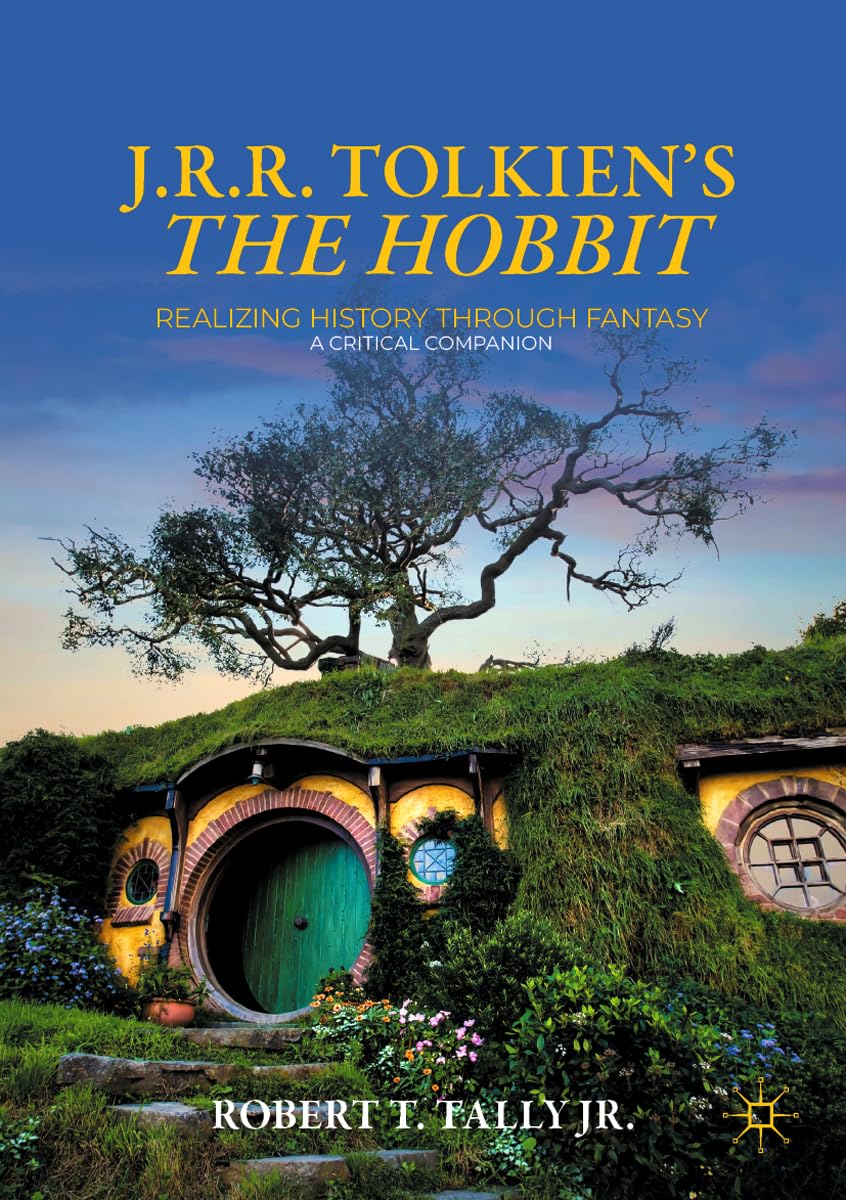
Robert T. Tally Jr.’s approach to analysing J.R.R. Tolkien’s The Hobbit in his critical companion J.R.R. Tolkien’s The Hobbit: Realizing History Through Fantasy focuses on positioning the novel as a work that uses fantasy to explore historical themes. Tally argues that The Hobbit can be considered a historical novel despite its fantasy genre, examining how Tolkien bridges the gap between myth and reality. He delves into Tolkien’s narrative style, world-building techniques, and presentation of different races and cultures within Middle-earth. Tally pays particular attention to the character of Bilbo Baggins, viewing him as an ordinary person involved in world-historical events, which reflects on how individuals can unexpectedly shape history. The analysis also covers Tolkien’s use of anachronisms, the hierarchies and social structures within Middle-earth, and how these elements contribute to the novel’s enduring appeal and immersive quality. Through this multifaceted examination, Tally provides insights into how Tolkien’s storytelling techniques have established The Hobbit as a cornerstone of fantasy literature.
Chapter 1, ‘Introduction: In a Hole in the Ground…,’ describes the accidental creation and unexpected success of this classic novel, and how Tolkien’s famous anecdote about writing “In a hole in the ground there lived a hobbit” while grading papers marks the spontaneous birth of the story. The chapter presents Bilbo Baggins as an ‘intruder’ into Tolkien’s established Middle-earth mythology, highlighting the unplanned nature of The Hobbit‘s emergence as a bestselling work of children’s literature. Interestingly, Tolkien later regretted writing it specifically for children, lamenting his use of a “silliness of manner” (Letters 215) he deemed unnecessary.
The introduction also explores The Hobbit‘s evolving place in Tolkien’s broader work, including how the book is now often viewed as a prequel to The Lord of the Rings (1954-55), despite this not being Tolkien’s original intention, and notes the revisions Tolkien made to align it with his later work. Tally presents an intriguing perspective, arguing that The Hobbit can be seen as a historical novel using fantasy to explore themes of history and individual agency. The chapter concludes by touching on the cultural impact of Tolkien’s work, including its adaptations and enduring popularity, setting the stage for a deeper analysis of The Hobbit as a cornerstone of fantasy literature.
Chapter 2, “The Way to Talk to Dragons: Interpellation, Style, and Narrative Form,” explores Tolkien’s distinctive narrative style, focusing on how the author engages the reader through a voice that is both authoritative and familiar. Tally uses Bilbo’s encounter with Smaug as a prime example of this technique, highlighting the narrator’s intrusive yet instructive style. The chapter explores how this narrative approach bridges the gap between modern readers and the mythic world of Middle-earth, effectively positioning the reader within the story and creating a sense of historical depth.
Tally argues that Tolkien’s storytelling method is crucial in making the fantasy world feel real and accessible. He examines how the narrative voice contributes to the overall world-building of Middle-earth, enhancing the reader’s experience and immersion in the story. As Tally notes, “The narrative voice in The Hobbit is quite striking. It is at once authoritative, belonging to one who so thoroughly knows this otherworldly world as to be able to speak with confidence—but also in a rather matter-of-fact way—about dealings with dragons, but it is also familiar and friendly, implicitly admitting the audience into the same sphere of authoritative knowledge” (16). This analysis provides insight into how Tolkien’s techniques contribute to what Tally describes as the enduring appeal and immersive quality of The Hobbit.
Chapter 3, “Nasty Disturbing Uncomfortable Things: The Intrusions of History,” explores the historical aspects of The Hobbit and its place within Tolkien’s broader literary project. The chapter argues that The Hobbit can be considered a historical novel, despite being a work of fantasy, and here Tally emphasizes Tolkien’s concept of Middle-earth as a version of our own world with a different history, not an entirely imaginary realm. Chapter 3 examines how Tolkien uses fantasy to explore themes of history and the role of ordinary individuals in shaping it. It also discusses Tolkien’s use of anachronisms, particularly through Bilbo’s character, as a crucial element in bridging the gap between the modern reader and the mythic past.
The chapter delves into how Tolkien’s revisions of The Hobbit were intended to align it better with The Lord of the Rings, highlighting his efforts to create a cohesive historical narrative within his fictional universe. Tally also explores how Bilbo, as an ordinary hobbit, becomes involved in world-historical events, reflecting on how individuals can unexpectedly find themselves shaping history. As Tally notes, “The Hobbit is, in part, a story about an ordinary person who ‘makes history,’ but it is also very much a tale about history, about our situatedness in history, and about the emergence of a historical consciousness” (29).
Chapter 4, “Show Me Now Your Map: Toward a Literary Cartography of Middle-earth,” explores the significance of maps in The Hobbit in particular, as well as their role in fantasy literature in general. The chapter begins by discussing the prominence of Thrór’s Map at the beginning of The Hobbit, highlighting how maps have been an integral part of books throughout literary history. Tally examines the importance of maps in fantasy literature, noting that they have now become an expected feature of the genre.
The chapter argues that Tolkien’s use of maps goes beyond mere illustration, becoming an integral part of the narrative and contributing significantly to the depth and believability of his fantasy world. Tally introduces the concept of literary cartography, noting that “No matter how vividly places and spaces are depicted within the language of the text, writers and readers have frequently also desired figural or pictographic representations of those places and spaces” (49). Here, Tally is suggesting that Tolkien’s approach to mapping Middle-earth not only enhances the reader’s experience but also plays a crucial role in the storytelling process itself.
Chapter 5, “More Dangerous and Less Wise: Race, Class, and the Geopolitical Order,” examines the hierarchies and social structures within Middle-earth as presented in The Hobbit. The chapter begins by discussing the introduction of Wood-elves in Mirkwood, who are described as “more dangerous and less wise” than the High Elves of the West, but still considered “Good People” (76).
The chapter explores how Tolkien introduces different races and cultures throughout the novel, noting that “a new creature, culture, or ‘race’ is introduced in almost every chapter of The Hobbit, at least until Bilbo and the dwarves arrive at the Lonely Mountain and meet the dragon” (66). It argues that Tolkien’s world-building includes not just diversity, but also a hierarchical system within and among these groups. Tally proposes that this racial hierarchy in Tolkien’s work functions as a form of class system, which “structures the geopolitical order of Middle-earth as a whole” (66). The chapter examines how these distinctions are portrayed through the encounters Bilbo and the dwarves have during their journey, contributing to the overall narrative and the development of Tolkien’s fictional world.
Chapter 6, “Conclusion: Quite a Little Fellow in a Wide World,” begins by comparing Tolkien’s perspective on heroism with that of Bertolt Brecht, noting that both writers were sceptical of hero-worship in modern culture, despite their different political and aesthetic views. Tally discusses Tolkien’s love for heroic romance and myth, quoting Tolkien’s statement that a “basic passion of mine ab initio was for myth […] and for fairy-story, and above all for heroic legend on the brink of fairy-story and history” (Letters 144, qtd. Tally 85). However, Tally argues that The Hobbit presents a form of anti-heroic heroism through its protagonist, Bilbo Baggins.
Tally points out that early in the novel, Gandalf notes the scarcity of traditional heroes, leading him to choose Bilbo as a burglar instead. As Tally states, “The Hobbit is fundamentally a tale of the anti-heroic heroism to be found in regular people’s efforts to deal with the exigencies of their time” (86). The chapter examines how Bilbo’s character development throughout the novel represents this idea of everyday heroism. It concludes by reinforcing the idea that The Hobbit serves as both a captivating fantasy adventure and an exploration of the role of ordinary individuals in larger historical events.
Sara Brown is Chair of the Language and Literature Faculty at Signum University, USA. She currently serves on the editorial board of Mallorn, the academic journal of the Tolkien Society, and is co-presenter on podcasts such as The Tolkien Experience, The Rings of Power Wrap-Up, Rings and Rituals, and The Prancing Pony. She won the Tolkien Society Award for Best Article in both 2023 and 2024, and is currently working on a book, Transgressive Tolkien, with Christopher Vaccaro.


