Horror as Racism in H.P. Lovecraft: White Fragility in the Weird Tales


Review of Horror as Racism in H.P. Lovecraft: White Fragility in the Weird Tales

Vladimir Rizov

John L. Steadman. Horror as Racism in H.P. Lovecraft: White Fragility in the Weird Tales. Bloomsbury Academic, 2024. Hardback. 249 pg. $90.00. ISBN 9798765107683.

Version 1.0.0

John L. Steadman offers a blunt exploration of H.P. Lovecraft’s racism. While severely limited in his engagement with race scholarship, Steadman nevertheless presents an intriguing exegetic text on key stories in Lovecraft’s oeuvre. Steadman’s main thesis is twofold: Lovecraft’s racism manifests one way in his early works and another way in his later writings. Specifically, the early works have a focus on miscegenation as brought on by immigration, and the later works have a focus on slavery as seen in a master/slave race dichotomy. The book is divided into three parts and nineteen chapters. Part I (Chapters 1-4) is titled ‘Beginnings,’ and it offers an introduction to Lovecraft’s early life with a focus on biographical details, especially his intellectual preoccupations and formative experiences. Part II (Chapters 5-11) is titled ‘Humankind against Hybrid, Degenerative Monsters’ and it is concerned with racism as miscegenation in the early works of Lovecraft. Part III (Chapters 12-19) focuses on the later works, and Steadman’s second thesis respectively; it is titled ‘Humankind against the Cosmic Slave Masters.’ Overall, Steadman’s argument is persuasive in its distinction between Lovecraft’s twofold racist fixation and its development throughout his work. More than that, the book does well to root its thesis in an analysis of Lovecraft’s formative years. The common Lovecraftian protagonist’s ultimate stupor upon uncovering the hidden eldritch knowledge is argued to mirror Lovecraft’s own passivity in dealing with trauma and hardship.

While Steadman presents a focused monograph with a cumulative logic, certain matters tend to get obscured and displaced. For instance, the book, especially in Parts II and III, takes on the format of a single chapter per specific text by Lovecraft. Most chapters of this kind might prove rather descriptive to the reader familiar with Lovecraft’s work, and there is only occasionally a reference to a scholar or writer other than Lovecraft. At the end of both Part II and III, Steadman offers a ‘Critical Commentaries’ chapter (11 and 18, respectively), in which he moves away from the story-specific chapters and situates his own twofold thesis in relation to other scholars. While the bulk of the book tends to have a reverential, albeit critical, approach to the original text, Steadman seems to be rather quick to dismiss certain perspectives from other scholars. For instance, in a discussion of Lovecraft’s “The Lurking Fear” (1923), Steadman cites Williams’ work on the hysterical female gothic in relation to Lovecraft’s use of underground locations such as caves and grottoes.  Instead of providing an argument against Williams’ claim (or Callaghan’s claim cited shortly before), Steadman rejects it out of hand and provides a dismissive generalisation about ”so-called psychological analyses of Lovecraft” (90). Interestingly, Steadman does not see his own argument in this vein, even though significant attention is devoted to Lovecraft’s own “pattern of loss and failure […as] evident in the lives of Lovecraft’s main characters” (5). This results in a certain tension that cannot be ignored by the careful reader of the book, let alone the reader familiar with Lovecraft. Specifically, this means that the potential significance of a range of patterns in Lovecraft’s fiction remains ignored; so is the case with the multiple cases of chthonic female goddesses, the symbology of the witch (which Steadman acknowledges on pg.197), and the spatial symbolism of caves and grottoes, especially considering Steadman’s own remarks on Lovecraft’s own formative experiences of restrictive spaces (such as the house he moved into with his mother after his grandfather’s passing, or his inability to enter hospitals and only visiting his ailing mother in the hospital grounds—in fact described as “the grotto” in a quotation provided on p. 27).

This is not an uncommon pattern in the book. Steadman will acknowledge a perspective, only to dismiss it without engaging with the claim in question in much depth. Another example is Simmons’ argument that Lovecraft’s characters are both repulsed and attracted by the Other. Steadman is a little more thorough here with his dismissal of the claim, but similarly as noted above, the tension between the dismissal and Lovecraft’s texts remains unresolved. Steadman claims that there is nothing attractive about the Other in Lovecraft’s work. Such a dismissal has to ignore the very fact that Lovecraft’s characters seek out magic from Western Asia, knowledge from Africa, or refer frequently to places beyond Western Europe and North America as abounding with mystery and danger. In the simplest of terms, Lovecraft’s characters are in need of people over which to rule. The common interweaving of revulsion with attraction in orientalism appears to be a proposition unworthy of consideration for Steadman.

Overall, Horror as Racism in H.P. Lovecraft promises an intriguing perspective by trying to pick apart Lovecraft’s racism and its central role throughout his work. Nevertheless, Steadman, while clearly critical of Lovecraft’s racism, fails to provide much insight into the subject. At this point in time, the description and acknowledgement of Lovecraft’s racism is easy and should be the bare minimum in critical scholarship. It is much more important to understand it.

Vladimir Rizov is Assistant Professor in the Department of Sociology and Criminology at the University of Sussex. His current book project is titled A Criminology of Videogames: Playing at Crime and its Control. He is the author of Urban Crime Control in Cinema: Fallen Guardians and the Ideology of Repression. He has published articles and essays on film, videogames, the history of documentary photography, and urban history.

Artificial Women: Sex Dolls, Robot Caregivers, and More Facsimile Females


Review of Artificial Women: Sex Dolls, Robot Caregivers, and More Facsimile Females

Sue Smith

Julie Wosk. Artificial Women: Sex Dolls, Robot Caregivers, and More Facsimile Females.  Indiana University Press, 2024.  220 pg.  $30.00. ISBN 9780253069252. eBook ISBN 97802530692694.

Version 1.0.0

Julie Wosk’s Artificial Women explores society’s enduring fascination with the constructed female–who is created in a variety of guises both in reality and fiction, from embodied machines, automatons and robots, to disembodied AIs and virtual voices. In these techno-re-imaginings of the female as servo-bot, Wosk outlines how cultural understandings of women as passive, giving and obedient are held in tension with the reality of lived female personhood, in which women desire agency and self-determination. The primary questions asked are: In the complex world of technology and gender, how do women combat the cultural proliferation of the female as an exploited identity? How do women intervene in a male-dominated industry of technology and engineering that genders servitude as feminine, reifying women as subordinate to the needs of patriarchy and capital? In Wosk’s readings of the artificial woman, she is not opposed to the creation of the female simulacrum to explore human-machine encounters. However, she does insist that we must create her so that the interface between human and machine will, a) productively and positively rehearse the rightful treatment of women, and b) genuinely foster respect for the human female. However, as Wosk’s book highlights, in the service of male desire and in the pursuit of profit, tech companies and corporate businesses are, for the most part, perpetuating archaic stereotypes of women that continue to distort visions and gender relations and future technology. In this respect, Wosk is a crucial voice for scrutinising and contesting male dominated visions of gender and technology.

 Artificial Women begins with a fascinating and compelling introduction that outlines Wosk’s enduring interest in female simulacra in both avant-garde and popular culture. Here, Wosk demonstrates an impressive range and depth of knowledge of the subject in visual, material and literary culture across differing timelines. Following the introduction, Wosk discusses the myriad synthetic females that have been and still are being created and exploited by industry and culture today. In Chapter 1, ‘A New Breed of Sex Robots and Sex Dolls,’ Wosk looks at the female robot and AI as a self-sacrificing sex worker/slave who frequently doubles as an emotional companion. She plays with the stereotype of the ‘tart with the heart’ normalising the male treatment and expectations of such stereotypes in which the human male is put first and women, whether organic or synthetic, second. In Chapter 2, ‘Under the Skin: The Fabricated Femme Fatale,’ the performative masque of the artificial woman as lure and threat is explored through the seductive image of the femme fatale. In this section is the suggestion that the synthetic skin as a progressive development in robot technology is a deception akin to women who are accused of putting on femininity as artifice to distract and subvert for personal gain. In Chapter 3,  ‘Female Robot Caregivers, Doubles, and Companions,’ Wosk’s focus shifts towards social and emotional robots envisioned as caregivers and companions to ailing elderly adults and vulnerable children. Extending to narratives of human loneliness brought about by failing health, cataclysmic events and hostile environments, the female robot – in fiction and reality – is a replacement or double designed to mitigate loneliness or protect their human (or humanoid) charge by emulating human empathy and compassion.

In Chapter 4, ‘Paradoxes of Perfection: A Servant No More,’ Wosk takes the reader through cultural anxieties about technology in the home by exploring the female robot as a familial, domestic helper who ultimately becomes either a perceived threat to traditional family relations or threatens to rebel and break free from her servitude. In Chapter 5, ‘Virtual Voices: Talking Barbie Dolls, Alexa, Bitchin’ Betty and More,’ Wosk discusses the cultural history of the talking doll and automaton and its evolution into disembodied voices and computerised companions that serve as assistants in the work and home and fascinatingly as a warning system in domestic and military aviation. The disembodied female is open to abusive treatment, which Wosk discusses in detail, but when contextualised in a more life-threatening setting and safety is of the utmost importance to protect human life, such as in the field of aviation, the virtual female is afforded respect and the authority of her voice being adhered to without question or derision. Finally, in ‘Coda,’ Wosk summarises her book’s premise of humanity’s hope, fascination and anxiety surrounding the figure of the artificial woman. Can the artificial woman produce new and transformative possibilities for humanity? Or will she reify gender roles that reduce women to a commodity in accordance with patriarchal expectations? It is in these closing pages that Wosk calls to women to intervene in the vast array of new robot and AI technologies. Here she provides examples of women who are already doing so as they work to empower and create a space for living in a complex, contemporary world. It is in these final moments that Wosk draws examples from the active work and engagement of LGBTQ+ and disability communities, a springboard perhaps for further work and research for those who negotiate the everyday from a diverse and alternate position of the human.

Julie Wosk’s book is a relevant new addition to the field of robot technology and gender studies.  Her work on the artificial is long-standing, and her interests are fuelled by life experiences working in media and magazine culture, art, literature and museums. Artificial Women demonstrates Wosk’s extensive knowledge of the cultural and social history of the artificial woman. It is written for academics and students of visual and material culture and literature and accessible for non-academic individuals who are interested in the subject. It provides a comprehensive source of ideas for those who want to take the discussion further.

Sue Smith is an English Teacher at a Post-16 SEN College in Leicestershire, UK. Her interest is in the representation of gender and disability in American Cyborg Fiction. Her current research article is on the robot psychiatrist in American military medicine and American military science fiction.          

Utopian and Dystopian Explorations of Pandemics and Ecological Breakdown: Entangled Futurities


Review of Utopian and Dystopian Explorations of Pandemics and Ecological Breakdown: Entangled Futurities

Corpus Navalón-Guzmán

Heather Alberro, Emrah Atasoy, Nora Castle, Rhiannon Firth, and Conrad Scott, eds. Utopian and Dystopian Explorations of Pandemics and Ecological Breakdown: Entangled Futurities. Routledge, 2025. Routledge Environmental Humanities. Hardcover. 254 pg. $190.00. ISBN 9781032385914.

Version 1.0.0

What if the real question cultural artifacts ask after a global catastrophe is not what happened but why do we keep imagining it that way? Utopian and Dystopian Explorations of Pandemics and Ecological Breakdown: Entangled Futurities operates less as a blueprint for the ‘end of times’ and more as a forensic investigation into our collective anxieties, hopes, and failures. It is a kind of whydunit in which the apocalypse is never just an end, but a narrative charged with ideology, desire, and critique. Comprising four major parts, each divided into approximately four chapters, this edited collection catalogues representations of crisis across literature, activism, and performance, interrogating the deeper patterns beneath them. It highlights how cultural production reflects ecological and epidemiological realities, helping us to reimagine what comes next.

Framing the collection within the current world context is a timely and urgent provocation since, even as we appear to teeter on the edge of the so-called posthuman era marked by the collapse of stable binaries, technological saturation, and ecological precarity­, we remain deeply entangled in the complex web of humanity. This foundational tension animates the collection’s interdisciplinary inquiry, which employs theoretical frameworks from scholars such as Jason Moore, Karen Barad, and Donna Haraway to explore the ruptures and continuities between the human and the non-human. Concepts such as Moore’s “intimacy, porosity, and permeability,” Barad’s “intra-action,” and Haraway’s “more-than-human” (1) become key tools to unpack how pandemics both reveal and intensify these entanglements. The book’s relevance has only deepened after the COVID-19 pandemic, which has prompted our interconnectedness with microbial and ecological systems in ways we can no longer ignore. The editors are quick to acknowledge that while the volume’s conception was there before the pandemic, its development during this global health crisis makes it a crucial intervention in the present moment. Each section of the book unfolds as an iteration of an ongoing crisis; the sections build upon each other to shed light on how global health, environmental breakdown, and social injustice are not separate but mutually reinforcing.

The editors’ introductory section establishes a theoretical framework that is as ambitious as it is urgent. Rejecting the more familiar language of climate change in favor of the term “ecological breakdown” (5), the editors seek to capture an intricate network of mutually influencing crises: the erosion of biosphere integrity, mass extinction events, and the systemic unraveling of ecological interdependencies. This reframing is not merely semantic since it underscores the collection’s broader commitment to an intersectional analysis attentive to colonialism, capitalism, patriarchy, queerphobia, and human supremacy. While this theoretical section gestures toward concepts from critical posthumanism, such as entanglement, and acknowledges ecological affects like fear and anxiety, its brevity occasionally leaves key theoretical anchors underexplored. Nevertheless, the editors articulate a compelling vision of pandemics as events that rupture rather than reinforce human exceptionalism. Their nuanced treatment of utopia and dystopia similarly resists static definitions, proposing instead a dynamic continuum where dystopic collapse may give rise to fragile yet vital forms of hope.

            The first part of the collection, “Monsters and Monstrosity,” draws together a set of chapters that redress the figure of the monster as a key to explore the collapse of boundaries between human and non-human life. Across the three chapters by Tânia Cerqueira, Ujjwal Khobra and Rashmi Gaur, and Timothy S. Murphy, a shared concern emerges with the political and affective work monsters perform within pandemic imaginaries. Rather than framing monstrosity as an object of fear, the narratives explored in these chapters present how figures of contamination, whether viral, ecological, or social, break down with anthropocentric models of agency and citizenship. Cerqueira’s chapter proves foundational, as it introduces the theoretical framework of EcoGothic, a new interpretive lens whereby ecocriticism draws from typical traits from the gothic novel to explain environmentally-related collapse. While Cerqueira leans on gothic and ecological motifs, Kothra and Gaur foreground Braidotti’s politics of otherness. Murphy’s chapter, for its part, pivots toward a more explicit political critique, using Richard Matheson’s novel I am Legend  (1954) to illustrate how ecological and social collapse expose the fragility of dominant power structures, particularly when the majority finds itself displaced. When read together, these chapters not only stage an encounter between historical materialism and new materialism but also signal the collection’s broader project: envisioning forms of posthuman belonging in the ruins of familiar worlds.

If part one foregrounds monstrosity as a rupture in the human/nonhuman divide, part two recalibrates this tension through the lens of intersectionality. What emerges from the chapters in “Intersectional Critique” is a sustained interrogation of how posthuman ecologies are never experienced abstractly but mediated through histories of dispossession, gendered embodiment, and racialized vulnerability. Crucially, these essays do not deploy intersectionality as a stable lens. Rather, this framework works as a moving analytic that constantly shifts according to context. Legatt’s discussion of “fungal capital” (71) in HBO’s TV show The Last of Us (2023–) and Ling Ma’s novel Severance (2018) underscores how capitalist flow masquerades as disorganized rhizomes that subtly reproduce hierarchies of value and access. However, these rhizomes also embody the potential for radical horizontal solidarities that surface in crisis. Benjamin Burtt’s reading of Joca Reiners Terron’s novel Death and the Meteor contrasts this view by foregrounding the Indigenous experience of ongoing apocalypse as colonial continuity, not rupture, and evokes ritual, not resilience, as a form of collective refusal. Meanwhile, González-Bernardez and Rossi’s respective chapters resist the treatment of nature as passive terrain: in Naomi Novik’s Uprooted (2015) and Sophie Mackintosh’s The Water Cure (2018), the nonhuman world functions as a volatile ethical subject where vulnerability emerges not as a weakness but as a condition for political transformation.

The third part of this collection critically interrogates the concept of mutual aid, particularly in its intersection with ecological justice. COVID-19 put mutual aid into the spotlight but stripped it of its radical roots to serve the political elites as a mask to state failures. Yet, the contributions of this section return to the concept’s original transformative potential, expanding the boundaries of mutual aid beyond human-centric frameworks. Curtis’ chapter explores post-pandemic science fiction to reveal how the genre’s preoccupation with environmental justice urges a shift from survivalist thinking toward proactive frameworks that seek justice for both human and non-human life. Similarly, Horn, Martin, and Seville’s analysis of Charles Burns’s graphic novel Black Hole (1995) shows how the viral transmission of a sexual disease turns into an agent of transformation that fosters posthuman sensibility. Both analyses critique anthropocentric, capitalist frameworks that isolate humans and their environments, urging instead a radical reimagining of interdependent solidarity.  Grześkiewicz and Boschen’s chapter also adds to this critique by underscoring the destructive effects of state-imposed borders and the potential of more-than-human solidarity in resisting it. Collectively, these chapters foreground that more-than-human mutual aid does not simply offer an antidote to neoliberalism’s failures but a push for radical ecological and social justice that embraces a multispecies, interconnected world.

Part four, “Creative Resistance and Utopian Glimmers,” turns away from critique as diagnosis toward critique as creation. This section assembles a set of chapters that treat culture as a mode of political and ecological practice. Throughout these chapters, utopia is not presented as a distant concept, but as a set of situated, messy practices: DIY music enclaves, pandemic theater, and youth-led climate action. Moreover, these contributions offer a sustained interrogation of how aesthetics and performance can resist the logic of legal, spatial, ecological enclosure and foreground relational forms of agency. Käkelä, Breemen, Yağcıoğlu, and McKnight all push back against narratives of apocalyptic finality, opting instead for a speculative mode rooted in entanglement between humans and more-than-human actors, between past devastation and future invention. Importantly, these chapters do not romanticize resilience or prefiguration. Their focus is instead on how minor gestures, or “micro-utopias” (215) as McKnight calls them, can reorient perception and shape collective imaginaries. Nonetheless, a critical tension persists: can cultural resistance unsettle the infrastructures of surveillance, control, and commodification it navigates? Or does it risk being reabsorbed as aesthetic capital in the very systems it critiques? This section insists that utopian thinking must remain alert to this paradox, which is at once generative and complicit, speculative and material.

In sum, Utopian and Dystopian Explorations of Pandemics and Ecological Breakdown is a timely and thought-provoking collection that does more than analyze crisis. It dwells in it, navigates through it, and asks what forms of thought and practice might still be possible from within wreckage. There is something about this collection that sets it apart from others. It refuses to offer simple solutions or neatly packaged theories. Instead, it models a form of scholarly engagement that is porous, speculative, and deeply rooted in the urgency of our current moment. Whether discussing plague literature, performance during lockdown, or youth climate movements, these contributions do not deliver definite conclusions. Rather, they equip readers, especially scholars, students, and artists, with conceptual tools to rethink what critique, resistance, and creativity can mean in a world shaped by ecological collapse and viral entanglement. In that sense, it is not just a collection of essays but an invitation to reimagine how we live, relate, and create in times of crisis.

Corpus Navalón-Guzmán holds a PhD in English Literature and Culture from the University of Murcia, where she completed her dissertation on queer trauma in contemporary Anglophone literature and cinema. She has been a visiting researcher at the University of Northampton and Ghent University. Her research interests include queer theory, trauma studies, childhood studies, and cultural studies, with a focus on the representation of queer trauma in literary and cinematic texts.

Folk Horror on Film: Return of the British Repressed


Review of Folk Horror on Film: Return of the British Repressed

Brontë Schiltz

Louis Bayman and K. J. Donnelly. Folk Horror on Film: Return of the British Repressed. Manchester University Press, 2025 Paperback. 264 pg. $33.99. ISBN 9781526191205.

Version 1.0.0

Although use of the term ‘folk horror’ has been traced back to 1936, it was not until the twenty-first century that it entered the critical lexicon, used by director Piers Haggard to describe his 1971 film Blood on Satan’s Claw in 2003, and then by actor, writer and director Mark Gatiss, with reference to Haggard’s film as well as to Witchfinder General (1968) and The Wicker Man (1973), in the 2010 documentary A History of Horror. Folk Horror on Film: Return of the British Repressed, edited by Louis Bayman and K. J. Donnelly and recently released in paperback following its 2023 hardback publication, delves deeper into this now canonised triad, but also reaches back to Night of the Demon (1957) and forward to Apostle (2018), and examines films more typically associated with other genres, such as the science fiction thriller Doomwatch (1972). Comprising fourteen chapters, the book begins with debates on The Wicker Man—today the best-known of the “unholy trinity” (Scovell, 8)—followed by analysis of the titular ‘Return of the British repressed,’ and, finally, of ‘Folk horror’s cultural landscapes.’

Adam Scovell’s Folk Horror: Hours Dreadful and Things Strange (2017) sparked new interest in folk horror, which Scovell theorised not as a subgenre or (as is often the case in Gothic studies) a mode, but rather as a “chain” that links “disparate forms of media through their summoning of … themes and ideas,” including isolation, unsettling landscapes, “a skewed belief system or morality,” and a “happening” or “summoning” (Scovell, 17–18). As Bayman and Donnelly observe, “folk horror is of the folk themselves, and of the wider conditions that sustain their existence” (5). As the unity of the United Kingdom disintegrates, with 54% of Scottish adults favouring independence as of March 2025 polling and thousands of farmers protesting proposed changes to inheritance tax in the English capital in 2024, British folk horror’s interrogation of national identity and evocation of metropolitan anxieties concerning rural communities are increasingly relevant. This collection thus offers politically as well as academically significant theorisations of such cultural products.

The opening three chapters probe The Wicker Man’s religious ideologies. While Ronald Hutton identifies a representation of “paganism as dangerous in a way that either Christianity or modern scientific scepticism are not” (34), Laurel Zwissler reads the film as offering “a carnivalesque experience for viewers, both Pagan and otherwise” (51). As Miken J. Koven notes, however, the word “Pagan,” derived from “[t]he Latin pagamus,” which “simply meant rural,” was later “further applied to designate between dichotomies of … Christian/non-Christian,” and as a consequence, “to identify as Pagan is nonsensical because to do so would be to recognise the hegemonic power of the Church” (58-9). Such varied perspectives exemplify the collection’s excavation of the complexity of Britain’s cultural and mythological history.

Derek Johnston begins the following section with an interpretation of “folk horror communities as microcosms of the wider nation,” particularly in their “reproduction of a form of class system” (79). Dawn Keetley likewise attends to capitalism’s influence, reading Doomwatch as centrally concerned with “the life-destroying sickness of global modernity that dooms land and people alike” (89). In his analysis of Requiem for a Village (1975), Paul Newland similarly identifies the locus of horror not in the film’s undead, but in its “faceless, gigantic mechanical leviathans” (109). But the past is as threatening as the present. Donnelly reads folk horror “as a form of historicism,” revealing “a forgotten – and happily forgotten – heritage” (117) and producing “an ‘outsider’ version of Britain’s history” (129). As Beth Carroll argues, however, folk horror’s relegation of regions beyond “England, and arguably even more specifically the south of England and London” to outsider status (131), rather than contesting this traditional hegemony, instead “assume[s] an English framework and mode of viewing” (144), reinforcing existing power structures. Amy Harris’ examination of folk horror as “defined by androcentrism” (152), meanwhile, brings vital attention to the Othering of women in the folk horror tradition – a form of exclusion endemic not just to British history, folklore and folk horror itself, but also to related academic discourse. The ‘British repressed’ of the collection’s title thus emerges as referring less to marginalised communities than to the actual processes of marginalisation – geographic, socioeconomic and gendered – that have shaped British history at the level of both content and methodology.

In the final section, David Evans-Powell and Mark Goodall explore the ascription of “agency, sentience or autonomy” to landscapes (Evans-Powell, 178) and “to the built-up environment, liminal areas and technology” (Goodall, 211) in traditional folk horror and what Goodall terms the “urban wyrd” (211). This transgression of the boundaries between the animate and the inanimate is mirrored by a coalescence of the diegetic and non-diegetic. Goodall notes that the rape scene in Blood on Satan’s Claw is “filmed voyeuristically[,] forcing the viewer to be almost party to the crime” (214), while Lyndsay Townshend explores the role of drums in “conjuring … community, bodily affect and fear” (164), acting “as a sonic identifier for a human heartbeat” (175) that encourages corporeal identification in viewers. Diane A. Rodgers also considers audience response in her analysis of the “wyrd,” which she suggests generates “a general sense of brooding fear” (225). As well as cultural, theological and historical frameworks, then, the collection also attends to audience studies—a growing area of academic interest that is essential to analysis of texts so concerned with emotion, corporeality and communality.

WORKS CITED

Scovell, Adam. Folk Horror: Hours Dreadful and Things Strange. Auteur Publishing, 2017.

Brontë Schiltz is a PhD candidate at Manchester Metropolitan University, England. Her work has been published in The Sibyl, Fantastika Journal, Aeternum Journal, SIC Journal, Revenant Journal and Horrified Magazine, as well as several edited collections. She features on documentaries and commentaries on Hammer’s 2025 rereleases of The Quatermass Xperiment and Quatermass 2, and has appeared on podcasts including Victorian Legacies, The Ghost Story Book Club, The Death Studies Podcast, BERGCAST, There’s Not Always a Twist, The Folklore Studies Podcast and Scarred for Life. She is the members coordinator of the International Gothic Association and principal editor of Hive Journal.

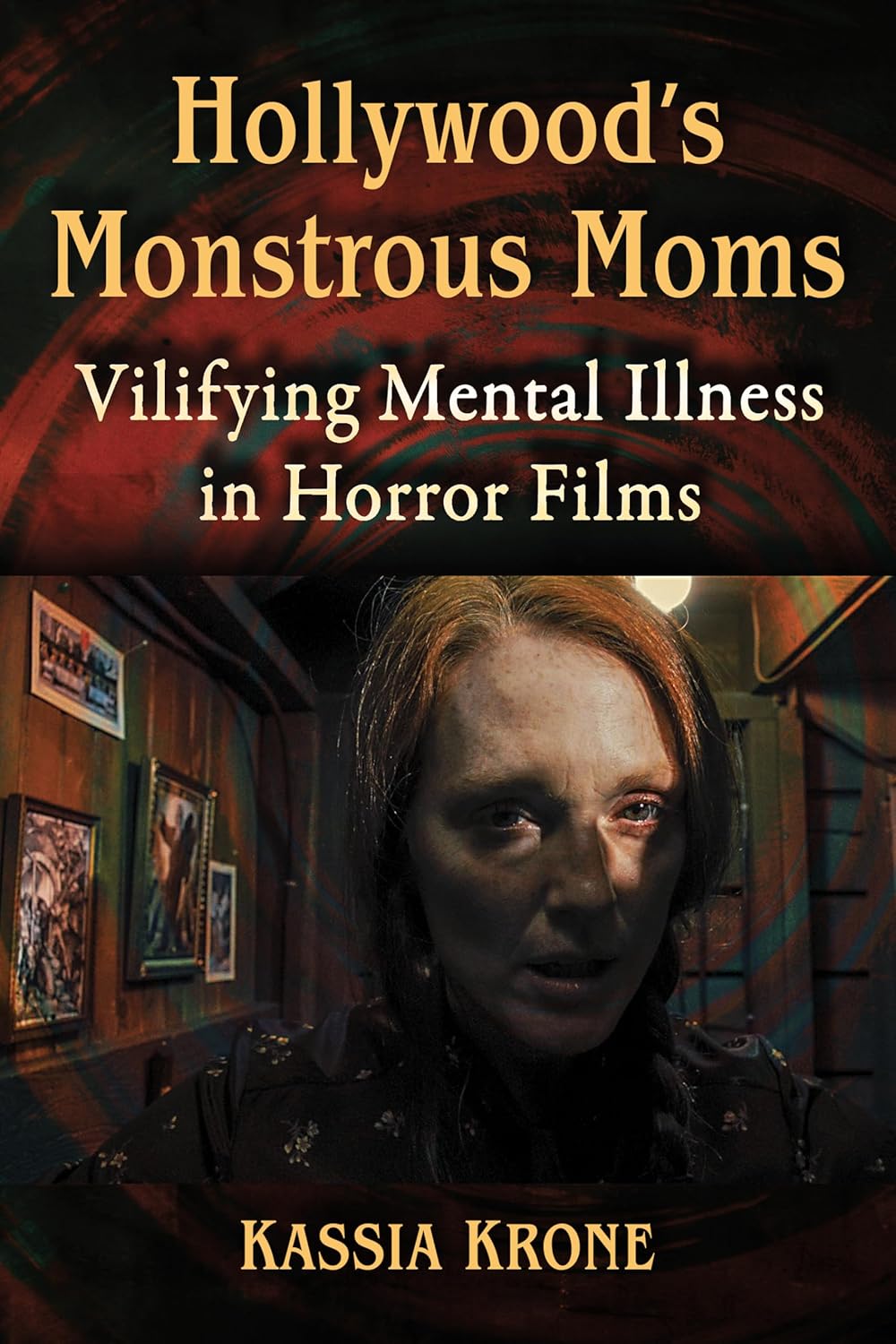
Hollywood’s Monstrous Moms


Review of Hollywood’s Monstrous Moms: Vilifying Mental Illness in Horror Films

Shiqing Zhang

Kassia Krone. Hollywood’s Monstrous Moms: Vilifying Mental Illness in Horror Films. McFarland, 2024. Softcover. 209 pg. $55.00. ISBN: 9781476688930. eISBN: 9781476652337.

Version 1.0.0

Kassia Krone’s Hollywood’s Monstrous Moms exposes the long-term stigma against mothers with mental illness in Hollywood horror films. Her study demonstrates a troubling pattern in the film industry of villainizing mothers with mental illness. Her book also identifies a research gap that hasn’t been fully explored at the intersection of disability studies, women, and mental illness. Disability studies in film has increasingly focused on representations of physically disabled bodies, arguing that their representation challenges the dominant able-bodied cinematic narrative. While there is some attention to cinematic characters with mental disorders, the one-dimensional characters make the discussion lack complexity. Even within feminist disability studies which critically examine the stereotypes about women with disabilities, women with physical disabilities or chronic illnesses are often central in discussions about the female body, beauty standards, and medical treatment as opposed to the experiences of women who are mentally ill. However, Krone’s research follows a feminist approach while adding the focus on mental disabilities. 

The scope of Krone’s research includes classic horror films such as Carrie (1976), Mommie Dearest (1981), and Rosemary’s Baby (1968); slasher films such as Friday the 13th (1980) and Scream 2 (1997), as well as other more recent films such as The Sixth Sense (1999), Us (2019), Things Heard & Seen (2021), and so on. Her research also examines prestige horror films such as Hereditary (2018) and The Babadook (2014) to address the new trend. Krone’s scope is large, but all these films portray women with mental illness, which also illustrates how their images are rendered as a horror trope by the film industry. As Krone argues, these tropes vilify disability and gender together, especially motherhood. These depictions are also harmful to those in the disability community who fight for justice and equal rights.

Krone mainly examines female characters with mental illness from the following perspectives: women’s liberation movements and the film industry backlash; the representation of disability tropes; medical and social models of disability; and mother-child relationships. This approach draws her research into conversation with the gender inequality in Hollywood, disability tropes in films, and the narrative of female madness. Dating back to the Victorian period, women with mental illnesses were viewed as moral failures or as inherently emotionally fragile, which successfully constructed female madness as something stigmatizing and distorted. Krone’s analysis persuasively argues that these discriminations are also ubiquitous in contemporary cultural products.

Chapter One discusses classic horror films such as Carrie, Rosemary’s Baby and Mommie Dearest, in which mentally ill mother characters serve as a horror response to the emerging independent women. Their mental illness is used as a metaphor for punishment, suggesting that their progress is “detrimental to their mental health or stability” (22). Chapter Two analyses the films The Others (2001), Mama (2013), and Things Heard and Seen to illustrate how mental health facilities or haunted houses impact women’s mental condition and dehumanize them. This discussion is also addressed to the history of women who are diagnosed with hysteria, showing the long history of the medical narrative inclined to stigmatize them as ‘mad women’ without questioning the reason and truthfulness and then imprison them into isolated spaces (45). In these films, these female characters become ghosts after their suicide and haunt their children in the house. These depictions also complicate Jay Timothy Dolmage’s “kill or cure” trope for disability representation in film, as these mentally ill women “are already dead” and need to be banished again (57). Chapter Three focuses on the female killers in the slasher films Scream 2 and Friday the 13th. They are labelled as psychotic, driven to seek revenge for their sons’ death, a characterization reinforced by the slasher film narrative to emphasize their ‘craziness’ while ignoring their grief and emotional trauma over losing their children.

Moreover, these harmful portrayals are also linked to other forms of discrimination, such as racism and medical bias. Krone’s discussion situates these elements within the concept of intersectional feminism, which recognizes overlapping oppression rather than focusing solely on sexism. Chapter Four shifts the focus to mentally ill Black women in the horror films Ma (2019), Barbarian (2022), and Us. Even when Black women are present, the film industry often commodifies them through fixed tropes or stereotypes, such as the “Black villain” (96) and the “Black female vixen” (97). Their mental health is often overlooked by medical professionals and the film narrative, especially when they encounter racism and ableism at the same time: “blackness” is sometimes regarded as a form of disability within horror film narratives (108). Chapter five discusses the representation of mothers with Munchausen syndrome by proxy (MSP) in films The Sixth Sense, Fragile (2005), Love You to Death (2019), and Run (2020). It is implied that mothers who have mental illnesses are unfit to raise children.

However, this does not mean that all contemporary horror films are trapped in this representational dilemma. As readers might be aware, horror films are also constantly evolving, responding to the growing concern regarding approaches to disability and gender. Krone examines Things Heard and Seen in Chapter Two to argue that it provides an unconventional ending that resonates with contemporary feminist movements by foregrounding female solidarity. The film emphasizes the collaborative efforts among spectral moms to break the cycle of domestic abuse. Chapter Six shows that Hereditary and The Babadook portray the female protagonists who navigate their mental struggles with resilience which challenges stereotypes linking their mental illness with villainy. These depictions also embody the potential to understand the mentally ill in another way: to sympathize with them. This change mirrors the rising of “prestige horror” in the film industry (149); these films juxtapose mental illness with societal issues and call for greater attention to people’s spiritual world. In the films Hereditary and The Babadook, the mothers are portrayed as “three-dimensional” characters, with their mental illness symbolically linked to themes such as religion, family grief, and personal trauma (149). Krone posits that these films also “present mental illness as more of an allegory or symbol through the use of the supernatural” (176). In this way, they complicate the trope of mental illness in horror cinema, rather than solely using it to characterize villains. However, the thematic direction expressed by the creators and the audience’s perception can be vastly different. Krone argues that Hereditary expresses compassion toward mentally ill characters, especially the mother character Annie. However, I see the film as reinforcing a fear of mental illness, particularly through its title, which indicates that mental disorders are inevitably passed down through generations. This implication could further deepen societal fear and misunderstanding of mental illness. Thus, Krone’s interpretation also needs to be supported by further evidence.

Krone is, however, correct when she argues that an often-overlooked issue in horror films that we rarely reflect on is the negative impact of depicting mentally ill characters as villains. Audiences tend to accept these terrifying portrayals as natural. Furthermore, Krone points out that Hollywood rarely casts actors with disabilities in disabled roles. This reiterates the need for more diverse representations in horror films. I believe this book could explore its connection with the Victorian tradition of depicting female madness in literary works, a topic not fully explored in this study. At the same time, this book can also be integrated with queer theory, as this theory similarly challenges the narrative of “normality,” creating intersections with both disability studies and feminist scholarship. Scholars interested in horror cinema, feminist disability studies, and mad studies will likely find this book valuable.

Shiqing Zhang is a PhD candidate at Newcastle University, where she studies children’s literature. In particular, she does research on Ursula K. Le Guin and how her work challenges the conventions of YA literature. She acknowledges the support of the China Scholarship Council (CSC) for funding her research in the UK.

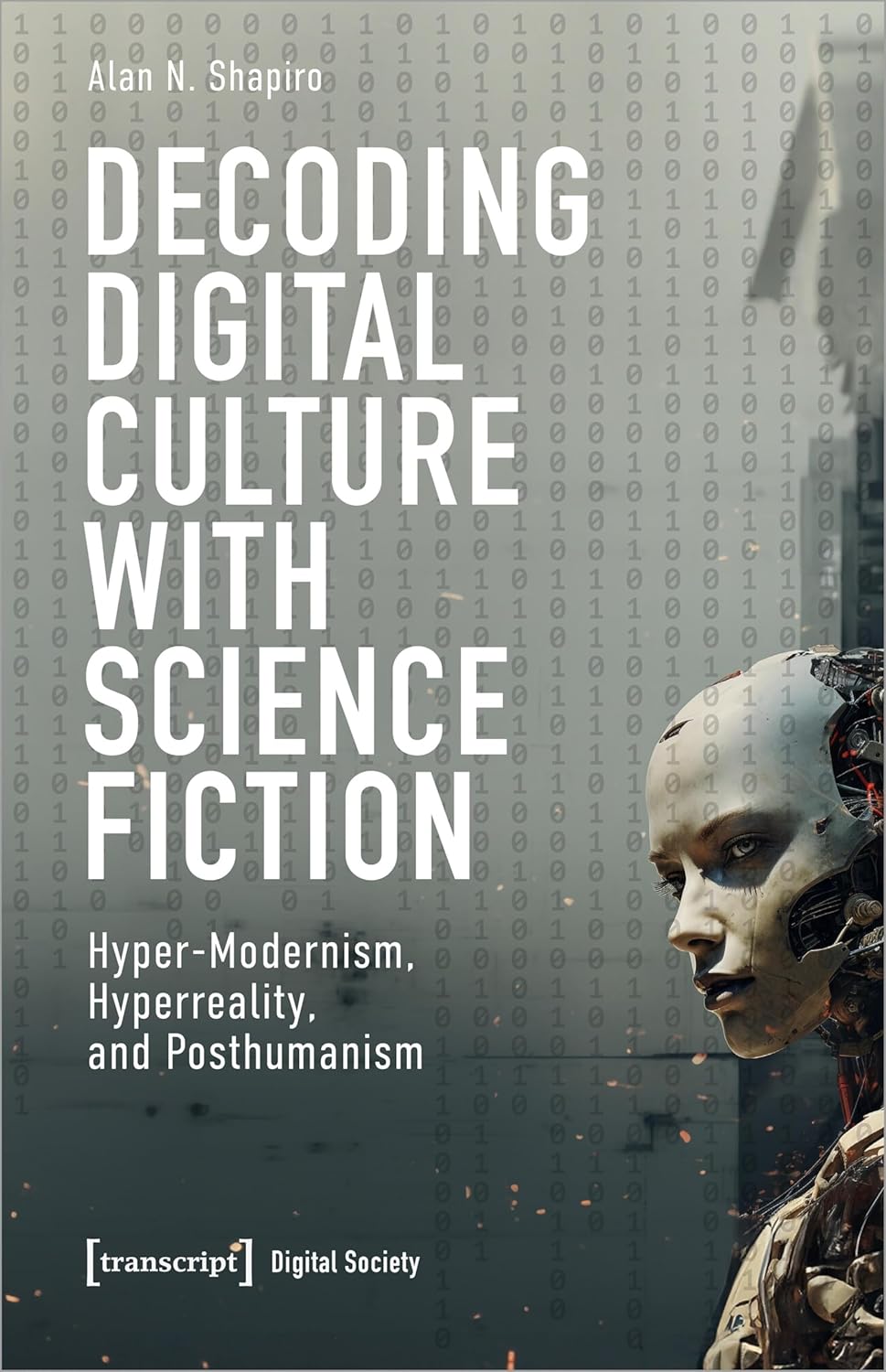
Decoding Digital Culture with Science Fiction


Review of Decoding Digital Culture with Science Fiction

Nanditha Krishna

Alan N. Shapiro. Decoding Digital Culture with Science Fiction: Hyper-Modernism, Hyperreality, and Posthumanism. Bielefeld: transcript Verlag and New York: Columbia University Press, 2024. Paperback. 374 pages. €50.00. ISBN 9783837672428.

Version 1.0.0

When I completed my Master’s degree in English Language and Literature in July 2024, I found myself increasingly drawn to the question of how science fiction (SF) can help us think critically about the digital and technological futures we now inhabit. Many of the speculative worlds I explored during my degree – once purely imaginative, especially in the late 20th century – no longer feel like distant possibilities. They feel less like fiction and more like our lived reality. Surveillance systems, pervasive data collection, algorithmic control and governance, and artificial intelligence are no longer abstract concepts. They are already here, shaping everyday life in profound ways.

Science fiction has evolved beyond simple prediction or foresight; it has become a practical method, a way to decode the complex digital cultures around us. This shift is at the heart of Alan N. Shapiro’s Decoding Digital Culture with Science Fiction, a book that blends cultural theory, media studies, and futures thinking to explore how science fiction (SF) helps us understand and even shape emerging technologies. I wish I had discovered the book earlier, particularly during my thesis research. Still, it has since become a key influence in my current role as a Fellow in the Young Future Maker Fellowship Program, run by Future Days (Portugal), the Copenhagen Institute for Futures Studies (Denmark), and Media Lab Bayern (Germany).

During my fellowship, I have been applying many of the ideas that Shapiro discusses: using literary and science-fictional thinking to analyze digital futures, especially around themes of surveillance, privacy, and algorithmic governance. My work focuses on utilizing cultural texts (literary studies) to address real-world challenges, collaborating with futures and media experts to explore how stories and technologies intersect. For instance, in preparing for my Future Days 2025 fellowship presentation, I used his concept of science fiction as a critical lens and methodological tool—an applied iteration of the Literary Futures method by Rebecca Braun and Emily Spiers—to analyze not only the stories we tell about technology but also the algorithms and systems that structure our digital lives. This book hasn’t just been a background reference; it has directly influenced my practice-based research, showing how theory can guide creative, future-oriented work. Shapiro’s framework has profoundly shaped my approach to projects that bridge narrative, technology, and futures thinking. The book has helped me frame projects that bring literature into dialogue with foresight practices, culminating in recent presentations at the Future Days Conference (2025) Garden Gallery in Estufa Fria, Lisbon, Portugal.

Shapiro’s book explores the deep entanglement of science fiction, digital technologies, and cultural theory, arguing that SF is no longer just a storytelling genre. Instead, it has become a shaping force, influencing both the design of new technologies and the ways in which society understands them. The text is divided into three interconnected sections: Hyper-Modernism, Hyperreality, and Posthumanism, progressing from analysis to critique and ultimately to proposals for transformation.

In Part 1, Shapiro introduces Hyper-Modernism, an intensification of postmodernism driven by algorithmic systems that now organize culture and everyday life. Drawing on theorists such as Fredric Jameson and Gilles Lipovetsky, he shows how science fiction has evolved from mere storytelling to a force that actively influences technological development. Through examples like Black Mirror and Star Trek, Shapiro demonstrates SF’s dual function: it both inspires technological innovation and provides critical commentary on its consequences. This section particularly resonated with me, as it highlights why SF deserves serious study within the humanities and beyond.

Part 2 engages with Jean Baudrillard’s theory of hyperreality, where simulations and images replace reality itself. Shapiro argues that in today’s digital, algorithm-driven world, Baudrillard’s ideas are more relevant than ever, but they need to be updated. Platforms such as social media, VR, and AI have pushed hyperreality to new extremes, eroding the distinction between the real and the virtual. This section also addresses post-truth politics and the algorithmic shaping of perception, connecting Baudrillard’s theories to contemporary debates. What I appreciated most here was Shapiro’s insistence that we are not powerless: by “re-coding” digital systems, we can resist and reconfigure the structures of hyperreality. His use of The Matrix as a metaphor for this kind of critical engagement was especially compelling.

Part 3 moves toward transformation, focusing on Creative Coding and Posthumanism. Drawing on N. Katherine Hayles’ How We Became Posthuman, Shapiro critiques the traditional, abstract conception of code as purely functional. Instead, he envisions coding as a creative, embodied, and collaborative practice. This has profound implications for computer science, which he argues should become more transdisciplinary, connecting technology, art, and the humanities. Creative Coding, as Shapiro presents it, can resist algorithmic capitalism, generate art, and decenter human authorship through collaboration with AI. While this section was inspiring, I found myself wishing for more detailed, practical, and concrete examples of Creative Coding, as this concept feels especially promising for education and futures studies. It would have been valuable to see specific examples of how these ideas could be applied in classrooms, labs, and workshops.

Shapiro situates his work within a rich theoretical tradition. His arguments draw on thinkers such as Michel Foucault (panopticism and power), Donna Haraway (Informatics of Domination), Cornelius Castoriadis (The Imaginary Institution of Society), Jean Baudrillard (hyperreality and simulation), and Gilles Deleuze (rhizomatic thought and networks). By engaging these foundational ideas, Shapiro provides a strong intellectual grounding for his claim that science fiction is not only a cultural artifact but also a methodological tool for decoding digital life.

In this sense, Shapiro’s work sits alongside other major texts in digital culture and futures studies. For example, while Shoshana Zuboff’s The Age of Surveillance Capitalism examines the economic and political dimensions of the surveillance economy, Shapiro goes further by showing how narrative and imagination can decode and critique these systems. Similarly, where Hayles explores the evolution of posthuman subjectivity, Shapiro provides a practical, future-facing perspective, demonstrating how SF can actively shape our responses to technological change.

One of the most compelling chapters in the book is “Science Fiction Heterotopia: The Economy of the Future.” In the section “Similar Technologies in the Real World Today,” Shapiro draws striking parallels between fictional worlds and actual technologies. He weaves together Foucault’s panopticon, Zuboff’s surveillance capitalism, and science-fiction narratives to explore the politics of surveillance and power in the digital age. These intersections between theory, technology, and narrative are where the book truly shines, showing how science fiction can act as both a mirror and a map for our future.

The book’s greatest strength lies in its interdisciplinary reach. It speaks to literary scholars interested in speculative fiction, digital humanists exploring the links and intersections of narrative and technology, and futures practitioners seeking frameworks to guide foresight projects. Its ideas could enrich courses in literary studies, cultural theory, media studies, and futures education, helping students and researchers think critically about how stories and technologies co-evolve.

From a personal perspective, this book has been transformative for my fellowship work. It provided not just theoretical insight but also a practical philosophy for using science fiction as a tool in real-world futures work. Shapiro’s approach reaffirmed my belief that fiction is not just meant to be read or interpreted, but to be applied—as a way of anticipating, critiquing, and reshaping the future. This understanding has guided my collaborations with media experts and informed public presentations, where science fiction acts as a bridge between storytelling and systems thinking.

If there is one area where the book could be expanded, it would be its treatment of Creative Coding. Shapiro’s vision of coding as an artistic and philosophical practice is compelling, but I found myself wanting more concrete examples and teaching strategies. Given the rapid growth of computational creativity and generative AI, this topic deserves more attention. While I would have liked to see a deeper dive into Creative Coding, this does not diminish the book’s impact. For me, it has been more than just an academic text: it has become a practical tool and a source of inspiration. In an era when algorithms and simulations define so much of our world, Shapiro’s call to “decode” digital culture feels both urgent and empowering.

Decoding Digital Culture with Science Fiction is more than just a book about literature or technology; it is a call to action. By positioning science fiction as both a critical lens and a creative practice, Shapiro urges readers to move beyond passive story consumption and toward active engagement with digital systems. For educators, scholars, and practitioners across philosophy, literary studies, digital humanities, and futures thinking, this book offers an essential framework for navigating our algorithmic age. It has been pivotal in my own work, highlighting that science fiction is not just a genre but a method for creating better futures. As our world becomes increasingly shaped by algorithms, simulations, and automated decisions, Shapiro’s work feels urgent and necessary. It is a book that should be read widely, not only for its intellectual depth but also for its potential to change how we teach, create, and imagine digital futures. Overall, Decoding Digital Culture with Science Fiction offers a critical yet hopeful vision of our technological future. This is a book I strongly recommend to anyone seeking to understand, critique, and reimagine our technological futures.

Nanditha Krishna graduated in 2024 with a Five-Year Integrated Master’s (M.A.) degree in English Language and Literature from Amrita Vishwa Vidyapeetham (Amritapuri, India). She is a Future Days 2025 Fellow (Copenhagen Institute for Futures Studies, Media Lab Bayern, and Future Days). Previously, she was a virtual research intern at the Australian Research Centre for Interactive and Virtual Environments (University of South Australia), contributing to projects on interactive narratives, news games, digital art, virtual reality (VR), and creativity in immersive performance. From 2021 to 2023, she was a HASTAC Scholar and a research intern at the Empathic Computing Lab (University of Auckland). Her interests span speculative fiction, media studies, and futures studies, exploring how digital technologies shape culture and society.

Black Speculative Feminisms


Review of Black Speculative Feminisms

Rebecca Hankins

Cassandra L. Jones. Black Speculative Feminisms: Memory and Liberated Futures in Black Women’s Fiction. The Ohio State University Press, 2024. E-book. 122 Pages. $29.95 ISBN 9780814283776.

Version 1.0.0

In Black Speculative Feminisms, Cassandra Jones explores how Black women authors use science fiction, fantasy, and speculative fiction to challenge linear notions of time by drawing on Afrocentric concepts. The work positions itself within a larger effort to excavate and highlight the power of Black women’s history and its implications for the future. Jones emphasizes “attention to record-keeping as an ongoing antiracist intervention” (2) and introduces key hashtags such as #ListenToBlackWomen, #BlackWomenArtTheFuture, and #CiteHerWork as part of Black Twitter’s tradition of disrupting the erasure of Black women’s contributions.

The book distinguishes Afrofuturist feminism from broader Afrofuturism (speculative fiction, science fiction, fantasy, and futuristic literature written about and by Africans and African Americans), defining it as a literary tradition where “people of African descent and transgressive, feminist practices born of or from across the Afro-diaspora are key to a progressive future” (5). Central to Jones’s analysis, and repeated throughout the book, is the concept of “restorative critical fabulation” – not simply mythologizing a great African past but creating imaginative works that humanize Black women and breathe life into historical records, shifting our relationship with traumatic histories. Jones further notes that this concept of restorative fabulation “recognizes the emotional labor of the author and serves as a balm for reckoning with those histories of trauma” (8).

In Chapter 1, Jones examines Tananarive Due’s The Good House (2003) and Nalo Hopkinson’s The New Moon’s Arms (2007) to illustrate how memory serves as an instructive device for identifying threats to Black people, a concept she defines as rememory. These repressed memories can be transformed into healing when dealing with generational traumas from the past. She notes that rememory is similar to what we are currently experiencing in political circles with the attacks on Black history and Black studies; how learning, remembering, and sharing of this history is determined to be dangerous and traumatic. Jones examines rememory through the figure of Due’s conjure woman, Angela, and Hopkinson’s Calamity, both of whom celebrate the power and promise of an African past, using memory to resolve historical horrors and transform that trauma into healing.

The chapter examines how the strength of Black women is often pathologized, referencing destructive narratives, such as the Moynihan Report (https://www.dol.gov/general/aboutdol/history/webid-moynihan). This 1965 study by sociologist and, at the time of the report, Assistant Secretary of Labor Daniel Patrick Moynihan proposed that the high rate of Black families headed by single mothers was a major obstacle to Black progress towards equality. Rather than focusing on systemic racism, the report pathologized Black women as the cause of the deterioration of the Black family. In contrast, both novels reclaim Black women as figures who celebrate them, emphasizing love over pain, a healing that is rooted in giving oneself over to a restorative fabulation that engages and adds to Dr. Sadiyah Hartman’s methodology called critical fabulation. Hartman’s method requires that we interrogate the historical record through the lens of the marginalized and the aftereffects of the institution of slavery. Both frameworks of Jones and Hartman enable the recall of a familiar history that is critical, restorative, and finally, celebratory. 

The Conjure woman has also been demonized and stigmatized as an evil force, but these two novels reclaim Conjure women as bearers of ancestral knowledge that is important and continuously present. In Due’s book, it is the entity titled the Baka that represents the colonial past; the desire to suppress memories and the horrors they experienced that devours Black people. Through this analysis of works featuring spiritual possession, Jones demonstrates how surrendering oneself to memory can facilitate healing by connecting it with the transformative power of love from departed family members. This remembering is used to fight against the Baka, an evil force and horror that forces characters to kill others or themselves. One of the main characters, Tariq, is used as the metaphor for how the embrace of toxic masculinity, homophobia, and the rejection of the wisdom of the ancestors makes him vulnerable. That vulnerability causes Tariq to succumb to the Baka. It is through Angela, the Conjure woman, the figure that unites the past and future into a singular moment, that she can defeat the baka. More importantly, she can connect “ancestral memory and love…this healing a step further to physically rewrite the world, restoring Corey and all those killed by the baka to life” (26).

The chapter also examines Hopkinson’s The New Moon’s Arms, which centers on a Caribbean woman, Calamity, as she nears menopause. Her hot flashes bring back familiar memories and items from her past, and the recurring theme of good/bad mothers and communal rememory that Jones discusses throughout the book. These themes are combined in Calamity’s story with the repression of sexuality, which traumatizes Black people throughout their lives. In the novel, this sexual repression is often done through religious adherence that embraces the compulsory heterosexuality and homophobia of Calamity’s Christian upbringing, which has traumatized her since childhood. The hot flashes force her to trust her body and to accept her role as matriarch and the vessel for communal rememory. Calamity confronts the disappearance of her mother, who she believes drowned in the sea, and her memories connect to the trans-Atlantic slave trade and the sea creatures, seals and merpeople (mermaids/mermans), which in these narratives are often depicted as the descendants of enslaved Africans who escaped into the sea rather than submit to slavery.  “Calamity’s horror in Hopkinson’s novel is not only tied to a fear of the supernatural unknown, but also deeply tied to a fear that repressed memories and stories from her past kept from her by her parents might reemerge” (33). It is the ability of these women, Angela and Calamity, to connect to the past that guarantees their futures and those of their ancestors.

Chapter 2, “Memory and African Traditions”, examines how memory functions in novels to imagine futures that incorporate African traditions, rather than simply reinforcing Western modernity. Jones pushes back against criticism of science fiction/fantasy as “white” literature, noting that these forms have always been part of African-centered storytelling traditions. This perspective is particularly important as Jones challenges conventional genre boundaries and demonstrates throughout the book how African narratives naturally feature “beings from space, seers, talking animals and sentient plants” (36) that communicate morality and tradition across the continent.

Jones’s analysis of Nnedi Okorafor’s Lagoon (2014), in which aliens invade Nigeria, explores how the novel critiques Christian traditions that foster self-hatred, addressing the complex interplay of ideological and physical influences in the postcolonial, neocolonized world. Jones examines how the novel challenges neocolonialism, which frames Africa as perpetually in need of Western intervention, and highlights how African intellectuals have sometimes been complicit in perpetuating cultural imperialism. This approach resonates with other significant works of Black speculative fiction, such as esteemed lawyer Derrick Bell’s “Space Traders” (1992), a story about aliens coming to America and requesting that all Black people be sent to their spaceship. In return for sending them all the African Americans, they offer the United States riches, clean air and water, and overall prosperity. Both Okorafor’s and Bell’s work confronts Black self-hatred while demonstrating how anti-Blackness has been complicit in propagating Western cultural imperialism, revealing that holding on to these ideas ultimately offers no protection.

The variety of protagonists that are central to Okorafor’s story include Father Oke, who represents anti-Blackness and misogyny; Adaora, the marine biologist who introduces the aliens; Ayodele the alien ambassador; Mami Wata, the water deity who destroys Father Oke; and Legba, whose use of the Nigerian Prince, also called the 419 scam, is rehabilitated after his encounter with the aliens. Through these diverse characters, Okorafor illustrates how the aliens serve as agents of transformation. Upon the aliens’ arrival in Lagos, Nigeria, they not only destroy the internet cafes that facilitated these scams but, as Okorafor notes, “the invasion’s dramatic ability to unseat Western discourses by strengthening the existing power of resistance” (46). Toppling multiple social hierarchies and cleansing the oceans, these shapeshifting aliens, who proclaim themselves catalysts of change, inspire nationalist pride and expel the lasting influences of colonialist rule.

The novel’s use of animals and mythological figures exemplifies how “animals hold a place of extreme importance in African storytelling and mythology” (43), serving as messengers of gods or living incarnations of deities in Ashanti, Igbo, and Yoruba traditions. This is particularly evident in Okorafor’s portrayal of Mami Wata as a powerful water deity who represents traditional African spiritual forces resisting colonial impositions. Through these elements, Jones demonstrates how “restorative fabulation employs the tropes of science fiction to restore indigenous beliefs and cultures,” using alien contact narratives to explore both anti-African sentiment and the cultural beauty and power of African cultures (51). Ultimately, the chapter reveals how Black women authors such as Okorafor use speculative fiction not merely as entertainment but as a powerful vehicle for cultural preservation and decolonization of the imagination.

In Chapter 3, Jones introduces the concept of “Sankofarration,” derived from “Sankofa,” meaning “it is not taboo to fetch what is at risk of being left behind” (56). She examines how Black authors employ narrative and writing to reclaim and preserve memory, drawing on what was left behind. The chapter contrasts how Black Studies tends to focus on the past, while Afrofuturism looks to the future, revealing how Black speculative fiction uniquely bridges these temporal orientations to recover non-Western concepts of history and time.

The chapter analyzes Octavia Butler’s Kindred (1979), showing how it connects memory, trauma, and time travel as an act of decolonization. “Decolonizing time becomes an additional approach to recognizing and healing this trauma” (53). Drawing on Butler’s archives housed at the Huntington Library in San Marino, California, Jones illuminates how the novel’s time travel mechanics connect to Igbo cosmology, demonstrating Butler’s deliberate engagement with African philosophical traditions. Kindred exemplifies “imaginative thinking that cannot change the past but can breathe life into the historical record and shift our relationship with the past” (57). Through this lens, Jones reveals how Butler attempts to spark emotion and create empathy in readers by demonstrating that racism is not merely individualized but deeply systemic, requiring a cross-temporal understanding to comprehend its enduring impacts fully.

Butler’s Wild Seed (1980) serves as another powerful example of restorative fabulation, creating “a world in which characters reckoning with chattel Slavery are not yoked to realist history” (58). This narrative approach offers readers the opportunity to shift their perspective and relationship to historical trauma without diminishing its significance. By transcending conventional temporal boundaries, Butler creates spaces where Black women can imagine alternatives to oppressive systems while acknowledging the weight of historical memory.

Jones also analyzes Rasheedah Phillips’ novella “Telescoping Effect” (2017), which borrows its central concept from psychiatry to portray memory as an economically exploitable resource. The term refers to cognitive temporal displacement where one’s understanding of linear time is disrupted, creating what Phillips sees as “an undiscovered scientific possibility that time might be collapsed in order to achieve contact between the past, present and the future” (66). Phillips argues that this “collapsing of time” that women experience in the novella serves to “decolonize our memory” (66), positioning the relationship between temporality and memory as a site for Black critical imagination and the creation of future possibilities.

What makes Phillips’ work particularly significant is her development of Black Quantum Futurism as both a theoretical framework and a practical community resource, as evident in her website and series. Unlike many academic theorists, Phillips begins with community engagement before presenting her ideas in academic spaces, thereby inverting the traditional flow of knowledge from institutions to communities. Her innovative work on metaphysics, ontology, and epistemology—areas traditionally dominated by scholars in the social sciences and humanities—represents a radical shift in how we might understand time, memory, and Blackness outside of Western paradigms. This approach demonstrates how Black women speculative writers are not merely creating entertaining fiction but developing comprehensive philosophical systems that challenge fundamental assumptions about reality, time, and historical knowledge.

Chapter 4 examines Octavia Butler’s ‘Patternists’ series (Patternmaster [1976], Mind of My Mind [1977], Survivor [1978], Wild Seed, and Clay’s Ark [1984]) as a complex exploration of memory, power, and historical consciousness that transcends conventional chronology. These interconnected novels create what Jones describes as “lieux de memoire” (sites of memory) – concentrated nodes of spontaneous public memory that function fundamentally differently from ‘official’ historical narratives, which accrue power to particular perspectives. She contrasts institutional history with living memory that incorporates “legends, folklore and other forms of storytelling” (71-72), demonstrating how Butler’s work exists in this more fluid, communal space of memory-making.

The chapter centers on Jones’s nuanced analysis of Anyanwu, the immortal shape-shifter who serves as the moral anchor and disruptive force throughout the series, particularly in Wild Seed. As a character whose existence spans centuries, Anyanwu embodies collective memory itself, defying historical amnesia and functioning as a voice of resistance whose memory offers revolutionary potential against oppressive systems. Through Anyanwu, Butler creates not just a character but a living archive of resistance that persists across temporal boundaries.

Jones masterfully dissects the power dynamics between the series’ central characters. Doro, the body-snatching immortal who builds a breeding program for psychically gifted individuals, represents the colonizer’s mindset: consuming others while justifying his actions through claims of progress and protection. Mary, who eventually defeats Doro in Mind of My Mind by creating the telepathic Pattern, initially appears to represent liberation; however, she ultimately establishes an oppressive hierarchy that mirrors Doro’s regime. Both Doro and Mary function as vampiric forces, though Mary refuses this comparison, creating a society where non-telepathic ‘mutes’ are treated as lesser beings without agency. Jones notes how both rulers create “official histories… that functions as  an accounting of past events that has sedimented into layers of narrative, repeating only the ‘official’ narrative, accruing power to a certain people or nations through this shared narrative and those creators authorized to contribute layers of history, denying the ability to create legitimate narratives to the general populace” (71). Doro and Mary justify their behavior, mirroring real-world colonial and post-colonial power transitions.

What makes Jones’s analysis particularly powerful is her examination of how Anyanwu serves as the true revolutionary force throughout the series. Unlike the dramatic power struggles between Doro and Mary, Anyanwu’s resistance operates through the preservation of memory and quiet subversion. She “acts as a site of memory in multiple crucial movements,” using her historical knowledge to critique not only Doro’s horrific acts but also highlights what “E. Frances White reminds us about the problems that came from accepting a false unity during the decolonization phase that has led to the transfer of local power from an expatriate elite to an indigenous one” (88). As the embodiment of the people’s disruptive power, Anyanwu recognizes what others cannot: that Mary is becoming indistinguishable from Doro despite her claims of difference.

The chapter draws important connections between Butler’s fictional worlds and real historical processes, highlighting Butler’s interest in Igbo culture as a repository of memory and a reminder of alternative social organizations. Jones quotes Butler directly: “I don’t think it would be wise…for any black person…to forget” (82), underscoring the political dimension of memory-keeping in Black communities. Through her concept of ‘critical fabulation,’ Jones shows how Butler conjures fully realized characters that conventional historical archives often fail to document, creating speculative figures who participate in North American slavery without changing its factual record. This approach enables emotional and psychological explorations of historical trauma that traditional historical accounts often cannot access, demonstrating the unique power of speculative fiction as a tool for historical recovery and healing.

Jones concludes her analysis by connecting the theoretical frameworks she has developed throughout the book to pressing contemporary issues, including the COVID-19 pandemic, the overturning of Roe v. Wade, accelerating ecological disasters, the persistence of white supremacy, and the genocide of Palestinians in Gaza. These current crises serve as stark reminders of why speculative fiction by Black women isn’t merely entertainment but rather essential cultural work that helps us imagine alternative futures while processing traumatic histories.

While acknowledging science fiction’s visionary potential, Jones emphasizes that “understanding the past and how we remember it are equally important in any project that aims to ‘save ourselves from ourselves’” (89). She points specifically to Butler’s prescient novels, Parable of the Sower (1993) and Parable of the Talents (1998), as warnings particularly relevant to our troubled times, challenging readers to question societal priorities—whether lavish space exploration should take precedence over sustaining democratic systems and addressing fundamental human needs. The Black women authors showcased throughout Jones’s analysis demonstrate how “an understanding of the past and how we remember it are just as important in any project that purports to save ourselves from ourselves” (90), positioning memory work as essential to survival rather than merely as an academic exercise.

Jones draws urgent connections between her literary analysis and contemporary political movements aimed at suppressing collective memory, particularly highlighting anti-critical race theory legislation and voter suppression laws that echo earlier Jim and Jane Crow policies. These connections reveal the high stakes of memory work in an era where historical amnesia is being deliberately cultivated through institutional means. Against these forces, Jones advocates for public and activist scholarship that moves beyond the academy, positioning restorative fabulation as “a praxis for acting in the world” (90) rather than merely a literary technique.

The conclusion extends beyond literary analysis to consider the practical applications of Afrofuturist principles, highlighting how Black and Indigenous agricultural practices provide concrete insights as a component of Afrofuturist activism. This connection between speculative imagination and practical environmental knowledge demonstrates how restorative fabulation can inform concrete solutions to contemporary crises. Jones ultimately argues that restorative fabulation draws attention to temporality and our understanding of history, transcending the anthropocentric view of time and progress, and refusing “to reject our human emotional response to work in ways that according to patriarchal models, render us weak and overly feminine” (93).

In her final synthesis, Jones positions the worlds created by Black women speculative fiction writers as vital spaces “for respite from our horrors, a place to refresh, and a place to consider our options in responding to injustices and threats to our existence as we learn about our past and imagine our potential futures” (93). This conclusion powerfully articulates the therapeutic, political, and revolutionary potential of Black women’s speculative fiction as not just literary artifacts but as living technologies of resistance, healing, and possibility in increasingly uncertain times.

This book is an excellent text for undergraduate and graduate students in the academy. It offers a varied reading list of works for a wider public consumption, including works not critiqued by the author.  Scholars of Africana Studies, English/Literature, Physics, and Women’s & Gender Studies will find that this book provides a wealth of opportunities for lively discussions and further study.

Rebecca Hankins is a full professor in the Department of Global Languages and Cultures in the College of Arts and Sciences at Texas A&M University. She has been at the University since 2003. She researches and teaches courses in Africana and Religious Studies.  She has a substantial publication portfolio of peer-reviewed works and has presented at national and international conferences, most recently in Barcelona, Spain; Doha, Qatar; and Berlin, Germany.

Tolkien, Enchantment, and Loss: Steps on the Developmental Journey


Review of Tolkien, Enchantment, and Loss: Steps on the Developmental Journey

Dani Tardif

John Rosegrant. Tolkien, Enchantment, and Loss: Steps on the Developmental Journey.Kent State University Press, 2022. Hardcover. 224 pg. $55.00. ISBN 9781606354353.

Version 1.0.0

John Rosegrant is a clinical psychologist and psychoanalyst whose main interest is to help people live a full life integrating creativity and fantasy. He is also a Tolkienist and a creative author who has written many young adult fantasy novels. His scholarly work has been published both in psychology journals and in Mythlore: A Journal of JRR Tolkien. This dual perspective puts him in a unique position to write this book: a psychoanalytic and literary analysis of Tolkien’s relationship with loss and enchantment, both in his early developmental life and in his writing. To do this, Rosegrant mobilizes throughout the book concepts from three main psychoanalysts: Winnicott, Kristeva, and Freud. Instead of writing Tolkien’s biography and then exploring its meaning in the text or vice-versa, Rosegrant subdivides the book by themes. The book consists of a series of scholarly articles that seems to have been organized to recreate the hero’s journey schema. This structure works well to make apparent unconscious relationships between objects, affects, and ideas. However, it also brings its own issue: the reading is sometimes repetitive, as important events in Tolkien’s life are referenced repeatedly throughout the book.

Rosegrant’s main thesis is that “For Tolkien, enchantment remains always in sight but always threatened” (2), and that this unresolvable tension between enchantment and disenchantment “was so important in Tolkien’s creativity because it grew out of a psychological strain that he himself struggled with throughout his life” (5). Rosegrant adds, “By writing an enchanting story about the dialogue between enchantment and disenchantment, Tolkien gave us ‘product and vision in unflawed correspondence’” (174).

Themes of enchantment and loss are both well-explored in fantasy. Indeed, James Gifford proposes that “As a genre, [fantasy] does not direct attention toward the utopian speculation on what might be, but rather fuels the disappointment with what is ” (2018, 252). Here, the analysis focuses on the unresolved quality of this ambiguity: “The deepest truth lies not in resolving the ambiguity, but in the process of looking at the ambiguity directly and honestly” (111). Rosengrant notes: “What Tolkien uniquely and crucially adds is the twist that destroying the dark enchantment will also inevitably destroy good enchantment as well” (16). This way of reflecting on Tolkien’s legendarium makes me think of Tom Moylan’s critical utopia (Demand the Impossible, 1986) or Larissa Lai’s insurgent utopia (“Insurgent Utopias: How to Recognize the Knock at the Door,” 2018), works that discuss utopian impulses and dystopian consequences without resolving the tension that exists in their conversation.

Rosegrant argues convincingly that early life development (the loss of his estranged father at the age of four and the loss of his mother at 12) shaped Tolkien’s worldview and poetic explorations. Without defining Tolkien, Rosengrant suggests that these early experiences might have made him more vulnerable to subsequent loss (friends during WW1, his wife) and making him especially sensitive to the feeling of the loss of a “comforting and beautiful world” (17) and the “disenchantment of the world” (174). I particularly appreciated the discussions around how creativity can be a way for authors and readers to enter “transitional experiences”; a concept by Winnicott that describes an “experience that is transitional between the experience of Me and the experience of Not-Me” (20). Rosengrant is not necessarily implying that art is therapeutic, although I think he would argue it could be, but rather that there are some ways to engage with the experience of art that can make us travel between the realm of the Faerie and real-world responsibilities, helping us with the tasks of “developing as separate individuals and integrating […] into a world much larger than themselves” (22).

Le Guin critiqued psychological analyses of fantasy that were looking for rational answers while removing elements specific to fantasy: “The purpose a fantasy serves may be as inexplicable, in those terms, as is a dragon” (Le Guin 86). She argues that “to such interpreters the spell is a spell only if it works to heal or reveal” (86). Fantasy, is rather, to her, “creation meaning” (86). Rosegrant, while reading Tolkien through a psychological lens, does a wonderful job of taking faery and fantasy seriously and claiming their inherent importance in adulthood: imagination, play, creativity. In doing that, he honors beautifully Tolkien’s life work.

Rosengrant’s presentation is very convincing, which is both a strength and a weakness of the text. After the first chapter, the book starts to feel repetitive. The overexemplification feels anecdotical at times, as if we are collecting proofs through a rhizomatic thread instead of journeying toward a larger argument. Some chapters are better integrated than others, while some could have been left as standalone articles. Moreover, some parts can feel obtuse to folks who are not Tolkienist experts; if you haven’t read every story he ever wrote, you won’t find summaries of Tolkien’s work here. Furthermore, the shift in tone between literary and psychoanalytical analysis is better executed in some sections than others.

Le Guin has often said that she tells stories not for their resolution, but for their process; for her, they are “thought-experiments” (Le Guin in Lai, 2020, 30) that she conceptualizes as “heavy magic bags” (30), far removed from the straight, hard lines of traditional male heroism. Reading Le Guin, I always assumed she thought of Tolkien when she wrote about male heroism—and honestly I still think she might have—but I believe that further research on Tolkien’s view of what constitutes power and heroism, the internal fight against evil (fascism),  based on Rosengrant’s work, would be very interesting.

WORKS CITED

Gifford, James, A Modernist Fantasy: Modernism, Anarchism, & the Radical Fantastic. ELS Editions, 2018.

Lai, Larissa, “Insurgent Utopias: How to Recognize the Knock at the Door.”Exploring the Fantastic: Genre, Ideology, and Popular Culture, Edited by I. Batzke, ‎ E. C. Erbacher, L.M. Heß, and Corinna Lenhardt. Verlag, 2018. pp. 91–113.

Le Guin, Ursula K., “The Critics, the Monsters, and the Fantasists.”, The Wordsworth Circle, vol. 38, no. 1/2, 2007, pp. 83–87, http://www.jstor.org/stable/24043962.

—, The Carrier Bag Theory of Fiction. Cosmogenesis, 2019 [1986].

Moylan, Tom, Demand the Impossible: Science Fiction and the Utopian Imagination, Peter Lang, 2014 (1986). Ralahine Utopian Studies, vol. 14.

Dani Tardif is a québécois (french-canadian) non-binary queer artist and anthropologist, working across various mediums including video, sound, and both oral and written storytelling. Their practice blurs the boundaries between fiction and ethnography, magic and politics, exploring themes of vulnerability, grief, desire, and the interplay between the individual and the collective. They are now completing a creative writing MA at UQAR (Rimouski, Québec) exploring how fantasy and speculative fiction worldbuilding can be used to tell nuanced stories of conflicts and lateral violences in queer communities.

Cloverfield: Creatures and Catastrophes in Post-9/11 Cinema


Review of Cloverfield: Creatures and Catastrophes in Post-9/11 Cinema

Leah Olson

Steffen Hantke. Cloverfield: Creatures and Catastrophes in Post-9/11 Cinema. The U P of Mississippi, 2023. Reframing Hollywood. Paperback. 232 pg. $20.00. ISBN 9781496846754.

Version 1.0.0

Steffan Hantke’s Cloverfield: Creatures and Catastrophes in Post-9/11 Cinema asserts that J. J. Abrams’s Cloverfield franchise is a particularly well-suited cultural artifact through which to analyze the political, social, and formal influences of the 9/11 terrorist attacks on blockbuster entertainment in The United States through to the present day. 

Hantke titles his introduction “Some Thing Has Found Us,” making immediate the connection to monster films that Cloverfield invites while also suggesting that the “thing” can be read metaphorically, such as the speed of cultural currency in entertainment, cinematic authorship, reimagining originality and conventionality, domestic and international war, and capitalist and colonial critiques. The analysis draws upon a variety of methodologies, mirroring Hantke’s argument that Cloverfield is a multi-genre piece of media that cannot be assessed through singular means. He first invokes Thomas Pynchon’s Gravity’s Rainbow (1973), suggesting that “the visceral experience in Cloverfield felt like the cinematic equivalent of the nightmare [of war] in Gravity’s Rainbow” (3). Cloverfield’s affective register, specifically “the sense of complete absorption in the moment and that of self-conscious familiarity underneath,” is the unifying center of Hantke’s analysis from which he then historicizes the diverse cinematic tradition (both in terms of audience reception and formal techniques) Cloverfield draws upon, the political and social complexity in which Cloverfield—released seven years after the events of 9/11—and its audience exists within.

The work begins by establishing the narrative and, by extension, social function of giant monsters throughout cinema history, complicating a surface level-reading of Cloverfield. Hantke argues that “there comes a point in the growth process of a giant creature when its size exceeds even the wildest flights of extrapolative fancy,” and it is at this point that it becomes accessible as and through metaphor (33). What that metaphor is, however, is highly contextualized. Thus, the first chapter is heavily invested in demonstrating that, on a formal level, Cloverfield is highly aware of its position in cinematic history and utilizes the visual language of the form to provide audiences with initial tools for engagement that are then upended with unsolved questions, placing the onus on the fans to assemble the pieces themselves.  

Chapters 2 and 3 are dedicated to parsing out the film’s context as a post-9/11 blockbuster and the narrative tools it uses to offer narrative space for critiquing or engaging with the implications of a highly militarized American response to the attacks and its effect on civilian lives without making any sweeping statements itself. Hantke argues that Cloverfield “was not coy” about using imagery that was “immediately recognizable iconography of terror” (55). Part of this is made possible using found footage as the visual framing of the film (entirely viewed by the audience through the conceit of a handheld camera operated by several of the main characters) that draws upon war footage of the era. Hantke ends these chapter with the core of his project: “the heritage of 9/11 is not war of nation against nation, but the cognitive paradox of not knowing anything while having all the facts at our command and responding to this conundrum with a vague yet not less powerful and pervasive sense of paranoia” (100). The use of found footage also draws attention away from the propagandized visions of nationhood or other such organizing narratives towards a very private and personal site of meaning making. Private joys are positioned not as a means by which to defeat the giant monster but to understand its effects.

That vagueness allows for the visceral effect that Hantke identifies in the introduction and, as he explores in chapters 4 and 5, that forms the foundation for the franchise itself. For Hantke, the “elliptical nature” of Cloverfield is both the means of its success as well as its end (101). Because Cloverfield offers few to no answers to audience questions, it leaves space for subsequent narratives that will draw the audience’s interest. In these chapters, it becomes necessary to parse out the role of the showrunner or producer, in this case J. J. Abrams, as a sort of authorial center to which audiences are likewise drawn. Hantke argues that Abrams’s model of franchise relies on “ellipsis and fragmentation, incoherence, and uncontrollably proliferating complexity” where other serial storytellers would view such techniques as a sign of a failing creation (133). And yet, because each subsequent film becomes further and further removed from the original context of a post 9/11 viewership and must maintain the fragmentation, there are no unifying characters or locations that bind the films together. Thus, Hantke argues that the third and final installment, The Cloverfield Paradox, “leaves viewers with little else to talk about than its relationship to the preceding two films in the franchise” (123). Interestingly, this is similar to Fran Hoepfner’s review of Alien: Romulus (2024) in which she states that while the Alien films share similar formulas, “their goopy scares still delight and disgust” largely because of their familiarity.

Hantke’s work offers a thorough close reading of Cloverfield both as a text and a franchise through which his impressive knowledge on cinema, post-9/11 history, and Hollywood’s innerworkings are on full display. However, in what could be seen as attempts to legitimize dedicating an academic text such as this to a popular culture artifact, Hantke makes vague and repetitive references to literary traditions such as the literary gothic, the nineteenth-century bildungsroman, and Gravity’s Rainbow without fully fleshing out or making explicit their usefulness to his argument or to the field(s) he is engaging with. What could have been a very informative integration of literary and film studies reads more like a haphazard space filler at worst and a weak or tangential argument at best.

The strengths of Hantke’s Cloverfield lie in its accessibility. Hantke’s illuminating close readings pair well with the heavily researched (and thoroughly footnoted) complex histories that he is very familiar with. It would be easy to become lost in the sheer number of references, and yet Hantke has structured his argument in such a way as to make it easily readable. The most compelling and useful part of his argument is, perhaps, the analysis of J. J. Abrams’s views on franchising and their influence on American blockbuster entertainment. Hantke offers a frame of analysis beyond Cloverfield itself and the content of this chapter remains potentially fruitful for additional research.

WORKS CITED

Hantke, Steffen. Cloverfield: Creatures and Catastrophes in Post-9/11 Cinema. University Press of Mississippi, 2023. Print.

Hoepfner, Fran. “Humans Are Killable. The Alien Franchise Isn’t.” The Atlantic, Atlantic Media Company, 16 Aug. 2024, www.theatlantic.com/culture/archive/2024/08/alien-romulus-review/679479/.

Leah Olson is a PhD student at The University of Nevada, Las Vegas in English Literature where she holds a graduate assistantship. She holds a master’s degree in English Literature from Claremont Graduate University, with a certificate in Preparing Future Faculty. Her research focuses on nineteenth-century American literature, apocalypse/post-apocalypse, and visual narratives. She is particularly interested in the relationship between realism and speculative fiction across genres and time periods. 

Midnight Rambles: H. P. Lovecraft in Gotham


Review of Midnight Rambles: H. P. Lovecraft in Gotham

Martijn J. Loos

David J. Goodwin. Midnight Rambles: H. P. Lovecraft in Gotham. Fordham UP, 2024.Empire State Editions. Hardcover. 287 pg. $29.95. ISBN 9781531504410.

Version 1.0.0

Any account of Lovecraft’s life stands in the shadow of S. T. Joshi’s comprehensive biographical work—A Life in 1996 and I Am Providence in 2010—and will hence either need to be argumentative or opt to take a specific approach to add to Joshi’s work. David J. Goodwin chose the latter and wrote a micro-biography, a “thorough telling of his [Lovecraft’s] relationship with New York City” (15), starting in 1921 and ending in 1926. This approach is largely successful: the sharp delineation enables Goodwin to explore specific aspects of Lovecraft’s life in-depth; taking a short period of his life allows for a closer analysis of Lovecraft’s day-to-day activities than a biography of his entire life could achieve. As a result, Goodwin recreates entire days of Lovecraft’s life in New York, substantiating this with exhaustive research in the form of close readings of Lovecraft’s sent and received letters, complemented by historical research to reconstruct the city as it was in the 1920s.

Midnight Rambles primarily concerns Lovecraft’s changing view on the city; as a concomitant, Goodwin barely focuses on Lovecraft’s admittedly small literary output of the period. After moving to New York in 1924, Lovecraft quickly accrued a circle of intellectual and literary friends—the Kalem Club—with whom he would embark on the titular midnight rambles. Just after moving, Lovecraft was enthralled by the city. This captivation soured over the years, as his marriage to Sonia Greene cooled, he failed to accrue a stable income, he moved from Flatbush to the lower-class Brooklyn Heights, and, perhaps most significantly, he was exposed more regularly to the city’s immigrant population. He ultimately left the city and returned to his native Providence, dubbing the former “the pest zone” (179). Goodwin analyses this changing—and oftentimes ambivalent—relationship while tracking Lovecraft’s circle of friends, daily occupations, and opinions of the city as expressed in his letters and as extrapolated from his activities.

Goodwin advances the argument that Lovecraft, enamored of the city’s colonial heritage, “pictured himself sauntering through New York of the late eighteenth century—a city decidedly constructed on a human scale, still existing alongside the natural world, and notably devoid of an appreciable number of non-English-speaking immigrants,” a “lost New York City, one in which he believed he might have thrived” (84, 94). This serves to explain why Lovecraft’s rambles were mostly at night; it is easier to envision a bygone, sanitized New York when there are fewer people on the street (99-100). This argument deftly weaves together two significant aspects of Lovecraft’s personality and life: his antiquarian interests and indelible racist opinions. This ambivalence towards the city runs parallel to “the complexity inherent in Lovecraft’s choice of friends” (37), such as the Jewish Sonia Greene and Samuel Loveman, or the liberal James F. Morton. Goodwin’s psychologizing approach to Lovecraft’s relationships with the city and its inhabitants—supported by meticulous research—pays dividends in sketching a picture of a complex man, not only warm to his friends and relentless in his rambling, but also an unrepentant racist. This conundrum is central to Lovecraft studies, and Goodwin handles it deftly and thoroughly.

Further innovations to the field are novel analyses of aspects of Lovecraft’s personality. Goodwin convincingly shows that Lovecraft was well in the know about cultural trends (90) and contemporary popular culture (127), repudiating the often-promulgated image of Lovecraft as a man out of time. Despite Lovecraft’s own misgivings about the term, Goodwin dubs him a bohemian, as Lovecraft aspired to earning “a living as a writer and keeping company exclusively with intellectuals, booksellers, and authors” (156), a far cry from the image of Lovecraft as a conservative recluse (171). In a similar vein, Goodwin suggests that Lovecraft might not have been the sexually disinterested prude he is often imagined as, contradicting popular and scholarly opinion (74-74, 150). Here, again, Goodwin’s approach pays off: the micro-biography format allows him to closely scrutinize Lovecraft’s engagement with pop culture in the city and his marriage with Greene, substantiating his innovative claims about Lovecraft’s personality.

The focus on Lovecraft’s life places his fiction in the background. Goodwin briefly mentions the stories drafted or written during Lovecraft’s New York years—“The Horror at Red Hook” (137-141), “He” (143), “Cool Air” (158-161), and the beginnings of the famous “Call of Cthulhu” (146)—but sparsely reads them. Instead, Goodwin briefly touches on how the city influenced the writing of these stories, keeping with the subject of the book: the relationship between Lovecraft and New York.

A scholar of Lovecraft’s tales in isolation from his life will have little use for Midnight Rambles. Those who are interested in Lovecraft’s habits, marriage, changing views on New York, antiquarian interests, stubborn adherence to his racist views, personality, or the Kalem Club, will find this book of great interest. Those in the middle, searching for the connections between fiction and man, will recognize a work invested in the idea that New York intimately shaped Lovecraft’s literary vision, allowing him to mature into the critically acclaimed later phase of his writing after his return to Providence in 1926 (170-172). Goodwin convincingly argues this point, all the while decisively showing the value of the micro-biography format to the field and beyond.

Martijn J. Loos is a Dutch PhD candidate at New York University’s department of Comparative Literature. He works at the intersection of science fiction and philosophy, having published on, amongst others, H. P. Lovecraft, Octavia E. Butler, Ray Bradbury, and Ted Chiang. He enjoys Belgian beers and anything with laser guns.