
Non-Fiction Reviews
Review of Artificial Women: Sex Dolls, Robot Caregivers, and More Facsimile Females
Sue Smith
Julie Wosk. Artificial Women: Sex Dolls, Robot Caregivers, and More Facsimile Females. Indiana University Press, 2024. 220 pg. $30.00. ISBN 9780253069252. eBook ISBN 97802530692694.
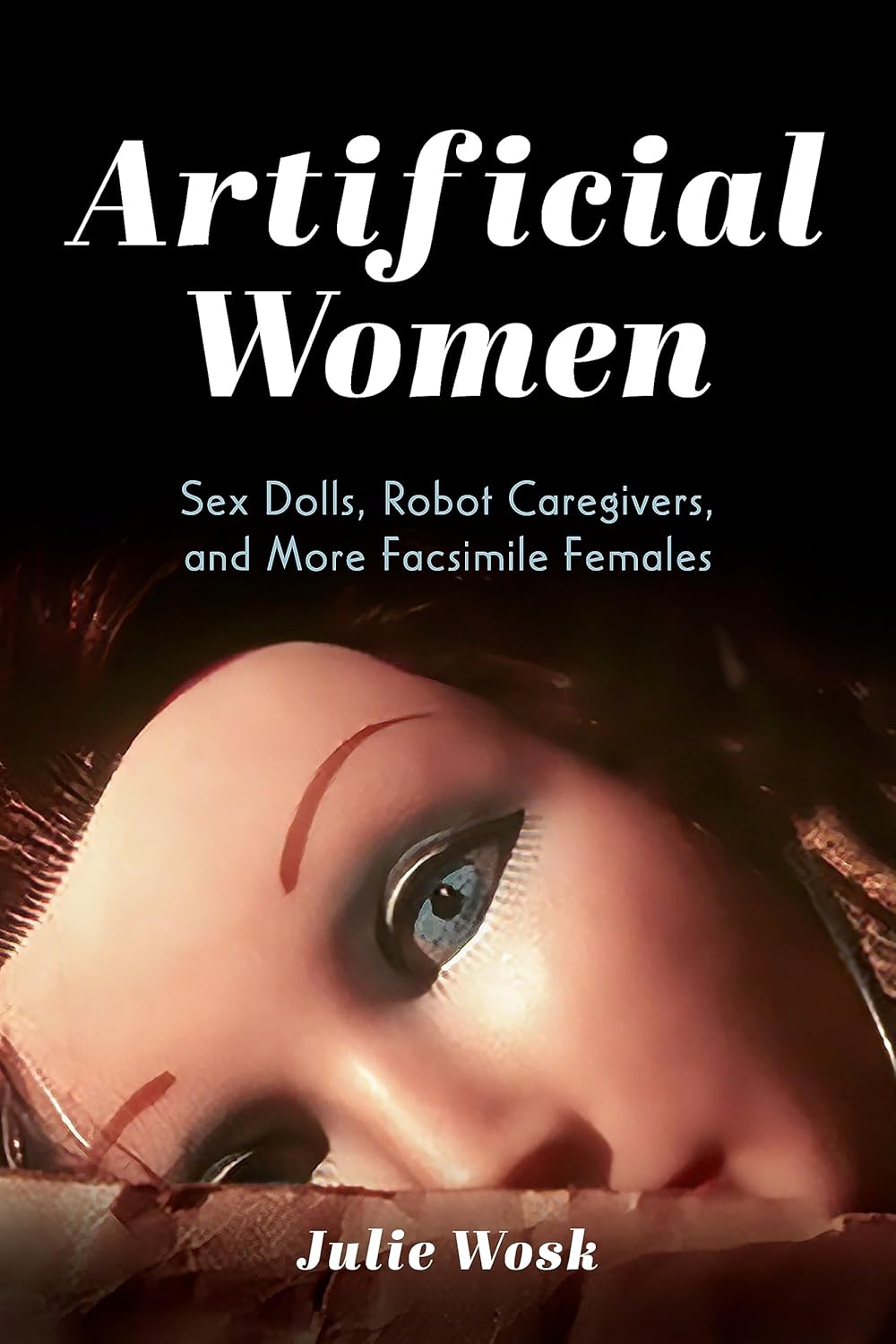
Julie Wosk’s Artificial Women explores society’s enduring fascination with the constructed female–who is created in a variety of guises both in reality and fiction, from embodied machines, automatons and robots, to disembodied AIs and virtual voices. In these techno-re-imaginings of the female as servo-bot, Wosk outlines how cultural understandings of women as passive, giving and obedient are held in tension with the reality of lived female personhood, in which women desire agency and self-determination. The primary questions asked are: In the complex world of technology and gender, how do women combat the cultural proliferation of the female as an exploited identity? How do women intervene in a male-dominated industry of technology and engineering that genders servitude as feminine, reifying women as subordinate to the needs of patriarchy and capital? In Wosk’s readings of the artificial woman, she is not opposed to the creation of the female simulacrum to explore human-machine encounters. However, she does insist that we must create her so that the interface between human and machine will, a) productively and positively rehearse the rightful treatment of women, and b) genuinely foster respect for the human female. However, as Wosk’s book highlights, in the service of male desire and in the pursuit of profit, tech companies and corporate businesses are, for the most part, perpetuating archaic stereotypes of women that continue to distort visions and gender relations and future technology. In this respect, Wosk is a crucial voice for scrutinising and contesting male dominated visions of gender and technology.
Artificial Women begins with a fascinating and compelling introduction that outlines Wosk’s enduring interest in female simulacra in both avant-garde and popular culture. Here, Wosk demonstrates an impressive range and depth of knowledge of the subject in visual, material and literary culture across differing timelines. Following the introduction, Wosk discusses the myriad synthetic females that have been and still are being created and exploited by industry and culture today. In Chapter 1, ‘A New Breed of Sex Robots and Sex Dolls,’ Wosk looks at the female robot and AI as a self-sacrificing sex worker/slave who frequently doubles as an emotional companion. She plays with the stereotype of the ‘tart with the heart’ normalising the male treatment and expectations of such stereotypes in which the human male is put first and women, whether organic or synthetic, second. In Chapter 2, ‘Under the Skin: The Fabricated Femme Fatale,’ the performative masque of the artificial woman as lure and threat is explored through the seductive image of the femme fatale. In this section is the suggestion that the synthetic skin as a progressive development in robot technology is a deception akin to women who are accused of putting on femininity as artifice to distract and subvert for personal gain. In Chapter 3, ‘Female Robot Caregivers, Doubles, and Companions,’ Wosk’s focus shifts towards social and emotional robots envisioned as caregivers and companions to ailing elderly adults and vulnerable children. Extending to narratives of human loneliness brought about by failing health, cataclysmic events and hostile environments, the female robot – in fiction and reality – is a replacement or double designed to mitigate loneliness or protect their human (or humanoid) charge by emulating human empathy and compassion.
In Chapter 4, ‘Paradoxes of Perfection: A Servant No More,’ Wosk takes the reader through cultural anxieties about technology in the home by exploring the female robot as a familial, domestic helper who ultimately becomes either a perceived threat to traditional family relations or threatens to rebel and break free from her servitude. In Chapter 5, ‘Virtual Voices: Talking Barbie Dolls, Alexa, Bitchin’ Betty and More,’ Wosk discusses the cultural history of the talking doll and automaton and its evolution into disembodied voices and computerised companions that serve as assistants in the work and home and fascinatingly as a warning system in domestic and military aviation. The disembodied female is open to abusive treatment, which Wosk discusses in detail, but when contextualised in a more life-threatening setting and safety is of the utmost importance to protect human life, such as in the field of aviation, the virtual female is afforded respect and the authority of her voice being adhered to without question or derision. Finally, in ‘Coda,’ Wosk summarises her book’s premise of humanity’s hope, fascination and anxiety surrounding the figure of the artificial woman. Can the artificial woman produce new and transformative possibilities for humanity? Or will she reify gender roles that reduce women to a commodity in accordance with patriarchal expectations? It is in these closing pages that Wosk calls to women to intervene in the vast array of new robot and AI technologies. Here she provides examples of women who are already doing so as they work to empower and create a space for living in a complex, contemporary world. It is in these final moments that Wosk draws examples from the active work and engagement of LGBTQ+ and disability communities, a springboard perhaps for further work and research for those who negotiate the everyday from a diverse and alternate position of the human.
Julie Wosk’s book is a relevant new addition to the field of robot technology and gender studies. Her work on the artificial is long-standing, and her interests are fuelled by life experiences working in media and magazine culture, art, literature and museums. Artificial Women demonstrates Wosk’s extensive knowledge of the cultural and social history of the artificial woman. It is written for academics and students of visual and material culture and literature and accessible for non-academic individuals who are interested in the subject. It provides a comprehensive source of ideas for those who want to take the discussion further.
Sue Smith is an English Teacher at a Post-16 SEN College in Leicestershire, UK. Her interest is in the representation of gender and disability in American Cyborg Fiction. Her current research article is on the robot psychiatrist in American military medicine and American military science fiction.


