
Non-Fiction Reviews
Review of Utopian and Dystopian Explorations of Pandemics and Ecological Breakdown: Entangled Futurities
Corpus Navalón-Guzmán
Heather Alberro, Emrah Atasoy, Nora Castle, Rhiannon Firth, and Conrad Scott, eds. Utopian and Dystopian Explorations of Pandemics and Ecological Breakdown: Entangled Futurities. Routledge, 2025. Routledge Environmental Humanities. Hardcover. 254 pg. $190.00. ISBN 9781032385914.
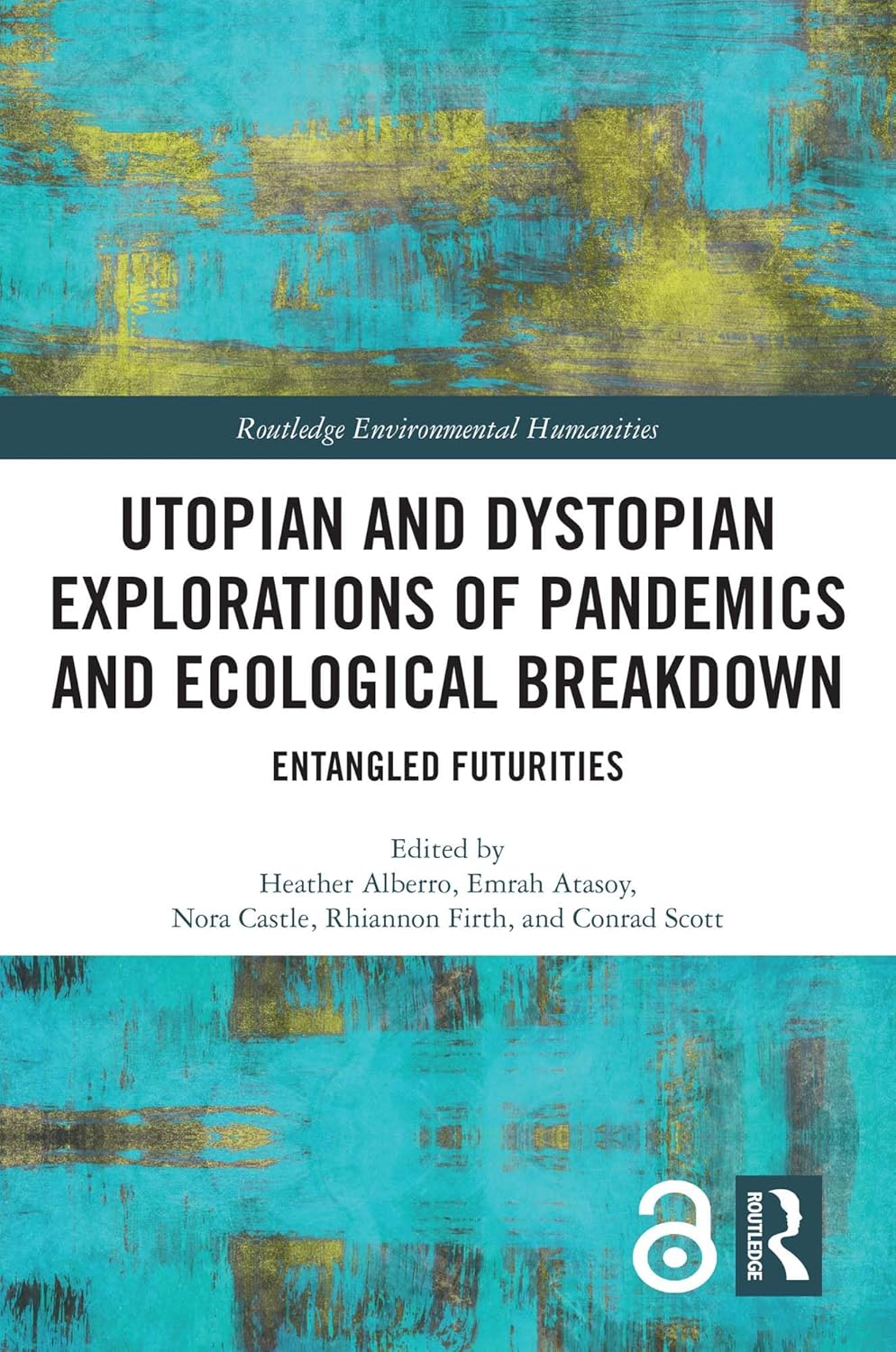
What if the real question cultural artifacts ask after a global catastrophe is not what happened but why do we keep imagining it that way? Utopian and Dystopian Explorations of Pandemics and Ecological Breakdown: Entangled Futurities operates less as a blueprint for the ‘end of times’ and more as a forensic investigation into our collective anxieties, hopes, and failures. It is a kind of whydunit in which the apocalypse is never just an end, but a narrative charged with ideology, desire, and critique. Comprising four major parts, each divided into approximately four chapters, this edited collection catalogues representations of crisis across literature, activism, and performance, interrogating the deeper patterns beneath them. It highlights how cultural production reflects ecological and epidemiological realities, helping us to reimagine what comes next.
Framing the collection within the current world context is a timely and urgent provocation since, even as we appear to teeter on the edge of the so-called posthuman era marked by the collapse of stable binaries, technological saturation, and ecological precarity, we remain deeply entangled in the complex web of humanity. This foundational tension animates the collection’s interdisciplinary inquiry, which employs theoretical frameworks from scholars such as Jason Moore, Karen Barad, and Donna Haraway to explore the ruptures and continuities between the human and the non-human. Concepts such as Moore’s “intimacy, porosity, and permeability,” Barad’s “intra-action,” and Haraway’s “more-than-human” (1) become key tools to unpack how pandemics both reveal and intensify these entanglements. The book’s relevance has only deepened after the COVID-19 pandemic, which has prompted our interconnectedness with microbial and ecological systems in ways we can no longer ignore. The editors are quick to acknowledge that while the volume’s conception was there before the pandemic, its development during this global health crisis makes it a crucial intervention in the present moment. Each section of the book unfolds as an iteration of an ongoing crisis; the sections build upon each other to shed light on how global health, environmental breakdown, and social injustice are not separate but mutually reinforcing.
The editors’ introductory section establishes a theoretical framework that is as ambitious as it is urgent. Rejecting the more familiar language of climate change in favor of the term “ecological breakdown” (5), the editors seek to capture an intricate network of mutually influencing crises: the erosion of biosphere integrity, mass extinction events, and the systemic unraveling of ecological interdependencies. This reframing is not merely semantic since it underscores the collection’s broader commitment to an intersectional analysis attentive to colonialism, capitalism, patriarchy, queerphobia, and human supremacy. While this theoretical section gestures toward concepts from critical posthumanism, such as entanglement, and acknowledges ecological affects like fear and anxiety, its brevity occasionally leaves key theoretical anchors underexplored. Nevertheless, the editors articulate a compelling vision of pandemics as events that rupture rather than reinforce human exceptionalism. Their nuanced treatment of utopia and dystopia similarly resists static definitions, proposing instead a dynamic continuum where dystopic collapse may give rise to fragile yet vital forms of hope.
The first part of the collection, “Monsters and Monstrosity,” draws together a set of chapters that redress the figure of the monster as a key to explore the collapse of boundaries between human and non-human life. Across the three chapters by Tânia Cerqueira, Ujjwal Khobra and Rashmi Gaur, and Timothy S. Murphy, a shared concern emerges with the political and affective work monsters perform within pandemic imaginaries. Rather than framing monstrosity as an object of fear, the narratives explored in these chapters present how figures of contamination, whether viral, ecological, or social, break down with anthropocentric models of agency and citizenship. Cerqueira’s chapter proves foundational, as it introduces the theoretical framework of EcoGothic, a new interpretive lens whereby ecocriticism draws from typical traits from the gothic novel to explain environmentally-related collapse. While Cerqueira leans on gothic and ecological motifs, Kothra and Gaur foreground Braidotti’s politics of otherness. Murphy’s chapter, for its part, pivots toward a more explicit political critique, using Richard Matheson’s novel I am Legend (1954) to illustrate how ecological and social collapse expose the fragility of dominant power structures, particularly when the majority finds itself displaced. When read together, these chapters not only stage an encounter between historical materialism and new materialism but also signal the collection’s broader project: envisioning forms of posthuman belonging in the ruins of familiar worlds.
If part one foregrounds monstrosity as a rupture in the human/nonhuman divide, part two recalibrates this tension through the lens of intersectionality. What emerges from the chapters in “Intersectional Critique” is a sustained interrogation of how posthuman ecologies are never experienced abstractly but mediated through histories of dispossession, gendered embodiment, and racialized vulnerability. Crucially, these essays do not deploy intersectionality as a stable lens. Rather, this framework works as a moving analytic that constantly shifts according to context. Legatt’s discussion of “fungal capital” (71) in HBO’s TV show The Last of Us (2023–) and Ling Ma’s novel Severance (2018) underscores how capitalist flow masquerades as disorganized rhizomes that subtly reproduce hierarchies of value and access. However, these rhizomes also embody the potential for radical horizontal solidarities that surface in crisis. Benjamin Burtt’s reading of Joca Reiners Terron’s novel Death and the Meteor contrasts this view by foregrounding the Indigenous experience of ongoing apocalypse as colonial continuity, not rupture, and evokes ritual, not resilience, as a form of collective refusal. Meanwhile, González-Bernardez and Rossi’s respective chapters resist the treatment of nature as passive terrain: in Naomi Novik’s Uprooted (2015) and Sophie Mackintosh’s The Water Cure (2018), the nonhuman world functions as a volatile ethical subject where vulnerability emerges not as a weakness but as a condition for political transformation.
The third part of this collection critically interrogates the concept of mutual aid, particularly in its intersection with ecological justice. COVID-19 put mutual aid into the spotlight but stripped it of its radical roots to serve the political elites as a mask to state failures. Yet, the contributions of this section return to the concept’s original transformative potential, expanding the boundaries of mutual aid beyond human-centric frameworks. Curtis’ chapter explores post-pandemic science fiction to reveal how the genre’s preoccupation with environmental justice urges a shift from survivalist thinking toward proactive frameworks that seek justice for both human and non-human life. Similarly, Horn, Martin, and Seville’s analysis of Charles Burns’s graphic novel Black Hole (1995) shows how the viral transmission of a sexual disease turns into an agent of transformation that fosters posthuman sensibility. Both analyses critique anthropocentric, capitalist frameworks that isolate humans and their environments, urging instead a radical reimagining of interdependent solidarity. Grześkiewicz and Boschen’s chapter also adds to this critique by underscoring the destructive effects of state-imposed borders and the potential of more-than-human solidarity in resisting it. Collectively, these chapters foreground that more-than-human mutual aid does not simply offer an antidote to neoliberalism’s failures but a push for radical ecological and social justice that embraces a multispecies, interconnected world.
Part four, “Creative Resistance and Utopian Glimmers,” turns away from critique as diagnosis toward critique as creation. This section assembles a set of chapters that treat culture as a mode of political and ecological practice. Throughout these chapters, utopia is not presented as a distant concept, but as a set of situated, messy practices: DIY music enclaves, pandemic theater, and youth-led climate action. Moreover, these contributions offer a sustained interrogation of how aesthetics and performance can resist the logic of legal, spatial, ecological enclosure and foreground relational forms of agency. Käkelä, Breemen, Yağcıoğlu, and McKnight all push back against narratives of apocalyptic finality, opting instead for a speculative mode rooted in entanglement between humans and more-than-human actors, between past devastation and future invention. Importantly, these chapters do not romanticize resilience or prefiguration. Their focus is instead on how minor gestures, or “micro-utopias” (215) as McKnight calls them, can reorient perception and shape collective imaginaries. Nonetheless, a critical tension persists: can cultural resistance unsettle the infrastructures of surveillance, control, and commodification it navigates? Or does it risk being reabsorbed as aesthetic capital in the very systems it critiques? This section insists that utopian thinking must remain alert to this paradox, which is at once generative and complicit, speculative and material.
In sum, Utopian and Dystopian Explorations of Pandemics and Ecological Breakdown is a timely and thought-provoking collection that does more than analyze crisis. It dwells in it, navigates through it, and asks what forms of thought and practice might still be possible from within wreckage. There is something about this collection that sets it apart from others. It refuses to offer simple solutions or neatly packaged theories. Instead, it models a form of scholarly engagement that is porous, speculative, and deeply rooted in the urgency of our current moment. Whether discussing plague literature, performance during lockdown, or youth climate movements, these contributions do not deliver definite conclusions. Rather, they equip readers, especially scholars, students, and artists, with conceptual tools to rethink what critique, resistance, and creativity can mean in a world shaped by ecological collapse and viral entanglement. In that sense, it is not just a collection of essays but an invitation to reimagine how we live, relate, and create in times of crisis.
Corpus Navalón-Guzmán holds a PhD in English Literature and Culture from the University of Murcia, where she completed her dissertation on queer trauma in contemporary Anglophone literature and cinema. She has been a visiting researcher at the University of Northampton and Ghent University. Her research interests include queer theory, trauma studies, childhood studies, and cultural studies, with a focus on the representation of queer trauma in literary and cinematic texts.


