
Non-Fiction Reviews
Review of Folk Horror on Film: Return of the British Repressed
Brontë Schiltz
Louis Bayman and K. J. Donnelly. Folk Horror on Film: Return of the British Repressed. Manchester University Press, 2025 Paperback. 264 pg. $33.99. ISBN 9781526191205.
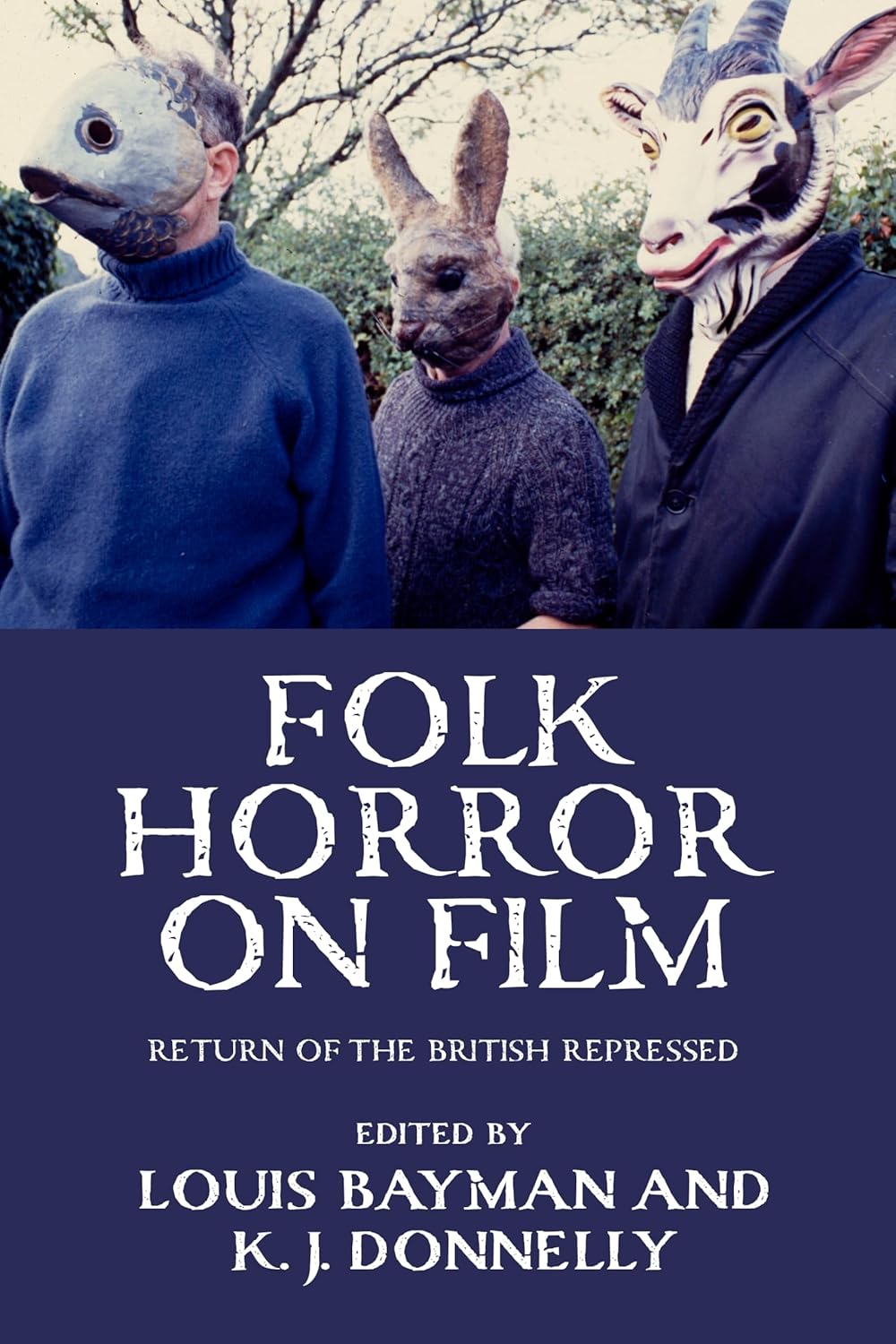
Although use of the term ‘folk horror’ has been traced back to 1936, it was not until the twenty-first century that it entered the critical lexicon, used by director Piers Haggard to describe his 1971 film Blood on Satan’s Claw in 2003, and then by actor, writer and director Mark Gatiss, with reference to Haggard’s film as well as to Witchfinder General (1968) and The Wicker Man (1973), in the 2010 documentary A History of Horror. Folk Horror on Film: Return of the British Repressed, edited by Louis Bayman and K. J. Donnelly and recently released in paperback following its 2023 hardback publication, delves deeper into this now canonised triad, but also reaches back to Night of the Demon (1957) and forward to Apostle (2018), and examines films more typically associated with other genres, such as the science fiction thriller Doomwatch (1972). Comprising fourteen chapters, the book begins with debates on The Wicker Man—today the best-known of the “unholy trinity” (Scovell, 8)—followed by analysis of the titular ‘Return of the British repressed,’ and, finally, of ‘Folk horror’s cultural landscapes.’
Adam Scovell’s Folk Horror: Hours Dreadful and Things Strange (2017) sparked new interest in folk horror, which Scovell theorised not as a subgenre or (as is often the case in Gothic studies) a mode, but rather as a “chain” that links “disparate forms of media through their summoning of … themes and ideas,” including isolation, unsettling landscapes, “a skewed belief system or morality,” and a “happening” or “summoning” (Scovell, 17–18). As Bayman and Donnelly observe, “folk horror is of the folk themselves, and of the wider conditions that sustain their existence” (5). As the unity of the United Kingdom disintegrates, with 54% of Scottish adults favouring independence as of March 2025 polling and thousands of farmers protesting proposed changes to inheritance tax in the English capital in 2024, British folk horror’s interrogation of national identity and evocation of metropolitan anxieties concerning rural communities are increasingly relevant. This collection thus offers politically as well as academically significant theorisations of such cultural products.
The opening three chapters probe The Wicker Man’s religious ideologies. While Ronald Hutton identifies a representation of “paganism as dangerous in a way that either Christianity or modern scientific scepticism are not” (34), Laurel Zwissler reads the film as offering “a carnivalesque experience for viewers, both Pagan and otherwise” (51). As Miken J. Koven notes, however, the word “Pagan,” derived from “[t]he Latin pagamus,” which “simply meant rural,” was later “further applied to designate between dichotomies of … Christian/non-Christian,” and as a consequence, “to identify as Pagan is nonsensical because to do so would be to recognise the hegemonic power of the Church” (58-9). Such varied perspectives exemplify the collection’s excavation of the complexity of Britain’s cultural and mythological history.
Derek Johnston begins the following section with an interpretation of “folk horror communities as microcosms of the wider nation,” particularly in their “reproduction of a form of class system” (79). Dawn Keetley likewise attends to capitalism’s influence, reading Doomwatch as centrally concerned with “the life-destroying sickness of global modernity that dooms land and people alike” (89). In his analysis of Requiem for a Village (1975), Paul Newland similarly identifies the locus of horror not in the film’s undead, but in its “faceless, gigantic mechanical leviathans” (109). But the past is as threatening as the present. Donnelly reads folk horror “as a form of historicism,” revealing “a forgotten – and happily forgotten – heritage” (117) and producing “an ‘outsider’ version of Britain’s history” (129). As Beth Carroll argues, however, folk horror’s relegation of regions beyond “England, and arguably even more specifically the south of England and London” to outsider status (131), rather than contesting this traditional hegemony, instead “assume[s] an English framework and mode of viewing” (144), reinforcing existing power structures. Amy Harris’ examination of folk horror as “defined by androcentrism” (152), meanwhile, brings vital attention to the Othering of women in the folk horror tradition – a form of exclusion endemic not just to British history, folklore and folk horror itself, but also to related academic discourse. The ‘British repressed’ of the collection’s title thus emerges as referring less to marginalised communities than to the actual processes of marginalisation – geographic, socioeconomic and gendered – that have shaped British history at the level of both content and methodology.
In the final section, David Evans-Powell and Mark Goodall explore the ascription of “agency, sentience or autonomy” to landscapes (Evans-Powell, 178) and “to the built-up environment, liminal areas and technology” (Goodall, 211) in traditional folk horror and what Goodall terms the “urban wyrd” (211). This transgression of the boundaries between the animate and the inanimate is mirrored by a coalescence of the diegetic and non-diegetic. Goodall notes that the rape scene in Blood on Satan’s Claw is “filmed voyeuristically[,] forcing the viewer to be almost party to the crime” (214), while Lyndsay Townshend explores the role of drums in “conjuring … community, bodily affect and fear” (164), acting “as a sonic identifier for a human heartbeat” (175) that encourages corporeal identification in viewers. Diane A. Rodgers also considers audience response in her analysis of the “wyrd,” which she suggests generates “a general sense of brooding fear” (225). As well as cultural, theological and historical frameworks, then, the collection also attends to audience studies—a growing area of academic interest that is essential to analysis of texts so concerned with emotion, corporeality and communality.
WORKS CITED
Scovell, Adam. Folk Horror: Hours Dreadful and Things Strange. Auteur Publishing, 2017.
Brontë Schiltz is a PhD candidate at Manchester Metropolitan University, England. Her work has been published in The Sibyl, Fantastika Journal, Aeternum Journal, SIC Journal, Revenant Journal and Horrified Magazine, as well as several edited collections. She features on documentaries and commentaries on Hammer’s 2025 rereleases of The Quatermass Xperiment and Quatermass 2, and has appeared on podcasts including Victorian Legacies, The Ghost Story Book Club, The Death Studies Podcast, BERGCAST, There’s Not Always a Twist, The Folklore Studies Podcast and Scarred for Life. She is the members coordinator of the International Gothic Association and principal editor of Hive Journal.


