
Fiction Reviews
Review of Tomorrow’s Parties: Life in the Anthropocene
Peter Sands
Strahan, Jonathan. Tomorrow’s Parties: Life in the Anthropocene. MIT, 2022.
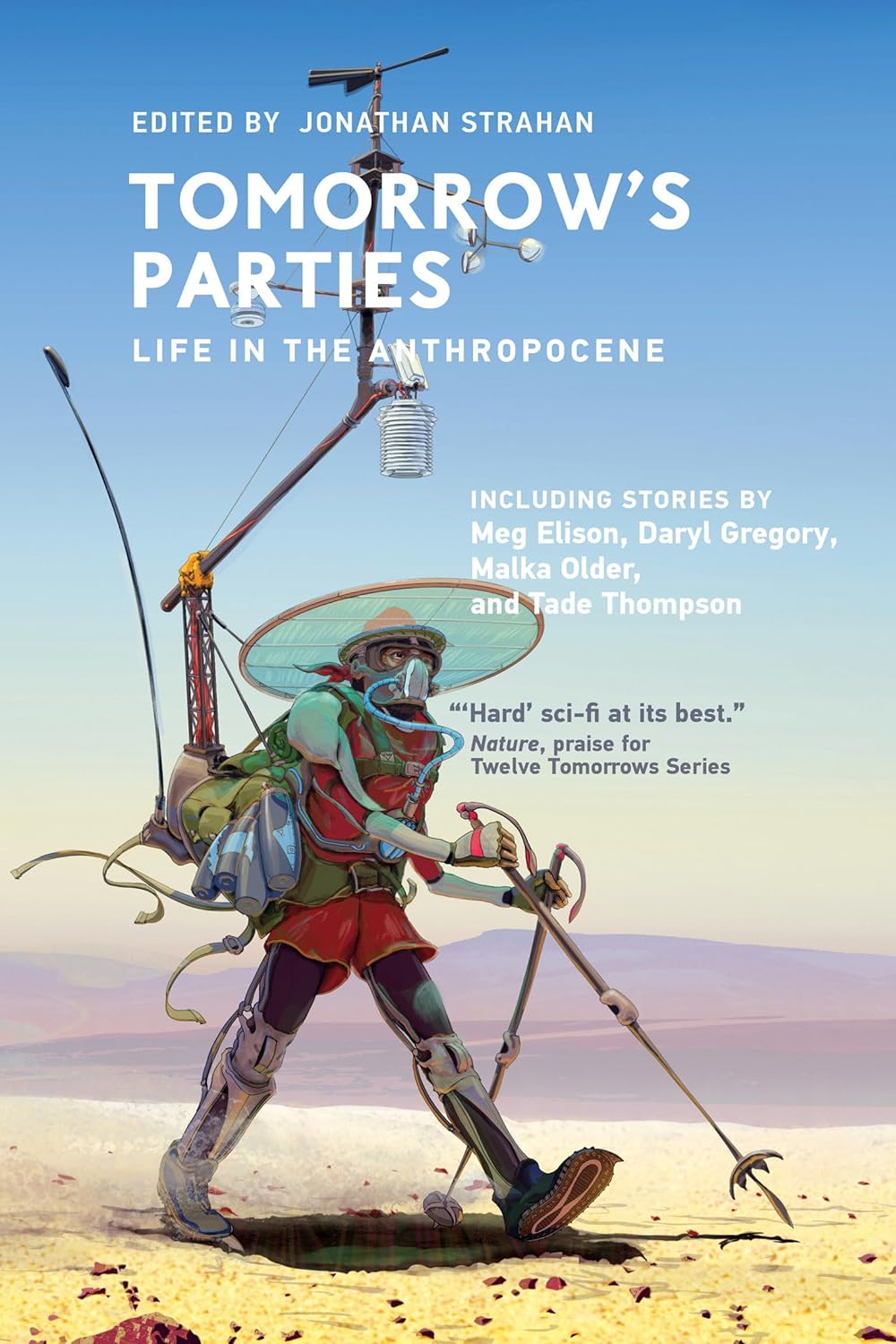
Tomorrow’s Parties is the eighth installment in an MIT anthology series published in one form or another since 2011, often with distinguished editors and featuring well-known authors engaging with contemporary technologies. This volume is edited by Jonathan Strahan, an award-winning anthologist and veteran editor based in Australia. It features writers from Australia, Bangladesh, China, the UK, and the United States, and begins with an interview between James Bradley, a novelist and critic, and Kim Stanley Robinson, the most important writer of science fiction in the utopian vein working today. The remaining ten stories and one short essay contextualizing the artwork provided by Sean Bodley are workmanlike engagements with the Anthropocene, including contributions from very familiar names, including Tade Thompson and Greg Egan. Some readers may enjoy its aesthetic or speculative qualities, but its true value would be as a classroom text.
Bradley interviewed Robinson in 2021, not long after his Ministry for the Future (2020) was published, and during the COVID pandemic, both of which are given as contexts, along with climate change records being set, and the January 6th attack on the United States Capitol as elements sharpening their sense of crisis. Robinson’s answers to Bradley’s questions cover many themes he has developed in longer essays, noting for instance that the pandemic has brought people to a better understanding “that we are indeed in a global civilization” (13; all citations are to a PDF review copy, so pagination in print may differ). He tells us that “[a]s prophecy, SF is always wrong; as metaphor, it is always right, being an expression of the feeling of the time of writing” (14). Much of the rest strikes familiar notes: there is a “science versus capitalism” moment in history, with the two “arm-wrestling for control” (17) and the institutional structures (science) have to be strengthened to combat “all the older power systems of the few over the many” (capitalism) if humanity is to have hope in the changed future of the Anthropocene (18). Elsewhere, Robinson offers expected recourse to law and legal institutions as bulwarks against the predations of capital (19-20) and against “old-style violent revolutions” (22). In a striking bit of understatement (from my perspective in late 2025 and early 2026), he says, “I think it really is a crux moment in history. The 2020s are going to be wild” (26). Robinson’s answers to Bradley’s queries are as always cogent, but do not bring to light anything like a new position. Still, as clear statements of his positions, they are pretty hard to beat.
The strongest stories in the volume are powerful studies of affect in the face of environmental disaster, sometimes framed or assisted by extrapolated technologies, but mostly given power by the sense of wrack and ruin—if not quite the end of the world, a significant step toward a fundamentally altered future—that surrounds the characters. Tade Thompson’s evocative “Down and Out in Exile Park” sets his characters mostly in a gigantic island of floating plastic that has been urbanized and settled by societal outcasts off the coast of Lagos, Nigeria; Greg Egan’s “Crisis Actors” gives an unsettling look at what happens when the conspiracy-minded confront immovable realities that contradict their views; Justina Robson’s “I Give You the Moon” plays out a late-life love story inside a frame of climate-altered economies and advanced technologies; and Malka Older’s “Legion” gives a tense, unnerving glimpse of the possibilities offered by surveillance technologies and crowdsourcing for combating the intractable threats posed by men against women the world over and across all epochs. Two stories stand out for their evocation of place and affect: Chen Qiufan’s “Do You Hear the Fungi Sing?” and James Bradley’s “After the Storm.”
Quifan, translated by Emily Jin, imagines a village in China some time after 2060 in which a “hypercortex network” is being laid over the actual physical geography of the country to create a parallel AR system for real-time adjustments to climate-impacting human activities. One of the few remaining blind spots in the country turns out to be a remote, matriarchal village that resists the encroachments of modern technologies separating humans from the natural world. The villagers of Baenl are in a symbiotic relationship with the vast mycorrhizal fungi network around them, using fungi for food production, building materials, even electricity generation. Su Su, a woman sent to the village to convince them to permit the hypercortex technology to be located there and map their territory, gradually becomes part of their society, returning her to a balanced relationship with herself and with nature (aided by a mushroom-fueled psychedelic experience, naturally), that reveals the true hypercortex of fungi networks under the earth. “Symbiosis was the way of life,” she realizes (215). She is given a gift of insight into the true network: “Like the duet in her dreams, she was meant to bring them all to perfect synchrony. In a future like that, humans would be endowed with the wisdom to restore and sustain the delicate balance between nature and technology, saving the fragile blue planet that they— alongside a multitude of other beings—cherished as home from destruction” (219) and must remain in the village as a conduit for older ways of knowledge to save the future of humanity.
In “After the Storm,” we get a complex, multigenerational story of alcoholism, abandonment, loss, and redemption in the frame of an Australia ravaged by rising seas and temperatures about twenty years from now. It could easily be a piece of contemporary realist fiction and indeed ends on a note of ambiguity and shared pain, but it is helped along throughout by the unraveling social and economic fabric in the wake of climate-intensified storms.
At the outset, I said I could see this more as a classroom text than anything else, and I want to revisit that comment. There are no stories in here that I think would be award contenders, but there are also no stories here that I could not use in a classroom to engage with the effects of climate change or the trajectories of technologies and adaptations we might extrapolate from today to the world of the next few decades. There are some standout moments—Tom Hanks as a possible cannibal, eating a synthetic Bronson Pinchot resonates with readers of a certain age; the creeping realization that being a creep is no longer to be tolerated in an age of cheap and widespread surveillance—and the stories do model something more than solarpunk or hopecore fantasies. Strahan writes in the introduction of seeking to create a volume that is “a little sad, a little elegiac, a little hopeful,” which today, in the wake of COVID, January 6th, and now the wholesale undermining of renewable energy and post-war consensus politics, would be a good place to begin a discussion with the students who will live in tomorrow’s parties.
Peter Sands is Director of the University of Wisconsin-Milwaukee Honors College and associate professor of English. He primarily teaches utopian and dystopian literature, science fiction, and American literature courses. His research includes work on white representations of Native American otherness in nineteenth-century literature, utopian and dystopian responses to racial and class divides from the nineteenth century to the present day, and work on the slow food and related slow movements as alternatives to contemporary social and economic frameworks that particularly empower non-dominant communities to resist global inequities and imagine possible worlds.


