
Fiction Reviews
Review of Saltcrop: A Novel
Sarah Nolan-Brueck
Kitasei, Yume. Saltcrop: A Novel, Flatiron Books 2025.
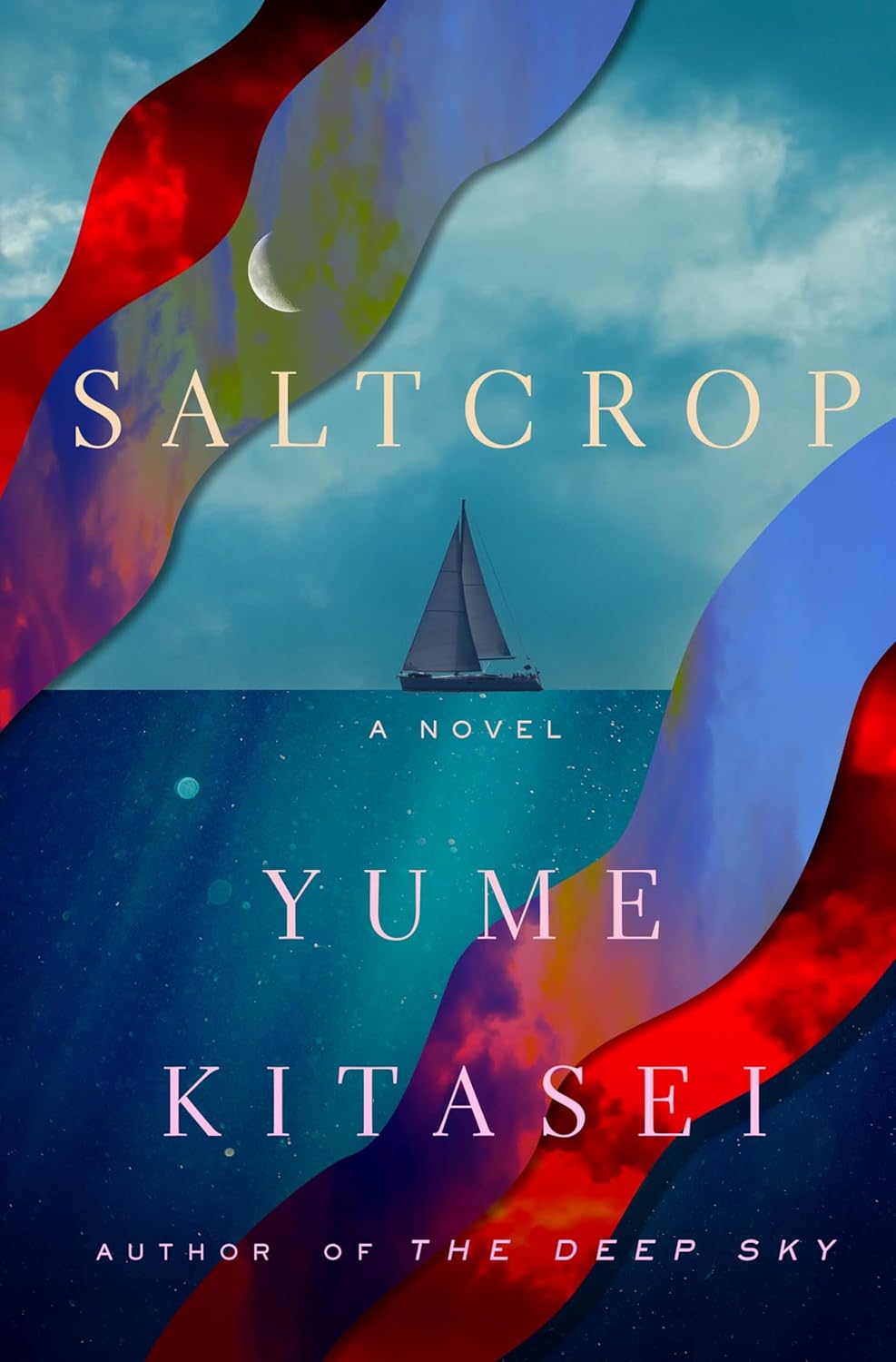
Saltcrop is Yume Kitasei’s latest novel, her third in three years, which turns its attention away from the author’s former interest in space narratives and towards the displaced landscape of our own planet. The book is evenly cleaved in three portions, each narrated by one of the main characters: Skipper, Carmen, and Norah, who are all sisters. Skipper, the youngest, begins the tale, revealing the shrunken parameters of life in her resource-drained, barely disguised U.S. context. Skipper is the youngest and seems to be the least successful of the sisters; where Norah has moved to the city for a fancy research job, and Carmen has just secured a new job as a nurse, Skipper makes her living scavenging, skimming the ocean in her little boat and bringing back once-treasured trash. That is, until she discovers that her oldest sister, Norah, has disappeared. Skipper is intent on finding her, and Carmen—the responsible but somewhat intolerable sister—invites herself along for the voyage. The second section, from Carmen’s point of view, describes life after making ground across the ocean, when the sisters must work at a remote seed vault for incredibly low wages and hope to both solve the mystery of where Norah went and figure out how to follow her with so little resources to barter. The last section, from Norah’s point of view, reveals much of the vault’s secrets and of the sisters’ own history and destinies.
Like Kitasei’s previous novels, The Deep Sky (2023) and The Stardust Grail (2024), Saltcrop meditates on the unique bonds that spring up in the wake of collapse and acts of valor that have domino effects, changing and saving the lives of many. Here, however, she dives more deeply into the oil-slick evil of corporate greed, giving an all-too realistic portrayal of how agricultural companies might leverage their power when food becomes scarce. The seed vault, no doubt inspired by the Svalbard Global Seed Vault, is an especially potent object and setting here. Other recent novels, like C. Pam Zhang’s Land of Milk and Honey (2023) and Charlotte McConaghy’s Wild Dark Shore (2025), have similarly depicted agricultural arks as symbols of misplaced faith. The vault, meant to be a bastion of hope, becomes the ultimate symbol of this world’s moral failure. It is run on wage slavery and secrets that cast doubt on the benevolent agricultural company, Renewal, which has been keeping the world alive during a series of increasingly aggressive blights.
Though the novel focuses on the pain and beauty of the sisters’ sacrificial care for each other, I found the most moving portion of the book to be Skipper’s description of the enormous trash pile she and Carmen discover on the ocean. The list is reminiscent of the lost treasures Emily St. John Mandel catalogues in Station Eleven (2014), but where Mandel records the many nostalgic experiences that have vanished from the post-apocalyptic world, Kitasei makes it clear just how many things lose their meaning and remain, sickeningly, to outlive the humans who once believed them precious. She describes the floating debris as “the detritus of everything that has ever been loved and bought and consumed by people”:
cat toys, dog toys, sex toys, fidget toys, baby toys, water bottles, suitcase wheels, an infinite number of pens running out of ink at the moment its user needed to write, telephones with curly cords, flip phones, smartphones and the oversized boxes they came in, clocks that never got someone somewhere when they needed to be there, microwaves, hangers, rubber duckies, packaging from favorite snacks, jewelry bought by teenagers with the first money they earned themselves… (150)
The list goes on and on, filling an entire page and overwhelming the reader with a mountain of beloved trash. Giving the trash all the heartbreaking banality it entails, Kitasei writes, “It is the last two hundred years of human history come to rest in the great gyre compressed into one, singular, cacophonous moment” (150). Kitasei puts Skipper and Carmen’s high seas adventure and search for their sister on hold to imagine our society’s watery grave, a swirling, beautiful pile of filth.
After the delightful surprise of Kitasei’s generation starship debut, The Deep Sky, and the space-alien-heist romp of The Stardust Grail, I’ll admit to some disappointment concerning Saltcrop, which felt much smaller, more mundane and shackled to the earth. Upon reflection, though, I can see how this focus on the ordinary is meant to push at a different sort of adventure, one that takes even more courage than venturing into outer space. This is the adventure of, as Donna Haraway puts it, staying with the trouble, an exercise that:
requires learning to be truly present, not as a vanishing pivot between awful or edenic pasts and apocalyptic or salvific futures, but as moral critters entwined in myriad unfinished configurations of places, times, matters, meanings. (1)
Here, Haraway expresses her frustration with two, too-simple responses to Anthropocene terror: first, the faith in a deus ex machina, that either a machine or the return of literal god will save us; and second, the more insidious belief that it is too late to stop the consequences of our actions, and we should accept inevitable doom (3). While narratives of galactic adventure and alien contact scratch an escapist itch while still critiquing things like environmental decay and xenophobia, Kitasei’s Saltcrop strikes a hard note in favor of imagining the world as it will be for those who stay, who are born into the trouble and must make their lives within it.
In the end, Saltcrop is a novel that answers Imre Szeman’s call for “narratives that shake us out of our faith in surplus…by tracing the brutal consequences of a future of slow decline, of less energy for most and no energy for some” (325). Skipper, Carmen, and Norah’s world displays an intensification of our contemporary worries, particularly surrounding climate change and corporate overreach, and gives us a recognizable future of decline. Such a world becomes localized, with concerns and horizons shrinking down to the community level, which makes Skipper and Carmen’s voyage across the ocean all the more daring and all the more terrifying.
WORKS CITED
Haraway, Donna J. Staying with the Trouble: Making Kin in the Chthulucene. Duke University Press, 2016.
Laurie Shannon, Vin Nardizzi, Ken Hiltner, Saree Makdisi, Michael Ziser, Imre Szeman and Patricia Yaeger. “Editor’s Column: Literature in the Ages of Wood, Tallow, Coal, Whale Oil, Gasoline, Atomic Power, and Other Energy Sources.” PMLA, March 2011, Vol. 126, No. 2 (March 2011), pp. 305–326.
Sarah Nolan-Brueck is a PhD candidate at the University of Southern California, where she studies how science fiction authors critique medical legislation that restricts diverse gendered groups in the United States. Sarah was a 2024 Le Guin Feminist Science Fiction Fellow at the University of Oregon. She has been previously published in ASAP/J, Utopian Studies, Orbit: A Journal of American Literature, Extrapolation, and Huffpost.


