
Fiction Reviews
Review of A View from the Stars
Zichuan Gan
Liu, Cixin. A View from the Stars Tor Books, 2024.
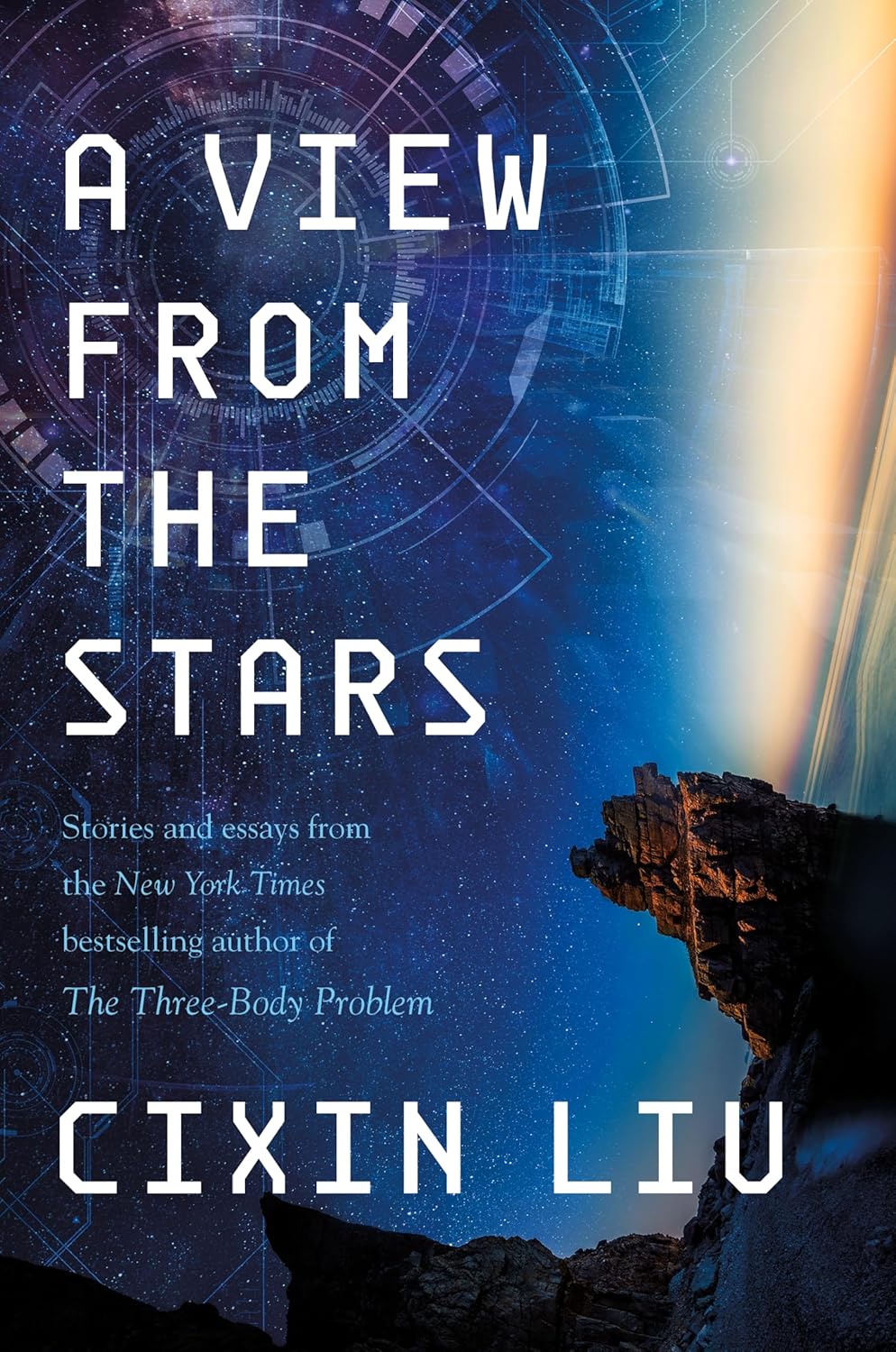
A View from the Stars is a rich collection of Liu Cixin’s essays and short fiction in translation. Bringing together six short stories and thirteen essays, the volume offers readers a multifaceted portrait of Liu Cixin not only as a major writer but also as a reflective commentator on his own creative practice and on the development of science fiction as a genre. The fiction stories included in the collection were originally published around 2000, and most of the essays date from the early 2000s to 2015. While the collection is not organized by the chronology of the original Chinese publications, its arrangement foregrounds the breadth of Liu’s intellectual thinking and the range of his literary imagination.
The fiction in the collection engages questions of technology and development, and each story emphasizes different concerns. “Whale Song” and “Butterfly” point to two political events around the turn of the millennium, respectively: the anti-whaling movement and the political upheavals in Yugoslavia. “The Messenger” takes the form of a quasi-historical fantasy, imagining the evolution of physics theory through a figure suggestive of Einstein. “End of the Microcosmos,” “Destiny,” and “Heard It in the Morning” are comparatively less marked by historical specificity, and they speculate respectively on theories of microscopic particles, space-time, and cosmological models. The essays in the collection illuminate Liu’s relatively under-discussed professional trajectory from a science fiction fan to one of the most representative writers of Chinese science fiction, as well as his creative process and a more humble, even vulnerable side of himself when confronting fundamental philosophical questions. For instance, essays such as “Time Enough for Love,” “A Journey in Search of Home,” and “Thirty Years of Making Magic Out of Ordinariness” discuss Liu’s first encounters with science fiction, how he developed an interest in the genre, the difficulties he faced in publishing during his early years as a writer, and the material circumstances behind his decision to writing science fiction at different moments in his life. In essays such as “The ‘Church’ of Sci-Fi” and “Civilization’s Expansion in Reverse,” he addresses philosophical themes explored in his works and his methods of writing science fiction, particularly on how to represent a sense of awe toward the cosmos and the unknown in science fiction stories. Across these essays, Liu also repeatedly comments on the state of the Chinese science fiction industry. For example, in “On Ball Lightning, An Interview with Liu Cixin,” originally published in 2004, he offers predictions about the future of Chinese science fiction that, in retrospect, seem strikingly prescient.
It is worth noting that the stories and essays included in this volume primarily foreground Liu’s writing before The Three-Body Problem achieved international success. In these relatively early works, one can trace Liu’s fiction writing from comparatively single-dimensioned storytelling to a more multilayered approach to worldbuilding. The essays in the collection supplement this trajectory by presenting, in more analytical terms, his reflections on science fiction as a literary practice. When discussing the history and development of Chinese science fiction, Liu frequently contrasts the genre with “mainstream literature,” by which he means the realist tradition that has dominated Chinese literature since the early twentieth century. Prior to the 2010s, science fiction occupied a more or less marginalized position within the Chinese literary field; these texts therefore register Liu’s concern for the future of Chinese science fiction as a genre and his efforts to articulate its distinctive epistemological force as a means of legitimizing it.
For scholars, this collection provides excellent primary material for understanding both the worldbuilding of Liu’s fiction and the historical conditions under which his works emerged. Some of the essays in the collection—especially those originally published on internet forums and blogs around 2000—are particularly valuable, as this kind of text has become more difficult to access amid tightening publishing censorship in China today. One shift in Liu Cixin’s thinking that can be traced through the selected essays is especially noteworthy. In “Civilization’s Expansion in Reverse,” written in 2001, Liu argues that if human civilization were to expand outward, the resources of the solar system would not be sufficient to sustain human consumption; thus, one possible response, he suggests, would be for humanity to intervene technologically in its own evolution and thereby reduce its biological scale. Yet a decade later, in “One and One Hundred Thousand Earths,” written in 2011, he speculatively suggests that expansion into outer space might offer one possible solution to the survival crisis humanity faces as a result of environmental changes on Earth, and that the resources of the solar system would be sufficient to sustain the population of a hundred thousand Earths. My intention in highlighting this shift here is certainly not to moralize either perspective—after all, in the original texts, these ideas function more as thought experiments than as serious judgments—but rather to suggest that it exemplifies the productive tension between competing currents of thought within Chinese science fiction. Such tensions have been central to the emergence of the remarkable boom in Chinese science fiction we witness today.
The texts in this collection are, for the most part, written in the grand narrative mode for which Liu is best known: a mode concerned with civilization, humanity, and the future on a grand scale. Readers can clearly discern the influence of generic forms of canonical Western science fiction on Liu’s writing. At the same time, Liu’s specific concerns and lines of inquiry remain grounded in the realities of China, including the economy of the Chinese science fiction industry and the practical and historical-political considerations shaping publication. Overall, this accessible volume is a valuable resource for understanding both the history and development of science fiction in China and the study of Liu Cixin and his works.
Zichuan Gan is a PhD Candidate in Comparative Literature at the University of Toronto, with a specialization in Women and Gender Studies. His research and teaching engage literature, digital media, and popular culture, with a particular focus on contemporary Chinese science fiction and modern Chinese cultural production.


