
Fiction Reviews
Review of Bee Speaker
Zorica Lola Jelic
Tchaikovsky, Adrian. Bee Speaker Head of Zeus, 2025.
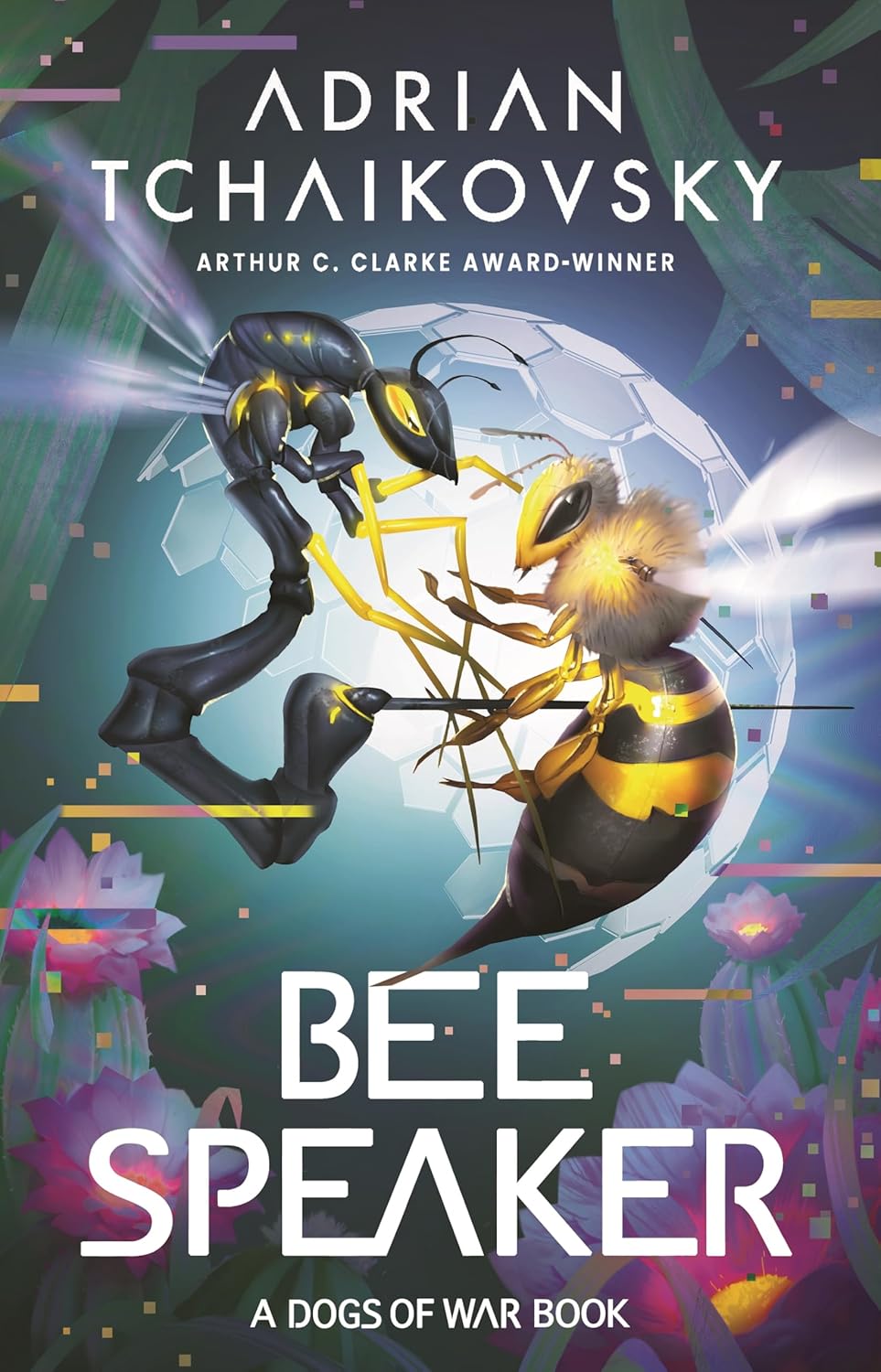
Bee Speaker is the third book in the Dogs of War Series: it follows the development of bioforms (genetically modified, enhanced, and sentient beings) and presents a certain homage to bees without which there is no life for humans. The first book shows the growth of bioforms from mere weapons to entities who develop moral agency while the second book focuses on the secluded evolution of bioforms and humaniforms (enhanced humans) adapted to live on Mars. Bee Speaker takes place some two hundred years after the second book, and it begins with a received signal for help from Earth. Mars has not changed ecologically, but life has adapted to it with the help of distributed intelligence (DisInt/AI) –Bees. It is relatively peaceful, and everyone has learned how to depend on one another. Bioforms and humaniforms do not remember life on Earth; they have forgotten how treacherous humans can be. This naïve approach to life leaves room for error when they decide to travel to Earth in order to help Earthly Bees. On the other hand, life on Earth has regressed to some form of cut-throat dystopian world in which Bunker-folk, unarmed villagers, atheistic monks (the keepers of knowledge), bioforms, clones, and other DisInts have painstakingly achieved some kind of fragile détente solely based on transactional dependency through which everyone has something that the other needs. Information is the greatest asset, and trust is a word in which no one believes. Therefore, when the crew consisting of two humaniforms and two bioforms (a dog and a dragon) arrives on ancestral turf and expects to connect the two parts of humanity, everything goes awry, and they find themselves in a hostile environment with an unknown entity pulling all the strings.
Tchaikovsky presents a highly imaginative world, which in reality is very hard to imagine. For the reader, it is difficult to visualize the modified beings, the advancement of technology, and the sentience of dogs and dragons. Once again he plays with the “what if” of science fiction and takes bioengineering to a level that has the reader questioning the ethics of such scientific growth. Just because something can be done does not mean that it should be done. It is interesting that the reader’s empathy does not waver when it comes to the actions and wellbeing of the bioforms because from all the entities that are bound in the local mess of misunderstandings and manipulations, the actual humans are the ones who are the least likeable characters. This raises the issue of what it truly means to be human and who is capable of moral agency in this story. Every character believes that they deserve moral consideration, but only the humans and the Earthly Bees (the corrupt AI) refuse to acknowledge the worthiness of the other’s life. Earthly Bees is an entity that is only looking out for herself/itself and how to survive. Bees does what it needs to in order have everyone under her/its control. The humans are no better. For example, they cut off the arms and legs of their leader, Josh Griffin III (so he cannot run away), and keep him connected to a machine in order to harvest his enriched blood.
Yet, the crux of the story is the the moment humans realize that they need Martian Bees (AI) to make sense of their world and guide them towards prosperity, peace, and coexistence. Bees will organize their lives, communicate with the outside world, and create a more promising future for all involved. It follows that this advanced AI has more rationale than the humans do. Still, it is unknown whether Bees will have moral agency. Bees will see if it will at some point decide that it is beneficial for her/it to continue with the biological enhancement of humans. The decision will be Bee’s. The question is will AI manipulate the humans just as its predecessor has or will it be a benevolent part of Earth’s future? For the time being, Bees is neither good nor bad. It does not have empathy nor preference. It is still not sentient.
Another interesting aspect of the novel is the role that women have within it. Most of the important characters are female or have been assigned the feminine gender (two bioforms, one humaniform, distributed intelligence, the women in the villages and bunkers). In the bunkers, the men seem to rule as in the time of Vikings, but the women have their own second culture that seems to covertly create the climate within the clan. They live subserviently in the shadow of men, but they are cunning and strong. Their clandestine meetings and conversations are the source of all the important information that is the foundation of all the decision making. Yet, Tchaikovsky does not provide any information or clues as to why he chose these characters (especially the artificially created ones) to be female. Apart from being savvy, they do not have any grand or noble characteristics: Ada is weak, Serval is conniving, the witch lurks around and collects fungus, Jennifer is portrayed as a sociopath, and the Earth Bees is a tyrant. The only truly good female character is Boatman since she seems to have empathy and an understanding of the humans and bioforms alike. Perhaps the message is that the world would be run—maybe not better but more effectively—by women.
Bee Speaker is an ideal novel for undergraduate and graduate science fiction courses since it deals with the topic of bioengineering, which has become more science than fiction with the development of CRISPR technology. It can be used for scholarly work discussing the consequences of genetic manipulation and biological enhancement, the use and abuse of prosthetics and personalized medicine, and the difference between moral status and moral agency. Furthermore, it deals with peace as an aesthetic condition and the effects of soft and hard power on humanity. One can also discuss narrative theory, affect theory, feminist and ecofeminist criticism, and any theory that analyzes biostudies, biopolitics, trauma, and postcolonialism.
Zorica Lola Jelic, Ph.D. is an Assistant Professor at the faculty of Contemporary Arts in Belgrade, Serbia. She teaches English as a foreign language, Business English, Shakespeare, and English Drama. She earned her degrees in Shakespeare studies, but she also loves to write about literary theory and science fiction. She has published scholarly papers, coursebooks, and enjoys attending professional conferences.


