
Media Reviews
Review of Murderbot
Jeremy Brett
The Blue Trail (O Último Azul). Dir. Gabriel Mascaro. Vitrine Filmes, 2025.
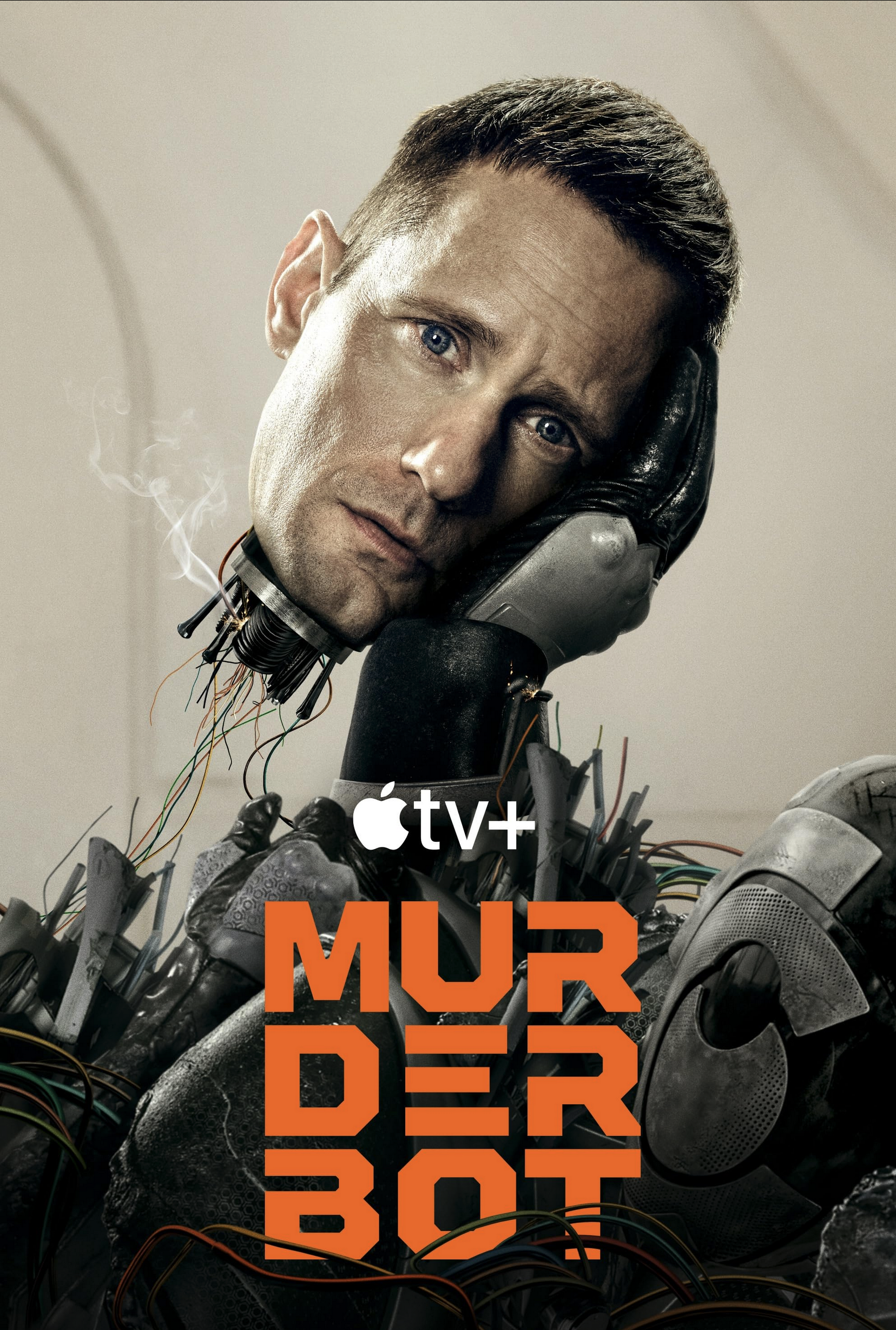
“And humans…well, they’re assholes.” This world-weary comment by Murderbot’s titular cyborg (Alexander Skarsgard) simply and crudely summarizes the broad appeal of the character—created by Martha Wells in her acclaimed Murderbot Diaries series—for legions of readers.[1] There is much for audiences to relate to in a construct living in a permanent existential dilemma between serving humans in all their limitless array of faults, follies, and idiocies and wanting nothing more than to hide oneself away from the unscripted, unpredictable, and illogical messiness that humanity generates on a daily basis.
The genius of Wells’ creation (carrying over seamlessly into its broadcast interpretation by the Weitz brothers) is the very (ironically) human nature of a being who regards actual humans with disdain and frustration yet desperately guards its feelings out of self-preservation and the need to function inside a society in which it is an explicit outsider. It is an understandable complex of emotions, giving Murderbot a relatable dimensionality lacking in other artificial beings in fiction that might serve humanity without question (R2D2 and C3PO or Robocop), look to destroy or surpass it (the Terminator or Prometheus’ David), desire to be more human (Data), or even sublimate contempt for humans into an overall depression over the entire universe (Douglas Adams’ Marvin the Paranoid Android). Murderbot is as human as the beings it is forced to serve, and in that contradiction lies the pain (and much of the bitter humor) of its existence. Murderbot is not the first fictional artificial being on whom we look as an instrument for exploring the range of our own complicated emotional existence, but it is one of the most comical. After all, who among us would not—from time to time—rather retire from life around us and be left alone to watch our shows, rather than engage with the behavioral messiness inherent to human beings? At the same time, though, the series is a poignant examination of the development, offering, and extension of empathy, as well as the awakening to the responsibilities and opportunities of personal autonomy. Much of this is accomplished through Skarsgard’s dry narration and his subtle, minute eye and facial movements that reveal both Murderbot’s inner emotional struggles and its heroic attempts to keep from betraying them to its clients.
Upon hacking its governor module, its first free act is to give itself a secret name— ‘Murderbot’, symbolizing a new and private self-construction as a being who fantasizes about killing the countless humans that exist only to aggravate it. It is a moment of great personal significance that signals the genesis of personal independence and identity. Murderbot then immediately expands its universe into joyful new dimensions when it discovers and downloads limitless entertainment content, immersing itself whenever a free moment arises in soapy fantasy worlds where human behavior is flattened into simplistic digestible stories without the messiness of human reality that so vexes Murderbot on a regular basis.
However, much as Murderbot would like to remain aloof in its own world—distaste for humans intact—it is leased for a scientific survey expedition to an unexplored planet by members of Preservation Alliance (“PresAux”), a granola-crunchy communal polity led by the compassionate Dr. Ayda Mensah (Noma Dumezweni), and where artificial constructs such as Murderbot enjoy rights and distinct identities. Much of the series is concerned with behavioral clashes between the PresAux team trying to live out its ethical code through proffering Murderbot opportunities for self-expression, self-motivation, self-identity, and independent behavior (things Murderbot increasingly owns internally but keeps secret for its own protection), and Murderbot’s own annoyed exasperation with its earnest clients who live awash in inconvenient and irritating human relationships.
As the series progresses, PresAux—while still hesitant at times to trust Murderbot, especially once its secret name and possible homicidal past is revealed—develops a relationship with it that celebrates and centers its autonomy as a rational being with free will, one whose life they will risk their own to protect, and for whom they will fight against the vastly powerful Company to secure Murderbot’s independence; in turn, Murderbot evolves its own sense of emotional obligation and community (dryly noting near the series’ conclusion, “My clients are the best clients.”) towards PresAux, creating a strategy to save them from a rival corporate team, the ruthless GreyCris, and sacrificing itself on multiple occasions to prevent their deaths. It is not a 180-degree turnaround; instead, in a much more realistic way reflecting the complexities of real human behavior, Murderbot retains its exasperation with humanity but experiences a newfound openness to the idea of living in the midst of a human universe. And, in the emotional final scene, Murderbot’s psychological multidimensionality extends even further when it leaves its newfound PresAux family to pursue its own destiny, to experience autonomy and freedom on its own terms. Departing on a transport ship to parts unknown, Murderbot narrates, referring to itself and to Mensah, “I don’t know what I want, but I know I don’t want anyone to tell me what I want or to make decisions for me…even if they are my favorite human.” Murderbot is ultimately a story of developing understanding about the definition of human freedom and its concomitant ethical obligations; in this effort, the show succeeds remarkably, hilariously, and poignantly.
[1] In the interests of full disclosure for this review, I note that I am both a friend of Wells and the archivist for her literary papers.
Jeremy Brett is an archivist and librarian at Cushing Memorial Library & Archives, Texas A&M University. There he serves as Curator of the Science Fiction & Fantasy Research Collection, one of the largest of its kind in the world. Both his M.A. (History) and his M.L.S. (Library Science) were obtained at the University of Maryland, College Park. His professional interests include science fiction, fan studies, and the intersection of libraries and social justice.


