
Media Reviews
Review of The Blue Trail
Alfredo Luiz Suppia
The Blue Trail (O Último Azul). Dir. Gabriel Mascaro. Vitrine Filmes, 2025.
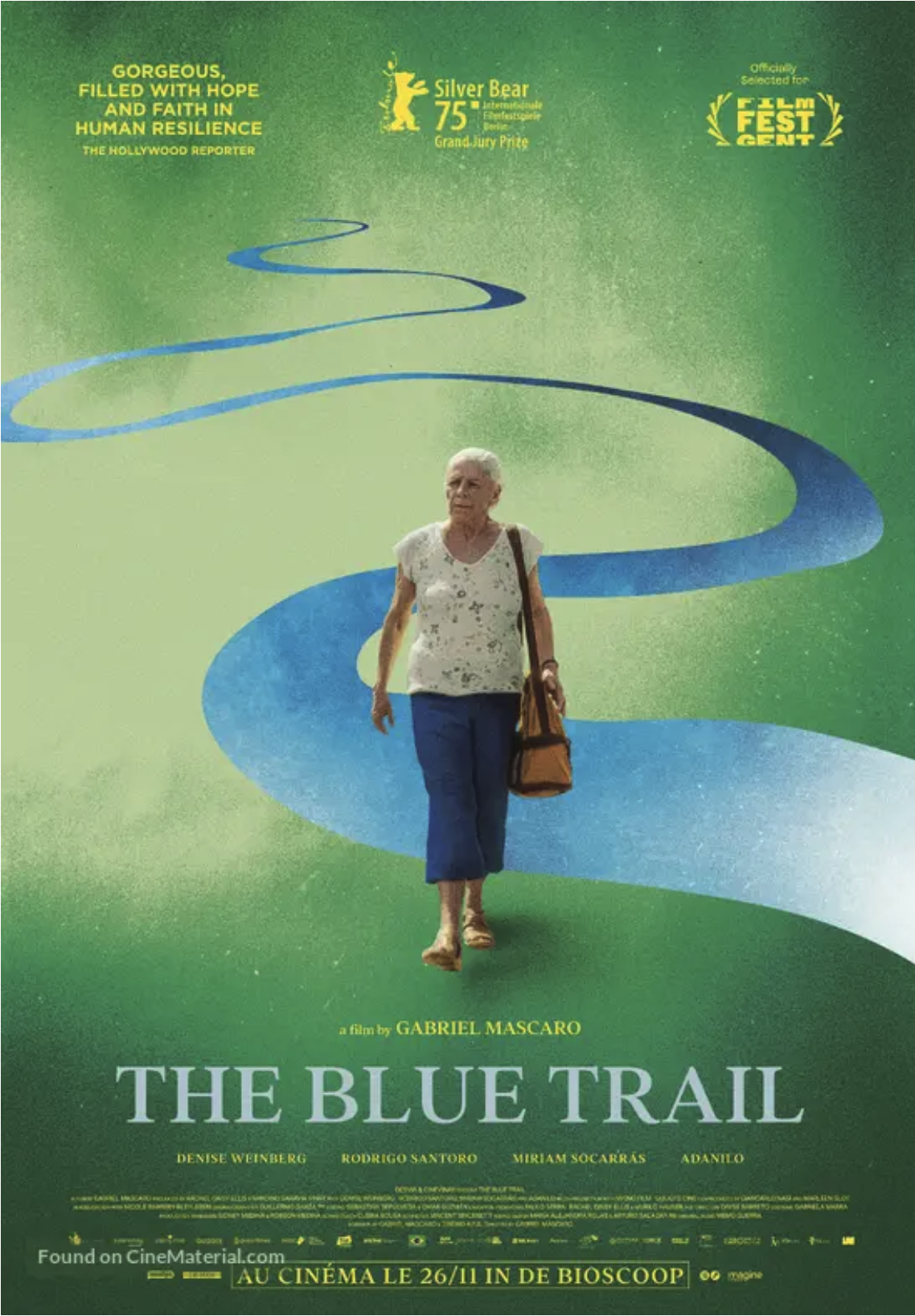
Gabriel Mascaro’s The Blue Trail (O Último Azul, 2025) is a quietly devastating work of speculative cinema. Set in a near-future Brazil that feels less imagined than extrapolated, the film explores aging, social utility, and biopolitical control through a restrained yet deeply unsettling narrative. Rather than staging dystopia through spectacular technologies or authoritarian excess, Mascaro constructs a world in which exclusion operates through hypocritical politeness, bureaucracy, and the language of care.
At the center of the film is Tereza, portrayed with remarkable nuance by Denise Weinberg. Approaching eighty years of age, Tereza remains lucid, physically capable, and economically active, working in a riverside processing facility in the Brazilian Amazon. Yet, none of these qualities matter in the social order the film depicts. In this imagined Brazil, old age itself constitutes a terminal category. Citizens who reach a certain age are forcibly retired and relocated to state-run “colonies,” spaces ambiguously described as sites of protection, rest, and dignity. Tereza’s response is not revolt but movement. Rather than accept relocation, she seeks to fulfill a minimal desire: to fly, if only once. This simple wish becomes radical in a society that regulates aging bodies through paternalistic control. When even the purchase of a plane ticket requires a daughter’s authorization, the film exposes how aging subjects are deprived not only of autonomy but of imaginative agency.
The Amazonian settings function not as exotic backdrop but as part of the film’s narrative logic. Movement is fluvial, slow, and contingent. Rivers replace roads; boats replace cars. This temporal dilation counters the accelerationist fantasies typical of much science fiction, producing a speculative ecology grounded in embodied experience and local rhythms.
Along her journey, Tereza encounters figures who inhabit the margins of legality and institutional order: smugglers, failed entrepreneurs, and a woman who has purchased her own freedom and lives aboard a floating church, selling digital Bibles to river communities. None presents true salvation from the status quo. Instead, they represent negotiated forms of autonomy within overlapping systems of commerce, faith, and survival.
The film’s most overt speculative gesture appears in the form of a rare snail whose blue secretion, when applied to the eyes, induces a trance-like state and altered perception. The resulting blue-stained gaze evokes classic science fiction imagery—from Dune to Logan’s Run—yet Mascaro reframes the trope through Amazonian epistemologies. Vision here is not mastery but vulnerability; the future is glimpsed obliquely, without promise of control. The blue in the eyes evokes the Fremen and the spice of Arrakis, but here, in The Blue Trail, this trope is given new meaning based on Amazonian knowledge and a long tradition of ritual usage of natural substances for the expansion of consciousness. It is less about pastiche and more about speculative anthropology, fully integrated into the territory.
In this sense, the film also dialogues, perhaps even more precisely, with The Night Travelers (I Viaggiatori della Sera, 1979), by Ugo Tognazzi, in which a seemingly tourist trip reveals itself to be a veiled form of collective euthanasia. Just like in the Italian film, The Blue Trail articulates social violence not as an explicit gesture, but as a process mediated by affection, bureaucracy, and forced consent.
Formally, The Blue Trail resists closure. Tereza’s journey does not resolve in escape or defeat, but in suspension. This refusal of narrative finality mirrors the film’s ethical stance: resistance is not triumph but persistence. Life is not performance, production, or utilitarianism. Tereza stands for a symbol of life refusing utilitarianism and, above all, discarding. At almost 80 years old, she appears to start living for real, along her way across the rivers. One cannot avoid thinking of Heraclitus of Ephesus’s famous metaphor about the man who cannot bathe twice in the same river.
Situated alongside recent Brazilian works such as Kleber Mendonça Filho and Juliano Dornelles’s Bacurau and Mascaro’s Divine Love, The Blue Trail exemplifies a mature engagement with speculative genres as tools of social critique. These films do not treat speculative elements as exceptional; they integrate them into everyday life, revealing futures already embedded in the present.
Ultimately, The Blue Trail offers a model of speculative cinema grounded in modesty and ethical attention. By centering an aging woman’s insistence on desire—on the right to want something unnecessary—the film articulates a powerful critique of societies that measure human worth through productivity alone. Its speculative force lies not in distant futures, but in trajectories already unfolding.
Alfredo Luiz Suppia is Associate Professor of Film and Audiovisual Studies at the University of Campinas (UNICAMP), Brazil. His research focuses on speculative cinema, science fiction film, and the intersections between cinema, science, and technology, with particular attention to Brazilian and Latin American audiovisual cultures. He is the author and editor of several books and articles on science fiction cinema, experimental film, and film historiography, and he regularly curates film programs and exhibitions related to archival and speculative audiovisual practices. Suppia’s work combines academic research, curatorial practice, and experimental filmmaking.


