
Non-Fiction Reviews
Review of Horror as Racism in H.P. Lovecraft: White Fragility in the Weird Tales
Vladimir Rizov
John L. Steadman. Horror as Racism in H.P. Lovecraft: White Fragility in the Weird Tales. Bloomsbury Academic, 2024. Hardback. 249 pg. $90.00. ISBN 9798765107683.
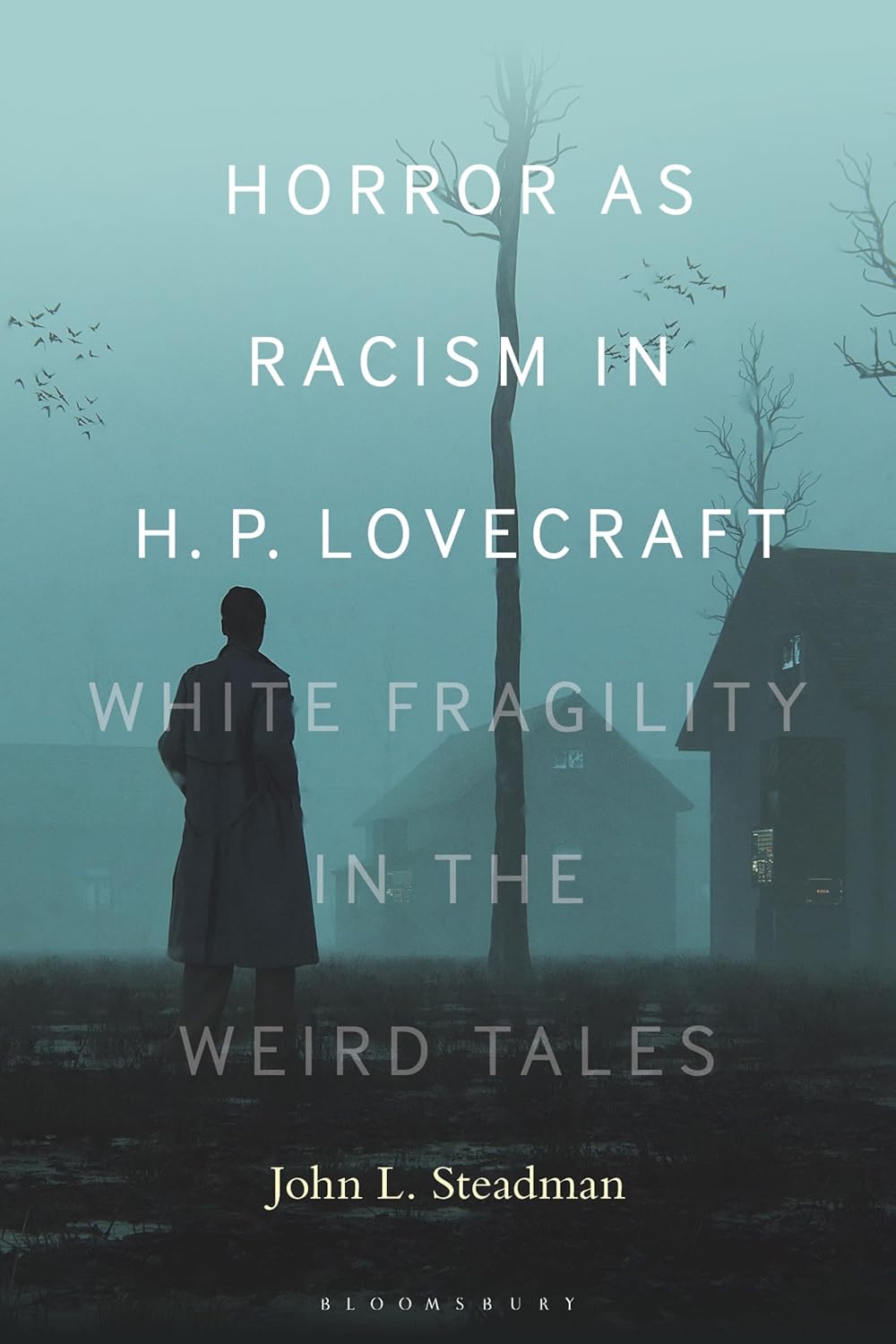
John L. Steadman offers a blunt exploration of H.P. Lovecraft’s racism. While severely limited in his engagement with race scholarship, Steadman nevertheless presents an intriguing exegetic text on key stories in Lovecraft’s oeuvre. Steadman’s main thesis is twofold: Lovecraft’s racism manifests one way in his early works and another way in his later writings. Specifically, the early works have a focus on miscegenation as brought on by immigration, and the later works have a focus on slavery as seen in a master/slave race dichotomy. The book is divided into three parts and nineteen chapters. Part I (Chapters 1-4) is titled ‘Beginnings,’ and it offers an introduction to Lovecraft’s early life with a focus on biographical details, especially his intellectual preoccupations and formative experiences. Part II (Chapters 5-11) is titled ‘Humankind against Hybrid, Degenerative Monsters’ and it is concerned with racism as miscegenation in the early works of Lovecraft. Part III (Chapters 12-19) focuses on the later works, and Steadman’s second thesis respectively; it is titled ‘Humankind against the Cosmic Slave Masters.’ Overall, Steadman’s argument is persuasive in its distinction between Lovecraft’s twofold racist fixation and its development throughout his work. More than that, the book does well to root its thesis in an analysis of Lovecraft’s formative years. The common Lovecraftian protagonist’s ultimate stupor upon uncovering the hidden eldritch knowledge is argued to mirror Lovecraft’s own passivity in dealing with trauma and hardship.
While Steadman presents a focused monograph with a cumulative logic, certain matters tend to get obscured and displaced. For instance, the book, especially in Parts II and III, takes on the format of a single chapter per specific text by Lovecraft. Most chapters of this kind might prove rather descriptive to the reader familiar with Lovecraft’s work, and there is only occasionally a reference to a scholar or writer other than Lovecraft. At the end of both Part II and III, Steadman offers a ‘Critical Commentaries’ chapter (11 and 18, respectively), in which he moves away from the story-specific chapters and situates his own twofold thesis in relation to other scholars. While the bulk of the book tends to have a reverential, albeit critical, approach to the original text, Steadman seems to be rather quick to dismiss certain perspectives from other scholars. For instance, in a discussion of Lovecraft’s “The Lurking Fear” (1923), Steadman cites Williams’ work on the hysterical female gothic in relation to Lovecraft’s use of underground locations such as caves and grottoes. Instead of providing an argument against Williams’ claim (or Callaghan’s claim cited shortly before), Steadman rejects it out of hand and provides a dismissive generalisation about ”so-called psychological analyses of Lovecraft” (90). Interestingly, Steadman does not see his own argument in this vein, even though significant attention is devoted to Lovecraft’s own “pattern of loss and failure […as] evident in the lives of Lovecraft’s main characters” (5). This results in a certain tension that cannot be ignored by the careful reader of the book, let alone the reader familiar with Lovecraft. Specifically, this means that the potential significance of a range of patterns in Lovecraft’s fiction remains ignored; so is the case with the multiple cases of chthonic female goddesses, the symbology of the witch (which Steadman acknowledges on pg.197), and the spatial symbolism of caves and grottoes, especially considering Steadman’s own remarks on Lovecraft’s own formative experiences of restrictive spaces (such as the house he moved into with his mother after his grandfather’s passing, or his inability to enter hospitals and only visiting his ailing mother in the hospital grounds—in fact described as “the grotto” in a quotation provided on p. 27).
This is not an uncommon pattern in the book. Steadman will acknowledge a perspective, only to dismiss it without engaging with the claim in question in much depth. Another example is Simmons’ argument that Lovecraft’s characters are both repulsed and attracted by the Other. Steadman is a little more thorough here with his dismissal of the claim, but similarly as noted above, the tension between the dismissal and Lovecraft’s texts remains unresolved. Steadman claims that there is nothing attractive about the Other in Lovecraft’s work. Such a dismissal has to ignore the very fact that Lovecraft’s characters seek out magic from Western Asia, knowledge from Africa, or refer frequently to places beyond Western Europe and North America as abounding with mystery and danger. In the simplest of terms, Lovecraft’s characters are in need of people over which to rule. The common interweaving of revulsion with attraction in orientalism appears to be a proposition unworthy of consideration for Steadman.
This is indicative of Steadman’s understanding of race, which at times appears superficial, at others severely misguided. The bulk of the conceptualisation of racism seems to rely on Robin DiAngelo’s White Fragility (2018). However, despite informing the subtitle of Steadman’s book, DiAngelo seems to be cited only once on the first page of the introduction. Nevertheless, the evocative phrase of ‘white fragility’ is made to carry a lot of weight in support of Steadman’s general lack of engagement with scholars of race. This is made worse in two telling instances. First, in the chapter discussing Lovecraft’s The Shadow Over Innsmouth (1936), there is a misguided, to be quite generous, attempt at riffing on Lovecraft’s racist language that amounts to Steadman himself using the n-word (165). Second, the appendix seeks to go beyond Lovecraft and engage with work that deals head on with Lovecraft’s racism. To do this, Steadman discusses Afrofuturism in general and Matt Ruff’s Lovecraft Country (2016) and Victor LaValle’s The Ballad of Black Tom (2016) in particular. Steadman’s ignorance of race scholarship is quite telling. It is such ignorance that leads him to draw parallels between Afrofuturist music duo Drexciya and Lovecraft’s work. Steadman (223) cites Kodwo Eshun’s description of Drexciya’s “science-fictional retelling of the Middle Passage,”: in which they imagine “water-breathing, aquatically mutated descendants of ‘pregnant America-bound African slaves thrown overboard by the thousands during labour for being sick and disruptive cargo”’ (Drexciya as cited in Eshun, 2003: 300). Steadman, perhaps facetiously, and definitely in bad taste, pontificates so: “The idea of adding the water babies born from drowned female slaves into the mix is intriguing and one, I think, that Lovecraft might not have objected to” (223). To claim that Afrofuturism is “overtly Lovecraftian” (223) is a terrible misreading of the unbridgeable difference in what separates the aesthetics being compared.
Overall, Horror as Racism in H.P. Lovecraft promises an intriguing perspective by trying to pick apart Lovecraft’s racism and its central role throughout his work. Nevertheless, Steadman, while clearly critical of Lovecraft’s racism, fails to provide much insight into the subject. At this point in time, the description and acknowledgement of Lovecraft’s racism is easy and should be the bare minimum in critical scholarship. It is much more important to understand it.
Vladimir Rizov is Assistant Professor in the Department of Sociology and Criminology at the University of Sussex. His current book project is titled A Criminology of Videogames: Playing at Crime and its Control. He is the author of Urban Crime Control in Cinema: Fallen Guardians and the Ideology of Repression. He has published articles and essays on film, videogames, the history of documentary photography, and urban history.


