Review of Banerjee and Fritzsche’s Science Fiction Circuits of the South and East


Review of Science Fiction Circuits of the South and East edited by Anindita Banerjee and Sonja Fritzsche

Virginia L. Conn

Anindita Banerjee and Sonja Fritzsche, editors. Science Fiction Circuits of the South and East. Peter Lang, 2018. World Science Fiction Studies 2. Paperback, 258 pages, $67.95. ISBN 9781787075931.


Situating this project in the trajectories and “dizzying arcs of migration” (2) that have co-constituted the vast constellation of science fiction produced across the world—as numerous as stars in the sky and much of it equally unexplored—Science Fiction Circuits of the South and East opens with a beautiful personal account of the trajectories that brought the editors to their respective orientations to and within science fiction. As Banerjee points out, within her real lived experience, much of science fiction was more familiar to her, more comprehensible and close, than stories from the English canon. Using the daffodil as an image of alienation, for example, ties this collection to many other notable authors—Chinua Achebe, Jamaica Kincaid, Chimamanda Ngozi Adichie—who have similarly staked their work in a recognition of the inapplicability of writing imposed from outside their lived experiences. Despite its radical recontextualizing of translation and transmission, however, this collection does not strike an essentialist argument; rather, it recognizes that the intertextuality of much “semi-peripher[al] and peripher[al]” (6) SF has been shaped by and often in response to stories already received as deeply alien. At the same time, it recognizes that the dual impulses at work in much contemporary SF theorizing—to historicize traditions outside of the historical centers of Western power while simultaneously seeking to deconstruct the center/periphery binary—tend to not be in dialogue with each other. This anthology, then, offers a unique contribution to contemporary SF studies by focusing on circulation, through which literature transforms and is transformed.

The collection traces the circulations of socialist and postsocialist SF in Europe and Asia alongside examinations of the materio-cultural productions of the global South in Asia and the Americas, a shift in contextual perspective that is mirrored in the collection’s layout. Shifting the impetus from space and location to movement and adaptation allows for fascinating juxtapositions, such as the association in the first section, “An Other Transatlantic,” of Transatlantic writings and their receptions and adaptations across socialist Russia, 1919 Mexico, and through the Soviet-Cuban imaginary of the Cold War period. Race and socialist revolution are the hallmarks of these essays, which uniformly offer unorthodox and exciting new ways of reading. The very first chapter, for example, analyzes Zemyatin’s seminal We (1924) as a radical Afrofuturist text—an unconventional reading that is meticulously researched, elegantly argued, and works specifically because of its unique perspective.

Part two, “Transnationalism behind the Iron Curtain,” focuses on East-East circulations between the Soviet Union and associated satellite states. The focus here is on the shared ethos of communist science pedagogy and humanistic grappling with what it means to confront the Other and, in doing so, how we establish our place in the universe. These essays, too, tackle who “we” are, primarily in the context of displaced contemporary anxieties mapped onto a future that has become largely homogeneous under socialism. While all the essays contained herein are geographically situated in Eastern Europe, the content they address is very different—from the dialectical materialism of Carl Gelderloos’ approach to Eastern European science fiction texts to Sonja Fritzsche’s East German cinema to Sibelan Forrester’s “elite literary science fiction” (165) and its translations. 

The final section, “Asymptotic Easts and Subterranean Souths,” deals with East-South and East-East circulations. Unlike the first two sections, which each contained three essays, this segment includes only two—a real pity, given the potential richness of the umbrella topic. As it stands, it’s perhaps not surprising that for a collection so focused on the workings of comparative literary studies outside of the imperialist center, a member of the Warwick Research Collective, Pablo Mukherjee, would be included here with an essay on race, science, and the spirit of Bandung. A wonderful distinction about this essay in particular is that it privileges the role of science in science fiction and what that means when “science” is removed from its Western epistemological dialectics and considered in a specific and localized spatio-temporal register for assessing lived, material conditions, rather than as a “mere” narrative device. This discussion of “non-aligned science” (193) and local adaptation leads seamlessly to the next essay, which focuses on the reception of a Russian writer in China and the impact his work had on reassessing the memory of revolution through non-state-sanctioned mediations. 

This collection offers a meticulously-researched, compelling approach to an aspect of global science fiction that is at once constantly mutable and yet tied to specific sites of production. Both Fritzsche and Banerjee are renowned scholars in their own areas of expertise, and together they make a formidable pair of editors. The essays collected here are significantly more polished and subtle than many similar attempts at anthologies, in no small part—as many of the authors explicitly acknowledge—thanks to the incisive eye for detail Banerjee and Fritzsche have brought as editors. 

Not only are the essays excellent taken individually—each one deserves its own response essay—but the collection as a whole works beautifully to illustrate its overall theme of transmission and adaptation. The rhizomatic scaling of topics contained in this collection illustrates the complexity of working with multiples sites of production as located in specific geographic milieus while simultaneously connecting and branching to numerous other material productions; there is no one canon of “world SF” in much the same way that we cannot speak of one internet. This rhizomatic internet analogy is made explicitly at the conclusion of the introduction and finds a fascinating mirror complement in the final essay by Jinyi Chu, which touches on unofficial internet translations and their role in shaping and disseminating information. So, then, even in layout and flow the collection serves to illustrate its own theme. Ultimately, while this groundbreaking anthology might be most warmly received by those working outside the Western Anglophone canon, its unique approach to the assessment of literature in circulation makes it a critical addition to any SF scholar’s library.

Review of Michaud and Watkins’s Iron Man vs. Captain America and Philosophy


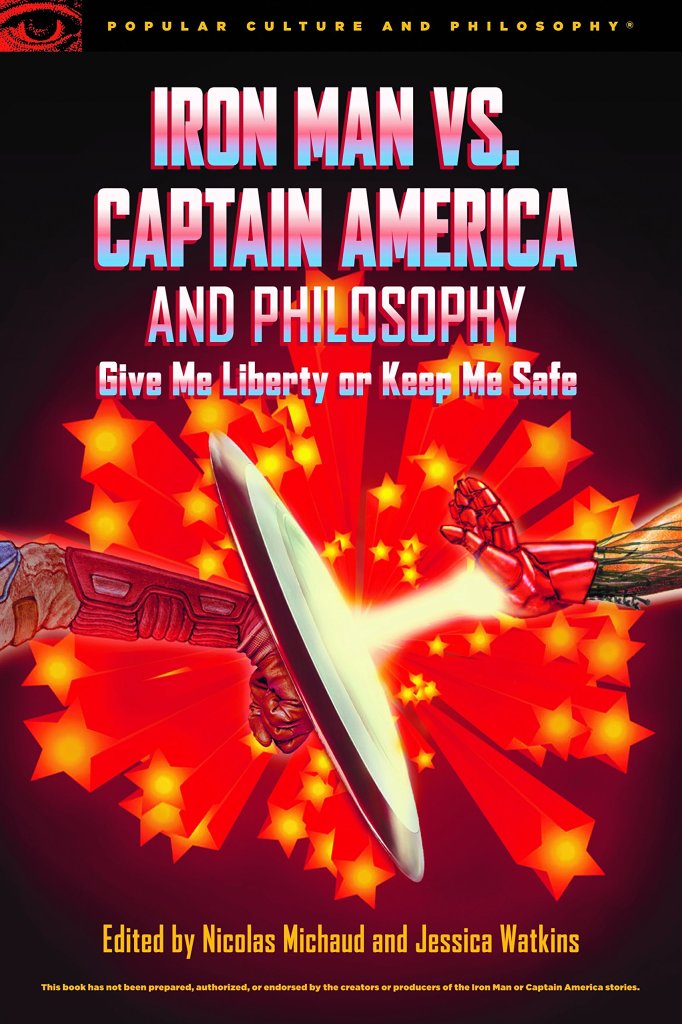
Review of Iron Man vs. Captain America and Philosophy: Give Me Liberty or Keep Me Safe edited by Nicolas Michaud and Jessica Watkins

Michael J. Hancock

Nicholas Michaud and Jessica Watkins, editors. Iron Man vs. Captain America and Philosophy: Give Me Liberty or Keep Me Safe. Open Court, 2018. Paperback. 288 pages, $13.56. ISBN 9780812699760.


In May 2019, the release of Avengers: Endgame served as the culmination of the Marvel Cinematic Universe thus far, a franchise of twenty-two films released over eleven years. This essay collection, Iron Man vs. Captain America and Philosophy: Give Me Liberty or Keep Me Safe, edited by Nicholas Michaud and Jessica Watkins, focuses on a key installment in that franchise, Captain America: Civil War (2016). In the film, Avengers Iron Man (aka Tony Stark) and Captain America (aka Steve Rogers) have a falling out over ceding the Avengers’ authority to a governing body and the fate of Bucky Barnes, Cap’s brainwashed former best friend. Each of the twenty-four chapters in the collection considers the characters’ respective cases, resulting in a book that uses philosophy to evaluate the superhero genre, and vice versa.

The first section of the book features six essays that favor Iron Man’s perspective, that superheroes need to be regulated for the greater good, and more generally, Iron Man is the better hero. Three particularly stand out. Daniel Malloy argues that Tony is ultimately a better hero because he is more flawed but struggles against those flaws. This argument reflects a popular framing of the difference between Marvel and DC superheroes, that DC’s are more iconic, but Marvel’s, through their flaws and insecurities, are more relatable. Heidi Samuelson maintains that despite Captain America’s overt patriotism, it is billionaire entrepreneur Tony Stark who better represents the values of the United States. The argument is perhaps pessimistic, but it does very well in tracing the ideas of Locke and Smith into contemporary neoliberalism. Finally, Cole Bowman closes the section with an examination of friendship from Aristotle to Derrida, arguing that while Cap shows great loyalty to a single friend, Bucky Barnes, he endangers his other friends, whereas Iron Man acts for the greatest benefit of all.

The second section takes the opposite approach, with nine essays in favor of Captain America and his insistence on remaining free from regulatory power. Many of these arguments focus on Captain America’s relation to universality: for example, Rob Luzecky and Charlene Elsby argue that Cap recognizes Camus’ paradox of humanity, striving for a universal good while remaining rooted in the particular: he neither surrenders to circumstances nor, as Tony does, maintains an idealized principle over the people around him. Nathan Bosma and Adam Barkman use Kant to argue that Cap’s ideals make for a better universal principle than Iron Man’s, explaining Kant’s categorical imperatives in an accessible manner. Last, Maxwell Henderson argues in a dialogue with an imaginary idealized comics fan that, via analogy to Bertrand Russell’s set theory paradox, Iron Man’s entire premise is flawed—choosing regulation endangers those close to them, but defying it, according to Iron Man, places people in danger. Thus, even framing the question places superheroes in an unsolvable paradox.

The third and fourth sections are framed around the notion of a tie between the two and a focus on the war itself, respectively; in practice, that means illustrating that Tony’s and Cap’s arguments are equal or equally flawed, and questioning the entire premise of superheroes. For example, Christophe Porot argues that both heroes concentrate on extending their capacities: Tony extends himself through technology and Steve through people, convincing others to join his cause. However, Cap then takes responsibility for the actions performed by people acting as his extension, which sounds noble, but Porot makes the case that in doing so, he dismisses their emotional response to those actions, thus moving against the personal autonomy he seems to champion. In one of the most interesting essays of the collection, Jeffrey A. Ewing argues that the Civil War event, in both its comic book and film forms, draws out the challenge superheroes pose to nation-states. As forces that operate within a nation-state’s border but outside of its monopoly of force within those borders, superheroes, through their existence as independent agents, challenge the nation-state’s claim to sovereignty; like Henderson, Ewing draws out how Civil War speaks to the tensions at the core of the genre.

This collection seems intended primarily for an audience of interested lay people already interested in superheroes and curious about philosophy. But with some guidance from the instructor, it is also well-suited for use in the classroom, as I can attest; while I was reading it, I somewhat serendipitously had a student who chose to write their final paper on Captain America: Civil War, and reference to the ideas in this book made it much easier for the student and myself to clarify what ideas from the film they wanted to address. This instance demonstrates the book’s value: that its topic is one students are already willing to engage. However, as the 115th book in the Popular Culture and Philosophy series, Iron Man vs. Captain America faces a challenge its compatriots do not: by centering itself on this particular conflict between heroes, the collection limits its potential scope. It does so more gracefully than a similar, earlier book in the series (Batman, Superman, and Philosophy) but there is still a sense of repetition, as the reader is told yet again the events of Civil War. I greatly appreciate that many authors do go a bit beyond the film’s boundaries to incorporate the comics, though it’s a shame the comics are omitted from the references list.

In the aftermath of End Game, it is tempting to read that film as erasing the consequences of Civil War, that Tony and Steve set aside their differences figuratively and literally, each explicitly adopting advice given by the other. However, to do so would also be to erase the questions the film raises about the superhero genre, questions of having authority to act and responsibilities toward others. The most common superhero question always seems to be who would win in a fight; by transitioning that question into a fight of ideas, Iron Man vs. Captain America illustrates how the questions of fans and the questions of philosophers are already in conversation.

Review of Ransom’s I Am Legend as American Myth: Race and Masculinity in the Novel and Its Film Adaptations


Review of I Am Legend as American Myth: Race and Masculinity in the Novel and Its Film Adaptations by Amy J. Ransom

J.R. Colmenero

Amy J. Ransom. I Am Legend as American Myth: Race and Masculinity in the Novel and Its Film Adaptations. McFarland, 2018. Paperback, 231 pages, $45.00. ISBN 9781476668338. 


Although it misses some opportunities to engage more rigorously with theories of race and masculinity, Amy J. Ransom’s comprehensive book about Richard Matheson’s horror/sci-fi novel I Am Legend and its many screen adaptations is an eminently readable and useful addition to critical literature on the horror/science fiction genre, studies of Richard Matheson’s oeuvre, and the intertwined histories of literature, film, and mass media in twentieth and early twenty-first century texts. Before reading this book, I was mostly ignorant about the pervasive nature of Matheson’s 1954 text in structuring horror/sci-fi conventions of the late twentieth century. After finishing this book, I’m convinced that I Am Legend deserves an exceptional position as a reflecting pool for social concerns about masculinity as well as race and race-mixing in a United States context. 

The best part of American Myth is in its lucid treatment of the historical and cultural context for the series. Ransom is thorough in discussing literary and filmic antecedents for the “last man” apocalyptic narrative (such as M. P. Shiel’s novel The Purple Cloud [1901] and The World, The Flesh and the Devil [1959], written and directed by Ranald MacDougall). Historical details — of production and direction of the adaptations, as well as of Matheson’s response to those adaptations — are interestingly and usefully explained in an accessible way. Finally, Ransom’s overall argument about the most recent iterations of I Am Legend as conjecturing a “post-white” United States is persuasive (181). 

The first chapter, “The Trauma of World War II and the Decline of Western ‘Right’,” includes a thorough critical summary of the originary novel, situating Matheson’s work both historically — as a response to post-WW2 and Cold War fears — and generically, as the vampire novel Matheson intended it to be. Thematically, Ransom is most concerned with the figure of the protagonist and the different interpretations of the Robert Neville character. Even in the 1954 original text, Matheson’s Neville “problematizes the white male’s role as arbiter of right” with his erratic behavior and symbolic castration (being the only surviving human foreclosing possibilities for reproduction) (56). One of the interventions of the original narrative is its illustration of the “Last Man” post-apocalyptic narrative, one that is “symptomatic of the gravity of the national crisis in white masculinity and its traditionally perceived prerogatives” (82). Ransom’s use of “star” theory guides the second and third chapters, in which she analyzes the first filmic adaptations of Matheson’s book, the 1964 film The Last Man on Earth and 1971’s The Omega Man. 

Chapter 2 is a well-reasoned argument that reads Matheson’s two novels The Shrinking Man (1956) and IAL in order to establish Matheson’s thematic interest with depicting a “crisis of masculinity” (112). This claim is then used to examine the casting and performance of Vincent Price as the protagonist in the first film adaptation of IAL and how Price’s interpretation of the character makes clearer the more submissive and perhaps queered role of a bachelor being pursued by “lustful” vampires and locked in a passionate relationship with his vampire suitor, neighbor and friend-in-a-former-life Ben Cortman. The third chapter, “The Last White Man on Earth: Charlton Heston in The Omega Man,” intervenes in critical conversations about the film that have overly relied on the “star persona” (12) of Charlton Heston and his reinforcement of a strong, masculine protagonist (in contrast to the earlier film starring Price) to define their interpretation of the film. Indeed, Ransom comes to show that Omega’s messages regarding race and masculinity are more ambivalent than critics have historically argued, and that the film “retained the subversive core of Matheson’s novel and its interrogation of its white hero and his moral imperative” (127). 

While The Last Man on Earth and The Omega Man register cultural fears about the Cold War and Vietnam respectively, Ransom situates the two most recent adaptations of Matheson’s text — two films produced in 2007, Francis Lawrence’s I Am Legend and Griff Furst’s I Am Omega in their position as post 9/11 U.S. cultural productions. The section on Lawrence’s I Am Legend takes up the question of “what it means when the last man on earth is black” (160). Although it is Lawrence’s film that has garnered the most critical and popular attention in recent years, I also appreciated Ransom’s exegesis of its straight-to-DVD homologue, a more flashy interpretation of the original text — this time featuring cannibalistic zombies and martial arts — that nevertheless raises interesting questions about the future of an increasingly multiracial U.S.

While it’s a given that there is no single totalizing mythos that defines the history of the United States, reading race and gender at the center of U.S. horror/science fiction endeavors is a sound place to start. If anything, I wish that Ransom had engaged more with foundational theory about race and feminist theories of masculinity. Since the book already utilizes critical terms such as “star” theory and adaptation to inform the argument, I think a deeper engagement with critical race theory as well as theories about masculinity to inform her reading of the protagonists’ various identities throughout the adaptations would have been helpful.

Ultimately, Amy J. Ransom’s book is clever, well-argued, and accessible to lay readers interested in the horror/science fiction genre, movie adaptations, and 20th century film and “star” histories. Because of the nature of the subject matter (using a variety of theoretical lenses to study a text and its adaptations by different people at different times), it is also an ideal book for undergraduates to learn how to usefully compare and close-read texts and their adaptations. For the more serious scholar of Matheson, Ransom offers both a comprehensive introduction to literary criticism about I Am Legend, as well as lucid new readings of the significance of the text, reminding us that the barriers between “literature” and “mass media” are increasingly permeable, and best understood as the inextricable realities that they represent.

Review of Caroti’s The Culture Series of Iain M. Banks: A Critical Introduction


Review of The Culture Series of Iain M. Banks: A Critical Introduction by Simone Caroti

Edward Carmien

Simone Caroti. The Culture Series of Iain M. Banks: A Critical Introduction. McFarland, 2015. Paperback. 252pp, $29.95. ISBN 978-0786494477. 


Simone Caroti memorializes Iain M. Banks in his dedication to The Culture Series of Iain M. Banks: A Critical Introduction. “To the Memory of Iain Menzies Banks (1954-2013). Thank you for everything, Sir.” As Banks fell ill and passed away unexpectedly, Caroti did not intend for his book to bear this inscription, but this text serves as an admirable cenotaph to Banks, taken from us with books unwritten and years unlived. In its eight chapters (and preface, introduction, conclusion, chapter notes, bibliography and index) Caroti presents what he promises: a critical introduction to this important writer’s Culture series. 

Like Caroti, I remember my first encounter with Iain M. Banks, if less clearly. Thirty years ago, as a graduate student in northwestern Ohio, I cracked open the first of the Culture novels, Consider Phlebas (1987). Caroti fell harder for Banks and his work than I did, for while I was immediately entranced by his take on space opera and aware something special was afoot in the field, Caroti decided upon his first reading of Banks to write a book. This is just that book. 

Caroti comprehensively surveys the dual nature of Iain Banks and Iain M. Banks. Banks, who published novels without obvious SF content, added the ‘M’ when he published the first of the Culture series. By presenting Banks as an author who transgresses traditional categories, Caroti effectively introduces us to the narrow focus of his critical introduction. Here and elsewhere he demonstrates an excellent grasp of the existing work on Banks, especially that by John Clute, and on the directly related field of Utopian studies, the primary critical instrument he brings to bear on the Culture series. 

“1. Beginnings” surveys Banks’ early life and speculates about his drive to write. Caroti shows the Culture series, despite not the first of Banks’ work to appear in print, were written early in his writing career. Having found success with The Wasp Factory (1984), Banks rewrote and refined the early Culture novels. To the outside world, Banks’ science fiction seemed a new turn for the author. Caroti shows the centrality of the Culture as a created entity, Banks’ fictional expression of worldview that so distinguishes his work from American space opera. 

Caroti then addresses the individual works of the Culture series, starting with Consider Phlebas and how it helped redefine the space opera genre. He claims Banks “did reclaim the moral high ground for the left, and he did demystify the garish glamour of space opera…he also rejuvenated the entire subgenre…” (44). He later acknowledges that other authors had started this process before Consider Phlebas saw print. Caroti describes the critical context that shaped the novel as well as the novel’s impact on the sub-genre. 

In publication order the rest of the Culture series receives the same thorough treatment, from The Player of Games in Chapter 3 to the double-header of Chapter 4: The State of the Art and Use of Weapons, linked by the utopian agent Diziet Sma, an important figure in the Culture novels and in Banks’ expression of the utopian ideal. For while the people of the Culture are utopian, they have an activist branch called Contact, and a very activist group that handle Special Circumstances, or SC for short. 

SC interferes. The claim is, backed by the sentient super-minds of the Culture and their statistics, that interference helps and that more good comes from their dirty deeds than would result from doing nothing. Those raised in a utopia, Banks argues throughout his Culture novels, are singularly unsuited to espionage dirty-tricks. Illustrating Diziet Sma’s role as a recruiter of barbarian, non-utopian outsiders allows Caroti to observe Sma is “of the Culture, yes, but she’s also a citizen of the fringe, the place where utopia meets its twin, where the morally correct choice reshapes itself after every iteration…” (104). Banks presents interference as utopian, which as one might imagine requires a singular narrative rhetoric and as it happens one of the key features of the Culture series. 

Banks paused in his publication of the Culture series. The first set were rewrites of manuscripts he’d written before he broke in to the business with a “mimetic” text, The Wasp Factory. Prior to Excession (1996), addressed in Chapter 5, Banks took a six-year break in his Culture series production. It is here Caroti more fully addresses the issue of “The Culture as a Critical Utopia,” the chapter’s subtitle. It is here he most fully engages a critical discussion; calling some critics to task and valorizing others in how they have addressed (or failed to address) Banks and his Culture series. 

Chapters 6 and 7 return to more novel-centric discussion. Caroti paints Excession and Inversion (1998) as directional mirrors, one up and out, the other down and in, and he provides what a reader has come to expect in thoroughness and critical perspective as he does so. The following chapter focuses upon Look to Windward (2000), a title that references the same Eliot poem as Consider Phlebas. This novel’s publication date, subject matter, and the 9/11 attacks in the United States coincide closely enough to enable interesting commentary alongside Caroti’s continuing and highly effective analysis of the series in the context of critical utopia. Titled “The Encroachment of Reality,” this chapter ties to an additional layer of material, while remaining introductory in nature. 

The bookending of Eliot quotes might have served Banks as signposts where the Culture series begins and ends, but after a break of some years he produced three more novels: Matter (2008), Surface Detail (2010), and The Hydrogen Sonata (2012). Discussion of these final Culture novels rounds out the book’s eighth chapter, with each receiving a thorough going-over that both contextualizes them and analyzes content. If a reader of the Culture series ever wondered why it never devolved into a “more of the same” exercise of mere formula, the answer is here: Banks always had literary purpose, and he did not repeat that purpose, or ask the same question twice. This made for readers always hankering for the next “M.” novel frustrating waits–once of six years, once of eight–but very rewarding reads. 

For the critic, new or otherwise, The Culture Series of Iain M. Banks serves as an excellent foundation, an introduction indeed. From it one finds numerous ways to travel further into not just utopian studies, but space opera. Very few readers of Banks’ Culture novels will leave without some new insight. 

Simone Caroti’s smoothly written, thoroughly researched and documented book serves as a monument to Banks and his Culture series. As a cenotaph it does not contain the mortal remains of Iain M. Banks, but expresses critical appreciation of his work, of the Culture, of artistic transgression that livens and renews a genre and subgenre. I recommend it both as a resource on Banks and as a model for others to follow, should they be taken, upon reading an author for the first time, with the urge to write a book.