
Non-Fiction Reviews
Review of Asimov’s Foundation and Philosophy: Psychohistory and Its Discontents
Zachary Reger
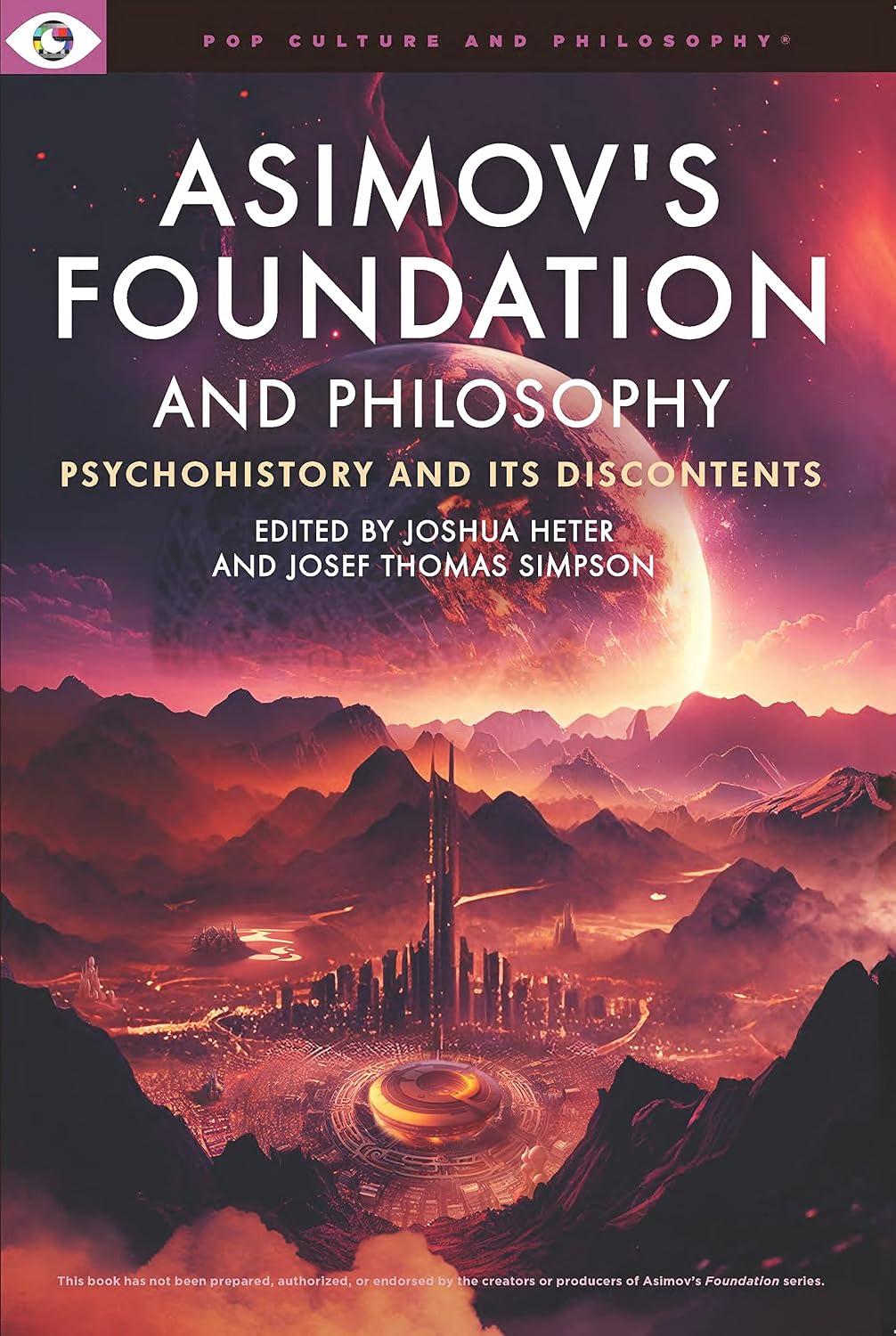
Joshua Heter and Josef Thomas Simpson, eds. Asimov’s Foundation and Philosophy: Psychohistory and Its Discontents. Carus Books, 2023. Paperback. 262 pg. $26.95. ISBN 9781637700303.
Isaac Asimov’s Foundation series is a cornerstone of science fiction. It also represents a lifetime of work from one of the genre’s most prolific authors. Asimov began Foundation at the age of 21, as a series of short stories for Astounding Science Fiction during what would become known as the ‘Golden Age’ of science fiction. Over the succeeding decades, the series grew into an empire of material: the original Foundation trilogy, consisting of three books collecting nine short stories; two sequel novels; two prequel novels (including one published posthumously); dozens of other novels and short stories not originally intended as precursors to Foundation, but which Asimov later drew into the larger Foundation continuity; works by other authors, both authorized and unauthorized; and a television series on Apple TV Plus, which aired its third season in summer 2025. The series is expansive, exploring Asimov’s thoughts on philosophy, history, psychology, politics, religion, and more. When it comes to Foundation, there’s no shortage of topics to discuss.
Asimov’s Foundation and Philosophy dives headfirst into this tangled web. The book collects twenty-one essays across six overarching subjects: “Foundation and Reason,” “Foundation and History,” “Foundation and Faith,” “Foundation and Science,” “Foundation and Morality,” and “Foundation and Being.” The essays examine different aspects of Asimov’s seven Foundation books and the first season of the television show (at the time of the book’s publication, further seasons had yet to air). They are mostly written by professors, researchers, and those with academic experience, but target a lay audience. Despite the authors’ pedigree, I was happy to discover that advanced scientific or mathematical knowledge is not a prerequisite for understanding. All is explained within.
Although the title of the book indicates a focus on philosophical analysis, the term ‘philosophy’ should be understood loosely. Philosophical classics such as Plato’s Republic, Immanuel Kant’s Critique of Pure Reason, and David Hume’s A Treatise on Human Nature are given their fair due, but many philosophy-adjacent concepts are also broached. The third essay examines the use of symbolic logic in one of the Foundation series’ early stories, and the twentieth essay examines the nature of mathematics, a core theme of the television show’s first season. The fourth through seventh essays examine the role of history in the Foundation saga, which Asimov noted as being heavily inspired by Edward Gibbon’s The Decline and Fall of the Roman Empire. And the eighth through thirteenth essays explore the religious themes of the stories and television show.
The breadth of topics in this collection is remarkable, but there are a few instances of repetition. For example, two essays compare the thought experiment of Laplace’s Demon (an omniscient being who can, in a deterministic universe, perfectly predict the future) to the fictional science of psychohistory (which predicts the fall of the Galactic Empire through advanced mathematics). Two essays compare the tripartite organization of the kallipolis in Plato’s Republic to the organization of Asimov’s galaxy into First Foundationers, Second Foundationers, and ordinary citizens. And three essays highlight the real-world science that formed the foundation for Asimov’s fictional field of psychohistory, the kinetic theory of gases, in which individual atoms behave randomly but the movement of the whole can be explained by defined laws.
Nevertheless, it is interesting to see the authors begin with similar concepts, but take them in different directions. One essay uses Laplace’s Demon in aid of a historical analysis while another considers the mathematical consequences. The tripartite structure of kallipolis is itself the focus of one essay, but the ‘noble lie’ undergirding that tripartite structure (and how it compares to the ‘noble lies’ of a few Foundation characters) is the focus of another. And the parallel of psychohistory to the kinetic theory of gases is used by two essays to examine population dynamics and historical events, but by a third essay to examine the impact of determinism and random movement on the philosophical justification for individual free will. Perhaps in this case we should accept the Latin maxim repetitio est mater studiorum (’repetition is the mother of learning’).
In summary, Asimov’s Foundation and Philosophy is a thought-provoking read for fans of the Foundation series. As a collection of essays by separate authors, the philosophical concepts at times overlap, but the diversity of viewpoints is well worth the occasional repetition. Prior philosophic, scientific, and mathematical knowledge is not necessary, given the book’s focus on a lay readership. However, a passing understanding of Asimov’s stories and the plot of the first season of the television show is beneficial. Readers are warned that spoilers for the Foundation series abound. While some essays focus on the early Foundation stories, others examine concepts from the later books, including the rise and fall of the Mule, the nature and existence of the Second Foundation, the planet-sized collective-consciousness of Gaia, the revelation of R. Daneel Olivaw’s millenia-spanning tinkering with human history, and the birth of psychohistory described in the two prequel books. Before starting Asimov’s Foundation and Philosophy, a detour to Terminus is advised. But there’s no need to head to the edge of the galaxy; a trip to the science-fiction section of one’s local library will do.
Zachary Reger is an attorney in Washington, D.C. His legal scholarship has appeared in the Missouri Law Review, the University of Chicago Law Review, and the University of Chicago Law Review Online. His speculative fiction has appeared in Bewildering Stories and the Sci Phi Journal.


