
Media Reviews
Review of Silo, season 3
Alfredo Suppia
Yost, Graham, creator. Silo, season 3. Apple TV, 2026.
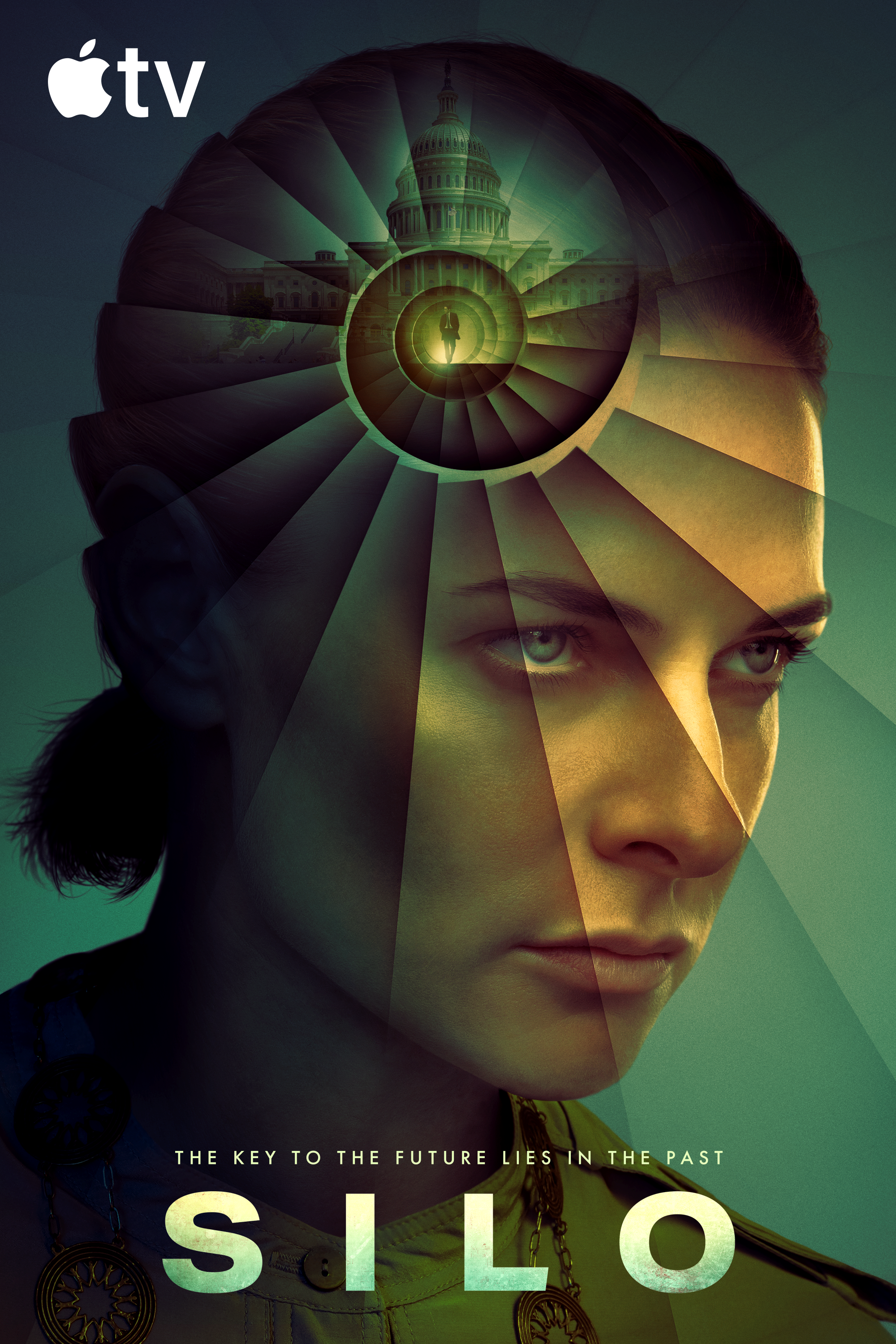
The Doomsday Clock has crept dangerously close to midnight in recent years, and scientists have not tired of sounding the alarm over climate change, geopolitical conflict, military conflagration, pandemics, and the anxieties surrounding artificial intelligence. It is in this context that we encounter yet another post-apocalyptic series that turns to the “nuclear shelter” as a sociological laboratory for testing humanity’s capacity to survive once cut off from the Earth’s surface and from sunlight. The acclaimed Apple TV series Silo is one of the most recent examples of what might be called the “underground dystopia” subgenre of post-apocalyptic fiction. In it, a society apparently of the future lives isolated from a toxic surface world following some unspecified cataclysm. Futuristic technologies coexist with objects from the past, some of them anachronistic or subtly retro in character. Both the cast and the production design are meticulously assembled: the show is led by Rebecca Ferguson, alongside Tim Robbins (as Bernard Holland), Common (as Robert Sims), Harriet Walter (as Martha Walker), Chinaza Uche (as Paul Billings), Avi Nash (as Lukas Kyle), Rashida Jones, David Oyelowo, and Iain Glen, among others.
This underground society attempts to preserve a fragile equilibrium through a set of laws recorded in a founding book known as the “Pact.” In broad terms, Silo stages what Freud would have called civilization and its discontents; the subterranean city has its own “mayor,” police forces, and judiciary. The silo’s vertical layout also reproduces a social hierarchy, with the most dehumanized labor confined to the lower levels while a comparatively gentler existence is reserved for the upper floors and public spaces such as the cafeteria.
Despite its handsome production design and occasional flashes of originality, Silo is strikingly reminiscent of a Brazilian feature film released in 1981, Abrigo Nuclear, directed by Roberto Pires. In that film, humanity is likewise forced into a subterranean city after a nuclear accident or conflict renders the surface uninhabitable. Within this aseptic, constantly surveilled underground society, the protagonist Lat (played by Pires himself) is responsible for the shelter’s supervised expeditions to the surface to manage waste disposal. The community lives under the strict rule of Commander Avo (Conceição Senna), and its members are kept ignorant of the fact that humanity once inhabited the surface not so long ago. This secret is eventually uncovered by the geologist Lix (Norma Bengell), who leads an insurgency against Avo’s government and draws Lat into the cause of reclaiming the surface—a narrative skeleton not far removed from that of Silo.
In Silo, the protagonist Juliette Nichols (Rebecca Ferguson) is introduced as a lowly worker in the mechanical/engineering department. Coming from a subaltern class, Nichols is drawn into a suspense or detective story over the course of the first season. The second season marks her social ascent and the consolidation of her leadership: she becomes a sheriff of sorts, investigates crimes, and, condemned to death for violating the Pact, is sentenced to “cleaning”—the practice of sending a condemned individual out to the toxic surface. Equipped with a suit of unusually high resistance to the toxic atmosphere, however, Nichols survives and reaches a different silo (Silo 17), uncovering disturbing secrets about the network of underground shelters along the way.
If the end of the second season still left a great deal shrouded in obscurity, the third season complicates matters further still. Nichols returns to her home silo, Number 18, where she is welcomed as a hero and assumes the office of mayor. Yet the crimes, investigations, and palace intrigues only intensify, and Nichols soon finds herself weakened again in her pursuit of her people’s liberation. More sober, and considerably less complex in terms of cast size, locations, and worldbuilding—and far less carnivalesque—than Fallout, the video-game adaptation with which it is often compared, Silo seems, at least through the end of this third season, to deliver less than it promises.
The third season gains additional complexity through a notable shift in narrative form. Rather than following a single timeline, the season interweaves two: one is believed to unfold in a period contemporary to the viewer (the United States in the second decade of the 21st century in a conflict with Iran, though situated in the deep past of the story’s own fictional world), and the “main” futuristic storyline is set inside the silo. The contemporary-past thread follows Congressman Daniel Keene (Ashley Zukerman)—revealed, through a telling slip of the tongue, to be the character known in Hugh Howey’s source novels as Donald Keene—and his sister Charlotte “Charles” Keene (Jessica Brown Findlay), a Navy aviator who survives a disastrous retaliatory mission against Iran only to be subjected to an experimental, memory-altering neuropsychiatric treatment. These sequences function as an extended flashback prologue to the silo’s main plot, gradually revealed through Daniel and Charlotte’s entanglement with journalist Helen Drew (Jessica Henwick). At a certain point in the season, the “present” (the life and conflict inside the post-apocalyptic silo) and the “past” (the United States of a recognizable near-present) begin to converge.
All this narrative virtuosity, its heavyweight cast, and its apparent complexity have not, however, resulted—at least not yet—in a truly gripping series in terms of originality. Many of the narrative devices, and even the characters’ own actions, are easily predictable for anyone acquainted with the broader tradition of underground post-apocalyptic film, from Il giorno prima (Giuliano Montaldo, 1987, released internationally as Control) to the aforementioned Abrigo Nuclear, and even Fallout itself. Silo’s sobriety is, at times, undercut by an uneven alternation between slow and accelerated rhythms that can leave the viewer’s train of thought somewhat adrift. And although its fictional universe is, in principle, more compact and circumscribed than that of Fallout, Silo may in fact suffer from an excess of characters and from a plot whose events are not always convincingly connected. One senses a great many gaps—not necessarily gaps in the characters’ own knowledge, but in the narrative’s construction itself. By the end of the third season, many questions remain poorly answered or entirely unanswered, and some characters’ actions appear disconnected from, or simply implausible within, the logic of the diegesis. There are many pauses, many lingering close-ups, that read less like the characters’ own dilemmas than like sheer hesitation on the part of the writers’ room.
A palpable risk looms over all this: that a fourth or fifth season will be forced to scramble to fill in these gaps, untie narrative knots, and reconnect actions to characters retroactively. Unless the series is still holding something back that is genuinely brilliant—something capable of disrupting the established tradition of the underground-shelter post-apocalyptic subgenre—there is a real possibility that the whole enterprise will remain sealed inside its own iron cylinder. This is precisely what renders the series’ current shortcomings so disappointing from a scholarly standpoint. At a moment when the anxieties Silo dramatizes are not speculative but lived, the show appears to settle for genre competence rather than the kind of critical, world-historical reflection its own premise invites. The underground dystopia deserved, and still deserves, more than a well-produced echo of its own tradition. Hope is in the air.
Alfredo Suppia is an Associate Professor of Film Studies at the University of Campinas (Unicamp), Brazil, where he teaches Brazilian cinema, scriptwriting, film theory, and science fiction film for both undergraduate and graduate students. He is the author of books such as Brazilian Science Fiction Film: A Critical History (NYC: SUNY Press, 2024), and Atmosfera Rarefeita: A Ficção Científica no Cinema Brasileiro (São Paulo: Devir, 2013), in addition to numerous articles on Latin-American cinemas, world cinemas, and world science fiction cinemas.


