
Fiction Reviews
Review of Ode to the Half-Broken
Jeremy Brett
Palmer, Suzanne. Ode to the Half-Broken. DAW, 2026.
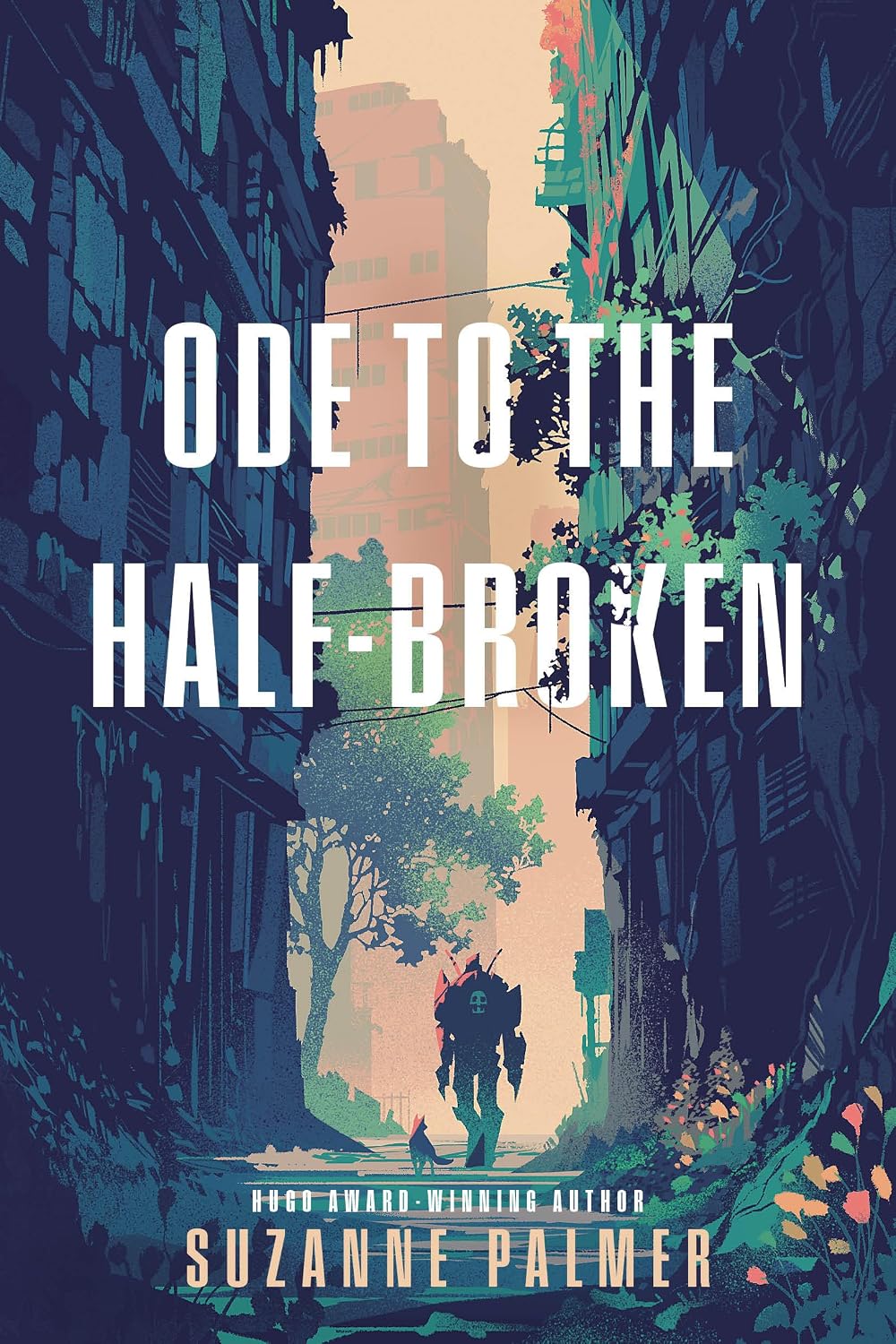
Having recently produced a review in this journal first for Adrian Tchaikovsky’s novel Service Model, and now this review, I wonder if I’ve not been assigned permanently to the small “robot-finds-identity-and-purpose-after-the apocalypse” beat. If so, I consider it in truth quite a fertile reviewing field, because these sorts of narratives raise multiple existential questions of intense interest—including, asking how and why we go about constructing our individual identities, creating opportunities for newfound autonomies, and both accepting and escaping toxic historical legacies.
“I awake, small of mind and full of alarm, only an inner subset of myself.” So opens Ode to the Half-Broken, its unnamed bot narrator (who later adopts the symbolically significant name “Be”) finding itself in an old bathtub inside a derelict building somewhere in a decaying, nearly empty New York City, minus one of its legs. Upon taking stock of its situation, Be is almost immediately liberated by Atticus, a dog equipped with numerous cybernetic implants that permit speech and interactions with other beings. The two share a number of commonalities: they both live in an NYC (indeed, an entire world) that suffered mass apocalypse produced by combinations of pandemics, toxic pollution, mass societal breakdown, deliberate lies spread via social media, and civil war, but a NYC in which mech life is thriving as sentient bots have created vibrant social networks based on barter and cooperation. Both live in the shadow of human machinations that warped them in their old lives and left them with lingering PTSD. Atticus’ refusal to discuss, except obliquely, his brutal vivisection, is subtly chilling, and sad. And Be’s determination to hide away in the abandoned NY Botanical Gardens, in order to study and preserve life rather than take it, is equally sad and reveals early that the mecha of Palmer’s novel have notably rich interior lives and emotional complexities.
Notably, those complexities include not only positive characteristics such as friendship, helpfulness, and reciprocity, but negatives such as prejudices against hybrids such as Atticus or humanoid-shaped bots, and, more darkly, the objectification of others (as one helpful mech warns Be, “I have heard rumors of mecha being attacked for parts… I do not understand how we have become like this, emulating humans in their disdain for one another except as products or consumers of product, but it has been growing worse of late.”). Finally, both Be and Atticus, together with the rest of mech civilization, coexist in a sometimes-wary, sometimes genuinely collaborative partnership with the scattered remnant human communities living in the shadow of lingering disease, toxicity, and disorder.
Palmer’s novel is extraordinary in its depiction of a multilayered, complex post-apocalyptic society that refuses to fade away and still moves on in the face of existential destruction and reevaluation. The descriptor of “half-broken” is apt across the world as a whole; it is not merely restricted to Be or Atticus or any of their other mech or human companions. The Earth can never return to its pre-collapse state, nor, frankly, should it. In many post-apocalyptic narratives, a return to the age before the disaster(s) is presented as the ideal. Such a resurrection would, of necessity, be deeply rooted in the nostalgic reconstruction of pre-disaster structures and hierarchies: revisited ideas of presidents, congresses/councils, industries, corporate entities, and so forth. And, in fact, the major villain of the book is hoping to prolong the mistakes of the past and carry out business-as-usual policies—namely, letting the ultra-rich play with people’s lives as if we truly were the NPCs they think we are. Be, whose dark and guilty past is intimately connected with the world’s destruction and those who caused it, ruminates at one point, “That any government had been foolish enough to let oligarchs build and operate critical – and unique – security infrastructure such as that network was an inevitable, and fatal, trojan horse. Dr. Milton had once said that allowing billionaires to come into existence in any society was the same as allowing knives to be inserted between your own ribs, with the same obvious and inevitable consequences for letting them remain here.” However, this new world is less permanently fractured and more kintsugi-like in its construction. The survivors have, most of them, grown into the fractures and thus forged new ways of being and of forming altruistic communities, both human and mecha.
Palmer’s “ode” is less to the world of before and to the innocent millions who perished; it is not even to the new world post-collapse, but to the humane resilience and transformative nature of the beings that live in that new word and are actively working to make something new and better. It is an ode to the brokenness of the survivors and how they use that as a method of evolution. A conversation Be has with 22-Banjo, a sentient AI train that serves as a mobile society of humans and mechas, is revealing. Be is asked: “Do you fear that, when you are allowed to return to your previous life of solitude, even if you put all the pieces of your life back exactly as they were before you left, that it will not ever be home again?”
<Yes,>, I say. <Not so much that I won’t get home but that I can’t. That I have become broken, deviated from myself enough that I won’t fit.>
<Sometimes, we cease to fit into a continuation of our past because we are broken, but more often, we cease to fit because we have grown,> 22-Banjo says. (235)
When Be mentions to 22-Banjo that “mecha are not metaphorical beings”, the railmech responds laughingly, “Are we not? Perhaps we are the most metaphorical beings of all, being constructed of strings and scrap, having had life breathed into us with only numbers and electricity and the glorious overconfidence of dreamers.” (Ibid) The half-broken world is a world of choice in the face of grief. Grief and trauma are ever-present weights for mecha and humans alike, but the world is made livable by the ways in which sentient beings resolve to carry their traumas, how they recognize their mistakes (the truly amoral and destructive among us are the ones who refuse to realize their own fallibilities), and how they deploy the lessons those traumas teach to learn from the damage caused by them or to them. Ode to a Half-Broken World may have too much death and destruction in it to be labeled “cozy” in the traditional sense of that subgenre, but its concern with both reparative justice and the communitarian potential of sustained hope certainly imbue the novel with empathy and kindness (though the latter is sometimes hard-won and reluctant), concepts that are common to the cozy or hopepunk subgenres.
Jeremy Brett is a Librarian at Cushing Memorial Library & Archives, where he is the Curator of the Science Fiction & Fantasy Research Collection, one of the largest of its kind in the world. He has also worked at the University of Iowa, the University of Wisconsin-Milwaukee, the National Archives and Records Administration-Pacific Region, and the Wisconsin Historical Society. He received his MLS and his MA in History from the University of Maryland – College Park in 1999. His professional interests include science fiction, fan studies, superheroines, and the intersection of libraries and social justice.


