From H.G. Wells’ The Time Machine (1895) to Octavia E. Butler’s Kindred (1979) and Arthur C. Clarke and Stephen Baxter’s A Time Odyssey Trilogy (2003-2007), writers have probed temporalities to question the nature of existence, our relation to history, and the limits of ethics in relation to technology. Extremity, a 2025 novella by Nicholas Binge, fuses the UK police procedural with the time travel subgenre to concoct a brisk, action-driven work about murder, a nightmarish future, and a mysterious time machine.
Binge’s 2023 breakout Ascension garnered raves from critics and the public. The novel concerns the sudden appearance of a mountain the size of Everest in the middle of the Pacific Ocean and an expedition that explores the mammoth structure. Ascension was selected as a New York Times ‘Editor’s Choice Pick’ with many noting its successful blending of action, suspense, and Lovecraftian elements. Binge’s Dissolution (2025) focuses on a man whose Alzheimer’s may be concealing the erasure of his memory by an external force. Extremity joins multiple novellas published annually by Tordotcom. The Tor Publishing Group imprint remains dedicated to the (re)-emerging novella market.
Constructed from three interwoven testimonies of investigators, Extremity’s action begins with the murder of billionaire tech giant Bruno Donaldson in contemporary London. Across the city, far from Donaldson’s penthouse, an exact replica of Donaldson—also dead—is located under a graffiti scrawled bridge. This bizarre discovery sets into motion a series of rapidly accumulating dead bodies and strange occurrences across the city. The reader traces much of the narrative through Julia Torgrimsen, a celebrity detective who has drifted into retirement and obscurity. She has been asked to return to determine the cause of these odd events. By her side is rookie DC Mark Cochrane and veteran DCI John Grossman. The investigators follow up with Donaldson’s criminal colleagues, bodies begin to pile up, an assassin is revealed, and the investigators stumble across a series of files that have future stock reports, photographs of body parts, and labels such as “date of attempted breach” and “date of disposal.” Eventually, our protagonists uncover a conspiracy that involves Earth in 6 million years, interaction with an unknown malevolent intelligence, boneless clones, and the ability to travel to the future.
Perhaps the strongest part of Extremity resides in its structure and action-driven writing. Composed of three alternating testimonies from our investigators, the narrative cohesively presents the action to its readers. Unfortunately, the three characters’ voices are interchangeable. With three differing perspectives, I was expecting to witness conflicting perspectives on the events. Yet, very rarely do the investigators provide contradictory testimonies. In a structure that could have yielded narrative complexity, the author employs the structure as a contrivance. In essence, the chosen structure and form minimally serve the content of the work.
Undoubtedly, Extremity possesses a strong hook: two dead bodies, identical in all ways, are discovered. The proceduralism sprints quickly from page to page, providing the reader with little time to catch their breath or to consider the logic of the tale or the ideas at play. And perhaps that is effective, because little of the work holds up to scrutiny regarding character, reason, motivation, or science. Extremity works as an excellent “action film” on the page, but not as science fiction invested in anything beyond an entertaining joyride. The writing itself propels the reader along—yet reflection on the events and characters reveals that the pace conceals many of the work’s faults. Extremity serves as a lightning quick read but is rarely challenging. That is not to say there is not a place for literature as pure entertainment crafted for pleasure and action, but this novella could be enriched by embracing complexities, paradoxes, and unseen concepts to captivate the reader beyond action.
The plot owes a great deal to police procedurals that have remained popular on UK screens and pages for decades. The science fiction elements of the novella truly manifest toward the end of the work. The “science” is cursory at best, yet there are a few time travel dynamics that are compelling, but—as with other elements—they are not sufficiently explored. Though one would expect a novella merging the police procedural and science fiction to locate commonalities with the work of Phillip K. Dick, I see little crossover.
Extremity does not further the subgenre in terms of intellectual concerns. That said, Extremity moves at a whiplash pace and illustrates how to propel action forward. Sadly, this results in implausible plot points, shallow characters, and ideas that would benefit from further contemplation. Unfortunately, characters make choices that seem unaligned with their established personalities, information dumps intrude, leaps of deduction are made, and there stands no real probing of the science and consequences of time travel. Further, police procedural cliches abound, while the lack of credibility in action makes one wish for more heavy editorial interference. There is no question that Binge writes solid action. Now, if he could graft the sophisticated ideas and challenging notions that thrive in science fiction to his writing in Extremity, I believe the result would be fulfilling.
In all, Extremity stands as a fast-paced, action-driven novella that is not invested in exploring the power and paradox of time travel but simply in taking the reader for a thrilling jaunt. The work trades in heady ideas of morality and temporal alterations for pushing the characters through a series of kinetic scenes. Extremity owes less to other noteworthy entries in the time travel subgenre and rests firmly in the tradition of many entertaining pulp tales that provided rip-roaring action but very few notions regarding humanity, time, and the consequences of our actions. Extremity does not further the time travel subgenre in any determinable way, but serves as an inoffensive, at times credibility-straining, piece of escapist literature.
Shannon Blake Skelton (he/him) is a teacher, professor, author, and researcher located in the Midwest. His scholarship, fiction, and reviews have appeared in numerous journals. His volume Interviews: Wes Craven was published by The University Press of Mississippi. He is a proud contributor to the Ad Astra Institute: https://adastra-sf.com/about.htm#about.
Simsa, Cyril. Starspawn and Other Stories. Invocations Press, 2025.
Version 1.0.0
Cyril Simsa’s previous collection, Lost Cartographies, was sub-titled Tales of Another Europe. Starspawn both expands and contracts his focus, evoking (as he says in his introduction) the techniques of Arthur Machen to summon images of the buried past of Muswell Hill, but also echoing Michael Moorcock’s multiversal cultural snapshots in a story in which “Jerry Comenius” waits at the Berlin Astrodome for the return of Scott and Zelda Fitzgerald from the Moon, and drawing upon 1940s horror film and the undercurrents of New York sf fandom. The result is another collection enhanced by the way Simsa excavates the ambiguous archaeologies of place, time, and narrative to reveal the strangeness of the familiar.
The title story begins with an uncanny vision conjured in a North London pub by the eponymous band, who get it together not in the obligatory country cottage but in a borrowed studio near a golf course: part of a number of green spaces carved out of what was once primordial forest. An attempt to capture the spirit of the pastoral by drumming on the trees takes some of the band into this forest. Two of them return, leaving bass player Dora behind. Band leader Moon and producer Jack later find themselves back in this strange realm. Their encounter with Lilith/Hecate/the Owl Queen results in the return of Dora, but the future career of the band suggests that, in this close encounter of Kenneth Grahame’s “Piper at the Gates of Dawn” and David Lynch’s Twin Peaks, goat-footed Pan is, in a world less bound by gender stereotypes, no longer the embodiment of pleasure. “Moje Sestra” shows a young researcher attempting to uncover the reason behind Elizabeth Russell’s famous cameo in the 1942 film Cat People—a trail which leads him to Jack Williamson’s novel Darker Than You Think (1948) and the feuds and wild stories of sf fandom, and finally to recently-discovered reels of film from a Czech director showing a deeper truth behind Val Newton’s production of Cat People. “Shuffle” is a more conventional science fiction story, if a device that allows you to access alternative pasts and futures is “conventional”. What seems to be a scientific experiment also seems to undermine the very concept of a consensus reality.
“Crescendo and Diminuendo in Blue” sweeps through the cultural detritus of the past century: there is a cameo appearance by Hugo Gernsback and an amusing young novelist who writes exciting space-travel stories for boys (and their fathers) waiting to board her first trip to the Moon. Its Moorcockian flavour is offered by “Jerry Comenius”: a professional flâneur, or, as another person notes, “wastrel”, watches: “I soak up the life of the people around me, and I reflect it back at them.” “On the Ridgeway” explores more fully the notion hinted at in “Shuffle” about splicing ancient DNA into the living human genome, but what ensues after one subject, Skutru, escapes (or is allowed to escape) is more thoroughly an exploration of the psychology of landscape, as he is traced to the Ridgeway locations of many psychogeographical emanations to a barrow which might predate even the Uffington White Horse and the travellers who crossed Doggerland to claim the hills on the far side. The final story, “The Shadow of Leaves Under Water”, switches focus but remains a snapshot of space, time, and identity. A former academic, Dr Durnsford, is journeying from Cambridge to Ely. It is the future of our time and much of East Anglia is in the grip of rising sea levels. Most of the story is Durnford’s meditation as she stops off at a hostel before completing her journey. Cambridge University as a symbol of rational learning with Ely Cathedral with its carvings of Green Men serving as a reminder of the new Spirit of the Land. One word which comes to her as she considers the future is “rehabilitation”: the return of the land to its original state of grace.
Like Arthur Machen, Simsa’s writing oscillates between two cultures with London (where Prague resident Simsa was brought up) as the ambiguous place they have in common. It is a place, both writers tell us, vividly evoked through place-names and memory and yet rendered almost invisible by the way it is built upon almost-forgotten networks and architectures which, when invoked, remind us of their presence. Many stories calling up “old gods” drag them to the present as threats or revelation. Simsa is more subtle. Pan, for instance, for Machen an embodiment of monstrosity, is, in “Starspawn,” “Mr P”, a “delinquent upstart”. In “The Shadow of Leaves” we are reminded that, despite the image of the “Green Man”, “wildness had never been gendered”. The great joy in reading Simsa’s psychogeographies is that he makes us look carefully at them. Many of us, revisiting old haunts and places once lived in but long ago departed from, will have encountered a peculiar double-vision: the memory of the streets and landscapes we once knew suddenly and vividly overlain upon those we are seeing. Simsa’s stories offer something like this. The past is something that is never gone, never lost, and in Starspawn we see pasts and former histories sneaking out of the shadows to remind us of their presence.
Andy Sawyer is a retired librarian, researcher, teacher, critic, and reviewer of sf. From 1993-2018 he was librarian of the Science Fiction Foundation Collection at the University of Liverpool Library. From 2002-2012 he directed an MA in Science Fiction Studies for the University’s Department of English. He is now an Honorary Senior Research Fellow, English Department, University of Liverpool. He was the 2008 recipient of the Science Fiction Research Association’s Clareson Award for services to science fiction. He co-edited (with David Ketterer) Plan for Chaos, a previously unpublished novel by John Wyndham (Liverpool University Press, 2009) and (with Peter Wright) Teaching Science Fiction (Palgrave 2011). He compiled a four-volume collection of significant essays on science fiction for Routledge’s “Critical Concepts” series (2020) and a critical edition of Jane Webb Loudon’s 1827 The Mummy!, one of the earliest British science fiction novels. His most recent book is Terry Pratchett for Liverpool University Press’s “Writers and Their Works” series.
Review of The Broadview Anthology of Science Fiction
Timothy S. Miller
Haslam, Jason, Ed. The Broadview Anthology of Science Fiction. Broadview Press, 2025.
Version 1.0.0
Editor Jason Haslam’s Broadview Anthology of Science Fiction promises to cover and contextualize two hundred years of speculative fiction in a neat package suitable for course adoption. Because so few anthologies of SF intended for the classroom have been published, especially in recent years, I will dedicate the first part of this review to an extended comparison between this new Broadview effort and the title with which it most obviously competes for a place on the syllabus, the landmark Wesleyan Anthology of Science Fiction, assembled in 2010 by the editors of Science Fiction Studies at the time, Arthur B. Evans, Istvan Csicsery-Ronay, Joan Gordon, Veronica Hollinger, Rob Latham, and Carol McGuirk. This enormously distinguished roster of scholars makes for a tough act to follow, and I expect that Haslam has studied the Wesleyan anthology carefully and taken some valuable lessons from it. In fact, many of the authors and almost twenty percent of the story titles overlap: H. G. Wells, “The Star” (1897); E. M. Forster, “The Machine Stops” (1909); Leslie F. Stone, “The Conquest of Gola” (1931); Ray Bradbury, “There Will Come Soft Rains” (1950); Pamela Zoline, “The Heat Death of the Universe” (1967); James Tiptree, Jr., “And I Awoke and Found Me Here on the Cold Hill’s Side” (1972); Joanna Russ, “When it Changed” (1972); Octavia Butler, “Speech Sounds” (1983); and Ted Chiang, “Exhalation” (2008). Here in the coinciding nine stories is a spine that we could certainly agree to enshrine in a canon of eminently important but also eminently teachable works of science fiction. The most obvious difference between the two anthologies—apart from individual stories in the Wesleyan not present in the Broadview that one might miss, such as, from my own syllabi, C. L. Moore’s indispensable “Shambleau” (1933)—is that the latter features considerably less “Golden Age” SF from the 1930s–50s, with the Wesleyan containing 17 stories out of its total 52 from these crucial decades, compared with only 11 of the Broadview’s 53 selections. The Broadview therefore is somewhat less useful in offering a historical picture of science fiction in its classic era around the midpoint of the twentieth century, but it more than makes up for this deficiency in other respects that I will detail below.
While quite diverse in comparison with earlier such efforts and for the state of SF and SF studies in 2010, the table of contents for the Wesleyan now looks far less so by comparison. By my count, the Broadview has almost double the number of BIPOC authors and women authors (though in each case still amounting to fewer than half of the total authors included). The story is not really in the raw numbers, however, but rather in how Haslam has so admirably taken steps to incorporate into his selection philosophy and editorial framing several important developments in both SF publishing and SF scholarship from the past decade and a half. Most notably, The Broadview of Anthology of Science Fiction contains an unexpectedly robust history of Afrofuturism and Black SF—with pieces by Charles Chesnutt, W. E. B. Du Bois, Sun Ra, Gil Scott-Heron, Charles Saunders, and Derrick Bell, among others—as well as showing the influence of the broader concept of CoFuturisms recently popularized by The Routledge Handbook of CoFuturisms, edited by Taryne Jade Taylor, Isiah Lavender III, Grace L. Dillon, and Bodhisattva Chattopadhyay. While Haslam acknowledges in his introduction that the book does not attempt to cover comprehensively the same range of futurisms treated in the handbook, “it is hoped that the current text can be a starting point for readers’ more in-depth journey into these multiple genealogies” (35). Authors from the Caribbean, South Asia, and Africa are represented here, as well as multiple Indigenous writers from Canada, although the bulk of the stories come from the US and the UK, and, unlike the Wesleyan, Haslam for reasons of scope has limited selections to works originally written in English (meaning no Verne or Lem). One final feature that distinguishes the Broadview from several other such anthologies including the Wesleyan is the effort to gesture towards additional forms and media via the inclusion of some poetry, song lyrics, and even a few Buck Rogers comic strips.
Haslam’s introduction suggests many possible definitions, histories, and points of origin of SF, grounding an account of SF’s multiple communities of practice in John Rieder’s work, and he prudently opts to begin the book with texts from the early nineteenth century. The choice to open specifically with Washington Irving’s “Men of the Moon” from his History of New York, however, may seem idiosyncratic, as this piece of Swiftian satire, with its speculative content firmly in the subjunctive, could serve as a disorienting beginning to the story of science fiction for a student. Haslam’s handful of vocabulary glosses and other notes will not do enough by themselves to help some students navigate this offering and, say, connect it to Star Wars and Star Trek. Of course, the book need not be read or assigned in order from cover to cover, and Haslam sketches multiple paths through the selections that one might follow other than the strictly chronological, this being the one that necessarily places Irving’s 1809 text first. To this end, the book devotes space to three separate arrangements of the same table of contents, organized by “Period/Chronological”; “Multiple Histories, Multiple Futures”; and “Thematic and Sub-Genre.” Following Irving, the stories in the first chronological section by Poe, Shelley, and Wells provide a more typical foundation for thinking through proto-SF. Florence McLandburgh’s always unexpected “The Automaton Ear” (1873) also serves as a unique glimpse into late 19th-century culture and science, as well as kicking off the book’s clear objective of placing more women writers in the longer history of SF prior to second-wave feminism, and thus moving away from a typical version of that story casting Mary Shelley as anomalous, followed by generations of male descendants. The many women writers who have always been present throughout SF’s history appear throughout the collection situated in their proper historical contexts, a vital step forward from reprinting their stories primarily in anthologies highlighting “forgotten” women writers.
The second chronological section, “Foundations of SF II: Enter the Twentieth Century: 1900-1936,” succeeds in capturing the richness and complexity of the early pulp magazine era while not centering only a handful of familiar SF pulp magazines, beginning with the increasingly popular proto-solarpunk fantasia “Sultana’s Dream” (1905) by Rokeya Sakhawat Hossain. Haslam judiciously includes some verse reprinted in pulp magazines as well as a story by Francis Stevens predating Gernsback’s first issue of Amazing Stories but published in the all-important generalist pulp magazine All-Story (“Friend Island,” 1918), broadening the story of the early magazines beyond the usual emphasis on the Gernsback-Campbell lineage alone. I was also pleased to find here two stories that I teach in just about every course I can because their relevance to the present only continues to increase, Forster’s “The Machine Stops” (1909) and Du Bois’s “The Comet” (1920). Classic pulp stories by Lovecraft and Leslie F. Stone round out this section, which in my view collectively provides an astoundingly compact and effective introduction to these key decades in SF’s emergence. I also appreciate Haslam’s use of images from this period and elsewhere across the anthology, which help to convey media ecologies quite alien to contemporary students and illuminate the original contexts for these works’ circulation and reading.
The only absence from the second section that I truly felt deeply was, again, C. L. Moore’s, but one of her most famous stories co-authored with Henry Kuttner, “Mimsy Were the Borogoves” (1943), instead appears at the commencement of the subsequent section on the “Golden Age,” in enviable company sandwiched between Isaac Asimov’s ur-robot story “Liar!” (1941) and Ray Bradbury’s often anthologized apocalyptic story “There Will Come Soft Rains” (1950). All are superb teaching texts, and this section notably moves on not only to core science fiction luminaries such as Arthur C. Clarke, Theodore Sturgeon, and Judith Merril but continues tracing Black speculative writing and thinking through one of James H. Hill’s newspaper stories, “The Space Ship” (1950), and Afrofuturist jazz icon Sun Ra’s poem “The Space Age Cannot Be Avoided” (1957).
The fourth section covers the 60s, 70s, and early 80s, titled “Revolutions and New Waves.” It provides a textbook overview of the new feminist SF of the time (Zoline, Tiptree, Russ) and stories by Philip K. Dick, J. G. Ballard, Samuel R. Delany, and William Gibson that characterize the experimentation as formal and otherwise of the time. One unique selling point for the book is a previously unpublished version of Delany’s story “Among the Blobs” (1976, 1987), accompanied by a new introduction from the author himself, but, as far as I can tell, the differences are minimal, and largely involve paragraph breaks and a few words switched out here and there. As a meta-history of science fiction and its futures itself, Gibson’s “The Gernsback Continuum” (1981) works particularly well in an anthology such as this one, pairing nicely with some of the stories from earlier sections. I will again praise Haslam’s care to highlight works by women and also BIPOC authors in each section: here, the Saunders story, Scott-Heron’s spoken word track on the Apollo program “Whitey on the Moon” (1970)—a piece I have taught in many courses myself to great success—and, in the next section, William F. Wu’s 1983 story “Wong’s Lost and Found Emporium” help dispel the myth that SF was thoroughly white up until the 21st century, with Delany, like Shelley, the single exception proving the rule.
The penultimate historical section navigates the later 80s to the early 2000s and as such struggles more than other groupings to tell a coherent story, perhaps because by this time science fiction had begun to mean so many things and pull in so many directions, and Haslam is clearly eager to hasten on to the present. The organizing framework offered by the title is “The Digital Age and Its Discontents,” and cyberpunk stories do appear here in abundance, with an emphasis on women authors such as Pat Cadigan, Candas Jane Dorsey, and Eden Robinson. But Gibson’s story had already appeared in the previous grouping, and, with only two stories from the 90s compared to the ten selections published since the 90s that the book contains, this section flounders somewhat as an implicit historical account or exercise in periodization. It overlaps conceptually and temporally with the preceding section, which shares the 80s, as well as with the following one, with which it shares the early 2000s; it is also impossible to tell the story of SF at this time without extensive consideration of film, games, and other media, so increasingly important to the meaning and understanding of the genre. I do not question the inclusion of any particular text here: I teach Butler’s “Speech Sounds” and Bell’s “The Space Traders” at every opportunity myself, and Nalo Hopkinson and N. K. Jemisin as well, but I am simply observing the high heterogeneity of this section, more a symptom of SF than this SF anthology, in the end.
One of course expects this kind of heterogeneity and lack of clear historical narrative in any account of the present moment, and so the same could be said of the final section on contemporary SF that features work by eight authors published between 2008 and 2019. Beyond showcasing stories by some of the major authors of this century—Ted Chiang, China Miéville, and Ken Liu—it also includes more work from less well-known Indigenous authors—here, Richard Van Camp and Drew Hayden Taylor and from Africa, Dilman Dila’s “The Last Storyteller” (2019), appropriately the final story in the book. I might have grouped Hopkinson and Jemisin in this section myself, key writers of the present and future, to be sure. In the end, the range of different versions of science fiction and futurisms presented here serves as a useful snapshot of the unrepresentable vast phenomenon that we call “SF.”
Any additional complaints or criticisms about the anthology that I could raise would remain quite minor. For example, there are a few too many puns about the book taking a “broad view” of science fiction for my taste, a minor complaint indeed. It is also strange for a historical anthology of English-language science fiction to lack a Heinlein story, although a remark in the introduction suggests that this omission and a few others may have resulted from permissions and/or expense issues (35). The larger and perhaps largest concern might be that the broad approach taken here risks hastening the forgetting of once centrally canonical twentieth-century authors of SF, including those featured in the Wesleyan such as Alfred Bester, Clifford D. Simak, and Frederik Pohl, and a little later Robert Silverberg and Harlan Ellison, among many other multiple Hugo and Nebula winners past. The tradeoff inherent in the rightly more expansive vision of SF presented here is the compressing of certain essential parts of SF history, but Haslam’s introduction, notes, and brief critical bibliography offer solid guidance for further explorations in any era and corner of SF’s history. Finally, because of the expansiveness of that vision of what SF encompasses and the many critical conversations with which Haslam engages, the erudite seventeen-page introduction, while generally accessible, occasionally makes points likely to fly over the heads of truly novice students without much prior exposure to or understanding of science fiction and its history. Nevertheless, I would recommend the book highly as an excellent base classroom text that an instructor can choose to supplement in various ways according to the preparation level of the students. Right now, The Broadview Anthology of Science Fiction seems like the best anthology of its kind for adoption in a university-level science fiction course, in that it most effectively captures and communicates the current state of science fiction scholarship as well as science fiction’s diverse historical trajectories.
Timothy S. Miller teaches medieval literature and contemporary speculative fiction as Associate Professor of English at Florida Atlantic University, where he contributes to the department’s MA degree concentration in Science Fiction and Fantasy. He has published widely on both later Middle English literature and various contemporary authors of speculative fiction and is the author of the books Ursula K. Le Guin’s A Wizard of Earthsea: A Critical Companion and Peter S. Beagle’s The Last Unicorn: A Critical Companion. Both belong to the series “Palgrave Science Fiction and Fantasy: A New Canon,” which he now co-edits with Anna McFarlane.
Tchaikovsky, Adrian. Children of Strife. Orbit, 2026.
Version 1.0.0
Children of Strife is the fourth novel in the Children of Time series (Children of Time, Children of Ruin, Children of Memory, and Children of Strife). The novels can be read as interconnected standalones, but it is best to read them in order. If one could choose a word to describe the humans in these novels and what they cause, it would be the word strife. The final conflict happens in this last novel, so the title is appropriate. Hence, who are the children and what is the strife? As in most of his books, Tchaikovsky begins with a conflict between humans on Earth. Different factions are fighting for power, for resources, for political dominance, and of course it is all fueled by their unavoidable hubris. Tchaikovsky also plays with the chronotope, so the reader has to keep track of the different worlds, spaceships, and timelines to understand how the characters developed and how everyone got to that final place. There are quite a few “what ifs” in this series, and the main one is what if science can release a terraforming nanovirus that can accelerate evolution in monkeys and create humans? This is Kern’s quest in Children of Time: creating life, being greater than life, being God. Of course, members of the other faction sabotage the project, and the virus is released on an alien planet named Nod (without the monkeys). Evolution is accelerated and new sentient species are created. This last installment to the series brings together the visitors and inhabitants of all the new worlds from the previous novels in a final conflict for humanity and the other evolved species of the Panspecific alliance.
It seems that no matter how far humans go into the future (the events happen over a few millennia) or away from Earth, they cannot leave behind the anthropocentric worldview. Kern suffers from the God complex, but she treasures her creations more than humans, which makes her somewhat different from Hartmand, who just wants to be a merciless God. Therefore, after millennia away from a destroyed Earth the final conflict is between the creations that God-like humans have made, the human “Gods,” and the human refugees that have survived the trip across space and time. Yet, these creations are not only biological; they are also artificial intelligences. What makes the story even more intriguing is that the creators themselves have transferred their identities, along with their good and bad aspirations, into these worlds as AI.
Apart from nanotechnology and imperialist terraforming, Tchaikovsky explores artificial intelligence and cybernetic immortality. Kern cannot live forever, but she can upload her consciousness into the computer and thus achieve a form of immortality. The question is whether Tchaikovsky treats these entities as clones or different selves of the same person. It appears that in the end Kern is a different identity from the one that set out to terraform alien planets. Another interesting concept is the supercomputer/simulator on planet Imir where humans encounter a virtual reality. They set into it to find the original creators only to realize that virtual reality will not give you the truth; instead, it will give you what you want to find. Alis spends a whole human lifetime in it, going deeper and deeper only to find out in the end that she never scratched the surface of it. She was only exploring her own scenarios. This is an interesting concept considering all the hype and theories regarding ChatGPT and other AI programs of today. She comes out of it traumatized and not able to differentiate reality from a virtual construct, thus, constantly questioning her sanity.
Tchaikovsky revisits the concept of symbiotic relationships (Alien Clay) through the rather comic virtual symbiosis of arachnid-like creatures Portia and Fabian, who struggle to combine their identities and find mutual ground for existence. A new approach is given through the symbiotic relationship of Alis and Mira, who have embraced each other’s personalities via their patient / therapist relationship. Their mutual interaction helps Alis ground herself in reality while helping Mira evolve. Mira is perhaps the most interesting character in the novel. Readers find out that the therapist helping Alis is actually Kern’s first creation. She is the original microbial organism (or group of organisms) that has adapted and transformed into a scientist. However, she struggles to contain her true nature, which involves a keen desire to ruthlessly assimilate all life in her path. Her symbiotic relationship with Alis helps her become a better living being. In the end, Mira displays more humanity and empathy than the humans do. At one point, Mira would rather end her own existence than bring more harm to others. She helps bring together the somewhat torn Panspecific alliance and gives a second chance to those who wish it by creating bodies for the AI entities. In the end, Mira is the dream that Kern set out to create.
Once again, Tchaikovsky takes the “what if” to another level by creating worlds in which life does life. Entities and creations explode in full force by assimilating everything and everyone into their own world. Yet, the highly evolved ones prove to have more “humanity” than humans do. It appears that the only true monsters in this universe are the vindictive and rather petty intelligences that conquer others not for the symbiotic advantages but for absolute power. They are the ones who, though capable of using their knowledge and science to cure Earth, do want to and would rather not share the accolades with their political opponents. With these novels, Tchaikovsky reminds us that in reality there is no terraforming, there is no other planet, and that our efforts should be aimed at saving the only planet we have.
Children of Strife is a good novel for those taking science fiction courses, although it is advised to read all the novels in the series for a better grasp of the concepts and storyline. The series is an excellent example of the Bakhtinian chronotope since the temporal and spatial shifts are layered and well done. Also, Tchaikovsky’s approach to giving different perspectives from various characters can be discussed further. The novel is useful for scholars interested in topics such as empathy, AI, cybernetic immortalities, virtual realities, terraforming theories, ecocriticism, trauma theory, ethics, anthropomorphism, and symbiotic relationships.
Zorica Lola Jelic, Ph.D. is an Assistant Professor at the faculty of Contemporary Arts in Belgrade, Serbia. She teaches English as a foreign language, Business English, Shakespeare, and English Drama. She earned her degrees in Shakespeare studies, but she also loves to write about literary theory and science fiction. She has published scholarly papers, coursebooks, and enjoys attending professional conferences.
Service Model has many spiritual predecessors—including every story or novel in which an artificial life form achieves new levels of sentience and independence—but in reading the novel, I found myself most drawn to a memory of the 1950 Ray Bradbury short story “There Will Come Soft Rains”. Soft Rains is a simple story, chronicling the daily routine of an automated ‘smart house’ that unknowingly goes about its preprogrammed and scheduled day even though its owners have been incinerated in a nuclear war. There is a deep sadness in Bradbury’s story, in not only the contemplation of the complete death of humanity but also the bleak realization that the automata that serve us will go on and on in our ruin, trying to perform its duties of service now rendered utterly pointless. What if all that is left of us are the systems and machines we built for our comfort and ease that now have no discernable purpose? What if a service model, a construction that only exists in direct relation to humanity, has no one left to serve? Both Bradbury’s story and Tchaikovsky’s novel ask their readers to consider the longevity of ourselves and our built environments in relation to the value of the legacies they leave behind for their survivors.
Tchaikovsky takes these stark existential questions and answers, “Well, obviously, what remains must learn to serve itself, serve alternates, or else accept its eventual extinction.” Service Model’s protagonist, the electronic valet Charles, embarks on something of a Dantean-level quest for a new identity and sense of purpose in a world where he has been rendered gradually, and then quite suddenly and violently, obsolete. Charles (whose evolution is initially signified by a name change, first to Undesignated Valet Unit and then to Uncharles—the latter a clear thematic abandonment of his former existence) is a valet for an isolated, introverted rich man, following the typical range of assigned tasks of pampering and ease for which a footman is traditionally responsible. When his master becomes abruptly removed from the equation, Charles/Uncharles is forced to come to grips with his existence in the wake of a slow apocalypse that has disappeared the vast majority of humanity. What remains in its place, and which provides at times moments both of high comedy and deep sadness in the novel, are the maddeningly slow and inefficient bureaucratic processes that made a modicum of sense when humans were running them, but which result in a Kafkaesque hell realm of unintentional cruelty to innocent bots endlessly awaiting resolution for their malfunctions. In one nightmarish scene, Uncharles, after travelling through neighborhoods of empty streets and abandoned manors, reaches the monolithic Central Services in hopes of repair or reassignment, only to confront long lines of lost, broken robots, many of whom Tchaikovsky presents as heartbreaking in their desperate attempts to retain their identities and functions. Robots stranded at Central Services exist in a forever holding pattern, without human officials to make accepted processes workable, and many are destroyed in the mindless process of “Data Compression,” supposedly a way to efficiently store robot memory for the future but quite fatally literal in its effects on robot physicality. It is a powerful moment in Uncharles’ existential journey, as he, already believing himself defective, becomes increasingly aware that something is badly askew in the world, something his machine logic cannot process or accept. (“Uncharles looked from the great static mass of robots awaiting a diagnosis that would never come, to the shattered remains of Data Compression. Inside his decision-making software there were two subroutines in the shape of wolves, and one insisted that he stay, and the other insisted that he could not stay. Neither of which seemed to be natural behavior for wolves, but Uncharles could only assume this was another aspect of his undiagnosed defect. He let them fight until one ate the other.”) As then-Charles reports to the AI that governs his master’s house near the novel’s beginning, “House…Everything is wrong. I am aware of a very large number of inefficiencies…None of these things are efficient or logical. I wish to report an error in the way that everything works.” All at once, “as his systems tried over and over to establish a new queue of tasks in a world that wanted absolutely nothing from him, he found that he could conceive of a world where things worked better.”
From that first moment of realization, Service Model becomes a story of expanding one’s worldview, as Uncharles migrates from a mental and emotional self-image of himself as the malfunction to a holistic worldview that considers alternatives to the way things are. His journey is one not only dedicated to self-definition and self-fashioning, but to the meaning that those things represent in a greater world. The house in “Soft Rains” is particularly sad, carrying out its functions mindlessly because it knows no better, understands no other way to be, and is incapable of reevaluating its purpose. It is forever trapped in a meaningless cycle, and only an accidental fire puts its existence to an end—and even then, a remnant of the system goes on, forever reciting the current date to an absent audience. Uncharles, on the other hand, develops a self-image independent of his dead creators and that instills in him an independence from unworkable, unjust systems. It’s a development with clear emotional resonance for sf readers; witness, for example, the rabid popularity of Martha Wells’ Murderbot, who similarly evolves out of its programmed constraints into a freer, more autonomous life.
As Uncharles proceeds through the novel, he encounters various ways in which both humans and robots have sought to create alternative ways of survival and societal revitalization in the face of apocalypse, as well as their catastrophic failures to do so. Each encounter is a learning experience for Uncharles, who is searching for a place where he and the new world can meet and function efficiently together. At one point he states to another robot, “I was constructed for only the one purpose. Since leaving the manor I have witnessed many things I did not understand…I have travelled through many places that functioned at less than a satisfactory level and did not seem to fulfil their purposes. The world, as I have witnessed it, is a place lacking in efficiency, rationality, and cleanliness. I am driven to find a place in it nonetheless.” Uncharles seeks to escape the reality of illogic by trying to find a place in which he logically, purposefully exists and functions. In a parallel quest, he is accompanied by The Wonk, a human disguising herself as a robot (the book’s longest running joke is Uncharles’ complete failure to recognize The Wonk as a human rather than a bot, even as the reader realizes this from Sentence One). The Wonk wants to know why and how the apocalypse happened, desperately hoping that the cause was a revolution by robots recognizing, like Uncharles, the ability to choose for themselves. “Because if it was just…economics, or climate, or plagues or something then that’s…pointless.” For The Wonk, the only escape from meaningless chance is to believe that robots rose up and destroyed the humanity that enslaved them; that would mean justice and fairness exist in a mad world. Without ethical meaning, what good were we? What is the good of a world where little survives of us but the detritus we thought made our lives purposeful but ultimately prove as pointless as the endlessly date-droning house of “Soft Rains”? In the end, The Wonk, like Uncharles, is obliged to consider different ways of living in the world and different reasons for its prevailing disorder. In sum, Service Model carries on the venerable sf tradition of evolving machine autonomy but adds to those works new dimensions of philosophical complexity by pairing that quest with a wider exploration of meaning on both the world macro- and the individual microlevel.
Jeremy Brett is a Librarian at Cushing Memorial Library & Archives, where he is the Curator of the Science Fiction & Fantasy Research Collection, one of the largest of its kind in the world. He has also worked at the University of Iowa, the University of Wisconsin-Milwaukee, the National Archives and Records Administration-Pacific Region, and the Wisconsin Historical Society. He received his MLS and his MA in History from the University of Maryland – College Park in 1999. His professional interests include science fiction, fan studies, superheroines, and the intersection of libraries and social justice.
Nayler, Ray. The Tusks of Extinction. Tor Publishing Group, 2024.
Version 1.0.0
Ray Nayler’s The Tusks of Extinction (2024) is a conceptually dense novella that confronts the vanity of the Anthropocene through the lens of de-extinction. The narrative centers Dr. Damira Shakhbazova, a preeminent mammoth expert and digital ghost. In her past life, Damira was a brilliant behavioral ecologist who was brutally murdered by poachers while trying to protect elephant herds. In the narrative’s present, her digitized consciousness—salvaged from a cold-storage backup—is uploaded into the mind of a cloned mammoth matriarch. Resurrected by the shadowy, oligarchic “Moscow Corporation,” this mammoth is meant to anchor a newly-bred herd in the Siberian “Pleistocene Park.” Conflict arises because the cloned mammoths, lacking generational memory and social structures, are dying of behavioral failure; they do not know how to be mammoths. Damira’s human mind must synthesize with the ancient, dormant instincts of the mammoth body to teach the herd how to survive.
Nayler articulates the novella by weaving Damira’s internal, posthuman experience alongside two parallel plotlines. The first follows a team of highly weaponised eco-defense mercenaries hired by the corporation to protect the multi-billion-dollar herd from heavily-armed poaching syndicates. The second follows a wealthy, elite modern hunter who has purchased the ultimate luxury experience: the legal right to hunt and kill one of these resurrected giants. Instead of yielding to the technophilic spectacle typical of modern clone-and-capture narratives, Nayler introduces a stark, suspenseful eco-thriller that quickly shifts away from the mechanics of genetic engineering to examine the structural violence of ecotourism and late-stage capitalism. The narrative converges in an inevitable, bloody confrontation where human greed clashes directly with the ancient, newly-awakened instincts of the herd, resulting in a bleak interrogation of human supremacy.
Within the broader trajectory of science fiction, The Tusks of Extinction actively converses with and subverts the long-standing “resurrection” lineage depicted in Michael Crichton’s Jurassic Park (1990). While Crichton’s foundational text explores the chaotic collapse of human systems under the weight of genetic pride and chaos theory, Nayler alters this trope by shifting the focus from the scientific how to the socio-ecological why. The novella draws deeply upon the conventions of climate fiction and contemporary posthumanism, trading the typical pulp-adventure thrills of rampaging monsters for a somber, philosophical exploration of digital reincarnation, interspecies trauma, and synthetic ecology.
Furthermore, by choosing the mammoth, a creature deeply tied to actual, contemporary scientific efforts regarding Siberian permafrost restoration, Nayler grounds his speculative world in immediate, real-world ecological debates. He draws on the traditions of classic eco-speculative fiction, such as the works of Kim Stanley Robinson and Ursula K. Le Guin, where the natural world is not merely a passive backdrop for human drama but an active, agentic protagonist. Nayler employs the genre’s historic capacity for cognitive alienation to mirror our current climate anxieties, playing with the generic boundaries between the hard sci-fi cyberpunk matrix (the digitised mind) and the gritty, visceral reality of climate-altered landscapes.
From a scholarly and formal perspective, the novella offers immense critical potential for science fiction studies. Its formal structure, juxtaposing the corporate-funded resurrection of megafauna against the continuous, low-intensity warfare of modern poaching, powerfully complicates the historical science fiction trope of the “technological fix”. Nayler suggests that merely resurrecting a biology does not resurrect an ecology, nor does it dissolve the capitalist frameworks that caused the extinction in the first place. Thus, the text introduces a profound, dialectical tension between the physical flesh of the mammoth and the digitised ghost of the human mind inside it. This raises crucial posthumanist questions regarding where human agency ends and animal subjectivity begins, directly contributing to the intellectual and philosophical concerns of contemporary science fiction.
Compared to contemporary science fiction texts that favour lengthy space operas or techno-optimistic solarpunk, Nayler’s approach stands out for its concise, razor-sharp focus on the ethics of the Anthropocene. The prose is stripped of excess, functioning like a clinical yet deeply poetic case study in extinction economics.
For researchers and educators in the English Studies domain, The Tusks of Extinction possesses remarkable pedagogical utility. It serves as an ideal anchor for undergraduate or graduate modules focusing on the Environmental Humanities, Critical Animal Studies, or contemporary speculative fiction. The novella can be productively paired with classic extinction literature or contemporary eco-theory, such as Donna Haraway’s Staying with the Trouble or Ursula K. Heise’s Imagining Extinction, to ground its narrative in biopolitical theory. It also pairs brilliantly alongside Crichton’s Jurassic Park for a comparative study on how the Science Fiction genre’s attitude toward genetic engineering has evolved over three decades. An effective classroom exercise would involve a discourse analysis of the corporate rhetoric utilised by the novella’s “Moscow Corporation” versus the real-world promotional material of actual de-extinction startups (such as Colossal Biosciences). Students can map out how speculative literature exposes the hidden neocolonial and neoliberal motivations embedded within contemporary science, analysing how Nayler seizes form to critique the commodification of the non-human world. Ultimately, the text offers a compact yet theoretically rich intervention that challenges students to rethink the boundaries of conservation, memory, and species justice.
Adrián Pla Ángel holds a Cum Laude PhD with international distinction in Applied Languages, Literature, and Translation from Universitat Jaume I, where he serves as an Associate Professor in the Department of English Studies. Besides, he is also lecturer of the Education department at the European University of Valencia. As a member of the IULMA research institute and the SPARK research group, his research focuses on discourse analysis, corpus linguistics, and the multimodal analysis of digital and textual genres. His extensive university teaching experience includes courses in complex text production, advanced registers, and technical English, backed by international research stays in Germany and the Czech Republic. He is also actively involved in educational innovation and funded research projects.
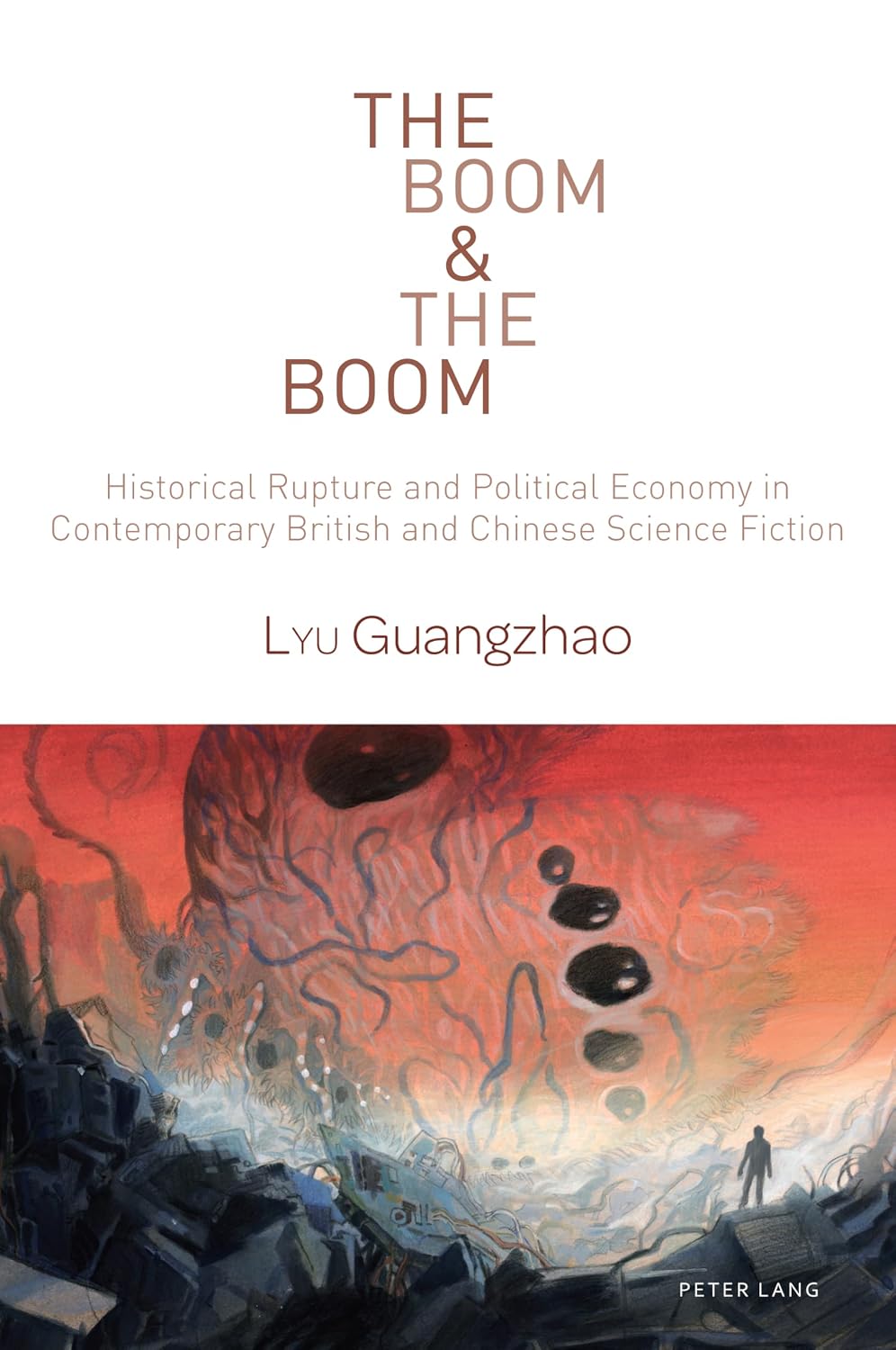
Review of The Boom & The Boom: Historical Rupture and Political Economy in Contemporary British and Chinese Science Fiction
Angus Stewart
Lyu Guangzhao. The Boom & The Boom: Historical Rupture and Political Economy in Contemporary British and Chinese Science Fiction. Lausanne, 2024. Peter Lang. Paperback. 320 pg. $67.95. ISBN 9781803742328.
Version 1.0.0
In The Boom & The Boom, Lyu Guangzhao’s intention is both to close the intellectual distance between two national zones of global sci-fi, and to widen a breach in its established discourse and structure. Two previously disconnected movements within the genre are beginning to speak to each other without US-mediation. Chinese works have already gone global, and modern British works are finding readership in China (5). Academic discourse can, perhaps, facilitate further and deeper mutual recognition.
His subtitle is a straightforward promise: political and historical analysis of sci-fi from two nations. As for the title, Lyu’s ‘booms’ are two ‘new waves’ from broadly parallel historical moments: China’s transition from Maoist communism to growth-oriented ‘post-socialism,’ and Britain from postwar social democracy to post-industrial neoliberalism. The title’s syntax is an intentional invocation of China Mieville’s The City and the City (3), in which two worlds exist side by side, each never recognising the other. (China isn’t chosen for his name: he’s the closest thing to a figurehead of the ‘New Weird’ strain in the British ‘boom.’)
Lyu’s thesis is that key works in each boom built a space to respond to a national and global swing from state socialism to market capitalism. He lays out how British and Chinese writers publishing at the supposed end of history (and later, ‘capitalist realism’) rallied to form critiques and imagine alternative societies. Steering clear of denial and wishful thinking, Lyu underscores how different works lament, subvert, or even imagine accelerations of a turn away from the security and grandeur of a society with socialist ambitions. He dwells much upon questions of coming together, or shattering apart.
In Lyu’s approach, ‘Chinese sci-fi’ and ‘British sci-fi’ are two national literatures unfolding against a historical and political backdrop. Other identities and languages within each state fall outside the fame. The first two of Lyu’s five chosen British authors are Scots, but this fact proves incidental. Appended to Lyu’s broadly left political approach is the use of theorists from the critical canon—Marx, Jameson, Foucault, etc—but also of figures and schools such as Mark Fisher, Gilles Deleuze, and Object Oriented Ontology. Deleuze in particular bridges orthodoxy and the weirder theorists.
Lyu also draws on literary specialists. Examples concerning China: David Der-wei Wang for Sinophone literature, and Li Hua, Song Mingwei, and Nathaniel Isaacson for Chinese science fiction. Concerning Britain, Stuart Hall for politics and culture in the neoliberal era, and Roger Luckhurst and Andrew M Butler for commentary on UK sci-fi and its boom—not to mention choice quotes from the politicians Tony Benn, Tony Blair, Nigel Lawson, and (naturally) Margaret Thatcher.
Each chapter pairs one novel or series from the British boom with a correspondent from the Chinese boom. Lyu’s selected texts also mix intuitive and niche choices. Of the five British authors selected, Iain M Banks and China Mieville are the celebrities, Ken MacLeod a rung or two lower, James Lovegrove a could-have-been who receded into IP tie-ins, and M John Harrison a dark star. Of the five Chinese novels selected, two of the five are not published in English translation. One author, Long Yi, has had none of his works released in English.
The introductory chapter, Mapping the Field, sets the model for the book’s pleasingly symmetrical approach. After defining ‘boom’ and introducing each of them, Lyu sets the historical context for one nation, and then the other. Britain goes first. The section A Journey to the Right: The Rise of Thatcherism is a detailed political timeline starting with the end of Britain’s postwar consensus and progressing to the present. Those familiar with the terrain could skip it, but whether as a refresher or introduction, the marriage of detail and flow is commendable. Next comes Challenging the Narrative: British SF Boom as Left-Wing Responses, discussing Thatcher’s legacy in British culture, and how it relates to sci-fi. In Lyu’s telling, the left’s material defeat shifts resistance to culture, which is in turn neutered by institutions (31), yet sci-fi maintains an edge due to its low status (32). In the book’s concluding chapter, Chinese sci-fi faces a similar conundrum. When you are nobody, there is no need to become respectable. But when you are somebody, the reverse [277].
Next, China. In the section Before the SF Boom: Spiritual Pollution and “Top-down” Elitism, Lyu details the first attempt at a post-Mao emergence of sci-fi, and how it fell victim to an intellectual pile-on in which a new cultural elite resorted to a moralistic backlash that favoured science writing over science fiction. Lyu’s summary brings this history into English—extremely helpful for readers previously unfamiliar with the names of key players and publications. Chinese sci-fi’s complicated relationship with liberalisation continues in the next section, The Cat’s Colour Does Not Matter: Deng’s Reform and the Dawning of the Chinese Boom. Lyu first details how, despite pushback, China’s opening up continued, albeit with a heavy skew toward marketisation. The decoupling of publishing houses from state protection forced them to consider the tastes of readers, thus freeing sci-fi from the judgements of once-dominant intellectual elites (49). Lyu pins the start of the Chinese boom to 1991, when the magazine Science, Art and Literature changed its name to Science Fiction World, an indicator of collective insistence on the value of applying fiction, and not just educational writing, to scientific topics (52).
Lyu finishes the introduction with a claim sitting on the verge where academia falls away into esoterica: that the parallel emergence of the UK and PRC booms is not coincidental, but rather two local expressions of the same hyperobject. Or in plainer English, products of a force/system so massive that it resides on the edges of human comprehension (53).
More concretely, Lyu tees up his next task: to initiate dialogue between the booms (54). In his words, they are family: “Fraternal twins already separated for too long.” (53) In Chapter 1, The Ones Who Walk Away, Lyu’s first attempt to connect the twins brings in Han Song’s Red Star Over America (火星照耀美国) (2000) and Iain M Banks’ Culture series. The topic is ‘disrupted utopias.’ At the opening of Red Star (also translatable as ‘Mars’), China is governed by a benevolent AI named Amanduo, whose collapse triggers massive chaos. The main character, a Chinese go champion, sets out across America to seek a replacement utopia. Lyu argues that Amanduo represents various aspects of China’s authoritarian model, from grand-narrative Marxism to post-Mao humanism: secure, static, suffocating. Though it was never perfect nor sustainable, once dead it can be mourned as a lost utopia. But in its collapse, the innocent optimism necessary to conceive another utopia dies (76). Thus, nothing subsequent can suffice.
Lyu ends his discussion of post-utopian China by noting that a search for a ‘new form of sovereignty’ could look to Iain Banks’ Culture: “the other utopia that exists in the shadow of its own disruption” (79). Lyu then introduces the Culture (series) as something less grand: as Banks’ vengeance against Thatcherism (84), taken by modelling a new form of space opera centred on a society running on what we might call “fully automated luxury communism” (Bastani). Then, citing Sherryl Vint’s use of Hardt and Negri’s Empire, Lyu details how a close reading of the series indicates that the Culture in fact reflects the real-world shift from classical forms of imperialism (power secured through force, territory, conquest, hierarchy, purity) to the American (90) postmodern form (power secured through values, lifestyle, assimilation, decentralisation, hybridity). He guides the reader to note a fundamental contradiction in both the Culture and the US: a society that vaunts freedom, plurality, and noble ethics, but practices confrontation and homogenisation, driven by a fundamental belief in the value of itself over all alternatives (96). Lyu closes with comparisons of Han Song’s dying utopia and Banks’ contradictory utopia, focusing particularly on a comparison of their respective AI governors: the centralised Amanduo and the distributed, autonomous Minds. Scarcity is also discussed, which leads into the next chapter.
Chapter 2, What’s Past is Prologue, concerns ideological options for building an ideal society, operating under the constraints and dilemmas of political reality. Lyu’s chosen texts are Hao Jingfang’s Vagabonds (流浪苍穹) (2016) and Ken MacLeod’s Fall Revolution series. Lyu starts with Vagabonds, which follows youths torn between a high-minded collectivist society built on Mars, and a hyperindividualist consumer society on Earth. The former offers a managed life of intellectual and technical pursuits; secure but solemn. The latter promises personal freedom and self-expression, but a constant fight to sink or succeed. Lyu’s focus is to evaluate this Martian variant of utopia. In comparing one of its key mechanisms with China’s once-foundational work unit (danwei) system, he brings in insight those less familiar with China would surely miss (106). He also dwells on the characters’ feelings of disenchantment, and notes that the Martian society’s noticeably academic system of funding and citation bears a similarity with Earth’s capitalism: both systems motivate their subjects through competition and personal ambition rather than solidarity and collective enrichment (116). So, as Hao Jingfang intends, Lyu reads her Mars as an ambiguous utopia.
Lyu then brings in Robert Nozick’s concept of meta-utopia to deal with MacLeod’s Fall Revolution series: that is, a zone in which contrasting utopian models can be attempted and administered, leaving individual humans free to migrate and participate in their preferred version of society. MacLeod’s series features and explores both socialist and libertarian ideas, yet for Lyu the series’ fascination with the market—imagined to its extremes, and safe from consignment to the scrapheap of history—suggests the “historical exhaustion” (135) of the neoliberal era in Britain. Capitalist realism in space, legislated by a weary socialist. Earlier, Lyu notes that MacLeod’s characters are luckier than Hao’s (122). The former don’t need to forge or overthrow societies to find their ideological home. The latter are orphans forever. But at the chapter’s end he evens the score, noting that both authors’ characters live in universes where no conclusive utopia can exist (136).
Chapter 3, Long Live the Vampire, returns from space to consider how China Mieville’s Perdido Street Station (2000) and Chen Qiufan’s Waste Tide (2013) use elements of speculative genre, chaos, and the weird to approach social issues and dynamics as they exist on Earth today: foremost the exploitation of the weak and the marginal, hybrid identity, and collective resistance. In Chen’s words, spoken in 2007 at a conference in Chengdu (Dongmei): “reality has surpassed science fiction.” The vampire in question is capitalism, not any lone predator. Neither author leads: Lyu’s analyses the books in tandem. The theory he deploys here is Foucault’s heterotopia, concerning marginal places of otherness and difference – worlds in words, opposite but adjacent, again mirroring Mieville’s TheCity and the City (2009). Cities and symbols are Lyu’s starting point. He explains that the Silicon Isle (硅屿, guī yǔ) of Waste Tide stands in for the real town of Guiyu (贵屿, guì yǔ), a massive e-waste recycling hub on the edge of Chen’s native Shantou (141). Perdido Street Station’s New Crobuzon stands for London: colossal, mongrel, fluid, and vastly unequal (149). The exploited of the former are, just as in real Chinese cities, domestic migrants from poorer provinces. The exploited of the latter are a diverse array of humanoid species, standing in for London’s globalised, multiethnic populace.
Lyu’s analysis begins following the natural fault lines for each group, considering class foremost for the migrant workers and identity for the ‘xenoid’ species. But as the chapter progresses, he weaves this back around. Concerning the waste people, he analyses how social demarcations and anxieties form a social caste for them, blocking them from integration or synthesis with the ‘natives’ of Silicon Isle (152), and thus allowing class exploitation for profit to continue. Concerning New Crobuzon, he explores how the technocratic aristocracy work in conjunction with organised crime to engineer the vampiric conversion of citizens’ dreams into a commodity: a drug. The distinction here is that in Waste Tide, exploitation has arisen without conspiracy, whereas in Perdido Street Station the elite use weird forces to force it on the populace (164). The reader may decide for themself which world is more frightening and chaotic.
Chapter 4, From Consumption to Prosumption, deals with worlds where market logic and consumer psychology have achieved total dominance, and to do so brings the reader into less-mapped literary space. James Lovegrove’s Days is an early entry (1999) from an author who departed from the British boom to write less ambitious works: mostly teen fiction, pastiche and IP tie-ins. Long Yi’s Earth Province is far more recent (2018), but is not available in English translation. Lyu uses each to move from class society to consumer society: another mirror, this time reflecting Britain and China’s journey across the new millennium. The former from postwar democratic socialism of unions and nationalised industries to a financialised and individualist service economy, and the latter from revolution, rigid Maoism, and the ‘iron rice bowl’ to market reforms, an expanded personal freedom, and burgeoning inequality.
Days is a satire focusing on a middle Britain fixated upon an all-encompassing department store. Earth Province is something darker: a depiction of our planet under the thumb of an alien race who harvest us for food. In Days, the store is the locus of prestige and desire. In Earth Province, every aspect of society is up for sale, purchase, and taxation. Life ends at 45 for men and 40 for women, but that too can be prolonged by a purchase. This pair clicks perfectly with Lyu’s titular concept, presumption: a mode of consumerism in which the consumer pays to contribute to production (203). Aided by Days, Earth Province, and his chosen theorists, Lyu demonstrates how, in both British and Chinese novels, the desirous and defanged consumer-citizen will now volunteer their own energies to feed the machine, whether tapping at the McDonald’s self-service screen, or handing over cookies and content to Meta and Meituan.
In Chapter Five, Past the Point of No Return, Lyu uses two trilogies, Liu Cixin’s Three Body and M John Harrison’s Kefahuchi Tract, to characterise opposing visions of despair and possibility. The former is the logic underpinning the war for survival in Three Body: the universal ‘dark forest’ in which (A) trust is not possible and therefore that which is not self is enemy (214), and (B) everything which is not strictly economic and strategic is a liability that must be jettisoned (224). Lyu interprets the titular zone of Harrison’s series as the opposite (238), not in the sense that it is safe and cheerful, but that it is pluralistic rather than reductive (241), and impossible to capture in any conceivable law or system (240). Lyu frames the dark forest’s conversion of social subjects into objects of capital and enterprise as emblematic of post-socialism and neoliberalism, and documents how in China capitalism’s beneficiaries (corporate elites) (219) and proponents (the online right) (228) have embraced the aspects of Three Body that favour a bleak and narrow will to power. Inability to see beyond the market, recast as virtue.
Lyu finds a line of dialogue in Harrison’s series to summarise his proposed opposition: “Uncertainty is all we have. It’s our advantage. It’s the virtue of the day” (Harrison, 21). Sticking to this line of thinking, Lyu uses Deleuze and Guattari’s concepts to characterise the series: a drama of and journey toward radical multiplicity, decentralisation, and perpetual flux. Lyu is not afraid to use Deleuze and Guatarri’s internal language, either, to frame the series as one in which the principal characters become ‘haecceities’ rocket along ‘rhizomatic’ ‘lines of flight’ to be ‘reterritorialised’ in a blinding light. He returns to the topic of capitalism at the close, suggesting that Harrison’s stories orbiting the Kefahuchi Tract model a way to move beyond capitalism, rather than defeat it through binary war and resistance (255). Readers are free to ponder the length of such a road relative to their own lifespan.
In the conclusion, A Confession of Breach, Lyu considers the breach in literary culture where these two national booms have begun to speak to each other. Lyu devotes the most words to the Chinese boom. As he makes clear, the British boom has conclusively ended, while its Chinese counterpart persists. Lyu’s personal confessions here—really, they’re anecdotes—are illuminating. He recounts conversations with British readers which revealed that their understandings and valuations of the Three Body trilogy were remarkably different from his own, leading him to surmise that the contrast hinged on foreign readers’ desire to experience “Chinese-ness” (261). This prompts a digression on questions of Orientalism, ‘world literature’, and an opportunity for Lyu to synthesise the thoughts of key academics such as David Der-wei Wang and Song Mingwei, and his own: suppose world science fiction is a hyperobject (267), or a planetary literature (279)? The polyphonic planet is a pleasing note to end on, and suitable. Consider the Earth as a hard limit (for the time being), but one host to teeming, cross-pollinating multiplicities.
The Boom and The Boom joins a small but growing cohort of English language academic works on Chinese sci-fi, and is the first to bring in another country on equal terms. The Boom and The Boom is verbose but easily penetrable, and flush with enthusiasm, and thus could serve as a great step up for Anglophone readers who devoured the essays in the Invisible Planets and Broken Stars anthologies edited and translated by Chinese-American writer Ken Liu (or perhaps more appropriately Sinopticon, whose assembler Xueting C Ni is British-Chinese). Lyu’s words can take the reader to places these titles’ paratexts can only tease. Sino-specialism aside, the book will also be of genuine interest for those keen to explore readings of British science fiction, and more broadly how the worldwide turn to market economics ushered in by the likes of Thatcher, Deng, and Reagan has rippled through world cultures.
If I were to reach for a critique of the book I might point to its asymmetries. For example, Lyu is far stronger on context and details for Chinese works: take his run-through of Chinese internet culture wars over Three Body (228), which is of the top rank of all available in English, or his footnote on Chengdu’s botched Worldcon (276). His engagements with British sci-fi skew more broadly, more likely to engage with Britain’s literary figureheads and already-archived discourse than beating-pulse intricacies around, say, household registration laws (143) or uproar over crowdsourced marketing for the Tangdaren instant noodle brand (210). In dealing with Days, for example, we find no mention of Britain’s greatest lost middle class utopia: Debenhams. But whether or not the mirror is askew, and though it is hard to say if one academic can link two worlds, Lyu certainly succeeds in widening the breach, and creating a strange and pleasurable portal for the critical and curious to dive into.
Angus Stewart is a Dundonian living in Greater Manchester who writes occasional strange stories and essays. His fiction has appeared in various small publications including Ab Terra, Necksnap, and Dark Horses. His writing on Chinese literature and culture has featured in Asian Cha, the Asian Review of Books, and Crumble. He holds a BA Hons in English Literature and Creative Writing from Manchester Metropolitan University, and an MSc in Publishing from Edinburgh Napier University. He spent several years teaching in China, and currently works as an editor within the bowels of the University of Manchester. His show, the Translated Chinese Fiction Podcast, is on hiatus.
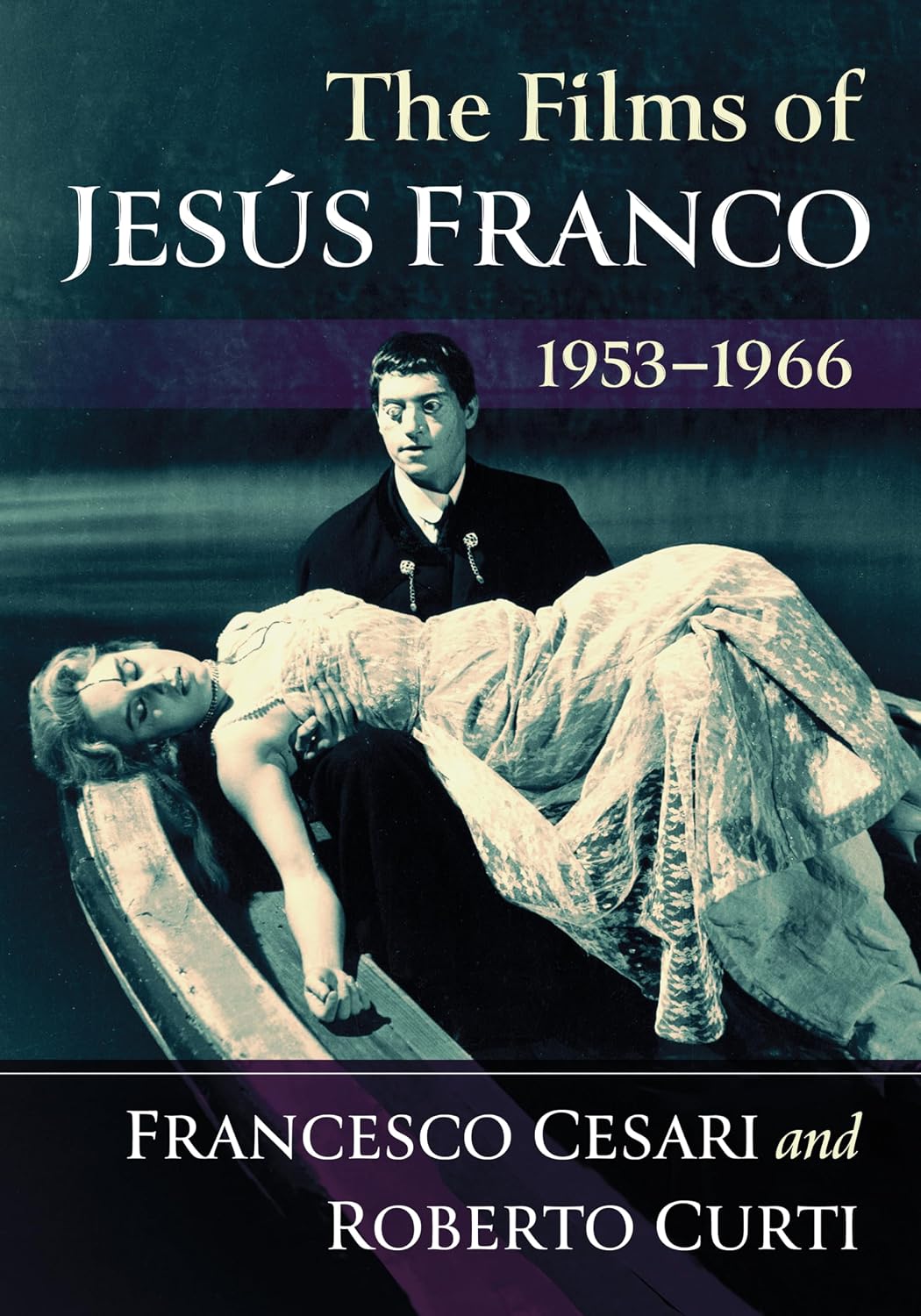
Francesco Cesari and Roberto Curti. The Films of Jesús Franco, 1953-1966. McFarland Books. 2024. Paperback. 381 pg. $59.95. ISBN 9781476694313. eBook ISBN: 9781476652115. https://mcfarlandbooks.com/.
Version 1.0.0
Jesús “Jess” Franco (1930–2013) occupies a unique position within European genre cinema, navigating the boundaries between exploitation, auteur filmmaking, and underground aesthetics. The years 1953 to 1966 mark Franco’s formative period, laying the foundation for his later cult status. Despite directing over two hundred films, Franco has remained a marginal figure in mainstream film scholarship, though his work has garnered considerable attention within cult cinema circles. Academic engagement with his body of work remains uneven and often polarized, oscillating between celebratory fan discourses and outright critical dismissal. Notable contributions include Obsession: The Films of Jess Franco (1993) by Lucas Balbo, Peter Blumenstock, Christian Kessler, and Tim Lucas, which combines biographical insights with an accessible, albeit non-academic, exploration of Franco’s recurring motifs and aesthetic tendencies. Similarly, Alain Petit’s The Strange Case of Jesús Franco (1998) provides filmographic detail and personal recollections, though its critical perspective is limited. More recently, Stephen Thrower’s two-volume work, Murderous Passions: The Delirious Cinema of Jesús Franco (2015), has become a key reference for both scholars and fans, offering production histories and in-depth analysis. However, its coverage of Franco’s early films remains cursory, focusing predominantly on his later, more sensational output. Within the broader context of European exploitation cinema, Cathal Tohill and Pete Tombs’ Immoral Tales: European Sex & Horror Movies 1956–1984 (1995) situates Franco alongside contemporaries such as Jean Rollin and José Ramón Larraz, emphasizing his transgressive role within genre traditions. Nevertheless, focused academic attention on Franco’s early career (1953–1966) remains notably scarce—a gap that The Films of Jesús Franco, 1953–1966 directly addresses.
Primary sources authored by Franco himself offer valuable insights into his creative process and self-perception as a filmmaker. His statements, dispersed across interviews and liner notes for home video releases, reveal his resistance to genre classifications and his commitment to artistic subversion. Notably, La noche pasa demasiado lenta (1991), Franco’s semi-autobiographical and poetic work, provides a glimpse into his personal mythology and creative psyche, blending fiction with reflections on his cinematic preoccupations. Further interviews compiled in Balbo et al.’s Obsession and Thrower’s Murderous Passions illuminate Franco’s views on censorship, genre hybridity, and his complex relationship with commercial and avant-garde cinema. Although often anecdotal, these sources are essential for understanding the idiosyncratic trajectory of Franco’s early artistic development.
The Films of Jesús Franco, 1953–1966 offers a timely, well-researched examination of Franco’s often overlooked early films, situating them within two intersecting frameworks: the political and cultural conditions of Francoist Spain, and the industrial dynamics of European co-productions. By focusing on his formative years—characterized by genre experimentation, musical influences, and subversive elements—the book fills a significant gap in Franco critical studies. It challenges the prevailing assumption that his career began solely within exploitation cinema, instead of foregrounding his engagement with diverse genres and artistic aspirations. As discussed in Obsession: The Films of Jess Franco (1993), these early films provided fertile ground for experimentation, wherein Franco explored musical motifs and genre hybridity, foreshadowing the more defined horror and erotic aesthetics of his later work. The book offers critical reassessment through archival research, primary sources, and detailed film analysis.
Authors Francesco Cesari and Roberto Curti engaged in rigorous archival work, drawing on censorship records, contemporary reviews, and production documents to construct a comprehensive portrait of Franco’s artistic development. Their approach significantly deepens the understanding of Franco’s early output, demonstrating that his subversive tendencies and experimentation were present from the outset.
While The Films of Jesús Franco, 1953–1966 provides an academically grounded, contextual analysis of his early work, Cesari and Curti’s earlier publication, The Jess Franco Files – Vol. 1: Cuatro guiones y una sinopsis de Jesús Franco (2017), offers a complementary perspective through its use of primary sources. This volume presents four of Franco’s screenplays and one synopsis, granting unprecedented access to his creative process through previously unpublished materials. As an archival resource, The Jess Franco Files is invaluable for researchers focused on textual analysis and script development.
In contrast, The Films of Jesús Franco, 1953–1966 prioritizes critical interpretation, situating Franco’s early films within the socio-political and industrial contexts of post-war Spain and Europe. It combines scholarly argumentation with insights from secondary sources, production histories, and interviews, rather than relying exclusively on Franco’s unmediated creative documents. Its strength lies in connecting these early films to broader discourses on genre cinema, censorship, and transnational production, while The Jess Franco Files provides raw textual material without substantial analytical framing.
One of the book’s most compelling contributions is its examination of Franco’s relationship with national identity and international co-productions. The authors demonstrate how his collaborations with French, German, and Portuguese producers enabled him to transcend the constraints of Spanish cultural policy, resulting in films that defy straightforward categorization. In doing so, the book aligns with contemporary scholarship that reframes European exploitation cinema as inherently transnational. Rather than portraying Franco as merely a purveyor of low-budget cinema, Cesari and Curti present him as a director who actively negotiated the boundaries of artistic freedom within restrictive political and commercial environments. Their research underscores Franco’s ongoing experimentation with narrative form and genre conventions as central to understanding his evolution as an artist, preceding the more sensational elements that would later define his reputation.
However, the book offers limited exploration of how Franco’s early films were marketed, censored, or critically received beyond Spain. While it provides a thorough analysis of the transnational production context, the international reception of these works receives comparatively less attention. This omission mitigates? inhibits? makes it difficult for readers to gain? a comprehensive understanding of the global circulation and legacy of Franco’s pre-1967 output—an area complicated by the post-war political climate and the challenges of incomplete, poorly preserved, or lost film records from the period.
Despite this limitation, the book makes a substantial contribution to cult cinema studies by elevating Franco’s early work from historical obscurity to essential groundwork for his later, more widely discussed productions. By centering on this neglected period, Cesari and Curti invite a reassessment of Franco as a filmmaker whose artistic ambitions extended well beyond his most controversial films.
The Films of Jesús Franco, 1953–1966 offers a much-needed scholarly examination of a crucial yet underexplored phase in Franco’s career. Through meticulous archival research and critical film analysis, the book challenges reductive readings of his early work and situates it within broader cultural and industrial frameworks. While certain aspects, particularly international reception, could be more fully developed, the book ultimately succeeds in addressing a significant gap in research about Jess Franco. It serves as a vital resource for scholars of Spanish cinema, European genre film, and cult cinema more broadly, representing a key step in the ongoing academic reassessment of Jess Franco’s diverse and often misunderstood filmography.
WORKS CITED
Balbo, Lucas, et al. Obsession: The Films of Jess Franco. Editions 7e Dimension, 1993.
Franco, Jesús. La noche pasa demasiado lenta. Ediciones La Máscara, 1991.
Franco, Jesús. The Jess Franco Files: Cuatro Guiones y Una Sinopsis de Jesús Franco (Laberinto; La Noche Tiene Ojos; El Castillo de Frankenstein; Un Tiro en la Sien; Orloff 2001). Edited by Roberto Curti and Francesco Cesari, 2017.
Petit, Alain. The Strange Case of Jesús Franco. L’Étrange Festival, 1998.
Thrower, Stephen. Murderous Passions: The Delirious Cinema of Jesús Franco. Vol. 1, Strange Attractor Press, 2015.
Tohill, Cathal, and Pete Tombs. Immoral Tales: European Sex & Horror Movies 1956–1984. Titan Books, 1995.
Elena Natalia Romea Parente holds a PhD in Spanish Cinema and Literature, with a doctoral dissertation focused on the Spanish mystic filmmaker José Val del Omar. She also holds dual degrees in English and Spanish Studies, as well as a Master’s in European Literary Studies. Her academic career includes teaching appointments at several Spanish universities, including the Universidad Autónoma de Madrid (UAM) and the Universidad Nacional de Educación a Distancia (UNED). In addition to her scholarly work, she is the founder of Spanish Fear (spanishfear.com), a platform and podcast dedicated to the study and dissemination of Spanish horror cinema. Her research engages with multidisciplinary contemporary narratives, with particular emphasis on horror, the uncanny, and the aesthetics of strangeness.
Review of Thinking through High-Tech Hell: A Theory of the New Media Dystopia
Sara Martín
Miguel Sebastián-Martín. Thinking through High-Tech Hell: A Theory of the New Media Dystopia. Peter Lang, 2024. Ralahine Utopian Studies, Volume 35. Softcover. 384 pg. $60.95. ISBN 9781803744629. https://doi.org/10.3726/b21834.
Version 1.0.0
Miguel Sebastián-Martín is a postdoctoral researcher and teacher in the English Department at the Universidad de Salamanca, Spain, where in 2023 he completed the PhD dissertation behind the volume here reviewed, Thinking through High-Tech Hell: A Theory of the New Media Dystopia. Sebastián-Martín, an MPhil in Film and Screen Studies from the University of Cambridge, focuses his research on Anglophone speculative fiction in audio-visual media. In this volume, he studies in particular diverse British and American 2010s series, which he presents as part of the SF sub-genre of new media dystopia.
With this label, Sebastián-Martín refers to the series that criticize digital capitalism while being at the same time successful products of the digital-capitalist streaming platforms. Sebastián-Martín’s volume is informed by the underlying supposition that new media dystopia is part of an epoch-making structure of feeling, as a narratively reflexive sub-genre, as an aesthetically ambivalent form, and as the expression of (post-)postmodern quixotism. The author explores which ways the series selected contribute to, rather than truly criticize, the hopelessness with which we face seemingly indestructible contemporary capitalism, and encourages readers to boldly face the high-tech SF hell that current life is in the age of digital capitalism.
The success of the series that Sebastián-Martín analyzes is paradoxically based on inviting viewers to acknowledge the many points of contact between SF and current reality, and to critically rethink both, but without abandoning the 21st century dystopian structure of feeling. Sebastián-Martín wonders, therefore, whether the series do offer a truly meaningful discourse beyond the attractive post-cyberpunk aesthetics and the enjoyable reflexivity about their own medium: platform TV. The author argues that, actually, the often-ironic approach to their position as SF audiovisual texts made to entertain a media-savvy audience results in a rather limited critical-dystopian message. Often, the characters express a utopian impulse, but, since this follows the myth of Don Quixote, spectators are left with no feasible referents for actual change. Unless, that is, they approach the fictions of new media dystopia as Quixotes ready to fight digital-capitalist giants even knowing they’re windmills.
Thinking through High-Tech Hell is divided into four substantial chapters, each constituting an area of theoretical exploration dense enough to originate a separate volume (the author himself hints this might be particularly desirable in the case of the last chapter, devoted to examining quixotism, and I agree). Chapter 1, “Our Hopeless SF Times: Contemporary Capitalism as a New Media Dystopia,” addresses the contradictions articulating the bleakness that current dystopia expresses, paying attention to left melancholy, capitalist realism, and, above all, to Raymond William’s notion of the structure of feeling. Inspired by Tom Moylan’s concept of the critical dystopia and its links to hope, Sebastián-Martín investigates how in dystopia “contrasting ideological impulses, the utopian and the anti-utopian, are put into dialog, resulting in a complex interplay of hopefulness and cynicism” (43). He worries, though, that our postmodern stance and the neoliberal hegemony are preventing us from finding an alternative to the bleak vision of the dystopian future. This dark panorama has been thoroughly absorbed by SF, so that “new media are now re-imagined as a science-fictional novum when they are understood as a totality and a totalizing force that seems to be taking history in a dystopian direction” (83, original italics). The series, in short, might seem just the cherry on top of the fictional dystopian cake, but they are actually a basic ingredient in our march towards something that might be even worse than the current capitalism.
Chapter 2, “New Media Reflexivity: Self- Referentiality and Self-Consciousness in the Audio-Visual SF of Digital Platforms,” claims that this speculative sub-genre mirrors the nature of the digital media themselves. Using Pedro Javier Pardo’s transmedia model of reflexivity, Sebastián-Martín reads Amazon’s serialized adaptation of Philip K. Dick’s The Man in the High Castle and Black Mirror’s interactive film Bandersnatch, made for American Netflix after the series abandoned UK’s Channel Four. For the author, new media reflexivity is both “a symptom of digital capitalism’s dominant dynamics, which predispose a degree of commodified self-referentiality” but also “a potential mode of estrangement that can be allied with SF’s own estrangement—and directed against the system from within” (120), though neither production ultimately challenges the thriving streaming platforms system of production and consumption.
Chapter 3, “Between Critique and Mystification: The Aesthetic and Ideological Ambivalences of New Media Dystopias,” explores the essential ambivalence of this sub-genre, which offers its products as a potential critique of the excesses of technology while flaunting that same technology as the source of mere SF audio-visual spectacle, just as SF cinema has always done. The analysis of HBO’s Westworld in comparison to Devs (a DNA/FX production distributed by Hulu) also raises the issue of whether unnecessary plot complexity is the main enemy of new media dystopia and the main hindrance to build clear-cut utopian hope.
Chapter 4, “New Media Quixotism: Satiric and Utopian: Characterizations of Digital Subjectivity,” offers a ground-breaking theorization of current SF’s indebtedness to the myth of Don Quixote. Sebastián-Martín considers Black Mirror’s popular episode “USS Callister” (Netflix), Mr. Robot (US Network) and Maniac (a Netflix remake of a Norwegian series), to explore characters who, following Cervantes’s unique protagonist, mix (science) fiction and reality with different degrees of awareness, and madness. Sebastián-Martín, however, prefers not to deal with the issue of whether this new SF quixotism affects in particular male characters, concluding instead that all spectators are “somewhat quixotic as users of digital technologies” (337) which provide us with dystopian views of the present and the future, as we ponder, each of us alone before the screen, “what we can do about the apparently inevitable” (337).
Thinking through High-Tech Hell: A Theory of the New Media Dystopia does not conceal from readers that its aim is to present a theory of a particular SF sub-genre. This is why the analysis of the series selected leaves readers asking for more (such as information about the platforms distributing the series and the material conditions of production), while the deluge of footnotes leaves us asking for less. Sebastián-Martín assumes a no doubt idealizing quixotic position in trying to impose order onto a very complex phenomenon, as he maps simultaneously the theorization of capitalism (above all of commodified culture), audio-visual SF, the new media, their rather hypocritical dystopian inclinations and their techno-ambivalent gaze (a re-purposing of Laura Mulvey’s ‘male gaze’). He calls, besides, for “theorizing digital platforms as self-referential, all-encompassing paratexts” (341) since “there is still need for a theory of the possibilities—and the limits—that digital cultural consumption poses for reflexive narration” (341). The author’s beautiful quixotism is also manifest in his decision to celebrate his mentor, Pedro Javier Pardo, cited in many points of his book as an indispensable referent, when most of us, Spanish scholars in SF studies and/or English Studies, too often unfairly ignore our own local talent to rely instead on Anglophone big (and small) names.
“Maybe descending into high-tech hell,” Sebastián-Martín writes as a final conclusion, “was a necessary exercise that gave us a degree of critical-utopian clarity” in the 2010s to “keep on walking away, to see what awaits” (345) beyond the paralyzing hopelessness of the 2020s, to which the popular series of new media dystopia have so significantly contributed. The future calls, indeed, for a new utopian SF but, as Sebastián-Martín warns, this cannot be built unless we abandon our postmodern cynicism and turn technology into a source of welfare rather than despair.
Sara Martín is Senior Lecturer in English Literature and Cultural Studies at the Universitat Autònoma de Barcelona and a SFRA member. Dr Martín specializes in Gender Studies, particularly Masculinities Studies, and in Science Fiction Studies. Her most recent books are American Masculinities in Contemporary Documentary Film (2023), Masculinity in Contemporary SF by Men: No Plans for the Future (2025) and Masculinities in Contemporary Science-Fiction Television (2025, co-edited with Michael Pitts).
Review of Late Star Trek: The Final Frontier in the Franchise Era
Jeremy Brett
Adam Kotsko. Late Star Trek: The Final Frontier in the Franchise Era.University of Minnesota Press, 2025. Mass Markets: Storyworlds Across Media. Paperback. 256 pg. $22.95. ISBN 9781517919108.
Version 1.0.0
Above all, reading Late Star Trek gives the reader a solid appreciation for the result of scholarly and thoughtful analysis when melded with the enthusiasm, excitement, and feelings of betrayal for a franchise that only a fan can provide. Kotsko’s volume is suffused with his own fannish opinions (for example, his love for the first season of Discovery[1] [DIS] [2017-2024] followed immediately by his crushing disappointment in its remaining seasons, or his scathing summary of the narrative failures of Picard [PIC] (2020-2023), or his clear affection for Lower Decks [LD] [2020-2024]). Trek fans and scholars alike, I believe, will commend Kotsko’s avoidance of stereotypical scholarly bloodlessness; rather, they will, as I do, take delight in the ways in which he is deeply committed to the Trek storyworld in its various permutations and how that longtime love informs his analysis of its successes, failures, and creative potential. I think, in fact, that Kotsko’s work is a model of readable, practical popular cultural analysis, because the best scholars tell us not only factually or analytically what we need to consider about a particular topic but emotionally why that topic is meaningful. There’s uncommon emotional resonance in a media franchise like Star Trek, which has nearly six decades of history behind it, including eleven television series, fourteen films (13 theatrical, 1 streaming) from two different in-universe timelines, more than 850 tie-in novels and story collections, numerous comic book series, and boundless amounts of social and cultural recognition. Such a widespread body of content that has generated so much love and fannish dedication over the years deserves attention, particularly in our late-stage capitalist age when nothing seems free of commodification, even a beloved media franchise that traditionally roots itself in a post-scarcity utopia where inequality is nonexistent.
One of the more valuable portions of Kotsko’s study is his examination of the ways in which “late Star Trek” (the term Kotsko applies to the period of the franchise following the end of Voyager in 2001, the time when “Star Trek stops being a business out of necessity, simply because that’s what it takes to keep new stories, and becomes more purely commodified (2)”) evolves in the face of corporate necessity. Late Star Trek represents a media moment where, as Kotsko puts it, “story decisions are dictated by business strategy, when the quest for new audiences risks undercutting everything the established fans love, and when endless reams of materials are churned out in the expectation that those same fans will shell out for anything with the name Star Trek on it” (Ibid.) (No doubt Star Wars fans are nodding along with this sentiment.) However, Kotsko never simply surrenders to a simplistic model in which late Trek = late-stage capitalism and neoliberalism (and a concomitant assumption that late Trek is automatically and forever worse than the original series or Next Generation [1987-1994]). Instead, throughout the book he brings to bear his inner Trekkie and posits that Trek avoids full commodification in this late period—despite multiple dramatic missteps—because the people who generate and consume it still tend to love it (well, perhaps not Section 31 [2025]) and take to heart the ethics, values, and ethos that mark the Trek universe. And by proceeding step by step through each iteration of post-Voyager (1995-2001) Trek, Kotsko produces what he calls “a case study for late capitalist franchise storytelling…(and) our understanding of a franchise that has always been noted for its relative intellectual sophistication and has therefore held a privileged place in the academic study of popular culture” (16). Furthermore, he looks deeply into the double-edged, fraught influence of franchise “canonicity,” which throughout Trek is a push-and-pull struggle between fan service (where canonicity is enshrined as the highest value), artistic freedom as expressed through discontinuity from the main established storyworld narrative (which can be a perilous endeavor the more it pulls away from that narrative), and maximizing worldbuilding (which synthesizes both these other strategies, but which risks losing character and plot development). His method is an elegant one for exploring canon in all its ramifications for a franchise, ranging from igniting fannish enthusiasm to a cheap replacement for narrative exploration.
These three different narrative strategies and their varying levels of deployment mark the directions of every Trek iteration in late Trek. Kotsko begins with an exploration of the prequel show Enterprise (2001-2005), Star Trek’s redheaded stepchild, generally disliked by fans and eschewed by scholars. The series, under franchise bêtes noires Rick Berman and Brannon Braga, had the unenviable task of being the first Trek iteration to try and solidify the universe’s timeline into some sort of cohesive whole. But despite bright spots, Kotsko argues that the show was dragged down by the creative decision to make a prequel (that should, by definition, prioritize fan service and reward fannish understanding of franchise lore) that instead tried to center Berman and Braga’s desire for creative freedom which ended by downplaying or ignoring the Trek tradition of progress, diversity, and inclusion. Later attempts in the show to try and exercise fan service (i.e. the Klingon head ridges storyline) were maladroit and unnecessary at best, producing in the end a series that was “a fragment, riven by contradictions and continually making promises its creators could not—and perhaps did not even want to—fulfill” (64). However, Kotsko argues that Enterprise set the tone for future late Trek in trying to maintain a successful tension between fan service and creative freedom while making frequent use of in-text meta gestures to continually cement itself into the franchise’s history and evolution.
The next section of the book examines the area of the Trek universe that has received the least scholarly analysis: the “novelverse,” that is, the body of so-called ‘beta canon’ that supplements what we see on screen. Kotsko quotes Sean Guynes and Gerry Canavan, who define the novels as “an imaginative space for fans to collectively work out the implications of concepts from televisual Star Trek, as well as to identify and attempt to resolve apparent contradictions in the character portraits, fictional history, and philosophical themes of the series” (70). That massive and complex body of work is no less meaningful because the corporate owners of Trek deem it noncanonical and not legitimate. He uses the works of three different authors to ground his analysis here: Christopher L. Bennett (who personifies effective deployment of fan service), Kirsten Beyer (artistic freedom), and David Mack (Federation- or worldbuilding strategies). The novelverse in many ways, Kotsko argues, enjoyed the freedom to drastically expand our reading of thefranchise from Enterprise through Voyager, but that creative flowering was dramatically curtailed once Picard began production and the novels’ canon was deemed irreconcilable with what the Powers That Be declared “official,” requiring an overwriting and destruction of the entire novelverse, in part, it seems, to meet studio executives’ need for control over a profitable product.
Another chapter explores the “Kelvin Timeline,” the three films from J.J. Abrams set in an alternate timeline and rooted in a creative freedom that would free them from the constraints of an established canon. The first film, Star Trek (2009), however, proved empty in being concerned with nothing more than placing new versions of beloved Original Series characters into familiar positions on board the U.S.S. Enterprise. The next film, Into Darkness (2013) was a poorly disguised 9/11 allegory, and the third, Beyond (2016), is convoluted and, like its predecessor—and much else in late Trek—is darkly overlaid with themes and images of terrorism. The Kelvin reboot/prequel/sequel hybrid series proved ultimately unsuccessful in impacting the greater Trek universe by its emotional and actual separation (mandated by corporate pettiness between co-owners CBS and Paramount) from the beloved Original Series. Kotsko then moves to Trek’s return to television after a 12-year absence: Discovery (2017-2024), whose first season resulted in what Kotsko calls one of the finest story arcs in Trek history, through both a re-embrace of traditional Trek diversity and taking seriously franchise worldbuilding via intricate plots and dramatic retcons (i.e. a devastating Federation-Klingon war that had never been mentioned in the franchise before). But later seasons betrayed this original expansion of artistic freedom by writing the series into an irrelevant dead end and much more clumsy, haphazard worldbuilding.
Kotsko reserves his greatest fannish scorn and disappointment for Picard (2020-2023), the first Trek since the 2002 film Star Trek: Nemesis to move the timeline forward past Next Generation. As with Discovery, the first season of Picard combined creative freedom with expansive worldbuilding to create a complex and emotionally rich story, one that “breaks” the utopia of Next Generation by placing TNG’s Picard in a Federation that is callous towards Romulan refugees and allows economic inequalities, and where old friends (William Riker and Deanna Troi) live lives marked by grief and trauma. But Picard suffers from developing plot incoherence and an increasing tendency to reset in the name of fan service—season 3 virtually erases season 2—and culminates in a painfully pandering conclusion that reunites the TNG crew on the bridge of the old Enterprise-D battling the last of the Borg. Kotsko notes that this moment marks perhaps the lowest point of late Trek, “the moment when the franchise threatened to transform into a purely cynical commodity, nothing more than ‘content’ churned out to extract subscription fees for Paramount+” (197).
A final chapter plays cleanup by discussing together the latest three Trek shows: the animated and ultra-meta comedy Lower Decks (2020-2024), the animated children’s adventure series Prodigy (2021-2023), and the prequel Strange New Worlds (2022-present), all of which taken together demonstrate late Trek’s potential for narrative variety. All three series share a general unconcern with the knottiness of worldbuilding, that instead obliges them to concentrate on interesting and likeable characters and a return to the episodic nature of old Trek instead of a focus on universe-shattering story arcs that mark Discovery and Picard. Their approach to canon varies. Prodigy, set just before Picard, sidesteps canonical disconnect by setting itself mostly (especially in season 1) in the distant Delta Quadrant, far from the Federation; Lower Decks embraces canon as an opportunity by constantly referencing it as part of the characters’ lived experiences as self-aware fans of the franchise’s past; and Strange New Worlds manages to wear lightly its identity as an ultimate expression of fan service while still flexibly playing with canon without destroying it (i.e. by readjusting the romantic tension between Spock and Christine Chapel, or by giving the lizardlike Gorn a terrifying and horrific Xenomorph-like maturity cycle).
Kotsko concludes his remarkable study on a cautionary note, referencing failures in studio management, corporate tendencies to interfere with creative production, the periodic invalidation of tie-in productions, problems with the streaming television model and, most of all, an overreliance on the significance of franchise canon. He calls this concept of a binding canon “a marketing technique to compel fans to consume every new installment because it may become relevant for still later installments” (239), and worries that, for all the fun that fan theories and connections to canon may generate (I’m certainly guilty myself of such activities!), an iron-clad commitment to a corporate-mandated continuity may ultimately suffocate drama, and cause consumers, driven by a production environment devoted to maximizing profits, to replace appreciation of plots and characters on their own terms in favor of labored, endless searches for canonical connections that may not exist. But, in the finest tradition of the Star Trek he loves, Kotsko holds out optimism, if future Trek creators can be freed from the current neoliberal moment and given freer rein to explore the post-capitalist utopia in which Star Trek resides.
[1] For the purposes of this review, I am ignoring the naming convention that the titles for all the series discussed here formally begin with the prefix ‘Star Trek:’.
Jeremy Brett is a Librarian at Cushing Memorial Library & Archives, where he is the Curator of the Science Fiction & Fantasy Research Collection, one of the largest of its kind in the world. He has also worked at the University of Iowa, the University of Wisconsin-Milwaukee, the National Archives and Records Administration-Pacific Region, and the Wisconsin Historical Society. He received his MLS and his MA in History from the University of Maryland – College Park in 1999. His professional interests include science fiction, fan studies, superheroines, and the intersection of libraries and social justice.