SFRA Country Report: India


SFRA Review, vol. 51, no. 2

Features


SFRA Country Report: India

Vishnu Prasad Thandassery Radhakrishnan


This is my first contribution to the SFRA Review in any format and I am deeply humbled and honored to write the country report for India. The report features an Introduction to the Indian Association for Science Fiction Studies (IASFS) and our activities including the organization of an International online conference in 2020 and proposed activities for 2021, followed by an overview of the Indian SF films and literature released in 2020 and 2021 until now.

IASFS is a non-profit association established on 2nd January 1998. The association’s headquarters is in Bangalore, Karnataka State. This is the only registered association in India which promotes the research in science fiction and fantasy. The association promotes research in the field of Science Fiction, organizes conferences and conducts SF short story writing workshops for Indian citizens of all ages and levels of education. IASFS has organized 14 National and 5 International Science Fiction conferences at different locations in India. The Association has collaborated with many Colleges, Universities, Local Bodies and Institutions in organizing conferences. Hence, it was able to bring together hundreds of academicians, scholars, students, scientists, writers, publishers, critics, movie makers, journalists, fans, industrialists, technologists, farmers and readers.  So far the Annual Conferences of IASFS were held at Chennai, Coimbatore, Gandhigram, Gudiattam and Vellore in Tamil Nadu, Bangalore, Yelahatti and Mysore in Karnataka, Varanasi in Uttar Pradesh, Aurangabad and Pune in Maharashtra, Pondicherry, and Ernakulum in Kerala, my home state. Each conference had plenary sessions and story reading sessions by respective authors in addition to the paper presentations. IASFS had also arranged a SF Story Writing Workshop conducted by Eric Miller and story reading sessions by respective SF writers. The association was also able to organize a video conference with Professor James E Gunn, Director of the Center for Science Fiction Studies at Kansas University.

Dr. Srinarahari is the Secretary-General of IASFS and he plans and distributes all the duties and activities of the association including memberships, roles of members in association and conference related activities. I am a life member of the association since 2019. The 19th Annual or the 5th International Science Fiction virtual Conference of the association was held in collaboration with Bangalore University, from December 7 to 10 in 2020. This conference was entitled “All Roads to Science Fiction”. A unique feature of the conference was that all the 52 departments of the Bangalore University, SF fans, media and the general public had converged at “ISFC 2020”. Themes of the conference varied from myths to advanced technology and to the life in other worlds. The conference was inaugurated by the Chief Minister of Karnataka State, and the Deputy Chief Minister, the Minister for Higher Education, the Minister for Primary and Secondary Education, the Vice Chancellor of Bangalore University, and the Physics Nobel Laureate of 2019 Professor Didier Patrick Queloz had made their esteemed presence. Some of the highlights of this conference include plenary sessions from SF experts and scholars from different countries, paper presentations, special lectures, interviews, panel discussions, and the narration of SF stories. Guest Speakers of the conference included science fiction writers from Czech Republic, Julie Novakova and Lucie Lukacovicova. The conference also hosted guest speakers from different disciplines including Neural Engineer Dr. John RoLacco from Singapore, NASA scientist Ravikumar Kopparapu, and Dr. Ashish Mahabal, Astronomer and Data Scientist from Caltech.

The Association publishes a quarterly magazine entitled Indian Journal of Science Fiction Studies. It comprises of papers and stories presented in the previous conferences, review of books, and an interaction by the readers. As part of the conference, we had also prepared a collection of all the abstracts received for the conference and it was released as an E-book after the conference. Selected papers from the conference will be published in a peer reviewed journal maybe later this year. IASFS proposes to hold Regional, National and an International Conferences during 2021-22. This year’s National Conference may be held at Shridi in Maharashtra.

As for the recent developments in Science Fiction novels, films, and TV shows from India, there is very little to mention from the year 2020 till now. One SF novel worth noting is Samit Basu’s Chosen Spirits. This is a dystopia set in a near Indian future and has all the elements of a traditional dystopia like surveillance, an exploitative government, and the manipulation of technology. It was featured in the short list of the JCB Prize for Literature in 2020. Other honorable mentions include The Wall by Gautam Bhatia, Analog/Virtual: And Other Simulations of Your Future by Lavanya Lakshminarayan, Star Daughter by Shveta Thakrar, and Hunted by the Sky written by Tanaz Bhathena. S.B. Divya, who is known for her SF short stories, published her first SF novel Machinehood in March 2021.When it comes to SF films and TV shows, the trend is no different in the number of production. Only two SF films were released in theatres after the pandemic. It is to be noted that both of these are Telugu-language films. Disco Raja directed by Vi Anand was released on 24th January 2020 before the lockdown phases started in India. Zombie Reddy directed by Prasanth Varma was released on 5th February 2021 when the theatres partially reopened amidst the pandemic. This film is considered as the first zombie film in Telugu language and it is also based on the COVID-19 pandemic. Two Hindi language SF web series were released in 2020, Betaal and JL50. Betaal is a zombie horror series directed by Patrick Graham and it was released on Netflix. Even though it received mixed to negative reviews, it is still India’s first zombie web series. JL50 is directed by Shailender Vyas and it is available on the streaming platform Sony Liv. OK Computer is the only Indian SF series released in 2021 till now. This SF comedy drama series is directed by Pooja Shetty and Neil Pagedar and it was released on Disney+ Hotstar.

I feel that this is the ideal time for me to write a country report for India. Because India is going through the worst second wave of COVID pandemic and people are dying from the lack of oxygen supply in hospitals all over the country. It feels like we are living in a dystopia on the verge of apocalypse which also reflects our common interest in this venture, Science Fiction.   Let us hope that the pandemic will be over very soon so that we can survive this trial and get back to our normal lives.  


Vishnu Prasad Thandassery Radhakrishnan is a Ph.D. Student in the English department of St. Thomas’ College (affiliated to the University of Calicut) in Thrissur, Kerala, India. His MA dissertation was on J.R.R. Tolkien’s The Hobbit and The Lord of the Rings Trilogy. In his Ph.D. thesis, he is working on Young Adult Dystopian literature which tries to look into the genre’s impact on popular culture, film adaptations, and social media discussions all over the world. Vishnu is a lifetime member of the Indian Association for Science Fiction Studies (IASFS) which promotes science fiction research both in English and India’s regional languages and organizes an International Science Fiction Conference every year. He is also the current country representative of India for the Science Fiction Research Association (SFRA). Vishnu is also a member of the YA Studies Association and his research interests include Science Fiction and Fantasy, Utopias and Dystopias, Children’s and Young Adult Literature and Media, Gothic Studies and Popular Culture Studies.
Call for Applications: Associate Editor


Call for Applications: Associate Editor

The Editorial Collective


We will greatly miss our longtime Associate Editor, Amandine Faucheux, who says that “It was my privilege and my honor to work with my talented colleagues and brilliant authors over the years, and I cannot wait to continue following the Review and the field as a reader.”

The SFRA Review would like to invite applicants for the position. To submit an application, please email Ian Campbell at sfrarev@gmail.com and briefly outline qualifications and interest.

In collaboration with the Editor and Associate Editor(s), the Associate Editor is generally responsible for special issues and symposiums. However, duties and responsibilities are generally negotiated with the rest of the editorial team as befits the Associate Editor’s interests, skills, and experience.

Overview of Responsibilities:

  • Participate in regular meetings with the Editor and other Associate Editors
  • Propose, organize, and/or take charge of special issues and symposiums
  • Be the point of contact with authors, conference/panel organizers
  • Edit and copyedit essays (about 20-30 per quarter)
  • Occasional other responsibilities

From the Editor


Spring 2021

Ian Campbell
Editor, SFRA Review


During the last few weeks, I’ve experienced William Gibson’s unevenly-distributed future. My wife was in a motorcycle accident last month, and as of a few days ago now has a knee supplemented with metal and polymer parts and ligaments from a cadaver. My father, who at 93 was still running on a treadmill up until quite recently, experienced tremendous pain from sciatica and is now re-learning how to walk: the surgery that inserted artificial spacers between his lumbar vertebrae and metal rods to hold them together has temporarily confused his spinal cord. My daughter and I are now the only family members who aren’t cyborgs, though both of us wonder how long that will last.

In this issue of the SFRA Review, we present to you at least three distinctly different versions of that future. First, we have a new Fiction section, inaugurated by the Chinese writer Tang Fei: we will be henceforth accepting fiction submissions, as delimited by the call for submissions at the beginning of the new section. We also have two symposia addressing the future. The first, Sinofuturisms, gives perspectives on the past, present and future of the rapidly-growing discourse around Chinese SF. Our other symposium consists of selected papers from the “Living in the End Times” conference, which detail a rich variety of takes on the slow-motion apocalypse many of us have found ourselves in: SF enables us to examine and critique the causes of and responses to the changes presented to us by the Anthropocene. We also have, in addition to the usual panoply of reviews, a call for papers relating to Indigenous SF, which will be one of the primary subjects of our November 2021 issue.

Finally, we bid farewell to one of our Associate Editors, Amandine Faucheux, whose competence and collegiality will be greatly missed. Please pass to your friends and colleagues our call for a new Associate Editor.

Call for Submissions: Fiction


Call for Submissions: Fiction

The Editorial Collective


The SFRA Review welcomes well-written and carefully-edited pieces of short fiction that conform to the following guidelines:

  • Stories (or poetry, drama, etc.) should be no more than 4000 words
  • Submissions must be original work that has not been previously published; if, for example, it has been previously posted on a blog or similar medium, please include a note explaining when and where.
  • Submissions should be clearly recognizable as SFF
  • Submissions should not be thinly-disguised social or political rants
  • Submissions should be clearly germane to the issue’s topic
  • Microsoft World .docx files only. If you are unable to access Word, please use
  • Google Docs.
  • All files must include a brief (<100 word) bio of the author and proper
  • contact information
  • All stories must be sent as attachments to sfrarev@gmail.com with the subject “Fiction Submission: Summer 2021”.

Stories will be read and edited by at least two members of the collective. We will be much more likely to reject submissions out of hand than to request revisions, though we may do the latter.


The Summer issue’s symposium is on Mormonism and SFF, so for the Summer issue we are requesting submissions that are related to one of the following:

  • religion
  • pilgrimage/migration
  • societies/states that are theocratic or otherwise dominated by religion
  • conquest/erasure of Indigenous populations by settler colonialism

Subsequent issues will have different topics: each of these will be revealed in the immediately previous issue.


The SF in Translation Universe #11


SFRA Review, vol. 51, no. 2

Features / SFT Universe


The SF in Translation Universe #11

Rachel Cordasco


Welcome back to the SF in Translation Universe! It’s supposedly Spring here in Madison, Wisconsin, but it actually snowed for about five minutes this afternoon, so I don’t know anything anymore.

Wait, I do know one thing, and that’s the fact that 2021 is giving us a lot of fantastic SFT. So much, in fact, that since I wrote the previous installment of this column, I’ve discovered even more novels and collections that came out between January and March. Thus in a first for this column, I’ll include a paragraph about SFT that came out in the first three months of this year, and then I’ll jump into what this installment is supposed to be about, which is SFT coming out between April and June.

Somehow The Lunar Trilogy—a famous series of science fiction novels by Polish author Jerzy Zulawski—slipped under my radar at the time of my last writing, though it is now not just on my radar but also my website. Written between 1901 and 1911, and published in English in January of this year, these books tell the story of Earth astronauts who get stranded on the Moon and establish a colony, one that goes on to develop in many ways like the civilization they left behind. February brought us Rabbit Island, a collection of magical realist stories from Spain, and In the Company of Men (Côte d’Ivoire), which explores the Ebola outbreak through a fabulist lens. In March, we were treated to German SFT from Julia von Lucadou—The High-Rise Diver, a story about the cost of ubiquitous surveillance—and Markus Heitz (of the Dwarves and Alfar fantasy series), who is out with the Doors trilogy, an alternate-history thriller about a mysterious cave system to another timeline. March also brought us Zabor, or The Psalms (about writing as a way to achieve immortality), the fourth installment in Jin Yong’s wuxia series Legends of the Condor Heroes, plus Italian SF author and editor Francesco Verso’s collection Futurespotting and the ecologically-focused (and quite excellent) anthology Elemental:Earth Stories.

Which brings us to April, May, and June, when flowers should be blooming and snow should not be falling…but I digress. Korean SFT continues to roll in—which makes me very happy—this time in the form of a collection of interconnected stories by Kim Bo-young (I’m Waiting For You) and a novel by Choi Jin-young (To the Warm Horizon), about a group of people trying to move forward literally and metaphorically across an apocalyptic wasteland. From Japan, we’re getting Izumi Suzuki’s first stories translated into English—Terminal Boredom—a collectiondescribed as “at turns nonchalantly hip and charmingly deranged.” Sign me up.

Staying in Asia, we have a Chinese novel and anthology to look forward to in June. Chi Ta-wei’s The Membranes is a near-future tale about humanity living in undersea domes after climate devastation. Sinopticon, edited by Xueting Christine Ni, offers readers thirteen newly-translated stories from some of China’s most engaging science fiction authors.

French post-exotic author Antoine Volodine shows up in May with Solo Viola, where a viola player might just save his compatriots from the suffering they’re experiencing at the hands of an authoritarian leader. From Mohamed Kheir comes a magical story about Egypt’s hidden, magical spaces and life after the Arab Spring. And surely most of you reading this column know about Lavie Tidhar’s latest anthology of world speculative fiction—The Best of World SF—with stories about time travel, aliens, and everything in between. With authors like Taiyo Fujii, Cristina Jurado, Francesco Verso, and Nir Yaniv, you know this’ll be good.

“But what about short fiction?” I hear you asking. So far in April, we’ve gotten two excellent stories available for free online: “The Final Test” (Future Science Fiction Digest), translated from the Chinese, about a machine that must prove its worth by facing a virtual reality human in a test of wills; and the disturbing Icelandic story “The Sea Gives Us Children” (Words Without Borders) about a community without adults living on an island, where the sea periodically deposits babies for the children to care for.

Thanks for reading, and I’d love to hear what you’re reading now and what you’re looking forward to: rachel@sfintranslation.com.

Until next time in the SFT Universe!

Call for Papers: Trans-Indigenous Science Fictions


SFRA Review, vol. 51, no. 2

Trans-Indigenous Science Fictions


image by insspirito

Trans-Indigenous Science Fictions: Imagining Beyond Settler Colonialism

The Editorial Collective


Indigenous peoples, and indigeneity in general, have always been central to sf. As scholar John Rieder has argued, a colonial ideology and colonial history are endemic to sf, shaping the genre since its inception. Indeed, the history of exploration and settlement seem central to common notions of the genre, especially in Western texts. Yet it is precisely this way of considering the relationship between indigeneity and sf—a Euro-American approach—that continually relegates Indigenous peoples to the “primitive.” According to Grace Dillon (Anishinaabe), “Indigenous sf is not so new,” and the relationship between indigeneity and science fiction is one where material effects are felt in both directions. She writes, “Writers of Indigenous futurisms sometimes intentionally experiment with, sometimes intentionally dislodge, sometimes merely accompany, but invariably change the parameters of sf” whether in the ruined return of boarding school ideologies in Cherie Dimaline’s (Métis) The Marrow Thieves to the metaphorical, interspecies re-telling of colonization in Claire G. Coleman’s (Noongar) Terra Nullius. A futuristic outlook is embedded within Indigenous decolonial thinking, which encourages seeing past the confines of settler colonial ideologies. Scholarship in the past twenty years has taken up exploring the way Indigenous sf “changes the parameters of sf.” It is this conversation this special section for an issue of the SFRA Review looks to continue and expand upon.

This special section will examine the depths of not just Indigenous sf, but Trans-Indigenous sf. Trans-Indigenous scholarship, as introduced by literary scholar Chadwick Allen (Chickasaw), works to think across and juxtapose Indigenous texts. As Allen argues, “My goal in staging purposeful Indigenous juxtapositions is to develop a version of Indigenous literary studies that locates itself firmly in the specificity of the Indigenous local while remaining always cognizant of the complexity of the relevant Indigenous global.” Indigenous sf is rooted in particular places and particular communities that must be considered, even while we acknowledge the often inter-tribal, global, inter-planetary, or cosmic messages at the heart of these works. From foundational novels like Darkness in St. Louis Bearheart by Gerald Vizenor (Anishinaabe) to more contemporary works by Cherie Dimaline (Métis), Daniel H. Wilson (Cherokee), and Blake Hausman (Cherokee) and through video games, films, comics, and multimedia artworks by Elizabeth LaPensée (Anishinabee/Métis), Cole Pauls (Southern Tutchone), and Skawennati (Mohawk) Indigenous sf is not only expanding into the future but drawing from communal and ancestral pasts. It is in the spirit of this long-running communal, global, and cosmic tradition that we are inviting abstracts relating, but certainly not limited, to the following areas and topics:

  • Activism
  • Art/art history
  • Comics/Graphic Novels
  • Decolonization
  • Gaming and/or digital narratives
  • Indigenous futurisms
  • Indigenous scientific knowledges
  • Indigenous slipstream (time travel and alternative futures/realities)
  • Landback (contemporary activist movement for reclamation)
  • Languages and revitalization
  • Media Culture
  • Posthumanism
  • Sf contact narratives, particularly from an Indigenous perspective
  • Specific Indigenous sf authors or texts
  • Teaching/Education
  • Two-Spirit/LGBTQ texts
  • Treaties
  • Water protection

This issue will also feature a special response essay by Grace Dillon (Anishinaabe), Professor of Indigenous Nations Studies at Portland State University and editor of the collection Walking the Clouds: An Anthology of Indigenous Science Fiction.

Please send your abstracts (250-300 words) describing your provisional 3000-4000-word essay accompanied by a brief bio (50-100 words) to jeremy.carnes@ucf.edu by 20 June 2021. Authors will be notified within 2 weeks and first drafts of selected papers (prepared in MLA Style with a Works Cited in MLA 8th Edition) will be expected by 31 August. Essays will be published in a special section in the Autumn (November) 2021 issue of the Review.

If you have any questions regarding this project, please reach out to guest editor Jeremy M. Carnes at the email address above.


Review of Border Crosser by Tom Doyle


Review of Docile

Ed Carmien

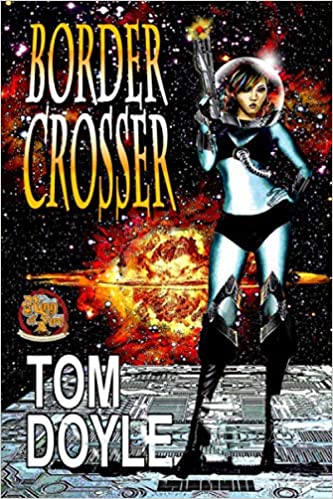
Doyle, Tom. Border Crosser. Eric Flint’s Ring of Fire Press, 2020. Paperback, 383 pp. $15.99. ISBN 9781953034144.


Tom Doyle, fresh from his American Craftsmen trilogy (one part Clancy-esque Jack Ryan, one part Kurtz-ish Adept series, all parts wahoo) turns to space opera with his October, 2020 novel Border Crosser. The back cover tells us the novel features Eris, “a charismatic spy with a violent borderline personality and emotional amnesia,” a condition that allows her to bypass scanners meant to assess the intentions of galactic travelers.

            Border Crosser serves aptly as title and descriptor; Eris crosses many a border in her adventures, during which she unknowingly instigates galactic war and an investigation into her employers, with whom she communicates by chatty, light-hearted correspondence (no drudgery of espionage paperwork for her!), ultimately joining her “friends” and family in a frothy resolution of most of the major issues of the plot. She is transhuman, sexually omnivorous, emotionally fragmented yet true at her core, and carries out a character development arc of self-discovery and self-identity. Eris begins as the epitome of a Bond villain: charismatic, violent, cartoonish. In the end she…saves the galaxy? Gaining agency is her game: she retains the charisma, a violent nature, and a “painted in broad strokes” quality. Any galaxy saving serves her goal of self-determination.

            The cover copy fails to mention Eris’s most interesting attribute: a working and productive artist, she crafts her art from the bodily fluids and DNA of those she interacts with. Yes, quite often those bodily fluids. Facing torture at the hands of a minor enemy, she blithely suffers it all—until the villain begins to torch one of her works of art.

            If one refers to the excellent The Space Opera Renaissance, edited by Hartwell and Cramer (2006), it becomes apparent Doyle knows space opera, as the antecedents of Border Crosser appear everywhere one looks in the table of contents. The novel transgresses like Samuel R. Delany, plays on a big field like Robert Scheckley, Lois McMaster Bujuold, and Iain M. Banks, performs on the inner field like Catharine Asaro, and at least glances at the political as might Charles Stross. Any mangling of references remains my fault, as are any blatant omissions.

            This is not to say Border Crosser represents a derivative work. It expresses an original energy all its own. Where Banks’ Culture presents a wealth of opportunity for redefining the human, Eris’s madness expresses a transhuman relationship to technology that would find no place in Banks’ studied, clear, and essentially hopeful works. And where Larry Niven’s Known Space setting postulates a future Earth with cheap teleportation, Doyle offers us a more likely scenario, and merely as a sideshow to the main plot: an Earth with expensive teleportation, where the children of the very upper crust spend ordinary fortunes to leap “into low orbit and on to some antique space station refitted as a microgravity pleasure palace…” to “the bottom of the sea and into an open-water club designed like some silent film fantasy of Neptunian delights.” All of this operates in the service of the spy trope “do something interesting until the villain’s kids invite you to party.”

            Later Eris recreates herself in a (male—another purported border crossed!) genetically constructed body of a species exterminated by one of the junior villains of the piece while at the same time compelling one of a growing number of her “friends” to craft a doppelganger with a limited subset of her memories; this complicates a family reunion through questions of identity (border crossed!). The novel proceeds through the plot with increasing speed; the narrative structure is one that invites closure at several points but resists, instead spiraling out to the next, always wider environment: Eris moves from ship to planet to interplanetary system to ongoing interstellar war to final galactic showdown, and the pace increases to cover the ever-lengthier amount of spiral along the way. Contemplate the path a needle takes from the start of a vinyl record to the end.

            Practiced readers instinctively assess important narrative cues merely from holding a text—one can feel where one is as the pages turn. As I read this novel electronically due to the limitations of Covid-19 precautions, without that page “feel” the novel unspooled unsettlingly, a practice I recommend. At least one natural stopping point went by like a bypassed rest area on a freeway: looks like a good place to…nope, not stopping here! Reading a paper copy of the novel would not have disoriented one in the least—the fingers’ pinch of pages would reveal how much story there was to go. Where good old James Bond (as presented in his Daniel Craig persona) travels through several plots to arrive at his ultimate showdown between the powers controlling his life, Eris spirals up through such a sequence in an extended sprint, all one show, resolving a factional clash playing out around the galaxy while leaving plenty of sequel material to follow.

            Using this text in a college classroom requires fortitude: while the frequent sex is largely un-graphic, it is plentiful and nearly always violent. Eris, a “borderline personality” as the back cover text tells us, stops at murder when inconvenient and not part of her work or art. “Trigger warning?” anyone? The novel presents elements of the transhuman and includes characters who are examples of the posthuman. Gender issues abound, and many a scholar could sharpen their knives for a discourse on Tom Doyle, though I would recommend perception precede action, and caution in any event.

            Doyle includes thanks in an afterward to two different workshops: The Clarion Writer’s Workshop and the Writers Group from Hell. In addition, he thanks a number of editors and commenters who “helped me with this tale.” That the dynamism and hard corners of this novel weren’t rounded off by such group reviews is good. But that also means the author had access to plenty of feedback. It is not a self-indulgent work. It is not easy to keep a train on the tracks when it speeds so quickly along such a spiral. So: caution before judgement. Border Crosser embodies space opera wahoo. Readers of The Space Opera Renaissance might find it hard to place—a call back to the wide-open wahoo of E. E. “Doc” Smith? Yes. Delany-esque? Indeed. Bujold-y galactic spy wahoo? For sure. Banksian enabling tech wahoo? Yep! But by crossing all those borders, it is Doyle-ian. Doyle-esque? Question instead the need for such a categorization. In closing, I suggest letting wahoo be wahoo. Doyle-esque wahoo.


Ed Carmien teaches writing, science fiction, fantasy, and other literatures at Mercer County Community College in New Jersey. He is: a member of the SFWA, a member of the SFRA, section hiking the Appalachian Trail, of the belief C.J. Cherryh doesn’t get enough critical attention, and full of admiration for the current incarnation of the SFRA Review.

Review of Docile by K.M. Szpara


Review of Docile

Adam McLain

K. M. Szpara. Docile. Tor.com, 2020. Hardcover, 496 pp. $27.99. ISBN 9781250216151.


A book like Docile requires a reviewer to provide a strict content warning at the beginning. This book (and this review) contains discussions and depictions of sex, slavery, and abuse. It contains moments of harm that can be triggering for survivors of sexual violence and abuse. K. M. Szpara handles violence and forgiveness with grace and civility instead of gratuitousness and voyeurism. Under Szpara’s pen, these topics become molded into a story that is aware of the harm they can cause and the future that all survivors must live through.

Having inherited his family’s insurmountable debt, Elisha Wilder “chooses” to sell himself into the docile program, a program that allows a person to give up their agency for monetary return. The man who buys Elisha Wilder’s contract is none other than Alexander Bishop III, the inheritor of the company that patents, manufactures, and markets Dociline, the drug that makes dociles docile, numb to the choices they make and obedience to those who bought their contracts. Upon entering the contract, though, Elisha refuses to use Dociline, something usually not done but provided for as a docile’s right. The book then delves into questions around systemic capitalism, consent, and change. Switching perspectives between Elisha and Alex allows Szpara to dismantle the dystopic future he has built and thus provide readers with a possibility of dismantling the dystopic present in which we live.

In the previous paragraph, I provide quotes around chooses to highlight one of the central themes of this book. What is choice and consent? The question occurs over and over again as the characters grapple with being benefited by, trapped in, and assaulted with a system that does not let anyone out. Szpara’s text highlights the sexual and capitalistic system of a dystopian, near-future America, but the questions he poses are universal as we struggle in the relationship between humanity, humanness, and all institutions. Szpara shows a keen awareness of thinkers like Michel Foucault, Judith Butler, Louis Althusser, and so many others as he engages in dismantling and deconstructing what agency and consent mean within a system that grips the very soul of humanity; in other words, Szpara’s thoughts, questions, and beautiful eloquence are on par with (and in some cases better than) the writers and thinkers we enshrine in academia, but his text fundamentally undermines that same system that builds up, defends, and obscures knowledge. Indeed, to understand what Szpara is saying and to allow it to work within you, a reader simply needs literacy and empathy, instead of a degree or an intellectual guide.

Docile’s handling of sexual violence, consent, and capitalism is genre nuancing. On its surface, one could see it as a book about the relationship, even a form of romance, between Elisha and Alex, but its complications of this relationship turn it from a simple book into one of the most evocative written in recent years. As with dystopian novels like Margaret Atwood’s The Handmaid’s Tale, Docile is never what it completely seems and will always evoke reread after reread as we mull over and consider what Szpara is saying about institutionalized control and (the lack of) consent within that system.

But Szpara doesn’t simply portray his capitalism as necessary of anarchistic response or proletarian revolution. Szpara realizes that systems, institutions, and the humans who make up both are more complicated than the necessity of overthrowing them. Docile grapples with the humanity that philosophical treatise and systemic interventions cannot. Through the relationship of Elisha and Alex, readers receive an intimate complexity to what it means to live in a world of systems and institutions. By the end of the novel, readers are not left with a one-way path to an answer, but they are instead given a diversity of intersectional roads by which to travel.

Not only does Docile deliver a resounding critique of debt and prison, but it also provides room for readers to think, consider, and rethink their positions. At every page turn, I found myself questioning how I viewed the systems around me and how I might be able to change them. Docile delivers where fiction is needed most: it is not a systemic takedown of an institution but rather the systemic buildup of awareness and possibility that a reader can gain in experiencing this America that almost is but hopefully never will be. It delivers the perfect package of dystopian philosophizing and fictional questioning that empowers the thoughtful reader to return to reality better equipped to battle our own tyrannies and our own docility.


Adam McLain recently graduated from Harvard Divinity School with a master of theological studies and holds a BA in English from Brigham Young University. He will be a Harvard Frank Knox Traveling Fellow in Fall 2021, studying 20th-century dystopia and the legal history of sexual violence in the UK.

Review of Star Trek: Lower Decks, season 1 (2020, TV)


Review of Star Trek: Lower Decks, season 1 (2020, TV)

Jeremy Brett

McMahan, Mike, creator. Star Trek: Lower Decks, Season 1, CBS Television, 2020.


The opening to each episode of Lower Decks has a familiar ring to viewers of Star Trek. The grand views of deep space and a mighty starship, the U.S.S. Cerritos, set to swelling music until asteroids start thudding off the ship’s hull, or until the ship arrives in the middle of a pitched battle with the Borg and immediately turns around and retreats, or until the Cerritos is seen zipping through space at warp speed with a giant bug-eyed parasite suctioned to the engine nacelles. Ideally, the audience smiles as they realize that this is not typical Star Trek nor is the Cerritos the U.S.S. Enterprise or Voyager or Discovery.

But the Cerritos is a more typical Starfleet vessel, and therein lies the beauty of this intentionally goofy show. The Cerritos is no flagship devoted to Enterprise-like missions of deep exploration; it takes on the less glamorous assignments, most notably “second contact”. As Ensign Bradward Boimler (voiced by Jack Quaid) notes in his practice ‘Captain’s Log’ in the pilot episode:

First contact is a delicate, high-stakes operation of diplomacy. One must be ready for anything when Humanity is interacting with an alien race for the first time. But we don’t do that. Our specialty is second contact. Still pretty important. We get all the paperwork signed, make sure we’re spelling the name of the planet right, get to know all the good places to eat.     

The Cerritos and its crew don’t live on the final frontier; they live behind, and maybe slightly to the left, where the scutwork gets done that gives the heroes the freedom to do what they do best. It’s an inspired concept that makes Lower Decks a show of immense humor and surprising emotional depth.

For decades, audiences have watched Star Trek almost entirely through the eyes and experiences of high-level Starfleet officers: Kirk, Picard, Sisko, Janeway, Archer, Burnham, and their command crews. In most cases, members of the lower ranks appear as extras and disappear as rapidly as they came (represented most visibly in popular culture by the concept of the ‘redshirt’—the utterly expendable crewmember who dies early, unheralded, and often nameless). But Starfleet is a massive and sprawling organization, which in order to function as peacekeeper and exploration arm of the Federation must rely on countless underlings to make everything run: namely, the ensigns. Lower Decks centers around four of these lowly officers who live and work far from the Cerritos’ bridge, taking part in missions that waver between routine and fatally hazardous, sometimes with a healthy dollop of grinding dullness.

Crammed into bunks that line the corridors at the bottom of the ship’s saucer section, the ensigns deal with their lots in life in various ways: Boimler is an anxious rule-follower who dreams of captainhood and idolizes his superiors; Beckett Mariner (Tawny Newsome) is an excited, excitable, impulsive devil-may-care junior officer who ignores Starfleet regulations and the chain of command (including her mother, Cerritos’ Captain Carol Freeman (Dawnn Lewis)). Sam Rutherford (Eugene Cordero) is an engineer with a cybernetic implant and boundless enthusiasm for constant repairs and inspections of the ship’s machinery. The last in this quartet is Deltan D’Vana Tendi (Noel Wells), new to the Cerritos and bringing comedic levels of excitement to her sick bay duties. Over the course of the season, the four grow close, forming tight bonds equaling any in Trek’s long series of shipboard friendships forged from shared loyalties, senses of duty, and curiosity about the wider universe. Much of the dramatic (and comic) tension in Lower Decks comes from the disconnect between the ensigns and their superiors, as each ensign comes up hard against the perilous realities inherent to Starfleet missions.

Lower Decks isn’t for everyone. The animation and vocal stylings are fast and frenetic, like Rick & Morty. There is much more violence than is typical of Trek, and far more sexual references. Some may find it just too silly. Arguably, however, Lower Decks adds a welcome note of hilarity to the sometimes-too-solemn-for-its-own-good Trek franchise, poking fun at some of its traditions and cliches but doing so with a sense of real love and respect for its predecessors. Not the least part of this comes from the constant shower of references to incidents and characters from previous Treks. Yes, these kinds of references are Easter eggs for Trek fans, but they give Lower Decks a lived-in sort of feel—that the show is not just a parody but part of a shared canonical universe.

One of Lower Decks’ direct inspirations is a 1994 TNG episode (also titled “Lower Decks”) in which four Enterprise-D junior officers are shown to have lives of their own, with the ship itself a setting for the lives and struggles of non-main cast members. Lower Decks follows in this narrative tradition, showing how the “regular” people—the ones that work behind the scenes undramatically and with perseverance, or whose unseen lives are lived in the wake of decisions made by major characters—have their own moments of heroism and centrality to the moment. That is certainly an inspiring notion for the legions of Trek fans who have imagined themselves as members of Starfleet and through fanfiction or cosplay written themselves into the narrative.

Some may quibble over whether Lower Decks should be considered Trek canon. Lower Decks, in fact, can be a source of fruitful discussions about what constitutes true “canon”—is there room in a media universe for a production that so differs in tone and pace from the keystone shows? Where does an animated production fit into a family of non-animated productions? This last question has been asked in Trek history before, of course, with the 1973-1974 Star Trek: The Animated Series. Is canonicity even necessary—does a particular media universe require a single accepted narrative for audiences to enjoy individual productions within it?

Lower Decks is also an example of what many in the Trek community see as a retrograde obsession with revisiting and recrafting the historical timeline. In recent years, the mainstay of filmed Trek has involved prequel material such as Discovery or the upcoming Strange New Worlds, or the Kelvin Universe of J.J. Abrams’ film trilogy. Furthermore, productions like Star Trek: Picard or the upcoming animated Star Trek: Prodigy are centered on major cast members that have been explored in previous installments. These all suggest a question: how imaginatively rich is a media enterprise that at times seems entrapped by its past, endlessly retreading the same time periods and settings and relying on appeals to viewer nostalgia through in-the-know references or memes? None of this makes Lower Decks any less enjoyable to watch, but it does raise questions about the franchise’s overall commitment to the original themes of Trek that have inspired several generations of viewers—the ever-forward progress of science and technology, the movement towards an increasingly utopian future, and a growing consciousness that humanity can and must unite for the collective good. Indeed, similar questions can be posed of other recycled franchises at this time. As time passes, expect much fruitful scholarship to be mined from Lower Decks and its relation to Trek’s classic vision of the human future, as well as to the dramatic and narrative malleability of media franchises.

 The Cerritos’ ensigns, in their imperfect personhood, are appropriate representatives of that vision: in their own quirky ways, they are always evolving into their better selves. That character development and purposeful optimism contrast with more recent Trek productions (such as Picard) that eschew confident 1960s SF for a grimmer, more cynical, and more pessimistic Federation populated by ruthless Section 31 agents and corrupt Starfleet officers. That attitude may well reflect our weary and traumatized present. Lower Decks, though, for all its irreverence and animated lunacy, is an interesting throwback extension of the Trek utopian tradition that demands a humanity moving ever forward towards a societal and technological ideal.


Jeremy Brett is an Associate Professor at Cushing Memorial Library & Archives, Texas A&M University, where he is both Processing Archivist and the Curator of the Science Fiction & Fantasy Research Collection. He received his MLS and his MA in History from the University of Maryland – College Park in 1999. His professional interests include science fiction, fan studies, and the intersection of libraries and social justice.


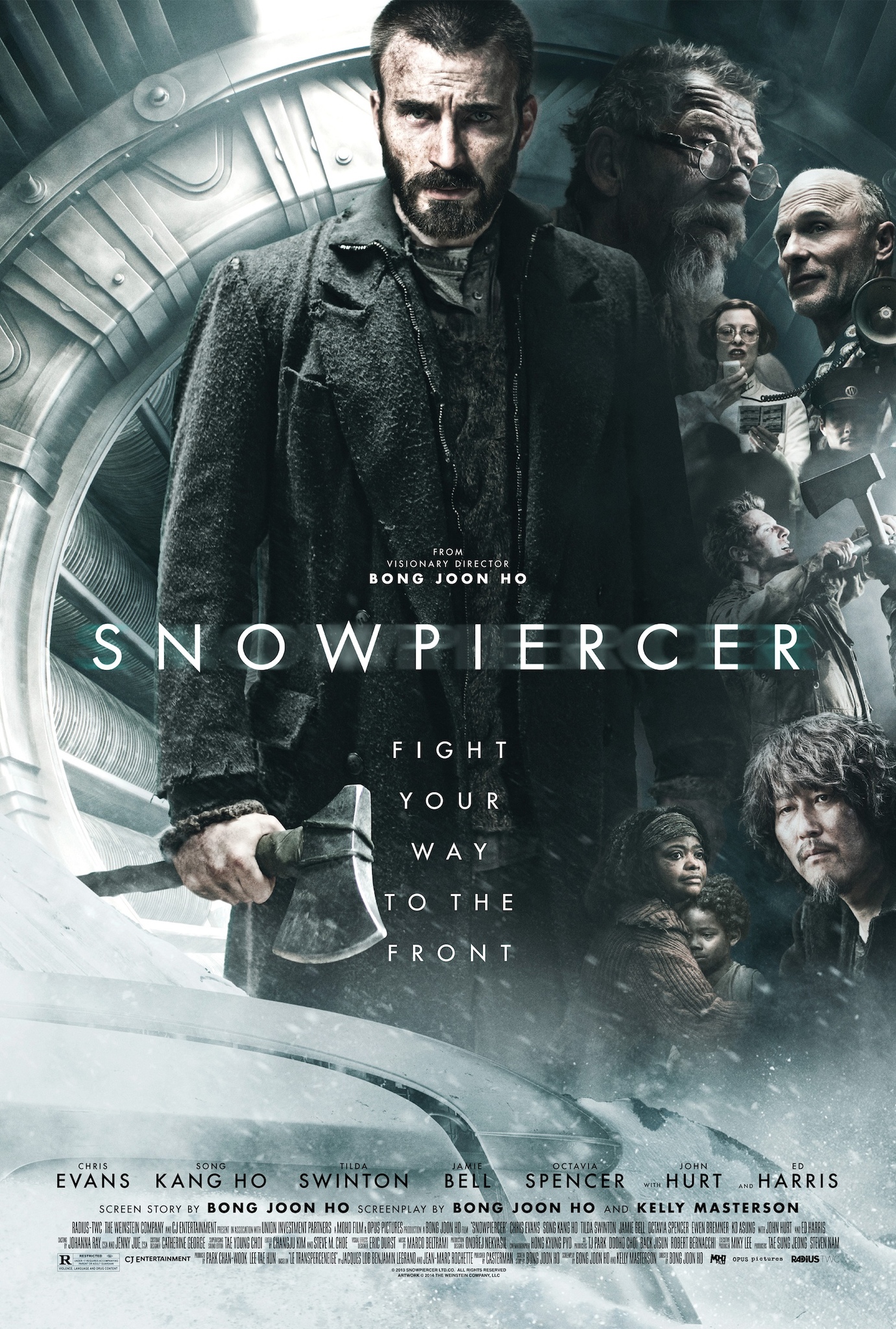
Review of Snowpiercer (2020-2021, TV)


Review of Snowpiercer (2020-2021, TV)

Ada Cheong

Hawes, James and Graeme Manson, producers. Snowpiercer. Netflix, 2020-2021.


There is a strange dissonance about watching fictional depictions of the end of the world when the world we live in feels about to end. As the Covid-19 virus devastated many parts of the globe, the gratuitous pleasure and morbid intrigue offered by on-screen catastrophes felt like a confirmation of the adage that it is easier to imagine an end to the world than an end to capitalism.

I was thus reluctant to give Snowpiercer (2020-2021) a go when it was pulled onto the Netflix platform. At first glance, the TV series is just another story about Humanity’s struggle to survive on an inhospitable planet, joining the many post-earth TV series on their catalogue, such as The 100 (2018-2020), The Rain (2020) and Into the Night (2020). The eponymous Snowpiercer is a train that circles an uninhabitable earth. The apocalyptic event that precedes the story is triggered by the release of synthetic coolant CW-7 into the atmosphere in an attempt to reverse global warming. Now on its seventh revolution through the earth’s unforgiving whiteness, the train struggles to stay on track as a rebellion from its tail end threatens its delicate socio-ecological balance. Consisting of unticketed passengers that have been forced into the last carriages with limited space, food, and water, the Tailies seek to rearrange the social order of the rain. The fragility of the closed container of Snowpiercer is jeopardized by an external temperature that is announced to be -119.6 degrees in the first episode. Used to execute dissidents by freezing off entire limbs in a matter of seconds, the cold makes even the smallest breach a grave threat. Snowpiercer thus becomes (for the most part) the last container of life on earth, a near-biblical ark brought to fruition by human ingenuity and technological prowess.

The TV series first premiered on TNT in the US and is based loosely on the French graphic novel series created in 1984 by Jacques Lob and illustrator Jean-Marc Rochette. The second and third volumes of the original comic were released by Benjamin Legrand and Rochette in 1999 and 2000 respectively, with Olivier Bocquet and Rochette wrapping things up with the fourth volume in 2015. Bong Joon-Ho’s esteemed direction of the Snowpiercer film in 2013, based mostly on the first and second French volumes, was produced in English. Boosted by widely recognised faces such as Chris Evans and Tilda Swinton, the narrative assumed an international reach that triggered the translation of the original French comic series into English in 2014 and 2016, re-distributed into three volumes instead of four by Titan Comics. Titan Comics also produced a two-volume prequel comic to the Snowpiercer universe in September 2019 and November 2020, written by Matz and illustrated by Rochette.

Amidst this vibrant intertextual history, Graeme Manson and co-producer James Hawes have done well with the TV series. Their version of the end of the world rejects an essentialised, undifferentiated notion of Humanity (with a capital H). It reinserts the complex material and cultural struggles surrounding resource scarcity into the dominant technocratic narrative of climate breakdown, a narrative that has long presented green technology as the main solution to the present climatological condition. The consequences of climate breakdown, they insist, will always be experienced unevenly, the blame most heavily falling on the Global North, and the consequences most greatly borne by the Global South.

As is typical of works in the post-apocalypse and cli-fi genre, energy scarcity forms a key concern, managed through human technology and ingenuity. Indeed, across all Snowpiercer’s permutations, humanity’s last vanguard of defence against a frozen death is the old energy myth of sf: the perpetual motion engine. In Lob’s graphic novel, the engine assumes a pseudo-sentient status, requiring human companionship. Although it loosely gestures towards notions of sentient AI, the comic series never really develops this, eventually choosing to take its plot off-train. In the TV series, on the other hand, as with Bong’s film, the eternal engine is completely inanimate and thoroughly engineered by human design: specifically, by Wilford Industries. Mr. Wilford, as the creator of the engine, assumes a god-like status in both film and series, something that Manson and Hawes magnify in the latter. The man is even afforded an altar in the Snowpiercer’s Tea Room, a spiritual car. In a tongue-in-cheek allusion to the Catholic practice of drawing the sign of the cross, his supporters draw a W across their chest. Wilford’s deification in the TV series most vibrantly articulates the faith in the progress of Humanity’s technological expertise that has become so characteristic of the Capitalocene. This technocratic faith is also encapsulated by the admittance of protagonist Layton’s adopted son, Miles, into the ranks of the train’s engineers, a highly esteemed role. As the brightest new mind to continue this essential work of balancing the train’s energy inputs and outputs, his full name, Miles and Miles, is a hopeful prayer for an engine truly eternal.

Keeping the carrying capacity of the train’s biosphere on track is thus a major plot engine within the TV series, involving the neo-Malthusian balancing act of limiting population size and creating food supplies. Yet, while scientists and engineers hold great esteem within the series for their ability to keep this delicate mathematical balance in check, the show makes it clear that it is not just about the math. Indeed, the TV series’ main success is its ability to strike a fine balance between the histrionic ecological emergencies that threaten to derail the train (always soothed by the hospitality team, dressed in an inoffensive faux-calm shade of teal) and the other very human, social issues that the series explores.

Manson’s Snowpiercer sheds the brutalist aesthetics of the original cramped, Soviet-like train in Lob’s comic (Bocquet). It more closely resembles the luxury liner designed within Bong’s film, by production designer Ondrej Nekvasil. Masterminded by Barry Robinson, the beauty of animal and plant life in the TV series is given space to shine around the human dramas of the train, acting as an elegy to the complex ecosystems wiped out by the manmade apocalypse. The mathematical problem of sustaining life is thus given a highly sensuous quality. Furthermore, by avoiding chrome finishes for the train’s interior and utilising copper instead (Grebey), the TV series distracts from the train’s apocalyptic dieselpunk exterior and eschews a minimalist end-of-earth aesthetic.

The material and cultural issues that accompany the end of the world are also given ample space to play out around the ecological and technological crises in Manson’s series. Indeed, it is in the articulation of socio-economic inequality where the series sets itself apart from the 2013 film. In the latter, Bong’s critique of capitalist inequality is couched in allegory and absurdity. Who could forget Minister Mason’s (Tilda Swinton) speech as the limb of a Tail member gets frozen off? Resting a shoe on his head, their theatrical rhetoric is at once laughable and deeply unsettling: “Would you wear a shoe on your head?” The film gestures towards the cyclical and inherently chaotic nature of capitalist progress, as Mr. Wilford is revealed to work in tandem with ex-leader of the tail, Gilliam, to spark periodic revolts. Through such rebellions, the tail population is systematically pruned by 74%, thus restoring ecological balance. Unfortunately, the momentum of Bong’s plot loses steam after Curtis successfully reaches the engine. The lengthy dialogue he has with Wilford on capitalism and its cycles of instability is an anti-climactic finish to his rebellion—saved only by the final explosion of the entire train. The derailment of the train and the emergence of the last two surviving humans into the snow (Korean girl, Yona, and 5-year-old Afro-American boy, Timmy) suggests that destroying the train is a more viable option than rehauling its existing capitalist system.

Conversely, the serialised medium of television offers Manson and Hawes more space to explore the intricacies of resource struggles. The caloric distribution of food is the most visible manifestation of such inequalities in a post-apocalyptic world. Both the graphic novel and film imagine radical changes in our food future. In the comic, rabbits are bred as meat for the most privileged, while the rest of the train’s population feed on something called the mother, the quasi-sentient blob that resembles a yeast culture. The artificial supply of meat is grotesque despite its miraculous proliferation and certain supply, disturbing in the same way as       Margaret Atwood’s chickienobs in her novel Oryx and Crake. Bong’s film similarly invokes a sense of grotesque when depicting the food of the Tail section, even exploring the trope of cannibalism. Furthermore, the dark, gelatinous slabs of protein that the Tail eats are ground from insects (roaches), an ingredient that has now received serious scientific consideration in technofixing the worlds’ shrinking food supplies.

In this, Manson’s latest reincarnation of the tale is perhaps the least original. Yet, in part because of this, it most poignantly critiques the realities of the current world food system. Synthetic and miraculous gustatory concoctions are completely missing from the TV series. The train’s food system is instead supported by greenhouses and aquariums as well as feedlots in the cars loosely grouped together as Ag-Sec. While slabs identical to those in Bong’s film are served up, their origin is not mentioned, suggesting a perhaps more open-minded attitude to non-animal protein alternatives. Despite the (just) sufficient volume of calories being produced for the entire train population, the richest eat in quality and excess, while the poorest starve. The highly familiar food system of the microcosmic train thus provides a no-frills critique of food distribution in reality, mirroring it closely.

Building on the film’s abstract critique of capitalist inequality, the TV series also more fully explores its unsustainable contradictions through its rebellion. Manson’s chosen hero, Layton, stages a more convincing revolution than Curtis in Bong’s film, with information networks and diplomatic tactics. Significantly, he forms an alliance between the Tail and Third Class section, unfolding a complex picture of class politics and the value of unionising labour as underground networks unfurl amongst janitors, caterers, and brakemen. As Miss Audrey, a key ally from Third, threatens, “Third touches every system on this train. We will be heard.”

The diverse and inclusive world of the Tailies and Third Class that displaces the wealthy population of the First Class section in the series is a key tenet of its success. The distinct rejection of a white-centric picture of Humanity’s survival, engineered through wealthy technocrats, is reflected through Manson’s and Hawes’ casting choices, containing a deliberate diversity that is absent from the graphic novels and film. Unlike a largely white, cisgendered heterosexual cast of the film, led by the face of Chris Evans, with the token black and Asian actors, the TV series features African American actor Daveed Diggs, playing Layton’s character, as its hero.

The mix of characters in the series is also far more inclusive along the lines of gender and sexuality. Unlike the film, in which Curtis stops the young female Yona from engaging in combat, the series stars strong women in the frontlines of political and military confrontation. Strikingly, the brightest engineer and character behind Mr. Wilson’s fictional persona in the first season is Melanie Cavill. She is joined by a whole host of other female characters who play key roles in the revolution: Miss Audrey (the Madonna of the Nightcar who performs the train’s healing and emotional salvation); Josie (Layton’s revolutionary partner-in-crime) and Bess Till (another frontliner in the revolution who convinces the brakemen to join the movement). The series also features several queer characters such as train detective Bess Till, chef Jinju, civilian Zarah and brakeman Osweiller.

Overall, I am surprised by the nuance of the TV series, given the limited mileage offered by the ‘last train on earth’ premise. Despite being strongly rooted within a hard sf tradition where math is critical in ensuring survival, the TV series asserts that it can only get us so far in understanding the end of the world. Beyond the abstract margins of scientists and engineers, climate breakdown and resource scarcity are experienced in highly material and uneven terms. If climate breakdown is not just a technological problem but also a cultural and imaginative one, the series offers a bold vision of what it would be like to radically re-imagine our existing socio-political structures of inequality. With the production for season 3 now in train, I am excited to see where the next season alights.


WORKS CITED

Bocquet, Olivier and Jean-Marc Rochette, creators. Terminus. Casterman, 2015.

Halperin, Moze. “We Talked to Snowpiercer’s Production Designer About Building A World Inside A Train”. Vice, 2014. https://www.vice.com/en/article/mgpvba/we-talked-to-snowpiercers-production-designer-about-building-a-world-inside-a-train

Grebey, James. “Make it a little more Ridley Scott’: How Snowpiercer’s 1,001-car train got built IRL”. SyfyWire, 2020. https://www.syfy.com/syfywire/snowpiercer-1001-car-train-inspiration.

Joon-Ho, Bong, director. Snowpiercer. CJ Entertainment, 2013.

Lob, Jacques and Jean-Marc Rochette, creators. Le Transperceneige. Casterman, 1982.

Legrand, Benjamin and Jean-Marc Rochette, creators. The Explorers. Casterman, 1999.

—–, creators. The Crossing. Casterman, 2000.


Ada Cheong is a PhD candidate at the Department of English in the University of Exeter. Her thesis examines contemporary sf of the Americas and the ways in which such fictions help us to navigate the late-capitalist food ecology. Sitting loosely within the field of the Energy Humanities, her interdisciplinary research looks at a variety of sf tropes such as terraformation, post-apocalyptic biospheres, zombies, etc. to illuminate the intersections between food, technology and ecology in the Capitalocene. Beyond her academic teaching and research, Ada also takes an active interest in local foodways, and is a home fermenter and baker.