Review of The Twilight Zone (TV Milestones)


Review of The Twilight Zone

Dominick Grace

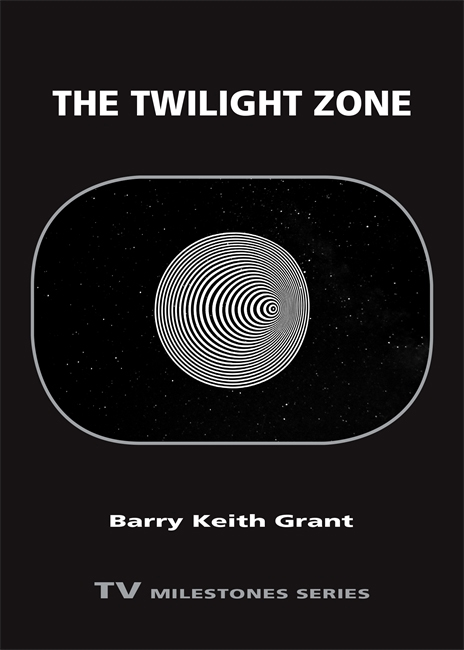
Barry Keith Grant. The Twilight Zone. Wayne State UP, 2020. TV Milestones. Paperback. 132 pg. $19.99. ISBN 9780814345788. Ebook. ISBN 9780814345795.


The Wayne State University Press has published nearly 40 volumes in the TV Milestones series; surprisingly, it has taken on The Twilight Zone, one of the most celebrated TV shows ever made (so much so that it has been rebooted three times, with limited success, as well as adapted into a feature film) and arguably the seminal show to make the fantastic legitimate adult fare on TV, only in 2020. Barry Keith Grant’s volume is as compact as the other entries in this series, and it is a quick and easy read. Non-academics should find this a perfectly accessible introduction/primer. However, the book is also thoroughly researched, well-grounded in the scholarly tradition associated with the show, and insightful in its own right. Anyone interested in The Twilight Zone, whether as a fan or scholar (or both) will find this book valuable.

Bookended between an introduction and a conclusion waggishly entitled “Zoning In” and “Zoning Out” are three chapters exploring, as Grant outlines his plan in the introduction, “the interrelated questions of authorship, genre, style, and ideology in the context of The Twilight Zone”. (14) Throughout the book, Grant balances relatively deep dives into key episodes with quick summaries of linked episodes. As a result, he manages to be comprehensive without being superficial.

The first chapter, “’Once Upon a Time’: The Twilight Zone and Genre,” focuses on “the place of The Twilight Zone within the various modes of the fantastic, showing how it combined them with other generic traditions to offer social criticism cast as moral fables”, (17) but crucially also explores in some detail how the show works as a hybrid of genres, folding in, notably, elements of film noir, as well as other genres (e.g. the then-popular on TV Western; several episodes of the series are explicitly Westerns or at least are set in the West).

Chapter Two, “’The Prime Mover’: The Twilight Zone and Authorship,” addresses the extent to which the show represents a unified vision. As Grant notes, the show is indelibly associated with Rod Serling, who created the show, oversaw the production (for the first few seasons, anyway), wrote a significant percentage of the episodes, and, most significantly perhaps, hosted the show, stamping his personality on each episode and himself becoming a TV icon as a result (so much so that he is folded into the final episode of the first season of the latest reboot). While Grant acknowledges the complexities of auteurist criticism, he makes a compelling case for Serling’s voice and characteristic concerns as the dominant elements of the series. 

Chapter Three, “’What’s in the Box’: The Twilight Zone and the Real World,” is perhaps the book’s most interesting chapter, delving as it does into The Twilight Zone’s hallmark social commentary. Grant carefully contextualizes the show historically, showing how it responds to current concerns and anxieties. He also deftly documents its own tensions, arguing that the conflicting condemnation of collective action as dangerous (the show’s famous “The Monsters Are Due on Maple Street” [1.22, March 4, 1960] being perhaps the paradigmatic example) weighed against the show’s consistent condemnation of selfishness, greed, and other dangerous manifestations of individualism constitutes the “thematic tension at the heart of the show” and “places it squarely within the debates that have informed American culture and political thought from the nation’s beginning”. (98)

Also central to Grant’s argument is his recognition of the tension between art and commerce, a tension he recognizes as built in to Serling’s own conflicted view of television as, on the one hand, a commercial medium reliant on formula and beholden to sponsors but, on the other, a popular medium that could be used artfully to engage in social commentary. Grant notes that The Twilight Zone “reveals the tensions between artistic ambition and commercial capitulation at a pivotal point in the history of the medium”, (100) but that Serling was largely successful (with some instances of unsuccessful episodes scrupulously noted): “With The Twilight Zone, Rod Serling joined the ranks of such otherwise very different American artists as Walt Whitman, Frank Capra, and Frederick Wiseman, all of whom have sought in their work to find ways to integrate the individual within the great democratic project of the nation”. (99)

This book is a valuable addition to Twilight Zone scholarship, acknowledging the work of previous scholars while also advancing the study of the show. Its clear and accessible style makes it ideal for undergraduate students, perhaps especially in media courses, but its depth and insight make it valuable for advanced scholars as well. I would recommend it for any library interested in remaining current with studies of the fantastic across media.

Review of The Twilight Zone and Philosophy: A Dangerous Dimension to Visit


Review of The Twilight Zone and Philosophy: A Dangerous Dimension to Visit

Robert Creedon

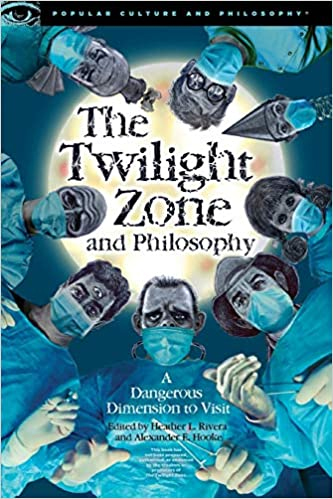
Heather L. Rivera and Alexander E. Hooke, eds. The Twilight Zone and Philosophy: A Dangerous Dimension to Visit. Popular Culture and Philosophy: Volume 121. Open Court, 2019. Paperback. 247 pg. $19.95. ISBN 9780812699890.


This book is a concise view of philosophical topics using the classic television series The Twilight Zone (1959-1964) as the basis of its explorations in 21 short essays. It follows the standard format for the series by having various authors explore concepts in short 9-14 page essays that allow the reader to delve into heavier material. Although being familiar with the series helps, it is not necessary, as detailed examples from the series are given to provide clarity for the reader. Readers will also find many episodes are discussed repeatedly, as they apply to numerous topics and concepts. Most of the chapters include direct references to the philosophers and their writings, documented and indexed for ease of reference. These essays are well divided into subsections under headings offering expansions on ideas from the main premise: “First Dimension: Facing the Zone”; “Second Dimension: Beyond the Boundaries of You and Me”; “Third Dimension: The Wondrous Land Called Truth”; “Fourth Dimension: As Vast as Space and Timeless as Infinity”; “Fifth Dimension: Our Twisted Imaginings”; and finally “The Dimension that Can’t Be Named or Numbered.”. Most readers should enjoy the bite-size nature of the information which is designed to make it more accessible to the general public and specifically to the fans of the series. This format is the same as has been used for other volumes of the Popular Culture and Philosophy series, giving continuing readers greater context and understanding.

What I found most interesting were the chapters that asked questions about the concept of the Twilight Zone as a shadow of our own world. The Twilight Zone was written by a group of horror writers from southern California in the late 50’s and early 60’s that as Matt Cardin says, “founded their sense of the fantastic in everyday reality and the experience of characters that might live next door” (quoted in “No Place Like a Non-Place,”by Fernando Gabriel Pagnoni Berns, Juan Ignacio Juvé and Emiliano Aguilar, pg. 131).  We also learn that except for just a couple of episodes, an element of supernatural, the future or aliens, was used to create twists or surprise endings. These thought plays provide ideal bases for the philosophical thought exercises in this book. The pairing is as natural as that between Candid Camera and sociology. Rod Serling and his associates created a series that created thought experiments that illustrate the great theories of the philosophers, although not by design. 

The chapters exploring specific theories are more interesting than the others, providing as they do a detailed framework including examples to aid the readers’ comprehension. Philosophers discussed range from Aristotle to recent philosophers so current that the writers provide timelines indicating when episodes came out between major works by these contemporary figures. Many of the essays require the reader to invest time to absorb and work through the ideas expressed after reading. My favourites include “No Place like a Non-Place,” by Fernando Gabriel Pagnoni Berns, Juan Ignacio Juvé and Emiliano Aguilar, in which they explain Marc Augé’s Non-Places: Introduction to an Anthropology Of Supermodernity via the episodesWill the Real Martian Please Step Up?”, “The Four of Us Are Dying,” “The Hitch-hiker,” “The After Hours,” “The Passersby,” “Passage on the Lady Anne,” and the classic “Nightmare at 20,000 Feet”;“The Twists and Turns of Second Chances,”by JohnV. Karavitis, describing Soren Kierkegaard’s Either/Or (which is about the aesthetic versus the ethical world) in episodes including “A Nice Place to Visit,” “A Game of Pool,” and “Devil’s Printer”; and “The Pleasure of the Twist,” by Stephen Scales, discussing Thomas Kuhn’s The Structure of Scientific Revolutions with references to “The Hitch-hiker,” “The Lateness of the Hour,” and the classic “To Serve Man.” The essay “The Science of Alternative Realities,” by David Morgan, is a wonderful treat for this science fiction and comic reader as it explores the theories of alternate dimensions and timelines. The book has enough layers to be read multiple times and remain on your bookshelf for years of reference and enjoyment. 

“Memories Are Made of This,” by Clara Nisley, mentions David Hume’s belief in continued existence briefly before moving into a consideration of  “And When the Sky Was Opened” and “The Trouble with Templeton”; the relevance of Hume could have been explored in more detail  Other chapters work better, such as  “Lost in Time,” by Elizabeth Rard, which discusses the time travel paradox with examples from the episodes “The Rip Van Winkle Caper,” “Last Flight,” and “No Time Like the Past.” “The Twilight Zone on Our Doorstep,” by Tim Jones, is most intriguing in its exploration of where The Twilight Zone actually existed. “A Shadowland Called the Twilight Zone,” by Trip McCrossin, on how Serling’s art mirrored the events of his time, showing his own opinions, will be of interest to film historians. Serling’s contribution to later movies is discussed in “The Science of AlternativeRealities,” by David Morgan, as Serling’s ideas can be seen in blockbusters and feature length movies, although Serling’s contributions were unaccredited. Many of the essays are well-developed persuasion pieces on the theory and the related episodes, and they serve as fine examples of how to form an argument.

Given The Twilight Zone’s popularity and reputation, I am surprised it was not covered earlier in the series. This book would be a great companion piece for any philosophy course if the instructor uses an episode or more to illustrate some philosophical theories. As someone who watched the Twilight Zone recently, I found that this book provided a great opportunity to explore theories in philosophy more easily than the complexity of the theories would indicate.  Reading these essays will encourage the reader to find the episodes online, or set up their PVRs. For those who enjoy some of the reincarnations such as Black Mirror and others, including the recent reboot of The Twilight Zone itself, this book connects well to a more innocent time in television that explored many concepts long before these recent imitations began to do so.

Review of Star Trek and the British Age of Sail: The Maritime Influence Throughout the Series and Films


Review of Star Trek and the British Age of Sail: The Maritime Influence Throughout the Series and Films

Russell Alexander Stepp

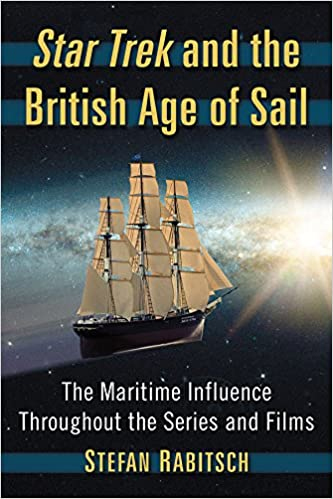
Stefan Rabitsch. Star Trek and the British Age of Sail: The Maritime Influence Throughout the Series and Films. Jefferson, NC: McFarland, 2019. Paperback, 279 pg. $45.00, ISBN 97814766-64637. EBook ISBN 9781476634197.


Since 1966, the Star Trek franchise has made significant contributions to popular culture, spanning six television series, one animated television series, thirteen full-length motion pictures, and numerous novels, comics, video games, and other media tie-ins. The franchise has frequently been described as “Wagon Train to the stars,” stemming from shared themes and a format with the television program Wagon Train, which follows the adventures of settlers in the American West during the nineteenth century as they travel from Missouri to California. The program was popular in the fifties and sixties just prior to the original Star Trek’s premiere on NBC in the fall of 1966. Wagon Train, like Star Trek, was episodic in nature, each week’s program taking place in a new location as the settlers moved West followed by a new location in the next week’s episode.

While much has been made of Star Trek’s connection to the genre Western and the mythos of the westward expansion of the United States, very little has been made of the franchise connections to a shared Anglo-American naval tradition. Stefan Rabitsch, in his book Star Trek and the British Age of Sail: The Maritime Influence Throughout the Series and Films, seeks to right that omission. This book is the first major publication to argue that Star Trek owes as much of its legacy to a trans-Atlantic naval tradition as it does to the American Western. It would be just as accurate, if not more so, to state that Star Trek is as much “Horatio Hornblower in space” as it is “Wagon Train to the stars.” The volume itself is divided into two major sections: “Elementary, Dear Trekker (A Primer)” consisting of three chapters, and “Rule, Britannia! Britannia Rules Outer Space in Star Trek! (A Voyage),” four chapters. The volume also includes a shorter preface, introduction, and conclusion, and an impressive bibliography and extensive endnotes.

Rabitsch’s approach is principally literary, rather than historical, and oriented in a post-colonial approach. He centers his argument on, but does not limit it to, C.S. Forester’s Horatio Hornblower novels, a series of novels centered on the career of a British naval officer in the Age of Sail, particularly during the Napoleonic wars. The novels were published between the late nineteen-thirties and mid-sixties, and thus were very much part of popular culture at the time that Star Trek was released. These novels were set at the height of British imperial power, and, as they were hugely popular on both sides of the Atlantic, tap into American interest into its own historical colonization and growing awareness of its increasing prominence on the world stage, as well as British notions of empire during the Age of Sail. Forester’s Hornblower was a combination of skilled strategist, charismatic leader, dedicated naturalist, and caring friend—the prototype for a Starfleet captain.

The author’s focus on Forester and his literary works should, in no way, be taken as a lack of intellectual rigor or scholarly attention. Rabitsch not only shows fluency in critical theory, but has also clearly mastered several literary corpora, which he has incorporated into his book. To begin with, Rabitsch is intimately familiar with the bulk of the Prime timeline in the Star Trek franchise consisting of the first five live-action series, the animated series, and the first ten theatrical films. He largely excludes Star Trek: Discovery, as the series was in its infancy at the time the volume was being prepared for publication, and the Kelvin timeline (i.e. the J.J. Abrams films). When necessary, Rabitsch also incorporates production notes and other archival texts related to the production and development of the franchise. His knowledge of Forester’s Hornblower corpus, as well as the life and writings of Horatio Nelson and James Cook, nineteenth century British naval officers on whom the character of Hornblower was largely based, is equally impressive. Furthermore, Rabitsch manages to interweave these various threads into his prose to create a compelling argument, frequently presenting an idea from Forester of historical accounts of the British navy, followed by a methodical analysis of the same point in each of the Star Trek series. The depth of Rabitsch’s analysis gives his work a feeling of completeness and elevates his argument that “Hornblower in space” is a much better description of the franchise than “Wagon Train to the stars.”

This is not to say that Rabitsch’s analysis is above reproach. At times, the author seems to be so concerned with his postcolonial analysis, in which he compares the Federation and Starfleet to British and American colonialism, that he ignores conflicting evidence that would undermine that narrative. This is particularly evident when it comes to Star Trek: Enterprise, which depicts a time in franchise history in which Earth was not among the more influential planets, prior to the foundation of the Federation. With this said, Star Trek and the British Age of Sail deserves praise for the quality of content, the depth of research, and the clarity of thought, and should be of value to any academic interested in the history of the Star Trek franchise.

Review of M Archive: After the End of the World


SFRA Review, vol. 51, no. 1

Nonfiction Reviews


Review of M Archive: After the End of the World

Sarah Heidebrink-Bruno

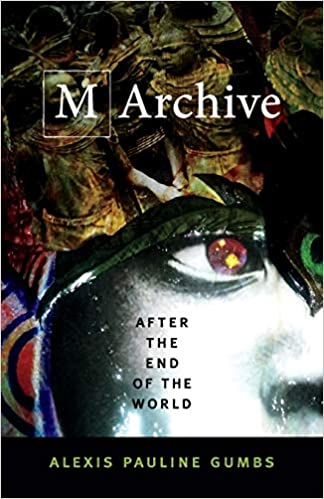
Alexis Pauline Gumbs. M Archive: After the End of the World. Durham, North Carolina: Duke UP, 2018. Paperback, 248 pg. $24.95, ISBN 978-0822370840.


Alexis Pauline Gumbs’s M Archive is the second installment in a planned trilogy that explores a speculative future landscape, ravaged by the effects of late capitalism, environmental devastation, and the exploitation of black and brown bodies. In the introduction, Gumbs credits M. Jacqui Alexander’s Pedagogies of Crossing (2006) as a literary ancestor to M Archive. For Gumbs, the “M” in M Archive has a multitude of meanings—including magic, muscles, memory, and importantly, more. She describes her text as a “speculative documentary” (xi)—an inventive literary form that she imagines could be written by future survivors, who are witnesses to “the realities we are making possible or impossible with our present apocalypse” (xi). Fundamentally, Gumbs’s work is concerned with “black life, black feminist metaphysics, and the theoretical imperative of attending to Black bodies in a way that doesn’t seek to prove that Black people are human” (xi). In other words, Gumbs uses speculative documentary as a space in which to trace the possible impact of humanity’s exploitative labor and environmental policies, which rely on the subjugation of black and brown bodies—especially women of color—in order to create profits for others.

Just as Gumbs pays homage to Pedagogies of Crossing, she also references several other key intersectional feminists and scholars of color over the course of her narrative. Writing in lower case text, she resists the linguistic conventions one typically associates with scholarly works of theory. Instead, she subtly references her foremothers, such as bell hooks, who shift the standard linguistic paradigm to create new ways to engage with theory and praxis. The result is a text that is an intriguing mix of stream of consciousness, poetry, speculative fiction, and black feminist theory.

Furthermore, each section begins with a selection of the Periodic Table of Elements, in which Gumbs highlights different elements that set the tone for that portion of the text. Told from the perspective of a futuristic researcher, Gumbs’s text invites the reader to sift through layers of detritus to uncover the cultural artifacts below, in order to understand the harm that humanity has caused to itself and the planet as a whole. She breaks her book up into the Archive of Dirt, Archive of Sky, Archive of Fire, Archive of Ocean, and Baskets (Possible Futures Yet to be Woven). Each section then explores the cause and effect of the environmental catastrophe that Gumbs imagines ruined the planet and forced the surviving members of humanity to adapt and live underground to escape from the toxins on the surface of the planet after the ozone layer had been destroyed.

In Archive of Dirt, the speaker begins with a description of the capitalistic greed and disregard for other living beings that caused her ancestors (us) to treat everything as though it were expendable. Gumbs’s words pack a punch, leaving the reader with reverberating images of the body as containers for waste— “simply put, every piece of the planet was filled with trash. Our minds notwithstanding. Our bodies included”. (46) From there, she delves into the painful and traumatic process by which humanity had to give up the old ways of being in order to adapt to the harsh landscape in the post-apocalyptic future. The speaker discovers that in order to survive, humanity must become one with the Earth—both by reestablishing our connection to the planet that sustains us and by moving underground. In Archive of Ocean, Gumbs makes a powerful connection between science and spiritualism, reminding the reader that water is “the place where evolutionists and creationists agree that life began, the source of all the salt we breathed to get here, lives with us”. (11) Gumbs continues to advocate convincingly for the need for a belief in both science and the soul over the course of the text, ultimately showing the reader that humanity can survive only if it attends to both.

Finally, in Baskets, Gumbs further speculates on the limitations and possibilities that could define humanity. She rejects an individualistic way of thinking and encourages readers to think of themselves as part of a larger system. Yet, she cautions that any feeling of universalism must not overshadow the dark history of human exploitation (exemplified by the slave trade) or the need for intersectional thinking when describing the experiences of people of color. As Gumbs writes, “there did come a time when the species was united on the planet as human, but it was not what anyone had dreamt. And it was too late to truly benefit those of us who had been called alien. We who had nonconsensually generated the human across time” (171). In other words, universalism could potentially be just as problematic as individualism, if it erases the identities and hardships faced by cultural “others”.

Overall, I believe this text will be of particular interest to scholars and readers who appreciate literary forms that meld poetry and theory, such as Cherríe Moraga and Gloria Anzaldúa’s This Bridge Called My Back (1981) and (Gumbs’ earlier work) Revolutionary Mothering (2016). However, I would not recommend it as a primer into intersectionality or black feminist thought, as Gumbs takes for granted the readers’ familiarity with her many references to feminist concepts and black feminist writers, including bell hooks, Audre Lorde, and Octavia Butler, among others. In doing so, Gumbs shifts the onus onto the reader—to study foundational black feminist scholars and practitioners, and to learn from their theories, in order to avoid the future that M Archive uncovers.

Review of Global Frankenstein


Review of Global Frankenstein

Sarah Canfield

Margaret Davison and Marie Mulvey-Roberts, eds. Global Frankenstein. Palgrave Macmillan, 2018. Hardcover, 344 pg. $119.99, ISBN 978-3319781419. Ebook, $89.00, ISBN 978-3319781426.


I first found Global Frankenstein, part of Palgrave’s relatively new Studies in Global Science Fiction series, when I was searching for material for my first-year seminar course titled “Global Frankenstein.” Both my idea for the class and this ambitious anthology participate in the 200th anniversary celebrations of Mary Shelley’s Frankenstein (1818), which may or may not be the first modern science fiction text. Regardless of where you may stand on that issue, the popularity of the mad scientist and the monster for those 200 years certainly justifies the hoopla. I was particularly excited by the global moniker, however, as I am always eager to learn more about how the novel has been received, translated, adapted, and transformed beyond English-speaking cultures. All too often, “global” content still remains Western and Eurocentric, and I hoped this volume would help me avoid this problem in my own course.

Sadly, Davison and Roberts have not been as successful in collecting scholarship on Frankenstein’s international travels as I hoped, a shortcoming that they admit frankly in their introduction: “Despite its title, this critical collection cannot fully convey the enormity and scope of Frankenstein’s global reach [. . ..] we acknowledge the linguistic and cultural limitations of this collection and welcome other international interrogations”. (8) As a scholar and teacher who was drawn to their text specifically because I hoped to find an English-language consideration of that global reach, I would have preferred a different title, or perhaps a subtitle that clarified these completely understandable difficulties. The blurb claims that the book “reassesses Frankenstein’s global impact for the twenty-first century across myriad cultures and nations, from Japan, Mexico, and Turkey, to Britain, Iraq, Europe, and North America.” Indeed, articles touch on works from all of these countries, but the analysis definitely focuses more substantially on direct readings of Shelley’s text and its British, American, and European afterlives than those in the other countries on this list. Nevertheless, the number of non-English Frankensteins covered within this volume is notably higher than any other collection I have seen, so perhaps my disappointment exceeds justification.

Having noted my reservations regarding the title, I must declare that the essays in this collection comprise a thorough, thought-provoking, and occasionally brilliant body of scholarship. Sixteen essays are presented in five sections, devoted to the novel’s science, corporeality, stage and screen adaptations, illustrations and literary adaptations, and “Futuristic Frankensteins.” The editors have each contributed, Mulvey-Roberts with an analysis of the surgical context of the novel and the contemporary French artist ORLAN’s radical body modifications, and Davison with an intriguing account of balletic interpretations of Frankenstein. I applied the adjective “ambitious” earlier in this review—the range may not be “global” in the specific sense that I had hoped for when I saw the title, but in terms of sheer scope and comprehensive consideration of where the influence of Shelley’s text can be found, the word is appropriate. In addition to the usual textual issues and filmic adaptations that any collection must address, the plastic surgery as art and the danse macabre are joined by stage plays, television series, picture books, graphic novels, interactive digital texts, video games, memes, philosophical riffs, and even a poem as afterword.

When these authors focus their attention on Shelley’s text, they provide cogent analysis in thoughtful conversation with earlier scholars. The editors’ introduction succinctly reviews the critical history of the novel, noting major critical insights as well as the biases that inflected them. The essays advance many of these conversations. For example, Bruce Wyse reads the novel’s deployment of disability and disgust and the evolution of those themes in texts from Bulwer Lytton to Doctor Who, noting ways in which these adaptations “broaden the representational purview of Frankenstein to clarify its subtext” (89) through the lens of disability studies. Carolyn D. Williams explores the marked lack of humor in the original novel as a symptom of Shelley’s concerns with decorum, a “dangerous strategy” because “like Gothic monsters, laughter, if banished, may return with devastating effect” (91). In addition to her careful reading of Shelley’s manuscript and revisions, Williams also considers the challenges and opportunities this creates for critics, interpreters, and adapters.

As the essays move further from the original novel to explore its global and cultural adaptations, they provide nuanced considerations of a wide array of responses to and reworkings of Shelley’s text, direct and indirect. Many essays in the collection concentrate on the visual traditions, and some of the strongest—and most international—focus specifically on illustrations, comics, and graphic novels. Emily Alder provides an especially interesting analysis of how Frankenstein adaptations for children, even in such apparently simplified forms as picture books, show exceptional sensitivity and creativity as they “alter the original’s script about otherness, acceptance, and responsibility [in order to] answer back to oversimplification of Frankenstein through film and popular discourse” (223).

Sometimes the connections become rather attenuated. Xavier Aldana Reyes pursues the creature’s influence on the specific subspecies of zombies produced through human-engineered viruses as well as recent portrayals of sympathetic zombies. While he acknowledges that most zombies are rightly distinguished from Frankenstein’s creature, Aldana Reyes argues that these “lumbering creatures who walk the line between life and death may now be embodying the most relevant aspects of the myth” (179) for current audiences. I am not sure yet if I accept the argument (in part because I don’t know enough about zombies), but I want to run it past my students. This satisfies the purpose that drew me to the collection in the first place: to stimulate my thinking about the novel and enrich my teaching with new examples, insights, and questions. Less successful for me, though still provocative, is Tanya Krzywinska’s review of Frankenstein’s impact on video games. With few direct game references to consider, Krzywinska focuses on visual and creative aesthetics several iterations removed from the original text. While I don’t doubt their lineage, I do wonder what to do with it.

I cannot conclude my review without addressing the final essay, written by the renowned Fred Botting, “What Was Man . . .? Reimagining Monstrosity from Humanist to Transhumanism.” Botting questions the relevance of Shelley’s novel today, a cultural touchstone easily mined for metaphor but otherwise displaced by more modern monsters: “Frankenstein and creature—all two-human [sic]—seem to have no place, deleted by global posthumanism, either in the voracious supersession enacted by the attractive vampires of neoliberalism or in the nonhuman hordes of walking dead that testify to a transhumanist future present, subsisting as refuse, less than meat, and barer than bare life” (310). Botting finds a powerful reimagining in Bernard Rose’s film Frankenstein (2015), but one which may mark the end point of the Frankenstein myth, clearing the way for “some cyborgs, chimeras, hybrids, and posthumans [to] begin, without fear or fantasy, to foster some other imagining” (315).

Taken as a whole, Global Frankenstein provides a varied and fascinating array of critical approaches to Frankenstein itself as well as a truly remarkable range of related works. If more of those works are from Western, and especially English-speaking, cultures than the title suggests, I recommend following Davison and Mulvey-Roberts’ excellent collection with further scholarship on the international reach of Shelley’s hideous progeny.

Review of Fake Geek Girls: Fandom, Gender, and the Convergence Culture Industry


Review of Fake Geek Girls: Fandom, Gender, and the Convergence Culture Industry

Anelise Farris

Suzanne Scott. Fake Geek Girls: Fandom, Gender, and the Convergence Culture Industry. New York, NY: New York UP, 2019. Paperback, 304 pg. $29.98, ISBN 9781479879571.


Geeks, nerds, fans, and the like are in the middle of an interesting era. Although big-name companies like Marvel Comics are devoting more energy to diversification and inclusivity, fans themselves appear to be growing increasingly divisive over concerns related to “authenticity.” This ongoing question of who is allowed to be a fan and what that entails for people of different genders is at the heart of Suzanne Scott’s Fake Geek Girls: Fandom, Gender, and the Convergence Culture Industry.

Stemming from the toxic fan culture wars over the past decade, Scott’s work is less concerned with female character media representation and more invested in interrogating how female fans continue to be marginalized by both the industry and fan culture at large. Due to Scott’s focus on the time period from 2006 to 2017, her work is significantly informed by the growing presence of men’s rights movements, anti-feminist agendas, and, of course, the results of the 2016 United States presidential election. Scott perceives the political climate to be one in which white, cisgender, heterosexual males endure under a logical fallacy, that “more for someone else [minorities] will inevitably mean less for me [white, cishet men]” (3)—regardless of whether the topic is immigration, reproductive rights, or fandom. As Scott explains in detail in Fake Geek Girls, it would be remiss to overlook how these misogynistic practices outside of popular culture have grossly impacted the making of an androcentric geek culture.

In her introduction, “Make Fandom Great Again,” Scott establishes this political lens, while also positioning her work alongside critical theorists Theodor Adorno and Max Horkheimer, as well as media scholar Henry Jenkins. While acknowledging that there is over half a century between the former and the latter, Scott deftly brings their voices together, along with her own. As she explains, Adorno’s, Horkheimer’s, and Jenkins’s foundational work on convergence culture gave her an entry point into more critically examining its effect on female fans. Although the convergence culture industry has empowered some fan identities, it is important to stress how it has continued to silence others. Furthermore, as Scott notes, “a key distinction is that fans themselves are now working as the agents of the convergence culture industry, reinforcing these industrial predilections and routinely using them to alternately dismiss and harass female fans” (12-13). And this is precisely what Scott theorizes about in the six chapters contained within Fake Geek Girls.

Chapter 1, “A Fangirl’s Place Is in the Resistance: Feminism and Fan Studies,” examines the feminist roots of early fan studies and the debates over whether incorporation or resistance is the better way to participate (also known as the affirmational/transformative dichotomy). In preparation for her subsequent chapters, Scott maps out how the convergence culture industry’s continued pressure to participate in the “appropriate” brand of fandom has marginalized female fans and the historically feminist practices behind the initial fan studies movement. To illustrate this phenomenon, Chapters 2 and 3 both look to specific representations of fan identity in the media, highlighting how frequently female fans are pathologized. From the 1986 Saturday Night Live “Get a Life!” sketch and a 2008 Entertainment Weekly comic to the 2011 “Idiot Nerd Girl” meme, there is no shortage of examples that depict the distinctive difference between the purported legitimacy that comes with being a “fanboy” and the dismissiveness and skepticism associated with being a “fangirl.” Scott asserts, “By identifying geek girls and fangirls as too ‘normal’ or ‘mainstream’ to be ‘real’ fans, male fans belie (or attempt to combat) their own normalcy within the convergence culture industry, positioning themselves as simultaneously the oppressors and the oppressed”. (95)

Accordingly, the unfair pressure placed on fangirls to prove their authenticity has driven many of them to fall prey to fan labor schemes perpetuated by the convergence culture industry, as highlighted in chapter 4 “Terms and Conditions: Co-Opting Fan Labor and Containing Fan Criticism.” Flowing from a discussion that takes place at the end of Chapter 4, Chapter 5 focuses on Chris Hardwick, host of Talking Dead and founder of Nerdist Industries. Here Scott analyzes the ways in which Hardwick performs as a fanboy and how he is able to use his fan identity for professional gain in a way that is currently unavailable for fangirls. The final chapter, “From Poaching to Pinning: Fashioning Postfeminist Geek Girl(y) Culture,” Scott critically examines how fangirl clothing companies such as Her Universe have perpetuated a curated fangirl lifestyle. To challenge this pre-packaged fangirl existence, Scott offers the concept of “strategic pinning” on Pinterest – inspired by the early-nineteenth century “strategic scrapbooks” created by women’s rights activists – as well as various crossplay activities, in order to highlight diverse fangirl experiences.

Fake Geek Girls: Fandom, Gender, and the Convergence Culture Industry is without doubt an important text for media scholarship and fandom studies. It’s meticulously researched, politically relevant, and it significantly revisits and reimagines early convergence culture theory. That said, due to its heavy theoretical nature, it lacks readability and, at times, appears disorganized. Due to its price point, it would be ideal to assign for a class. However, it is not textbook material. It is a book to digest slowly and sporadically, rather than read front-to-back, and Scott does not take time to explain terminology so as to make it more accessible for an interdisciplinary audience. Although an informative and interesting book on gender politics and fandom studies, due to its overall structure it is best suited for the serious media studies scholar alone.

Review of A Desire Called America: Biopolitics, Utopia, and the Literary Commons


Review of A Desire Called America: Biopolitics, Utopia, and the Literary Commons

Benjamin Blackman

Christian Haines. A Desire Called America: Biopolitics, Utopia, and the Literary Commons. Fordham UP, 2019. Paperback. 272 pg. $30.00. ISBN 9780823286959.


Christian Haines’s first book is a timely one. At a moment when the logics of American exceptionalism (e.g., “Make America Great Again”) have appeared to culminate in a bleak present whose dystopian mood is fed in part by the rise of neo-Fascist politics, rampant wealth inequality, capitalist violence, and a climate crisis that decimates non-human species and burns down cities and whose maximum effects we still tensely anticipate, Haines looks to literature from the American Renaissance (mid nineteenth-century) and postmodernism in order to recover a minor utopian tradition that offers from within exceptionalism a corrective to ideologies of exceptionalism and the systemic injustices that sustain and are sustained by such ideologies.

Focusing on the work of Emily Dickinson, Walt Whitman, William S. Burroughs, and Thomas Pynchon, Haines cultivates a series of readings that builds toward a vision of what he calls a “singular America,” a “refunctioning of nationality: a nation without nationalism, a people without the exclusionary logic of citizenship, a collective bond without the mediation of the state”. (7) Unlike futuristic or exoplanetary societies found in science fiction, a “singular America” exists here and now, residing in the contemporary moment alongside and within neoliberal and capitalist forms of social and political arrangement. If this notion of a singular America is a utopian one that offers a more fair and just society, Haines urges us not to see it as fundamentally opposed to the logics of exceptionalism but instead part of the very same structure of desire for “unique social, political, and cultural vitality”. (3) As such, each of these writers works toward a singular America not by imagining other worlds distinct from our own but by remodeling America (or the concept of America) from the inside out, pushing “the revolutionary potential of American exceptionalism to the point where its nationalist-capitalist frame breaks”. (3) Many years before Thomas Jefferson wrote the Declaration of Independence, Lucretius explained that a thing contains within it what happens in its past, present, and future. America, too, as Whitman would put it, “contains multitudes.” If this singular version of American society sits captive in the present, Haines offers literature as a vitalizing agent. Imbuing literature with the power to help realize a culture of the commons, and drawing on Foucault’s work on biopolitics as a theoretical framework through which to locate the emergence of utopia in the body itself – from a site within the bounds of the nation – Haines advances what he calls the literary commons as the socio-political form of a singular America. Each of these writers offers a vision of a singular America mobilized by the utopian impulse which sits at the heart of American exceptionalism. Indeed, this utopian impulse is baked into the very concept of America, even if today that impulse has been largely co-opted by neoliberalism, wrapped in rhetoric that promises a return to a Golden Age that never really existed (or was only goldenfor a certain population), conjuring a future that might appear different but merely reifies the conditions of the present.

Early in the book’s introduction, Haines cites Thomas Paine writing on the American Revolution, paying special attention to Paine’s language which frames the Revolution as a kind of historical rupture – a chance to, in Paine’s words, “begin the world over again.” It’s here, towards the end of Paine’s Common Sense, that Haines grounds his theorization of utopianism with exceptionalism. Noting that Paine’s “new world” rhetoric rehearses colonial narratives of the American continent as an “exceptional space…[that] consecrates violence against indigenous peoples in the name of ‘Man,’” Haines nevertheless identifies in Paine’s language “a surplus of social potentiality immanent in the long arc of American exceptionalism – a singular America that doesn’t transcend exceptionalism but lives within and against it”. (4) Crucially, Haines does not read the utopian nature of Paine’s writing in opposition to the presence of a colonial narrative that promises the genocide of Native Americans, nor does he dismiss Paine’s utopianism as merely false. Rather, he holds these positions together, if painfully at first, in order to extract a disquieting yet liberatory insight: that the intensification of American exceptionalism over the last two centuries or so might well be understood as itself the product of utopian resolve. As Margaret Atwood reminds us in The Handmaid’s Tale (1985), “Better never means better for everyone…It always means worse, for some”. (211) Yet, recognizing this relationship between utopia and exceptionalism brings our attention to the fact that utopia does not exist elsewhere in space or time, but lies dormant in the very structures of Americanism itself.

Scholars of American culture and literature will find Haines’s reading of these canonical American writers compelling, not least because each is mobilized by a utopian imperative that offers new, peripheral ways for thinking through forms of the American speculative imagination outside mainstream traditions of early and canonical science fiction. Scholars of science fiction, too, would be wise to read this book for its deft sensitivity to the nuances of the speculative imagination and its grasp on the role of utopia in a politically turbulent present. Drawing on the language and theories of science and speculative fiction (citing Suvin and Jameson), and rarely shy in addressing what is his visibly American audience, Haines offers a praxis of utopian hermeneutic that encourages us to recognize the commons in our literature, and take up the work of estrangement ourselves so that we might see our home again for the first time.

WORKS CITED

Atwood, Margaret. The Handmaid’s Tale. 1985. Anchor, 1998.

Review of Devs, season 1 (2020, TV Series)


Review of Devs, season 1 (2020, TV Series)

Miguel Sebastián-Martín

Devs. Dir. Alex Garland. Hulu, 5 March 2020.


Distributed by Hulu, Devs is an 8-episode, single-season series that has been written and directed by Alex Garland, already known for writing and directing SF films Ex Machina (2014) and Annihilation (2018). As a TV series, Devs is understandably more detailed and lengthier in its narrative development than Garland’s cinematic works, but it also shares some of their contemplative-minded design and pace. Throughout its roughly 8-hours total runtime, Devs is wholly set between the city of San Francisco and the nearby R&D campus of Amaya, a high-tech capitalist Leviathan in the likes of Silicon-Valley companies such as Apple, Alphabet or Facebook. The series mainly focuses on the character of Lily Chan (Sonoya Mizuno), a talented computer engineer at Amaya who lives with her co-worker and romantic partner, Sergei Pavlov (Karl Glusman). In the first episode, Sergei is misleadingly presented as the protagonist, and we follow him as he joins Devs, the company’s top-secret development program; however, upon his attempt to leak information, Amaya’s head of security, Kenton (Zach Grenier), assassinates him by direct order of Forest (Nick Offerman), Amaya’s owner. Thus, throughout the rest of the series, we follow Lily’s arduous search for answers and her ultimate arrival into the Devs facility—a spy-movie-like storyline that is interspersed with Forest’s and his staff’s progress with the Devs programme. 

On the whole, Devs raises a range of socio-philosophical questions, from specific dilemmas posed by the rise of surveillance capitalism, all the way to a grander pondering of the (im)possibility of free will in a seemingly overdetermined universe. Nonetheless, Devs also seems to be a site of numerous ideological ambiguities—which are not necessarily flaws, but rather provocative triggers for productive, deeper studies of the series. “What is Devs?” is the simple question that is constantly suggested by the series and explicitly asked by its characters, and it also seems to be the most fruitful question for potential scholarly examinations. At the diegesis’s literal level, Devs is Amaya’s grand ambition and Forest’s pet project: specifically, an ongoing, partially successful attempt at both predicting the future and recreating the past, doing so with the utmost wealth and preciseness of detail. Thus, thanks to Amaya’s select team of coders and to a powerful quantum computer, the Devs machine proves capable of recreating reality in all directions of time and space, showing its results as a literal video-on-demand stream, eventually one with sound and colour. 

On an immediate sociological level, the series appears as an anxious vision of the potential of predictive algorithmic/AI systems, which are currently the target of heavy investment by most surveillance capitalist corporations. Were these technologies capable of providing epistemic omnipotence, and were they concentrated upon the hands of such a secretive, cult-like few, would these be the consequences for our democracy and our individual freedoms? Relatedly, but on a more theological note, Devs (the Latin spelling of Deus, God) poses another set of questions, recently asked, among others, by Yuval Noah Harari’s Homo Deus: What would the so-called singularity imply for humanity? Will technological development turn us into gods, or rather, will technology itself emerge as a new, mechanical God?

In parallel to Devs’s social and religious echoes, the series is also worth examining for its reshaping of numerous SF motifs: for instance, the series presents Forest as a Silicon Valley Dr. Frankenstein, given his life-defining obsession with resurrecting his daughter Amaya through the Devs system. Devs thus re-imagines the Faustian-Promethean figure as an almighty capitalist entrepreneur, a high-tech guru of the twenty-first century. On another line of enquiry, lead character Lily and her ex-boyfriend Jamie (Jin Ha) are both constructed upon cyberorientalist stereotypes, given their racially marked, seemingly innate ability for mathematics and coding—although there is a degree of ambivalence in this. On the one hand, Lily and Jamie’s conformity to the stereotype could be said to reinforce cyberorientalism, but, on the other hand, there is a potential subversive quality to this, insofar as are Lily and Jamie dynamic, central characters, often with greater autonomy and self-awareness than their white counterparts.  

Regarding visual aesthetics, Devs seems profoundly ironic, since the Devs system, the very source of the series’ anxieties and fears, is shown as a beautifully designed, temple-like workplace—a connotation that is reinforced by the solemn, religiously themed music. The secret facility is a magnetically levitated, perfectly geometrical cube, with an organically shaped, tree-like computer at its core: a symmetrical machine, made of gold-seeming materials, with a “steampunk-ish” look. It is in this aspect that Devs seems to ironically juxtapose its dystopian discourse with a utopian-seeming, awe-provoking setting—an aspect in which it may be comparable to the ambivalent aesthetics of Zamyatin’s We.  Moreover, because of the series’ otherwise contemporary setting, it could also be argued that Devs blurs the limits of SF itself. Following Nilges’s “The Realism of Speculation” and his interpretation of Gibson’s Pattern Recognition, I would contend that Devs seems symptomatic of a certain conflation of cyberpunk and realism within the context of a highly speculative, future oriented economy.  In other words, because of the logics of contemporary surveillance capitalism, the series explores a classic cyberpunk theme—namely, the emergence of a sharply technocratic, extremely unequal society—without extrapolating towards the future, but by (so to speak) “extrapolating into” the present’s logics.

Finally, the series can also be scrutinised as an overtly self-reflexive narrative. In a medium-specific sense, the Devs machine is ostensibly cinematic, the source of an endless stream of audio-visual materials, and its designers and supervisors are its constant spectators, especially the obsessively voyeuristic and nostalgic Forest. Moreover, in a genre-specific manner, the machine is also a machine for extrapolation: it is a reflection of the very mode of fiction that imagines it, although one that, contra SF, seems to seal off the possibility of alternative futures. In these ways, Devs’s pondering of free will may be linked back to a timeless metafictional and existential question, repeatedly asked by numberless time-travel and SF narratives: can the future (and the present) be changed, or is it already predetermined?  Although this is absolutely not a new question, the series’ merit is to ask it in an entertaining televisual format which does not renounce provoking critical reflections on the power of surveillance capitalism. Hence, media and SF scholars, as well as sociologists, theologians and philosophers, could take Devs as a fruitful ground for reflection.


WORKS CITED

Gibson, William. Pattern Recognition. G. P. Putnam’s Sons, 2003.

Harari, Yuval Noah. Homo Deus: A Brief History of Tomorrow. Vintage, 2016.

Nilges, Mathias. “The Realism of Speculation. Contemporary Speculative Fiction as Immanent Critique of Finance Capitalism.” CR: The New Centennial Review, vol. 19, no. 1, 2019, pp. 37-59.

Zamyatin, Yevgeny. We. 1924. Translated by Clarence Brown, Penguin Books, 1993.

Review of Outer Wilds (2019, video game)


Review of Outer Wilds (2019, video game)

Jennifer Baker

Outer Wilds. Annapurna Interactive, 2019.


Outer Wilds is a space exploration game developed by Mobius Digital and published by Annapurna Interactive in 2019. The player character is a newly-minted astronaut who ventures from their home planet of Timber Hearth to explore the surrounding solar system. The worlds of Outer Wilds recall the rich environments of the Metroid series in their compelling combination of dynamic, physics-driven planetary activity with the environmental storytelling of the Nomai ruins, remnants of an ancient alien civilization that disappeared long before the time of the Hearthians. Players can explore black holes, translate Nomai writing to uncover bits of history, and chase down quantum singularities– until the solar system’s sun goes supernova, destroying the solar system and killing everyone in it, including the player.

This apocalyptic event reveals the central conflict of the game: the player is trapped in a 22-minute time loop that spans from the moment the player character wakes up beside a campfire on Timber Hearth to the destruction of the known universe. The beginning of each loop sets in motion a sequence of events that occur across all planets of the solar system: one planet pulls the sand off of the other in the manner of a vast hourglass, another planet falls piece by piece into a black hole, and the sun expands to consume a small space station circling its outer reaches. The player’s task is to observe and make sense of these events while searching for clues to discover how to escape the time loop, solve the mystery of the Nomai, and perhaps even prevent the end of the universe. However, even as the player is allowed to explore freely without much direction from the game, it becomes painfully clear that Outer Wilds is a cosmic on-rails narrative that the player merely moves through, an existential horror that the player can never truly prevent, but only make peace with.

Outer Wilds began as creator Alex Beachum’s Master’s Thesis at the University of Southern California. He had developed a number of planetary tech demos, small projects that model a particular game mechanic or physics simulation, but struggled to find a thread to bind them together into a coherent game. He then designed an “emotional prototype”, a project similar to a tech demo that would establish the game’s mood. Beachum set the player on a planet next to a roaring fire, where the player character would peacefully roast marshmallows until they were consumed by the nearby sun going supernova. This set the tone for the rest of the project (Cameron). According to Beachum, there were three pillars that guided the game’s design: curiosity-driven exploration, a world that changed outside of the player’s control, and a deliberate centering of the “feeling of space … a camping in space aesthetic where you still felt vulnerable” (Wallace). Beachum has since stated that the intent was to “tell a story that only a video game could tell” through elements such as environmental storytelling and limiting the player’s agency (O’Dwyer). As a video game that so self-consciously utilizes all elements of the medium to tell a speculative narrative, Outer Wilds is ideal for any number of theoretical interventions.

As a science fiction narrative told through a game medium, Outer Wilds grapples with a number of science fictional concerns that are both conveyed through and complicated by game mechanics. A reading of genre conventions, for example, suggests that Outer Wilds is a sort of space western with its banjo-heavy soundtrack, ramshackle spacecraft, and aliens in cowboy hats, but the game cleverly undercuts the self-aggrandizing and colonial positioning immanent in the genre though the player’s relative lack of agency. In a similar vein, Outer Wilds engages science fiction’s propensity for literalizing its metaphors by embodying Janet Murray’s definition of a video game, “a kind of abstract storytelling that resembles the world of common experience but compresses it in order to heighten interest” (176). In Outer Wilds, this compression is realized in planets that are small enough to be thoroughly explored by the player within the 22-minute timeframe. Another potential research intervention is Aki Järvinen’s framework for analyzing video games through emotional processes, which reveals the connection between the emotional effects of narrative and the paradox of player agency. The Rumor Mode system in Outer Wilds displays points of interest that the player has found as an interconnected web of “rumors”. This interface “embodies the unknown,” establishing curiosity as the game’s driving force and primary source of pleasure (Järvinen 103). As players sate their curiosity, however, they also must come to terms with their complete lack of agency in the universe. The more points of interest the player uncovers, the more it becomes obvious that the player is not the center of the story, but one small, insignificant piece of it. Observation is a paradox that effaces agency each time agency is exercised.

Outer Wilds is ultimately an existential project that suggests modes of meaning-making in the face of a vast and uncaring cosmos. True to the creators’ intent to create a story that could only be told through a video game, it is an exceptional example of a text that demands analysis in all aspects of video game modality, from level design to player agency and immersion, to narrative design, to visual elements. Outer Wilds is a model text for the necessity of interdisciplinarity in science fiction studies as it engages with video games as a new frontier of speculation.


WORKS CITED

Cameron, Phill. “Road to the IGF: Alex Beachum’s Outer Wilds.” Gamasutra, 27 Jan. 2015, https://www.gamasutra.com/view/news/235008/Road_to_the_IGF_Alex_Beachums_Outer_Wilds.php.

Järvinen, Aki, “Understanding Video Games as Emotional Experiences.” The Video Game Theory Reader 2, edited by Bernard Perron and Mark J. P. Wolf, Routledge, 2009, p. 85-108.

Murray, Janet H. Hamlet on the Holodeck: The Future of Narrative in Cyberspace. The MIT Press, 2017.

O’Dwyer, Danny. “The Making of Outer Wilds – Documentary.” YouTube, uploaded by Noclip, 1 Jan. 2020, https://www.youtube.com/watch?v=LbY0mBXKKT0.

Wallace, Chris. “Mobius Digital on the multi-BAFTA award-winning Outer Wilds.”
MCV/DEVELOP, 3 April 2020, https://www.mcvuk.com/business-news/we-didnt-think-it-would-have-tremendously-broad-appeal-mobius-digital-on-the-multi-bafta-award-winning-outer-wilds/.

Review of Economic Science Fictions


Review of Economic Science Fictions

Bruce Lindsley Rockwood

William Davies, editor, Economic Science Fictions. Goldsmiths Press, 2018. Goldsmith Press PERC Series. Hardback. 400 pg. $29.95. ISBN 9781906897680.


Economic Science Fictions is a diverse collection of essays and stories aimed at using science fiction tropes and examples to bridge the gap between conventional economic thinking and the unreliable nature of contemporary economic reality through a mixture of critical theory and unexpected, stimulating short fiction.

After a thoughtful introduction by William Davies, the book has 17 chapters by a variety of contributors divided into four Sections: (I) The Science and Fictions of the Economy; (II) Capitalist Dystopias; (III) Design for a Different Future; and (IV) Fumbling for Utopia. The goal of the collection, in the words of Mark Fisher, is to come up with “a multiplicity of alternative perspectives” for a post-capitalist society “each potentially opening up a crack into another world” (xiii).

William Davies’s introduction rehearses the history of market economics, the challenges of planned economies and socialism, the rise of neoliberalism in the late 20th century, and the impact of big data on 21st century economies and societies. He asks how we can visualize viable alternatives to money, markets, and potential ways of simply living and valuing ourselves and our communities (1-11). He is troubled by “the various innovations in the monitoring of emotion and affect that have taken off since the 1990s. These include neuroscientific representations and techniques of ‘affective computing,’ which [. . .] allow computers to detect emotion via [. . .] machine learning, monitoring of bodily movement and data capture from online communication” (11-12). He contrasts the “avant-garde modernists of Mises’ time” who believed the “future is to be imagined, invented, designed and planned” with von Mises and  his followers who thought the market and the price system should suffice to mediate between “evolving visions, ideas and tastes”(14). The problem becomes the impossibility of “wholesale transformation of society” if all of your options for the future have to be channeled into a market, governed by “consumerism plus the mathematical rationality of risk” (14). Ideas can be as constricting as institutions, and this collection of essays seeks to release some of those constraints.

Davies cites Fredric Jameson’s critique of the post-modern (16) and argues that science fiction “enables us to imagine ourselves looking back upon the present, with a critical eye. It is thereby a political resource [. . .] to see the present as amenable to conscious transformation” (16). One concern with this essay is its failure to explicitly reference examples of science fiction which could support his argument – Philip K. Dick in his reference to Prozac, powerlessness and depression (16) for example, or Kim Stanley Robinson in reference to the role of SF in addressing a “need in the face of some lack” such as that posed by climate risk (18). Davies may be setting up the theoretical interdisciplinary context for the rest of the text to explore, making oblique references to phrases (“cool hunting” or “collapse of history” and “No past other than that which has been captured as data,” all at 20).  He argues that “economics deals in all manner of things that do not exist outside the economics profession” (24) and makes the same claim for lawyers who “see their role in terms of interpreting existing rules, but far less commonly in terms of inventing new ones,” an assertion belied by the role of story in law making as well as in what he calls “partly imaginary” economic institutions (24). In short, engaging with this introduction requires a close reading but sparks many responses.

What follows in Section I is an overview of “Economics, Science Fiction, History and Comparative Studies” by Professor Ha-Joon Chang, who argues that much of neoclassical economics is already a kind of SF in two senses: it claims that economics is a pure science free of moral constraints, and that it can solve all problems if you give people the right incentives (31-32). He shows why both claims are false, first arguing that SF writers would be more effective if they had a sounder understanding of economics (34). For example, Ward Moore’s Bring the Jubilee (1953) has the  “implausible premise” that the South could have won the American Civil War, when it could not have done so given the shift in economic development to industrial development in the North (34-35). On the other hand, economists would benefit from knowing more about SF because its portrayal of alternative realities and dystopias can enable economists to “rethink the assumptions” they usually take for granted (35).

Laura Horn’s “Future Incorporated?” explores the portrayal of corporations as displacing, or merging with, nations as portrayed in SF, and their lessons for thinking about whether the future must indeed be dominated by corporate structures, citing Pohl and Kornbluth’s The Space Merchants (1952), and films or television shows such as  Blade Runner (1982) and Mr. Robot (2015-2019).  She argues that by “mobilizing utopias [. . .] of worker cooperatives” we can conceive of a “future that does not necessarily have to be incorporated” (42). These may be “post-scarcity Star Trek fashion,” “non-capitalist utopian visions” such as Ursula Le Guin’s The Dispossessed (1974), or the “co-operative economic organization” in Kim Stanley Robinson’s Mars trilogy (49-54).

In “Currencies of Social Organization: The Future of Money,” Sherryl Vint explores the varieties of currencies deployed in SF, such as poscreds  in Philip K. Dick’s Ubik (1969), gold-pressed latinum valued by the Ferengi on Star Trek, or the “reputation-based currency of the whuffie in Cory Doctorow’s Down and Out in the Magic Kingdom (2003)” (59). The world uses money, but no one is exactly sure what it is, how it works, or how tokens of value are supported. Vint argues that “as a genre that defamiliarises the present by exaggerating it into an imagined future, science fiction can serve a vital role in reminding us that money is a social technology, not a thing,” citing Andrew Niccol’s film In Time (2009) as an example, where “the unit of account is simply time” (63). Time becomes “capital” that the rich accumulate and the poor cannot acquire, showing the “fundamental injustice” of the economic system (64-65). She draws a parallel to the impact of austerity imposed by the IMF on the debt burdened world, calling for a cancellation of debt like the “Biblical Law of the Jubilee” (68-72).  

The fourth essay is a close reading by Brian Williams of Robert Heinlein’s The Moon is a Harsh Mistress (1966), “Automating Economic Revolution” (73-92). Utopian ideas of an automated, workless future with a guaranteed basic income in a decarbonized world are both “tropes of science fiction as potential signposts for a future economics” and unlikely to be realized if the future is seen as on “lockdown” with all options “subsumed by neoliberal strategies” (74). Citing Fredric Jameson’s comment that “it is easier to imagine the end of the world than to imagine the end of capitalism” (75), Williams explores how economic change could be “automated” and “create utopia in the midst of [. . .] depression” (76) and argues that Heinlein’s novel demonstrates how this can be accomplished, relying on the centralized computer AI personality of Mike, who creates the blueprint for revolution that the prison colonists on the Moon are able to implement with Mike’s help (77-92). The “revolutionary cell group” with Mike as its center (almost like a god) is one version of how automated revolution could occur (80). Williams shows parallels in Heinlein’s novel to Norbert Wiener’s cybernetics similar to the concept of “performative economics” seen in the Black-Scholes-Merton model of options trading’s impact on the economy (81), and explores the role of computers in enabling high frequency trading (HFT), the rise of derivatives, options and collateralized debt obligations (CDOs) (87-92), all of which had unfortunate consequences for humanity in the financial crisis of 2007-2010.

Section II (“Capitalist Dystopias”) includes Carina Brand’s exploration in “Feeding Like a Parasite” of the “dystopian, expansionary drive of capitalism” through the concept of “extraction,” including the harvesting of our digital data to “extract value from us during the full 24-hour day” (103). Next are two fictional pieces, one by the artists’ collective AUDINT called “Pain Camp Economics” which hypothesizes a world in which corporations and nations are merged to address scarcity of resources by creating a currency based on human pain, followed by Khairani Barokka’s story “AT392-Red” (139-146) in which a case study of an arson investigation explores how an inhuman scheme of “Biodiversity Credits” to ration and allocate disability benefits might be implemented and the resistance it would provoke. Davies suggests that this is a satire of the UK’s “punitive welfare reforms brought in under austerity” (94), but it could equally apply to attempts to restrict social security disability in the Trump administration, or the abuse of carbon offset credits to excuse continued carbon pollution by industrial nations. Nora O Murchú’s “The New Black” shows the depressing impact of “post-Fordist work” (94) where there are no boundaries between life and work, the passage of time is seized by management, and life is consumed by overtime and compliance with the system.

Dan G. Brady and James Pockson, writing as PostRational, conclude this section with a faux consultancy report: “Fatberg and the Sinkholes: A Report on the Findings of a Journey into the United Regions of England.” Fatberg represents London, from which the rest of England has seceded to form the United Regions (URE), and the essay compares the concentration of wealth in London, where things “are going well. [. ..] Productivity and the economy are booming. Disrupt, capitalize, optimise, repeat” (167) with the more diffuse, cooperative and low-tech style of life that has evolved in the regions under the rubric of “absorbism.” The premise is that the URE were exhausted and exploited by diversion of wealth to London, and developed an “interest in resilience, not growth” (176). Looking at infrastructure, architecture, and personal relations, the essay highlights the contrast between the individualism implicit in capitalism with the cooperative decision-making of absorbism: “Absorbism means withstanding shock, a person is a member who forms relationships” (198).

Section III, “Design for a Different Future,” begins with an illustrated historical piece by Owen Hatherley, “Prefabricating Communism: Mass Production and the Soviet City” (207-235). Next is Mark R. Johnson’s essay “Megastructures, Superweapons and Global Architecture in SF Computer Games” with examples from games Halo, Half-Life, Killzone and Mass Effect. Johnson argues that “in game constructions [. . .] are serving as the site for experimenting with possible techno-economic futures [. . .]” (238). The games all posit megastructures left behind by a long departed super race, and they appear to rely largely on assumed techno-science solutions, abundance of resources in post-scarcity societies, or slave labor, none of which provides a plausible setting for actual possible futures. Focusing on games, the essay overlooks the classic example of Larry Niven’s Ringworld (1970) and its sequels in the Known Space universe, though it does acknowledge the appearance of megastructures in the Star Wars and Star Trek franchises (252). The games create “entire worlds to be experienced by viewers and players” (255), and are both time-sinks and a source of fun. But it is implausible to think that they can provide insight into actual solutions for the here and now on Earth. Indeed, the proliferation of data miners and gold farming on-line in China and other developing countries to raise real-world cash, the tricks of some to curtail this by inserting “Free Taiwan” into data streams, and the political reaction to some game content on streaming sites shows that the impact of gaming may simply be to reinforce the existing system.

The two remaining essays in this Section focus on using design methods for thinking about “alternative economic paradigms” (Bastien Kerspem) and using speculative design to reimagine “economic life and realization of utopian plans” (Tobias Revell et.al.) (206). The latter cites the history of SF exploring diverse economic conditions, from Star Trek’s “post-scarcity” to Margaret Atwood’s free market in Oryx and Crake (2003) or the “calorie economics” of Paolo Bacigalupi’s The Windup Girl (2009) (281). It reviews a variety of projects aimed at challenging the underlying assumptions in designed objects, and suggests “changes in social, economic or cultural conditions” that can then be reflected in newly “designed material objects” and “challenge and disrupt” the assumed “techno-utopia” in objects as they exist today (282-283).

Section IV concludes with four distinct approaches for considering how to work towards utopias. Tim Jackson’s very personal essay, “Shooting the Bridge: Liminality and the End of Capitalism,” explores the question of transformation from older more physically demanding modes of transport and exploration to the faster, more technological present by narrating a sailing trip with his children where it is imperative to drop sail and lower the mast at just the right point of tide to be able to get through the low arch of a Medieval bridge and cross the threshold to what lies beyond. His journey  explores the concept of the liminal as a “fertile one in understanding [. . .] transitions of a social as well as a personal nature.[ . . .] [W]hat happens as one social order begins to break down and before another is established” (301). 

Anthropologist Judy Thorne creates a narrative based on interviews with students “struggling with day-to-day” realities who express both their concerns and their hopes for a better world (311). Miriam A. Cherry presents an alternative history of England’s Luddite movement during the early 19th century and proposes how it might have led to a more cooperative, non-violent and creative future leading us to an earlier expansion into space.  

Jo Walton concludes the volume with the story “Public Money and Democracy,” which portrays a world where fake news is a given despite passage of the “I said, I’M SORRY” law (342); a free-lance journalist named Laing covers monetary policy reform with a commitment to evidence, and the government is seeking to control the money supply for its militaristic purposes. Preferable policy options are demonized and government gets the policy (and news coverage) it wants. An alternative more democratic monetary policy is designed as a hobby by Laing’s friend Abiodun (an eternal intern) that supports a more hopeful future, through the design of “indie markets” he puts “up on KickMarket” as he “designs whole regional economies […] [and] makes up churning cities where everyone can be welcome and fed and safe, and wise and healthy and happy and free”(348). Walton concludes with a pitch for “Positive Money,” https://positivemoney.org/ including the idea that when the Bank of England (or any central bank) creates new money, rather than channeling it through the usual banking institutions, it simply deposit it in individuals’ accounts to use as they please, or give to charity. The only rule is it must be spent or given away within a certain time, to bolster the economy (357), but creating currency this way would be more democratic and socially beneficial. The various ways nations are responding to the COVID-19 virus economic downturn reflect competing choices of this sort.

The book ends without a summing up or concluding essay by the editor. There is an index, and sources are well documented in footnotes, but there is no bibliography. The mixture of serious scholarship and unusual, intriguing and sometimes whimsical fiction and design theory makes for a pastiche or bricolage effect on the reader who will bear with the dense theoretical introductory material. It is aimed in part at getting economists to think about using science fiction to broaden their minds, and getting SF fans and authors to be more thoughtful as they design plausible and livable future worlds for their stories. I recommend this for library collections, editors and scholars, and in light of the current crisis, perhaps even for the general reader of SF.