Review of Italian Science Fiction


SFRA Review, vol. 51, no. 3

Nonfiction Reviews


Review of Italian Science Fiction

Terence Sawyers

Simone Brioni and Daniele Comberiati. Italian Science Fiction: The Other in Literature and Film. Palgrave Macmillan, 2019. Studies in Global Science Fiction. Hardcover. xvi  + 289 pg. $84.99. ISBN 9783030193256. eBook ISBN 9783030193263.
The “Anglophone Bias” in science fiction consumption and scholarship is an unfortunate phenomenon whose validity, causes, and outcomes have been discussed at length. Indeed, select a science fiction aficionado at random from any English-speaking country, and generally they would be hard-pressed, if called upon, to provide any detail about the science fiction product of, say, Italy, or why they should know or care about any of it at all. This study provides that reader with a lively, coherent education while leaving a residue of unsated curiosity on their palate. Brioni and Comberiati’s book explores how the speculative fiction of modern Italy, be it in literature, film, or the sequential art narrative, has presented The Other, and to what end. The authors concede that Italian science fiction published post-unification (1861) may on its face seem to be derivative of more well-known English language works, but analysis of it informed by social and historical context reveals truths about definitions of Italian national and regional identity and how Italy’s minorities are perceived and valued. These insights extrapolate to postcolonial and neocolonial situations, and point the way to the latent value of science fiction, in “other” settings.

The monograph begins chronologically, with an examination of the relationship between colonialism, exploration narratives/travel writing, and early science fiction produced after the unification of Italy in 1861. Even before the birth of the nation, science fiction writers imagined an Italian future where outsiders such as Germany and the Vatican had been dispatched. Later, travel periodicals such as Giornale illustrato dei viaggi e delle avventure di terra e di mare [Illustrated Journal of Travels and Adventures on Land and Sea] (1878-1931) set up a dichotomy between the idealized civilized Italian explorer and the savage indigene. An important function of this dichotomy was to justify colonization and to represent it as a righteous endeavor so that the explorer was not merely appropriating land, resources, and labor, but instead providing scientific progress, order, and moral direction to beings who were perceived/depicted as little more than animals and thus lacking in any legitimate right to the exotic paradises they inhabited and the precious natural resources therein. Writers such as Paolo Mategazza, Emilio Salgari, and Yambo published science fiction stories in the early twentieth century that had all the trappings of travel writing, but these journeys were either to other planets or the Earth’s future; the protagonists continued to be Italian or European adventurers who were left to contend with and bring a civilizing force to aliens that were merely exaggerated contemporaneous racial stereotypes of Earth’s colonized peoples. Thus, early Italian science fiction provided some of the fabric in the curtain that was placed between “Italian-ness” and “Other.”

Later chapters look at narrative reactions and responses to the perceived challenges Italian national identity, calcified by tradition, faced by merely existing in the proximity of other cultures. In the decades following World War II, Italy endured a monkey’s paw-like material prosperity followed by profound political turmoil. Apocalyptic films explored the resulting fractures to Italian culture with varying levels of success and ambiguity. In Omicron (1963) the advance party for an alien invasion observes Italian society through the eyes of a southern migrant factory worker. L’ultimo uomo della terra (The Last Man on Earth [1964]) shows the last stand of an isolated white middle-aged male in the ruins of a world overrun by zombie-vampire hybrids in black shirts. In I cannibali (The Cannibals [1970]) a young heroine and her foreign companion push back against the constraints imposed upon them by the older generation in an authoritarian near-future Milan. The discussion of these latter two films affords the reader insight into how works from other times and places—Richard Matheson’s I am Legend (1954) and Sophocles’ Antigone (442 BCE)—translate into and comment on the anxieties of modern Italy.

Comberiati discusses Michele Medda, Antonio Serra, and Bepi Vigna’s dystopian science fiction fumetti Nathan Never (1991-present), which “focuses on the fear of contamination, and the borders that separate ‘pure’ humans and aliens, mutants, or cyborgs” (169). Never exists in a complex vertical society where the privileged live high above and away from the downtrodden. His adventures have him mix it up with the spectrum of social groups, and he sometimes serves as the “white messianic figure” that protects the helpless in a cyberpunk world (170). Another popular sequential art narrative, Stefano Tamburini, Tanino Liberatore, and Alain Chabat’s RanXerox (1978-97) features a title character who is as far from a charismatic white savior as one can get—he’s a hybrid of a human and a copy machine making his way in yet another vertically stratified and unequal society. RanXerox is more durable than humans in moving about his violently chaotic setting, and thus, useful to employers, allies, and friends, but is not valued as a human would be. As they move forward in time, Brioni and Comberiati explore anxieties related to the increasing presence of Chinese residents in Italy and Islamophobia in the wake of the September 11th attacks. Tommaso Pincio’s Cinacitta (Chinacity [2008]) and Pierfrancesco Prosperi’s La casa dell’Islam (The House of Islam [2009]) speculate as to what an Italy ruled by Chinese and Muslim majorities, respectively, would look like.

Aside from demographic dread, uniquely Italian issues are discussed within the context of the contemporary science fiction narrative. One such example is the economic disparity and political tension between the North and the South. Booms and upswings have not distributed prosperity equally across the country. Antonio Pennacchi’s Storia di Karel (Karel’s Story [2013]) “is the struggle between those who want to modernize and those who want to maintain the traditional way of life, a key theme in debates on the Southern Question” (186). In Gabriele Salvatore’s 1997 film Nirvana, the separatist dreams of the Lega Nord have come to pass and the resulting Northern Conglomerate is the economic and political center of the world. Quando le radici [When the Roots 1977]) shows how even economic boom times can devastate rural communities. The protagonist of that story is able to find meaning and authenticity only by adopting the way of life of the Romani, an oft demonized, misrepresented, and thus, misunderstood minority that has inhabited Italy since the Middle Ages, and has been the subject of persecution for just as long.

The study closes with an exploration of alternate histories that struggle to reckon with the legacy of the Fascist Era. The revisions of Italian history focus on Italy, in one way or another, joining the Allies and exiting World War II as one of its victors. While works by Enrico Brizzi (L’inattesa piega degli eventi [The Unexpected Turn of Events, 2008], La nostra Guerra [Our War, 2009], and Lorenzo Pellegrini e le donne [Lorenzo Pellegrini and The Women, 2012]), and Stefano Amato repudiate fascism, Mario Farneti’s “Fantafascist Trilogy” (2001-2006) celebrates it as a source of energy and power that can repel potential invaders. In Amato’s Il 49esimo Stato (The 49th State [2013]), Sicily becomes the 49th state of the United States and is thus more baldly susceptible to neocolonialism and Cold War machinations (including the collusion of corporations, the CIA, and organized crime). Brizzi’s  version of postwar Italy gains new colonies in Africa and Europe, but when Mussolini, upon his death, is succeeded by the moderate wing of the Fascist Party, the result is a contemporary Italy that in many ways resembles our own.

Brioni and Comberiati’s text is of great interest to both the scholar and the general reader who has more than a passing interest in Italian history and culture, postcolonial studies, and the effective use of science fiction to explore and uncover the important social and political issues to yield insights. Even when coming to the book’s subject, Italian science fiction, with healthy skepticism and modest expectations, readers will find that the information presented here is quite fascinating and leaves them wanting to know even more. Since Italy has been home to such a diversity of political entities, institutions, and systems of government over time, contemporary studies of it are not interesting just for their own sake, but also may provide revelations that can be applied to other subjects. Going into the book, many readers will have no context for uniquely Italian terminology, concepts, and historical events such as “Piano Solo,” “Lega Norda,” and the EUR neighborhood, but the authors do an excellent job of quickly and clearly explaining them and their relevance. The book itself is well-grounded in postcolonial theory and by the end readers have seen, as promised, just who “The Other” is via the prism of one nation’s contemporary science fiction and are well-equipped to apply what was learned to other subjects. The authors have provided a sound template to anyone who might do a similar study featuring sf works from another country or region on a particular topic, and they offer up to the scholar suggestions of authors and works for study and possible future translation.

Sean Memolo is a lover of comic books, SF, jazz, Boston Terriers, and calcio. He studied and lectured at East Carolina University in the earlier part of this century and now works in the software industry but writes the odd review or conference paper about science fiction here and there. Currently he lives a rather happy quiet life with his wife, two children, and two dogs in the land of Northern Alabama.

Review of High Weirdness: Drugs, Esoterica and Visionary Experience in the Seventies


SFRA Review, vol. 51, no. 3

Nonfiction Reviews


Review of High Weirdness: Drugs, Esoterica and Visionary Experience in the Seventies

Terence Sawyers

Erik Davis. High Weirdness: Drugs, Esoterica, and Visionary Experience in the Seventies. The MIT Press, 2019. Hardback. 550 pg. $34.95. ISBN 9781907222764.

Erik Davis’s most recent foray into the weird currents of the post-war counterculture complements his previous examination of similar territory. Where TechGnosis (1998) unfurled the occult foundations of our modern information technologies and Nomad Codes (2010) offered a glossary of key ideas in contemporary occulture, High Weirdness is a collection of three case studies of key “counter cultural seekers” that places them firmly within the context of California in the early to mid 1970s (31). Taking a critical approach described as incomplete constructivism, Davis strives to map the dynamic forces that structured the first half of the 1970s and had such a profound effect on his three seekers: Robert Anton Wilson, Terence McKenna, and Philip K. Dick. His case studies for each of these authors focus, in turn, on extraordinary experiences that they each reported, and the various methods they each deployed to help them find meaning in those experiences. This is an intimidating book for many reasons, not least of all the 550-page doorstop physicality of the current hard-back edition, so Davis’s arguments and approach will prove challenging to many humanities scholars, especially those wedded to prevailing discourses within literary studies.

When approaching the epiphanic experiences of his three psychonauts (a term he uses throughout to collectively describe his three subjects), Davis takes “the risky move of trying to take them seriously without taking them literally” (6). Religious experience is not examined here at arm’s length or with any attempt to explain away the experiences, for example, as delusion, as hallucination, etc. Instead, it is taken for granted that in each case something was experienced, and there is no handwringing on Davis’ part about how to either taxonomize these experiences or provide ontological justifications for them. Instead, the focus is on producing maps of “influences, resonances and structural dynamics” that reveal the interrelated and looping lines of force that shape, and are in turn shaped by, these religious experiences (7). It is this post-critical approach that may prove incompatible with traditions of Enlightened materialism that have been so central to the discipline of science fiction studies.

This, more religious than literary studies, approach is influenced by William James’s The Varieties of Religious Experience (1902). James’s text exemplifies the technique of incomplete constructivism by only partially committing itself to the tenets of social constructivism, hence its incompleteness. For James, and in turn Davis, strict adherence to social constructivism is too reductive, reducing all experience to the social forces that shape them while leaving no space for encounters from within or without; from within the biological bodies we inhabit or from a without that is situated outside of or beyond the frame of structured reality. Davis argues that these two spheres, the body and the cosmic, are not blank slates, with the consequence that although encounters will be structured–“organized and exploited” (23)–by social forces, they cannot always be reduced to them.

Davis’s transgressive engagement with the prevailing norms of humanities scholarship is furthered by his sympathy for the ideas of polarizing public intellectual Bruno Latour. Latour’s storied career has seen his arguments gain both vociferous attack and celebrated acceptance across the disparate schools that make up the broader humanities. For Davis, Latour is useful twice over. First, Latour’s mapping of the discourses of power that structure knowledge production and legitimization emboldens Davis in his position-taking as a primarily religious studies scholar, a sub-discipline that has (until recently) been in the proverbial doghouse. Second, Latour’s problematizing of cause and effects arguments through his concept of networks and forces of interrelation is a key tool that Davis deploys in order to unlock the interrelationships that produce, and are produced by, the various encounters explored as part of High Weirdness.

Though I have described Davis’s tome as intimidating, this can be somewhat pushed against. Though a dense text, filled with challenging ideas, the structure is designed to be modular, which is often aimed for in longform academic writing but rarely achieves this degree of success. Chapters are separated into sub-sections, and then into further entries that average out at about 4-5 pages each. Davis invites readers to jump about and read the entries that appeal to them, in the order they choose. Each entry is both discrete from its neighbors while also being one part of a larger jigsaw. This allows flexibility for the reader, who may be pursuing a specific narrow interest, may want to pore over the same entry repeatedly or may want to read the book cover to cover. There are three comparisons that I think are apt here when considering this modular reading as an actualization of potential: first is The Atrocity Exhibition (1970) by JG Ballard; second are the exegetical writings of Philip K. Dick, which are synchronistically covered as part of High Weirdness’ case study on Dick; third the Bible, and other religious books that invite one to move between procedural and selective reading.

The success of this modularity makes Davis’s work far more accessible than might be suspected. One does not need a strong foundation in occult literature or religious studies before tackling this text, nor is it necessary to be a keen reader of any of the three writers focused on: Wilson, McKenna and Dick. However, those already conversant in the existing scholarship are afforded the opportunity to see a leading scholar of religious studies act as part of the vanguard of an increasingly self-confident sub-discipline no longer satisfied with existing on the periphery of the broad humanities.

For science fiction scholars, critical frameworks being developed as part of the respective studies of the weird, the occult, and New Religious Movements can prove challenging to those wedded to secular Marxism and ideology critique (which both make up part of the foundational DNA of SF studies). For scholars who welcome this challenge, the post-critical approach used by Davis could open new approaches to SF texts as well as productively problematizing the boundaries of genre and of form that characterize speculative expression. In this respect, High Weirdness puts its money where its mouth is by including Philip K. Dick as its third, and most extensive, case study. Dick, who proved so important to the legitimatization of the nascent discipline of Science Fiction studies, may also prove, via the work of scholars like Davis, to be a key gatekeeper that moves SF studies into the weirder territory that lies beyond.

Terence Sawyers is a film and media scholar who insists he is not a SF scholar; despite this the vast majority of his research continues to overlap with SF scholarship, go figure. His primary research area is the adaptation of SF writer Philip K. Dick into film and television. He also side-lines as a conspiracy theory theorist and is a dabbler in the history of occultism.  When not sifting through layers of simulated hyperreality he can be found hosting About Film (aboutfilmedinburgh.wordpress.com), a regular public engagement event held in the meat-space that is Edinburgh, Scotland.


Review of Star Wars Meets the Eras of Feminism


SFRA Review, vol. 51, no. 3

Nonfiction Reviews


Review of Star Wars Meets the Eras of Feminism

Kara Kennedy

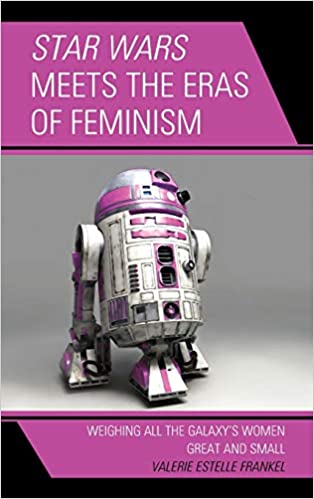
Valerie Estelle Frankel. Star Wars Meets the Eras of Feminism: Weighing All the Galaxy’s Women Great and Small. Lexington Books, 2018. Hardcover. 353 pg. $120.00. ISBN 9781498583862.

Valerie Estelle Frankel takes on the daunting task of analyzing all of the women who appear in the Star Wars Universe in Star Wars Meets the Eras of Feminism: Weighing All the Galaxy’s Women Great and Small. The resulting study is a pleasurable and enlightening trip through the decades of Star Wars media, where one may be simultaneously cringing in agreement with the criticism while marveling at the many interesting ways of examining the representation of women. It is clear that Frankel has a solid grasp of the vast amount of material to be able to discuss women in the films and television shows, as well as the comics, novels, video games, and other media from the legacy expanded universe and the Disney canon. It is unfortunate that the book was published before the final film in the Sequel Trilogy was released, but there is certainly room for continuing studies as new media are produced. For those who have not had the time to keep up with the Star Wars Universe, this book may spark interest in reengaging with the franchise to discover characters such as rogue archaeologist Doctor Aphra, who currently only appears in the comics and an audio drama adaptation.

Frankel takes advantage of a variety of metrics in her analysis, moving between lenses such as the male gaze, the Bechdel Test, agency, and diversity to discuss the representation of women and intersectional issues of race and sexuality. The resulting richness and multi-layered nature of the analysis demonstrate the value in drawing from a wide theoretical pool. Her study brings together conversations and critical perspectives largely occurring in popular culture publications alongside theories and analyses found in academic articles and books. This provides a real sense of a larger picture unfolding in the world of science fiction and fantasy about the place of women and other marginalized people.

Frankel begins her study in section one, “The Original Trilogy Meets Seventies Feminism,” with a thorough discussion of Princess Leia Organa and other Original Trilogy women in relation to second wave feminism of the 1970s. She weaves together commentary on Leia’s costuming, changes in agency across the trilogy, and the extent to which she reflects tropes about princesses and damsels in distress. Frankel acknowledges the breakthroughs Leia represented in the historical time period, but she does not shy away from interrogating problematic areas. The analyses in this section of characters such as Leia, Mon Mothma, and Oola the Twi’lek are important in establishing the context for the discussion of women in Star Wars and also allowing for comparisons with later depictions of the same characters or species. Frankel thus carefully layers her arguments to be able to demonstrate some movement away from stereotypical portrayals of women.

In “The Girl Power Prequel Era,” Frankel moves into an analysis of women in the Prequel Trilogy and legacy multimedia and how they reflect aspects of third wave feminism and girl power. For example, her critique of Padmé/Queen Amidala reveals a complicated web of images that help explain the difficulty in labeling female characters in simple terms. Indeed, Frankel calls this “an era of contradictions, seen in the variously empowered and weakened character” (43). The analysis of Padmé’s complex costumes and the downward trend of her agency is insightful and further strengthened when placed in conversation with the idealistic markers of third wave feminism and key texts such as Mary Pipher’s Reviving Ophelia: Saving the Selves of Adolescent Girls (1994).

In the final section, “The Fourth Wave Hits the Sequel Era,” Frankel covers the increased presence of women in the franchise since 2008 and explores the extent to which they align with fourth wave feminism. Moving fluidly between major characters, their expanded characterization in other media, and minor characters, she is able to show both progression and setbacks in the franchise’s movement toward greater inclusion of a diverse range of women. There is significant attention to female Force users such as Ahsoka Tano and Rey, and the increased diversity in the Sequel Trilogy and Rogue One. Even the more experimental media of the Forces of Destiny cartoons—designed as tasters of the larger universe for young girls—receive coverage. The closing analysis of the women in Solo shows a return to traditional archetypes; however, Frankel suggests that the droid L3-37 represents a stand-out character as “a delightful voice for empowerment” who, though cast as humorous, reminds the audience of the rights some characters must still fight for (318).

Accessible and engaging, this book offers a solid addition to the growing body of scholarship on Star Wars, and the representation of women and diversity in particular. One of its advantages is its comprehensiveness with regards to the sheer amount of media covered in both primary and secondary sources. The strength of Frankel’s arguments is fairly even throughout, though there are some rare places where her conclusions seem overly generous in trying to find positive representations. She relies on relevant direct quotations to support the thread of her analysis, which enables a multiplicity of voices to comment on the material under discussion. The study thus adds value by bringing key points of previous material in conversation with each other as filtered through Frankel’s perspective of each character, though sometimes the other voices dwarf Frankel’s own. This book would be useful to scholars and students in a cross-section of disciplines including science fiction and fantasy studies, feminist and women’s studies, film and media studies, and cultural studies. However, it is also presented and written in a way that can engage general readers with an interest in analyses of the Star Wars universe.

Kara Kennedy is a researcher and writer in the areas of science fiction and digital literacy. Her doctoral work focused on women in Frank Herbert’s Dune series, and she has also published articles on world-building in the series. She has forthcoming works on other topics in the series and posts literary analyses of Dune for a mainstream audience on her blog at DuneScholar.com.


Review of Inception (Constellations: Studies in Science Fiction Film and TV)


SFRA Review, vol. 51, no. 3

Nonfiction Reviews


Review of Inception (Constellations: Studies in Science Fiction Film and TV)

Bruce A. Beatie

David Carter. Inception. New York: Auteur (Columbia UP), 2019. Constellations: Studies in Science Fiction Film and TV. Paperback. 120 pg. $15.00. ISBN 9781911325055. E-book $14.99. ISBN 9781911325062.

This small (3.5” x 7.5”) and short (120 pages) monograph is part of a brief series published since 2016; the first volume on Blade Runner by Sean Redmond had appeared first in 2008 as “Studying Blade Runner.”  Jon Towlson’s Close Encounters appeared in 2016, and all of the subsequent half dozen in the series appeared in 2019.  I was interested in reviewing this volume because, shortly after Christopher Nolan’s film appeared in 2010, I reviewed a 2011 volume of semi-scholarly articles on Inception (Extrapolation 54, Winter 2013, pp. 316ff.), and I wanted to see how critical views might have changed over those years.  What strikes the reader immediately, however, is that within the book’s ten numbered chapters plus “Notes” and “General Bibliography” are 57 titled sections and subsections—an average of some two pages per section; the “Contents” page alone lists seven of the subtitles. Clearly, the brevity of these sections would not do justice to a discussion of changing critical views. In a very brief “Introductory Remarks” that includes a “Synopsis” of Nolan’s films (7-8), Carter introduces us to “Christopher Nolan: The Director and His Work” (9-29) with summaries of his films from Memento (2000) to Dunkirk (2017) and stills from all the films but the second and third Batman films. After a very brief chapter 3 (“The Industrial Context of Inception from Production to Premiere” 31-32), chapter 4 (“The Question of Genre” 33-49) discusses “The Notion of  Genre,” “The Heist Film Genre,” and “The Sci-Fi Film Genre,” concluding with a brief “Note on Tech-Noir.”  In chapter 5 (“Dreams in the Cinema 51-78), Carter finally focuses on the title film Inception; after shorter subsections, he turns to “How Inception Uses Dream Theory” (54-78), illustrated with eleven images from the film.

In chapter 6 (“Cobb’s Emotional Journey: From Guilt to Redemption” 51-78), the only chapter with no subtitles, Carter provides a close analysis of the film itself. The only image is taken from the end of the film: the image of “The spinning top, now still” (88). The chapter concludes: “The final ambiguous image in the film of the spinning top and Cobb’s reunion with the children can therefore be interpreted as implying that maybe it does not matter whether the scene is real or not” (93).

The concluding chapters are very brief:  Chapter 7 (“Inception and the Arts,” 95-97) includes images by M. C. Escher and Francis Bacon. Chapter 8 (“The Ending:  Dreams, Reality and Ambiguity” 99-100) provides a narrative of the final minutes of the film, in which Cobb and the team apparently return to current reality; it includes an unidentified photo (100), titled “Dream or reality?” which looks like a desktop covered with obscure objects, perhaps toys. The penultimate chapter 9 (“Critical Reception” 101-103) briefly describes a few reviews, negative and positive. In the final chapter (“10. Further Lines of Inquiry” 105-108), the most interesting line provides a partial text, in both French and English, of the Edith Piaf song, a few lines of which one hears frequently in the film. The “Notes” section (109-113) contains the sources of texts referred to in the text, and the “General Bibliography” (115-116) lists “works recommended for further reading on specific topics.”

Since my university library does not own any of the monographs in this series, I cannot compare Carter’s study of Inception with the other publications in this series. The substance of the book is in chapter 4-6, but only chapter 6 deals exclusively with the film. What I found most interesting was the discussion in chapter 4 of Inception as a heist film, a concept new to me. Carter’s only direct reference for the film is to Daryl Lee’s 2014 The Heist Film: Stealing with Style; a check of its contents shows that Lee does not deal with Carter’s Inception. Carter fails to mention sources available on the internet, including an online article of 2018 (“The Best 25 Heist Films of All Time”) that mentions Inception as the 5th best heist film. Wikipedia has a very detailed 30-page anonymous entry on Inception with 178 references; only some 30 of the references were published later than 2012. Carter’s “Notes” fail to mention the 2011 collection of studies I mentioned in the first paragraph; in that book, the essay by Sylvia Wenmacker is the most instructive writing on Nolan’s film than I have come across. In short, this little book is, for me a least, more frustrating than informative.


Review of Science Fiction Rebels: The Story of the Science Fiction Magazines from 1981 to 1990


SFRA Review, vol. 51, no. 3

Nonfiction Reviews


Review of Science Fiction Rebels: The Story of the Science Fiction Magazines from 1981 to 1990

Bryce L. King

Mike Ashley. Science Fiction Rebels: The Story of the Science-Fiction Magazines from 1981 to 1990. Liverpool University Press, 2020 (hardback: 2016). Liverpool Science Fiction Texts and Studies 54. Paperback. 495 pg. $39.10. ISBN 9781789621716. Ebook ISBN 9781781384404.

To fully and accurately account for the history of science fiction remains a difficult task for scholars of the genre due to its ever-changing subject matter, fluctuating surges, and mixed public receptions, as well as the bordering genres it can include, depending on who one asks and in what time period, and the colossal range and measure of the genre in itself. It seems to be to this end that Mike Ashley, a legendary scholar, editor, and anthologist of science fiction, fantasy, and mystery, attempts to recount the history of specifically science fiction (hereafter “SF”) magazines by time period in his ambitious collection of volumes entitled The History of the Science Fiction Magazine. The series includes the previously published The Time Machines (2001), Transformations (2005), and Gateways to Forever (2007) and the subject of this review, Science Fiction Rebels: The Story of the Science-Fiction Magazines from 1981 to 1990 (2016), the latest volume, although a projected fifth volume entitled The Rise of the Cyber Chronicles is set to cover the 1990s. Unlike most existing scholarship on science fiction magazines, Science Fiction Rebels microscopically focuses on the publication and editing history of the magazines while occasionally mentioning the trends of the genre, namely the cyberpunk movement, slipstream SF, and the radical hard-SF renaissance. This volume heavily centers on the editors and sales trends of the SF magazines around the world along with their format, level of professionalism, circulation, and samples of their content. Science Fiction Rebels proves to be an irreplaceable companion for study of SF magazine editorship in the 1980s and, though it is not ideal for new or casual SF fans, those interested in specifically SF magazine editing will find this volume as a useful resource for surveying editorial hardships and might view the decade as more difficult for SF writers to prosper in than originally thought. Besides arguing for better publishing and editorial techniques, Ashley displays no interest in hypothesizing an argument from his data, but instead offers it up to future scholars as a prime literary source on SF magazine culture in the 80s.

In Science Fiction Rebels, Ashley organizes the magazines by prozine—meaning professional magazine, semi-prozine—to mean semi-professional magazine, and small press magazines, approaching them in mostly that respective order. Ashley also divides the magazines by region, starting with America, Britain, Canada, Ireland, Australia, and South Africa, ending with non-English speaking regions covering Asia, Western Europe, Eastern Europe, and the Americas. Ashley concludes the volume with five appendixes that are astoundingly detailed and absolutely unparalleled in bibliographic utility, recounting the names and issues of the magazines, a directory of the magazines’ editors and cover artists, and the magazines’ circulation figures. Interviews with editors, a few authors, and clips of reviews and even some magazine reader reviews are frequently made use of throughout Science Fiction Rebels to establish public attitudes and behind-the-scenes stories surrounding the magazines.

Ashley spends little time speculating or judging what makes an SF magazine attractive or successful, but rather suggests that future magazines learn from the mistakes of the many failed magazines of the 1980s. He postulates, using the recounted tales of fallen SF magazines in the 80s as evidence, that insufficient funding, inadequate planning, and lack of an open, devout, manifold publishing and editing team as combined and individual factors steered the magazines, professional or not, into their demise. Other than this, however, Ashley does not attempt to argue over the best of the magazines, their content or art, nor the theory surrounding their content. Ashely’s main objective in Science Fiction Rebels is to give a mostly historical account of SF magazines in the 80’s, not more, not less, with microscopic detail and momentous collections of data, focusing mainly on the editorial side of the magazines. Throughout Science Fiction Rebels, the rapid imparting of editorial history and name-dropping might be overwhelming for less than serious SF readers, but to advanced SF enthusiasts and scholars, the brisk history is welcome for academic purposes, and the name-dropping is an exciting discovery of beloved authors who started their careers in SF magazines. However, to both types of readers the repetitiveness of recounting the back story and demise of the literary magazines can become tedious.

Thus to start, in chapters 1 and 2, Ashley recounts the stories of the prozine SF magazines, Isaac Asimov’s Science Fiction Magazine, The Magazine of Fantasy and Science Fiction, Weird Tales, Amazing Stories and Analog Science Fiction and Fact, and Omni. Here Ashley retells the birth of cyberpunk and the competition between SF magazines as well as their conformity to a slick magazine design or tradition, as well as the ways in which formatting and content changed and affected sales. Ashley briefly mentions public opinions on each magazine while paying most attention to the editors behind the magazines and sales and circulation history. As with most of the magazines discussed in Science Fiction Rebels, Ashley offers brief bibliographies of some authors and summaries of stories within these magazines to provide a glimpse into what each magazines’ interests and readerships were like. Ashley spends the most time on these magazines, rightfully so given their legendary legacies and impact on not only SF magazines, but SF as a whole.

Chapter 3 details the related cousin of SF in horror and dark SF, mentioning splatter punk. Here Ashley describes the histories of Rod Sterling’s The Twilight Zone magazine, Night Cry, The Horror Show, and Pulphouse, amongst other small press magazines, giving an overview of their birth, life, and fall. Here Ashley draws attention to the blurring and mixing of genres that SF was undergoing in America while also emphasizing the competition between SF and other genre magazines. Recounting the hard-SF renaissance, though there is relatively little commentary on what contributed to it, chapters 4 and 5 tell the histories of SF magazines in English-speaking countries other than America. These include Interzone, Something Else, Back Brain Recluse, Dream Magazine, Stargate, Tesseracts, Omega, and, of course, others. These chapters illuminate the reversion to hard SF in other countries besides America, which was experiencing a pushing of SF boundaries and a “Cyberpunk Daze,” (212)  as Ashley coins it.

At the end, chapters 6 and 7 encompass slipstream SF’s and speculative fiction’s places in the SF magazines, discussing the history of Last Wave, Modern Stories, New Pathways and others. The chapter also offers a much-needed highlight on the short-lived but influential small press magazines of the 80s. Lastly and interestingly, appendix 1, which seems out of place as an appendix and could have easily been a chapter 8, details the history of SF magazines that took root in non-English speaking countries; here Ashley manages to cover multiple countries from every region of the world. The other appendixes are collections of data tables involving sales figures, production, and contributors.

Though Science Fiction Rebels offers an unparalleled collection of data and a detailed editorial history, it excludes historical events and social justice issues of the 80s that impacted SF. For instance, there is no mention of the AIDS epidemic, the Cold War, the election of Sandra Day O’Connor (the first female U.S. Supreme Court Justice), the Ronald Reagan campaign, or the savings and loan crisis, all of which impacted either the economic or the content side of SF. Ashley makes no connection between general history and the history of SF magazines, not even to make commentary or connections on the impact of the world on the genre, its authors or editors.

There is also no mention of or allusion to the relationship between SF magazines and the massive blockbuster SF films of the 80s such as Back to the Future (1985), E.T. (1982), Star Wars: The Empire Strikes Back (1980),  or Star Wars: The Return of the Jedi (1983), all of which sparked mainstream and widespread interest in SF. Ashley does not speculate about whether the magazines received any benefit from this SF explosion or if the content was influenced by these major films. Given the hard-SF renaissance, it seems impossible to not discuss these major films and their impact on authors. Part of this omission could be due to the fact that Ashley seems less interested in analyzing the literary content of the magazines than in focusing on the sales and editorship of the magazines, in an attempt to avoid arguments over the magazines’ stories and literary themes. This remains the only, albeit major, downside of Science Fiction Rebels. With no opinion or connection between the world of SF outside of magazines, a microscopic view of the 1980s SF magazines editorship becomes the result.

Besides its lack of historical context and linguistic repetitiveness, Science Fiction Rebels fills a niche but tremendous void in SF scholarship of 80s literary magazines and history. Giving an origin story of cyberpunk and slipstream SF, along with over 200 pages of appendices of editorial data and a developed recounting of the history behind the SF magazines of the 80s, Ashley gives other scholars of SF magazines valuable insight to the world of editing SF in one of the world’s most eclectic decades. Ashley makes Science Fiction Rebels a scholarly must-have for research and editorial history within 80s SF.


Bryce King is an MA graduate student and instructor at Florida Atlantic University with a concentration in SF and Fantasy. She is an ICFA, PCA/ACA and SFRA member and has presented at each of the 2021 conferences for those associations. Her master’s thesis will be an ecocritical look at The Witcher series and she is a proud working member of Heartwood Books and Art, an antiquarian and rare book seller.

Review of The Paradox of Blackness in African American Vampire Fiction


SFRA Review, vol. 51, no. 2

Nonfiction Reviews


Review of The Paradox of Blackness in African American Vampire Fiction

Misha Grifka Wander

Jerry Rafiki Jenkins. The Paradox of Blackness in African American Vampire Fiction. The Ohio State UP, 2019. New Suns: Race, Gender, and Sexuality In The Speculative. Paperback. 234 pg. $29.95. ISBN 9780814214015.

Picture a vampire in your head. Whether your image is more Nosferatu or more Edward Cullen, more than likely one of its most notable traits is the stark whiteness of its skin. Although humans come in a great variety of colors, depictions of vampires rarely reflect that. In The Paradox of Blackness In African American Vampire Fiction, Jerry Rafiki Jenkins uses stories of Black vampires to investigate how the seldom paired traits of “vampire” and “black” expose American society’s assumptions about what it means to be Black.

Jenkins focuses on a specific work of African American vampire fiction in each of the five chapters, covering The Gilda Stories (Jewelle Gomez, 1991), My Soul To Keep (Tananarive Due, 1997), Dark Corner (Brandon Massey, 2004), Fledgling (Octavia Butler, 2005), and Image of Emeralds and Chocolate (K. Murry Johnson, 2012). Through the lens of the novel in question, each chapter also focuses on a particular aspect of Black life and experience, from masculinity to religion to sexuality.

In the introduction, Jenkins efficiently counters the idea that the vampire myth is a European one, sourcing vampire myths from across Africa and the Caribbean, and writing, “to treat the vampire as the sole property of whites is to ignore the history of this creature, a history which predates the word ‘vampire’ and the biological notion of race” (5). Rather, Jenkins writes, the vampire is a tool, used to express the fears and anxieties of its originating culture, especially those about death and immortality. This thesis is well-accepted in speculative fiction studies, but to my knowledge, has seldom been used to examine questions of Black racial construction. Jenkins poses the main question of the book as, “Is there more to being black than having a black body, and what might the answers to that question mean for African Americans in the 21st century?” (10).

In the following chapters, Jenkins uses the vampire novel to illustrate ways in which various parties have attempted to define Blackness in line with requirements other than the simple fact of having a Black body. The nature of vampirism allows the novels’ authors to use tools to assert their characters’ racial “authenticity” in ways that would not be possible for human characters, such as establishing their characters’ participation in American slavery, lives in historical Africa, and connections with famous abolitionists and civil rights activists. Simultaneously, the characters question the assumptions of other characters about what is necessary to be deemed Black, or Black enough. Gilda from The Gilda Stories frequently says, “a row of cotton is a row of cotton,” indicating that oppression is oppression no matter how you slice it, and this sentiment is echoed across Jenkins’ book. The oppression that women, queer people, and other marginalized groups experience does not make them less Black, but rather is part and parcel of the oppression Black people face in America.

Jenkins uses analysis of the novel and real-world events and theories in equal measure, alternating between characters’ narration and explanations of their own racial beliefs, and real political figures and movements such as Afrocentrist Molefi Kete Asanti and political scientist Francis Fukuyama. Jenkins uses the fictional vampires to counter real arguments, demonstrating for instance how the unquestionable Blackness of Marquis in Image of Emeralds and Chocolate or Dawit in My Soul To Keep are not at war with their homosexuality or atheism, and therefore neither homosexuality nor atheism can dilute one’s Blackness, as has been argued by various Afrocentrists, Black conservatives, and Church members (whom Jenkins cites).

Though each chapter focuses on a specific topic, the chapters as a whole build toward answering the question Jenkins poses in the introduction: is there more to being Black than having a Black body? Each chapter answers no in its own way, but the final chapter, on Octavia Butler’s Fledgling and transhumanism, goes a step further. Shori, the main character of Fledgling, is the first Black Ina, a race of nonhuman vampires who have no melanin in their skin. Shori is a hybrid of human and Ina, the first Ina to possess melanin and therefore the first to be able to withstand the sun’s rays. Jenkins argues that Butler, through the figure of Shori, is demonstrating that all humans have melanin, and therefore all humans belong on a spectrum of Blackness. There is no such thing as a non-Black human, just humans with more or less melanin. Jenkins ends the volume with the statement:

By linking humanity’s fate to the fate of black people, the new-black vampire novel offers us a future in which blackness no longer defines one part of the human species, as it does in the post-black vampire novel and most of the Western world, but the entire species […] The road to that future, as Butler suggests in Fledgling, begins with accepting the fact that nonblack people are not born notblack; rather, we make them not black (180).

This triumphantly transhumanist ending confirms the ambitious scope of Jenkins’ work—reconfiguring our understanding of Blackness to include all of humanity.

This brings me to my one critique of this otherwise brilliant book. “All humans are black” is a statement Jenkins supports elegantly throughout the book, but one that struggles in regular conversation. Jenkins does not address what that conclusion does for the cause of any real humans, Black or otherwise. One might argue that he never promises to, which is true, but when working with a politically laden topic, one might ask for a few signposts as to the political utility of such an argument.

That said, I highly recommend this book. Academic books are rarely called page-turners, but this one might qualify, for Jenkins’s skill at building his argument propels each chapter. Jenkins glosses the basics of both race theory and vampire theory, so those lacking expertise in either will not be lost, but doesn’t dwell on it enough to bore more experienced readers. I recommend this book for scholarly and general audiences interested in speculative fiction and race, vampires, and the battle over Black authenticity in America.


Misha Grifka Wander is a PhD student at the Ohio State University. Their research focuses on media, speculative fiction, gender, and ecocriticism. 

Review of Suburban Fantastic Cinema


SFRA Review, vol. 51, no. 2

Nonfiction Reviews


Review of Suburban Fantastic Cinema: Growing Up in the Late Twentieth Century

Rob Latham

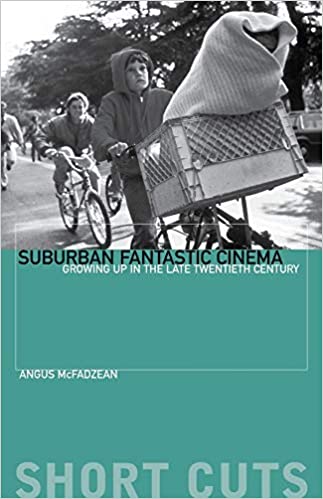
Angus McFadzean. Suburban Fantastic Cinema: Growing Up in the Late Twentieth Century. Wallflower Press, 2019. Short Cuts: Introduction to Film Studies. Paperback. vii + 140 pg. $22.00. ISBN 9780231189958.

The seed for this slim book was a 2017 essay in the Journal of Science Fiction Film and Television that anatomized a cluster of movies from the 1980s and 1990s the author saw as forming a new genre he called the “suburban fantastic.” At 25 pages, the essay was one-fifth the length of the new volume, which is basically an expanded version, chopped into five chapters and with more developed readings. A sixth chapter extends the discussion to encompass films released in the twenty-first century.

McFadzean’s basic claims are cogent and illuminating. According to him, the suburban fantastic initially crystallized in the films of Steven Spielberg and other directors—e.g. Joe Dante, Robert Zemeckis—who worked for his production company, Amblin Entertainment, during the early-to-mid 1980s. In movies such as E.T.: The Extraterrestrial (1982), Gremlins (1984), and The Goonies (1985), a distinct pattern emerged: an adolescent boy with some kind of personal dilemma (conflict with parents, alienation from peers) is confronted with a supernatural intrusion (an alien being, demonic entities); these related crises develop in parallel over the course of the narrative, such that the resolution of one leads to the resolution of the other. At the end of the story, the supernatural element has been expunged and the protagonist has been effectively socialized into the suburban patriarchal order. Later in the decade and into the 1990s, other producers and directors developed and experimented with this basic model, in films such as Flight of the Navigator (1986), Short Circuit (1986), Terminator 2: Judgment Day (1991), Jumanji (1995), and numerous others. In the process, they hybridized the form with themes and narrative elements borrowed from science fiction, horror, romantic comedy, and other genres. At the same time, a significant subset of these films included parodies or pastiches of earlier fantastic traditions, especially 1950s SF movies, making the genre increasingly self-reflexive. Yet the core remained a fusion of personal melodrama and fantastic incident, usually set in contemporary suburbia or some narrative surrogate for it.

Laying out this model, structurally and historically, takes up the first two chapters, with chapters three through five pursuing specific thematic strands within this cinematic corpus. Chapter three focuses on the crisis of masculinity experienced by the youthful protagonist, who over the course of the narrative moves from outsider to representative of the patriarchal order, in effect being successfully socialized into an appropriate gender identity (as a Freudian critic would say, Oedipalized) through confrontation with the fantastic. Chapter four further addresses the self-reflexivity of the genre by analyzing a series of films in which the mass media is centrally, almost metafictionally present—e.g., Explorers (1985), The Monster Squad (1987), Matinee (1993). Chapter five considers the genre’s socioeconomic implications, claiming that the fantastic intrusion into suburbia functions as some sort of allegory of contemporary capitalism and its key social institutions: government, science, and the military. The final chapter, as noted above, looks at later Hollywood versions of this basic story structure, such as War of the Worlds (2005), Frankenweenie (2012), and the Stranger Things TV series (2016-).

While McFandzean’s core claims are largely convincing, and many of his readings of specific films are compelling, few readers will really need this longer version of the argument—the 2017 article is probably enough. A larger problem, at least for me, is the structuralist framework underpinning the argument (borrowed from film theorist Rick Altman), which tends to make the process of narrative construction sound much too mechanical. Essentially, the genre is reduced to a kind of toolkit of “semantic” and “syntactic” elements from which individual filmmakers borrow to assemble a new film text. While McFadzean is a bit more attentive to external history than are most structuralist critics—he shrewdly shows, for example, how developments like the new PG-13 rating impacted the genre—he still makes most film narratives sound like mix-and-match aggregations of pre-fabricated materials rather than complex and often contradictory aesthetic creations. This tendency is exacerbated by his rather mechanical, often jargon-clotted prose: “Even as the fantastic established itself as a semantic and syntactic bend, with the defining syntactic trait of a connection between the pre-teen protagonists and the element of the fantastic, it became subject to a series of experiments and extensions that altered its semantic and syntactic set” (39). If this were what the process of movie-making is actually like, no one would ever watch movies.            

This problem aside, I can recommend Suburban Fantastic Cinema to scholars and students of SF and horror film, and fantastic media more broadly—though, as noted, the article-length version will be more than adequate for most purposes.


Rob Latham is the author of Consuming Youth: Vampires, Cyborgs, and the Culture of Consumption (2002) and the editor of The Oxford Handbook of Science Fiction (2014) and Science Fiction Criticism: An Anthology of Essential Writings (2017). He is a senior editor for The Los Angeles Review of Books

Review of Undead Ends: Stories of Apocalypse


SFRA Review, vol. 51, no. 2

Nonfiction Reviews


Review of Undead Ends: Stories of Apocalypse

Daniel Helsing

Sarah Trimble. Undead Ends: Stories of Apocalypse. Rutgers University Press, 2019. Paperback. 210 pg. $29.95. ISBN 9780813593647.

As I am writing this review in June 2020, in the midst of the COVID-19 pandemic, social distancing, face masks, and travel restrictions have become the new normal. At times, the line between fiction and real life has seemed eerily blurry; if headlines and news clips from the past few months were edited into a minute-long video, it could easily be mistaken for the opening scenes of an apocalypse film. For this reason, and for the fact that we do not know when and how this pandemic is going to end, it is more important than ever to examine the apocalypse narratives that circulate in film and literature. Which narratives are we enacting in our responses to COVID-19? How do we imagine life after the crisis? And who are “we”?

In her book Undead Ends: Stories of Apocalypse, Sarah Trimble examines popular Anglo-American apocalypse films of the past two decades. Her arguments illuminate the entire genre, but she singles out six films for closer analysis: The Road (2009), I Am Legend (2007), 28 Days Later (2002), 28 Weeks Later (2007), Children of Men (2006), and Beasts of the Southern Wild (2012). Though highly relevant also before COVID-19—anthropogenic climate change, the rise of right-wing populism, and the persistence of neoliberal capitalism being three important reasons—Undead Ends has taken on another level of relevance in this unprecedented global pandemic.

Trimble argues that the prevalence of high-visibility apocalypse films should be read in the context of a particular kind of capitalism that has gained influence in recent decades. She invokes cultural critics and theorists, including David Harvey and Naomi Klein, who characterize this version of capitalism as “creative destruction” (Harvey, cited on page 2) and “disaster capitalism” (Klein, cited on page 2): when disaster strikes or is induced, as the case may be, policy makers and investors arrive at the scene to privatize resources and reconstruct society in ways that will benefit them. Apocalypse films neatly parallel this process of destruction and reconstruction: the old order collapses, and a group of survivors struggle to create a new order. And since, according to Trimble, stories are incredibly powerful—she borrows Sylvia Wynter’s term homo narrans to characterize humans as “a species of storytellers” (9)—it becomes crucially important to critically analyze the identities, behavior, and aspirations of the survivors in apocalypse films. Do they reproduce Western colonialism and neoliberal capitalism? Or do they let other voices in, offering alternative visions of culture and society? In Trimble’s words: “In Undead Ends, I argue that contemporary apocalypse films offer an occasion to intervene in neoliberal storytelling. At the heart of this claim is the conviction that stories make and remake the world” (3).

The historical roots of Trimble’s arguments extend further than the last few decades, however. She builds on Wynter, who traces the “invention of Man” to the Renaissance, when “the Christian tale of humanness gave way first to a vision of the human as rational (Man1) and then to a ‘biocentric’ vision of the human as a living organism imperiled by natural scarcity (Man2),” a vision that “took shape in relation to Others imagined as exploitable and/or killable” (3). Closer to our time, Trimble argues, Man2 can be identified with homo oeconomicus, or the “economic Man,” who “defines good humanness in terms of economic productivity and security” (3). Borrowing the title of Mary Shelley’s novel The Last Man (1826), Trimble then defines “the Last Man” as “the protagonist who exemplifies the norms of humanness established by Man’s story” (153, n8). For Trimble, “the Last Man” thus signifies both a survivor of the standard apocalypse narrative and an embodiment of the Western, neoliberal “economic Man.”

Except for 28 Days Later and 28 Weeks Later, which she discusses in the same chapter, Trimble devotes a chapter each to the films listed above. But rather than ordering the films chronologically, she creates a kind of narrative of her own through the order in which she discusses them. Very simply and roughly, the films increasingly problematize the story of the Last Man and, in different ways, let other voices in. In Trimble’s reading, The Road reinforces the current economic order. For example, the unnamed father explains to his unnamed son that they are “the good guys” and that they are “carrying the fire.” They are distinguished as such in the plot of the film too, both through the contrast with the unnamed mother—who has committed suicide—and through the contrast with a group of cannibals—a trope which evokes the old Western binary of “the savage” versus “the civilized” (29–30).

In subsequent chapters in Undead Ends, the Last Man is still present, but his hegemony becomes undermined and other perspectives and voices gain in strength. The last film, Beasts of the Southern Wild, sees a very different protagonist from The Road: not a white man trying to rekindle “civilization,” but a young, black girl, called Hushpuppy, living with an abusive father in precarious circumstances. However, Trimble does not simply praise Beasts for challenging the status quo; she quotes and discusses a number of critics who have argued that Beasts amounts to “a romanticization of racialized poverty” and reinforces “tired tropes of primitivism and black familial dysfunction” (119). But Trimble also sees an opportunity for challenging the hegemonic “we” in our renderings of history. For example, in a key scene early in the film, Hushpuppy “accidentally-intentionally sets her house on fire” (119). While hiding from both the flames and her father in a cardboard box, she draws pictures on the walls of the box and explains: “If daddy gonna kill me, I ain’t gonna be forgotten. I’m recording my story for the scientists in the future” (quoted on page 119).

Undead Ends is a valuable and timely addition to the literature on climate fiction and apocalypse narratives. Through her well-written and nuanced readings of Anglo-American apocalypse films, Trimble illuminates and problematizes the “we” of widespread apocalypse narratives by relating the films’ plots and perspectives both to 500 years of colonial history and to the “disaster capitalism” of recent decades. We will be better off if we read Undead Ends—with regard to everyday life as well as to COVID-19 and other potentially apocalyptic hazards down the road.


Daniel Helsing received his PhD in literature from Lund University in 2019, and he currently teaches at the Department of Interdisciplinary Studies in the Liberal Arts at California Polytechnic State University. His research centers on representations of science and the universe in texts of various kinds, including fiction, poetry, creative nonfiction, and science communication.

Review of Star Wars after Lucas


SFRA Review, vol. 51, no. 2

Nonfiction Reviews


Review of Star Wars after Lucas: A Critical Guide to the Future of the Galaxy

Benjamin J. Robertson

Dan Golding.  Star Wars after Lucas: A Critical Guide to the Future of the Galaxy.  University of Minnesota Press, 2019. Hardcover. 264 pg. $21.95. ISBN 9781517905422.

In Star Wars after Lucas, Dan Golding implicitly and explicitly grapples with challenging questions scholars of that galaxy far, far away must consider when they attempt to make definitive statements about the franchise. How does one deal with more than forty years of Star Wars? How does a single person, in a single text (even a book-length one) identify and address an adequate sample of films, television shows, novels, comics, toys, video games, theme park attractions, and so on? How does one make sense of the relationship and interplay among the various groupings of narrative texts that make up the universe: the original trilogy, the prequel trilogy, the Disney trilogy, the films labeled as Star Wars stories, the de-canonized texts that make up Star Wars Legends, the new non-filmic texts that have replaced the Legends as canon, and so on? How does one account for the myriad historical moments in which they were produced and the various models that shaped their production, distribution, and reception? Perhaps most importantly, how does one say something about Star Wars now, in the present, when the inevitable progress of the franchise machine will make whatever one says about it obsolete in the very near future, perhaps even before one’s claims find their way to readers?

Star Wars After Lucas comprises an introduction and nine chapters, the bulk of which, as Golding’s title suggests, focus on the Disney era of the franchise, especially Star Wars Episode VII: The Force Awakens (2015). The introduction lays out the foundations for Golding’s subsequent discussion of the complex nostalgia Star Wars produces in its fans, a nostalgia that has become perhaps the franchise’s main thematic concern and narrative guide since at least 2015. Chapter one examines the politics of the original trilogy, the malleability thereof, and the consequences of this malleability with regard to the ongoingness of franchise. Chapter two turns to the Disney era, specifically to fan reaction to the announcement of new Star Wars films after the prequels—whose legacy has been, at best, problematic for the franchise—and the prospect of revitalizing Star Wars in such complex circumstances. Chapter three offers a strong reading of The Force Awakens by way of Golding’s conceptualization of the legacy film, whose goal is “to extend the life of a film series and renew it for a new era” by: bringing back actors/characters from earlier films, introducing new actors/characters, repeating and revising narrative strands and thematic concerns from earlier films, documenting a handoff from one franchise generation to the next, and using this handoff to shift the narrative focus from the older generation to the younger one (71). Chapter four stays with The Force Awakens to investigate the film’s politics, which shift away from the original trilogy’s concerns with colonialism and war in the aftermath of Vietnam and towards questions of diversity and representation appropriate to a decade when Black Lives Matter, #MeToo, and similar identitarian movements focused on marginalized voices have taken center stage in political debates. Chapter five, perhaps the most interesting in the book along with chapter three, also focuses on The Force Awakens and how the film’s score, by John L. Williams, plays a clear and important role in Disney’s nostalgic enterprise. In chapter six, Golding compares the nostalgia deployed by The Force Awakens to that deployed by the second film of the Disney era (and the first film to not be part of the episodic structure of the entire film franchise to that point), Rogue One (2016). Chapter seven then compares how Rogue One and the animated Star Wars Rebels television program take on fascism in their respective ways. Chapter eight turns away from engagements with specific films in order to think about how actors and the characters they play (specifically Carrie Fisher/Leia and Harrison Ford/Han Solo), by way of their mortality in the real world and their narrative weight in the storyworld, affect franchise production and reception. Finally, in chapter nine, Golding turns to Star Wars Episode VIII: The Last Jedi (2017) and how it responds to The Force Awakens and Rogue One “by questioning some of the fundamental questions about Star Wars that these films took for granted” (205). Such questioning, undoubtedly, will remain at the heart of the franchise for the foreseeable future.

As this summary suggests, Golding accomplishes a great deal in Star Wars after Lucas even as he continually faces the specific challenges Star Wars presents to critics, as discussed above. In some cases, he answers a challenge by doing what so many scholars of the franchise have already done. For example, he defines his object mainly in terms of the films, and privileges discussions of them over Star Wars in other media—a sensible move given the volume of material in other media and given the fact that the films will likely always remain canonical, and therefore central, for the Star Wars universe.  While this choice might appear merely standard, it allows Golding the opportunity for a very clear and focused discussion of the consequences of Disney’s 2012 acquisition of Lucasfilm for the recent rebirth and success of the Star Wars franchise through The Force Awakens and subsequent films. As Golding makes clear, this success derives from a complex relation the new material establishes with the older material, a complexity that the idea of the legacy film clarifies and makes available to further scholarship. For Golding, as for many other fans and critics, while The Force Awakens and subsequent films clearly recall beloved moments from the original trilogy, they also distance themselves from the prequel trilogy.  However, Golding takes a further, and much needed, step by making clear that we must not only consider how the Disney-era films relate themselves to the past, positively or negatively. We must also account for how these films do something new within the franchise itself: “For all that has been made about these new films’ ability to deliver something quintessentially ‘Star Wars-y,’ their atonement for past sins, and their renewal of the franchise, there are discontinuities here, too. […] Disney’s strategy in reviving Star Wars can tell us much about not just how American, global media functions today but also the power of the contemporary audience’s thirst for revisiting the past, and culture that deals with questions of legacy and myth” (3-4). In other words, Star Wars will always refer to its own past, but such reference goes beyond the valorization of what we like and denigration of what we don’t. It requires that Disney balance the weight of franchise history with the need for new narrative and thematic possibilities which can leverage the galaxy for further profit.

Here, however, we find a challenge that no critic of Star Wars will likely ever completely overcome. Just as Anakin Skywalker could not bring any final balance to the Force, no critic can ever make a final claim about how the franchise works. Because the franchise always carries on, and because this particular franchise (more than most, I think) so clearly concerns itself with a constant revision of its own history, future films (and television shows such as The Mandalorian [2019]) will not only provide new grist for the critical mill in and of themselves, they will also constantly affect how we understand all that has come before. With this point in mind, we can understand how any scholarly investigation into Star Wars will not only offer potential insights into what the franchise means (or has meant to date) and how it works (or has worked to date), but such statements will also provide a snapshot of Star Wars and its reception prior to some new revelation that might moot such statements. It is, of course, far too early to tell how, for example, Star Wars Episode IX: The Rise of Skywalker (2019) might undermine Golding’s arguments. Nonetheless, the fact that Golding could not have known the title of this film—revealed in April 2019; Golding refers to the film as “Episode IX”—hints at the franchise’s potential for such undermining. Along similar lines, Golding says very little about Solo: A Star Wars Story (2018) or the claims that its relatively poor performance at the box office caused Disney to cancel or delay previously announced Star Wars projects, including trilogies by The Last Jedi director Rian Johnson and Game of Thrones showrunners David Benioff and D.B. Weiss (both of which Golding mentions in his introduction as evidence of the robust future Disney imagines for the franchise). Finally, although Golding spends a whole chapter on The Last Jedi, his reading of the film does not seem to have much impact on his discussions of earlier films, perhaps because he could not wait for it to be released and integrate his reading of it into the rest of the book given academic publishing timelines.

I do not mean to suggest that Golding’s inability to see the future is a problem for this book so much as that every scholar’s inability to do so presents a problem for critical engagement with twenty-first century cultural production generally and the most prominent form of such production specifically. Insofar as Golding’s book both succeeds as an investigation of Star Wars in the Disney era and performs the limitations such investigations necessarily entail, it provides a useful and necessary account of contemporary, popular entertainment. It shows us that, as critics, we must make claims about what we know even when part of what we know involves the fact that knowledge, and therefore claims, will always remain radically provisional under contemporary capitalism and the forms it produces.


Benjamin J. Robertson is an assistant professor of English at the University of Colorado, Boulder, author of None of This is Normal: The Fiction of Jeff VanderMeer (2018), and editor, with Gerry Canavan, of a new book series from the University of Minnesota Press: Mass Markets: Studies in Franchise Culture.

Review of The Dark Fantastic


SFRA Review, vol. 51, no. 2

Nonfiction Reviews


Review of The Dark Fantastic: Race and the Imagination from Harry Potter to the Hunger Games

Jonathan W. Thurston-Torres

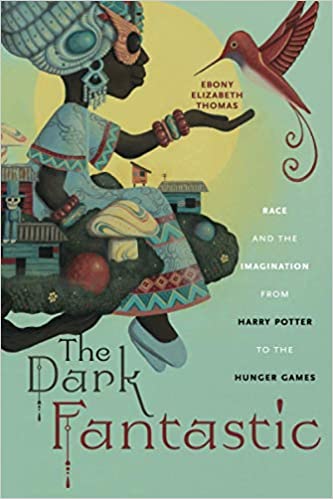
Ebony Elizabeth Thomas. The Dark Fantastic: Race and the Imagination from Harry Potter to the Hunger Games. New York UP, 2019. Hardback, 240 pg. $28.00, ISBN 9781479800650.

Even as I am writing this review, I am wearing both a Slytherin tank top and a Slytherin scarf. I grew up in a generation in which J. K. Rowling’s famed Harry Potter book series was coming out; they were published during my middle and high school years. While I have seen the movies a few times, I have never gone back to read the original books. But, when I saw the title and subtitle for Ebony Elizabeth Thomas’s new book, I found myself thinking back to racial representation in the book series. I knew about the occasional person of color in the books, and I knew that representation was minimal. I remembered, too, the “scandal” in the media over the black Hermione in the stage production of Harry Potter and the Cursed Child (2016). But Thomas’s book pushes back against all of these preconceived notions of race in the Harry Potter books and other young adult literature, begging the question, “What about the space for young adult imagination?”

Thomas begins her book with the eponymous critical term for her work: “the dark fantastic.” She first defines it as “the role that racial difference plays in our fantastically storied imaginations” (7). In this introduction, she details how monstrous others in fantastic literature are “endarkened” and convey to “readers, hearers, and viewers of color” that they “are the villains […] the horde […] the enemies […]the monsters” (23). She gives numerous examples throughout the text to showcase the term more concretely, such as Rumpelstiltskin who becomes the “Dark One” in the TV series Once Upon a Time (2011-18), the Native American bestial werewolves of the Twilight series (2008-12), and the “majority of witches and warlocks” with “visible African ancestry” in the television show The Vampire Diaries (2009-17) (30-31). However, as the diversity of these examples shows, the “dark fantastic” is a murky term to define.

In his 2019 monograph The Paradox of Blackness in African American Vampire Fiction, Jerry Rafiki Jenkins summarizes and discusses race discourse around Bram Stoker’s Dracula (1897). In this description, he shows how while many scholars have argued that a dominant response to the novel is to empathize with the victims of the vampire, some race readers like Jewelle Gomez align more with Dracula himself as a form of “shared ‘suffering’” (24). What Jenkins creates here is an awareness that both darkness and othering are spectra in and of themselves, not to mention their intersections. Is Mina Harker capable of being a Dark Other for Thomas, or is only Dracula capable of that? As Thomas points out, being othered in literature often means being darkened, so, therefore, are all folkloric antagonist archetypes qualifiers for Dark Othering? All antiheroes?

When Thomas moves into case studies, she starts with representations of Rue in The Hunger Games (2008). This section begins with a solid analysis of construction of race and ethnicity in the series, showing how Rue was raced in the first book. While these representations are complex, Thomas excels at being able to focus the camera in at the line level and then zoom back out to show the larger picture: we see how specific phrases and sentences help to create a systematic construction of race, and that affects the ways that Rue “becomes” innocence in the novel. But, as Thomas shows, that innocence is “transferred” to Katniss by the end, and Rue “fades from the narrative” (57). The chapter wraps up with a survey analysis of social media responses to the black representation in the films, investigating what Thomas calls the “dark fantastic cycle,” a narrative cycle that tracks the role of the Dark Other in fantastic literature (60, 26). This cycle makes it so that cishet white men can read the work and not even notice these characters who just “happen to not be white.”

The next chapter reads closely representations of Gwen in BBC’s Merlin (2008-12). The chapter starts by showing how the mixed-race character of Gwen might disrupt the dark fantastic cycle, but, at each step of the analysis, while there is potential for disruption, Thomas shows how even this narrative follows the conventions, even if in more roundabout ways. The second half of the chapter is devoted to Thomas countering common trends in social media response to Gwen’s racialization. However, many of these analyses are really quoting various posts, putting them in conversation with each other, and then making a brief point that could have been explained more. In one section, Thomas traces the statement that “Gwen and Arthur [as a desired coupling] are heteronormative” (96). She sets up the context for this discourse, she shows some quotes, details how important an Arthur and Merlin shipping is for the LGBTQI community, gives more quotes, one of which says that race is important for characterizing Gwen, and then paraphrases that quote some more, and then moves on to the next assertion. The social media analysis throughout Thomas’s work signifies new ways to examine young adult literature and its reception, but I would have liked to see more critical analysis of it, rather than mostly summary.

In the final two chapters, Thomas examines blackness in The Vampire Diaries and the Harry Potter series. In each, she grounds the discussions in anecdotes of conversations with her family about race and racial representation, and these anecdotes showcase one of the strongest aspects of the book: this book is an essential text for anyone teaching young adult literature, especially in middle or high schools. Thomas models reading YA lit for race and encourages ways to teach not just reading but also analysis of social media reception of race in literature and film. Thomas’s work definitely needs to be in university libraries, educators’ hands, and scholars’ shelves. And for me at least, even as a proud Slytherin, I have new understandings of the Harry Potter series and the ways the dark fantastic cycle snakes its way into the narrative.


Jonathan W. Thurston-Torres is a PhD Candidate in English at Michigan State University, and their edited collection Animals & Race is scheduled to come out through MSU Press later this year. They specialize in early modern studies, animal-race theory, and HIV activism.