Review of Thrills Untapped: Neglected Horror, Science Fiction and Fantasy Films, 1928-1936


Review of Thrills Untapped: Neglected Horror, Science Fiction and Fantasy Films, 1928-1936

Michael Pitts *

Michael R. Pitts. Thrills Untapped: Neglected Horror, Science Fiction and Fantasy Films, 1928-1936. McFarland, 2019. Paperback, 348 pg. $49.95. ISBN 9781476673516.

* Editor’s Note: The author of this review is not the same person as the author of the book under review.


Thrills Untapped draws attention to serials, documentaries, and sound era films widely overlooked in current scholarship and in this way contributes significantly to science fiction film studies. Choosing to omit evaluations of largely celebrated works such as Dracula (1931) and The Mummy (1932), Michael R. Pitts instead examines those lesser known works likely to produce new, fruitful research into early genre films of the sound era. His research therefore spans the beginning of the sound era, 1928, to the year in which the British film ban went into effect, restricting the production of horror films, 1936. As Pitts states, the goal of his volume “is to chronicle these mostly ignored movies, providing the exposure they so rightfully deserve” (1). In presenting to his audience in-depth analyses of nearly 150 mostly forgotten films spanning the horror, science fiction, and fantasy genres, he provides an invaluable resource for researchers at the intersection of film studies and science fiction studies.

A particular strength of Thrills Untapped is the expansive quality of its analyses, which move beyond simple summations and evaluations of these films. While detailing the salient elements of each film’s plot, for example, this collection presents invaluable extratextual information, including the cultural context within which each film was produced, important details related to its production, the origins of the cinematic project, its place within larger trends of the time, and popular and critical evaluations of it upon its release. In citing, for example, a review from the Philadelphia Exhibitor published soon after the release of the film upon which it focuses, The Mystery of the Marie Celeste (1935), Pitts both emphasizes the technical, editing problems of the movie and presents the response of critics at the time to these weaknesses. The film review states, “this is pretty poor. The actors are positively hammy; the recording, the photography are awful; [Bela] Lugosi is an unbelievable, silly menace, the editing leaves out whole scenes so that the story is annoyingly choppy” (177). The works making up this collection, therefore, take into consideration myriad aspects related to the production, quality, and reception of these overlooked films. In this way, they assess the value of these films and emphasize the complex, interwoven evaluations of them by earlier and contemporary critics and scholars. Such a widened focus significantly strengthens and complicates the analyses making up this text.

Still, this collection, while otherwise an invaluable overview of this era of genre film, is somewhat problematized by its parameters, which are at times vague and inconsistent. While horror, fantasy, and science fiction films receive the most attention, and the inclusion of mystery films is successfully justified according to the horror elements they possess, those works representing the “B” western and broadly defined foreign genres appear to stray from the purpose of this research project. Blue Steel (1934), a conventional western starring John Wayne, is, for example, noted as a suitable inclusion to this collection due to scenes presenting a storm, a shadow-engulfed way station, and a particularly brutal murder. The analysis of the film and the critical responses of others that are woven into the analysis present the film, however, as predominantly a western typical of this era. Its inclusion and that of other western films seems at odds, therefore, with the overall purpose of the study. 

Similarly, foreign films are included in the text, but the parameters determining their inclusion are at times vague and inconsistent. Though they, like their American counterparts, satisfy the requirement that they include “sound, be it dialogue, sound effects, or a music score,” there is no additional justification for those selected since, among these foreign features, most but not all “received United States release” (1). While a valuable overview of science fiction, horror, and fantasy films in this era, the text could therefore be strengthened by its inclusion of further foreign works or their exclusion according to such a requirement concerning a United States release. Similar also to the issue plaguing the “B” western movies analyzed, there is an inconsistency concerning some of the foreign films included. While Pandora’s Box (1929), with its dark visual elements and equally horrific plot involving Jack the Ripper, possesses qualities matching the purpose of this study, there are other foreign movies included that venture from these parameters. The inclusion of the widely influential historical film The Passion of Joan of Arc (1929), for example, departs from the stated intension of the collection since it, while including violent depictions of public execution and mob violence, does not belong to the horror genre. 

Though Thrills Untapped does, therefore, venture occasionally from its focus, it is a predominantly robust overview of overlooked horror, science fiction, and fantasy films. Besides the aforementioned depth and breadth of its analyses, the form and organization of the text provide additional strength to this publication. It is divided into five sections—preface, film analyses, appendix, bibliography, and index—that simplify efforts to locate particular films, references, and timelines. The film analyses section is organized alphabetically by movie titles, and each entry outlines key information, such as its production credits and cast members. Following this information is a summary and analysis of each movie into which is synthesized the voices of notable critics and scholars. An appendix is additionally included that lists the films in chronological order. The text contains a bibliography outlining books, periodicals, and websites germane to this research. Concluding the collection is an index listing the names of the reviewed films and individuals related to their production with corresponding numbers for the pages on which they are discussed. Ideally and logically organized, this text enables effective, timely research into its subject matter. 

Suitable for scholars focused predominantly upon horror, fantasy, and science fiction films of the early sound era, Thrills Untapped continues the work of researchers at the intersection of genre fiction and film. Seeking to emphasize the value of these early motion pictures, it includes alongside original analyses valuable and in-depth information related to the production and reception of these movies. At times, the text ventures from its stated focus and evaluates films unrelated to the identified genres. Still, in illuminating widely overlooked movies and illustrating their importance for current film and science fiction studies, it fills a current gap in research and is therefore a valuable resource for scholars working in these fields. 

Review of Desire and Empathy in Twentieth-Century Dystopian Fiction


Review of Desire and Empathy in Twentieth-Century Dystopian Fiction

Adam Heidebrink-Bruno

Thomas Horan. Desire and Empathy in Twentieth-Century Dystopian Fiction. London, UK: Palgrave Macmillan, 2018. Hardcover, 212 pp, $99.99, ISBN 9783319706740.


Thomas Horan’s study of twentieth-century dystopian fiction is a recent addition to the Palgrave Studies in Utopianism series. This collection selects academic studies based on their broad subject appeal and their importance to the long history of utopian thought. Horan’s text is no exception. In this study, Horan traces the role of desire and empathy in seven of the most popular dystopias of the twentieth-century (Jack London’s The Iron Heel [1908], Yevgeny Zamyatin’s We [1924], Aldous Huxley’s Brave New World [1932], Katherine Burdekin’s Swastika Night [1937], Ayn Rand’s Anthem [1938], George Orwell’s Nineteen Eighty-Four [1949], and Margaret Atwood’s The Handmaid’s Tale [1985]) to make sense of a key narrative trope that appears in all seven novels; namely, why does sexual desire always precede political subversion? 

In each of the novels Horan examines, two characters meet, express unsanctioned desire for one another, and ultimately engage in some sort of illicit sexual activity. The sexual liaisons take place between a revolutionary thinker and a docile member of the totalitarian state resulting in the political awakening of the orthodox character. After seeing this literary trope appear time and again, Horan argues that sexual desire is “an aspect of the self that can never be fully appropriated by the totalitarian state” (1). Accordingly, Horan recognizes that sexual desire has a powerful political role. As he explains, desire serves as an effective means of political subversion that motivates resistance, humanizes the opposition, and produces empathy for people in situations vastly different than one’s own. Among the dystopian backdrops of the narratives in Horan’s study, desire is the only force strong enough to resist the allure of losing oneself to the false promises of totalitarianism.

Discussing the illicit sexual relationships in twentieth-century dystopia is not new. After all, the relationship between Winston and Julia in Nineteen-Eighty-Four, for instance, is one of the most recognizable displays of unsanctioned desire in the English literary canon, and dozens of articles have been published on the significance of their relationship. Moreover, according to Horan’s own research, arguments about desire and resistance in twentieth-century dystopian novels date back over a century to a time when the contemporaries of Jack London and Yevgeny Zamyatin contemplated the role of subversive desire in The Iron Heel and We, respectively. 

Given the prolific and lasting interest in the subject, Horan’s most difficult task in this study is making room for his contribution in a field that is already saturated with arguments about dystopia and desire. He accomplishes this not by adding something entirely new to any one specific novel, but rather by synthesizing the immense body of scholarship already published on the subject and comparing the details and nuances of sexual desire across some of the most iconic relationships in the genre. Horan approaches the study comparatively. While each chapter is purportedly about one novel, it never quite seems that way. At key moments in each chapter, Horan looks back at relationships he investigated earlier in the study to draw out connections and then gestures toward the relationships appearing in subsequent chapters. As a result, readers of this study will not only acquire a strong understanding of desire in seven specific dystopias, but also walk away with knowledge of how they all fit together as a genre convention.

The study’s broad, comparative approach also makes this text a remarkable introduction to these seven important novels. Despite the focus on desire and empathy in the book’s title, the study goes into great depth on topics as disparate as genre conventions, totalitarian politics, and religious rhetoric. As Horan is also the editor of critical editions of Nineteen Eighty-Four and Animal Farm (1945), perhaps his survey of key themes is unsurprising. Nevertheless, this approach results in a thematic study of desire and empathy that also serves as a general overview of the major discussions surrounding these popular dystopias, making individual chapters from this study valuable for many students of dystopian literature.

Horan’s meticulously comparative approach in an already saturated field has some limits, as well. The study’s heavy investment in secondary scholarship detracts from the author’s own reading of the texts and makes his argument feel marginal or even insignificant at times. In many chapters, Horan doesn’t assert his own position on the use of illicit sexual desire in the novel until the very end of the discussion, summarizing the voices and arguments of previous scholars much more thoroughly than advancing his own. The majority of quotations Horan includes in the study, for example, are from secondary sources rather than the novels under investigation. While this strengthens his claims about the genre’s use of desire, it also restricts his ability to make definitive claims about the texts individually and makes it difficult for individuals unacquainted with the secondary scholarship to follow the thread of his argument.

The central value of this study is in Horan’s ability to build connections between a wide range of dystopian texts. The variety of novels examined in the study allows readers to see how twentieth-century authors employed desire in a variety of ways depending on their own political position. Scholars rarely have the chance to see an author as conservative as Ayn Rand situated as part of the same tradition as Aldous Huxley or Margaret Atwood, and yet there is much to learn about how desire functions across political differences by reading these texts together. Moveover, the inclusion of both male and female authors as well as discussions about heterosexual and homosexual desire makes this study a valuable asset to feminist and queer scholars interested in dystopian literature. 

In the end, Horan does contribute something new about dystopia and desire despite the abundance of scholarship already available on the subject, but it doesn’t come from reading individual novels. Instead—much like the political awakenings in the novels themselves—this new understanding of the genre emerges from the surprising and sometimes troubling relationships between these seven authors. Alone, each of these authors envisions a totalitarian nightmare. But together, as Horan explains, they paint a more hopeful picture: one that speaks to the power of desire to create empathy and inspire action across profound ideological differences.

Review of Alternate Worlds: The Illustrated History of Science Fiction


Review of Alternate Worlds: The Illustrated History of Science Fiction

Donald M. Hassler

James Gunn.  Alternate Worlds: The Illustrated History of Science Fiction. Third Edition. McFarland, 2018. Paperback, 336 pages, $49.95, ISBN 9781476673530.


Back in 1976 when the master James Gunn won two major awards for the first edition of this work with its Introduction by Isaac Asimov, vision and youth and optimism ruled in the genre. Star Trek was fresh in our heads with all of its visuals and color. Asimov was working at the top of his creativity and was beginning to speculate autobiographically about “golden ages” that were coming to a close for all of us. Large picture books of the colorful, pulp genre were selling, so Gunn provided one. Just at the same moment, of course, with John Clute and Peter Nicholls working on the SF Encyclopedia (1979) and with Neil Barron’s first edition of The Anatomy of Wonder (1976), the detail and the systematic accuracy in reference books increased to a new level for this literature.  But the Gunn “illustrated history” was history with vision and purpose; it expressed the enthusiasm and sheer love for SF. There was a second edition that I failed to notice and, now, this handsome third edition. Much is still the same, but much has changed. 

In the short space available here, I will describe what I see as changes as well as the ruling Vision and Purpose. In chapter one of both editions, Gunn uses the phrase “science fiction and the world.” The phrase is Romantic and purposeful, and the Gunn vision and sense of purpose fit well with the trending Asimov focus in his career, his obsessive sense of self and its awareness of Golden Age potentials. Expansive heroism and the youthful loneliness of real adventure that become muted a bit in the many years between the first edition and the third edition can be seen represented even in the cover art for the two books. On the 1975 cover, we see a classic and lonely rocket resting on its tail fins. The resting point seems to be one of the moons of Mars, with the huge red planet looming before it and dominating half of the cover in its lonely redness. The Third Edition cover shows a complex and populated space station in orbit above Earth or some similar planet that sports clouds, indicating water, and varied colors, maybe Gethen even, but certainly not the Romantic emptiness of mysterious Mars. In the latter, I sense the presence of much greater complexity and dystopia, but more on that below when I get to the text in the book, as well as more on the sense of predatory competition in the genre. The latter notion seems to be ignored by the gentlemanly Gunn. But basically, I think, he is a hard fighter in his work who hopes to survive in the not-so-visionary Darwinian competition.

Even though he has been dead now for more than half the interval of time between the First Edition and this Third Edition, Asimov still provides Gunn with the laudatory Introduction to his Vision history—an early sign of Gunn’s Romantic denial of the possible predatory nature of death. The text has not been changed, of course. Gunn and Asimov have always seemed to me somewhat of an “odd couple,” even though Gunn did write an early study of Asimov’s work that was published by Oxford University Press (1982).  But the men, about the same age, came from very different backgrounds. The males in Gunn’s family were printers and hawkers of short pulps of the classics called “blue books” throughout the Midwest (see his own autobiography, Star-Begotten: A Life Lived in Science Fiction, 2017). Asimov was a New York fan who grew into the genre as part of the Futurians and by writing fan letters to the pulps of the thirties. Asimov learned his craft in this way and by talking with Campbell. What they shared was the great Romantic vision of the expanding “American” potential for speculative and adventure storytelling. His Introduction in both editions I have before me is actually one of his autobiographical pieces about the meaning to him of SF—“a love affair.” He wrote this for Gunn a bit after his anthology Before the Golden Age (1974) and while he was working on his massive autobiography, the first volume of which appeared as In Memory Yet Green (1979). Note the rich color image in the Asimov title—so Romantic, so much Vision. The two editions of the Gunn history are rich in color.

For the practical use as reference books, however, the color and vision may often serve as a mirage. In both his original conception and, especially, in the later editions, Gunn seems to me a little cavalier in his handling of the details of black and white fact, and these moves relate to his Vision. The actual text writing does resemble the verve and energy we read in Billion Year Spree (1973) by Brian Aldiss. That book is a history, of course, coming a little before Gunn, and Gunn does mention it. But the important hard historical and research work done especially by Clute and Nicholls and by Neil Barron that Gunn was immediately competing with in his own historical work simply is absent from this Third Edition. Gunn had done his own “Encyclopedia” shortly after the Clute and Nicholls work appeared in 1979, and the Gunn efforts had been completely “eaten up” by the success of Clute and Nicholls that now has become a huge database. In fact, this is the hard, predatory world of competition that does not fit well with the youthful energy and vision that both Gunn and Asimov believe in; the wonderful color and pictures hold the Vision. It is a vision we still believe in, and we are delighted to hold and admire this more compact but still lovely Third Edition. The work of James Gunn over his 97 some years of believing is, indeed, inspiring. But even his editorial choices, it seems to me, indicate a somewhat less Romantic scenario that also drives our work. We are grateful for all that the literature of science fiction gives us, both in hard detail and in Vision, even if the Vision itself must be a little predatory in ignoring its competition.

Review of “The Sweet and the Bitter”: Death and Dying in J. R. R. Tolkien’s The Lord of the Rings


Review of “The Sweet and the Bitter”: Death and Dying in J. R. R. Tolkien’s The Lord of the Rings

Dominick Grace

Amy Amendt-Raduege. “The Sweet and the Bitter”: Death and Dying in J. R. R. Tolkien’s The Lord of the Rings. Kent State University Press, 2018. Paperback, x + 160 pages, $30.00. ISBN 9781606353059.


Amy Amendt-Raduege’s slim volume takes as its impetus the fact (supported by numerous sources cited by Amendt-Raduege) that those facing the risk or even the imminence of death, such as soldiers in combat zones or the terminally ill, seem to find J. R. R. Tolkien’s The Lord of the Rings a text that helps them deal with their impending mortality. Her overt agenda is to argue that the novel “works like an ars moriendi—a guide to the art of dying well” (3), thereby filling an important need in this secular age in which such guides have largely fallen by the wayside. Divided into five chapters, the book deals with the good death in chapter one, “The Wages of Heroism”; the bad (though not necessarily irredeemable) death in chapter two, “The Bitter End”; the memorialization of the dead, via both literary and physical markers, in chapter three, “Songs and Stones”; the significance of ghosts and revenants in chapter four, “”Haunting the Dead”; and finally with how Tolkien’s overall treatment of death acquires applicability (thereby adopting Tolkien’s preferred term, in place of allegory, when readers attempted to find hidden meaning in his work) for the twentieth- and twenty-first-century reader, in the concluding chapter, “Applicability: ‘Hope without Guarantee.’”

Despite its brevity, the book is well-grounded in Tolkien scholarship and in an understanding of relevant historical and literary antecedents for Tolkien’s treatment of death. Amendt-Raduege uses not only Tolkien’s texts (though she sticks primarily to The Lord of the Rings, she often draws in relevant passages from other works) but also the knowledge of history and literary history that clearly informs Tolkien’s writing. Though some readers will no doubt already have some idea of the debts Tolkien owes to Anglo-Saxon, Icelandic, Norse, medieval English, and other literary/cultural sources and inspirations, Amendt-Raguege adds to our understanding of the importance of these antecedents thanks to her tight focus on how Tolkien’s representations of death and the trappings of death are often rooted in such materials. 

While different readers might find different interventions most useful, for me the most insightful chapters were three and four, which document and analyze Tolkien’s treatment of burial customs across the different cultures of Middle-earth, and how, especially, the restless dead—encountered in the Barrow Downs, the Paths of the Dead (significantly, themselves beneath the mountain Dwimorberg, a Tolkienian neologism that Amendt-Raduege argues persuasively has etymological links with “barrow”), and the Dead Marsh. Chapters one and two cover four significant “good” deaths—those of Théoden, Gandalf (acknowledging that her challenge here is significant, since wizards rarely are accorded noble ends—and in any event, Gandalf, unlike the others, is resurrected), Aragorn and, problematically, Boromir, whose “good” death is tainted by the corruption that precedes it—and that precipitates the breaking of the Fellowship—and, in parallel, four significant “bad” deaths—those of Denethor, Gollum, Saruman, and Grìma Wormtongue. While the structure is not schematic, Amendt-Raduege not only reminds us of the obvious pairings—Théoden/Denethor, Gandalf/Saruman—but also offers up intriguing intimations of ways to see the deaths of Gollum and Grìma in relation to the good deaths, as well. Notably, she makes a tempting, if not entirely convincing, case for Gollum as redeemable. Chapters three and four, however, do more to explore new (or at any rate less-frequently-travelled) territory.

Amendt-Raduege’s exploration of the death and burial customs of the Elves, Dwarfs, and humans (which vary from culture to culture) offers useful insights into the sorts of cultures Tolkien imagines them as being, with their conceptions of and relationships to death revealing (or at least suggesting) significant aspects of their self-conceptions and preoccupations. Especially illuminating is her consideration of the contrast between Rohan and Gondor in this regard. Though she reiterates at least once too often that the way death is hidden away and suppressed in Gondor can be tied back to the Nùmenorean ancestry of the people of Gondor (indeed, despite its brevity this book would have benefitted from some tightening and closer editing), her exploration of Middle-earth’s human cultures and of what death means to them is, for me, the most useful aspect of the book. Aragorn excepted, it would seem, the people of the West have forgotten the ars moriendi, whereas the Rohirrim have not.

Amendt-Raguege’s focus on The Lord of the Rings as ars moriendi does lead her (perhaps unsurprisingly) into ideologically-grounded assumptions about death and its meaning. Insofar as Tolkien was a Catholic, and despite leaving out almost entirely (Amendt-Raduege notes one significant exception, Tolkien’s invocation of the idea of heathenism) anything smacking of explicit or even implicit Christian allegory in the text, his own beliefs clearly informed much of the novel, and one can easily find Christian “applicability” (if not allegory) in the text—most overtly, of course, in Gandalf’s death and resurrection. Tolkien’s underlying point, Amendt-Raduege argues, is that one can face death best only when one faces it with hope, without guarantee, that death is not the end. Tolkien may have believed this (and indeed, believing it for the soldiers and terminally ill who find comfort in the book may be useful for them), but at times the book seems to cross the line between analyzing Tolkien’s ideology and  (implicitly, at least) endorsing it. Her assertion, for instance, that “[d]eath is only meaningful if life is sacred” (111-12) seems to represent a given for this text, rather than simply a given for Tolkien’s text. I am inclined to think her argument might have been stronger, or at any rate less tendentious, if it interrogated rather than simply accepting such a view. Nevertheless, this book is clearly-written (if under-edited), accessible, and insightful. It is probably of more value to the student than the scholar of Tolkien, but scholars will find much of use here, as well. 

Review of Girls on Fire: Transformative Heroines in Young Adult Dystopian Literature


Review of Girls on Fire: Transformative Heroines in Young Adult Dystopian Literature

Kelly J. Drumright

Sarah Hentges. Girls on Fire: Transformative Heroines in Young Adult Dystopian Literature. Jefferson, NC: McFarland, 2018. Paperback, 290 pages, $39.95, ISBN 9780786499281.


With Girls on Fire: Transformative Heroines in Young Adult Dystopian Literature, Sarah Hentges offers a panoramic view of the literary archetype (turned multi-media cultural phenomenon) exemplified by Katniss Everdeen, the “girl on fire” protagonist of Suzanne Collins’s Hunger Games trilogy. Hentges challenges common critiques of YA dystopia as one-dimensional and escapist by emphasizing the complexity of the author’s worldbuilding and the protagonists’ struggles for social justice. Girls on Fire builds on some of the ideas articulated in the edited volume Female Rebellion in Young Adult Dystopian Fiction (Routledge, 2016) as well as scholarship about the Hunger Games, with the important difference of centering the voices of more marginalized writers.  

Despite the section’s name, those looking for a theoretical deep-dive into young adult dystopia as a genre will not find it in “Part I: Excavating Theories and Legacies,” but Girls on Fire has many other strengths. For one, Hentges commits to an interdisciplinary and intersectional critical framework that includes American Studies, Cultural Studies, Women’s, Gender, and Sexuality Studies. Additionally, Hentges excels at taxonomizing the formidable corpus of 140+ primary texts, illustrating connections between series with diagrams she calls “dystopia trees” (249), which help readers visualize the influences of the Girl on Fire (roots), the core texts (trunk), and the proliferation of diverse examples (branches and leaves).  

While a helpful chart in the introduction provides an overview of the Girl on Fire’s most salient characteristics, it is not until “Part II: Excavating Fiction, Imagination and Application,” that Hentges unpacks the titular archetype more fully in the textual analyses that form the volume’s core. With the exception of sections on the Hunger Games trilogy and Octavia Butler’s oeuvre as precursor to the Girl on Fire archetype, Hentges carries out the analysis point-by-point. This approach has its advantages— namely, illuminating trends and highlighting connections between a massive corpus of texts— but necessarily sacrifices in-depth explorations of a single character, text, or series. Standout sections such as the discussion of white supremacy’s pervasive influence on YA dystopia in Chapter 6, “Othered Girls Towards Intersectional Futures,” provide important reminders for other scholars and students to question “assumptions of whiteness” (8). Ultimately, Hentges has opted for the approach that most closely fits her final goal: to describe an archetype, mining the richness of its myriad iterations for insights into our present cultural moment. 

One of the most refreshing aspects of Girls on Fire is Hentges’s candid self-identification as a fangirl: “Fangirling shapes my relationship to this literature as a teacher, a scholar, and a critic” (75). Readers yearning for the distant, antiseptic tone that often characterizes literary scholarship will be disappointed by Girls on Fire. Rather, Hentges’s dynamic voice, optimism, and transparent appreciation coupled with critique honor the characters she describes as “compelling and hopeful subjects” (3). In this way, form follows content, as Hentges argues that any textual analysis of YA dystopia is incomplete if it willfully ignores the affective dimension that makes these books so engrossing. 

Hentges knowingly positions herself as a fan regardless of the possible pitfalls attendant in doing so, admitting that “Fangirls can be too close to our subject, but we can also provide insights that a reader without a passion for the texts might not” (75). Girls on Fire certainly benefits from Hentges’s enthusiasm; after all, successfully wrangling a massive corpus into an accessible volume of scholarly critique requires passion and tenacity. To my mind, however, Hentges’s proximity to the subject holds the book back in two ways. First, Hentges’s encyclopedic knowledge can manifest in the tendency to list examples as support for claims, resulting in a frenzied pace that can leave the reader feeling unmoored. Furthermore, because of the thematic structure of her analysis and the extensive corpus, these examples often require a brief plot synopsis that interrupts the argument’s rhythm. Secondly, Hentges sometimes revels in the exception— extensively analyzing outstanding books or characters that transgress the genre’s norms— while her critiques of certain thornier trends (e.g., the focus on romance, heteronormativity), which she rightly identifies as central to YA dystopia, remain relatively superficial. However, these elements are not enough to discount the important contributions of the ambitious project that is Girls on Fire

Accessing this book’s content demands familiarity with the genre of YA dystopia, not expertise; even superficial knowledge gleaned from a casual viewing of the Hunger Games film adaptations will suffice. The volume is accessible to audiences inside and outside of academe, although readers less familiar with the genre may find themselves in one of two positions: either overwhelmed by the scope of the project’s primary corpus or invigorated by their growing TBR (to-be-read) lists. Fortunately for her readers, Hentges has included a rather unorthodox “Appendix 2: Something Like a Rating System,” in which she shares “brief sketches of [her] ‘likes’ and ‘dislikes’ of these books as well as some of the main elements” (249). 

Most importantly, Girls on Fire is a goldmine for educators. With her literary analysis, Hentges models how to engage popular texts with intersectionality at the fore, and these sections would make accessible readings for undergraduate students. Readers will notice that the book is structured with pedagogy in mind, moving from theory and methodology to application via textual analysis, and finally, to the classroom and beyond. In Chapter 7, Hentges generously shares resources such as “action projects” that challenge students to apply their knowledge outside of the classroom (209-214). Although the “action projects” Hentges details are tailored to YA dystopia, they could easily transfer to other fields. As educators, we would do well to follow Hentges’s example when she states, “I have always encouraged my students to critique the thing they most love” (75). Girls on Fire certainly provides many tools and examples of how to do so.

Review of Other Worlds: Spirituality and the Search for Invisible Dimensions


Review of Other Worlds: Spirituality and the Search for Invisible Dimensions

Aga J. Drenda

Christopher G. White. Other Worlds: Spirituality and the Search for Invisible Dimensions. Harvard UP, 2018. Hardback. 384 pg. $35.00, ISBN 9780674984295.


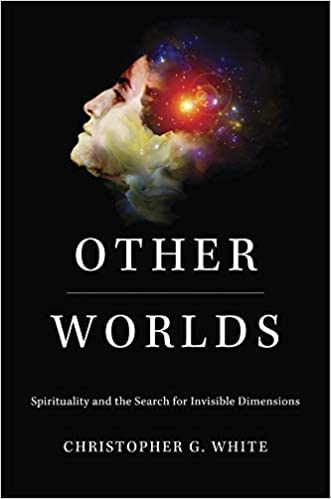
In Other Worlds: Spirituality and the Search for Invisible Dimensions Christopher G. White explores the history and imaginative power of the idea that the universe has higher, invisible dimensions. To accomplish his goal, White assembles an unusual cast of characters: visionary mathematicians, fantasy writers like George MacDonald and C. S. Lewis, mystical physicists, spirit channelers, television producers, hippie scientists, New Age prophets, social reformers, indefatigable parapsychologists, and artists like Max Weber (3). White argues that the diversity of this group is dictated by the desire to make a larger point about science and religion, which are often seen as implacable enemies. He posits that scientific and religious ideas come braided together and influence each other to a degree that has gone unnoticed, and he strives to address it (13). 

White treats the idea of the invisible dimensions historically and structures his book accordingly. He begins with the mid-nineteenth century mathematical discoveries of the idea of the fourth dimension and moves through the evolution of the idea across various disciplines until the modern day. This historical approach to the subject makes the structure of the book easy to navigate, especially as chapters are also thematically focused on areas of interest. For example, chapter one is focused on Edwin Abbott’s life and career, with special attention paid to Flatland (1884), a text that has become a classic for scholars of science fiction, students of mathematics, and spiritual seekers alike. Chapter two discusses the turbulent career and private life of Charles Howard Hinton, the inventor of the four-dimensional cube called “tesseract.” The ideas fleshed out in these two chapters are fundamental to the rest of the book, because White traces and refers to them consistently in every chapter that follows. Abbott’s allegory of the world existing only on a two-dimensional plane and Hinton’s conceptualisation of the “tesseract” serve as two points of reference throughout the history of invisible dimensions. These points create a referential springboard which White applies to move seamlessly between chapters, from one discipline to another, one time period to another. The example of the transition between chapter four and five illustrates it well. White devotes chapter four to a detailed analysis of the life and work of an architect Claude Bragdon, a man described by his contemporaries as fully as great an architect as Frank Lloyd Wright but lacking Wright’s talent for self-promotion (108). Bragdon incorporated higher-dimensional philosophy in architecture by designing hypercubes and other objects into otherworldly ornamentation. By showing the links between Abbott’s and Hinton’s ideas and Bragdon’s work in the early twentieth century, White sets up a transition to chapter five, in which the same ideas are highlighted throughout the art of the period. In chapter five the main area of interest is the evolution of impressionism into cubism and the life and work of Russian-born American painter Max Weber. The philosophy of invisible dimensions is a consistent lens through which White shows the last two centuries to his readers.    

My only criticism of Other Worlds is that in his analysis of many famous literary works, such as C. S. Lewis’s Chronicles of Narnia (1950-1956) and Madeleine L’Engle’s A Wrinkle in Time (1962), White rarely engages with the abundant literary scholarship produced on the works so far, but rather focuses on the bibliographies and philosophical views of the authors. In this, however, White remains true to his analytical lens of invisible dimensions. When discussing genre literature, White also remains true to his speciality. As a professor of religion, he is interested in how the mythopoeic nature of genre literature influences belief. He argues that “the lesson of modern Christian fantasy and sci-fi is not just that belief takes practice but that objects of belief have to be made believable again for new generations” (228). 

Other Worlds is a generous hardback, as it offers over 300 pages of material, along with bibliographical notes, credits, and a useful index at the end, all of which enhance the reading experience. It is a valuable resource for those interested in the intersection of science and religion. Scholars and students, fans and creators, specialists in science fiction, fantasy, popular culture and art will be able to find something of interest in this volume. Its historical structure offers the story of invisible dimensions and encourages the reader to treat the book as one would treat a work of fiction. However, the chapters are so diverse and holistic in their internal structure that they can easily stand up to selective reading. I can imagine chapters from this book being used selectively as reading material for a variety of teaching modules. A science fiction scholar might, in the words of L’Engle, “tesser with joy” through a selection of short stories analysed by White (242), such as Algernon Blackwood’s “Victim of Higher Space” (1914), Robert Heinlein’s “And He Built a Crooked House” (1941), William McGivern’s “Doorway of Vanishing Men” (1941), and Mark Clifton’s “Star, Bright” (1952), to name only a few. Other Worlds achieves its goal of delineating how the scientific idea of a higher dimension has spread across popular culture. More importantly, in an impressive feat of scholarship spanning across several disciplines, White manages to revise the conventional way of writing about the modern “conflict between science and religion” by showing how scientific insights were used sometimes not to attack spiritual beliefs but to buttress them in unexpected ways (3).

Review of None of This Is Normal: The Fiction of Jeff VanderMeer


Review of None of This Is Normal: The Fiction of Jeff VanderMeer

Thomas Connolly

Benjamin Robertson. None of This Is Normal: The Fiction of Jeff VanderMeer. Minneapolis, MN: University of Minnesota Press, 2018. Paperback, 208 pages, $19.95, ISBN 9781517902933.


Despite his long-standing critical and (following the publication of the Southern Reach trilogy) commercial success, scholarly attention to Jeff VanderMeer has so far been rather scant on the ground. None of This Is Normal comprises the first book-length study of VanderMeer’s weird fiction—Robertson notes in his introduction that, at the time of publication, there were only two other scholarly articles on VanderMeer’s fiction, both published in the same issue of Paradoxa.

This relative paucity of scholarly publications on VanderMeer is surprising: anyone who has attended a recent conference on a theme related to SF or fantasy will be aware of the popularity of, and evident critical consideration given to, VanderMeer’s fiction. (Indeed, Robertson acknowledges this unusual imbalance.) This attention forms part of a wider scholarly interest in the political, literary, and philosophical ramifications of the “new weird,” a literary genre which has proved to be both nebulous and subversive in its literary aims. Whereas the original weird, à la Lovecraft and M.R. James, sought to dramatize the insufficiency of human reason in the face of an indifferent and incomprehensible universe, the new weird, according to Robertson, stresses not indifference but abdifference, the rejection of difference altogether as a viable category for grappling with the challenges of the Anthropocene.

Such is the political impetus of Robertson’s work, which comprises both a study of VanderMeer’s fiction and an impassioned call for new modes of thinking that move beyond the humanist tenets of liberalism, environmentalism, and representationalist literary criticism. The political urgency behind Robertson’s work is evident from the first page of the introduction, in which Robertson paints a grim picture of the spiralling political chaos—Brexit, Trump, the resurgence of right-wing xenophobic nationalism—of recent years. “None of this,” Robertson remarks, borrowing a phrase from VanderMeer, “is normal” (2). Even liberalism, he later argues, is not free from the taint of humanist preconceptions, since such ideological worldviews are underpinned by the assumption that all differences can be collapsed into a fundamental sameness, an “inside opposed to an outside” (140). Such an inside, Robertson remarks, is defined by arbitrary borders that delimit nothing so much as the incapacity of the human mind to exist without such comforting constructs.

The political value of weird and new weird fiction, then, lies in its ability to think outside such delimiting conceptions. Such works demonstrate “the possibility of other norms” (2) that may move us beyond the humanist tenets of western thought. This is achieved, Robertson argues, through the creation of what he repeatedly calls “fantastic materialities” (10 etc.), a key concept underpinning the study. One of the most profound insights of Robertson’s work is also perhaps the simplest: that all texts, and all narratives, rely on materiality, which conditions all “patterns and modes of thought” (8). The question that VanderMeer poses in his fictions, according to Robertson, is likewise a relatively simple one: “How does this entanglement of materiality, subjectivity, situation and norms operate when the first term in this list is wholly other—when it is a separate or secondary materiality, a fantastic materiality?” (8).

Robertson’s study here owes an intellectual debt to the recent “materialist turn” in critical theory, and in particular to the notion of “cultural geology” developed by Mark McGurl. Cultural geology aims at “crack[ing] open the carapace of human self-concern, exposing it to the idea, and maybe even the fact, of its external ontological preconditions, its ground” (McGurl 380). This “ground” can be understood, quite literally, as the ground, the fact of human material dependence on a planet that does not obey human laws. As Robertson puts it in a compelling passage, “[no] amount of power to declare borders will forestall the inert force of a nonliving geos” (142), and so there is an evident need to engage critically with the actually-existing fact of material conditions. This need informs the shape of Robertson’s study: following an initial chapter outlining these theoretical and material frameworks, each subsequent chapter examines one of VanderMeer’s fantastic materialities: the Veniss milieu, the Ambergris novels, and the Southern Reach trilogy. In each chapter, Robertson strives to demonstrate how VanderMeer’s works must be understood as offering “other norms” (2)—ways of thinking and being conditioned by materialities radically other to the familiar materialities of the world of author and reader.

Considering the Veniss stories, Robertson critically examines the concept of setting, and the manner in which this concept “makes meaning by drawing boundaries around heres and nows,” and thus reconstitutes space and time within the limited parameters of human meaning (56). The Veniss stories, in contrast, comprise not a setting but a “milieu,” an unbounded and discontinuous collection of spaces and times that do not cohere into a recognisable whole. For Robertson, this milieu invokes—without, importantly, allegorising—the experience of living in the Anthropocene, itself a material milieu that refuses to be collapsed down to human-centred frames of reference.

Regarding the Ambergris stories, Robertson turns to look at how the textuality of these novels, which deploy the self-referential techniques of postmodernist writing, invokes a materiality that such techniques often serve to deny or subvert. Robertson highlights how sections of City of Saints and Madmen, for example, require the reader to decode numerical sequences that refer to specific paragraphs and sentences earlier in the text. The textual meaning here depends on the physical materiality of the book itself—a “materiotextualisation” which, because it neither claims nor denies the possibility of representing the “real” world, avoids the pitfalls of both realist and postmodernist fiction (108). Ambergris is a secondary fantastic world whose material laws are created and conditioned by the very textuality of the Ambergris texts—impossibilities and contradictions occur in Ambergris, Robertson argues, precisely “because that can happen in books” (108). The novels thus confront the reader with a textuality not separate from, but fundamentally constitutive of, a fantastic materiality.

In the final section, Robertson turns to the Southern Reach trilogy, and to the question of borders mentioned above. The achievement of this trilogy, he argues, lies in its creation of a world without borders. Area X offers an example of a “weird planet,” a material geos whose relationship to humanity can never be known, since to know such a thing would require the very act of bordering (defining a limited time and space in which to examine causes and effects) that Area X resists. Area X is not indifferent to humanity, as are the “Great Old Ones” of older weird fiction, but abdifferent, that is, existing “outside” (to use an insufficient spatial metaphor) the limits of humanist thought demarcated by such notions as “same” and “different.” There is no “away” from Area X, Robertson argues, because it is already everywhere. To paraphrase Roger Luckhurst (quoted by Robertson), Area X does not “breach” the ordinary world—“It is (in) Breach” (114). The relevance of such fantastic materialities to the condition of humanity in the Anthropocene is clear: Area X is a “materiality ignorant of the rules by which humans measure themselves and their productions” (142).

Following a discussion of Borne in the conclusion, Robertson ends the volume with the following: “VanderMeer teaches us that even if the production of such fictions will not save us, they may show us the planet saving itself” (158). If this seems like a rather pessimistic note on which to end, it perhaps reflects a broader pessimism regarding the capacity for humanity to actually deal with the challenge of the Anthropocene—how does one confront a problem that transcends even the possibility of setting, or of bordering? This is not a question that Robertson answers, nor would it be fair to expect such an answer—the value of Robertson’s study is rather to be found in the manner in which it frames the issue. The “problem” of the Anthropocene, he notes in the conclusion, is only a problem within a humanist paradigm that recognises the relevance of such concepts as “problems” and “solutions.” It is likely that much of humanity (and Robertson is at pains to stress the particular vulnerability of certain human groups—and the culpability of others—in this regard) will very soon find themselves confronted with a much different paradigm, one that, like Area X, will remain ignorant of human attempts to understand or control it.

Robertson’s work provides us with a much-needed critical vocabulary for engaging with these and other challenges of the Anthropocene. For this reason, and for Robertson’s intelligent and thought-provoking readings of VanderMeer’s fiction, None of This Is Normal is required reading for those looking to better understand the new materialist paradigms with which we are—or are soon to be—confronted.


WORKS CITED

McGurl, Mark. “The New Cultural Geology.” Twentieth Century Literature, vol. 57, no. 3/4, Fall/Winter 2011, pp. 380-390.

Review of Posthuman Folklore


Review of Posthuman Folklore

Peter Cullen Bryan

Tok Thompson. Posthuman Folklore. University Press of Mississippi, 2019. Paperback. 214 pg. $30. ISBN 9781496825094.


Tok Thompson’s Posthuman Folklore endeavors to locate the future of folklore within the realms of speculative fiction and animal studies, offering an overview of paths forward for the discipline. The book is divided into two major sections: one focused on animal studies and one discussing the larger trends of folklore, with an eye towards how folklore studies might evolve to better engage with new media. Posthuman Folklore functions more as a broad review of the current literature than deeply-focused monograph, and should be broadly accessible to anyone with an interest in the future of the humanities. Thompson avoids getting lost in the weeds of scholarly debate, creating a text that offers a useful primer of the current field, as well as potential paths forward.

The first portion of Posthuman Folklore focuses on the application of animal studies to the question of artificial intelligence. Speculative fiction and folklore can help to bridge this divide, in Thompson’s estimation, and Thompson makes the case for the humanities within the larger discussion: “postcolonial science opens itself up to the inclusion of considerations of other schools of thought, other epistemologies, and offers possible avenues of thought out of the dead-end of anthropocentrism” (55). By locating concepts within Native American approaches to human-animal relationships, for instance, Thompson views the solution to the problem as being more open to alternative modes of thought. He uses animal studies as a framework for deconstructing Western thought on sexuality: “sharing sexuality between humans and other species seems to similarly engage this same taboo of troubling human-animal binary division” (70). Thompson posits that the arrival of non-human relationships is likely inevitable with advances in artificial intelligence, and developing a framework for how to handle this will soon be necessary, a framework that can be found (in part, at least) within animal studies.

The second section of Posthuman Folklore explores the role of folklore in a digital (and perhaps post-digital) culture. In Thompson’s argument, Western philosophy is ill-equipped to respond to the arrival of non-human (artificial) intelligences, contending that there are approaches in folklore and transnational perspectives: “given that we have long studied ways that cultures perceive and predict future events, folklorists should not shy away from taking on the new role of futurists, bringing our insights to predict, plan for, and shape the swiftly oncoming future” (118). In this respect, this echoes the fears of figures like Francis Fukuyama (Our Posthuman Future) but offers an optimistic counterpoint and locates a place for humanities in a future of science and technology. Thompson echoes as well Marshall McLuhan, stating, “the digital realm is not only a place for communication, but is also, and increasingly, a contributor to the communication that takes place” (146). Thompson positions the humanities as especially well-equipped to respond to the needs of present-day citizens, arguing that the tools developed for comprehending the history of human civilization are just as applicable to new technology as rural folkways.

There is a lot of value in Posthuman Folklore, both as an overview of the current state of affairs in animal studies and folklore, as well as a potential roadmap for future research in those fields. Thompson’s approach is often theoretical, more concerned with possible directions of future research than fully engaging with specific concepts, but that does also make this a more accessible text. He further makes the case for a more muscular humanities taking a more proactive approach with the broader public. Thompson poses questions for this approach, such as, “will culture’s everyday artistic communication be increasingly free, or increasingly owned?” (108). In this respect, Thompson emphasizes the role of folkloric approaches in discussions of copyright or animal rights, for instance, locating a useful framework for engaging not only with future issues, but also with those faced in the modern digital world. Thompson does not offer specific remedies to the problems of the moment (the humanities in itself is not the solution to the effects of globalization and cultural hegemony), instead positing folklore as a piece of the solution that belongs within the deeper public conversation. Thompson concludes with a keen point about generational shifts: “[Alexa] is putting kids to bed with bedtime stories.  Children very often believe she is a real person […] we are increasingly raising our children as natively cyborg” (151). There is an inevitability to this conversation: technology will continue to evolve just as surely as its users will. Better engagement with folkloric traditions and approaches (particular non-Western traditions) allow for the more flexible thinking required for this historic moment, and Thompson presents an entry point to a conversation that will continue beyond the foreseeable future.

Review of Publishing the Science Fiction Canon: The Case of Scientific Romance 


Review of Publishing the Science Fiction Canon: The Case of Scientific Romance

James Allard

Adam Roberts. Publishing the Science Fiction Canon: The Case of Scientific Romance. Cambridge Elements: Elements in Publishing and Book Culture Series, edited by Samantha Rayner and Rebecca Lyons. Cambridge University Press, 2018. Paperback, 82 pages, ISBN 9781108708890.


Adam Roberts delivers exactly what his title promises: he uses the genre of scientific romance to explore canon formation in general and the development of the SF canon in particular, claiming that this “one iteration of SF’s protean variety, known to critics as the ‘scientific romance’, is as much an artefact of a shift in the underlying logic of commercial publication at the very end of the nineteenth century and beginning of the twentieth, as it is anything else” (8). His core claim is deceptively straightforward: “the material conditions of production of what is called ‘scientific romance’ determined key aspects of the form going forward, and therefore shaped important aspects of contemporary SF” (1). Roberts explores those conditions, from major changes in the production of texts to equally momentous changes in the contexts in which those texts were consumed, linking those conditions to the emergence and cultural impact of scientific romance, and then, ultimately, connecting that impact to the shape and scope of later SF, from the pulps to film. The result is a lucid, engaging, and provocative study of a crucial moment in the history of popular culture that manifestly, but never defensively, demonstrates the value of greater critical attention to the texts and contexts of popular cultures.

Roberts is at his best when interrogating the material conditions of canon formation. SF provides an important point of access to any consideration of canonicity: he notes that in “the case of science fiction there are distinct levels by which specifically SF texts fit into this larger critical narrative,” since “SF has developed its own canon, both in the top-down university syllabus sense [. . .] and in the bottom-up sense of an active and engaged fandom” (12). At the same time, the historical moment when scientific romance was dominant—“after the older dominance of circulating libraries had become obsolete but before the newer commercial restrictions of the Net Book Agreement had come into force” (8), or “the last two decades of the nineteenth century and the first two of the twentieth” (14)—sees a collision of emerging modernism and its aesthetic, philosophical, and political concerns together with shifts in print culture and the business of publishing:

It is from the 1880s, and especially the 1890s, that we can date the expansion of SF, its shift from being a niche form of cultural production, with small print runs, limited readerships and a marginal place in publishing, through a rapid commercial expansion based around cheaper books, and (especially) magazines—“Pulps”—into cinema and TV and, finally, to our present state of affairs, in which SF and Fantasy, especially in “Young Adult” (YA) writing and superhero modes, has a greater cultural penetration, and flat outsell other forms of cultural production. The period under consideration here, in other words, figures as a hinge point in the larger narratives of genre.

2-3

But more than locating the conditions that led to the emergence of a canon, Roberts stresses that this “state of affairs is not a coincidence” and “that the form of this type of SF actually directly expresses that underlying cultural-economic substrate,” that “this window, shaped by a set of particular exigencies to do with the manufacture and sale of fiction, generated the ‘scientific romance’ as we now understand it” (8).

Roberts points to two key factors that had the most profound effects on the creation and circulation of scientific romance, and thus on the SF canon more broadly: first, substantial changes in publishing that saw the marketplace flooded with cheap texts of all sorts, displacing the circulating library as the primary source for reading material, and, second, the advent of easy rail travel. In terms of the former, Roberts demonstrates that a “combination of reduction in unit costs, greatly increased literacy in the general population, and relaxation of government controls produced a boom in publishing that in turn fed a new literary culture in which [. . .] some SF writers enjoyed success on a scale that launched the genre as a popular cultural mode” (29-30). But it’s with the latter point that Roberts’s book is most likely to make its most significant impact, and where it may provoke controversy, as he seems well aware. He notes that more than just “facilitating [. . .] movement,” “railways were machines that generated new tranches of leisure” (37)—including, of course, leisure reading. But the real key is in recognizing how “iterations of the age-old science-fictional fascination with exploration” (43) that dominate scientific romance—from often luxurious “Verneian voyages extraordinaires” (43) to the Wellsian tendency that “keeps his protagonist in one place and moves the world around him, or makes the exotic commute into the protagonist’s world” (43)—“become increasingly figured [. . .] in terms of the sorts of convenience and comfort a commuter might expect” (43) from rail travel at the turn of the twentieth century. Roberts is, however, careful to state that “This is not to argue for a facile mapping of rail travel onto space travel, but it is to suggest that the determining logic of a new reading public, a public often literally in motion, and carried by the most advanced technology of the day, tended to revert back upon the material context out of which it was being disseminated” (39). Thus, if the railway both symbolizes and incarnates a new kind of mobility, demonstrating that “social mobility is not only about physical travel [. . .] [but also] about access to resources” (51), then scientific romance, in both form and content, as a set of generic conventions and a point of access into something bigger than itself, made it clear that “cultural resources” (51), like those supplied by the simple act of reading what many others were also reading, were as vital to survival as anything else.

Readers looking for a sustained treatment of the influences, themes, and politics of scientific romance may not find as much to chew on here as they might like—though those things are certainly discussed and in interesting and generative ways. But readers looking for a nuanced exploration of canons and canonization, especially the vexed relationship between ‘high’ and ‘low’ art, ‘literary’ and ‘genre’ fiction, ‘academic’ and ‘popular’ cultures, will find this book immensely rewarding. It makes bigger claims than we might expect from a slim volume of just over eighty pages (standard, of course, for the Elements series), but it also has the potential to make a much bigger impact than we might expect from a slim book, maybe especially one on some aspect of SF, and deserves serious attention from a great many readers, and not just those interested in early SF.

Review of Nevala-Lee’s Astounding: John W. Campbell, Isaac Asimov, Robert A. Heinlein, L. Ron Hubbard, and the Golden Age of Science Fiction


Review of Astounding: John W. Campbell, Isaac Asimov, Robert A. Heinlein, L. Ron Hubbard, and the Golden Age of Science Fiction by Alec Nevala-Lee

Andy Duncan

Alec Nevala-Lee. Astounding: John W. Campbell, Isaac Asimov, Robert A. Heinlein, L. Ron Hubbard, and the Golden Age of Science Fiction. Dey St., 2018. Hardcover. 544 pp. $28.99. ISBN 9780062571946.


In his first non-fiction book, novelist and longtime Analog contributor Alec Nevala-Lee tackles a daunting topic: a braided biography of the affinity group of science fiction writers that once centered on John W. Campbell Jr., the longtime Astounding/Analog editor who for a decade shaped a field that subsequently arrayed itself largely in opposition to him. 

One must admire the feat of distillation this book represents. Nevala-Lee appends 83 pages of notes and an eight-page, 94-item secondary bibliography, but he also seems well acquainted with all the works of his notoriously prolific subjects, and the complete contents of 30-plus years of Campbell’s monthly magazines. In shaping this prodigious mass of material, Nevala-Lee’s storytelling skills serve him well. Throughout, he maintains firm control of his multiple narratives, and his pacing never flags.

Nevala-Lee acknowledges that he is “particularly indebted” (415) to Asimov’s three volumes of memoirs, to William H. Patterson’s two-volume Heinlein biography, and to Russell Miller’s Bare-Faced Messiah: The True Story of L. Ron Hubbard (1987). But the Asimov and Patterson books are forbidding tomes of layered minutiae that dissatisfy in different ways (Asimov by blithely ignoring the difficult material, Patterson by forcing his protean subject into a manageable libertarian box), while Miller’s bracing muckrake has been legally unavailable in the United States for decades thanks to Scientologist litigation. (If you’re content with a PDF, the robust anti-Church of Scientology web can fix you up.) Nevala-Lee’s judicious and clear-eyed sampling of these predecessors is thus something of a public service.

Every page of Astounding is engaging and thought-provoking, and even those familiar with the era will make discoveries here. Especially intriguing are Nevala-Lee’s character sketches of the women who eventually broke free of their husbands’ concentric macho orbits, one way or another; Dona Campbell, Leslyn Heinlein, and Sara Hubbard deserve a collective biography of their own. 

Many of Nevala-Lee’s most compelling passages involve John Campbell, a confounding and ultimately tragic figure who understandably has eluded biographers until now. Nevala-Lee details Campbell’s unhappy adolescence and complex family life; the development of his lonely conviction that science fiction was somehow central to the 20th-century American enterprise; his ability to attract disciples and repel them in equal measure; and the racist attitudes that poisoned much of his later thinking.

Above all, Nevala-Lee explores Campbell’s genuinely “astonishing” capacity for self-invention, which often was indistinguishable from self-deception. That he infamously was given to identifying himself, without evidence, as a nuclear physicist pales beside some of Campbell’s grander claims, for example that he once pinned the hapless Asimov to a chair through sheer hypnotic will power, or that his biofeedback control of his own cell structures meant he could never die. Fans of Mary Roach’s and John Grant’s books on pseudoscience and fringe science will find much to appreciate here.

Nevala-Lee’s most poignant chapter details the grief-stricken Campbell’s characteristic reaction to his stepson Joe Kearney’s fatal 1955 car accident on the Pennsylvania Turnpike: a vow to solve the problem of “the relationship between the present human mental mechanism and the operation of high-energy, high-performance, extreme-endurance machines” (314). Nothing came of it, other than everything: “Joe’s death was too painful for him to abandon it entirely,” Nevala-Lee writes. “The answer, he decided, was psionics, which would serve as a source of objective data on the brain. . . . It was a turning point in the history of the genre, and although Joe was never mentioned again, he provided its unspoken motivation, haunting it to the end like a ghost” (315-316).

Nevala-Lee’s final hundred pages, though they climax with the science-fictional triumph of Apollo 11, comprise a long dying fall, as his principals go their separate ways from the 1950s onward. Heinlein turned to “slick” magazines, YA fiction, and eventual cult status in both the Haight and the Pentagon; Asimov embraced popular science and gained household fame as a go-to expert on all subjects; and Hubbard steadily faded from view behind the impenetrable cloud layers of the church he founded. Moreover, all of them largely kept their distance from their onetime mentor, until Campbell’s death in 1971 triggered a spasmodic wave of nostalgia in the field for all that he once signified. He should have lived to participate in the tacky yet touching 1972 ocean cruise promoted as the Voyage Beyond Apollo, described in Nevala-Lee’s epilogue. I’m sure no participant ever quite forgot that voyage, much as they may have tried.

Nevala-Lee has a good story to tell, and he tells it well, but what is its larger meaning—other than perhaps to underscore the late Thomas Disch’s argument, in The Dreams Our Stuff Is Made Of (1998), that the history of science fiction is inextricably tied to cranks, charlatans, and hoaxers? On the last page of his back-of-the-book Acknowledgments, Nevala-Lee writes, “My greatest hope is that this book will inspire a larger conversation about the history of science fiction” (411). One could argue that the conversation is already under way, and that Campbell and company are not terribly relevant to it. Three recent brilliant pop-culture biographies—Julie Phillips on Alice Sheldon a.k.a. James Tiptree Jr., Ruth Franklin on Shirley Jackson, and Jill Lapore on Wonder Woman—make their eccentric 20th-century subjects seem quite timely, inspiring to a new generation of creators, and relevant far beyond genre borders. Can such a brief be made today even for Asimov and Heinlein, much less Campbell and Hubbard?

Packed with rich, weird details and told with a storyteller’s brio, Astounding is a welcome account of the field’s pulp origins. As I enjoy and admire it, I can’t help but wonder whether it hasn’t been published a generation too late.