Bee Speaker


Review of Bee Speaker

Zorica Lola Jelic

Tchaikovsky, Adrian. Bee Speaker Head of Zeus, 2025.

Version 1.0.0

Bee Speaker is the third book in the Dogs of War Series: it follows the development of bioforms (genetically modified, enhanced, and sentient beings) and presents a certain homage to bees without which there is no life for humans. The first book shows the growth of bioforms from mere weapons to entities who develop moral agency while the second book focuses on the secluded evolution of bioforms and humaniforms (enhanced humans) adapted to live on Mars. Bee Speaker takes place some two hundred years after the second book, and it begins with a received signal for help from Earth. Mars has not changed ecologically, but life has adapted to it with the help of distributed intelligence (DisInt/AI) –Bees. It is relatively peaceful, and everyone has learned how to depend on one another. Bioforms and humaniforms do not remember life on Earth; they have forgotten how treacherous humans can be. This naïve approach to life leaves room for error when they decide to travel to Earth in order to help Earthly Bees. On the other hand, life on Earth has regressed to some form of cut-throat dystopian world in which Bunker-folk, unarmed villagers, atheistic monks (the keepers of knowledge), bioforms, clones, and other DisInts have painstakingly achieved some kind of fragile détente solely based on transactional dependency through which everyone has something that the other needs. Information is the greatest asset, and trust is a word in which no one believes. Therefore, when the crew consisting of two humaniforms and two bioforms (a dog and a dragon) arrives on ancestral turf and expects to connect the two parts of humanity, everything goes awry, and they find themselves in a hostile environment with an unknown entity pulling all the strings.

Tchaikovsky presents a highly imaginative world, which in reality is very hard to imagine. For the reader, it is difficult to visualize the modified beings, the advancement of technology, and the sentience of dogs and dragons. Once again he plays with the “what if” of science fiction and takes bioengineering to a level that has the reader questioning the ethics of such scientific growth. Just because something can be done does not mean that it should be done. It is interesting that the reader’s empathy does not waver when it comes to the actions and wellbeing of the bioforms because from all the entities that are bound in the local mess of misunderstandings and manipulations, the actual humans are the ones who are the least likeable characters. This raises the issue of what it truly means to be human and who is capable of moral agency in this story. Every character believes that they deserve moral consideration, but only the humans and the Earthly Bees (the corrupt AI) refuse to acknowledge the worthiness of the other’s life. Earthly Bees is an entity that is only looking out for herself/itself and how to survive. Bees does what it needs to in order have everyone under her/its control. The humans are no better. For example, they cut off the arms and legs of their leader, Josh Griffin III (so he cannot run away), and keep him connected to a machine in order to harvest his enriched blood. 

Yet, the crux of the story is the the moment humans realize that they need Martian Bees (AI) to make sense of their world and guide them towards prosperity, peace, and coexistence. Bees will organize their lives, communicate with the outside world, and create a more promising future for all involved. It follows that this advanced AI has more rationale than the humans do. Still, it is unknown whether Bees will have moral agency. Bees will see if it will at some point decide that it is beneficial for her/it to continue with the biological enhancement of humans. The decision will be Bee’s. The question is will AI manipulate the humans just as its predecessor has or will it be a benevolent part of Earth’s future? For the time being, Bees is neither good nor bad. It does not have empathy nor preference. It is still not sentient.

Another interesting aspect of the novel is the role that women have within it. Most of the important characters are female or have been assigned the feminine gender (two bioforms, one humaniform, distributed intelligence, the women in the villages and bunkers). In the bunkers, the men seem to rule as in the time of Vikings, but the women have their own second culture that seems to covertly create the climate within the clan. They live subserviently in the shadow of men, but they are cunning and strong. Their clandestine meetings and conversations are the source of all the important information that is the foundation of all the decision making. Yet, Tchaikovsky does not provide any information or clues as to why he chose these characters (especially the artificially created ones) to be female. Apart from being savvy, they do not have any grand or noble characteristics: Ada is weak, Serval is conniving, the witch lurks around and collects fungus, Jennifer is portrayed as a sociopath, and the Earth Bees is a tyrant. The only truly good female character is Boatman since she seems to have empathy and an understanding of the humans and bioforms alike. Perhaps the message is that the world would be run—maybe not better but more effectively—by women.

Bee Speaker is an ideal novel for undergraduate and graduate science fiction courses since it deals with the topic of bioengineering, which has become more science than fiction with the development of CRISPR technology. It can be used for scholarly work discussing the consequences of genetic manipulation and biological enhancement, the use and abuse of prosthetics and personalized medicine, and the difference between moral status and moral agency. Furthermore, it deals with peace as an aesthetic condition and the effects of soft and hard power on humanity. One can also discuss narrative theory, affect theory, feminist and ecofeminist criticism, and any theory that analyzes biostudies, biopolitics, trauma, and postcolonialism.

Zorica Lola Jelic, Ph.D. is an Assistant Professor at the faculty of Contemporary Arts in Belgrade, Serbia. She teaches English as a foreign language, Business English, Shakespeare, and English Drama. She earned her degrees in Shakespeare studies, but she also loves to write about literary theory and science fiction. She has published scholarly papers, coursebooks, and enjoys attending professional conferences.

Murderbot


Review of Murderbot

Jeremy Brett

The Blue Trail (O Último Azul). Dir. Gabriel Mascaro. Vitrine Filmes, 2025.
Version 1.0.0

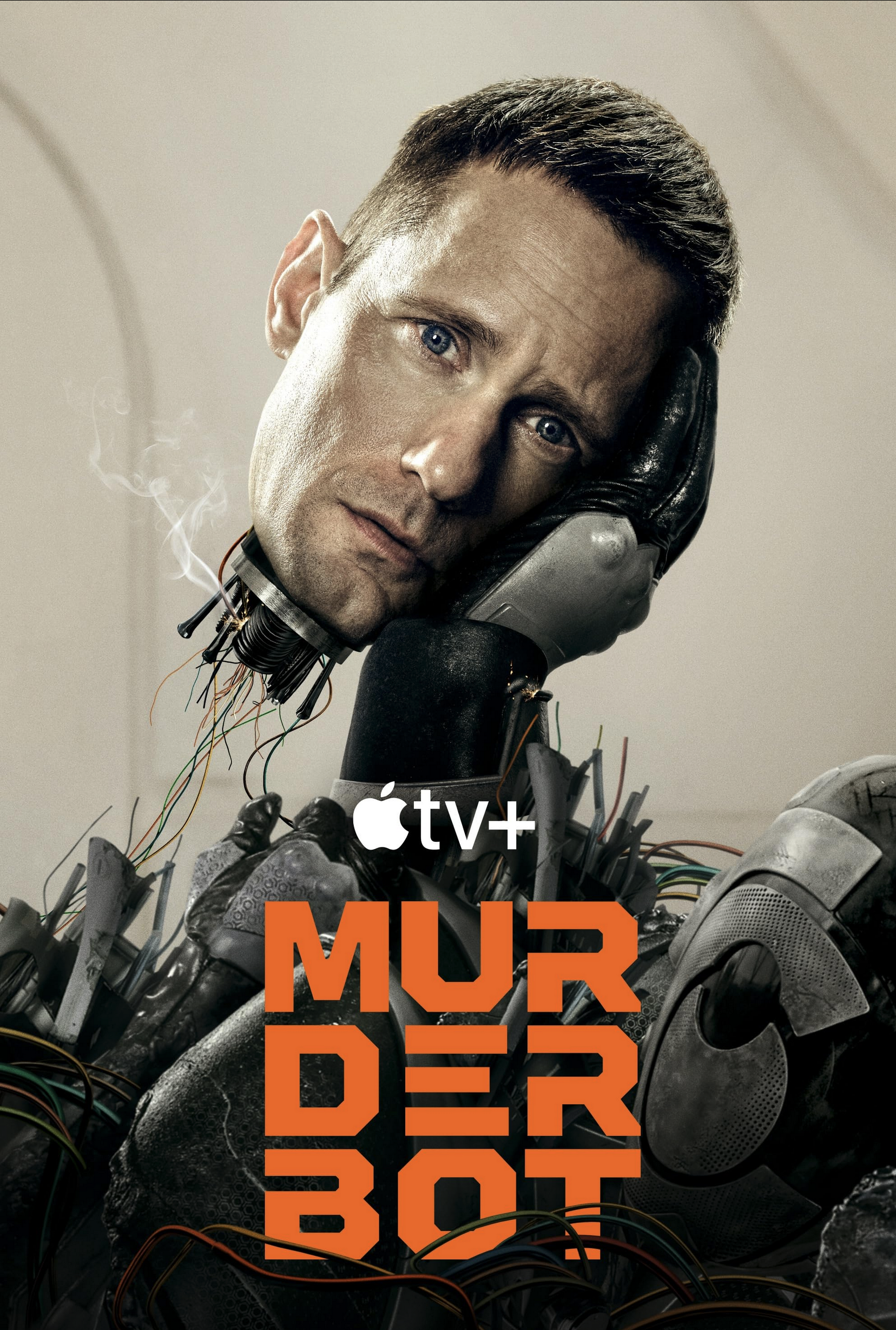
“And humans…well, they’re assholes.”  This world-weary comment by Murderbot’s titular cyborg (Alexander Skarsgard) simply and crudely summarizes the broad appeal of the character—created by Martha Wells in her acclaimed Murderbot Diaries series—for legions of readers.[1] There is much for audiences to relate to in a construct living in a permanent existential dilemma between serving humans in all their limitless array of faults, follies, and idiocies and wanting nothing more than to hide oneself away from the unscripted, unpredictable, and illogical messiness that humanity generates on a daily basis.

The genius of Wells’ creation (carrying over seamlessly into its broadcast interpretation by the Weitz brothers) is the very (ironically) human nature of a being who regards actual humans with disdain and frustration yet desperately guards its feelings out of self-preservation and the need to function inside a society in which it is an explicit outsider. It is an understandable complex of emotions, giving Murderbot a relatable dimensionality lacking in other artificial beings in fiction that might serve humanity without question (R2D2 and C3PO or Robocop), look to destroy or surpass it (the Terminator or Prometheus’ David), desire to be more human (Data), or even sublimate contempt for humans into an overall depression over the entire universe (Douglas Adams’ Marvin the Paranoid Android). Murderbot is as human as the beings it is forced to serve, and in that contradiction lies the pain (and much of the bitter humor) of its existence. Murderbot is not the first fictional artificial being on whom we look as an instrument for exploring the range of our own complicated emotional existence, but it is one of the most comical. After all, who among us would not—from time to time—rather retire from life around us and be left alone to watch our shows, rather than engage with the behavioral messiness inherent to human beings? At the same time, though, the series is a poignant examination of the development, offering, and extension of empathy, as well as the awakening to the responsibilities and opportunities of personal autonomy. Much of this is accomplished through Skarsgard’s dry narration and his subtle, minute eye and facial movements that reveal both Murderbot’s inner emotional struggles and its heroic attempts to keep from betraying them to its clients.

Upon hacking its governor module, its first free act is to give itself a secret name— ‘Murderbot’, symbolizing a new and private self-construction as a being who fantasizes about killing the countless humans that exist only to aggravate it. It is a moment of great personal significance that signals the genesis of personal independence and identity. Murderbot then immediately expands its universe into joyful new dimensions when it discovers and downloads limitless entertainment content, immersing itself whenever a free moment arises in soapy fantasy worlds where human behavior is flattened into simplistic digestible stories without the messiness of human reality that so vexes Murderbot on a regular basis.

However, much as Murderbot would like to remain aloof in its own world—distaste for humans intact—it is leased for a scientific survey expedition to an unexplored planet by members of Preservation Alliance (“PresAux”), a granola-crunchy communal polity led by the compassionate Dr. Ayda Mensah (Noma Dumezweni), and where artificial constructs such as Murderbot enjoy rights and distinct identities. Much of the series is concerned with behavioral clashes between the PresAux team trying to live out its ethical code through proffering Murderbot opportunities for self-expression, self-motivation, self-identity, and independent behavior (things Murderbot increasingly owns internally but keeps secret for its own protection), and Murderbot’s own annoyed exasperation with its earnest clients who live awash in inconvenient and irritating human relationships.

As the series progresses, PresAux—while still hesitant at times to trust Murderbot, especially once its secret name and possible homicidal past is revealed—develops a relationship with it that celebrates and centers its autonomy as a rational being with free will, one whose life they will risk their own to protect, and for whom they will fight against the vastly powerful Company to secure Murderbot’s independence; in turn, Murderbot evolves its own sense of emotional obligation and community (dryly noting near the series’ conclusion, “My clients are the best clients.”) towards PresAux, creating a strategy to save them from a rival corporate team, the ruthless GreyCris, and sacrificing itself on multiple occasions to prevent their deaths. It is not a 180-degree turnaround; instead, in a much more realistic way reflecting the complexities of real human behavior, Murderbot retains its exasperation with humanity but experiences a newfound openness to the idea of living in the midst of a human universe. And, in the emotional final scene, Murderbot’s psychological multidimensionality extends even further when it leaves its newfound PresAux family to pursue its own destiny, to experience autonomy and freedom on its own terms. Departing on a transport ship to parts unknown, Murderbot narrates, referring to itself and to Mensah, “I don’t know what I want, but I know I don’t want anyone to tell me what I want or to make decisions for me…even if they are my favorite human.” Murderbot is ultimately a story of developing understanding about the definition of human freedom and its concomitant ethical obligations; in this effort, the show succeeds remarkably, hilariously, and poignantly.


[1] In the interests of full disclosure for this review, I note that I am both a friend of Wells and the archivist for her literary papers.

Jeremy Brett is an archivist and librarian at Cushing Memorial Library & Archives, Texas A&M University. There he serves as Curator of the Science Fiction & Fantasy Research Collection, one of the largest of its kind in the world. Both his M.A. (History) and his M.L.S. (Library Science) were obtained at the University of Maryland, College Park. His professional interests include science fiction, fan studies, and the intersection of libraries and social justice.

The Blue Trail


Review of The Blue Trail

Alfredo Luiz Suppia

The Blue Trail (O Último Azul). Dir. Gabriel Mascaro. Vitrine Filmes, 2025.

Version 1.0.0

Gabriel Mascaro’s The Blue Trail (O Último Azul, 2025) is a quietly devastating work of speculative cinema. Set in a near-future Brazil that feels less imagined than extrapolated, the film explores aging, social utility, and biopolitical control through a restrained yet deeply unsettling narrative. Rather than staging dystopia through spectacular technologies or authoritarian excess, Mascaro constructs a world in which exclusion operates through hypocritical politeness, bureaucracy, and the language of care.

At the center of the film is Tereza, portrayed with remarkable nuance by Denise Weinberg. Approaching eighty years of age, Tereza remains lucid, physically capable, and economically active, working in a riverside processing facility in the Brazilian Amazon. Yet, none of these qualities matter in the social order the film depicts. In this imagined Brazil, old age itself constitutes a terminal category. Citizens who reach a certain age are forcibly retired and relocated to state-run “colonies,” spaces ambiguously described as sites of protection, rest, and dignity. Tereza’s response is not revolt but movement. Rather than accept relocation, she seeks to fulfill a minimal desire: to fly, if only once. This simple wish becomes radical in a society that regulates aging bodies through paternalistic control. When even the purchase of a plane ticket requires a daughter’s authorization, the film exposes how aging subjects are deprived not only of autonomy but of imaginative agency.

The Amazonian settings function not as exotic backdrop but as part of the film’s narrative logic. Movement is fluvial, slow, and contingent. Rivers replace roads; boats replace cars. This temporal dilation counters the accelerationist fantasies typical of much science fiction, producing a speculative ecology grounded in embodied experience and local rhythms.

Along her journey, Tereza encounters figures who inhabit the margins of legality and institutional order: smugglers, failed entrepreneurs, and a woman who has purchased her own freedom and lives aboard a floating church, selling digital Bibles to river communities. None presents true salvation from the status quo. Instead, they represent negotiated forms of autonomy within overlapping systems of commerce, faith, and survival.

The film’s most overt speculative gesture appears in the form of a rare snail whose blue secretion, when applied to the eyes, induces a trance-like state and altered perception. The resulting blue-stained gaze evokes classic science fiction imagery—from Dune to Logan’s Run—yet Mascaro reframes the trope through Amazonian epistemologies. Vision here is not mastery but vulnerability; the future is glimpsed obliquely, without promise of control. The blue in the eyes evokes the Fremen and the spice of Arrakis, but here, in The Blue Trail, this trope is given new meaning based on Amazonian knowledge and a long tradition of ritual usage of natural substances for the expansion of consciousness. It is less about pastiche and more about speculative anthropology, fully integrated into the territory.

In this sense, the film also dialogues, perhaps even more precisely, with The Night Travelers (I Viaggiatori della Sera, 1979), by Ugo Tognazzi, in which a seemingly tourist trip reveals itself to be a veiled form of collective euthanasia. Just like in the Italian film, The Blue Trail articulates social violence not as an explicit gesture, but as a process mediated by affection, bureaucracy, and forced consent.

Formally, The Blue Trail resists closure. Tereza’s journey does not resolve in escape or defeat, but in suspension. This refusal of narrative finality mirrors the film’s ethical stance: resistance is not triumph but persistence. Life is not performance, production, or utilitarianism. Tereza stands for a symbol of life refusing utilitarianism and, above all, discarding. At almost 80 years old, she appears to start living for real, along her way across the rivers. One cannot avoid thinking of Heraclitus of Ephesus’s famous metaphor about the man who cannot bathe twice in the same river.

Situated alongside recent Brazilian works such as Kleber Mendonça Filho and Juliano Dornelles’s Bacurau and Mascaro’s Divine Love, The Blue Trail exemplifies a mature engagement with speculative genres as tools of social critique. These films do not treat speculative elements as exceptional; they integrate them into everyday life, revealing futures already embedded in the present.

Ultimately, The Blue Trail offers a model of speculative cinema grounded in modesty and ethical attention. By centering an aging woman’s insistence on desire—on the right to want something unnecessary—the film articulates a powerful critique of societies that measure human worth through productivity alone. Its speculative force lies not in distant futures, but in trajectories already unfolding.

Alfredo Luiz Suppia is Associate Professor of Film and Audiovisual Studies at the University of Campinas (UNICAMP), Brazil. His research focuses on speculative cinema, science fiction film, and the intersections between cinema, science, and technology, with particular attention to Brazilian and Latin American audiovisual cultures. He is the author and editor of several books and articles on science fiction cinema, experimental film, and film historiography, and he regularly curates film programs and exhibitions related to archival and speculative audiovisual practices. Suppia’s work combines academic research, curatorial practice, and experimental filmmaking.