The Modern High Fantasy Novel was Born in France: An Essay on Reverse Literary History


The Modern High Fantasy Novel was Born in France: An Essay on Reverse Literary History 

Mariano Martín Rodríguez
Independent scholar and co-editor of journal Hélice


Bibliographies, encyclopaedias and literary research by both fans and scholars are increasingly revealing the international wealth of science fiction’s past and present. In contrast, the other great branch of speculative fiction, fantasy, has still a long way to go in this respect. Andrzej Sapkowski’s “Witcher” series is virtually, and exceptionally, the only international fantasy works well known in English. This contention could seem far-fetched if we consider that Gabriel García Márquez’s magical realist works, as well Italo Calvino’s post-modern fancies are widely read and praised world-wide, and that Michael Ende’s The Neverending Story (Die unendliche Geschichte, 1983) has previously taken the world by storm. The European “fantastique,” from E. T. A. Hoffmann to the French “Décadents,” not to mention Franz Kafka’s symbolic parables, enjoys high critical consideration. My contention stands, however, if we consider how fantasy, and high fantasy in particular, can be defined. This task of defining is not an idle one even from the historical perspective here adopted. Without exactly knowing what we are talking about, namely the high fantasy novel and its origin in French literature, any contention about this matter would probably lack a solid scientific foundation. A prior specific theoretical description of high fantasy seems, therefore, necessary to escape the vagueness that affects all too often academic approaches to this kind of fiction. 

Whereas science fiction is, despite its range of definitions, a clear literary entity, the English word ‘fantasy’ is so all-encompassing that it has virtually lost any taxonomic value. Putting Edgar Allan Poe and J.R.R. Tolkien under the same heading because both use the supernatural amounts to a complete disregard of the specific nature of fantasy, and namely of high fantasy. Faster than light travel is as supernatural as ghosts appearing to the living. Narrative omniscience in the realistic novel looks like a godlike, supernatural power as well. On the other hand, fantasy, especially high fantasy, is a literary species with distinctive fictional features that can be inferred from even a superficial reading of its classics. High fantasy is about the realistically consistent building of a fictional secondary world fully independent from the mundane one (past, present, or rationally anticipated). Whether it is specifically named or not, high fantasy hardly stands intrusions from our world without losing its ontologically autonomous status, if we are to follow the definition of ‘secondary world,’ as it appears in this genre, proposed by Waggoner: “A fantasy world is a secondary reality whose metaphysical premises are different from those of the real world” (4). Using a more precise narratological language, Trębicki contends that fantasy follows:

a strategy aimed at the creation of a secondary world model with its own precisely described spatial and temporal parameters, its own social and ontological order, and its own causality, unusual from the point of view of mimetic reality but perfectly coherent and logical within the fictional universe. 

2014: 488

Therefore, I would exclude from high fantasy those works in which modern characters intervene in the secondary world, thus depriving it of the illusion of completeness in its own legendary, far-away setting in place and time, as well as distracting readers from a fully immersive experience. C. S. Lewis’ Narnia is a wide and sophisticated secondary world but the children’s access through a cupboard during World War II implies that it coexists with modernity, instead of remaining impervious to it as it would be the case in the true exercises of sub-creation in the Tolkienian sense. Portal fantasies (Conkan, 2017) such as Lewis’ (and Ende’s), to which one could add the weird awakening of alien gods in modernity in H. P. Lovecraft’s horror stories, are enjoyable in their own right but they cannot be considered genuine high fantasy. 

High fantasy eschews implausible contacts between ontologically different kinds of fictional worlds (the mundane and the fantastic) in order to offer the complete result of a speculative process of world building akin to that of science fiction (since it is rationally created on the basis of a particular set of premises). These appear to be scientific in science fiction, as its name implies. They are rather mythical in high fantasy, thus warranting the presence of supernatural beings, magical powers and extraordinary occurrences in the framework of a plausible pagan and pre-technological society.1 In this kind of imaginary society godlike forces intervene, or are believed to intervene, in human affairs in the same way as they do in the true mythological lore that modern archaeological, philological, and ethnological research have revealed to us using rational methods from the Enlightenment Age onwards. However, unlike mythological and legendary fiction based on existing matter (Greek mythology, Arthurian legends, Arabian Nights, etc.), as well as fairy tales, where narratives follow traditional and stereotyped settings and motives usually borrowed from folklore, high fantasy is ‘created.’ Its worlds are essentially personal artistic inventions by a particular author, although fantasy writers often find inspiration in existing mythologies as well as in ancient history for their creations. As Braga notes, “la littérature fantasy actuelle … est une pseudo-morphose, modelée par l’esprit positiviste et réaliste, par la sensibilité et le goût contemporain, de la littérature magique et féerique traditionnelle” [current fantasy literature … is a pseudo-morphosis, shaped by the positivist and realist spirit, by contemporary sensibility and taste, of the traditional magical and fairy-tale literature (my translation)] (2018: 44).

High fantasy writers, however, treat features borrowed from the ancient lore yet revealed by the modern human sciences as mere elements in their free world building, the consistency of which is internal, and which need not to be externally consistent with previous mythological, ethnographical or historical knowledge. For example, while Robert H. Howard uses names and peoples from the true ancient history of our planet, his work does not constitute archaeological fiction, because his history is invented, as his fictional historiographical account of the Hyborian age shows. Lord Dunsany was probably inspired by Japanese mythology but his mythology of Pegāna was his own. 

These features are common to all high fantasy worlds now considered canonical in the Anglosphere, such as Lord Dunsany’s Pegāna, Robert H. Howard’s Hyboria, Clark Ashton Smith’s Zothique, Tolkien’s Middle-earth, Fritz Leiber’s Nehwon, Fletcher Pratt’s Dalarna, L. Sprague de Camp’s Novaria, Ursula K. Le Guin’s Earthsea, Samuel Delany’s Nevèrÿon, Terry Pratchett’s Discworld and George R. R. Martin’s Westeros. A similar mythopoetic imagination already appears active in William Blake’s narrative poems where his personal mythology is, rather confusedly, presented to the world as an alternative to Christianity. Regarding prose narratives, John Sterling’s short story “The Sons of Iron” (included as an independent narrative in the novel Arthur Coningsby, 1833) explores the customs and history of an ancient race of men made of iron with a sober speculative tone similar to that adopted by later fantasists such as Giovanni Papini and Jorge Luis Borges in their imaginary ethnographies. 

Actually, the first high fantasy novels are believed to have appeared relatively late in the 19th century. If we do not consider the portal fantasies and fairy tale novels by Lewis Carroll and George MacDonald, as we should not do if the above descriptive definition of high fantasy stands, the high fantasy novel is to be found fully in Laurence Housman’s “Gods and Their Makers,” published in a collection of the same title in 1897. This appears as the first significant landmark2 in a long tradition of high fantasy novel that blossomed in Britain in the interwar period alongside with works such as Lord Dunsany’s The King of Elfland’s Daughter (1924), Margaret Irwin’s These Mortals (1925), Norman Douglas’ In the Beginning (1927) and Tolkien’s The Hobbit (1937). Together with the high fantasy stories written by Clark Ashton Smith and Robert H. Howard, and published during the same period in the US pulps, these narratives helped to elevate high fantasy to an inescapable feature of the contemporary literary landscape. It is easy to see that high fantasy novels not written in English are conspicuously absent from this list of early acknowledged classics, in the same way as they are hardly to be found in most surveys of fantasy, either in English (for example, Barron, 1990; Mendlesohn and James, 2009; Wolfe, 2011; Moran, 2019) or in other languages (Pech, 1990; Pato, 2019). Why is this so? Do other literatures lack writers who have created their proper speculative fantasy worlds long before Tolkien’s success and his countless global imitators? How is it possible that French, Italian, Spanish, German and Russian scientific romances have already been translated into English and taken into account in histories of world science fiction at this time, but no early continental high fantasy novels seem to exist according to present knowledge on the matter? 

In literary history, as in archaeology, one can hardly find anything without looking for it where others have not, for instance in French Literature. Since high fantasy scholars are rarer than science fiction ones even in the Anglosphere, let alone in other cultural areas of the world, it is a small wonder that some of the few hints of the existence of early, pre-Tolkienian high fantasy novel in French has been revealed at all by Brian Stableford, a writer, researcher and translator whose main field of work is science fiction. However, he has also translated other kinds of speculative works. For instance, two novels translated by him, André Lichtenberger’s The Centaurs (Les Centaures, 1904) and Han Ryner’s The Superhumans (Les Surhommes, 1929), are perhaps better understood as high fantasies. The latter is a rhetorically sophisticated work3 of its prospective brand, consisting of fantasies set in a future that looks like a mythic past, including the presence of supernatural entities and the absence of modern technology and science. Following its rediscovery in France thanks to Stableford’s English translation, the former has tentatively been considered there as the first French high fantasy novel.4 

Stableford has also translated shorter narratives by Remy de Gourmont, Gabriel de Lautrec, Bernard Lazare, Camille Mauclair, Victor-Émile Michelet, Éphraïm Mikhaël and other French Belle Époque authors. Most of these authors wrote in the so-called purple prose typical of Symbolism. French purple prose was widely imitated by British and American high fantasists from the Aesthetic Movement such as Lord Dunsany, Kenneth Morris and Clark Ashton Smith, and its influence can still be seen in Tolkien’s style. Rhetorically at least, modern(ist) high fantasy owes much to French Décadence. This style encompasses the high fantasy tales by those writers, as well as by Marcel Schwob and Remy de Gourmont, just to mention the ones whose work has acquired some canonical status in French literature. Now their contribution to the high fantasy short story should certainly be re-appraised, but it is also to be acknowledged that no high fantasy French novels written in this period or earlier other than Lichtenberger’s The Centaurs seemed to exist, except maybe for a short one by Mauclair entitled Le Poison des pierreries (1903), later collected in his collection L’Amour tragique (Tragic Love, 1908). This is indeed a beautifully decadent and weird high fantasy that was translated by Stableford in 2016 as The Poison of Precious Stones.

French high fantasy novel would seem then to have appeared later than, for example, Housman’s “Gods and Their Makers” (1897) if it were not for a famous mother and her less renowned son. They were Aurore Dupin (1804-1876) and Jean-François Maurice Arnauld (1823-1899), better known as George Sand and Maurice Sand, respectively. The latter inaugurated modern fantasy novels about Atlantis with Le Coq aux cheveux d’or (The Golden-Haired Rooster, 1867 in book form). Although it is set in the mythical ancient city-empire described by Plato, complete with its end by the gods’ wrath, Maurice Sand’s novel reads as a Howardian sword and sorcery story, with its barbarian protagonist, the blond ‘rooster,’ endowed with virtually supernatural strength and panache negotiating his way among the intrigues and decadence of ancient sedentary kingdoms. This hero rescues his romantic interest from her scheming father the king, as well as from her religious and marital duties as high priestess and wife of the volcano god worshipped in Atlantis. He even saves her from the eruption and the deluge that destroy the mythical world of Atlanteans, Scythians and other ancient peoples. These coexist in that legendary place and time without regard for archaeological findings, but according to the artistically controlled freedom of high fantasy. Maurice Sand’s style, with his short sentences and narrative conciseness and dynamism combined with colourful descriptions capable of generating the desired atmosphere of decadence, looks exactly like that of Howard’s Hyborian stories. Having arrived a century too early, Maurice Sand’s novel unfortunately went virtually unnoticed.5 Its existence is thus rather an anecdote in the history of (high) fantasy.

By contrast, George Sand’s Évenor et Leucippe (Évenor and Leucippe, 1856), afterwards re-titled Les amours de l’âge d’or: Évenor et Leucippe (Loves of the Golden Age: Évenor and Leucippe, 1861), is arguably the first high fantasy novel, at least the first subject to some academic attention6 and re-issued. Its author achieved fame as a writer throughout the Western world. Although this particular work did not enjoy the popularity of her novels of manners, and it was not translated into English, it was known in Anglophone intellectual circles, where French was widely read. This “Légende antédiluvienne” (‘antediluvian legend’) was anonymously commented upon, for example, in April 1862 in The North American Review. The unknown reviewer mentions its models, namely the Biblical account of the fall and the Platonic Atlantis myth, but only as the basis for a fully new mythology created by Sand about the origins of humanity, love and civilization. Both the Hebrew single god and the panoply of Greek deities are absent from the narrative, which tells the life as well as the emotional and philosophical growth of Évenor, a human child living in a balanced primitive society. The seeds of selfishness and evil already exist among humans, however, and the little protagonist is happy to find, after getting lost in the forest, a secluded, paradisiacal valley where he decides to stay. He meets there another child, Leucippe, who is being raised by Téleïa, the last of the ‘dives,’ a species of beings “half humane, half divine, – rather at once divine and human, having the heavenly soul and knowledge, with an earthly body and needs,” according to the American reviewer of the novel (558). The ‘dive’ (name adapted from ‘diva,’ the Latin and Italian word for ‘goddess’) teaches them morality and true love as the main inheritance from her race to this couple of children, then teenagers and married couple, so that they can deliver it to the successor sentient race, the humans. They fail, however, in their mission. Evil has already grown deep roots in human society. Évenor, Leucippe and their followers are forced to escape from their tribe. Only the dive’s supernatural intervention finally saves them from their pursuers, allowing them to return to their paradise in the valley, called Éden. This parts them from their fellow humans and therefore from the course of human history. Their fate is lost in the mist of myth and legend. Despite the echoes of their names and place in later traditions, namely the aforementioned Biblical and Platonic ones, their internally consistent world is a closed one, having nothing to do either with sacred or secular history. 

Évenor et Leucippe is not a fictional reconstruction of prehistory as it could have been but rather a symbolic narrative intended to convey, for a grown-up readership, an ethical and philosophical meaning through mythopoesis. The fictional world created there by George Sand fulfils all the requirements of high fantasy. It has “its own precisely described spatial and temporal parameters, its own social and ontological order” (Trębicki, 2014: 488) with its own beliefs and customs, which are all realistically shown. Its characters are individualised, and are radically different from those typified in fairy tales,7 as it is its plot, where the folktale motifs inherited by the literary fairy tale are also absent or, at least, they do not define the structure of the novel. Moreover, it has further features usual in later high fantasy literature, such as the presence, as well as the agency, of a supernatural category of beings independent from any previous lore and mythology, the ‘dives.’ Even Sand’s use of expressive invented anthroponyms (Le Guillou, 2013), similar to the ones typical of high fantasy is witness to her pioneering high fantastical approach. Nothing of this sort existed in the European and American novel at that time, at least as far as we know given the current state of research and translations, and there would be virtually nothing similar until the Symbolist/Decadent experiments in creative mythography and ethnography a few decades later. Therefore, unless further comparative research proves it wrong, there are solid grounds to maintain that the modern high fantasy novel to have been born, indeed, in France. It would can be claimed that two women, Mary Shelley and George Sand, invented in the Romantic age, most likely without knowing it, the science fiction and the high fantasy novel, respectively. Shelley has been given her due credit for it. Sand awaits hers.


NOTES

1 Trębicki has proposed a further definition of high fantasy that takes into account the pre-modern technological level of its secondary worlds. Actual supernatural agency is taken for granted in them following a posited pre-modern and pre-scientific world-view: “The basic structure of SWF [secondary world fantasy] is … placing the plot in a world whose technological level is rather low and spatial parameters closed, and which is presented as a reality not connected with the mimetic universe either spatially of temporally” (2011: 45).

2 Histories dealing with high fantasy usually mention the late romances by William Morris published in the 1890s as pioneering works. Christian institutions and real place names (for example, Rome) appear in these romances, which have a quest structures borrowed from medieval chivalric narratives. These features trouble their high fantasy status, since Morris’ fictional worlds would not be then full-fledged secondary subcreations in the Tolkienian sense here adopted (Tolkien, 2001). Moreover, they often lack an easily recognizable usual landmark of high fantasy, namely what Lin Carter called ‘neocognomica:’ “In creating an imaginary world with words, the author is thrust into the role of Adam. Everything must be named” (1973: 192-193). What kind of secondary worlds can be the ones in Morris’ chivalric romances when their characters are named Ralph or Arthur?

3 In my essay on this work which accompanies its contemporary edition, I describe it as follows: “Les Surhommes semble être un « monstre narratif », où le roman doit cohabiter avec d’autres genres, comme la poésie (en prose) dans ses manifestations tant sapientielles qu’épiques, ou l’historiographie, faisant fi de l’illusoire psychologie des personnages, collectifs par ailleurs, et des exigences d’une action conventionnelle” (2016: 125). My translation: “The Superhumans appears to be a ‘narrative monster,’ where the novel must cohabit with other genres, such as (prose) poetry in its sapiential as well as epic variants, or historiography, ignoring the illusory psychology of the characters, which are collective for that matter, as well as the demands of conventional action.”

4 In the preface to its contemporary edition, Fraysse contends that it could be considered to be the “« premier roman de fantasy français »” (‘first French high fantasy novel’) but with a possible caveat: “mais rêvons plutôt qu’il existe de nombreux textes antérieurs dignes d’endosser ce rôle” (2017: xiii). My translation: “but let us rather dream that there are many earlier texts deserving this consideration.” These earlier French high fantasy novels are precisely the matter of the present essay.

5 The most detailed review of this novel was written by his mother (Sand, 1867). In contemporary times, only a book devoted to Maurice Sand briefly comments on it (Bissonnette, 2017: 228-235, 331, 380-381). There is no contemporary edition of this significant work.

6 It is to be noted that none of the recent academic studies on this novel that I have been able to read (Gillet, 1977; Le Guillou, 2012, 2013, 2016; Mathias, 2018) clearly mentions its high fantasy features. French academic study of this kind fiction is still in its early infancy, though (Bougon, 2019).

7 Matthew David Surridge argued in a blog entry from 2010 (https://www.blackgate.com/2010/09/19/worlds-within-worlds-the-first-heroic-fantasy-part-iv/) that Sara Coleridge created in her novel Phantasmion (1837) the first fantasy secondary world. However, this novel’s subtitle, “A Fairy Tale,” is very clear regarding the particular kind of fiction it belongs to. Although the fairy tale is an important predecessor of high fantasy, their secondary worlds are different, even in the many instances, before and after Coleridge, where fairy tale worlds are fully independent from our mundane one. In high fantasy characters are individuals whereas those of the fairy tale are “occupational labels” (Waggoner, 23). Moreover, in the fairy tale magic and supernatural occurrences are taken for granted; in high fantasy they “must be realistically established” (22) following the posited rules of the (sub)created world. Following Tolkien, Nikolaya states that “genuine and skilful fantasy creates Secondary Belief (unlike the Primary Belief of myth or religion), putting the reader in a temporary state of enchantment. As soon as suspension of disbelief is disturbed, the spell is broken” (153) whereas “the addressee of a fairy tale knows that the story is not true” (153). Furthermore, the intrusion in fairy tales of elements from the phenomenological world also disturbs the suspension of disbelief or secondary belief. On the other hand, high fantasy stories “take place in a closed, self-contained Secondary World without any connection with reality. However, unlike fairy tales, they are definitely based on Secondary Belief” (154). Last but not least, ‘fairy-land’ “is a space where things happen, not a place of itself” (Hunt, 12) as Sand’s Éden is.


BIO

Dr. Mariano Martín Rodríguez is a translator and independent scholar based in Brussels (Belgium). He obtained his Ph.D in Philology at the Universidad Complutense (Madrid) in 1994. Since then, he has published numerous studies in different languages related to modern drama, scientific romance, and utopian, speculative (including high fantasy and theological fiction) and science fiction, in Spain and in Europe, as well as several critical editions of translations from different Romance languages and English into Spanish. He has also published several critical editions of Spanish works of utopian, fantastic, speculative and science fiction. He is currently co-editor of the online journal on speculative fiction Hélice (www.revistahelice.com).


WORKS CITED

Anon. “Évenor et Leucippe. Les Amours de l’Âge d’Or. Légende Antédiluvienne. Par George Sand. Paris: N. Lévy Frères. 1861.” The North American Review 94.195 (1862): 557-559.

Barron, Neil (ed.). Fantasy Literature: A Reader’s Guide. New York (NY) and London: Garland Publishing, 1990.

Bissonnette, Lise. Maurice Sand : Une œuvre et son brisant au xixe siècle. Rennes: Presses Universitaires de Rennes, 2017.

Bougon, Marie Lucie. “Cosmogonie de la fantasy française : Genèse et émancipation.” Revue de la BNF 59.2 (2019): 38-47.

Braga, Corin. “La littérature « fantasy ».” Pour une morphologie du genre utopique. Paris: Classiques Garnier, 2018. 39-44.

Carter, Lin. “A Local Habitation and a Name: Some Observations on Neocognomica.” Imaginary Worlds: The Art of Fantasy. New York (NY): Ballantine Books, 1973. 192-212.

Conkan, Marius. Portalul şi lumile secundare: Tipologii ale spaţiului în literatura fantasy. Bucureşti: Tracus Arte, 2017.

Fraysse, Thierry. “Le conteur homérique.” André Lichtenberger. Les Centaures. Paris: Callidor, 2017. vi-xiv.

Gillet, Jean. “Les Amours de l’âge d’or : l’Éden tourmenté de George Sand.” Romantisme 16 (1977): 46-55.

Hunt, Peter. “Fantasy and Alternative Worlds.” Eds. Peter Hunt and Millicent Lenz. Alternative Worlds in Fantasy Fiction. London and New York (NY): Continuum, 2003. 1-41.

Le Guillou, Claire. “Les Amours de l’âge d’or, une œuvre de la marginalité.” Eds. Pascale Auraix-Jonchière, Simone Bertrand-Grifftiths and Marie Cécile Levet. La Marginalité dans l’œuvre de Goerge Sand. Clermont-Ferrand: Presses Universitaires Blaise Pascal, 2012. 434-355.

Le Guillou, Claire. “De l’usage des anthroponymes dans Évenor et Leucippe, Les Amours de l’âge d’or; Légende antédiluvienne de George Sand.” Nouvelle Revue d’Onomastique 55 (2013): 259-268.

Le Guillou, Claire. “Présentation.” George Sand, Œuvres complètes. 1856. Évenor et Leucippe. Paris: Honoré Campion, 2016. 7-24.

Lichtenberger, André. “The Centaurs.” The Centaurs, adaptation and translation by Brian Stableford. Encino (CA): Black Coat Press, 2013. 13-187.

Martín Rodríguez, Mariano. “Foissonnement fictionnel et richesse de discours: Les Surhommes de Han Ryner.” Han Ryner, Les Surhommes. Saint-Martin de Bonfossé: Théolib, 2016. 119-135.

Mathias, Manon. “Pre-Darwinian Species Change: Reincarnation and Transformism in George Sand’s Évenor et Leucippe.” Journal of Literature and Science 11.1 (2018): 33-49. http://eprints.gla.ac.uk/148958/1/148958.pdf 

Mauclair, Camille. “The Poison of Precious Stones.” The Virgin Orient, adaptation and translation by Brian Stableford. Encino (CA): Black Coat Press, 2016. 349-389.

Mendlesohn, Farah, and Edward James. A Short Story of Fantasy. London: Middlesex University Press, 2009.

Moran, Patrick. The Canons of Fantasy Lands of High Adventure. Cambridge: Cambridge University Press, 2019.

Nikolayeva, Maria. “Fantasy Literature and Fairy Tales.” The Oxford Companion to Fairy Tales: The Western Fairy Tale Tradition from Medieval to Modern, edited by Jack Zipes. Oxford: Oxford University Press, 2002. 150-154.

Pato, Silvia. Breve historia de la fantasía. Madrid: Nowtilus, 2019.

Pesch, Helmut W. Fantasy: Theorie und Geschichte einer literarischen Gattung. Passau: Erster Deutsche Fantasy Club, 1990.

Ryner, Han. “The Superhumans.” The Superhumans, adaptation and translation by Brian Stableford. Encino (CA): Black Coat Press, 2011. 181-288.

Sand, George. Évenor et Leucippe. Paris: Garnier Frères, 1856.

Sand, George. “Essais et notices: Le coq aux cheveux d’or, récit des temps fabuleux, par Maurice Sand.” Revue des Deux Mondes 67.4 (1867): 1010-1022.

Sand, Maurice. Le Coq aux cheveux d’or : Récit des temps fabuleux. Paris: A. Lacroix, Verboeckhoven et Cie, 1867.

Tolkien, J. R. R. “On Fairy Stories.” Tree and Leaf. London: HarperCollins, 2001. 1-81.

Trębicki, Grzegorz. “Mythic Elements in Secondary World Fantasy and Exomimetic Literature.” Mityczne scenariusze. Od mitu do fikcji, od fikcji do mitu, edited by Tomasz Ratajczak and Bogdan Trocha. Zielona Góra: Oficyna Wydawnicza Uniwersytetu Zielonogórskiego, 2011. 41-52.

Trębicki, Grzegorz. “Supragenological Types of Fiction versus Contemporary Non-Mimetic Literature.” Science Fiction Studies 41.3 (2014): 481-501.

Waggoner, Diana. “Theory of Fantasy.” The Hills of Faraway: A Guide to Fantasy. New York (NY): Atheneum, 1978. 3-27. 

Wolfe, Gary K. “Fantasy from Dryden to Dunsany.” Eds. Edward James and Farah Mendlesohn. The Cambridge Companion to Fantasy Literature. Cambridge: Cambridge University Press, 2011. 7-20.

From the Vice President


SFRA Review, vol. 50, no. 4

From the SFRA Executive Committee


From the Vice President

Sonja Fritzsche
Michigan State University


The SFRA Support a New Scholar Grant deadline has just closed on November 15, 2020 for the graduate student competition. For those interested in the non-tenure track scholar competition look for that call in the early fall of 2021. Since we weren’t able to host a conference, the Student Paper Award has been suspended for this year. But graduate students who present at our conference in summer 2021 – make sure to submit your paper for consideration for this award in in response to the e-mail call that will go out in fall 2021.

We are excited to be discussing plans for an all virtual conference 2021 hosted by Graham Murphy and Seneca College in Toronto. Dates will be announced soon so keep a look out! This will no doubt be one of our most international conferences yet due to the virtual format.

The SFRA Country Representatives have met twice now since the beginning of the fall and are busy sharing information, ideas, and expanding the global network of scholars working on science fiction. We are still looking for representatives as many countries have yet to be represented so don’t be shy and please e-mail me if you are interest (fritzsc9@msu.edu). The current rep list is: http://www.sfra.org/Country-Reps. The job description is as follows:

A SFRA Country Representative facilitates academic communication on science fiction for their specific country to SFRA members, and also passes on SFRA news/events to their own colleagues in country.  Such activities include taking flyers to conferences, posting on SFRA social media (Facebook, Twitter, or Listserve) about conferences, symposia, publishing opportunties, etc. The SFRA News will include a column that will be written by country representatives on rotation. Must be a member of the SFRA.

Look for the information that these country representatives will be sharing so that you can become aware of opportunities near you or on the other side of the globe. The virtual spaces that we occupy now make this type of sharing possible in ways that we could only have imagined just 6 months ago. Our next meeting is in early January 2021. Country representatives will also be writing a contribution for the SFRA Review so look for this new addition to find out a more detailed account of work going on in a particular country. Also don’t forget to pass on information to me if you want me to post an event or cfp for you on Facebook and Twitter. I’m always open to other suggestions and ideas as to how we can help to promote the work of our colleagues in the SFRA.

Namárië (From the Editor)


Namárië

Sean Guynes
Editor, SFRA Review


As the Fellowship departed Lothlórien, Galadriel recited a poem, a song of longing for the home she cannot return to. That poem is “Namárië,” the longest text in The Lord of the Rings written in Tolkien’s Elvish language Quenya. The title comes from a shortening of the Quenya phrase á na márië, or “be well,” a common Elvish greeting and farewell. I invoke it here, now, as farewell to you and the SFRA Review, just as I invoked Klingon in greeting nearly three years ago. Namárië, friends.

Over the past few years, since my first issue in the summer of 2018, things have changed quite a lot—in our geopolitical lives, in my personal life, and here at SFRA Review. New editors have come on and old editors have left. The Review changed format, leveled-up in terms of professional visibility, to look like a real journal: and damn straight, it’s been here for 50 years with scholars young and old contributing reviews, essays, and more. Why not treat it with the respect it deserves? If anything, the authors publishing here deserve to be contributing to a publication that takes itself seriously, I thought. And so I worked hard to professionalize the look of the journal and how things work behind the scenes. Moreover, we transitioned to a more secure digital home, bringing the journal to readers in a way that meets the basic standards of digital distribution for academic scholarship. No longer do Review articles linger in a PDF downloadable from an obscure SFRA webpage. Now, each article has a link, its own home on the web, and is fully text-searchable by search engines, optimizing the work our contributors have done for greater discoverability. Boring, time-consuming, subservient to neoliberal academia’s demands for digital presence? Yes, yes, yes, but necessary. Fight me or sue me, I’m right.

My editors have worked hard and now it’s time for me to move on. I have no doubt that the next editor (not yet chosen) will continue the work we’ve done, and then some. (I’ll be watching you, so don’t screw it up!)

Thanks for all your labor, editors, and for your words, contributors. And, if anyone reads this, thanks for doing so, but surely you’ve got something better to do! In the meantime, you can find me on Twitter (@saguynes) and at my website (www.seanguynes.com). Take care of yourselves, gentlefolk.

Be seeing you! / Namárië!

Sinofuturism and Chinese Science Fiction: An Introduction to the Alternative Sinofuturisms (中华未来主义) Special Issue


SFRA Review, vol. 50, no. 2-3

Special Issue: Alternative Sinofuturisms (中华未来主义)


Sinofuturism and Chinese Science Fiction: An Introduction to the Alternative Sinofuturisms (中华未来主义) Special Issue

Virginia L. Conn
Rutgers University / USA


As a mode of global and temporal situatedness, Sinofuturism has largely emerged as a concept applied externally to China by Western observers. By compartmentalizing sociocultural development as a form uniquely tied to the nation-state while also seeking to maintain both distance and otherness, Sinofuturism differs from theorizations such as Afrofuturism (to which it is often compared) through its application to, not development from, the subjects it takes as object. As a result, the very label of “Sinofuturism” developed out of the same Orientalizing impulses that previously relegated China to a space of backwardness and barbarism (Niu, Huang, Roh 2015) and which now attribute to it a projected futurity. Yet this Western label is one that Chinese authors and artists have appropriated and weaponized for their own creative ends, without necessarily sharing unified goals.

Authors of science fiction in China have uniquely grappled with this impulse, especially insofar as digital technologies—such as the growing e-publishing industry and networked media platforms—allow for the proliferation of new voices historically barred from traditional publishing venues. (Xu 2015) Too, contemporary science fiction in China functions as a transnational form that centers a technoscientific process or material object as a means of introducing social change, rendering the aim of science fiction inherently future-oriented even when relying on the past or focused on the present. Because potential future ontologies are expected to be relevant to present extrapolations, they fundamentally rely, to some degree, not only on realistic depictions of possible technologies and circumstantial realism, but also the familiar perceptions of the extant material and digital worlds—a central tenet of Sinofuturism’s omnivorous inclusion of technology, labor, art, and the visions it makes possible. (Lek 2016)

The globalizing effect of the internet and the subsequent rise in wide-scale digital exchange, in particular, has created a space for production in which Chinese authors are writing for an increasingly global audience and shifting their goals correspondingly. As early as the beginning of the 20th century, authors and public reformers in China (such as Liang Qichao, who, in his 1902 unfinished novel The Future of New China, described a utopian 1962 in which China was the dominant global power) were envisioning Sinofutures in which China was preeminent on the world stage. The idea of China as a dominant force in the world yet-to-come continues through much Chinese science fiction today, from standout international sensations such as The Three-Body Problem to anonymously published digital short stories like “Olympic Dream.” For science fiction authors describing the Chinese future (or the future as Chinese), an awareness of the fact that American and Western media largely paints China as a place of repression and censorship is an integral part of the worlds they depict.

To the extent that this is true, publishing regulations in China mean that the internet and other digital forms of publications, such as video games and online message boards, have become increasingly important outlets for science fiction. The Three-Body Problem, for example, was serialized first in the online-only Science Fiction World before being published as a book, and Western publication outlets like Clarkesworld have partnered with China-based Storycom to publish more Chinese science fiction in translation online. Because of the expectation of a global audience that online publication ensures, science fiction is changing as readership expands, yet the balance of global power remains uneven. Noted science fiction authors such as Xia Jia still describe science fiction coming out of China as having the mission of educating Western readers (Xia 2016), while English translators are increasingly burdened with the necessity of explaining historiocultural specificities through lengthy footnotes. (Liu 2014) That is, just as the West applies the term “Sinofuturism” to an entire national development project, Chinese authors are put in the position of responding and catering to Western assumptions in order to be legible on a global scale.

Here is where the specificity of China as a technologicized imaginary, located outside of both space and time, results in a an Orientalizing impulse fundamentally different from the fetishization of a high-tech Japan seen prominently in cyberpunk and the gleamingly sexualized noir adoration of the 80s. Shaped by and reliant on Western projections of Asia as the techne through which to shape a future defined by and created for the West, Sinofuturism not only projects China as a temporal locus for the project of modernity (Niu 2008), but also posits Chinese individuals themselves as resources, not originary producers of cultural or technological capital. Reduced by the West to faceless algorithmic data points, Chinese laborers and producers are commodified in an ideologically reproductive system informed by the racial panic of outsourcing common in the early nineties with the rise of overseas data centers. (Atanasoki and Vora 2015) Chinese science fiction writers are well aware of this and increasingly find themselves in a position to either push back against it or grapple with those fears in order to appear legible to an international readership.

Some authors do this by writing directly to the negative visions of a Chinese future most commonly held by the West: Chen Qiufan’s The Waste Tide, for example, deals with the physical detritus left behind by the dreams of digital development and the environmental devastation created when those developments are made obsolete and discarded, while Ma Boyong’s “City of Silence” shows both digital message boards and spoken language as subject to the same censorship as physical media, giving lie to the aspirations of online communications as a state of expressive exceptionalism. Other Chinese content producers actively embody the digitizing impulse that seeks to turn human beings into images for consumption: Naomi Wu (Shenzhen’s “sexy cyborg”), for example, has created a 3D scan of her body and uploaded it for the purpose of 3D printing models. These models are marketed alongside 3D models of Major Motoko Kusanagi from the Japanese anime Ghost in the Shell—an explicit juxtaposition of two stylized bodies (one real, one fictional) that, in their respective worlds, represent the future through a conscientious abandonment of the biological for the constructed.

So what, then, does it mean for Chinese science fiction to attempt to depict a Sinofuturist vision in the increasingly globalized space made possible by digital technologies? And what does it mean to produce content within a framework that imagines a techno-utopic future founded on artistic labor while simultaneously reproducing racialized tropes of dehumanization? How is material production changed by an increasing reliance on the digital? In the following essays, various researchers and theorists attempt to grapple with digital imaginaries, production, labor, and futurity across a wide range of topics multiply bound in Sinofuturist space.

The idea for this special issue developed out of a workshop organized by Dino Ge Zhang as part of the WuDaoKou Futurists collective, a collective aimed at decentering Sinofuturism from its Western articulations. The workshop, “Alternative Sinofuturisms,” already presupposes Sinofuturism as a venue for alterity and retains a space for various approaches and understandings of who and what is being foregrounded. Centralized in Beijing but held online with invited speakers from four different continents, the workshop was organized around a series of provocations, most of which are included in this issue. Amy Ireland articulated a view of darkside empathy that positioned Sinofuturist visions as methods of inculcating weaponized empathy, while Gabriele de Seta argued that Sinofuturism functions as a framework for denying the possibility of coevalness to China on the part of the West. I discussed Sinofuturism as an aestheticized projection that fixed images of the country in a perpetual futur antérieur; Vincent Garton, not included here, argued for a reappropriation of the term by Chinese theorists and politicians in order to reconstruct a new world system inclusive of heterogenous futures. The organizer, Dino Ge Zhang (without whom neither the original symposium nor this special issue would be possible), expanded on his concept of Sino-no-futurism to describe a world post-pandemic, which in many ways now reads as a science fictional dream for an American and British audience trapped in the perpetual now of our own countries’ ongoing pandemic-based immiserations.

The papers contained in this special issue respond to these various provocations and the overall concept of Sinofuturism from various angles. While some are supportive, seeing in Sinofuturism an opportunity for alternative epistemologies, others criticize its foreclosure of heterogenous elements and re-centering of global development vis-à-vis the West. What’s more, while Sinofuturism is an explicitly temporal projection, it is not necessarily a science fictional one except insofar as any futurist projection is a work of imagination—as a result, some of the essays contained here do not consider science fiction at all, while still engaging with the concept of how to situate the future on a global scale. By questioning who gets to imagine the future alongside who and what contributes to bringing those visions about, these essays incisively demonstrate that the material is never separate from the conceptual and the real-world consequences of imagining such alternatives.


WORKS CITED

Atanasoski, Neda and Kalindi Vora. “Surrogate Humanity: Posthuman Networks and the Racialized Obsolescence of Labor.” Catalyst: Feminism, Theory, Technoscience, vol. 1, no. 1, 2015, https://doi.org/10.28968/cftt.v1i1.28809.

Lek, Lawrence. “Sinofuturism (1839–2046 AD).” Center for Art and Media Karlsruhe, 2016, https://zkm.de/en/sinofuturism-1839-2046-ad.

Liu, Cixin. The Three-Body Problem. Translated by Ken Liu, Tor Books, 2014.

Niu, Greta Aiyu. “Techno-Orientalism, Nanotechnology, Posthumans, and Post-Posthumans in Neal Stephenson’s and Linda Nagata’s Science Fiction.” Melus: Multi-Ethnic Literature of the United States, vol. 33, no. 4, 2008, pp. 73-96.

Roh, David S., Betsy Huang, and Greta A. Niu, eds. Techno-Orientalism: Imagining Asia in Speculative Fiction, History, and Media. Rutgers University Press, 2015.

Xia Jia. “What Makes Chinese Science Fiction Chinese?” Invisible Planets: Contemporary Chinese Science Fiction in Translation, edited by Ken Liu, Tor, 2016.

Xu Jing. “’Golden Age’ Dawns for Chinese Web-Writers.” China Daily, 6 September 2015, http://www.chinadaily.com.cn/culture/2015-06/09/content_20951494_4.htm.

SFRA Innovative Research Award 2019


SFRA Innovative Research Award 2019

Susan Ang
Awardee


The SFRA Innovative Research Award (formerly the Pioneer Award) is given to the writer or writers of the best critical essay-length work of the year.

This year’s awardee is Susan Ang for her essay “Triangulating the Dyad: Seen (Orciny) Unseen,” Foundation, vol. 48, no. 132.

Raino Isto received an honorable mention for his essay “‘I Will Speak in Their Own Language’: Yugoslav Socialist Monuments and Science Fiction,” Extrapolation, vol. 60, no. 3.


Committee Statement

Joan Haran (chair), Stefan Rabitsch, Ben Robertson.

From an apparently simple starting point—the ampersand that joins the two cities in the title of China Miéville’s The City & the City—Susan Ang raises questions of profound complexity. These questions not only bear upon the novel in question but also the hidden histories of language and the fraught relationship between epistemology and ontology in weird fiction and the wider literary landscape. As Ang writes, “The City & The City, viewed through the metaphor of the ampersand, becomes readable as an enquiry into the epistemological workings of metaphor as a mechanism or model of productive thought.” As Ang makes clear, this sort of productivity characterizes The City & the City and much of Miéville’s fiction (including Kraken and Embassytown). More importantly, Ang’s essay continues the scholarly inquiry into the larger generic ramifications of Miéville’s work, in which the ampersand and related “meta-metaphors” both create and maintain, on one hand, and undermine and destroy, on the other, the boundaries among science fiction, fantasy, and other generic categories that subtend all such scholarly discussions. In Ang’s words, in both Miéville’s position as a writer and theorist of science fiction, fantasy, and the weird and Tyador Borlu’s position as a member of Breach at the conclusion of The City & the City, “there is an implied need to bide one’s time and maintain the boundaries in order that the boundaries might eventually be worn down.”

For her attention to a seemingly small, perhaps even insignificant detail of this novel and insofar as she demonstrates the importance of that detail to this novel as well as to the scholarly conversations that SFRA cultivates, Susan Ang is well-deserving of this award.


Awardee Statement

Susan Ang
National University of Singapore / Singapore

When I received the email from Gerry Canavan telling me I was the recipient of this year’s SFRA innovative research award, my first instinct was that I must be dreaming. That’s not quite the cliché it sounds like; the email came in about 3 or 4 am Singapore time and the “bing” from my ipad woke me up. I read it, didn’t take it in, and went back to sleep. When I woke up properly, I was sure I must have dreamt it, except that the email was actually in my inbox.

My surprise was mostly because while I quite like the article which the SFRA has so kindly and generously selected for the award, it has a modest history, starting out life as an undergraduate lecture on Mieville’s City & The City for a module on sf, which I then tidied and wondered what to do with. I should explain that I’m terrified of sending off work to journals, and that my work tends to go way over the word limit decreed by most journals which makes the matter all the more difficult. I looked at Foundation, which, if I recall, wanted work no longer than 6000 words; my article at that point weighed in at about 10,000. I apologetically (and somewhat dismally) emailed Paul March-Russell, asking whether he would even be willing to read it at that length, and was resigned to the prospect of being sent off with the proverbial flea in my ear. Paul, however, is the kindest and most generous editor I’ve ever met, and he said “send it on,” and to my surprise, took it, although not without chops and edits. 

My most grateful thanks, therefore, go first to Paul, for that generosity of spirit, and for all his editorial guidance. My thanks also to Gerry Canavan for that lovely shocked moment when I realized his kind email wasn’t a dream. I am also tremendously grateful to the judges—not for the award per se—but for the enormous investment of their time and care given to reading through a year’s worth of publications before somehow deciding on mine. I am immensely humbled to have been given this award—with so much being published in the field that is brilliant and incisive, I would never have expected to be in the running at all. This is not rhetoric but fact. I’m just secretly thrilled that people liked the piece. And last but not least, I’d like to thank my students—who inspired the lecture and responded to it; there are some students who spur one on to write lectures that hope not to disappoint, and those, too, whose rigorous arguments which run counter to sections of my own reading push one to find what one hopes will be satisfactory rebuttals. I’d therefore like to add my ex-students Lim Zhan Yi and Shawn Lim to the list of those without whom this article would not have seen the light of day.

In the current situation it seems hubristic to plan any kind of travel. But if COVID is under control, I hope to be able to offer my thanks for this award in person next year. Till then, please keep safe and well.

Mary Kay Bray Award 2019


Mary Kay Bray Award 2019

Erin Horáková and Rich Horton
Awardees


The Mary Kay Bray Award is given for the best essay, interview, or extended review to appear in the SFRA Review in a given year.

This year’s awardees are Erin Horáková and Rich Horton for their essays “Trekonomics” and “Gene Wolfe,” respectively, both from issue #327.


Committee Statement

Katherine Bishop (chair), Agnieszka Kotwasińska, Jessica FitzPatrick

The Mary Kay Bray Award is given to any interview, essay, or extended review published in the SFRA Review in 2019. We chose from fiction, non-fiction, and media reviews as well as Feature pieces, roundtable submissions, and SF Retrospectives. Given the increasingly wide range of items featured in the Review, we agreed that awarding just one piece would be unfair.Therefore, we chose two winners of merit, ex æquo, in alphabetical order:

Erin Horáková, “Trekonomics,” SFRA Review, no. 327, pp. 69-71.

Horáková employs an engaging and distinct voice as well as very clear organization in this lovely-in-execution negative review. She is respectful, but not overindulgent of, the reviewed text. Attending to matters of race, global economics, and cultural production while drawing upon her wide-ranging acumen to comment upon the matter at hand, Horáková fearlessly takes the author of Trekonomics to task with humor and sensitivity in a review that feels refreshingly honest, bold, bright, and necessary.

Rich Horton, “Gene Wolfe,” SFRA Review, no. 328, pp. 5-7.

The best thing an obituary can do is to bring a glimmer of the deceased back into the world. Horton does this. He celebrates Gene Wolfe’s life without venerating him, deftly reminding the audience of Wolfe’s humor, brilliance, and humanity. Along the way, he adds colorful details such as Wolfe’s part in making Pringles and an anecdote about finding the author paused in humble gratitude in front of his book on a shelf in a mall bookstore.

Thank you to all who contributed to the SFRA Review over the year! Your scholarship is greatly appreciated. 


Awardee Statements

Erin Horáková
University of Glasgow / Scotland

Thank you to Sean Guynes for telling me to write the review for which I’m being recognized rather than simply stew in annoyance on a locked Twitter account for an improbable amount of time, like a boeuf bourguignon of regret. Thanks also to the award committee and to SFRA.

Rich Horton
Science Fiction Critic / USA

I cannot readily express the surprise and joy I felt to learn that I had been awarded the 2020 Mary Kay Bray Award. I am humbled to share this award with Erin Horáková, whose essay “Treknomics” is something I can only admire. I wish I could be standing in front of all of you to say this—and I am sure that, leaving aside any consideration of the value of what I might say, all my readers wish that it had been possible for any of us to go to conventions in July!

Finally, on rereading my piece on Gene Wolfe, I realize that the man I really must thank is Gene himself. I feel this way any time someone thanks me for a review of their work—all thanks are due to the writer who inspired me to write a nice review. And doubly, triply, infinitely are thanks due to Gene Wolfe. His writing inspired me to believe that there was value in writing about this science fiction that I love so much. Without writers like Wolfe (and Le Guin, and others) I would not have this avocation—criticism—that is so enjoyable. Do I think my award-winning essay is good? Yes, I do, I admit. But it is good because of its subject—it is good because I had such wonderful work to write about, from a writer who was a model for any writer. I hope only that what I have written might lead to those who loved Gene’s work remembering it the more after his death; and to those who haven’t discovered him yet to discover him now.

In close, I’ll quote the closing words of Gene’s great story “Forlesen” once more, changed a bit: “I want to know if it’s meant anything . . . if it’s been worth it? ‘Yes. Yes. Yes. Yes. Yes. Yes.’”

SFRA Award for Lifetime Contributions to SF Scholarship 2019


SFRA Award for Lifetime Contributions to SF Scholarship 2019

Sherryl Vint
Awardee


Originally the Pilgrim Award, the SFRA Award for Lifetime Contributions to SF Scholarship was created in 1970 by the SFRA to honor lifetime contributions to SF and fantasy scholarship. The award was first named for J. O. Bailey’s book, Pilgrims through Space and Time and altered in 2019.

This year’s awardee is Sherryl Vint of the University of California, Riverside.


Committee Statement

Joan Gordon (chair), Amy Ransom, Art Evans

Sherryl Vint is one of the hardest working and most modest scholars now working in science fiction. She is also certainly one of the best. I have found her scholarship invaluable ever since her first book, Bodies of Tomorrow: Technology, Subjectivity, Science Fiction (2007). Her second, Animal Alterity: Science Fiction and the Question of the Animal (2010), is very important to my own work in animal studies and science fiction. She has published two other books and co-edited four more, all vital to any decent collection of sf scholarship. All these books are widely read and cited in sf scholarship.

But wait, that’s the least of it in some ways. As Professor of Science Fiction Media Studies at the University of California, Riverside, she has made Riverside a mecca for sf study, growing a strong department, nurturing graduate students and launching them into the academic world. She has hosted wonderful conferences there, wrangled the International Association of the Fantastic in the Arts as their president, been a keynote speaker on sf all over the world, and written many fine articles. In between all this work she managed to found, with Mark Bould, the journal Science Fiction Film and Television.

Most importantly of all in my universe, she is a co-editor of Science Fiction Studies, where I and five others share editorship. I know for sure how much work that involves–I only feel vaguely on top of things now that I’m retired but she’s doing it along with teaching, administrating, writing, speaking, etc., etc., etc. And doing it as meticulously and thoroughly as she approaches all those other things. She is a wonderful scholar, a wonderful colleague, and a wonderful companion. That’s just my opinion (one shared with the other editors at SFS). Our committee took about five minutes to decide that the Award for Lifetime Achievement in Science Fiction Scholarship should go to Sherryl because my opinion is also that of the award committee as a whole, and I feel confident it is an opinion that the members of SFRA share. 


Awardee Statement

Sherryl Vint
University of California, Riverside / USA

I am honoured and humbled to be selected to receive this award, joining so many scholars I admire. I am tremendously grateful to this field for welcoming me into your conversations and giving me an academic home that has not only inspired my scholarship, but also enabled me to meet people whom I consider among my closest friends. I believe that such generosity is a significant part of why the sf research community produces important and relevant scholarship that strives to make a difference in the world.

Thank you to the SFRA Executive and those who work on committees for your role in fostering this field of study, and especially for your role in preserving this space for younger scholars to continue to expand and improve.

I must also thank Douglas Barbour, my PhD supervisor, who introduced me to sf as a field of study. Unlike many, I came to sf scholarship not through fandom but through critical theory: sf writers engaged the questions that most excited me in my critical reading, and with Doug’s support I thus transformed my planned area of study. I’ve followed in the footsteps of so many great scholars whose work showed me what was possible in the field, chief among them Veronica Hollinger, whose essays on gender and more showed me a model of the kind of scholar I wished to become. I first met Veronica as the external examiner on my dissertation, and I’m so pleased that today I can call her my colleague and friend.

I feel fortunate to be part of a community that prioritizes thinking about how and why the world might be otherwise. Such thinking is vitally important today, a volatile moment in history in which competing visions of the future—even about the nature of reality—are highly contested topics. In my research, I have aspired to show that sf is a significant site of political engagement that grapples with central theoretical and ethical issues. To me, the struggle over the imagination has never seemed more urgent than it does today, a time that feels on the cusp of momentous cultural change—although whether this will be to reimagine social inclusion and extend measures such as debt relief that have suddenly become “possible” in the wake of the pandemic, or to intensify the racialized inequalities the pandemic has made all-the-more visible in an austerity-driven return to “normal” remains to be seen. In her National Book Foundation Medal acceptance speech in 2014, Ursula K. Le Guin reminded us that sf is the voice of those who can “see alternatives to how we live now,” who recognize that what is described as “inescapable” is, in fact, contingent. I’m privileged to be part of a community that cultivates the imagination of a better world, that takes the struggle to imagine the future as serious political work, and that provides hope and vision to enable us to make as well as to imagine change. Over the past decade, I’ve seen the field grow and change in ways that are consistent with this ethos, led by visionary writers and scholars.

There are so many people to thank who have educated, inspired, and supported me along the way, as scholars and as friends. The list (which inevitably will fall short) includes Jonathan Alexander, Andrew M. Butler, Gerry Canavan, Grace Dillon, Paweł Frelik, David M. Higgins, Roger Luckhurst, Farah Mendlesohn, Colin Milburn, Keren Omry, John Rieder, Steven Shaviro, Rebekah Sheldon, and Taryne Taylor. I’m lucky to be able to call these people friends as well as colleagues. I’ve frequently collaborated with Mark Bould, whose scholarship deserve special acknowledgement in shaping my own. My colleagues on the Science Fiction Studies board—Arthur B. Evans, Joan Gordon, Istvan Csicsery-Ronay Jr., Veronica Hollinger, Carol McGuirk, and Lisa Swanstrom—continually teach me and have become a second family. My sf colleagues at UC Riverside—andré carrington, Nalo Hopkinson, and John Jennings—exemplify all that is best about collegiality in our field and enable me to work in a research culture that epitomizes what I value about this field. Finally, I want to thank my graduate students, whose cutting-edge and politically engaged work shows me that the best is yet to come.

I’m so pleased to accept this award and I thank you for this recognition. 

Review of Nevala-Lee’s Astounding: John W. Campbell, Isaac Asimov, Robert A. Heinlein, L. Ron Hubbard, and the Golden Age of Science Fiction


Review of Astounding: John W. Campbell, Isaac Asimov, Robert A. Heinlein, L. Ron Hubbard, and the Golden Age of Science Fiction by Alec Nevala-Lee

Andy Duncan

Alec Nevala-Lee. Astounding: John W. Campbell, Isaac Asimov, Robert A. Heinlein, L. Ron Hubbard, and the Golden Age of Science Fiction. Dey St., 2018. Hardcover. 544 pp. $28.99. ISBN 9780062571946.


In his first non-fiction book, novelist and longtime Analog contributor Alec Nevala-Lee tackles a daunting topic: a braided biography of the affinity group of science fiction writers that once centered on John W. Campbell Jr., the longtime Astounding/Analog editor who for a decade shaped a field that subsequently arrayed itself largely in opposition to him. 

One must admire the feat of distillation this book represents. Nevala-Lee appends 83 pages of notes and an eight-page, 94-item secondary bibliography, but he also seems well acquainted with all the works of his notoriously prolific subjects, and the complete contents of 30-plus years of Campbell’s monthly magazines. In shaping this prodigious mass of material, Nevala-Lee’s storytelling skills serve him well. Throughout, he maintains firm control of his multiple narratives, and his pacing never flags.

Nevala-Lee acknowledges that he is “particularly indebted” (415) to Asimov’s three volumes of memoirs, to William H. Patterson’s two-volume Heinlein biography, and to Russell Miller’s Bare-Faced Messiah: The True Story of L. Ron Hubbard (1987). But the Asimov and Patterson books are forbidding tomes of layered minutiae that dissatisfy in different ways (Asimov by blithely ignoring the difficult material, Patterson by forcing his protean subject into a manageable libertarian box), while Miller’s bracing muckrake has been legally unavailable in the United States for decades thanks to Scientologist litigation. (If you’re content with a PDF, the robust anti-Church of Scientology web can fix you up.) Nevala-Lee’s judicious and clear-eyed sampling of these predecessors is thus something of a public service.

Every page of Astounding is engaging and thought-provoking, and even those familiar with the era will make discoveries here. Especially intriguing are Nevala-Lee’s character sketches of the women who eventually broke free of their husbands’ concentric macho orbits, one way or another; Dona Campbell, Leslyn Heinlein, and Sara Hubbard deserve a collective biography of their own. 

Many of Nevala-Lee’s most compelling passages involve John Campbell, a confounding and ultimately tragic figure who understandably has eluded biographers until now. Nevala-Lee details Campbell’s unhappy adolescence and complex family life; the development of his lonely conviction that science fiction was somehow central to the 20th-century American enterprise; his ability to attract disciples and repel them in equal measure; and the racist attitudes that poisoned much of his later thinking.

Above all, Nevala-Lee explores Campbell’s genuinely “astonishing” capacity for self-invention, which often was indistinguishable from self-deception. That he infamously was given to identifying himself, without evidence, as a nuclear physicist pales beside some of Campbell’s grander claims, for example that he once pinned the hapless Asimov to a chair through sheer hypnotic will power, or that his biofeedback control of his own cell structures meant he could never die. Fans of Mary Roach’s and John Grant’s books on pseudoscience and fringe science will find much to appreciate here.

Nevala-Lee’s most poignant chapter details the grief-stricken Campbell’s characteristic reaction to his stepson Joe Kearney’s fatal 1955 car accident on the Pennsylvania Turnpike: a vow to solve the problem of “the relationship between the present human mental mechanism and the operation of high-energy, high-performance, extreme-endurance machines” (314). Nothing came of it, other than everything: “Joe’s death was too painful for him to abandon it entirely,” Nevala-Lee writes. “The answer, he decided, was psionics, which would serve as a source of objective data on the brain. . . . It was a turning point in the history of the genre, and although Joe was never mentioned again, he provided its unspoken motivation, haunting it to the end like a ghost” (315-316).

Nevala-Lee’s final hundred pages, though they climax with the science-fictional triumph of Apollo 11, comprise a long dying fall, as his principals go their separate ways from the 1950s onward. Heinlein turned to “slick” magazines, YA fiction, and eventual cult status in both the Haight and the Pentagon; Asimov embraced popular science and gained household fame as a go-to expert on all subjects; and Hubbard steadily faded from view behind the impenetrable cloud layers of the church he founded. Moreover, all of them largely kept their distance from their onetime mentor, until Campbell’s death in 1971 triggered a spasmodic wave of nostalgia in the field for all that he once signified. He should have lived to participate in the tacky yet touching 1972 ocean cruise promoted as the Voyage Beyond Apollo, described in Nevala-Lee’s epilogue. I’m sure no participant ever quite forgot that voyage, much as they may have tried.

Nevala-Lee has a good story to tell, and he tells it well, but what is its larger meaning—other than perhaps to underscore the late Thomas Disch’s argument, in The Dreams Our Stuff Is Made Of (1998), that the history of science fiction is inextricably tied to cranks, charlatans, and hoaxers? On the last page of his back-of-the-book Acknowledgments, Nevala-Lee writes, “My greatest hope is that this book will inspire a larger conversation about the history of science fiction” (411). One could argue that the conversation is already under way, and that Campbell and company are not terribly relevant to it. Three recent brilliant pop-culture biographies—Julie Phillips on Alice Sheldon a.k.a. James Tiptree Jr., Ruth Franklin on Shirley Jackson, and Jill Lapore on Wonder Woman—make their eccentric 20th-century subjects seem quite timely, inspiring to a new generation of creators, and relevant far beyond genre borders. Can such a brief be made today even for Asimov and Heinlein, much less Campbell and Hubbard?

Packed with rich, weird details and told with a storyteller’s brio, Astounding is a welcome account of the field’s pulp origins. As I enjoy and admire it, I can’t help but wonder whether it hasn’t been published a generation too late.

Review of Gallagher’s Telling It Like It Wasn’t: The Counterfactual Imagination in History and Fiction


Review of Telling It Like It Wasn’t: The Counterfactual Imagination in History and Fiction by Catherine Gallagher

Glyn Morgan

Catherine Gallagher. Telling It Like It Wasn’t: The Counterfactual Imagination in History and Fiction. University of Chicago Press, 2018. Paperback. 359 pp. $35. ISBN 9780226512419.


Catherine Gallagher is Professor Emerita of English at the University of California, Berkeley. In her distinguished career, she has become best known as one of the leading contemporary figures associated with New Historicism, a school of literary criticism that seems to work quite naturally with a study of alternate history and counterfactual thought. Telling It Like It Wasn’t is the culmination of lengthy research project, bringing together arguments initially laid out in articles such as “War, Counterfactual History, and Alternate-History Novels” (Field Day Review 3 (2007): 52-65) and “What Would Napoleon Do? Historical, Fictional, and Counterfactual Characters” (New Literary History 42 (Fall 2011): 315-36). It is an important and timely text which broadens our thinking about counterfactual thought beyond the alternate history novel, military history essay, and political hypothesis to encompass theological thought, philosophical proposition, and legal argument.

Gallagher begins by presenting the long-history of counterfactual thought, pausing only briefly to acknowledge then discard the most commonly cited first example: the Roman writer Livy. Instead, she chooses to truly begin her account of the history of alternate history with Gottfried Leibniz. Gallagher argues that, with his ardent belief in God’s Providence, Leibniz is not the preventer of counterfactualism which he is more conventionally portrayed as, but that in fact his “apparently paradoxical theorization of contingent imminent historical causes as the basis of divine supervision” is one of the first significant developments in counterfactual thought (17, emphasis in original). God, Leibniz argues in his Theodicy (1710), sees all possibilities of all timelines and selects for us the best possible route. Hence, when some disaster befalls us we must have faith that it is part of a divine plan to a better reality. From this new foundation stone, Gallagher demonstrates the construction of counterfactual thought as a tool in theology and philosophy, via amongst others Voltaire and D’Israeli, to its deployment as a tool in critical military history. Here, Gallagher argues, counterfactual thought becomes truly established as a legitimate method of analysis and reflection, culminating in Carl von Clausewitz’s various discussions in his treatise on the nature of warfare: On War (1832). “Military historians are at ease with counterfactualism,” she writes, “because wars are notoriously full of unpredictable turning points, meeting the counterfactualists’ need for contingency and multiple possibilities, and yet they have unusually long-range and widespread ramifications” (27). This remains true today with battles and wars providing the background material, if not the entire subject matter, for a vast array of essays by historians and analysts, as well as novels and short pieces by authors of fiction.

Gallagher’s history of counterfactualism is pleasing in its scope and the breadth of its sources, taking in early tabletop war games, through to the use of counterfactual arguments in law and political debate. This wide-ranging familiarity with the historical sources, non-fiction counterfactual essays and experiments, and the political and cultural contexts in which each piece was created follows through to her discussion of fictional texts in the subsequent chapters. Gallagher introduces an interesting distinction to her terminology when discussing counterfactual thought in fiction. In line with most scholarship on the subject, she retains “counterfactual histories” as the term to discuss analytical essays and speculations, but narrative forms are split into two categories: the “alternate history” and the “alternate-history novel,” the distinction being that the alternate history describes “one continuous sequence of departures from the historical record . . . drawing the dramatis personae exclusively from the historical record,” whilst alternate-history novels invent “not only the alternative-historical trajectories but also fictional characters” (3). She later gestures towards the reader’s possible confusion at this distinction when she writes that “the word ‘novel’ may be losing this precision of meaning, but this study will insist on its retention” (325).

These distinctions in place, Gallagher’s next chapter charts the changes in counterfactual thought through the nineteenth-century, taking particular note of the rise of the novel in France, the United States, and England. However, the remaining text is largely split into analyses of texts in two thematic categories: those, by American authors, which imagine scenarios where the Union loses the American Civil War, and those, by British authors, which imagine scenarios in which Britain is occupied by Nazi Germany in the Second World War. Limiting the pool of writers to those native to the country in question limits Gallagher’s discussion somewhat by removing some particularly interesting texts, but it also allows the author to avoid the risk of undermining her central argument that these counterfactual scenarios are being written in response to some cultural or political shift or event contemporary to the writer. For example, that writers in the Jim Crow era saw that “the racial situation in the South was so bad that it could not have been worse and would have been better if the Confederate states had seceded” (113, emphasis in original), reflected disillusionment with the war’s outcome because though free, the former slaves were now subject to terrible conditions and laws which were also rapidly being normalised in the Northern states. In effect, Gallagher argues, these writers were easily able to imagine that the North had lost the Civil War because it felt to them like they actually had.

The resulting volume presents a very neatly packaged argument for the relevance and critical worth of counterfactual thought in both historical writing and narrative fiction, with no snobbishness about science fiction’s role in this process, but also an awareness of its deeper roots. If anything, it sometimes feels almost too neat, a result of Gallagher’s precise calibration of texts to contexts with each author carefully orientated to appear as a reflection of their time and place. As is so often the case with such arguments, it leads us to wonder about the authors who write similar material in different places, or those writers who are perhaps old-fashioned in their approaches (writing in the mode of the previous generation) or indeed ahead of their time. Yet this is a minor complaint in an otherwise excellent discussion of alternate history and counterfactualism.

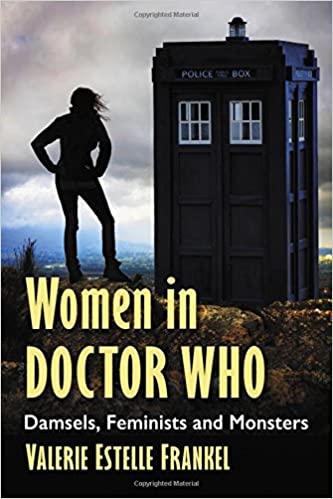
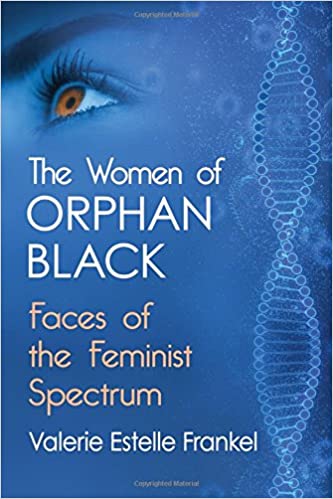
Review of Frankel’s Women in Doctor Who and The Women of Orphan Black


Review of Women in Doctor Who and The Women of Orphan Black by Valerie Estelle Frankel

Jeanne Hamming

Valerie Estelle Frankel. Women in Doctor Who: Damsels, Feminists and Monsters. McFarland, 2018. Paperback. 253 pp. $29.95. ISBN 9781476672229.

Valerie Estelle Frankel. The Women of Orphan Black: Faces of the Feminist Spectrum. McFarland, 2018. Paperback. 226 pp. $39.95. ISBN 9781476674124.


A quick Google search of Valerie Estelle Frankel paints a clear portrait of a prolific, detail-oriented independent scholar who has found her niche: pop-feminist analyses of pulp genres and cult science fiction and fantasy favorites—Doctor Who and Orphan Black, but also Outlander, Game of Thrones, Harry Potter, Hunger Games, True Blood, Wonder Woman. The list goes on. It’s clear that Frankel is a pop culture super-fan, which equips her with the enthusiasm, if not the academic bandwidth, to produce the meticulous compendia of observations that comprise the two volumes reviewed here. 

The Women of Doctor Who is a timely addition to critical work on the long-running series given that the 2018 season brings viewers a female doctor for the first time, played by actor Jodie Whittaker. Frankel’s review of human and non-human female characters in the series and its spin-offs (The Sarah Jane Adventures, Torchwood, Class, K9) is exhaustive, arranging Doctor Who’s treatment of women into broad categories: sweet girls, experts, bad ladies, tough girls, and outsiders. From there, Frankel further identifies female characters in the series by their established archetypes: sexy damsel, evil ice queen, trickster-seductress, and so on. While this convenient conceptual schema works well for a quick reference guide, it is less conducive to a deeper exploration of the critical issues surrounding gender, race, species or their intersections, including analysis of the recent trend to gender- and race-flip established characters and the implications, good or bad, of this particular cultural zeitgeist.

 Frankel’s encyclopedic approach works well to highlight the ways that, despite attempts to explore future and alternative worlds, female characters in the series remain firmly fixed as products of twentieth and twenty-first century attitudes that limit the depth and range of the roles women are expected to inhabit. Frankel offers an account of the evolution of women’s roles, from pubescent damsels like Susan in the first seasons, to more “competent” (read: contrary) women in the series’ reboot— e.g. Donna Noble and River Song. This trajectory is both fascinating as it charts the shifting history of feminism’s impact on popular culture, and distressing as you come to realize how little has changed in the past six decades, and how, as Frankel observes, these women remain “trapped within the patterns of their archetypes” (3). One consistently defining characteristic of the Doctor’s companions, Frankel points out, is their collective obligation to serve as his moral compass, to provide, in today’s parlance, invisible emotional labor. While his companions exist to nurture privately the Doctor’s better angel and steer him away from more destructive impulses, he remains free to play the public hero. This narrative through line is brought into starkest relief during the “War Doctor” arc when Billie Piper returns as both the specter of Rose Tyler and as “Bad Wolf,” a sentient weapon of mass destruction that, nonetheless, has a heart (Frankel, Doctor Who 167-168). 

In The Women of Orphan Black, Frankel organizes her analysis of the show around two intersecting histories: the evolution of feminism from first to fourth wave and how this history has been shaped by emerging bioethical issues, especially as they relate to the biopolitical battle over control of women’s bodies. Rich with excerpts and insights from the show’s creators, actors, and consultants, including the fascinating science advisor, Cosima Herter, on whom Cosima the clone is based, Frankel explores how the series deliberately engages in contemporary debates over reproductive rights, bodily autonomy, tensions between science and religion, gender, and globalization. Cleverly, Frankel shows how each female character in the series embodies various feminist waves, from the radical seventies feminism of Mrs. S, to Cosima as second wave feminist-lesbian, to Sarah as radical, “punk” feminist, to Mika/M.K., the elusive cyber-feminist whose hacktivism brings viewers’ attention to issues of disability, virtuality, and neurodiversity (M.K. is portrayed as being on the autism spectrum). Perhaps the most useful part of Frankel’s close look at Orphan Black is her exhaustive catalog of the series’ numerous “easter eggs,” from the literary references in each episode’s title to the allusions embedded in the show’s narrative. Frankel carefully teases to the surface allusions to Charles Darwin, Isaac Newton, Francis Bacon, William Wordsworth, Aldous Huxley, Arthur Conan Doyle, Richard Dawkins, and Donna Haraway, among others, demonstrating how the show’s fast-paced adventure narrative is smartly informed by philosophical, scientific, and literary histories.

The strength of Frankel’s contributions to discussions of Doctor Who and Orphan Black is more curatorial or archival, and one can imagine that this kind of work would make for good starting points to stoke the interests of high school students, undergraduates, or science fiction fans looking to enter mainstream conversations about representations of women and bioethics.