“The (Cyber) Center Cannot Hold”: Futures, Bodies and Minds in William Gibson’s The Peripheral


SFRA Review, vol. 50, no. 4

Symposium: The CyberPunk Culture Conference


“The (Cyber) Center Cannot Hold”: Futures, Bodies and Minds in William Gibson’s The Peripheral

Carmen M. Méndez-García


In The Peripheral (2014), William Gibson revisits in a dystopian, or maybe utopian, mode issues such as alternative communities, the possibilities that technology offers for transcendence (not least importantly that of the body itself), and the effect on individuals of hyper-technologized post-late capitalist societies. Gibson goes back to the familiar space of the über-modern city as a locale for his fiction, while also advancing ecological concerns and hypotheses on the effects of an environmental, economic, and political apocalypse. The move “from a predictive style of science fiction to contemporary fiction” in Gibson (Griffith 44) emphasizes the connection in his writing between the present and imagined futures, since as he has declared, “[w]ithout a sense of how weird the present is—how potentially weird the present is— it became impossible for me to judge how much weirder I should try to make an imagined future” (Dayal).

This move seems to contradict Gibson’s association with cyberpunk,1 a genre which carries with it a “bleak perception of the possibility of agency” (Wilson 91). I would like to argue, however, that Gibson is still writing within the genre, and that the potential for connection between privileged and under-privileged individuals through technology is at the core of Gibson’s novel. In this sense, The Peripheral does use what has been called the “sentimental endings” (Elias) preferred by Gibson, and as Paul Graham Raben suggests, it is a “standard Gibson . . . suggesting a benchmark of quality, certainly, but also that trustworthy familiarity of form that accrues to any consistently reliable brand.” This familiarity, however, also suggests the possibility of change by allowing the disfranchised to be in charge of their own bodies and destinies.

The Peripheral is set in two different future times, seventy years apart, the first of which is the second’s past. In the later one, early 22nd century London is an extreme late-capitalist society, a mixture of “post-humanism and globalized military-industrial technological complex ruled solely by the logic of finance capitalism” (Elias), after the apocalypse known as the Jackpot has taken place. This Jackpot is a combination of “unchecked climate disaster, worldwide financial collapse, rampant disease outbreak, and ubiquitous social breakdown after the crackup of all nation-states” (Elias), and it has wiped eighty percent of the Earth’s population. Those who have survived did so by using “assemblers” (advanced nanotechnology bots) to rebuild cities, which has provided for efficient, eco-friendly cities which are, nonetheless, mostly empty. In this 22nd century future, “peripherals” (remotely controlled enhanced cyborgs avatars) can be used as protection or disguise. These surrogate bodies are a commodity, and the most advanced models can only be afforded by the wealthy. Personal security can be ensured by using the peripherals to interact from the safety of a distant location.

In the second future we find a piece of rural America in the 2030s, which Gibson has defined as a “a more fully corrupt, third-worlded version of contemporary America” (“William Gibson”). There, bodies are less a commodity than a burden, with impoverished army veterans suffering constant neural pain from malfunctioning haptic implants or having very limited control of their bodies due to permanent physical disabilities. The inhabitants of this timeline (or “stub”) are “dependent upon (and highly proficient using) advanced technology, but under-educated and futureless, scraping a living by working in tech-industry workshops, low-end merchandise superstores, and illegal black markets” (Elias). A so-called “singularity” temporarily allows both timelines to interact, but not reciprocally. The 2100s future can talk and listen to, but not physically manipulate, their past, while inhabitants of the past, projecting their minds into the peripherals and inhabiting them, can physically interact with the future. The control of the bodies of the future by the minds of the past promises to be of benefit to both. The people in the future can profit from mental capabilities (knowledge, information and skills) of the characters in the past, while the successful use of the peripherals allows disabled veterans both the exhilarating opportunity of escaping their own limited bodies and a hefty financial reward.

My argument when it comes to what I consider a recent shift in Gibson’s texts will be two-fold: first, I will explore what Gibson does to the bodies in the book, beyond Cartesian traditional divisions of body and mind, as bodies can be analyzed as commodities to be used, bought, sold, or hired in the unequal economies of the two time-lines in the text, and secondly, I will analyze how the tension between center and peripheries works, and the potential for political and social change at the end of the book.

 I SING THE BODY PERIPHERAL

The Cartesian divide between body and mind is one that has worried Gibson during his entire career. His work makes us reconsider the existence of the divide itself, and also the preponderance, dependence and/or equilibrium of one and the other.

The ambivalence of cyberpunk as a genre towards the body (“its integrity, its vulnerability, even its possibility as an idea” Gutiérrez-Jones 71), and more specifically Gibson’s apparent rejection of the body as “dead meat” in Neuromancer, where we are presented with “characters who seek to reject the body” (Wilson 132) seems to stage the virtual world as one of exhilarating possibility, celebrating the “bodiless exultation of cyberspace” (Gibson, Neuromancer 3). However, as Sherryl Vint points out, Gibson’s “critics and his imitators have overstated [his] rejection of the body” (107). The rejection or, rather, transcendence of the body often carries social and political commentary in his work, and this is the case with The Peripheral.

In the book, the bodies of people in the past, especially those of veterans, are a burden due the failed use of technology. Malfunctioning haptic tattoos are a constant source of pain and an example of how useful technology can go awry when it goes from being useful to the machinery of war to being abandoned inside the individual. Disabled veterans, maimed by technological violence and war, are constantly reminded of their subordination to economic and political spheres and also of the government “owning” their bodies, either for sacrifice, or by leaving invasive technology in them. The relationship that people in the future have with their bodies is, however, radically different: bodies are used as “art” based on “complex embodiments of technological accumulation” (Griffith 45). Bodies are also commodified instruments for protection. Peripherals can be operated remotely, while the mind maneuvering them stays safely elsewhere but is in complete control of the peripheral’s physical surroundings, a combination of ultimate safety and total control of the environment for those who can afford it. The encounter of both timelines, with minds from the past being invited to inhabit cybernetic bodies of the future, allow those in the past the thrilling liberation of their constricting bodily “meat” into apparently limitless athletic shells.

While not in such traumatic or violent ways as in Cronenberg’s films, there is in Gibson a constant menace of technology entering and transforming/transcending the body. In his texts, technology can enhance and liberate the mind, but it can also destroy the body, create addictions to different drugs that desensitize the body to specific technology, or produce constant pain. Technology can also, however, fix bodies (such as the use of medical nanobots which travel through the body repairing tissue and internal organs in The Peripheral), even if that body-repairing technology is connected to its origins in military operations.

The use of different bodies and avatars in The Peripheral seems to eventually be mostly positive, as they ultimately serve each character’s original timelines and their communities, i.e. their reality. The poor and disabled characters in The Peripheral whose minds are being projected into other bodies are able to access abilities they no longer have, and environments they could never walk in. But they do know, no matter how exhilarating the experience may be, that this is temporary and serving a specific purpose: the time inhabiting another body may be pleasurable, but eventually, it is their own temporal “reality” that they are responsible and accountable for.

People in the future in The Peripheral use these cyborg bodies as tools, but they are also willing to use the minds from the past (and their skills and knowledge) as a commodity. The people from the past enter this pact, this disembodied rental of their selves, knowingly and expecting to get something in return. What they are initially hoping for is money, something they are in dire need of, but towards the end of the book they get more than they bargained for, in the form of agency given to them by the ones apparently with the power, by the future.

PRESENT CENTERS, PERIPHERAL PASTS

Even if the peripheral in the title makes reference to the cyborgs avatars in the book, there is another way in which the title of the text could be analyzed: the 22nd century future could be constructed as the center, both economically and in the sense of power and agency, with the 21st century future being the margin, the periphery. The center has wealth and technology that are not available to the periphery, and said periphery is initially only given access to technology insofar it serves the center’s interests. As Gibson has noted, in The Peripheral the past is “third-worlded” for the profit of First-World cities (“William Gibson”). As Amy J. Elias signals, in a way this relationship could be seen as a replication of “the Colonialism that gave First-World Nations their early-modern economic hegemony . . . now located not only in space but in time” (Elias). But while this “lending” or “outsourcing” of technology to the peripheries is a reality in our world and in literary texts, there are a number of things in The Peripheral that complicate the relationship between center, margins and how outsourcing technology works.

First off, in The Peripheral the “Other,” post-colonial subjects pose no physical risk, i.e. there is no danger of their uprising or taking over the center, since the only way they can communicate with the future is by the future allowing their using the technology they provide them with. Secondly, the relationship of center and periphery is not really one of exploitation, but one of collaboration, where the periphery is given notable agency both in how they use their (borrowed) bodies and in the reward for their help. In opposition to traditional constructions of center/periphery relations, the periphery that the past is in the book is given notable agency, by providing them, “the precariat that will be wiped out when the Jackpot is unleashed” (Elias) with both money and technology. They also get knowledge in exchange for their work: all of these things could potentially help them elude the Jackpot apocalypse. One could argue that there is deception initially as to the people in the future’s interests (the protagonist, Flynn, thinks that she is just being paid to play a first-person videogame, while she is actually part of a real-life surveillance program), and that some rich people in the future do “use the past as a playground and hiring pool, soliciting people from the past to work for them as an underclass labor fare” (Elias). However, in the end, giving knowledge and power to people in the past could be considered to be an entirely selfless act, since due to time-travelling paradoxes (what Gibson has defined as “forking paths” (“William Gibson”), changes in the past’s reality will not affect the future we see in the book.

Gibson understands that technology itself is neutral, and it is the use of it that makes it destructive or “a universal tool for countering hegemonic power structures” (Moorwood 178). As Esko Suoranta points out, Gibson does require that we think beyond the promises of these “embodied technologies of transhumanity,” and to realize that “they themselves do not dismantle oppressive systems” (18). People in the past in the book are given access to these technologies and thus to using them to try and avoid the Jackpot, but Gibson himself has expressed his “alarm at the ending . . . [where] a situation is set up such that the fate of the world literally rests on the goodwill of a very few people who can easily be corrupted by the power they yield” (Elias). Since both futures are “caught on singularities,” Elias seems to side with Gibson in seeing how the potential for improvement seems not to depend on “collective action or democratic representation,” and points out the visible tension between Gibson’s “rather old-fashioned humanist ethics—for which the success of social structures depends upon private, ethical decisions by self-determining individuals—and his cyberpunk vision, which implicitly asserts that human ethics is irrelevant in a world of capital” (Elias).

It is possible, however, to present Gibson’s ending and the agency given to the margins in the text under a slightly more positive light, focusing not on the lack of systemic changes that Elias seems to be distressed by, but on how systemic changes may start with individuals being given the agency and responsibility to implement singular, incremental changes. I would like to emphasize the possibility of a deep empathic connection of the two humanities in their respective social context that motivates the final mutual understanding of both futures. This can be achieved by applying the change in the idea of kinship suggested among others by Judith Butler, where kinship needs not be merely biological, but rather constituted by “a sense of relatedness, mutual responsibility, and collaborative creativity, all growing out of a presumption of shared origins” (Gutiérrez-Jones 72). Gutiérrez-Jones recovers ideas by Donna Haraway, N. KatherineHayles, and Butler to talk about the performativity of kinship, i.e. kinship seen as a process of creation of relations that exists in a material context and therefore “entails some aspect of embodiment” (72). Butler also identifies in her redefinition of kinship a “shared responsibility . . . a potential for coalition, and shared performance, which generates significant creative potential” (Gutiérrez-Jones 73).

In his analysis of Gibson’s Neuromancer, Fredric Jameson asserts that “the utopian drive [can be] an impulse of collectivity and the human being … a collective animal, perhaps something of a biological origin might be adduced for it too” (306). Jameson also signals that characters in Gibson’s text “complete each other,” pointing out the “collective (and thereby utopian) act” at work in Neuromancer. Jameson immediately qualifies this collective effort by emphasizing that in that text the need for collaboration is “a ruse devised by . . . two mega-computers in the service of their alliance and transfiguration” and that therefore the “utopian dimension” is displaced (Jameson 307). There is not such a ruse at work, however, at the end of The Peripheral: the act of “giving” the past a better future could be seen as a factor of a re-imagined notion of kinship that is recognized in the time (dis)continuum, and as such, the ending could work as a powerful deconstruction of the center/periphery or metropolis/colonies configuration set up at the beginning of the text.

Timo Siivonen has signaled Gibson’s tension between “technological developments and the future of humanizing,” often moving in between “two opposing forces, with one expressing pessimism regarding the future of the human race, and the other evincing a certain optimism regarding the possibility of the existence of intelligent life on some level facilitated by technological development” (231). I would like to argue that, by deconstructing traditional constructions of the periphery’s minds and mostly bodies as being “used” by the center, and by providing the weakest part of the equation with technology that seems to promise a better future, Gibson seems to be moving towards a certain utopian optimism. I find this assertion to be in line with Jameson’s argument that literature “can serve as a registering apparatus for historical transformations we cannot otherwise empirically intuit” (Jameson 312). In The Peripheral, there is the reality of those on the margins finding their corporeal suffering temporarily reduced through technologies of virtual labor, but also the possibility of a better future once the work has been done, by being given agency and knowledge by the center. This is a testament to how non-realistic literature, such as the cyberpunk mode Gibson uses, can be political by allowing us to imagine new configurations of kinship as the first step systemic changes beyond traditional models of center v. periphery.


WORKS CITED

Dayal, Geeta. “William Gibson on Why Sci-Fi Writers Are (Thankfully) Almost Always Wrong.” Wired, 12 Sept. 2018, www.wired.com/2012/09/interview-with-william-gibson/. Accessed 23 June 2020.

Elias, Amy J. “The Futureless Future.” American Book Review, vol. 36, no. 5, 2015, p. 12–13.

Gibson, William. Neuromancer. Harper Collins, 1984.

Gibson, William. The Peripheral. Berkley, 2014.

Griffith, Michael. Visualizing Virtual Space in Modern and Postmodern Literature. 2014. Tulane University, PhD Dissertation.

Gutiérrez-Jones, Carl. “Stealing Kinship: Neuromancer and Artificial Intelligence.” Science Fiction Studies, vol. 41, no. 1, 2014, p. 69–92.

Jameson, Fredric. The Ancients and the Postmoderns: On the Historicity of Forms. Verso Books, 2015.

Moorwood, Nicholas. Sovereignty, the State of Exception and Counter-Culture: Toward a Transnational Critique of State Power in 20th and 21st Century Anglophone Fiction. 2013. University of Toronto, PhD Dissertation.

Raben, Paul Graham. “The Spectacle of Disintegration: Lessons from a Peripheral Utopia.” Los Angeles Review of Books, 27 Oct. 2014, https://lareviewofbooks.org/article/spectacle-disintegration-lessons-peripheral-utopia/. Accessed 28 July 2020.

Siivonen, Timo. “Cyborgs and Generic Oxymorons: The Body and Technology in William Gibson’s Cyberspace Trilogy.” Science Fiction Studies, vol. 23, no. 2, 1996, pp. 227–244.

Suoranta, Esko. “The Ironic Transhumanity of William Gibson’s The Peripheral.” Fafnir—Nordic Journal of Science Fiction and Fantasy Research, vol. 3, no. 1, pp. 7–20.

Vint, Sherryl. Bodies of Tomorrow: Technology, Subjectivity, Science Fiction. University of Toronto Press, 2007.

“William Gibson: The Complete io9 Interview.” io9, 27 Sept. 2012, https://io9.gizmodo.com/william-gibson-the-complete-io9-interview-5946779. Accessed 26 June 2020.

Wilson, Robert Glen. You Can’t Get There from Here. 2014. University of Arkansas, Fayetteville, PhD Dissertation.
Ontology of the Hologram: Gothic Tropes and the Ontological Transgressions of Technoscience


SFRA Review, vol. 50, no. 4

Symposium: The CyberPunk Culture Conference


Ontology of the Hologram: Gothic Tropes and the Ontological Transgressions of Technoscience

Anastasia Klimchynskaya


 Science fiction often provides the lexicon through which we make sense of the novel and the unfamiliar. Damien Broderick has expertly written about science fiction “icons,” such as the robot or the spaceship, which recur frequently in science fiction but whose valences change with each appearance. These icons also enter into popular culture, where they serve as reference points for the unknown, and cyberpunk has furnished some of the most recognizable images among them: its futuristic cityscapes, neon lights, and holograms are among the most familiar of visual aesthetics.

It has been striking, then, to trace the discourses around modern-day hologram technologies in light of this fact. Today, holograms proliferate swiftly in the music industry to bring musicians back from the dead and send them on tour. Or, rather, what is created in this way are simulacra: motion-capture photography is used to record the movements of a body double that forms the basis for a 3D digital model, which is then overlaid with a likeness of the artist in question taken from videos. During a “live” performance, this simulacrum goes through a set of pre-programmed motions, lip-synching to recordings of the artist’s voice. Science fiction, and cyberpunk in particular, offers no shortage of reference points to describe this technology; Star Wars, Star Trek, Altered Carbon, and Blade Runner are but a handful among dozens. So why is it, then, that contemporary media tends to speak of holograms in terms of ghosts and resurrections, describing, for example, the “uneasy pallor” of a hologram “insubstantial like a ghost struggling to fully materialize”? (Binelli) That is, why are the registers of the Gothic, rather than allusions to science fiction, drawn on?

While the absence of science-fictional references in texts about such an “obviously” cyberpunk technology at first seems incongruous, historically the Gothic has often offered a set of conceits and tropes for exploring the distinctions between the categories of life and death, presence and absence, identity and imitation, which cyberpunk continues to interrogate. Scholars have noted that the similarities between Gothic and cyberpunk fiction go “far beyond the perceived surface aesthetics of both narrative modes to the core questions of being human and becoming posthuman,” (Heise-von der Lippe 265). But more than just a shared interest with cyberpunk in metaphysical questions and the production of emotional affect, however, the Gothic also has a history of engaging with these metaphysical questions specifically as a response to new technologies or scientific discoveries that challenge the distinctions between fundamental ontological categories of life, death, and identity. And holograms, in creating the illusion of bringing the dead back to life with perfect precision, seem to transgress our most fundamental ontological categories, pushing against the boundaries between life and death, and the idea of the unique self, that form the foundational truths of our reality. Modern-day coverage of this technology that mines Gothic tropes of ghosts and hauntings, grotesque reanimation and soulless revenants, then, inscribes itself into this history. In this article, I’m interested in more brightly illuminating that history and, in the process, shedding light on another facet of Gothic’s close relationship with cyberpunk, and the sources of the significant intersections between the two forms.

FRANKENSTEIN

I begin at an obvious beginning: Frankenstein, which has been heralded as the text that invented science fiction and given the genre a number of its fundamental icons and tropes. It forged these, however, by drawing on the Gothic to deal with metaphysical questions on the nature of life and death. Gothic monsters, by their very nature, push against neat ontological categories: ghosts and revenants of all sort challenge the neat delineations between life and death, while doubles and doppelgangers challenge distinctions between self and other, presence and absence, and the uniqueness of human identity. Frankenstein’s monster fits into this lineage: the genesis of the fiction goes back to a storytelling contest among Mary and Percy Shelley, Lord Byron, John Polidori, and Claire Clairemont at the Villa Diodati – a contest in which they were challenged to write a ghost story, a popular genre in the nineteenth century.

Of course, Frankenstein’s monster is no ghost, but he is something of a revenant, and Shelley’s inspiration was the question of the source of life; as she recounts in an introduction to the novel, at the Villa Diodati “many philosophical doctrines were discussed, and among others the nature of the principle of life” (293). She alludes, too, to galvanism, a scientific practice of the day that explored the source of life by pushing at the boundaries between it and death. At its simplest, galvanism refers to the stimulation of muscles with pulses of electrical current. Supposedly, in the 1780s, Luigi Galvani discovered that he could make the muscles of a dead frog twitch by applying electricity. This discovery took off, with many scientists replicating Galvani’s experiment upon the corpses of both animals and humans, including a famous public demonstration by Galvani’s nephew Giovanni Aldini in 1803, during which he electrically stimulated the limbs of the executed criminal George Foster at Newgate in London. The application of electrical current made the cadaver move and twitch, giving an impression of life and vitality where there was none. Through such experiments, Galvani, Aldini, and their followers were raising the question of the vital force that animates human beings by pushing at ontological boundaries and creating uncanny visions of corpses animated by some kind of unearthly force.

This was Shelley’s first vision for the novel: a “student of unhallowed arts kneeling beside the thing he had put together,” which stirs “with an uneasy, half vital motion” (293). Consequently, like the surgeons and galvanists of the period, and like the group discussing “philosophical doctrines” at the Villa Diodati, Frankenstein investigates the source of life. He “collected bones from charnel houses; and disturbed, with profane fingers, the tremendous secrets of the human frame,” (80) and upon discovering that secret, the monster is literally animated by that knowledge. The creature thus incarnates – again, literally – Frankenstein’s transgression, through science, of the boundaries between life and death, and is defined by his duality. He is technically a cyborg, an organic body artificially brought to life through scientific practice, a fact made explicit by Shelley’s extensive references to the discoveries of the day and which situate Frankenstein as a scientist, not a magician, and render his creation an enduring icon of science fiction. But the creature is also a Gothic monster. He has the grotesqueness of one: “dull yellow eyes,” a “shriveled complexion,” and pearly teeth that form a “horrid contrast with his water eyes,” such that Frankenstein, “unable to endure the aspect of the being I had created,” is filled with “breathless horror and disgust” (85). But mostly, the creature is monstrous because he is a corpse brought to life, a walking and breathing transgression of the categories of life and death, not unlike the bodies that populate Gothic fiction, which are “intrinsically uncanny…threshold phenomena precariously suspended between materiality and immateriality” (Cavallero, 270).

In other words, the original cyborg is a Gothic monster, and with this lineage in mind, we might read cyberpunk as a high-tech Gothic – as a kind of translation into a different mode of a gaze already turned onto the scientific investigation of questions of life and death.1 In fact, Veronica Hollinger has argued that Frankenstein “has been transformed into a precursor text of cyberculture” (192); it “draws attention to how the infinite possibilities of technoscientific creation tend to destabilize human individuality and our sense of self, origin, and purpose” (270). Cyberpunk, with its visions of uploaded, downloaded, and duplicated consciousnesses, artificial intelligences, fragmented identities, holograms, and interchangeable bodies, deals with the transgression of normative categories and ontological boundaries that the Gothic has long investigated with its ghosts, its hauntings, its resurrected corpses and reanimated beings. To upload a consciousness is another form of animation, in the literal sense of the word: to breathe life into a being, to ensoul it, and just as Frankenstein became “capable of bestowing animation upon lifeless matter,” (77) the question of whether an artificial, uploaded, digitized, or copied consciousness possesses a “soul,” or something of the essence of the original, is a metaphysical question cyberpunk frequently wrestles with.2

This lineage illuminates the rhetoric used around holographic technologies today; the ghosts and revenants we find in it are like Frankenstein’s monster, a reaction to metaphysical questions raised by technoscientific discoveries. The New York Times Magazine article quoted above, titled “Old Musicians Never Die. They Just Become Holograms,” bluntly acknowledges this fact, stating that “using technology to blur the line between the quick and the dead tends to be a recipe for dystopian science fiction.” This is the one reference to science fiction throughout the article, and it draws attention to the transgression of ontological categories inherent within holograms, a transgression that also resides within Frankenstein’s creature. Later in the article, Mark Binelli describes the process of creating holograms: “motion-capture photography records the performance of a body double, which becomes the basis for a three-dimensional digital model, a block of clay animators proceed to modify.” “Animator” of course refers here to the digital animation industry, but the word’s original root is the Latin anima, meaning soul; to animate is then to ensoul, or, more metaphorically, to breathe life into. This is Frankenstein’s original power: he describes his ability to bring a being to life by stating “I possessed the capacity of bestowing animation,” (78) and he proceeds to “animate the lifeless clay” (80). The word clay, of course, has multiple religious connotations, harkening back to the creation of Adam; it casts Frankenstein in the role of a man playing god, attempting to ensoul an inanimate being.  As Binelli refers to the “block of clay animators proceed to modify,” then, he harkens back to this lineage of Gothic monsters and re-animated corpses responding to galvanism’s transgressive practices.

Another evocative description is that of “the lifeless eyes of a corpse propped up between living people,” offered by Binelli to describe a holographic Frank Zappa concert. Again, the reference to a lifeless corpse recalls both galvanism and Frankenstein’s creature, as a cadaver is forced to move and act unnaturally through electricity (though, in this case, it is not electric current stimulating the muscles, but it is electricity enabling the projection of the hologram). But it is also reminiscent of the fictions of Edgar Allan Poe, who was familiar with the practices of galvanism and mesmerism and drew on them for his Gothic fictions of reanimation and resurrection. A handful of years after Frankenstein’s revised edition (1830), he published “The Fall of the House of Usher,” (1840) in which the dead Madeline Usher literally rises from her coffin, and “Ligeia,” (1838) in which the spirit of the narrator’s eponymous beloved appears to animate the corpse of his second wife; in “The Strange Case of M. Valdemar,” (1845) meanwhile, a dead body is kept from decomposing for months through mesmerism. Poe, who struggled with death and loss throughout his tragically short life, was obviously fascinated by the distinctions between life and death, and his fiction repeatedly pushed at those boundaries with hypotheticals that toed the line between scientific and supernatural. Contemporary rhetoric around holograms reveals a similar oscillation between technical explanation and Gothic modes of description in its interrogation of similar boundaries.

The Castle of the Carpathians

The second text I examine is not a work of science fiction, but a Gothic one with close ties to the genre. Penned in 1892 by Jules Verne, who by that point had gained widespread fame for his Extraordinary Voyages, which laid the groundwork for much science fiction to come, the Castle of the Carpathians is one of those tales in which supernatural effects turn out to have rational explanations – not unlike Frankenstein’s monster, whose grotesque and uncanny being is made possible by scientific research. And in this novel, as in Frankenstein, a Gothic trope – this time of the ghost in a haunted castle – is used to explore what was understood at the period to be an ontologically transgressive technology: the phonograph.

Invented in 1877 by Thomas Edison (though Charles Cros has also been given credit, but he did not provide a working model), the phonograph was articulated as a technology that could allow the dead to speak. The New York Sun, for example, upon a demonstration of the phonograph published an article titled “Echoes of Dead Voices,” writing that “Nothing could be more incredible than the likelihood of once more hearing the voice of the  dead, yet the invention of the new instrument is said to render this possible hereafter….” In other words, the phonograph was an ontologically transgressive medium, giving voice to the dead and thus allowing them to appear and speak as if alive, and The Castle of the Carpathians realizes this vision of the new medium. The story begins by fully embracing Gothic convention, with Count Franz de Telek finding himself in a mysterious, secluded castle, where he first sees the apparition of his former lover, the dead singer La Stilla, and then hears her voice with “all of its inflections, its inexpressible charm, its modulations – in a word, her voice that was the instrument of that marvelous talent that seemed to have died with the artist herself” (179).3 Her first appearance is described as a “vague form,” (161) then an “apparition,” (162) dressed in the same clothes she wore upon her death. Consequently, Franz is convinced that Stilla is somehow, inexplicably, alive, but as it turns out, the inventor Orfanik has been projecting her image and playing a high-quality phonograph recording of her voice. In other words, in a tale that participates fully and explicitly in the conventions of the Gothic, the phonograph is used to realize the genre’s trope of the ghost and the haunting; moreover, because the illusion is so realistic that Franz believes that Stilla is alive, the phonograph is able to explode the distinction between alive and dead.

This, again, strikingly resembles how holograms are represented today: just as the New York Sun wrote of being able to speak “long after we have turned to dust,” the New York Times describes artist Ronnie James Dio’s preparations for his first tour in a decade even though he “has been dead for almost 10 years” (Binelli). Rolling Stone writes of a hologram of Frank Zappa that “the apparition truly looked like an otherworldly version of Frank” (Grow); The Guardian titles their article on the subject “Back to Life,” and NPR uses the similar title “Raising the Dead – and a Few Questions – with Maria Callas’ Hologram.” Wired, in a lengthy piece on bringing celebrities “back to life,” uses the word “resurrection” nine times. There is an obvious history here: as the Vox piece on the hologram “controversy” about bringing dead artists back details, modern-day holograms are really a version of the “Pepper’s Ghost” technology, which uses a sheet of glass and reflections to create a spectral-looking figure which was used to add a ghost to a nineteenth-century staging of a Dickens play. As Wired points out, this technology “provided a vehicle for the Victorian-era obsession with the supernatural” (Famurewa) at a time when Spiritualism was at its height, but I argue that the story behind the rhetoric used in these pieces goes far beyond the explicit allusions to this tellingly named technology. It is, once again, an attempt to call on Gothic tropes to theorize a medium that explodes ontological categories and distinctions, as was done a century earlier to articulate the uncanniness of the phonograph.

CONCLUSION

Today, recorded sound (and its twin, photography, which in the nineteenth century was seen as uncanny for its ability to produce a perfect double of an individual) have seeped into our lives so profoundly as to become unremarkable. Neither old photographs nor vinyl recordings provoke extreme feelings of existential anxiety. This is due, in part, to technical improvements: shorter exposure time in photography, for example, means there is no longer the appearance of ghosts due to motion blur. But it is also familiarity: we inevitably adapt to the transgressive ontologies of new technologies and mediums even as we maintain a commitment to the distinctions between fundamental categories such as alive and dead. So, as we wrestle with what it means to reincarnate someone via hologram, I suggest that this technology, too, will one day cease to seem so uncanny, and soon enough, Gothic registers will fade from mainstream discussions of it to be marshalled, instead, in service of articulating the newest ontologically transgressive technology or medium – such as, for example, brain implants that replace our smartphones. In this sense, cyberpunk is already ahead of the curve (as science fiction often is), drawing on the Gothic to engage with technologies and mediums that are far ahead of our present capabilities: cloned bodies, uploaded consciousness, and copied minds are its uncanny doubles and ghostly resurrections.


NOTES

[1]  In this respect, scholars have suggested the term posthuman Gothic, or alternatively cybergothic, to describe cyberpunk fictions that “destabilize ingrained readings and patterns, challenging our understanding of what it means to be human” (Heise-von der Lippe 265).

[2] There are other ways this translation might be seen as occurring: the duplication of consciousness and its insertion into multiple bodies is a high-tech version of the Gothic double. And, if posthumanism is about decentering the human, then nineteenth-century monsters, representing anxieties of atavism and evolutionary throwbacks to our more animalistic selves, are a lower-tech decentering of the human.

[3] All translations of Verne from the French are mine. 


WORKS CITED

Binelli, Mark. “Old Musicians Never Die. They Just Become Holograms.” New York Times Magazine, 7 January 2020, www.nytimes.com/2020/01/07/magazine/hologram-musicians.html. Accessed 20 October 2020.

Broderick, Damien. “Reading sf as a mega-text.” Science Fiction Criticism, edited by Rob Latham, Bloomsbury, 2020, pp. 139-148.

Cavallaro, Dani. Cyberpunk and Cyberculture. Athlone Press, 2000.

“Echoes from Dead Voices.” New York Sun, 6 November 1877.

Famurewa, Jimi. “Inside the bitter war to bring Tupac and Michael Jackson back to life.” Wired, 8 May 2018, www.wired.co.uk/article/tupac-michael-jackson-billie-holiday-dead-celebrity-holograms. Accessed 20 October 2020.

Grow, Cory. “Live After Death: Inside Music’s Booming New Hologram Touring Industry.” Rolling Stone, 10 September 2019, www.rollingstone.com/music/music-features/hologram-tours-roy-orbison-frank-zappa-whitney-houston-873399/. Accessed 20 October 2020.

Heise-von der Lippe, Anya. “Gothicism.” Routledge Companion to Cyberpunk Culture, edited by Anna McFarlane, Lars Schmeink, and Graham Murphy, Routledge, 2020, pp. 264-272.

Hollinger, Veronica. “Retrofitting Frankenstein.Beyond Cyberpunk: New Critical Perspectives, edited by Graham J. Murphy and Sherryl Vint, Routledge, 2010, pp. 191-210.

Huizenga, Tom. “Raising The Dead — And A Few Questions — With Maria Callas’ Hologram.” NPR, 6 November 2018, www.npr.org/sections/deceptivecadence/2018/11/06/664653353/raising-the-dead-and-a-few-questions-with-maria-callas-hologram. Accessed 20 October 2020.

Poe, Edgar Allan. Selected Tales. Oxford, 1998. 

Shelley, Mary. Frankenstein. Edited with a foreword & notes by Leslie S. Klinger, W.W. Norton and Company, 2017.

–. “Author’s Introduction to Frankenstein.Science Fiction Criticism, edited by Rob Latham, Bloomsbury, 2017, pp. 291-294.

Thorpe, Vanessa. “Back to life, back to virtual reality as music stars return to stage as holograms.” The Guardian, 25 May 2019, www.theguardian.com/music/2019/may/25/virtual-reality-music-stars-stage-holograms-whitney-houston-jeff-wayne. Accessed 20 October 2020.

Tiffany, Kaitlyn. “No industry is weirder than the dead celebrity hologram industry.” Vox, 23 October 2018, www.vox.com/the-goods/2018/10/23/18010274/amy-winehouse-hologram-tour-controversy-technology. Accessed 20 October 2020.

Verne. Jules. Le Chateau des Carpathes. Hachette, 1970.

Cyberpunk in the Modern Museum: Actuality, Future, and the Challenges of Exhibiting Movie Memorabilia


SFRA Review, vol. 50, no. 4

Symposium: The CyberPunk Culture Conference


Cyberpunk in the Modern Museum: Actuality, Future, and the Challenges of Exhibiting Movie Memorabilia *

Agnieszka Kiejziewicz


The young market of movie memorabilia is continuously growing, expanding on new thematic areas related to genre cinema and animation. A relatively short overview of this market highlights the lack of complete comparative price reports, as well as detailed academic analyses. The reports keep focusing on the most profitable auctions, such as the ones featuring the Delorean from Back to the Future (1985) or Robby the Robot from Forbidden Planet (1956) (Nevins, n.p.). Most of the accessible academic publications cover the initial wave of interest in movie memorabilia around the world, which was at the end of the 1980s and the beginning of the 1990s (Chaneles; Heide and Gilman). However, it is possible to assess the scale of the success of the market browsing through soft data, for example by juxtaposing the prices of movie memorabilia with fine art auctions over the years.

Together with increasing sales of memorabilia, the collectors organize exhibitions, aiming at reconsidering the notions of art and the possibility of introducing popular culture to the museums and galleries. Also, the exhibiting movie memorabilia raises the question of the aesthetic value of popular-art-related objects. An example of such an exhibition is the  DC Exhibition: Dawn of Superheroes, which was shown among others in Łódź, Poland, and London, UK. In this context, it is symptomatic that the objects connected to film and animation changed their functions. Once, they were parts of scenography and popular culture, but now, they are displayed in the museums, considered as legitimate art. I leave the question on the sources of interest in movie memorabilia open, as the answer needs thorough sociological research, which exceeds the subject range of this article.

This paper stems from the experience of designing a concept of cyberpunk movie memorabilia exhibition that I developed together with Marek Kasperski, the owner of the Art Komiks gallery located in Warsaw, Poland (Kasperski, n.p.). Art Komiks administers the collection of over 300 objects classified as cyberpunk art, gathered by Polish collectors from auctions around the world. The collection contains objects related to cult titles, such as Ghost in the Shell (1995-2017; both animation and live-action film), as well as less-known titles from world cyberpunk – among the plethora of titles – New Hurricane Polymar (animation, 1996), Magnus, Robot Fighter (comic books franchise; 1963-2014), or Eat-Man (1997).

In this article, I am going to present the substantive issues related to the process of designing a cyberpunk movie memorabilia exhibition, as well as comment on the intermedia relations between the objects in the context of the overall concept of the display. It is worth adding that some of the ideas related to the exhibition narrative path were based on the findings presented in my book Japanese Cyberpunk: From Avant-garde Transgressions to Popular Cinema.

NEW MUSEOLOGY AND CYBERPUNK MOVIE MEMORABILIA

Modern museums search for unusual objects to gain a contemporary audience’s attention and, at the same time, create an interactive experience with (potential) educational values. It creates a situation in which the exhibitions are planned under measurable factors, such as potential income from tickets sold, attendance, and media response (i.e., journalists’ or bloggers’ reviews, number of views of the photo galleries published on Facebook and Instagram). Barron and Leask observe that museums are significant elements of cultural tourism, designed to be effective in gaining recognition and publicity. Researchers underline that institutions often ensure their future by, among other factors, enhancing the viewer’s engagement (Baron and Leask, 1-2). The value of novelty and shock, as well as the visible and easily recognizable connections to popular culture, diversify the audience, inviting to the exhibition space those who are not usually engaged in fine art displays. This wave of interest in expanding the notions of traditional art opens up an opportunity for movie memorabilia, comic art, and popular culture-related objects, such as bootleg art.

In this context, cyberpunk movie memorabilia and other art (comic book sketches, animation frames, photos, bootleg art, etc.) once perceived only as parts of cyberpunk narratives, changed their function. Now, away from the film scenography, the objects can be recognized by the contemporary viewer as sources of prophetic memory about the future and simultaneously  gaining cult status because of their universal message. Movie memorabilia depicted in an art gallery can also be considered as a legitimate art, encouraging philosophical reflections about social development. It opens new research perspectives on the functions and objects exhibited in modern museums, expanding the definition of contemporary museology.

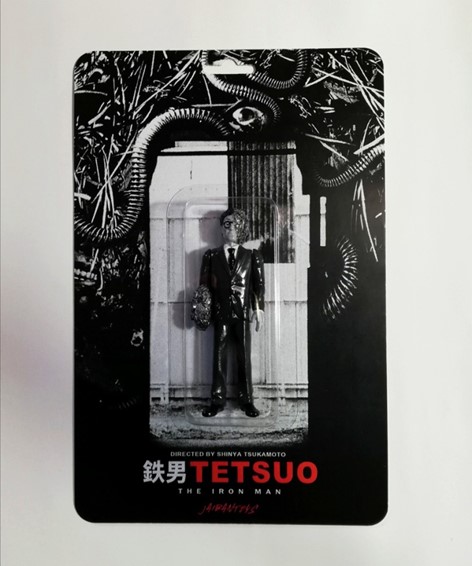
Fig. 1. Tetsuo: the Iron Man bootleg, Jaibantoys

COLLECTING CYBERPUNK OBJECTS

Situating cyberpunk objects in the broader context of popular culture art collections, it should be noticed that they can be classified as movie memorabilia, comic art, game art, video games, books, autographs (i.e., autographed objects) and bootleg art. The collectors can reach a variety of forms through obtaining the objects from several different sources, such as auctions, directly from the authors, or the other private collectors. The uniqueness of the collection administered by Art Komiks stems from the model of support of the project, which is based on the contributions of the Polish private collectors, willing to lend the objects for the exhibitions.

As Marek Kasperski pointed out in a podcast about popular culture recorded for Deloitte (Kotecki), the process of building a collection of cyberpunk objects is related to a broader trend of collecting movie memorabilia, which is connected to the dynamics of income distribution between fans of popular culture narratives. Popular culture artifacts associated with nostalgia and trending superheroes universes for younger generations are gradually replacing the need of collecting fine art. Also, in the case of popular culture art, the act of building one’s own collection is less associated with gathering valuable possessions and increasing one’s material status. Instead, obtaining such objects is related to the need for the embodiment of passion towards particular narratives, heroes, or themes. Accordingly, the interest in the specific kinds of memorabilia varies – from the higher interest of the foreign customers in transnational cyberpunk narratives to the lower interest in local cyberpunk (for example the comic art created by Polish artists brings most attention from Polish fans and collectors).

CYBERPUNK EXHIBITION DESIGN

While designing the exhibition on cyberpunk, we found it essential to group the objects according to themes they covered, to provide the viewer with a clear, understandable path. Consequently, we  divided the objects according to three main themes that reappear in cyberpunk narratives.

The first one revolves around the depictions of machines, androids, and cyber bodies, focusing on the protagonists under and after transgressive body metamorphosis. The impact of technology on human life, both in the context of the physical changes and the possibility of mental immersion in the virtual world, was the issue reappearing in the first literary cyberpunk narratives. The connection of the body to the machine, which became the basis of the intermedia genre, took various forms: from mechanical prostheses, replaceable organs, and under-skin hardware to interference in the brain. Cyborgizations were also a perfectly personalized, fancy arsenal of weapons attached to the user. In cyberpunk, the fusion of the body with the machine exceeds the limitations imposed by the imperfection and instability of biological tissue. The user strives for the ultimate defeat of death by improving physical capabilities or diving into cyberspace, thus leaving the imperfect body behind. Cyberpunk’s technology penetrates the biological tissue and leads to the disappearance of what the viewer recognizes under the concept of humanity.  The protagonist of cyberpunk narratives uses the benefits of technological development, knowing that by bonding with the machine at the same time, he moves away from society, alienates from reality, and becomes the Other. An integral element of the fusion of man and machine is the terror of metamorphosis, the pain that accompanies the act of attaching the technological extensions to the biological organism. The appearance of an android reflects the possibility of comparing the determinants of human and machine existence, i.e., recognizing the features that distinguish an organic being from a mechanical one. This comparison also arouses  the obsessive desire of conscious androids to confirm their existence by understanding what the soul is and whether an artificial creature can discover it.

According to the specter of works we (ArtKomiks gallery) have in the collection, we mostly focused on the terror of connecting biological tissue with mechanical cyber-improvements, at the same time discussing the new possibilities and powers gained by the characters. In this section, we also highlighted the place of the mechanical Other (android) in society. Here, among the objects we displayed, there is the head of the post-exploded android from Ghost in the Shell live-action film (2017) and animation art referring to this universe (i.e., the frames depicting the main character, Major Kusanagi’s mechanical body disintegration), Eric Canete’s covers from Cyborg comic books,  Genocyber (1994) animation art or Tetsuo the Iron Man bootleg art created by Jaibantoys.

Fig. 2. Cyborg, Eric Canete, comic art/cover, 2017, 23,5×35,5 cm

The second thematic area is focused on cyberspace and the world inside the computer. Here the narrative path followed such themes as the escapist nature of virtual surroundings or the moment of entering cyberspace and separating an imperfect biological body from an immaterial personality, thus introducing the dilemma of the existence of the soul and the Absolute. The division of the world into real and virtual has its roots in Jean Baudrillard’s reflections on a society immersed in simulations, wandering in hyper-reality, and manipulated by the media. The cyberpunk concept of cyberspace, inspired, among other things, by Baudrillard’s thoughts, was formulated and presented for the first time in the story True Names (1981) by Vernor Vinge. Since then, the vision of a cyber-world inside the Net has evolved, being successively developed with new plots showing the immaterial existence of a future man. The objects displayed in this section are, among others, photos from Johnny Mnemonic (1995) signed by Keanu Reeves, photos and the Atari game from TRON (1982) or comic art related to such titles as Magnus Robot Fighter (1963, reintroduced in 2010), Barb Wire (1994-1995), Godzilla: Cataclysm (2014) and Gall Force (1995).

Fig. .3. Magnus Robot Fighter, Jorge Fornes, comic art/ variant cover, 29,5×42 cm

Furthermore, the third section was dedicated to the depictions of a dystopian, futuristic city, including interior design. We underlined that a cyberpunk dystopia is a place of confrontation of corporations, subcultures, and residents of the criminal underworld. Despite technological development, a large proportion of the city’s future residents exist under challenging conditions, struggling with addictions and poverty. It turns out that advanced cyber implants only improve the lives of the privileged. Postindustrial dystopia, in which governments have fallen, and corporations have gained most of the decisive power, shows visible similarities to the reality behind the screen. As the plot of cyberpunk narratives takes place in the near future, the viewer recognizes fashion, architecture, and digital solutions, which they know perfectly well. The fall of order and social structures frightens, but also attracts with the mysterious beauty of the dark streets inhabited by the future man. The design of dystopia is a combination of space settlements, underground cities, and a vision of post-apocalyptic Earth after an atomic disaster, which is perfectly depicted by Severio Tenuta in his comic art from Heavy Metal, Dublin 2077 or by Syd Mead’s art.

Fig. 4. Blade Runner, Syd Mead, signed photo/ movie memorabilia, 15×10 cm

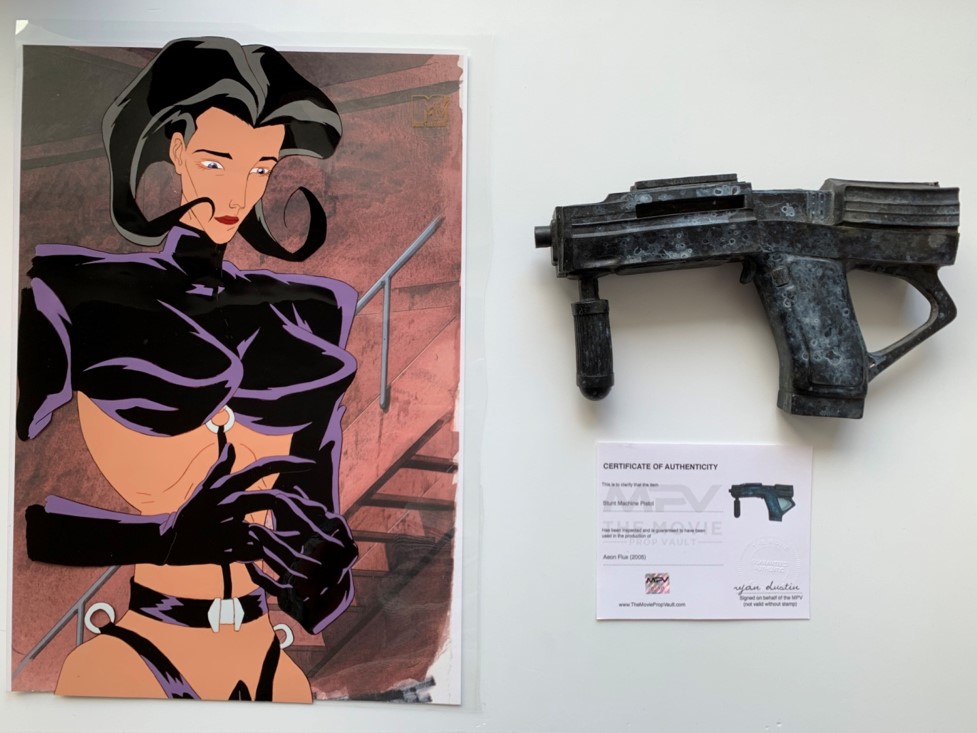
Those three themes can be found in most cyberpunk narratives, though they function as a core for further thematic developments in the context of more prominent exhibitions. For example, the section about future landscape can be accompanied by insight into a dystopian fashion, not only highlighting film costumes from Ghost in the Shell, which we have in the collection, or weapons (i.e., a machine gun from Aeon Flux), but also depicting the comic sketches of the inhabitants of future cities.

Fig. 5. Aeon Flux, 1991-1995, animation art (left) and film prop (right)

CYBERPUNK BRANDS AND EXHIBITION PATH

On the level of recognition, cyberpunk artworks can be divided into those classified as big names, such as Ghost in the Shell or RoboCop, and less-known cyberpunk TV series or local comic art. Having in the collection examples of both categories, it is crucial to successfully merge the interest that the viewer will express towards the recognizable names with the artistic value that less-known narratives often offer. However, the big names will bring the most media attention and can serve as an incentive for potential media partners.

The appearance of big cyberpunk names should be considered while designing the narrative path based on the relations between the chosen objects and highlighted themes. For the viewers with partial knowledge about the genre, the media narratives (or the plots) associated with particular objects seem less important than the overall aesthetics of cyberpunk and the balance between the recognition of big names and the act of discovering less-known objects. Analyzing the practical implementations of exhibition design in several new media museums (i.e., in Finland, Sweden, Norway, Germany, and Poland), we contend that it could be discouraging for the viewer to read and learn every narrative separately and with a detailed plot. In this case, we adopted the approach in which the objects themselves tell the stories according to their placement in relation to each other.

INTMEDIA RELATIONS

It is worth underlining that media franchise titles such as Ghost in the Shell are accompanied by various kinds of objects (costumes, photos, drafts and sketches, props), whose presence underlines the intermedia relations within cyberpunk productions. Accordingly, we suggest that a narrative path should be based on clear connections, revolving around the variety of forms. For example, a cyberpunk weapon (accessory) and a sketch depicting this weapon or a frame showing a scene of using it can be showcased together.

We listed two elements that can underline the intermedia character of cyberpunk narratives, at the same time fulfilling the need for a clear exhibition path and creating a unique ‘cyberpunkish’ atmosphere. The first one is the influence on the audience and recognizability of a particular object. Mostly, it is the costume or a prop that appeared in the well-known film, which can be associated with the viewer with cult status. Also, the presence of 3-D objects (together with sketches and photos) draws attention to the production process. Furthermore, the second element is the meaning of the prop and its actual value, often enriched by an author’s signature or a certificate of authentication. We for example have Blade Runner‘s script signed by Rutger Hauer in the collection.

Fig. 6. Blade Runner‘s script signed by Rutger Hauer

THE VIEWER

We are aware that the contemporary viewer, if they are not a fan of the cyberpunk genre, may not recognize all the authors, connections, and themes presented at the exhibition. Therefore, more than focusing on teaching people  about cyberpunk’s visions in different media, we count on building a unique mood.

In this case, the cyberpunk movie memorabilia exhibition becomes a physical implementation of the conception of media diffusion in cyberpunk discourse. The variety of the gathered objects encourages the meditation on the character of modern times and the futuristic visions that became a palpable reality. For the viewer, cyberpunk narratives will function as the points of reference to fulfilled prophecies about the future. Entering the exhibition space filled with the artifacts from the cyber-world, the observer experiences the embodied futuristic dreams, or, referring to Baudrillard’s terminology, a heterotopia – an area on the verge of reality and imagination. In the optics of cyberpunk narratives, the technological solutions and aesthetics familiar to the viewer through their daily experiences are distorted, monstrous, and derived from their original context.

Cyberpunk movie memorabilia exhibitions show the manifestation of various names and media in cyberpunk discourse. The diversity of the collected objects allows the viewer to reflect on the nature of our times when visions of the future became a tangible present. Entering the exhibition, the observer gets familiar with films, comics, and game narratives currently functioning not only as a record of the creators’ imagination but also as a reference point to the prophetic visions of the development of modern societies. Futuristic objects and mechanical creations appropriating the body and perception of the individual reflect the everyday experiences of the observer, creating comparisons between the contemporary world and cyberpunk narratives. The exhibition of film memorabilia allows the viewer to confront the designed shape of futuristic visions by comparing it with what is known and familiar to them. Emphasizing the terror of transformation into a mechanical being, or recalling the post-apocalyptic character of the future, the creators of cyberpunk narratives are forcing the observer to verify contemporary social changes. Approaching cyberpunk aesthetics, we are balancing between technophobia and technophilia, unable to free ourselves from the need for creating comparisons.

CONCLUSION

The objects gathered within the collection, once treated as integral elements of cyberpunk narratives, have become records of the memory of the futuristic visions, striking the viewer with their universal character. At present, the fact of viewing the cyberpunk set of objects in the art gallery allows us to perceive them as a legitimate part of contemporary culture.

The successful merge of the exhibiting patterns reserved for fine art with popular culture objects opens a new field for discussion about the archiving and preservation of memory about contemporary media products. Also, the actuality presented in cyberpunk narratives, together with the excessive interest in the genre, expanded by the upcoming premiere of the Cyberpunk 2077 digital game, creates a need for revising the exhibition concept. The fact of showing cyberpunk movie memorabilia on display is a proposal addressed to two generations of viewers: those who seek for a nostalgic journey into the narratives from the beginnings of cyberpunk and those who have already started discovering the genre, encouraged by the newest productions.


NOTES

*All pictures used in this article come from Art Komiks’ archive.


WORKS CITED

Barron, Paul & Leask, Anna. “Visitor engagement at museums: Generation Y and ‘Lates’ events at the National Museum of Scotland.” Museum Management and Curatorship, vol. 32, 2017, pp. 1-18.

Baudrillard, Jean. Simulacra and Simulation, edited by Mark Poster. Stanford UP, 1988.

Castro, Adam-Troy. “Blade Runner Gun Auctioned for $270,000.” SYFY Wire, 2012, https://www.syfy.com/syfywire/blade_runner_gun_auctione. Accessed 5 November 2020.

Chaneles, Sol. Collecting Movie Memorabilia, Arco 1979.

N.a. DC Exhibition: Dawn of Superheroes Website. 2020, http://www.switsuperbohaterow.pl/. Accessed 3 November 2020. [in Polish].

Extended Museum in Its Milieu, edited by Dorota Folga-Januszewska, Muzeologia, Vol. 18. Universitas, 2018.

Holmes, Mannie. “Empire Strikes Back Stormtrooper Helmet Fetches $120,000 at Auction.” Variety, 2015, https://variety.com/2015/artisans/news/stormtrooper-helmet-sells-for-120000-at-auction-1201611983/. Accessed 3 November 2020.

Kasperski, Marek. ArtKomiks Website, https://artkomiks.pl/en/.

Kiejziewicz, Agnieszka. Japoński cyberpunk. Od awangardowych transgresji do kina popularnego [Japanese cyberpunk: from avant-garde transgression to popular cinema]. Kirin, 2018.

Kotecki, Wiesław. “Podcast: Człowiek Biznes Technologia by Wiesław Kotecki; #38 Marek Kasperski o sztuce [Podcast: Human, Business, Technology by Wiesław Kotecki; #38 Marek Kasperski about art.” Deloitte, 2020, https://www2.deloitte.com/pl/pl/pages/deloitte-digital/podcast-czlowiek-biznes-technologia/38-Marek-Kasperski-o-sztuce.html. Accessed 10 September 2020.

Lapin, Tamar. “Rare props from ‘Star Wars,’ ‘Batman’ and other classics up for auction.” New York Post, 2019, https://nypost.com/2019/08/20/rare-props-from-star-wars-batman-and-other-classics-up-for-auction/. Accessed 12 September 2020.

Lasiuta, Tim. Collecting Western Memorabilia, McFarland, 2004.

Oliver, Richard W., Lowry, Glenn D., and Terrence Rilely. Imagining the Future of the Museum of Modern Art, The Museum of Modern Art New York, 1998.

Nevins, Jake. “The world’s most expensive film props and costumes – in pictures.” The Guardian, 2017, https://www.theguardian.com/film/gallery/2017/nov/27/the-worlds-most-expensive-film-props-and-costumes-in-pictures. Accessed 5 September 2020.

Vinge, Vernor. True Names, Penguin Books, 2016.

The Fractal Subject and the Hologram Rose: On Baudrillard and Cyberpunk as Media Theory


SFRA Review, vol. 50, no. 4

Symposium: The CyberPunk Culture Conference


The Fractal Subject and the Hologram Rose: On Baudrillard and Cyberpunk as Media Theory

Jiré Emine Gözen


At the conference “Philosophy of new Technology,” which took place at Linz in 1988, Jean Baudrillard stated:

The whole of the human being, his biological, muscular, animal physicality has been transferred to mechanical prostheses. Not even our brain has remained within us, but is now floating in the countless Hertzian waves and networks that surround us. This is by no means science fiction but merely the generalization of McLuhan’s theory about the ‘extension of man.’

Baudrillard 1989, 114

In the mid 1970s, Jean Baudrillard started developing his theory of simulation, which began with the assumption that modern societies experienced a drastic disruption through the appearance of new media technologies. In this context, Baudrillard proclaimed the dissolution of the subject, of the political economy, of meaning, of truth, and of the social formations of current societies. In order to describe and analyze these processes, new theories, terms, and narrations were needed. Baudrillard’s own contribution to the theory of media thus started with the statement: “The real radical alternative is somewhere else.” (Baudrillard 1978, 83)

Indeed, this alternative approach, one which asks to reflect on the implications of new media and technology, is to be found somewhere else: in cyberpunk literature.

I argue that cyberpunk should be seen as an important companion to media theories, both in terms of artistic expression and in terms of a method of knowledge production by itself, including its theorization. When I speak about cyberpunk literature I refer to a specific body of work written by authors who gathered in the late 1970s in Austin, Texas (Gözen 2012). Thus cyberpunk literature implies a body of work that revolutionized science fiction writing. This revolution was spearheaded by authors such as Bruce Sterling, William Gibson, John Shirley, Lewis Shiner, Rudy Rucker, and Pat Cadigan. This group published their criticism of the science fiction of their time in the fanzine Cheap Truth and in the preface of the cyberpunk anthology Mirrorshades, which could be seen as the cyberpunk manifesto – the discursive foundation for a newly forming movement.

At the time, ‘technical culture’ began sprawling into everyday life due to advancements in computers, media, and bio- and medical technologies. This formed the basis for the movement. “Technology […] has slipped control and reached street level,” states Bruce Sterling. “For the cyberpunks […] technology is visceral. It is not the bottled genie of remote Big Science boffins,” he continues, but is rather “pervasive, utterly intimate. Not outside us, but next to us. Under our skin; often, inside our minds” (346).

The aim of cyberpunk was to reflect on these technological advancements in an artistic way, and to engage with the way they alter the human being and society at large.

These kinds of thoughts and observations are also the basis of many theoretical media approaches. Marshall McLuhan, one of the founders of media theory, claims in his writings that media and technology are interfering with our perception, senses, psyche, and identity. By doing so, they change our behavior, our culture, our societies, and our politics. The basic architecture of electronic media mimics our own central nervous system, and hence technically extends it. It is now very interesting to see that cyberpunk  incorporates this idea when drafting future worlds and, by doing so, pushes it further.

By designing fictional virtual worlds that are accessed through an interface with the human brain, the extension of the human nervous system through an electric central system becomes as much a reality as the McLuhan-postulated dissolution  of the subject-object-relation between man and machine. 

McLuhan’s category of implosion also plays a significant role  in the extrapolated worlds of cyberpunk. Virtual realities as a “medium for the meeting of our minds” (Cadigan 243) not only allow its users to take part in the dreams, memories, and fantasies of others; the connection between the human mind and the machine is also used to create entertainment devices, such as, for example, Gibson’s ASP, Cadigan’s madcap, or Effinger’s moddy, which make it possible to experience the neuroses and psychoses of others. This way, seasonal bestsellers allow societies to experience all kinds of collective madness. This inability to comprehend the difference between the inner world and the outer world, the sense of time and space and between you and me that comes with the madness of a collective psychosis is a manifestation of McLuhan’s implosion in the electronic age.

Furthermore, the main categories of Jean Baudrillard’s theory – hyperreality, simulation, and implosion – are omnipresent symbolizations in the worlds of cyberpunk. This is especially the case in the superimposition of reality by simulation. In cyberpunk, physical presence has lost its relevance. Instead, virtual worlds frame a new realm of hyperreality that offers a new home to humankind. In this context, Greg Bear’s Eon is a very impressive example. In the world of Eon, Bear describes an asteroid from a parallel universe that found its way to our world around the turn of the millennium. The hollowed out asteroid contains various artificial chambers that used to be the habitat of a future humankind. In each chamber, we find a future city from a different era of the future humankind. Interestingly, the change of the interiors and architectures of the cities of the different eras demonstrate the different states of the Baudrillardian simulation. The advanced media technologies in one of the older future cities enables the contemporary peoples of Eon to immerse themselves within a virtual world that creates a simulation of the abandoned city in its former state with its inhabitants that can’t possibly be distinguished from reality

“She called up a student’s basic guide to the second chamber city. In an instant, Alexandria surrounded her. She appeared to be standing on the portico of an apartment in the lower floors of one of the megas, looking down on the busy streets. The illusion was perfect – even providing her with a memory of what “her” apartment looked like. She could turn her head and look completely behind her if she wished – Indeed, she could walk around, even though she knew she was sitting down.” (Bear 1998, 339)

The sequence unfolding before the eyes of the user shows recordings from a future that did not take place in the user’s reality and which probably will also never take place in her future, but still insist in representing a history that has already passed by. Hence, we have here a model that is both true and an illusion – in both cases, truth dissolves into simulation. In this mediated reality, sensual experiences are perfectly superimposed by the virtual, as shown by the divergence between real and simulated experiences of space and body. Digital signs replace the tactility of reality with a field of tactile simulations.

In the final city of the future there is no longer a medial environment, but rather a humankind that has itself become a simulation: The whole of humankind is digitalized and lives in a computer called City Memory.

Death and natural birth are no longer present in this digitized world. A new person or subject is created by the merger of various parts of digital personalities – which means that every new being is a simulation based on the code of already existing models. While these models in the analog world used to be DNA codes, in the digitalized world of Eon, the models consist of bits and bytes. Nevertheless, it is still possible to live outside the City Memory. The ‘outside’ environment of the city memories’ virtual world is composed of a space without contours so that landscapes, apartments, objects, and even climate features can be projected onto it. If one wants to move in the outside parts of the city simulation, bodies could be created and used.

However, these bodies have nothing to do with “natural” human bodies. These bodies are equipped with an implant that records all experiences and memories, just in case something might happen to them. Hence, even death does not have a significant impact on the physical or the virtual existence of a person. In Baurillard’s words, this means that in the world of cyberpunk, even death, fails to serve as a distinction between the real and the imaginary.

The future shows that the difference between illusion and truth lost ground to the play with reality. The simulation is omnipresent; even if there is a body, it only contains digitalized and uploaded minds.   The Baudrillardian dictum of self-referential signs finds itself radicalized here:  A humankind based on digital bits and bytes that have merged into the endless circulation of signs referring to themselves becomes a model without an origin and eventually a sign in and of itself. In its final stage, the future society of Eon could be understood as the ultimate reign of the technical as humankind itself becomes the most radical form of simulation.

In his novel Halo, Tom Maddox not only processed aspects of Baudrillard’s idea of simulation, he even opens his book with a quote from America by Jean Baudrillard: “Everything is destined to reappear as simulation” (8).

Similar to Gibson in Neuromancer, Maddox describes an omnipresent and almost omnipotent artificial intelligence. This artificial intelligence, known as Aleph, has used its inherent potential to control all transmission systems to build a city in orbit, whose reality it will henceforth simulate. The initial reality of the dark orbital city without contours and atmosphere disappears through Aleph’s simulation behind a constantly repeating spring and a media-generated blue sky. In Halo City, therefore, the technically mediated experience of the world has quite obviously become a new reality, and the entire system created by Aleph represents a gigantic simulacrum in the Baudrilliardian sense.

In many cyberpunk worlds, the advanced merger of technology and nature also shows itself in the fact that natural phenomena can no longer be perceived and conceptualized separately from technology. Gibson opens his debut novel with a highly significant sentence: “The sky above the port was the colour of television, tuned to a dead channel” (Gibson 1984, 9).

With this description of a technical condition, used as a metaphor to describe nature, the reader is introduced to a world where a total implosion between nature and technology had taken place.  In the highly technical worlds of cyberpunk literature, nature is understood as part of the technologies surrounding man. The American literary scholar Lance Olsen describes the  frequent use of technological images as a metaphor for describing nature as follows: “If the romantic metaphor makes nature familiar and technology unfamiliar, these postmodern metaphors make nature unfamiliar and technology familiar.” (Gözen 293)

Now the question arises – is cyberpunk simply a literarization of the media theories of McLuhan and Baudrillard, or is there more to it? A close reading of Baudrillard’s lecture “Videoworld and Fractal Subject” and  William Gibson’s short story “Fragments of a Hologram Rose” – which can be seen as the prelude to cyberpunk as a genre – might reveal an answer to this question.

Baudrillard describes the subject in the simulation of hyperreality as having been fragmented and disintegrated into its component parts. Hence, difference does not mean the difference from one subject to another, but rather, the differentiation of the subject from itself – the subject becomes fractal and is held together by a network of body prostheses. In his own words:

transcendency disrupted into thousands of fragments, which are like pieces of a mirror, in which we fleetingly can grasp our reflection before it disappears completely. As in the fragments of a hologram each piece of the mirror contains the whole universe […] The others have practically disappeared as a sexual or social horizon […] Humankind itself became ex-orbiton, a satellite. There is nowhere to be local anymore, he is crowded out of his own body and his own functions.

Baudrillard 1978, 114

The similarity to the imagery drawn by Gibson in his short story “Fragments of a Hologram Rose” is striking. In this story, the protagonist reflects on the events of the day, during  which his relationship has failed after he shredded a postcard with a holographic rose that was sent to him by his ex-girlfriend: 

“Parker lies in darkness, recalling the thousand fragments of the hologram rose. A hologram has this quality: Recovered and illuminated, each fragment will reveal the whole image of the rose. Falling toward delta, he sees himself the rose, each of his scattered fragments revealing a whole he‘ll never know – stolen credit cards – a burned out suburb – planetary conjunctions of a stranger – a tank burning on a highway – a flat packet of drugs – a switchblade honed on concrete, thin as pain. Thinking: We‘re each other‘s fragments, and was it always this way? That instant of a European trip, deserted in the gray sea of wiped tape – is she closer now, or more real, for his having been there? She had helped him get his papers, found him his first job in ASP. Was that their history? No, history was the black face of the delta-inducer, the empty closet, and the unmade bed. History was his loathing for the perfect body he woke in if the juice dropped, his fury at the pedal-cab driver, and her refusal to look back through the contaminated rain. But each fragment reveals the rose from a different angle, he remembered, but delta swept over him before he could ask himself what that might mean.“ (Gibson 1977)

Not only is it remarkable that Gibson uses the hologram as a metaphor for a world steeped by hyperreality and its fragmented subjects, but also remarkable is that he did this in 1977 – eleven years before Baudrillard. Hence, we can see that cyberpunk writers such as Gibson not only made similar observations about their current world as theorists such as Baudrillard, but also that the terms, symbols, metaphors, and aesthetics they use are practically  superimposable. These writers use these concepts as a framework to illustrate their own understanding of the paradigm shift that took place at the end of the twentieth century. Although the concepts of McLuhan and Baudrillard appear in a mediated way, the future worlds described in Neuromancer, Mindplayers, or Schismatrix show understandable prognoses of futures based on these complex theoretical ideas. This goes to show that cyberpunk is capable of deciphering theoretical media concepts and  of shifting them from the realm of theory into a world imagined.

Cyberpunk offers more than a mere fictionalization of theoretical media concepts; rather it opens up new perspectives capable of enhancing and expanding theoretical ideas. The fictional worlds of cyberpunk are as much a speculation about the world to come as the theories themselves. But while Baudrillard was accused of having lost his focus as he began to draw a rather dystopian image of the technological future – an apocalyptic version of “Western civilization” – cyberpunk can be seen as more dynamic and differentiated. While Baudrillard’s postmodern world seems plain, rational, and without surprises, the worlds of cyberpunk seem alive, mysterious, adventurous, and full of risks but also opportunities. That said, cyberpunk is not naively technophile, but instead manages to show both sides of the age of media technology, the negative and the positive. The acceptance of postmodern environments as exposed in cyberpunk literature is hard to come by in academic circles. Cyberpunk created a platform wherein the potentialities of a society strongly influenced by new technologies can be reflected and thought through. In this sense, writers like Gibson, Sterling, Shirley, and Shiner not only fulfilled McLuhan’s demand for artists to elevate consciousness into life; rather, they went further than the theories as such. This is why cyberpunk should be seen as an important companion to media theories in the context of postmodern thinking – both as an artistic expression and as a method of knowledge production by itself, including its theorization.


WORKS CITED

Baudrillard, Jean. Kool Killer, Oder, Der Aufstand Der Zeichen. Merve Verlag, 1978. 

Baudrillard, Jean. “Videowelt Und Fraktales Subjekt.” Philosophien Der Neuen Technologie, by Ars Electronica, Merve Verlag, 1989, pp. 113–131. 

Cadigan, Pat. Mindplayers. Bantam, 1987. 

Gibson, William. Neuromancer. Penguin Group, 1984. 

Gibson, Willian. Fragments of A Hologram Rose, 1977, icem.folkwang-uni.de/~born/wrk/parker/gibson-hologram_rose.pdf. 

Greg, Bear. Eon. Vista, 1998. (First published in 1985)

Gözen, Jiré Emine. Cyberpunk Science Fiction: Literarische Fiktionen Und Medientheorie. Transcript, 2012. 

Maddox, Tom. Halo. Legend, 1991. 

Sterling, Bruce. “Preface from Mirrorshades.” Storming the Reality Studio: a Casebook of Cyberpunk and Postmodern Science Fiction, edited by Larry McCaffery, Duke University Press, 1991, pp. 343–348. 

Fabulation of Alternative Parallel Universes: Queertopia in Turkish Science Fiction


SFRA Review, vol. 50, no. 4

Symposium: The CyberPunk Culture Conference


Fabulation of Alternative Parallel Universes: Queertopia in Turkish Science Fiction

Sümeyra Buran


INTRODUCTION: FEMINIST CYBERPUNK

What if there are other universes just like ours where we can meet uncountable versions of our beloved ones who have passed away from this world? A mirror or a reverse version of our reality is not so far and may, in fact, be right here. In recent times, interdimensional travel and alternate reality have gained increasing prominence in science fiction film series like Stranger Things, Travellers, The OA, Black Mirror, and Fringe. However, the parallel universe or multiverse concept traces back to Margaret Cavendish’s 17th century The Blazing World. It reached its peak with the cyberpunk tradition in the 1980s. Cyberpunk’s white masculine and heterosexual forms are reimagined by a parallel universe of feminist cyberpunk writers like Pat Cadigan, Kathy Acker, Melissa Scott, and Marge Piercy, all of whom focus on diverse forms of feminist and queer perspectives. Feminist cyberpunk writing focuses on queer communities, reproduction, motherhood, mythology, and religion. Feminism’s political notions meet with science fiction’s narrative concepts such that feminist sf authors explore non-binary gender-fluid identities. Queer theory “converge[s] with science fiction’s imaginative production of ‘sometimes-utopian futurities’” (Lothian, 17), and we can regard such feminist utopian novels as queer utopias (queertopia) with their non-binary single-sex female relations and asexual reproduction by women like in Charlotte Perkin Gilman’s Herland or Nicola Griffith’s Ammonite.

Şeyda Aydın (Sheida Aiden) is the first Turkish feminist and queer science fiction author who speculates neo-futuristic utopia and cyberpunk anti-utopias/dystopias. Her novels cannot be considered in the category of lesbian separatist utopian fiction but, rather, fall under the umbrella of utopian queer fiction. Aydın’s The Woman in the Other Universe (2019) initially begins in a green queertopian techno-universe called Netta (meaning “worth”), a peaceful utopic world, but eventually shifts to a retro cyberpunk dys(queer)topian parallel universe called Antero (meaning “male”), which is a dangerous reversal of Netta. As Wendy Pearson claims, “sf and queer theory frequently share both a dystopian view of the present and a utopian hope for the future” (59), so Aydın portrays both dystopian and utopian views of queer sf in her novel.

Departing from Donna Haraway’s note that “the boundary between science fiction and social reality is an optical illusion” (148), I argue that science fiction explores “queer worlding” by offering alternate sexuality in the utopian portrayal of gender-friendly universes. As Lisa Yazsek claims, “feminist cyberpunk reject[s] the alienation, isolation, and nihilism typically associated with masculinist cyberpunk and replace it with an emphasis on creative self-expression, community, and sociopolitical change” (32). In this respect, Aydın’s novel depicts tgenderless eternal love by queer women who travel between parallel universes through opening a gate portal with a triangle machine as a social norm.

My aim is to discuss the intersections between feminist cyberpunk and queer theory to explore how queer Turkish science fiction speculatively represents alternate constructions of gender identity in cyberpunk future by breaking sexist walls in a culture constructed around gender. Aydın focuses on the impact of gender on the lives of women by rethinking the problematics of Turkish science fiction’s straight heteronormative discourse. Thus, I examine how queer sexualities and homonormativity in a genderless utopian universe challenge racial and discriminative orders constructed by the homophobic and transphobic society represented in a dystopian cyberpunk universe. Aydın’s novel demonstrates how non-Western alternative feminist futures offer new forms for bothfamily and gender by questioning the importance of what it means to be a genderqueer human being in a utopian universe, as well as its reversal in a reflected dystopian parallel universe.

GATEWAY TO A PARALLEL CYBERPUNK UNIVERSE

The novel starts with film writer Veera Virtanen’s mourning for her partner of 13 years, Eeva Van Rooyen, who died due to cancer in Netta, where non-sexist, queer, transgendered individuals and all other sexes live together in peace. Vera searches for the reflection of Eeva, who continues to exist under another identity in a place called Antero. So, to find her lover, Veera travels to Antero, where people are accustomed to living in a capitalist and imperialist world filled with viruses, contagious illnesses, homophobia, femicide, child sexual abuse, animal torture, hunger, anger, hatred, wars, environmental and economic collapse, and gender inequalities. In this other dimension, a different reflection of Eeva continues to exist as a famous actress and a movie star dedicated to saving children from AIDS.

Şeyda Aydın explores what would happen if we could open a portal to a parallel universe that is completely opposite to our reality. The novel echoes Joanna Russ’s The Female Man, which offers four different parallel universes centered on the same woman (professor Joanna and Jeannie are the closest to our world, with Janet hailing from an alternate future all-female world of no men and Jael from a world in between ours and Janet’s in which men are killed as a result of a war between men and women). Aydın’s novel, in fact, makes a harsh criticism of our own world, portraying it as a dystopian parallel universe in which queer people fight to survive. So, we can say that by creating a dystopian cyberpunk parallel universe in tandem with a utopian one, she depicts how pure and genderless love can overcome all struggle and rage.

A group of scientists in the novel tries to open a Stranger Things-style gateway to a parallel universe. Physicists open “a triangular door hung in the air on the front of the three-meter machine; it was floating like a sea of mercury, it was like a mirror when it appeared completely, and when Veera looked at the door, she could see multiple fluctuating reflections of her” (Aydın 132). The novel depicts the fact that “[f]or some reason, the person who will pass through the door must be women; the door only allows if a woman is standing in front of it, and it works like that and the door only opens to a single world dimension” where the person does not exist (105). This shows that, like in science fiction movies, we are not likely to sit and chat with our reflection in another universe (108).

The gate resembles a pyramid that allows the transition to the alternative dimension, which is dark and dangerous. Veera deeply feels sad when she meets her lover, Eeva, who is oppressed, repressed, and changed by the patriarchal society. Eeva is able to upload her previous memories and identity from the Netta universe through a consciousness transfer when she falls in love and remembers Veera again. However, in homophobic Antero, the media and news start a defamation campaign against Eeva for her lesbian affair. Eeva is on the verge of losing her career and even suffers from harassment and violence perpetuated by the public. Veera can’t stand seeing her successful Eeva like this and decides to return to Netta in order to save her life from society’s lynching attempts. Then, thanks to Veera, who provides a curative vaccine that she brought from Netta, Eeva devotes her life to protecting children from AIDS. The couple lives in separate universes until they reunite in Antero on Eeva’s 60th birthday with their daughter, EB.

CYBERQUEERTOPIAN AND DIS(QUEER)TOPIAN PARALLEL UNIVERSES

Following Haraway’s Cyborg Manifesto and the cyborg world it describes, Aydın’s queertopian universe is itself a kind of cyborg world “about lived social and bodily realities in which people are not afraid of the joint kinship with animals and machines, not afraid of permanently partial identities and contradictory standpoints” (Haraway 154). So, as Hollinger comments, “queer marks a utopian space, which is, perhaps, also an ironic space, inhabited by subjects-in-process who are not bound by reifying definitions and expectations, and in which bodies, desires, and sex/gender behaviors are free-floating and in constant play” (33) Thus, Haraway’s cyborg figure offers queertopian potential. Aydın, by creating such two opposite parallel universes, a cyberqueertopia and a dis(queer)topia, criticizes the homophobic attitudes of our world by creating a beacon of hope with her queertopian Netta, which resembles Haraway’s own cyborg world in which “gender might not be global identity at all” (180). So, Aydın depicts a queertopian future in which we become “fluid, being both material and opaque” (Haraway 153).

Also similar to Marge Piercy’s Woman on the Edge of Time, Aydın’s queer utopian Netta welcomes gender equality where there is no sexism, racism, homophobia, or transphobia. Like in Le Guin’s The Dispossed: An Ambigious Utopia, Aydın contrasts two universes: Antero—an oppressive and exploitative dystopian universe ruled by the worst of capitalism and patriarchy—and its parallel universe, Netta—a perfect genderqueer utopia ruled by peace and equality. The inhabitants of Netta call each other by non-gendered words such as “Dear” or “Beloved.” Aydın also anticipates a counter-alternative future in Netta in that the most culturally and economically developed country is “the State of African Continental Integrity” which, with its best doctors, finds treatments and cures for all diseases and viruses (Aydın 73). She also locates futuristic alternatives in the fact that this universe ends world wars by closing the last “arms factory” in the world (73). That is, Aydın’s queer future is no longer “curtailed, whether through death from AIDS or via the policing and delegitimization of deviant desires” (Lothian 5). However, the depictian of Africa in the Antero universe depicts Africa much worse than now, surrounded by AIDS (which is identified with homosexuality and other diseases) and having been witness to four great world wars, ecological collapse, and economic collapse.

As Lee Edelman says, “queer is a zone of possibilities” (114), and as a third-wave feminist and cyberpunk writer, Aydın offers “another discursive horizon, another way of thinking the sexual” (de Lauretis, iv) with her lesbian, gay, bisexual, and transgender characters. Aydın creates genderqueer families without a nuclear family bond: Veera and Eeva neither have a heterosexual family unit nor live under the same roof, and in fact inhabit totally different universes. Eeva’s egg transportation allows Veera to have a daughter in a more beautiful, modern world, where transgender, gay, lesbian, and other kinds of queer people can have children by technologies that free women “from the tyranny of their sexual reproductive roles” (Firestone 31) and also free men from their boundaries of reproduction within the nuclear family unit. That is, Aydın’s queertopian alternative world offers a beacon of reproductive hope for queer and transgender people. Meanwhile, however, in the homophobic and transphobic Antero, where sex-change surgeries were banned years ago and homosexuals and transgender people are excluded, beaten, and even killed if they do not hide their sexual orientation, Veera’s manager, Siiri, a black transgender woman, is reflected in an unhappy male body (98). The novel depicts the fact that, in a dystopian cyberpunk universe, gender equality cannot be achieved until the “one-sided domain of power ends in all spheres of life” (Buran 2020).

CONCLUSION: FROM MYTH TOWARDS A GODDESS-LIKE POSTHUMAN

Feminist cyberpunk writing focuses on queer communities, reproduction, motherhood, mythology, and religion. As Carlen Lavigne claims, women’s cyberpunk novels reflect “the problematic positioning of mythology and folklore with feminist thought— feminists, in general, do not seem happy with either mythology or religion, but no alternative language has yet been produced; the cyborg has not yet truly risen as an iconic image, and within cyberpunk there is little room for the goddess” (130). Aydın criticizes patriarchal mythologies by creating her own mythological figure, a giant raven that represents a goddess of nature, the universe, and memory who watches over the two mourning queer lovers, Eeva and Veera, and changes the rules of physics in the universe to reunite them at the end of the novel.1

The novel concludes when the couple reunites and begins to live in Netta with their posthuman daughter, EB who, like a mythological goddess Lofn, a Norse goddess of forbidden love, reunites the couple. Born from the two eggs of two mothers from different universes, EB becomes a time- and dimensional traveler and, like a goddess-like posthuman, changes the ugly consciousness of human beings. In Aydın’s third novel, Fragmented Reflections (2019), she even ends the gender bias in Antero forever.

Aydın shows that, until the divisions between different sexes end,  women, lesbians, gays, queer and transgender people cannot escape from the constructed binary conflicts of gender even in alternative universes in the future. Thus, I conclude that in order to live in a borderless, gender-free future, we should recognize new kinds of gender and identities outside the binary gender markers of women/men.

1 The genus Corvus represented by the raven preserves all its mystery throughout the story. The raven was inspired by the raven goddess Muninn⸻the memory in Norse-Scandinavian mythology, and it protects the love of queer women throughout the novel. According to the old religion of Turkish Shamanism which includes the 500 years of journey from Central Asia to today’s Turkey, the past, present and future are related to the stars in the universe. After converted to Islam, some Turks continued to believe in extraterrestrial life and highly intelligent creatures from the other stars in different multiple layers of the universe. One of the mythological creatures in Turkic-Shamanic Myth is raven which symbolizes healing and protection.


WORKS CITED

Aydın, Şeyda. Woman in the Other Universe (Diğer Evrendeki Kadın). İstanbul: İkinci Adam, 2019.

Aydın, Şeyda. Fragmented Reflections (Parçalanmış Yansımalar). Istanbul: İkinci Adam, 2019.

Buran, Sumeyra. “Violence against Women in Science: The Future of Gender and Science in Gwyneth Jones’s Life.” Critique: Studies in Contemporary Fiction, 18 August 2020. https://doi.org/10.1080/00111619.2020.1803195.

De Lauretis, Teresa. “Queer Theory: Lesbian and Gay Sexualities.” Differences: A Journal of Feminist Cultural Studies, vol. 3, no. 3, 1991, pp. iii–xviii.

Edelman, Lee. Homographesis: Essays in Gay Literary and Cultural Theory. Routledge, 1994.

Firestone, Shulamith. The Dialectic of Sex: A Case for Feminist Revolution. William Marrow and Company, 1970. 

Haraway, Donna. “A Cyborg Manifesto: Science, Technology and Socialist-Feminism in the Late Twentieth Century.” Simians, Cyborgs and Women: The Reinvention of Nature. Routledge, 1991, pp. 149-181.

Hollinger, Veronica. “(Re)reading Queerly: Science Fiction, Feminism, and the Defamiliarization of Gender Author(s).” Science Fiction Studies, vol. 26, no. 1, 1999, pp. 23-40.

Lavigne, Carlen. Cyberpunk Women, Feminism and Science Fiction: A Critical Study. Jefferson, NC: McFarland Publishing, 2013.

Pearson, Wendy. “Science Fiction and Queer Theory.” The Cambridge Companion to Science Fiction, edited by Edward James and Farah Mendlesohn. Cambridge University Press, 2003, pp. 149-160.

Yaszek, Lisa. “Feminist Cyberpunk.” Routledge Companion to Cyberpunk Culture, edited by Anna McFarlane et al., NY: Routledge, 2020, 32-40. 

The Horror of Direct Experience: Cyberpunk Bodies and “The Machine Stops”


SFRA Review, vol. 50, no. 4

Symposium: The CyberPunk Culture Conference


The Horror of Direct Experience: Cyberpunk Bodies and “The Machine Stops”

Rachel Berger


1. MACHINE

“The Machine Stops,” E. M. Forster’s masterful science fiction novella from 1909, has long been lauded for its prescient descriptions of electronic communications technology. With its early vision of the allure and danger of global, networked communication, the story is in direct conversation with classic cyberpunk literature. 

Cyberpunk culture and the critical discourse that surrounds it tends to be concerned with the interface between technologies and bodies. The following paper largely leaves technology to the side to meditate on the cyberpunk body itself. When a person pursues “the bodiless exultation of cyberspace,” who or what is left behind (Gibson 6)? How is their relationship with the empirical world changed? Today, as coronavirus sweeps the globe and citizens everywhere struggle in and out of pandemic-imposed lockdowns, such questions take on fresh urgency.

2. MILK

“The Machine Stops” is Forster’s only overtly science fictional story, sandwiched in time between A Room with a View (1908) and Howards End (1910), two better-known masterpieces. Though “The Machine Stops” is undoubtedly a work of science fiction—set in a distant future and brimming with descriptions of hypothetical technologies—it is redolent of Forster’s favorite themes: the struggle for human connection and the tension between freedom and restriction. It also represents Forster’s rebuttal of the euphoric view of science and progress espoused by contemporaries like H. G. Wells, as well as his critique of aestheticism, a late-nineteenth century art movement that promoted experiencing the world through the mediation of art (Seegert 34–35).

Forster’s narrative hinges on a future humanity’s radically changed relationship to the body. He imagines a world where technological advancement and environmental necessity have caused people to isolate themselves in underground cells, communicate via videotelephony, and rely on a giant machine for all their needs. 

The story focuses on a woman named Vashti and her wayward son Kuno. The Machine provides Vashti with everything she needs, so she rarely leaves her chair, much less her room. She lives a life of “pure mentality” (Seegert 37), using the Machine to study obscure subjects and keep up with thousands of friends. Forster’s descriptions of Vashti’s body dehumanize her and emphasize her sunless, stationary existence. In the story’s opening paragraph, the narrator describes Vashti as a “swaddled lump of flesh” (133), before identifying her as a woman. Scholars have variously interpreted Vashti’s swaddling to suggest infantilization and straightjacketing (Seegert 40) and cocooning and mummification (Caporaletti 35 and 41), but such analyses don’t go far enough. She’s not a baby, she’s a lump. Her Machine-worshiping body has transformed into a doughy, boneless bundle of cells. 

Whether one considers Vashti’s transformed body to represent evolution or devolution depends on where one situates the boundaries of her body. In her foundational “Cyborg Manifesto,” Donna Haraway asks, “Why should our bodies end at the skin” (61)? N. Katherine Hayles answers, “The boundaries of the autonomous subject are up for grabs” (2). Anne Balsamo connects this line of inquiry to cyberpunk’s “vision of posthuman existence where ‘technology’ and the ‘human’ are understood in contiguous rather than oppositional terms” (136). Alf Seegert applies it directly to Vashti: “Vashti’s mechanically-mediated body is… extended through such external prosthetics and becomes thereby enhanced, not diminished” (43). Vashti never claims the Machine as an extension of her body, but she does view herself as highly evolved. She is “civilized and refined” (Forster 139) and an “advanced thinker” (148). She has no use for the “clumsy system[s]” of previous civilizations (136).

It seems, however, that Forster aims to cast Vashti’s body as devolved, particularly in contrast with her son Kuno. Forster describes Vashti’s physical ugliness: she is toothless and hairless, with “a face as white as a fungus” (133). He emphasizes her frailty—she “tottered” rather than walked (138)—and her primitivism—she “fed” rather than eating (136). In the age of the Machine, Vashti’s physical weakness is not disadvantageous. Instead, “it was a demerit to be muscular,” and infants “who promised undue strength were destroyed” (142). 

Vashti’s son Kuno, cursed with physical strength, is his mother’s opposite. If she is pure mentality, he is pure physicality. He repudiates the Machine. He exercises until his flesh aches, until he can run and jump and climb. Kuno dreams of a humanity free of the swaddling garments of the Machine. He believes the “body is the measure for all that is lovable and desirable and strong” (142). Vashti’s son disgusts and saddens her. When she notes the hair growing above his lip and fears it signifies his descent into savagery, Forster’s text suggests she considers her own hairlessness a sign of evolutionary advancement.

In the story’s closing scene, the Machine breaks down, wiping out humanity. Vashti’s spirit reunites with Kuno’s, and together they mourn their society’s dependence on the Machine at the expense of the body. Their fate is a warning: in the pursuit of evolution, humans “sin[ned] against the body,” allowing their muscles, nerves, and sense organs to atrophy (153). In a final, damning image, Forster equates humanity’s abandoned body with “white pap” (153). Pap is a soft food, fed to infants and invalids. Forster couldn’t have chosen a more offensively inoffensive and emasculating substance. That pale lump from early in the story has transformed still further into a bland, milky mush. In Forster’s dystopian view, the cyberpunk body isn’t just a baby, it’s baby food.

3. MEAT

Vashti’s body is a forward echo of the cyberpunk body. Like Vashti, cyberpunk heroes find freedom and fulfillment in the virtual realm. Like Vashti, their physical bodies pay a price. Due to the affordances of the Machine, Vashti seems largely unaware of her physical body. This sets her apart from cyberpunk heroes. Because they move between the real and the virtual, they are more conscious of the limitations of the flesh. They view their bodies as prisons tethering them to the physical world. 

In Neuromancer (1984), cyberpunk’s urtext, William Gibson famously refers to Case’s cyberpunk body as “meat” (6). This has become an enduring and indelible metaphor in cyberpunk culture, perhaps reaching its fullest expression in Pat Cadigan’s Synners (1991). In Synners, the character Visual Mark gets brain implants that enable him to achieve total immersion in cyberspace. After Visual Mark’s consciousness abandons his body, “He lost all awareness of the meat that had been his prison for close to fifty years, and the relief he felt at having laid his burden down was as great as himself” (232).

Meat and pap are both foods, but their resemblance ends there. Pap is feminine. Meat is masculine. Meat is heavy, dark, bloody, animal. It is a dead, inert thing. Meat is carne, carnage, carnal. To call the body meat is to reify the crude appetites of the flesh. In Neuromancer, Case’s sexual desire “belonged…to the meat;” his lust is an “infinite intricacy that only the body, in its strong blind way, could ever read” (Gibson 239). Forster would agree. In A Room with a View, published the year before “The Machine Stops,” he opines, “Love is of the body; not the body, but of the body” (189). Case’s bodily urges are so strong that they supersede vision, the sense that predominates in the virtual realm (Lanier 127). Meanwhile, in “The Machine Stops,” Vashti is sexless. Her sense organs are blunted, not by her corporeality, but by her reliance on the Machine.

In Technologies of the Gendered Body, Anne Balsamo uses four characters from Pat Cadigan’s Synners to map “four different versions of cyberpunk embodiment: the marked body, the disappearing body, the laboring body, and the repressed body” (140). Visual Mark represents the disappearing body. The repressed body is Gabe, a character who is addicted to the safety of cyberspace simulations and fearful of the consequences of embodied experience. Gina represents the marked body. She is marked by her Blackness, her doomed love for Mark, and her wrath. The laboring body is Gabe’s daughter Sam, a hacker who builds a chip reader that runs on her own bodily energy. Balsamo argues that the four types of cyberpunk embodiment are gendered. The male body is repressed or disappearing. The female body is marked or laboring. She then invokes Donna Haraway’s “cyborgian figuration of gender differences, whereby the female body is coded as a body-in-connection and the male body as a body-in-isolation” (144).

Vashti and Kuno invert the gender roles Balsamo identifies in her analysis of Synners. Vashti displays both Mark and Gabe’s versions of cyberpunk embodiment. Materially, she is the disappearing body, disregarding her physical form in favor of complete immersion in the Machine. Behaviorally, she is the repressed body, disgusted by her son’s physicality and terrified of direct experience. Conversely, Kuno has more in common with Gina and Sam. He is marked by his physical strength and his hair. He labors to escape the bonds of the Machine. 

Whether Vashti and Kuno confirm or confound Haraway’s own cyborgian coding of gender is another matter. Which of them is more connected? Which is more isolated? According to Seegert, “The Machine Stops” is fundamentally about the battle between rival modes of connection: “that of machinery and tele-technology” and that of “gross bodily connection through the flesh (34). By virtue of her connection with the Machine, Vashti is in constant contact with thousands, yet lives alone in a featureless cell. Kuno seeks and finds physical connection outside the world of the Machine, yet he is a social pariah.

The gender subversion of “The Machine Stops” does not end there. As a woman, Vashti is an unlikely cyberpunk progenitor. Andrew Ross describes classic cyberpunk as a “baroque edifice of adolescent male fantasies” (145). Fred Pfeil argues that most cyberpunk literature is “stuck in a masculinist frame” (89). According to Veronica Hollinger, cyberpunk fantasies primarily speak to “young white males with access to computer hardware” (126). Classic cyberpunk heroes are marginalized, alienated loners who live on the edge of society. In that sense, Kuno is more cyberpunk than his mother, who is achingly mainstream. Yet Kuno spurns all things cyber. Silvana Caporaletti notes that the character of Kuno has been credited with inspiring a different science fiction archetype, that of the alienated hero who rebels against a totally mechanized or automated society, as in Logan’s Run, THX 1138, and Metropolis (44).

4. MIRROR

Forster’s descriptions of Vashti’s body and physical environment are much more vivid than the images conveyed by the Machine. When Vashti speaks to Kuno through the Machine, his image is not clear enough for her to discern his emotions. The Machine mediates everything Vashti sees, hears, smells, tastes, and touches. It provides a “good enough” but unnuanced facsimile of the real. Her cell is “flooded with radiance and studded with electric buttons”—buttons for food, medicine, clothing, music, and calling friends. She has a “hot-bath button, by pressure of which a basin of (imitation) marble rose out of the floor, filled to the brim with a warm deodorized liquid” (135). Vashti can access everything she wants without leaving the comfort of her room. Living this way, she develops a “horror of direct experience” (138). She finds the prospect of actually seeing, hearing, or touching another person unbearable. In a pivotal scene, she loses her balance, then angrily scolds a woman for “barbarically” putting out a hand to keep her from falling (140).

Classic cyberpunk stories like Neuromancer and Synners brim with drugs, sex, and danger. Their real worlds are comparably hypersensory and hallucinatory to their virtual worlds—if less consensual (Gibson 51). In Ernest Cline’s post-cyberpunk book Ready Player One (2011), the veracity gap between the virtual and the real in “The Machine Stops” is inverted. Cline’s protagonist Wade finds the real world “washed out and blurry” compared to the virtual (299). Wade is more self conscious than a true cyberpunk hero. Anxious that spending so much time in virtual reality is negatively impacting his physique, Wade avoids mirrors and adopts a punishing fitness regimen. He reflects:

Standing there, under the bleak fluorescents of my tiny one-room apartment, there was no escaping the truth. In real life, I was nothing but an antisocial hermit. A recluse. A pale-skinned pop culture-obsessed geek. An agoraphobic shut-in, with no real friends, family, or genuine human contact. I was just another sad, lost, lonely soul, wasting his life on a glorified videogame.

309

Pale and alone, jacked into a virtual reality from a small, brightly lit room, Wade is a neurotic after-image of Vashti.

5. ME

When I first read “The Machine Stops,” I found Forster’s notion of a future humanity’s radically changed relationship to the body to be less credible than his visions of videotelephony and the internet. I could not relate to Vashti’s horror of direct experience. Of course this was before the coronavirus pandemic. 

Today, reeling through the endless autumn of 2020, I identify with Vashti all too well. As I absorb and enact shelter in place orders and epidemiological guidance, I find my relationship to my body and the bodies around me changed, perhaps forever. A stranger’s proximity, let alone touch, has become intolerable. I can’t bear the thought of resuming my packed commute. When I go grocery shopping, I shy away from anyone who comes near. If someone were to touch me, even by mistake, even to help, I might scream. To protect my body and those of others, I have blunted my senses, by wearing a mask and gloves, by maintaining social distance, and of course by machines. 

Writing about “The Machine Stops” in 1997, Silvana Caporaletti describes the fluidity of utopian literature’s connection to reality: “The relation of the utopian text to reality can vary, indeed, with time, because human history and science may develop in directions that narrow the gap between imagination and reality” (32). She then asserts that “The Machine Stops” has become more relevant and significant with time. Writing in the same year, Marcia Bundy Seabury observes that totalitarian dystopias like 1984 now seem “less imminent than Forster’s of satisfied individuals sitting before their personal computers” (61). Of course, this was before the coronavirus pandemic. 

Cyberpunk and virtual reality arose a generation ago, during a period of extreme anxiety about our bodies’ vulnerability to the “unprecedented threats of AIDS, cancer, nuclear annihilation, overpopulation, and environmental disasters” (Springer 27). In the 1980s, techno-utopian “beliefs about the technological future ‘life’ of the body [were] complemented by a palpable fear of death and annihilation from uncontrollable and spectacular body threats” (Balsamo 1–2). In such a moment, the opportunity to escape into Vashti’s world, with its absence of discrimination, crime, hunger, illness, labor, and injustice, might have seemed tempting.

In the real world of 2020, the gap between Forster’s imagination and the reality of those with privilege has narrowed considerably. In small, wired-up rooms all over the world, the fortunate have donned cyberpunk bodies. They have abandoned the hazards of meatspace in favor of cyberspace. At the touch of a button, they can summon a delivery service to bring anything they want without leaving the comfort of their room. They continue their work and life by virtual means, attending virtual meetings and happy hours and lectures and birthday parties. They have learned the profound unsexiness of a day spent jacked into endless video conferences. They are increasingly pale and physically weak. They have the illusion of control. And they would do well to remember that their minds belong to the meat, not the Machine.


WORKS CITED

Balsamo, Anne. Technologies of the Gendered Body: Reading Cyborg Women. Duke University Press, 1996.

Cadigan, Pat. Synners. 1991. Four Walls Eight Windows, 2001.

Caporaletti, Silvana. “Science as Nightmare: ‘The Machine Stops’ by E. M. Forster.” Utopian Studies, vol. 8, no. 2, 1997, pp. 32–47.

Cline, Ernest. Ready Player One. Broadway Books, 2011.

Forster, E. M. A Room with a View. 1908. Penguin, 2000.

Forster, E. M. “The Machine Stops.” 1909. The Science Fiction Century, Volume One, edited by David Hartwell, Tom Doherty Associates, 1997, pp. 133–154.

Gibson, William. Neuromancer. Ace Science Fiction Books, 1984.

Haraway, Donna. “A Cyborg Manifesto.” 1985. Manifestly Haraway, University of Minnesota Press, 2016, pp. 3–90.

Hayles, N. Katherine. How We Became Posthuman. University of Chicago Press, 1999.

Hollinger, Veronica. “The Technobody and its Discontents.” Science Fiction Studies, vol. 24, no. 1, 1997, pp. 124–132.

Lanier, Jaron. Dawn of the New Everything: Encounters with Reality and Virtual Reality. Henry Holt, 2017.

Pfeil, Fred. Another Tale to Tell: Politics and Narrative in Postmodern Culture. Verso, 1990.

Ross, Andrew. Strange Weather: Culture, Science, and Technology in the Age of Limits. Verso, 1991.

Seabury, Marcia Bundy. “Images of a Networked Society: E. M. Forster’s ‘The Machine Stops.’” Studies in Short Fiction, vol. 34, no. 1, 1997, pp. 61–71. 

Seegert, Alf. “Technology and the Fleshly Interface in Forster’s ‘The Machine Stops’: An Ecocritical Appraisal of a One-Hundred Year Old Future.” The Journal of Ecocriticism, vol. 2, no. 1, 2010, pp. 33–54.

Springer, Claudia. Electronic Eros: Bodies and Desire in the Postindustrial Age. University of Texas Press, 1996.

The CyberPunk Culture Conference


SFRA Review, vol. 50, no. 4

Symposium: The CyberPunk Culture Conference


The CyberPunk Culture Conference

Lars Schmeink


With COVID-19  taking center stage in our lives in 2020, we are all faced with new perspectives on our jobs and the resurgence of old inequalities. On the one hand, the coronavirus jumpstarted a digital transformation in our work and research that no one really anticipated. Prejudices against the digital and lacking technical infrastructure be damned, this virus dragged us all into the virtual realms of cyberspace whether we wanted to or not. While some cling to the minimum translations of analog to digital and hold fast to the ideal of face to face human interaction (hello, to all those administrators who thought  Fall 2020 was going to be just another day in HE), others opted to become more creative. We have seen orchestras play virtual concerts from hundreds of different living rooms, world leaders convene in digital meetings, people take digital vacations, and we got Captain Picard (yes, I know) reading Shakespearean sonnets so that we would be inspired. The possibilities of virtual worlds seem as endless as Vernor Vinge, William Gibson, and Neil Stephenson predicted in the 1980s and 90s.

And yet, on the other hand, we also saw that our world had become more entrenched in its inequalities, that some were disproportionately more effected by the virus, as we experienced “the divide between a managerial class that can be shifted to work from home and a worker class, low-paid, without significant savings, and (in the United States) even lacking health care benefits that must nonetheless put itself at daily risk of infection,“ as Gerry Canavan noted on Facebook. Technology is a dividing factor between those who have access to it and those who control it. This is a claim that Karen Cadora had noted 25 years ago, when writing about cyberpunk, which imagines a world where technology is a tool of both oppression and liberation. Poverty is pervasive in cyberpunk, and technological resources are expensive luxuries. Those without access to […them] are effectively kept in the underclass” (359). Well, in corona-times it works both ways and then some. Not having a job that allows you to self-isolate and work remotely, not having access to stable internet, to high-end computers, to technological systems that replace physical interactions with the world comes at a high price in a pandemic, a price that black and brown communities pay doubly. Intersectional discrimination is enhanced through technological inequality.

So, when Veronica Hollinger wrote in a testimonial for the first CyberPunk Culture Conference that she believed the CPCC was “an opportunity to test-drive our critical posthumanism, to be aware of the intriguing complexities of our material participation“ I understood this to speak to both of these described effects of the coronavirus on our academic realities. We are becoming-with the machine, scarily so in E. M. Forster’s sense but also as Donna Haraway means it. Our technologies become surrogates for our interactions with each other. A digital-only conference on cyberculture, then, seems ‘meta’ in that it addresses issues that influence its own materiality. And, not to forget, our material participation is dependent on our social and political circumstances. While many would have loved to come to the SFRA conference (or any other physical meeting), not only the virus but also financial, social, or political obstacles stood in the way of this. And this is true even without the virus at work.

When all plans were cancelled this summer, I wanted to organize an event that takes a different approach, not just out of necessity of a raging pandemic, but as a chance to critically reflect our material participation and our posthuman existence. The CyberPunk Culture Conference was that event, morphed from a planned roundtable discussion and book launch of The Routledge Companion to Cyberpunk Culture that I co-edited with Anna McFarlane and Graham J. Murphy. Building from the idea that cyberpunk is not only an important genre of sf literature, but a cultural formation that speaks immensely to our moment in time and is ideally situated to map our realities, I started to think about what would make the CPCC.

In terms of theme, the conference was open to all interested in cyberculture and the 32 papers presented show an amazing breadth of scholarship, from fashion to music, from holograms to social media, from classics to brand new works of culture, from Turkey to Japan. In addition to the 32 individual papers, we also had a keynote by the fantastic Pawel Frelik, whose musings on the political myopia of cyberpunk are worth a longer discussion, and the above-mentioned roundtable with the editors of the Routledge Companion and two contributors, Sherryl Vint and Hugh O’Connell. We had a lively discussion of how “Living in Cyberpunk Times” and all the utopian and dystopian moments that go with it. If you have not had a chance to look into it, read up here in this symposium issue of SFRA Review, or head on over to www.cyberpunkculture.com where all of the papers are still available to watch and read.


WORKS CITED

Cadora, Karen. “Feminist Cyberpunk.” Science Fiction Studies, vol. 22, no. 3, 1995, pp. 357-372.

Canavan, Gerry. “feeling cute, might delete later” Personal Facebook post. Jun 30, 2020. https://www.facebook.com/photo?fbid=10105425657515891&set=pcb.10105425658224471

Hollinger, Veronica. “Testimonial”. CyberPunk Culture Conference. Jul 09, 2020. http://cyberpunkculture.com/cpcc20/

Introducing the 2020-2021 Support a Scholar Grant Recipient: Ida Yoshinaga


SFRA Review, vol. 50, no. 4

Features / Support a Scholar 2020-2021


Introducing the 2020-2021 Support a Scholar Grant Recipient: Ida Yoshinaga

Ida Yoshinaga


Hi everyone, I was asked to introduce myself and my work.  I guess you could say I am a narrative analyst, content producer, and labor scholar working at the odd intersection between science-fictional praxes, genre theory, and postcolonial folklore studies. I want to help diverse community people tell meaningful stories in mass media and thus try to contribute to the field of transmedial creative writing and the cultural politics of storyworld construction.

I have a couple of projects during this pandemic.  First, I study the complex dynamics between labor and leisure within the political economy of corporate-transmedial (i.e., “franchise” or “IP”) speculative and fantastic storytelling (this is the stream of research I refer to as my Disney scholarship). I deploy cross-platform narratological analyses to evaluate the productive value of gender, class, racial, and colonial content across narrative and non-narrative media. Then, working with this sense of value, I focus on the digital-age technologies of creative-labor extraction from cultural communities used by Disney and the relationship of these media-tech extractive practices to diverse female consumer subjectivities produced to create Disney’s worldwide sf/f lifestyle empire. I analyze data from my passive and participatory observation conducted at Disney Parks and Universal Studios Parks (and resorts) alongside those from fieldwork done at alternative fantasy franchise and non-franchise leisure sites within the community, framing those findings against the scripted production of fantasy narrative by Disney writers (i.e., the company’s ideological representations).

Second, I am developing ideas on the ways that non-Native allies of global Indigenous peoples can aid pragmatically in the production of Indigenous sf/f mass-media narratives reflecting community storyworlds and survivance. As a settler ally of Indigenous creative artists, I look specifically at the workplace dynamics of commercial, academic, nonprofit, and artistic institutions where the enervating navigation of liberal institutional racism/settler colonialism, often gets in the way of Native media expression of cultural histories, ethics, and values. (This is an extension of my dissertation on the politics of sf/f genre blending as a means of expressing minority-community spiritual worldviews, via teleplay writing and TV producing.) Today, I am learning to produce Indigenous sf/f films, the daily, difficult, sometimes high-stakes making of which I am reflecting upon so as to figure out a sort of playbook for media allies.  I am interested in problem solving the intimate and dysfunctional institutional relationships born of settler colonialism and imperial racism, in light of the immediate workplace stakes of decisions over textual representation but also of how to optimize (in practical ways) creative autonomy for Indigenous mediamakers and storytellers working in contemporary mass-expressive forms which might be co-created or co-produced by non-Native creative workers or bosses.  Specific interpersonal practices of patience and empathy especially become affective technologies with which to bridge sometimes seemingly non-reconcilable gaps in historical difference, functioning both as decolonial education and harm reduction.

Hoping everyone is healthy and well these days, as we head into the holiday season!

The SF in Translation Universe #9


SFRA Review, vol. 50, no. 4

Features / SFT Universe


The SF in Translation Universe #9

Rachel Cordasco


Welcome back to the SF in Translation Universe! It’s certainly been a hell of a year, but if you’re reading this, that means that you’ve made it through and you can start dreaming about how much better 2021 will be.

Of course, 2020 wasn’t bad at all if you think about it in terms of books and stories, since I’m going to tell you about some fantastic SF in translation that came out between September and the end of the year. It’s certainly been a good fall/winter for collections, including Clelia Farris’s Creative Surgery (tr from the Italian by Rachel Cordasco and Jennifer Delare), Christiane Vadnais’s Fauna (tr from the French by Pablo Straus), The Beast and Other Tales by Jóusè d’Arbaud (tr from the Provençal by Joyce Zonana), Cixin Liu’s To Hold Up the Sky (various translators), Aleksandar Žiljak’s As the Distant Bells Toll (tr from the Croatian by the author), Okamoto Kidō: Master of the Uncanny (tr from the Japanese by Nancy H. Ross), and Jean Ray’s Circles of Dread (tr from the French by Scott Nicolay). That’s right—seven collections, translated from six different source languages, from seven distinct publishers. Ranging from the fantastic and surreal (Fauna, The Beast, and As the Distant Bells Toll), to horror and the uncanny (Okamoto Kidō and Circles of Dread), and finally to intriguing blends of science fiction and surrealism (Creative Surgery, Fauna, and To Hold Up the Sky), these collections will whet any reader’s appetite for more stories by these authors who should be much better known.

The one anthology that came out this season was The Valancourt Book of World Horror Stories, which includes tales from Spain, Norway, Hungary, Italy, Quebec, Mexico, and everywhere in between. Many of these authors have never appeared in English before, and will greatly enrich our understanding of the modern horror genre, which has been and always will be an international one.

We got two Japanese novels and one Polish novel in October, along with a standalone novella by the great Polish surreal fantasist Bruno Schulz. His story, Undula (originally published in Polish in 1922, tr in 2020 by Frank Garrett) is one of dreams and nostalgia, cockroaches and masochism. Similarly, Hiroko Oyamada’s The Hole (tr David Boyd) takes us into a region between reality and dream, where a woman who has recently moved to the countryside falls into a hole that seems to have been made for her (makes me think of Murakami’s The Wind-Up Bird Chronicle). What follows is a series of strange characters and creatures that destabilize her understanding of her world. Sayaka Murata’s Earthlings (tr Ginny Tapley Takemori) also begins with a character’s shift from the city to the country and her growing belief that she is an alien (with all that that word might mean). Finally, Andrzej Sapkowski’s The Tower of Fools (tr David French) introduces us to a new fantasy world (not connected to the Witcher), in which a magician and healer is caught up in a war and thrown into an asylum filled with people who are either insane or iconoclastic.

Rounding out the year is a short novel that seems to capture the dislocation from reality that many of us have felt in 2020. Guido Morselli’s Dissipatio H. G. (tr from the Italian by Frederika Randall) takes as its starting point one man’s realization (after abandoning a suicide attempt) that every single person, except for him, has vanished off the face of the Earth. What follows is a series of philosophical speculations about the place humans had held in the world, what their absence means for animals and the natural landscape, if time and history have any meaning when almost everyone is gone, and what a lone man should do when he has only his memories and human detritus for company. This is a strange, melancholic, yet strikingly touching story, and one I highly recommend.

In terms of short fiction, September and October have brought us a richly diverse group of stories from Bulgaria, Germany, Russia, Korea, Mexico, China, El Salvador, and elsewhere. We have magazines like Clarkesworld, World Literature Today, Samovar, Future Science Fiction Digest, Asimov’s and others to thank for this treasure trove (most of which is freely available online- check the “SFT on the Web” tab on sfintranslation.com).

Thanks for reading, and I’d love to hear what you’re reading now and/or looking forward to: rachel@sfintranslation.com.

Until next time in the SFT Universe!

Meet the Future: An Interview with Nichole Nomura


SFRA Review, vol. 50, no. 4

Features / Meet the Future


Meet the Future: An Interview with Nichole Nomura

Nichole Nomura
PhD Candidate, Stanford University


SFRA Review: Hi, Nichole, could you tell us a bit about yourself? As much (or as little) as you’d like!

Hello! I’m currently a PhD candidate at Stanford English, and I’ve just wrapped up my M.A. in Education from Stanford’s Graduate School of Education. I grew up in and did all my schooling in California, and somewhat stereotypically love the beach, the desert, swimming, and any form of being on the water (in all seasons). I collect (not hoard) books, tools, and blazers.

Review: How do you describe yourself professionally?

N: I work and teach in the digital humanities, education, and literary studies in order to study the way science fiction teaches and is taught. I’m a researcher in Stanford’s Literary Lab, a digital humanities (DH) research collective. Being a part of the Lab is such an incredible experience—I love the collaborative structure of project-based inquiry, the chance to explore questions outside my area of expertise, and the way DH methods estrange me from my own work and assumptions—it’s a science-fictional way to work on SF, but that’s not the only reason I use DH methods. DH’s ability to move to different scales is really useful when working on something as massive as science fiction or something as small as syntagmatic spaces between words. My research and teaching in the school of Education gives me the critical tools to see the lesson plans and curricula embedded in SF, and to analyze SF as embedded in lesson plans and curricula. The sociological methods I use, such as qualitative coding, come from my training in the Ed school, and help me approach questions that deal with real readers in ways that I choose for their respect and rigor. And literary studies, perhaps the most traditional home of the SF scholar, provides the theories that are at the core of my research and are the foundation of my personal reading habits and inclinations.

Review: Why does sf matter to you?

N: SF matters to me because people read it. People watch it. People write it and dress up in it and live in it. A lot of people. We would be fools not to study it.

That’s the short version of the manifesto. The longer version is built on a collection of anecdotes—students who have told me my class was the first one where they read books they liked; an engineering student who made his career decision as a kid watching Iron Man suit up for the first time; the way either Picard, Janeway, or Sisko seems to have a quote for any difficult occasion; or the time I watched a 6th -grader carefully hide a copy of The Hunger Games under his desk while we were watching a documentary. SF matters to me not only because people read it, but because people love it. These stories shape our lives because we choose to let them.

Review: What brought you to sf studies?

N: I got my first dose of SF theory in a creative writing class (specifically, for all you teachers out there, Langer’s “Case Studies in Reading 2: Key Theoretical and Critical Texts in Science Fiction Studies” from The Science Fiction Handbook), and while I had been exposed to some theory elsewhere in my undergraduate program, it had never clicked. For the first time, I understood what other people saw in theory. Somebody had tools for thinking about texts I cared about, in ways that changed how I thought about them—and I could use them as tools, choosing between them, refining them, setting them aside when they didn’t serve me anymore. The clichéd lightbulb turned on, and I don’t think it was a coincidence that it was the science fiction theory that excited me—there’s something special about it. I probably bored all my friends and professors with endless papers and discussion posts on cognitive estrangement, but they were supportive, excellent educators and collaborators who pushed me to read more, deeper, and better.

Review: What project(s) are you working on now, and how did you get there?What question(s) really drive your work?

N: I’m fascinated by the explicitly didactic—by the attempt to convey theoretical information directly in the context of a largely experiential narrative. Much of my work is driven by a desire to account for the giant lecture, the book within a book, or the equations that we commonly dismiss as sloppy worldbuilding or too heavy-handed. This interest in the explicitly didactic comes from a deeper pedagogical interest in what “theory” is and how we distribute it.

My dissertation examines the relationship between didacticism and science fiction. I argue that science fiction has an outsized pedagogical potential compared to that of traditional realist fiction, as a result of its more frequent movement between model and simulation and its investment in models as such. The model, in fiction, is a claim about how a system works—a theory of capitalism, family, physics, politics, biology, school, class, etc.—that the simulation then enacts over narrative time. Taking an interdisciplinary approach—combining traditional literary criticism, digital humanities methods, and qualitative social-science methods—the project seeks to understand how and what science fiction can and does teach.

In the Literary Lab, I’ve been working on a project called “Novel Worldbuilding” with Mark Algee-Hewitt that investigates science-fictional worldbuilding using computational methods. We’re able to detect passages that grammatically resemble scientific writing, using methods developed for the Microgenres project, as well as compare the probabilities of syntagmatic word combinations in SF novels against “real-world” scientific discourses, like that found in Scientific American and medical journals. These two methods proxy very different kinds of worldbuilding—and so the project’s next steps are to explore the relationships between them, as well as their relationship to the relative prestige, award-status, and scientific domain of novels that use them.  

Review: What do you envision for the future of sf studies and sf scholars? What do you want to see us accomplish?

N: We’ve spent the last however-many years fighting for the legitimacy of our field—now that a moment has come where SF is no longer relegated to the corners of “nerdy” and “unacademic,” I hope we do not squander it. I hope we guard against gatekeeping of all kinds, both directed at us and facilitated by us.

The line between scholastic and artistic work has always been blurry in SF studies—I hope we can not only keep it blurry, but develop better protocols for working within and across that blurry space. This is a question our field has to come to terms with at a variety of scales, from the citational practices of our own work and teaching to the CFPs we produce and the people we choose to fund. Is “critical” a stance or form? Are you introducing works as “primary” or “secondary” sources? “Theory” or “fiction”? How can we strengthen the critical praxis of SF, across and within this boundary space? How can we train future practitioners that feel equally at ease in critical and creative spaces, and how do we institutionalize and support those interdisciplinary spaces? We’ve already started—I think it’s imperative that we continue, and then share our theories of how to work in the blurry space with our respective home disciplines.

Review: If you could write a dream book, or teach a dream course, what would it/they be?

N: I’m itching to spend time thinking and writing about the way we learn to craft and be crafty through fiction. Dystopian worlds with instructions for survival, Engineering debates in Star Trek, prepper novels with lists of supplies, fantasy swordsmiths and healers, and Little House on the Prairie. Too broad for a dissertation, but I’ve been working on it for fun whenever I find a wonderful example of it.

Although it doesn’t look like a traditional book project or course, I’ve been building a database of SF award winners that allows for digital humanities methods like text-mining to be analyzed alongside qualitative coding methods and metadata like award-status or the pronouns used on an author’s Wikipedia page. The database has been an ongoing project of its own—it definitely started as a part of my dissertation (I just wanted to answer one small question about “hard SF”!) but then quickly became, with the support of undergraduate research assistants in the Literary Lab and the Center for Spatial and Textual Analysis, a project that far exceeds the scope of my dissertation. I’m excited to get to dig into it once the dissertation is done—whether that’s in a (somewhat untraditional) classroom space, a lab space, or as part of a book project remains to be seen. Most likely—all three!

Review: Thank you, Nichole! Your labor and thoughts are valued and appreciated.