Review of UPLOAD (2020, TV)


Review of UPLOAD

Nora Castle

UPLOAD. Prime Video, 2020.


Following in the vein of shows like The Good Place (2016-2020) and Forever (2018), Amazon Prime Video’s Upload (2020) tackles the question of what happens after we die. A bingeable, comedic SF TV show set in 2033, it depicts an Earth in which the death of the body does not spell the end for the mind; with sufficient warning (and a sufficient budget), humans can ‘upload’ into one of a variety of pay-to-play virtual-reality (VR) ‘heavens’ and live on, interacting with the living as well as their fellow ‘uploads’. Nathan Brown, the protagonist, is a coder working on a freeware version of one of the many ‘heavens’ currently on offer from mega-corporations such as Oscar Meyer Intel and Nat Geo Instagram—the irony that this show is produced by one such mega-corporation should not be lost on the viewer. After his autonomous vehicle crashes, Nathan, dazed and dying, is pressured by his overbearing girlfriend, Ingrid, into uploading his consciousness into Lakeview by Horizen, “the only digital afterlife environment modelled on the great Victorian hotels of the United States and Canada” (“Welcome to Upload”). Among his fellow residents are a multibillionaire, a veteran who ‘suiscanned’ (i.e., committed suicide by upload), and a child who fell into the Grand Canyon on a school trip.

With the first (46 min) episode given over primarily to exposition, the remaining installments of the show’s 10-episode arc (ranging in duration from 24-32 min) deal with Nathan’s difficulty adjusting to a stuffy digital eternity where every purchase must be approved by Ingrid, his budding romance with his Angel (aka customer service rep), Nora, and the increasingly realization that his death was in fact a murder. Part-romcom, part-mystery, Upload is effectively what would happen if a Hallmark movie crashed a Cyberpunk convention.  The show draws heavily on video game tropes, with the portrayal of Lakeview invoking a kind of massively multiplayer online game, complete with in-app purchases, pop-up ads, and a Street Fighter gamer mode. The non-VR world of the show is one similar to our own, with a neoliberal gig-economy and stark wealth disparity, albeit with some significant technological advances. These include innovations with regard to driverless vehicles—which, importantly in the series, allow the user to “prioritize passenger” or “prioritize occupant” in the event of a crash—and 3D-printed foods, though the most significant advancement is undoubtedly the posthumanist digital afterlife itself.

Virtual (after)lives are, of course, nothing new in the world of SF. As early as 1933, Laurence Manning imagined in The Man Who Awoke a world in which machines could replace human senses with electrical impulses, allowing people to escape to a virtual life of their choosing. Even uploading consciousness into virtual reality (VR) after death—as opposed to re-downloading into human bodies as in Altered Carbon (novel: 2002, TV show: 2018-2020), transferring into androids like in Rudy Rucker’s Software (1982), or uploading into computer consoles as in Cory Doctorow’s Walkaway (2017)—has a number of precedents, including Philip K. Dick’s Ubik (1969), Iain M. Banks’ Surface Detail (2010), Black Mirror’s “San Junipero” episode (2016), and Neal Stephenson’s Fall (2019). It is interesting to note that the society in Upload is, in fact, striving for the Altered Carbon model of re-downloading consciousness, though so far only with disastrous results. What makes Upload unique, however, is its comedic take, opting for a more optimistic vibe even while depicting a variety of social ills such as ubiquitous surveillance, overbearing labor, and social control via Uber-style star-ratings.

Designed to be easily watchable with an adequate—but not obtrusive—dose of social awareness, Upload is less genre-bending than genre-melding, and the murder plot and digital-panopticon milieu tend to get overlooked in deference to the garden-variety love story. Fans of hard SF will no doubt struggle with the mismatch in the technology portrayed, with, for example, the immense leaps in data-storage for consciousnesses met with chunky VR glasses that already appear outdated for 2020—not to mention the slasher-comedy-esque head-zapping upload sequence.

The series in general seems to have difficulty maintaining a clear focus, and often, in trying to do too much, it ends up doing too little. This includes the character development of its protagonist, who is somehow simultaneously comically narcissistic and impressively altruistic. Intelligent enough to build his own Upload, he doesn’t realize the suspicious circumstances of this death until they are spelled out to him by a neighbor: “Yeah, sure… you just threatened a 600-billion-dollar-a-year industry, and no one murdered you” (“Five Stars”). Nevertheless, it does address a number of themes worthy of scholarly exploration. It does so while treading a middle ground of not-quite biting the hand that feeds it (i.e., Amazon), which in itself may be interesting to analyze for media studies and/or cyberpunk scholars, especially given Sean McQueen’s assertion that “Cyberpunk’s subversive strategies were quickly adopted by, and became indistinguishable from, the corporate structures they initially opposed” (McQueen 5).

Upload is worth watching for those interested in posthumanism, digital worlds, video game studies, artificial intelligence, and biocapitalism, as well as those interested in portrayals of neoliberalism and/or contemporary labor relations. Related to its portrayal of stratified society, it also obliquely addresses questions of racial inequity through its casting and visuals, though there is not anything terribly new there for critical race scholars. The series will be interesting for food studies scholars due to its portrayal of 3D-printed foods and its making visible of the deep enmeshment of food companies in the capitalist world-system (e.g. Nokia Taco Bell, Panera/Facebook). The latter will also make it of interest to scholars working on the Anthropocene/Capitalocene/Plantationocene, though Upload pointedly avoids any mention of climate change. Environmental humanities scholars may also find it interesting in its invocation of a (digital) pastoral sublime. Despite its lukewarm story arc, Upload is eminently topical, and its Amazon backing adds a paratextual dimension which makes it a cultural artifact worth at least passing consideration.      

WORKS CITED

Daniels, Greg. “Welcome to Upload.” Upload, 1, Amazon Video, 1 May 2020.

—. “Five Stars.” Upload, 2, Amazon Video, 1 May 2020.

McQueen, Sean. Deleuze and Baudrillard: From Cyberpunk to Biopunk. Edinburgh University Press, 2016.


Review of THE ORVILLE, season 2 (2018-2019, TV)


Review of THE ORVILLE, season 2

Jeremy Brett

THE ORVILLE. MacFarlane, Seth, creator. Season 2, 20th Century Fox Television, 2018-2019.


It seems an axiom that any television show involving humanity’s future in space must inevitably be compared to Star Trek, the mother of them all. That makes sense, given the long shadow of cultural and aesthetic influence that the Trek franchise casts on televised science fiction. That shadow received particular notice in 2017-2018, when a brief online war erupted between dueling fans of Star Trek: Discovery and the comedic drama The Orville over which show was more worthy of carrying on Star Trek’s cultural mantle. Fans of the former contended that The Orville was a derivative and unfunny farrago of Seth MacFarlane-penned Family Guy nonsense, while adherents of the latter pinned Discovery as pointlessly dark and gritty Trek that overturned franchise history for no good reason and continued the Star Trek Enterprise/Kelvin Universe obsessions with revisiting and reworking the past. Like a great many Internet wars, there was evidence to support both cases. However, I submit that Season 2 of The Orville demonstrated that MacFarlane may prove a better custodian of the Trek legacy–Orville has inherited, much more deeply than Discovery or the Abrams films or even Star Trek: Picard, the spirit of Star Trek at its most thoughtful, optimistic, and socially conscious.

In its worldbuilding, The Orville greatly resembles its television ancestor. The show is set in the 25th century, taking place primarily on board the eponymous vessel, an exploration ship serving the Federation-like Planetary Union. The show’s lead is Captain Ed Mercer (MacFarlane), a Union officer whose career took a downturn after his adulterous betrayal by ex-wife and first officer Kelly Grayson (Adrienne Palicki). The first season, as is often the case, was an opportunity for worldbuilding – we learned about a number of the species that populate (and some that oppose) the Union, most notably the Klingon-like Moclans, an aggressive single-sex species of which one member is Orville’s second officer Bortus (Peter Macon). We also encounter the Xelayans, a humanoid species noted for their great strength in Earth-like gravities, through the ship’s security officer Alara Kitan (Halston Sage), as well as the reptilian Krill, powerful enemies of the Union. By the end of the first season, the Orville had truly come together as a cooperative crew, and Mercer and Grayson had generally reconciled their emotional issues. Although the first season was marked by a not-insignificant amount of MacFarlane’s characteristic mixture of lowbrow humor and pop culture references (the subject of much of the criticism leveled at the show in the media), it also contained several episodes that would have not been out of place on Star Trek: The Next Generation or Star Trek: Voyager, and that demonstrated the show’s potential for emotional range and character complexity.

Season 2 embraces that range and complexity. True, the lowbrow humor does not disappear entirely. Indeed, when it does appear, it has the effect of making the characters more relatable and, oddly, more human. The Orville, by and large, avoids the temptation to which iterations of Star Trek have sometimes fallen to make its characters permanently upstanding and so serious and morally earnest they can seem artificial. Although most of the heavy lifting for MacFarlane’s humor falls in Season 2 onto helmsman Gordon Malloy (Scott Grimes), there is enough of it go around to make Orville’s crew seem more natural in their humanity., less the cardboard cutouts of polite perfection that the Next Generation crew, for example, sometimes became. But, broadly speaking, in Season 2 The Orville truly comes into its own as a show of characters with inner lives and rich emotion. Show creator MacFarlane has the gift of understanding what gives Star Trek its particular charm and identity, and he brings that to The Orville. He is well aware that what made Trek so beloved was never the plots or the action scenes or interstellar combat. It was never even Trek’s particular commitment to exploring social issues. Like the best of Trek, The Orville shines because its characters are less a collection of crewmembers than a family; the show succeeds because it focuses on exploring the emotional bonds – expressed via empathy, concern, inside jokes, anger, exasperation, fear, love, and joy – that a close family forms through shared experiences, as well as how those bonds can tighten or fray in times of crisis.


Those personal crises abound in Season 2. In “Primal Urges”, the ship’s mission to rescue the remnants of a civilization from the expansion of its red star is put at risk from a shipwide computer virus. The source of that virus? A VR pornographic program used by Bortus, who is hiding from his husband Klyden (Chad Coleman) both his addiction to pornography and his growing emotional distance from Klyden. The crisis is resolved in time (though not without Bortus having to bear Mercer’s fury), but Klyden and Bortus face a crisis in their marriage that they mutually agree to face and overcome together. The strains in their relationship are sources of ongoing conflict for the remainder of the season. The episode “Nothing Left on Earth Excepting Fishes” gives us Mercer enjoying a happy romantic relationship with Lt. Janel Tyler; that romance is shattered when Tyler is revealed as Teleya (Michaela McManus), a Krill operative disguised as a human and sent to capture Mercer in order to secure his Union command codes. The two are thrown together in a mission to survive an attack from another species; in the course of this struggle, the two develop a grudging respect for each other, and Mercer chooses to release Teleya to her people in the hopes that good relations may open as a result. The episode is charged with Mercer’s sense of betrayal and violation of trust, as well as Teleya’s own complicated feelings towards him.

There is no overarching story arc to Season 2, but one relationship marks the most dramatic events of the entire season. Orville medical officer Claire Finn (Penny Johnson Jerald) finds herself falling in love with science officer Isaac (Mark Jackson). Isaac is a Kaylon, a unit of a race of artificial life forms, sent to the Orville to observe organic life and pass back reports to his homeworld. Isaac initiates a romantic/sexual relationship with Finn as part of his study of humans, but finds himself developing a true emotional bond with her. This relationship takes a fateful turn in the dark, high-stakes double episode “Identity”, in which the Orville returns a malfunctioning Isaac to Kaylon 1; what follows is the Battlestar Galactica-like revelation that the Kaylon wiped out the humanoid species that created them and now intend to launch an invasion of the Union and destroy all organic sentient life. The Kaylon hijack Isaac and the Orville,and send a massive armada to Earth. The resulting space battle between the Kaylon, the Union fleet, and the Union’s recent enemies/new allies the Krill,  is one of the most elaborate and well-shot battles ever made for televised science fiction. In the end, the invasion is thwarted in large part because Isaac has formed deep family ties to Finn and her children, and turns against his own species. The consequential importance of strong emotional relationships is reaffirmed in the season finale “The Road Not Taken”, where an alternate timeline is formed in which Mercer and Grayson never go on a second date and therefore never marry. Without that marriage and subsequent divorce, Mercer never commands the Orville, Finn never meets and falls in love with Isaac; the Kaylon invasion thus succeeds in conquering the Union because Isaac never develops the feeling of family he used in the original timeline to inspire his changing alliances.

These stories and others in the season demonstrate that The Orville is not just Star Trek with Family Guy jokes; it is rather a surprisingly good example of character-driven televised science fiction with a strong, emotionally resonant core. Orville makes the case that an SF television show need not sacrifice humor or lightheartedness or human failings in order to chronicle progress towards the final frontier. Those character traits – all part of the rich emotional mosaic of humanity – provide substantial character development and story depth, that provide relatable, fallible characters free of the moral earnestness that ofttimes afflicts the Trek franchise. With The Orville, MacFarlane makes entertaining use of humanity’s light and dark sides alike, as he champions and celebrates the human drive towards exploration and discovery.


From the Editor


Winter 2021

Ian Campbell
Editor, SFRA Review


I’d like to thank you for reading SFRA Review. This is my first issue as senior editor, and while I cannot hope to surpass the standards Sean Guynes instituted during his tenure, I can try to maintain these standards. In fact, this issue is really his, as Sean directed the content, while I merely arranged it. We have him to thank for everything that’s been done to professionalize the Review and raise its visibility.

I live in Atlanta, in the lovely and newly-blue state of Georgia, where I work at Georgia State University. I primarily write about Arabic-language SF, though I also publish on postcolonial Moroccan literature in Arabic and French, and sometimes on Anglophone SF. I grew up on old-school Anglo-American SF, but have gradually learned not to reread the sort of things my teenage self thought magnificent.

It is in the spirit of looking back upon things we once thought magnificent, now with a more mature and critical eye, that we present to you the only part of this issue that is my contribution rather than Sean’s. The Review has been publishing for fifty years, now: half a century of discourse on SF as serious literature. We invite creators, critics, scholars and fans of all generations to take a look at what we’re calling Interrogating Our History, and to consider the call for papers, through which you can consider submitting a reflection upon works the critics, scholars and fans of the year 1971 considered influential. Please consider submitting: the papers will be published in the year’s remaining issues.

My role here is to boost the signals of other people: writers and artists, reviewers, graduate students, emerging scholars, established scholars, independent scholars and scholars from outside the Anglophone world. The Review provides a platform for anyone to make observations or draw conclusions about the vast, increasing diversity of SF and related genres. As an international publication, we have the reach to enable scholars from all over the world to discuss speculative fiction and how it manifests in corners of the world that my teenage self only knew about through stereotypes and Orientalism. Do you have a point to make, or an axe to grind? Contact us.

For now, little will change, especially structurally. Sean did a great job raising the level of professionalism, and I hope to build upon that. In this issue, in addition to reviews and feature articles, our editorial team brings to you papers from Us in Flux and Beyond Borders; future issues will maintain these symposia and special sections. Are you organizing a conference or part of a group of scholars who wish to present multiple perspectives on the same topic? Again, contact us. We look forward to hearing from you.

Special Issue CFP / On the Edge: Hungarian SFF and Hungarofuturism (March 31, 2021)


On the Edge: Hungarian SFF and Hungarofuturism

Special Issue of SFRA Review, vol. 51, no. 4, Fall 2021

Edited by Vera Benczik and Beata Gubacsi


Background

The SFRA Review’s Fall 2021 issue is dedicated to explore Hungarian SFF and Hungarofuturism, responding to emerging and intersecting trends in global SFF scholarship. The “science fictionalisation” of communicating global challenges, highlighting economic inequalities, political imbalances and racial biases, necessitate the proper representation and amplification of “local”, marginalised voices. The efforts of decolonising popular culture inherently result in a proliferation of “futurisms” and a greater attention to non-Anglo-American SFF.  While Hungarian culture has a rich fantastic tradition in the arts, and there has been a recent, considerable growth of Hungarian SFF scholarship, engaging with climate crisis, economic and political breakdown, it is still on the peripheries of mainstream critical discourse. The themes and scope of the special issue are partially inspired by Zsolt Miklósvölgyi and Márió Z. Nemes’ coinage “Hungarofuturism” originating from their satiric 2017 Manifesto:

Hungarofuturism (HUF) is a mythofiction and aesthetic strategy designed to condition cultural memory. […] The goal of HUF is the transformation of imagination in both a spatial and a temporal sense. This can be achieved through the creative rechannelling of narratives of origin and a restoration of hope in futures past, or even speculative utopian futures that never have been or never will be.

Translation by Adam Lovász

Consequently, the purpose of the special issue is to explore the strange horizons (pun intended) and variety of Hungarian SFF across genres and media, navigating how the fantastic intrusion impacts national identity of a culture self-defined by crisis, facilitates dealing with past traumas, and negotiates perspectives of the future. In order to accurately represent the extent of current research into the fantastic in Hungarian popular culture, the SFRA Review special issue is open to scholars working in the fields of Science Fiction, Fantasy, Horror and their different subgenres and cross-hatches, colleagues working in Humanities and Social Sciences as well as Science and Technology. We are inviting abstracts relating but not limited to the following areas and topics:

  • Art and art history
  • Alternate histories and time travel
  • Anthropocene and climate anxieties
  • Comics and graphic novels
  • Cultural identity
  • Diaspora
  • Film and television
  • Folklore, myths and mythmaking
  • Gaming and digital narratives
  • Geography, topography, maps
  • Heritage and museum studies
  • Medicine and healthcare
  • Media and meme culture
  • Politics and Political ideologies
  • Socialism and the Cold War
  • Publishing SFF – history and ideology
  • Posthumanism
  • Roma SFF – representation and perspectives
  • Trauma and cultural memory
  • Translation studies
  • Teaching and Education

Submissions

Please send your abstracts (250-300 words) describing your provisional 3000-4000-word English-language paper accompanied by a brief bionote (50-100 words) to hunsff.specialissue@gmail.com by 31 March 2021. Authors will be notified within a week and first drafts of selected papers (prepared in MLA style with a Works Cited in MLA 8th edition) will be expected by 30 July 2021. If you have any queries regarding the project, editors Dr Vera Benczik (ELTE) and Beata Gubacsi (University of Liverpool) are happy to provide further information.

Review of Devs, season 1 (2020, TV Series)


Review of Devs, season 1 (2020, TV Series)

Miguel Sebastián-Martín

Devs. Dir. Alex Garland. Hulu, 5 March 2020.


Distributed by Hulu, Devs is an 8-episode, single-season series that has been written and directed by Alex Garland, already known for writing and directing SF films Ex Machina (2014) and Annihilation (2018). As a TV series, Devs is understandably more detailed and lengthier in its narrative development than Garland’s cinematic works, but it also shares some of their contemplative-minded design and pace. Throughout its roughly 8-hours total runtime, Devs is wholly set between the city of San Francisco and the nearby R&D campus of Amaya, a high-tech capitalist Leviathan in the likes of Silicon-Valley companies such as Apple, Alphabet or Facebook. The series mainly focuses on the character of Lily Chan (Sonoya Mizuno), a talented computer engineer at Amaya who lives with her co-worker and romantic partner, Sergei Pavlov (Karl Glusman). In the first episode, Sergei is misleadingly presented as the protagonist, and we follow him as he joins Devs, the company’s top-secret development program; however, upon his attempt to leak information, Amaya’s head of security, Kenton (Zach Grenier), assassinates him by direct order of Forest (Nick Offerman), Amaya’s owner. Thus, throughout the rest of the series, we follow Lily’s arduous search for answers and her ultimate arrival into the Devs facility—a spy-movie-like storyline that is interspersed with Forest’s and his staff’s progress with the Devs programme. 

On the whole, Devs raises a range of socio-philosophical questions, from specific dilemmas posed by the rise of surveillance capitalism, all the way to a grander pondering of the (im)possibility of free will in a seemingly overdetermined universe. Nonetheless, Devs also seems to be a site of numerous ideological ambiguities—which are not necessarily flaws, but rather provocative triggers for productive, deeper studies of the series. “What is Devs?” is the simple question that is constantly suggested by the series and explicitly asked by its characters, and it also seems to be the most fruitful question for potential scholarly examinations. At the diegesis’s literal level, Devs is Amaya’s grand ambition and Forest’s pet project: specifically, an ongoing, partially successful attempt at both predicting the future and recreating the past, doing so with the utmost wealth and preciseness of detail. Thus, thanks to Amaya’s select team of coders and to a powerful quantum computer, the Devs machine proves capable of recreating reality in all directions of time and space, showing its results as a literal video-on-demand stream, eventually one with sound and colour. 

On an immediate sociological level, the series appears as an anxious vision of the potential of predictive algorithmic/AI systems, which are currently the target of heavy investment by most surveillance capitalist corporations. Were these technologies capable of providing epistemic omnipotence, and were they concentrated upon the hands of such a secretive, cult-like few, would these be the consequences for our democracy and our individual freedoms? Relatedly, but on a more theological note, Devs (the Latin spelling of Deus, God) poses another set of questions, recently asked, among others, by Yuval Noah Harari’s Homo Deus: What would the so-called singularity imply for humanity? Will technological development turn us into gods, or rather, will technology itself emerge as a new, mechanical God?

In parallel to Devs’s social and religious echoes, the series is also worth examining for its reshaping of numerous SF motifs: for instance, the series presents Forest as a Silicon Valley Dr. Frankenstein, given his life-defining obsession with resurrecting his daughter Amaya through the Devs system. Devs thus re-imagines the Faustian-Promethean figure as an almighty capitalist entrepreneur, a high-tech guru of the twenty-first century. On another line of enquiry, lead character Lily and her ex-boyfriend Jamie (Jin Ha) are both constructed upon cyberorientalist stereotypes, given their racially marked, seemingly innate ability for mathematics and coding—although there is a degree of ambivalence in this. On the one hand, Lily and Jamie’s conformity to the stereotype could be said to reinforce cyberorientalism, but, on the other hand, there is a potential subversive quality to this, insofar as are Lily and Jamie dynamic, central characters, often with greater autonomy and self-awareness than their white counterparts.  

Regarding visual aesthetics, Devs seems profoundly ironic, since the Devs system, the very source of the series’ anxieties and fears, is shown as a beautifully designed, temple-like workplace—a connotation that is reinforced by the solemn, religiously themed music. The secret facility is a magnetically levitated, perfectly geometrical cube, with an organically shaped, tree-like computer at its core: a symmetrical machine, made of gold-seeming materials, with a “steampunk-ish” look. It is in this aspect that Devs seems to ironically juxtapose its dystopian discourse with a utopian-seeming, awe-provoking setting—an aspect in which it may be comparable to the ambivalent aesthetics of Zamyatin’s We.  Moreover, because of the series’ otherwise contemporary setting, it could also be argued that Devs blurs the limits of SF itself. Following Nilges’s “The Realism of Speculation” and his interpretation of Gibson’s Pattern Recognition, I would contend that Devs seems symptomatic of a certain conflation of cyberpunk and realism within the context of a highly speculative, future oriented economy.  In other words, because of the logics of contemporary surveillance capitalism, the series explores a classic cyberpunk theme—namely, the emergence of a sharply technocratic, extremely unequal society—without extrapolating towards the future, but by (so to speak) “extrapolating into” the present’s logics.

Finally, the series can also be scrutinised as an overtly self-reflexive narrative. In a medium-specific sense, the Devs machine is ostensibly cinematic, the source of an endless stream of audio-visual materials, and its designers and supervisors are its constant spectators, especially the obsessively voyeuristic and nostalgic Forest. Moreover, in a genre-specific manner, the machine is also a machine for extrapolation: it is a reflection of the very mode of fiction that imagines it, although one that, contra SF, seems to seal off the possibility of alternative futures. In these ways, Devs’s pondering of free will may be linked back to a timeless metafictional and existential question, repeatedly asked by numberless time-travel and SF narratives: can the future (and the present) be changed, or is it already predetermined?  Although this is absolutely not a new question, the series’ merit is to ask it in an entertaining televisual format which does not renounce provoking critical reflections on the power of surveillance capitalism. Hence, media and SF scholars, as well as sociologists, theologians and philosophers, could take Devs as a fruitful ground for reflection.


WORKS CITED

Gibson, William. Pattern Recognition. G. P. Putnam’s Sons, 2003.

Harari, Yuval Noah. Homo Deus: A Brief History of Tomorrow. Vintage, 2016.

Nilges, Mathias. “The Realism of Speculation. Contemporary Speculative Fiction as Immanent Critique of Finance Capitalism.” CR: The New Centennial Review, vol. 19, no. 1, 2019, pp. 37-59.

Zamyatin, Yevgeny. We. 1924. Translated by Clarence Brown, Penguin Books, 1993.

Review of Outer Wilds (2019, video game)


Review of Outer Wilds (2019, video game)

Jennifer Baker

Outer Wilds. Annapurna Interactive, 2019.


Outer Wilds is a space exploration game developed by Mobius Digital and published by Annapurna Interactive in 2019. The player character is a newly-minted astronaut who ventures from their home planet of Timber Hearth to explore the surrounding solar system. The worlds of Outer Wilds recall the rich environments of the Metroid series in their compelling combination of dynamic, physics-driven planetary activity with the environmental storytelling of the Nomai ruins, remnants of an ancient alien civilization that disappeared long before the time of the Hearthians. Players can explore black holes, translate Nomai writing to uncover bits of history, and chase down quantum singularities– until the solar system’s sun goes supernova, destroying the solar system and killing everyone in it, including the player.

This apocalyptic event reveals the central conflict of the game: the player is trapped in a 22-minute time loop that spans from the moment the player character wakes up beside a campfire on Timber Hearth to the destruction of the known universe. The beginning of each loop sets in motion a sequence of events that occur across all planets of the solar system: one planet pulls the sand off of the other in the manner of a vast hourglass, another planet falls piece by piece into a black hole, and the sun expands to consume a small space station circling its outer reaches. The player’s task is to observe and make sense of these events while searching for clues to discover how to escape the time loop, solve the mystery of the Nomai, and perhaps even prevent the end of the universe. However, even as the player is allowed to explore freely without much direction from the game, it becomes painfully clear that Outer Wilds is a cosmic on-rails narrative that the player merely moves through, an existential horror that the player can never truly prevent, but only make peace with.

Outer Wilds began as creator Alex Beachum’s Master’s Thesis at the University of Southern California. He had developed a number of planetary tech demos, small projects that model a particular game mechanic or physics simulation, but struggled to find a thread to bind them together into a coherent game. He then designed an “emotional prototype”, a project similar to a tech demo that would establish the game’s mood. Beachum set the player on a planet next to a roaring fire, where the player character would peacefully roast marshmallows until they were consumed by the nearby sun going supernova. This set the tone for the rest of the project (Cameron). According to Beachum, there were three pillars that guided the game’s design: curiosity-driven exploration, a world that changed outside of the player’s control, and a deliberate centering of the “feeling of space … a camping in space aesthetic where you still felt vulnerable” (Wallace). Beachum has since stated that the intent was to “tell a story that only a video game could tell” through elements such as environmental storytelling and limiting the player’s agency (O’Dwyer). As a video game that so self-consciously utilizes all elements of the medium to tell a speculative narrative, Outer Wilds is ideal for any number of theoretical interventions.

As a science fiction narrative told through a game medium, Outer Wilds grapples with a number of science fictional concerns that are both conveyed through and complicated by game mechanics. A reading of genre conventions, for example, suggests that Outer Wilds is a sort of space western with its banjo-heavy soundtrack, ramshackle spacecraft, and aliens in cowboy hats, but the game cleverly undercuts the self-aggrandizing and colonial positioning immanent in the genre though the player’s relative lack of agency. In a similar vein, Outer Wilds engages science fiction’s propensity for literalizing its metaphors by embodying Janet Murray’s definition of a video game, “a kind of abstract storytelling that resembles the world of common experience but compresses it in order to heighten interest” (176). In Outer Wilds, this compression is realized in planets that are small enough to be thoroughly explored by the player within the 22-minute timeframe. Another potential research intervention is Aki Järvinen’s framework for analyzing video games through emotional processes, which reveals the connection between the emotional effects of narrative and the paradox of player agency. The Rumor Mode system in Outer Wilds displays points of interest that the player has found as an interconnected web of “rumors”. This interface “embodies the unknown,” establishing curiosity as the game’s driving force and primary source of pleasure (Järvinen 103). As players sate their curiosity, however, they also must come to terms with their complete lack of agency in the universe. The more points of interest the player uncovers, the more it becomes obvious that the player is not the center of the story, but one small, insignificant piece of it. Observation is a paradox that effaces agency each time agency is exercised.

Outer Wilds is ultimately an existential project that suggests modes of meaning-making in the face of a vast and uncaring cosmos. True to the creators’ intent to create a story that could only be told through a video game, it is an exceptional example of a text that demands analysis in all aspects of video game modality, from level design to player agency and immersion, to narrative design, to visual elements. Outer Wilds is a model text for the necessity of interdisciplinarity in science fiction studies as it engages with video games as a new frontier of speculation.


WORKS CITED

Cameron, Phill. “Road to the IGF: Alex Beachum’s Outer Wilds.” Gamasutra, 27 Jan. 2015, https://www.gamasutra.com/view/news/235008/Road_to_the_IGF_Alex_Beachums_Outer_Wilds.php.

Järvinen, Aki, “Understanding Video Games as Emotional Experiences.” The Video Game Theory Reader 2, edited by Bernard Perron and Mark J. P. Wolf, Routledge, 2009, p. 85-108.

Murray, Janet H. Hamlet on the Holodeck: The Future of Narrative in Cyberspace. The MIT Press, 2017.

O’Dwyer, Danny. “The Making of Outer Wilds – Documentary.” YouTube, uploaded by Noclip, 1 Jan. 2020, https://www.youtube.com/watch?v=LbY0mBXKKT0.

Wallace, Chris. “Mobius Digital on the multi-BAFTA award-winning Outer Wilds.”
MCV/DEVELOP, 3 April 2020, https://www.mcvuk.com/business-news/we-didnt-think-it-would-have-tremendously-broad-appeal-mobius-digital-on-the-multi-bafta-award-winning-outer-wilds/.

Review of Economic Science Fictions


Review of Economic Science Fictions

Bruce Lindsley Rockwood

William Davies, editor, Economic Science Fictions. Goldsmiths Press, 2018. Goldsmith Press PERC Series. Hardback. 400 pg. $29.95. ISBN 9781906897680.


Economic Science Fictions is a diverse collection of essays and stories aimed at using science fiction tropes and examples to bridge the gap between conventional economic thinking and the unreliable nature of contemporary economic reality through a mixture of critical theory and unexpected, stimulating short fiction.

After a thoughtful introduction by William Davies, the book has 17 chapters by a variety of contributors divided into four Sections: (I) The Science and Fictions of the Economy; (II) Capitalist Dystopias; (III) Design for a Different Future; and (IV) Fumbling for Utopia. The goal of the collection, in the words of Mark Fisher, is to come up with “a multiplicity of alternative perspectives” for a post-capitalist society “each potentially opening up a crack into another world” (xiii).

William Davies’s introduction rehearses the history of market economics, the challenges of planned economies and socialism, the rise of neoliberalism in the late 20th century, and the impact of big data on 21st century economies and societies. He asks how we can visualize viable alternatives to money, markets, and potential ways of simply living and valuing ourselves and our communities (1-11). He is troubled by “the various innovations in the monitoring of emotion and affect that have taken off since the 1990s. These include neuroscientific representations and techniques of ‘affective computing,’ which [. . .] allow computers to detect emotion via [. . .] machine learning, monitoring of bodily movement and data capture from online communication” (11-12). He contrasts the “avant-garde modernists of Mises’ time” who believed the “future is to be imagined, invented, designed and planned” with von Mises and  his followers who thought the market and the price system should suffice to mediate between “evolving visions, ideas and tastes”(14). The problem becomes the impossibility of “wholesale transformation of society” if all of your options for the future have to be channeled into a market, governed by “consumerism plus the mathematical rationality of risk” (14). Ideas can be as constricting as institutions, and this collection of essays seeks to release some of those constraints.

Davies cites Fredric Jameson’s critique of the post-modern (16) and argues that science fiction “enables us to imagine ourselves looking back upon the present, with a critical eye. It is thereby a political resource [. . .] to see the present as amenable to conscious transformation” (16). One concern with this essay is its failure to explicitly reference examples of science fiction which could support his argument – Philip K. Dick in his reference to Prozac, powerlessness and depression (16) for example, or Kim Stanley Robinson in reference to the role of SF in addressing a “need in the face of some lack” such as that posed by climate risk (18). Davies may be setting up the theoretical interdisciplinary context for the rest of the text to explore, making oblique references to phrases (“cool hunting” or “collapse of history” and “No past other than that which has been captured as data,” all at 20).  He argues that “economics deals in all manner of things that do not exist outside the economics profession” (24) and makes the same claim for lawyers who “see their role in terms of interpreting existing rules, but far less commonly in terms of inventing new ones,” an assertion belied by the role of story in law making as well as in what he calls “partly imaginary” economic institutions (24). In short, engaging with this introduction requires a close reading but sparks many responses.

What follows in Section I is an overview of “Economics, Science Fiction, History and Comparative Studies” by Professor Ha-Joon Chang, who argues that much of neoclassical economics is already a kind of SF in two senses: it claims that economics is a pure science free of moral constraints, and that it can solve all problems if you give people the right incentives (31-32). He shows why both claims are false, first arguing that SF writers would be more effective if they had a sounder understanding of economics (34). For example, Ward Moore’s Bring the Jubilee (1953) has the  “implausible premise” that the South could have won the American Civil War, when it could not have done so given the shift in economic development to industrial development in the North (34-35). On the other hand, economists would benefit from knowing more about SF because its portrayal of alternative realities and dystopias can enable economists to “rethink the assumptions” they usually take for granted (35).

Laura Horn’s “Future Incorporated?” explores the portrayal of corporations as displacing, or merging with, nations as portrayed in SF, and their lessons for thinking about whether the future must indeed be dominated by corporate structures, citing Pohl and Kornbluth’s The Space Merchants (1952), and films or television shows such as  Blade Runner (1982) and Mr. Robot (2015-2019).  She argues that by “mobilizing utopias [. . .] of worker cooperatives” we can conceive of a “future that does not necessarily have to be incorporated” (42). These may be “post-scarcity Star Trek fashion,” “non-capitalist utopian visions” such as Ursula Le Guin’s The Dispossessed (1974), or the “co-operative economic organization” in Kim Stanley Robinson’s Mars trilogy (49-54).

In “Currencies of Social Organization: The Future of Money,” Sherryl Vint explores the varieties of currencies deployed in SF, such as poscreds  in Philip K. Dick’s Ubik (1969), gold-pressed latinum valued by the Ferengi on Star Trek, or the “reputation-based currency of the whuffie in Cory Doctorow’s Down and Out in the Magic Kingdom (2003)” (59). The world uses money, but no one is exactly sure what it is, how it works, or how tokens of value are supported. Vint argues that “as a genre that defamiliarises the present by exaggerating it into an imagined future, science fiction can serve a vital role in reminding us that money is a social technology, not a thing,” citing Andrew Niccol’s film In Time (2009) as an example, where “the unit of account is simply time” (63). Time becomes “capital” that the rich accumulate and the poor cannot acquire, showing the “fundamental injustice” of the economic system (64-65). She draws a parallel to the impact of austerity imposed by the IMF on the debt burdened world, calling for a cancellation of debt like the “Biblical Law of the Jubilee” (68-72).  

The fourth essay is a close reading by Brian Williams of Robert Heinlein’s The Moon is a Harsh Mistress (1966), “Automating Economic Revolution” (73-92). Utopian ideas of an automated, workless future with a guaranteed basic income in a decarbonized world are both “tropes of science fiction as potential signposts for a future economics” and unlikely to be realized if the future is seen as on “lockdown” with all options “subsumed by neoliberal strategies” (74). Citing Fredric Jameson’s comment that “it is easier to imagine the end of the world than to imagine the end of capitalism” (75), Williams explores how economic change could be “automated” and “create utopia in the midst of [. . .] depression” (76) and argues that Heinlein’s novel demonstrates how this can be accomplished, relying on the centralized computer AI personality of Mike, who creates the blueprint for revolution that the prison colonists on the Moon are able to implement with Mike’s help (77-92). The “revolutionary cell group” with Mike as its center (almost like a god) is one version of how automated revolution could occur (80). Williams shows parallels in Heinlein’s novel to Norbert Wiener’s cybernetics similar to the concept of “performative economics” seen in the Black-Scholes-Merton model of options trading’s impact on the economy (81), and explores the role of computers in enabling high frequency trading (HFT), the rise of derivatives, options and collateralized debt obligations (CDOs) (87-92), all of which had unfortunate consequences for humanity in the financial crisis of 2007-2010.

Section II (“Capitalist Dystopias”) includes Carina Brand’s exploration in “Feeding Like a Parasite” of the “dystopian, expansionary drive of capitalism” through the concept of “extraction,” including the harvesting of our digital data to “extract value from us during the full 24-hour day” (103). Next are two fictional pieces, one by the artists’ collective AUDINT called “Pain Camp Economics” which hypothesizes a world in which corporations and nations are merged to address scarcity of resources by creating a currency based on human pain, followed by Khairani Barokka’s story “AT392-Red” (139-146) in which a case study of an arson investigation explores how an inhuman scheme of “Biodiversity Credits” to ration and allocate disability benefits might be implemented and the resistance it would provoke. Davies suggests that this is a satire of the UK’s “punitive welfare reforms brought in under austerity” (94), but it could equally apply to attempts to restrict social security disability in the Trump administration, or the abuse of carbon offset credits to excuse continued carbon pollution by industrial nations. Nora O Murchú’s “The New Black” shows the depressing impact of “post-Fordist work” (94) where there are no boundaries between life and work, the passage of time is seized by management, and life is consumed by overtime and compliance with the system.

Dan G. Brady and James Pockson, writing as PostRational, conclude this section with a faux consultancy report: “Fatberg and the Sinkholes: A Report on the Findings of a Journey into the United Regions of England.” Fatberg represents London, from which the rest of England has seceded to form the United Regions (URE), and the essay compares the concentration of wealth in London, where things “are going well. [. ..] Productivity and the economy are booming. Disrupt, capitalize, optimise, repeat” (167) with the more diffuse, cooperative and low-tech style of life that has evolved in the regions under the rubric of “absorbism.” The premise is that the URE were exhausted and exploited by diversion of wealth to London, and developed an “interest in resilience, not growth” (176). Looking at infrastructure, architecture, and personal relations, the essay highlights the contrast between the individualism implicit in capitalism with the cooperative decision-making of absorbism: “Absorbism means withstanding shock, a person is a member who forms relationships” (198).

Section III, “Design for a Different Future,” begins with an illustrated historical piece by Owen Hatherley, “Prefabricating Communism: Mass Production and the Soviet City” (207-235). Next is Mark R. Johnson’s essay “Megastructures, Superweapons and Global Architecture in SF Computer Games” with examples from games Halo, Half-Life, Killzone and Mass Effect. Johnson argues that “in game constructions [. . .] are serving as the site for experimenting with possible techno-economic futures [. . .]” (238). The games all posit megastructures left behind by a long departed super race, and they appear to rely largely on assumed techno-science solutions, abundance of resources in post-scarcity societies, or slave labor, none of which provides a plausible setting for actual possible futures. Focusing on games, the essay overlooks the classic example of Larry Niven’s Ringworld (1970) and its sequels in the Known Space universe, though it does acknowledge the appearance of megastructures in the Star Wars and Star Trek franchises (252). The games create “entire worlds to be experienced by viewers and players” (255), and are both time-sinks and a source of fun. But it is implausible to think that they can provide insight into actual solutions for the here and now on Earth. Indeed, the proliferation of data miners and gold farming on-line in China and other developing countries to raise real-world cash, the tricks of some to curtail this by inserting “Free Taiwan” into data streams, and the political reaction to some game content on streaming sites shows that the impact of gaming may simply be to reinforce the existing system.

The two remaining essays in this Section focus on using design methods for thinking about “alternative economic paradigms” (Bastien Kerspem) and using speculative design to reimagine “economic life and realization of utopian plans” (Tobias Revell et.al.) (206). The latter cites the history of SF exploring diverse economic conditions, from Star Trek’s “post-scarcity” to Margaret Atwood’s free market in Oryx and Crake (2003) or the “calorie economics” of Paolo Bacigalupi’s The Windup Girl (2009) (281). It reviews a variety of projects aimed at challenging the underlying assumptions in designed objects, and suggests “changes in social, economic or cultural conditions” that can then be reflected in newly “designed material objects” and “challenge and disrupt” the assumed “techno-utopia” in objects as they exist today (282-283).

Section IV concludes with four distinct approaches for considering how to work towards utopias. Tim Jackson’s very personal essay, “Shooting the Bridge: Liminality and the End of Capitalism,” explores the question of transformation from older more physically demanding modes of transport and exploration to the faster, more technological present by narrating a sailing trip with his children where it is imperative to drop sail and lower the mast at just the right point of tide to be able to get through the low arch of a Medieval bridge and cross the threshold to what lies beyond. His journey  explores the concept of the liminal as a “fertile one in understanding [. . .] transitions of a social as well as a personal nature.[ . . .] [W]hat happens as one social order begins to break down and before another is established” (301). 

Anthropologist Judy Thorne creates a narrative based on interviews with students “struggling with day-to-day” realities who express both their concerns and their hopes for a better world (311). Miriam A. Cherry presents an alternative history of England’s Luddite movement during the early 19th century and proposes how it might have led to a more cooperative, non-violent and creative future leading us to an earlier expansion into space.  

Jo Walton concludes the volume with the story “Public Money and Democracy,” which portrays a world where fake news is a given despite passage of the “I said, I’M SORRY” law (342); a free-lance journalist named Laing covers monetary policy reform with a commitment to evidence, and the government is seeking to control the money supply for its militaristic purposes. Preferable policy options are demonized and government gets the policy (and news coverage) it wants. An alternative more democratic monetary policy is designed as a hobby by Laing’s friend Abiodun (an eternal intern) that supports a more hopeful future, through the design of “indie markets” he puts “up on KickMarket” as he “designs whole regional economies […] [and] makes up churning cities where everyone can be welcome and fed and safe, and wise and healthy and happy and free”(348). Walton concludes with a pitch for “Positive Money,” https://positivemoney.org/ including the idea that when the Bank of England (or any central bank) creates new money, rather than channeling it through the usual banking institutions, it simply deposit it in individuals’ accounts to use as they please, or give to charity. The only rule is it must be spent or given away within a certain time, to bolster the economy (357), but creating currency this way would be more democratic and socially beneficial. The various ways nations are responding to the COVID-19 virus economic downturn reflect competing choices of this sort.

The book ends without a summing up or concluding essay by the editor. There is an index, and sources are well documented in footnotes, but there is no bibliography. The mixture of serious scholarship and unusual, intriguing and sometimes whimsical fiction and design theory makes for a pastiche or bricolage effect on the reader who will bear with the dense theoretical introductory material. It is aimed in part at getting economists to think about using science fiction to broaden their minds, and getting SF fans and authors to be more thoughtful as they design plausible and livable future worlds for their stories. I recommend this for library collections, editors and scholars, and in light of the current crisis, perhaps even for the general reader of SF.

Review of Thrills Untapped: Neglected Horror, Science Fiction and Fantasy Films, 1928-1936


Review of Thrills Untapped: Neglected Horror, Science Fiction and Fantasy Films, 1928-1936

Michael Pitts *

Michael R. Pitts. Thrills Untapped: Neglected Horror, Science Fiction and Fantasy Films, 1928-1936. McFarland, 2019. Paperback, 348 pg. $49.95. ISBN 9781476673516.

* Editor’s Note: The author of this review is not the same person as the author of the book under review.


Thrills Untapped draws attention to serials, documentaries, and sound era films widely overlooked in current scholarship and in this way contributes significantly to science fiction film studies. Choosing to omit evaluations of largely celebrated works such as Dracula (1931) and The Mummy (1932), Michael R. Pitts instead examines those lesser known works likely to produce new, fruitful research into early genre films of the sound era. His research therefore spans the beginning of the sound era, 1928, to the year in which the British film ban went into effect, restricting the production of horror films, 1936. As Pitts states, the goal of his volume “is to chronicle these mostly ignored movies, providing the exposure they so rightfully deserve” (1). In presenting to his audience in-depth analyses of nearly 150 mostly forgotten films spanning the horror, science fiction, and fantasy genres, he provides an invaluable resource for researchers at the intersection of film studies and science fiction studies.

A particular strength of Thrills Untapped is the expansive quality of its analyses, which move beyond simple summations and evaluations of these films. While detailing the salient elements of each film’s plot, for example, this collection presents invaluable extratextual information, including the cultural context within which each film was produced, important details related to its production, the origins of the cinematic project, its place within larger trends of the time, and popular and critical evaluations of it upon its release. In citing, for example, a review from the Philadelphia Exhibitor published soon after the release of the film upon which it focuses, The Mystery of the Marie Celeste (1935), Pitts both emphasizes the technical, editing problems of the movie and presents the response of critics at the time to these weaknesses. The film review states, “this is pretty poor. The actors are positively hammy; the recording, the photography are awful; [Bela] Lugosi is an unbelievable, silly menace, the editing leaves out whole scenes so that the story is annoyingly choppy” (177). The works making up this collection, therefore, take into consideration myriad aspects related to the production, quality, and reception of these overlooked films. In this way, they assess the value of these films and emphasize the complex, interwoven evaluations of them by earlier and contemporary critics and scholars. Such a widened focus significantly strengthens and complicates the analyses making up this text.

Still, this collection, while otherwise an invaluable overview of this era of genre film, is somewhat problematized by its parameters, which are at times vague and inconsistent. While horror, fantasy, and science fiction films receive the most attention, and the inclusion of mystery films is successfully justified according to the horror elements they possess, those works representing the “B” western and broadly defined foreign genres appear to stray from the purpose of this research project. Blue Steel (1934), a conventional western starring John Wayne, is, for example, noted as a suitable inclusion to this collection due to scenes presenting a storm, a shadow-engulfed way station, and a particularly brutal murder. The analysis of the film and the critical responses of others that are woven into the analysis present the film, however, as predominantly a western typical of this era. Its inclusion and that of other western films seems at odds, therefore, with the overall purpose of the study. 

Similarly, foreign films are included in the text, but the parameters determining their inclusion are at times vague and inconsistent. Though they, like their American counterparts, satisfy the requirement that they include “sound, be it dialogue, sound effects, or a music score,” there is no additional justification for those selected since, among these foreign features, most but not all “received United States release” (1). While a valuable overview of science fiction, horror, and fantasy films in this era, the text could therefore be strengthened by its inclusion of further foreign works or their exclusion according to such a requirement concerning a United States release. Similar also to the issue plaguing the “B” western movies analyzed, there is an inconsistency concerning some of the foreign films included. While Pandora’s Box (1929), with its dark visual elements and equally horrific plot involving Jack the Ripper, possesses qualities matching the purpose of this study, there are other foreign movies included that venture from these parameters. The inclusion of the widely influential historical film The Passion of Joan of Arc (1929), for example, departs from the stated intension of the collection since it, while including violent depictions of public execution and mob violence, does not belong to the horror genre. 

Though Thrills Untapped does, therefore, venture occasionally from its focus, it is a predominantly robust overview of overlooked horror, science fiction, and fantasy films. Besides the aforementioned depth and breadth of its analyses, the form and organization of the text provide additional strength to this publication. It is divided into five sections—preface, film analyses, appendix, bibliography, and index—that simplify efforts to locate particular films, references, and timelines. The film analyses section is organized alphabetically by movie titles, and each entry outlines key information, such as its production credits and cast members. Following this information is a summary and analysis of each movie into which is synthesized the voices of notable critics and scholars. An appendix is additionally included that lists the films in chronological order. The text contains a bibliography outlining books, periodicals, and websites germane to this research. Concluding the collection is an index listing the names of the reviewed films and individuals related to their production with corresponding numbers for the pages on which they are discussed. Ideally and logically organized, this text enables effective, timely research into its subject matter. 

Suitable for scholars focused predominantly upon horror, fantasy, and science fiction films of the early sound era, Thrills Untapped continues the work of researchers at the intersection of genre fiction and film. Seeking to emphasize the value of these early motion pictures, it includes alongside original analyses valuable and in-depth information related to the production and reception of these movies. At times, the text ventures from its stated focus and evaluates films unrelated to the identified genres. Still, in illuminating widely overlooked movies and illustrating their importance for current film and science fiction studies, it fills a current gap in research and is therefore a valuable resource for scholars working in these fields. 

Review of Desire and Empathy in Twentieth-Century Dystopian Fiction


Review of Desire and Empathy in Twentieth-Century Dystopian Fiction

Adam Heidebrink-Bruno

Thomas Horan. Desire and Empathy in Twentieth-Century Dystopian Fiction. London, UK: Palgrave Macmillan, 2018. Hardcover, 212 pp, $99.99, ISBN 9783319706740.


Thomas Horan’s study of twentieth-century dystopian fiction is a recent addition to the Palgrave Studies in Utopianism series. This collection selects academic studies based on their broad subject appeal and their importance to the long history of utopian thought. Horan’s text is no exception. In this study, Horan traces the role of desire and empathy in seven of the most popular dystopias of the twentieth-century (Jack London’s The Iron Heel [1908], Yevgeny Zamyatin’s We [1924], Aldous Huxley’s Brave New World [1932], Katherine Burdekin’s Swastika Night [1937], Ayn Rand’s Anthem [1938], George Orwell’s Nineteen Eighty-Four [1949], and Margaret Atwood’s The Handmaid’s Tale [1985]) to make sense of a key narrative trope that appears in all seven novels; namely, why does sexual desire always precede political subversion? 

In each of the novels Horan examines, two characters meet, express unsanctioned desire for one another, and ultimately engage in some sort of illicit sexual activity. The sexual liaisons take place between a revolutionary thinker and a docile member of the totalitarian state resulting in the political awakening of the orthodox character. After seeing this literary trope appear time and again, Horan argues that sexual desire is “an aspect of the self that can never be fully appropriated by the totalitarian state” (1). Accordingly, Horan recognizes that sexual desire has a powerful political role. As he explains, desire serves as an effective means of political subversion that motivates resistance, humanizes the opposition, and produces empathy for people in situations vastly different than one’s own. Among the dystopian backdrops of the narratives in Horan’s study, desire is the only force strong enough to resist the allure of losing oneself to the false promises of totalitarianism.

Discussing the illicit sexual relationships in twentieth-century dystopia is not new. After all, the relationship between Winston and Julia in Nineteen-Eighty-Four, for instance, is one of the most recognizable displays of unsanctioned desire in the English literary canon, and dozens of articles have been published on the significance of their relationship. Moreover, according to Horan’s own research, arguments about desire and resistance in twentieth-century dystopian novels date back over a century to a time when the contemporaries of Jack London and Yevgeny Zamyatin contemplated the role of subversive desire in The Iron Heel and We, respectively. 

Given the prolific and lasting interest in the subject, Horan’s most difficult task in this study is making room for his contribution in a field that is already saturated with arguments about dystopia and desire. He accomplishes this not by adding something entirely new to any one specific novel, but rather by synthesizing the immense body of scholarship already published on the subject and comparing the details and nuances of sexual desire across some of the most iconic relationships in the genre. Horan approaches the study comparatively. While each chapter is purportedly about one novel, it never quite seems that way. At key moments in each chapter, Horan looks back at relationships he investigated earlier in the study to draw out connections and then gestures toward the relationships appearing in subsequent chapters. As a result, readers of this study will not only acquire a strong understanding of desire in seven specific dystopias, but also walk away with knowledge of how they all fit together as a genre convention.

The study’s broad, comparative approach also makes this text a remarkable introduction to these seven important novels. Despite the focus on desire and empathy in the book’s title, the study goes into great depth on topics as disparate as genre conventions, totalitarian politics, and religious rhetoric. As Horan is also the editor of critical editions of Nineteen Eighty-Four and Animal Farm (1945), perhaps his survey of key themes is unsurprising. Nevertheless, this approach results in a thematic study of desire and empathy that also serves as a general overview of the major discussions surrounding these popular dystopias, making individual chapters from this study valuable for many students of dystopian literature.

Horan’s meticulously comparative approach in an already saturated field has some limits, as well. The study’s heavy investment in secondary scholarship detracts from the author’s own reading of the texts and makes his argument feel marginal or even insignificant at times. In many chapters, Horan doesn’t assert his own position on the use of illicit sexual desire in the novel until the very end of the discussion, summarizing the voices and arguments of previous scholars much more thoroughly than advancing his own. The majority of quotations Horan includes in the study, for example, are from secondary sources rather than the novels under investigation. While this strengthens his claims about the genre’s use of desire, it also restricts his ability to make definitive claims about the texts individually and makes it difficult for individuals unacquainted with the secondary scholarship to follow the thread of his argument.

The central value of this study is in Horan’s ability to build connections between a wide range of dystopian texts. The variety of novels examined in the study allows readers to see how twentieth-century authors employed desire in a variety of ways depending on their own political position. Scholars rarely have the chance to see an author as conservative as Ayn Rand situated as part of the same tradition as Aldous Huxley or Margaret Atwood, and yet there is much to learn about how desire functions across political differences by reading these texts together. Moveover, the inclusion of both male and female authors as well as discussions about heterosexual and homosexual desire makes this study a valuable asset to feminist and queer scholars interested in dystopian literature. 

In the end, Horan does contribute something new about dystopia and desire despite the abundance of scholarship already available on the subject, but it doesn’t come from reading individual novels. Instead—much like the political awakenings in the novels themselves—this new understanding of the genre emerges from the surprising and sometimes troubling relationships between these seven authors. Alone, each of these authors envisions a totalitarian nightmare. But together, as Horan explains, they paint a more hopeful picture: one that speaks to the power of desire to create empathy and inspire action across profound ideological differences.

Review of Alternate Worlds: The Illustrated History of Science Fiction


Review of Alternate Worlds: The Illustrated History of Science Fiction

Donald M. Hassler

James Gunn.  Alternate Worlds: The Illustrated History of Science Fiction. Third Edition. McFarland, 2018. Paperback, 336 pages, $49.95, ISBN 9781476673530.


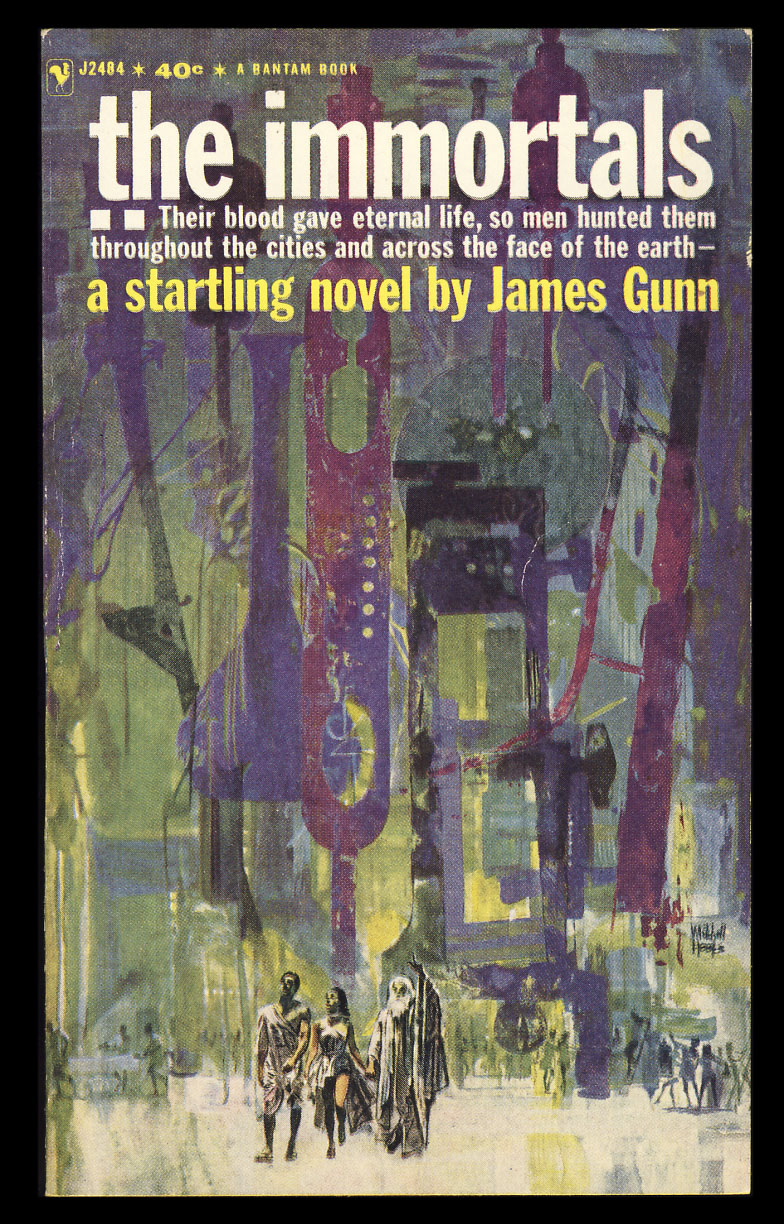
Back in 1976 when the master James Gunn won two major awards for the first edition of this work with its Introduction by Isaac Asimov, vision and youth and optimism ruled in the genre. Star Trek was fresh in our heads with all of its visuals and color. Asimov was working at the top of his creativity and was beginning to speculate autobiographically about “golden ages” that were coming to a close for all of us. Large picture books of the colorful, pulp genre were selling, so Gunn provided one. Just at the same moment, of course, with John Clute and Peter Nicholls working on the SF Encyclopedia (1979) and with Neil Barron’s first edition of The Anatomy of Wonder (1976), the detail and the systematic accuracy in reference books increased to a new level for this literature.  But the Gunn “illustrated history” was history with vision and purpose; it expressed the enthusiasm and sheer love for SF. There was a second edition that I failed to notice and, now, this handsome third edition. Much is still the same, but much has changed. 

In the short space available here, I will describe what I see as changes as well as the ruling Vision and Purpose. In chapter one of both editions, Gunn uses the phrase “science fiction and the world.” The phrase is Romantic and purposeful, and the Gunn vision and sense of purpose fit well with the trending Asimov focus in his career, his obsessive sense of self and its awareness of Golden Age potentials. Expansive heroism and the youthful loneliness of real adventure that become muted a bit in the many years between the first edition and the third edition can be seen represented even in the cover art for the two books. On the 1975 cover, we see a classic and lonely rocket resting on its tail fins. The resting point seems to be one of the moons of Mars, with the huge red planet looming before it and dominating half of the cover in its lonely redness. The Third Edition cover shows a complex and populated space station in orbit above Earth or some similar planet that sports clouds, indicating water, and varied colors, maybe Gethen even, but certainly not the Romantic emptiness of mysterious Mars. In the latter, I sense the presence of much greater complexity and dystopia, but more on that below when I get to the text in the book, as well as more on the sense of predatory competition in the genre. The latter notion seems to be ignored by the gentlemanly Gunn. But basically, I think, he is a hard fighter in his work who hopes to survive in the not-so-visionary Darwinian competition.

Even though he has been dead now for more than half the interval of time between the First Edition and this Third Edition, Asimov still provides Gunn with the laudatory Introduction to his Vision history—an early sign of Gunn’s Romantic denial of the possible predatory nature of death. The text has not been changed, of course. Gunn and Asimov have always seemed to me somewhat of an “odd couple,” even though Gunn did write an early study of Asimov’s work that was published by Oxford University Press (1982).  But the men, about the same age, came from very different backgrounds. The males in Gunn’s family were printers and hawkers of short pulps of the classics called “blue books” throughout the Midwest (see his own autobiography, Star-Begotten: A Life Lived in Science Fiction, 2017). Asimov was a New York fan who grew into the genre as part of the Futurians and by writing fan letters to the pulps of the thirties. Asimov learned his craft in this way and by talking with Campbell. What they shared was the great Romantic vision of the expanding “American” potential for speculative and adventure storytelling. His Introduction in both editions I have before me is actually one of his autobiographical pieces about the meaning to him of SF—“a love affair.” He wrote this for Gunn a bit after his anthology Before the Golden Age (1974) and while he was working on his massive autobiography, the first volume of which appeared as In Memory Yet Green (1979). Note the rich color image in the Asimov title—so Romantic, so much Vision. The two editions of the Gunn history are rich in color.

For the practical use as reference books, however, the color and vision may often serve as a mirage. In both his original conception and, especially, in the later editions, Gunn seems to me a little cavalier in his handling of the details of black and white fact, and these moves relate to his Vision. The actual text writing does resemble the verve and energy we read in Billion Year Spree (1973) by Brian Aldiss. That book is a history, of course, coming a little before Gunn, and Gunn does mention it. But the important hard historical and research work done especially by Clute and Nicholls and by Neil Barron that Gunn was immediately competing with in his own historical work simply is absent from this Third Edition. Gunn had done his own “Encyclopedia” shortly after the Clute and Nicholls work appeared in 1979, and the Gunn efforts had been completely “eaten up” by the success of Clute and Nicholls that now has become a huge database. In fact, this is the hard, predatory world of competition that does not fit well with the youthful energy and vision that both Gunn and Asimov believe in; the wonderful color and pictures hold the Vision. It is a vision we still believe in, and we are delighted to hold and admire this more compact but still lovely Third Edition. The work of James Gunn over his 97 some years of believing is, indeed, inspiring. But even his editorial choices, it seems to me, indicate a somewhat less Romantic scenario that also drives our work. We are grateful for all that the literature of science fiction gives us, both in hard detail and in Vision, even if the Vision itself must be a little predatory in ignoring its competition.