
Non-Fiction Reviews
Review of Thinking through High-Tech Hell: A Theory of the New Media Dystopia
Sara Martín
Miguel Sebastián-Martín. Thinking through High-Tech Hell: A Theory of the New Media Dystopia. Peter Lang, 2024. Ralahine Utopian Studies, Volume 35. Softcover. 384 pg. $60.95. ISBN 9781803744629. https://doi.org/10.3726/b21834.
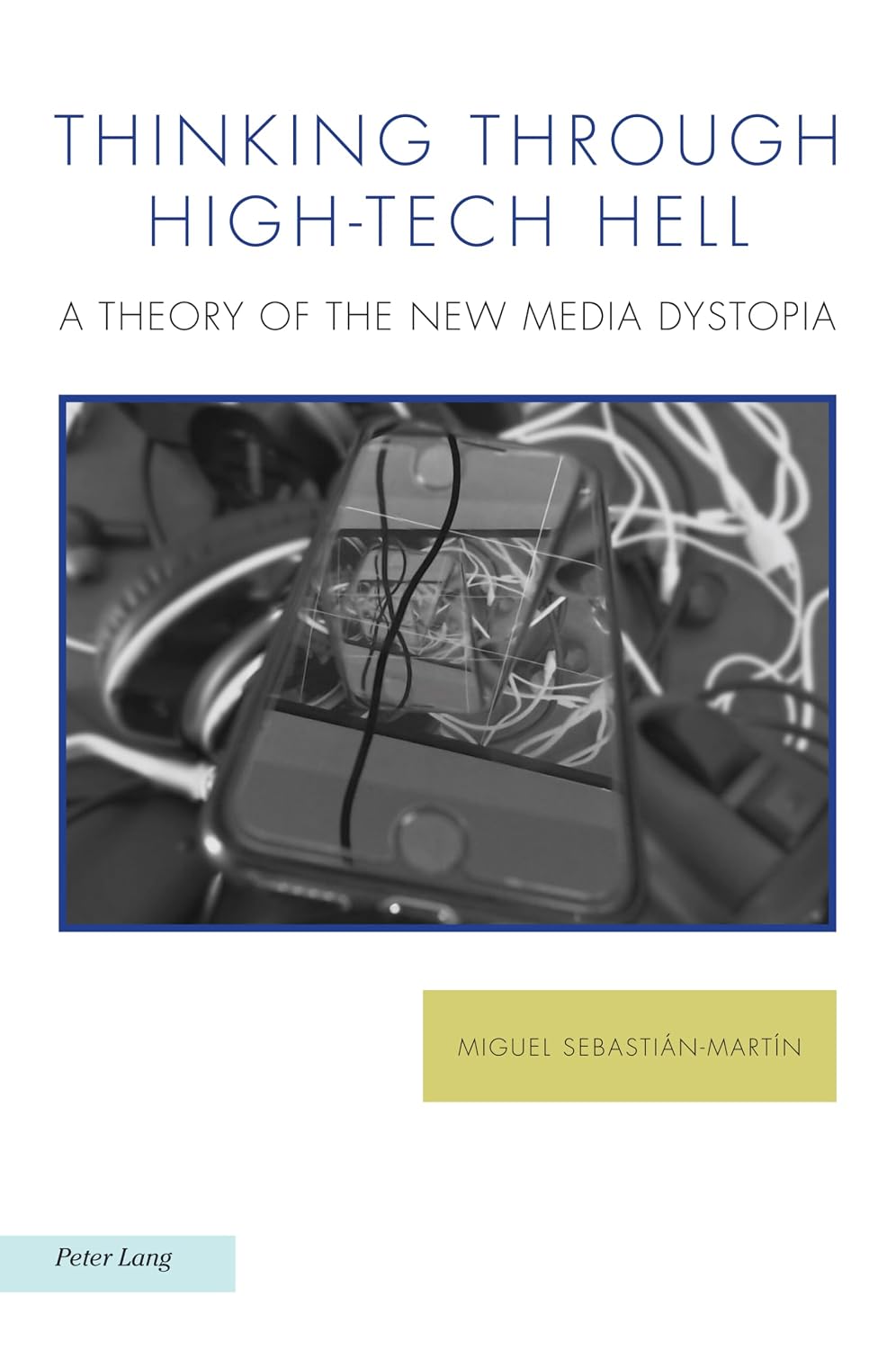
Miguel Sebastián-Martín is a postdoctoral researcher and teacher in the English Department at the Universidad de Salamanca, Spain, where in 2023 he completed the PhD dissertation behind the volume here reviewed, Thinking through High-Tech Hell: A Theory of the New Media Dystopia. Sebastián-Martín, an MPhil in Film and Screen Studies from the University of Cambridge, focuses his research on Anglophone speculative fiction in audio-visual media. In this volume, he studies in particular diverse British and American 2010s series, which he presents as part of the SF sub-genre of new media dystopia.
With this label, Sebastián-Martín refers to the series that criticize digital capitalism while being at the same time successful products of the digital-capitalist streaming platforms. Sebastián-Martín’s volume is informed by the underlying supposition that new media dystopia is part of an epoch-making structure of feeling, as a narratively reflexive sub-genre, as an aesthetically ambivalent form, and as the expression of (post-)postmodern quixotism. The author explores which ways the series selected contribute to, rather than truly criticize, the hopelessness with which we face seemingly indestructible contemporary capitalism, and encourages readers to boldly face the high-tech SF hell that current life is in the age of digital capitalism.
The success of the series that Sebastián-Martín analyzes is paradoxically based on inviting viewers to acknowledge the many points of contact between SF and current reality, and to critically rethink both, but without abandoning the 21st century dystopian structure of feeling. Sebastián-Martín wonders, therefore, whether the series do offer a truly meaningful discourse beyond the attractive post-cyberpunk aesthetics and the enjoyable reflexivity about their own medium: platform TV. The author argues that, actually, the often-ironic approach to their position as SF audiovisual texts made to entertain a media-savvy audience results in a rather limited critical-dystopian message. Often, the characters express a utopian impulse, but, since this follows the myth of Don Quixote, spectators are left with no feasible referents for actual change. Unless, that is, they approach the fictions of new media dystopia as Quixotes ready to fight digital-capitalist giants even knowing they’re windmills.
Thinking through High-Tech Hell is divided into four substantial chapters, each constituting an area of theoretical exploration dense enough to originate a separate volume (the author himself hints this might be particularly desirable in the case of the last chapter, devoted to examining quixotism, and I agree). Chapter 1, “Our Hopeless SF Times: Contemporary Capitalism as a New Media Dystopia,” addresses the contradictions articulating the bleakness that current dystopia expresses, paying attention to left melancholy, capitalist realism, and, above all, to Raymond William’s notion of the structure of feeling. Inspired by Tom Moylan’s concept of the critical dystopia and its links to hope, Sebastián-Martín investigates how in dystopia “contrasting ideological impulses, the utopian and the anti-utopian, are put into dialog, resulting in a complex interplay of hopefulness and cynicism” (43). He worries, though, that our postmodern stance and the neoliberal hegemony are preventing us from finding an alternative to the bleak vision of the dystopian future. This dark panorama has been thoroughly absorbed by SF, so that “new media are now re-imagined as a science-fictional novum when they are understood as a totality and a totalizing force that seems to be taking history in a dystopian direction” (83, original italics). The series, in short, might seem just the cherry on top of the fictional dystopian cake, but they are actually a basic ingredient in our march towards something that might be even worse than the current capitalism.
Chapter 2, “New Media Reflexivity: Self- Referentiality and Self-Consciousness in the Audio-Visual SF of Digital Platforms,” claims that this speculative sub-genre mirrors the nature of the digital media themselves. Using Pedro Javier Pardo’s transmedia model of reflexivity, Sebastián-Martín reads Amazon’s serialized adaptation of Philip K. Dick’s The Man in the High Castle and Black Mirror’s interactive film Bandersnatch, made for American Netflix after the series abandoned UK’s Channel Four. For the author, new media reflexivity is both “a symptom of digital capitalism’s dominant dynamics, which predispose a degree of commodified self-referentiality” but also “a potential mode of estrangement that can be allied with SF’s own estrangement—and directed against the system from within” (120), though neither production ultimately challenges the thriving streaming platforms system of production and consumption.
Chapter 3, “Between Critique and Mystification: The Aesthetic and Ideological Ambivalences of New Media Dystopias,” explores the essential ambivalence of this sub-genre, which offers its products as a potential critique of the excesses of technology while flaunting that same technology as the source of mere SF audio-visual spectacle, just as SF cinema has always done. The analysis of HBO’s Westworld in comparison to Devs (a DNA/FX production distributed by Hulu) also raises the issue of whether unnecessary plot complexity is the main enemy of new media dystopia and the main hindrance to build clear-cut utopian hope.
Chapter 4, “New Media Quixotism: Satiric and Utopian: Characterizations of Digital Subjectivity,” offers a ground-breaking theorization of current SF’s indebtedness to the myth of Don Quixote. Sebastián-Martín considers Black Mirror’s popular episode “USS Callister” (Netflix), Mr. Robot (US Network) and Maniac (a Netflix remake of a Norwegian series), to explore characters who, following Cervantes’s unique protagonist, mix (science) fiction and reality with different degrees of awareness, and madness. Sebastián-Martín, however, prefers not to deal with the issue of whether this new SF quixotism affects in particular male characters, concluding instead that all spectators are “somewhat quixotic as users of digital technologies” (337) which provide us with dystopian views of the present and the future, as we ponder, each of us alone before the screen, “what we can do about the apparently inevitable” (337).
Thinking through High-Tech Hell: A Theory of the New Media Dystopia does not conceal from readers that its aim is to present a theory of a particular SF sub-genre. This is why the analysis of the series selected leaves readers asking for more (such as information about the platforms distributing the series and the material conditions of production), while the deluge of footnotes leaves us asking for less. Sebastián-Martín assumes a no doubt idealizing quixotic position in trying to impose order onto a very complex phenomenon, as he maps simultaneously the theorization of capitalism (above all of commodified culture), audio-visual SF, the new media, their rather hypocritical dystopian inclinations and their techno-ambivalent gaze (a re-purposing of Laura Mulvey’s ‘male gaze’). He calls, besides, for “theorizing digital platforms as self-referential, all-encompassing paratexts” (341) since “there is still need for a theory of the possibilities—and the limits—that digital cultural consumption poses for reflexive narration” (341). The author’s beautiful quixotism is also manifest in his decision to celebrate his mentor, Pedro Javier Pardo, cited in many points of his book as an indispensable referent, when most of us, Spanish scholars in SF studies and/or English Studies, too often unfairly ignore our own local talent to rely instead on Anglophone big (and small) names.
“Maybe descending into high-tech hell,” Sebastián-Martín writes as a final conclusion, “was a necessary exercise that gave us a degree of critical-utopian clarity” in the 2010s to “keep on walking away, to see what awaits” (345) beyond the paralyzing hopelessness of the 2020s, to which the popular series of new media dystopia have so significantly contributed. The future calls, indeed, for a new utopian SF but, as Sebastián-Martín warns, this cannot be built unless we abandon our postmodern cynicism and turn technology into a source of welfare rather than despair.
Sara Martín is Senior Lecturer in English Literature and Cultural Studies at the Universitat Autònoma de Barcelona and a SFRA member. Dr Martín specializes in Gender Studies, particularly Masculinities Studies, and in Science Fiction Studies. Her most recent books are American Masculinities in Contemporary Documentary Film (2023), Masculinity in Contemporary SF by Men: No Plans for the Future (2025) and Masculinities in Contemporary Science-Fiction Television (2025, co-edited with Michael Pitts).


