
Non-Fiction Reviews
Review of Late Star Trek: The Final Frontier in the Franchise Era
Jeremy Brett
Adam Kotsko. Late Star Trek: The Final Frontier in the Franchise Era.University of Minnesota Press, 2025. Mass Markets: Storyworlds Across Media. Paperback. 256 pg. $22.95. ISBN 9781517919108.
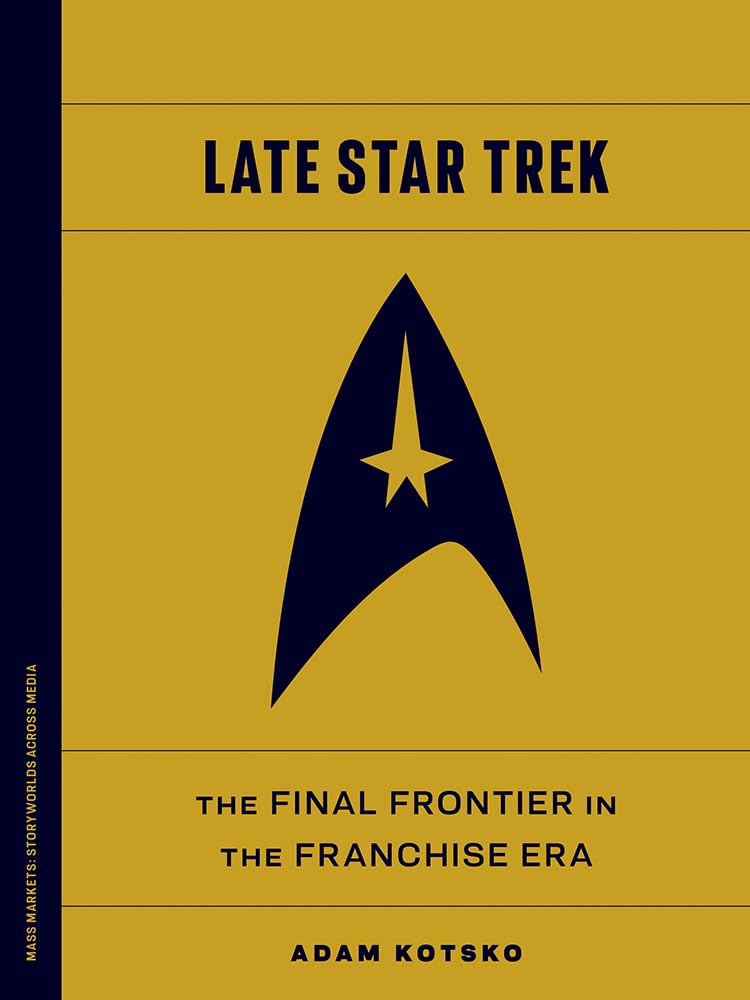
Above all, reading Late Star Trek gives the reader a solid appreciation for the result of scholarly and thoughtful analysis when melded with the enthusiasm, excitement, and feelings of betrayal for a franchise that only a fan can provide. Kotsko’s volume is suffused with his own fannish opinions (for example, his love for the first season of Discovery[1] [DIS] [2017-2024] followed immediately by his crushing disappointment in its remaining seasons, or his scathing summary of the narrative failures of Picard [PIC] (2020-2023), or his clear affection for Lower Decks [LD] [2020-2024]). Trek fans and scholars alike, I believe, will commend Kotsko’s avoidance of stereotypical scholarly bloodlessness; rather, they will, as I do, take delight in the ways in which he is deeply committed to the Trek storyworld in its various permutations and how that longtime love informs his analysis of its successes, failures, and creative potential. I think, in fact, that Kotsko’s work is a model of readable, practical popular cultural analysis, because the best scholars tell us not only factually or analytically what we need to consider about a particular topic but emotionally why that topic is meaningful. There’s uncommon emotional resonance in a media franchise like Star Trek, which has nearly six decades of history behind it, including eleven television series, fourteen films (13 theatrical, 1 streaming) from two different in-universe timelines, more than 850 tie-in novels and story collections, numerous comic book series, and boundless amounts of social and cultural recognition. Such a widespread body of content that has generated so much love and fannish dedication over the years deserves attention, particularly in our late-stage capitalist age when nothing seems free of commodification, even a beloved media franchise that traditionally roots itself in a post-scarcity utopia where inequality is nonexistent.
One of the more valuable portions of Kotsko’s study is his examination of the ways in which “late Star Trek” (the term Kotsko applies to the period of the franchise following the end of Voyager in 2001, the time when “Star Trek stops being a business out of necessity, simply because that’s what it takes to keep new stories, and becomes more purely commodified (2)”) evolves in the face of corporate necessity. Late Star Trek represents a media moment where, as Kotsko puts it, “story decisions are dictated by business strategy, when the quest for new audiences risks undercutting everything the established fans love, and when endless reams of materials are churned out in the expectation that those same fans will shell out for anything with the name Star Trek on it” (Ibid.) (No doubt Star Wars fans are nodding along with this sentiment.) However, Kotsko never simply surrenders to a simplistic model in which late Trek = late-stage capitalism and neoliberalism (and a concomitant assumption that late Trek is automatically and forever worse than the original series or Next Generation [1987-1994]). Instead, throughout the book he brings to bear his inner Trekkie and posits that Trek avoids full commodification in this late period—despite multiple dramatic missteps—because the people who generate and consume it still tend to love it (well, perhaps not Section 31 [2025]) and take to heart the ethics, values, and ethos that mark the Trek universe. And by proceeding step by step through each iteration of post-Voyager (1995-2001) Trek, Kotsko produces what he calls “a case study for late capitalist franchise storytelling…(and) our understanding of a franchise that has always been noted for its relative intellectual sophistication and has therefore held a privileged place in the academic study of popular culture” (16). Furthermore, he looks deeply into the double-edged, fraught influence of franchise “canonicity,” which throughout Trek is a push-and-pull struggle between fan service (where canonicity is enshrined as the highest value), artistic freedom as expressed through discontinuity from the main established storyworld narrative (which can be a perilous endeavor the more it pulls away from that narrative), and maximizing worldbuilding (which synthesizes both these other strategies, but which risks losing character and plot development). His method is an elegant one for exploring canon in all its ramifications for a franchise, ranging from igniting fannish enthusiasm to a cheap replacement for narrative exploration.
These three different narrative strategies and their varying levels of deployment mark the directions of every Trek iteration in late Trek. Kotsko begins with an exploration of the prequel show Enterprise (2001-2005), Star Trek’s redheaded stepchild, generally disliked by fans and eschewed by scholars. The series, under franchise bêtes noires Rick Berman and Brannon Braga, had the unenviable task of being the first Trek iteration to try and solidify the universe’s timeline into some sort of cohesive whole. But despite bright spots, Kotsko argues that the show was dragged down by the creative decision to make a prequel (that should, by definition, prioritize fan service and reward fannish understanding of franchise lore) that instead tried to center Berman and Braga’s desire for creative freedom which ended by downplaying or ignoring the Trek tradition of progress, diversity, and inclusion. Later attempts in the show to try and exercise fan service (i.e. the Klingon head ridges storyline) were maladroit and unnecessary at best, producing in the end a series that was “a fragment, riven by contradictions and continually making promises its creators could not—and perhaps did not even want to—fulfill” (64). However, Kotsko argues that Enterprise set the tone for future late Trek in trying to maintain a successful tension between fan service and creative freedom while making frequent use of in-text meta gestures to continually cement itself into the franchise’s history and evolution.
The next section of the book examines the area of the Trek universe that has received the least scholarly analysis: the “novelverse,” that is, the body of so-called ‘beta canon’ that supplements what we see on screen. Kotsko quotes Sean Guynes and Gerry Canavan, who define the novels as “an imaginative space for fans to collectively work out the implications of concepts from televisual Star Trek, as well as to identify and attempt to resolve apparent contradictions in the character portraits, fictional history, and philosophical themes of the series” (70). That massive and complex body of work is no less meaningful because the corporate owners of Trek deem it noncanonical and not legitimate. He uses the works of three different authors to ground his analysis here: Christopher L. Bennett (who personifies effective deployment of fan service), Kirsten Beyer (artistic freedom), and David Mack (Federation- or worldbuilding strategies). The novelverse in many ways, Kotsko argues, enjoyed the freedom to drastically expand our reading of thefranchise from Enterprise through Voyager, but that creative flowering was dramatically curtailed once Picard began production and the novels’ canon was deemed irreconcilable with what the Powers That Be declared “official,” requiring an overwriting and destruction of the entire novelverse, in part, it seems, to meet studio executives’ need for control over a profitable product.
Another chapter explores the “Kelvin Timeline,” the three films from J.J. Abrams set in an alternate timeline and rooted in a creative freedom that would free them from the constraints of an established canon. The first film, Star Trek (2009), however, proved empty in being concerned with nothing more than placing new versions of beloved Original Series characters into familiar positions on board the U.S.S. Enterprise. The next film, Into Darkness (2013) was a poorly disguised 9/11 allegory, and the third, Beyond (2016), is convoluted and, like its predecessor—and much else in late Trek—is darkly overlaid with themes and images of terrorism. The Kelvin reboot/prequel/sequel hybrid series proved ultimately unsuccessful in impacting the greater Trek universe by its emotional and actual separation (mandated by corporate pettiness between co-owners CBS and Paramount) from the beloved Original Series. Kotsko then moves to Trek’s return to television after a 12-year absence: Discovery (2017-2024), whose first season resulted in what Kotsko calls one of the finest story arcs in Trek history, through both a re-embrace of traditional Trek diversity and taking seriously franchise worldbuilding via intricate plots and dramatic retcons (i.e. a devastating Federation-Klingon war that had never been mentioned in the franchise before). But later seasons betrayed this original expansion of artistic freedom by writing the series into an irrelevant dead end and much more clumsy, haphazard worldbuilding.
Kotsko reserves his greatest fannish scorn and disappointment for Picard (2020-2023), the first Trek since the 2002 film Star Trek: Nemesis to move the timeline forward past Next Generation. As with Discovery, the first season of Picard combined creative freedom with expansive worldbuilding to create a complex and emotionally rich story, one that “breaks” the utopia of Next Generation by placing TNG’s Picard in a Federation that is callous towards Romulan refugees and allows economic inequalities, and where old friends (William Riker and Deanna Troi) live lives marked by grief and trauma. But Picard suffers from developing plot incoherence and an increasing tendency to reset in the name of fan service—season 3 virtually erases season 2—and culminates in a painfully pandering conclusion that reunites the TNG crew on the bridge of the old Enterprise-D battling the last of the Borg. Kotsko notes that this moment marks perhaps the lowest point of late Trek, “the moment when the franchise threatened to transform into a purely cynical commodity, nothing more than ‘content’ churned out to extract subscription fees for Paramount+” (197).
A final chapter plays cleanup by discussing together the latest three Trek shows: the animated and ultra-meta comedy Lower Decks (2020-2024), the animated children’s adventure series Prodigy (2021-2023), and the prequel Strange New Worlds (2022-present), all of which taken together demonstrate late Trek’s potential for narrative variety. All three series share a general unconcern with the knottiness of worldbuilding, that instead obliges them to concentrate on interesting and likeable characters and a return to the episodic nature of old Trek instead of a focus on universe-shattering story arcs that mark Discovery and Picard. Their approach to canon varies. Prodigy, set just before Picard, sidesteps canonical disconnect by setting itself mostly (especially in season 1) in the distant Delta Quadrant, far from the Federation; Lower Decks embraces canon as an opportunity by constantly referencing it as part of the characters’ lived experiences as self-aware fans of the franchise’s past; and Strange New Worlds manages to wear lightly its identity as an ultimate expression of fan service while still flexibly playing with canon without destroying it (i.e. by readjusting the romantic tension between Spock and Christine Chapel, or by giving the lizardlike Gorn a terrifying and horrific Xenomorph-like maturity cycle).
Kotsko concludes his remarkable study on a cautionary note, referencing failures in studio management, corporate tendencies to interfere with creative production, the periodic invalidation of tie-in productions, problems with the streaming television model and, most of all, an overreliance on the significance of franchise canon. He calls this concept of a binding canon “a marketing technique to compel fans to consume every new installment because it may become relevant for still later installments” (239), and worries that, for all the fun that fan theories and connections to canon may generate (I’m certainly guilty myself of such activities!), an iron-clad commitment to a corporate-mandated continuity may ultimately suffocate drama, and cause consumers, driven by a production environment devoted to maximizing profits, to replace appreciation of plots and characters on their own terms in favor of labored, endless searches for canonical connections that may not exist. But, in the finest tradition of the Star Trek he loves, Kotsko holds out optimism, if future Trek creators can be freed from the current neoliberal moment and given freer rein to explore the post-capitalist utopia in which Star Trek resides.
[1] For the purposes of this review, I am ignoring the naming convention that the titles for all the series discussed here formally begin with the prefix ‘Star Trek:’.
Jeremy Brett is a Librarian at Cushing Memorial Library & Archives, where he is the Curator of the Science Fiction & Fantasy Research Collection, one of the largest of its kind in the world. He has also worked at the University of Iowa, the University of Wisconsin-Milwaukee, the National Archives and Records Administration-Pacific Region, and the Wisconsin Historical Society. He received his MLS and his MA in History from the University of Maryland – College Park in 1999. His professional interests include science fiction, fan studies, superheroines, and the intersection of libraries and social justice.


