
Non-Fiction Reviews
Review of The Films of Jesús Franco, 1953–1966
Elena Natalia Romea Parente
Francesco Cesari and Roberto Curti. The Films of Jesús Franco, 1953-1966. McFarland Books. 2024. Paperback. 381 pg. $59.95. ISBN 9781476694313. eBook ISBN: 9781476652115. https://mcfarlandbooks.com/.
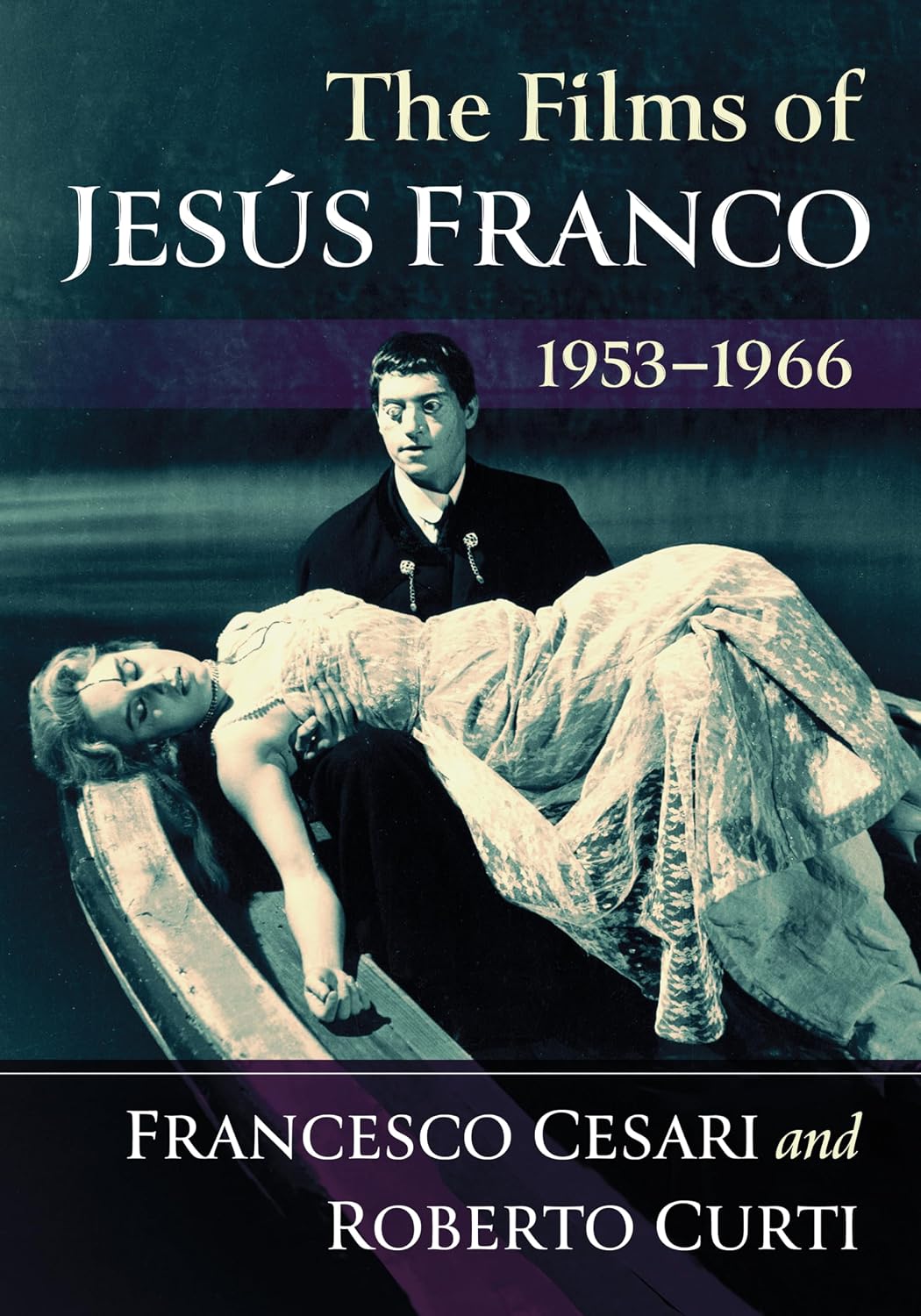
Jesús “Jess” Franco (1930–2013) occupies a unique position within European genre cinema, navigating the boundaries between exploitation, auteur filmmaking, and underground aesthetics. The years 1953 to 1966 mark Franco’s formative period, laying the foundation for his later cult status. Despite directing over two hundred films, Franco has remained a marginal figure in mainstream film scholarship, though his work has garnered considerable attention within cult cinema circles. Academic engagement with his body of work remains uneven and often polarized, oscillating between celebratory fan discourses and outright critical dismissal. Notable contributions include Obsession: The Films of Jess Franco (1993) by Lucas Balbo, Peter Blumenstock, Christian Kessler, and Tim Lucas, which combines biographical insights with an accessible, albeit non-academic, exploration of Franco’s recurring motifs and aesthetic tendencies. Similarly, Alain Petit’s The Strange Case of Jesús Franco (1998) provides filmographic detail and personal recollections, though its critical perspective is limited. More recently, Stephen Thrower’s two-volume work, Murderous Passions: The Delirious Cinema of Jesús Franco (2015), has become a key reference for both scholars and fans, offering production histories and in-depth analysis. However, its coverage of Franco’s early films remains cursory, focusing predominantly on his later, more sensational output. Within the broader context of European exploitation cinema, Cathal Tohill and Pete Tombs’ Immoral Tales: European Sex & Horror Movies 1956–1984 (1995) situates Franco alongside contemporaries such as Jean Rollin and José Ramón Larraz, emphasizing his transgressive role within genre traditions. Nevertheless, focused academic attention on Franco’s early career (1953–1966) remains notably scarce—a gap that The Films of Jesús Franco, 1953–1966 directly addresses.
Primary sources authored by Franco himself offer valuable insights into his creative process and self-perception as a filmmaker. His statements, dispersed across interviews and liner notes for home video releases, reveal his resistance to genre classifications and his commitment to artistic subversion. Notably, La noche pasa demasiado lenta (1991), Franco’s semi-autobiographical and poetic work, provides a glimpse into his personal mythology and creative psyche, blending fiction with reflections on his cinematic preoccupations. Further interviews compiled in Balbo et al.’s Obsession and Thrower’s Murderous Passions illuminate Franco’s views on censorship, genre hybridity, and his complex relationship with commercial and avant-garde cinema. Although often anecdotal, these sources are essential for understanding the idiosyncratic trajectory of Franco’s early artistic development.
The Films of Jesús Franco, 1953–1966 offers a timely, well-researched examination of Franco’s often overlooked early films, situating them within two intersecting frameworks: the political and cultural conditions of Francoist Spain, and the industrial dynamics of European co-productions. By focusing on his formative years—characterized by genre experimentation, musical influences, and subversive elements—the book fills a significant gap in Franco critical studies. It challenges the prevailing assumption that his career began solely within exploitation cinema, instead of foregrounding his engagement with diverse genres and artistic aspirations. As discussed in Obsession: The Films of Jess Franco (1993), these early films provided fertile ground for experimentation, wherein Franco explored musical motifs and genre hybridity, foreshadowing the more defined horror and erotic aesthetics of his later work. The book offers critical reassessment through archival research, primary sources, and detailed film analysis.
Authors Francesco Cesari and Roberto Curti engaged in rigorous archival work, drawing on censorship records, contemporary reviews, and production documents to construct a comprehensive portrait of Franco’s artistic development. Their approach significantly deepens the understanding of Franco’s early output, demonstrating that his subversive tendencies and experimentation were present from the outset.
While The Films of Jesús Franco, 1953–1966 provides an academically grounded, contextual analysis of his early work, Cesari and Curti’s earlier publication, The Jess Franco Files – Vol. 1: Cuatro guiones y una sinopsis de Jesús Franco (2017), offers a complementary perspective through its use of primary sources. This volume presents four of Franco’s screenplays and one synopsis, granting unprecedented access to his creative process through previously unpublished materials. As an archival resource, The Jess Franco Files is invaluable for researchers focused on textual analysis and script development.
In contrast, The Films of Jesús Franco, 1953–1966 prioritizes critical interpretation, situating Franco’s early films within the socio-political and industrial contexts of post-war Spain and Europe. It combines scholarly argumentation with insights from secondary sources, production histories, and interviews, rather than relying exclusively on Franco’s unmediated creative documents. Its strength lies in connecting these early films to broader discourses on genre cinema, censorship, and transnational production, while The Jess Franco Files provides raw textual material without substantial analytical framing.
One of the book’s most compelling contributions is its examination of Franco’s relationship with national identity and international co-productions. The authors demonstrate how his collaborations with French, German, and Portuguese producers enabled him to transcend the constraints of Spanish cultural policy, resulting in films that defy straightforward categorization. In doing so, the book aligns with contemporary scholarship that reframes European exploitation cinema as inherently transnational. Rather than portraying Franco as merely a purveyor of low-budget cinema, Cesari and Curti present him as a director who actively negotiated the boundaries of artistic freedom within restrictive political and commercial environments. Their research underscores Franco’s ongoing experimentation with narrative form and genre conventions as central to understanding his evolution as an artist, preceding the more sensational elements that would later define his reputation.
However, the book offers limited exploration of how Franco’s early films were marketed, censored, or critically received beyond Spain. While it provides a thorough analysis of the transnational production context, the international reception of these works receives comparatively less attention. This omission mitigates? inhibits? makes it difficult for readers to gain? a comprehensive understanding of the global circulation and legacy of Franco’s pre-1967 output—an area complicated by the post-war political climate and the challenges of incomplete, poorly preserved, or lost film records from the period.
Despite this limitation, the book makes a substantial contribution to cult cinema studies by elevating Franco’s early work from historical obscurity to essential groundwork for his later, more widely discussed productions. By centering on this neglected period, Cesari and Curti invite a reassessment of Franco as a filmmaker whose artistic ambitions extended well beyond his most controversial films.
The Films of Jesús Franco, 1953–1966 offers a much-needed scholarly examination of a crucial yet underexplored phase in Franco’s career. Through meticulous archival research and critical film analysis, the book challenges reductive readings of his early work and situates it within broader cultural and industrial frameworks. While certain aspects, particularly international reception, could be more fully developed, the book ultimately succeeds in addressing a significant gap in research about Jess Franco. It serves as a vital resource for scholars of Spanish cinema, European genre film, and cult cinema more broadly, representing a key step in the ongoing academic reassessment of Jess Franco’s diverse and often misunderstood filmography.
WORKS CITED
Balbo, Lucas, et al. Obsession: The Films of Jess Franco. Editions 7e Dimension, 1993.
Franco, Jesús. La noche pasa demasiado lenta. Ediciones La Máscara, 1991.
Franco, Jesús. The Jess Franco Files: Cuatro Guiones y Una Sinopsis de Jesús Franco (Laberinto; La Noche Tiene Ojos; El Castillo de Frankenstein; Un Tiro en la Sien; Orloff 2001). Edited by Roberto Curti and Francesco Cesari, 2017.
Petit, Alain. The Strange Case of Jesús Franco. L’Étrange Festival, 1998.
Thrower, Stephen. Murderous Passions: The Delirious Cinema of Jesús Franco. Vol. 1, Strange Attractor Press, 2015.
Tohill, Cathal, and Pete Tombs. Immoral Tales: European Sex & Horror Movies 1956–1984. Titan Books, 1995.
Elena Natalia Romea Parente holds a PhD in Spanish Cinema and Literature, with a doctoral dissertation focused on the Spanish mystic filmmaker José Val del Omar. She also holds dual degrees in English and Spanish Studies, as well as a Master’s in European Literary Studies. Her academic career includes teaching appointments at several Spanish universities, including the Universidad Autónoma de Madrid (UAM) and the Universidad Nacional de Educación a Distancia (UNED). In addition to her scholarly work, she is the founder of Spanish Fear (spanishfear.com), a platform and podcast dedicated to the study and dissemination of Spanish horror cinema. Her research engages with multidisciplinary contemporary narratives, with particular emphasis on horror, the uncanny, and the aesthetics of strangeness.


