Review of Diverse Futures: Science Fiction and Authors of Color


Review of Diverse Futures: Science Fiction and Authors of Color

C. Palmer-Patel

Joy Sanchez-Taylor. Diverse Futures: Science Fiction and Authors of Color. Ohio State UP, 2021. New Suns: Race, Gender, and Sexuality in the Speculative. Paperback. 188 pg. $29.95. ISBN 9780814257975.
By probing works of science fiction by authors of color, Joy Sanchez-Taylor’s Diverse Futures addresses an incredibly necessary missing facet of science fiction literature and criticism. While there have been a number of critical works that focus on specific cultures and locales, Sanchez-Taylor takes on the incredible task of finding common ground between narratives from a variety of different cultures and racial identities (all published in the US and Canada in the English language). Rather than taking a survey approach, Sanchez-Taylor focuses on themes that decenter a Eurowestern perspective on science fiction. She approaches this undertaking deftly and sensitively. It would have been easy for an academic to conflate connections and thereby homogenize cultures, but Sanchez-Taylor avoids this pitfall with a notable hesitancy throughout the book. While a hesitant tone is not usually a quality to aspire to in a scholarly text, I use this assessment here not as a critique, but in praise: her tone serves as a useful model to other scholars who may be examining identities with which they themselves may not identify; rather than authoritatively sweeping these gaps under the rug, Sanchez-Taylor recognizes her own limitations and biases in a conscientious way.

The monograph begins with an introduction that acknowledges that the act of defining science fiction itself is charged with Eurocentric overtones, as the demarcation of ‘science’ and ‘rationality’ are generally taken from a Eurowestern point of view. This problem of definitions continues as Sanchez-Taylor expounds on debates of more culturally specific genre labels such as Afrofuturism alongside considerations of nomenclatures of peoples and cultures themselves, such as Latinx. In a footnote, Sanchez-Taylor clarifies, “I recognizes that any catch-all descriptor comes with issues, so I am choosing the term that is, to date, the most contemporary and inclusive term available” (16). This remark not only exemplifies Sanchez-Taylor’s care towards her chosen subject, but also an awareness of the ways that language and subtext may shift in the future.

The meat of the monograph is spread over four chapters which arguably may be read out of order, with each chapter further divided into sectioned themes and motifs. As a result, the text would work well in the classroom as sections can be selected to suit the topic of discussion at hand. For instance, chapter 1, “Space Travel and First Contact Narratives,” is sectioned into alien invasions, first contact and colonial relations, interplanetary diaspora and adaptation, and decentering the human. Overall, the chapter focuses on the inevitable colonization themes of space exploration and alien contact narratives. Sanchez-Taylor presents several authors of color who further the boundaries of these themes by complicating the role of alien as Other, focusing on examples that pose the alien as benevolent or malevolent colonizer/explorer rather than as a colonized entity mistreated by humans. Chapter 2, “Race, Genetics, and Science Fiction,” turns to considerations of how narratives of science and technology can be used to perpetuate race discrimination. Here and throughout all four chapters, Sanchez-Taylor effectively integrates close reading of fictional texts with examinations of real-world historical narratives, critical theories, and legal factoids. Spanning a range of examples from nineteenth century Social Darwinism to more recent trends such as genealogy and common sites such as AncestryDNA, these examples are set alongside reflections on documented medical apartheid, experimentation without consent, and eugenics, all of which demonstrate the ways in which scientific language has been historically used to justify the subjugation of peoples of color. This seamless blending of fictional analysis with real-world politics is one of the main strengths of the monograph, as it leads the reader away from hypothetical thought and theory into making connections with the experiences and mistreatment of real people and cultures.

The references to real events throughout also place the text as a valuable contribution to science fiction studies, as it situates and contextualizes many science fiction texts that are too often read in a vacuum. For instance, in chapter 3, “The Apocalypse Has Already Come: Post-Apocalyptic Landscapes,” Sanchez-Taylor begins with illustrations of colonial history and how “Eurowestern colonizers justified their colonization of peoples […] based on the argument that “certain races and ethnicities were more prone to criminal behaviors” (86). She uses the example of the Criminal Tribes Act of 1911; grounding race crimes in such legal history then allows Sanchez-Taylor to provide additional context for the ongoing interrogations of citizen and resident rights and freedoms, raising the issue of the culture of surveillance and containment in the U.S, which she then parallels in her exploration of dystopic fiction. Sanchez-Taylor then moves to zombie narratives, presenting another form of the supernatural Other but this time as a means to question the characters’ (and thus the audience’s) human superiority. Reminding the reader that “[t]he zombie figure was born of colonial slave violence” (107), Sanchez-Taylor presents the zombie as a sanctioned fantasy of racial violence and argues that these narratives force the audience to evaluate their own parallels with both human and zombie. The ongoing theme of decentering the Eurocentric view is expanded in Chapter 4, “‘Our Knowledge Is Not Primitive’: Indigenous and Eurowestern Science,” which continues the conversation begun in the introduction, that of the problems of defining science fiction—and science itself—through a Eurowestern lens. Here Sanchez-Taylor presents an important and timely global issue, that of climate change, by considering the global-connectedness views of Indigenous peoples with the more anthrocentric approach of Eurowestern scientists. The chapter thus adds further nuances to analyses of climate fiction, focusing as it does on the ways in which primarily Westernized science and technology has contributed to the climate crisis.

There are few moments throughout the monograph which could have benefitted from early signposting of the connections between racial disparities and problems of gender, sexuality, and class struggles. A reader familiar with science fiction criticism (presumably the target audience of the book) would have immediately made these connections themselves before Sanchez-Taylor draws her arguments to include these considerations. But this criticism is one I make as a content editor, and it does not detract from the strength and value of the overall monograph. Indeed, if I have one quibble with the text, it is of an opportunity lost: while the monograph is an absolute essential for science fiction students and scholars—especially as universities move globally to decolonize the classroom—the book would also have been equally valued, if not more, if aimed at postcolonial critics. Diverse Futures: Science Fiction and Authors of Color is not simply a book that recognizes and acknowledges important contributions of peoples of color in the science fiction genre (as the subtitle might indicate), but instead highlights how each text contributes to a meaningful and impactful examination of postcolonial or diasporic struggles and identities. Consequently, Sanchez-Taylor misses a golden chance to promote critical considerations of science fiction literature in more traditional ‘literary’ fields, a goal that might have been easily accomplished through minor repacking. That said, while the monograph is not overtly pitched toward postcolonial critics, it would still make a meaningful addition to a postcolonial module or courses dedicated to discussions of global literatures and identities. And, of course, it should also be on the recommended reading list for any science fiction module, as it serves as a fantastic primer for any scholar of science fiction who wishes to approach the genre with postcolonial conscientiousness.


Charul (“Chuckie”) Palmer-Patel is founder of Fantastika Journal (www.fantastikajournal.com), a journal that brings together the genres of Fantasy, Science Fiction, Gothic Horror, among others. Her first monograph, The Shape of Fantasy (Routledge 2020) investigates the narrative structures of Epic Fantasy, incorporating ideas from science, philosophy, and literary theory. The monograph has been shortlisted for the Mythopoeic Award twice. Her next research project, The Mother-Hero, interrogates power structures depicted in contemporary American Fantasy Fiction, specifically investigating the place of women within these structures. You can find out more about Palmer-Patel at www.doc-fantasy.com.
Review of Fear and Nature: Ecohorror Studies in the Anthropocene


Review of Fear and Nature: Ecohorror Studies in the Anthropocene

Jonathan W. Thurston-Torres

Christy Tidwell and Carter Soles. Fear and Nature: Ecohorror Studies in the Anthropocene. Pennsylvania State UP, 2021. AnthropoScene SLSA Book Series. Cloth. 300 pg. $109.95. ISBN 9780271090214.

Ecohorror is a long-standing genre in film and literature that is both immensely popular and woefully under-analyzed by academia. Christy Tidwell and Carter Soles’s edited collection Fear and Nature: Ecohorror Studies in the Anthropocene is an attempt to remedy that dearth of scholarly criticism. What I love most about this book is the scaffolding that happens for young scholars here as well as the intellectual inquiry that naturally (pun intended) comes from many of these essays. The introduction helps to develop a language for discussing ecohorror. The early chapters work on showing the versatility of ecohorror. The later chapters showcase more specific applications of the theory earlier in the book. It is a book meant to be read from start to finish, and that is a rare treat in these edited collections. That scaffolding makes many of these topics approachable for rising scholars. And again, many of these chapters left me thinking for days and even weeks after reading. I will never see a bathroom scene in a horror film the same way again. I will never read Junji Ito without looking for an ecohorror implication. And I am confident I will have an excellent book to teach when next I teach an ecohorror lit class.

The editors spend much of the book’s introduction in defending the title. In defining “ecohorror,” a central term throughout the book, they examine the multiple ways that the book’s authors approach ecohorror: “We fear science and its attempts to control the natural world; we fear the natural world and the way it exceeds our control. We also value science as a way of understanding the world, however, and return to it repeatedly in these narratives; we value the natural world and fear its loss at least as much as we fear nonhuman nature itself” (7). Clearly, “fear and nature” have a complex relationship in ecohorror, and this book works to unpack at least some of those complexities. What is perhaps more compelling than Tidwell and Soles’s explication of ecohorror is their analysis of extant ecohorror scholarship. They examine each of the “four full-length critical works on ecohorror to date” and show the limits of those works (8). Tidwell and Soles envision Fear and Nature as adding to the discourse an “ecohorror-as-mode approach… a cross-generic and cross-media mode” (10). This interdisciplinarity is explored in four parts throughout the book. The first part, “Expanding Ecohorror,” focuses on “new types of ecohorror and seek[s] out connections between ecohorror and other types of horror” (10). The next section, “Haunted and Unhaunted Landscapes,” prioritizes readings of the environment as literary landscape in ecohorror. “The Ecohorror of Intimacy,” the third section, centers on “horror located in the home and/or family” (12). And the final part of the book, “Being Prey, Being Food,” “examines narratives of food and predation between human and nonhuman in ecohorror texts” (13). Together, these sections work to explore the boundaries of both ecohorror and ecohorror scholarship.

The first essay, “Tentacular Ecohorror and the Agency of Trees in Algernon Blackwood’s ‘The Man Whom the Trees Loved’ and Lorcan Finnegan’s Without Name,” by Dawn Keetley, argues that one type of ecohorror that does not get much attention is “tentacular ecohorror, which describes the terrifying encounter with a nonhuman nature that reaches out to grab and entangle the human” (24-25). She claims that the two titular works exemplify this narrative of facing alterity and the human being transformed by it. The essay excels in seating acute close reading inside comparatist contexts, comparing this kind of ecohorror to Friday the 13th (1980) or The Texas Chainsaw Massacre (1974). The writing alone would be a great model to rising scholars.

The final essay in the section, “‘The Hand of Deadly Deca’: The Rotting Corpse, America’s Religious Tradition, and the Ethics of Green Burial in Poe’s ‘The Colloquy of Monos and Una,’” by Ashley Kniss, examines a rare example of buried-alive stories, “The Colloquy” by Poe. Kniss claims that, in its resistance of the religious resurrection narrative or typical horror of this kind of story, “The Colloquy” acts as a “mediation of the binary tension between ecophobia and ecophilia,” rather than perpetuating either in isolation (71). What I found most compelling as Kniss’s departure from Sara L. Crosby, arguing that the body’s decomposition indicates an “actual physical merger with the nonhuman Other” rather than Kniss’s claim that it signifies a “pretended merger with the other” (71). Due to the specificity of the text, however, and the lack of comparatist work, it is probably one of the least applicable or interesting-to-teach essays unless you happen to be teaching this one specific story.

The next part begins with Keri Stevenson’s “The Death of Birdsong, the Birdsong of Death: Algernon Charles Swinburne and the Horror of Erosion.” Stevenson characterizes Swinburne’s poetry of erosion as “disanthropic,” “‘distinguished [from misanthropic] by [man’s] absence from the future he envisages’” (93). As Stevenson later says, “time and the sea have destroyed only the human portions of the garden,” noting that weeds, less romanticized birds, and thorns survive easily throughout the works (97). This focus on disanthropy is productive in considering ecohorror largely, so, even though the essay lingers on one author with whom the average reader might not be familiar, the reader can walk away with useful tools for analyzing ecohorror here.

In “An Unhaunted Landscape: The Anti-Gothic Impulse in Ambrose Bierce’s ‘A Tough Tussle,’” Chelsea Davis argues that some fictional landscapes “actively refuse to absorb, echo, or respond to us,” and these “rejections might take the form of a parody, a hoax, or an empiricist dismissal of ghosts in the wilderness” (111). I immediately thought of the ways the recent film The Witch (2015) did not make these rejections; just in a few pages, Davis’ work challenges you to find examples and counterexamples. And then, she moves on to her own main case study, Bierce’s “A Tough Tussle.” Her analysis covers comparatist and historicist readings that move almost into philology and cultural studies by the end. I can easily envision teaching this chapter and this story in a class just on literary studies, as it takes from these different methodologies and weaves them together in provocative ways.

Bridgitte Barclay’s “The Extinction-Haunted Salton Sea in The Monster That Challenged the World” is the final essay in the section and focuses on the titular SF horror film. While there is not much in the way of close reading, I appreciate the interdisciplinarity of the essay, with its work in both natural history and scientific history, which advocates for a specific way of reading ecohorror that is productive. Overall, this section of the book is easily one of the strongest just because it has that interdisciplinary feel that makes it great for modeling to students and allows for multiple ways to approach ecohorror as a genre worthy of literary analysis.

The third part, focusing on “the ecohorror of intimacy,” begins with “From the Bedroom to the Bathroom: Stephen King’s Scatology and the Emergence of an Urban Environmental Gothic,” by Marisol Cortez. Definitely one of the more interesting titles in the book, this essay was also one of the more interesting ones to read. The essay begins with an in-depth defense of scatology in ecohorror studies. Cortez moves from an examination of “bathroom horror,” starting with the original film Psycho, and uses theory to back up a reading of the toilet in these kinds of films not as just a fear of generally gross things but as a fear specifically of bodily functions, what goes on inside the body, and therefore a subset of ecophobia. Cortez then takes this well-established theory and situates it within King’s It (1986) and Dreamcatcher (2001), focusing on the sewers in the former and the bathroom moments in the latter. The essay is cogent due to its structure, close reading, and practical application of theory. Despite its odd subject matter, this is an essay that will have you thinking long after reading.

Brittany R. Roberts’s “‘This Bird Made an Art of Being Vile’: Ontological Difference and Uncomfortable Intimacies in Stephen Gregory’s The Cormorant” focuses on ethical relationships and responsibilities in the titular 1986 ecohorror novel. Roberts reads into the tensions and anxieties of the novel underlying concerns about our relationships with pets. One major weakness the essay has, though, is its narrow focus. Most of the essay is in-depth close reading, and the author does not do much to try to make any takeaways applicable outside of this relatively obscure text.

The last chapter in this section is “The Shape of Water and Post-pastoral Ecohorror” by Robin L. Murray and Joseph K. Heumann. They generally provide a genre reading of del Toro’s film, explicating the ways the film blurs and blends the genres of fairy tale pastorals and horror stories. Unfortunately, the essay does not have much depth to it. The first section of the piece is background: What is the film? Why did del Toro make it? What kinds of films does del Toro generally make? Then, it moves on to a defense of what makes the film horror, then what makes it a fairy tale, and finally what makes it “post-pastoral ecohorror” (205) This last section is the most useful of the chapter, providing a new way to look at the film, “suggesting that embracing our interdependent relationships with nonhuman nature may save us all” (205). The essay as a whole felt like it had too easy or obvious of an argument, and it could have been a bit longer to give more depth to that final section.

The final section, “Being Prey, Being Food,” begins with Kristen Angierski’s “Superpig Blues: Agribusiness Ecohorror in Bong Joon-ho’s Okja.” I was immediately enchanted by Angierski’s pivotal questions about ecohorror and veganism: “What is the relationship between ecohorror, vegan studies, and critical animal studies? How can the context of the slaughterhouse productively interrogate ecohorror’s definition of resistance—of what counts” (219)? These are, of course, rather large questions, and Angierski seats them in a “close reading of the film’s arguably most emotional denunciations of factory farming” (221). However, by that point, we are already a third into the chapter, and most of what follows feels less like a close reading and more like a comparative literature reading, one second going from a close reading of a quotation from a Mirando employer to a holistic reading of the film to biological journals to Peter Singer. The close reading never dives deep enough, and it constantly zooms out to talk about larger theories and systems, and then the essay is done far too soon! There are great questions being asked here, and the theory that is brought in is useful. However, the chapter is just too short and does not engage in the quality close reading promised at the one-third mark in the chapter.

Zoo: Television Ecohorror On and Off the Screen,” by Sharon Sharp, showcases everything that can be productive from a film studies paper. She takes on adaptation studies, reception studies, close reading, and film technology studies, all while bringing in the key theoretical aspects of animal studies and ecohorror studies. Her approach in this chapter is artful: the sections naturally weave together, so you don’t experience any theory whiplash here, and you feel very fulfilled in reading it. If—when—I teach my next ecohorror class, I’ll definitely be teaching Zoo, if only because of the case Sharp has made for it as the source of theoretical inquiry.

The book’s final essay, “Naturalizing White Supremacy in The Shallows,” by Carter Soles, deserves to have appeared far earlier in the book. It has always been a personal pet peeve of mine for editors to put the “diversity” chapters near the end of the book. (I would note though that this could have been a move on Soles’s part since he was one of the co-editors to put other authors before himself out of humility.) The chapter excels at close reading the film The Shallows in terms of the white Final Girl and the racial vision suggested by the end. The reading is thorough and left me thinking about other similar films, too. My only critique here is that Soles spends a significant amount of time comparing what was happening in this film to other non-aquatic films, such as Alien (1979), Halloween (1978), and even First Blood (1982), that it felt more circumstantial that this happened to be an ecohorror film, and that the claims made here could have applied to a number of non-ecohorror horror films. That said, I am excited to read more of Soles’ work!

For the most part, this book provides a lot of food for thought. The chapters here open up new dialogues, new ways of thinking of and analyzing ecohorror texts. The book as a whole would be an essential text for any course on ecohorror and would appeal to both undergraduate and graduate students. For the most part, too, many of the essays here would serve as great models for academic writing. This book is definitely going to be one of the more authoritative texts in the field for a while, due to its sharp, language-building introduction, the chapters’ wide applications of ecohorror theory, and the scholars’ tendency to use their work to open up conversations rather than simply proving a statement and walking away.


Jonathan W. Thurston-Torres is a PhD candidate in English and Animal Studies at Michigan State University. Their edited collection Animals & Race is coming out through MSU Press’ Animal Turn series in 2022, and they also have a chapter forthcoming in Palgrave’s Spenser and Animals. Their HIV work has appeared in TEDx, Weasel Press’ Blood Criminals, and Fenris Publishing’s HIV isn’t poetic.

Review of Roger Zelazny


Review of Roger Zelazny

Bruce Lindsley Rockwood

F. Brett Cox. Roger Zelazny. University of Illinois Press, 2021. Modern Masters of Science Fiction. Hardback. 224 pg.$110.00. ISBN 9780252043765. Paperback. $27.95. ISBN 9780252085758. Ebook. $14.95. ISBN 9780252052668.

Roger Zelazny is a thorough and sympathetic review of the life, career, and work of one of the seminal creators in science fiction and fantasy of the last half of the 20th century. It takes into account the prior work of reviewers, critics, and biographers as well as commentary by his peers and fans, from every period of his sadly shortened life and since. It includes an interview with Zelazny (152-161) conducted by Jeffrey D. Smith and Richard E. Geis reprinted from The Alien Critic: An Informal Science Fiction and Fantasy Journal, vol. 2, no. 4 (November, 1973). There is a comprehensive bibliography of all his fiction, selected poetry, non-fiction, and interviews. The list of secondary sources (193-198) notes that the author also made use of the archives of Zelazny’s papers at Syracuse University and the University of Maryland, Baltimore County, in pursuit of completing this work.  

The only omission of note is any reference to the audio books that Zelazny recorded of his own work and that of others, including his performances of the Amber novels, Eye of the Cat, and A Night in the Lonesome October. These recordings provide a memorable sense of the vibrancy of these stories and the man who wrote them that merits further inquiry.

Cox divides his book into five chapters covering the early life, education, initial publications, and the arc of Zelazny’s career until his death (146), as well as posthumous publications and reprints of his works. Chapter 1, “Out of Nowhere Beginnings—1963,” focuses on Zelazny’s early life, initial interests, losses, and the creation of his first great short story, “A Rose for Ecclesiastes,” which he wrote in 1961 at the age of 24, and sold to Fantasy and Science Fiction in 1962 (14-19). Cox comments, “This story… may have been fueled in part by a young man’s heartbreak, but it also emerged from the combination of artistic ambition and commercial goals that marked Zelazny’s entire career” (14).

Chapter 2, “Everybody Loves a Winner: 1964-1968,” Chapter 3, “Do Quit Your Day Job: 1969-1971,” and Chapter 4, “A Series of Different Endeavors: 1972-1979,” track the variety of short stories, novellas, and novels that Zelazny produced during these periods, their artistic and thematic differences, and the reaction of his peers, critics, and fans. Commenting on some of Zelazny’s early stories, Cox notes, “If The Graveyard Heart’ stands as an early consideration of one of Zelazny’s main preoccupations—immortality—‘The Furies’ offers an early glimpse of two recurrent concerns of Zelazny’s later work: the outlaw-terrorist whose violence emerges from the collision of human and alien cultures, and classic mythology as a template for the science fiction story” (27).

Already there were differences of opinion concerning his work: Theodore Sturgeon “called ‘The Furies’ a ‘tour de force,’” while Frederik Pohl rejected the story for Galaxy “on the grounds that . . . it was simply confusing” (27-28). Cox cites this as emblematic of a “a long-term debate about Zelazny’s fiction. Was the author fully, and brilliantly, in control of his materials, or not?” (28). Cox explicates his next stories: The Doors of His Face, the Lamps of His Mouth(1965) (28-30), and He Who Shapes (1965) (32-33), commenting “The miraculous year of 1965 concluded with the serial publication of …And Call Me Conrad” (1965), his “first novel… a far-future tale of a ruined Earth, interplanetary politics, exotic aliens, and a hero who may or may not be immortal” (33).

In 1966 Ace Books published his first novels …And Call Me Conrad as This Immortal, and He Who Shapes as The Dream Master, followed by his first collection of short fiction in 1967 (38). …And Call Me Conrad tied with Dune for the Hugo as best novel at the 1966 World Science Fiction Convention in Cleveland, greatly impressing Samuel R. Delany. Cox notes the enthusiasm Zelazny met when he was introduced at the Convention (38-39). He goes on to discuss the place of Delany and Zelazny as contributors to the 1960s New Wave in SF, citing their contributions to Harlan Ellison’s Dangerous Visions in 1967 (38-39), and how Zelazny’s remarriage and full-time work at the Social Security Administration (SSA) provided him with the stability to write 19 new “well developed, fully resonant stories,” two of which contributed to his novels Lord of Light (1967) and Damnation Alley (1969) (40-41). Cox describes in detail the creation and complex plot of Lord of Light as a “science fantasy novel that blurs genre lines” (47-55), and the creation of the loner anti-hero Tanner in Damnation Alley (57-58). By May, 1969 Zelazny and his wife felt comfortable enough to quit their SSA jobs, and he devoted himself to full time writing (60).   

Each subsequent chapter in Roger Zelazny follows the same pattern of detailed and thoughtful assessment of the works produced in the period, their critical reception and often contrasting popular appreciation by his fans. Chapter 3, “Do Quit Your Day Job: 1969-1971,” examines Creatures of Light and Darkness (1969) and the first Amber novel, Nine Princes in Amber (1970), which Cox’s research indicates was written between April, 1966 and February, 1967 and reflects “a deliberate shift toward more commercial writing” (62). Zelazny’s next major novel in this period was Isle of the Dead (1969), a contribution to the “renowned series Ace Science Fiction Specials edited by Terry Carr” (63). The protagonist is Francis Sandow, who was born in 1965 but due to time dilation from space travel and medical advances is nearly a thousand years old, and a practitioner of an alien religion that allows him the telepathic “power to modify and create new worlds” (63). Cox finds the novel more “pared-down and under the author’s control,” and “Zelazny’s most nuanced treatment to date of the theme of immortality” (65) with suggestions of environmental concerns that emerged more clearly in his later work (67). Its critical reception was again mixed, with one review condemning its “mediocre plot” and another praising it as his “finest work to date” (68).

Cox then discusses the Egyptian-based mythology and the plot of Creatures of Light and Darkness (68-73), and its mixed reviews: James Blish disliked his “application of myth to science fiction,” while Algis Budrys’s review in Galaxy called it “full of adventure and poetry,” with “nearly a perfect clarity,” although Zelazny later suggested it was a parody of New Wave or even a “self-parody” (72-73).

Cox suggests that at this time Zelazny was trying to establish his identity as a writer, “whether he [was] fundamentally a wordsmith or a storyteller,” and that the 1970 publication of Nine Princes in Amber seemed to answer this question in favor of storytelling, even though it had been written earlier (73). Cox gives a detailed plot summary of the novel (73-78). Blish this time praised the novel “as an adventure story with real originality and zest” and observed that Zelazny’s “mixture of poetry and slang . . .is not jarring here” since it matches Corwin’s “double life” in the real and fantasy world (75). The last novel in this period, Jack of Shadows (1971), was less well received (78-83), featuring a self-interested loner comparable to Damnation Alley’s Hell Tanner. Cox cites Jane Lindskold’s discussion of these two as “More Villain than Hero” (81). Zelazny later commented in a 1989 introduction to a reprint of Jack that “This was not one of my experimental books… This was a more workmanlike job in that I knew exactly what I wanted to do and how to do it,” which Cox suggests could be an epigraph for the next phase of his career, “with an increasingly mixed critical response” (83).

Chapter 4, “A Series of Different Endeavors: 1972-79,” continues the close analysis of Zelazny’s career and creative choices, including his focus on novels over short fiction for commercial reasons, and his engagement with a Writer’s Workshop in Baltimore called the Guilford Gafia (84-85). His publications included the next four sequels in the Amber series, which Cox assesses in detail (92-101), My Name is Legion (1976), and a collaboration with Philip K. Dick, Deus Irae (1976). Zelazny and his family moved to New Mexico, and a film version of Damnation Alley was made, which, while not true to his story, helped pay for his house (86-87). To Die in Italbar (1973), a “straightforward adventure tale” (89), was followed by four more novels: Today We Chose Faces (1973), Doorways in the Sand and Bridge of Ashes (1976), and Roadmarks (1979). All were open to criticism for “incompleteness” while showing Zelazny’s continued interest in “experimenting with narrative structure” and “outbursts of lyricism” (101). His interest in science fiction continued despite his increased commitment to fantasy (101 & 108). Cox notes that Bridge of Ashes, one of the first novels written after the move to New Mexico, addresses environmental concerns while also returning to Zelazny’s theme of political violence to protect the earth (106-107). Concluding with an exegesis of Roadmarks, Cox asserts that Zelazny was still committed to pursuit of his “feelings… toward narrative” while “even eager, to write for the market,” which would reflect his priorities in the decade to come (121-122).

Cox then assesses Eye of the Cat (1982), concluding that “William Blackhorse Singer is Zelazny’s most emotionally mature protagonist, and Eye of the Cat may be his most emotionally mature novel” (132-136). It involved more research than his “straight adventure books” and permitted him to “use all the tricks” he had as an artist, despite being received to mixed reviews at the time (136-137). Critical reception of his next novella, 24 Views of Mt. Fuji, by Hokusai (1985), was much more positive, and featured a female protagonist as “a direct response to criticism that the main characters of his longer works were always men,” as he wrote in a letter to Lindskold in 1989 (139). The story is informed by a knowledge of Japanese art and literature, while its use of computers, data nets, and “the projection of a human consciousness into virtual landscapes” reflects an awareness and appreciation of the cyberpunk movement of the era, coming out a year after the publication of William Gibson’s Neuromancer (138). Cox points out that Zelazny was not just jumping on a bandwagon and had made use of computers, artificial intelligence, and virtual landscapes in many earlier stories, such as He Who Shapes and Lord of Light (139).  At the start of Chapter 5: “Nothing on Spec But Still Some Joy: 1980-1995,” Cox reports thaton July 31, 1980, Zelazny “incorporated himself as the Amber Corporation.” (123). Other SF writers have also incorporated (Asimov and Ellison, for example), and Cox notes this reflects Zelazny’s careful attention to his finances and recognition that the Amber novels were a significant source of his commercial success. He published 23 books between 1980 and his death, “only two” of which were adult stand-alone novels: Eye of the Cat (1982) and A Midnight in the Lonesome October (1993) (123). He wrote five more novels in the Amber series, and approximately 30 short stories (123-124). Zelazny collaborated with Fred Saberhagen on the novels Coils (1982) and The Black Throne (1990), and with Thomas T. Thomas on The Mask of Loki (1990) and Flare (1992) (124), and produced the Dilvish the Damned stories (1982), a sword-and-sorcery series that he said was “easy to write . . .when I might need a story in a hurry” (125). His most significant work in this period was the second Amber series, starting with The Trumps of Doom (1985). He had many fan requests to continue the series, had more Amber tales to tell, and was partially motivated by a substantial advance from Avon Books to continue the series (125). Cox explicates the plots of these stories and critical response in great detail (125-132), pointing out, as “Lindskold and Khanna have noted, that the women in the second series are more prominently featured and operate with significantly more agency” than in the first series (130). The series was and remains a popular success and subgenre of fandom that continues to this day.

Zelazny’s last stand-alone book, A Night in the Lonesome October (1993), made use of characters, stories and tropes associated with Hallowe’en, Jack the Ripper, H. P. Lovecraft’s Cthulhu mythos, and more, presented in 32 chapters (an introduction and then one day for each day in October), and came with illustrations by Gahan Wilson (140-144). While the book was not widely reviewed at the time, George R. R. Martin saw it as Zelazny’s “last great novel,” and Cox suggests that it supports Neil Gaiman’s comment that in the “late eighties and early nineties he got his joy back” (144). Cox concludes by describing Zelazny’s support of the arts in Santa Fe, travel, personal life, and the shock felt in the writing and fan community at the news of his untimely death (146). An afterword summarizes his posthumous publications and reprints of his work, including The Great Book of Amber (1999) and the 2009 Collected Stories of Roger Zelazny in six volumes (147-152).

For a relatively short treatise, Roger Zelazny is a comprehensive and insightful presentation of his life and works, a resource for anyone interested in further research, and a reading list for those who came to him from Amber and now realize how much more there is to explore. Highly recommended for general readers and library collections alike.


Bruce Lindsley Rockwood, Emeritus Professor of Legal Studies at Bloomsburg University, Pennsylvania, is a long-time member of SFRA, having served as Vice President (2005-2006), and regularly writes reviews for SFRA Review from his retirement home in Midcoast Maine. He has taught and published on law, literature, climate change and science fiction, and attends SFRA and WorldCon with his wife Susan when possible (most recently in Montreal, Spokane, and the June, 2021 virtual SFRA).

Review of Epistemological Warfare and Hope in Critical Dystopia


Review of Epistemological Warfare and Hope in Critical Dystopia

Jade Hinchliffe

Emrah Atasoy. Epistemological Warfare and Hope in Critical Dystopia. Nobel Bilimsel, 2021. Ebook. 177 pg. $21.00. ISBN: 978-625-7589-05-5.

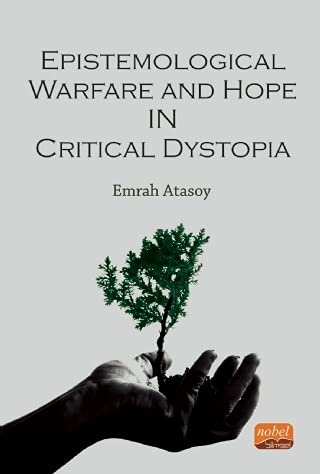
In his engaging, informative description of the birth and evolution of the utopian and dystopian genres, Emrah Atasoy explains why the dystopian genre overtook the utopian genre in the twentieth century due to international conflicts and the rise of totalitarian and fascist regimes. For those unfamiliar with utopian and dystopian literary theory, Atasoy provides a comprehensive overview of the most influential scholars and texts. In the introduction, Atasoy discusses recurring themes in utopian and dystopian fiction, such as power, surveillance, and social control. The journey of the protagonist and other key utopian and dystopian literary tropes are also explained. Undergraduate students and non-specialists will benefit greatly from reading Atasoy’s introduction to the field of utopian studies and his overview of the utopian and dystopian genres not only because of his extensive research, which is abundantly clear, but also because of Atasoy’s lucid writing style.

A wide range of theorists are drawn on throughout this monograph, but Atasoy’s engagement with Rafaella Baccolini, Tom Moylan, and Lyman Tower Sargent is particularly significant because of their scholarship on the critical dystopia. Sargent coined the term “critical dystopia” to refer to a fictional place that is worse than the reader’s world but which has some semblance of hope. Baccolini and Moylan similarly state that critical dystopias must maintain hope within the text, which is achieved through an open ending. The critical dystopia is often used to describe dystopias of the 1980s and 1990s but Atasoy, like Baccolini, claims that some earlier dystopian texts are critical dystopias. Through his analysis of Katherine Burdekin’s Swastika Night (1937), Anthony Burgess’ The Wanting Seed (1962), and P.D. James’ The Children of Men (1992), Atasoy makes a convincing case for reading these novels as critical dystopias that maintain the utopian impulse, by examining these novels alongside their historical context.

Atasoy claims that the critical dystopia “does not only function as a warning, a cautionary tale, but it takes an active part in the possibility of radical transformation” (7). This is important as the possibilities of the dystopian genre to effect positive change are often overlooked by scholars, in favour of the utopian genre. This is because dystopian literary texts are seen by some theorists—most notably Ruth Levitas—as encouraging a sense of fatalism. Recently, scholars from the humanities and social sciences have begun to argue that, as a political genre, dystopian fiction inspires critical thinking and activism, and that it can be used for utopian thinking. Adam Stock’s Dystopian Fiction and Political Thought (2019), like Atasoy’s monograph, focuses on the significance of twentieth century dystopian fiction and social change. Meanwhile, Annika Gonnermann’s Absent Rebels (2021), Aaron Rosenfeld’s Character and Dystopia (2021), and Sean Seeger and Daniel Davison-Vecchione’s “Dystopian Literature and the Sociological Imagination” (2019) suggest that twenty-first century dystopian fiction has more potential to effect positive social change than twentieth century dystopian fiction. This is because twenty-first century dystopian fiction tends to be set either in the very near future or in the present, it is typically set in recognisable, real locations around the globe, it is explicit in terms of what is being critiqued, and many contemporary dystopias also depict collective rebellion, through the collaboration of multiple protagonists and/or characters. Atasoy demonstrates, however, that the texts he analyses are indeed political, hopeful, and extrapolative, and he illustrates the importance of revisiting twentieth century dystopias.

In the three literary chapters, Atasoy examines the primary texts—Swastika Night, The Wanting Seed,and Children of Men. Atasoy’s choice of novels provides an illuminating discussion of gender roles, reproduction, and population control in twentieth century dystopian fiction. It is also refreshing to see two twentieth century dystopias by female authors, which differ from the current trend of twenty-first century feminist dystopias—particularly in terms of their portrayal of male protagonists—put in dialogue with each other. The novels complement each other well and the analysis makes the connections between the novels clear. Although these texts are fairly well-known, they have often been overshadowed by canonical dystopias such as Aldous Huxley’s Brave New World (1932) and George Orwell’s Nineteen Eighty-Four (1949), and they have been somewhat overlooked by scholars. By examining twentieth century dystopian fiction which is often given short shrift, Atasoy convincingly suggests that many twentieth century dystopias need further analysis.

Epistemological Warfare and Hope in Critical Dystopia is a key text for utopian and dystopian scholars. As Atasoy frames Swastika Night, The Wanting Seed,and Children of Men as critical dystopias, the connections and nuances between twentieth century and twenty-first century dystopias are drawn out further. As all three primary texts are by British authors, however, it would be interesting to see whether there are examples of critical dystopias before the 1980s beyond Britain. A comparative global approach to twentieth century critical dystopias could be an area for future research for Atasoy and other scholars to build on.


Jade Hinchliffe is a PhD researcher at The University of Hull. Her interdisciplinary thesis examines the discriminatory impacts of surveillance in twenty-first century dystopian fiction from the global north and global south.

Review of Seconds


Review of Seconds

Steven Shaviro

Jez Conolly and Emma Westwood. Seconds. Auteur, Liverpool University Press, 2021. Constellations. Paperback. 120 pg. $29.95. ISBN 9781800859296. Ebook ISBN 9781800858497.

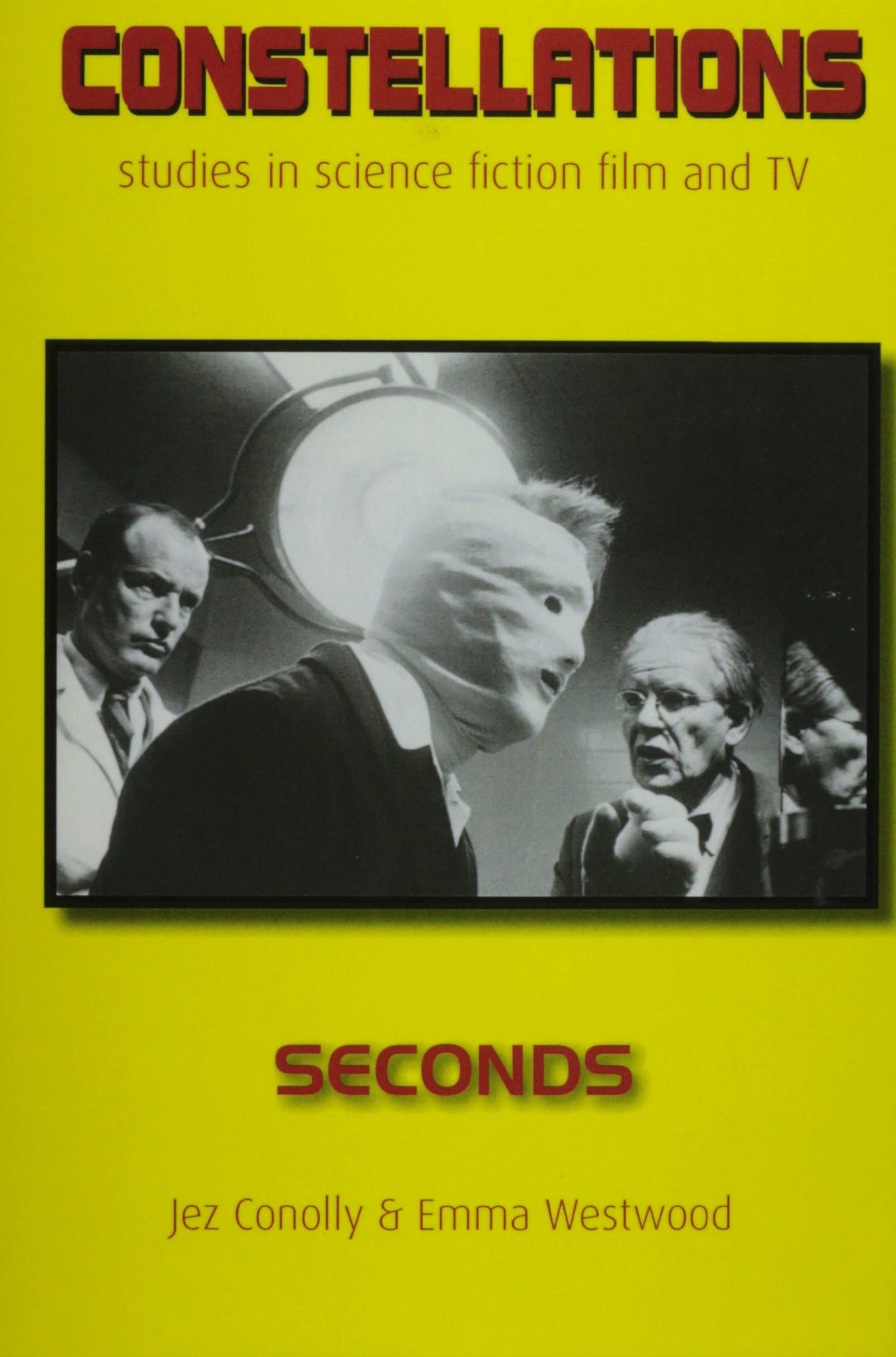
John Frankenheimer’s 1966 film Seconds, starring Rock Hudson, was not marketed as a science fiction film, but its premise is sufficiently science fictional that it merits inclusion in the Constellations series of brief “studies in science fiction film and TV.” Although the book is outrageously overpriced for a text of about 35,000 words, Jez Conolly and Emma Westwood do a brilliant job of summarizing the film, exploring its implications, and finally giving it its proper place in the canon of science fiction cinema.

I cannot avoid a few spoilers here; the book assumes that the reader has already seen Frankenheimer’s movie. Seconds is about a mysterious corporation, known only as “the Company,” that offers affluent but dissatisfied men a supposed second chance to live their lives all over again. If you take them up on their services, and pay them well enough, the Company will fake your death, surgically reconstruct your body, and give you a new identity. The movie’s protagonist, initially played by John Randolph (one of four blacklisted actors for whom Seconds offered their first Hollywood roles after fifteen years without work), is a middle-aged New York banker, wealthy and powerful but living an empty life; he is trapped in a loveless marriage, and commutes daily into the city from his expensive home in the suburbs. He is both cajoled and blackmailed into signing up for the Company’s services. After a series of grueling operations, the protagonist emerges as a younger-looking and healthier man, now played by Rock Hudson. Thus rejuvenated, the protagonist moves to California and embarks upon a new life, filled with art, excitement, and even a bit of 1960s countercultural pizzazz. But this new life ultimately proves as sterile and unsatisfying as the old one. At the end of the movie, the protagonist returns to the Company; only this time, instead of surgically altering him yet again, they kill him and use his body as fodder for further operations with new subjects. It is implied that this is the ultimate fate of all the Company’s clients.

Conolly and Westwood begin the volume by reflecting upon their own different reasons for valuing the movie. They then proceed to a brief plot summary. After this, instead of proceeding sequentially, they give a series of overviews of the film from different perspectives and in accord with different interests. They analyze everything from the overall shape of Frankenheimer’s career as a director to small but telling details about the fonts used in the opening titles (designed by Saul and Elaine Bass, who had previously worked with Hitchcock). They spend a lot of time on set design, and on James Wong Howe’s innovative black and white cinematography. They are especially good in discussing how the disruptive and alienating style of the film—with its departure from Hollywood norms, and its nods to the French New Wave—works to express the negativity of the narrative, which refuses to accord us the happy ending that audiences of the time still craved. They also focus on the significance of the movie for Rock Hudson himself, a gay man who lived a closeted existence as a heterosexual-romantic screen idol. And they situate the film in the larger currents of American popular culture, which in 1966 was in the midst of its transition from a concern with suburban lifestyles and the gray, monotonous lives of middle-management businessmen (as reflected in movies like The Man in the Grey Flannel Suit [1956]) to mainstream adoption of the more free-wheeling 1960s counterculture (as reflected in the New Hollywood of the early 1970s).

In this way, Conolly and Westwood provide a close analysis of the movie, while at the same time showing its relevance for larger concerns about cultural transformations in the mid-twentieth-century. The authors are especially astute in the way that they relate emblematic details of the film to more pervasive issues. I am thinking here especially of the chapter in which they analyze one of the more memorably weird sequences in the film: that in which Hudson’s rejuvenated protagonist is induced to participate in a Dionysian grape-stomping ceremony. The participants are not quite hippies, but rather people more or less in Hudson’s own age-group (he was 41 when the film was shot). The protagonist hesitates to join in, but he is finally induced to, and he ultimately gives way to an almost orgasmic ecstasy. Nonetheless, we still see in Hudson’s performance vestiges of the uptightness that were most evident in Randolph’s previous incarnation of the character. In Conolly and Westwood’s analysis, the movie is skeptical both of our fictions of personal identity, and of our fantasies of being able to simply erase those fictions and substitute them with others. This double questioning of identity and of escape from identity is one of the important science fictional themes that the authors pull out from the movie, even though they do not write explicitly about science fiction as a genre or mode of discourse.

There are a few minor points in the book where I wished for a slightly different treatment. The authors spend more pages than necessary worrying about the believability, for the audience, of Randolph’s transformation into Hudson. This doesn’t seem to me to be much of a problem, since few subjective fantasies are more alluring than the prospect of being transformed into a gorgeous and sexy movie star. I was also disappointed that the authors didn’t give more attention to Will Geer’s role in the movie. Geer in real life was a radical political activist; he is one of the four formerly blacklisted actors who were given roles in Seconds. Here he plays the head of the Company, whose sinister aims are disguised behind a veneer of empathetic folksiness; it is almost as if Geer were giving us, in advance, a parody and deconstruction of the role for which he became famous in the following decade, as Grandpa in The Waltons.

Despite these reservations, I consider Seconds to be a deeply insightful and accomplished book, which does justice to an important movie that has long been overlooked. Although the book doesn’t explicitly address the issues most overtly articulated in science fiction scholarship and criticism (e. g. cognitive estrangement and the duality of utopianism and dystopianism), its actual concerns are deeply congruent with those issues. The goal behind the Constellations book series—that of giving succinct yet comprehensive readings of particular science fiction films and television series—is an important one, and this volume fulfills that goal admirably.


Steven Shaviro is the DeRoy Professor of English at Wayne State University, where he teaches film studies. His books about science fiction include Connected, Or What It Means To Live in the Network Society (2003), Discognition (2016), and Extreme Fabulations; Science Fictions of Life (2021).

Review of Tolkien and the Classical World


Review of Tolkien and the Classical World

James Hamby

Hamish Williams, ed. Tolkien and the Classical World. Walking Tree, 2021. Cormarë Series. Paperback. 440 pg. $32.00. ISBN 9783905703450.

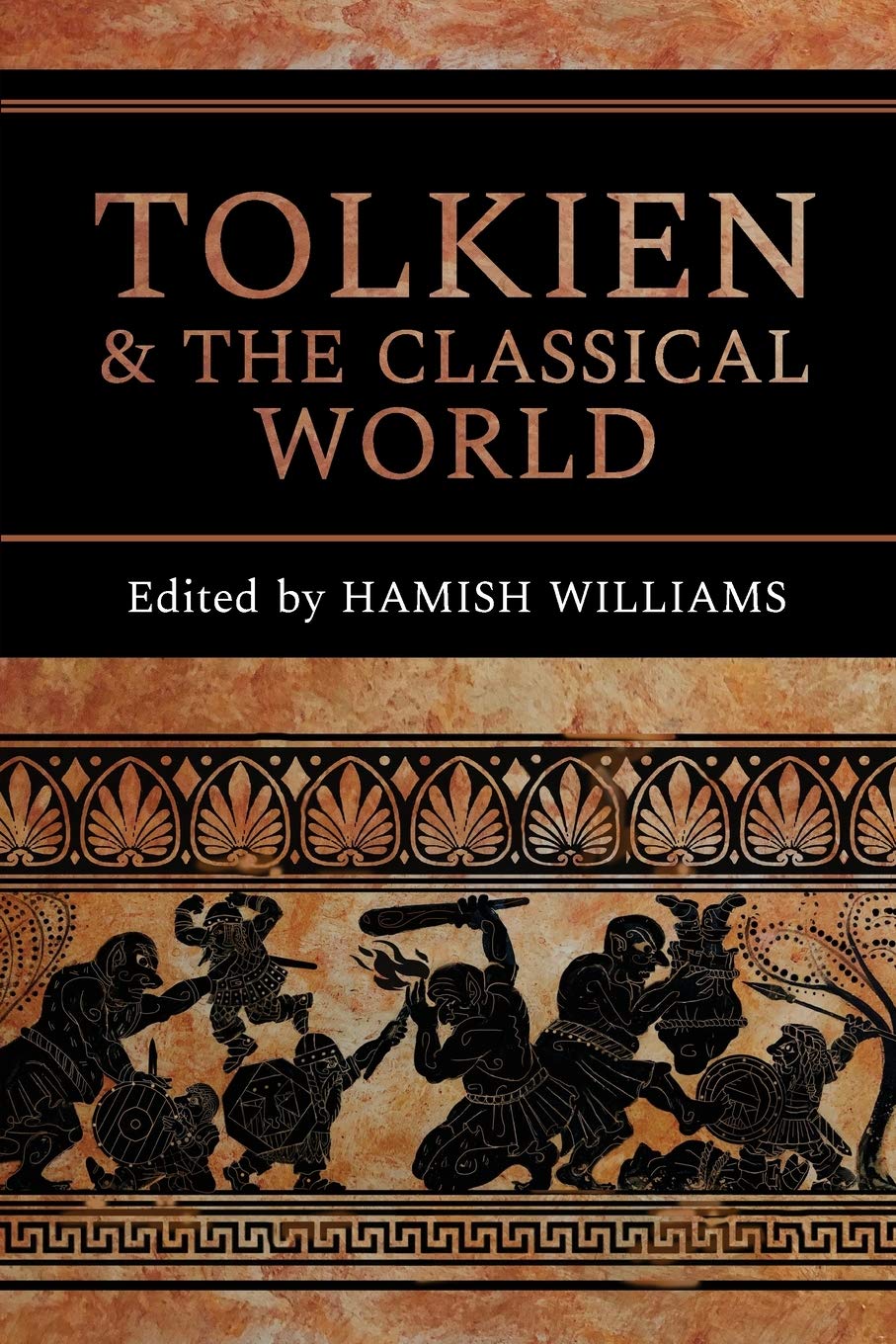
When tracing the origins of Middle-earth, most scholars over the years have focused on Tolkien’s deep knowledge of German philology. While this is indeed a rich field for Tolkien’s mythopoeic vision, it is only a portion of the much larger well from which Tolkien drew his inspiration. The essays in Tolkien and The Classical World, edited by Hamish Williams, explore the ways classical influences shaped the stories, characters, and ideas found in Tolkien’s works. In a wide-ranging collection of essays that focus on everything from Tolkien’s early training as a classicist to Greco-Roman myth to ancient philosophy, this volume demonstrates how the oft-neglected classical influences on Tolkien’s writing truly are some of the most powerful forces in his creative imagination.

The volume is organized into five major sections of two to four essays each. The first of these sections, “Classical Lives and Histories,” serves as an excellent introduction to the topics of the volume. Wiliams’s essay, “Tolkien the Classicist: Scholar and Thinker,” traces the long period of Tolkien’s life in which he studied the Classics, from his home schooling through his undergraduate years at Oxford.. Williams’s detailing of the curriculum at King Edward’s particularly illustrates how well Tolkien was acquainted with the Classics and how they shaped his literary sensibilities. Williams notes how students at King Edward’s School were inculcated in the classical world through “various Anglified popularisations of the Classics” (9), including Lord Macaulay’s Lays of Ancient Rome, which inspired the young Tolkien to write his own mock epic in Macaulay’s style. Additionally, in his study of ancient Greece, Tolkien found models for social construction that would shape the peoples of Middle-earth. Williams observes how Tolkien saw in the ancient Greeks “an anarchic, diverse, inefficient, and quarrelsome form of human virtue which can resist power without succumbing to it” (27). Tolkien saw in these troublesome Greeks a society of independent, strong-minded people capable of resisting tyranny. Here may be seen the genesis of the free peoples of Middle Earth and their struggles against Sauron. The next essay in the opening section, “Greek and Roman Historiographies in Tolkien’s Númenor” by Ross Clare, ties in nicely to Williams’s opening piece. Clare compares the history of Númenor to that of the Delian League, pointing out how both grew into autocracies. These two essays combined make a compelling foundation for the volume’s argument that Tolkien’s created world has deep roots in the Classics.

The next section, “Ancient Epic and Myth,” delves deeply into the literature of the Classical world that influenced Tolkien. All four essays in this section are excellent works of scholarship, but two, “Middle-earth as Underworld: From Katabasis to Eucatastrophe” by Benjamin Eldon Stevens and “Pietas and the Fall of the City: A Neglected Virgilian Influence on Middle-earth’s Chief Virtue” by Austin M. Freeman, work particularly well together by showing how Tolkien transformed ancient concepts such as katabasis and pietas into ideas such as eucatastrophe and estel that underpin his own created world. Freeman, likewise, finds in the “leaf mold” of Classics the ideas that Tolkien developed into his own concepts. Freeman argues that Tolkien took the ideas of pietas (Virgilian notions of duty), Northern courage, and pistis (Christian faith) and combined them into estel—firmly believed hope that inspires action (153). Estel is the force that spurs Aragorn in his quest against Sauron, for instance. Freeman’s essay provides a particularly illustrative look at the way Tolkien combined Classics, Germanic philology, and Christianity into his own vision for human experience.

Section Three, “In Dialogue with the Greek Philosophers,” looks at Tolkien’s engagement with Plato and Aristotle, and many of these essays tie in with those from earlier in the volume. Michael Kleu, for instance, in his essay “Plato’s Atlantis and the Post-Platonic Tradition in Tolkien’s Downfall of Númenor,” again examines the Greek influence on Númenor but this time in its relationship to Plato’s Timaeus. Łukasz Neubauer’s contribution, “Less Consciously at First but More Consciously in the Revision: Plato’s Ring of Gyges as a Putative Source of Inspiration for Tolkien’s Ring of Power” ably demonstrates how the magic ring from Plato’s work provided inspiration, along with other literary rings (such as the one from The Niebelungenlied), for Tolkien’s One Ring. As in Freeman’s essay above, Neubauer also explores how Tolkien combines Classical and Germanic influences. Once again, all of the essays in this section look at Tolkien’s art not as one derivative of the Classics, but as one that transforms ancient ideas and narratives into something new.

Section Four, “Around the Borders of the Classical World,” further examines the connections between Tolkien’s interest in Germanic philology and the Classical civilizations of the Mediterranean. Juliette Harrisson’s “‘Escape and Consolation’: Gondor as the Ancient Mediterranean and Rohan as the Germanic World in The Lord of the Rings,” astutely examines how Tolkien recreated the relationship between these two cultures and instead envisioned a happier, symbiotic union instead of one fraught with conflict. This reworking of the history between Germany and Rome demonstrates the heavy influence both cultures had on Tolkien. The volume concludes with a miscellaneous section of two essays and an afterword by Graham Shipley. The final section is a bit disappointing; not because of the quality of the essays but rather because they seem like an afterthought by not being grouped into other sections. The afterword, however, does make a satisfying ending for the volume.

These essays should be of great interest to both Tolkien scholars and to Classicists. Tolkien scholars will appreciate the ways in which these essays expand the pool of Tolkien’s source material. While it is not new to find Classical influences on Tolkien’s work, they have been overshadowed by the study of his Northern influences, and as a result have been undervalued. Scholars of classical reception theory will find in this volume engaging works on how the ancient world continues to exert its influence over our literature and society. Indeed, Tolkien and the Classical World is one of the best volumes the Cormarë Series has produced, and it will no doubt prove to be a necessary text for anyone studying the connections between Tolkien and the Classics.


James Hamby is the Associate Director of the Writing Center at Middle Tennessee State University, where he also teaches courses on composition and literature, including Victorian Science Fiction, Fantasy, and Fairy Tale. His dissertation, David Copperfield: Victorian Hero, explores how Charles Dickens created a new hero for the Victorian Age by reconceiving his own life through the prism of myths and fairy tales.

Review of Islam, Science Fiction and Extraterrestrial Life


Review of Islam, Science Fiction and Extraterrestrial Life

Mayurika Chakravorty

Jörg Matthias Determann. Islam, Science Fiction and Extraterrestrial Life: The Culture of Astrobiology in the Muslim World. Bloomsbury, I.B. Tauris Publishing, 2021. Hardcover. 288 pg. $115.00. ISBN 978-0-7556-0127-1.

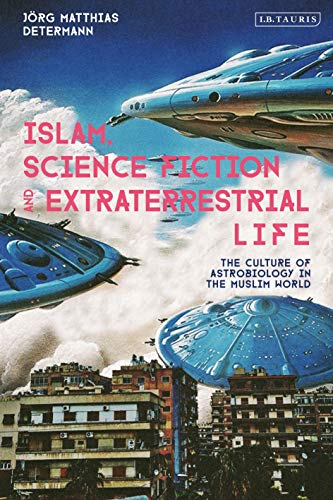
Islam, Science Fiction and Extraterrestrial Life: The Culture of Astrobiology in the Muslim World (2021) follows Jörg Matthias Determann’s earlier books on the subjects of space science (2015) and evolutionary biology (2018) in the Arab world and the Gulf states respectively. However, in place of a specific regional focus, his latest book adopts a transnational and transregional approach as it explores a religio-cultural context of the works that he identifies and analyzes in the book. This work is a very welcome addition to the field of science fiction studies and, broadly speaking, speculative literature which, in recent years, has been looking further afield to afford critical attention to non-Anglo-European authors and texts and include them within its frameworks of analyses.

The book’s particular focus on Islam is significant for at least two reasons. First, it aims to bridge the chasm between fundamentally divergent realms of faith and science (in spite of what may be conveyed by the first part of the title, the book is not just about science fiction – it also includes science and to a large extent, the scientific imagination of individual scientists). Secondly, it also counters views such as the ”Muslim world is still not commonly associated with science fiction” as the book points out that “even authoritarian countries have produced highly imaginative accounts on one of the frontiers of knowledge: astrobiology, or the study of life in the universe” (x) and that “scientists in and from Muslim-majority countries have been at the forefront of the exciting search for extraterrestrial life, the ultimate Other” (xi). The perceived incompatibility between Islam and science fiction, and in fact, scientific imagination, certainly has a long political and cultural pre-history, its genesis being in orientalism, or the West’s perception of the orient as essentially “aberrant, undeveloped, inferior” which postcolonial critics such as Edward Said have pointed out, was most rigorously directed against the Islamic orient, since Islam, as “the very epitome of an outsider” of the West, was deliberately conceptualised and projected as “uncreative, unscientific, and authoritarian” (Said 296). Determann’s book triumphantly upends such orientalist and colonial notions. As he points out, not only is Islam not against science fiction or extra-terrestrial life and multiple worlds, the Qur’an itself refers to the God as the ‘lord of the world’ forty-two times, and as the Syrian artist Ayhem Jbr claims, one might even consider the Qur’an as “the first work of SF” (10).

What adds to the richness and variety of the material is the fact that the book moves beyond the literary corpus and includes films as well as scientific and journalistic research, and as the author states, the “protagonists of this book therefore comprise professional scientists and journalists alongside writers and visual artists” (30). Besides an Introduction (Chapter 1) and a Conclusion (Chapter 6), the book has four chapters which are broadly chronological with each focusing on a specific medium, beginning with scientific journals and popular magazines in the nineteenth and the early twentieth centuries in Chapter 2. The third chapter, titled “Trips to the Moon,” focuses on the depiction of extraterrestrial lives in films from primarily Turkey, Egypt, and Pakistan during the cold war period, while Chapter 4, “Islamic UFO Religions,” analyses a series of UFO-logical texts written in Urdu, Turkish, and Arabic from the 1960s onwards. Chapter 5, “Building Nations and Worlds,” studies science fiction novels and short stories by authors from Pakistan, Bangladesh, Egypt, and Indonesia and includes the works of Ibne Safi, Muhammed Zafar Iqbal, Nehad Sherif and Eliza Handayani. The conclusion (Chapter 6) revisits the myriad forms and expressions of scientific imagination, adding in visual arts and video games, with particular attention to the body of research on exoplanets. As evident from the range and breadth of the corpus, Determann does not confine his focus to the Muslim-majority countries of the Arabian Peninsula (and to texts only in Arabic) as he includes a multi-lingual corpus from countries in North Africa and South and South-East Asia including Egypt, Tunisia, Pakistan, Bangladesh, Indonesia, Malaysia, and others, thereby adding to the existing scholarship such as Ian Campbell’s Arabic Science Fiction (2018).

In the diverse and wide-ranging collection of texts that are referred to, there are fascinating and often startling references to head-scarf wearing robots, modestly dressed Martian swimmers, endorsement of a young girl’s marriage to an alien as long as he is a Muslim, as well as deliberations on the location of the Kaaba and the direction of daily prayers from outer space, some of which may lead the reader to ask: What use is the future when it is not imagined as a radical and rupturous departure from the past? The book also, however, underscores the political potential of science fiction since many of the authors conceive their writing as a form of resistance against colonial and neo-colonial forces, often through alternative histories and deliberately hyperbolic inversions. In the Malaysian author Faisal Tehrani’s novel 1515 (2011), for example, the Malays liberate Goa and capture Lisbon in 1515; in Abdelaziz Belkhodja’s (Tunisia) novel The Return of the Elephant (2003), it is the West that is on the brink of economic collapse while North Africa witnesses growth buoyed by technological advancements.

In the diverse and wide-ranging collection of texts that are referred to, there are fascinating and often startling references to head-scarf wearing robots, modestly dressed Martian swimmers, endorsement of a young girl’s marriage to an alien as long as he is a Muslim, as well as deliberations on the location of the Kaaba and the direction of daily prayers from outer space, some of which may lead the reader to ask: What use is the future when it is not imagined as a radical and rupturous departure from the past? The book also, however, underscores the political potential of science fiction since many of the authors conceive their writing as a form of resistance against colonial and neo-colonial forces, often through alternative histories and deliberately hyperbolic inversions. In the Malaysian author Faisal Tehrani’s novel 1515 (2011), for example, the Malays liberate Goa and capture Lisbon in 1515; in Abdelaziz Belkhodja’s (Tunisia) novel The Return of the Elephant (2003), it is the West that is on the brink of economic collapse while North Africa witnesses growth buoyed by technological advancements.

Determann’s book, thus, through meticulous research, presents a remarkable history of dialogue and cross-pollination between nations and cultures in the fields of science and science fiction, and points out how, in spite of Islamic opposition to science fiction in many places and its complex relationship with the state, SF has not only thrived, but it continues to be reimagined by Muslim authors from across the world. While the rich corpus of texts, by virtue of its sheer geographical and temporal breadth, might at times seem overwhelming, and the analysis, in places, a little hurried, this book presents a repository of hitherto unknown or lesser-known texts that would be invaluable to future researchers in the field.


Mayurika Chakravorty teaches in the Department of English and the Institute of Interdisciplinary Studies, Carleton University (Ottawa, Canada). She completed her Ph. D. from the School of Oriental and African Studies, University of London, UK, and her primary area of research is postcolonial speculative fiction from the global South. Her current research also focuses on children’s literature and the representation of children in literature and popular media. 

Review of The Routledge Introduction to Canadian Fantastic Literature


Review of The Routledge Introduction to Canadian Fantastic Literature

Ben Eldridge

Allan Weiss. The Routledge Introduction to Canadian Fantastic Literature. Routledge, 2021. Hardcover. 228. Pg. $128.00. ISBN 9780367409449. Paperback. $42.95. ISBN 9780367409432. eBook. $42.95. ISBN 9780367810023.

Canada’s literary history is as bleak as it is illustrious. This is a bleakness which also permeates the global—and even local—reception (or, perhaps more accurately, the relative lack thereof) of many Canadian texts. Despite laying claim to a raft of innovative and influential authors, Canadian productions are often overlooked in broad literary discussions. Part of the problem arises from historical publishing and distribution limitations; Canada’s literary art has long been perceived to be a peripheral one, denied consecration in the hallowed halls of the major publishing houses. But this bleakness also manifests in the content of Canadian texts themselves, and, indeed, Canada’s literary output has become inflected with its own idiosyncratic tendencies, the most prevalent theme of which is, simply, perseverance, or, as Margaret Atwood once more famously phrased it, “survival” (1972). Allan Weiss’s latest non-fiction work, The Routledge Introduction to Canadian Fantastic Literature (2021; henceforth CFL) is an attempt to redress this imbalance as, from its opening sentence, it promises “an overview” (1) of its titular topic, and is complete, in this instance, with the backing of a major international publisher.

And an overview is precisely what the text delivers: CFL is a well-indexed and extensively-researched historical contribution to the field, replete with a survey of neglected or otherwise forgotten primary texts. Such a synoptic approach unquestionably has its benefits, particularly because, as Weiss notes midway through the book, “Canada did indeed have a tradition of fantastic literature, but it was largely invisible to Canadian culture as a whole” (100), not to mention to a broader international audience. Indeed, it would be difficult to find a title with such a detailed bibliographic knowledge of its subject as is to be found here: CFL will surely function to acquaint a broad array of readers with new (and old) literary works, and will likely provide a useful starting point for further research in the field. But its greatest benefit is simultaneously its greatest shortcoming: while CFL functions as an extensive directory of primary texts, it is one that tends to include only metadata. While the title certainly demonstrates an encyclopaedic expertise—and performs an ambitious archiving—of large swathes of Canadian ‘fantastic’ literary texts, the critical analyses offered of its entries are lacking in any corresponding ambition. Rather than endeavour to elucidate the idiosyncratic inflections apparent in Canadian ‘fantastic’ literature, CFL more often seems content to catalogue its products with little by way of an attempt to appraise their significance.

CFL, that is,basically comprises a list of primary texts that are in turn loosely related to periodized historical moments. The title thus functions according to a paratactic logic wherein its argument is implied via the accretion of the various informational fragments it provides being placed in close proximity. CFL is, then, “deployed in order to order,” to follow Liam Cole Young’s reflection on the role of categorisation: providing a database of potential knowledge, rather than establishing any of its own (30, emphasis in original). The theoretical ambition in CFL is thus etherised by the tabular form that it both performs and inhabits: an effective text does not arise from a combination superficial plot recounts; implicit alignments with broader (global) cultural and artistic trends; a re-treading of well-established theoretical ground, including total reliance on existing secondary scholarship to propel its narrative; and an unspoken expectation that the cited Canadian texts are of importance, without convincingly arguing that this should, in fact, be the case. And so, mileage may vary with regard to the use-value of this title: for those interested in adding to their collection another introductory text of the type that tends to dominate science fiction and fantasy (SFF) criticism, CFL may indeed offer a comfortable read, and provide a useful recital of primary texts that have likely remained heretofore unobserved; for those who are more demanding of extended critical insight, the title is almost certainly destined to represent something of a missed opportunity.

I suspect this dichotomy may also be the case for Weiss himself, given both his background as one of the leading scholars of Canadian SFF and the astute scholarly writing released throughout his career, of which flashes remain observable throughout CFL. Indeed, sections of many chapters contained within CFL are excerpted from material that has been published in singular form before, but the decision to jettison much of the rigorous critical analysis that marked these more focussed articles leaves much to be desired: collation is one thing, but condensation that results in a lack of insight is a very curious move for an academic title. There is certainly enough material here for a much longer—or another—book, because there is simply no way that the space limitations allow for a properly comprehensive survey. Another hangover of this partial compilation of previously published materials is that there is some repetition of content across the chapters, but, all things considered, this may be a net benefit to CFL, given that its individual chapters are relatively self-contained as a result, and could thus be easily set on introductory tertiary reading lists in isolation rather than assigning the title as a whole.

The somewhat idiosyncratic use of the phrase ‘fantastic fiction’ in the title is subsequently posited as an all-inclusive term for non-realist/non-mimetic texts, and Weiss tells us:

That is why fantastic fiction is a better umbrella term than speculative fiction. It covers all the genres that involve the creation of a secondary world, whether speculative or not. Some of the fantastic genres, the ones we categorize as speculative fiction, highlight the differences from our real world and consider the implications of the change, while others accept the secondary world as a given and focus on other things. (12)

Maybe so; there is certainly nothing intrinsically wrong with such a distinction, particularly as it does attempt to bring together potentially conflicting generic definitions. The chapter from which this extract is taken, however, also engages in a short-shrift dismissal of existing terminology—the sources ranging from Atwood to Wikipedia—directly prior to its own attempted restructuring of generic nomenclaturein CFL. As it happens, Weiss has previously lamented that “it seems that any book-length [criticism] of science fiction requires an introduction that reviews the various definitions of the genre, and sets out the scholar’s own” (2005, 48); the irony is that from the very first major chapter (“Terminology”) this current book-length study is swiftly bogged down in precisely this definitional dilemma, and CFL never really recovers from its initial theoretical stall. Furthermore, the initial intensive focus on definitions most markedly involves an extended discussion of the ostensible distinctions between ‘science fiction’ and ‘speculative fiction.’ One of the ramifications of this strategy is that science/speculative fiction is de facto made effectively synonymous with the entire ‘fantastic’ field across the remaining chapters, which is detrimental for the breadth of the analysis. Relatedly, the recurrent laundry lists encapsulating sometimes dubious subgeneric distinctions (and their attendant tropes) quickly becomes tiresome.

Chapter 5 (“The Flowering”) is by far the most interesting chapter of CFL overall, given that it speaks directly to the development of an infrastructure of national genre literature; it is a more technically-minded chapter, providing some solid and more specific recapitulation of the major players and publishing opportunities in the Canadian territories (for example, publishers; anthologies; magazines). Though each of the remaining chapters have their highlights, they are unfortunately of varying quality. This is partially related to their inconsistent length and oddly modular internal arrangement, with the latter issue being most evident where transitions between sections are jarring and/or unmarked. Some further thought should have been given to the scope, scale, and arrangement of the text. Weiss makes multiple concessions to the former issue, noting, for instance, that the overview of selected primary texts “does not come close to being exhaustive” (154), and that “it will be necessary to pick out only a few representative figures… while cautioning that many more could have been included had space permitted” (182-183). I certainly take Weiss’s point that “it has become far more difficult in recent years to make generalizations about Canadian fantastic literature overall due to its increasing size and diversity” (206), but I cannot help but wonder about the contents left on the editorial cutting-room floor; about the justification for the authors and works that did make the final cut (given CFL itself does not attempt to establish this); and, perhaps most significantly, if the broadly archival approach is particularly productive in the first instance, given the obvious length limitations. Beyond these concerns, though, there is also an odd tendency to take recourse in intentional fallacy at times; a recurrent fallback into phrasal and logical faults (including the aforementioned moments where fleeting comments are made without outlining their significance, and gestures are made toward outside sources rather than making an argument explicit in the text itself); and some incredibly awkward slippages in language. For an example of all three issues manifesting in a single compact quote, when Weiss introduces contemporary author Larissa Lai, he writes: “As a lesbian, she writes about gender themes” (194). Such comments reflect poorly on both the critical and the editing process, and there are other such missteps across CFL as a whole.

 “A word,” writes one of my favourite Canadian writers, “has power” (Weiss 2016, 12). Not all collections of words are equally powerful, however. In CFL Weiss writes clearly and efficiently for the most part, but there is little by way of the wit, verve, and wordplay that defines his excellent fiction and, to a lesser extent, his previous scholarly work. Indeed, the straightforward nature of the prose draws attention to some of the other weaknesses of the text: most markedly its argumentative contradictions and its general lack of theoretical ambition. The project is clearly a labour of love, but it does not add anything particularly substantial to our understanding of either the Canadian instantiation of SFF (which reads almost as an afterthought at certain points), or, more broadly, to our understanding of SFF itself. But it is always important to judge a text on its own merits, and what CFL does offer is an extensive reading list, and viewed in this light—as a kind of lightly annotated bibliography of Canadian primary fantastic texts (and history)—it is a useful addition to the corpus of SFF criticism that motions toward some important but historically overlooked texts that have remained peripheral to both popularity and criticism. Ultimately, for a title professed as an introduction to the field of Canadian fantastic literature, Weiss’s text is only partially successful, and I cannot but wish that the text was more consistently ambitious in its approach. It will be interesting to see whether survival is, in fact, on the cards for this style of criticism, and the book series (Routledge Introductions to Canadian Literature) of which CFL represents the inaugural entry.

WORKS CITED

Atwood, Margaret. 1972. Survival: A Thematic Guide to Canadian Literature. Toronto, ON: House of Anansi.

Weiss, Allan. 2005. “The Question of Genre.” Further Perspectives on the Canadian Fantastic: Proceedings of the 2003 Academic Conference on Canadian Science Fiction & Fantasy, ed. Allan Weiss, 47-56. Toronto, ON: ACCSFF.

—. 2016. Making the Rounds. Calgary, AB: Edge Science Fiction and Fantasy Publishing.

—. 2021. The Routledge Introduction to Canadian Fantastic Literature. New York and Oxon: Routledge.

Young, Liam Cole. 2017. List Cultures: Knowledge and Poetics from Mesopotamia to Buzzfeed. Amsterdam: Amsterdam University Press.


Ben Eldridge is an early career researcher & the current Vice-President of the Association for Canadian Studies in Australia and New Zealand (ACSANZ), who lives and works primarily on unceded Darug and Gadigal land. If not performing the exploitative, unpaid labour that is intrinsic to the functioning of the modern neoliberal ‘academic’ sector, Eldridge can be found either denouncing technocratic management or—like his personal avatar, the Canada goose (Branta canadensis)—honking eternally into the void of existential despair. This, he realises, may be a tautological claim.

Review of The Computer’s Voice: From Star Trek to Siri


Review of The Computer’s Voice: From Star Trek to Siri

Bryce L. King

Liz Faber. The Computer’s Voice: From Star Trek to Siri. University of Minnesota Press, 2020.Paperback. 226 pg. $27.00. ISBN 9781517909765.

In The Computer’s Voice: From Star Trek to Siri, Liz Faber discusses gendered representations of what she terms “acousmatic computers” (4) throughout science fiction film and pop culture, by which she means forms of artificial intelligence without a human-presenting body, with the consequence that their voice is their defining feature and means of expressing gender. Faber argues that the gendering of these computer voices both reveals historical attitudes towards gender while also pushing the social boundaries surrounding gender binaries and norms. Faber utilizes psychoanalytic feminist theory and sound studies to analyze these norms because the intersection of these schools of thought offers not only an interpretation of gender relations but also of power relationships through womb and phallic iconography. By analyzing voice, Faber outlines the ways in which video-synchronized sound is linked to characterization and therefore the structuring of the narrative. Faber studies the ways in which bodily-based engendering is projected onto bodiless computers to argue that, through this contradiction, there occurs a conflict in both the challenging and promotion of gender essentialism as well as the implementation that the engendering of the acousmatic computers results in the gendering of their roles in our lives and our media. Essentially, if an inherently non-gendered entity such as a computer can have gender, it pushes us to recognize that gender is constructed.

The introduction recounts the Turing test and its relations to gender studies, and then Faber states that she aims to cover the whitewashing of classic science fiction films; however, throughout the rest of the chapters, this latter ambition seems to reappear infrequently at best, not being directly addressed until chapter 5. She goes on in the introduction to summarize the evolution of sound in film and the auditory properties of stereo technology. Faber asserts that the imageless characters such as these acousmatic computers often hold more power than robotic characters with physical bodies in their narratives due to their production of tension, their evocation of the unknown, and their disembodied omnipresence, all stemming from their ability to be heard but not seen. She then discusses the link between cinematic sound and Freudian/Lacanian theories, relating these frameworks to how science fiction depictions of technology are impacted by their time of conception. We understand the future through our present, and thereby classical Hollywood cinema reflects castration anxiety and serves as the fantasy realm of male subjectivity. Because the acousmatic computer oftentimes represents or evokes the castrated woman, it also represents trauma, explaining why oftentimes the viewer does not identify with the computer, but instead with the other embodied characters.

In chapters 1 and 2, Faber analyzes acousmatic spaceship computers including the foundational HAL9000 from 2001 (1968), the U. S. S. Enterprise from Star Trek: The Original Series (1966-69), and the Enterprise-D from Star Trek: The Next Generation (1987-94), along with their parodic counterparts from Dark Star (1974), Quark (1977-78), and Moon (2010). Though Faber does a thorough job of describing the mise en scène of these works, it is beneficial for the reader to have seen the films themselves, because these chapters heavily focus on Freudian iconography as well as color theory. She argues that acousmatic spaceships represent the paradox of the primordial uncanny, the womb. HAL9000 in his masculinity, phallic queerness, and sterility reflects the active trauma of birth, while the Enterprise represents the warm passive female womb in her domesticity and subjectivity; thus, the good Oedipal desirable mother and the bad inhospitable traumatizing mother dichotomy are invoked. In both representations, however, gender roles remain within the norm socially. Yet despite this dichotomy, both gendered voices are projected onto the same idea of the mothership, complicating these seemingly stable gender norms. The parodies Quark, Dark Star, and Moon alleviate the cultural anxieties of trauma in birth, the threat of castration, and gender instability through their reestablishment of typical gender roles and comedic license. These chapters serve as an important basis for the study of gender in acousmatic computers throughout the text.

In chapters 3 to 5, Faber focuses on terrestrial acousmatic computers, which is to say vocal computers in films taking place on Earth as well as acousmatic computers that reflect male subjectivity. Chapter 3 specifically focuses on the dystopian paternal creator/computer films of the 1970s utilizing the films: Colossus: The Forbin Project (1970), THX 1138 (1971), Rollerball (1975), and Demon Seed (1977). Faber excellently outlines and connects the phallocentric power relations between the films’ respective acousmatic computers in relation to the oedipal complex and technophobia, entailing that the son now identifies with the father out of fear of the castrated mother. However, considering the sexual power dynamic between Dr. Forbin and the computer Colossus could have made for a more interesting reading rather than simply studying the father/son, creator/creation dichotomy of the film. Chapters 4 and 5 center on the films Tron (1982), Electric Dreams (1984), Fortress (1992), Smart House (1999), the television series Eureka (2006-12), and Iron Man (2008). Faber discusses the masculine and feminine-coded computers of these texts in order to identify the cultural anxieties of women leaving the domestic space for the workforce, cementing heteropatriarchal gender roles while also encouraging the entrepreneurial rival sons of the 1970s to take on the dominant paternal power role in the 90s. Faber discusses the heavily hetero-erotic scenes between feminine computers and their human male dominators but ignores the homosocial undertones of male humans to male computers. Ultimately, Faber proves that the construction of gender is as much vocal as it is visual.

Lastly, chapter 6 circles back to the evolution of Siri as promised in the title, as well as including analyses of The Big Bang Theory (2007-2019) and Her (2013). Faber again analyzes color and its relationship to gender in the film, linking Her with 2001 and the previously discussed texts. Faber argues that the desire for the viewer to view is made up for by their ability to hear the acousmatic computer. Faber discusses this through Her,emphasizing not only the gendering of acousmatic computers but also the sexualization of them. Samantha, an artificially intelligent virtual assistant akin to Siri, then by vocal means experiences her gender, her sexualization, her sexual awakening, and her sexual relationship with Theodore. Faber relates The Big Bang Theory to the hilarity of engendering and romanticizing computers through their voice. Although she discusses The Big Bang Theory first, it may have been more effective to discuss the television series after the film Her in order to reconvey earlier arguments about how comedy allows for social anxieties and discomforts regarding technophobia and gender to be expressed and alleviated. Then using the television series and film as a segue since both mediums feature acousmatic computers meant to mirror Siri, Faber contends that within the confines of our current language we are not equipped to mediate “the multiplicity of gendered subjectivities we construct every day” (181). The liminality of the internet calls into question the stability of our heteropatriarchal social structure the same way that a disembodied, but gendered computer questions what we perceive as the essential sex of gender; without a body, gender must be constructed and, more importantly, constructed through vocality. Siri then has embodied social anxieties and typical female passive subservient roles, but in her absence of body has become a real-life technological example of acousmatic gender construction. Thus not only has Siri’s voice been gendered but also her role in our lives, reflecting and perpetuating current ideologies of gender essentialism. Through the previous examples of what a gendered computer could sound like, we have come to recognize Siri as feminine even though she herself is programmed to respond that she has no gender.

Faber works from a strong foundation of previous scholarship while offering invaluable insight for further psychoanalytical feminism and sound theory within science fiction, making this book a great resource overall, but even useful on the micro-level of individual film readings in relation to their respective chapters. Faber’s strength, though it might seem repetitive to some readers, is her ability to optimally and efficiently structure her argument and individual chapters in a way that progresses through the decades from the 1960s to the modern day while giving historical context at the beginning of each chapter, then recommunicating what aspects of the previous chapter she is going to build on, then carrying out a psychanalytical reading of the texts, closing with a summary of what she has just analyzed and a snippet of what the next chapter holds in store. Though she could have stressed the potential queerness and repeated whiteness of certain cultural gender roles and anxieties, Faber makes a particularly strong argument for the vocal engendering of science fiction’s most popular and most obscure computers.


Bryce King is an MA graduate student and instructor at Florida Atlantic University with a concentration in SF and Fantasy. Her master’s thesis debates the limitations of environmental and feminist thinking within The Witcher series, and she is a proud working member of Heartwood Books and Art, an antiquarian and rare bookseller. Bryce is a proud cat mom and Star Wars fan.

Review of Biology and Manners: Essays on the Worlds and Works of Lois McMaster Bujold


Review of Biology and Manners: Essays on the Worlds and Works of Lois McMaster Bujold

Jerome Winter

Regina Yung Lee and Una McCormack, editors. Biology and Manners: Essays on the Worlds and Works of Lois McMaster Bujold. Liverpool University Press, 2020. Liverpool Science Fiction Texts and Studies 64. Hardcover. 320 pg. $120.00. ISBN: 9781789621730. Ebook ISBN: 9781789627534.

By any reasonable critical scorekeeping, the fan-favorite work of Lois McMaster Bujold has been sorely overlooked by sf academics; however, happily enough, that critical neglect seems to be now becoming quickly corrected. A winner of six Hugo and two Nebula awards, whose numerous books—including one massive space opera series and two fantasy series, not to mention the many novellas and short stories—had sold by one estimate over two million copies by 2010, Bujold received only approximately a dozen scholarly articles devoted to her work until the mid-2000s, as meticulously shown in Robin Anne Reid’s history of Bujold scholarship that begins the current volume. In roughly the last decade, however, there has been one in-depth monographs on Bujold, Edward James’s Bujold entry in University of Illinois Press’s Modern Masters of Science Fiction series; some focus on Bujold in thematically organized books such as John Lennard’s Of Sex and Fairy; and two essay collections on Bujold, including an entry, edited by Janet Brennan Croft, in McFarland’s Critical Explorations in Science Fiction and Fantasy series, in addition to the present volume under review, Biology and Manners, edited by Regina Yung Lee and Una McCormack, which takes its title from the subtitle to Bujold’s A Civil Campaign: A Comedy of Biology and Manners (1999).

The reasons for the critical neglect have been subject to fascinating speculation. Is it a lack of sustained interest in feminist utopias? Is it because of the military sf elements? Is it the widespread critical disdain for space opera? Is it her uncool focus on parenting? Is it her whiteness? My more humdrum suspicion, though, is a less conspiratorial one; I agree with Reid’s argument that there is a “growing disparity between the [sff] genres’ growth in multiple mediums and the number of academics specializing in a marginalized field” (14). It is hard to discount the fact that a vast amount of sf literature and media goes largely unstudied for no more complicated justification than an embarrassment of riches in cultural production dwarfing the random, stringent contingencies of the niche, non-commercial market of academic publishing. Such a harsh reality, of course, means we should celebrate all the more when a worthy new author, text, or movement does begin to receive more extensive and concerted scholarly treatments, as has clearly been occurring with Bujold. There is a lot of interesting thematic and theoretical overlap across this whole essay collection; however, the collection is ostensibly divided into an introduction section of two essays on said emergence of Bujold studies and five more sections of two or three essays each, focusing respectively on “Bujold’s Women,” “Heroes’ Journeys,” “Potential Futures and Imagined Pasts,” “Holy Families,” and “Beyond the Books.”

One pronounced focus of this anthology as a whole is on critically overlooked aspects of Bujold’s two high-fantasy series, The World of the Five Gods (2001-21) and The Sharing Knife (2006-2019), especially its representations of gender and sexuality. Regina Yung Lee’s essay “Untimely Graces”  reads the widowed protagonist of Paladin of Souls (2003), Ista dy Chalion, and her pointed failures to fit conventional normative scripts as recuperating the character as covertly queered. Likewise, Caitlin Herington, in “You Wish to Have the Curse Reversed?”, argues that the Chalion novels resist the arrogation of women to the stereotyped roles of dutiful mother, wife, or daughter. Moreover, in “The Shape of a Hero’s Soul,” C. Palmer-Patel limns the Chalion novels for the tension between prophetic destiny and heroic freedom in their high fantasy conceit of mortals channeling divine avatars, stressing that Lady Ista’s active invoking of supernatural fate subverts charges of passivity endemic to this trope. Despite Bujold’s stated protestations that she is no “unconscious gonfalonier” (113) for feminist viewpoints, Sylvia Kelso nevertheless productively examines the four novels in the Sharing Knife series for their unique contributions to women’s writing, especially their rewriting of masculinized romantic quest story structure.                   

Tackling the conjunction of biology and manners from a different emphasis than exclusively one of gender and sexuality, Joanne Woiak’s “Pain Made Holy” narrows in on the torture-victim Castillar Lupe dy Cazaril from The Curse of Chalion (2001) as a figure whose hellish suffering challenges both ableist presumptions of what counts as legitimate embodiment and also subverts some of the prerogatives of disability studies that broadly advocate for more normalizing portrayals of the differently abled instead of an overriding focus on care or healing. Reid’s second essay in the collection, “The Holy Family,” also draws on disability studies to analyze The Curse of Chalion and its prequel The Hallowed Hunt (2005) as well as the more recent Penric and Desdemona series of novellas (2015-2021). Reid argues that the depiction of spiritual visions in these works resists hegemonic narratives about ability, gender, and sexuality. Meg MacDonald, in the essay “Bastard Balances All,” also discusses the Penric and Desdemona series in terms of queer theory but adds to the discussion Bujold’s fashioning of an antiauthoritarian theology.

The Vorkosigan Saga (1986-2016), a primary focus of Croft’s essay collection, also receives the due attention of a handful of essays in this book. In “Quiet Converse,” Katherine Woods pairs A Civil Campaign with Jane Austen’s Mansfield Park (1814) to suggest Cordelia Naismith, Miles Vorkosigan’s mother, is not the boring character some readers have dismissed her as, given her subtle cultivation of multiple identities as captain, refugee, mother, and hidden power behind the regent. In “Queering Barrayar,” Jey Saung reads the more recent novel Gentleman Jole and the Red Queen (2016) and the pregnancy-sidestepping novum of the uterine replicator, which has long been a keystone in the extrapolative world-building of the Vorkosiverse, for its opening up of utopian personal and public alternatives to normative biological temporalities. Oppositely, Ally Wolfe’s “Womb with a View” examines the early novel Ethan of Athos (1986) for its nuanced critique of the heterotopia of a misogynist all-male society also extrapolated from the uterine replicator. More broadly, blending visions of the future and the past in the merging of cod-medieval fantasy and space opera tropes, the Vorkosigan books enact an estranged time warp, a “futuristic feudalism” (171), as Sarah Lindsay writes in an analysis of the very first Miles book, The Warrior’s Apprentice (1986).

Expanding beyond the authorial focus, Jennifer Woodward and Peter Wright’s “The Naismith Strategem” explores Genevieve Cogman’s Bujold-themed tabletop role-playing game, The Vorkosigan Saga. Woodwood and Wright demonstrate how this game ludically systemizes Bujold’s intricate universe into a playable format, even to the point of assigning point values to characters that reflect the stigmas that often pervade feudal male-dominated and heterosexist monocultures. Kristina Busse’s “Canon Compliance and Creative Analysis in the Vorkosigan Saga Fan Fiction” reverses Bujold’s own stated endorsements of fan fiction to show how specific forms of Vorkosigan fan fiction—namely, in the slash, alternate universe, and Mary Sue subgenres—deeply engage with Bujold’s novels. Regardless of the belated scholarly recognition of Bujold’s work, these last two essays suggest that the growth of an active fandom that critically appreciates Bujold’s achievement continues apace.


Jerome Winter, PhD, is a full-time lecturer at the University of California, Riverside. His first book, Science Fiction, New Space Opera, and Neoliberal Globalism, was published by the University of Wales Press as part of their New Dimensions in Science Fiction series. His second book, Citizen Science Fiction, was published in 2021. His scholarship has appeared in The Oxford Handbook of Science Fiction, Extrapolation, Journal of Fantastic and the Arts, the Los Angeles Review of Books, Foundation, SFRA Review, and Science Fiction Studies.