Review of Science Fiction in Translation


Review of Science Fiction in Translation

Alice G. Fulmer

Ian Campbell, ed. Science Fiction in Translation: Perspectives on the Global Theory and Practice of Translation. Palgrave Macmillan, 2021. Studies in Global Science Fiction. eBook. 359 pages. $109.00. ISBN 9783030842086. Hardcover ISBN 9783030842079. Softcover ISBN 9783030842109.

Science fiction (often abbreviated throughout this volume as SF), as a genre, has far more potential than just to provide scaffolding for media franchises that have dominated Anglophone ‘fandom’ spheres, such as Doctor Who or Star Wars. Modern translation studies and its dissemination into other fields, such as SF, carries the tools to decenter and destabilize the Anglocentrism of these media ventures. And it is precisely at these intersections that Georgia State University’s Ian Campbell makes a powerful case for inclusivity in SF. A scholar of Arabic science fiction and its translation into English, he binds together articles incredibly diverse not only in language and/or place of origin, but in genre and across  time. Campbell dispenses this attitude readily to the intersection of SF and translations studies—a mission statement from the volume’s beginning:

SF as a genre evolved largely—though by no means exclusively—in English and in Anglophone cultures. In these cultures, even readers who don’t care for SF will likely have a clear understanding of the characteristics of the genre; they will be accustomed to the tropes and discourse of SF to an extent that readers in other cultures may not. There are many languages and cultures where SF has a firm presence: Russian and French at first, then Japanese, Spanish and Korean, and Chinese and some of the languages of the Indian subcontinent. There are still other cultures (notably, in sub-Saharan Africa) where literature is often written and read in English but where SF is a comparatively new phenomenon. This is in no way to say that people from such cultures cannot or do not understand SF: of course they can, and among other things, the expansion and distribution of SF film and television have gone a long way toward bridging that gap. (Campbell 7)

This volume does not show up empty handed or without evidence for Campbell’s vision for international science fiction. It does, though, fight for inclusion in a field dominated by ‘angloisms’ and by extension, one that has historically been white, misogynist, and queerphobic. Painfully so. An antidote is to bring attention to other canons, authors, ideas, and corpuses, moreso by introducing the Anglo world to non-Anglo SF instead of the other way around. Walt Disney Studios and its affiliates have that market cornered.

So in conducting a review for an essay anthology on translation, naturally I find myself trying to bring my own parable to the rather long and oblong table of discourse Campbell puts together neatly in Science Fiction in Translation: Perspectives on the Global Theory and Practice of Translation. To start, looking from my primary field of English medieval literature(s), I see the work of science fiction and translation both together and separately in this anthology as a reckoning of an irresistible force and immovable object, not unlike the most memorable section of Venerable Bede’s (c. 673-735) Ecclesiastical History of the English People. Therein, he sought to translate “Caedmon’s Hymn” (aka, the first ‘poem’ in English) from the Old English to Latin and subjects the reader to the force and object which complicate translation (signaled in bold, emphasis and translation mine):

Hic est sensus, non autem ordo ipse verborum quae dormiens ille canebat; neque enim possunt carmina, quamvis optime composita, ex alia in aliam linguam ad verbum sine detrimento sui decoris ac dignitatis transferri.

(This here is the sense, though not the order of the words themselves, of which he was singing while sleeping. Although they are not able to be “sung”, however excellently composed, out of one language to another, it is not possible to translate without hurting the charm and merit of them.)

In translation studies, then, from Bede to Campbell, there is the teleological battle between conveying the sensus verborum (sense of the words) and the methods transferri (to carry over, to translate). The tension between this ‘force(s)’ and ‘object(s)’, and the subsequent consequences of prioritizing one over the other, is the joy and angst inherent in works of translation. Now, applying the metaphor to science fiction and its speculative relatives, we, the initiates of this field, see a similar tension between the conventions of what is ‘hard’ or ‘soft’ SF, hard SF being speculative literature whose diegesis explicates the fiction in terms of mathematics, physics, engineering, or otherwise what may be construed as ‘STEM,’ while ‘soft SF’ may focus instead on the framings of psychology, sociology, history, or the legacy of literary lineages that converge onto the text.

On the whole, the wide array of science fiction materials may necessarily use both hard and soft SF in the development of worldbuilding, narrative scaffolding, and aesthetics, just as the translator carefully balances the sense of the words against how to translatus them—that is: “trans” (across) and “latus” (been carried). So then, the exegesistic direction across the essays—crafting theses on corpuses ranging from Swedish sci-fi epics to Cuban enslavement narratives in verse, feminist utopias found from Spain to Quebec, international translations of subversive Anglo SF tomes from Phillip K. Dick to A Clockwork Orange—runs along and around the political ramifications, consequences, and contexts surrounding the works of translation and precisely how they came to be.

Science fiction, famous for encompassing rich and original (and English-language-based) worlds such as those found inButler’s Dawn Trilogy and even the ill-fated Cyberpunk 2077, is shown in Campbell’s anthology to be more composite and diverse than the dichotomy of hard and soft SF. The breadth of geography and genres themselves expand in SF, together and separately, when ‘anglophonics’—that is the collocation of both Anglo and Americans literatures, media and mores – is no longer the dominant corpus that is expanded upon and invested into. Touching on the Swedish sci fi epic Aniara and its subsequent translations, Dr. Daniel Helsing, Linnaeus University, writes that:

[t]raditional poetic metaphors evoke images that are unspeakably insufficient to capture the universe, yet they may lead to a sense of comprehension. They are thus not only ineffective when trying to grasp the universe; they may also be misleading. In this sense, traditional metaphors can be said to use domesticizing strategies when translating the findings of science into any natural human language. (Helsing 86)

Traditional literary devices, systems, and ambitions, no less traditional audiences, is where SF and its international author base meets the hard work to convey the majestic sublime of space and all the hopes it can contain for the reader and author alike. However, staples of ‘the classics’ definitely do contain speculative and SF imaginings. I would, though, as a premodern scholar, further emphasize that speculative and science fiction has its origins long before Jules Verne. Geoffrey Chaucer’s Squire’s Tale (c. 1390s)  or Sir Thomas More’s Utopia (1516)are both powerful exempla of premodern speculative fiction—one in verse and one in prose. An understated job of translation is not only carrying over the sense of the words, but also being able to translate time: looking to the past and looking for the future within it. That is, traditional devices of literature do not have to exclude science fiction or international visions of it. In fact, they can help and historically have shaped speculation in literature. However, we are as critics also able to separate and diminish the mores of exclusion that movements of literature historically have. Science fiction has us looking to the stars—and they should be shining as brightly as possible.

Campbell’s volume is an indispensable collection of new voices and media spanning from at least the 1830s to the close of the 2010s, which not only makes the case for inclusion within the field but provides a tangible, though far reaching, web from which to choose a new vision for SF. This involves, for the casual reader or the adherent, letting go of certain attachments to what SF can and cannot be. It may involve breaking through at least two well-established binaries: the dichotomy of hard and soft SF, and from translation studies down from Bede’s time: the angst between sensus verborum (the sense of the words) and transferri (what is actually carried across from translations). In a world where the lenses of SF and conscious reality seem to blur more and more, Campbell’s volume and the authors included are a beacon of hope.

Alice Fulmer (she/her) is an MA/PhD student at the University of California, Santa Barbara, ESL teacher, and poet. She is pursuing a Medieval Studies emphasis, and planning a prospectus on digital cultures and late medieval British manuscript culture. Her debut collection Faunalia (2023), on Gods and Radicals/Ritona Press, is a love letter to the great god Pan.
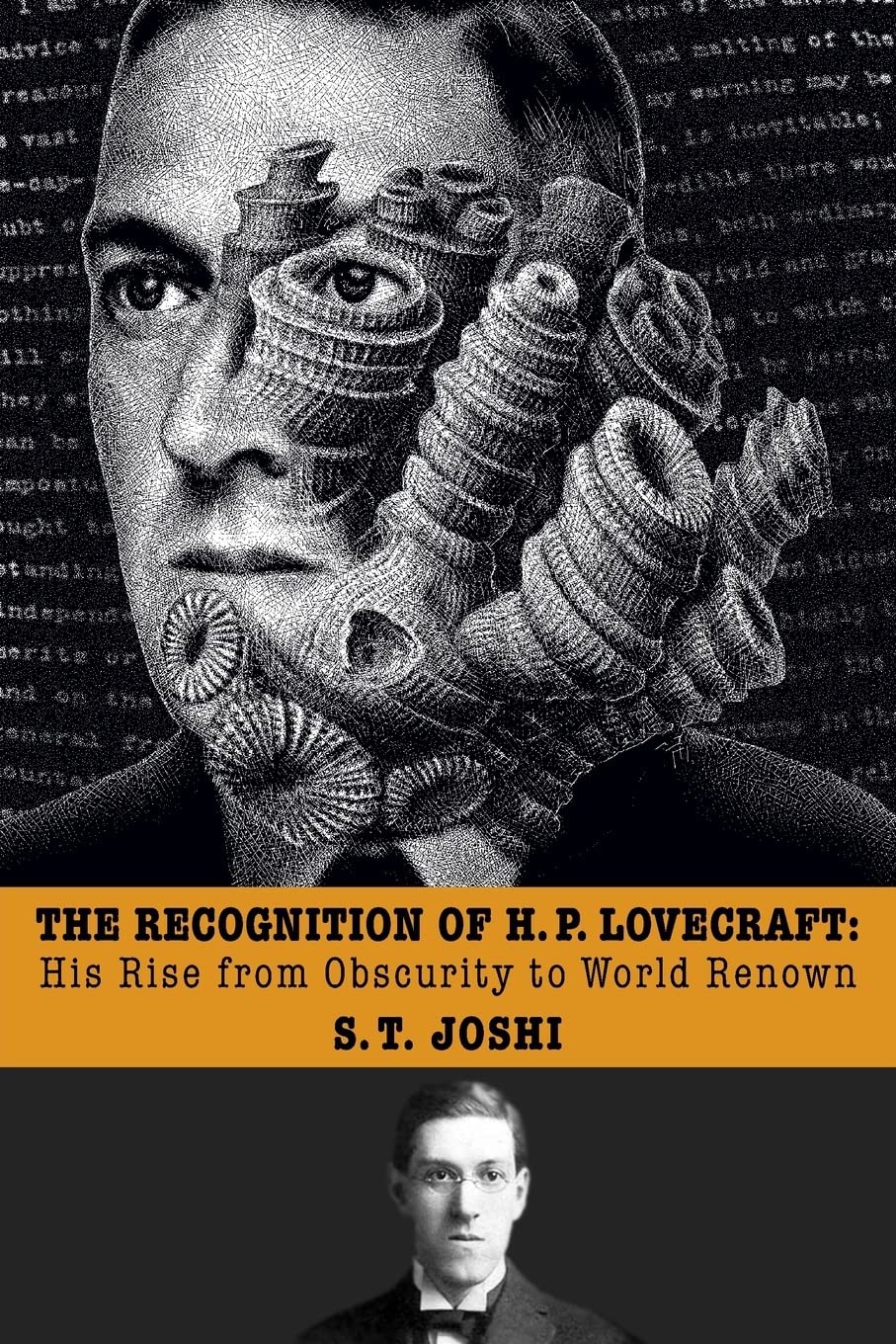
Review of The Recognition of H. P. Lovecraft: His Rise from Obscurity to World Renown


Review of The Recognition of H. P. Lovecraft: His Rise from Obscurity to World Renown

Beatrice Steele

S.T. Joshi. The Recognition of H. P. Lovecraft: His Rise from Obscurity to World Renown. Hippocampus Press, 2021. Paperback. 340 pg. $25.00. ISBN 9781614983453.

When H. P. Lovecraft died in 1937, not a single book of his stories had been published. This is a fact we are frequently reminded of in S. T. Joshi’s The Recognition of H. P. Lovecraft: His Rise from Obscurity to World Renown. This thorough study attempts to explain at least part of Lovecraft’s meteoric rise to worldwide fame by charting public discussions of his life and work. I use the slightly vague term “discussions” to describe the materials Joshi draws upon in this study because they are incredibly wide-ranging. He assesses all kinds of engagement with the Lovecraftian paper trail, from critical notices, scholarly tomes, and translations to rock music and pulp films. Despite some diffidence in the preface about whether he is the correct choice to author a book such as this, perhaps because of his own considerable stake in the recognition of Lovecraft, it soon becomes clear that nobody is better placed than Joshi to track and evaluate these developments. The reader gains useful insight into the circumstances that led to Lovecraft gaining popularity in a society that is arguably even weirder than the early twentieth-century one he inhabited. Joshi does not confine his study to Lovecraft’s fictional works, but also examines the legacy of his essays, poems, and philosophical thought.

One imagines that this body of research could have been rendered as a vast bibliographic list of items that make mention of Lovecraft. This might have proved useful for academics searching for a database comprising every important piece of public recognition. Indeed, Joshi acknowledges such previous projects, particularly where they do manage a significant act of textual excavation, but this book could appeal to an audience of casual Lovecraft enthusiasts as well as academics. It acknowledges that the story of his ascent is a fascinating one in itself. Yet, Joshi is careful to prioritise the impact of the fiction and not let the substance of his discussion become trapped in tangents about the author’s personal life.

The Recognition of H. P. Lovecraft begins with a newspaper column on the meteorological station Lovecraft built and ran as a teenager. His fascination with astronomy was what first encouraged him to write a letter to Scientific American. Lovecraft’s membership in the United Amateur Press Association opened up a new world of colleagues, friends, and rivals. Joshi briefly covers this amateur press career, but the book is primarily invested in responses to Lovecraft’s imaginative work. Indeed, members of the UAPA were generally not receptive to the fiction, but by the time Joshi moves on to examine Lovecraft’s pulp career, the engine of approbation is beginning to get started. Fictional outings in Weird Tales and Amazing Stories were met with acclaim, although Joshi is careful to point out that the editor of Weird Tales did not choose to publish letters critical of Lovecraft’s work.

Despite the famous caricature of Lovecraft as a reclusive genius, Joshi makes it clear that his friends and associates were the ones who kept his memory alive long enough for the popular paperbacks and movie adaptations of the 1960s to filter into serious scholarship in the late 1970s. The remarkable aspect of this trajectory is just how many setbacks Lovecraft’s reputation suffered and overcame. An interesting case study is that of 1945, a watershed year which soured into an annus horribilis. During this year there were many publications concerning Lovecraft, including an Armed Services Edition of The Dunwich Horror, illustrating the traction Lovecraft was gaining in the English-speaking imagination. In Joshi’s opinion, the tide was turned by an extremely negative review by Edmund Wilson, an eminent American critic. In him, Joshi appears to have located the quintessential case of the literary snobbery that would dog anyone who wanted to take Lovecraft seriously as an artist for years to come. In particular, Joshi highlights Wilson’s comment about Lovecraft being more “interesting” than his work (113). It becomes clear in the last part of the book as to why Joshi thinks that these probings into the author’s personal life are something to be regarded with suspicion.

The latter chapters are nothing short of gold dust for any scholar seeking a comprehensive and informative history of monographs and articles on Lovecraft. The canonisation of Lovecraft as a literary titan, in addition to the seismic effect of his work in science fiction internationally, makes the general recognition of his talent seem a foregone conclusion by the time we reach the ninth chapter of the book. Joshi admits that a total audit of Lovecraft-related media by this point in time is basically impossible. Nevertheless, readers of SFRA Review will no doubt already be familiar with much of what Joshi covers in terms of the growth of Lovecraft in popular culture.

The most polarising aspect of this book is undoubtedly how it approaches the recent controversies surrounding Lovecraft’s prejudices. Joshi makes no bones about his negative opinion of “virtue signalling” (305). His main objection to the attacks on Lovecraft is essentially what many of Lovecraft’s defenders have said in the past, namely, that his views were conceived in a historical context that deserves to be considered. He also argues that the criticism of Lovecraft’s worst lines often devolves into slander and has achieved little more than the defacement of every other facet of the man’s personality. The end result has been the condemnation of the entire person rather than his views, many of which Lovecraft regretted later in life. Joshi does not hesitate in calling out cynical personalities who profited from Lovecraft’s legacy only to trample on his reputation later.

Joshi ends by reminding us of the most important point. Whatever we may think of Lovecraft the man, this controversy has had little effect on the sales of his fiction around the world. The Recognition of H. P. Lovecraft is ultimately a testament to the power of the stories, which have proved resistant to many different crises, and will certainly survive many more.

Beatrice Steele is a PhD researcher and freelance writer from Guildford, England. She gained a Master’s in eighteenth-century literature from the University of Oxford in 2022 and is now undertaking an AHRC-funded PhD based at the University of Exeter. Her research interests include Victorian science, visual culture, and astronomy. She is also a regular contributor to the Dotun Adebayo Show on BBC Radio 5 Live. In her spare time, she likes to read and write poetry. She recently won second place in the Jane Martin Poetry Prize, a national competition run by Girton College, Cambridge.

Review of Household Horror: Cinematic Fear and the Secret Life of Everyday Objects


Review of Household Horror: Cinematic Fear and the Secret Life of Everyday Objects

Sabina Fazli

Marc Olivier. Household Horror: Cinematic Fear and the Secret Life of Everyday Objects. Indiana UP, 2020. Ebook. 350 pg. 44 b&w illus. $18.99. ISBN 9780253046598.

The underlying idea of Olivier’s study, namely that objects in horror films are more than they seem, is probably intuitively evident to anyone who has ever watched a horror movie. But rather than focus on the props that come to mind—the haunted houses and cursed objects—Olivier attends to objects that sit on the margins of the plot and seem to be benign, familiar, and even mundane.

Olivier’s object-oriented readings of horror films offer detailed analyses which illuminate the ‘secret lives’ of these domestic objects on screen. This object-led approach is also reflected in the book’s structure and its visualization: Household Horror takes the reader on a tour of an apartment and guides them through four sections titled “Kitchen/Dining Room,” “Living Room,” “Bedroom,” and “Bathroom,” each containing chapters on objects which we would expect to find in these rooms (for example, the “Bathroom” contains chapters on the “Radiator,” discussing Lynch’s Eraserhead [1977], on “Pills” which probes the medicated female body in The Bad Seed [1956], Rosemary’s Baby [1968], and The Exorcism of Emily Rose [2005], and lastly the famous “Shower Curtain” from Psycho [1960]). The floor plan of a one-bedroom apartment preceding the first chapter functions as an additional flat, visual table of contents mapping all of the objects discussed in the book. This structure already illustrates Olivier’s approach. Rather than ordering his analyses according to “traditional strategies of coherence such as chronology, country, director, and subgenre,” readers are free to “roam” among the object-themed chapters (2), which can be read in any order.

In the short introductory chapter, Olivier establishes the theoretical orientation of the following analyses. Setting out to follow objects’ ‘secret lives,’ the book announces its inspiration by reference to work within the material turn that seeks to decenter the hierarchical organization of humans and objects. Olivier cites Ian Bogost and his elaboration of object-oriented ontology (OOO) as the basis for “treat[ing] objects as beings that surpass the roles given to them as props or decor” (3). This re-perspectivization recovers the various pieces of furniture, tools, and devices that form the unremarkable tapestry of everyday life from the background and grants them center stage. Viewed through the lens of OOO, horror films, Olivier argues, turn this domestic landscape inside out and foreground humble objects as central participants on a par with humans.

Methodologically, Olivier combines a range of approaches, two of which seem to be particularly characteristic of his project: He takes the reader on contextual excursions into the histories, inner workings, and material make-up of objects, detailing their usually obscured or forgotten ‘lives’ on their own terms and then tying them back into the films. For example, one of the objects in the first section, “Kitchen/Dining Room,” is the microwave which Olivier reads as a pivotal element in Gremlins (1984): “The microwave is a gremlin-sized chamber of atmospheric terror rooted in wartime research, embroiled in spy scandals and health scares—it is an inspirer of tabloid stories and urban legends and possibly the least understood device in the kitchen” (30). It is, Olivier suggests, much more than a convenient appliance as its public and imaginary lives complicate its status as a mundane domestic appliance, not the least, because microwave ovens are a relatively recent addition to kitchens. Their new owners in the 1980s were particularly fascinated by rumors and sensationalized stories about the dangers of microwaves, because the technology evokes the threat of nuclear radiation (35). This residual uncanniness of objects seems to emerge from their incomplete domestication due to their relatively recent adoption in homes. Mining the history of the refrigerator, sewing machine, and typewriter, Olivier provides compelling interpretations of their roles in Possession (1981), Silence of the Lambs (1991), Carrie (1976), and The Shining (1980) and includes readings that draw out the complicated processes of domestication that these technologies underwent. Their horror, Olivier’s readings also suggest, lies in their continued, but obscured, connections with histories and networks outside the home. Other object-led excursions consist in attending to the inner workings of devices, offering physical routes into black-boxed objects, as Olivier demonstrates with regard to call tracing in Black Christmas (1974), where “The call is taking place not only at two ends of a phone line but also at a police station and in a switching station” (60). Olivier then dwells on the latter as much as on the former two locations and opens up a constitutive but hidden space within the network. In this way, histories and technologies that lead outside the films (and outside the home) are reinserted into the analyses in a movement reminiscent of Elaine Freedgood’s ‘old’ materialist “strong metonymic reading” (see her The Ideas in Things: Fugitive Meaning in the Victorian Novel of 2006) which recovers the cultural and historical meanings of objects outside the literary text and then weaves them back into the narratives.

Olivier further centers objects through the straightforward but effective strategy of translating plots into lists (4). This re-segmentation based on the object rather than subject, assisted by phrases that highlight the non-human agent, as in “table events” (80, Noriko’s Dinner Table [2005]), “remote-control phenomena” (123, Poltergeist [1982]), “bed scenes” (184, The Exorcist [1973]), or “typographic events” (212, The Shining), subtracts human agents and provides inventories instead (also the diagram of phone calls in Black Christmas, 56). The ‘inventory’ is a key figure and programmatic device in Olivier’s study to which he returns in the brief conclusion: “Household Horror takes a simple inventory of household objects, explores the deformations caused by their presence in cinematic horror, and produces new objects as readings” (312), relying on the “gentle knot of the comma” (312, quoting Bogost).

Household Horror is a readable and jargon-free study that demonstrates the benefits of object-led analyses through the sheer range of illuminating case studies rather than abstract theory. Reading it from cover to cover, as I have done following the protocols for reviewing academic monographs, is probably less effective than picking and choosing chapters that are of interest either because of the films they analyze or the objects featuring in them. The book, or rather its individual chapters, would thus be of interest not only to students and researchers of horror but also to anyone wondering how film (and, indeed, literary studies) can put OOO into interpretative practice.

Sabina Fazli is a postdoc in the collaborative research center ‘Studies in Human Categorization’ at Mainz University, Germany. Her PhD thesis was in English literature and has been published as Sensational Things: Souvenirs, Keepsakes, and Mementoes in Wilkie Collins’s Fiction (2019). The book explores the significance of sentimental objects in sensation fiction. Her research interests are now in magazine studies, and the material and affective side of periodical reading, independent, experimental, and zine publishing, as well as Neo-Victorian and steampunk fiction.

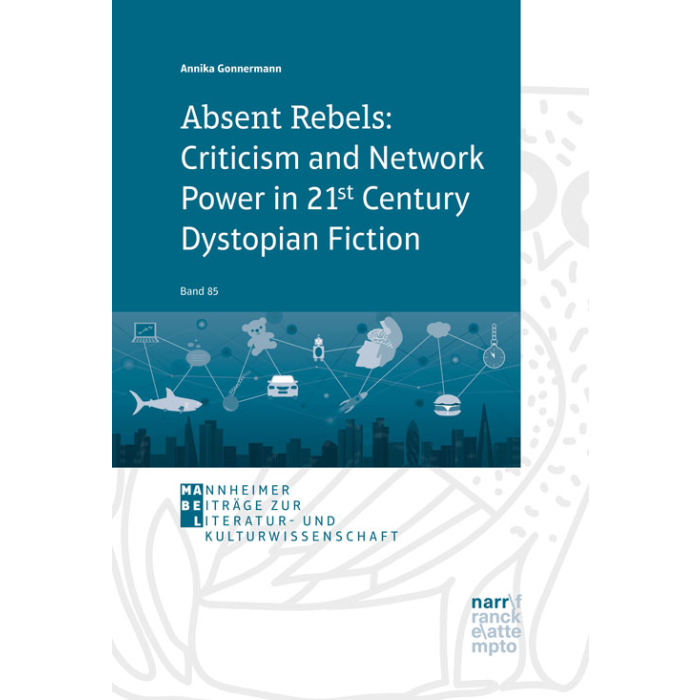
Review of Absent Rebels: Criticism and Network Power in 21st Century Dystopian Fiction


Review of Absent Rebels: Criticism and Network Power in 21st Century Dystopian Fiction

Ben Eldridge

Annika Gonnermann. Absent Rebels: Criticism and Network Power in 21st Century Dystopian Fiction. Narr Francke Attempto, 2021. Print. 352 pg. €68.00. ISBN 9783823384595.

We live in dystopian times, at this early stage of the twenty-first century. Against a backdrop of environmental disaster and increasingly violent geopolitical manoeuvrings, a raging viral pandemic continues to exacerbate long-developing global inequalities. Meanwhile, dystopian fiction has also become inescapable. Novels such as George Orwell’s Nineteen Eighty-Four (1949) are once again topping global bestseller charts, television series including 오징어 게임 (Squid Game) (2021-) have come to dominate on-demand streaming services, and film adaptations like The Hunger Games franchise (2012-2023) continue to break various box-office attendance records. Annika Gonnermann’s Absent Rebels: Criticism and Network Power in 21st Century Dystopian Fiction (henceforth Absent Rebels) responds directly to this booming popular cultural embrace of dystopia, but makes a further seemingly provocative claim: such “classical” (12) fictional dystopias are effectively meaningless for the current age. Gonnermann argues that this type of dystopian fiction (which she identifies as material containing a “focus on political entities” [17], primarily totalitarian regimes) – particularly as such works increasingly infiltrate mainstream channels – cannot act as a subversive critique of its cultural status quo, but can exist only as a commodity that offers light, somewhat anachronistic, entertainment. While Big Brother is certainly still watching, Big Brother is also being watched, in record numbers.

Absent Rebels posits that the commodification of dystopia is a direct result of the economic milieu that engulfs contemporary Western culture: neoliberalism—that most highly aggressive and unchecked form of capitalism—functions by flattening, incorporating, and ultimately commodifying everything, even its own potential critique. According to Gonnermann, this leaves classical dystopias neither adequate nor appropriate for representing—much less challenging—contemporary forms of political organisation, because “the state’s monopoly of power” (18) is now subsidiary to the logistical and financial networks that underpin globalized capital. Gonnermann proceeds to claim that a “new relentless bleakness” (304) is evident in certain exemplary contemporary dystopian texts – her selection consists of David Eggers’s The Circle (2013), Margaret Atwood’s The Heart Goes Last (2015), M.T. Anderson’s Feed (2002), David Mitchell’s Cloud Atlas (2004), and Kazuo Ishiguro’s Never Let Me Go (2005)—and is beginning to “rejuvenate” ( 19) the genre in order to “spell out the inevitability of free-market capitalism” (304) and its attendant violent social impacts. Presented by Gonnermann as “especially progressive and subversive” (18), she argues that her chosen texts are identifiable by their lack of “rebels and dissidents,” (19) which means that they “urge readers to explore the possible alternatives to the dystopian world presented to them on their own” (19, emphasis in original). For Gonnermann, the lack of protagonists who can challenge the economic system that they are depicted as existing within reflects the truncated possibility of meaningful resistance in a more broadly networked society that features no clearly identifiable antagonists. The texts thus act as “phenotypes of a neoliberal economic system” (241), and function to “map out the contradictions of contemporary neoliberal capitalism” (19). Absent Rebels, then, is a timely and sometimes innovative contribution to the field of dystopian studies and is impressive for its ambition, even if it is rather frustrating to witness this ambition only inconsistently realised across the text.

The limitations are unfortunately apparent from the opening of Absent Rebels, which does read rather like a postgraduate dissertation, desperate to prove its bona fides in an overdetermined manner: the early definitional sections are laboured, and the literature review of canonical dystopian literature and literary history that comprises the first major chapter of the book is rather cumbersome, as are the frequent and extended footnotes that addend the text.[1] More problematically, however, Absent Rebels is underlain by a number of somewhat problematic assumptions that remain completely unchallenged. Take Gonnermann’s starting point, for instance:

What makes dystopia so fascinating is its ability to capture cultural anxieties and voice them in literary terms, so that it acts as a mouthpiece and tool of diagnosis and critique for social, political and economic developments… dystopian fiction is always meant as a normative criticism of the socio-historical and historical characteristics of its own origins. (38; 40 emphasis in original)

Claiming an invariable one-to-one correspondence between textual representation and societal critique is a basic misjudgement, because it presumes, amongst other things, that critique is in fact the raison d’etre of all dystopian texts: a highly dubious presumption given the cynically populist manner in which many such texts are written, produced and marketed.[2] But there is an even more fundamental supposition that informs Gonnermann’s claim: in positioning dystopia as a literary expression of extratextual criticism, and claiming that “the aim of any criticism is a transformation of the status quo” (45), she explicitly aligns dystopian texts with their authors’ attempts to engage in real-world revolutionary change. At its most fundamental, then, the premise about the essential function of dystopian literature is naïve in Absent Rebels: there is simply no necessary relationship between any specific piece of cultural production and extraliterary political effect or social reform. In this and other areas, and to its detriment, Absent Rebels repeatedly fails to distinguish between the fictional representations found within the pages of its selected texts and the external reality in which readers and writers live.

Relatedly, much of Absent Rebels understands its primary texts as predominantly, and oftentimes solely, didactic and veers, sometimes headfirst, into intentional fallacy. Take, for example, Gonnermann’s following rumination:

The challenge authors are faced with is to develop an appropriate imagery or language to capture neoliberal thought in its essence while avoiding the fallacies of methodological individualism, i.e. blaming individuals for systemic problems. (175)

What remains unclear is why—or even if—such innovations in form, theme or style are intended in the first instance, and, more crucially, why authorial intention matters in any case. The above quotation is indicative of a general trend by which Absent Rebels simply presumes the accuracy of each of its theoretical speculations, and frequently does not bother offering simple things like evidential substantiation. Indeed, the repeated blind profession of opinions on behalf of a hypothetical reader and the constant moralising throughout Absent Rebels can become fairly overbearing, even to a reader that is already sympathetic to its ideological starting point.

Credibility is further strained in Absent Rebels by the indiscriminate application of its central thesis to its primary texts. By reducing each of its focal texts simply to their relationship with “globalised predatory neoliberal mechanisms” (206), Gonnerman leaves any other themes that arise in the respective novels almost entirely adrift.

For all these problems, however, Absent Rebels does make some insightful observations on both a large and small scale. The foregrounding of theory – particularly in positioning capitalism as a kind of “hyperobject” (Morton 2013, 1) that is “almost impossible to criticise directly” (Gonnermann 66) – is highly productive, and some of the close readings of the primary texts are relatively compelling, particularly in the later chapters.[3] Indeed, Absent Rebels should be applauded for its serious exploration of contemporary texts and social systems. All in all, Absent Rebels is a book that demonstrates a lot of promise, but is heavily flawed on both a theoretical and a formal level. The fairly frequent errors with grammar and spelling are frustrating, and combine to undermine the text’s clarity and coherence in their own right, but also cause further issues with phrasing and stridency (for example, a claim that a text “obviously references” a specific event shifts to merely “hinting at” that event later in the same paragraph [152]). The latter issue is also likely responsible for some arguments being at odds with the evidence provided, instances of further dubious foundational bases provided for the claims being made, and occasional outright misrepresentation of some secondary source content.


NOTES

[1] The copyright page reads “Zugleich Dissertation an der Universität Mannheim,” (translation: “At the same time dissertation at the University of Mannheim”) so this may be an unrevised thesis. I do hasten to note that this is a good, interesting and somewhat innovative dissertation, but that fact alone does not necessarily translate directly into a wholly convincing academic publication.

[2] Gonnermann herself makes precisely this point, in fact: “novels in general, and dystopias, struggle to maintain their integrity as channels of criticism [because t]hey are always products of a neoliberal market policy and are produced as commodities by publishing houses and marketing departments to satisfy consumer demand for the highly popular dystopian genre” (2021, 67). Accordingly, it is one of the constant frustrations of Absent Rebels that Gonnermann seems unable to consistently maintain her own argumentative line(s).

[3] Morton describes hyperobjects as “things that are massively distributed in time and space relative to humans” (2013, 1).

WORKS CITED

Morton, Timothy. Hyperobjects: Philosophy and Ecology after the End of the World. Minneapolis: University of Minnesota Press, 2013.

Petrozza, Mille (Kreator). “Terrible Certainty.” Terrible Certainty. Berlin: Noise Records N 0342-2, compact disc. 1987.

Ben Eldridge an early career researcher of Literatures in Englishes & the current Vice-President of the Association for Canadian Studies in Australia and New Zealand (ACSANZ), who lives and works primarily on unceded Darug and Gadigal land. If not performing the exploitative, unpaid labour that is intrinsic to the functioning of the modern neoliberal ‘academic’ sector, Eldridge can be found either denouncing technocratic management or—like his personal avatar, the Canada goose (Branta canadensis)—honking eternally into the void of existential despair. This, he realises, may be a tautological claim.

Review of Middle-earth, or There and Back Again


Review of Middle-earth, or There and Back Again

James Hamby

Łukasz Neubauer, ed. Middle-earth, or There and Back Again. Walking Tree, 2020. Paperback. 156 pg. $19.45. Cormarë Series. ISBN 9783905703443.

Łukasz Neubauer’s edited collection Middle-earth, or There and Back Again covers an eclectic array of works from J. R. R. Tolkien’s oeuvre. Four of the six essays focus on Tolkien’s Middle-earth legendarium while the other two discuss The Fall of Arthur and The Story of Kullervo. Each essay focuses on the texts that influenced Tolkien’s world-building, examining the ways in which Tolkien took themes, characters, and even worldviews from earlier mythologies and changed, elaborated, or otherwise recapitulated them in order to create his own mythopoeic texts. In all, this collection leaves the reader with a deeper understanding of just how fertile Tolkien’s familiarity with ancient and medieval literature was for his writing.

Neubauer’s own contribution to the volume, “‘You cannot pass’: Tolkien’s Christian Reinterpretation of the Traditional Germanic Ideals of Heroism and Loyalty in The Lord of the Rings”, is the most notable essay in the collection. Neubauer argues that the scene in The Lord of the Rings in which Gandalf battles the Balrog in the depths of Moria was inspired by Beorhtnoth’s actions in The Battle of Maldon. Both texts envision a battle against formidable foes where a leader’s followers come to his aid, as well as a setting where the enemies must cross a bridge in order to engage in battle. The major difference between the two texts, Neubauer argues, is that while Beorhtnoth allows the Vikings to cross in a hubristic desire to increase the glory of a supposed victory, thus allowing his followers to die needlessly, Gandalf positions himself on the bridge to prevent the Balrog’s passing and refuses help from his company, thus sacrificing himself for the greater good. As Neubauer comments, Tolkien’s “understanding of what truly defines heroism goes well beyond the somewhat narrow and oversimplified framework of the oft-examined Germanic ‘heroic ideal’” (34). In this way, Tolkien takes an older story and reimagines it to adhere to his Catholic worldview, transforming what had been a story of warrior heroism into a parable of heroic sacrifice.

In the same vein, Michał Leśniewski in “Tolkien and the Myth of Atlantis, or the Usefulness of Dreams and the Methodology of Mythmaking” examines the influence of Plato’s tale of Atlantis on Tolkien’s creation of Númenor. While scholars elsewhere have made this connection between these two doomed societies before, Leśniewski emphasizes how the fallen nature of the Edain constitutes a significant theme throughout the Middle-earth mythos. As Leśniewski observes, “the Edain are … inclined to make the same mistakes, over and over again” (17). This, Leśniewski argues, also falls in line with Plato’s thinking, as “Tolkien appears to share Plato’s pessimistic view concerning the fallible character of human nature” (17). Plato’s influence on Tolkien’s legendarium therefore extends beyond just the tale of a civilization doomed by punishment for its wickedness, it also inspires a paradigm for all human actions on Middle-earth and the way in which its history unfolds.

Barbara Kowalik’s essay, “Tolkien’s Use of the Motif of Goldsmith-craft and the Middle English Pearl: Ring or Hand?,” offers a fascinating look at how one of Tolkien’s favorite medieval poems influenced his creation of the Ring of Power. While previous scholarship has largely focused on how Tolkien was inspired by the rings from Niebelungenlied and Plato’s “Ring of Gyges,” Kowalik instead convincingly argues that Pearl provides the model for the One Ring. Yet, as in the essays discussed above, it was not inspiration merely for one object; rather, it offered an entire framework of beliefs around rings that Tolkien used throughout his Middle-earth Legendarium. Kowalik notes how the symbolism of precious metals and gems found in Pearl are recapitulated in The Silmarillion and The Lord of the Rings. Kowalki points out that both works contain “a story of attachment and loss, and of regret, pain, and quest for a jewel” (48). In addition to similarities in plot, Kowalki demonstrates that these works both contain similar themes, such as how the jewels “must not be isolated to please a single individual” (53) because “isolation is shown to be at the root of … evil-doing” (54), that “personal dignity and goodness is preserved through acknowledging authority” (53), and that the circular shape of the rings “suggest both perfection and entrapment” (59), amongst others. Tolkien scholars have long noted how Tolkien’s interest in medieval literature affected his creation of Middle-earth, and Kowalki’s essay should bring more critical attention to Pearl as source material for Tolkien’s mythos.

The final essay that focuses on Middle-earth, “The Wisdom of Galadriel: A Study in the Theology of J. R. R. Tolkien’s The Lord of the Rings” by Andrzej Wicher, looks at the many influences that Tolkien drew upon to construct Galadriel, from Saint Paul’s Epistles to John Ruskin’s ideals of womanhood.Wicher’s interpretation of Galadriel focuses on how she is “an unlikely heroine of the struggle with Sauron” (128) because she herself took part in Fëanor’s rebellion against the Valar. This, however, gives her wisdom and helps her understand humanity’s sinful nature, making her, as Wicher says, into a character “through whom many Biblical echoes reverberate” (128).

The two essays that focus on Tolkien’s works outside of his Middle-earth legendarium, “The Mythical Model of the World in The Story of Kullervo” by Andrzej Szyjewski and “J. R. R. Tolkien’s The Fall of Arthur in the Context of the Medieval Tradition of Romance” by Bartłomiej Błaszkiewicz, both look at Tolkien’s direct adaptations of older mythic cycles. Szyjewski’s assessment of The Story of Kullervo is that while composing this work Tolkien honed his skills in creating new languages and pantheons, thus teaching him the principles of mythopoeic creation that would ultimately result in his tales of Middle-earth (110). Błaszkiewicz explicates Tolkien’s adaptation of the Arthurian language and likewise argues that Tolkien’s experiences in writing this poem contributed to his creation of Middle-earth (81).

This volume provides a valuable overview of some of the sources Tolkien was familiar with as a medievalist and that he used to create his own literary works. While readers of the Cormarë series may expect a more focused theme for an edited collection, these essays are connected (even if somewhat loosely) by their explorations of how Tolkien reworked medieval and ancient literature into his own writings. These essays provide important studies of Tolkien’s sources and, as with all the other volumes put forth in the Cormarë series, this collection makes a valuable contribution to Tolkienian scholarship.

James Hamby is the Associate Director of the Writing Center at Middle Tennessee State University, where he also teaches courses in composition and literature. He currently serves as the editor for The Incredible Nineteenth Century: Science Fiction, Fantasy, and Fairy Tale, and he previously held the position of Associate Book Reviews Editor for Journal of the Fantastic in the Arts. He has written book reviews for many different journals, and recently published an article on Dickens’s Holiday Romance with Dickens Studies Annual.

Review of According to Jack Kirby


Review of According to Jack Kirby

Dominick Grace

Michael Hill. According to Jack Kirby: Insights Drawn from Interviews with Comics’ Greatest Creator. Lulu Publishing, 2021. Paperback. 348 pg. $19.95. ISBN 9781667133072.

Michael Hill’s title here—the subtitle especially—tells you much of what you need to know about this book. This self-published study is evidently a labor of love by a self-identified Kirby fan, and it wears its admiration of Kirby on its sleeve. Hill’s contention is straightforward and clear: the history of Marvel Comics, certainly the official Marvel history, exaggerates Stan Lee’s role and criminally downplays Kirby’s in the creative explosion of the early 1960s from which most of Marvel’s major characters emerged. I think it is fair to say that Hill’s is an uncontroversial position; certainly, I have believed Kirby was the primary architect of Marvel’s early superhero line for decades—and indeed, Hill relies on interviews that are decades old as the basis of much of his argument. Two features make this book stand out. First, it takes a fairly absolutist view of the question, essentially accepting both Kirby’s claims to have created almost everything and Kirby’s dismissals of Stan Lee. Second, it offers a comprehensive tour through an enormous number of interviews with Kirby and others to make its case. One key point Hill makes, and demonstrates, is that Kirby’s story remained consistent across decades, whereas Stan Lee’s did not, which one can easily see as damaging Lee’s credibility. Hill also lands hard on two financial arguments. First, he argues, persuasively, that the so-called “Marvel Method,” whereby artists produced pages from plot summaries rather than from full scripts, really meant that the artists actually did most of the heavy lifting on the books. Hill cites artists other than Kirby who assert that Lee often provided no actual plot at all, leaving the artist to create the story; Lee then took the writing credit, leaving the art credit only for the artist. Hill’s argument is that this practice allowed Lee to exploit the artists by claiming not only the writing credit but also the payment for writing. Second, he argues, perhaps somewhat less persuasively, that Lee’s shift to asserting that he was the creator of all the early Marvel superheroes coincided with the takeover of the company so was part of a scheme to confirm company ownership of all of its lucrative characters. These are arguably the book’s core points, and they are good and important ones. They are not, however, news to those already well-versed in this long-standing controversy. Many other commentators have largely accepted Kirby’s claims, though not as thoroughly as Hill does, as is evident from Hill’s critiques of earlier researchers in this area.

Furthermore, the book suffers from limitations. First of all, Hill’s criticisms of the hagiographic way Lee has been viewed may sound valid given that Kirby has been so overlooked, but they also seem ironic, as Hill is engaged in his own hagiographic depiction of Kirby. This is not an academic study, so its fannish style is to be expected, but Hill’s strongly anti-Lee perspective, understandable (and valid, in my opinion) as it may be, means that he is unlikely to win over anyone not already on his side of the debate. His decision to give Kirby the same benefit of the doubt that he argues has always been given to Lee’s claims leads him not to question Kirby’s own claims, thereby correcting (from his point of view) the different standards of credibility Lee and Kirby have received in the past, but also thereby letting all of Kirby’s claims go essentially unchallenged. The critical consensus is that Kirby did indeed play a far greater role than the partisan official history grants him, but it also and legitimately recognizes that Kirby’s own claims need to be evaluated rather than simply accepted. Interestingly, Abraham Josephine Reisman’s biography of Stan Lee, True Believer: The Rise and Fall of Stan Lee, also published in 2021, essentially supports Kirby’s claims over Lee’s, without Hill’s propensity for partisanship in Kirby’s favor.

Second, and more problematically, the book’s structure is confused and repetitive. The book consists of two sections. Part one is derived from Hill’s chronological examination of the Lee-Kirby controversy for the Jack Kirby Museum and Research Center’s web page in 2015, produced because a promised treatment of the same subject in the magazine The Jack Kirby Collector had been cancelled. As Hill reports, that special issue “was quietly added back to the schedule” (x) for the magazine after his piece appeared. Part two of this book comprises Hill’s point by point and exhaustive response to that special issue. Consequently, part one and part two cover much of the same territory, and in a great many instances say essentially the same thing, even using the same quotations. Multiple quotations appear twice (or more) in the book, and many repeat the same information. While documenting different occasions on which Kirby said essentially the same thing does support Hill’s argument that Kirby’s story stayed consistent, the extensive repetition of information, whether verbatim or in multiple similar quotations, unnecessarily pads the book and weakens its coherence. Hill could have combined his two separate accounts into one linear narrative, though doing so would have required considerably more reshaping of the material than has evidently been done.

Those unfamiliar with the Kirby side of the story, and even Kirby enthusiasts, might find value here, the uninitiated simply because the book provides a corrective to the Marvel version, and enthusiasts because Hill’s thoroughness means that many difficult-to-find interviews are referenced and cited, and because other rare documents are also reproduced. However, this book does need to be read with a critical lens, and those interested in the long history of the Lee vs Kirby argument would do well to consult other sources, perhaps especially those Hill cites and criticizes. Unfortunately, though, Hill does not provide a bibliography of works consulted, only an index of the interviews referenced. Comprehensive comics libraries might want to add this book, but more selective collections can pass it by.

Dominick Grace is the author of The Science Fiction of Phyllis Gotlieb: A Critical Reading and of numerous articles. He has co-edited several books covering topics such as comics, television, and Canadian speculative fiction.

Review of Chinese and Western Influence in Liu Cixin’s Three Body Trilogy


Review of Chinese and Western Influence in Liu Cixin’s Three Body Trilogy

Jerome Winter

Peyton, Will. Chinese and Western Influence in Liu Cixin’s Three Body Trilogy. Palgrave Studies in Global Science Fiction. Palgrave Macmillan, 2021. 161 pg. $54.99. ISBN 978-3030793142

When the English translation of Liu Cixin’s Three Body Problem won the Hugo Award in 2015, the moment was widely hailed in the Western news media as the global emergence of ‘Chinese science fiction.’ To what extent was that coverage merely a convenient marketing label? In this book-length inquiry into the eclectic influences of Western and Chinese literature on the Three Body Trilogy, Liu Cixin-scholar Will Peyton suggests the writer’s interest in what the literary critic C. T. Hsia has called writing tinged by culturally distinctive ‘Chinese characteristics’ has been overstated; likewise, Peyton contends that in general the Sino-affiliated work typically grouped as Chinese SF (kehuan xiaoshuo) developed not simply independently from Western influence but in an extensive and dynamic dialogue with a wide variety of non-Chinese SF. Hence in this way Peyton advocates for understanding the Three Body Trilogy as a fascinating entry into the broad, cross-pollinating phenomenon popularly known as global SF: “Liu Cixin, like many contemporary Chinese authors, consciously views himself in a lineal relationship with translated Western writers, often making marginal reference to native Chinese fiction” (18).

Another controversial and complicated issue this book weighs in on is the precise political valences of Liu Cixin’s work and specifically that of the Three Body Trilogy. As now plastered on his Wikipedia page, in June 2019, Liu Cixin, in a profile-interview for the New Yorker, parroted the standpoint discredited by Western observers and promoted as the official position of the People’s Republic of China (PRC) that the mass detention of Uyghurs in Xinjiang is justified to preempt future terrorist attacks. Peyton does not merely condemn the Chinese writer from the cosmopolitan distance of the Western intelligentsia, as so many glib commentators have done; oppositely, and more subtly, Peyton also specifically refuses to argue that Liu Cixin critiques the political unconscious of ‘soft power’ implicit in endorsing a distinctive brand of politically flexible Chinese science fiction against the dubiously universalized stipulations of human-rights rhetoric (thus eluding a well-flogged whipping post typified by the anti-China sentiment of certain U.S. Republican senators opposed to Netflix’s in-development adaptation of The Three Body Problem). Instead, Peyton more productively historicizes Liu Cixin’s dystopian political “fatalism” as evincing a shrewd “ambivalence towards defining or engaging with discussion of political progress” (139) very much in strategic consonance with the ideological messages emanating from the PRC.

The argument of the book flows from such concretely historicizing moves. The second chapter delineates Liu Cixin’s critical assays against the anthropocentric narcissism of modern literature. The chapter performs a close reading of the virtual-reality simulations depicted in the Three Body Problem as vividly representing a putatively neutral scientism indicative of Western-influenced, post-Mao Chinese literature. The third chapter explicates the impact of the Early Modern writings of Thomas More and Tommaso Campanella as well as Darwinian thought on Liu Cixin, Chinese SF, and the Three Body Trilogy. Its specific argument is that the cosmic sociology of the trilogy fuses these utopian traditions with a contemporary scientism influenced by Western thinkers such as Peter Singer and Richard Dawkins.  The fourth chapter analyzes specifically The Dark Forest (2008) and Death’s End (2010) for their evocation of a broad Shakespearean humanism. The fifth chapter frames Liu Cixin in terms of the discrepant flavors of historical realism rendered by Arthur C. Clarke and Herman Wouk. The fifth chapter discusses the classic dystopias by George Orwell, Yevgeny Zamyatin, and Aldous Huxley to limn the ethical relativity of Liu Cixin’s dystopian space opera and its glimmers of utopian scientism. The seventh chapter contextualizes Liu Cixin’s fiction as a mature outgrowth of Chinese youth fiction of the Cultural Revolution. The eighth chapter concerns the technologically utopian bent of both Liu Cixin’s trilogy and Chinese science fiction more broadly, and the ninth chapter traces the fatalism toward progress in Liu Cixin’s work to competing strands of Confucian and Daoist political thought. This last chapter includes a cursory conflation, by way of Karl Popper, of the sheer multiplicity of rigorous critical theory that can be swept under the banner of “Marxist historicism” (131) with the doctrinaire propaganda of the Maoist Cultural Revolution and therefore seemed tendentious to this reader.

All in all, though, this book greatly appeals to readers and scholars of science fiction, Chinese literature, translation studies, global studies, as well as those interested in close readings of Liu Cixin’s seminal trilogy in light of its historical and literary context.       


Jerome Winter, PhD, is a full-time continuing lecturer at the University of California, Riverside. His first book, Science Fiction, New Space Opera, and Neoliberal Globalism, was published by the University of Wales Press as part of their New Dimensions in Science Fiction series. His second book, Citizen Science Fiction, was published in 2021. His scholarship has appeared in The Oxford Handbook of Science Fiction, Extrapolation, JFA, the Los Angeles Review of Books, Foundation, SFRA Review, and Science Fiction Studies.      

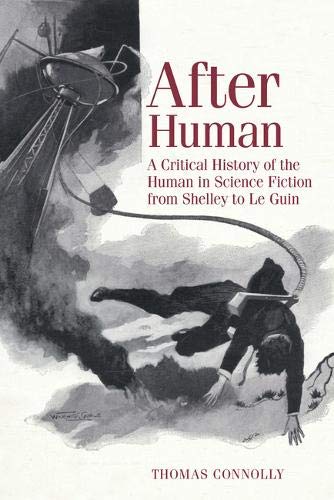
Review of After Human: A Critical History of the Human in Science Fiction from Shelley to Le Guin


Review of After Human: A Critical History of the Human in Science Fiction from Shelley to Le Guin

Lars Schmeink

Thomas Connolly. After Human: A Critical History of the Human in Science Fiction from Shelley to Le Guin. Liverpool UP, 2021. Liverpool Science Fiction Texts and Studies 69. Hardcover. 240 pg. $119.15. ISBN 9781800348165.

Looking at critical theory as the body of work that defines our toolset as literary critics, in science fiction (sf) especially, one cannot but notice the dominant position that posthumanism has taken on ever since its rise to prominence in the 1980s. Donna J. Haraway’s “Cyborg Manifesto” (1985) belongs into the category of must-reads for any sf scholar and its ripple effect into our field cannot be overstated. And given its timing, coinciding with the emergence of cyberpunk as a central mode of sf, it is no wonder that posthumanist readings have grown from there, proliferating in contemporary sf studies. But, as Thomas Foster has pointed out so aptly, cyberpunk is not the literary “vanguard of a posthumanism assumed to be revolutionary in itself” (xiii). Instead, it is a multiplier of posthumanism, a prism that changes the theory and allows it to take diverse forms.

But what comes out as a variety of posthumanisms must have gone into this prism at some point. It is this realization that feeds Thomas Connolly’s study After Human, that much sf before the posthumanist turn must address these issues somehow, that “even the most avowedly humanist text raises posthumanist concerns” (20). Connolly argues that in its discussion of human interaction with technology and nature, historical text of sf will reveal their concern for posthumanist issues. He sees the ‘post’ of posthumanism as a feature within humanism itself, an admittance of “the constructed nature of human experiences of the world” (20). His study is, consequently, a critical history of sf texts that foreground human interaction, not with the inhuman (however that may be), but with technology and nature, and with other humans. 

Connolly then proceeds to explore the humanist-posthumanist spectrum and the ontological modes associated with it in the history of sf through four chapters, each detailing a specific period of writing. Starting with 19th century proto-sf in the works of Mary Shelley, Jules Verne, and H.G. Wells, Connolly sets up a comparison of the depiction of primitive pre-humanity in Sir Arthur Conan Doyle’s The Lost World and Jack London’s The Iron Heel, which contrasts with the humanist view of self-realization and centeredness. In the next chapter, on Aldous Huxley’s Brave New World and E.E. Smith’s Skylark series, Connolly then moves on to the relation of the human and technology, shifting the mirror from primitive pre-humanity towards a technologized trans-humanity. Here, more clearly than with the humanist-oriented narratives of the turn of the century, two distinct lines emerge: one that sees humanity “rendered powerless by technological systems beyond their control” and one that argues for a “utopic image of human self-actualization, evincing ever-greater technological control over the material world” (109).

In the 1950s, Connolly argues, a similar duality can be found not in a technological trans-humanity but in an evolved supra-humanity, which he explores in Isaac Asimov’s Foundation-series and Arthur C. Clarke’s The City and the Stars. Finally, in the 1970s, Connolly shifts from trans- or supra-humanity to a true post-humanity, in discussing the utopian project of J.G. Ballard’s The Crystal World and Ursula K. LeGuin’s The Dispossessed. All of the chapters analyze works that attempt to engage with new positions of the human, in developing with technological progress, in challenging the idea of individualism, or in decentering the human. But, as Connolly makes clear, many retreat back into their more humanist positions, not following through with fully embracing the posthumanism that they tease out. In his conclusion, Connolly sees these stories as positioned in a framework of how the non-human is approached, either “assimilative” (192) in that the human enfolds the non-human cognitively or culturally, or “transformative” (193) in that human cultural frames are challenged and changed. His analysis places the historical works discussed in this framework, thus allowing scholars of posthumanism to see the theoretical trajectories of the categories.

After Human thus cleverly uses the posthumanist scaffolding to re-read traditional science fiction and excavate positions of the human within it, tracing the development of posthumanist positions up to the 1980s. For those scholars interested to treat posthumanism not as a given of the 21st century, but as a development of the humanism and anti-humanism that came before, Connolly’s book is a valuable resource explaining the lines of thought in sf that have led up to, for example, the cyberpunk multiplication of posthumanism. After Human will help ground current work in contemporary posthumanist criticism by providing a historical perspective.  


Lars Schmeink is currently Leverhulme Visiting Professor at the University of Leeds. He has inaugurated the Gesellschaft für Fantastikforschung and has served as its president from 2010-19. He is the author of Biopunk Dystopias (2016) and the co-editor of Cyberpunk and Visual Culture (2018), The Routledge Companion to Cyberpunk Culture (2020), Fifty Key Figures in Cyberpunk (2022) and New Perspectives on Contemporary German Science Fiction (2022). 

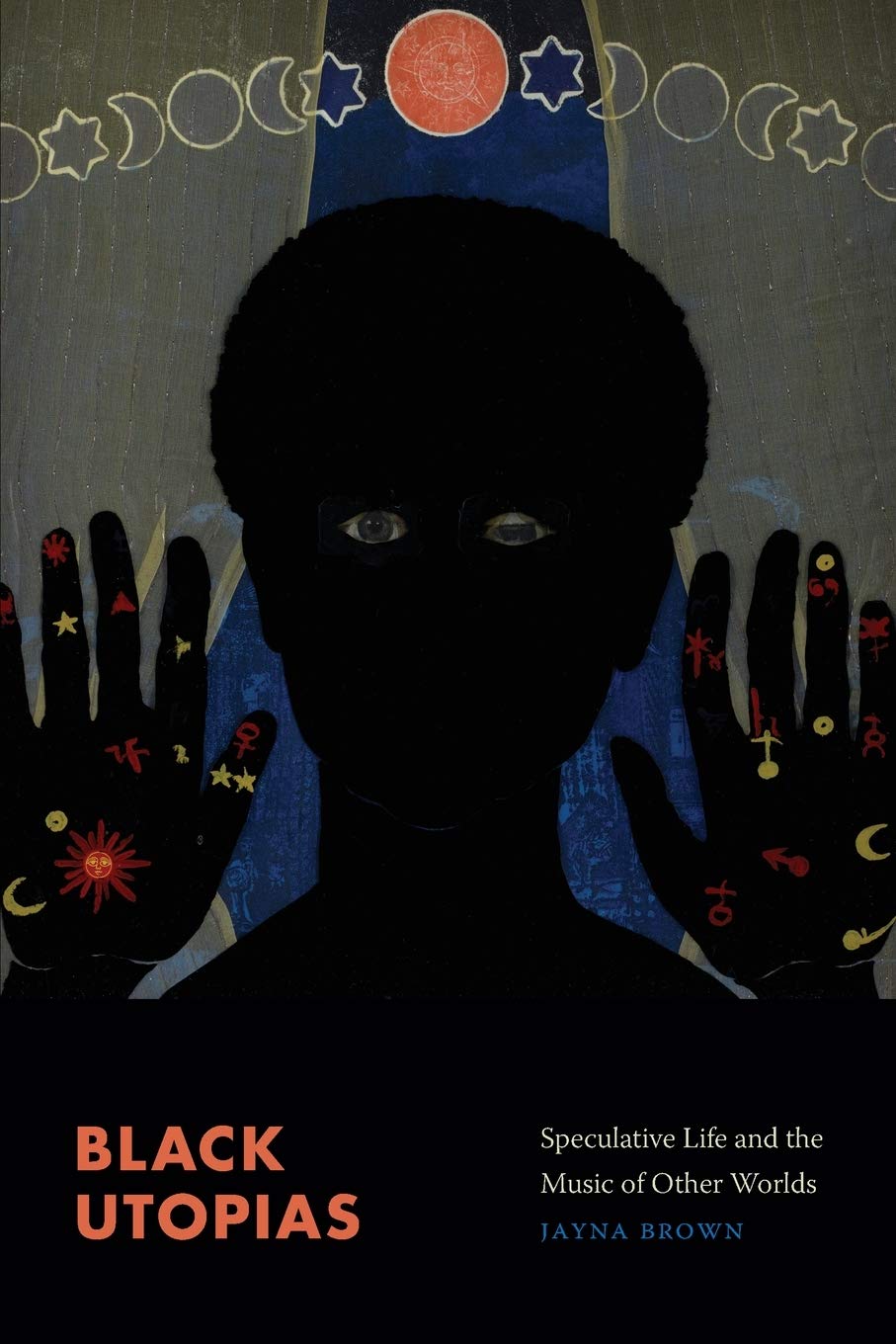
Review of Black Utopias: Speculative Life and the Music of Other Worlds


Review of Black Utopias: Speculative Life and the Music of Other Worlds

John Rieder

Jayna Brown. Black Utopias: Speculative Life and the Music of Other Worlds. Duke UP, 2021. Paperback. 224 pg. $25.95. ISBN 9781478011675. Ebook ISBN 9781478021230

Jayna Brown introduces her argument in Black Utopias with a short, moving section about her father, who was a poet, a Black Panther, a political exile, then a prisoner in the US, and finally, after his release, a self-proclaimed prophet in communication about the coming final days with a spirit named Golden Ray. Brown writes that struggling with what she considered her fatherʻs psychosis led her to ask questions about where one can draw the line betwen vision and madness. Perhaps, she wondered, one ought to listen more carefully to “mad souls.” The project of Black Utopias “is a way of residing in spaces of ambiguity” where the line between madness and prophetic vision cannot be confidently drawn (5). It is very worthwhile to follow her lead into exploring that uncanny space in this innovative, well-researched piece of scholarship.

Brown “use[s] the term utopia to signal the (im)possibilities for forms of subjectivity outside a recognizable ontological framework, and modes of existence conceived of in unfamiliar epistemes” (6). This is a very particular, narrow sense of what Lyman Tower Sargent, in one of the most widely cited essays in utopian studies, calls “the broad, general phenomenon of utopianism.” Sargent defines utopianism as “social dreaming—the dreams and nightmares that concern the ways in which groups of people arrange their lives and which usually envision a radically different society than the one in which the dreamers live” (Sargent 4). But the envisioning of radically different societies in, for example, the Back to Africa movement or Martin Luther Kingʻs non-violent protest, or implied by the critical dystopian features of Ralph Waldo Ellisonʻs Invisible Man (1952) or George Schuylerʻs Black No More (1931), are not part of the genealogy of black radicalism Brown constructs in this volume. Indeed the Harlem Renaissance is completely absent from Brownʻs essay, and Black nationalism is explicitly excluded from Brownʻs notion of utopianism because it seeks for recognition within the political and epistemological framework of white hegemony. Instead, says Brown, “the art and practices I consider involve a radical refusal of the terms by which selfhood and subjectivity are widely used and understood” (8). Brown wants to “redefine what the very term radical means” (26).

The version of radicalism that Brown delineates is indeed a stark departure from most received leftist, and especially Marxist, notions. She rejects dialectical thinking, which according to her remains inscribed within hierarchical practices that exclude black subjects from full participation in the category of the human. Nor are her radicals materialists in the scientific sense common to Enlightenment thought in general and most leftist critical theory in particular. Instead they embrace spiritualism and mysticism. Rather than rejecting life after death as an ideological soporific, they discover “radical forms of selfhood . . . produced in dream states, spirit, and temporal impulses not fettered by the cycle of life and death” (25). For the nineteenth century black woman preachers whose careers Brown describes, “The claim to life after death, while coded in the language of Christian belief, is a profoundly political claim by the living that they cannot ever truly be killed, enabling them to claim the space between life and death as another dimension of consciousness” (51). For jazz musician and poet Sun Ra, the subject of Brownʻs final chapter, civil rights activism was an illusory project because the only way to achieve peace and equality was to be dead. Therefore Ra often enjoined members of his audiences to “give up your death for me.”

The key category for Brownʻs redefinition of radicalism is the human. Her version of radicalism does not follow Marxist tradition or black nationalism in defining the goal of revolutionary activism as the seizure of state power, and it equally rejects civil rights protest’s goal of attaining equal treatment within the legal structure of state power. Brown’s radicals instead pursue something rooted in being itself, a sense of selfhood attainable only through “a complete break with time as we know it—an entirely new paradigm” (8). She argues that “black people’s existence is mythological in the first place. We don’t really exist, according the the logic of the human” (4). Readers familiar with the 1974 film Space Is the Place starring Sun Ra will surely hear echoes here of Raʻs film-opening declaration that time has officially ended, and of the speech Ra makes to a group of Oakland teenagers who challenge the outlandishly costumed musician whether he is for real. Ra replies: “I’m not real. I’m just like you. You don’t exist in this society. . . . I do not come to you as a reality; I come to you as a myth. Because that’s what black people are, myths.” What Brown adds to Raʻs position is an argument “that because black people have been excluded from the category human, we have a particular epistemic and ontological mobility” (7). There is “real power to be found in such an untethered state” because “those of us who are dislocated on the planet are perfectly positioned to break open the stubborn epistemological logics of human domination” (7). Brown accordingly places Sun Ra within a genealogy of black visionary radicalism that stretches back to the nineteenth century preachers Sojourner Truth, Rebecca Cox Jackson, Jarena Lee, and Zilpha Elaw, includes fellow mystic and jazz artist Alice Coltrane, and looks forward from them to the science fictional writing of Samuel R. Delany and Octavia E. Butler.

As the inclusion of preachers at one end of this history and writers of fiction at the other indicates, it is not music or any other sort of artistic form that unites these figures, but rather notions of the self and practices of community. It is the ritualistic, immersive character of Alice Coltraneʻs and Sun Raʻs performances that primarily attracts Brownʻs attention, rather than their innovations in the form of jazz (and both musicians could certainly afford rich material for a more formal approach). Brown says of Coltrane that her “mix of praise singing from the black Christian church, jazz, and Hindu worship songs” adds up to “a utopian practice of attunement with an infinite universe of aural vibratory phenomena” (60). Tellingly, Brown refers not to Coltraneʻs audience here but to her “congregation.” Brownʻs emphasis in the chapter on the four women preachers is less on any doctrinal position or rhetorical strategy than on their common investment and participation in alternative, non-heteronormative forms of community. Brown insists that the apolitical, otherworldly turn of the preachers and the musicians “also includes the concrete: the creation of community. Like Rebecca Cox Jacksonʻs Shaker community, Aliceʻs model could be considered escapist. But escape is an important trope in African American culture” (80). (Cf. Sun Ra: “If you find earth boring / Just the same old same thing / Come on and join us / At Outerspaceways Incorporated.”)

Brownʻs chapters on Octavia E. Butler and Samuel R. Delany are similarly focused on the way some of their fiction envisions forms of community. Her approach to Butlerʻs Parable series and Delanyʻs Triton (1976) shows little or no interest in literary devices such as plot or point of view or style. The focus in the Butler chapter is on the protagonist Olaminaʻs religious ideas for their own sake, not for the way they function within a literary fiction, and the same is mostly true for her attention to the setting of Delanyʻs Triton. For scholars of science fiction, perhaps the most pertinent aspect of her reading of Butler is her insistance, against what she calls a hagiographic tendency in Butler scholarship, on the “complexities and contradictions” introduced into Butlerʻs work “by a particularly grim version of Darwinism” that jostles uncomfortably alongside “biological forms of cooperation, symbiosis, and commensality” (84). For Brown, the utopian experiment that Olamina launches in the Parable novels remains heteronormative and deeply humanist—which are not, for Brown, good things. Finally, “the extent to which the texts can imagine evolutionary possibility is held back by a concept of change beholden to heteronormative ideas of a biological imperative” (107). Brownʻs argument has the considerable merit of emphasizing a set of issues within Butlerʻs work that is perhaps too often skirted or treated apologetically.

The pages Brown devotes to the nonfictional utopian writing of H. G. Wells are even more firmly set against critical evasion of what is problematic and disturbing in Wellsʻs writing. Brown argues that Wells “is revered as a foundational figure in science fiction while his frightening and horrific eugenicist ideas are ignored or minimized” (116). Within the structure of Brownʻs argument, Wells acts mostly as a foil to help introduce an analysis of the way Delany “explores the malleability of biological matter and frees it from normative determination” (127) in Babel-17 (1966) and The Einstein Intersection (1967). One of the main foci of Brownʻs reading of Delany is his treatment of desire, which, she says, Delany does not take in a Hegelian or Lacanian sense as something rooted in negation or lack, but rather in Deleuzean terms as “a productive and generative activity” (138). The point is the way this alters conceptions of the subject and the dependence of subject formation on relationality. This is the place in Brownʻs argument that relies most strongly and productively on queer theory, asserting that “transgender and transsexuality theories” show the way to “relaxation of the need for set and fixed gender and sexual identities and the embrace of fluid and expansive modes of being” (138).

Brownʻs final chapter is devoted to the person who seems to me to preside over the entire argument, Sun Ra. True to her approach to Butler, Brown avoids turning her analysis into a hagiography, facing squarely up to the authoritarianism of Raʻs band leadership. But she is more interested—and rightly so—in the way that “the homosocial space of the Ra houses was not modeled on that of a heterosexual family or compound of families. While they were based in discipline, they were not based in hierarchical rank or competition” (162). This kind of noncompetitive, nonmasculinist organization of the jazz orchestra runs counter to dominant practices of the music then and now, but for Brown it is more important that it is based on challenging the notion of the possessive individual and all that comes with it. In her reading of Sun Ra, Brown achieves the clearest enunciation of her profoundly non-Althusserian version of antihumanism. “For Ra,” she says, “being human is a state of ignorance and not a status we should be fighting for. . . . Black people have to let go of the idea of the human, which Ra sees as inseparable from the liberal terms that have defined it. . . . Raʻs call is not for a new genre of the human but a new genre of existence” (172-73).

Whether Brownʻs intervention into utopianism, black intellectual history, and the genealogy and significance of Afrofuturism will end up being judged boldly iconoclastic or merely interestingly idiosyncratic I do not presume to be able to say. But I can say with absolute certainty that I learned a lot from this book, and that I found it a fascinating and pleasurable read.


WORKS CITED

Sargent, Lyman Tower. “The Three Faces of Utopia Revisitied.” Utopian Studies, Vol. 5, No. 1 (1994), pp. 1-37.


John Rieder, an emeritus professor of English at the University of Hawai‘i at Mānoa, was the recipient of the SFRA Innovative Research Award in 2011 and the SFRA Lifetime Achievement Award in 2019. He is the author of Colonialism and the Emergence of Science Fiction (Wesleyan UP, 2008), Science Fiction and the Mass Cultural Genre System (Wesleyan UP, 2017), and Speculative Epistemologies: An Eccentric Account of SF from the 1960s to the Present (Liverpool UP, 2021). He has served on the editorial board of Extrapolation since 2010.

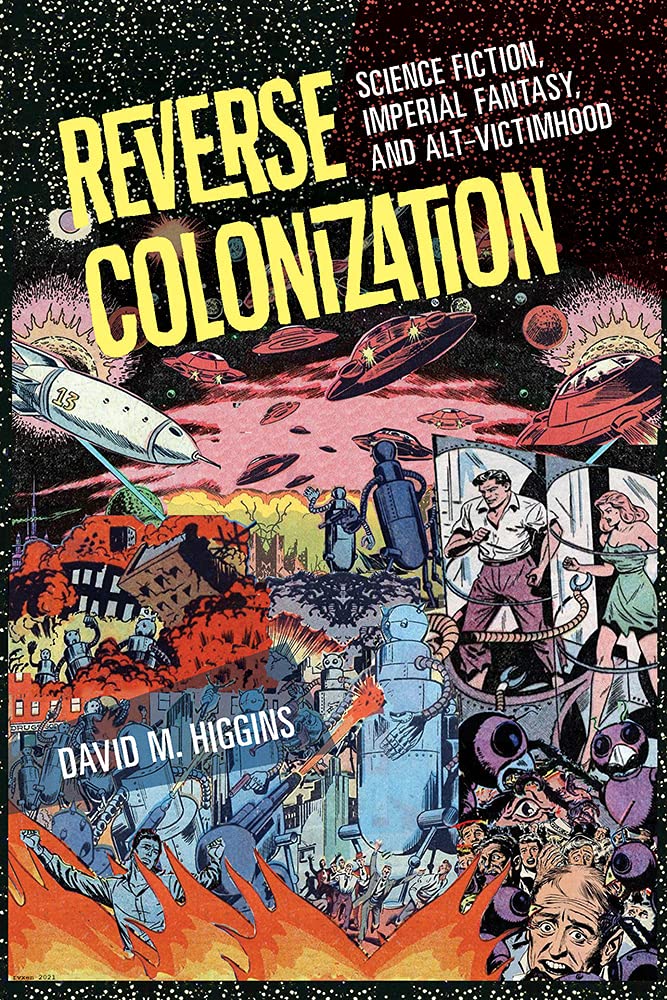
Review of Reverse Colonization: Science Fiction, Imperial Fantasy, and Alt-Victimhood


Review of Reverse Colonization: Science Fiction, Imperial Fantasy, and Alt-Victimhood

Jeremy Brett

David M. Higgins. Reverse Colonization: Science Fiction, Imperial Fantasy, and Alt-Victimhood. University of Iowa Press, 2021. The New American Canon: The Iowa Series in Contemporary Literature and Culture. Paperback. 250 pg. $39.95. ISBN 9781609387846.

Reverse Colonization, David M. Higgins’s new work of clever, thoughtful textual analysis, has the unenviable privilege of being a necessary book for the dark and ominous times before us. Those times make the experience of reading the book sadly relevant when harried readers might have appreciated a more standard dive into the strictly and more comfortably theoretical. On the other hand, as the shrill, shallow, and twisted concerns of the Right infiltrate ever deeper into our culture—including the ongoing evolution and development of science fiction and fantasy—understanding how those concerns impact the writing and reception of these genres becomes almost a duty. We’re seeing it most recently in the ‘Puppygate’ kerfuffle of 2013-2017, in which a sad sack coalition of self-described revolutionaries led a backlash against perceived ‘injustices’ committed against ‘traditional’ (i.e., white, male, and cisgender) modes of science fiction storytelling. The irony is palpable—we see supporters of the Empire now think of themselves as the Rebel Alliance, and fans raised on and claiming to love Star Trek now decry perceived ‘wokeness’ in the utopian ideals of the United Federation of Planets. The phenomenon has become a veritable orgy of willful cultural misinterpretation.

But, as Higgins delineates so well in his study, that reactionary impulse, that “appropriation of righteous anti-imperial victimhood—the sense that white men, in particular, are somehow colonized victims fighting an insurgent resistance against an oppressive establishment—depends on a science fictional logic that achieved dominance in imperial fantasy during the 1960s and has continued to gain momentum ever since” (4). These dark and bad-faith interpretations have deep genre roots, in what Higgins calls the “imperial masochism” (2) that centers important SF&F works of the 1960s and 1970s. It behooves us, then, to have scholars like Higgins so deftly analyze the imperial masochism phenomenon, if only to better understand the ways in which beloved texts can be so disastrously misread, misused, or misdirected. But these kinds of projects also help readers and scholars alike uncover the evolution of bad-faith arguments from good-faith ones, for, as Higgins notes, the roots of reverse colonization narratives lie in soil of positive motivations.

Reverse colonization is no new concept in science fiction. Higgins offers a useful and well-written summary of its history in his introduction, along with an outline of its appropriation by nostalgic imperial fantasists and illiberal right wingers into narratives of imperial masochism. The ur story here is, of course, Wells’s The War of the Worlds (1897), in which Wells used the cover of a fictional Martian invasion to allow his readers—beneficiaries of the advantages of an aggressive world empire—to imagine themselves as the colonized victims. But over the next century, this perpetrator/victim reversal and appeals to reader empathy and to increasing anti-colonial sentiments mutated in some cases into Higgins’ imperial masochism, which he defines as a sort of dream logic in which the “subjects who enjoy the advantages of empire adopt the fantastical role of colonized victims to fortify and expand their agency.” The pleasures of imperial masochism lie in a conscious enjoyment of the “presumed moral superiority that fantasies of victimization enable” (2-3), Although right-wing positioning of reactionaries as social and cultural victims is not new, Higgins’s study is pioneering in its uncovering of what he calls “science fiction’s troubling complicity in the formation of modern imperial discourses and practices” (3) (and a concurrent adaptation and misuse of SF imagery: note, for example, how the “red pill” of The Matrix has become an important metaphor for many alt-right subcultures). Higgins also delves into the irony that the anti-imperial 1960s (when science fiction, as well as the greater culture, finally dismissed the idea of the noble conqueror or colonizer) produced several important works inadvertently fostering the notion that those with actual social, cultural, and political power are actually the powerless victims of evil conspiracies against them.

Higgins takes on a number of important mid-century texts (taking care, it should be noted, to explicitly deny any implication that the authors were working with deliberate reactionary intent), particularly in the book’s first chapter. Herbert’s Dune (1965, an inadvertently popular text among the alt-right), Heinlein’s Stranger in a Strange Land (1962), and Clarke’s novelization of 2001: A Space Odyssey (1968, based on his and Stanley Kubrick’s screenplay) are all offered up for their particular explorations of interior masculinity that replace—or seek to replace—the old Golden Age of Science Fiction imperial narratives of planetary settlement and conquest. All three works offer what can be read as optimistic portrayals of authoritarian Ubermensch fantasies. What is key to the appeal of these stories—what makes them feel heroic rather than oppressive—is the fact that Heinlein, Herbert, and Clarke frame their iconic supermen as victim-heroes struggling to achieve freedom, rather than as fascist heroes bent on domination. In particular, all three novels use the logic of reverse colonization to portray psychedelic awakening as a triumphant victory against empire (32).

In the tradition of the decade that spawned these works, the way to true liberation and true mastery is to free one’s mind and let the body follow. The true path to power in these texts lies in eschewing dreams of conquest (and the psychological barriers of internal colonization) in favor of real, lasting agency. This sounds reasonable enough, but Higgins argues that the result across the narratives is to invite white elite male heroes to identify as psychically colonized victims who must reject the passive consumer nature of their societies; these protagonists evolve greater forms of self-mastery and heroic masculinity that have unsettling parallels to fascist ideas of manhood and power. From these examples, it’s not hard to see how some readers may make a wrongheaded conceptual leap towards championing reactionary ideals while calling themselves ‘victims’ of an inferior society.

Higgins devotes a chapter to Philip K. Dick’s body of work and his narrative preoccupation with the idea of consensual reality as a “colonizing system of control” (66). Of course, Dick is rightly heralded for his explorations of the truth behind the realities we perceive, but Higgins thoughtfully dissects the potential pitfalls of this sort of mindset. Incel mass murderer Elliot Rodger (who constantly referenced examples from science fiction in his twisted self-reflections) is cited as an example of how disastrously narratives and authorial intent can be perverted. As Higgins notes, “(Rodger’s) autobiography reveals a disturbing engagement with an even deeper mode of science fictional thinking: the idea that reality itself is somewhat wrong, twisted, or broken, and that an insurgent revolution must be fought against such a false reality to create or restore a better world” (62). It is a seductively believable idea and falls into easy line with Dick’s 1960s-1970s stories that depict our perceived reality as a prison and our brains colonized by untruths and false beliefs. Higgins points out that Dick has been one of the preeminent creative minds of the genre in projecting the idea of a false reality obscuring the truth—neither Higgins nor we would blame Dick for the disastrous social situation that can arise from this (we’ve all been forced to bear witness to the Trumpian and right-wing strategies of discarding troublesome and inconvenient realities in favor of desired outcomes), but the seductiveness of the idea clearly has influence on today’s alt-right, and its science fictional groundings therefore deserve analysis and consideration. More specifically in this chapter, Higgins uses Dick’s alternate history classic The Man in the High Castle (1962, itself a story of a false reality within a larger truth) to explore the ambivalent tensions in reverse colonization texts between imperial critique (the dissection of imperial morality) and imperial masochism: these texts at once “ask audiences to identify with victims, yet they can also enable audiences to identify as victims” (69). The book does good work in encouraging its readers to sympathize with victims worldwide of oppression and injustice, but as Higgins explicates, it also fortifies feelings of imperial masochism by “inviting privileged male subjects to identify as victims struggling against internal and external domination” (ibid). Castle demonstrates that reverse colonization narratives often operate within a “contested imaginative terrain” (ibid) in which imperial masochisms can be both enabled or dismantled, which, of course, reinforces the complexity of texts and the foolhardiness of identifying singular interpretations.

False realities and mental prisons become real prisons in Higgins’s exploration of both the cult television show The Prisoner (1967-1968) and Thomas M. Disch’s 1969 literary adaptation of the series. The Prisoner, of course, is rooted in the concept of the integrity of the resisting individual standing against an all-encompassing system, and it is famous for championing free will over the oppression and conformity of social life. But Higgins makes the interesting argument that the show can also be read as a “carceral reverse colonization fantasy” (99), a work centered on the fantasy of an elite white male whose self-possession signifies a moral and emotional center invulnerable to lies or societal violation, and which promotes the secessionist dream of withdrawal (that, sadly, lies at the heart of much alt-right discourse). These types of carceral fantasies (including both Disch’s Prisoner and his 1968 novel Camp Concentration, also touched on here) “encourage and enable identification with imprisoned subjects and give force to liberatory, anti-imperial sentiments – for good or for ill” (123). Again we see the potential for texts to serve either (or multiple, to expand past the binary) sides in social and political rhetoric, strategy, and worldviews.

The next chapter is particularly thought-provoking in its focus on and creative use of the metaphor of entropy, sparked here by the idea among some commentators that pro-Brexit voters were motivated by the fears of “social entropy”, that is, the science fictional notion that the United Kingdom under the European Union and the continuing forces of globalization faced inevitable and approaching “heat death” (126): the destruction of everything that makes Britain Britain. Worries over this entropy drove the actions of nationalists and reactionaries to escape the prison of European control in favor of an ‘independent’ UK. Entropy is a central theme for many New Wave writers, and as a metaphor for the inevitable disintegration of empire it is key, says Higgins, to the early work of British New Wave writers J.G. Ballard and Michael Moorcock. Certainly Ballard and Moorcock are not fans of an inherently unjust and stratified British Empire, but Higgins presents their work as marking “the decline of empire with profoundly mixed feelings, because for them, empire frequently embodies the apex of civilization and human aspiration striving against entropy, decay, darkness, and savagery” (128). It’s certainly an interesting take, especially when one considers, say, the liberal and anti-establishment views of Moorcock, but Higgins makes a thoughtful case that both he and Ballard are writing reverse colonization stories that both attack the imperial idea while at the same moment “framing imperial elites as tragic and helpless victims of entropic decline” (128). Both authors use the inevitability of erosion and destruction to strike a fatalistic tone that sees empire’s fall less as a good in itself and something that can be manipulated to serve the underserved, and more as a troubling, regrettable and universal phenomenon that erases the great as well as the small and which inflicts a complete lack of agency on imperial participants. (The chapter ends on a more complex note by analyzing two New Worlds pieces—one fiction, one non—by David Harvey that complicate the notion of entropy and its more simplistic conceptions by some authors.)

Higgins concludes his study of texts with a look at Samuel R. Delany’s post-apocalyptic trilogy The Fall of the Towers (1963-1965) and its concern with the significance of objective information. Higgins describes Delany’s characters across the three books as “colonized prisoner-victims trapped in lies and illusions that exist to perpetuate imperial wars” (187), who must ultimately be liberated by an exposure to truth and the breadth of vital information. In doing so, victims’ consciousnesses are raised to a point where they may accurately engage with the accepted fantasies that power oppressive imperial systems and overcome them. The imperial project, built on lies and preconceptions, is too large for any one person to overturn, and none of Delany’s individual characters can apprehend the bigger picture, but a collective effort, a “difficult, tentative, and uncertain exploration of the world’s true complexity that must be undertaken despite the fact that perfect, ultimate knowledge will always, by necessity, remain forever out of reach” (188).

A commitment to an awareness of complex and objective truths is necessary, Delany argues, to obviating imperial exploitation, which can only occur because victims alone are too small to see how that exploitation functions. But that awareness must be tempered by the irreducibility of subjective experience. In this, Higgins sees Delany as a valuable corrective to an irreconcilable “opposition between modern and postmodern ideals of political consciousness. He therefore offers a much-needed model for what cognitive justice might look like in a post-truth era” (167). As an antidote to the simplification of empire, Delany provides a reverse colonization narrative that can be an effective imperial critique, on the grounds that the “more a reverse colonization narrative refuses to simplify empire and explores the complexities of imperialism in a thoughtful manner, the less traction such a narrative offers for misappropriation in service of imperial masochism” (167).

Higgins’s book is a valuable and important study, indeed, crucial in this time when science fictional ideas and narratives are worryingly turned to malignant purposes, many of them inspired by harmful imperial fantasies. As he notes, “I still believe that science fiction has a powerful capacity to function as a critical literature of empire…science fiction, I argue now, almost always takes empire as its central subject, but whether a given narrative perpetuates or challenges imperial discourse and practice (or does both simultaneously) depends very much on that particular narrative and the context of its production and reception” (200). Certainly he has made that clear in this volume. Although for the good of our relations with one another it is vital that narratives exist which provoke empathy in readers by letting them see through the eyes of others, it is equally important to realize that the possibility for harmful, destructive, even murderous misinterpretations of that enterprise exist. Such are the social complexities of the genre we all love.


Jeremy Brett is an Associate Librarian at Cushing Memorial Library & Archives, where he is both Processing Archivist and the Curator of the Science Fiction & Fantasy Research Collection. He has also worked at the University of Iowa, the University of Wisconsin-Milwaukee, the National Archives and Records Administration-Pacific Region, and the Wisconsin Historical Society. He received his MLS and his MA in History from the University of Maryland – College Park in 1999. His professional interests include science fiction, fan studies, and the intersection of libraries and social justice.