
Non-Fiction Reviews
Review of Reverse Colonization: Science Fiction, Imperial Fantasy, and Alt-Victimhood
Jeremy Brett
David M. Higgins. Reverse Colonization: Science Fiction, Imperial Fantasy, and Alt-Victimhood. University of Iowa Press, 2021. The New American Canon: The Iowa Series in Contemporary Literature and Culture. Paperback. 250 pg. $39.95. ISBN 9781609387846.
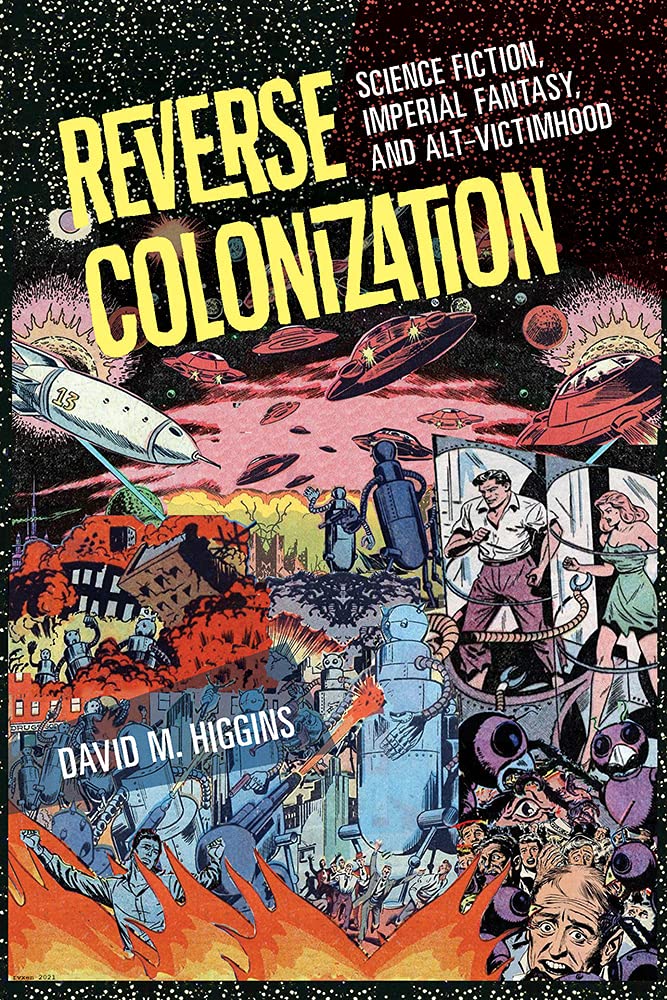
Reverse Colonization, David M. Higgins’s new work of clever, thoughtful textual analysis, has the unenviable privilege of being a necessary book for the dark and ominous times before us. Those times make the experience of reading the book sadly relevant when harried readers might have appreciated a more standard dive into the strictly and more comfortably theoretical. On the other hand, as the shrill, shallow, and twisted concerns of the Right infiltrate ever deeper into our culture—including the ongoing evolution and development of science fiction and fantasy—understanding how those concerns impact the writing and reception of these genres becomes almost a duty. We’re seeing it most recently in the ‘Puppygate’ kerfuffle of 2013-2017, in which a sad sack coalition of self-described revolutionaries led a backlash against perceived ‘injustices’ committed against ‘traditional’ (i.e., white, male, and cisgender) modes of science fiction storytelling. The irony is palpable—we see supporters of the Empire now think of themselves as the Rebel Alliance, and fans raised on and claiming to love Star Trek now decry perceived ‘wokeness’ in the utopian ideals of the United Federation of Planets. The phenomenon has become a veritable orgy of willful cultural misinterpretation.
But, as Higgins delineates so well in his study, that reactionary impulse, that “appropriation of righteous anti-imperial victimhood—the sense that white men, in particular, are somehow colonized victims fighting an insurgent resistance against an oppressive establishment—depends on a science fictional logic that achieved dominance in imperial fantasy during the 1960s and has continued to gain momentum ever since” (4). These dark and bad-faith interpretations have deep genre roots, in what Higgins calls the “imperial masochism” (2) that centers important SF&F works of the 1960s and 1970s. It behooves us, then, to have scholars like Higgins so deftly analyze the imperial masochism phenomenon, if only to better understand the ways in which beloved texts can be so disastrously misread, misused, or misdirected. But these kinds of projects also help readers and scholars alike uncover the evolution of bad-faith arguments from good-faith ones, for, as Higgins notes, the roots of reverse colonization narratives lie in soil of positive motivations.
Reverse colonization is no new concept in science fiction. Higgins offers a useful and well-written summary of its history in his introduction, along with an outline of its appropriation by nostalgic imperial fantasists and illiberal right wingers into narratives of imperial masochism. The ur story here is, of course, Wells’s The War of the Worlds (1897), in which Wells used the cover of a fictional Martian invasion to allow his readers—beneficiaries of the advantages of an aggressive world empire—to imagine themselves as the colonized victims. But over the next century, this perpetrator/victim reversal and appeals to reader empathy and to increasing anti-colonial sentiments mutated in some cases into Higgins’ imperial masochism, which he defines as a sort of dream logic in which the “subjects who enjoy the advantages of empire adopt the fantastical role of colonized victims to fortify and expand their agency.” The pleasures of imperial masochism lie in a conscious enjoyment of the “presumed moral superiority that fantasies of victimization enable” (2-3), Although right-wing positioning of reactionaries as social and cultural victims is not new, Higgins’s study is pioneering in its uncovering of what he calls “science fiction’s troubling complicity in the formation of modern imperial discourses and practices” (3) (and a concurrent adaptation and misuse of SF imagery: note, for example, how the “red pill” of The Matrix has become an important metaphor for many alt-right subcultures). Higgins also delves into the irony that the anti-imperial 1960s (when science fiction, as well as the greater culture, finally dismissed the idea of the noble conqueror or colonizer) produced several important works inadvertently fostering the notion that those with actual social, cultural, and political power are actually the powerless victims of evil conspiracies against them.
Higgins takes on a number of important mid-century texts (taking care, it should be noted, to explicitly deny any implication that the authors were working with deliberate reactionary intent), particularly in the book’s first chapter. Herbert’s Dune (1965, an inadvertently popular text among the alt-right), Heinlein’s Stranger in a Strange Land (1962), and Clarke’s novelization of 2001: A Space Odyssey (1968, based on his and Stanley Kubrick’s screenplay) are all offered up for their particular explorations of interior masculinity that replace—or seek to replace—the old Golden Age of Science Fiction imperial narratives of planetary settlement and conquest. All three works offer what can be read as optimistic portrayals of authoritarian Ubermensch fantasies. What is key to the appeal of these stories—what makes them feel heroic rather than oppressive—is the fact that Heinlein, Herbert, and Clarke frame their iconic supermen as victim-heroes struggling to achieve freedom, rather than as fascist heroes bent on domination. In particular, all three novels use the logic of reverse colonization to portray psychedelic awakening as a triumphant victory against empire (32).
In the tradition of the decade that spawned these works, the way to true liberation and true mastery is to free one’s mind and let the body follow. The true path to power in these texts lies in eschewing dreams of conquest (and the psychological barriers of internal colonization) in favor of real, lasting agency. This sounds reasonable enough, but Higgins argues that the result across the narratives is to invite white elite male heroes to identify as psychically colonized victims who must reject the passive consumer nature of their societies; these protagonists evolve greater forms of self-mastery and heroic masculinity that have unsettling parallels to fascist ideas of manhood and power. From these examples, it’s not hard to see how some readers may make a wrongheaded conceptual leap towards championing reactionary ideals while calling themselves ‘victims’ of an inferior society.
Higgins devotes a chapter to Philip K. Dick’s body of work and his narrative preoccupation with the idea of consensual reality as a “colonizing system of control” (66). Of course, Dick is rightly heralded for his explorations of the truth behind the realities we perceive, but Higgins thoughtfully dissects the potential pitfalls of this sort of mindset. Incel mass murderer Elliot Rodger (who constantly referenced examples from science fiction in his twisted self-reflections) is cited as an example of how disastrously narratives and authorial intent can be perverted. As Higgins notes, “(Rodger’s) autobiography reveals a disturbing engagement with an even deeper mode of science fictional thinking: the idea that reality itself is somewhat wrong, twisted, or broken, and that an insurgent revolution must be fought against such a false reality to create or restore a better world” (62). It is a seductively believable idea and falls into easy line with Dick’s 1960s-1970s stories that depict our perceived reality as a prison and our brains colonized by untruths and false beliefs. Higgins points out that Dick has been one of the preeminent creative minds of the genre in projecting the idea of a false reality obscuring the truth—neither Higgins nor we would blame Dick for the disastrous social situation that can arise from this (we’ve all been forced to bear witness to the Trumpian and right-wing strategies of discarding troublesome and inconvenient realities in favor of desired outcomes), but the seductiveness of the idea clearly has influence on today’s alt-right, and its science fictional groundings therefore deserve analysis and consideration. More specifically in this chapter, Higgins uses Dick’s alternate history classic The Man in the High Castle (1962, itself a story of a false reality within a larger truth) to explore the ambivalent tensions in reverse colonization texts between imperial critique (the dissection of imperial morality) and imperial masochism: these texts at once “ask audiences to identify with victims, yet they can also enable audiences to identify as victims” (69). The book does good work in encouraging its readers to sympathize with victims worldwide of oppression and injustice, but as Higgins explicates, it also fortifies feelings of imperial masochism by “inviting privileged male subjects to identify as victims struggling against internal and external domination” (ibid). Castle demonstrates that reverse colonization narratives often operate within a “contested imaginative terrain” (ibid) in which imperial masochisms can be both enabled or dismantled, which, of course, reinforces the complexity of texts and the foolhardiness of identifying singular interpretations.
False realities and mental prisons become real prisons in Higgins’s exploration of both the cult television show The Prisoner (1967-1968) and Thomas M. Disch’s 1969 literary adaptation of the series. The Prisoner, of course, is rooted in the concept of the integrity of the resisting individual standing against an all-encompassing system, and it is famous for championing free will over the oppression and conformity of social life. But Higgins makes the interesting argument that the show can also be read as a “carceral reverse colonization fantasy” (99), a work centered on the fantasy of an elite white male whose self-possession signifies a moral and emotional center invulnerable to lies or societal violation, and which promotes the secessionist dream of withdrawal (that, sadly, lies at the heart of much alt-right discourse). These types of carceral fantasies (including both Disch’s Prisoner and his 1968 novel Camp Concentration, also touched on here) “encourage and enable identification with imprisoned subjects and give force to liberatory, anti-imperial sentiments – for good or for ill” (123). Again we see the potential for texts to serve either (or multiple, to expand past the binary) sides in social and political rhetoric, strategy, and worldviews.
The next chapter is particularly thought-provoking in its focus on and creative use of the metaphor of entropy, sparked here by the idea among some commentators that pro-Brexit voters were motivated by the fears of “social entropy”, that is, the science fictional notion that the United Kingdom under the European Union and the continuing forces of globalization faced inevitable and approaching “heat death” (126): the destruction of everything that makes Britain Britain. Worries over this entropy drove the actions of nationalists and reactionaries to escape the prison of European control in favor of an ‘independent’ UK. Entropy is a central theme for many New Wave writers, and as a metaphor for the inevitable disintegration of empire it is key, says Higgins, to the early work of British New Wave writers J.G. Ballard and Michael Moorcock. Certainly Ballard and Moorcock are not fans of an inherently unjust and stratified British Empire, but Higgins presents their work as marking “the decline of empire with profoundly mixed feelings, because for them, empire frequently embodies the apex of civilization and human aspiration striving against entropy, decay, darkness, and savagery” (128). It’s certainly an interesting take, especially when one considers, say, the liberal and anti-establishment views of Moorcock, but Higgins makes a thoughtful case that both he and Ballard are writing reverse colonization stories that both attack the imperial idea while at the same moment “framing imperial elites as tragic and helpless victims of entropic decline” (128). Both authors use the inevitability of erosion and destruction to strike a fatalistic tone that sees empire’s fall less as a good in itself and something that can be manipulated to serve the underserved, and more as a troubling, regrettable and universal phenomenon that erases the great as well as the small and which inflicts a complete lack of agency on imperial participants. (The chapter ends on a more complex note by analyzing two New Worlds pieces—one fiction, one non—by David Harvey that complicate the notion of entropy and its more simplistic conceptions by some authors.)
Higgins concludes his study of texts with a look at Samuel R. Delany’s post-apocalyptic trilogy The Fall of the Towers (1963-1965) and its concern with the significance of objective information. Higgins describes Delany’s characters across the three books as “colonized prisoner-victims trapped in lies and illusions that exist to perpetuate imperial wars” (187), who must ultimately be liberated by an exposure to truth and the breadth of vital information. In doing so, victims’ consciousnesses are raised to a point where they may accurately engage with the accepted fantasies that power oppressive imperial systems and overcome them. The imperial project, built on lies and preconceptions, is too large for any one person to overturn, and none of Delany’s individual characters can apprehend the bigger picture, but a collective effort, a “difficult, tentative, and uncertain exploration of the world’s true complexity that must be undertaken despite the fact that perfect, ultimate knowledge will always, by necessity, remain forever out of reach” (188).
A commitment to an awareness of complex and objective truths is necessary, Delany argues, to obviating imperial exploitation, which can only occur because victims alone are too small to see how that exploitation functions. But that awareness must be tempered by the irreducibility of subjective experience. In this, Higgins sees Delany as a valuable corrective to an irreconcilable “opposition between modern and postmodern ideals of political consciousness. He therefore offers a much-needed model for what cognitive justice might look like in a post-truth era” (167). As an antidote to the simplification of empire, Delany provides a reverse colonization narrative that can be an effective imperial critique, on the grounds that the “more a reverse colonization narrative refuses to simplify empire and explores the complexities of imperialism in a thoughtful manner, the less traction such a narrative offers for misappropriation in service of imperial masochism” (167).
Higgins’s book is a valuable and important study, indeed, crucial in this time when science fictional ideas and narratives are worryingly turned to malignant purposes, many of them inspired by harmful imperial fantasies. As he notes, “I still believe that science fiction has a powerful capacity to function as a critical literature of empire…science fiction, I argue now, almost always takes empire as its central subject, but whether a given narrative perpetuates or challenges imperial discourse and practice (or does both simultaneously) depends very much on that particular narrative and the context of its production and reception” (200). Certainly he has made that clear in this volume. Although for the good of our relations with one another it is vital that narratives exist which provoke empathy in readers by letting them see through the eyes of others, it is equally important to realize that the possibility for harmful, destructive, even murderous misinterpretations of that enterprise exist. Such are the social complexities of the genre we all love.
Jeremy Brett is an Associate Librarian at Cushing Memorial Library & Archives, where he is both Processing Archivist and the Curator of the Science Fiction & Fantasy Research Collection. He has also worked at the University of Iowa, the University of Wisconsin-Milwaukee, the National Archives and Records Administration-Pacific Region, and the Wisconsin Historical Society. He received his MLS and his MA in History from the University of Maryland – College Park in 1999. His professional interests include science fiction, fan studies, and the intersection of libraries and social justice.


