Review of Islam, Science Fiction and Extraterrestrial Life


Review of Islam, Science Fiction and Extraterrestrial Life

Mayurika Chakravorty

Jörg Matthias Determann. Islam, Science Fiction and Extraterrestrial Life: The Culture of Astrobiology in the Muslim World. Bloomsbury, I.B. Tauris Publishing, 2021. Hardcover. 288 pg. $115.00. ISBN 978-0-7556-0127-1.

Islam, Science Fiction and Extraterrestrial Life: The Culture of Astrobiology in the Muslim World (2021) follows Jörg Matthias Determann’s earlier books on the subjects of space science (2015) and evolutionary biology (2018) in the Arab world and the Gulf states respectively. However, in place of a specific regional focus, his latest book adopts a transnational and transregional approach as it explores a religio-cultural context of the works that he identifies and analyzes in the book. This work is a very welcome addition to the field of science fiction studies and, broadly speaking, speculative literature which, in recent years, has been looking further afield to afford critical attention to non-Anglo-European authors and texts and include them within its frameworks of analyses.

The book’s particular focus on Islam is significant for at least two reasons. First, it aims to bridge the chasm between fundamentally divergent realms of faith and science (in spite of what may be conveyed by the first part of the title, the book is not just about science fiction – it also includes science and to a large extent, the scientific imagination of individual scientists). Secondly, it also counters views such as the ”Muslim world is still not commonly associated with science fiction” as the book points out that “even authoritarian countries have produced highly imaginative accounts on one of the frontiers of knowledge: astrobiology, or the study of life in the universe” (x) and that “scientists in and from Muslim-majority countries have been at the forefront of the exciting search for extraterrestrial life, the ultimate Other” (xi). The perceived incompatibility between Islam and science fiction, and in fact, scientific imagination, certainly has a long political and cultural pre-history, its genesis being in orientalism, or the West’s perception of the orient as essentially “aberrant, undeveloped, inferior” which postcolonial critics such as Edward Said have pointed out, was most rigorously directed against the Islamic orient, since Islam, as “the very epitome of an outsider” of the West, was deliberately conceptualised and projected as “uncreative, unscientific, and authoritarian” (Said 296). Determann’s book triumphantly upends such orientalist and colonial notions. As he points out, not only is Islam not against science fiction or extra-terrestrial life and multiple worlds, the Qur’an itself refers to the God as the ‘lord of the world’ forty-two times, and as the Syrian artist Ayhem Jbr claims, one might even consider the Qur’an as “the first work of SF” (10).

What adds to the richness and variety of the material is the fact that the book moves beyond the literary corpus and includes films as well as scientific and journalistic research, and as the author states, the “protagonists of this book therefore comprise professional scientists and journalists alongside writers and visual artists” (30). Besides an Introduction (Chapter 1) and a Conclusion (Chapter 6), the book has four chapters which are broadly chronological with each focusing on a specific medium, beginning with scientific journals and popular magazines in the nineteenth and the early twentieth centuries in Chapter 2. The third chapter, titled “Trips to the Moon,” focuses on the depiction of extraterrestrial lives in films from primarily Turkey, Egypt, and Pakistan during the cold war period, while Chapter 4, “Islamic UFO Religions,” analyses a series of UFO-logical texts written in Urdu, Turkish, and Arabic from the 1960s onwards. Chapter 5, “Building Nations and Worlds,” studies science fiction novels and short stories by authors from Pakistan, Bangladesh, Egypt, and Indonesia and includes the works of Ibne Safi, Muhammed Zafar Iqbal, Nehad Sherif and Eliza Handayani. The conclusion (Chapter 6) revisits the myriad forms and expressions of scientific imagination, adding in visual arts and video games, with particular attention to the body of research on exoplanets. As evident from the range and breadth of the corpus, Determann does not confine his focus to the Muslim-majority countries of the Arabian Peninsula (and to texts only in Arabic) as he includes a multi-lingual corpus from countries in North Africa and South and South-East Asia including Egypt, Tunisia, Pakistan, Bangladesh, Indonesia, Malaysia, and others, thereby adding to the existing scholarship such as Ian Campbell’s Arabic Science Fiction (2018).

In the diverse and wide-ranging collection of texts that are referred to, there are fascinating and often startling references to head-scarf wearing robots, modestly dressed Martian swimmers, endorsement of a young girl’s marriage to an alien as long as he is a Muslim, as well as deliberations on the location of the Kaaba and the direction of daily prayers from outer space, some of which may lead the reader to ask: What use is the future when it is not imagined as a radical and rupturous departure from the past? The book also, however, underscores the political potential of science fiction since many of the authors conceive their writing as a form of resistance against colonial and neo-colonial forces, often through alternative histories and deliberately hyperbolic inversions. In the Malaysian author Faisal Tehrani’s novel 1515 (2011), for example, the Malays liberate Goa and capture Lisbon in 1515; in Abdelaziz Belkhodja’s (Tunisia) novel The Return of the Elephant (2003), it is the West that is on the brink of economic collapse while North Africa witnesses growth buoyed by technological advancements.

In the diverse and wide-ranging collection of texts that are referred to, there are fascinating and often startling references to head-scarf wearing robots, modestly dressed Martian swimmers, endorsement of a young girl’s marriage to an alien as long as he is a Muslim, as well as deliberations on the location of the Kaaba and the direction of daily prayers from outer space, some of which may lead the reader to ask: What use is the future when it is not imagined as a radical and rupturous departure from the past? The book also, however, underscores the political potential of science fiction since many of the authors conceive their writing as a form of resistance against colonial and neo-colonial forces, often through alternative histories and deliberately hyperbolic inversions. In the Malaysian author Faisal Tehrani’s novel 1515 (2011), for example, the Malays liberate Goa and capture Lisbon in 1515; in Abdelaziz Belkhodja’s (Tunisia) novel The Return of the Elephant (2003), it is the West that is on the brink of economic collapse while North Africa witnesses growth buoyed by technological advancements.

Determann’s book, thus, through meticulous research, presents a remarkable history of dialogue and cross-pollination between nations and cultures in the fields of science and science fiction, and points out how, in spite of Islamic opposition to science fiction in many places and its complex relationship with the state, SF has not only thrived, but it continues to be reimagined by Muslim authors from across the world. While the rich corpus of texts, by virtue of its sheer geographical and temporal breadth, might at times seem overwhelming, and the analysis, in places, a little hurried, this book presents a repository of hitherto unknown or lesser-known texts that would be invaluable to future researchers in the field.


Mayurika Chakravorty teaches in the Department of English and the Institute of Interdisciplinary Studies, Carleton University (Ottawa, Canada). She completed her Ph. D. from the School of Oriental and African Studies, University of London, UK, and her primary area of research is postcolonial speculative fiction from the global South. Her current research also focuses on children’s literature and the representation of children in literature and popular media. 

Review of The Routledge Introduction to Canadian Fantastic Literature


Review of The Routledge Introduction to Canadian Fantastic Literature

Ben Eldridge

Allan Weiss. The Routledge Introduction to Canadian Fantastic Literature. Routledge, 2021. Hardcover. 228. Pg. $128.00. ISBN 9780367409449. Paperback. $42.95. ISBN 9780367409432. eBook. $42.95. ISBN 9780367810023.

Canada’s literary history is as bleak as it is illustrious. This is a bleakness which also permeates the global—and even local—reception (or, perhaps more accurately, the relative lack thereof) of many Canadian texts. Despite laying claim to a raft of innovative and influential authors, Canadian productions are often overlooked in broad literary discussions. Part of the problem arises from historical publishing and distribution limitations; Canada’s literary art has long been perceived to be a peripheral one, denied consecration in the hallowed halls of the major publishing houses. But this bleakness also manifests in the content of Canadian texts themselves, and, indeed, Canada’s literary output has become inflected with its own idiosyncratic tendencies, the most prevalent theme of which is, simply, perseverance, or, as Margaret Atwood once more famously phrased it, “survival” (1972). Allan Weiss’s latest non-fiction work, The Routledge Introduction to Canadian Fantastic Literature (2021; henceforth CFL) is an attempt to redress this imbalance as, from its opening sentence, it promises “an overview” (1) of its titular topic, and is complete, in this instance, with the backing of a major international publisher.

And an overview is precisely what the text delivers: CFL is a well-indexed and extensively-researched historical contribution to the field, replete with a survey of neglected or otherwise forgotten primary texts. Such a synoptic approach unquestionably has its benefits, particularly because, as Weiss notes midway through the book, “Canada did indeed have a tradition of fantastic literature, but it was largely invisible to Canadian culture as a whole” (100), not to mention to a broader international audience. Indeed, it would be difficult to find a title with such a detailed bibliographic knowledge of its subject as is to be found here: CFL will surely function to acquaint a broad array of readers with new (and old) literary works, and will likely provide a useful starting point for further research in the field. But its greatest benefit is simultaneously its greatest shortcoming: while CFL functions as an extensive directory of primary texts, it is one that tends to include only metadata. While the title certainly demonstrates an encyclopaedic expertise—and performs an ambitious archiving—of large swathes of Canadian ‘fantastic’ literary texts, the critical analyses offered of its entries are lacking in any corresponding ambition. Rather than endeavour to elucidate the idiosyncratic inflections apparent in Canadian ‘fantastic’ literature, CFL more often seems content to catalogue its products with little by way of an attempt to appraise their significance.

CFL, that is,basically comprises a list of primary texts that are in turn loosely related to periodized historical moments. The title thus functions according to a paratactic logic wherein its argument is implied via the accretion of the various informational fragments it provides being placed in close proximity. CFL is, then, “deployed in order to order,” to follow Liam Cole Young’s reflection on the role of categorisation: providing a database of potential knowledge, rather than establishing any of its own (30, emphasis in original). The theoretical ambition in CFL is thus etherised by the tabular form that it both performs and inhabits: an effective text does not arise from a combination superficial plot recounts; implicit alignments with broader (global) cultural and artistic trends; a re-treading of well-established theoretical ground, including total reliance on existing secondary scholarship to propel its narrative; and an unspoken expectation that the cited Canadian texts are of importance, without convincingly arguing that this should, in fact, be the case. And so, mileage may vary with regard to the use-value of this title: for those interested in adding to their collection another introductory text of the type that tends to dominate science fiction and fantasy (SFF) criticism, CFL may indeed offer a comfortable read, and provide a useful recital of primary texts that have likely remained heretofore unobserved; for those who are more demanding of extended critical insight, the title is almost certainly destined to represent something of a missed opportunity.

I suspect this dichotomy may also be the case for Weiss himself, given both his background as one of the leading scholars of Canadian SFF and the astute scholarly writing released throughout his career, of which flashes remain observable throughout CFL. Indeed, sections of many chapters contained within CFL are excerpted from material that has been published in singular form before, but the decision to jettison much of the rigorous critical analysis that marked these more focussed articles leaves much to be desired: collation is one thing, but condensation that results in a lack of insight is a very curious move for an academic title. There is certainly enough material here for a much longer—or another—book, because there is simply no way that the space limitations allow for a properly comprehensive survey. Another hangover of this partial compilation of previously published materials is that there is some repetition of content across the chapters, but, all things considered, this may be a net benefit to CFL, given that its individual chapters are relatively self-contained as a result, and could thus be easily set on introductory tertiary reading lists in isolation rather than assigning the title as a whole.

The somewhat idiosyncratic use of the phrase ‘fantastic fiction’ in the title is subsequently posited as an all-inclusive term for non-realist/non-mimetic texts, and Weiss tells us:

That is why fantastic fiction is a better umbrella term than speculative fiction. It covers all the genres that involve the creation of a secondary world, whether speculative or not. Some of the fantastic genres, the ones we categorize as speculative fiction, highlight the differences from our real world and consider the implications of the change, while others accept the secondary world as a given and focus on other things. (12)

Maybe so; there is certainly nothing intrinsically wrong with such a distinction, particularly as it does attempt to bring together potentially conflicting generic definitions. The chapter from which this extract is taken, however, also engages in a short-shrift dismissal of existing terminology—the sources ranging from Atwood to Wikipedia—directly prior to its own attempted restructuring of generic nomenclaturein CFL. As it happens, Weiss has previously lamented that “it seems that any book-length [criticism] of science fiction requires an introduction that reviews the various definitions of the genre, and sets out the scholar’s own” (2005, 48); the irony is that from the very first major chapter (“Terminology”) this current book-length study is swiftly bogged down in precisely this definitional dilemma, and CFL never really recovers from its initial theoretical stall. Furthermore, the initial intensive focus on definitions most markedly involves an extended discussion of the ostensible distinctions between ‘science fiction’ and ‘speculative fiction.’ One of the ramifications of this strategy is that science/speculative fiction is de facto made effectively synonymous with the entire ‘fantastic’ field across the remaining chapters, which is detrimental for the breadth of the analysis. Relatedly, the recurrent laundry lists encapsulating sometimes dubious subgeneric distinctions (and their attendant tropes) quickly becomes tiresome.

Chapter 5 (“The Flowering”) is by far the most interesting chapter of CFL overall, given that it speaks directly to the development of an infrastructure of national genre literature; it is a more technically-minded chapter, providing some solid and more specific recapitulation of the major players and publishing opportunities in the Canadian territories (for example, publishers; anthologies; magazines). Though each of the remaining chapters have their highlights, they are unfortunately of varying quality. This is partially related to their inconsistent length and oddly modular internal arrangement, with the latter issue being most evident where transitions between sections are jarring and/or unmarked. Some further thought should have been given to the scope, scale, and arrangement of the text. Weiss makes multiple concessions to the former issue, noting, for instance, that the overview of selected primary texts “does not come close to being exhaustive” (154), and that “it will be necessary to pick out only a few representative figures… while cautioning that many more could have been included had space permitted” (182-183). I certainly take Weiss’s point that “it has become far more difficult in recent years to make generalizations about Canadian fantastic literature overall due to its increasing size and diversity” (206), but I cannot help but wonder about the contents left on the editorial cutting-room floor; about the justification for the authors and works that did make the final cut (given CFL itself does not attempt to establish this); and, perhaps most significantly, if the broadly archival approach is particularly productive in the first instance, given the obvious length limitations. Beyond these concerns, though, there is also an odd tendency to take recourse in intentional fallacy at times; a recurrent fallback into phrasal and logical faults (including the aforementioned moments where fleeting comments are made without outlining their significance, and gestures are made toward outside sources rather than making an argument explicit in the text itself); and some incredibly awkward slippages in language. For an example of all three issues manifesting in a single compact quote, when Weiss introduces contemporary author Larissa Lai, he writes: “As a lesbian, she writes about gender themes” (194). Such comments reflect poorly on both the critical and the editing process, and there are other such missteps across CFL as a whole.

 “A word,” writes one of my favourite Canadian writers, “has power” (Weiss 2016, 12). Not all collections of words are equally powerful, however. In CFL Weiss writes clearly and efficiently for the most part, but there is little by way of the wit, verve, and wordplay that defines his excellent fiction and, to a lesser extent, his previous scholarly work. Indeed, the straightforward nature of the prose draws attention to some of the other weaknesses of the text: most markedly its argumentative contradictions and its general lack of theoretical ambition. The project is clearly a labour of love, but it does not add anything particularly substantial to our understanding of either the Canadian instantiation of SFF (which reads almost as an afterthought at certain points), or, more broadly, to our understanding of SFF itself. But it is always important to judge a text on its own merits, and what CFL does offer is an extensive reading list, and viewed in this light—as a kind of lightly annotated bibliography of Canadian primary fantastic texts (and history)—it is a useful addition to the corpus of SFF criticism that motions toward some important but historically overlooked texts that have remained peripheral to both popularity and criticism. Ultimately, for a title professed as an introduction to the field of Canadian fantastic literature, Weiss’s text is only partially successful, and I cannot but wish that the text was more consistently ambitious in its approach. It will be interesting to see whether survival is, in fact, on the cards for this style of criticism, and the book series (Routledge Introductions to Canadian Literature) of which CFL represents the inaugural entry.

WORKS CITED

Atwood, Margaret. 1972. Survival: A Thematic Guide to Canadian Literature. Toronto, ON: House of Anansi.

Weiss, Allan. 2005. “The Question of Genre.” Further Perspectives on the Canadian Fantastic: Proceedings of the 2003 Academic Conference on Canadian Science Fiction & Fantasy, ed. Allan Weiss, 47-56. Toronto, ON: ACCSFF.

—. 2016. Making the Rounds. Calgary, AB: Edge Science Fiction and Fantasy Publishing.

—. 2021. The Routledge Introduction to Canadian Fantastic Literature. New York and Oxon: Routledge.

Young, Liam Cole. 2017. List Cultures: Knowledge and Poetics from Mesopotamia to Buzzfeed. Amsterdam: Amsterdam University Press.


Ben Eldridge is an early career researcher & the current Vice-President of the Association for Canadian Studies in Australia and New Zealand (ACSANZ), who lives and works primarily on unceded Darug and Gadigal land. If not performing the exploitative, unpaid labour that is intrinsic to the functioning of the modern neoliberal ‘academic’ sector, Eldridge can be found either denouncing technocratic management or—like his personal avatar, the Canada goose (Branta canadensis)—honking eternally into the void of existential despair. This, he realises, may be a tautological claim.

Review of The Computer’s Voice: From Star Trek to Siri


Review of The Computer’s Voice: From Star Trek to Siri

Bryce L. King

Liz Faber. The Computer’s Voice: From Star Trek to Siri. University of Minnesota Press, 2020.Paperback. 226 pg. $27.00. ISBN 9781517909765.

In The Computer’s Voice: From Star Trek to Siri, Liz Faber discusses gendered representations of what she terms “acousmatic computers” (4) throughout science fiction film and pop culture, by which she means forms of artificial intelligence without a human-presenting body, with the consequence that their voice is their defining feature and means of expressing gender. Faber argues that the gendering of these computer voices both reveals historical attitudes towards gender while also pushing the social boundaries surrounding gender binaries and norms. Faber utilizes psychoanalytic feminist theory and sound studies to analyze these norms because the intersection of these schools of thought offers not only an interpretation of gender relations but also of power relationships through womb and phallic iconography. By analyzing voice, Faber outlines the ways in which video-synchronized sound is linked to characterization and therefore the structuring of the narrative. Faber studies the ways in which bodily-based engendering is projected onto bodiless computers to argue that, through this contradiction, there occurs a conflict in both the challenging and promotion of gender essentialism as well as the implementation that the engendering of the acousmatic computers results in the gendering of their roles in our lives and our media. Essentially, if an inherently non-gendered entity such as a computer can have gender, it pushes us to recognize that gender is constructed.

The introduction recounts the Turing test and its relations to gender studies, and then Faber states that she aims to cover the whitewashing of classic science fiction films; however, throughout the rest of the chapters, this latter ambition seems to reappear infrequently at best, not being directly addressed until chapter 5. She goes on in the introduction to summarize the evolution of sound in film and the auditory properties of stereo technology. Faber asserts that the imageless characters such as these acousmatic computers often hold more power than robotic characters with physical bodies in their narratives due to their production of tension, their evocation of the unknown, and their disembodied omnipresence, all stemming from their ability to be heard but not seen. She then discusses the link between cinematic sound and Freudian/Lacanian theories, relating these frameworks to how science fiction depictions of technology are impacted by their time of conception. We understand the future through our present, and thereby classical Hollywood cinema reflects castration anxiety and serves as the fantasy realm of male subjectivity. Because the acousmatic computer oftentimes represents or evokes the castrated woman, it also represents trauma, explaining why oftentimes the viewer does not identify with the computer, but instead with the other embodied characters.

In chapters 1 and 2, Faber analyzes acousmatic spaceship computers including the foundational HAL9000 from 2001 (1968), the U. S. S. Enterprise from Star Trek: The Original Series (1966-69), and the Enterprise-D from Star Trek: The Next Generation (1987-94), along with their parodic counterparts from Dark Star (1974), Quark (1977-78), and Moon (2010). Though Faber does a thorough job of describing the mise en scène of these works, it is beneficial for the reader to have seen the films themselves, because these chapters heavily focus on Freudian iconography as well as color theory. She argues that acousmatic spaceships represent the paradox of the primordial uncanny, the womb. HAL9000 in his masculinity, phallic queerness, and sterility reflects the active trauma of birth, while the Enterprise represents the warm passive female womb in her domesticity and subjectivity; thus, the good Oedipal desirable mother and the bad inhospitable traumatizing mother dichotomy are invoked. In both representations, however, gender roles remain within the norm socially. Yet despite this dichotomy, both gendered voices are projected onto the same idea of the mothership, complicating these seemingly stable gender norms. The parodies Quark, Dark Star, and Moon alleviate the cultural anxieties of trauma in birth, the threat of castration, and gender instability through their reestablishment of typical gender roles and comedic license. These chapters serve as an important basis for the study of gender in acousmatic computers throughout the text.

In chapters 3 to 5, Faber focuses on terrestrial acousmatic computers, which is to say vocal computers in films taking place on Earth as well as acousmatic computers that reflect male subjectivity. Chapter 3 specifically focuses on the dystopian paternal creator/computer films of the 1970s utilizing the films: Colossus: The Forbin Project (1970), THX 1138 (1971), Rollerball (1975), and Demon Seed (1977). Faber excellently outlines and connects the phallocentric power relations between the films’ respective acousmatic computers in relation to the oedipal complex and technophobia, entailing that the son now identifies with the father out of fear of the castrated mother. However, considering the sexual power dynamic between Dr. Forbin and the computer Colossus could have made for a more interesting reading rather than simply studying the father/son, creator/creation dichotomy of the film. Chapters 4 and 5 center on the films Tron (1982), Electric Dreams (1984), Fortress (1992), Smart House (1999), the television series Eureka (2006-12), and Iron Man (2008). Faber discusses the masculine and feminine-coded computers of these texts in order to identify the cultural anxieties of women leaving the domestic space for the workforce, cementing heteropatriarchal gender roles while also encouraging the entrepreneurial rival sons of the 1970s to take on the dominant paternal power role in the 90s. Faber discusses the heavily hetero-erotic scenes between feminine computers and their human male dominators but ignores the homosocial undertones of male humans to male computers. Ultimately, Faber proves that the construction of gender is as much vocal as it is visual.

Lastly, chapter 6 circles back to the evolution of Siri as promised in the title, as well as including analyses of The Big Bang Theory (2007-2019) and Her (2013). Faber again analyzes color and its relationship to gender in the film, linking Her with 2001 and the previously discussed texts. Faber argues that the desire for the viewer to view is made up for by their ability to hear the acousmatic computer. Faber discusses this through Her,emphasizing not only the gendering of acousmatic computers but also the sexualization of them. Samantha, an artificially intelligent virtual assistant akin to Siri, then by vocal means experiences her gender, her sexualization, her sexual awakening, and her sexual relationship with Theodore. Faber relates The Big Bang Theory to the hilarity of engendering and romanticizing computers through their voice. Although she discusses The Big Bang Theory first, it may have been more effective to discuss the television series after the film Her in order to reconvey earlier arguments about how comedy allows for social anxieties and discomforts regarding technophobia and gender to be expressed and alleviated. Then using the television series and film as a segue since both mediums feature acousmatic computers meant to mirror Siri, Faber contends that within the confines of our current language we are not equipped to mediate “the multiplicity of gendered subjectivities we construct every day” (181). The liminality of the internet calls into question the stability of our heteropatriarchal social structure the same way that a disembodied, but gendered computer questions what we perceive as the essential sex of gender; without a body, gender must be constructed and, more importantly, constructed through vocality. Siri then has embodied social anxieties and typical female passive subservient roles, but in her absence of body has become a real-life technological example of acousmatic gender construction. Thus not only has Siri’s voice been gendered but also her role in our lives, reflecting and perpetuating current ideologies of gender essentialism. Through the previous examples of what a gendered computer could sound like, we have come to recognize Siri as feminine even though she herself is programmed to respond that she has no gender.

Faber works from a strong foundation of previous scholarship while offering invaluable insight for further psychoanalytical feminism and sound theory within science fiction, making this book a great resource overall, but even useful on the micro-level of individual film readings in relation to their respective chapters. Faber’s strength, though it might seem repetitive to some readers, is her ability to optimally and efficiently structure her argument and individual chapters in a way that progresses through the decades from the 1960s to the modern day while giving historical context at the beginning of each chapter, then recommunicating what aspects of the previous chapter she is going to build on, then carrying out a psychanalytical reading of the texts, closing with a summary of what she has just analyzed and a snippet of what the next chapter holds in store. Though she could have stressed the potential queerness and repeated whiteness of certain cultural gender roles and anxieties, Faber makes a particularly strong argument for the vocal engendering of science fiction’s most popular and most obscure computers.


Bryce King is an MA graduate student and instructor at Florida Atlantic University with a concentration in SF and Fantasy. Her master’s thesis debates the limitations of environmental and feminist thinking within The Witcher series, and she is a proud working member of Heartwood Books and Art, an antiquarian and rare bookseller. Bryce is a proud cat mom and Star Wars fan.

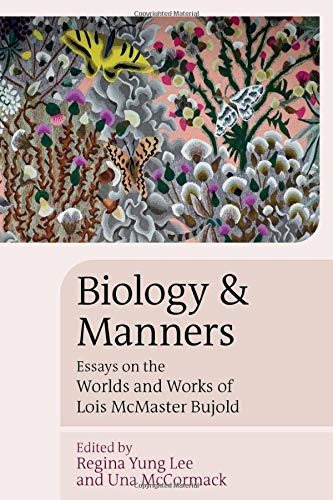
Review of Biology and Manners: Essays on the Worlds and Works of Lois McMaster Bujold


Review of Biology and Manners: Essays on the Worlds and Works of Lois McMaster Bujold

Jerome Winter

Regina Yung Lee and Una McCormack, editors. Biology and Manners: Essays on the Worlds and Works of Lois McMaster Bujold. Liverpool University Press, 2020. Liverpool Science Fiction Texts and Studies 64. Hardcover. 320 pg. $120.00. ISBN: 9781789621730. Ebook ISBN: 9781789627534.

By any reasonable critical scorekeeping, the fan-favorite work of Lois McMaster Bujold has been sorely overlooked by sf academics; however, happily enough, that critical neglect seems to be now becoming quickly corrected. A winner of six Hugo and two Nebula awards, whose numerous books—including one massive space opera series and two fantasy series, not to mention the many novellas and short stories—had sold by one estimate over two million copies by 2010, Bujold received only approximately a dozen scholarly articles devoted to her work until the mid-2000s, as meticulously shown in Robin Anne Reid’s history of Bujold scholarship that begins the current volume. In roughly the last decade, however, there has been one in-depth monographs on Bujold, Edward James’s Bujold entry in University of Illinois Press’s Modern Masters of Science Fiction series; some focus on Bujold in thematically organized books such as John Lennard’s Of Sex and Fairy; and two essay collections on Bujold, including an entry, edited by Janet Brennan Croft, in McFarland’s Critical Explorations in Science Fiction and Fantasy series, in addition to the present volume under review, Biology and Manners, edited by Regina Yung Lee and Una McCormack, which takes its title from the subtitle to Bujold’s A Civil Campaign: A Comedy of Biology and Manners (1999).

The reasons for the critical neglect have been subject to fascinating speculation. Is it a lack of sustained interest in feminist utopias? Is it because of the military sf elements? Is it the widespread critical disdain for space opera? Is it her uncool focus on parenting? Is it her whiteness? My more humdrum suspicion, though, is a less conspiratorial one; I agree with Reid’s argument that there is a “growing disparity between the [sff] genres’ growth in multiple mediums and the number of academics specializing in a marginalized field” (14). It is hard to discount the fact that a vast amount of sf literature and media goes largely unstudied for no more complicated justification than an embarrassment of riches in cultural production dwarfing the random, stringent contingencies of the niche, non-commercial market of academic publishing. Such a harsh reality, of course, means we should celebrate all the more when a worthy new author, text, or movement does begin to receive more extensive and concerted scholarly treatments, as has clearly been occurring with Bujold. There is a lot of interesting thematic and theoretical overlap across this whole essay collection; however, the collection is ostensibly divided into an introduction section of two essays on said emergence of Bujold studies and five more sections of two or three essays each, focusing respectively on “Bujold’s Women,” “Heroes’ Journeys,” “Potential Futures and Imagined Pasts,” “Holy Families,” and “Beyond the Books.”

One pronounced focus of this anthology as a whole is on critically overlooked aspects of Bujold’s two high-fantasy series, The World of the Five Gods (2001-21) and The Sharing Knife (2006-2019), especially its representations of gender and sexuality. Regina Yung Lee’s essay “Untimely Graces”  reads the widowed protagonist of Paladin of Souls (2003), Ista dy Chalion, and her pointed failures to fit conventional normative scripts as recuperating the character as covertly queered. Likewise, Caitlin Herington, in “You Wish to Have the Curse Reversed?”, argues that the Chalion novels resist the arrogation of women to the stereotyped roles of dutiful mother, wife, or daughter. Moreover, in “The Shape of a Hero’s Soul,” C. Palmer-Patel limns the Chalion novels for the tension between prophetic destiny and heroic freedom in their high fantasy conceit of mortals channeling divine avatars, stressing that Lady Ista’s active invoking of supernatural fate subverts charges of passivity endemic to this trope. Despite Bujold’s stated protestations that she is no “unconscious gonfalonier” (113) for feminist viewpoints, Sylvia Kelso nevertheless productively examines the four novels in the Sharing Knife series for their unique contributions to women’s writing, especially their rewriting of masculinized romantic quest story structure.                   

Tackling the conjunction of biology and manners from a different emphasis than exclusively one of gender and sexuality, Joanne Woiak’s “Pain Made Holy” narrows in on the torture-victim Castillar Lupe dy Cazaril from The Curse of Chalion (2001) as a figure whose hellish suffering challenges both ableist presumptions of what counts as legitimate embodiment and also subverts some of the prerogatives of disability studies that broadly advocate for more normalizing portrayals of the differently abled instead of an overriding focus on care or healing. Reid’s second essay in the collection, “The Holy Family,” also draws on disability studies to analyze The Curse of Chalion and its prequel The Hallowed Hunt (2005) as well as the more recent Penric and Desdemona series of novellas (2015-2021). Reid argues that the depiction of spiritual visions in these works resists hegemonic narratives about ability, gender, and sexuality. Meg MacDonald, in the essay “Bastard Balances All,” also discusses the Penric and Desdemona series in terms of queer theory but adds to the discussion Bujold’s fashioning of an antiauthoritarian theology.

The Vorkosigan Saga (1986-2016), a primary focus of Croft’s essay collection, also receives the due attention of a handful of essays in this book. In “Quiet Converse,” Katherine Woods pairs A Civil Campaign with Jane Austen’s Mansfield Park (1814) to suggest Cordelia Naismith, Miles Vorkosigan’s mother, is not the boring character some readers have dismissed her as, given her subtle cultivation of multiple identities as captain, refugee, mother, and hidden power behind the regent. In “Queering Barrayar,” Jey Saung reads the more recent novel Gentleman Jole and the Red Queen (2016) and the pregnancy-sidestepping novum of the uterine replicator, which has long been a keystone in the extrapolative world-building of the Vorkosiverse, for its opening up of utopian personal and public alternatives to normative biological temporalities. Oppositely, Ally Wolfe’s “Womb with a View” examines the early novel Ethan of Athos (1986) for its nuanced critique of the heterotopia of a misogynist all-male society also extrapolated from the uterine replicator. More broadly, blending visions of the future and the past in the merging of cod-medieval fantasy and space opera tropes, the Vorkosigan books enact an estranged time warp, a “futuristic feudalism” (171), as Sarah Lindsay writes in an analysis of the very first Miles book, The Warrior’s Apprentice (1986).

Expanding beyond the authorial focus, Jennifer Woodward and Peter Wright’s “The Naismith Strategem” explores Genevieve Cogman’s Bujold-themed tabletop role-playing game, The Vorkosigan Saga. Woodwood and Wright demonstrate how this game ludically systemizes Bujold’s intricate universe into a playable format, even to the point of assigning point values to characters that reflect the stigmas that often pervade feudal male-dominated and heterosexist monocultures. Kristina Busse’s “Canon Compliance and Creative Analysis in the Vorkosigan Saga Fan Fiction” reverses Bujold’s own stated endorsements of fan fiction to show how specific forms of Vorkosigan fan fiction—namely, in the slash, alternate universe, and Mary Sue subgenres—deeply engage with Bujold’s novels. Regardless of the belated scholarly recognition of Bujold’s work, these last two essays suggest that the growth of an active fandom that critically appreciates Bujold’s achievement continues apace.


Jerome Winter, PhD, is a full-time lecturer at the University of California, Riverside. His first book, Science Fiction, New Space Opera, and Neoliberal Globalism, was published by the University of Wales Press as part of their New Dimensions in Science Fiction series. His second book, Citizen Science Fiction, was published in 2021. His scholarship has appeared in The Oxford Handbook of Science Fiction, Extrapolation, Journal of Fantastic and the Arts, the Los Angeles Review of Books, Foundation, SFRA Review, and Science Fiction Studies.   

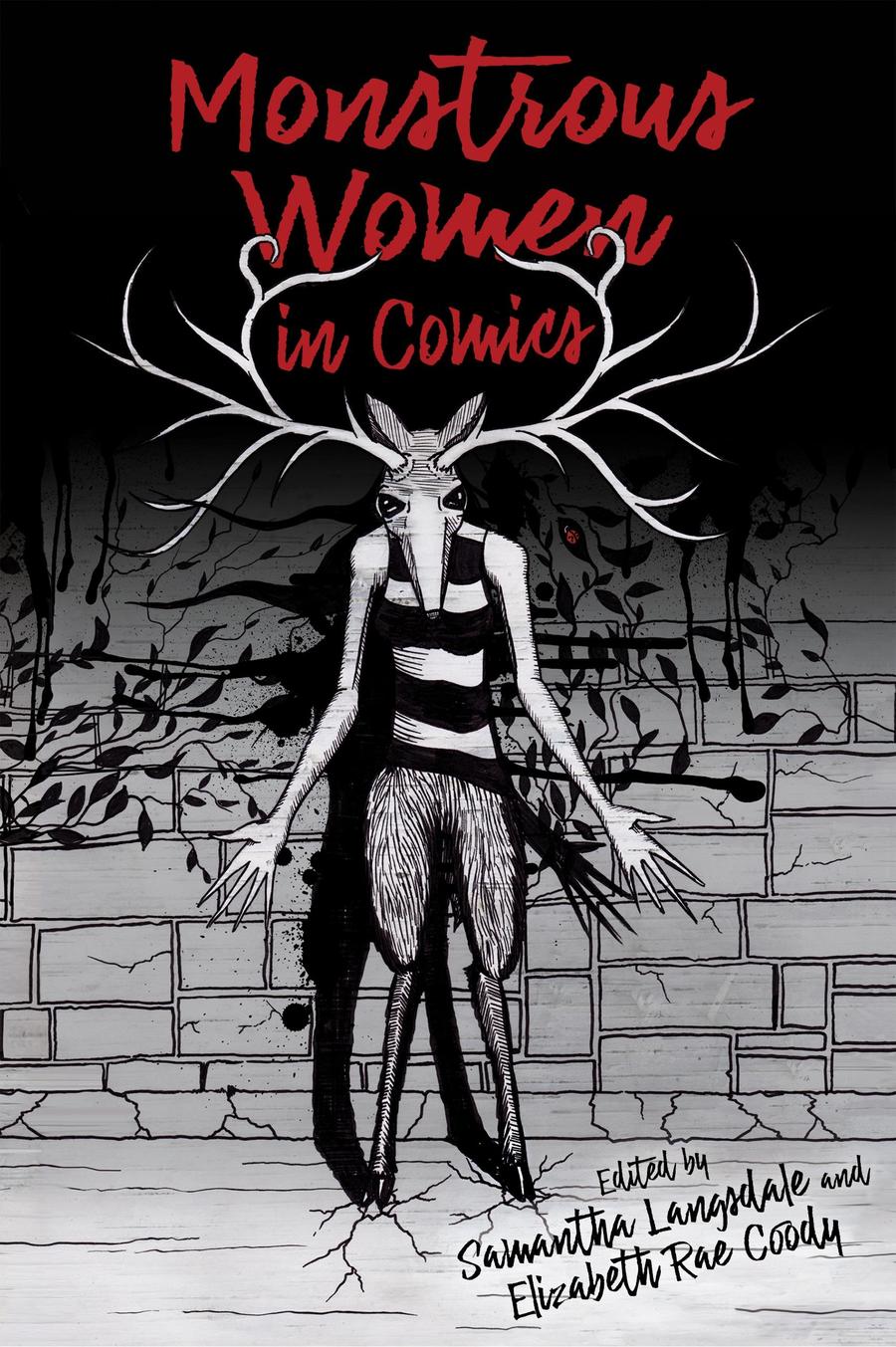
Review of Monstrous Women in Comics


Review of Monstrous Women in Comics

Brianna Anderson

Samantha Langsdale and Elizabeth Rae Coody, eds. Monstrous Women in Comics. University Press of Mississippi, 2020. Horror and Monstrosity Studies Series. Paperback. 296 pg. $20.99. ISBN 9781496827630.

Monsters have played a pivotal role in comics across genres and throughout time, with strange, boundary-crossing creatures and people populating the panels of pulp, superhero, and even romance comics. Creators frequently code these monsters as female, provoking important questions about the intersections of ability, femininity, maternity, race, and sexuality with representations of monstrosity and the Other in comics. In Monstrous Women in Comics, editors Samantha Langsdale and Elizabeth Rae Coody assemble fifteen essays that take up these pressing topics, focusing particularly on the ways that depictions of female monsters in comics contribute to the dehumanization, marginalization, or empowerment of women. As Langsdale and Coody note in their introduction, the chapters “explore not only the ways monstrous women evoke damaging cultural norms in patriarchal contexts, but also how constructions of woman as monster contain within them the potential to destroy the systems of thought that are productive of such norms” (5). The collection covers an impressive array of transnational comics, with analyses of popular Western characters like Batgirl and Harley Quinnappearing alongside readings of Bolivian, Chinese, and Japanese graphic narratives. Despite this expansive scope, each chapter follows a similar structure, beginning with a rigorous text-critical analysis of a comic or a selection of comics “in order to ask how the monster makes meaning within the text(s) and what it means for the monster to be coded as a woman” (5). Building on these close readings, the chapters interrogate how monstrous women connect to broader social and cultural anxieties and discourses surrounding gender and sexuality. Prominent feminist and monster studies scholars like Barbara Creed, Jeffrey Jerome Cohen, Julia Kristeva, and Margrit Shildrick serve as common touchstones for many of the analyses, and the richly interdisciplinary collection also draws on critical race studies, disability studies, queer studies, and other disciplines. Langsdale and Coody organize the essays thematically into five sections that explore different facets of female monstrosity: power, embodiment, childbearing, childhood, and performance.

Part One, “The Origins, Agency, and Paradoxes of Monstrous Women,” posits that female monsters evoke fear and unease in (often male) comics audiences due to their paradoxical nature. Langsdale and Coody note the characters examined in this section “actively choose monstrosity and exhibit agency that rejects normative femininity” and “are neither wholly empowered nor entirely disenfranchised” (6). Coody’s contribution, “Rewriting to Control: How the Origins of Harley Quinn, Wonder Woman, and Mary Magdalene Matter to Women’s Perceived Power,” contends that the “multivocal”—or repeatedly rewritten—origin stories of Harley Quinn and Wonder Woman reveal shifting cultural and patriarchal discomforts surrounding empowered, boundary-crossing women. Coody extends her analysis to the biblical figure Mary Magdalene, demonstrating the trans-disciplinary possibilities of her approach.  In “Exploring the Monstrous Feminist Frame: Marvel’s She-Hulk as Male-Centric Postfeminist Discourse,” J. Richard Stevens similarly addresses monstrous women in superhero comics, surveying representations of female empowerment and feminist discourses in over 800 appearances of She-Hulk in comics published between the 1980s and 2015. While comics fans and scholars have frequently lauded She-Hulk as a “feminist ideal,” Stevens reveals that the character engages only superficially with other female characters and second-wave and third-wave feminism, a fact that the author attributes to her mostly male creators and readers (31). As a result, Stevens concludes that She-Hulk “articulates the paradoxes and challenges of female agency in a hypermasculine public sphere,” namely the superhero comics industry (31). Finally, in “‘There is More to Me Than Just Hunger: Female Monsters and Liminal Spaces in Monstress and Pretty Deadly,” Ayanni C. H. Cooper analyzes the connections between abjection, beauty, and violence in the two titular comics. She argues that the monstrous heroines challenge conventional ideas of “acceptable femininity” through their liminal positionality and paradoxically gain empowerment through abjection. Together, these chapters highlight the complexities of monstrous femininity and demonstrate how audience expectations, artwork, and larger cultural movements shape representations of monstrous women.  

The chapters included in Part Two, “The Body as Monstrous,” focus on the intersections of disability, embodiment, and sexuality with female monstrosity. Stefanie Snider’s chapter “The (Un)Remarkable Fatness of Valiant’s Faith” examines the radical potential and limitations of heroine Faith Herbert/Zephyr’s fatness. Media outlets promoted Faith as the first fat superhero, yet her fatness largely goes uncommented on in the first sixteen issues of the 2016 series. Snider contends that Faith’s fatness somewhat challenges stereotypical representations of superheroines as able-bodied, conventionally attractive, and feminine, but the comic’s failure to explicitly address her visible fatness “can induce a normalization that makes invisible the power of representation and resistance that comes from her body size and shape” (80). The chapter encourages readers to envision the transformative potential of comics that would celebrate fat bodies instead of normalizing or stigmatizing them. Next, in one of the book’s most compelling chapters, “New and Improved? Disability and Monstrosity in Gail Simone’s Batgirl,” Charlotte Johanna Fabricius explores representations of able-bodiedness and disability in the first six issues of Gail Simone’s controversial New 52 Batgirl run, which cured Barbara Gordon/Oracle’s paralysis. Fabricius contends that the comic perpetuates harmful narratives about disability by portraying the villains as disabled monsters who Barbara must defeat. Moreover, Barbara’s victories over these villains parallel her own road to recovery as she transforms from a paralyzed woman to the able-bodied Batgirl. As a result, Fabricius argues that the comic’s “promise of monstrosity as disruptive remains unfulfilled, and the coding of disability as monstrous and other remains uncontested” (95). Finally, in “Horrible Victorians: Interrogating Power, Sex, and Gender in InSEXts,” Keri Crist-Wagner draws on queer theory, quantitative frequency, and visual rhetoric to analyze the relationship between gender, power, queerness, and violence in Marguerite Bennett’s horror comic InSEXts. The series centers on two queer Victorian women who transform into monstrous insects and enact violent vengeance on men who harm women. Crist-Wagner creates two tools, a “Diamond of Violence” and a “Scale of Escalating Romance,” to evaluate how the women’s “twofold monstrousness”—their physical insect transformations and their queerness—“allows them to cause material impact and damage to the patriarchy and to change their world and circumstances, almost completely without punishment” (110-111). By closely analyzing monstrous female bodies through several disciplinary lenses, these chapters highlight how monstrosity can unsettle power structures, while also demonstrating how these narratives can reinforce harmful stereotypes about aberrant bodies.

Part Three, “Childbearing as Monstrous,” explores the abject horrors of maternity and pregnancy. In “Kicking Ass in Flip-Flops: Inappropriate/d Generations and Monstrous Pregnancy in Comics Narratives,” Jeannie Ludlow explores how comics about abortion, childbearing, and motherhood can challenge or reinscribe binary notions of birth and pregnancy. For instance, she criticizes Leah Hayes’s Not Funny Ha-Ha: A Handbook for Something Hard for depicting abortion as always traumatic and shameful, perpetuating the stigmatization of abortion and ignoring the positive experiences of many real women. By contrast, A. K. Summers’ graphic novel Pregnant Butch: Nine Long Months Spent in Drag disrupts notions of normalcy and appropriateness by depicting pregnant queer bodies. By analyzing several texts from different genres, Ludlow demonstrates how comics can use grotesque and monstrous representations to promote more nuanced views of reproductive choices. Next, Marcela Murillo’s chapter “The Monstrous Portrayal of the Maternal Bolivian Chola in Contemporary Comics” analyzes representations of chola mothers in three Bolivian comics: Corven Icenail and Rafaela Rada’s La Estrella y el Zorro, Álvaro Ruilova’s Noche de mercado, and Rafaela Rada’s Nina cholita Andina. Murillo provides a detailed historical overview of political and structural discrimination suffered by cholas, indigenous Aymara or Quechua women who have historically occupied a marginalized position in Bolivia. Though Bolivia has recently adopted pro-indigenous policy changes, the three analyzed comics negatively portray chola mothers as monstrous and subaltern. Moreover, Murillo reveals how the comics use similar visual and narrative strategies to juxtapose the monstrosity of the cholas with the European femininity of their offspring, revealing larger anxieties surrounding gender and indigeneity in Bolivia. In the section’s final chapter, “The Monstrous ‘Mother’ in Moto Hagio’s Marginal: The Posthuman, the Human, and the Bioengineered Uterus,” Tomoko Kuribayashi discusses representations of posthuman femininity in Moto Hagio’s science fiction manga Marginal. The manga’s biologically engineered heroine, Kira, and her relationships with her male lovers invite readers to consider “whether the posthuman future will bring with it a radical reorganization or even total erasure of sexual differences and of gender roles and dynamics” (155). Despite this radical proposition, Kuribayashi concludes that the manga ends on a less empowering note by depicting Kira as reliant on her male partners, suggesting that men will continue to control and exploit posthuman women and their fertility. This section effectively illustrates both the transformative potential and limits of monstrous maternity, which can expand or trouble binary notions of childbirth and pregnancy.

Part Four, “Monsters of Childhood,” centers on comics that feature female monsters who reject conventional associations of women as devoted caretakers of children. In the fascinating chapter “SeDUCKtress! Magica De Spell, Scrooge McDuck, and the Avuncular Anthropomorphism of Carl Barks’s Midcentury Disney Comics,” Daniel F. Yezbick contends that the shapeshifting, villainous duck Magica De Spell threatens both the privileged protagonist Scrooge and, by extension, the larger patriarchal structures of Barks’s comic universe. Examining Magica’s abject monstrosity, hyper sexualization, possible queerness, and transgressive behavior, Yezbick argues that the character demonstrates Barks’s ambiguous attitudes toward women and, by extension, the larger Disney empire that owns his creations. In “On the Edge of 1990s Japan: Kyoko Okazaki and the Horror of Adolescence,” Novia Shih-Shan Chen and Sho Ogawa analyze representations of adolescent anxieties, female sexuality, and monstrosity in three of Kyoko Okazaki’s manga: Pink, River’s Edge, and Helter Skelter. Though Okazaki’s representations of monstrous women potentially “reinforce the nexus between monstrosity and women’s sexuality,” her characters also productively “allow us to interrogate the capitalist construction of femininity and reproduction in 1990s Japan” (205). Lastly, in “Chinese Snake Resurfaces in Comics: Considering the Case Study of Calabash Brothers,” Jing Zhang traces the historical development of the transgressive figure of the snake woman in Chinese culture and then provides a close reading of Snake Woman, the monstrous antagonist who terrorizes the child protagonists of Shanghai Animation Film Studio’s animation and comic series Calabash Brothers. Zhang links Snake Woman to larger traditions in Buddhism, Confucianism, and Taoism and insists that the character “is not a simple force of monstrous evil; she is a complex character with roots in traditional Chinese folklore and medicine, and a more sympathetic interpretation is possible” (218).

Finally, Part Five, “Taking on the Role of the Monster,” explores how women can embrace their monstrosity to resist patriarchal social norms. In “Monochromatic Teats, Teeth, and Tentacles: Monstrous Visual Rhetoric in Stephen L. Stern and Christopher Steininger’s Beowulf: The Graphic Novel,” Justin Wigard draws on adaptation, monster theory, and visual rhetoric to examine shifting visual representations of Grendel’s mother in Beowulf retellings. Closely analyzing Stern and Steininger’s phallic depiction of the woman’s body, Wigard argues that the comic reveals enduring heteronormative anxieties about empowered women, concluding, “Ultimately, the text suggests that even with one thousand years of progress, insidious patriarchal fears about female sexuality, power, and agency still pervade the human consciousness as modern adaptors perpetuate a cycle of monstrous (visual) rhetoric” (224). In “Beauty and Her B(r)east(s): Monstrosity and College Women in The Jaguar,” Pauline J. Reynolds and Sara Durazo-Demoss contend that The Jaguar’s animal-like monstrosity reinforces the marginalization that the Latina superheroine experiences as an international college student in troubling ways. Finally, in “UFO (Unusual Female Other) Sightings in Saucer Country/State: Metaphors of Identity and Presidential Politics,” Christina M. Knopf reveals how Mexican American heroine Arcadia Alvarado resists the monstrous othering that occurs in both American politics and the science fiction genre. This concluding section provides nuanced readings of the complexities of female monstrosity, which can serve as both a source of resistance and oppression.

Together, the fifteen chapters provide an expansive exploration of representations of monstrous women in graphic narratives from a diverse range of cultures and genres. Comics, feminist, and monster studies scholars alike will find valuable insights in the volume, and the collection serves as a strong model of effective interdisciplinary, transnational scholarship.


Brianna Anderson is a PhD candidate in the Department of English at the University of Florida. She is currently writing a dissertation that examines representations of environmental issues and youth environmental activism in children’s and young adult comics and zines. Her research has appeared in Studies in Comics and The Lion and the Unicorn and is forthcoming in The Comics Grid.

Review of Fighting for the Future: Essays on Star Trek Discovery


Review of Fighting for the Future: Essays on Star Trek Discovery

Vincent M. Gaine

Sabrina Mittermeier and Mareike Spychala, eds. Fighting for the Future: Essays on Star Trek Discovery. Liverpool UP, 2020. Hardback. 352 pg. $130.00. ISBN ‎9781789621761.

Star Trek is one of the world’s longest running science fiction franchises, yet it has attracted relatively little academic attention considering its longevity and transmedia presence. Fighting for the Future: Essays on Star Trek Discovery is the first critical study of Star Trek: Discovery, the franchise’s first small screen output in over a decade. The essays in this volume cover the show’s first two seasons, across four themed sections that offer studies on the role of Discovery within the Star Trek franchise, different forms of storytelling both in canon and fanon, the negotiation of otherness, and queer readings of the show. It is especially useful that this collection considers Discovery within the larger franchise as well as a specifically post-network Star Trek. Valuable points are made on this topic by Michael G. Robinson, who identifies key aspects of Discovery in relation to its contemporaries in sci-fi television. Robinson’s essay, “These are the Voyages?: The Post-Jubilee Trek Legacy on the Discovery, the Orville, and the Callister,” performs an in-depth industrial analysis of Discovery’s production, distribution, and consumption, and makes an effective comparison between Discovery, The Orville (2017-) and the Black Mirror episode “Callister” (2017) in terms of which is most “Trek,” identifying their various complexities.

Other highlights in the collection include Will Tattersdill’s “Discovery and the Form of Victorian Periodicals,” which compares Discovery’s serialized structure with that of Victorian periodicals, featuring strong references to wider generic and narrative tendencies as well as consumer understanding. Another insightful discussion of consumer engagement comes from editors Sabrina Mittermeier and Mareike Spychala, who in “Never Hide Who You Are: Queer Representation and Activism in Star Trek: Discovery,” analyze queer representation and advocacy. Their succinct yet detailed argument of queer representation across Star Trek contributes to multiple debates by taking account of the tensions between representation, the overall tenets of Star Trek and the commercial demands of television, as well as the interplay between product and fandom, including the voices of actor activists (“actorvists”).

Several essays in the collection critique the ostensibly liberal humanist politics of Star Trek, illuminating entrenched attitudes and beliefs both in the franchise and American popular culture more widely. In “‘Into A Mirror Darkly’: Border Crossing and Imperial(ist) Feminism in Star Trek: Discovery,” Judith Rauscher gives an astute analysis of how Star Trek deploys and reinforces stereotyping and imperialism, with particular attention to the seduction of feminism by imperialist fantasy. Torsten Kathke gives a similarly insightful discussion of liberalism and its problems throughout Star Trek in “A Star Trek About Being Star Trek: History, Liberalism and Discovery’s Cold War Roots.” One of the strongest chapters in the collection is Henrik Schillinger and Arne Sonnichsen’s “The American Hello: Representations of U. S. Diplomacy in Star Trek: Discovery.” Their discussion of how Discovery confronts and complicates diplomacy in Star Trek is contextualized with a history of US diplomacy, especially in the 21st century. This complex analysis of contradictory elements leads to a critical and nuanced discussion of how Discovery utilizes notions of diplomacy to explore the values and ethics of the Federation, and by extension, the United States.

While much of the collection is strong, there are some shortcomings. Multiple typos throughout the book suggest rushed copy-editing, and the multiple riffs on “boldly going where no [INSERT NOUN] has gone before” get a bit tiresome. More specifically, several of the essays offer superficial and unconvincing arguments. Sarah Bohlau’s chapter, “‘Lorca, I’m Really Gonna Miss Killing You’: The Fictional Space Created by Time Loop Narratives,” offers some interesting links to PTSD within the context of Discovery’s time loop episode but is overall rather descriptive. Lisa Meinecke discusses Discovery’s device of a spore drive as a metaphor for connections and posthuman identity in “Veins and Muscles of the Universe: Posthumanism and Connectivity in Star Trek: Discovery,” and while Meinecke synthesizes an impressive array of theories, the chapter largely describes the show’s narrative and misses the opportunity for an in-depth analysis of posthumanism. Another missed opportunity is “To Boldly Discuss: Socio-Political Discourses in Star Trek: Discovery Fanfiction” by Kerstin-Anja Munderlein. Munderlein argues that the reflection of Star Trek’s socio-political content in fan fiction is inextricable from the show, but the analysis is excessively quantitative and appraising rather than critical. Perhaps most troubling is “The Conscience of the King Or: Is There in Truth No Sex and Violence?” in which John Andreas Fuchs performs a rather superficial analysis of sex and violence in Discovery and other Star Trek instalments. Various inconsistencies in Fuchs’ chapter suggest inadequate care, a problem further compounded by a lack of nuance and context as well as a condescending tone.

Due to the limited content of Star Trek: Discovery, there is some overlap in terms of what the authors discuss. The Mirror Universe comes up more than once, as Andrea Whitacre’s “Looking in the Mirror: The Negotiation of Franchise Identity in Star Trek: Discovery” analyzes Discovery’s reworking / reiterating of Star Trek’s tension between inclusion and exclusion. Whitacre delivers particular insight into how the Mirror Universe works as a place to work out alternatives to and problems with the ethos normally presented in Star Trek. In a similar vein, Ina Batzke’s chapter “From Series to Seriality: Star Trek’s Mirror Universe in the Post-Network Era” identifies the importance of the Mirror Universe as a device of seriality which allows for the problematization of Star Trek in the post-network context.

Another recurring feature is a focus on particular characters, especially Michael Burnham (Sonequa Martin-Green), with various chapters discussing the identity politics of race, gender, and sexuality. Amy C. Chambers highlights that “Star Trek Discovers Women: Gender, Race, Science, and Michael Burnham,” in her discussion of the under-representation of black women in science fiction and scholarship, with an insightful focus on the figure of the woman scientist and the ideas of gendered science. Another perceptive commentary on Discovery’s protagonist is the “Interview with Dr. Diana A. Mafe on ‘Normalizing Black Women as Heroes,’” who identifies the representative strategies embodied by Burnham as well as how she is negotiated with other female characters on the show. Female roles within the structures of Starfleet and Star Trek are also the focus of Mareike Spychala’s “Not Your Daddy’s Star Trek: Exploring Female Characters in Star Trek: Discovery.” Spychala notes that Discovery goes further than previous iterations did with gender and gender relations through close attention to presentation and costume and persuasively argues for the show’s new forms of femininity, such as new roles for mothers.

Whit Frazier Peterson uses Afrofuturism to critically interrogate the philosophy of Discovery in “The Cotton-Gin Effect: An Afrofuturist Reading of Star Trek: Discovery.” While Peterson’s overall approach to technology as an intrinsic tool of oppression is interesting, the final argument that draws a parallel between the cotton-gin and Discovery’s spore drive is too rushed to be persuasive. A similar problem occurs with Si Sophie Pages Whybrew’s “‘I Never Met A Female Michael Before’: Star Trek: Discovery between Trans Potentiality and Cis Anxiety,” which identifies Discovery’s problematic framing of non-cisheteronormativity as alien and therefore Other, but offers a rather stretched argument over the character(s) of Ash Tyler/Voq (Shazad Latif) being a metaphor for trans-gender identity. More persuasively, Sabrina Mittermeier and Jennifer Volkmer also discuss Tyler/Voq in “‘We Choose Our Own Pain. Mine Helps Me Remember’: Gabriel Lorca, Ash Tyler, and the Question of Masculinity.” Mittermeier and Volkmer persuasively link Discovery’s construction of masculine identity to contemporary practices of masculinity as well as trauma studies and make excellent use of interviews to illustrate actors’ approaches to characters.

Whit Frazier Peterson uses Afrofuturism to critically interrogate the philosophy of Discovery in “The Cotton-Gin Effect: An Afrofuturist Reading of Star Trek: Discovery.” While Peterson’s overall approach to technology as an intrinsic tool of oppression is interesting, the final argument that draws a parallel between the cotton-gin and Discovery’s spore drive is too rushed to be persuasive. A similar problem occurs with Si Sophie Pages Whybrew’s “‘I Never Met A Female Michael Before’: Star Trek: Discovery between Trans Potentiality and Cis Anxiety,” which identifies Discovery’s problematic framing of non-cisheteronormativity as alien and therefore Other, but offers a rather stretched argument over the character(s) of Ash Tyler/Voq (Shazad Latif) being a metaphor for trans-gender identity. More persuasively, Sabrina Mittermeier and Jennifer Volkmer also discuss Tyler/Voq in “‘We Choose Our Own Pain. Mine Helps Me Remember’: Gabriel Lorca, Ash Tyler, and the Question of Masculinity.” Mittermeier and Volkmer persuasively link Discovery’s construction of masculine identity to contemporary practices of masculinity as well as trauma studies and make excellent use of interviews to illustrate actors’ approaches to characters.

Although the perspectives and critical approaches vary, the reader may wish there was more material to talk about. The problem of limited material is most apparent in the section on Queering Star Trek. While it is valuable to highlight the dearth of queer representation in Star Trek, the three essays overlap in their discussions of the same few episodes. Season 3 of Discovery would have offered more material, and the writers and editors may have rejoiced or bemoaned the further forms of representation in that season. Perhaps ironically for a book entitled Fighting for the Future, it might have been improved by waiting for that future to arrive.

Despite these shortcomings, the essays of this collection are insightful and diverse and indicate a promising critical future for Discovery and Star Trek as a whole. It is likely to be of use to scholars interested in Star Trek and post-network television as well as various forms of narrative and representation. As Discovery and indeed Star Trek as a whole continues to develop, the reader may find themselves hoping for a second edition of this volume that explores the subsequent seasons as well as further iterations of this ongoing and continually rich science fiction mythos.


Dr Vincent M. Gaine is an academic, film critic and podcaster based at Lancaster University. His monograph, Existentialism and Social Engagement in the Films of Michael Mann, is published by Palgrave. He has published further articles and book chapters on filmmakers and genres in the Journal of Cinema and Media StudiesEuropean Journal of American Culture and Journal of the Fantastic in the Arts, as well as reviews and interviews for the websites the Critical Movie Critics, the Geek Show and Moving Pictures Film Club, and also discusses film and media on the podcast Invasion of the Pody People. He specialises in the intersection of globalisation, liminality and identity politics in media, and is currently researching spies, superheroes and Boston.

Review of Pop Culture for Beginners


Review of Pop Culture for Beginners

Kania Greer

Jeffrey Andrew Weinstock. Pop Culture for Beginners. Broadview Press, 2021.  Paperback. 310 pg. $46.92.  ISBN: 9781554815657 (paperback) 9781770488113 (PDF)

Asking someone to define pop culture is like asking someone to define what a dog is: meaning that depending on who you ask, you may get a very scientific answer or something more general in terms of what a dog looks like or types of dogs. The same is true for pop culture. Some people will define it based on current trends or ideations while others will focus on the more esoteric assumptions of the genre. As a result, the understanding of and study of pop culture becomes a difficult task, especially for those new to the field. Jeffrey Weinstock’s book, as the title suggests, provides the reader with a great primary resource which could be useful to beginning scholars and those needing a refresher.  For both beginning teachers and  seasoned scholars of pop culture the foundational lens which Weinstock brings serves to break apart the mystery of pop culture and make it relatable, understandable, and accessible to all.

Most people, by the time they reach higher education (and especially the further they go up the education ladder), become far removed from what originally brought them to pop culture, namely entertainment. Academics tend to become focused on the meaning of pop culture and thereby are often seen as taking the entertainment and joy out of it. This is where Weinstock’s book can help. By getting back to basics, Weinstock acknowledges the fast paced, ever changing face of pop culture but also encourages one to dive deeper into what pop culture is and what it means, both individually and for groups. 

The book is divided into two sections: The Pop Culture Toolbox (Chapters 1-4), which I refer to as the “academic” chapters, and The Pop Culture Units (Chapter 5-10) or what I refer to as the “practitioner” chapters. In Chapter 1, Weinstock hooks us in by trying to define pop culture but also making us rethink what we understand pop culture to be. For example, he starts Chapter 1 with the statement that pop culture as a definitive term is “elusive…of a single, clear definition” (pg. 4).  From here he goes on to address the myriad of influences that make up pop culture, ultimately landing on “pop culture [being] something people seem to know when they see it” (pg. 11).  While this may leave some people shaking their heads and wondering if there will be a definition, rest assured it is in there. However, what is beneficial is the periodic breaks in information he scatters throughout the chapters to ask the reader questions. Titled as “Your Turn”, he stops the flow of information to ask the reader to reflect on what they have read. Weinstock appears to understand how people learn and that they need time to digest and process information. His questions are designed to be examined from an individual perspective in order to acknowledge one’s own influences, tastes, biases, and lens. This element takes this chapter (and others) to a higher level of understanding as I was no longer reading for information but rather reading for understanding and decoding of my own perspective.

Chapter 2 takes us on a more academic journey helping us to understand the way culture is formed and how we signify information (signs). This semiotic approach is further broken down into not only our own connotation of what we see but also the denotation of those same signs. To better understand this approach, Weinstock uses common everyday signs like tattoos to further illustrate his meanings, making the concepts relatable and easy to process. Chapter 3 takes us into theories of viewing culture and examines the perspective by  which culture can be examined (post-colonial, feminist, critical race, etc.) but does so in such a way as to remind the reader of the lens by which each of these theories views culture. Weinstock’s purpose here is to inform the reader that each pop culture offering can be viewed through multiple approaches and each of these becomes part of a larger understanding. Through this chapter he succeeds in breaking down these theories into relatively easy to understand bite sized pieces to shed light on differing viewpoints. This is perhaps one of the best chapters in the book as it takes the theories back to basics and serves to define and give substance to some theories I had created my own meaning for rather than fully understanding.   

Chapter 4 is the last of what I call the “academic” chapters, in terms of chapters imparting information. This chapter really looks at pop culture in terms of authenticity, appropriation, structure, and subcultures. For example, as Weinstock puts it there is an almost “cultural imperative to ‘be yourself’” (pg. 87), but even this can cause dissonance when we consider which self to be: work self, spouse self, friend self, etc. The challenge is determining what is meant by authentic to each person. In relation to this is the idea of cultural appropriation and how members of one culture can appropriate (or misappropriate) another culture. This creates lines which are “murky” (pg. 90) between appreciation and misappropriation. When thinking about subculture, Weinstock challenges the reader to dive deep into cultural nuances. What makes one science fiction fan different from another? Don’t all punk rockers like the same music?  Examples can be found in subcultures of “subversive” (pg. 104) groups like “bikers, skaters, punks, goths…” (pg. 104) who can be categorized as anti-culture, but each holds its own in terms of representation. Just as valid, however, are other subcultures including science fiction subcultures like “Potterheads… Trekkies, and so on” (pg. 105). In this way subculture becomes even more specialized and an “expression of personal taste” pg. 105). At the end of each of the “academic” chapters, there are suggested assignments which could be easily incorporated into classrooms. Each of the assignments serves to help students examine pop culture from their own lens but also encourages students (and faculty) to think outside of their preferred focus to examine how culture is viewed by others. 

The “practitioner” chapters (5-10) break down the sub-genres of pop culture and dive deeply into their influences and meanings. From television to fandom each chapter details what is meant by the sub-genre, asks questions throughout, and then gives a sample essay at the end.  This breakdown gives equal weight to most sub-categories of pop culture and allows students to focus in on their favorite, for deeper study, or to take a little-known sub-genre and investigate it. These essays are beneficial for driving home the points made throughout the chapter. I found these essays some of the most enjoyable reading throughout the book. While Weinstock acknowledges the “term-limits” (my words) of the pop culture references in these essays, I believe they can be valuable in helping students and faculty rethink pop culture for many years. As with chapters 1-4, there are suggested assignments in each chapter and suggested readings.  Lastly, there is Chapter 11, which challenges readers to ”extend the approach adopted [in the book] to a different popular form” (pg. 277). Readers can use the book as scaffold to develop their own questions which challenge interpersonal thinking and viewpoints on culture.

Weinstock does a great job of introducing and reintroducing pop culture and does so in a relatable, humorous, and enjoyable way; in fact, I often forgot I was reading a textbook. While he presents an academic study of pop culture, he does so without abandoning the mystique and enjoyment most people find in pop culture. He challenges readers/students to examine their own cultural lens while encouraging us to think outside of the story presented to develop larger meanings. This book would be an excellent introductory book for pop culture studies (or really any studies) as it is easy to digest, thought-provoking, and just plain fun. Having said that, I study the intersection of science fiction and science interest (how does science fiction draw people to science), and I found this book a nice refresher and reminder of the broader contexts I am researching. Therefore, I recommend it to all academics, from those just starting to those who have been in the field for a while.

Kania Greer currently serves as the Coordinator for the Center for STEM Education at Georgia Southern University.  She studies the intersection of science fiction and science fact by people who attend science fiction conventions.

Review of The Modern Myths: Adventures in the Machinery of the Popular Imagination


Review of The Modern Myths: Adventures in the Machinery of the Popular Imagination

Jack Durant

Philip Ball. The Modern Myths: Adventures in the Machinery of the Popular Imagination. Chicago UP, 2021. Hardcover. 426 pg. $30.00. ISBN 9780226719269.

In The Modern Myths: Adventures in the Machinery of the Popular Imagination, Philip Ball argues that “the Western world has, over the past three centuries or so, produced narratives that have as authentic a claim to mythic status as the psychological dramas of Oedipus, Medea, Narcissus, and Midas” (3). These stories, “which everyone knows without having to go to the trouble” of reading them, have “seeped into our consciousness, replete with emblematic visuals, before we reach adulthood” (2). Modern myths—of which Ball identifies seven, starting with Robinson Crusoe and ending with Batman—are not, despite their origins in specific texts, so much singular narratives as “evolving web[s] of many stories—interweaving, interacting, contradicting each other”—but with one thing in common: “a rugged, elemental, irreducible kernel charged with the magical power of generating versions of the story” (9). This fecund capacity to produce new narratives is what allows these myths to do their “cultural work”: they “erect a rough-hewn framework on which to hang our anxieties, fears and dreams” (16).

This summary suggests the level of analysis the book sustains: this is not a theoretical study or ideological critique of myth, along the lines of Roland Barthes’s classic Mythologies (1957) or the work of Claude Lévi-Strauss (critics mentioned only a half-dozen times, mostly in passing). Rather, The Modern Myths is an old-fashioned literary anatomy, in the mold of John Cawelti’s classic Adventure, Mystery, and Romance: Formula Stories as Art and Popular Culture (1976). What the book lacks in terms of theoretical claims it more than makes up for with its detailed close readings and rich historical contextualizations. Seven long chapters carefully lay out Ball’s mythic archetypes: Crusoe, Frankenstein, Jekyll and Hyde, Dracula, Martian invaders (à la Wells’s War of the Worlds), Sherlock Holmes, and Batman. As this list suggests, the coverage is heavy on British, mostly Victorian, examplars, a bias Ball seems a bit defensive about, though he argues effectively that the “British character of much of the modern mythopoeia” has led to an emphasis in modern pop culture on themes of class and empire (20). Ball’s mythic canon is also exclusively male (though the origin text of the Frankenstein myth was written by a woman), and it is unclear why he did not select a female archetype to analyze, since pop culture is filled with compelling femmes fatales, such as Sheridan Le Fanu’s Carmilla and Rider Haggard’s Ayesha. Perhaps Ball felt that this tradition was too diverse, not focused on a singular figure. In any case, he is quite frank about the biases informing his pantheon, and the individual chapters searchingly explore the cultural implications of the Anglophone and masculinist orientation of these various myths.

Each of the seven chapters devoted to a specific myth takes basically the same form. First, Ball traces the origins of the figure to a particular work of literature (or core collection of stories, as in the case of Sherlock Holmes) that has been abidingly popular. Yet, as he shows, the development of the myth over time has involved a process of adaptation and mutation that leaves the author’s intent far behind. A myth, Ball asserts, “is not identical to its founding text”; rather, myths “are the work of a culture” (14). The figures that have proven enduringly resonant are those reducible to key kernels of meaning that can be elaborated and adjusted over and over again. In the case of Frankenstein, for example, that kernel is the potential for Promethean overreaching built into the modern scientific enterprise, the possibility that “knowledge injudiciously applied” might “generate an entity too large and unruly to control” (129). Having thus distilled down the original text, Ball then pursues the pop-cultural career of this kernel or theme over decades of cultural production, from direct adaptations (e. g. James Whale’s classic 1931 film of Frankenstein) to various offshoots and allusions (e. g.. stories about rampaging robots and disobedient computers). These seven chapters are marked by extensive primary research and imaginative extrapolation, and Ball writes with an easy grace that is refreshingly free of jargon.

The volume concludes with two chapters that pan back from a focus on specific myths to offer more sweeping speculations about the nature of the “mythic mode” and the possibility of new myths emerging. These final chapters are somewhat less sure-footed, in part because they are so speculative; thus, Ball argues that the zombie may be an emergent myth, the first to be generated by the cinema rather than by a literary text—an assertion that, on the one hand, tends to ignore the literary lineage of the modern zombie (cf. Roger Luckhurt’s Zombies: A Cultural History [2015]), while on the other hand slighting mythic figures that are even more deeply rooted in a filmic corpus, such as the hardboiled private eye of modern noir. The capping chapter on the “mythic mode” of storytelling is a hodgepodge of tentative conclusions that is too short (barely 10 pages) to offer a synoptic perspective encompassing the diverse archetypes that the earlier chapters have spent so much time exploring (the chapter on Dracula alone runs almost 60 pages). It is these seven long chapters that form the core of Ball’s book, and they are all solid, well-researched, and unfailingly interesting studies that any student of modern pop culture will have much to learn from.

Jack Durant is a long-time reviewer of SF literature and criticism. He was a stalwart of the late Fantasy Review magazine and published a number of reviews in The Science Fiction and Fantasy Book Review Annual

Review of Extreme Fabulations: Science Fictions of Life


Review of Extreme Fabulations: Science Fictions of Life

Mattia Petricola

Steven Shaviro. Extreme Fabulations: Science Fictions of Life. Goldsmiths Press, 2021. Hardcover. 192 pg. $24.95. ISBN 9781912685882.

According to its author, Extreme Fabulations is “a thought experiment” (1). More precisely, this experiment unfolds as an attempt to establish a dialogue between science fiction and the hermeneutical tools developed by modern and contemporary philosophy. Thus, Extreme Fabulations further develops the lines of inquiry that Shaviro inaugurated in his 2016 monograph Discognition. However, whereas Discognition explored the notions of consciousness, thought, and sentience, Extreme Fabulations focuses—as the title suggests—on how we can conceptualise, perceive, and reimagine the very idea of “life.” Shaviro’s argument starts from a compelling definition of science fiction as “counter-actual” rather than “counter-factual,” in the sense that “it offers us a provisional and impossible resolution, suspended in potentiality, of dilemmas and difficulties that are, themselves, all too real” (2). An “extreme fabulation” can thus be seen—even if Shaviro does not provide a clear definition of this expression—as a narrative that pushes the limits of our understanding of what “life” is while tackling the dilemmas that spring from this cultural and cognitive reconfiguration.

Each of the eight chapters that make up Extreme Fabulations investigates such dilemmas through an in-depth study of a single work of science fiction. More specifically, Shaviro provides close readings of Charles Harness’ 1950 short story “The New Reality”(chapter 1), Adam Roberts’ 2015 novel The Thing Itself (chapter 2), Clifford Simak’s 1953 short story “Shadow Show” (chapter 3), Ann Halam’s 2002 novel Dr. Franklin’s Island (chapter 4), Nalo Hopkinson’s 2005 short story “Message in a Bottle” (chapter 5), Chris Beckett’s 2012 novel Dark Eden (chapter 6), a 2016 concept album by the hip hop group clipping. entitled Splendor and Misery (chapter 7), and Gwyneth Jones’ 2017 novella Proof of Concept (chapter 8). Since each chapter is a perfectly self-contained whole that can be read independently from the others, Extreme Fabulations resembles an essay collection rather than a monograph. The presence of a conclusion would have probably made Shaviro’s argument somewhat better-rounded; on the other hand, the book’s structure makes it easily accessible to scholars and students who are specifically interested in one or more fictional works among those examined by Shaviro.

Chapters 1 and 2 focus on what Shaviro calls “Kantian science fiction” (21), that is, on works that defy the ontology of life (in other words, the conceptualisation of what life is) as elaborated by Kant in his Critique of Pure Reason (1781). “The New Reality” and The Thing Itself provide Shaviro with an opportunity for discussing the difficult and somewhat marginal position of ontology in contemporary thought (which devotes much more attention to phenomenology and epistemology) and, more importantly, for exploring how science fiction can allow us to “poke around outside” (29) the categories that, according to Kant, structure human cognition and perception.

Chapters 3 and 4 shift the focus to science as a Foucauldian power-knowledge system and to how it conceptualises, controls, and policies life. Shaviro’s readings of “Shadow Show”and Dr. Franklin’s Island represent valuable contributions to both posthuman theory and monster theory, since they investigate how science fiction can thematise and challenge our conception(s) of the human. Shaviro is particularly interested in how the two texts shatter the old vitalist view of life as a ‘spark’ in favour of a non-anthropocentric view of life as a pervasive process of animation involving both human and non-human beings, as wells as in how they deconstruct the idea of the ‘great chain of being’ while moving towards an anti-hierarchical and networked conception of life.

In chapters 5 and 6, the ‘dilemma’ of life is approached from the perspectives of aesthetics and anthropology. Shaviro’s study of “Message in a Bottle”—an Afrofuturist story about an art exhibition that will take place in the storyworld’s remote future—is centred on the idea of futurity and interrogates how we can conceive of life as something that extends beyond the present and into a future that can be imagined, questioned, and colonised. Dark Eden, on the other hand, is read as a work of “speculative anthropology” (116). In his analysis, Shaviro discusses the notion of ‘speculation’ by comparing its applications in science fiction and in evolutionary psychology, ultimately arguing that the former are far richer and more complex than the latter.

Chapters 7 and 8 draw from the arguments developed in the previous chapters and apply them to the speculative representation of social oppression. More specifically, Shaviro interprets the narrative developed in the album Spendor and Misery in the light of Kim Stanley Robinson’s notion of ‘anti-anti-utopia’, thus arguing that “it is better […] to ’set up a random course’ into the unknown than to stay with what is reliably oppressive and deadly” (147). The study of Proof of Concept finally interrogates the continued presence of capitalist realism in a future society and how speculative fiction can imagine alternative scenarios in a world that cannot be reformed.

Throughout his essays, Shaviro consistently adopts a twofold argumentative strategy. The fictional texts chosen as case studies are both compared with earlier science/speculative fiction narratives and read in the light of specific concepts drawn from modern or contemporary philosophy. Extreme Fabulations thus deploys an extensive hermeneutical toolkit ranging from the aforementioned Kant’s Critique and Foucault’s biopower to Quentin Meillassoux’s correlationism and Maurice Blanchot’s limit-experiences, from Eugene Thacker’s notion of ‘dark pantheism’ to Deborah Levitt’s concept of ‘animal apparatus,’ from the speculative realist philosophy of Graham Harman to Lee Edelman’s queer theory. This toolkit is further enriched by the presence of notions derived from physics (Einstein, Schrödinger, and two interpretations of quantum mechanics), biology, and finance. This complex theoretical framework, however, never makes the reader feel overwhelmed. No in-depth knowledge of philosophy is required to enjoy the essays, and every new concept is introduced with clarity and conciseness. As regards the comparison with other works of science/speculative fiction, one of the aspects that makes reading Extreme Fabulations from cover to cover particularly compelling is the fact that it proposes, in a series of arguments disseminated throughout the book, many elements for what could be called an anti-Lovecraftian monster theory. More specifically, this theory aims to demonstrate that “[i]f we want to get away from anthropocentrism […] we need to give up our Lovecraftian visions of the implacable coldness, emptiness, and unconcern of the universe” (38).

To sum up, Extreme Fabulations provides a stimulating and refreshingly original perspective on the conceptualisation of life in science fiction that will offer new ideas and lines of inquiry to both students and scholars working on science fiction, the posthuman, and monster theory. It would be fascinating, for example, to further explore the idea of ‘Kantian science fiction’ and find other works that might fit this category, or to understand how Shaviro’s arguments could be adapted to media other than literature and music and to works outside the anglophone world.

Mattia Petricola received his PhD in comparative literature in 2019 from the University of Bologna and has been a postdoc research fellow in comparative literature at the University of L’Aquila (Italy). His research interests sit at the crossroads of speculative/fantastic fiction, thanatology, intermedial studies, and queer theory. He has published articles on Philip K. Dick, Peter Greenaway, the notion of spectrality in media studies, and queer theory. In 2021 he edited a dossier entitled What do we Talk about when we Talk about Queer Death? for Whatever. A Transdisciplinary Journal of Queer Theories and Studies.

Review of New Blood: Critical Approaches to Contemporary Horror


Review of New Blood: Critical Approaches to Contemporary Horror

Jonathan W. Thurston-Torres

Eddie Falvey, Joe Hickinbottom, and Jonathan Wroot, eds. New Blood: Critical Approaches to Contemporary Horror. U of Wales P, 2021. Horror Studies. Paperback. 288 pg. $60. ISBN 9781786836342. eBook ISBN 9781786836359.

New Blood is a collection of essays examining recent works of horror film. Separated into four parts, the book largely acts as a defense for analyzing new horror films through a scholarly lens. Some of the essays are invested in reception studies and production methods, while others engage more in theory and interpretive analyses. Ultimately, many of the chapters seem to fall short of the book’s intent, functioning more as an elevated film review than a work of serious scholarship. However, many chapters would be effective in teaching undergraduate classes in horror so could be included on syllabi for such courses.

The editors present a kind of defense of modern horror cinema as worthy of critical study in their introduction. What struck me here was that the defense was framed as a list of horror films, claiming that there have been both remakes and original films, an argument that generally should go without saying. Indeed, the editors seem to try to defend whythe genre is popular more than why it is worthy of scholarly attention. We constantly see phrases such as, “some horror franchises have proven so popular that…” and “To understand the genre’s enduring popularity…” (2, 3). The introduction continues to state the obvious: “Critical acclaim has been given in many cases – but whether praised or derided, horror has carried on regardless” (4). As a result of this set-up, it seems very unclear who the audience for the book really is. People who think horror stopped being a film genre in the 90s? Beginning horror scholars who are looking for definitive proof that the genre is indeed popular? After defining what the editors call “revisionist horror” (5) and talking further about the commercial aspects of the genre, they outline the various case studies of the book.

In “Apprehension Engine: The New Independent ‘Prestige Horror,’” David Church engages with “artsy” horror of the past couple of decades through the label “prestige horror” (16), discussing the sub-genre in terms of reception studies, critical acclaim, and cultural studies. What is compelling about Church’s arguments is his discussions of indie “alternative” prestige films and the ways that many horror fans appreciate the art and poetry of films over the commercial scare factor. My greatest concern with Church’s work is the limit of his scope. What he calls indie-art films are reasonably commercial successes as well, such as It Follows (2014), Saw (2003), and The Witch (2015). There does not appear to be much room for horror shorts on YouTube or the much more indie films released only on Shudder.

The next essay, by Steve Jones, “Hardcore Horror: Challenging the Discourses of ‘Extremity,’” seeks to give definition to the eponymous terms “hardcore horror” and “extremity.” Jones focuses on market and critical definitions for “extremity,” noting that a store’s willingness to stock a horror film contributes to the market definition, as an example. The strength of this chapter is in its ability to give several specific cases, such as mother! (2017) and A Serbian Film (2010), while also acknowledging and giving room to the slippages of meaning of “extremity.” Even tackling a bias toward extreme horror texts in academic publishing, Jones approaches the concept from so many angles I could see myself easily teaching this chapter alone alongside some horror films.

Continuing the focus on specific audiences, Xavier Mendik approaches cult horror festivals in “From Midnight Movies to Mainstream Excess.” Mendik blends the personal with the critical effectively as he situates his experiences with a university horror film festival in the larger commercial industry of horror film. Like Church, Mendik is invested in terms like “prestige” and “success,” although his scope is limited more narrowly to these specific film festivals.

Starting the book’s second section, Joe Hickinbottom’s “A Master of Horror?: The Making and Marketing of Takashi Miike’s Horror Reputation” is more of a fan’s defense of Miike as a “horror auteur” than a work of serious critical inquiry. It even goes so far as to answer the titular question in just the first couple of pages, rendering the rest of the chapter uninteresting. This chapter might have been better placed as an introduction to a volume just on Miike. Asian horror continues with “Bloody Muscles on VHS: When Asia Extreme Met the Video Nasties” by Jonathan Wroot. Easily one of the sharpest chapters in the book, Wroot’s conducts a reception studies and comparatist reading of J-horror film Bloody Muscle Body Builder in Hell (2014). What impressed me with this chapter was the vast amount of research Wroot conducted: into VHS production history, the trends of VHS nostalgia in the 21st century, and the theory behind J-horror’s reception.

Thinking about film in the 21st century, one, of course, cannot forget the popularity of streaming services like Netflix, as Matt Hills notes in “Streaming Netflix Original Horror: Black Mirror, Stranger Things, and Datafied TV Horror.” Like Wroot, Hills brings in considerable theory, focusing on postmodern readings of what he calls the “flagships” of “datafied horror” (125): Stranger Things and Black Mirror. He excels at analyzing concepts unique to Netflix, discussing “bingeing on fear” and the distinctions of genre bubbles that separate Netflix from something specifically geared toward horror fans like Shudder (130).

The next part, focused on subgenres of modern horror, begins with Jessica Balanzategui’s chapter, “The digital gothic and the Mainstream Horror Genre: Uncanny Vernacular Creativity and Adaptation.” Balanzategui is invested in exploring the collaborative efforts that go into Creepypasta stories and the gothic elements that appear in them. This chapter would be really beneficial for introductory students of horror, showing them that even those stories they read online “count” as genuine literature. However, I wish Balanzategui integrated more Gothic theory and scholarship into the chapter, making that bridge between academic theory and popular fiction more apparent. Abigail Whitall envisions “rethinking subgenres and cycles” in “Nazi Horror, Reanimated” (167). In this chapter, Whitall makes the basic argument that Nazi horror should be considered a subgenre rather than a cycle. While convincing, the argument seems very simple and easily defensible to scholars who would be reading this book.

The final subgenre explored is the “desktop film” in “Digital Witness: Found Footage and Desktop Horror as Post-cinematic experience,” by Lindsay Hallam. In discussing the subgenres of found footage films here, Hallam integrates not only directors’ quotations but actually really strong affect theory and social media theory, making the chapter shine for its integration of scholarship alongside its analysis of primary texts. This chapter could serve as the basis of an entire course syllabus. Eddie Falvey then discusses feminine monstrosity in “Revising the Female Monster: Sex and Monstrosity in Contemporary Body Horror.” When I first read the chapter, I was frustrated with its survey nature. I had hoped there would be something more in-depth here. However, the chapter excels at being just that: a captivating survey. This chapter would be great for undergraduates to read, as it opens up many compelling conversations about sex, gender, disability, and even STDs in horror.

The political theme continues with Thomas Joseph Watson’s “The Kids are Alt-Right: Hardcore Punk, Subcultural Violence and Contemporary American Politics in Jeremy Saulnier’s Green Room.Green Room (2015) is certainly a horror film worthy of academic analysis. However, aside from the occasional quotation here and there, this chapter felt like an extended film review that summarized what a lot of other critics have said about the film. The last chapter is “Twenty-first-century Euro-snuff: A Serbian Film for the Family,” by Neil Jackson. In contrast to the previous chapter, this one thrives on literary theory to analyze a film that many would dismissively call “torture porn.” Jackson relies on affect theory and allegorical interpretations to derive new meaning from the film. The film thus becomes a site of investigation and critical inquiry that opens the way for other scholars (whether they are established researchers or undergraduates).

On the whole, the book seems conflicted. Half of it consists of simple arguments such as, “This is a film I enjoy, and here’s why,” and “This film is popular”; the other half actually engages in productive film theory and academic discourse. For those strong chapters, I would highly recommend the book to instructors teaching undergraduate horror courses. Those chapters really open the floor for productive discussions of the genre and showcase what that kind of horror analysis can look like.

Jonathan Thurston-Torres (they/them) is a PhD candidate at Michigan State University, specializing in Animal Studies, early modern literature, and horror literature. Their work has led them to edit MSU’s new volume in The Animal Turn series, Animals & Race. Outside of their academic work, they are a local activist in HIV destigmatization, recently putting out a TEDx Talk, Being Positive.