Review of Girls on Fire: Transformative Heroines in Young Adult Dystopian Literature


Review of Girls on Fire: Transformative Heroines in Young Adult Dystopian Literature

Kelly J. Drumright

Sarah Hentges. Girls on Fire: Transformative Heroines in Young Adult Dystopian Literature. Jefferson, NC: McFarland, 2018. Paperback, 290 pages, $39.95, ISBN 9780786499281.


With Girls on Fire: Transformative Heroines in Young Adult Dystopian Literature, Sarah Hentges offers a panoramic view of the literary archetype (turned multi-media cultural phenomenon) exemplified by Katniss Everdeen, the “girl on fire” protagonist of Suzanne Collins’s Hunger Games trilogy. Hentges challenges common critiques of YA dystopia as one-dimensional and escapist by emphasizing the complexity of the author’s worldbuilding and the protagonists’ struggles for social justice. Girls on Fire builds on some of the ideas articulated in the edited volume Female Rebellion in Young Adult Dystopian Fiction (Routledge, 2016) as well as scholarship about the Hunger Games, with the important difference of centering the voices of more marginalized writers.  

Despite the section’s name, those looking for a theoretical deep-dive into young adult dystopia as a genre will not find it in “Part I: Excavating Theories and Legacies,” but Girls on Fire has many other strengths. For one, Hentges commits to an interdisciplinary and intersectional critical framework that includes American Studies, Cultural Studies, Women’s, Gender, and Sexuality Studies. Additionally, Hentges excels at taxonomizing the formidable corpus of 140+ primary texts, illustrating connections between series with diagrams she calls “dystopia trees” (249), which help readers visualize the influences of the Girl on Fire (roots), the core texts (trunk), and the proliferation of diverse examples (branches and leaves).  

While a helpful chart in the introduction provides an overview of the Girl on Fire’s most salient characteristics, it is not until “Part II: Excavating Fiction, Imagination and Application,” that Hentges unpacks the titular archetype more fully in the textual analyses that form the volume’s core. With the exception of sections on the Hunger Games trilogy and Octavia Butler’s oeuvre as precursor to the Girl on Fire archetype, Hentges carries out the analysis point-by-point. This approach has its advantages— namely, illuminating trends and highlighting connections between a massive corpus of texts— but necessarily sacrifices in-depth explorations of a single character, text, or series. Standout sections such as the discussion of white supremacy’s pervasive influence on YA dystopia in Chapter 6, “Othered Girls Towards Intersectional Futures,” provide important reminders for other scholars and students to question “assumptions of whiteness” (8). Ultimately, Hentges has opted for the approach that most closely fits her final goal: to describe an archetype, mining the richness of its myriad iterations for insights into our present cultural moment. 

One of the most refreshing aspects of Girls on Fire is Hentges’s candid self-identification as a fangirl: “Fangirling shapes my relationship to this literature as a teacher, a scholar, and a critic” (75). Readers yearning for the distant, antiseptic tone that often characterizes literary scholarship will be disappointed by Girls on Fire. Rather, Hentges’s dynamic voice, optimism, and transparent appreciation coupled with critique honor the characters she describes as “compelling and hopeful subjects” (3). In this way, form follows content, as Hentges argues that any textual analysis of YA dystopia is incomplete if it willfully ignores the affective dimension that makes these books so engrossing. 

Hentges knowingly positions herself as a fan regardless of the possible pitfalls attendant in doing so, admitting that “Fangirls can be too close to our subject, but we can also provide insights that a reader without a passion for the texts might not” (75). Girls on Fire certainly benefits from Hentges’s enthusiasm; after all, successfully wrangling a massive corpus into an accessible volume of scholarly critique requires passion and tenacity. To my mind, however, Hentges’s proximity to the subject holds the book back in two ways. First, Hentges’s encyclopedic knowledge can manifest in the tendency to list examples as support for claims, resulting in a frenzied pace that can leave the reader feeling unmoored. Furthermore, because of the thematic structure of her analysis and the extensive corpus, these examples often require a brief plot synopsis that interrupts the argument’s rhythm. Secondly, Hentges sometimes revels in the exception— extensively analyzing outstanding books or characters that transgress the genre’s norms— while her critiques of certain thornier trends (e.g., the focus on romance, heteronormativity), which she rightly identifies as central to YA dystopia, remain relatively superficial. However, these elements are not enough to discount the important contributions of the ambitious project that is Girls on Fire

Accessing this book’s content demands familiarity with the genre of YA dystopia, not expertise; even superficial knowledge gleaned from a casual viewing of the Hunger Games film adaptations will suffice. The volume is accessible to audiences inside and outside of academe, although readers less familiar with the genre may find themselves in one of two positions: either overwhelmed by the scope of the project’s primary corpus or invigorated by their growing TBR (to-be-read) lists. Fortunately for her readers, Hentges has included a rather unorthodox “Appendix 2: Something Like a Rating System,” in which she shares “brief sketches of [her] ‘likes’ and ‘dislikes’ of these books as well as some of the main elements” (249). 

Most importantly, Girls on Fire is a goldmine for educators. With her literary analysis, Hentges models how to engage popular texts with intersectionality at the fore, and these sections would make accessible readings for undergraduate students. Readers will notice that the book is structured with pedagogy in mind, moving from theory and methodology to application via textual analysis, and finally, to the classroom and beyond. In Chapter 7, Hentges generously shares resources such as “action projects” that challenge students to apply their knowledge outside of the classroom (209-214). Although the “action projects” Hentges details are tailored to YA dystopia, they could easily transfer to other fields. As educators, we would do well to follow Hentges’s example when she states, “I have always encouraged my students to critique the thing they most love” (75). Girls on Fire certainly provides many tools and examples of how to do so.
Review of Other Worlds: Spirituality and the Search for Invisible Dimensions


Review of Other Worlds: Spirituality and the Search for Invisible Dimensions

Aga J. Drenda

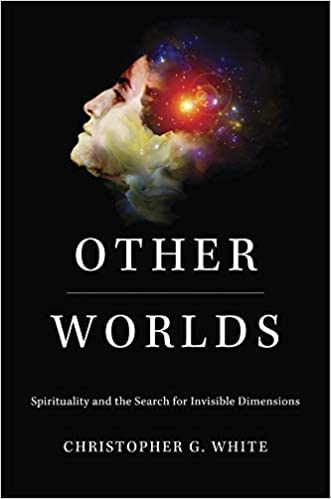
Christopher G. White. Other Worlds: Spirituality and the Search for Invisible Dimensions. Harvard UP, 2018. Hardback. 384 pg. $35.00, ISBN 9780674984295.


In Other Worlds: Spirituality and the Search for Invisible Dimensions Christopher G. White explores the history and imaginative power of the idea that the universe has higher, invisible dimensions. To accomplish his goal, White assembles an unusual cast of characters: visionary mathematicians, fantasy writers like George MacDonald and C. S. Lewis, mystical physicists, spirit channelers, television producers, hippie scientists, New Age prophets, social reformers, indefatigable parapsychologists, and artists like Max Weber (3). White argues that the diversity of this group is dictated by the desire to make a larger point about science and religion, which are often seen as implacable enemies. He posits that scientific and religious ideas come braided together and influence each other to a degree that has gone unnoticed, and he strives to address it (13). 

White treats the idea of the invisible dimensions historically and structures his book accordingly. He begins with the mid-nineteenth century mathematical discoveries of the idea of the fourth dimension and moves through the evolution of the idea across various disciplines until the modern day. This historical approach to the subject makes the structure of the book easy to navigate, especially as chapters are also thematically focused on areas of interest. For example, chapter one is focused on Edwin Abbott’s life and career, with special attention paid to Flatland (1884), a text that has become a classic for scholars of science fiction, students of mathematics, and spiritual seekers alike. Chapter two discusses the turbulent career and private life of Charles Howard Hinton, the inventor of the four-dimensional cube called “tesseract.” The ideas fleshed out in these two chapters are fundamental to the rest of the book, because White traces and refers to them consistently in every chapter that follows. Abbott’s allegory of the world existing only on a two-dimensional plane and Hinton’s conceptualisation of the “tesseract” serve as two points of reference throughout the history of invisible dimensions. These points create a referential springboard which White applies to move seamlessly between chapters, from one discipline to another, one time period to another. The example of the transition between chapter four and five illustrates it well. White devotes chapter four to a detailed analysis of the life and work of an architect Claude Bragdon, a man described by his contemporaries as fully as great an architect as Frank Lloyd Wright but lacking Wright’s talent for self-promotion (108). Bragdon incorporated higher-dimensional philosophy in architecture by designing hypercubes and other objects into otherworldly ornamentation. By showing the links between Abbott’s and Hinton’s ideas and Bragdon’s work in the early twentieth century, White sets up a transition to chapter five, in which the same ideas are highlighted throughout the art of the period. In chapter five the main area of interest is the evolution of impressionism into cubism and the life and work of Russian-born American painter Max Weber. The philosophy of invisible dimensions is a consistent lens through which White shows the last two centuries to his readers.    

My only criticism of Other Worlds is that in his analysis of many famous literary works, such as C. S. Lewis’s Chronicles of Narnia (1950-1956) and Madeleine L’Engle’s A Wrinkle in Time (1962), White rarely engages with the abundant literary scholarship produced on the works so far, but rather focuses on the bibliographies and philosophical views of the authors. In this, however, White remains true to his analytical lens of invisible dimensions. When discussing genre literature, White also remains true to his speciality. As a professor of religion, he is interested in how the mythopoeic nature of genre literature influences belief. He argues that “the lesson of modern Christian fantasy and sci-fi is not just that belief takes practice but that objects of belief have to be made believable again for new generations” (228). 

Other Worlds is a generous hardback, as it offers over 300 pages of material, along with bibliographical notes, credits, and a useful index at the end, all of which enhance the reading experience. It is a valuable resource for those interested in the intersection of science and religion. Scholars and students, fans and creators, specialists in science fiction, fantasy, popular culture and art will be able to find something of interest in this volume. Its historical structure offers the story of invisible dimensions and encourages the reader to treat the book as one would treat a work of fiction. However, the chapters are so diverse and holistic in their internal structure that they can easily stand up to selective reading. I can imagine chapters from this book being used selectively as reading material for a variety of teaching modules. A science fiction scholar might, in the words of L’Engle, “tesser with joy” through a selection of short stories analysed by White (242), such as Algernon Blackwood’s “Victim of Higher Space” (1914), Robert Heinlein’s “And He Built a Crooked House” (1941), William McGivern’s “Doorway of Vanishing Men” (1941), and Mark Clifton’s “Star, Bright” (1952), to name only a few. Other Worlds achieves its goal of delineating how the scientific idea of a higher dimension has spread across popular culture. More importantly, in an impressive feat of scholarship spanning across several disciplines, White manages to revise the conventional way of writing about the modern “conflict between science and religion” by showing how scientific insights were used sometimes not to attack spiritual beliefs but to buttress them in unexpected ways (3).

Review of None of This Is Normal: The Fiction of Jeff VanderMeer


Review of None of This Is Normal: The Fiction of Jeff VanderMeer

Thomas Connolly

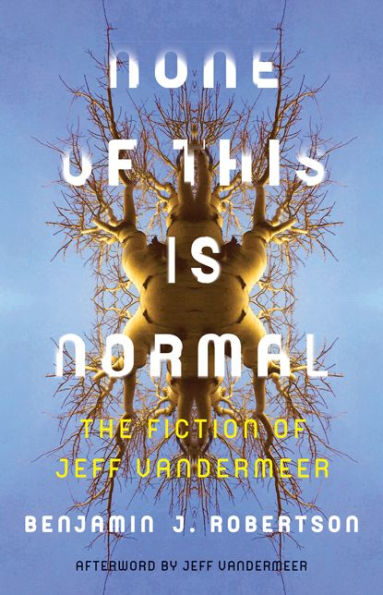
Benjamin Robertson. None of This Is Normal: The Fiction of Jeff VanderMeer. Minneapolis, MN: University of Minnesota Press, 2018. Paperback, 208 pages, $19.95, ISBN 9781517902933.


Despite his long-standing critical and (following the publication of the Southern Reach trilogy) commercial success, scholarly attention to Jeff VanderMeer has so far been rather scant on the ground. None of This Is Normal comprises the first book-length study of VanderMeer’s weird fiction—Robertson notes in his introduction that, at the time of publication, there were only two other scholarly articles on VanderMeer’s fiction, both published in the same issue of Paradoxa.

This relative paucity of scholarly publications on VanderMeer is surprising: anyone who has attended a recent conference on a theme related to SF or fantasy will be aware of the popularity of, and evident critical consideration given to, VanderMeer’s fiction. (Indeed, Robertson acknowledges this unusual imbalance.) This attention forms part of a wider scholarly interest in the political, literary, and philosophical ramifications of the “new weird,” a literary genre which has proved to be both nebulous and subversive in its literary aims. Whereas the original weird, à la Lovecraft and M.R. James, sought to dramatize the insufficiency of human reason in the face of an indifferent and incomprehensible universe, the new weird, according to Robertson, stresses not indifference but abdifference, the rejection of difference altogether as a viable category for grappling with the challenges of the Anthropocene.

Such is the political impetus of Robertson’s work, which comprises both a study of VanderMeer’s fiction and an impassioned call for new modes of thinking that move beyond the humanist tenets of liberalism, environmentalism, and representationalist literary criticism. The political urgency behind Robertson’s work is evident from the first page of the introduction, in which Robertson paints a grim picture of the spiralling political chaos—Brexit, Trump, the resurgence of right-wing xenophobic nationalism—of recent years. “None of this,” Robertson remarks, borrowing a phrase from VanderMeer, “is normal” (2). Even liberalism, he later argues, is not free from the taint of humanist preconceptions, since such ideological worldviews are underpinned by the assumption that all differences can be collapsed into a fundamental sameness, an “inside opposed to an outside” (140). Such an inside, Robertson remarks, is defined by arbitrary borders that delimit nothing so much as the incapacity of the human mind to exist without such comforting constructs.

The political value of weird and new weird fiction, then, lies in its ability to think outside such delimiting conceptions. Such works demonstrate “the possibility of other norms” (2) that may move us beyond the humanist tenets of western thought. This is achieved, Robertson argues, through the creation of what he repeatedly calls “fantastic materialities” (10 etc.), a key concept underpinning the study. One of the most profound insights of Robertson’s work is also perhaps the simplest: that all texts, and all narratives, rely on materiality, which conditions all “patterns and modes of thought” (8). The question that VanderMeer poses in his fictions, according to Robertson, is likewise a relatively simple one: “How does this entanglement of materiality, subjectivity, situation and norms operate when the first term in this list is wholly other—when it is a separate or secondary materiality, a fantastic materiality?” (8).

Robertson’s study here owes an intellectual debt to the recent “materialist turn” in critical theory, and in particular to the notion of “cultural geology” developed by Mark McGurl. Cultural geology aims at “crack[ing] open the carapace of human self-concern, exposing it to the idea, and maybe even the fact, of its external ontological preconditions, its ground” (McGurl 380). This “ground” can be understood, quite literally, as the ground, the fact of human material dependence on a planet that does not obey human laws. As Robertson puts it in a compelling passage, “[no] amount of power to declare borders will forestall the inert force of a nonliving geos” (142), and so there is an evident need to engage critically with the actually-existing fact of material conditions. This need informs the shape of Robertson’s study: following an initial chapter outlining these theoretical and material frameworks, each subsequent chapter examines one of VanderMeer’s fantastic materialities: the Veniss milieu, the Ambergris novels, and the Southern Reach trilogy. In each chapter, Robertson strives to demonstrate how VanderMeer’s works must be understood as offering “other norms” (2)—ways of thinking and being conditioned by materialities radically other to the familiar materialities of the world of author and reader.

Considering the Veniss stories, Robertson critically examines the concept of setting, and the manner in which this concept “makes meaning by drawing boundaries around heres and nows,” and thus reconstitutes space and time within the limited parameters of human meaning (56). The Veniss stories, in contrast, comprise not a setting but a “milieu,” an unbounded and discontinuous collection of spaces and times that do not cohere into a recognisable whole. For Robertson, this milieu invokes—without, importantly, allegorising—the experience of living in the Anthropocene, itself a material milieu that refuses to be collapsed down to human-centred frames of reference.

Regarding the Ambergris stories, Robertson turns to look at how the textuality of these novels, which deploy the self-referential techniques of postmodernist writing, invokes a materiality that such techniques often serve to deny or subvert. Robertson highlights how sections of City of Saints and Madmen, for example, require the reader to decode numerical sequences that refer to specific paragraphs and sentences earlier in the text. The textual meaning here depends on the physical materiality of the book itself—a “materiotextualisation” which, because it neither claims nor denies the possibility of representing the “real” world, avoids the pitfalls of both realist and postmodernist fiction (108). Ambergris is a secondary fantastic world whose material laws are created and conditioned by the very textuality of the Ambergris texts—impossibilities and contradictions occur in Ambergris, Robertson argues, precisely “because that can happen in books” (108). The novels thus confront the reader with a textuality not separate from, but fundamentally constitutive of, a fantastic materiality.

In the final section, Robertson turns to the Southern Reach trilogy, and to the question of borders mentioned above. The achievement of this trilogy, he argues, lies in its creation of a world without borders. Area X offers an example of a “weird planet,” a material geos whose relationship to humanity can never be known, since to know such a thing would require the very act of bordering (defining a limited time and space in which to examine causes and effects) that Area X resists. Area X is not indifferent to humanity, as are the “Great Old Ones” of older weird fiction, but abdifferent, that is, existing “outside” (to use an insufficient spatial metaphor) the limits of humanist thought demarcated by such notions as “same” and “different.” There is no “away” from Area X, Robertson argues, because it is already everywhere. To paraphrase Roger Luckhurst (quoted by Robertson), Area X does not “breach” the ordinary world—“It is (in) Breach” (114). The relevance of such fantastic materialities to the condition of humanity in the Anthropocene is clear: Area X is a “materiality ignorant of the rules by which humans measure themselves and their productions” (142).

Following a discussion of Borne in the conclusion, Robertson ends the volume with the following: “VanderMeer teaches us that even if the production of such fictions will not save us, they may show us the planet saving itself” (158). If this seems like a rather pessimistic note on which to end, it perhaps reflects a broader pessimism regarding the capacity for humanity to actually deal with the challenge of the Anthropocene—how does one confront a problem that transcends even the possibility of setting, or of bordering? This is not a question that Robertson answers, nor would it be fair to expect such an answer—the value of Robertson’s study is rather to be found in the manner in which it frames the issue. The “problem” of the Anthropocene, he notes in the conclusion, is only a problem within a humanist paradigm that recognises the relevance of such concepts as “problems” and “solutions.” It is likely that much of humanity (and Robertson is at pains to stress the particular vulnerability of certain human groups—and the culpability of others—in this regard) will very soon find themselves confronted with a much different paradigm, one that, like Area X, will remain ignorant of human attempts to understand or control it.

Robertson’s work provides us with a much-needed critical vocabulary for engaging with these and other challenges of the Anthropocene. For this reason, and for Robertson’s intelligent and thought-provoking readings of VanderMeer’s fiction, None of This Is Normal is required reading for those looking to better understand the new materialist paradigms with which we are—or are soon to be—confronted.


WORKS CITED

McGurl, Mark. “The New Cultural Geology.” Twentieth Century Literature, vol. 57, no. 3/4, Fall/Winter 2011, pp. 380-390.

Review of Posthuman Folklore


Review of Posthuman Folklore

Peter Cullen Bryan

Tok Thompson. Posthuman Folklore. University Press of Mississippi, 2019. Paperback. 214 pg. $30. ISBN 9781496825094.


Tok Thompson’s Posthuman Folklore endeavors to locate the future of folklore within the realms of speculative fiction and animal studies, offering an overview of paths forward for the discipline. The book is divided into two major sections: one focused on animal studies and one discussing the larger trends of folklore, with an eye towards how folklore studies might evolve to better engage with new media. Posthuman Folklore functions more as a broad review of the current literature than deeply-focused monograph, and should be broadly accessible to anyone with an interest in the future of the humanities. Thompson avoids getting lost in the weeds of scholarly debate, creating a text that offers a useful primer of the current field, as well as potential paths forward.

The first portion of Posthuman Folklore focuses on the application of animal studies to the question of artificial intelligence. Speculative fiction and folklore can help to bridge this divide, in Thompson’s estimation, and Thompson makes the case for the humanities within the larger discussion: “postcolonial science opens itself up to the inclusion of considerations of other schools of thought, other epistemologies, and offers possible avenues of thought out of the dead-end of anthropocentrism” (55). By locating concepts within Native American approaches to human-animal relationships, for instance, Thompson views the solution to the problem as being more open to alternative modes of thought. He uses animal studies as a framework for deconstructing Western thought on sexuality: “sharing sexuality between humans and other species seems to similarly engage this same taboo of troubling human-animal binary division” (70). Thompson posits that the arrival of non-human relationships is likely inevitable with advances in artificial intelligence, and developing a framework for how to handle this will soon be necessary, a framework that can be found (in part, at least) within animal studies.

The second section of Posthuman Folklore explores the role of folklore in a digital (and perhaps post-digital) culture. In Thompson’s argument, Western philosophy is ill-equipped to respond to the arrival of non-human (artificial) intelligences, contending that there are approaches in folklore and transnational perspectives: “given that we have long studied ways that cultures perceive and predict future events, folklorists should not shy away from taking on the new role of futurists, bringing our insights to predict, plan for, and shape the swiftly oncoming future” (118). In this respect, this echoes the fears of figures like Francis Fukuyama (Our Posthuman Future) but offers an optimistic counterpoint and locates a place for humanities in a future of science and technology. Thompson echoes as well Marshall McLuhan, stating, “the digital realm is not only a place for communication, but is also, and increasingly, a contributor to the communication that takes place” (146). Thompson positions the humanities as especially well-equipped to respond to the needs of present-day citizens, arguing that the tools developed for comprehending the history of human civilization are just as applicable to new technology as rural folkways.

There is a lot of value in Posthuman Folklore, both as an overview of the current state of affairs in animal studies and folklore, as well as a potential roadmap for future research in those fields. Thompson’s approach is often theoretical, more concerned with possible directions of future research than fully engaging with specific concepts, but that does also make this a more accessible text. He further makes the case for a more muscular humanities taking a more proactive approach with the broader public. Thompson poses questions for this approach, such as, “will culture’s everyday artistic communication be increasingly free, or increasingly owned?” (108). In this respect, Thompson emphasizes the role of folkloric approaches in discussions of copyright or animal rights, for instance, locating a useful framework for engaging not only with future issues, but also with those faced in the modern digital world. Thompson does not offer specific remedies to the problems of the moment (the humanities in itself is not the solution to the effects of globalization and cultural hegemony), instead positing folklore as a piece of the solution that belongs within the deeper public conversation. Thompson concludes with a keen point about generational shifts: “[Alexa] is putting kids to bed with bedtime stories.  Children very often believe she is a real person […] we are increasingly raising our children as natively cyborg” (151). There is an inevitability to this conversation: technology will continue to evolve just as surely as its users will. Better engagement with folkloric traditions and approaches (particular non-Western traditions) allow for the more flexible thinking required for this historic moment, and Thompson presents an entry point to a conversation that will continue beyond the foreseeable future.

Review of Publishing the Science Fiction Canon: The Case of Scientific Romance 


Review of Publishing the Science Fiction Canon: The Case of Scientific Romance

James Allard

Adam Roberts. Publishing the Science Fiction Canon: The Case of Scientific Romance. Cambridge Elements: Elements in Publishing and Book Culture Series, edited by Samantha Rayner and Rebecca Lyons. Cambridge University Press, 2018. Paperback, 82 pages, ISBN 9781108708890.


Adam Roberts delivers exactly what his title promises: he uses the genre of scientific romance to explore canon formation in general and the development of the SF canon in particular, claiming that this “one iteration of SF’s protean variety, known to critics as the ‘scientific romance’, is as much an artefact of a shift in the underlying logic of commercial publication at the very end of the nineteenth century and beginning of the twentieth, as it is anything else” (8). His core claim is deceptively straightforward: “the material conditions of production of what is called ‘scientific romance’ determined key aspects of the form going forward, and therefore shaped important aspects of contemporary SF” (1). Roberts explores those conditions, from major changes in the production of texts to equally momentous changes in the contexts in which those texts were consumed, linking those conditions to the emergence and cultural impact of scientific romance, and then, ultimately, connecting that impact to the shape and scope of later SF, from the pulps to film. The result is a lucid, engaging, and provocative study of a crucial moment in the history of popular culture that manifestly, but never defensively, demonstrates the value of greater critical attention to the texts and contexts of popular cultures.

Roberts is at his best when interrogating the material conditions of canon formation. SF provides an important point of access to any consideration of canonicity: he notes that in “the case of science fiction there are distinct levels by which specifically SF texts fit into this larger critical narrative,” since “SF has developed its own canon, both in the top-down university syllabus sense [. . .] and in the bottom-up sense of an active and engaged fandom” (12). At the same time, the historical moment when scientific romance was dominant—“after the older dominance of circulating libraries had become obsolete but before the newer commercial restrictions of the Net Book Agreement had come into force” (8), or “the last two decades of the nineteenth century and the first two of the twentieth” (14)—sees a collision of emerging modernism and its aesthetic, philosophical, and political concerns together with shifts in print culture and the business of publishing:

It is from the 1880s, and especially the 1890s, that we can date the expansion of SF, its shift from being a niche form of cultural production, with small print runs, limited readerships and a marginal place in publishing, through a rapid commercial expansion based around cheaper books, and (especially) magazines—“Pulps”—into cinema and TV and, finally, to our present state of affairs, in which SF and Fantasy, especially in “Young Adult” (YA) writing and superhero modes, has a greater cultural penetration, and flat outsell other forms of cultural production. The period under consideration here, in other words, figures as a hinge point in the larger narratives of genre.

2-3

But more than locating the conditions that led to the emergence of a canon, Roberts stresses that this “state of affairs is not a coincidence” and “that the form of this type of SF actually directly expresses that underlying cultural-economic substrate,” that “this window, shaped by a set of particular exigencies to do with the manufacture and sale of fiction, generated the ‘scientific romance’ as we now understand it” (8).

Roberts points to two key factors that had the most profound effects on the creation and circulation of scientific romance, and thus on the SF canon more broadly: first, substantial changes in publishing that saw the marketplace flooded with cheap texts of all sorts, displacing the circulating library as the primary source for reading material, and, second, the advent of easy rail travel. In terms of the former, Roberts demonstrates that a “combination of reduction in unit costs, greatly increased literacy in the general population, and relaxation of government controls produced a boom in publishing that in turn fed a new literary culture in which [. . .] some SF writers enjoyed success on a scale that launched the genre as a popular cultural mode” (29-30). But it’s with the latter point that Roberts’s book is most likely to make its most significant impact, and where it may provoke controversy, as he seems well aware. He notes that more than just “facilitating [. . .] movement,” “railways were machines that generated new tranches of leisure” (37)—including, of course, leisure reading. But the real key is in recognizing how “iterations of the age-old science-fictional fascination with exploration” (43) that dominate scientific romance—from often luxurious “Verneian voyages extraordinaires” (43) to the Wellsian tendency that “keeps his protagonist in one place and moves the world around him, or makes the exotic commute into the protagonist’s world” (43)—“become increasingly figured [. . .] in terms of the sorts of convenience and comfort a commuter might expect” (43) from rail travel at the turn of the twentieth century. Roberts is, however, careful to state that “This is not to argue for a facile mapping of rail travel onto space travel, but it is to suggest that the determining logic of a new reading public, a public often literally in motion, and carried by the most advanced technology of the day, tended to revert back upon the material context out of which it was being disseminated” (39). Thus, if the railway both symbolizes and incarnates a new kind of mobility, demonstrating that “social mobility is not only about physical travel [. . .] [but also] about access to resources” (51), then scientific romance, in both form and content, as a set of generic conventions and a point of access into something bigger than itself, made it clear that “cultural resources” (51), like those supplied by the simple act of reading what many others were also reading, were as vital to survival as anything else.

Readers looking for a sustained treatment of the influences, themes, and politics of scientific romance may not find as much to chew on here as they might like—though those things are certainly discussed and in interesting and generative ways. But readers looking for a nuanced exploration of canons and canonization, especially the vexed relationship between ‘high’ and ‘low’ art, ‘literary’ and ‘genre’ fiction, ‘academic’ and ‘popular’ cultures, will find this book immensely rewarding. It makes bigger claims than we might expect from a slim volume of just over eighty pages (standard, of course, for the Elements series), but it also has the potential to make a much bigger impact than we might expect from a slim book, maybe especially one on some aspect of SF, and deserves serious attention from a great many readers, and not just those interested in early SF.

Review of Nevala-Lee’s Astounding: John W. Campbell, Isaac Asimov, Robert A. Heinlein, L. Ron Hubbard, and the Golden Age of Science Fiction


Review of Astounding: John W. Campbell, Isaac Asimov, Robert A. Heinlein, L. Ron Hubbard, and the Golden Age of Science Fiction by Alec Nevala-Lee

Andy Duncan

Alec Nevala-Lee. Astounding: John W. Campbell, Isaac Asimov, Robert A. Heinlein, L. Ron Hubbard, and the Golden Age of Science Fiction. Dey St., 2018. Hardcover. 544 pp. $28.99. ISBN 9780062571946.


In his first non-fiction book, novelist and longtime Analog contributor Alec Nevala-Lee tackles a daunting topic: a braided biography of the affinity group of science fiction writers that once centered on John W. Campbell Jr., the longtime Astounding/Analog editor who for a decade shaped a field that subsequently arrayed itself largely in opposition to him. 

One must admire the feat of distillation this book represents. Nevala-Lee appends 83 pages of notes and an eight-page, 94-item secondary bibliography, but he also seems well acquainted with all the works of his notoriously prolific subjects, and the complete contents of 30-plus years of Campbell’s monthly magazines. In shaping this prodigious mass of material, Nevala-Lee’s storytelling skills serve him well. Throughout, he maintains firm control of his multiple narratives, and his pacing never flags.

Nevala-Lee acknowledges that he is “particularly indebted” (415) to Asimov’s three volumes of memoirs, to William H. Patterson’s two-volume Heinlein biography, and to Russell Miller’s Bare-Faced Messiah: The True Story of L. Ron Hubbard (1987). But the Asimov and Patterson books are forbidding tomes of layered minutiae that dissatisfy in different ways (Asimov by blithely ignoring the difficult material, Patterson by forcing his protean subject into a manageable libertarian box), while Miller’s bracing muckrake has been legally unavailable in the United States for decades thanks to Scientologist litigation. (If you’re content with a PDF, the robust anti-Church of Scientology web can fix you up.) Nevala-Lee’s judicious and clear-eyed sampling of these predecessors is thus something of a public service.

Every page of Astounding is engaging and thought-provoking, and even those familiar with the era will make discoveries here. Especially intriguing are Nevala-Lee’s character sketches of the women who eventually broke free of their husbands’ concentric macho orbits, one way or another; Dona Campbell, Leslyn Heinlein, and Sara Hubbard deserve a collective biography of their own. 

Many of Nevala-Lee’s most compelling passages involve John Campbell, a confounding and ultimately tragic figure who understandably has eluded biographers until now. Nevala-Lee details Campbell’s unhappy adolescence and complex family life; the development of his lonely conviction that science fiction was somehow central to the 20th-century American enterprise; his ability to attract disciples and repel them in equal measure; and the racist attitudes that poisoned much of his later thinking.

Above all, Nevala-Lee explores Campbell’s genuinely “astonishing” capacity for self-invention, which often was indistinguishable from self-deception. That he infamously was given to identifying himself, without evidence, as a nuclear physicist pales beside some of Campbell’s grander claims, for example that he once pinned the hapless Asimov to a chair through sheer hypnotic will power, or that his biofeedback control of his own cell structures meant he could never die. Fans of Mary Roach’s and John Grant’s books on pseudoscience and fringe science will find much to appreciate here.

Nevala-Lee’s most poignant chapter details the grief-stricken Campbell’s characteristic reaction to his stepson Joe Kearney’s fatal 1955 car accident on the Pennsylvania Turnpike: a vow to solve the problem of “the relationship between the present human mental mechanism and the operation of high-energy, high-performance, extreme-endurance machines” (314). Nothing came of it, other than everything: “Joe’s death was too painful for him to abandon it entirely,” Nevala-Lee writes. “The answer, he decided, was psionics, which would serve as a source of objective data on the brain. . . . It was a turning point in the history of the genre, and although Joe was never mentioned again, he provided its unspoken motivation, haunting it to the end like a ghost” (315-316).

Nevala-Lee’s final hundred pages, though they climax with the science-fictional triumph of Apollo 11, comprise a long dying fall, as his principals go their separate ways from the 1950s onward. Heinlein turned to “slick” magazines, YA fiction, and eventual cult status in both the Haight and the Pentagon; Asimov embraced popular science and gained household fame as a go-to expert on all subjects; and Hubbard steadily faded from view behind the impenetrable cloud layers of the church he founded. Moreover, all of them largely kept their distance from their onetime mentor, until Campbell’s death in 1971 triggered a spasmodic wave of nostalgia in the field for all that he once signified. He should have lived to participate in the tacky yet touching 1972 ocean cruise promoted as the Voyage Beyond Apollo, described in Nevala-Lee’s epilogue. I’m sure no participant ever quite forgot that voyage, much as they may have tried.

Nevala-Lee has a good story to tell, and he tells it well, but what is its larger meaning—other than perhaps to underscore the late Thomas Disch’s argument, in The Dreams Our Stuff Is Made Of (1998), that the history of science fiction is inextricably tied to cranks, charlatans, and hoaxers? On the last page of his back-of-the-book Acknowledgments, Nevala-Lee writes, “My greatest hope is that this book will inspire a larger conversation about the history of science fiction” (411). One could argue that the conversation is already under way, and that Campbell and company are not terribly relevant to it. Three recent brilliant pop-culture biographies—Julie Phillips on Alice Sheldon a.k.a. James Tiptree Jr., Ruth Franklin on Shirley Jackson, and Jill Lapore on Wonder Woman—make their eccentric 20th-century subjects seem quite timely, inspiring to a new generation of creators, and relevant far beyond genre borders. Can such a brief be made today even for Asimov and Heinlein, much less Campbell and Hubbard?

Packed with rich, weird details and told with a storyteller’s brio, Astounding is a welcome account of the field’s pulp origins. As I enjoy and admire it, I can’t help but wonder whether it hasn’t been published a generation too late.

Review of Gallagher’s Telling It Like It Wasn’t: The Counterfactual Imagination in History and Fiction


Review of Telling It Like It Wasn’t: The Counterfactual Imagination in History and Fiction by Catherine Gallagher

Glyn Morgan

Catherine Gallagher. Telling It Like It Wasn’t: The Counterfactual Imagination in History and Fiction. University of Chicago Press, 2018. Paperback. 359 pp. $35. ISBN 9780226512419.


Catherine Gallagher is Professor Emerita of English at the University of California, Berkeley. In her distinguished career, she has become best known as one of the leading contemporary figures associated with New Historicism, a school of literary criticism that seems to work quite naturally with a study of alternate history and counterfactual thought. Telling It Like It Wasn’t is the culmination of lengthy research project, bringing together arguments initially laid out in articles such as “War, Counterfactual History, and Alternate-History Novels” (Field Day Review 3 (2007): 52-65) and “What Would Napoleon Do? Historical, Fictional, and Counterfactual Characters” (New Literary History 42 (Fall 2011): 315-36). It is an important and timely text which broadens our thinking about counterfactual thought beyond the alternate history novel, military history essay, and political hypothesis to encompass theological thought, philosophical proposition, and legal argument.

Gallagher begins by presenting the long-history of counterfactual thought, pausing only briefly to acknowledge then discard the most commonly cited first example: the Roman writer Livy. Instead, she chooses to truly begin her account of the history of alternate history with Gottfried Leibniz. Gallagher argues that, with his ardent belief in God’s Providence, Leibniz is not the preventer of counterfactualism which he is more conventionally portrayed as, but that in fact his “apparently paradoxical theorization of contingent imminent historical causes as the basis of divine supervision” is one of the first significant developments in counterfactual thought (17, emphasis in original). God, Leibniz argues in his Theodicy (1710), sees all possibilities of all timelines and selects for us the best possible route. Hence, when some disaster befalls us we must have faith that it is part of a divine plan to a better reality. From this new foundation stone, Gallagher demonstrates the construction of counterfactual thought as a tool in theology and philosophy, via amongst others Voltaire and D’Israeli, to its deployment as a tool in critical military history. Here, Gallagher argues, counterfactual thought becomes truly established as a legitimate method of analysis and reflection, culminating in Carl von Clausewitz’s various discussions in his treatise on the nature of warfare: On War (1832). “Military historians are at ease with counterfactualism,” she writes, “because wars are notoriously full of unpredictable turning points, meeting the counterfactualists’ need for contingency and multiple possibilities, and yet they have unusually long-range and widespread ramifications” (27). This remains true today with battles and wars providing the background material, if not the entire subject matter, for a vast array of essays by historians and analysts, as well as novels and short pieces by authors of fiction.

Gallagher’s history of counterfactualism is pleasing in its scope and the breadth of its sources, taking in early tabletop war games, through to the use of counterfactual arguments in law and political debate. This wide-ranging familiarity with the historical sources, non-fiction counterfactual essays and experiments, and the political and cultural contexts in which each piece was created follows through to her discussion of fictional texts in the subsequent chapters. Gallagher introduces an interesting distinction to her terminology when discussing counterfactual thought in fiction. In line with most scholarship on the subject, she retains “counterfactual histories” as the term to discuss analytical essays and speculations, but narrative forms are split into two categories: the “alternate history” and the “alternate-history novel,” the distinction being that the alternate history describes “one continuous sequence of departures from the historical record . . . drawing the dramatis personae exclusively from the historical record,” whilst alternate-history novels invent “not only the alternative-historical trajectories but also fictional characters” (3). She later gestures towards the reader’s possible confusion at this distinction when she writes that “the word ‘novel’ may be losing this precision of meaning, but this study will insist on its retention” (325).

These distinctions in place, Gallagher’s next chapter charts the changes in counterfactual thought through the nineteenth-century, taking particular note of the rise of the novel in France, the United States, and England. However, the remaining text is largely split into analyses of texts in two thematic categories: those, by American authors, which imagine scenarios where the Union loses the American Civil War, and those, by British authors, which imagine scenarios in which Britain is occupied by Nazi Germany in the Second World War. Limiting the pool of writers to those native to the country in question limits Gallagher’s discussion somewhat by removing some particularly interesting texts, but it also allows the author to avoid the risk of undermining her central argument that these counterfactual scenarios are being written in response to some cultural or political shift or event contemporary to the writer. For example, that writers in the Jim Crow era saw that “the racial situation in the South was so bad that it could not have been worse and would have been better if the Confederate states had seceded” (113, emphasis in original), reflected disillusionment with the war’s outcome because though free, the former slaves were now subject to terrible conditions and laws which were also rapidly being normalised in the Northern states. In effect, Gallagher argues, these writers were easily able to imagine that the North had lost the Civil War because it felt to them like they actually had.

The resulting volume presents a very neatly packaged argument for the relevance and critical worth of counterfactual thought in both historical writing and narrative fiction, with no snobbishness about science fiction’s role in this process, but also an awareness of its deeper roots. If anything, it sometimes feels almost too neat, a result of Gallagher’s precise calibration of texts to contexts with each author carefully orientated to appear as a reflection of their time and place. As is so often the case with such arguments, it leads us to wonder about the authors who write similar material in different places, or those writers who are perhaps old-fashioned in their approaches (writing in the mode of the previous generation) or indeed ahead of their time. Yet this is a minor complaint in an otherwise excellent discussion of alternate history and counterfactualism.

Review of Frankel’s Women in Doctor Who and The Women of Orphan Black


Review of Women in Doctor Who and The Women of Orphan Black by Valerie Estelle Frankel

Jeanne Hamming

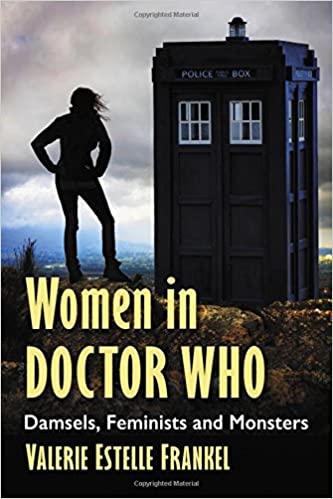
Valerie Estelle Frankel. Women in Doctor Who: Damsels, Feminists and Monsters. McFarland, 2018. Paperback. 253 pp. $29.95. ISBN 9781476672229.

Valerie Estelle Frankel. The Women of Orphan Black: Faces of the Feminist Spectrum. McFarland, 2018. Paperback. 226 pp. $39.95. ISBN 9781476674124.


A quick Google search of Valerie Estelle Frankel paints a clear portrait of a prolific, detail-oriented independent scholar who has found her niche: pop-feminist analyses of pulp genres and cult science fiction and fantasy favorites—Doctor Who and Orphan Black, but also Outlander, Game of Thrones, Harry Potter, Hunger Games, True Blood, Wonder Woman. The list goes on. It’s clear that Frankel is a pop culture super-fan, which equips her with the enthusiasm, if not the academic bandwidth, to produce the meticulous compendia of observations that comprise the two volumes reviewed here. 

The Women of Doctor Who is a timely addition to critical work on the long-running series given that the 2018 season brings viewers a female doctor for the first time, played by actor Jodie Whittaker. Frankel’s review of human and non-human female characters in the series and its spin-offs (The Sarah Jane Adventures, Torchwood, Class, K9) is exhaustive, arranging Doctor Who’s treatment of women into broad categories: sweet girls, experts, bad ladies, tough girls, and outsiders. From there, Frankel further identifies female characters in the series by their established archetypes: sexy damsel, evil ice queen, trickster-seductress, and so on. While this convenient conceptual schema works well for a quick reference guide, it is less conducive to a deeper exploration of the critical issues surrounding gender, race, species or their intersections, including analysis of the recent trend to gender- and race-flip established characters and the implications, good or bad, of this particular cultural zeitgeist.

 Frankel’s encyclopedic approach works well to highlight the ways that, despite attempts to explore future and alternative worlds, female characters in the series remain firmly fixed as products of twentieth and twenty-first century attitudes that limit the depth and range of the roles women are expected to inhabit. Frankel offers an account of the evolution of women’s roles, from pubescent damsels like Susan in the first seasons, to more “competent” (read: contrary) women in the series’ reboot— e.g. Donna Noble and River Song. This trajectory is both fascinating as it charts the shifting history of feminism’s impact on popular culture, and distressing as you come to realize how little has changed in the past six decades, and how, as Frankel observes, these women remain “trapped within the patterns of their archetypes” (3). One consistently defining characteristic of the Doctor’s companions, Frankel points out, is their collective obligation to serve as his moral compass, to provide, in today’s parlance, invisible emotional labor. While his companions exist to nurture privately the Doctor’s better angel and steer him away from more destructive impulses, he remains free to play the public hero. This narrative through line is brought into starkest relief during the “War Doctor” arc when Billie Piper returns as both the specter of Rose Tyler and as “Bad Wolf,” a sentient weapon of mass destruction that, nonetheless, has a heart (Frankel, Doctor Who 167-168). 

In The Women of Orphan Black, Frankel organizes her analysis of the show around two intersecting histories: the evolution of feminism from first to fourth wave and how this history has been shaped by emerging bioethical issues, especially as they relate to the biopolitical battle over control of women’s bodies. Rich with excerpts and insights from the show’s creators, actors, and consultants, including the fascinating science advisor, Cosima Herter, on whom Cosima the clone is based, Frankel explores how the series deliberately engages in contemporary debates over reproductive rights, bodily autonomy, tensions between science and religion, gender, and globalization. Cleverly, Frankel shows how each female character in the series embodies various feminist waves, from the radical seventies feminism of Mrs. S, to Cosima as second wave feminist-lesbian, to Sarah as radical, “punk” feminist, to Mika/M.K., the elusive cyber-feminist whose hacktivism brings viewers’ attention to issues of disability, virtuality, and neurodiversity (M.K. is portrayed as being on the autism spectrum). Perhaps the most useful part of Frankel’s close look at Orphan Black is her exhaustive catalog of the series’ numerous “easter eggs,” from the literary references in each episode’s title to the allusions embedded in the show’s narrative. Frankel carefully teases to the surface allusions to Charles Darwin, Isaac Newton, Francis Bacon, William Wordsworth, Aldous Huxley, Arthur Conan Doyle, Richard Dawkins, and Donna Haraway, among others, demonstrating how the show’s fast-paced adventure narrative is smartly informed by philosophical, scientific, and literary histories.

The strength of Frankel’s contributions to discussions of Doctor Who and Orphan Black is more curatorial or archival, and one can imagine that this kind of work would make for good starting points to stoke the interests of high school students, undergraduates, or science fiction fans looking to enter mainstream conversations about representations of women and bioethics.

Review of Ahmed’s RoboCop


Review of RoboCop by Omar Ahmed

Dominick Grace

Omar Ahmed. RoboCop. Auteur, 2018. Constellations Studies in Science Fiction Film and TV. Paperback. 117 pp. $15. ISBN 9781911325253.


It is disappointing, though no longer surprising, to see an academic book so riddled with compositional errors and infelicities as this one is make it into print. One can find writing problems—sometimes more than one—on many pages in this book. These range from the relatively minor (e.g. recurrent problems with punctuation, or inconsistent italicizing of titles—especially problematic when the main character and the movie have the same name) up to sentence-level issues. On page 25, for instance, a sentence says the opposite of what it evidently means: “A departure from the whiteness of the American Western is reversed by the presence of a black sergeant”; presumably, the black sergeant’s presence reverses the whiteness of the Western, so a departure from that reversal would in fact restore said whiteness. On the following page, we read, “By having Reed refuse the advances of the lawyer signifies both his authority as an honest blue-collar lawman and establishes the power he exercises over the precinct” (26). Such sentences suggest, at best, inept revision, but the problems seem more basic and extensive than that. For instance, a sentence such as “[Outland] reworked Alien’s theme of the merciless corporation with a deceptively savage rapt” (49) is simply incomprehensible (unless “rapt” as a noun has some specialized meaning that escapes me—and the dictionary). Incorrect or eccentric word choices are especially problematic; for instance, we read of an “apocryphal clash” (93) between Boddicker and RoboCop, when, presumably, “apocalyptic” might be the intended word, but if so, it’s not really an appropriate word in that context, either. That such extensive and basic slips, whether merely accidental or the result of poor writing, survived the editing and proofing process is disheartening. Nor do such problems encourage one’s faith in the content; if writing problems are so pervasive, can we rely on what the book is actually saying to be accurate? A professionally-published book should not be this riddled with basic errors.

Such problems are especially unfortunate, as a short (under 100 pages of actual text), basic reader such as this could be a useful and inexpensive tool for undergraduate students. The frequently casual and subjective tone of this book suggests that its target audience is the general reader or student rather than the more seasoned academic, though Ahmed certainly shows that he has done his research. Despite its brevity, the book does show a good range of scholarly influences and cites reasonably extensively from earlier work on RoboCop. Unfortunately, though, the book lacks an index, so tracking how Ahmed uses his sources (and even where in the book key scenes or characters are discussed) is a bit of a challenge.

The book is divided into four chapters, plus an introduction and afterword. The first chapter focuses on “Genre Mutations,” and explores the generic hybridity of the film. Its main focus is the ways in which RoboCop plays on the tropes of the Western, though other genres, such as horror, noir, and the cyborg film, are also considered. RoboCop’s echoes of the Western have been explored before, but Ahmed’s reading provides some additional insights. His comments on race, for instance, are of value, though the blackness of corporate drone Johnson is oddly ignored.

The second chapter, “Neo-fascist Corporate Bodies,” addresses the film’s politics, especially its ambivalent treatment of RoboCop’s relationship with OCP. The focus here is perhaps a bit fuzzy—more on ambivalence than on constructing a reading—but again, Ahmed has some interesting things to say, albeit arguably more for those less familiar with the critical tradition. Chapter three, “American Jesus,” is potentially the most interesting but also the least successful, as it does not have a sufficiently sharp focus on the film itself.

The final chapter, on “The Legacy of RoboCop,” offers a brief account of how the film was initially reviewed (more positively in England than in North America), how it was marketed and franchised, and how it might be seen in relation to some of Verhoeven’s later films, notably his other SF films: Total Recall (1990), Starship Troopers (1997)—which together with RoboCop tend to be viewed as a loose SF trilogy, the former of which is overrated and the latter of which is underrated, according to Ahmed—and The Hollow Man (2000), Verhoeven’s final SF, and final Hollywood, movie. The shortness of each chapter does not allow for close or detailed reading, so generally the book offers limited insights. All the books in this series are similarly brief, so Ahmed cannot be faulted for the limitations the brevity imposes, but nevertheless, the book is unable to offer much depth or detail.

Overall, the book would work best as a basic introduction to the film for undergraduates, if not for the extensive writing problems. Those already steeped in the critical tradition surrounding the film, or SF film generally, may find occasional insights and useful rehearsals of the film’s key elements, notably its satirical and subversive agenda, but will not find much new. However, I cannot advise assigning this book for students, either, given its extensive compositional problems. Overall, then, this is not a book I can recommend, for either the advanced or the beginning scholar.

Review of Tarr and White’s Posthumanism in Young Adult Fiction: Finding Humanity in a Posthuman World


Review of Posthumanism in Young Adult Fiction: Finding Humanity in a Posthuman World edited by Anita Tarr and Donna R. White

Anelise Farris

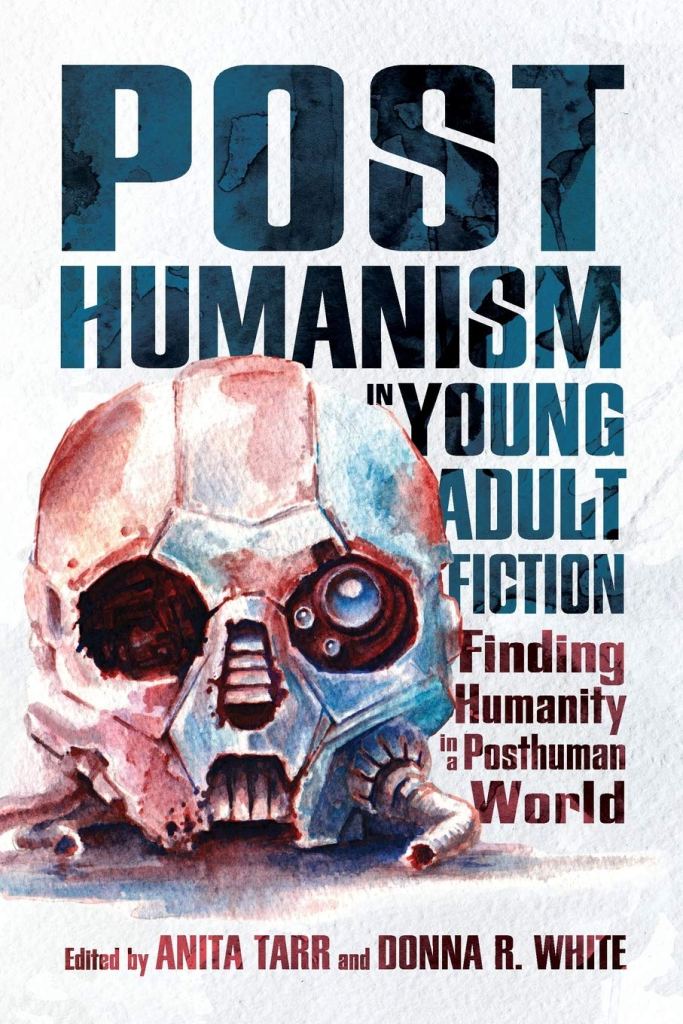
Anita Tarr and Donna R. White, editors. Posthumanism in Young Adult Fiction: Finding Humanity in a Posthuman World. University Press of Mississippi, 2018. Hardcover. 290 pp. $70. ISBN 9781496816696.


Since the 19th century, liberal humanist thought has encouraged the view that the ideal human being is unified, authoritative, and entirely autonomous (and generally male, white, and heterosexual). Not only does this favor a certain type of individual, but it also promulgates speciesism and fails to account for the ways in which our bodies interact with other forms of matter and different environments. Posthumanism, in contrast to traditional humanism, approaches the human as a hybrid, boundless subject. Through this lens, scholars critically examine the relationship between human beings and their environment, technology, and other species. 

In Posthumanism in Young Adult Fiction: Finding Humanity in a Posthuman World, editors Anita Tarr and Donna R. White have compiled twelve essays that emphasize the unique applicability of posthumanist thought to the study of young adult literature, where issues related to the changing body are paramount. Following a comprehensive yet concise introduction in which Tarr and White define the many forms of posthumanism, the collection is divided into four parts. Part one, “Networked Subjectivities,” includes two chapters that theorize a posthuman understanding of subjectivity—one that moves away from the singular self to an ethical understanding of one’s plurality. Mathieu Donner, in his reading of Octavia E. Butler’s Mind of My Mind (1977), questions the possibility of achieving unity without sameness, and Shannon Hervey reflects on social media as a type of collaborative, networked self-writing.

“The Monstrous Other: Posthuman Bodies,” the second part of the collection, contains five chapters that deal with adolescent bodies that are transformed either through magic or medicine. Several of the chapters look at material embodiment in Marissa Meyer’s Cinder (2012) and Julianna Baggott’s Pure (2012), while others look at Leigh Bardugo’s Grisha trilogy (2012-present), Michael Grant’s Gone series (2008-present), and works by Nancy Farmer. A unifying concern among the chapters in this section is how to manage the dangers inherent in an increasingly technologized society. Part three, “Posthumanism in Climate Fiction,” collects Lars Schmeink’s “Coming of Age and the Other: Critical Posthumanism in Paolo Bacigalupi’s Ship Breaker and the Drowned Cities” and Phoebe Chen’s chapter “Posthuman Potential and Ecological Limit in Future Worlds.” Both of these chapters are concerned with posthumanism as a political movement with a zoe-centric worldview and agenda. The final part, “Accepting/Rejecting Posthumanist Possibilities,” features three chapters that cover both film and literature: Ridley Scott’s Prometheus (2012), Lev Grossman’s The Magicians (2009), and novels by China Miéville. 

As evidenced here, the collection as a whole provides interdisciplinary insight into a significant number of understudied young adult texts. Posthumanist theory is dense and complex, and this collection offers an accessible and beginner-friendly introduction to the discipline. From defining key terms and the different branches of posthumanist thought to drawing attention to key scholars in the field—such as Pramod K. Nayar, N. Katherine Hayles, and Cary Wolfe—the introduction does an excellent job of preparing readers for the chapters included here. That said, for scholars familiar with posthumanism, the theses and general observations made by the authors are in danger of coming across as obvious or derivative. 

Many of the chapters included here still find themselves asking, in a very basic manner, what it means to be human, to be posthuman. Consequently, the authors speak to the same theories and conversations that have been in circulation for the past few decades, without providing us with new readings, just merely old readings of new texts. One of the more novel points the collection posits is that posthumanism must incorporate liberal humanism into its being, “as part of the assemblage” (White 153). What this necessitates, however, remains unresolved.

There are several other problematic aspects of Tarr and White’s collection, the first being that there is a sustained attention to technology as disturbing and negative. Although posthuman bodies are nothing new, the proliferation of technology and climate change has forced us to acknowledge posthumanist concerns with greater urgency. Yet, for some reason, this reality—as presented in this collection—is regularly regarded with distrust and fear. A lone voice among the host of scholars here, Lars Schmeink, rightly urges readers to recognize the “possibility of utopian hope in the face of dystopian systems” (177). 

The second major concern involves the application of the label young adult to texts that do not necessarily fall into that category: Ridley Scott’s Prometheus and Lev Grossman’s The Magicians. Torsten Caeners, in his chapter on Prometheus, spends only one sentence defending the inclusion of this text in a YA collection. Caeners holds that it is young adult fiction because “it focuses on one of the major themes of young adult fiction . . . finding one’s identity” and is “readily available to all audiences” (199). Not only does this present a simplistic understanding of YA literature, but it also broadens the category to such an extent that nearly any text can be read as young adult. Meanwhile, Tony M. Vinci, in his reading of The Magicians, offers no reason whatsoever for reading Grossman’s series as young adult. It is, and always has been, marketed as an adult series, and to include it here merely because it’s a magic school story suggests, once again, ignorance of what young adult literature entails. 

It is difficult to recommend the collection Posthumanism in Young Adult Fiction: Finding Humanity in a Posthuman World, especially at the price point. For individuals unfamiliar with posthumanist theory, the introduction is valuable, and the third part on climate fiction provides the best example of the positive potential of posthumanist thought. However, for a handful of essays, the collection, for individual purchase, is passable. It would be best suited for university libraries, as individuals can pick and choose what to take from the collection. While recognizing the possible dangers that technology can bring, we in the (post)humanities must begin to move forward and cultivate a positive, hybrid understanding of embodiment—something that, unfortunately, this collection illustrates is not likely to happen any time soon.