From the Vice President


SFRA Review, vol. 51, no. 3

From the SFRA Executive Committee


From the Vice President

Sonja Fritzsche
Michigan State University


Our first virtual conference was a success and attracted a greater number of participants than usual including more international representation!! Many thanks to the virtual conference host Graham Murphy and his institution Seneca College in Toronto, Canada!! Thank you too to Keren Omry who put the program together as well as Gerry Canavan, Sean Guynes, Hugh O’Connell who helped to run the conference and Carma Spence for the program art. The keynote speakers, many high-quality presentations, discussions, and hang-outs prompted by the conference theme—“The Future As/In Inequality”—made it especially memorable. Thank you to everyone who patiently navigated the technology as the conference progressed. Congratulations to all of the winners of the 2020 and the 2021 Awards!! We were finally able to congratulate both years. We especially want to thank the guests and participants who engaged with intentionality and candor in the special events surrounding race, bias, equity, and belonging both in the organization and in the broader academy. The Executive Committee has already engaged in meetings to follow-up on some of the resulting ideas from these sessions. More information will be forthcoming soon.  The next conference in summer 2022 will be hosted by Bodhisattva Chattopadhyay of the Blindern Campus at the University of Oslo in Oslo, Norway. This will most likely also be a virtual conference given the continued challenges across the globe as a result of the pandemic. It should be a very compelling event, so look for more information as it comes available.

The SFRA Country Representatives have met twice this year and are planning the next virtual meeting in early September. This initiative was organized in an effort to encourage support for the study of science fiction globally and also to help these scholars network with each other. Responsibilities include acting as an informational liaison between the SFRA and the country’s science fiction scholarly community through the promotion of events, new membership outreach, and otherwise helping to connect in the spirit of international communication and collaboration. It is possible for a country to have more than one liaison. All country representatives must be current members of the SFRA. If you would like to contact your representative with ideas or for more information, you can find their name on the website at http://www.sfra.org/Country-Reps. They represent seventeen different countries. Country reps are also contributing to each issue of the SFRA News, so look for that essay in these pages. If you are interested in being a country representative, you can contact me at fritzsc9@msu.edu.

Please also continue to pass on your announcements and any cfps that you would like to have posted on the SFRA Facebook or Twitter pages.

From the President


SFRA Review, vol. 51, no. 3

From the SFRA Executive Committee


From the President

Gerry Canavan
Marquette University


Thank you, thank you, thank you for a successful and stimulating SFRA21! It was an amazing conference, technical snafus and all, and it made me tremendously grateful to be a part of this community. People attending the business meeting and the banquet have heard my thanks already, possibly twice, but I wanted to extend one more round of appreciation to Graham Murphy for organizing such a terrific event; to Keren Omry for working such magic with the schedule; to everyone on the executive committee who pitched in in so many ways; to Carma Spence for her help with the website and design work; to the three amazing keynotes for their stellar presentations; to Aisha Matthews for her generous help both public-facing and behind-the scenes; to Lisa Yaszek, De Witt Kilgore, Isiah Lavender, and Taryne Taylor for the bracing and honest bias and belonging roundtable; to the panelists on the and to Ida Yoshinaga, Ali Sperling, and Bernie Mendoza for the terrific job workshop. I also wanted to extend some personal thanks to Lisa Yaszek, Isiah Lavender, Ida Yoshinaga, Sonja Fritszsche, Taryne Taylor, Sherryl Vint, and Bodhi Chattopadhyay, among others, for their counsel and good advice.

One of the things we’ve learned from this strange year is that some of the structures that govern SFRA are no longer working as well as we’d like them to, especially with regard to representation of its many different stakeholder groups. Following up on our robust conversation at the business meeting, we are exploring some possible changes to the composition of the executive committee that we hope to speak with the membership more about soon. Some of these changes will be customary; others of them would potentially require a vote of the membership to alter the bylaws. But we will have a robust comment period before we do anything; we certainly want anything that happens to reflect the will of the entire group. Our goal is to promote an SFRA that better represents the diversity of its membership, in every sense.

In the meantime, thanks to all those who have stepped up to serve on the awards committees, and to those who will be standing for election to the executive board this fall. We are still looking for help with design work for the new plaques and trophies; if you have experience with this sort of 3D design, or know someone who does, please, reach out to me! We are also still looking for a US-based host for the 2023 conference; if you think your institution might be a good fit for an in-person conference, and think you have the capacity to work with the group to plan one, please, let me know! Thanks again to all those whose labor and generosity help make SFRA work.

Call for Submissions: Fiction


SFRA Review, vol. 51, no. 4

Fiction


Call for Submissions: Fiction

The Editorial Collective


The SFRA Review welcomes well-written and carefully edited pieces of short fiction that conform to the following guidelines:

  • Submissions (stories, poetry, drama, etc.) should be no more than 4000 words.
  • Submissions must be original works that have not been previously published; if, for example, a submission has been previously posted on a blog or similar medium, please include a note explaining when and where.
  • Submissions should be clearly recognizable as SFF.
  • Submissions should not be thinly disguised social or political rants.
  • Submissions should be clearly germane to the issue’s topic.
  • Submit Microsoft Word .docx files only. If you are unable to access Word, please use Google Docs.
  • All files must include a brief (100 words or fewer) bio of the author and proper contact information; however, stories can be published under a pseudonym.
  • All stories must be sent as attachments to sfrarev@gmail.com with the subject “Fiction Submission: Autumn 2021”.

Stories will be read and edited by at least two members of the collective. We will be much more likely to reject submissions out of hand than to request revision, though we may do the latter.

The Autumn issue does not have a particular topic, so feel free to submit stories on whatever topic you desire.

Subsequent issues will have different topics which will be revealed in the issues immediately preceding them.


Even If They Leave


Even If They Leave

Lyuben Dilov
Translated by Andy Erbschloe
Edited by Joshua Derke


This story originally appeared in the collection Double Star (1979). It was also published in “Trakia Alamana” in 1978, under the title “Endless Night of Questioning”.

1

Dr. Zentano was undressing when the gong on the front door struck. He looked at his watch—at this hour and without a telephoned notice? He put on his robe, took the pistol from the nightstand drawer, released its safety, and went out into the hallway barefoot. He strode along the wall, careful not to touch it. He stood to the side of the door and slowly opened the peephole, but he couldn’t look through it without exposing his chest. It was an ordinary door, not armored like most of the housing in the palace. They had laughed at him when he once suggested that they put an armored door on his as well. Who would shoot the doctors?

After sensing no noise from outside for a long time, he gained the courage to look. And he unlocked the latches.

“Did I wake you?” Dr. Strauss said. “Pardon me!”

“I was in the bathroom,” Zentano lied. The midnight guest walked straight into the open bedroom.

“Get dressed, they’ll call you. I wanted to exchange a word or two before you get there.”

Zentano cursed softly but immediately took off his robe and grabbed the top shirt off the back of the chair. Dr. Strauss looked uneasily at the bachelor chaos in the bedroom.

“Talk, talk! I was thinking it over a while ago,” Zentano whispered, buttoning the opal buttons on his cuffs.

“Something disturbing is happening. In the course of an hour, I was summoned by three: Melis, Biko, and finally the boss. The generals, as usual, lied. They didn’t tell me exactly what was wrong with them. They were gripped by a fever and they couldn’t sleep, although they obviously hadn’t been to bed at all. They had the feeling that someone was standing next to them, that something was questioning them. I gave them a sedative…”

“Is it their first time?” Zentano interjected contemptuously.

Melis was the adjutant general, and Biko the chief of security. It was normal that they would face such moments since even he, the psychiatrist, couldn’t withstand the fears that were filling the presidential palace; not a palace, but a fortress packed with weapons and fears, as if under a state of siege.

“The boss was more candid, but he wants you to examine him too.”

“What’s with him?” Zentano groaned, leaning over his shoes.

Despite Zentano’s assurances that he had inspected the room for wiretapping devices, the president’s personal physician did not switch to the vocabulary they used in their rare meetings outside the palace. The two were forced to have their own plot against the dictator so they could survive when he fell, because few are those dictators who don’t fall in the end! Once they had both believed in his ideas, and they became members of his party which he himself later disbanded so as not to hinder him in governing the country. Then they regretted it, but it was too late. A personal physician could not resign with impunity to return to private practice. If Zentano, the psychiatrist, in particular, left the palace before his boss, it would be in a “lethal condition,” as they said in their parlance. And it would be caused most cruelly by General Biko’s thugs. In this situation, willingly or not, you become a conspirator.

“Auditory hallucinations of a rather strange type,” Dr. Strauss said. An internist and cardiologist with a rich medical culture, he possessed all the qualities of a luminary in medicine, but he was also nailed to a single patient, like the ancient rowing slaves to their galley. “Some being from another civilization had been interrogating him, asking him awkward questions, and so on.”

Dr. Zentano thought: “The beginning of the end!” Then he thought: “Although, a beginning like this can last monstrously long…” and his smile disappeared.

“Examine him, and let’s think about therapy together tomorrow,” Strauss added.

The psychiatrist understood his insistent gaze. The two had long since realized that they had the power to speed things up in their country, but they were still afraid to use it. They were not sufficiently acquainted with those forces that would claim the inheritance in the palace, and they did not have the necessary connections.

“Will he call me, or what?”

“Go! I told him that if he doesn’t need us tomorrow, we’ll go around eleven o’clock for some new medicines, to accept them personally.”

Zentano approved of his foresight. That exact message was the reason why Dr. Strauss hadn’t called him on the phone—so that Biko’s people wouldn’t hear it.

“Did you tell him about Melis and Biko?”

Strauss smiled for the first time. “Of course not. Why bother him?!” And he asked suddenly with the same insistent look as before, “Did you give them..?”

Zentano waved his index finger in the negative in front of his nose. Such an option had already been discussed. It would be more than foolish to intensify their madness with medication. In that state the three of them would become even more ferocious.

“Go now!” Strauss repeated.

The psychiatrist reengaged the safety on the pistol before putting it in the special holster under his jacket; he was entitled to a weapon. Then he picked up his bag which stood in constant readiness on the nightstand. In the corridor the two parted with only a wave of the hand.

At the door of the presidential apartment, two of Biko’s gorillas with automatic machine guns around their necks stood up sleepily in front of him. Zentano opened his jacket so they could take his pistol. One lazily felt the doctor’s body while the other peered into the medical bag. The other two, forewarned of his arrival, were stretched out in armchairs in the vestibule of the bedroom and they didn’t pay him any attention. Zentano looked at them, trying to remember their faces. Biko was constantly changing the duty assignments in the palace. Zentano took a breath, softened his facial muscles; it was time to be just a doctor.

The president laid the newspaper beside the whiskey bottle. He wasn’t sitting in the huge bed—an imperial style—but in the corner where he received his intimate guests.

The psychiatrist greeted him with restrained dignity. He said, “You shouldn’t have been drinking before I examine you, Mr. President.”

“I don’t think I need you anymore. This is more reassuring,” the president responded, slapping the paper with his palm and shifting in his operetta sleek pajamas. His entire bedroom was jammed with the same sleek splendor. “All everyone writes about is how much the people love their president, how loyal they are to him, and how happy they are under his government.”

Zentano lowered his head, and pulled the stethoscope out of his bag.

“You don’t have any complaints, do you?”

“I’m not interested in politics at the moment, Mr. President.”

“You’re cunning, you devil! I can’t understand why I trust you so much, even though the generals have been driving me to remove you for a while now.”

“Maybe that’s why,” the doctor allowed himself a smile. “Surely, the one who replaces me would no longer be only yours.”

“They must be pulling your soul out to make you talk about me, huh?”

“They’ve never allowed themselves anything reprehensible, Mr. President. I can assure you that they are just as loyal to you as I am. But again, I ask you not to distract me now. A psychiatrist doesn’t listen to noises in the abdomen and chest, but…”

“Is there anything in my mind but politics?” laughed the head of state. “Then what are you getting these headphones for? Strauss already examined me and measured my blood pressure. It’s normal.”

“I need to form my own picture of your general condition at the moment.”

“Forget about that! Sit down and talk! A whiskey?”

Zentano sat across from him but flatly refused the drink. “So, what are we complaining about? Wait with the whiskey, please! After the examination!” “Nothing. Nothing’s wrong. But I was just sitting there with nothing wrong, and I suddenly went crazy…” the president said and vigorously shimmied his small body. Apparently, he had already gotten over his fears. “A voice greeted me politely and asked if it could ask me some questions. It described itself as a being from another civilization. It wasn’t possible for it to show itself to me because…I don’t remember what its reasons were, but it assured me of its peaceful intentions…”

“Is this the first time?” the doctor interrupted.

“The first. Just a while ago. So, I talked with it. Then I told it to go to hell.”

“What questions did it ask you?”

“You can’t imagine all the naive and stupid questions! And they’re supposed to be another civilization. It was like it was testing a fifth grader in civics. The social structure of humans, how governance is conducted, how and why I was chosen to govern this nation…”

Dr. Zentano nodded amiably, but from under his half-closed eyelids, he was looking with a sort of distracted calculation at the withered face.

“And what did you say?”

“I told it to go find Machiavelli and read it. Things haven’t changed much.”

“And how did you tell it to go to hell?”

“I told it to get out of my head. And that everything it was asking me about is in books, that there’s a whole heap of professors of legal sciences, interrogate them.”

“Didn’t it ask more intimate questions?”

The president was engrossed in his own memory, his hands waving impulsively.

“After I told it all that, it wanted to ask me some personal questions, how we develop ourselves, humans, and something else I don’t remember, but I told it to go see my wife if it wanted to know something intimate about me.” The president laughed excitedly and added with even greater pleasure, “Although, between us, Doctor, she’s already forgotten my intimacies.”

Zentano didn’t react to the joke. He was already sufficiently immersed in the private life of this small person, who was constantly trying to demonstrate his self-confidence to as many women as possible, since it wasn’t enough to do it before the entire nation.

“So what, the voice is gone, is it?”

“It apologized for the inconvenience and left. It was very kind.”

“So it left right away, you say?” The doctor emphasized his distrust. A hallucination doesn’t leave just from a command, not even a presidential one.

“If it hadn’t asked such idiotic questions, I would have kept it talking. It’s interesting to talk to invisible people, isn’t it?”

His fingers, however, contrary to his words, were drumming something in morse on the glossy tabletop—an antique item, also from someone’s boudoirs.

“And you sensed a presence?”

“Of course. But not in a specific place. There was something there and then it disappeared.”

“After the whiskey?”

“I suppose so,” the head of state admitted, and a shiver ran across his oversized pajamas, like the shiny surface of a lake blown by a low wind. “But I hadn’t been drinking before that.”

The psychiatrist got up, though he had no desire to hear the intimate confessions of this ferocious fellow who regularly unburdened his mind before him in psychoanalytic sessions. The president insisted on them like he did his daily massage, his sports workouts, and the always encouraging predictions of his court fortune teller, because he insisted on ruling over the tormented country for at least another three or four decades.

“Lie down, Mr. President. I have repeatedly permitted myself to advise you and your wife to stop these spiritualistic sessions, to banish your favorite astrologers and fortune tellers…”

“I don’t need to lie down,” the president said in defense of the mysticism that inevitably conquers such people and regimes. “If you know more than they do, tell me now what it is!”

“It is my duty to examine you.”

“And you’ll say it’s nerves, I know that myself. First, tell me what you think!”

Dr. Zentano sat across from him again, smiling professionally.

“There’s nothing to worry about, of course.”

“Of course,” the president mocked him, jumping out of his armchair and stamping the carpet barefoot. “At least, don’t start with the de jour reassurances! It’s alarming!”

The doctor patiently studied the president’s yellowish legs kicking the embroidered oriental slippers away before they stood, then he startled him with a loud and sharp command, “Sit down and put on your slippers!”

The president abruptly interrupted his walk, stared into Zentano’s eyes in surprise, couldn’t stand their hypnotic power, and obediently returned to the couch. He softened, almost collapsing in his pajamas which were all wrinkled. The doctor grabbed his wrist; it was unnecessary, but measuring the pulse calms the patient and gives the doctor time to dig through their knowledge, or if not, to compose it. What to tell him? Auditory hallucinations are associated with very specific diseases from which the president did not suffer. The easiest thing, really, would be to turn him into a writhing worm, like he had on other occasions, with two or three sentences and the even, glassy shimmer of his green eyes. From time to time, the dictator needed to become a remorseful child in front of his doctor who would wash his guilt away after the mischief had been done. Zentano didn’t want to give him any relief tonight, but the president would still insist on an explanation. What to tell him? A psychiatrist is obliged to be able to explain to the patient what they themself do not know, like the coffee reader who sees all in the tiny black mud at the bottom of the cup.

“Mr. President,” he said cautiously, “You’re right. It’s troubling. It really is troubling! But it is only the onset of something that could be easily overcome, as long as it is well understood. This is a natural crisis for men our age,” Zentano delicately grouped himself in, although he was ten years younger. “Don’t take offense, Mr. President, but you and I are already beyond the ascent of life, on its opposite slope. There, the rhythm changes abruptly, and this leads to all sorts of jolts. Let me make it clearer for you: picture it as a hill. We make our way up, happy and out of breath, and we hurry to reach the top and our entire organism is subordinate to the struggle to propel itself towards its goal. It usually doesn’t turn out how we imagined or wanted, but that’s not even the main trouble. Lulled by it, we miss the top without realizing it…” A rather questionable illustration, the psychiatrist told himself, but he had already said it, and everything said must be explained further.

“And so… you see, Excellency, lulled, we fail to stop at the peak, to rest, to look around, to consciously digest what’s been accomplished, to prepare for the bitterness of the future. Instead, we keep the same pace, without rest, continuing on without transition, until one day, shaken up, we realize that we are now going down, not up. And going down is different. There our struggle is not to climb to the end but to hold the momentum of the rush, like shifting gears going downhill so the clutch can hold the car, to serve as a brake. But as I was saying, we are unprepared because no one can teach us  how to make our way across the hill, and we find ourselves surprised and realize with horror that we are no longer in command of our own labors or our own time, that the time ahead of us sucks us in like an abyss, and with ever-growing speed, but down there, Mr. President…” Zentano made a pause, in which he skillfully played the dramatics of the doctor who feels obliged to tell the whole truth to his patient. “Down there, Excellency, at the foot of the slope lies another goal, not our goal, not the one from before. Down there we can see, from afar, our open grave.”

“Hey,” the shiny man snapped. “Is that what you came to talk to me about? Death?”

Zentano squeezed his wrist tightly, calming him with a look.

“I’m answering you, Mr. President, as you should start answering yourself. Otherwise, the questions you heard from that voice will cease to be naive. Besides, they weren’t as naive as you thought. These are all existential questions and they’re frightening precisely because of their apparent naivete. You’ve missed your time for asking them, and now, on the opposite slope, it’s quite natural for someone else to ask them. They’re being asked by the other, which has been dormant inside us all along, while we were deluding ourselves that we knew what we were after, what we were striving for, while we were ascending to the supposedly consciously chosen goal, unlike that one goal we have now, that offends our pride, that makes us equal to everyone else, that we can neither abandon nor circumvent.”

“Enough, I told you,” the president shouted, pulling his arm away from Zentano’s. “I know we’re all going to die. Tell me something concrete! I don’t have time to ask myself stupid questions. Who will govern this country if I sit down now to ask myself how I’m organized and what I live for?”

“I haven’t recommended anything yet,” Dr. Zentano said soberly, and he internally mobilized because his patient wasn’t stupid. “I’m just explaining to you the intimate conditions of advanced age. Freud says: ‘We all know that we will die, but we do not believe it in our subconscious.’ I would add: The subconscious is the animal inside us, so it does not believe; the animal doesn’t know what death is, but it sometimes anticipates it. However, our subconscious is not as dumb as the animal, when it’s scared, it can ask questions…”

“Eh, I’m only fifty-three!” the president said indignantly.

“Exactly! I would say that’s the end point of the crisis. Later, you will stop questioning yourself, reconciliation will come. And you surely wouldn’t be hearing that voice now if you lived someplace else. You’re surging with too much energy to fit in this tiny country where you climbed all the peaks too soon, Mr. President. If you had been born in a powerful and wealthy country, you might have started a war, and you’d still be questing for domination over the continent, over the world. You would aim for the great goal until the end. The larger nations are the active ones; those like us, tiny and poor, are doomed to question themselves and tremble for their own survival.”

The compliment on the excessive energy did its job but prevented the president from catching the hint about trembling and asking questions. He shouted almost enthusiastically, “Smart you are, you devil! That’s it. I just have nowhere to go in this damned country!”

Zentano smiled. His patient called it “my blessed mother” in front of the microphones with the same passion.

“What would you recommend?”

“Stand up so I can examine you!” the doctor ordered again sharply, remorseful for his compliment and for all his dubious scientific nonsense. “Remove your clothes!”

Perhaps out of gratitude, perhaps in anticipation that the exam would immediately tell him where to direct his energy, the president readily took off his pajamas.

“Kneel on the couch, back towards me!”

“Are you going to torture me again?” murmured the little man, who made an entire nation tremble.

“Yes, again,” Dr. Zentano said relentlessly, taking a long, shiny nail out of his pocket. “I need to check the flow of nerve currents.”

In this case, both his answer and the procedure were pointless. A nail or similar spike was used by neurologists to check for skin reactions, but the nerves of the president, who maintained himself with well thought-out diets and a love of sports, were overly strong for his age. But Zentano found in it the possibility for his one small revenge. This nail, which his former neurology professor had jokingly presented to his students as the neurologists’ second major tool (“We’re worse than carpenters, they have a bunch of other tools and we only have a hammer and a nail!”), had come back to his memory when, a few years prior, he’d had to evaluate his colleague from the presidential prison.

The doctor who worked at the prison, where prominent political opponents were held, had asked to be released for health reasons. The president gave Zentano and Strauss the final decision, and they both found their colleague to be an irreparable wreck. The man who had witnessed the monstrous inquisitions in the presidential prison had for years intoxicated his conscience, not only with alcohol but with some of the opiates used to forcibly drive the prisoners insane or to end the agony of their broken bodies. They recommended him for retirement due to illness, and thus unknowingly signed his death sentence. They hadn’t considered that neither the president nor General Biko would leave such a stray witness alive. It was then that Dr. Zentano truly realized that the same thing awaited him as soon as he lost the trust of the dictator.

The same pathetic man who was on the couch now nearly naked, kneeling in front of his own portrait hanging on the wall. Like in front of an icon. The psychiatrist looked in disgust at the fat folds on his back and thighs, the protruding knobs on his shoulders, and the sagging leather pouch on his abdomen. And he slowly poked the nail under his ear, drawing a line all the way down his neck to the end of the shoulder blade. The president groaned and shook.

“Calm down!” Zentano continued to order, but he scratched the president’s thigh with even more pressure, so he jumped.

The lines bled instantly, like a scratch from cat claws.

“All right. Very good! I envy you, Excellency!”

Under the guise of praise, the nail drew more and more ferocious scratches on his back, on his emaciated thighs, on his thin calves, and on his tender, yellow feet. The pain was most intense there, and Zentano repeated it several times. The president was shaking on the couch springs, squealing, howling, but he endured. Zentano stood up abruptly. Unexpectedly, for the first time, he wondered if his high-ranking patient was voluntarily allowing himself to be tortured, wanting to empathize with the torments he had inflicted on his opponents in the basement of the palace, if it gave him the pleasure of the masochist. He wanted to drive the nail somewhere with all his strength, the most effective place would be into that hole between the skull and the neck, but he just threw it in the bag.

“Just as I thought, Mr. President. The voice has nothing to do with your nerves. It’s only that inexhaustible raging energy which doesn’t see itself being utilized enough. Maybe a trip, a romance; but excuse me, a true romance, falling in love, I mean, with a woman, whom you’ve chosen yourself…”

The president laughed briefly, slipping back into his shiny pajamas with visible satisfaction.

“Where would I get such a love, brother? Should I go to the discos to look for a girl? The president is the least free man in this country. But if you come across one that you think I can fall in love with, feel free to bring her here! You know me better than Biko, who brings me all these whores according to his own vulgar taste. And they’re his agents, of course. I don’t even need them, you know, I just enjoy checking on his spies without telling them a word.”

“Unfortunately, the president’s doctor is just as free,” Zentano responded restrainedly. Educated in grace and attention to humanity, he took as a personal insult the vulgar jargon with which the dictator sometimes tried to show himself as democratic, close to the people. And every time, Zentano wondered how it was possible and why this life should allow itself to be saddled by such nothingness.

“Excellency, have another glass of whiskey and go to bed! You don’t need anything else for now. And I’ll think about how, together, we can shut up the mouth whose voice we’re uncomfortable listening to. Allow me to leave now.”

“Thank you, Zentano,” said the president paternally, already clutching the bottle. “You’re a wonderful boy!”

2

The psychiatrist walked the long corridors to his quarters in that unpleasant midnight wakefulness that drives you to ask yourself unpleasant questions. The wonderful boy, Dr. Zentano! At his age, everything wonderful had already gone to hell, but despite being well-read, and though he had just referred to his own age, he continued to deceive himself. He was still soothed by an idea and a belief that the wonderful would return as soon as he managed to escape from this accursed palace where he was imprisoned like the legendary master Daedalus, with his legs broken by the tyrant, in a hopeless labyrinth. And he, like Daedalus, had no choice but to patiently, feather by feather, bind his wings and fly to freedom.

The feathers were the words of his future book. Drawn carefully with stenographic signs incomprehensible to anyone else, they told of the corruption in this palace. With the pleasure of revenge, they depicted the physiological and mental ugliness of the dictator and the people around him. The book was ready and lying in a safe place in the city. He would release it the day after the fall of the regime to buy his freedom. And use it to wipe the stains off his nameplate.

“I’m a doctor,” he repeated to himself every time he exited the bedroom of the president or his hysterical wife, “I have no right to refuse help to anyone, the doctor’s oath obliges me…” He would say the same to the future jurors of the revolutionary tribunal who were invariably waiting for him in the corridor. But the pathos of unvoiced self-defense wouldn’t silence the question that the tribunal would not fail to ask him: “Does the oath oblige you to deprive thousands of people of your competent aid for years, giving it to only two or three monsters?” He made endless speeches in response to this question—in the toilet, before going to sleep, in his dreams.

“And what have you done this time?” Dr. Zentano wondered with his first lonely steps down the hall. “Just look, he turned you into a pimp to look for girls worthy of falling in love with! Or perhaps, possessed by the idea of applying his energy somewhere, he drafts his new reform beside the whiskey bottle. Some of his favorite reforms, which usually sent hundreds of people to prison and stirred up devastation in the country… But doesn’t the old maxim apply here: the worse it is, the better it is? And isn’t it time now to stop denying Strauss your cooperation? True, he’s in a hurry because he hasn’t thought or dared to write his own book, but he enjoys the trust of the generals, and you know how to disable them, how to send them to the hospital longer. Why not lead the anti-regime forces yourself? How long will you wait before Biko cashes your check?”

Zentano reached under his jacket, but his hand immediately let go of the pistol grip, pulling the pen out of his inside pocket. The figure that popped out of the alcove near his apartment was familiar to all his senses. He pointed the pen.

“Hands up!”

“Jorge,” the young woman replied in a whisper. “Go to the lady, immediately.”

“Ugh,” Zentano groaned, reaching for her waist. “I thought you were coming for me, and I was happy to see you.”

“Run! Run to her because she’s flipped again!”

He overcame her resistance and pressed her to him for a second as if seeking support. Then they walked silently to the other wing of the palace. He really was happy to see her. Not that he loved this woman so much; she provided him consolation with her similar destiny.

The first lady, who had gone to great lengths to play the traditional role of muse for all the arts in the country, had abducted this talented artist from the National Theater where she had just begun her career as a set designer. She had given her the title of companion and advisor, but the first lady paid separately for her drawing lessons, which the two of them took together on Zentano’s recommendation. He had prescribed for her to paint as a remedy for her upset nerves. The first lady also paid her companion another salary for the position “Head of Palace Wardrobe and décor,” and, with all this generosity, had bound her to herself in the same chains of slavery as Zentano. She had sent the woman to him as a mistress, almost as an order, probably to secure the only two other people she trusted. Her astrologer was too old to need such attention.

The two had obeyed and impassively entered the embrace of a comfortable, formal love affair (because it protected them from palace intrigue). They were both guarded for a long time until they finally got tired of it, but they still didn’t become completely honest. They were honest with each other in body only, betraying a yearning for warmth, the need for an ally. Otherwise, their lovers’ moments, like the one now, passed almost in silence because neither of them yet knew what and how much the other was reporting to their common masters. The most they allowed themselves was to refer to the masters with epithets, but such small audacities in this country were allowed to artists and doctors.

“You come, too,” Zentano suggested in front of the first lady’s room.

“No. She’s all yours tonight.”

“Did something happen?”

“The usual hysteria.”

“Shall I come see you after?”

“I told you, tomorrow! And she probably won’t leave you any strength for me,” the girl replied, still combative, and slipped into the opposite door where she inhabited a small, artistically furnished apartment.

The first lady greeted him from the bed, curled up in a bun. She shouted, “Jorge, I’m going crazy! If I’m not crazy already.”

He grinned in an exaggerated radiance, “Madam, a Woman who isn’t capable of going crazy from time to time does not deserve this holy name.”

“Jorge, this time it’s serious!” she said, turning over on her back, slipping herself up on the pillow with visible relief at his appearance.

“Of course. Did I ever say it wasn’t serious?”

He always agreed with his patients initially, refuting them only with a demonstrative casualness, which actually did have a reassuring effect on them. And he managed to keep that expression on his face now even though, on the inside, he was still boiling from the sting of the artist. As if to prove her right, and as if taking from the master what her slave had refused him, he sat on the bed and unceremoniously threw back the satin blanket, threatening the slave: “No, darling, when this one here is swept away by the whirlwind, it won’t save you that you were my mistress, your starving colleagues will eat you along with your paintings. Only I can save you, but I will consider it…”

Above the navel, the first lady’s nakedness shined in front of him because her nightgown had twisted around her breasts. He ran a hand over her smooth belly, and her hips were trembling like a tired horse. The thin, faded scars of the cosmetic surgeries which had removed the excess from her abdomen and thighs were also trembling like cobwebs.

“I’m cold!” she moaned.

Zentano’s desire, however, had faded at the sight of the familiar, repeatedly cut nudity.

“Madam, why must a magnificent woman such as yourself resort to medical attention to keep her warm?”

“Jorge, leave the jokes! Something terrible is happening. I started talking to myself. Am I getting old?”

Her question was uttered with all the horror of a truly aging woman.

“Let’s pray that everyone ages like you, darling.” A psychiatrist is obliged to be able to speak gently, even to such thin-lipped and long-nosed faces. He covered her again, affectionately cradling her hands in his. “Is there anything else? Talking to ourselves is not the worst case. After all, who else should a person speak frankly to but themself?”

He almost let slip, “who else in this country,” but the swallowed part didn’t disturb his composure.

She looked around timidly and asked in a whisper, “Don’t you feel a presence? It’s like there’s someone in the bedroom.”

He looked reflectively around the huge, beautifully furnished room. It wasn’t nouveau riche like the presidential bedroom; here was found the skillful imagination of the artist-slave. The first lady didn’t sleep like her husband in imperial and royal styles.

“Ma’am, other than the presence of a heightened sense of civilization, I feel nothing.”

“Exactly!” she said with another bout of trembling, and he laughed, shaking her hands.

“Aren’t you used to it already?”

It was only then she realized that in addition to her furniture, he had in mind the state-of-the-art eavesdropping systems that General Biko had installed in the palace. Whispering, she turned her head on the pillow, “No, no! The voice said just that: another civilization!”

“Wow,” Dr. Zentano was merrily indignant. “Television has been serving up too much science fiction lately! You will have to get that under control, ma’am. Just look, the population has begun to rely not on themselves and their leaders but on foriegn…”

“Jorge,” she interrupted, and he thanked her for her stupidity which allowed him to make sometimes dangerous double entendres. “Do something, Jorge! I want to sleep. I have an important job tomorrow, and I’ll be trash.”

“Even if you sleep all day, you’ll still be trash,” he said her words to himself, but otherwise said with his most good-natured irony, “Madam, I would rather not ask you now what you talked about with this other civilization. These things are too intimate. Do you have a specific desire, something that you feel would help you? Because my opinion is that a valium will do the job.”

Not only the first lady but most of the grandes dames and rich people in this poor country paid dearly and overpaid for their personal psychoanalysts. The former monks-confessors had been reborn in them, and often they weren’t even doctors, just sweet-spoken and quick-witted charlatans. Zentano knew, of course, their enchanting technique, which in some cases did have a psychotherapeutic effect. He was forced to use it so as not to be expelled, but he feared that it might destroy the serious psychiatrist in him. So he usually tried to divert the first lady from the psychoanalytic session, taking the risk that she might want him to lie down next to her. Once every two or three months, she would make him close his eyes and intensely imagine some girl he had once desired so that he could kiss her fishy mouth. That’s what the artist had been hinting at, but her mistress, thank God, preferred the fantasy to the actual male embrace.

He had begun, some years before, to try and get to the root of her strong obsession with fantasizing. He would have her writhe and moan for half an hour in an imaginary love act, and she assumed that she was showing appreciation for the otherwise exhausting psychiatric method in a very stately way because it both relieved her sexual hunger and guarded her from reckless adventures. Thus, thanks to her psychiatrist, she was considered among the population to be a stupid and evil, but otherwise very moral, woman whose name was not associated with any such gossip. And her protégés—artists, writers, actors—could sleep undisturbed.

Zentano had cursed himself for his attempts at that time, and he still regretted it now, seeing her “stateliness” reawakened. She looked around, as if to make sure there were no witnesses, lifted herself, and slid her nightgown over her head in her usual gesture. She pulled off the blanket and lay down in her learned position. There were whitish cobwebs around her chest, as well. Through them, the surgeon-designers had stuffed some of the fat they had removed from her ass to make her breasts as big and hard as an ancient statue.

“You are beautiful, madam,” said Zentano, without looking at her. “One can’t get enough of looking at you. Why must such beauty…”

“Imagery!” she interrupted, taking his words as a self-offering. The psychiatrist swallowed the disgust in his throat. He rubbed his face sluggishly with his hands, rubbed it for a long time, and when he removed them, he met her wide-open eyes. They weren’t, as they usually were, coldly commanding but warmed now by expectation. He carefully stared into them, took her hands again. He didn’t have to do much because she was nearly self-hypnotized by her desire.  The man she needed right now must have been in her brain already. Zentano only had to tell her, “Oh, how you love him! And here he is in your arms, eager and strong, and you both throw yourselves into each other with all your passion. Accept him… accept him… he is inside you and you are inside him… and you are infinitely, infinitely happy…” But even though these words were unnecessary, he sometimes did sincerely feel sorry for her and would involuntarily tell her a few nice words to encourage her imagination towards the more human side of the experience.

He did that now but hastened to turn away from the poor thing who was already squeezing her breasts to blue on behalf of her imaginary lover and tossing her outstretched legs through the air. In the past, every now and then, a little of the voyeur’s vicious pleasure would pop up inside him, but since he was a normal man, in most cases, long after these sessions, he could not desire a woman. That’s why he immediately occupied himself with the illustrated magazine from the nightstand, so as not to hear the dog’s whimper of the first lady who was striving for her lonely orgasm.

And at that moment, a quiet, melodic, almost delightful voice asked him with sweet curiosity, “Excuse me, what is she doing right now? Why is she doing that?”

The magazine fell from his hands, but again the voice brought him out of his stupor, “Do not be afraid, we beg you. She told you we are from another civilization. We want to understand…”

The doctor’s duty held him back long enough to interrupt the first lady’s contranatural love ecstasy with two excessively strong slaps, after which Dr. Zentano simply fled.

3

He set the two latches on the front door, locked the living room door behind him, set the pistol on the drink table with the safety off, and slumped in a nearby armchair. Only then did he realize that he had become ridiculous in his panic. “You’re a psychiatrist, damn you. If Biko has decided to drive his masters crazy with some kind of cheap trick, at least don’t you get taken in by it! Leave the mystical to them, they can’t live without it. But it wasn’t a hallucination, although… Here’s what it was, the two of them had so insistently suggested that it talked… No, no, it was no accident that the generals had played their trick for Strauss first, to prepare everyone!”

He jumped up again and found himself in every corner and cabinet that could be outfitted with listening devices, or “bedbugs” as the European press had once called them. However, producing sound, as far as he knew the technology, required speakers, and they were always bigger than the microphones.

The voice had come from behind him as clearly and authentically as if its owner were in the middle of the living room. The pistol lay loaded on the drink table, but the voice had seemed created to soothe, not to frighten: soft, warm, something between alto and baritone, neither feminine nor masculine, with evenish intonations in its courtesy.

“Do not be afraid, we beg you!” said the voice, while he was in the middle of searching the living room. “We will just ask you about some things. We understand that you are the person who can best explain to us…”

“Where are you talking from?” Zentano hissed, looking around.

“We are here with you. You cannot perceive us because we are a different type of intelligence, structured differently. We want nothing more than to understand your intelligence.”

“If you speak our language, then you know our intelligence too. Language is a manifestation of intelligence.”

The psychiatrist was regaining his composure. After all, a voice posed no direct threat. The living room was locked, the gun close at hand. There was no feeling of anyone’s presence, as the first lady had felt. He forced himself into a natural behavior, but to support it, he needed support himself. He went to the bar, trying to act like he was alone in the living room. He pulled out a bottle of whiskey and a glass. Overly casual, he took ice from the built-in refrigerator, sat down in the armchair next to the pistol, and prepared his drink intently: first the ice, then the whiskey on top to shatter it, then the spritz of soda. Shake, and the heralding, blissful gong of ice and crystal.

The voice seemed to have gone away, embarrassed by Zentano’s objection, but as soon as the glass touched his lips, it spoke, “What is that, and why are you drinking it now?”

“Eh,” the psychiatrist was angered by the idiotic joke. “You were going to ask something about intelligence, weren’t you? I see no intelligence in this. And it’s best to postpone the conversation until tomorrow. It’s too late, I’m sleepy.”

He still believed he was talking to the undiscovered installation of Biko or Melis, or both, but then the voice made a confession that was beyond the capabilities of their agents.

“We still cannot comprehend what is important to you. You said that language is an expression of intelligence. We have studied it relatively well, but it gives us such contradictory information that it prevents us from grasping the motivation for human behavior in most cases. That is why we came to you, to the most prominent humans here. You are surely the smartest and most knowledgeable since you manage the other humans.”

A few large sips of whiskey were already affecting the “motivations for his behavior.” Zentano decided to serve the generals a bit of culture. “An old specialist in social sciences, Montesquieu was his name, said two centuries ago: If people only knew with how little intelligence they’re sometimes governed…”

“Is that true?” the voice asked with unshakable naivete.

“Uh-huh!” the psychiatrist confirmed casually with a glass to his lips.

“But if he said it a long time ago, then they do know it now.”

“They don’t know it.”

“Here is another one of those contradictions we told you about that are preventing us from….”

“Eh,” Zentano again raised his voice menacingly, angry at this silly game, but he restrained himself and decided to keep playing it with the help of his wits. “Has someone sent you to us, or did you decide that we’re the smartest on your own?”

“We realized that we needed to come here.”

“Then you really don’t understand anything about the motivations of human behavior.”

For some reason, the invisible kept talking about itself in the plural, apparently missing the very same wits that Biko’s agents were. “Well, we do understand that you are the specialist in these issues. That is why we will rely mostly on you. So, be so kind…”

This definitely looked like the beginning of an interrogation, and the psychiatrist interrupted it, “Here, you’re wrong again. I’m just a doctor. I can treat five or six abnormal motivations in a person without even being sure if they really are abnormal. If we recognize them as normal, however, our psychiatry would have to close shop, and we don’t want that. Look, I can tell you something more specific about the human structure. So, let’s start: protein is the basis of all life on this planet. It consists…”

“Pardon me,” the voice interrupted in turn with the same even kindness. “The chemistry of life here is already known to us. We want to talk to you about something else. But now you have told us something interesting: you treat illnesses that you claim may not be illnesses. Earlier, for instance, what did you cure those humans from, and why?”

Zentano poured himself another whiskey, took a sip, thinking resignedly that when General Biko brings him before his court in the basement of the palace tomorrow, he will hardly serve him whiskey during the interrogation. And Zentano tried to rehearse how he would behave before him. He knew that no acquittals were issued there, so he had no choice but to preserve at least his dignity. He replied with professional indifference, “From their fears.”

“From their fears,” the voice repeated in a very human voice, as if assimilating the answer. “Is it abnormal for a person to be afraid?”

“There is a natural, useful fear, but this one is harmful.” The psychiatrist would justify himself in the same way, in the other court, after the fall of tyranny. “It damages the nerves, blinds and confuses their minds. This fear makes them cruel and reckless to the people they govern.”

“And what exactly are they afraid of?”

“Of the people they govern.”

“We do not understand. So you are separated by some conflict here? Are you chosen as a doctor by the humans who are governed to protect them from those who govern them? Is that how we understand it?”

The psychiatrist blinked with desperate gaiety at the clumsily disguised trick. “Eh, you really are some cuties! Why don’t you show yourself though? I’m very curious to see you! And it’s impolite of you to be invisible to me in my own home.”

“We have explained this to you. It is not possible for you to perceive us with your senses. Maybe when we study you well, we will find some way for more direct contact, but for now it is impossible, believe us! We are also troubled by this; it bothers us very much that humans are afraid of us. But at least you, as a doctor and a scientist, are trying to accept the situation. Our future relationship with humankind will depend the most on humans like you.”

The doctor laughed, “And you suppose humanity will let you interrogate it like this?”

“But how else can it be studied?!”  The humorless invisibility still didn’t get it. “Our intelligence does not allow us to apply the methods by which you study other beings.” “They must have hired someone from television,” Dr. Zentano thought, “from the scientific-fiction editors. Still, it’s such a trite theme—for some higher civilization to start cutting up people the same way people had cut animals…” He didn’t finish his thought, however, because he had reminded himself of the methods by which they “study” political opponents in the dungeons of the palace. The late prison doctor had described them to him in great detail. The trembling courage of the whiskey in his chest melted like a mirage after the passing of the sun. With the last remnants of it, he said, “Then prove to me somehow that you’re present! Something to show us that we really are talking to the unseen from somewhere. At least pour me a little whiskey!”

Nothing moved in the room. The air remained just as thick and stuffy, but now there did seem to be something in it, as if a presence could be felt. Zentano smiled ironically, both at himself and at his patients. A person can fill up any space with their own imagination, especially when they’re frightened, and they’ve been frantically racking their brain over what explanations can be extracted. He suddenly pulled away from the table, and sank into the back of the armchair.

The bottle had risen smoothly into the air. There, it tilted over and confidently started pouring its contents into the large crystal glass. It filled the glass up by itself, to the brim, and silently returned to its place. No, it wasn’t completely silent. Zentano realized afterwards that he had heard both the gurgling of the liquid and the hollow thud of the bottle’s thick bottom against the wood.

In the altered silence that followed the explosion, he leaned over timidly, extended his index finger to the rim of the glass, and examined it. It was wet. No one would fill up a glass like that without leaving room for ice or soda.

“Hey, I thought I was a good hypnotist,” he laughed almost soundlessly, losing his voice. “Bravo, Bravo!”

But the other voice hadn’t gotten lost, it called out with an unchanged lyric and timbre—not alto, not baritone, not female, not male, “Now allow us to ask you our questions!”

“Let’s wait and see if I can drink what you poured!” The straight whiskey choked him, shattered his esophagus, and it shattered his doubts about being hypnotized. “What do you want from me?” He coughed out his question roughly and then went on coughing.

The voice waited for him to calm down. “To understand humans, nothing more!”

“Then go to the humans!” Zentano screamed and jumped out of the armchair with clenched fists.

“But are you not the best, the most knowledgeable..?”

“We are not.”

“If you have been chosen to lead…”

“Nobody has chosen us! We elected each other. Go somewhere else!”

“Where?”

He slumped back in his armchair, realizing the powerlessness of his threatening outburst before the invisible woman or man. He moaned, “So this is how we’ll be interrogated?”

“We have no other way. Our mission is to describe human civilization,” the voice announced, again with an even courtesy.

“And then?”


Andy Erbschloe is .

Review of His Master’s Voice and Return from the Stars


Review of His Master’s Voice and Return from the Stars

Jeremy Brett

His Master’s Voice. Translated by Michael Kandel. Forward by Seth Shostak. The MIT Press, 2020. Paperback. 259 pp. $17.95. ISBN 9780262538459.

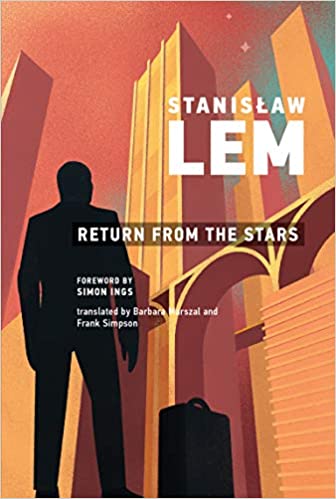
Return from the Stars. Translated by Barbara Marszal and Frank Simpson. Forward by Simon Ings. The MIT Press, 2020. Paperback. 295 pp. $17.95. ISBN 9780262538480

.


MIT Press’s decision to reissue the translated works of the incomparable, singular cosmic visions of Stanislaw Lem in lovely paperback versions is fortunate indeed for readers of philosophical and satirical fiction. Lem is one of those relatively rare authors of both profound ideas and deep prose; he provides each subsequent reading generation with renewed consideration of the impacts of technology on society, the inexplicability and utter foreignness to humanity of alien intelligence, and the complexities inherent in communication both between humans and between humans and aliens. These are longstanding and important concerns in speculative fiction, and it is a tribute to Lem that he remains, after six decades, one of the preeminent voices asking the kinds of foundational human questions that go to the very heart of the speculative fiction enterprise.

All the more appropriate, then, that these works started being released last year in advance of the 2021 centennial of Lem’s birth; their reissue signals the perennial interest in Lem and his lasting value as a thoughtful writer whose works constitute a truly deep literary dive into humanity’s relationship to the rest of the universe. And small wonder that Lem’s native Poland has declared 2021 the “Year of Stanislaw Lem”: a year of celebrations and commemorations of Lem and his place in world literature. But Lem’s work, with his lasting curiosity about the universe and our place in it, transcends a mere year of remembrance and tribute: in the best traditions of fiction, he is an author for all years, and all time.

His Master’s Voice, first published in 1968 and translated into English in 1983 by Michael Kandel (the version reissued and reviewed here), is centered around two of Lem’s more common themes: the limits of science’s ability to understand the universe around us, and how those limits are reflected in our own behavior. Lem wrote the book during the early years of the mid-20th century worldwide search for extraterrestrial intelligence, and Voice is an artifact of that time when concerted efforts were being made to seek out evidence of alien life and ask serious questions about how we as a species would receive that evidence and interpret messages received. The novel is narrated by mathematician Peter Hogarth, a brilliant, caustic, and self-aware professor attached to a secret US government project seeking to decipher a signal from deep space that arrived on Earth carried by neutrinos. Voice is less a straight narrative and more an extended philosophical essay about humanity disguised as an exhaustive description of the His Master’s Voice Project by Hogarth.

It is also the story of a massive failure, as evidenced by failed hypotheses and theories that the official project record will never show and the public will never see: as Hogarth notes, “the history of His Master’s Voice is the tale of a defeat: of wrong turns that were not followed by a straightened path. Thus one should not wipe away the zigzags of our journey, because those zigzags are all that is left us” (35-36). Finally, it is a chronicle, ultimately, of human insignificance and imperfection. “We stood at the feet of a gigantic find, as unprepared, but also as sure of ourselves, as we could possibly be. We clambered up on it from every side, quickly, hungrily, and cleverly, with our time-honored skill, like ants. I was one of them. This is the story of an ant” (36). Ironically, it is that very imperfection that not only causes its failure (through a lack of suitable intellect) but jump-starts the project in the first place – the initial theory that captured neutrinos are carrying an alien signal is inspired by the inadvertent efforts of con artists and pseudoscientists. Hogarth posits that “[e]very great matter has, among its circumstances, some that are ludicrous or pitifully banal, which does not mean that they do not play an integral role. Ludicrousness, anyway, is a relative thing” (60). Our imperfections and the ironies inherent in human activity are baked right into all our endeavors, Hogarth (and Lem) supposes. Although he notes at one point that “I do not know what it was among the people of the Project that determined finally the Project’s fate” (72), it seems clear that it is something stemming from humanity’s fallible nature that does it.

Explanations for the source and purpose of the signal all fail in the absence of proof. Was it sent containing information for starting life? For building an efficient mechanism for processing information? As a precursor to an alien invasion of Earth? As a symbolic extended hand of friendship? Hogarth himself dismisses all these as the fevered dreams of science fiction and the truth of the signal as being ultimately unknowable. “All these hypotheses (and there were more) I considered not just wrong but ridiculous. In my opinion, the stellar code denoted neither a plasmic brain nor an informational machine nor an organism nor a spore, because the object it designated simply did not figure in the categories of our conceptualizations. It was the plan of a cathedral sent to australopithecines, a library opened to Neanderthals. In my opinion, the code was not intended for a civilization as low on the ladder of development as ours, and consequently we would not succeed in doing anything meaningful with it” (121-122).  For Hogarth, the Senders broadcast their signal too early in humanity’s evolution to be of any use. In addition to the sheer time gap between human and Sender civilization, the project would have been doomed because the definition of words and concepts and contexts would differ between the two so widely. (All that, even so, assumes that the signal is indeed artificial: one Project scientist, Lerner, presents a reasonable case that it is merely a natural phenomenon.) In the end, the Project and Earth both have failed what Hogarth calls “a test of cosmic—or at least more-than-terrestrial—universality” (41), suggesting that much time will still be needed to straddle the gaps between our knowledge and the nature of the wider universe. In this, His Master’s Voice is a pointed rejoinder to the old strand of optimism and scientific progress running through classic science fiction, which Lem himself so derided.

“I took nothing with me, not even a coat” (1).

So begins the wholly undramatic return to his home planet by Prometheus astronaut Hal Bregg, following a long mission of exploration to the star Fomalhaut, some 23 light years from Earth. He comes home to no parades, no media interviews, and no serious reintegration into a society that has long passed him by. (Thanks to time dilation, only a decade has passed for Bregg, while 127 years have gone by at home.) What follows is a perilous new form of navigation by Astronaut Bregg, through a completely altered social order in which his experiences and social mores have no place. 

1961 was a prolific year for Lem: in those 12 months he wrote three significant works – his nightmarish riff on Kafka, Memoirs Found in a Bathtub; probably his most famous work, the graceful Solaris; and finally, Return from the Stars. Return was translated into English in 1980 by Barbara Marszal and Frank Simpson, the edition featured here in this 2020 reissue. Of those three 1961 works, Return may be the least memorable, but it is still a very interesting, even poignant exploration of the relativity of the utopian concept. And there are moments of literary brilliance: I am always taken with the dizzying and disorienting mood of the first chapter, in which Bregg is emptied out back onto Earth and forced to weave his way through a vast, confusing, and alienating metropolis. His emotional burden is extreme: “[f]rom the very first moment I was invariably behind in everything that went on, and the constant effort to understand the simplest conversation or situation turned that tension into a feeling horribly like despair” (2). He sees things whose function he cannot uncover, geographies he cannot follow, behaviors he cannot decipher; all this, as Lem accelerates the pace and the mass of details, contributes to Bregg’s growing fear and sense of alienation (which the reader keenly feels as well). The contradiction between Bregg’s decade spent inside spacecraft with a small group of fellow crewmembers and his new life in a sprawling city of countless strangers creates a feeling of real unreality that never leaves the reader (and it is a literary precursor to the disorientation felt some years later by American soldiers returning home from Vietnam, thrown back into unfamiliar civilian life with little or no assistance after a year or more of intense tours of duty) in the course of the novel.

That feeling of unreality, of unease, sets Return apart as a utopian novel, wholly appropriate because the Earth to which Bregg has returned is a utopia from the inside, less so from Bregg’s 127 year-out of date viewpoint. Poverty on Earth is gone, war is gone. Resources appear to be unlimited and free to all. People are happy, and no one is being turned into food or killed at the age of 30 or relying for their good condition on the abuse of one single poor child. But… social stability relies on a process called ‘betrization’, a medical procedure performed universally across the globe that eliminates the psychological need or capacity for aggression. As a result, Bregg and his fellow returnees, who go unbetrized, find themselves even more isolated and foreign, in a world where the mission for which they gave years of their lives is no more than a footnote from Earth’s aggressive and assertive past. At one point in the novel, Bregg has a conversation with an aged doctor who notes:

“There is a great deal you do not understand, Bregg. If you intended to live like a monk for the remainder of your days, your ‘I don’t mind’ might be in order, but… the society to which you have returned is not enthusiastic about what you gave more than your life for… Apart from a handful of specialists, no one cares about it, Bregg. You know that?…

The society to which you have returned is stabilized. Life is tranquil. Do you understand? The romance of the early days of astronautics is gone… You are alone. A man cannot live alone. Your interests, the ones you have returned with, are an island in the sea of ignorance. I doubt if many people would want to hear what you could tell them” (75-76)

Bregg, still a man wracked by strong emotions (among them guilt for causing the death of a fellow crew member), is shocked to hear that, thanks to betrization, “everything is now lukewarm” (82) – no hatreds, but no passions; no danger, but no need for adventure; no risks, but no rewards for challenging risks; no struggles, but no strivings. It is a world that runs neither hot nor cold. Lem asks us to consider whether a utopia is truly so – even if want has been eliminated – if human nature has been neutered or cast out of society. And are those qualities that Bregg possesses and notes the absence of, truly desirable parts of ourselves? Do we need them to be truly human, else our existence is ultimately sterile? It is in these questions that Return from the Stars may be of particular interest to researchers of utopian studies or scholars of SF concerned with the exploration of the human condition.

            Bregg’s solution to his crisis is to flee the city, abduct a young woman named Eri (certainly today the most troubling portion of the novel), and wrestle with his emotions, eventually reuniting with several of his fellow returnees and questioning the importance of their deep space mission that ended up robbing them of their lives and identities. It is in the light of a utopia made for others that Bregg clearly comes to see, in the end, a true understanding of himself as a contradictory human being. As Simon Ings puts it in his helpful introduction to the novel, Return is less about a future Earth and more about the story of a single man. “About his impulse towards solitude and his need for company. About the nonheroic risk and beauty of exploration, and about what it means to carry wounds and beauty home to a world that does not care” (xii). These are facets of ourselves that so many of us wrestle with in the real, and Lem asks whether a society can deny space for those of us who think, and act, and feel differently and strongly, and whether that society can still be called a utopia.


Jeremy Brett is an Associate Professor at Cushing Memorial Library & Archives, Texas A&M University, where he is both Processing Archivist and the Curator of the Science Fiction & Fantasy Research Collection. He received his MLS and his MA in History from the University of Maryland – College Park in 1999. His professional interests include science fiction, fan studies, and the intersection of libraries and social justice..

“Our Bodies Dazzle in the Light”: A Review of Love After the End: An Anthology of Two-Spirit and Indigiqueer Speculative Fiction


“Our Bodies Dazzle in the Light”: A Review of Love After the End: An Anthology of Two-Spirit and Indigiqueer Speculative Fiction

Jeremy M. Carnes

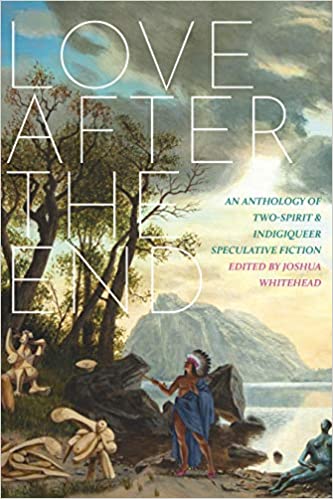
Love After the End: An Anthology of Two-Spirit and Indigiqueer Speculative Fiction. Edited by Joshua Whitehead. Arsenal Pulp Press, 2020. Paperback. 194 pp. $18.95. ISBN: 9781551528113.


How does anyone consider intimacy or eroticism in the age of the Anthropocene and the collapse of a world in the ruins of climate change and extractive capitalism? Even more, how do communities that have endured decades of violence and oppressive colonialism love within the apocalyptic? In Joshua Whitehead’s (Oji-Cree/nêhiyâw) edited collection Love After the End: An Anthology of Two-Spirit and Indigiqueer Speculative Fiction, he argues that a turn toward the utopian is a centrally important political shift. He writes, “For, as we know, we have already survived the apocalypse—this, right here, right now, is a dystopian present. What better way to imagine survivability than to think about how we may flourish into being joyously animated rather than merely alive?” (10-11). This point is, I think, the crux of this collection: intimacy, joy, growth, and love can be imagined into the present and future, even in the face of undeniable collapse. Perhaps this is the power of queer love: to face this paradox, love after the end, head-on, unwavering in the truth of potential.

Love After the End is a collection of stories that highlight the joy, love, and eroticism of 2SQ (two-spirit, queer) communities, whether in the love between human and AI-augmented animals or between two-spirit indigiqueers and the doomed planet they leave behind. It is a collection of stories about finding “what we need when we need it: through community and through our relations” (15). Kinship ties and communal love, erotic or otherwise, provide the ground upon which these stories build, showing the life-sustaining power of relations despite settler dominance and the continuation of unsustainable social, cultural, and economic structures.

Many of the stories begin with or concern ecological devastation of the Earth, though the devastation itself is rarely the primary focus. Rather, these stories seem to center on responses to the devastation: personal responses, interpersonal responses, communal responses, and global responses. For instance, in Jaye Simpson’s (Oji-Cree Saulteaux) “The Ark of the Turtle’s Back” we are introduced to a world on the verge of collapse; colonies have been established on the moon and on Mars, using the labor of Indigenous peoples to set up and sustain them. Ni, the protagonist, considers, “It will only be a matter of time before they come to take everyone capable from the Rez to work. The moon’s atmosphere is so successful that their oceans formed sooner than anticipated, and now they’re filling the waters with formerly extinct species. But at what cost? Our brown bodies?” (68). In a final escape attempt, the characters are convinced by Ni’s sister, Dakib, to escape on a series of arks; however, this exodus requires sacrifice: “we’re using energy from Earth’s kinetic core to fuel the trip. Upon takeoff, the core will cool almost entirely and cause significant damage to the planet. The magnetic field protecting Earth from solar winds and solar radiation will collapse and essentially turn Earth into the new Mars” (69). Simpson considers the weight of sacrifice and how much is too much. Should we leave the planet in an attempt to save our communities or should we stay as Ni argues: “Our people woundn’t leave her, and you know it. We would stay until her last breath and go with her. We are the caretakers, and if she dies, we die too.”

A similar complication arises in Adam Garnet Jones’s (Cree/Métis/Danish) “History of the New World,” which tells the story of a family—Em, a Cree woman; Thorah, her non-Native wife; and Asêciwan, their daughter—as they decide between staying on a collapsing Earth or going through a portal to “the New World.” In clear reference to settler colonial discourse, the New World is often assumed to be without history. Indeed, Thorah even argues, “The New World is a blank page…we can make our story there, anything we want” (43). This rhetoric clearly replicates the doctrine of Terra Nullius used to bolster so many settler claims to Indigenous lands. Eventually, and through a complex series of events, Em and Asêciwan decide to stay on Earth, joining an Indigenous camp in the center of Toronto: “A hand-painted sign above the entrance announced our arrival at NAGWEYAAB ANISHINAABEK CAMP: RAINBOW PEOPLES’ CAMP. A HOME FOR INDIGNEOUS 2SLGBTTQI PEOPLE AND FAMILIES” (59).

While the responses to collapse in these two stories are different—and we get similar responses in Mari Kurisato’s (Cote First Nation Ojibwe) “Seed Children”—each story centers 2SQ people and highlights the ways their choices depict love—love for their kin, love for the Earth, love for their partners. Whether in the scene of family ceremony on the departing ship carrying some land, flora, and fauna of the Earth in “The Ark of the Turtle’s Back” or in the decision to stay on a potentially doomed Earth in “History of the New World,” the stories focus more on the effects of having to make such decisions—and the potentials for joy within the decisions—rather than the idea that there is a correct choice to be made. While many of the stories about leaving give voice to the rights and responsibilities within Indigenous communities and in relation to the Earth through individual characters, they all refrain from casting judgment as if staying—or leaving—were the “more Native” thing to do.

A central facet to each of these stories is also the importance of stories themselves as vehicles for cultural knowledge, connection, and kinship. Indeed, story becomes a pivotal tool in considering “intimacy during doomsday” (10). In Kai Minosh Pyle’s (Métis/Baawiting Nishnaabe) “How to Survive the Apocalypse for Native Girls,” we are introduced to Nigig, a two-spirit Anishinaabe girl, as she navigates life and compiles a primer for existing in the apocalypse of settler colonialism. Nigig’s entries include pieces of advice and wisdom, including, “when the apocalypse happens, make sure you bring your kookum” (80), “Everyone has ancestors, but not everyone knows theirs” (84), “Watch those in power carefully” (87), and “Love is good” (82). These instructions and the remainder of the story consider the importance of kinship in creating community and connection, both not always pleasant experiences: “Love is part of Kinship laws—it is the Kinship laws. Of course, in reality Kinship is just as much about hating each other and messing each other up as it is about loving each other, but without Love there wouldn’t be any Kinship at all” (83). Story is about the messiness of connecting, especially in the messiness of apocalypse.

We see this same messiness in “Andwànikàdjigan” by Gabriel Castilloux Calderon (Mi’kmaq/Algonquin/Scottish/French Canadian), which tells the story of A’tugwewinu (Winu) living in a world where settlers have tried wipe out storytellers and carriers of Indigenous cultural knowledge. New storytellers and knowledge keepers become marked with memory markings, which appear “when someone share[s] a story and you truly listened, listened with all your heart” (97). When storytellers touch these marks on their bodies “words would appear in your head, and you would repeat the story back, verbatim, as if you were the one who shared it in the first place.” These markings and those who carry them become targets for the Enforcers—the militaristic, settler presence in the story. Much like in Pyle’s story, Calderon here offers story as a tool for connection; In “Andwànikàdjigan” the connection extends cross-communally, for it is only through real, intimate connection across communities that we can hope to survive and thrive in the face of abusive settler powers. As much as “Andwànikàdjigan” is a love story between the two-spirit Winu and Bel, it is also about the literal power of stories to shake the foundations of settler worldviews and a reminder that, despite settler conceptions otherwise, we are really only stories. [1]

Throughout this collection, the stories course through some of the central sub-genres now associated with Indigenous futurism, some of which provide the structure for the pivotal collection Walking the Clouds: An Anthology of Indigenous Science Fiction edited by Grace L. Dillon (Anishinaabe). We get stories of slipstream (“Nameless” and “Eloise”), stories of the Native apocalypse (“The Ark of the Turtle’s Back” and “History of the New World”), stories about Indigenous science and sustainability (“Seed Children”), and—coursing through all of this—the central notion of Biskaabiiyang, “Returning to Ourselves.” Yet, what this collection does differently is centering 2SQ stories. As Whitehead writes, “we have put Two-Spiritedness in the front, for once, and in that leading position we will walk into the future, in whatever form that may take, together, hand in hand, strong, resilient, extraneously queer, and singing a round dance song that calls us all back together” (12). So throughout it all, we are offered stories of connection, of the messiness of kinship, and of the potential that lies in the future and in queer love. The trials of history mark queer communities and their stories, but they are not silenced. As Whitehead notes, “we have lived in torture chambers, we have excelled under the weight of killing machinations, we’ve hardened into bedrock—see how our bodies dazzle in the light? (12). These stories, and the bodies in them, certainly dazzle in this light.

NOTES

[1] For more on the importance of story, see Thomas King’s The Truth About Stories.

WORKS CITED

Dillon, Grace L., Ed. Walking the Clouds: An Anthology of Indigenous Science Fiction. University of Arizona Press, 2012.

King, Thomas. The Truth About Stories: A Native Narrative. House of Anansi Press, 2011.


Jeremy M. Carnes, Ph.D., is currently a Visiting Lecturer at the University of Central Florida. His work is situated within both comics studies and Indigenous studies. He is the outgoing Fiction Reviews Editor and incoming Associate Editor for the SFRA Review and co-editor for the forthcoming collection The Futures of Cartoons Past: The Cultural History of X-Men: The Animated Series (UP of Mississippi). He is working on his first book on Indigenous comics.

The SF in Translation Universe #12


SFRA Review, vol. 51, no. 3

Features / SFT Universe


The SF in Translation Universe #12

Rachel Cordasco


Welcome back to the SF in Translation Universe! It’s been quite a summer (here in America), with people slowly emerging from their homes, blinking in the sunlight, visiting friends, going out to dinner, and sending their kids to camp. Contrast this with publishing during these warmer months, when books seem to slow to a trickle. And yet, and yet, we still have some fantastic new SFT to discuss! Because SFT never quits.

Of the five works of SFT that I’ll discuss in this issue’s column, four are out in English in July, with the fifth coming out in September (I’m looking askance at you, August!). Three are collections, translated from the Korean, Spanish, and Polish. July 15 brings us Korean author Bora Chung’s Cursed Bunny (tr. Anton Hur), which includes quite the mix of genres—magical realism, horror, and science fiction. Chung’s stories here defy genres and also readers’ assumptions about patriarchy and capitalism. The first story in this collection, “The Head,” first appeared in Samovar Magazine in 2019. It’s one of those deliciously-disturbing stories that sticks in your brain.

Of Claudio Ulloa Donoso’s Little Bird, translator Lily Meyer says “there may be no way to tell which stories in Pajarito are fiction, but there’s also no need. Each one has the immediacy of a diary entry and the floating nausea of a sleepless night.” This quote and an accompanying excerpt from the collection are available on Electric Lit (https://electricliterature.com/the-successful-candidate-will-not-have-a-dead-bird-in-her-pocket-claudia-ulloa-donoso/). Like Cursed Bunny, Little Bird refuses to fit neatly into generic constraints, though the latter focuses more on pushing the boundary between reality and fantasy. One character turns fireflies into men, another vacations in her cat’s stomach. Sounds like my kind of book!

And then there’s Stanislaw Lem’s The Truth and Other Stories (tr. Antonia Lloyd-Jones), which represents the most recent Lem published by MIT Press (from which an essay collection is due out later this year). Only three of the stories in this volume have been translated into English before, offering readers a banquet of new science fiction from one of the genre’s masters. Darkly funny, as many Lem stories are, these portraits of mad scientists, artificial life forms, and more will surely enthrall both new readers and Lem-loyalists.

The two novels out this summer/early fall include a Chinese story about strange creatures who live alongside humans but remain almost invisible and a work of Swedish horror about an epidemic of suicide. Yan Ge’s Strange Beasts of China (tr. Jeremy Tiang), set in a fictional Chinese city, tells the story of an amateur cryptozoologist’s attempt to learn more about the city’s fabled beasts. Their greenish skin, birthmarks, and other characteristics make them stand out from the human residents, but they’ve figured out how to blend in…until this cryptozoologists starts looking a little deeper.

Finally, it should come as no surprise that the work of Swedish horror I mentioned is the brainchild of John Ajvide Lindqvist—he of the popular Let the Right One In and Little Star. Known as Sweden’s Stephen King, Lindqvist has a gift for turning a simple horror story into a larger meditation on human psychology. In I Am the Tiger (tr. Marlaine Delargy), a journalist tries to understand the rash of suicides plaguing Sweden’s underworld and what connection the  drug-dealer named “X” has to do with it. When the journalist’s young nephew gets pulled into the maelstrom, this search for truth becomes more immediate.

And what of short fiction? The July issue of Clarkesworld brings us St. Petersburg-native Leonid Kaganov’s “I’m Feeling Lucky” (tr. Alex Shvartsman), an engaging time-travel story about hope and resignation.

Thanks for reading, and I’d love to hear what you’re reading now and what you’re looking forward to: rachel@sfintranslation.com.

Until next time in the SFT Universe!

SFRA Country Report: Germany


SFRA Country Report: Germany

Julia Gatermann and Lars Schmeink


Coming home from the first international academic conferences we ever attended, incidentally the ICFA, the SFRA, and the Utopian Studies conference—admittedly quite a few years back—we both agreed that science fiction people shared an incredibly warm and welcoming attitude that made it easy to catch fire. Engaged discussions over coffee about books, films, and games, which we all felt passionate about, helped to easily connect and make national and cultural borders seem meaningless. Nevertheless, SF scholarship is also a field where difference is crucial and, at its best, is celebrated as it adds depth and can yield the most productive results—both in the texts we engage with, as well as in our interpersonal, institutional, and academic contexts. SF fascinates us because it can come in so many different shapes and forms. Therefore, we were delighted to read the wonderful country reports from England and India and the last issues of SFRA Review, which gave us some insights into engagements with sf from (to us) largely new perspectives. We would like to contribute to this exchange and present to the members of the SFRA, a status report on how research in SF is faring in Germany.

The Science Fiction Club Germany (SFCD), a fan-organization, is arguably one of the oldest institutions of sf engagement in Germany. While it was already inaugurated in 1955, it took until the 1980s to bring enough public attention to the field to establish several national awards recognizing the growing interest in science fiction (and the fantastic more generally). In 1980, the Kurd Laßwitz Preis (named after the German ‘father’ of SF) was established, followed by the Phantastik-Preis (granted by the city of Wetzlar) in 1983 and the Science Fiction Award (granted by the SFCD) in 1985, and finally in 2012 the Seraph Award presented at the Leipzig book fair.

Leipzig has become the central public trade fair for the fantastic, connecting literary publishing with comics and cosplay and becoming a hub for fan engagement, while the Frankfurt book fair’s bigger and more established venue rather caters to the economic (and decidedly more mainstream and highbrow) side of the literary market. In addition, several larger commercial and a whole slew of smaller conventions keep fantasy and SF fans busy during the year, highlights being the German Comic Cons (currently in four different cities), MagicCon (since 2017, larger in scope but following in venue for Tolkien-based RingCon), and the science-fiction themed FedCon.

Research in science fiction—mainly conducted by SF enthusiasts—has been developing since the late 1970s, but due to historically rather rigid and conservative structures at universities and a strong focus on canon in the fields of literary and cultural studies (for the most part in German or English studies), this engagement has, for a long time, mostly taken place outside of academia. It fell to individuals and small institutions to begin early forays into the field. Academic interest in SF and fantasy slowly began to manifest with Suhrkamp (a well-regarded publishing house) producing a book series of collected essays from both national and international authors (among them Roger Caillois, Louis Vax, and Edmund Wilson) on theoretical aspects of the fantastic: Phaïcon: Almanach der phantastischen Literatur, published in five volumes between 1974 and 1982. But a uniquely German research tradition was first institutionalized with the inauguration of the Phantastische Bibliothek Wetzlar, a research library, which began its collection and research work in 1987 and can be credited with establishing the first German-language book series [1] on research in the fantastic during the 1990s.

It took until 2010, though, to firmly anchor the fantastic as a field of university-based academic research in Germany. The Gesellschaft für Fantastikforschung (GFF, Association for Research in the Fantastic) was inaugurated in the fall of 2010 during a conference at the University of Hamburg and has since provided a research network for more than 120 members, establishing an annual international conference in varying locations in Germany, Austria and Switzerland. Its next annual event will take place as an online conference, hosted by the Universities of Cologne and Bamberg under the title “Speculative Fiction and Ethics” from 23 to 25 September. [2] It might be appropriate to mention here that the GFF does offer small stipends for international students to attend the conference.  

Overall, it can be said that, over the last decade, research in SF and the fantastic has become a much more respected and recognized field at German universities and has found its way into curricula. Even at conferences with a more general scope, papers on science fictional topics are no longer a rarity (one example would be the annual conference of the German Association for Anglophone Postcolonial Studies [GAPS] that hosted four distinct panels dedicated to SF). And as a productive perspective to contribute to diversified interdisciplinary research, the importance of SF has been recognized as well, with ´third-party funded research projects such as Fiction Meets Science, which has dedicated a subproject to representation of science in postcolonial SF (that one of the authors of this text works for). 

In terms of German-language academic journals on research in the fantastic, the Zeitschrift für Fantastikforschung (ZFF), established by the GFF, has the honor to be the first of its kind. Since 2011, the journal has published peer-reviewed original articles, German translations of key texts from other languages, introductions to international fantastic literatures, and much more twice per year. In 2019, the ZFF has become the first German-language journal to move to the open-access platform Open Library of the Humanities [3], establishing new and very successful formats, such as a collection of shorter essays under the rubric “Forum”, which initiates academic debates around new aspects of the fantastic and thus serves as an ideal spark for longer research endeavors, or unusual interviews on the fantastic, i.e. currently an interview with former Greek finance minister Yanis Varoufakis about his book Another Now: Dispatches from an Alternative Present (2020).    

As for science fiction production from Germany, there is a large field of creatives in SF covering a large range of areas, styles, and genres—ranging from the famous pulp series Perry Rhodan (established in 1961 and still going strong, putting out a weekly space opera) to high literary endeavors that somewhat shy away from identifying with the genre (historically, SF was stigmatized with a low-brow reputation). Examples are Juli Zeh’s Corpus Delicti (2009, The Method) or Christian Kracht’s Ich werde hier sein im Sonnenschein und im Schatten (2008, not translated into English, but meaning: “I’ll be here in sunshine and in shadow”). One important issue for international audiences is the limited availability of translations of and English-language scholarship on German SF. Some (subjectively) selected texts of SF since the 2000s, which have been available in English translation, include Frank Schätzing’s SF-thriller The Swarm (2004), Dietmar Dath’s posthumanist philosophical novel Abolition of Species (2013), and Marc-Uwe Kling’s recent social media satire QualityLand (2017). But if German SF has ever made a big international splash in recent years, then it is probably due to the Netflix series Dark (2017–20) by Baran bo Odar and Jantje Friese. The show plays with well-established SF tropes of time travel but connects it with the 1980s nostalgia of Stranger Things and a very distinctly German sense of Heimat (home) and Spießigkeit (roughly translates to narrow-mindedness). It is international in its scope and yet can immediately be recognized as distinctly German—a mixture that is typical of much German SF.

All in all, Germany has a vibrant SF community, both in- and outside of academia, striving to diversify and connect with international perspectives. This feature helps us learn more about SF in other countries, and we are delighted at this opportunity to introduce our own community you. We hope that we can further develop and foster exchange and connections beyond our own contexts.


[1] Schriftenreihe und Materialien der Phantastischen Bibliothek Wetzlar, edited by Thomas Le Blanc – https://www.phantastik.eu/images/Publikationskataloge/KatalogSchriftenMaterialien.pdf

[2] Extending a warm invitation, please do attend: https://fantastikforschung.de/jahrestagung/jahrestagung-koeln-bamberg-2021/

[3] https://zff.openlibhums.org/


Julia Gatermann is currently writing her dissertation with the working title “The Future is Female: Non-Normative Embodiment as a Site of Resistance in Contemporary North-American Cultural Production.” She works as a researcher at the University of Bremen for the interdisciplinary research project “Fiction Meets Science II” with the subproject “Science in Postcolonial Speculative Fiction: Nature/Politics/Economies Reimagined.” She is a founding member of the Gesellschaft für Fantastikforschung and has served on its executive board for ten years. 

Lars Schmeink is Vice President’s Research Fellow at the Europa-University of Flensburg and project lead of the “Science Fiction” subproject in the “FutureWork” research network. He is a founding member of the Gesellschaft für Fantastik–forschung and has served as president of its executive board until 2019. He is the author of Biopunk Dystopias (2016), and the co-editor of Cyberpunk and Visual Culture (2018), The Routledge Companion to Cyberpunk Culture (2020), New Perspectives in Contemporary German Science Fiction (2021) and Fifty Key Figures in Cyberpunk Culture (2022).

The Life and Work of Bulgarian SF Writer Lyuben Dilov


The Life and Work of Bulgarian SF Writer Lyuben Dilov

Andy Erbschloe

In decay, a specimen’s constituent parts are revealed, and, with close observation, we earn new knowledge. The twentieth century saw the birth and death of one of SF’s most integral discourses, which can be very broadly grouped under the descriptor ‘Soviet speculative fiction’. The determination to instill the socialist-realism ambitions of the communists’ cultural architects manifested across the republics and its satellite states in degrees proportional to the strength of their respective ties to Moscow, and so it was with SF. Thus, we end up with an array of constituent parts, all of which add up to the whole corpus, and one of which is addressed herein.

In 1990 the modern Republic of Bulgaria directly succeeded the socialist People’s Republic of Bulgaria, which itself had succeeded the Kingdom of Bulgaria after World War II only forty-four years prior. The Communist party, in less than half a century of control, the final thirty-three of which were under the totalitarian Todor Zhivkov regime, was able to boast many advancements in industry, infrastructure, and developing technologies, but the dividends were hardly equally distributed. By the 1980s, the computer components being produced in Pravets, the ‘Silicon Valley of the Eastern Bloc’, were helping Russia get their rockets into orbit, but if you were to leave Pravets and go five miles in any direction, you would leave not only the cybernetic age but the age of electricity and running water.

Amidst the clamor of processors, microscopes, hammers, and sickles, a uniquely Bulgarian speculative tradition arose. Just like the Americans, British, Russians, etc. they built on the foundation of their own national literary heritage and herded the twentieth century’s technological stampede through the canyons of their own cultural morality in search of the greener pasture of whatever the future may hold for humanity.  Forgive the already extensive backstory, but understanding the deep and complex works in this tradition requires some knowledge about the direction of the lives and works of its creators. Among the best are Agop Malkonyan, Dimitr Peev and Svetoslav Slavchev: remember those names for later.

Lyuben Dilov, the first name in Bulgarian SF, was born in the Kingdom and then raised for a time in Hitler’s Germany before returning “home” to the People’s Republic and becoming part of its first generation of intellectual elite. Compelled to speak his mind openly from at least his university years, the non-partisan Dilov relates that various obstacles to his free expression led him to expound his humanist philosophies under the thin guise of allegory as a SF writer. He might have been content to join the still developing national literature, a fusion of their own pastoral folk sensibilities with the rationalist, democratic values espoused by the Enlightenment, but in order for him to say what he wanted to say, he found it necessary to say something different. But it would be short-sighted to see only camouflage and aloof estrangement. Like Lem and the Strugatskys, the Soviet world was his frame of reference and his audience, and besides, his wouldn’t be the first stories to have relevance in different places and times.

In Lyuben Dilov’s speculative fiction, the mores of socialist realism are delivered without any art, often deployed on the first page and occasionally quoting directly from, or loosely translating, Bulgarian and Soviet state memorandi. The author fulfills what clearly reads as his professional duty, but only just. The rest of the pages are his alone, and whether they are used to rethink the given or to drape something completely unrelated over it, the rest of the pages serve the reader a candid philosophy that speaks, not to the ideal future citizen of any specific nation but to something even more collective, primordial, and difficult to deny. The reader, by the end, isn’t turned towards or against any one set of myths or canons, and certainly not against myths and canons in general. Rather, the purpose of having myths and canons is discussed with deferential honesty alongside the very myths the books themselves contain. Dilov spoke often of modern SF as fitting into the crucial human developmental slot traditionally occupied by fairy tales. To borrow a term he wouldn’t have been familiar with (although Polish researchers were already describing the concept with the word “stereotypes”), Dilov thought of good stories as the “memes” of a good future, references for doing and speaking good that can be understood as goodness, even among strangers; indeed, especially among strangers. And it is this binding power of commonality, rather than any ideological motifs, that his tech-magic fables invoke to inform all their morals.

The tools of the trades, SF and allegorical literature, are ably employed by the author in chiseling the evasive truth from our common bare stone, variously embracing and completely neglecting the “fourth wall,” reworking the oldest testaments and myths, laughing at our shared fear of the unknown. Motifs recur throughout the oeuvre (drinking, suicide, and pride in one’s craft are examples) and effectively nuance the sometimes challenging discursive passages by tethering each newly birthed narrative to a perennial philosophy. All these years later, we are left with a temporal, dialectic continuum which I will very broadly section up for the purpose of exposition.

But first, I’ll briefly mention a connection between Dilov’s early life and that of many seminal individual contributors to twentieth-century SF: WWII. Lem’s work was impacted by his experience as a blond Jew in Lviv, using fake papers to pass for a gentile during the brutal prison pogroms. Arkady Strugatsky was evacuated from the Nazi seige of Leningrad, not without tragedy. Arthur C. Clarke was billeted in a decimated London, Vonnegut took shelter in the number five slaughterhouse, and Gene Roddenbury flew eighty-nine combat missions. Heinlein, Asimov, and de Camp fixed equipment for the US Navy. Komatsu Sakyō, after Japan’s surrender, worked clearing charred bodies.  The Berliner Günther Krupkat was active in resisting the Reich and later became the first chairman of the East German Writers Union’s Science Fiction Working Group. Lyuben Dilov spent six years of his childhood in Berlin. His father evacuated the family from Allied bombing, but upon returning to Bulgaria, he was politically imprisoned in notorious concentration camps like the one on Belene Island. Of course, no segment of society was left untouched by the global conflict, but the flames of burning cities did coincide with the ignition of a new wave of speculative literature.

Dilov’s early non-fiction works and non-fantastic narratives had been well received and earned the young author a reputation, and a dream for the better technology of the future. His first SF novel, The Atomic Man (1958), was initially held up at the state publisher, there being no hard-SF frame of reference in the country at that time. The book was unsuccessful, but nonetheless warranted a second printing; the new edition gives the protagonist a nationality transplant from American to Bulgarian. A lesser artist might have despaired at the imposition of obtuse moral coordinates, but Dilov seemingly accepted the challenge and embarked on a decades-long journey to reveal what is truly located at those coordinates.

His next novel, The Many Names of Fear (1967), was a detective fantasy lampoon of psychosurgery, but as the space age came to dominate the hearts and minds of many, Dilov’s attention turned towards the heavens. Dilov didn’t live to witness Starlink satellites repainting our night sky, but in The Weight of the Spacesuit (1969) we find that he was very much concerned with technology’s encroachments on our world’s sense of wilderness. Following nine cosmonauts’ journey to contact another civilization, the dense imagery is concise and laconic in describing primarily the inhabitants of the cabin, rather than what’s to be seen out the porthole. The spacesuit, and other manifestations of technology, are seen by the author as the vestments of a death cult that thrusts humanity into the icy cold horror of space, but they also define the physical limitations of existence.

The characters assess important philosophical puzzles, and the human characteristics each of them revealed in discussion accurately inform their later reactions. The result is an unbreakable coupling of human virtue with humankind’s eternal pursuit of the unknown and the unattainable. It is a testament to the triumph of human will under conditions of immense strain and a suggestion that such strain actually sharpens some human virtues while blurring the lines between them: camaraderie, duty, responsibility and self-sacrifice. Frequent Dilov reviewer Ognyan Saparev called it “the tightest, most complete, cast as if in one breath” of all Dilov’s works.

Covers by Tekla Alexieva for Double Star and The Weight of the Spacesuit

The Path of Icarus (1974), which first earned Dilov international recognition, is a first-rate space opera and a significant literary achievement. Considered by Arkady Strugatsky to be one of a handful of socialist speculative novels that defined the genre, the story follows an intellectually elite space crew piloting a generation ship in search of other habitable worlds. The story follows the young Zenon, first born child of the Icarus society, who has never seen the Earth, but Dilov proves, almost mathematically, that the Earth won’t be so easily left behind. Following family discord and changing human expectations, the novel rests heavily on the saga of a forbidden cyborg/clone and its creator, who is eventually removed from the society for his Frankensteinian ambition. The “child” is destroyed in a hyper-emotional scene that casts doubt on the entire utopian genre. Meanwhile, the enclosed society’s stringent code of conformity is repeatedly battered and invalidated by the never conforming space they encounter, ultimately leading Dilov to remind us that the “gaping abyss of contradictions between our new knowledge and old views” has always been bridged within the mind of a single person rather than a collective. It’s a masterwork of recasting scientific ideas which were then in their early stages into their potential future forms, not just as shock hypotheses but as a means of examining their socio-philosophical challenges.

Zenon, facing the incomprehensible alien “cloud” on the uninviting alien world, reflects on his part in the narrative of humanity as it will seem to the future colony:

These tales will surely seem like fantasy to them, but let’s hope they love them. And when, after centuries or millennia, their Neanderthals are civilized, they may recognize in their genes the memory of the Earth and follow the tales in search of it. And so it is with us, we will not stop looking to meet our own estranged children, to meet ourselves in space and close the circle of the great unity of the worlds.

In The Path of Icarus, we are also introduced to the Fourth Law of Robotics, ostensibly for comic effect. The claim to have produced the earliest known addition to Asimov’s sacred Three Laws is a matter of great pride for Bulgarian SF, but the passage where it is actually stated is somewhat condensed and unassuming. This new law obligates the robot to identify itself as a robot in all circumstances. The cynical justification mentions market forces and the embarrassment of accidentally flirting with an automated female voice on the phone, but the less obvious utility of including, and immediately augmenting, Asimov’s holy commandments is an uncondensed skeptical analysis of robotics, laws, humans, and the soothing nature of small numbers. Lest it be said that Lyuben Dilov was picking on Asimov as a foreign competitor, do note that he used equal diligence in his treatment of Bible stories, apocrypha, Plato, all historians, nationalistic traditions, the socialist-realism he was paid to promote, and his own narrative offerings, which were often as simple as an ordinary Bible story. And in this sense, you could call him irreverent, but, in most cases, you cannot fail to credit the exemplary modesty of his presentation.

In the wake of the resounding legitimacy brought by The Path of Icarus, and before his most biting satirical offerings, Dilov wrote a space novel for teenagers, Niki & Numi (1980, 1983), released in two parts. Still ever vigilant in his anti-establishment allegory (the school guard in the role of the state), Dilov addresses children with moderation, temperately, and accommodates without compromise, but avoids talking down to his audience, something the author often warned against with regard to children’s literature. Taken in the context of the oeuvre, the saga of the earthly Niki and the extraterrestrial Numi demonstrates Dilov’s consistent motivation to deliver a specific, vital message to a specific audience who needs it, not only to unload his imaginative excesses (a license he also fully utilizes, nonetheless). But perhaps good timely advice can also be universally valid by coincidence. Sometimes framed as familiar Aesopian diagramming, other times stated more directly, Dilov captures the child’s thin distinction between laughter and tears, and he educates the characters and us by having the heroes compare the two different worlds they come from. They discuss the pain of being unjust to others and whether each civilization has its own truths with equal vigor. Adult readers can rediscover the great historical markers of human civilization through Numi’s alien eyes and the various alien beings they meet paint a full image of the possible spectrum of the imaginary. In Bulgaria today, the two Niki & Numi books are probably the best remembered of Dilov’s works, owing to the timing; they’ve already been introduced to the first generation of the twenty-first century.

The best anecdote from Bulgarian SF lore involves the founding of the Biblioteka Galaktika publishing series. In 1979, author and translator Milan Asadurov launched the book series to introduce Bulgarian readers to the top SF and detective-fiction being produced around the world. The imprint went on to release over one hundred books, translated classics alongside the best domestic offerings, all with unique, story-specific original paintings by Tekla Alexieva. It can’t be overstated how seminal Galaktika’s editions and Alexieva’s eye-catching images were in bringing valuable ideas into legitimate competition for the Bulgarian workers’ meager beer money. So, as legend has it, Asadurov had tried to bring five-hundred books of American origin into the country. Naturally, they were stopped by State Security, but after negotiating their release for some months, Asadurov eventually managed to prove that the books had actually been translated and published in Moscow. Presenting readily available domestic and Soviet-sphere authors alongside hitherto unread Western giants such as Ursula Le Guin and Ray Bradbury, Biblioteka Galaktika’s books would go on to become a cherished commodity, not a small feat for a poor socialist country. But what the State Security didn’t know is that these books had gotten the entire editorial board of the Moscow publishing house “Molodaya Gvardiya” fired in the autumn of 1968 for the publication of “ideological diversion.” Lyuben Dilov was on the small editorial board at Galaktika, alongside Melkonyan, Peev, and Slavchev, and the “commodities” they produced for a little over a decade are iconic artifacts of the Cold War’s more artificial borders and SF’s rebellious attempts to thaw them.

Bulgarian SF also got a second boost in those years. Arkady Strugatsky left Russia for Bulgaria on his first ever visit abroad, on Melkonyan’s invitation. Strugatsky was an admirer of Dilov’s work, especially The Path of Icarus, and they became friends. Dilov would fictionalize their meeting in The Missed Chance (1981), which with Unfinished Novel of a Student (1982), and The Cruel Experiment (1985) are grouped not only chronologically but existentially. The ease of the author’s narrative direction and, paradoxically, the uneasiness it could lead to had been well exercised in his earlier work. But Dilov had bigger things in mind than Moscow’s perfect man and caricatures of despots. Besides, his 1979 story “Even If They Leave”, a seething berating of gasping totalitarianism in a small country, hadn’t even earned him a proper censor, perhaps because he already had some international awards to his name. But the extent of state censorship in Communist Bulgaria is by no means a settled issue. There were tragedies, state agencies approved publications, and despite widespread destruction of records, ample physical evidence of State Security’s political profiling has survived, but prominent voices from the Bulgarian literary community have, in more recent times, characterized the situation as one more driven by the artists’ own self-censorship. Dilov certainly writes candidly about one of his former colleague-informers, “one of those aspiring writers who didn’t ever become a writer, perhaps because he failed to get past the retelling stage.”

So, on the geographic and ideological fringes of the Soviet hemisphere, potentially emboldened by cultural exchange and an increasingly receptive audience, Dilov revisited his own literary path, and that of his nation (and all humanity), through its various forms and genres in The Missed Chance. Like Stanislaw Lem’s A Perfect Vacuum (1971), this composite work is first and foremost, structured as a literary experiment. A Perfect Vacuum is a playful metafictional “anthology” of fictional reviews, that is, reviews for books that don’t exist (unless you count the opening review for A Perfect Vacuum by S. Lem). But while Lem’s arguably genius lampoon of postmodern literary self-indulgence efficiently mobilizes the structure against his target, and though the sequence is not inconsequential, it is non-narrative, a fundamental impossibility for Dilov.

In The Missed Chance, a true composite novel, the reader gets their metafictional lesson, the value of story and the storyteller’s responsibility to humankind, between interludes detailing a few frustrating work days in the life of SF writer Lyuben Dilov. He has been compelled by the Writers’ Union to switch to the newest model of writing computer, which knows all world literature, recorded history, and data and can produce original works in the style of the author it serves. Dilov need only submit his spoken commands according to the manual. The eager computer effortlessly produces page after page, but the author is offended at the perceived diminution of his craft. Dilov hates all the stories, and as he vainly attempts to vocalize his specific complaints with this “highly-evolved” reflection of himself, the computer’s tales turn more and more bitterly satirical against their human patron and his arrogant self-denial. The effect is so immersive and complete and entertaining that it’s easy to forget what you definitely know: that you’re reading the words of Lyuben Dilov.

But even though The Missed Chance is seemingly fully occupied with Dilov’s experimental techno-puppet show format, the author stays true to his penchant for layering multiple textures and softly demanding the reader pay heed to the overlapping connections. Opening with an already solved murder case, Dilov’s facetiously challenging parameters elicit facetious responses from the computer-storyteller: a dragon tale without an end, a “secular” retelling of Cassandra, and a transgender, interplanetary transporter malfunction. The familiar sci-fi themes of time travel, alien encounters, and sex robots also appear, all with quotable comments on their respective spheres of influnece. But perhaps the most “subversive” topics pervading the composition are the decidedly un-collective concepts of “self” and “identity.”

For the closing tale, “The Plundered Truth”, let’s look at the cast of characters: So, in a story in a story written for Dilov by his computer, which is also him, we only find the author’s real-life friends, Arkady Strugatsky and Karl Levitin, one Lyuben Dilov confronting another Lyuben Dilov, and a seemingly innocuous cameo by Dilov’s secretary. It is strikingly tempting to draw a parallel from here to Dilov’s initial impression of the computer’s voice in the beginning: “…maybe the dark-eyed, passionate, and secretly-in-love-with-her-boss secretary. Its voice was well-selected, but I don’t yet know whether or not I will love this secret secretary back.

The computer-composer had already been directly accused by Dilov of writing itself into an earlier story, as a martyr for an owl-like alien race being imposed upon by the arrival of humans. And its mischievous, Scheherazade-like voice, which Dilov skillfully delineates from his own, can be detected in some others of its self-produced characters. But this designedly subtle call-back to the secretary, less than ten pages from the end of the book, whirls the reader’s cognition back through the ten preceding stories, and upon examination we find that all ten, seemingly hidden in plain sight, are covalently bonded by the shared electron of marital infidelity. Now, if you’re imagining Dilov crafting some banal confession to his wife, Milka, the mother of his children, his great love and muse, please try to pay closer attention. This encoded, guilty admission is for unfaithfulness to his own creative influences from bygone eras, to the “tradition of all dead generations,” as Marx put it, and for partaking in modernity, as demanded by his own revolutionary era, and his own contrarian whimsy, and his Marxist administrators. Ironically, when critics accused Ursula Le Guin of departing from genre tradition, they called her work “Balkanized.”

Nothing in its finishing or function separates The Missed Chance from Dilov’s other intricate productions, but the full blooming of the central concepts within the limits of the format, itself carefully selected, leaves this piece as one of the most instructive “textbooks” on writing style we have at our disposal today. But be careful not to confuse it with his later short story “How to Write a Science-Fiction Story”, which is actually Dilov’s comment on “just following orders.”

Time travel is SF’s flying trapeze. The discerning reader demands a daring spectacle and suspended reality, but every flyer must be skillfully caught and landed safely on the opposite board. And no nets, please! So, why not start the book with its third chapter and go back for its first two? Unfinished Novel of a Student (1982), Dilov’s contrary foray into the tradition, proclaims its own nonsensicalness from the start with a disclaimer reminiscent of these introductory words from Lucian’s True History:

…I turned my style to publish untruths, but with an honester mind than others have done: for this one thing I confidently pronounce for a truth, that I lie: and this, I hope, may be an excuse for all the rest… Let no man therefore in any case give any credit to them.

Dilov writes in the introduction, “Let the reader not worry if some things seem unmotivated and unclear, they also seem so to the author”, and then later when the unnamed, modern-day historian is considering the career switch to science fiction,

You can shovel all the historians in our country! And besides, our so-called science is making up more than a few things! At least SF isn’t telling you the lie that what it’s telling you ever really happened!

The historian had learned of his literary destiny by accident after stumbling into the twenty-fourth century. Soon after, but ages earlier, a little too much Corinthian wine compels a careless student of Temporal Flight to prematurely tell the ancient Greeks about their aeorema, the machine used to more convincingly lower the “gods” from above in the theater. Later, the future’s interference in the past is illustrated even more immaculately; a chrononaut’s indiscretion with an ancient Nazarene girl accidentally launches Christianity. (It’s worth remembering Dilov’s audience here: the Bulgarian Orthodox Church had been a vital force in forming the national identity in the nineteenth century, but the arrival of Soviet oversight had forced even Christmas behind closed doors.)

The protagonist of Unfinished Novel of a Student is Cyana (named after cyanide), a well-intentioned but flippant aspiring chrononaut. She is vigorous and youthful, the least informed but the most willing. Her superior, the aged Professor of Temporal Flight, warns her about the dangers of time travel with his own tragic testimony but to no avail. Experience cannot silence sanguinity, but it can waylay it; he sends her to the asteroid belt. The central research computer has stopped responding to the scientists there but only after it compiled an unsolicited treatise on human abuse against machines. Tasked with debugging the stubborn computer, Cyana and Dilov check all the familiar boxes of asking where the human and the machine begin and end and so on, but the way Cyana fixes the “broken” computer is purely Dilov. She tells it a story. She recounts her research mission to the Cretan Labyrinth and her run-in with the Minotaur. Dilov often appealed to readers’ familiarity with the Classics, Daedalus’ Labyrinth also supplying the titular metaphor in The Path of Icarus. Cyana sums up her framed narrative, “My Minotaur,” a lesson in the subjectivity of truth, with diplomatic platitude:

…they’d been envisioning a being less selfish than themselves, to be objective and fearless in its judgement. Humans have always strived to become that ideal, but when they realized they would never achieve it, they created a computer from metal and energy to have a more virtuous companion on their path. And here again, with these stories of yours, you’re making yourself just that—their fair and fearless judge. Love them in the future, dear colleague, help them because humans are very lonely in the universe and, in this endless loneliness, there’s no one to lead them out of the labyrinth they built.

“Colleague Cyana, you are a cutie,” said the computer beyond the wall that humans had placed between it and themselves.

The “real” Labyrinth was solved using a thread from Ariadne, a detail with symbolic value for which the author doesn’t fail to account, because Dilov, rather than telling the future facing forward, follows the threads back through the endless maze of tragic lies that brought us here, and reminds us that we’ll be looking back on them just as endlessly when the future arrives. But if you haven’t guessed the prime intent that unites all the threads by now, then you haven’t been paying attention. It’s love.

Around the time the Berlin Wall came down, the Eastern Bloc’s first generation of speculative masters took a step back. Arkady Strugatsky died in 1991, Lem’s final novel had already been written, and Dilov was occupied delivering a specific, vital message to a specific audience who needed it. Bulgarian identity was then, and is still now, actively developing, and I find an apt metaphor in the post-Communism debate over formal personal address. Bulgarian men had called each other “Mr.” in the Kingdom, but it had been replaced by “Comrade,” then after 1989, a brief reactionary period of “Citizen” before going back to “Mr.” (in Bulgarian: Gospodin, Drugaryu, and Grajdanin, respectively) Dilov’s characters very often used “Colleague”, by the way.

Dilov had released some short stories during the last few years of the Communist regime, notably “Adam’s Rib” and “Down by the Spring,” and prolifically defended SF’s credibility in his articles and interviews, but the next substantial batch of new material that was officially published has been described as the “manuscripts in the drawer,” meaning they had been prepared in anticipation of imminent regime change and the freedom of expression that entailed. Among these are a short story collection called We and the Others (1990), a brief historical memoir called Sex Life Under Totalitarianism (1993), and a difficult to categorize gathering of anecdotes entitled Impressions from a Planet: Notes of a Science-Fiction Writer (1990). The “manuscripts in a drawer” nomen was only selectively applied at the time, indicating a perceived distinction between those who were legitimately oppressed and those who didn’t have much to say anyway.

Saparaov writes that Dilov “doesn’t like categoricality. His skeptical writer’s attitude prefers the open discussion, the collision of contradictory points of view without a didactic-unambiguous answer.” Such an ambitious Socratic endeavor necessarily employs many elegant, but deliberate, deliveries. Pieces of such intricate devices can be, have been, and will always be taken, quite literally, out of context. So in Dilov’s writing, one encounters ‘-isms’ that are considered, at best, dated by today’s standards, but the author never digresses (even when he does) from the non-linear and non-dualistic meander that leads the reader straight ahead through a logical circle that tidily reduces to absurdity anything that lacks compassion.

Case in point: In Impressions from a Planet we find a chapter entitled “We Feed the Children Lies” which describes Dilov’s own experiences with state conspirators and mentions his father’s work and imprisonment. He quotes a song, remembered from his father, that perpetuates stereotypes about Romani, the predominant minority ethnic group in Bulgaria. He goes on to compare his poor childhood living conditions, and also the treatment of writers in well-fed nations, to the conditions of “gypsies” (Bulgarians use the word tsigani but rarely the endonym Romani). The implicit hierarchy of cultures would have been fully relatable to Dilov’s audience, not in any way controversial. He then recalls that, after relocating to Germany, the “gypsyism” of their young family, now immigrants living in Nazi Berlin, was even more confirmed. Already, the structure of the allegory is taking shape, but don’t count your dimensions before they hatch; Dilov isn’t done yet. Over just a few paragraphs, the author exponentially expands his father’s “prodigal son” return to Bulgaria into a continuum of moral wisdom extending through time from Homer to Archimedes, with nods to Jean-Jacques Rousseau and Jack London, encompassing both the racist song from earlier and his father’s own journalistic accomplishments.

Valuable for the historical information alone, Impressions from a Planet runs considerably longer than any of the novels Dilov published. But the mindful voice is the same, bright optimism and cold truths are still treated with equal respect, and the simple intent of spreading only good still lends a certain warmth to the reading. In fact, reading this collection of personal musings being shared unencumbered by the more or less state sponsored censorship mechanisms, those familiar with Dilov’s fiction work will be most struck by how successfully he had been delivering his “subversive” message in his own open code all along, but from the perspective of the fantastic.

Shortly thereafter, Dilov released another book of anecdotes, this time very easy to categorize. Fellows of the author, all Bulgarian, who had preceded him in death are commemorated with intimate recountings that are united by one purpose: cheer. For the Dead, Either Good or Funny is a continuation of Dilov’s reflections on the Communist era, and again uses contemporary history, rather than SF, as the stand-in vehicle for the real discussion. In the chapter on Georgi Markov, the dissident journalist assassinated in London under apparent orders from Todor Zhivkov, Dilov writes about an embarrassing social faux pas that the quick-witted Markov had covered up with a joke, and then, abruptly:

By the way, in the same manner, through his death, he covered up the self-delusions of our whole generation and its shameful compromises… His ambitious urge to always come to the fore naturally turned him into the scapegoat for what our generation did not dare do.

In 1991, Dilov established the Graviton award, the first for SF writing and art in Bulgaria (it would later recognize translators, too). Specifically established as an honor “For Good Imagination”, Dilov himself clarified its intent further: “for imagination that creates good”. Its inaugural recipients were Agop Malkonyan and Tekla Aleksieva. At the presentation of the statuettes, though his own literary credentials were not confined to the genre, Dilov took the opportunity to respond to some of Bulgarian SF’s domestic critics. These remarks, spoken on behalf of his fellow fantasists, would have been impossible just a few years earlier:

… our escape was an escape forward to greater space and more air to breathe… we tore our readers away from the absurdities of a poorly organized workday. We made them think about another reality. We prevented a machine, completely built for manipulating thought, from weakening the minds and imaginations of the young people… we reflected the real fears and hopes of our time, encouraged young people to worry about their future, to think about the great and common problems of humanityIt was not pure literature. It was real.

The Graviton award passed away with the author in 2008. I’m reminded of his lament in the preface for his own translation of Thomas Mann’s The Magic Mountain:

…a bookstore was opened in his honor in the Buddenbrook House; Hitler closed it down and it seems that to this day in the Free City of Lübeck, as it’s called on the sign, no one dares or thinks of finally reversing this decision.

With the drawers emptied of their manuscripts, Dilov again resumed the voice of the allegorist, crafting narrative fantasy, rebuilding SF’s powerful engines to propel his space-age, philosophical vessel ever further into the unknown. For years, his veil of satire had earned him sideways epithets like “under the zodiac sign of SF.” But after having forayed into non-fiction in the free new marketplace of ideas, Dilov’s waning creative years were spent telling fantastic stories. And perhaps it’s not surprising, considering how often he spoke about the power that a good myth or fairy tale has to spread good among people. As far as I know, he never spoke highly of non-fiction. 

The novella Hominiana and Time (1993) depicts a visit to a world that worships time, brutally enslaved by those who can give it and take it away. An excerpt,

…when you declare something your god, you automatically declare all other gods to be wrong. Meanwhile, the virtuous are constantly trying to expand the boundaries they carry within, to incorporate into them as much of the world as possible, and it is precisely this striving of the human soul that represents its merger with the infinite.

Lilith’s Bible (1999) is a convincing retelling of the Old Testament that’s impossible to decontextualize and warrants many pages more than I have left here. Bigfoot (1999), another novella, was released at the same time and follows the activities of an international expedition to the Himalayas in search of the Yeti. The Bulgarian title is also readable as The Big Step and the double meaning is intended. Interspersed with the adventure are the conscious thoughts of the Mountain Spirit’s true nature.

It’s easy to name names from the early days because SF writers were so few. Today, that’s not the case; Bulgarian literature, including fantasy and SF, is thriving. But there is a general scholarly consensus that immediately following the fall of Communism, the new republic was producing literature of merit, but nothing of note (save for the authors with “manuscripts in the drawer”). Perhaps emerging Bulgarian authors yielded shelf space to the influx of translated options, with some Western publishers offering vast catalogues of previously unavailable, proven best-sellers, but I’m speculating.

Maxwell’s Demon (2001) and Choose Yourself (2002) are Lyuben Dilov’s final two novels. The author was already facing too many obstacles related to Parkinson’s disease to continue his writing, but, ever prescient, he had foreseen this and prepared some works in advance for when such a time came. So, perhaps they will someday be retrospectively slid backwards in time to the twentieth century from whence they came, and the 1990s can be proclaimed Dilov’s fourth consecutive decade as undisputed champion of Bulgarian SF.

In the very second sentence of The Missed Chance, Dilov writes, “I’ve worked with writing computers of all generations to date…”, but in the 2014 edition from Enthusiast, edited and noted by Lyuben Dilov Jr., that page includes a note at the bottom stating that the writer never once used a computer to write, relying always on his old German Erika typewriter. So then, some questions arise: As the robot age draws nearer and our cosmic horizon grows ever more distant, can we really, truly rely on ourselves like you say, Uncle Lubo? And was Arkady Strugatsy really the inspiration for “The Plundered Truth”? Did your father really sing that racist song? Were your thinly veiled barbs at socialist-realism sincere, or were they an absurdly reduced tacit approval? Has this reviewer occasionally quoted directly from, or loosely translated, your own kind words about Thomas Mann to describe you yourself herein? The path to these answers is fraught with difficulty, but it sure is a good story.

Andy Erbschloe is a native English-speaker living in Bulgaria. Primarily occupied as a homemaker, Andy pursues a variety of interests including sociolinguistics, labor socialism, comparative religion, mushroom picking, and sequential art. He prefers to earn knowledge in lump gold rather than any debased cultural coinage, with its idolatrous stamping and unfaithful measure. Actively translating Bulgarian texts from the public domain since 2019, the author is presently advocating for what he considers his greatest discovery: the science-fiction works of Lyuben Dilov, virtually unknown in English. Two Dilov novels, The Missed Chance and Unfinished Novel of a Student, are set for English debut in 2021.


Locating Blackness at the End of the World: N.K. Jemisin’s Broken Earth and the Black Anthropocene


SFRA Review, vol. 51, no. 3

Selected ICFA 2021 Papers


Locating Blackness at the End of the World: N.K. Jemisin’s Broken Earth and the Black Anthropocene

Misha Grifka Wander

The Anthropocene has been portrayed as a crisis that implicates the whole human race, threatening every person as well as their nonhuman ecological surrounds. However, several theorists have critiqued the totalizing nature of the Anthropocene. Axelle Karera writes that “the ‘political Anthropocene’ (if there is or ought to be one) will remain an impossibility until it is able to wrestle with the problem of black suffering,” (33) and further argues that theorists of the challenges facing the human race have yet to take into account the fact that Black and other marginalized peoples are often not counted as part of that human race. I believe both that Anthropocene ethics are important and also that Karera is right. As a first step toward reconciling these two beliefs, this paper will use N. K. Jemisin’s Broken Earth series as a speculative staging of the ethics involved when Blackness meets apocalyptic sensibilities.

This paper is intended to be an opening statement in a conversation that I believe is crucial for scholars of speculative fiction: that of speculative fiction’s ability to imagine possibilities for us that critique has yet to address, specifically with regards to climate change and the pressing problems of the Anthropocene. While I hope to contribute valuable ideas to this discussion, I am not a Black person, and I acknowledge the potential discomfort in my speaking on this topic. I am still going to do so, hoping that I have honored the topic and material as best I can, because I believe white people should be and are called to do anti-racist work. That being said, I acknowledge the possibility I have failed to do the material justice, for which I can only apologize and invite correction from other scholars.

My main critical conversant is a paper by the philosopher Axelle Karera called “Blackness and the Pitfalls of Anthropocene Ethics,” in which she critiques the theorists of Anthropocene ethics in light of their failure to acknowledge race. Calls for interconnectedness with the earth and urgent recognition of relationality fall flat when one realizes that white humans have failed to treat other humans as equals, much less the nonhumans that Anthropocene ethicists would have them attend to. The claim that the world is ending once again begs the question: Whose world? As Karera writes, in the academy “To deny the ‘unprecedented’ geological impact of humans’ force on nature is now practically untenable” (33), and yet, this apocalyptic sensibility fails, in Karera’s eyes, to produce a viable ethics or critical framework. She sums up, “In other words, the insidious problem of the Anthropocene is the generalized—perhaps even calculated—unwillingness to account for past and current imperial injustices, coupled with a rampant inability to imagine alternative futures outsides an apocalyptic state of emergency” and that “More specifically, I would like to argue that apocalyptic sensibilities which have significantly monopolized Anthropocenean discourses are powerful in disavowing and erasing racial antagonisms” (33). The apocalyptic sensibility is one in which we are told that unless we take drastic collective action, the human species will not survive, to say nothing of the countless other species which will die (and are already dying). “We” who are about to die must act together, with each other and with an awareness of the interconnected nature of human and nonhuman existence.

However, this “we” is suspect. Currently much of Anthropocenic ethical writing “establishes grievability—or the capacity (and the necessity) of mourning one’s own life—as the constitutive imperative that both forms the category of the human and ensures its survival .” (37) And yet if we accept that, what do we make of “those ungrievable lives for which even survival requires facing death. That is to say, those lives for which existence requires suicidal decisions such as deadly expeditions across the Mediterranean Sea, the Mexico-United States border, and the many ‘border-fortresses’ of the EU” (45)? Karera makes a powerful argument about the failure of Anthropocene ethics to incorporate the reality of racial violence and death, and therefore its failure to make its own argument for interdependency and species unity.

Karera’s argument is troubling for scholars of the Anthropocene such as myself. And yet, I think the concept of Anthropocene ethics can be rescued. Karera concludes that “In these conditions, therefore, we are left with what I would like to call here the potential of ‘speculative experimentations’ whereby one can experiment with ethically counterintuitive terms like the ‘non-relational’ in the attempt to renew the central tenets of our critical endeavors” (50). Speculative fiction provides a space to conduct ethical experiments, creating test conditions, so to speak, where responses to extreme ethical quandaries can be explored, tested, rejected, altered, and more. N. K. Jemisin’s Broken Earth series is rife with difficult ethical questions, and thus provides a perfect testing ground for a re-evaluation of Anthropocene ethics.

In the Broken Earth series, we find the complete shape of an apocalypse: the lead-up, the beginning, and the struggle to survive mid-disaster, as well as the new shape of the world after the total apocalypse is averted. The people who live in the world of the Stillness (the setting of Broken Earth) are quintessential Anthropocene subjects—living in an actively unfriendly environment, suffering under onslaughts from both nature and the political system. The apocalypse they are suffering is swifter than the one discussed in Anthropocene ethics, but nonetheless the parallels are striking, as no doubt Jemisin intended. While many of the people in the Stillness are described as Black-presenting, it is the orogenes who are the metaphor for Blackness. Their labor and lives are exploited to maintain the status quo and even possibility of life in the Stillness, through the enforced labor of the Fulcrum orogenes and the grotesque enslavement of the tortured orogenes inside the node stations. Yet, even though they are necessary, they are despised and subject to both lynching and judicial murder. Just as Karera acknowledges that American democracy is built on Black death, so too is the Sansed Empire of the Stillness built on orogene enslavement and death.

It might at first appear, then, that Alabaster’s choice to end the world is a kind of revenge, a strike back against the world that has treated him and his kind as so much chattel. But then we learn that it was in fact an attempt to fix the world, to bring back the moon and end the Fifth Seasons that necessitate orogenes’ powers in the first place. Karera characterizes the apocalyptic sensibility of the Anthropocene as one that erases “the racist origins of global warming” (38) and fails to imagine a new system of racial relations in the hereafter. Alabaster’s actions portray the apocalypse as, instead, a kind of political action, a destructive but potentially also corrective and renewing explosion of the old political order, in favor of a hoped-for better future. Of course, there are differences between the world of the Stillness and ours—no one person is causing anthropogenic climate change. But it does portray the possibility of apocalypse as a liberatory rupture from oppressive systems.

In fact, as we learn in the third book, it is a rejection of oppression that caused the Fifth Seasons in the first place. An earlier civilization had subjugated the original orogenes and tortured them to provide energy; when the tuners (who later become stone eaters) found this out, they destroyed the civilization in question rather than allow such injustice to continue. In the process, the Earth grew angry at the people who tried to manipulate it, fought back, and the moon was flung out of orbit, causing the Fifth Seasons and further angering the Earth. Unfortunately, while this struggle successfully erased one kind of oppression, it gave way to another, as the orogenes were used to control the geological chaos of the Fifth Seasons.

So then, what: are apocalypses liberatory? Are they doomed to re-create the world in all its oppression again? The callous use of the Earth, the torture and oppression of the orogenes; these crimes resonate through the history of the Stillness just as anti-Blackness resonates through our own history. In her review of the series, author Amal El-Mohtar writes: 

I am used to fantasy and science fiction […] setting up apocalypse as threat, cataclysmic change as something to be prevented at all cost. […] The unquestionable premise of this kind of setup is that the world is precious and worth saving. The Stone Sky rejects this out of hand. If the Broken Earth trilogy as a whole shows a world where cataclysm and upheaval is the norm, The Stone Sky interrogates what right worlds built on oppression and genocide have to exist.

El-Mohtar’s writing aligns with Karera’s in understanding apocalyptic themes as a plea to protect the status quo. I could not agree more that Jemisin rejects the right of genocidal worlds to exist. However, I would like to examine the ending of the series. In the end, Essun makes the ethical choice to let her daughter end the world rather than kill her own child. And yet her daughter, Nassun, is inspired by this choice to save the world after all. Saving the world, though, does not mean restoring it to the same world in which she grew up. Neither Essun nor Nassun want to continue the world as-is, but they both recognize the value of life-in-relation, the value of one’s own loved ones, the ethical weight of caring. Caring for others’ pain, for the injustices they were subjected to, leads those in the Stillness to end the world, but also to make sure that there is some kind of afterlife for the world, a chance to rebuild a different and better society.This, ultimately, is how I believe The Broken Earth can help resolve the problems Karera describes: the apocalypse should not usher in an urgent desire to protect the status quo, but rather introduces an explosive, liberatory understanding of the fact that the apocalypse represents an opportunity to remake the world. The apocalypse may end some worlds, without ending all life. The interconnected, relational Anthropocene ethics that Karera critiques are valuable, I believe, but only as a goalpost to strive for in remaking the world. They are speculative as well: we have seen the instantiation of none of them, not yet. To fully commit to an ethics of interconnected relationality would mean committing to an ethics of justice, would mean addressing environmental racism as part and parcel of any other environmental topic. In the shadow of an Anthropocenic apocalypse that threatens to end all life, let us instead work to end the world-as-is, and make a new world that fully recognizes the importance of justice to our interconnected existences. Otherwise we will simply preserve the existing world of oppression and, for marginalized peoples, relationality will only be “the condition for the possibility of their enslavement” (48).

WORKS CITED

El-Mohtar, Amal. “In ‘The Stone Sky’, Some Worlds Need to Burn.” NPR, 2017,  https://www.npr.org/2017/08/19/542469223/in-the-stone-sky-some-worlds-need-to-burn

Jemisin, N. K.  The Fifth Season. Orbit, 2015.

—–. The Obelisk Gate. Orbit, 2016.

—–. The Stone Sky. Orbit, 2017.Karera, Axelle. “Blackness and the Pitfalls of Anthropocene Ethics.” Critical Philosophy of Race, vol. 7, no. 1, 2019, pp, 32-56.

Misha Grifka Wander is a PhD candidate in the Ohio State University English department. Their major fields are video game studies, comics studies, and speculative fiction studies, using a ecocritical and queer lens. Other publications include an essay on sexism in speculative fiction genre divides (The New Americanist, Fall 2019), ecology in Skyrim (Being Dragonborn, 2021), and a forthcoming chapter on pronoun use in contemporary science fiction (The Routledge Companion to Gender in Science Fiction).