Remarks on the Speculative Fictions and Cultures of Science Book Award 2020


SFRA Review, vol. 51, no. 3

From the SFRA 2021 Conference


Remarks on the Speculative Fictions and Cultures of Science Book Award 2020

Pawel Frelik


The Speculative Fictions and Cultures of Science Book Award (previously the Science Fiction and Technoculture Studies Book Prize) honors an outstanding scholarly monograph that explores the intersections between popular culture, particularly science fiction, and the discourses and cultures of technoscience. The award is designed to recognize groundbreaking and exceptional contributions to the field. Books published in English between 1 January and 31 December 2020 were eligible for the award. The jury for the prize were Aimee Bahng (Pomona College), Elizabeth Swanstrom (University of Utah), Sherryl Vint (University of California, Riverside), and Paweł Frelik (University of Warsaw), who served as jury chair.

After intense deliberations the jury announce that the ninth annual SFCS book award has been won by Melody Jue, Associate Professor of English at the University of California, Santa Barbara, for Wild Blue Media: Thinking Through Seawater (Duke UP 2020). Wild Blue Media treats the global ocean itself as both a speculative, science fictional medium and an entity that provokes speculation.In that, the study expands the principal focus of the “ecological” turn by engaging with a wide variety of artistic and cultural objects and practices.

One of the judges saw the monograph as “a beautifully rendered, deeply situated study of underwater mediations from coral mapping to deep-sea photography,” while another described it as helping the readers “think beyond conventional Western epistemologies as it repositions cognitive estrangement and ‘diving as method’ as modes of humanistic enquiry that are embodied, ethically attention to their interactions with their objects of enquiry, and reflexively open to making knowledge anew.” By theorizing the ocean as “a science fictional medium of estrangement,” Wild Blue Media provides affordances for new ways to understand kinship and connectivity.

The judges also decided to recognize, as particularly strong runners-up, William O. Gardner’s The Metabolist Imagination: Visions of the City in Postwar Japanese Architecture and Science Fiction (Minnesota University Press 2020) and Christopher B. Paterson’s Open World Empire: Race, Erotics, and the Global Rise of Video Games (New York University Press 2020). One of the judges praised the former for “a powerful example of how science fiction imaginaries shape collective cultural ways of understanding and inhabiting urban space,” as it approaches speculative architecture with intertwined questions of technology, media, and environment, while another spoke of the latter as ‘taking seriously the pleasures afforded by gaming, even as it demonstrates gaming’s uncomfortable connections to global exploitation and racism” and “not only calls attention to the limitations of the “freedom” gaming promises but also interrogates the play that eludes game design imperatives.”

The Science Fiction Foundation at Fifty


The Science Fiction Foundation at 50

Paul March-Russell


On 26 June, at our joint AGM with the British Science Fiction Association (BSFA), the SFF celebrated its 50th anniversary with two events: a panel chaired by Maureen Speller, with Roz Kaveney, Farah Mendlesohn, Andy Sawyer and Graham Sleight, and a conversation between myself and John Clute (the latter is available here). Much genial and insightful talk ensued, and yet—what exactly is the Science Fiction Foundation?

As Clute acknowledges, for much of its life, certainly up until the move of the SFF Collection to the University of Liverpool in the early 1990s, the SFF existed as a nebulous entity without legal status. We are now a registered charity and are reliant, for all our activities, upon the support of our members and the generosity of private donors. Our aims remain the same as stated in the first issue of Foundation in 1972: to provide research facilities for anyone wishing to study science fiction; to investigate and promote the usefulness of science fiction in education; to disseminate information about science fiction; and to promote a discriminating understanding of the nature of science fiction. Sounds clear enough, and yet…

Long before para-academia was even a thing, the SFF was a para-academic research center-cum-network. The story of its survival, and even more than that, its growth, is not only a victory against the odds but also a tale of how independent research, carried out by full-time academics, postgraduate students, non-affiliated scholars and out-and-out fans, can flourish within the margins of academia.

The origins of the SFF are unclear, even to those who were around at the time. Its prime instigator was George Hay, SF writer and editor, environmental campaigner and self-styled ‘futures consultant’, a man who, as a teenager, had feasted upon the works of John W. Campbell, and believed that SF offered a blueprint for not only how the world might be but how it should be. As reported to Andrew Darlington, Hay created his ‘think-tank’, the Science Fiction Foundation, in October 1970 with a view to re-educating the planet with the values of SF. I say ‘created’ but actually it was more like a feat of magical thinking. At this stage, the SFF was no more than a speech-act ventriloquized by Hay in performance with a few, notable friends: James Blish, John Brunner and Ken Bulmer.

The formal establishment of the SFF occurred in early 1971. According to Charles Barren, the first editor of Foundation, Hay persuaded George Brosan, an SF fan and the first director of the North East London Polytechnic (NELP), to establish the SFF as ‘a semi-autonomous unit’ within the Faculty of Arts. A public meeting was held, where Brosan stood aside, and Barren became the first Chair of the SFF. And here the first fault-line appeared. Whereas Hay was driven by a desire to save the world from itself via SF, Barren had the rather more limited desire of establishing SF as serious literature for writers and critics alike. The flagship of the SFF would be the journal, Foundation, and its engine, the SFF Library, initially created by donations from the BSFA. Much myth-making ensued. Hay painted a picture of Foundation as being edited and largely written by himself, a samizdat publication knocked-out on the polytechnic’s photocopiers. Barren recalls that Foundation was actually published by a small science press, and that it was he, not Hay, who conceived it as a mixture of academic and literary journal. The snag, as Barren later conceded, was that hopes of selling up to 5000 copies via high-street retailers were drastically misplaced. Furthermore, like other areas of academic publishing, contributors were not paid. Nonetheless, Foundation did manage to attract a Nebula-nominated short story from James M. Tiptree and a poem by Marilyn Hacker. When the SFF Administrator, Peter Nicholls, assumed editorship of the journal in 1974, in what amounted to a coup, both the fiction and the poetry were dropped (with occasional exceptions, most notably, the all-fiction Foundation 100).

From the contrasting perspectives of Barren and Hay, Nicholls’s ascendancy marked the growing academic dominance of the SFF. This is not how Nicholls saw it. The SFF had been formally launched in May 1971; Nicholls joined as Administrator in October, on loan from NELP, where he had been employed as a lecturer. Although physically situated in the polytechnic, the SFF was not fully part of it: its Management Committee was divided between NELP staff and Hay’s more revolutionary faction. (The SFF’s original patron was Arthur C. Clarke, later to be joined by Ursula Le Guin. Its current patrons are Neil Gaiman, Nalo Hopkinson and Prof David Southwood.) The idea of the SFF appealed to NELP because of its interdisciplinarity: it chimed with values which, in the early 1970s, distinguished the polytechnics from the older universities. However, although SF was taught as part of the University of London’s Extra-Mural Studies, it did not become part of the official undergraduate provision at NELP. With few UK scholars working in SF, Nicholls became the genre’s academic face: much of his time as Administrator and journal editor was spent writing for newspapers, appearing on TV, and organizing events at the National Film Theatre and the I.C.A. He was supported by professional writers such as Christopher Priest and Ian Watson: although, in 1975, Nicholls wrote a jeremiad attacking the New Wave, he was necessarily reliant upon writers and critics associated with New Worlds. In 1977, as his own position at NELP became economically precarious and The Encyclopedia of Science Fiction was contracted for publication, Nicholls left both UK academia and the SFF. He later declared that Foundation is ‘not an academic journal, for there is no academic infrastructure to support it’. If SF is often regarded as para-literature, then presumably, Foundation is para-literary criticism, somewhere between a prozine and an academic title. (Later editors may have revised that opinion.)

Malcolm Edwards, Nicholls’s successor as Administrator, stepped-up to become journal editor but left in 1980. His successor was David Pringle, but now there was no paid Administrator: Barren, Ian MacPherson, Ted Chapman and, most importantly, John Radford all took on unpaid duties. The only paid member of the SFF, and that part-time, was Joyce Day, who fronted the SFF Collection now held at NELP’s Barking campus—the largest, publicly available SF library in the UK with some 20,000 titles. There was, therefore, a massive discrepancy between the size of the SFF’s assets and its dwindling infrastructure. Yet, despite this, the platform that Nicholls had established with the journal was successively built upon by Edwards, Pringle and, from 1986, Edward James. The SFF therefore became identified with Foundation and the Collection—membership of the SFF, though, has always been more than just subscription to the journal.

An appointed Council lent the SFF the appearance of an infrastructure, but in the late 1980s, the Friends of Foundation was formed to protect it. In 1991, when NELP became the University of East London, it removed its remaining support from the journal and the Collection. The following year, the Council took up the University of Liverpool’s offer to re-house the Collection and, in 1993, Andy Sawyer was appointed as both Librarian and Administrator. On 26 January 1995, a charter was signed between the University and John Clute, representing the Friends of Foundation, ensuring the safekeeping of the Collection at Liverpool. Three years later, the Friends were dissolved and reformed as the Science Fiction Foundation, a registered charity with a Committee and Trustees. Only in 1998, therefore, did the SFF become a legal entity, some 27 (or maybe 28) years after it was willed into being.

And yet…

Although, since the mid-1990s, there has been a veritable renaissance with conferences, academic tracks, book publications (in addition to the journal), the annual George Hay Lecture, the SFF Masterclass, Science for Fiction, and a doubling in size of the Collection, the SFF remains something of a phantom. It has no office, no building, and it would be going too far to claim the Sydney Jones Library, which houses the Collection, as its own. The Committee meets twice a year, in addition to the AGM, but currently dispersed and online, from the comfort of their own homes. In other words, legal entity though it now is, the SFF retains its alluring, mysterious, para-academical status. It may be the closest thing to Bohemia that an academic can get.

At the same time, there has been a fluorescence in the UK of younger academic networks, propelled by tech-savvy and socially aware postgraduates. These include Current Research for Speculative Fiction (CRSF) based at the University of Liverpool, the Fantastika conferences and online journal initially founded at Lancaster University, and the London Science Fiction Research Community based in or around Birkbeck College, London. Sometimes these networks, most notably CRSF, overlap with the SFF but mostly they have emerged alongside it. In addition, there are now research centers and research clusters at Anglia Ruskin, Brunel, Glasgow and Liverpool. Although these developments bear witness to the SFF as a pathfinder, it can also become overlooked. It’s hard to contemplate a time when the SFF might disappear: its material assets, most notably the Collection, are vast, and Liverpool continues to commit itself via the outreach and MA degree now led by Phoenix Alexander and Will Slocombe. Yet, at some point, the SFF will have to merge with these networks since these younger academics constitute the future of SF studies in the UK.

The other transformative factor is that of digitality. As the events of 2020/21 have shown, we can now pursue several of our educational activities online. For example, this year’s Hay Lecture, given by the forensic archaeologist Kirsty Squires, was presented virtually while the next SFF Masterclass is earmarked for online delivery. We are gradually constructing an online archive for the journal, and at some point, we may have to consider whether Foundation will continue as a print and/or e-journal. (Past and present issues are already available electronically via EBSCO and ProQuest.) I certainly hope that when we next consider holding a conference, we will do so digitally—the SFF has already sponsored online events such as last October’s Riddley Walker Day. How we interact with our members will also change through the prism of digitality: the journal’s Facebook group currently has 847 members and, as I often remark, if each of those followers became actual members of the SFF, our fortunes would be dramatically enriched.

Which brings me to my final note. As Farah Mendlesohn observed at the anniversary panel, the UK’s university sector is going through severe changes with wide-scale job losses and departmental closures. The bankruptcy and merger of whole universities is on the immediate horizon. Due to its para-academic status, the SFF is not only placed to weather these storms but it can also provide shelter. Annual membership remains low, from £15 for a student to £25 for a salaried individual to £50 for a university. In the coming years, there are likely to be more independent scholars as universities contract. Foundation has repeatedly shunned the likes of Elsevier to remain as open and as accessible to as many scholars as possible. I hope that you will consider joining the SFF for the greater good of the academic community, whether affiliated to an institution or not.

FURTHER READING

Barren, Charles. 1990. ‘Guest Editorial: Foundation in Retrospect’. Foundation 50: 4-9.

Darlington, Andrew. 2012. ‘SF Interview: George Hay – By Space Possessed’. Eight Miles Higher, 29 October. http://andrewdarlington.blogspot.com/2012/10/sf-interview-george-hay-by-space.html (accessed 8 July 2021).

Nicholls, Peter. 1990. ‘Foundation Garments, or the Administrator’s New Clothes: An Unreliable Memoir’. Foundation 50 (1990): 10-27.

Nicholls, Peter, John Clute and Andy Sawyer. 2016. ‘Science Fiction Foundation’. The Encyclopedia of Science Fiction. Eds. John Clute and David Langford. http://www.sf-encyclopedia.com/entry/science_fiction_foundation (accessed 8 July 2021).

2020 SFRA Award Winners


SFRA Review, vol. 51, no. 3

From the SFRA Executive Committee


2020 SFRA Award Winners


Support a New Scholar Award
Guangzhao Lyu

Speculative Fictions and Cultures of Science Book Award
Melody Jue for Wild Blue Media

Mary Kay Bray Award
Virginia L. Conn and Andy Duncan

Thomas D. Clareson Award for Distinguished Service
Grace Dillon

Innovative Research Award
Jesse Cohn
Honorable Mention: Adriana Knouf

SFRA Book Award
Upamanyu Pablo Mukherjee
for Final Frontiers: Science Fiction and Technoscience in Non-Aligned India

Lifetime Contributions to SF Scholarship
Veronica Hollinger

Review of Wonder Woman 1984 (film)


SFRA Review, vol. 51, no. 3

Media Reviews


Review of Wonder Woman 1984
(film)

Jeremy Brett

Wonder Woman 1984. Directed by Patty Jenkins, Warner Brothers Pictures, 2020.


“Nothing good is born from lies. And greatness is not what you think.” So says Diana of Themyscira, or Wonder Woman (Gal Gadot), to villain Maxwell Lord (Pedro Pascal) towards the end of Wonder Woman 1984 (WW84). The nobility of truth is at the heart not just of this film, but of Diana’s entire character across much of her publication history. The physical, cinematic conflict between Diana and Lord in the film is almost secondary to the psychological struggle produced by the seductive nature of lies, and to the objective heroism of truth. One of Diana’s most significant character traits, in her recent films and in her comic career, is her determination to serve truth – her most emblematic symbol is her golden Lasso of Hestia, which in the early days of Wonder Woman was a method of forcing adversaries to her will but which in more recent decades has the overt power to compel the truth from those it binds. The theme of truth and lies is not only a familiar one across the superhero genre, but one that echoes the film’s sf intertext.

In Wonder Woman 1984 the audience finds themselves nearly seven decades on from the first film. Diana works as a scientist at the Smithsonian’s Museum of Natural History, while secretly fighting crime as Wonder Woman. She and her new colleague Dr. Barbara Minerva (Kristen Wiig) encounter a mysterious artifact – a crystalline stone desired by businessman/huckster Lord. The ‘Dreamstone” (created, it is revealed later, by an ancient god of lies and deception) has the power to grant a single wish to anyone; any viewer who has ever read the W.W. Jacobs story “The Monkey’s Paw”, knowingly referenced in the film, will anticipate the results, namely that every wish comes with an unseen cost, the loss of what is most precious to the wisher. Lord gains the Dreamstone and transfers its power to himself, becoming the granter of wishes and the taker of people’s money, power, resources, and life force. Diana and Barbara both inadvertently make fateful wishes – Diana to have her dead love Steve Trevor (Chris Pine) returned to her, which he does, in the host body of another man. This is the most troublesome aspect of the film, in that this consequence-free violation of bodily autonomy is entirely glossed over by everyone. Within the film’s context, however, the hijacking of another person is presented accurately as an unnatural lie that both Steve and Diana end up rejecting as false. Meanwhile, Barbara is granted the strength and confidence of Diana. Towards the end of the film, Barbara doubles down on this false identity with her transformation into ‘apex predator’ Cheetah.    

A commitment to truth as a noble virtue is one of the things that characterizes Diana as a superhero caught between two worlds. In her traditional origin story, Diana is born and raised on the all-female island of Themyscira, a place of peace, calm, and strict codes of honor. Yet she finds herself consigned to the outer world, where she fights evil on an Earth torn by war, crime, social injustice, and little men who grasp at power. Diana carries the tenets and lessons of her home within her and is a living embassy for Themyscirian truths, but at the same time she binds herself to a humanity where both those truths and her honor can seem radically out of place, quaint, even unnatural. In a world of deconstructed superhero media populated by broken, damaged and traumatized heroes marked by bitterness (the motley crews of Umbrella Academy or Doom Patrol), built-up heroes who dramatically fail to rise to the necessary occasion (John Walker in The Falcon and the Winter Soldier), and false heroes who are secretly corrupt and evil (the Seven from The Boys), watching Diana stand firm in her colorful costume and pronounce the value of love, honor, and truth may appear to jaded and cynical audiences in this post-truth era to be a Captain America-like relic of more innocent days. However, Diana’s ethical fortitude—like that of the MCU’s Steve Rogers or Sam Wilson—is a boldly refreshing counternarrative to the post-Watchmen age of flawed heroes.

It seems to me more than a coincidence that the new film is set in 1984, the same year providing the title for Orwell’s classic set in an oppressive society where truth is not merely relativized but reshaped and obliterated as necessary to ensure the continuation of an unjust, brutal society. In Oceania, truths are lies, and vice versa. Indeed, truth as an objective fact has no real existence or place in an Orwellian world. This perilous situation is even more relevant to readers today in the age of ‘fake news’ and Colbertian ‘truthiness’. The Diana of WW84 stands for something else. The exact opposite, in fact: for her, lies are lies. The one moment in the film where she herself embraces a lie (namely, that Steve’s return to life is acceptable rather than a dubious, magic-caused aberration) is, near the film’s conclusion, reversed not only to regain her powers but because Diana knows that to live a life is to live it in the world that is,not what we pretend it to be. Steve’s death at the end of the first film was the truth; his return violates that truth.

Unlike Diana, Lord is a small man who wants to become bigger. In television ads and in face-to-face encounters, he continually promises that “Life is good! But it can be better!”, almost an affirmation of and a call to utopia. His reputation and his career are built on facades and not reality (tellingly, the office for his company Black Gold Cooperative consists of a beautiful and well-apportioned lobby that fronts a nearly empty, barebones office space). He is composed completely of false promises and baseless hopes. In this, as in everything else, Lord is presented as Diana’s opposite: insecure in himself while Diana is serenely confident; needing to be seen, heard and followed while Diana lives her life of heroism covertly and without fanfare; emotionally connected to his son Alistair while Diana lives an isolated life of solitude and loneliness.

Unlike the climax of the first Wonder Woman, a standard comic book-style fight between Diana and the war god Ares, in WW84 Diana practices moral suasion, in keeping with her traditional character trait of seeing the good in humanity. She pleads to her worldwide audience: “This world was a beautiful place just as it was, and you cannot have it all. You can only have the truth, and the truth is enough. The truth is beautiful.” It is a Keatsian sentiment very true to Diana’s love for her adopted world and her courage in facing the truth—an experience that can be sad or painful, but which contains its own nobility. A superhero that defeats a villain through an appeal to morality and reason is rare indeed, and it makes WW84 a much more significant film in this genre than its mediocre reviews would suggest.

Wonder Woman 1984 is not a great film, certainly compared to its predecessor. The narrative holes are gaping at times, and shaky comic book logic—common to this film subgenre—sometimes takes hold. Overall, however, WW84 is useful to researchers and scholars as an examination of the traditional role of the superhero as expressed in modern times. Superheroes have always embodied certain societal values of their age: what does a figure like Diana represent and mean as a referent to commonly-held ethical principles, especially in our current age of shifting truths? Diana’s light in the postmodern darkness might be dismissed as mere nostalgia, but there is real psychological and cultural power in appeals to traditional societal values like honor and truth. Analyzing that power within the context of Wonder Woman 1984 would be a worthwhile scholarly endeavor. 


Jeremy Brett is an Associate Professor at Cushing Memorial Library & Archives, Texas A&M University, where he is both Processing Archivist and the Curator of the Science Fiction & Fantasy Research Collection. He received his MLS and his MA in History from the University of Maryland – College Park in 1999. His professional interests include science fiction, fan studies, and the intersection of libraries and social justice.

Review of The Outer Worlds (video game)


Review of The Outer Worlds
(video game)

Sara Walker

The Outer Worlds. Private Division, 2019.


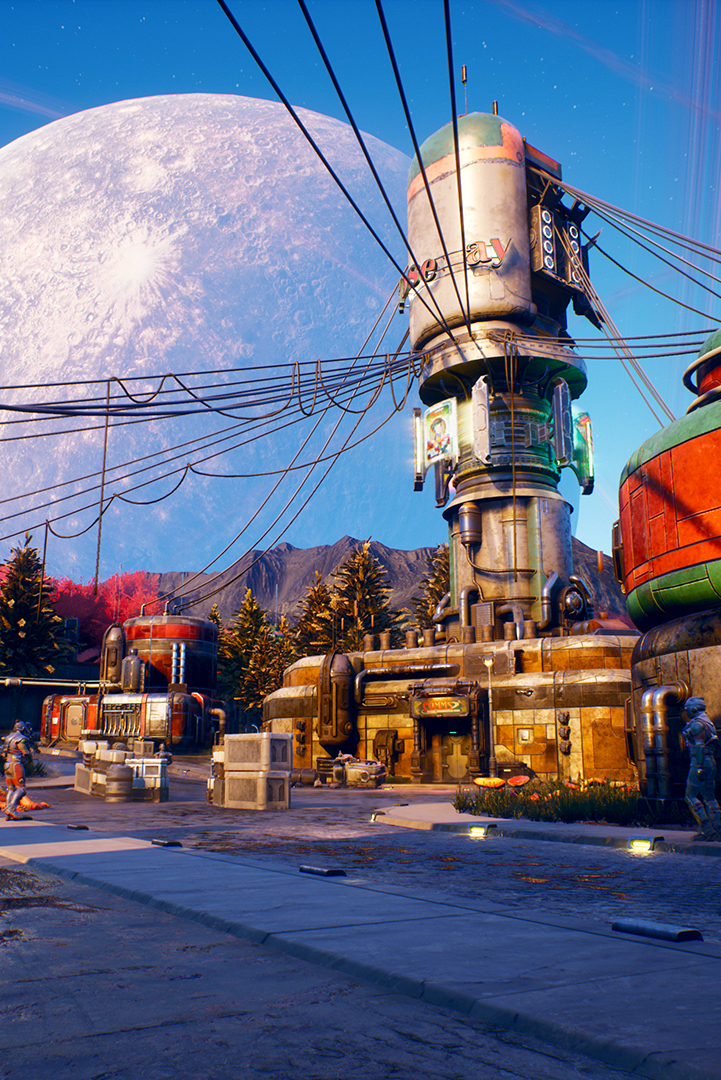
The Outer Worlds is an open-world science-fiction roleplaying game. Released in 2019, the game is inspired by the Fallout series of games, with the directors of the game, Tim Cain and Leonard Boyarsky, also being the creators of the Fallout franchise. The story follows “the Stranger,” a customizable character, who has been in cryostasis for 70 years aboard the Hope, a derelict ship floating through the Halcyon system. Dr. Phineas Welles, a mad scientist, boards the Hope to save the colonists. He only has the resources to wake the player up and, after joining him, the player is sent on a series of missions to collect resources to wake up their fellow colonists, which leads them to different planets and settlements in the Halcyon system. Along the way, they recruit people to their team: their objective changes into taking on the Board and the corporations that run the system.

The game shines with its writing, which is at times humorous and serious, but always thoughtful in its execution. The player is given absurd response options when communicating with various characters, but the writers understand when and where to pull back the humor enough to allow the significance of the events within the game stand for themselves. The player will sometimes be penalized for a certain choice—they may choose not to take on a quest, for example—but the dialogue options are not designed for “scoring” or punishing the player needlessly, though the actions still feel consequential. Like in the Fallout series, communication and player choice are important parts of the game, and the emphasis rests on these features rather than the combat, which is a standard first-person shooter.

The Halcyon system does not have a government in the traditional sense; instead, it is governed by ten corporations who together form the Halcyon Holdings Corporation (HHC). The HHC, referred to throughout the game as “the Board,” represents the primary antagonizing force in the game. Almost all the colonies and every planet are claimed by at least one corporation, with each one creating its own unique products and operating its own paramilitary force to protect its assets. Loyalty to corporate interests is paramount among Halcyon citizens, and the corporations go to great lengths to ensure workers are loyal and rebellions are quashed quickly. One HHC memo states, “please be reminded that acting against the interests of the corporations is acting against the interests of humanity,” emphasizing the connection between human status and the role of labor in the system.

Corporations are a common feature of many science fiction media, though their roles vary. For some, the corporations remain in the background, only existing to provide the reader, viewer, or player some level of recognition or worldbuilding. For others, particularly in the cyberpunk subgenre, corporations take on the role of government and represent the merging of consumerist and political spheres. In these media, a further subgenre is the self-referential parody, the texts that both portray the corporation as an evil entity, while presenting a distinct self-awareness. The Outer Worlds doesn’t necessarily break the mold in this regard, but it does provide an interesting text through which to examine corporate parody, and the setting in space allows the game to plausibly experiment with corporatism as the governing economy and philosophy. That the game is cognizant of its own depiction and active association with corporate interests allows it to provide a setting in which a player can fully realize the ubiquity of corporations without affecting those interests in the real world.

The overall tone of The Outer Worlds is humorous—a deep contrast to the Fallout titles and many other science-fiction video games. The use of humor in the game is not unlike the novel Snow Crash, where Neal Stephenson parodies the science fiction romp to imagine a dystopic world governed by corporate interests. In this game, the use of humor emphasizes the absurdity of not only the situation, but how corporations are governing the system. The humor is physical and dialogical. For example, the slogan of one of the corporations, Spacer’s Choice, is “you’ve tried the best, now try the rest—Spacer’s Choice!” This slogan, a required statement by all Spacer’s Choice employees, is catchy and boasts an uncomplicated and easily memorable rhyming pattern. Upon consideration, the slogan is expressing just how mediocre Spacer’s Choice products are. And yet, SC is one of the governing companies in the system, with the CEO of its holding company, Charles Rockwell, serving as Chairman of the Board of the HHC. The company should, in a perfectly meritocratic environment, be a failure, and yet, in this system, the corporation is successful, ostensibly pointing out the emptiness of meritocratic systems.

Because of the game’s focus on the absurdity of the corporations, it is debatable if the full scope of the corporate greed that established civilization in the system can be fully experienced by the player—while the horrors of the corporate machine are seen, the emotional connection to them is one of ridicule. Dr. Welles is the voice of reason and adds weight to the unethical corporate actions, but the gravity of the situation he presents is broken up by farcical events, such as the frequent mechanical failures that plague his ship. While it makes for excellent storytelling, such events take away from the game’s anti-corporate messaging, making it feel hollow and self-interested. But to its credit, it would be nigh impossible for any corporate product to simultaneously possess an anti-corporate message that included itself to the point of affecting consumer behavior. Here, then, the role of humor is integral: the text’s message is presented as an invitation to the player to join the game at the shallow end of the pool. Rather than shoving them out into deeper waters, the player is left in their comfort zone to synthesize the game’s message with their own ideology. At some point, they may wade out into the deep end—but the responsibility of the game is squarely in the shallow side.


Sara Walker recently completed her Master’s degree in English/Creative Writing at the University of West Florida. Her thesis, a creative piece titled “Moderator,” features a fictional social media company that uses algorithms and AI to manipulate its users. She writes short science-fiction stories and published “Pensacola 2045” in the student literature and art journal, the Troubadour. She is a nonprofit consultant currently living in Virginia.

Some Thoughts on Capitalist Futures: An Excerpt from the SFRA 2021 Keynote


SFRA Review, vol. 51, no. 3

From the 2021 SFRA Conference


Some Thoughts on Capitalist Futures: An Excerpt from the SFRA 2021 Keynote

Lars Schmeink


I would again like to thank Graham J. Murphy and the executive committee of the SFRA for the kind invitation and the opportunity to speak at SFRA. It was a really enjoyable experience and I regret that it wasn’t possible in a personal format. When asked by the SFRA Review to publish the keynote, I had to admit to myself that it did not feel ready for publication in its current form. I feel it needs further exploration, giving me a chance to incorporate aspects that were cut short from the text, adding new thoughts from the discussions afterwards and so on. But I still felt that some form of it should be included in this issue to mark its presence at the conference, whose topic “The Future of/as Inequality” is just too entangled with the exploits of capitalism to not comment on it in one way or the other. This short essay is my way of letting you in on my thought process. I have trimmed the keynote ramblings and instead offer up an extract from my “50 shades of capitalism” and their expression in science fiction.

            So, as with the keynote itself, I wanted to start with a two preliminary remarks. The first is that the ideas expressed are largely based on my research for the “FutureWork” project, which is funded by the Federal Ministry of Research and Education. [1] And the second is a self-position. Given the intersectional nature of inequality, I would like to acknowledge that I am in many ways privileged: a white, male, cis-hetero European. But inequality is intersectional, and I would like to mention that I am a first-generation academic, struggling my whole professional life with the precarity that has become so endemic to academia. And I struggle still to this day without a full-time and secure position, even though funding from a Federal source sounds like quite a feat. The irony of this is not lost on me. This essay, then, wants to explore the underlying socio-political construction that enables, entrenches, and arguably generates these inequalities. Yup, you guessed it: It’s capitalism.

Following Chris Harman, I would argue that capitalism is the central reason for many, if not most, of the problems, we are facing:

Capitalism transforms society in its entirety as its sucks people […] into labouring for it. It changes the whole pattern by which humanity lives, remoulding human nature itself. It gives a new character to old oppressions and throws up completely new ones. It creates drives to war and ecological destruction. It seems to act like a force of nature, creating chaos and devastation on a scale much greater than any earthquake, hurricane or tsunami. Yet the system is not a product of nature, but of human activity, human activity that has somehow escaped from human control and taken on a life of its own. (11)

Thus, when thinking about the future as/of inequality, I return, evermore, to the idea that the central aspect we need to address is capitalism. As Marc Fisher argues, we need to articulate “new economic science fictions” as it becomes a “political imperative” to oppose capitalism and counter it by “economic science fictions that can exert pressure on capital’s current monopolisation of possible realities.” In this essay, then, I want to pause and consider what futures our current science fiction has in store for us.

There are so many different forms of capitalism that it is hard to limit one’s exploration, so I decided against the more “classical” forms such as mid-20th century industrial capitalism or European-style Rhine capitalism. And I also excluded attempts to paint capitalism more positively, such as sustainable capitalism or green capitalism, both of which argue that the structure of capitalism can be used to promote ecological policy. Instead, I describe today some examples of what I call the “50 shades of capitalism” of the 21st century, which we encounter in an ever-growing amount of scholarly work.

            A good and recent example is what Naomi Klein has termed “disaster capitalism,” by which she means “orchestrated raids on the public sphere in the wake of catastrophic events, combined with the treatment of disasters as exciting market opportunities” (6). In Germany, we are currently seeing examples of this in the way the Corona-crisis is being handled with disaster capitalists making huge profits of medical masks, testing, and app development. And I am sure there are similar examples in other countries around the globe. In popular culture, Steven Soderbergh’s science-fictional film Contagion (2011) shows us Alan Krumwiede (Jude Law), who peddles a homeopathic drug called Forsythia through creating fake news stories, ending up making millions in stock options.

Biocapitalism, as another example, takes “materials such as egg-cells, sperm or organic tissue […] as disposable things” and uses them for “processes for capitalist accumulation” (13), as Susanne Lettow argues. The human (and non-human) body—not its labor, but the biomaterial itself—generates value. A famous example here would be the immortal cell line taken from Henrietta Lacks in 1951, which is to this day used for research and capitalist exploitation. Thierry Bardini takes this concept further, extrapolating a “genetic capitalism” (130) that will extend the idea of biocapitalism to include gene sequences, leading capitalist society not just to discipline or control its subjects but ultimately to generate them. And here we are fully in the realm of the future as inequality as expressed in the dystopian worlds of biopunk and its explorations of a posthumanity.

In the worlds of Paolo Bacigalupi, for example, posthumans are specifically engineered for obedience and servitude. In The Windup Girl (2009), the title character is described as an object—and here the novel can be criticized for including a problematic racialized and gendered reduction of the character. Emiko, the windup girl, is a Japanese invention created in the image of Geishas to serve the whim of a society growing old. Into her genetic make-up, her creators inject genes of loyalty and obedience taken from dogs and other companion species. A similar loyalty is bred into the warrior species, so called augments or half-men, in the Ship Breaker trilogy. [2] Tool, the character linking all three novels, has overcome this genetic programming which binds him to military obedience, when his generals slaughter his whole pack and leave everyone to die. Both Emiko, the server, and Tool, the military grunt have been created merely to fulfill a purpose within the framework of capitalist value production.

The economic frame behind the genetic engineering becomes even more obvious in Stephanie Saulter’s Gemsigns (2013), in which humanity becomes sterile, forcing massive shifts in demographics. Genetic engineering of servile workers becomes the solution to re-establish a growing economy, and posthumans are engineered so that they can fulfill a range of services, from autistic mathematical savants to superabled physiques for heavy work. The so-called ‘gems’ are property of large biotech corporations and only after years of exploitation are finally granted civil freedoms. The novel discusses the problematics of inequality, the need of the society to have gems work for the well-being of all. For genetic capitalism to function, gems need to be seen as objects, similar to dangerous machinery, in need of maintenance and supervision. In the novel, biotech corporations retain a narrative of differences of species in order keep up hegemonic superiority and the extraction of surplus value.

But not only does capitalism gain from the building blocks of life, controlling and genetically creating life, as Bardini argues. Capitalism has also found a way to accumulate profit from the “dispossession and the subjugation of life to the power of death,” as Subhabrata Bobby Banerjee claims, resorting to “death, torture, suicide, slavery, destruction of livelihoods, and the general management of violence” (1548). Based on Achille Mbembe’s idea of necropolitics, Banerjee calls this necrocapitalism. By using colonial legacies to declare continuous states of exception, necrocapitalism is able to define death worlds in which, as Warren Montag argues Giorgio Agamben’s homo sacer has found a sibling: “he who with impunity may be allowed to die, slowly or quickly, in the name of the rationality and equilibrium of the market” (11). 

With the effects of the plague thus comes the need for workers, the need to replace the dying labor to uphold the privileges of the elites—so a leading biotech company in the novel clones Asian women as slave labor. But with most men dead, the species also needs another way of procreation. The solution is the genetic engineering of the clones, splicing with lizard and other animal DNA to select for special traits such as the ability to regrow organs and function as donors, or the ability to self-reproduce through parthenogenesis. The so-called ‘Grist sisters’ are the ultimate commodity for necrocapitalist practices, as their organs can be sold to the rich, while their self-reproduction in litters of four to six clones allows them to be slowly worked to death with a constant flow of new sisters being born. Gatermann here pointedly argues that Lai employs these necrocapitalist practices as a critique of techno-Orientalism reducing the Asian body to a machine—a critique that here produces a “powerful image of colonial exploitation and dehumanization”. 

But so far, we have a blank spot in our discussion, that of Information, capital-I. There are a variety of ways to describe this—more shades of capitalism. Yann Moulier Boutang calls this “cognitive capitalism” and argues that it “is interested in the valorisation of intelligence and innovation” (41) based on “collective cognitive labour power” (37). Shoshanna Zuboff calls it “surveillance capitalism” that “claims human experience as free raw material for hidden commercial practices of extraction, prediction, and sales” and uses it for “behavioral modification”. Lastly, Mackenzie Wark argues that this is indeed not capitalism anymore, but something else, something worse. Wark claims that there is “a whole political economy that runs on asymmetries of information as a form of control” that should not be lumped together with capitalism as it is determined by a new level of abstraction:

It may even amount to a new kind of class relation. Sure, there is still a landlord class that owns the land under our feet and a capitalist class that owns the factories, but maybe now there’s another kind of ruling class as well—one that owns neither of those things but instead owns the vector along which information is gathered and used.

Wark calls them the ‘vectoralist class,’ which is exploiting its own labor form, the ‘hacker class,’ people “who produce new information out of old information.” Wark continues: “This is not capitalism anymore; it is something worse. […] The dominant ruling class of our time owns and controls information.” And vectors are present in all of today’s capitalist practices, be it GM, Nike, or Pepsico. Today, Wark argues, a “company is its brands, its patents, its trademarks, its reputation, its logistics, and perhaps above all its distinctive practices of evaluating information itself.” Vectoralism is post-capitalist in the sense of creating a new mode of production, a new political economy.

In SF we find this new political economy most prominently expressed in the British TV series Black Mirror (2011-19), with many episodes commenting exactly on the issue of information, vectors and who has access to them. In “The Entire History of You,” a device allows for the recording and playback of all of a person’s experiences, which leads to a close scrutiny of personal performances and decisions, every memory painstakingly available for revision. In “Be Right Back,” a new online service creates virtual duplicates of deceased love-one via all their social media history and the information that is available about them. “Nosedive” explores a society based on the rigorous evaluation of each and every social interaction, gathered in a social score that determines benefits and restrictions within this society. And “Hated by the Nation” investigates the idea of shitstorms and social media rage becoming a real threat when the hashtag #deathto is used to kill people with controversial media performances. In all, the series explores different examples of how vectoralism might be seen as the “something worse” that Wark warns us moves beyond ‘mere’ capitalism. Vectors of information, today, are engrained in all aspects of our social, cultural, economic, and political life—the vectoralist class thus exerting new power relations over us.

To conclude, then, science fiction today shows us how strong capitalism (or vectoralism) is still going strong. Whether we have to accept this, accelerate through them, or fight to abolish them depends on our ability to form new economic scenarios in which post-capitalist worlds are possible, in order for us to form them into realities. Science fiction can help us to understand how capitalism impacts us, but it can also help us formulate those new scenarios and hopefully save ourselves from the abyss that we are currently staring down into. Thank you very much. 

NOTES 

[1] Funded by the Bundesministerium für Bildung und Forschung (BMBF) under the funding numbers 02L18A510 and 02L18A511, supervised by the Projektträger Karlsruhe (PTKA).

[2]  A young adult series comprised of Ship Breaker (2010), The Drowned Cities (2012) and Tool of War (2017).

WORKS CITED

Banerjee, Subhabrata Bobby. “Necrocapitalism”. Organization Studies vol. 29, no. 12 (2008), pp. 1541–63. https://doi.org/10.1177/0170840607096386.

Bardini, Thierry. Junkware. University of Minnesota Press, 2011.

Fisher, Mark. “Foreword.” Economic Science Fictions, ed. by William Davies. Goldsmiths P, 2018. eBook.

Gatermann, Julia. “Groomed for Survival: Queer Reproductive Technologies and Cross-Species Assemblages in Larissa Lai’s The Tiger Flu.Technologies of Feminist Speculative Fiction, ed. by Sümeyra Buran and Sherryl Vint. Unpublished manuscript.

Harman, Chris. Zombie Capitalism: Global Crisis and the Relevance of Marx. Haymarket Books, 2010.

Klein, Naomi. The Shock Doctrine: The Rise of Disaster Capitalism. Metropolitan, 2013.

Lettow, Susanne. “Biocapitalism.” Krisis: Journal for Contemporary Philosophy vol. 2 (2018), pp. 13-14.

Montag, Warren. “Necro-economics: Adam Smith and death in the life of the universal’. Radical Philosophy vol. 134 (2005), pp. 7-17.

Moulier Boutang, Yann. Cognitive Capitalism, transl. by Ed Emery. Polity Press, 2011.

Wark, McKenzie. Capital is dead: is this something worse? Verso, 2019. eBook.

2020 Treasurer’s Report


SFRA Review, vol. 51, no. 3

From the SFRA Executive Committee


2020 Treasurer’s Report

Hugh C. OConnell


2020 Final Account Balances

  • Checking                     $66,897.90
  • Savings                       $20,466.82

2020 Income (Journal Subscriptions, Memberships, Donations, Savings Account Interest, Etc.)

  • Total Income               $15888.57

2020 Expenditures

  • Journal Subscriptions $14,727.26
  • Wild Apricot $1,001.16
  • Check Order Fee $45.2
  • Adobe Creative Cloud $254.27
  • 2020 Conference Costs $0
  • Conference Travel Grants $0
  • Postage $1.15
  • Accountants $635
  • WordPress/SFRA Review $96
  • Book Award $500

Total Expenditures   $17,260.09

Difference of Income to Expenditures        (- $1371.52)

Post-SFRA Executive Committee Meeting Notes


SFRA Review, vol. 51, no. 3

From the SFRA Executive Committee


Post-SFRA Executive Committee Meeting Notes

Sean Guynes
06 July 2021


Attendees: Gerry Canavan (president), Sonja Fritzsche (vice president), Sean Guynes (secretary), Hugh O’Connell (treasurer), Keren Omry (immediate past president)

  1. New Exec Composition: Development, DEI Officer, “At-Large” Membership
    a. We will need to rewrite bylaws and poll membership
    b. DEI Officer
    i. Someone in charge of making sure EC has a “diverse” perspective and who is in charge of a DEI committee that makes decisions and suggestions
    ii. Verdict: a good idea to add to EC, will explore specifics in a follow-up meeting
    c. Development Officer
    i. Someone in charge of bringing in money for SFRA
    ii. Keren suggests it’s difficult to see how “feasible” it is, esp. given how difficult it is to find people to take on positions like the Treasurer
    iii. Hugh suggests making this a “board-appointed” position, rather than an EC position, someone who could work on this for more than just a short term
    iv. Verdict: not to be added to EC but will begin looking for someone to appoint
    d. At-Large Members
    i. Voting members who represent some portion of the SFRA community, but don’t serve a more specific role, e.g. Treasurer
    ii. Keren suggests that our organization is quite small and there might be enough voices already on EC; we have business meetings to get people involved; and we are generally transparent as an organization
    iii. Verdict: Will discuss more with a stakeholder group
  2. Conference Standing Committee
    a. This is a great idea as one of several committees that work in tandem with the EC
  3. Next Steps
    a. For a soon-to-happen discussion with a stakeholder group:
    i. DEI officer
    ii. At-Large Members of EC
    iii. What committees would be worthwhile to get membership involved and feeling like they have a stake in SFRA?
  4. Polling the Membership?
    a. A Google form or Google doc (or both) that allows people to comment on our plan, and then propose a final decision and put forward a vote on any by-law changes.
  5. Shorter stuff:
    a. Elections
    i. Keren is having difficulty finding volunteers to be voted on for the treasurer position; she has reached out to several candidates
    ii. For VP, one candidate has come forward, and Keren has considered others
    iii. Several names were discussed and suggested by the EC
    b. Award Committees
    i. An email will go out soliciting volunteers for award committees
    c. SFRA Review
    i. Ian is gathering materials to present to us on peer review and a journals platform hosting solution
    ii. It was suggested that a stronger embrace of SFRA Review’s role in the organization would lead to greater feeling of participation from the membership, since the Review works with dozens of scholars each year
    d. Website Migration
    i. This will be happening at the end of 2021, as we transition away from Wild Apricot and to a new TBD web hosting platform

The SFRA Review’s Transition to Partial Peer Review


The SFRA Review’s Transition to Partial Peer Review

The Editorial Collective


With the explosive growth in scholarship on SF in recent times, the Editorial Collective feels that there are more scholars who need peer-reviewed scholarship to obtain and advance in their positions. As of the Winter 2022 issue, the SFRA Review will move to a peer-review model for some of its feature articles. This will happen gradually over the course of 2022: by the end of that year, we hope to be publishing three or four peer-reviewed articles per issue. We will of course need established scholars to perform peer review: you are more than welcome to volunteer by emailing us at sfrarev@gmail.com.

Scholars wishing to submit their articles for peer review should take care to properly edit and format their manuscript before sending it to us, and to clearly notify us that they wish their article to go through the peer-review process.

  • Articles should be a maximum of 8000 words in length, including notes and works cited.
  • Articles should conform to MLA 8th edition standards throughout.
  • MS Word .docx format only, or Google Docs should you not have access to Word.
  • Your first page should be a title page containing only your name and affiliation and
    the paper’s title.
  • Please anonymize your manuscript by making sure your name appears only on this title page; we will take care of disabling the automatic user tagging before sending the manuscript to peer reviewers.
  • Please make sure pages are numbered.
  • Please use endnotes, not footnotes. Do not link the note to the in-text number; this will require you not to use Word’s automatic notes.
  • Please avoid discursive notes when possible.

Articles not conforming to these guidelines will be returned rather than sent to peer review.

Once an article is received, two of our editors will review it and discuss its suitability for peer review. If the editors do not believe it suitable, we will either return it or propose that it be published as a non-peer-reviewed article. If the editors do believe it suitable, the submitter will be informed that it has been sent for peer review. For such articles, our intention is to have it reviewed by two scholars who are qualified to evaluate the work. Our intent is to spend no more than 60 days on the peer review process.

After receiving the results of the review(s), the journal editors will decide whether the article in question should be accepted as-is, perhaps with a few minor edits, or accepted only after major revisions, or rejected entirely. We will notify the submitter as soon as is practically possible after this decision is made.

Again, we will be doing this slowly and carefully. While scholars are encouraged to submit their work for peer review beginning now, please note that we will only accept two articles into the process for the Winter and Spring 2022 issues. This is not because we do not value your contributions; rather, we want things to move as smoothly as possible and are therefore being as careful as possible.

We are also planning a move away from WordPress to an established academic publishing platform, one that will allow for indexing in scholarly databases and DOI numbers. This will also be a gradual process, not least because it involves the appropriation of funds; we will keep you posted as the process unfolds.

We look forward both to your submissions and to bringing the Review, gradually, into the ranks of peer-reviewed journals in SF.

From the Editor


Summer 2021

Ian Campbell
Editor, SFRA Review


“Heat Dome” is the phrase we’ve all learned to associate with Summer 2021: while here in Atlanta, it’s just another warm but unremarkable summer, a friend in Oregon tells me it’s like living on a different planet out there. The Anthropocene is already here: it’s just unevenly distributed. We can hope that the science-fictionality of the present will encourage the powers that be and the general populace to consider the solutions SF might have to offer, but given that citizens wanting yet another term for Jim Crow ransacked the Capitol on live TV, this seems rather unlikely.

In cheerier news, we have a great deal happening at the Review, including our transition to partial peer review. We believe that with the exponential growth in the serious study of SF in recent times, it’s important to provide a platform where emerging scholars can receive publishing credit that will help them advance. We are of course absolutely looking for established scholars to help with the peer review, so you may expect a politely phrased request from us at some point in the future.

In this issue, we also have the annual results from the SFRA conference, including statements from award winners, reports from officers and a version of the keynote. We also have statements from candidates for executive positions, so please take the time to read these before you consider how to vote. In addition, we have a long-form piece on and a translated story by the Bulgarian SF master Lyuben Dilov, a special section on Mormonism and SF, some papers from the 2021 ICFA conference and our usual suite of reviews.

The Editorial Collective would like to welcome three new members and two members to new positions. Former associate editor Virginia Conn is now our managing editor; former fiction reviews editor Jeremy Carnes is taking Virginia’s place as associate editor. Jeremy is joined by Andrea Blatz, our other new associate editor; Michael Pitts is our new fiction reviews editor. Josh Derke has also just joined us in the new position of fiction editor, so if you’ve always wanted to write SF, he’s the one to reach out to. We look forward to serving you with more and better content in future issues.