Review of Supernova Era by Liu Cixin


Review of Supernova Era

Russell Alexander Stepp

Liu Cixin. Supernova Era. Trans. Joel Martinsen. Tor, 2019. Paperback. 352 pp. $27.99. ISBN 9781250306036.           


Liu Cixin, already a well-known author of hard science fiction in his native China, exploded onto the scene in the Anglophone world in 2014 following the publication his well-regarded novel, The Three-Body Problem (as the novel’s title has been rendered in English translation). The Three-Body Problem received nominations for both the Hugo and Nebula awards for best science fiction novel, winning the former in 2015, and was the first Asian novel to receive the prestigious award. The critical and commercial success of The Three-Body Problem, and its sequels, The Dark Forest and Death’s End, (the series was given the title Remembrance of Earth’s Past in translation) led to an interest in exploring the whole of Liu’s fiction, and the intervening years have seen the translation and publication of more of the author’s works. Supernova Era is the result of this continuing project.

Supernova Era was originally published in Chinese in 2003, three years prior to the Chinese release of The Three-Body Problem. Joel Martinsen, who also translated Liu’s novel The Dark Forest into English, was the translator of Supernova Era. The novel shows clear signs of belonging to an earlier stage of the author’s development, and a reader who picks up Supernova Era expecting the same brilliance that Liu displays in the Remembrance of Earth’s Past series will come away disappointed. The earlier novel does not quite rise to the same standard as the series that launched Liu to international fame. The characters in Supernova Era are somewhat two-dimensional and lack any significant development, and at times the plot feels almost episodic with sudden transitions between major sections within the novel. The prose is also occasionally a bit flat, lacking some of the power of Liu’s later novels.

While Supernova Era may not live up to the excellent standard that Liu set for himself throughout the Remembrance of Earth’s Past series, the novel stands on its own and demonstrates one of Liu’s most salient qualities as an author: the ability to propose a simple question and explore how one single change can alter the course of human history or perception. The central conceit of Supernova Era is that a nearby star goes supernova, bombarding Earth with high doses of radiation. In a departure from Liu’s love for hard science fiction and scientific accuracy, he does not dwell much on the biological effects of this radiation other than to say that it only affects older individuals whose DNA is less resilient to change. The result is that, shortly after the supernova is observed, humanity realizes that within a year all those above the age of thirteen will be dead, which naturally has significant ramifications for both the future trajectory of the human species and the civilizations we have spent thousands of years constructing.

The novel unfolds in three main phases, and in each, Liu demonstrates his ability to posit thought-provoking questions about the nature of technology and the human condition. In the first phase, humanity discovers, and must come to grips with the staggering conclusion that the destiny of the world will soon pass to children. This section explores the nature of education and the transmission of knowledge from one generation to the next as each nation is forced evaluate and asses each child and train them for a future career in the limited span of one year. In a particularly powerful episode, the Chinese government teaches the children selected to fill future roles as political leaders a powerful lesson in the logistical complexities of running a nation by showing them all the salt that the country consumes in a day – loaded into a series of transport trains. In the second phase, the adults have all perished and the children are forced to grapple with the new order where even small children are thrust into the world of adults, hastily educated and emotionally ill-prepared. This phase of the novel is best highlighted by a heartbreaking episode in which one of the main characters, trained as a pediatric nurse, struggles to care for the last surge of children born before the world’s adults perished. This, and other similar episodes push the novel into the final phase: children rejecting the old world and beginning to imagine what the new world would be. This reimagination is far from utopian and the world’s great powers agree to engage in a gamified version of warfare – potentially deadly but similarly governed by strict rules.

Each section raises poignant questions about education, diplomacy, politics, technology, and the artificial world humanity has constructed for itself. The novel’s consideration of these questions alone makes it worthy of investigation by any serious student of speculative fiction. It is made even more interesting to frequent readers of the genre as it presents a distinctly Chinese perspective on global politics and international relations. In particular, Liu’s depiction of the United States and its cultural values diverges from those found in Western speculative fiction and may be of interest to a new audience now that this novel has been made available in English.

While Supernova Era falls short of the excellent standard set by Liu himself in the Remembrance of Earth’s Past series, the novel warrants study and contemplation beyond its value as a window into Liu Cixin’s development as a writer. Supernova Era posits a remarkably simple change to our current world – with a reasonable scientific explanation – and allows the reader to observe how human nature plays out in the world that is science fiction. Ultimately, Supernova Era asks significant questions about some of the core constructs of modern society, government, economics, education, and the role of the family, all while providing an engaging work of speculative fiction.  

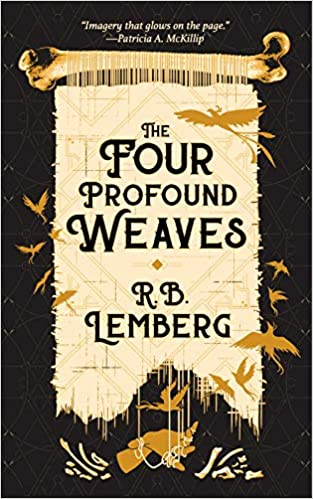
Review of The Four Profound Weaves by R.B. Lemberg


Review of The Four Profound Weaves

Jeremy Brett

R.B. Lemberg. The Four Profound Weaves. Tachyon, 2020. Paperback. 189 pp. $14.95. ISBN 9781616963347.


“This tale must be told four times”, said Uiziya, as if reciting a lesson. “Stitched with wind, stitched with sand, stitched with song, stitched with bones. Change, wanderlust, hope, and death. Only then will the ultimate secret become known (66).

Sadly, because of space, I cannot tell this review four times. This is a pity, because a typical review does not and cannot serve the utterly atypical R.B. Lemberg well. They are such a singular writer, their writing rich in both deep strangeness and lyric beauty, such as to be expansively beyond a typical work of fantasy. No writer I know of so populates their fantasy world with so many genderqueer and/or autistic characters (both sorely lacking in most standard SF&F). Their prose greatly resembles the graceful, stunning, nearly intangible carpets that feature in both this novella and its Nebula-nominated predecessor, “Grandmother-nai-Leylit’s Cloth of Winds.” Like those carpets, Lemberg’s fiction, particularly their Birdverse in which Weaves is set, is constructed of countless threads of bright color in the woof and threads of darkness and grief and suffering running crosswise in the warp. The latest Birdverse chronicle, The Four Profound Weaves, is likewise a beautiful piece of craft.

The first of the Four Profound Weaves is woven from wind. It signifies change”. (19) Change, transformation, shifts in identity – these are at the heart of Lemberg’s story. In fact, it is the heart of most of their stories. Intangibles such as wind and hope are woven into graspable objects, from something unseen into something that can be felt, touched, admired. Bones are made into cloths that robe assassins. In Lemberg’s Birdverse magical cosmology, the abstract concepts of geometry, are changed through the mystical use of special naming into usable works of protection and healing. Things and peoples and individuals are always changing in Birdverse.  

Yet, the most noticeable and outstanding characteristic of Lemberg’s Birdverse work is the acceptance and commonplaceness of genderfluidity. Moving between and among genders as a matter of course is a practice that generally escapes comments – to switch genders is much more the norm than the exception, despite some cultural differences on the subject. One of Weaves’ protagonists, nen-sasair, is a trans male who was originally introduced as the woman Bashri-nai-Tammah in “Cloth of Winds” but who transitioned before the beginning of Weaves. At one point he muses about his fellow protagonist, the weaver Uiziya e Lali, thinking:

I did not know that she was a changer like me. I never thought anyone was. I had never met others who went through the change in Iyar. They were banished or imprisoned or hiding or dead. But here, in the desert, changing one’s shape was a matter of ritual, of love, not of desperate secrets. (29)

Nen-sasair is a member of the Khana people (a rough Birdverse cultural analog to the Jews), among whose women both queerness and polyamory are accepted as a matter of course (as they are elsewhere in Birdverse). However, trans people are not. Change for nen-sasair is a psychological necessity and part of the natural order; his native Khana are lacking. They are less, in many ways, for not embracing the fluid nature of ongoing change. Uiziya’s aunt Benesret (the master crafter who creates the eponymous weaves) snorts at the notion that changing gender is foreign to the Khana, or indeed, to anyone. “That’s what he says. Changing is always and forever done. Everywhere, it is done; in open, in secret. He has gone through the change and so, I assure you, have others”. (59) And Uiziya herself notes, “It is not hard to be a changer among my people. I know that it is not true everywhere, but in the great Burri desert, changing your body to match your heart is not a thing to bleed over”. (27)

For Lemberg, change is a beautiful thing, a regular and welcome part of life and the human condition. Early in the novella, they describe nen-sasair’s transformation into what he calls his “true life” in the most poetic way.

But now I was here, far east and away from Iyar, in the great Burri desert. It was here, at this very place, in this dust, on the outskirts of the snake-Surun’ encampment, I had stood in my cloth made of winds, the weave of transformation my friends and my grandchildren had woven for me out of love. I’d lifted my arms to the sky and the sandbirds had come to me, sent to me by the goddess Bird and summoned by the cloth of winds. They were birds of bright fire that fell from the sky and cocooned me, until I could see and hear nothing except the warmth and the feathers enveloping me and the threads of the wind singing each to each until my whole skin was ignited by the sun, my body changing and changed by the malleable flame. And when it was done, I sang.

I sang as the wind and the feathers dissolved into sand under my feet; I sang because my transformation was complete. I sang the dawnsong – the sacred melody that the men of my people sing, standing on the roof of the men’s quarter every morning. (26)

The opposite of change is stasis, and stasis is unnatural. Uiziya and nen-sasair are travelling to the latter’s home city of Iyar to retrieve Benesret’s weave of hope from the Ruler of Iyar (“The Collector”) who hoards the beautiful and rare within his dark coffers in an attempt to stop time like an insect in amber. As he explains, “I want things to remain, sacred and sovereign and unchanging. I want to preserve what is best. It is a noble purpose”. (143) It is to rescue beauty and change from this dark imprisonment (albeit for their own purposes) that motivate the two protagonists to make the journey.

And as it turns out, the Ruler’s actions are even darker than at first supposed. In his behavior he stands in opposition to every one of the Four Profound Weaves: he refuses to embrace the natural inevitability of change, which he calls “a lie”. Rather than experience or trust wanderlust he would rather stay entombed within his palace. “Change is the world’s greatest danger…You rebel, you wander from place to place, you chafe at my rule, thinking that something else, somewhere else, would be better. It isn’t. But I save you. I am the one who is centered and stable, anchoring the whole world from my rainbow-tiered court, unmoved by world’s wildness, contained in my birdcage throne”. (120-121)

Rather than welcome hope and make it free to all, he warps it by offering it as a scrap of bait. As nen-sasair notes of him, “Hope. Hope has been perverted here, in your Rainbow-Tiered Court, into a thing only you can possess”. (145) By contrast, nen-sasair understands hope as a necessity of life, speaking of it in terms that any Jewish person—such as Lemberg themself—would find familiar:

It [the dawnsong nen-sasair hears] was hope. My hope, and the hope of all others of my people who sang it throughout the landmass. The hope that wherever we wandered, exiled, and unwanted, the dawn would still come for us. We had only to hold on. (107)

Finally, the Ruler fails to understand death, the final Weave. He seeks the carpet of death that is woven from bones, but only as a prize and a symbol of power. To that end he slaughters countless rebel woman and stores their bones in his dungeons, ready to have them used as mere tools in the crowning of his great and sterile collection. In the name of stability and a world where the frightening nature of change can never take hold, he acts supremely unnatural in trying to subdue hope and death. But in this, the Ruler must ultimately fail, because Lemberg knows that what is natural, what is true to nature and to oneself, cannot be suppressed. Towards the end of the novella, nen-sasair sings before the Ruler the truth:

“Bird’s feathers made the threads that Benesret wove into her great carpet of song; and the bone-threads Uiziya had made from the women you killed will now sing. Hope and death; the siblings are intertwined, and this is the mystery of the ever-changing desert. Hope cannot be given away, to you, or to anyone. Hope is the song which arises from silence where all our voices had been; all those locked away against their will one day will surge again, come forth with great exuberance, sweep the world in a reverberation of rainbow more true than your Rainbow-Tiered Court.” (168)          

Lemberg ends the novella with hope, hope at the promise of renewal and the excitement of new adventures. This is of a piece with the rest of The Four Profound Weaves, which is remarkable in its truths about the changing nature of life, poetic in its prose, and profound in its understanding of humanity.

Alternative History and Afrofuturist Bricolage in N. K. Jemisin’s “The Effluent Engine”


Alternative History and Afrofuturist Bricolage in N. K. Jemisin’s “The Effluent Engine”

Emily Lange


N. K. Jemisin has received well-earned critical attention for her novel-length works of speculative fiction, especially after her Hugo Awards triumphs in 2016, 2017, and 2018. Her collection of short fiction, How Long ‘Til Black Future Month (2018), brought together pieces of several genres, both previously published and unpublished materials. The collection includes “The Effluent Engine,”[1] which follows a Haitian spy through New Orleans in an alternative history adventure. Jemisin’s heroine must negotiate the new ideals of a liberated Haiti and the internalized norms of New Orleans’ Creole society as she attempts to garner vital strategic information. The story highlights intersectionality on a personal as well as a group level in a nuanced exploration of how we can change our worlds. As argued by scholars such as Sofia Samatar, alternative history itself can be a powerful tool of Afrofuturism. Alongside the concept of bricolage—a process of merging, reshaping, and redefining—alternative history highlights the confluence of individual and group identities within Jemisin’s story. Applying Samatar’s reading of alternative history and bricolage foregrounds how Afrofuturist techniques in “The Effluent Engine” explore the identities of intersectional characters, their community relationships, and their connection to place.

“The Effluent Engine” presents an alternative history where dirigibles and access to other technologies changed the course of Haitian struggles for independence. The main character, a Haitian spy named Jessaline, must enter the slave state of Louisiana to seek an engineer who can further refine the fueling mechanisms for these powerful airships. While Jessaline’s contact is unwilling to help lest it risk his position in New Orleans’ Creole society or prompt backlash from the white leaders of Louisiana and the United States, his sister, Eugenie, proves her knowledge of chemistry can help develop a dirigible engine powered by the effluent, or waste product, of sugarcane processing. Pursued by white supremacists hoping to steal the plans and sabotage Haiti’s independence, Jessaline and Eugenie flee to Haiti intent on developing the engine as well as their romantic relationship.

Speculative fiction as a broad category embraces alternative histories like “The Effluent Engine” for their ability to reimagine both the past and the future. Indeed, Sofia Samatar points out in “Toward a Planetary History of Afrofuturism” (2017) that alternative histories engage with both points in time simultaneously: “To propose an alternate history is to propose that history can be altered, to change directions, to inaugurate an alternate future.” (Samantar, 187) One cannot imagine an alternative past without carrying forward the implications of such changes. In picturing a new history for Haiti, readers are inherently asked to apply these changes to the arc of history. A rich alternative history crafts space for readers to question how such alterations would affect their present time. While some references to the arrest of Toussaint L’Overture place the action of the story in the years following 1802, the lack of dates overall points to their middling importance to the narrative; Jemisin does not need to offer a blow-by-blow account of the changes to history to tell a compelling story that prompts readers to think about large-scale shifts in society. Jemisin emphasizes the transformative aspects of alternative history through characters who are invested in imagining new futures.

At the core of the changes to history in “The Effluent Engine” are Haitian airships, which allowed them to fight back against French colonial forces. Jessaline’s mission is an attempt to find a scientist who can turn the by-product of rum, the titular effluent that produces methane, into a cheaper and plentiful fuel source. Innovative use of by-products and discarded materials is a theme within many pieces of Afrofuturist media, which Samatar evokes in her discussion of the terms bricolage and bricoleur. (177-178) Initially coined by Claude Lévi-Strauss, bricolage was used to distinguish (white) Western invention and what Lévi-Strauss deemed the lesser reinvention, “proceeding in a haphazard fashion and working with second-hand materials, the leftovers of various civilizations”. (Samatar 177) Samatar aligns herself with creators such as Nnedi Okorafor, who uses the phrases bricolage and bricoleur in her novel Who Fears Death. Bricolage celebrates the process of excavating history: “it is from these historical fragments that the data thief or bricoleur constructs visions of what is to come…the bricoleur detaches objects from time, making them available for the creation of new histories.” (Samatar 178) The process of reclamation and reformation is paralleled, for Samatar, by the formation of cultural independence and positive engagement with technology, as she argues that “Afrofuturistic bricolage asserts black people’s right to use whatever is at hand, to enter the technologically enhanced future through whatever door is closest and to do so without assimilation into a global monoculture.” (Samatar 178)[2] Haitian use of effluent as a fuel source repurposes the by-product of a process that itself was intimately connected to colonization. The economic benefits to France from rum and sugar production are re-integrated into the new, independent Haiti as something which has the potential to preserve the nation’s survival. Jessaline’s mission, therefore, is not only espionage but tied up with the process of bricolage.

Beyond the genre of the story itself, “The Effluent Engine” engages with personal uses of alternative history and bricolage as well as collective or group uses of the concepts; Jessaline is a notable character who uses these tools to create disguises and false histories for herself in her role as a spy:

She was indentured, she told the captain, and he had waved her aboard without so much as a glance at her papers (which were false anyhow). She was a wealthy white man’s mistress, she told the other passengers, and between her fine clothes, regal carriage, and beauty – despite her skin being purest sable in color – they believed her and were alternately awed and offended. She was a slave, she told the dockmaster on the levee; a trusted one, lettered and loyal, promised her freedom should she continue to serve to her fullest. He had smirked at this, as if the notion of anyone freeing such an obviously valuable slave was ludicrous. Yet he, too, had let her pass unchallenged. (Jemisin 78)

With every movement, speech, and look, Jessaline creates an alternative history for herself which both protects her and her nation while simultaneously eating away at the solidity of her own identity. In a single journey as described above, Jessaline navigates the elision between identities with practiced ease. Later, when she must change hotels to avoid the pursuit of white, anti-Haitian independence spies, she uses padding which “rendered her effectively shapeless—a necessity, since in this disguise it was dangerous to be attractive in any way”. (Jemisin 99-100) The disguise is meant to make her appear both older[3] and poorer; it includes alterations to her walk and a patched dress. The implication that appearing attractive and poor would make her a target comes across clearly; when she dresses better, Jessaline references a white owner or takes the guise of a white man’s mistress. Through her disguise, her attempts at anonymity are successful: “She was, for all intents and purposes, invisible”. (Jemisin 100) In both of these alternative histories of herself, it is not her class that provides protection, but the implication that she is under a white man’s control. But what effect does this constant construction of alternative histories have for Jessaline herself? Her identity itself is fluid as her goals change and she comes across different challenges. While her disguises can act as a shield, the necessity for a shield itself takes a toll.

Jessaline’s assumed surname for the start of the story, Dumonde, offers a hint at her attempted invisibility. The French du monde, meaning “of the world,” obscures a sense of specific nationality or community. As a spy, Jessaline must attempt to be a member of any and every nation where her mission might take her, and as such, she cannot risk solidifying her identity. Jessaline embodies the bricoleur in her relationship with the names she uses. Her true name, which she reveals to Eugenie in an attempt to gain her trust, does not seem to resonate with her personally. She explains “My name is Jessaline Cleré. That is the name of the family that raised me, at least, but I should have had a different name”. Her actual name does not provide her with a sense of identity, because she feels that she “should have had a different name, after the man who was my true father”. (Jemisin 92) Jessaline is the illegitimate child of Toussaint L’Overture, one of the best-known leaders of the Haitian Revolution. Jessaline’s attempt to identify with her father through his family name is frustrated by her status as the daughter of his mistress, revealing yet another source of liminal fluidity at the core of Jessaline’s identity. Her family, we are left to interpret, is itself a collection of pieces, and Jessaline is the bricoleur attempting to bring the disparate elements into harmony.

Jessaline embodies the use of alternative history and bricolage as an individual, but when considering the group identities at play in “The Effluent Engine”, New Orleans provides a key example. Jemisin’s depiction of New Orleans emphasizes this assemblage of identity, narrowing in on the liminality of the free Creoles such as Norbert and Eugenie Rillieux. Caught between social strata, Jessaline describes the Creole class as “a closed and prickly bunch, most likely because they had to be: only by maintenance of caste and privilege could they hope to retain freedom in a land which loved to throw anyone darker than tan into chains.” (Jemisin 78) The retention of hierarchical structures in the relative freedoms of Creole society stands as a question for Jemisin’s alternative Haiti, whether internalized norms have persisted after revolutionary change. Creole society’s retention of strict hierarchical boundaries is one example of normative class division making itself known, as the social group ostensibly outside of hegemonic control reconstructs the same or similar categories of division and power. The tensions between the norms of Creole society, particularly regarding feminine sexuality, come to the forefront as Eugenie begins to vocalize an imagined life with Jessaline in Haiti.

Even though the alternative history of Haiti shapes the entire story, “The Effluent Engine” never directly engages the alternative space. The fact that readers never see Haiti itself in the story encourages the perception of Jemisin’s Haiti as a potential utopia. Jemisin inverts the contemporary narrative of Haiti as a disaster-wrought refugee nation, especially as Eugenie and her brother Norbert are forced to flee their home in New Orleans. In “The Effluent Engine,”Haiti as a nation embraces the method of re-examination of that which is cast aside, a nation of bricoleurs. Airships function as more than the trappings of a steampunk-influenced alternative history here; rather, they are the site of a collective bricolage. “Producing rum is a simple process with a messy result; this effluent, namely, and the gas it emits, which until lately was regarded as simply the unavoidable price to be paid,” Jessaline explains to Norbert Rillieux. “We wish you to develop a process by which the usable gas—methane—may be extracted from the miasma you just smelled.” (Jemisin 81) The production of sugar and rum has decimated the landscape in parts of Haiti, Jessaline affirms, hinting at the ecological impacts of colonial production methods. Even when independent Haiti builds upon its relationship with sugar, not completely discarding it, but reframing the ecological relationship such that the country may have a more balanced impact on the landscape and fuel their airship engines. Jemisin’s Haiti engages with bricolage not only in the use of effluent as a fuel source but through examining how elements of the colonial past can help form an independent future.

Part of this imagined future for Jessaline and Eugenie comes from the alterations Haitian society has already undergone in its own history and accepted ways of being. By creating an alternative history for Haiti, Jemisin as an author has opened the door for greater representation of sexual preference. Jessaline explains to Eugenie that the revolution changed circumstances for women in Haiti, and that “it is not uncommon for a woman to head a family with another woman, and even raise children if they so wish”. (Jemisin 96) The word “wish” becomes operative here; couples have agency in choosing whether or not to have children, rather than a sense of responsibility to reproduce. But Eugenie’s eventual enthusiasm does not seem to acknowledge the radical potential of changes in Haiti; rather, she still relies upon the norms she finds familiar, such as the fact that one partner would provide for the family as in the typical heterosexual couples in New Orleans. Eugenie declares her concern for Jessaline’s work as a spy, “I’m not fond of you keeping up this dangerous line of work. My inventions should certainly earn enough for the both of us, don’t you think?”, and seems more than willing to step into the breadwinner role which she has seen enacted during her life in New Orleans, “there’s no reason for you to work when I can keep you in comfort for the rest of our days”. (Jemisin 111) Going to Haiti means that Eugenie can follow her passion for science both openly and lucratively, but she does not pause to ask whether Jessaline’s work as a spy provides her with similar fulfillment. Since Eugenie has only recently acknowledged her sexuality, one could interpret this as a part of a newly accepted identity trying to retain some of the structures of socially acceptable relationships, i.e. heterosexual, patriarchally-organized couples. Jessaline, as an individual, is once again caught in between, this time between the social openness of Haiti’s new society and the stricter norms of New Orleans Creole expectations. On the level of group identity, Haitian society allows for alternative ways of being, the crafting of alternative histories, but individuals such as Jessaline and Eugenie must still navigate the internalized norms embedded in their conceptions of possible futures.

Jessaline’s personal liminality reflects the transitions taking place around the main characters in “The Effluent Engine” and the resulting tension between new ideals and internalized norms. Both individuals and larger societies must negotiate such tensions to survive. Jessaline must create alternative histories for herself to be a good spy, but these take a toll on the solidity of her identity, which she must then attempt to reassemble in her role as a bricoleur. On a larger scale, the society of both Haiti and New Orleans must deal with different types of bricolage to make sense of their histories and strive for alternative futures. “The Effluent Engine” captures the struggle for socio-cultural survival and the balance between persistence and change. Jemisin’s short story is not only an example of richly imaginative Afrofuturism but a beautiful example of how authors and scholars can use tools of alternative history and bricolage in their writing to highlight both personal and group identity.


[1] Also published in Lightspeed Magazine in 2011.

[2] Divorced from the racially-charged comparisons of Lévi-Strauss, one might see how bricolage infuses the work of Black artists throughout history. The collages of Romare Bearden (1911-1988) are just one example of the work of African American collagists who reconstruct images out of seemingly disparate pieces. Visual artist Kara Walker’s installation piece Fons Americanus (2019) in the Tate Modern highlights this fusion of forms, echoing the Queen Victoria memorial, the Trevi Fountain, and Confederate statues in the United states while depicting images of slavery and black resistance (Bakare). Walker reclaims forms historically used in white European and American contexts to critically engage with historical and present harms and trauma.

[3] In order to make herself “disappear”, Jessaline chooses to make herself seem older, another layer of armor alongside the pillows she uses to make herself appear shapeless. With her obvious desire to avoid sexual violence, Jessaline ages herself in an attempt to seem sexless. Her strategies for personal survival rest upon the perpetuation of a belief that older people, and older women in particular, cannot be attractive. While not imperative for the argument of this article, acknowledging the intersectionality of both character identities and the identities they intend to evoke in the imaginations of others requires an understanding of the problematic character of essentializing conceptions of age.

WORKS CITED

Bakare, Lanre. “Tate Modern Fountain Tells ‘Jarring’ History of British Empire.” The Guardian, 30 Sept. 2019. http://www.theguardian.com/artanddesign/2019/sep/30/tate-modern-fountain-tells-jarring-history-of-british-empire. Accessed 16 Feb. 2020.

Jemisin, N. K. “The Effluent Engine.” How Long ‘Til Black Future Month, Orbit, 2018, pp. 75-112.

Samatar, Sofia. “Toward a Planetary History of Afrofuturism.” Research in African Literatures, vol. 48, no. 4, 2017 Winter 2017, pp. 175–91.

Emily Lange is an undergraduate student at Elon University studying English Literature and Philosophy. She is completing her two-year thesis on representation and intersectionality in contemporary speculative fiction. She has an article in FEMSPEC and a forthcoming piece in The Journal of Popular Culture. Her research interests include the pedagogical uses of speculative fiction, work at the intersection of philosophy and literature, and archival ethics.

Egypt as a Test Case for Gender in Arabic Science Fiction


Egypt as a Test Case for Gender in Arabic Science Fiction

Emad El-Din Aysha


The status and portrayal of women in Arabic science fiction is at a precipice in the post-Arab Spring era. Using Egypt as a test case, it emerges that the number of women contributing to the genre is on the rise, and that the presentation of women is generally positive, if not very in-depth and challenging. The politics and economics of literary production is the greater issue, holding back all authors regardless of gender.

Like many literary and cultural imports from the West such as women’s literature and feminism, science fiction is new to the Arab world. Nonetheless, the record of Arab SF is generally good, given that one of the first writers of science fiction in Algeria was Safia Ketou (1944-1989), with her short story “La Planète Mauve” (1969). One of the first authors of SF in Kuwait, likewise, was Taibah Al-Ibrahim (1945-2011), author of a trilogy published in the 1980s-90s on cloning and cryogenic freezing, where it is the men who lose their sexuality thanks to these modern technologies (see below). One of the first and most distinguished SF authors in the UAE is Noura Al-Noman, with her award-winning Ajwan trilogy, beginning in 2012. The problem, however, is continuity. There haven’t been any distinguished women SF writers in the entire Maghreb (Algeria, Morocco, Tunisia and Libya) since then, while countries like Kuwait and the UAE are latecomers, with only a handful of SF authors, the bulk of whom are men.

Then there is the ever-tricky issue of content. Are female characters portrayed in a positive light? Do they share equally with men in the building of the future, and what is the status of gender in these imagined future worlds, as illustrated through family, sexual relations, love and intimacy? Modern Egyptian literature and pop culture certainly has its own species of gender-related prejudices, and in many cases has actually imported stereotypes from the Western world. One oft-cited case is Shakespeare’s The Taming of the Shrew, adapted into an Egyptian black and white classic film Beware of Eve (1962), with the ‘modern,’ educated, assertive woman portrayed as the unfeminine shrew. (Zeyada, 2020; “Shakespeare’s Day”, 2007) Watching Egyptian black and white cinema, you feel like you’re watching cowboy epics, with a polarised separation of women either into the god-fearing, conservatively dressed housewife or the scantily-clad saloon girl. The older species of fantasy, fairy tales, is often captivated by this same polarised perception of the feminine—or Snow White and the Evil Witch, as Sandra Gilbert and Susan Gubar famously put it. (Eid, 2020; Tatar, 1999: 23, 28, 36-44; Gilbert and Gubar, 1984: 36-43) Such stereotypes emerge in modern SF guise via the vehicle of toxic male and female characterisations, as SFF author and literary instructor Christina ‘DZA’ Marie[1] has amply documented. (Marie, 2020; 2019) One particular trope we shall touch on below is the mad male scientist inventing the seductive female robot on the Pygmalion model, to cite AI expert Stephen Cave (2019). There is the added problem of the appropriation of science by men, relegating women to the realm of magic and superstition; I Dream of Jeannie being a classic example used by John Carlos Rowe (2011) and Marie Lathers (2009).

Syrian researcher and author Muhammad al-Yassin insiststhat female characters in Arab SF works are generally portrayed in a positive light, regardless of the gender of either the author or the protagonist. The problem, however, he explains, is making effective generalisations, given the small number of Arab SF authors, let alone the even smaller number of female authors. (Al-Yassin, 2020) Egypt as a test case helps solve this problem, since Arabic SF essentially began in Egypt and has been hampered by much the same problems as the rest of the Arab world. Having spoken to many an Arab author, I found repeatedly that the first examples of Arabic SF they ever read were Egyptian, often inspiring them to become authors in the genre themselves. Comparisons are called for with other Arab countries, no doubt, but Egypt is still leading the pack quantitatively and qualitatively.

Making sense of the Egyptian experience can be helped through periodisation. What were the major concerns of the genre as a whole, not just individual authors, and why and how has this changed over time? How did these authors look at gender and how did this change over time, and was the presence or absence of female writers a contributing factor to this? These are the questions that will be answered in the section below, followed by a critical appraisal and set of final remarks on the future direction of gender in Arabic SF, post-Arab Spring.

BETWEEN CONTEXT AND CONTENT

Egyptian science fiction goes essentially through four phases. (El-Zembely, 2018) The first in the 1950-60s was helmed chiefly by playwright Tawfik al-Hakim and Islamic thinker Mustafa Mahmoud, with some mainstream authors trying their hand at SF. The second in the 1970s-80s began with the ‘dean’ of Arabic SF, Nihad Sharif, since he was the first to specialise in this genre, along with some other mainstream authors. The third critical phase stretches from the 1990s to 2011 when the Egyptian SF scene was dominated by the pocketbook (pulp sci-fi) series led by Nabil Farouk, Ahmed Khaled Tawfik and Raof Wasfi; the beginning of mass readership of SF in Egypt and many other Arab countries that read these pocketbooks. Finally, the fourth and current phase, from 2011 to the present, begins with the January revolution and the launch of the Egyptian Society for Science Fiction (ESSF) in 2012 by Dr. Elzembely, a friend of Nihad Sharif, Nabil Farouk and Mustafa Mahmoud.

There are several layers of context lying behind this periodisation, some more unique to Egypt and some more general to the Arab world. Generally, there is little to no institutionalisation of SF in the Arab world. There are few associations and print magazines and little to no attention from the Ministry of Culture at the level of organising conferences or translating SF into Arabic,[2] with the small exception of Syria, thanks to the diligence of Dr. Taleb Omran, the country’s top SF author, who began writing in the 1980s. Institutionalisation in Egypt only began in part thanks to the Arab Spring, starting with the ESSF and then the Nihad Sharif Cultural Salon and some advocates in the Egyptian Writers’ Union. Another common problem across the Arab world is the state of the publishing industry, with a lax intellectual property rights regime and outdated business model when it comes to distribution and profits, (Maklad, 2014) along with the usual political restrictions. (Qualey, 2013) The situation is more pronounced in Egypt, in fact, since authors often have to shoulder the burden of proofing their own texts and contributing financially to publication costs. Editors only enter the picture when it comes to academic texts, and literary agencies are almost unheard of, a common problem in Arabic-speaking countries.

Another problem more peculiar to the Egyptian marketplace is the format for SF and other genre publications, a pattern that took root during the third phase thanks to pocketbooks. Full-length novels are making their way onto the bookshelves, but most novels are within the 20,000 word range, while short story collections are still more popular—and the shorter the short story, the better. This places undue restrictions on you when it comes to plot and character development. Ahmed Khaled Tawfik only began writing full-length novels, beginning with Utopia (2007), later in life, mainly to please the critics and only after gaining a huge following among young readers. (Aysha, 2018)

Ahmed Khaled Tawfik is emblematic for another reason entirely, since most of what he wrote was horror and adventure. A generation of readers-turned-writers came to emulate him, which is why most SF writers in Egypt do not write only SF. Horror, detective fiction, dark fantasy and Young Adult are the more popular genres. All Arab authors traditionally have to make ends meet by having a regular job elsewhere: as a civil servant (like Naguib Mahfouz) or a medical profession (Yousef Idris), schoolteacher, IT expert, translator or graphic designer. In short, the potential out there for SF is huge, but the market is holding everything back, while the literary establishment takes little to no interest in SF.

Women only enter the picture in the second phase, with Dr. Omayma Khafagi’s classic novel The Crime of a Scientist (1990), but no other female authors emerge after that until the fourth phase, with novelists like Basma Abdel Aziz, Asmaa Kadry, Sally Magdy, Dr. Kadria Said and Dina Hekal. This is a deceptively short list of names, as the number who have written short stories is much, much larger, indicative of a swelling of the numbers of female writers attracted to this genre. We can use the ESSF’s anthology series Shams Al-Ghad [“Sun of Tomorrow”] as an example. The number of stories by men compared to women is: Volume One, 4:1; Volume Two, 8:4; Volume Three, 9:5; Volume Four, 15:8; Volume Five, 14:9; Volume Six, 21:9—a slow but steady increase. Admittedly, Volume Seven was 23:2, but this was an exceptional issue dedicated to resistance literature and military SF: some stories by female authors designated for this volume went into other contests, so the numbers aren’t as representative as they seem. While progress has been incremental, the prospects are good, as far as the female contribution to Egyptian SF goes: one of the most critically acclaimed, and internationally recognised, Arab dystopian novels published is none other than Basma Abdel Aziz’s The Queue (2013). Equally important is the fact that women writers in Egypt testify to no discrimination upon entering the world of SF, despite the economic and institutional constraints we all face, men and women. (“In Conversation”, 2019) Even newcomers like Asmaa Kadry, an Egyptian writing and publishing in the UAE, have confirmed this. (Aysha, 2020) She also feels no need to have female protagonists only leading her storylines and is proud to write about men accurately. When queried as how to improve the status of Arab women in SF, she answered: “To just think of them as ‘writers’ not ‘women writers’, you know what I mean? The written word is an expression of the human soul, not the human body, and souls have no gender.” (quoted in Aysha, 2020)

This statement is illustrative of the experience of early Egyptian SF, since gender concerns were conspicuous by their absence. Khafagi’s The Crime of Scientist, purportedly a story about a scientist who makes a human-ape hybrid, has shades of Pygmalion in it, since the guilty scientist in question is a man while the victim is his wife, and the hybrid child is their daughter. Nonetheless, the focus here wasn’t gender, but fear of progress in the form of a searing condemnation of genetic engineering. The novel shocked many critics, because the author herself was a geneticist and trained in the Soviet Union. (Al-Sharouni, 2002: 75-81) The first two phases in Egypt were characterised by a persistent problem shared by many SF works in the Arab world, namely, a profound hostility, fear and mistrust of modern science. There was no hostility to science and technology as such, but to the way they were employed by Western modernity. The classic statement of this in Arabic SF, often cited by Western academics themselves, were the two dystopian Moroccan novels The Blue Flood (Campbell, 2017) and The Elixir of Life. (Campbell, 2015) This was even more pronounced in Egyptian SF works. Mustafa Mahmoud praised mysticism and the world of the soul in the face of science in his novels The Spider and Out of the Coffin, while A Man Below Zero is almost a dystopian novel set in a cosmopolitan future world of material plenty but spiritual aridity and emotional emptiness.

To clarify how gender fits into this, we have the example of Tawfik Al-Hakim’s In the Year One Million (1947), set in a future world where people live forever,  so there is no longer any sex, procreation, love or major biological differences between men and women. There is no awareness of change at all. People live indoors under artificial lighting and never sleep and aren’t aware of the distant past, forever living in the here and now. No art or poetry exists. Then, a scientist makes an archaeological discovery, the bones of an ancient man; he becomes aware of the possibility of death and nothingness and that their world could come to an end. A movement forms around him, it is quashed but persists nonetheless, and with that, death becomes a possibility again, so biological urges and procreation begin to return. The soulless world of the present, where humankind worships and is ruled by machines, gives way to the belief in God the creator. (Al-Sharouni, 2002: 106-110) It is not so much gender that is at issue but modernity and the fear that technological bliss will unmake humanity; with no difference, there is no creativity, art, passion or emotion. Gender is incidental. Anxieties about modernity are expressed in gendered terms but no more. Similar themes abound in Sabri Musa’s The Master from the Spinach Field (1987), with the value of the traditional family upheld by the rebel heroes in the face of the hedonistic, impersonal dystopian world they live in. (al-Yassin, 2009: 32)

For a more contemporary example we have “Love in the Year 2060” (1993), by Syrian author Mohammad Al-Hajj Saleh. The text is set a future world where reproduction and love are forgotten memories. Existence is bland and boring, only regaining colour and vitality once the male hero cures the infertility problem that has been hoisted onto humanity by a malevolent alien race. (al-Yassin, 2009: 51) This isn’t too different, in principle, than Taibah Ibrahim’s works, since cloning and freezing became alternative conduits to immortality, so men lose their sex drive. (Al-Sharouni, 2002: 255, 259-262)

The only examples of gender as a central theme or motif in early Egyptian SF are in Mustafa Mahmoud’s work. In A Man Below Zero, (1966) the hero is a scientist and university professor, an avowed atheist. His wife, formerly his student, is religious, and there is a love triangle of sorts with another male character who is envious of the professor and helps him with a dangerous experiment so as to take him out of the picture. Fortunately, his machinations come to nothing and the erstwhile hero of the novel, while heading on a collision course with the core of the sun, realises that the only truth is that of God and that his wife was right all along. She is left to try and propagate the faith afterwards, symbolically, through their offspring. Still, gender is not that high up on the priorities of the novelist.

In the next two phases, from the 1990s to the present, things begin to change, and for the better on all fronts. The level of hostility and anxiety towards modern science is less pronounced, with technologically bright futures portrayed in the pocketbooks of Nabil Farouk’s Future File series, accompanied with ample male and female heroes as scientific defenders of the realm. Ahmed Khalid Tawfik’s Fantasia novellas are led by a woman. The important things are that women were not denigrated and that science came to be seen as something Arabs and Muslims could use on their own terms to advance themselves and recapture their civilisation. The classic statement of this came in a trio of novels by Dr. Elzembely – The Half-Humans, The Planet of the Viruses and America 2030. (2001) They do owe a lot to the pocketbook series, particularly in the action-packed scenarios of America 2030 and The Half-Humans, but even here, the women are active participants in the action: The Planet of the Viruses is about a global pandemic of extraterrestrial origin, with women scientists and doctors playing a key role in solving the riddle of the viral threat.

In The Half-Humans in particular, we have a female android that the male hero falls in love with not only because she saves his life more than once, or because of her beauty, grace and intelligence, but also because she is presented as someone who has a ‘soul’. She is part mechanical, true enough, but also made of reconstituted human tissue, and the author deploys spiritual interpretations of the Qur’an that denote all things, even inanimate objects, as having some form of consciousness. To recollect the male-dominated gender stereotypes listed above, the Pygmalion and Jeanne stereotypes, Dr. Elzembely’s female android passes this with flying colours. Moreover, the early hostility to science run amok in Arab SF can be chalked down to fears of cultural colonisation in the early post-independence days. Not to forget that the very first science fiction novel, Frankenstein (1818), itself was hostile to scientific advancement, because Mary Shelly’s generation of writers and poets romanticised nature as a refuge from the faithless, materialistic and imbalanced world of early industrialisation and urbanisation. (Eid, 2020)

SF following 2011 is still more complex. The conflation of Western modernity with science is essentially gone while a whole new swath of subgenres has emerged, from post-apocalypse to steampunk, along with more distinctive Egyptian brands: conspiracy theory SF and spiritual or Sufi SF. For an example of the place of gender in all this, we have “The Rebels”, a short story by one of the ESSF top female authors, Lamyaa Al-Said. Here, a group of young intelligent reptilians from another planet escape their rigidly controlled world and come to Earth to wreak havoc and become disguised overlords. The aliens are particularly interested in ruling ‘the East’ given its slavish devotion to superstition and worshiping their leaders, or so they think. Fortunately, a young Egyptian couple, scientists, expose the aliens and save the world. The reptilians are even charged with driving Egyptians against each other, after the January revolution, and the young couple are also political activists. There still are worries about the misuse of science, but its proper use is deployed as a solution that can reassert the natural balance of things. Hence, Muhammad Ahmed Al-Naghi’s dystopian short story “Eugenics”, where world peace reigns through genetic engineering. The bulk of the population is female, given the warlike instincts of men, and people have limited lifespans and predetermined careers. Nonetheless, a scientific resistance movement forms. The heroine, who is the spitting image of Nefertiti, with resurrected ancient Egyptian genes, gives birth to a boy to help repopulate the eart. The reassertion of the natural order of things is exemplified by the closing scene, where the mother and son are tilling fields with the wind on their brow, unlike the beehive world of urban civilisation.

Dr. Elzembely has described this latest phase as one of “cultural authentication”. (Cultural Salon, 2019) Young authors are searching for their own answers as to what they want the world to look like, whether it be the relationship between religion and science, or matters like equality, minority rights, religious pluralism, democracy and free speech, etc. Muslims want to stake their claim to modernity, to their position in the world, and the portrayal of women by and large is positive and expanding. The only remaining question is, will they be allowed to continue in this path?

REMAINING CONSTRAINTS AND FUTURE PROGRESS

SF literature, always plagued by many a problem in Egypt, is now facing a charged political atmosphere. A translator friend of a friend of mine was arrested, inexplicably, while another fellow SF author was arrested after participating in a protest march. It turned out the police chief in charge of the district needed to make his quota of arrests and this particular protestor hadn’t been pulled in for questioning. Another young author was arrested, along with his father, for posting a photo of a protest march on Facebook. Yet another friend confessed to me that he had to praise a former Egyptian president in one of his stories to make sure it didn’t spook any potential publishers. When I applied to join the Writers’ Union, I found I had to hand over my fingerprints, something I’ve been told they didn’t ask for before. There’s a lot of bad blood and cherry-picking out there too, with select books and authors being sued or having their works banned for sexual content, while other authors that are much worse get off scot-free. Egyptian publishers positively encourage lurid literature and many an author deliberately writes about controversial topics, as free advertising.

The limiting word lengths publishers insist on continue to create problems and in some cases problems the authors are unaware of. Dr. Kadria Said and Muhammad Naguib Matter’s Adam without Eve (2020) owes much to the pulp series mentioned above—specific pocketbooks are mentioned by name in the novel—and characters as a consequence lose their sense of volition. (Cultural Salon, 2020) The novel is also captivated by that strain of hostility to science and modernity that animated the initial phases of Egyptian and Arab SF. The story is about cloners using their technology to either steal military secrets from Egyptian nuclear scientists, or steal the secrets of the ancients by cloning ancient Egyptians. It is also noticeable that one of the evil characters is a foreign-educated Egyptian women with blue eyes (of mixed descent) whereas another woman that fights against her is also well educated, relying on technology to evade capture, while thoroughly Egyptian in her upbringing and appearance.

The younger generation of authors is a bit luckier. One of the most interesting examples of this is SFF author Ahmed Al-Mahdi, a literary translator and also an Arab Spring protestor. In his post-apocalyptic, steampunk novel Malaz: The City of Resurrection, (2017) the male hero, Qasim, falls in love with a girl named Jihad, the daughter of Muhab, leader of the so-called Outcasts, a warrior clan that live in the mountains. He meets her for the first time while scavenging the ruins of Cairo for scrap metal and she saves his life from a wolf on the prowl. When he joins the Outcasts, Muhab takes it upon himself to teach Qasim swordsmanship and chivalry. Qasim almost gives up, until he sees Jihad close by and he forces himself to keep practicing and practising till he becomes an expert and all in an effort to impress her. For all his disdain of the corruption and tyranny of the Sayydin (hunters), the warrior class that run the city-state of Malaz, he is an intellectual and doesn’t busy himself with rebellion or righting the wrongs of the past. Jihad also insists on going to battle when the southern kingdom of Abydos goes to war with Malaz, despite Qasim’s protestations.

The bandits, or ‘outcasts’ as they’re known, were originally part of the warrior caste that ran Malaz, in its golden age when it was a safe haven for all; malaz in Arabic means haven or sanctuary. Querying Ahmed, he insisted that female participation was part of this ideal, older order, something he wanted to revive through the character Jihad:  jihad really means “effort” or “struggle”, but is often mistranslated as “holy war” in English. Querying Ahmed further he explained: “I try to give women more roles than just being passive watchers, and not stick to stereotypical gender roles”. Even more intriguing is the kingdom of Abydos, where the old gods of ancient Egypt are worshipped again, including: “Sekhmet is the Egyptian goddess of the sun, war, destruction, plagues and healing. She is one of the oldest deities and one of the most powerful. She is a member of the Memphite (cult center in Memphis) triad together with husband Ptah, the god of creation and wisdom and son Nefertum, the god of sunrise” (Mahdi, 2020). The boy prince of Abydos, Sia, overthrows his father and declares war on Malaz, reviving the old technologies of the pre-apocalyptic world to build a giant war machine to destroy the walls of Malaz; the machine is modelled on a lioness and named after the Goddess of War. The men of Malaz, including the Sayyadin, are terrified of the goddess, and it is only Qasim and Jihad that can take it on with his own retrofitted ancient technologies. Ahmed added that this was just out of historical accuracy, but it is noteworthy, one of the few instances when gender and male insecurities are tackled head on.

On the plus side, from all of the ESSF volumes listed above, I’ve only encountered two short stories that portrayed women in a negative light. Sex specifically is absent. There are romance stories in Egyptian SF, stretching as far back as Mustafa Mahmoud, but the relationships in question tend be innocent, platonic and cerebral. Nihad Sherif’s “The Woman in the Flying Saucer” (1981) has female humanoid aliens coming to Earth, asking help from an astronomer. There is a romantic atmosphere in the air but nothing more (Snir, 2000: 275-276). This pattern is repeated in many of our ESSF stories, not least one of the most interesting stories in our resistance volume. Mahmoud Abdel Rahim has a love story running parallel to an armed resistance movement, and it is the romantic story that inadvertently leads to an intifada that finally ends the occupation. Love is designated as the ultimate weapon, not the parallel-worlds mirror that allows the resistance to anticipate the enemy’s next moves.

This air of innocence is all the more amazing, given how mainstream Egyptian literature is captivated by sexualised stereotypes. Still, avoiding bad stereotypes is not the same thing as providing an alternative that isn’t didactic and flat, and that demands the kind of depth of characterisation and thematic controversy not allowed for in Egypt. Religious scruples are part of this hesitancy, no doubt. There is also the literary upbringing of the authors. Ahmed Al-Mahdi once noted how shocked he was at the rape scene in Utopia, given how he’d grown up reading Ahmed Khaled Tawfik’s highly sanitised pocketbook series (Aysha, 2018). Still, the bigger problems are the constraints placed on writers, women and men, as outlined above.

Where things will go from here is anybody’s guess, but I’m personally optimistic. To cite Muhammad al-Yassin again, the onus is on the critics to highlight what is missing in Arabic and Egyptian SF and to help the genre gain the kind of notoriety and acclaim it deserves (2020). If this critical piece can help in any way in this regard, then there is hope at the end of the tunnel.


[1] DZA stands for Dragons, Zombies & Aliens.

[2] This sort of governmental involvement is standard practice for literary fiction in the Arabic-speaking world – ed.


ACKNOWLEDGEMENTS

Special thanks to Rebecca Hankins, Ahmed Al-Mahdi and Marcia Lynx Qualey.

WORKS CITED

Al-Mahdi, Ahmed. (13 August 2020). Facebook communication.

Al-Sharouni, Yousef. (2002). Science Fiction in Contemporary Arabic Literature: Till the End of the 20th Century. Cairo: General Egyptian Book Organization. [Arabic].

Al-Yassin, Muhammad. (26 February 2020). Facebook communication.

Al-Yassin, Muhammad. (2009). “Egyptian and Syrian Science Fiction: Novels and Novelists”. Science Fiction, 10–11: 30-53.

Aysha, Emad El-Din. (2 April 2020). “Splicing and Dicing: interview with Fantasy-SF author Asmaa Kadry”. The Levant. https://the-levant.com/splicing-dicing-interview-fantasy-sf-author-asmaa-kadry/.

—-. (21 November 2018). “In Memoriam: Ahmed Khalid Tawfik, the Man and the Mission”. Arab Literature (in English) Blog. https://arablit.org/2018/11/21/in-memoriam-ahmed-khalid-tawfik-the-man-and-the-mission/.

Campbell, Ian. (2015). “Science Fiction and Social Criticism in Morocco of the 1970s: Muhammad Aziz Lahbabi’s The Elixir of Life”. Science Fiction Studies. 42(1). March: 42-55.

—–. (2017). “False Gods and Libertarians: Artificial Intelligence and Community in Aḥmad ‘Abd al-Salām al-Baqqāli’s The Blue Flood and Heinlein’s The Moon is a Harsh Mistress”. Science Fiction Studies. 44(1). March: 43-64.

Cave, Stephen. (14 October 2019). “Imagining the Future with AI”. Paper delivered at Artificial Intelligence, Innovation and Inclusion: What Prospects for the Middle East and Africa?, Ninth Annual Workshop of the Access to Knowledge for Development Center (A2K4D), held at the American University in Cairo.

Cultural Salon for the Egyptian Society for Science Fiction. (31 January 2020). Nasr City, Egypt. [Arabic].

Cultural Salon for the Egyptian Society for Science Fiction. (27 December 2019). Nasr City, Egypt. [Arabic].

El-Zembely, Hosam. (28 March 2018). “The Director of the Egyptian Society for Science Fiction on Arabic SF’s Past, Present, and Future”. Arab Literature (in English) Blog. https://arablit.org/2018/03/28/the-director-of-the-egyptian-society-for-science-fiction-on-arabic-sfs-past-present-and-future/.

Eid, Nariman. (29 February 2020). “Igor and Eva: A Deeper Relation than Frankenstein and His Monster”. Paper delivered at the International Graduate Student Conference: Transmedia Explorations: Literature-Film-Media Formulations, held at the American University in Cairo.

Gilbert, Sandra M. and Susan Gubar. (1984). The Madwoman in the Attic: The Woman Writer and the Nineteenth-Century Literary Imagination. New Haven: Yale UP.

“In Conversation: Passing the Baton of Egyptian Science Fiction, Post-Arab Spring”. (24 August 2019). Vector: British Science Fiction Association. https://vector-bsfa.com/2019/08/24/in-conversation-passing-the-baton-of-egyptian-science-fiction-post-arab-spring/.

Lathers, Marie. (31 March 2009). “Arabs, Aliens, and Women: The Colonization of Outer Space in Popular Culture”. Talk delivered at the American University in Cairo.

Maklad, Ashraf. (25 February 2014). “Major New Arabic Ebookstore Could Be Publishing Game-changer”. Arab Literature (in English) Blog. https://arablit.org/2014/02/25/major-new-arabic-ebookstore-could-be-publishing-game-changer/.

Marie, Christina ‘DZA’. (27 February 2019). “Superhero Movies that Fight Toxic Masculinity”. Luna Station Quarterly. http://lunastationquarterly.com/superhero-movies-that-fight-toxic-masculinity/.

Marie, Christina ‘DZA’. (5 July 2020). “Top 10 WORST Female Character Tropes”. Dragons, Zombies & Aliens. https://www.youtube.com/watch?v=5dFhzy7W_lo.Qualey, Marcia Lynx. (23 October 2013). “Muhammad Aladdin: ‘The Central Problem Was – And Is – Book Distribution’. Interview of Egyptian Novelist Muhammad Aladdin”. Arab Literature (in English) Blog. http://arablit.wordpress.com/2013/10/23/novelist-muhammad-aladdin-the-central-problem-was-and-is-book-distribution-2/.

Rowe, John Carlos. (1 November 2011). “Edward Said Memorial Lecture: American Orientalism after Edward Said”. Talk delivered at the American University in Cairo.

“Shakespeare’s Day”. (18 April 2007). Bibliotheca Alexandrina. http://www.bibalex.org/en/news/details?documentid=1540&searching=1&related=center_9&page=19.

Snir, Reuven. (2000). “The Emergence of Science Fiction in Arabic literature”. Der Islam. 77(2): 263-285.

Tatar, Maria. (1999). The Classic Fairy Tales. New York: W. W. Norton & Co.

Zeyada, Nada. (29 February 2020). “From Stage to Screen: A Cross-Cultural Examination of Gender Stereotypes in William Shakespeare’s The Taming of the Shrew and the Egyptian Movie Beware of Eve”. Paper delivered at the International Graduate Student Conference: Transmedia Explorations: Literature-Film-Media Formulations, held at the American University in Cairo.

Emad El-Din Aysha is an academic researcher, freelance journalist and literary translator currently residing in Cairo, Egypt., He is a published SF author, in English and Arabic, and a member of the Egyptian Society for Science Fiction and the Egyptian Writers’ Union.

From the President


SFRA Review, vol. 51, no. 1

From the SFRA Executive Committee


From the President

Gerry Canavan
Marquette University


After a year without a conference, I couldn’t be more excited for SFRA 2021—though of course I wish the event could be in person. We are hoping to build a flexible virtual format that will produce the lively encounters we are used to without asking too much from our presenters or audiences and without producing Zoom fatigue; we are learning from what other organizations have already done and from what IAFA is planning to do, but if you have ideas that could help us make this unusual conference format a success, or just want to help, please don’t hesitate to get involved!

On behalf of both the planning committee and the entire executive committee, I want to express again our collective regret for the way the lack of diversity on the original conference keynote let this community down, and our dedication to making repair. Without belaboring the point or adding any caveats, special pleadings, or explanations: We screwed up, and we are sorry. And the conference will be better and stronger because people had the courage to let us know and hold us accountable to the commitments we have made. The full, expanded keynote lineup will be released soon (and may even beat this President’s Note to press), as will additional details of some of the antiracist pedagogy workshops we plan to hold at the event. My home department held a version of these workshops with the Black Student Council at Marquette last summer and the dialogue was truly transformative for our program; I hope this can be the start of similarly productive and generative conversations for SFRA. Thanks again to those who reached out and called on us to live out the mission of the organization; we know that wasn’t easy, and we’re sorry it was necessary.

As always, let me know about events and CFPs I can promote on social media; best way to reach me is an @ or direct message to @sfranews or an email to gerrycanavan@gmail.com. See you in July!

The SF in Translation Universe #10


SFRA Review, vol. 51, no. 1

Features / SFT Universe


The SF in Translation Universe #10

Rachel Cordasco


Welcome back to the SF in Translation Universe! Thankfully, it’s a new year, which means a whole new stack of exciting SFT to read. Korean SFT, in particular, is continuing to make a strong showing (thanks to publishers like Honford Star and Kaya), plus we’ll be getting the very first anthology of Greek SFT, thanks to Francesco Verso, Francesca Barbini, and Luna Press Publishing.

The first three months of 2021 are bringing us several tantalizing novels and collections (as well as the aforementioned Greek anthology). In terms of science fiction, Galileo Publishers is offering us Mountains Oceans Giants: An Epic of the 27th Century by German author Alfred Döblin (tr Chris Godwin). In this far-future dystopia, the elites of the world try to melt Greenland’s icecap in order to make room for the Earth’s growing population. Of course, their plan to tap into the planet’s heat via Iceland’s volcanoes doesn’t work out and…well, you’ll have to read to find out what happens. Other science fiction includes Robot by famed Polish science fiction author Adam Wisniewski-Snerg (tr ?), in which BER-64 tries to figure out if it’s man or machine; and Bug by Italian author Giacomo Sartori (tr Frederika Randall)–a wild story about family dysfunction, robots, bees, and more.

If you’re looking for fantasy (broadly defined), look no further than The Route of Ice and Salt and Eleven Sooty Dreams. Translated from the Spanish by David Bowles, Route is Mexican author José Luis Zárate’s unique reimagining of Dracula’s journey to England. Eleven Sooty Dreams is the latest book in English from one of Antoine Volodine’s post-exotic heteronyms—Manuela Draeger. Translated from the French by J. T. Mahany, it’s set in a burning building in which a group of young leftists is trapped and moves between their minds and memories about their childhood and struggle to survive in a dystopian world.

Turning to collections, we can look forward to two by Korean speculative fiction authors and one by the multi-talented Brazilian author, translator, and editor Fabio Fernandes. Tower by Bae Myung-hoon (tr. Sung Ryu) is made up of interconnected stories set in a 674-story skyscraper that is also a sovereign nation. We learn about how the people living in the tower navigate the complex power relations of this particular society. Out a month later is Bo-Young Kim’s On the Origin of Species and Other Stories (tr Sora Kim-Russell), which moves freely between science fiction, fantasy, and myth, focusing on how humans and non-humans try to survive via biological, technological, and social evolution. Fernandes’s collection (tr from the Portuguese by the author)—Love: An Archaeology—includes fourteen stories that span space and subgenres but ultimately focus on love and its discontents.

Both Love: An Archaeology and the anthology of Greek SFT will be out from Luna Press Publishing, which has been bringing us an exciting array of SFT for the past few years. Nova Hellas: Stories From Future Greece, edited by Verso and Barbini, includes fiction from some of Greece’s most acclaimed authors, including three who have published in English before (Stamatis Stamatopoulos, Natalia Theodoridou, and Michalis Manolios). This is a wonderful chance for Anglophone readers to learn more about Greek speculative fiction and its intersection with contemporary Greek social and political concerns.

In terms of short fiction, the anthology Ab Terra 2020, which comes out in January from Brain Mill Press, includes my translation of the Italian story “Chronotope” by Raul Ciannella. Set in a future data entry center, “Chronotope” imagines how a group of individuals, who have become subsumed by their digital work, might escape by combining their human senses.

Hopefully, we have much more short SFT to look forward to this year from magazines like Future Science Fiction Digest, Samovar, Clarkesworld, Mithila Review, and new publications like Constelación and Eita! Magazine.

Thanks for reading, and I’d love to hear what you’re reading now and what you’re looking forward to: rachel@sfintranslation.com.

Until next time in the SFT Universe!

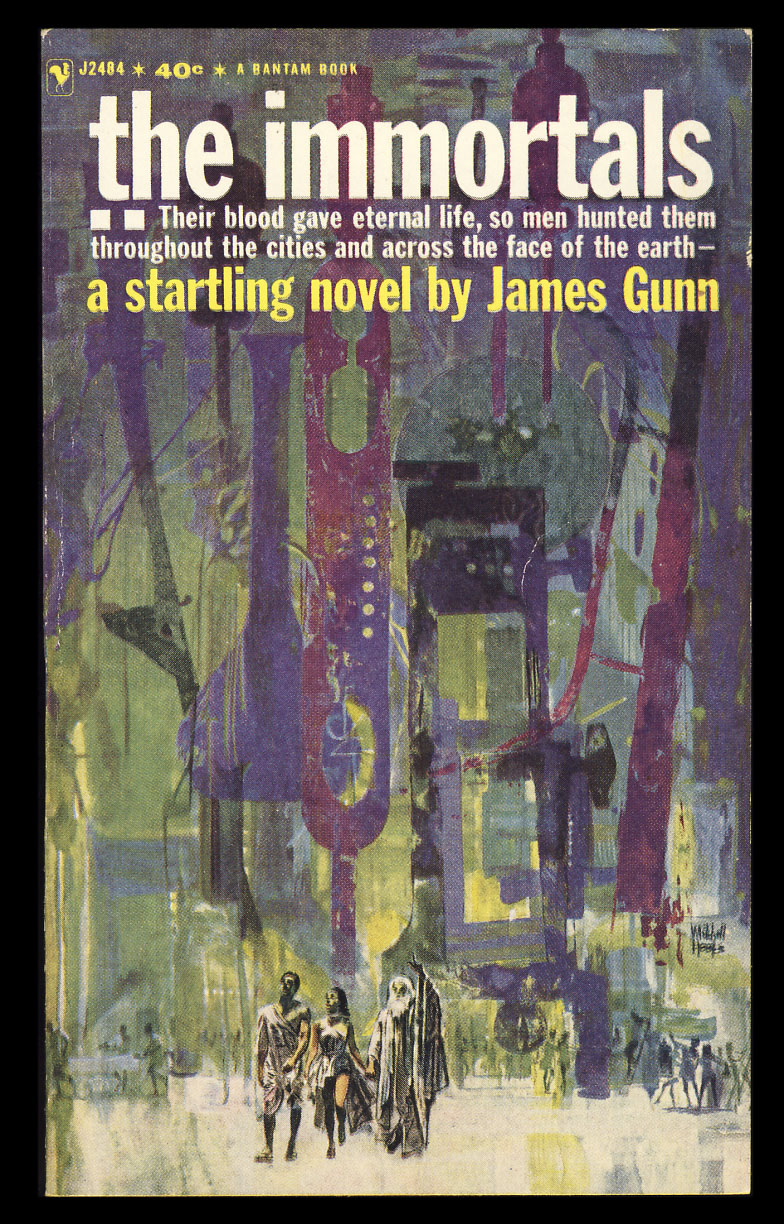
James E. Gunn, 1923-2020


James E. Gunn, 1923-2020

John Greyshaw


Science fiction literature lost one of its titans when James E. Gunn died on Dec. 23, 2020. For me, growing up in the ’90s, a lot of science fiction literature was already in the past by the time I started reading it. Asimov and Heinlein died before I read a word they wrote. Wells and Verne, though their stories still resonate, were voices from over a century ago. Imagine my surprise when about a year ago, I was able to interview a man who embodied the history of science fiction.

John Kessel said in 2007 when Gunn was named a Grandmaster, “As a boy, he shook hands with H.G. Wells. In the late 1940s he sold fiction to John W. Campbell and throughout the 1950s he was a regular in Horace Gold’s Galaxy.” (Kessel) And he had been involved in science fiction ever since.

In many ways, he was one of the last of the old guard. He knew all the science fiction writers of yesteryear and could tell you all about them—writers like Jack Williamson, Fred Pohl, Clifford Simak, Robert Bloch, Theodore Sturgeon, Harry Harrison, Brian Aldiss, Isaac Asimov, Robert Heinlein, Ben Bova, Samuel Delany, John Brunner, Harlan Ellison, and many more.

As a historian, editor, and scholar, Gunn worked tirelessly for the acceptance of science fiction as a legitimate academic field of study. Gunn founded the Center for the Study of Science Fiction at the University of Kansas in 1970. Over the years, it has grown into the best-known science fiction program in the country.

I asked Gunn if he preferred writing or teaching. He said, “Each of them has their rewards and their challenges. I used to hear that writers shouldn’t teach because they draw on the same sources of energy, but I found them a relief from each other: you can only write alone, which makes writing a lonely business, and you can only teach in the company of others. Unlike some writers, I found writing to be hard work. In fact, one of my remarks to students who told me how much they enjoyed writing was ‘You must be doing it wrong.’  Teaching was fun. There were term papers to read, exams to give, and grades to assign, but aside from that it was fun to stand in front of a class and tell them about the thing I loved and see them respond.” (2)

Of his own works, he said, “I am fond of different books for different reason. The Immortals was important because it was my first major novel and became a TV movie and series and made the most money.  Kampus was the most personal novel, because it came out of my experience. The Millennium Blues was my most artistic novel. I worked on it for twenty years thinking of it as a mainstream novel, but it ended up too close to the millennium itself, and it was published only in a collector’s edition and print on demand. And Transcendental was my tribute novel to the genre.” (SF Book Club)

I was surprised Gunn didn’t mention The Listeners, which was an important novel that predicted and inspired the creation of the Search for Extraterrestrial Intelligence (SETI).

When I asked Gunn about his legacy, he said, “I’m not sure I’ll have one, except as my former students and colleagues who now are continuing some of the programs I got started here… I think I have brought a sense of meaning and value to the thinking about science fiction that may continue while I am forgotten.” (SF Book Club)

Teaching sci-fi fits Gunn’s famous motto, “As I have been suggesting with every e-mail signature for the past decade (with only a trace of hyperbole), ‘let’s save the world through science fiction.’ I really believe that science fiction has the power to shape young minds in behalf of a better future and to liberate imaginations from the bonds that keep us tied to traditions that no longer function in today’s changing world.” (Troughton)

The Science Fiction and Fantasy Writers of America made James Gunn its 24th Grand Master in 2007; he was inducted by the Science Fiction and Fantasy Hall of Fame in 2015. He is also the only person to have served as both President of the SFWA and the SFRA.


WORKS CITED

“James Gunn, Grandmaster” by John Kessel. Delivered during the 2007 Nebula Awards ceremony in New York City, May 12, 2007. http://www.sfcenter.ku.edu/Kessel-appreciation.htm

“Interview with James E. Gunn” Science Fiction Book Club. Nov. 2019 https://middletownpubliclib.org/wp-content/uploads/2019/11/James-E-Gunn-Interview-Nov-2019.pdf

“Interview with SFWA Grand Master James Gunn” Amazing Stories by R.K. Troughton. July 10, 2013 https://amazingstories.com/2013/07/interview-with-sfwa-grand-master-james-gunn/

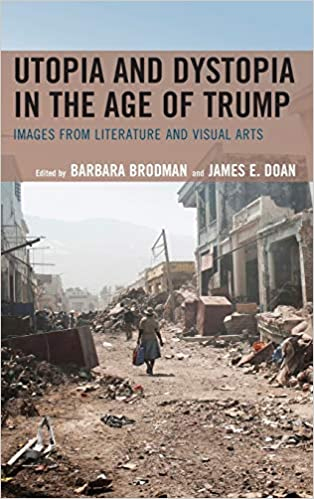
Review of Utopia and Dystopia in the Age of Trump: Images from Literature and Visual Arts


Review of Utopia and Dystopia in the Age of Trump: Images from Literature and Visual Arts

Simon Spiegel

Brodman, Barbara, and James E. Doan, eds. Utopia and Dystopia in the Age of Trump: Images from Literature and Visual Arts. Fairleigh Dickinson UP, 2019. Hardcover. 244 pg. $95.00. ISBN 9781683931676. EBook ISBN 9781683931683.


The title of this collection is, without any doubt, catchy, and the dystopia part in particular feels very topical at the moment. While I am writing this review, in the midst of the COVID-19 crisis and the protests against the murder of George Floyd, Donald Trumpʼs unique blend of viciousness and ineptitude is reaching new heights (or lows). The images we see from Washington, with armed forces in front of the Lincoln memorial, certainly have a dystopian feel to them. But, as it so often goes with catchy phrases, the title proves on closer inspection also to be quite problematic.

The problem is twofold and really concerns both parts of the book’s title. First, surprisingly few of the fourteen essays collected in this volume actually deal with proper utopias or dystopias. While opinions among scholars differ about how loosely the concept of the positive utopia should be understood, dystopia is quite clear-cut as a genre. Dystopias deal with a society which is worse than the one we live in. But neither Hamlet (c. 1599-1601) nor Edgar Allan Poeʼs “The Fall of the House of Usher” (1839), which Christine Jackson analyzes in her article, are set in dystopian societies. It is, of course, legitimate to read Poe or Shakespeare against the backdrop of the Trump presidency (as Stephen Greenblatt has done so beautifully in Tyrant), but the mere fact that Claudius has murdered Hamlet’s father does not make him a dystopian ruler. Claudius may be a bad person, but there is little evidence that he is also a bad king.

Similarly, Daniel Adleman reads Bret Easton Ellisʼs notorious American Psycho (1991) as a critique “of the callous cultural logic that underpins the utopian ideology of the US neoliberal project”. (70) It certainly makes sense to see Ellis’s murderous protagonist Patrick Bateman as a kind of proto-Trumpist—as Adleman points out, there are more than thirty direct or indirect references to Trump in the novel—but again it is not really clear how this relates to the concepts of utopia and dystopia except in the most general way.

While some might consider this criticism to be narrow-minded genre policing, it is telling that the editors give only short summaries of the individual articles in their introduction, but fail to come up with any kind of conceptual framework which would help to explain or contextualize their selection.

Utopia and Dystopia in the Age of Trump is not targeted at scholars of utopias or sf. This becomes evident in Jeffrey Barber’s chapter, which is a compressed introduction to and history of sf and utopian writing with a special focus on the theme of sustainability that ends with thoughts on the Trump presidency. While the overview given might prove useful to readers not acquainted with sf theory, the link to contemporary US politics does not go much beyond the assessment that sales of Orwell’s Nineteen Eighty-Four (1949) have soared after Trump’s election.

And this brings us to the book’s second, more serious problem: The question of how much it can tell us about Trump which is enlightening or relevant. Much has been and is still being written on the 45th US President. An obvious disadvantage of an academic book like this is its long gestation time. Utopia and Dystopia in the Age of Trump was published in June 2019, which means that probably none of its chapters was written later than the end of 2018. Not surprisingly, some of the essays therefore already feel outdated. Sometimes painfully so, such as Tom Shapira’s chapter on Judge Dredd, in which he likens special counsel Robert Mueller to the comic’s eponymous protagonist. Like the judge, a member of a special unit who is police, judge, jury, and executioner in one person, Mueller is “an authoritarian figure, a straight and narrow professional, stern of gaze and relentless in his task”. (188) Shapira’s observation that even people for whom a character like Mueller used to be something short of a bogeyman suddenly rooted for the special counsel is intriguing, but the sad fact that the Mueller report amounted to nothing in the end gives his essay a quite unexpected punch line. Unfortunately, unlike in the comic, in real life the crazy President was not brought down by a disciplined servant of the state.

As an introduction to Judge Dredd—which unlike Hamlet really deals with dystopia—Shapira’s chapter works well, as do Matthew Paproth’s discussion of the TV series Black Mirror (2011- ) and Kate Waites’s chapter on Mad Max: Fury Road (2015) and the Hulu TV series adaptation of Margaret Atwood’s The Handmaids Tale (1985). But in each case the connection with Trump—which should be the whole point of the book—seems forced and not very productive. Waites’s contribution is typical in this regard. Hulu’s The Handmaid’s Tale (2016- ) is probably the first example that comes to mind when people think of dystopia in the age of Trump. The adaptation of Margaret Atwood’s novel does indeed feel very timely, and some of its iconic elements, like the handmaid’s red dresses and white winged hats, have become symbols of the #MeToo movement and of resistance against Trump in general. In her analysis, Waites concentrates on visual strategies of the show, though, and says little about Trump.

The already mentioned lack of a theoretical framing for the volume becomes particularly striking with David L. McNarron’s chapter, which closes the book. McNarron discusses Albert Camusʼs classic novel The Plague (1947)—which has gained new topicality thanks to the COVID-19 pandemic—and Jean Raspail’s The Camp of the Saints (1973), an obscure French book which has in recent years become a favorite among the alt-right. McNarron’s reading of the two novels ­– which manages to turn Camus’s deeply humanist novel into a plea for nationalism – culminates in a surprising call for strong borders and unabashed support for Trump’s policy.

What is the point of this chapter? Do the editors intend to bring some kind of balance to the selection of texts which are with the exception of McNarron’s decidedly anti-Trump? Is it meant as a refreshing provocation? Since the book lacks a coherent concept, the readers are left to wonder.

Review of The Twilight Zone (TV Milestones)


Review of The Twilight Zone

Dominick Grace

Barry Keith Grant. The Twilight Zone. Wayne State UP, 2020. TV Milestones. Paperback. 132 pg. $19.99. ISBN 9780814345788. Ebook. ISBN 9780814345795.


The Wayne State University Press has published nearly 40 volumes in the TV Milestones series; surprisingly, it has taken on The Twilight Zone, one of the most celebrated TV shows ever made (so much so that it has been rebooted three times, with limited success, as well as adapted into a feature film) and arguably the seminal show to make the fantastic legitimate adult fare on TV, only in 2020. Barry Keith Grant’s volume is as compact as the other entries in this series, and it is a quick and easy read. Non-academics should find this a perfectly accessible introduction/primer. However, the book is also thoroughly researched, well-grounded in the scholarly tradition associated with the show, and insightful in its own right. Anyone interested in The Twilight Zone, whether as a fan or scholar (or both) will find this book valuable.

Bookended between an introduction and a conclusion waggishly entitled “Zoning In” and “Zoning Out” are three chapters exploring, as Grant outlines his plan in the introduction, “the interrelated questions of authorship, genre, style, and ideology in the context of The Twilight Zone”. (14) Throughout the book, Grant balances relatively deep dives into key episodes with quick summaries of linked episodes. As a result, he manages to be comprehensive without being superficial.

The first chapter, “’Once Upon a Time’: The Twilight Zone and Genre,” focuses on “the place of The Twilight Zone within the various modes of the fantastic, showing how it combined them with other generic traditions to offer social criticism cast as moral fables”, (17) but crucially also explores in some detail how the show works as a hybrid of genres, folding in, notably, elements of film noir, as well as other genres (e.g. the then-popular on TV Western; several episodes of the series are explicitly Westerns or at least are set in the West).

Chapter Two, “’The Prime Mover’: The Twilight Zone and Authorship,” addresses the extent to which the show represents a unified vision. As Grant notes, the show is indelibly associated with Rod Serling, who created the show, oversaw the production (for the first few seasons, anyway), wrote a significant percentage of the episodes, and, most significantly perhaps, hosted the show, stamping his personality on each episode and himself becoming a TV icon as a result (so much so that he is folded into the final episode of the first season of the latest reboot). While Grant acknowledges the complexities of auteurist criticism, he makes a compelling case for Serling’s voice and characteristic concerns as the dominant elements of the series. 

Chapter Three, “’What’s in the Box’: The Twilight Zone and the Real World,” is perhaps the book’s most interesting chapter, delving as it does into The Twilight Zone’s hallmark social commentary. Grant carefully contextualizes the show historically, showing how it responds to current concerns and anxieties. He also deftly documents its own tensions, arguing that the conflicting condemnation of collective action as dangerous (the show’s famous “The Monsters Are Due on Maple Street” [1.22, March 4, 1960] being perhaps the paradigmatic example) weighed against the show’s consistent condemnation of selfishness, greed, and other dangerous manifestations of individualism constitutes the “thematic tension at the heart of the show” and “places it squarely within the debates that have informed American culture and political thought from the nation’s beginning”. (98)

Also central to Grant’s argument is his recognition of the tension between art and commerce, a tension he recognizes as built in to Serling’s own conflicted view of television as, on the one hand, a commercial medium reliant on formula and beholden to sponsors but, on the other, a popular medium that could be used artfully to engage in social commentary. Grant notes that The Twilight Zone “reveals the tensions between artistic ambition and commercial capitulation at a pivotal point in the history of the medium”, (100) but that Serling was largely successful (with some instances of unsuccessful episodes scrupulously noted): “With The Twilight Zone, Rod Serling joined the ranks of such otherwise very different American artists as Walt Whitman, Frank Capra, and Frederick Wiseman, all of whom have sought in their work to find ways to integrate the individual within the great democratic project of the nation”. (99)

This book is a valuable addition to Twilight Zone scholarship, acknowledging the work of previous scholars while also advancing the study of the show. Its clear and accessible style makes it ideal for undergraduate students, perhaps especially in media courses, but its depth and insight make it valuable for advanced scholars as well. I would recommend it for any library interested in remaining current with studies of the fantastic across media.

Review of The Twilight Zone and Philosophy: A Dangerous Dimension to Visit


Review of The Twilight Zone and Philosophy: A Dangerous Dimension to Visit

Robert Creedon

Heather L. Rivera and Alexander E. Hooke, eds. The Twilight Zone and Philosophy: A Dangerous Dimension to Visit. Popular Culture and Philosophy: Volume 121. Open Court, 2019. Paperback. 247 pg. $19.95. ISBN 9780812699890.


This book is a concise view of philosophical topics using the classic television series The Twilight Zone (1959-1964) as the basis of its explorations in 21 short essays. It follows the standard format for the series by having various authors explore concepts in short 9-14 page essays that allow the reader to delve into heavier material. Although being familiar with the series helps, it is not necessary, as detailed examples from the series are given to provide clarity for the reader. Readers will also find many episodes are discussed repeatedly, as they apply to numerous topics and concepts. Most of the chapters include direct references to the philosophers and their writings, documented and indexed for ease of reference. These essays are well divided into subsections under headings offering expansions on ideas from the main premise: “First Dimension: Facing the Zone”; “Second Dimension: Beyond the Boundaries of You and Me”; “Third Dimension: The Wondrous Land Called Truth”; “Fourth Dimension: As Vast as Space and Timeless as Infinity”; “Fifth Dimension: Our Twisted Imaginings”; and finally “The Dimension that Can’t Be Named or Numbered.”. Most readers should enjoy the bite-size nature of the information which is designed to make it more accessible to the general public and specifically to the fans of the series. This format is the same as has been used for other volumes of the Popular Culture and Philosophy series, giving continuing readers greater context and understanding.

What I found most interesting were the chapters that asked questions about the concept of the Twilight Zone as a shadow of our own world. The Twilight Zone was written by a group of horror writers from southern California in the late 50’s and early 60’s that as Matt Cardin says, “founded their sense of the fantastic in everyday reality and the experience of characters that might live next door” (quoted in “No Place Like a Non-Place,”by Fernando Gabriel Pagnoni Berns, Juan Ignacio Juvé and Emiliano Aguilar, pg. 131).  We also learn that except for just a couple of episodes, an element of supernatural, the future or aliens, was used to create twists or surprise endings. These thought plays provide ideal bases for the philosophical thought exercises in this book. The pairing is as natural as that between Candid Camera and sociology. Rod Serling and his associates created a series that created thought experiments that illustrate the great theories of the philosophers, although not by design. 

The chapters exploring specific theories are more interesting than the others, providing as they do a detailed framework including examples to aid the readers’ comprehension. Philosophers discussed range from Aristotle to recent philosophers so current that the writers provide timelines indicating when episodes came out between major works by these contemporary figures. Many of the essays require the reader to invest time to absorb and work through the ideas expressed after reading. My favourites include “No Place like a Non-Place,” by Fernando Gabriel Pagnoni Berns, Juan Ignacio Juvé and Emiliano Aguilar, in which they explain Marc Augé’s Non-Places: Introduction to an Anthropology Of Supermodernity via the episodesWill the Real Martian Please Step Up?”, “The Four of Us Are Dying,” “The Hitch-hiker,” “The After Hours,” “The Passersby,” “Passage on the Lady Anne,” and the classic “Nightmare at 20,000 Feet”;“The Twists and Turns of Second Chances,”by JohnV. Karavitis, describing Soren Kierkegaard’s Either/Or (which is about the aesthetic versus the ethical world) in episodes including “A Nice Place to Visit,” “A Game of Pool,” and “Devil’s Printer”; and “The Pleasure of the Twist,” by Stephen Scales, discussing Thomas Kuhn’s The Structure of Scientific Revolutions with references to “The Hitch-hiker,” “The Lateness of the Hour,” and the classic “To Serve Man.” The essay “The Science of Alternative Realities,” by David Morgan, is a wonderful treat for this science fiction and comic reader as it explores the theories of alternate dimensions and timelines. The book has enough layers to be read multiple times and remain on your bookshelf for years of reference and enjoyment. 

“Memories Are Made of This,” by Clara Nisley, mentions David Hume’s belief in continued existence briefly before moving into a consideration of  “And When the Sky Was Opened” and “The Trouble with Templeton”; the relevance of Hume could have been explored in more detail  Other chapters work better, such as  “Lost in Time,” by Elizabeth Rard, which discusses the time travel paradox with examples from the episodes “The Rip Van Winkle Caper,” “Last Flight,” and “No Time Like the Past.” “The Twilight Zone on Our Doorstep,” by Tim Jones, is most intriguing in its exploration of where The Twilight Zone actually existed. “A Shadowland Called the Twilight Zone,” by Trip McCrossin, on how Serling’s art mirrored the events of his time, showing his own opinions, will be of interest to film historians. Serling’s contribution to later movies is discussed in “The Science of AlternativeRealities,” by David Morgan, as Serling’s ideas can be seen in blockbusters and feature length movies, although Serling’s contributions were unaccredited. Many of the essays are well-developed persuasion pieces on the theory and the related episodes, and they serve as fine examples of how to form an argument.

Given The Twilight Zone’s popularity and reputation, I am surprised it was not covered earlier in the series. This book would be a great companion piece for any philosophy course if the instructor uses an episode or more to illustrate some philosophical theories. As someone who watched the Twilight Zone recently, I found that this book provided a great opportunity to explore theories in philosophy more easily than the complexity of the theories would indicate.  Reading these essays will encourage the reader to find the episodes online, or set up their PVRs. For those who enjoy some of the reincarnations such as Black Mirror and others, including the recent reboot of The Twilight Zone itself, this book connects well to a more innocent time in television that explored many concepts long before these recent imitations began to do so.