Review of Science Fiction


SFRA Review, vol. 52, no. 3

Nonfiction Reviews


Review of Science Fiction

Jack Durant

Dan Byrne-Smith, ed. Science Fiction. MIT Press, 2020. Documents of Contemporary Art. Paperback, 240 pp., $24.95, ISBN 978-0-262-53885-5.

This odd and eclectic anthology is part of a series called “Documents of Contemporary Art” co-published, since 2006, by MIT Press and London’s Whitechapel Gallery; aside from a volume on The Gothic, it is the only entry devoted to an aesthetic—mainly literary—genre, as opposed to a concept (Time, Memory, Sexuality), a practice (Craft, Translation, Exhibition), or an institution (The Studio, The Market, The Archive). The format is simple: a brief introduction laying out the terrain is followed by a handful of thematic sections (here, four, called “chapters” by the editor) that sort several dozen individual pieces (here, 48). Given the brevity of the volumes, these pieces are necessarily short, usually abridged from longer works (the shortest entry here is half a page, the longest 12 pages); these works take a variety of forms—theoretical essays, critical reviews, interviews, and manifestoes—and cover some substantial temporal span (the earliest piece here is from 1962, though the vast majority, 42, hail from the past two decades). The goal of the series is to provide, in each volume, a “source book” to “a specific body of writing that has been of key influence in contemporary art generally,” featuring “a plurality of voices and perspectives defining a significant theme or tendency” (5).

It’s a peculiar remit but of a piece with a number of recent series, such as Reaktion Books’ “Focus on Contemporary Issues” and Columbia UP’s “No Limits”, that pursue selected issues or concepts. The difference here is the purported “source book” function: rather than wandering topical essays that cohere around a central idea, the MIT/Whitechapel volumes propose to gather cohesive “bod[ies] of writing” tracing “key influence[s] in contemporary art”—which presumably means representative samplings of material that make some pretense to comprehensiveness. But that is not exactly what Science Fiction is either, since the temporal span, as noted, is rather too constrained: only three items from the ’60s and ’70s, a period when New Wave SF was engaged in potent dialogue with avant-garde trends in the arts. The problem isn’t that editor Dan Byrne-Smith, a Senior Lecturer in Fine Art Theory at Chelsea College of Arts in London, doesn’t know this history, since he summarizes it efficiently in his introduction: the aesthetic appeal of Surrealism and Pop Art for J.G. Ballard and Brian Aldiss, and their reciprocal influence on major conceptual artists like Robert Smithson (12-13). Yet that important moment is represented here solely by a three-page excerpt from a 1971 interview in Studio International magazine featuring Ballard and Italian Surrealist Eduardo Paolozzi. The dialogue is fascinating, like most of the public utterances of those charming provocateurs, but it’s so clipped and condensed that it barely captures the excitement of the genre’s conversation with contemporary art in the New Wave era.

Perhaps the problem is with my use of the terms “genre” and “contemporary.” As Byrne-Smith says in his introduction, “science fiction” can be conceived as much more than an aesthetic genre. Rather, the term can refer, variously, to “forms of practice, complex networks, or a set of sensibilities”; to a certain “field, a space of metaphor, or a methodology”; or to the dominance of specific ideas, such as technological and social change (12). The reader gets the sense that the volume purports to cover all this ground in differing measure, though Byrne-Smith never says this precisely. What is clear is that he wants to abandon the limitations of a genre conspectus, especially the knotty issues of definition such overviews entail.

Though he inevitably includes a brief excerpt from Darko Suvin’s Metamorphoses of Science Fiction (1979) postulating the genre as a mode of cognitive estrangement, he ultimately plumps for Sherryl Vint’s later (2014) revisionist view that SF refers not to “an inherent or fixed set of properties” but rather a “network of linked elements” (14). Such an anti-essentialist “definition” potentially frees the editor up from the constraints of a standard overview since what “science fiction” means shifts depending on its use within specific historical, social, and institutional contexts. A focus on the broader artistic influences exerted by the SF genre is, then, only one of many possible configurations, and there is certainly some, but not much, of that sort of coverage here: e.g., a Ted Chiang story that was produced as the textual accompaniment to a 2014 video installation; a text written for a 2018 London exhibition that riffed on the dystopian future E.M. Forster envisioned in his 1909 story “The Machine Stops.”

The term “contemporary” may also be up for grabs, given the volume’s chronological bias towards work produced since the turn of the millennium. The editor himself says as much: “This volume responds to intensifications in engagement between art and science fiction in the early decades of the twenty-first century,” as SF has emerged as a global form capable of confronting pressing issues (12). From such a viewpoint, previous engagements, such as the New Wave’s with Pop Art and Surrealism, count as “historical precedents” (12) rather than currently vital debates. This is fair enough, I suppose; certainly, the issues the volume canvasses have emerged, over the past two decades, as compelling multidisciplinary points of focus for writers and artists. While the third and fourth sections, on “Posthumanism” and “Ecologies,” begin with brief excerpts from important “precursors” (e.g., Donna Haraway, Rachel Carson), they are dominated by more recent voices (addressing, e.g., body modification, climate change). Even the earlier, seemingly more traditional sections, on “Cognitive Estrangement” and “Futures,” are driven by postmillennial interests and concerns, especially the supercession of white Western models of futurity by “a broader range of perspectives, struggles and traditions,” such as Afrofuturism (15-16).

Within its self-imposed constraints of subject matter and chronology, I do think this is a provocative and potentially useful volume, especially in undergraduate classes (e.g., on SF and visual culture), where the bite-sized chunks of theory can be washed down with audiovisual supplements (the book, alas, has no images). Given how very small these chunks are, however, I don’t think it’s reasonable to call this an anthology; a mosaic of fragments is more apt, or, better yet, a critical montage. The individual pieces tend to blur together: it’s hard to meaningfully discriminate among so many different voices (more than 50 overall, since several items are coauthored) when they all are speaking so briefly on the same set of subjects. This isn’t helped by the fact that the introduction, itself so short (barely eight pages), is the only editorial apparatus to speak of: there are no section headers, much less headnotes to the individual pieces. It thus really helps if one has some prior acquaintance with the relevant issues and debates, which of course rather vitiates the book’s utility as a survey for undergrads, unless instructors can provide the missing context via lectures. But more serious researchers in the field (whether SF studies or art history) would likely prefer to access the arguments in undiluted form.

Jack Durant is a long-time reviewer of SF literature and criticism. He was a stalwart of the late Fantasy Review magazine and published a number of reviews in The Science Fiction and Fantasy Book Review Annual


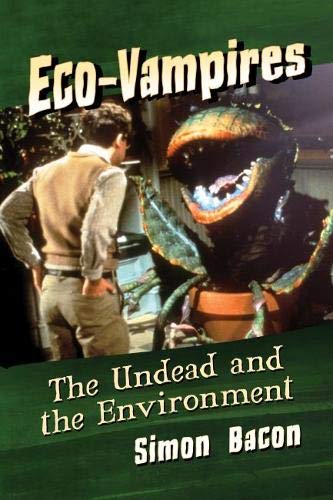
Review of Eco-Vampires: The Undead and the Environment


SFRA Review, vol. 52, no. 3

Nonfiction Reviews


Review of Eco-Vampires: The Undead and the Environment

Mihaela Stoica

Simon Bacon. Eco-Vampires: The Undead and the Environment. McFarland, 2020. Paperback. 215 pg. $45.00. ISBN 9781476676227. EBook ISBN 9781476639604.

Vampires of cinema, literature, and folklore have generally populated narratives of doom as malignant forces of destruction driven by a singular need for survival and jeopardizing the very existence of humanity. Traditional representations of the vampire have reflected our own fears and anxieties. Whether these fears were basic reactions to death as a misunderstood natural process of life, or reactions to an overwhelming and fast developing industrial world, stories have positioned the vampire as the quintessential immortal evil force. But depending on the medium vampires inhabit, images of them have also shifted to reflect an ambivalent enemy on the cusp of adapting to the anxieties of a humanity faced with an increasingly complex and everchanging lifestyle spurred on by industrial and technological discoveries.

Simon Bacon’s Eco-Vampires harnesses the ambivalence to differentiate between the many images of the vampire by looking at ways in which narratives and films “express the eco-friendly credentials of the undead” (1). Bacon’s angle on the eco-vampiric version of Dracula is tantalizing as it surprisingly positions the everlasting bloodsucker at the intersection of contemporary eco-studies and the politics of consumerism to suggest that the vampire is an essential part of a global system which does not tolerate globalization and consumerism. Thus, the vampire’s reaction to the increasing climate crisis, he suggests, despite the vampire being seen as a plague on humankind, is expressed as being that of a potential savior and eco-warrior of a desperate planet Earth in need of saving.

The image of Dracula, or any other vampiric character in literature or cinema, going green for the sake of the planet may be challenging for the skeptics to accept. But a closer look at the argument Bacon undertakes reveals the connection between nature and the undead as part of a symbiotic relationship with the ecosystem. In his attempt to overthrow the popular image of the vampire as a demonic force bent on destruction, Bacon points to the European tradition as a source for his green-fanged version. Indeed, the many case studies and field collected texts of Eastern European vampirism catalogued by Jan Louis Perkowski and Agnes Murgoci (see Perkowski’s “The Romanian Folkloric Vampire” and Murgoci’s “The Vampire in Roumania” in The Vampire. A Casebook, edited by Alan Dundes, WI UP, 1998) are a rich ground from which the creature can transmogrify into the eco-warrior Bacon professes it represents. As these early testimonials depict the vampire’s close connection to nature, the environment, and its elements, it is not far-fetched to imagine the jump to ecocritical studies as a base for Bacon’s argument. Ecocriticism emerged in the 1980s as an environmental movement that not only brought into focus the relationship between literature and the physical world but also emphasized the interdisciplinary aspect of the new field. Furthermore, Bacon’s eco-vampire concept makes use of intersectionality to bring forth a new type of marginalized, fallen hero in need of redemption. As an analytical framework, intersectionality looks at all aspects that relate to an individual in combination rather than in isolation. In this case, it emphasizes the vampire as “doppelganger of humankind, representing both a dark mirror image of humanity’s own vampiric characteristics, and actively trying to destroy/neutralize the forces of consumerism/technological progress” (8), which can further substantiate Bacon’s argument. Such redemption, it seems, is not sought out by the creature itself but by our own need to redefine what it means to be the eco-warrior our planet needs and deserves in our current crisis.

Bacon succinctly summarizes the vampiric history of European tradition to argue towards the connection with nature as he points out early correlations between vampires and other creatures such as, dogs, cats, and bats. These early examples see the vampire as an integral part of the environment. Whether because of climate, landscape, societal, or political environments, the vampire becomes a way of understanding, as being part of the land, of the cosmology that explains the environment, and a part that also remembers the past in a changing world (2). This underpins the transition from “real” vampire bats to literary ones and the ongoing synergy between the undead and the ecosystem (2). The first admittedly documented jump from the folkloric vampire to the literary version is Polidori’s 1819 The Vampyre,whose protagonist exhibits a deep connection to the moon, which paves the way to facilitating the identity formation of Bacon’s eco-vampire. The proliferation of novels with vampiric subjects during this period, such as LeFanu’s Carmilla (1874), Florence Marryat’s Blood of the Vampire (1897), H.G. Wells’s War of the Worlds (1897), and Bram Stoker’s Dracula (1897), establishes the connection and the bond between the undead, the animals, and the land to which they belong. The vampire, especially Dracula, the author argues, becomes a manifestation of an environment trying to protect itself from humanity and the increasing industrialization and destruction of the ecosystem (4). Bacon articulately establishes the connection between vampires, environment, and eco-activism with a quick nod to the relatively new fields of Ecogothic and Ecohorror, or plant-horror. This short detour into ecophobia turns out to be essential in expanding the field of inquiry. By looking at how ideas in the ecogothic and ecohorror literature and cinema work, he shows how vampires are the expression of an ecosystem at war using its own biological weaponry: the vampire plague (8).

The book is divided into five chapters, and each chapter analyzes five pairings of films or texts reflective of the section’s topic. What follows is a compendium of mainly cinematic sources exploring images of the eco-vampire. While many films are familiar to the fans of the genre, others are less so. Several examples, Bacon warns, are purposely provocative. Even though some of the films do not have vampires as protagonists, the vampiric influence and performativity is an underlying aspect of the narrative to give credence to the reading of the vampire as eco-warrior. The examples do not follow chronologically the order of the films’ releases, but they are chosen to represent thematically each chapter’s topic. In Chapter 1, “Dracula the Environmentalist: The Land Beyond the Forest,”Bacon explores the strong connection between the vampire and its natural environment, going as far as showcasing the creature as untamable nature, master of weather and animal life, and as “biological weapon released by the ecosystem to destroy the growing forces of technology” (9). Except for Stoker’s novel, Bacon’s celluloid choices range from the earliest and admittedly most faithful to the novel, such as Murnau’s 1922 Nosferatu, to Garland’s 2018 Annihilation. The types of environment rising to battle humanity are also varied: the American desert, the snow-covered lands of Alaska and Northern Europe, the woodlands, and rural locations.

Chapter 2, “Vampiric Sustainability: The Undead Planet,” focuses on how parts of the ecosystem take on vampiric qualities to protect themselves and the wider environment from human incursion (9). The discussion centers on the vampire’s interconnectedness with its environment to the point where it takes on forms of its fauna, or it brings forth manifestations of the fauna. The most obvious case is the connection between vampire and vampire bats. Thus, the undying ecosystems depicted in this chapter manifest themselves as various types of lifeforms as a means to defend themselves against the human invaders that have entered or threatened their domain. The examples reflect ways by which the ecosystem attempts to protect itself and maintain its balance by unleashing vampiric forces upon human incursion and enacting a battle between past and present to recreate a time when humanity had a more respectful and symbiotic relationship with its environment (82).

Chapter 3, “Undead Eco-Warrior. The End of the World as We Know It,” looks at apocalypse and those moments when the planet unleashes vampiric plagues against humanity in an effort to restore the ecosystem. Without dwelling on present-day pandemics, this chapter explores similar circumstances of doom, despair, and cataclysmic scenarios portraying vampires as planetary pest-controllers and humanity as the plague of which nature rids itself in the end to restore an ecological balance. Chapter 4, “The End of the End. Consumerism will Eat Itself,” explores how consumerism and industrialization become sources of their own demise while the vampires they inadvertently create ultimately assist in restoring the ecosystem they were trying to exploit. Scholarship about vampires after the 19th century reveals them as obvious manifestations of consumerism, namely the voracious consumer that must possess and consume until there is nothing left. But it also gives shape to the idea of never-ending consumption as a form of immortality. The films analyzed in this chapter reveal how a world governed by laws of consumerism will literally eat itself to extinction. Finally, Chapter 5, “Vampire Ecosystems. It Came from Outer Space,” looks at how narratives about vampiric invasions from outer space often work as a metaphor illustrating the self-protective qualities of the ecosystem or as a galactic idea of self-protection. Among the protagonists are transient vampires roaming outer space looking for sources of sustenance and acting as cosmic ecological regulators.

I appreciated each chapter’s prefatory opening sentence which facilitates the reader’s immediate immersion with the material. The book is very explicit and clear in its organization and is a must-have for any scholar or student interested in vampire and gothic studies, ecocriticism, and the many ramifications that these fields combine. The many examples used to explore each chapter’s main theme make this book a rich addition to the library of cinematic vampire lore and a robust resource for any media or film studies course.

Mihaela Stoica is senior assistant in the political science department at DePaul University, editor of the PSC Chronicle, and a research team member for Reading Chicago Reading, a digital humanities project studying the impact of the Chicago Public Library’s “One Book” program’s literary events. Her research focuses on the intersectionality of science fiction, the Gothic, sociology, digital humanities, and the politics of feminism. Her MA thesis, “Gender Ambivalence, Fragmented Self, and the Subversive Nature of James Tiptree, Jr’s Science Fiction,” was awarded Distinction. She is the author of Shepherd (2001), a novel inspired by the 1989 Romanian political turmoil.


Review of J.R.R. Tolkien: A Guide for the Perplexed


SFRA Review, vol. 52, no. 3

Nonfiction Reviews


Review of J.R.R. Tolkien: A Guide for the Perplexed

Audrey Isabel Taylor

Toby Widdicombe. J. R. R. Tolkien: A Guide for the Perplexed. Bloomsbury Academic, 2020. Guides for the Perplexed. Paperback. 208 pg. $24.95. ISBN 9781350092143. Ebook ISBN 9781350092150.

Toby Widdicombe’s J. R. R. Tolkien: A Guide for the Perplexed does what it says it will: it answers questions about Tolkien and his work from a hypothetical (perplexed) reader. The book examines a range of themes and content across Tolkien’s work and life and brings them together in a tidy package. Widdicombe has done a fine job across the book as a whole.

J.R.R. Tolkien consists of a foreword, introduction, and six chapters, followed by an afterword largely devoted to The Fall of Gondolin (2018), which was published when Widdicombe’s book was nearly ready for print. There are also three useful appendices. The first lists Tolkien’s sources, including names, dates, languages/sources, as well as brief notes on significance. To those who are teaching Tolkien, this information is particularly valuable. The other two appendices cover the Films of the Legendarium, and, more briefly, Scholarship on Tolkien. There is also a helpful reference list and an index. Widdicombe comments in chapter five that “I will focus on the major works (The Silmarillion, The Hobbit, The Lord of the Rings), but my portrait will be fleshed out by my understanding of other, less-well-known Tolkien works” (107-8), but this could be said for all his chapters.

Chapter One: Tolkien’s Life and Art, provides a quick overview of the basic biography of Tolkien and how his life influenced his work. Chapter Two, Tolkien’s Legendarium, showcases one of Widdicombe’s strengths, making a complex topic clear. He lays out the complicated history of Tolkien’s legendarium in a straightforward way (or as straightforward as could be done). In Chapter Three, Tolkien and His Languages, Widdicombe points out how Elvish, in its incompleteness, intentionally parallels natural languages (47). This chapter gives a good overview while also making clear the complex, recursive nature of Tolkien’s work on and with languages, leaving plenty of room for further scholarship or interest. 

Chapter Four looks at Tolkien on Time. This chapter presents a series of interesting points, for instance, that Tolkien “suggests the events have a reality beyond his ability to control them” (97), as well as how time is “less about the broad strokes of history [and more about how] friendship lasts even until the inevitable end” (102). There is also a useful timeline included with some comments about what events being in which place on the timeline might mean (98-101). Widdicombe notes in comments on Year 2 of the Third Age, for example, that “If the Second Age began with a burst of creation…so does the Third Age, for it is in this year that Isildur ‘plants a seedling of the White Tree in Minas Anor’” (98). These facts combined with editorial comments provide the reader insight into both events and their significance in time.

Chapter Five is Tolkien on Peoples, which examines the peoples and creatures of Tolkien’s work. Widdicombe also has a good approach to a big chapter like Chapter Six, Tolkien’s Themes. In Chapter Six he discusses themes he and his students found important, but also those put forward by other scholars, and points out that “Any discussion of themes is just a means to an end: to stimulate discussion of the meaning and relevance of Tolkien’s legendarium” (129). This includes a beautifully concise summary of Tolkien’s take on death: “In the same section of The Silmarillion as that in which Ilúvatar talks of elvish immortality as a sorrow, Tolkien contrasts that quality with the brevity of human life and considers this brevity to be akin to a sort of freedom ‘to shape their life, amid the powers and chances of the world’” (111-112).  My only quibble with this chapter is that although thorough, a list of themes at the beginning of the chapter might have been useful, particularly as there does not really seem to be an order to the themes, or not one I saw explained.

Although Widdicombe’s focus is largely on “bigger picture” items, he does include fascinating tidbits of close reading—a  discussion of the “queer sign” on Bilbo’s door from The Hobbit for example (48), or the thought-provoking point in Chapter Three about how Tolkien is rarely praised for “his attention to role and context, and his humorous extension of the fiction of the epic’s frame story,” demonstrated for instance when he frames his own work as only that of an editor or translator (61). Widdicombe reads beyond the surface, and is able to make connections within not only Tolkien’s work, but his life as well. 

There are elements that do not quite work. Widdicombe does not always manage to be as clear as one would like—the section on writing for example (pp. 59-60) left me confused rather than less-perplexed. Nor does he quite round out his point in the themes chapter about technology. He ends with a “good” use of technology after a long discussion of instances of its misuse, but unlike other cases he does not speculate about why, or how, this changes other readings (156-7). And though he looks at the lack of women with agency in Tolkien, he does not tackle the racism inherent in the Southrons (black men) (113), which is presumably something a modern audience of students might react strongly to.

Who the hypothetical reader of this book might be is a slightly thornier question than its general value to Tolkien studies. Widdicombe explains, “It is not my intent to be exhaustive; it is my intent to provide enough information to make engaging with Tolkien’s world as rich an experience as I can for the enthusiast” (107), thus indicating that this is for someone already an enthusiast on Tolkien. Widdicombe comments a great deal about what readers think or feel about Tolkien and his work based on his own experience with his students, but this seems rather limited. Further, to understand Widdicombe’s text, a good knowledge of Tolkien prior to reading Widdicombe is helpful, perhaps even necessary. Widdicombe obviously loves Tolkien’s work, but this does not occlude the critical, or interfere with J.R.R. Tolkien: A Guide for the Perplexed’s principal mission: to elucidate Tolkien.

Audrey Isabel Taylor is Assistant Professor of English at Sul Ross State University, Rio Grande College. Her first book, Patricia A. McKillip and the Art of Fantasy World-Building, came out in 2017, and she is at work on a second on science fiction author Anne McCaffrey.


Call for Submissions: Fiction


Call for Submissions: Fiction

The Editorial Collective


The SFRA Review welcomes well-written and carefully edited pieces of short fiction that conform to the following guidelines:

  • Submissions (stories, poetry, drama, etc.) should be no more than 4000 words.
  • Submissions must be original works that have not been previously published; if, for example, a submission has been previously posted on a blog or similar medium, please include a note explaining when and where.
  • Submissions should be clearly recognizable as SFF.
  • Submissions should not be thinly disguised social or political rants.
  • Submissions should be clearly germane to the issue’s topic.
  • Submit Microsoft Word .docx files only. If you are unable to access Word, please use Google Docs.
  • All files must include a brief (100 words or fewer) bio of the author and proper contact information; however, stories can be published under a pseudonym.
  • All stories must be sent as attachments to sfrarev@gmail.com with the subject “Fiction Submission: Autumn 2022”.

Stories will be read and edited by at least two members of the collective. We will be much more likely to reject submissions out of hand than to request revision, though we may do the latter.

The Autumn issue does not have a particular topic, so feel free to submit stories on whatever topic you desire.

Subsequent issues will have different topics which will be revealed in the issues immediately preceding them.


The SFRA Review’s Transition to Partial Peer Review


The SFRA Review’s Transition to Partial Peer Review

The Editorial Collective


With the explosive growth in scholarship on SF in recent times, the Editorial Collective feels that there are more scholars who need peer-reviewed scholarship to obtain and advance in their positions. As of the Winter 2022 issue, the SFRA Review will move to a peer-review model for some of its feature articles. This will happen gradually over the course of 2022: by the end of that year, we hope to be publishing three or four peer-reviewed articles per issue. We will of course need established scholars to perform peer review: you are more than welcome to volunteer by emailing us at sfrarev@gmail.com.

Scholars wishing to submit their articles for peer review should take care to properly edit and format their manuscript before sending it to us, and to clearly notify us that they wish their article to go through the peer-review process.

  • Articles should be a maximum of 8000 words in length, including notes and works cited.
  • Articles should conform to MLA 8th edition standards throughout.
  • MS Word .docx format only, or Google Docs should you not have access to Word.
  • Your first page should be a title page containing only your name and affiliation and
    the paper’s title.
  • Please anonymize your manuscript by making sure your name appears only on this title page; we will take care of disabling the automatic user tagging before sending the manuscript to peer reviewers.
  • Please make sure pages are numbered.
  • Please use endnotes, not footnotes. Do not link the note to the in-text number; this will require you not to use Word’s automatic notes.
  • Please avoid discursive notes when possible.

Articles not conforming to these guidelines will be returned rather than sent to peer review.

Once an article is received, two of our editors will review it and discuss its suitability for peer review. If the editors do not believe it suitable, we will either return it or propose that it be published as a non-peer-reviewed article. If the editors do believe it suitable, the submitter will be informed that it has been sent for peer review. For such articles, our intention is to have it reviewed by two scholars who are qualified to evaluate the work. Our intent is to spend no more than 60 days on the peer review process.

After receiving the results of the review(s), the journal editors will decide whether the article in question should be accepted as-is, perhaps with a few minor edits, or accepted only after major revisions, or rejected entirely. We will notify the submitter as soon as is practically possible after this decision is made.

Again, we will be doing this slowly and carefully. While scholars are encouraged to submit their work for peer review beginning now, please note that we will only accept two articles into the process for the Winter and Spring 2022 issues. This is not because we do not value your contributions; rather, we want things to move as smoothly as possible and are therefore being as careful as possible.

We are also planning a move away from WordPress to an established academic publishing platform, one that will allow for indexing in scholarly databases and DOI numbers. This will also be a gradual process, not least because it involves the appropriation of funds; we will keep you posted as the process unfolds.

We look forward both to your submissions and to bringing the Review, gradually, into the ranks of peer-reviewed journals in SF.

Note to “On the Edge: The Fantastic in Hungarian Literature and Culture”


SFRA Review, vol. 52, no. 2

On the Edge: The Fantastic in Hungarian Literature and Culture


Note to “On the Edge: The Fantastic in Hungarian Literature and Culture”

Beata Gubacsi and Vera Benczik

Introducing the special issue and the concept behind might as well begin with a brief explanation of the title. It is worth mentioning that the original title, as evidenced by our “call for papers” was “On the Edge: Hungarofuturism.” While we intended to use the term as an alternative for “Hungarian futurisms,” it would have led to ambiguity, due to the term’s association with the 2017 “Hungarofuturist Manifesto”, a satiric response to and parody of contemporary nationalist myth-making. Another pragmatic reason for changing the title was that it simply did not cover the scope of the papers we had received. More importantly, however, “futurism” in Hungarian has different connotations to that of the Anglo-American usage, and here we talk about the satirical reaction to certain nationalistic rhetorics rather than a proper artistic movement. For this reason, we felt we cannot offer relevant parallels to more established or emerging futurisms such as Afro, African and Sinofuturism, among others. The remaining part of the title “On the Edge”, on the one hand, refers to the geopolitical situation of Hungary, and its historical, philosophical and spiritual position as a “border” between Western and Eastern Europe, resulting in a continuous struggle with belonging, and forming a stable identity.

On the other hand, we felt, it also refers to the presence, reception and development of fantastic genres in Hungarian literature and culture: they have been gradually moving from the margins to the very centre of mainstream attention, meaning that they are “on the edge” of a great paradigm shift. The centralization of the fantastic owes greatly to the concentrated efforts of all participants—writers, publishers, fan communities, and audiences in general—within the field. While the 1990s still saw the fantastic as cheap and inferior mass market products, publishing houses, like Agave, Gabó or Könymolyképző, since the early 2000s have devoted increasing time and effort not only to produce good translations and quality editions of international SFF texts, but also to discover and mentor a new generation of Hungarian writers. Fan groups have grown into communities which embrace the complex layered meanings of texts, and especially the online communities have evolved into sites for sharing and communication.

There is a visibly growing interest in not just the fantastic itself but the study of it. In the past few years, major Hungarian literary journals and portals have published special issues dedicated to fantastic genres. Helikon published Posztmodern Gótika [Postmodern Gothic] in 2020, Ildikó Limpár’s ’s edited collection Rémesen Népszerű: Szörnyek a populáris kultúrában [Bloody Popular – Monster in Pop Culture] also came out in 2020, and the first issue of Prae’s Spekulativ Fikció [Speculative fiction] series appeared in March 2021. They do not only share several authors—some of whom are also featured in this collection—they also share similar, recurring critical approaches, namely the hybridisation of genres, the revival of post/apocalyptic and Weird fictions, as well as a focus on ecocriticism and posthumanism, trends which also appear in this special issue.

Considering all this, it is not surprising that the papers presented in this special issue are largely concerned with time, historicity, spatiality and material culture. While the articles, published in two part in the Winter and Spring issues of 2022, can be read in any order, we arranged them in four distinct groups, exploring different areas from the history and historicity of science fiction, Kádár era science fiction, the emerging New/Weird scene of Hungary, to folklore, and the fantastic representations of the country’s capital, Budapest.

The collection starts off with Sándor Szélesi’s “The Hungarian Way of Science Fiction” (translated by Gergely Kamper), an invaluable introduction to the history of science fiction in Hungary, and an overview of the different magazines and fanzines, book publishers, and fan communities that defined the understanding of science fiction in Hungary. This historical context is further established and complicated by Ádám Gerencsér’s “Alternative Histories: A Survey of The Alternate Histories of An Isolated Literary Corpus” and Áron Domokos in “The Fight For Uchronia: Counterfactual Histories in Contemporary Hungarian Short Fiction”. Both texts are concerned with the representations of alternate histories as early, fairly mainstream examples of science fiction/speculative fiction, re-imagining some of the most traumatic events of the 20th century.

These perspectives on historicism, alternative histories and science fiction allow for the exploration of the fantastic originating in the Kádár era, spanning three decades from the 1950s to the 1980s. This coincides with the Golden Age and New Wave of Anglo-American Science Fiction, and sees the beginnings of Hungarian Science Fiction television and film, magazines and anthologies, borrowing from, mocking, and amalgamating the clichés of both Western and the USSR SFF production. Ildikó Limpár in “Undead Culture in the East: The Hungarian Vampire Negotiating the National Past in Comrade Drakulich” demonstrates how the fantastic facilitated political criticism and Daniel Panka in “Lemon Juicers in Space: The Adventures of Pirx (1972-73)” explores the material culture of the Kádar era and how the rhetoric of science fiction is utilised for political satire in times where open political criticism and discourse was not possible. Finally, in “Star Girl on the Time Train: Children’s science fiction by Hungarian women authors in the Kádár era (1956-1989)”, Bogi Takács maps women’s participation in SFF production despite the difficulties they faced, and offers brief portraits of a spectrum of well-known and almost forgotten women who wrote fantastic stories.

The last group of articles focuses on fantasy. Mónika Rusvai’s “Copper, Silver and Gold: Metal Woods Set to a New Purpose in Hungarian Folk Fantasy” provides a great overview and introduction to the history of folk and fairy tales, and explores the “metal woods” motif in Csilla Kleinheincz’s seminal fantasy trilogy. Éva Vancsó in “The Representation of Otherness in Contemporary Hungarian Urban Fantasy” and András Molnár in “Poetic Justice for the Nonhuman Realm: Anita Moskát’s Irha és bőr as a Tool to Reflect on Public Life” both analyse Anita Moskát’s most recent novel, signalling how the Hungarian fantastic begins to address entering the Anthropocene through human-animal relationships. Continuing and further complicating the discussion of Weird spatiality, András Fodor in “Amongst you, we are the witnesses of withering: Hungarian New Weird spatial formations in the short fictions of Lilla Erdei, Balázs Farkas, and Attila Veres” provides a great overview of the emergence and emerging literary infrastructure of weird fiction in Hungary.

Finally, in many ways Péter Kristóf Makai’s article “The Austro-Hungarian Melting Pot: The Mythopoetics of Borgovia in The Incredible Adventures of Van Helsing” ties in the different themes we have introduced and seen in the collection from historicism and cultural memory politics to cultural identity, material culture and spatiality.

As the closing section of the collection, we solicited five interviews from prominent authors, editors and scholars—all of whom represent and excel in more than one of these categories—to reflect on their experiences witnessing, documenting and mapping, and changing the meaning and relevance of the fantastic in Hungarian literature and culture. In order to emphasise these unique points of view, we asked largely the same questions regarding the changing fantastic scene in Hungary, the way genres themselves are interpreted differently, and interrogating artistic practices which subvert the Anglo-American SFF traditions.

Margit Sárdi, perhaps one of the first SFF scholars in Hungary and the founder of the Magyar Scifitöténeti Társaság and István “Steve” Szabó founding editor-in-chief of Próza Nostra, a web platform that serves as a hub for critical and creative discussions about the fantastic represent different generations of science fiction fans, scholars and critics, giving insight into the state of the fantastic from the 1980s to the 2020s. Csilla Kleinheincz, author of the Ólomerdő [Lead Forest] trilogy and co-editor of the annual Hungarian SFF anthology series, and Bogi Takács, award-winning SFF author and critic have both contributed tremendously to the reception and shaping of the fantastic discourse in Hungary. In their respective interviews they also talk about their own creative practice, and approaches to writing SFF, as well as their insight into the future of the fantastic in Hungary. Last but not least, we were privileged to interview Theordora Goss, Hungarian-American author of The Strange Case of the Alchemist’s Daughter, European Travel of the Monstrous Gentlewoman, The Sinister Mystery of the Mesmerizing Girl, and ask about inspiration, diaspora and creative practice.

The articles and the interviews themselves are in conversation with each other. The first six papers, focusing on time and historicity and the Kádár era, can be juxtaposed with Margit Sárdi’s insights on unaddressed historical trauma, and how fantastic tropes from vampires to space and time travel can shape them, as well as the socio-political discourse surrounding these traumas. My intuition is that the current burgeoning interest in Weird and Horror genres in Hungary, as noted by all interviews, is a sign of the re-emerging of these traumas, and the need to engage with them, as well as picking up on the current anti-capitalism, posthumanist and ecological re-evaluation of the human-non-human relationships. Perhaps the writer and fan communities whose importance the interviews noted can shape how these traumas—old and new—can be expressed, processed and discussed. Related to this, Bogi Takács in their interview notes that there is no shortage of inclusive SFF texts in Hungary but there is a visibility problem. An important takeaway for us readers, fans and critics would be to give the necessary attention to these historically marginalised voices.

We believe the collection is timely and topical, and hope the increasing attention will catalyse the further development of fantastic scholarship in Hungary, perhaps even beyond our borders. We also hope that the critical interest will lead to the translation of the wonderful works our authors have covered, and more. Finally, we would like to thank all the contributors for sharing their great scholarship, knowledge and experience, and the SFRA Review’s editorial team for the opportunity and their tremendous work putting everything together for publishing.

Beata Gubacsi is a PhD candidate at the University of Liverpool, and columnist at The Polyphony, the UK’s largest medical and health humanities web platform, affiliated with Durham University. She’s recently received the ECR Foundation Award of the University of Glasgow’s Centre for Medical Humanities for a short project, “Neurodiversity in SFF”. To learn more about her work on “Medical Humanities and the Fantastic”, follow her on Twitter @beata_gubacsi and @fantastic_mhs.

Vera Benczik, PhD, is senior lecturer at the School of English and American Studies at Eötvös Loránd University, Budapest, where she teaches courses on American and Canadian literature, as well as popular culture. Her area of research is science fiction: she has published extensively on the science fiction of Ursula K. Le Guin, the fantastic in Margaret Atwood’s fiction, and the spatial formations of post-apocalyptic narratives.


Poetic Justice for the Nonhuman Realm: Anita Moskát’s Irha és bőr as a Tool to Reflect on Public Life


SFRA Review, vol. 52, no. 2

On the Edge: The Fantastic in Hungarian Literature and Culture


Poetic Justice for the Nonhuman Realm: Anita Moskát’s Irha és bőr as a Tool to Reflect on Public Life

András Molnár

Speculative fiction bears much relevance to how we experience the twenty-first century. After having been relegated to popular culture and discredited for offering nothing more than cheap and superficial entertainment for the masses, not only does speculative fiction constitute a sizable portion of contemporary entertainment nowadays; its tropes address some of humanity’s most salient issues in the twenty-first century. 

Hungarian speculative fiction has gained a strong momentum throughout the past decade. The 2010s witnessed the emergence of a new generation of authors with unique voices, new regular anthologies, and an intensified discussion of issues related to speculative fiction. Research groups and conferences are devoted to exploring the ways this subset of fiction reflects contemporary issues, and new thematic and annual anthologies are being published. Perhaps the most salient attribute of this new wave of Hungarian speculative fiction is that it is imbued with “local color.” Several stories are located in an all too familiar Hungary––either in the capital or in various country regions—and the plots are embedded in the cultural, social and political context of present-day Hungary (e.g., events take place in decaying villages or rural pubs, locations well known to many readers who grew up after the transition). There is also a marked usage of motifs from Hungarian folklore, exemplified by Attila Veres’s short story “Kisgömböc” [Little Hog Maw] [1], a reinterpretation of a popular Hungarian folk tale with the same title, or Alfonz Fekete I.’s A mosolygó zsonglőr [The Smiling Juggler], a collection of short stories that reach back to Hungarian folklore and the surrealist fiction of fin de siècle and early twentieth century Central Europe. The characteristic tropes of the various genres within speculative fiction, and speculative fiction’s now generally acknowledged role as a tool to reflect on contemporary challenges, are combined with regional topography and cultural background.

This article is an analysis of Anita Moskát’s 2019 novel Irha és bőr [Hide and Skin] by utilizing Martha C. Nussbaum’s approach, which views novels as a useful tool to recognize and appreciate the plight of others. For this reason, it can enhance empathy in public life. My point is that while Nussbaum’s focus was aimed at the modern realist novel, Moskát’s novel also has the potential to serve as a similar tool for present-day public discourse. The plight of nonhuman animals, their moral status, and our relationship with them are becoming increasingly important matters to deal with, not only because the harm humans cause Earth’s ecosystem may result in harm to humanity itself (e.g., by the perils of the decline of biodiversity), but also because the treatment of sentient beings is a matter of moral deliberation. Irha és bőr distinctively focuses on the perspective of its nonhuman (or perhaps semi-human) characters who need to cope with the mostly hostile attitudes and prejudices of the human world surrounding them, and this feature makes it eligible for an analysis within Nussbaum’s theoretical framework.

Irha és bőr at the Crossroad of Genres

Wolfe and Beamer’s suggestion that it is preferable to avoid “replac[ing] meaningful critical discourse with ingenious tagging” (164) seems especially well-founded in the case of Irha és bőr considering that the novel evades categorization particularly well. Perhaps it is not entirely unfounded to claim that the novel bears the characteristics of the urban fantasy subgenre as it takes place in contemporary Hungary, and quasi-supernatural events play a crucial role in the narrative. I think “quasi-supernatural” is the proper word to use here, because while some of the phenomena in the fictitious setting are indeed not possible in real life—or at least not today and not exactly the way they are presented to the reader—they cannot be said to be supernatural in the common meaning of the word. So while the plot does take place in an urban environment, and it contains some mythic elements, it does not feature the horror tropes that, according to Peter S. Beagle, are part of the subgenre (n.p.). On the other hand, the hybrid, asymmetrical, and sometimes dysfunctional bodies of the “sentient creatures,” their sometimes grotesque and repulsive appearance, and the sometimes gruesome, visceral descriptions give the novel a tinge of horror, calling to mind Carroll’s thought on impurity and fusion in the horror genre (Carroll 42–45).

Irha és bőr takes place in Hungary in an imagined world, in which millions of animals cocoon themselves and undergo inexplicable transformations. The result of these transformations is the emergence of a large group of half-human, half-animal beings called “chimeras” or “sentient creatures.” For the record, it should be noted that the original Hungarian text uses the derogatory word “fajzat,” a word used to emphasize the tainted bloodline or descendancy of its object. The chimeras are in no way “regular” hybrids; the proportion of their human and animal organs and the degree of their transformation are absolutely arbitrary, nor do they necessarily serve any meaningful purpose. They are more or less capable of rational thought (this feature also varies according to the development of their human brain). Humans are dumbfounded and disgusted by the inexplicable appearance of the new race and restrict them to ghettos and meticulously regulate their social life. At the time of the novel’s plot, tension mounts as the dissatisfaction of chimeras in the ghettos rises. In Hungary, a referendum is being initiated with the support of August Dahl, an activist of the International Organization for the Cause of Chimeras (Nemzetközi Fajzatügyi Szervezet, hereafter NFSZ) and a protagonist of the novel. Meanwhile, a mysterious, sect-like organization, led by the Black Sheep, a sheep-human hybrid, is causing revolt among chimeras. The incredibly complex and multi-layered novel relates the conflicts and struggles of chimeras in the shadow of an overheated discourse of nonhuman rights.

Partly through an omniscient, third-person narrator, partly through the narratives related in the blog posts of one of the protagonists, Kirill, a deer-human hybrid, the novel tells about the calamities that ensued after the inexplicable transformation of millions of animals all over the planet. There are three main protagonists of the novel. The aforementioned Kirill is an activist for the oppressed, who wants to uncover the atrocities the chimeras have to suffer. He is animated by an unrelenting desire for justice and revenge. His curiosity leads him to the Black Sheep, but it is his desire for revenge that makes him the Sheep’s follower and finally becomes his undoing. August, the NFSZ activist, is sincerely, even desperately, concerned with the plight of chimeras, but he is forced to face conflicts and difficulties that arise from the differences between his seemingly upper-class position as opposed to the underclass position of his impatient and ghettoized protégés who, under the influence of the Black Sheep, consider him a traitor to the cause of chimera liberation. The appearance of the Sheep also unfolds a series of events that make August face his true origins. Pilar, the badger-human hybrid, was initially exploited by her former master who posted footage of her to social media and thrived on her ever-increasing fandom. Pilar, after her master gets rid of her, begins learning about and wondering at the real world while gradually leaving the mediated illusions of her former life behind. This journey is full of perils and misunderstandings, but in the end, she becomes an indispensable key to discovering the origin of the chimeras. Through the omniscient, third-person narrator, the reader gets to understand the perspectives and ambitions of the various characters.

The novel focuses sharply on the emotions and motives of its characters, but the abstract issue at stake, equality of human and nonhuman (or partly human), is not marginalized as the plight of chimeras is one of the primary factors that influence the decisions of the characters and creates tensions. The reader is driven to experience what it’s like to belong to an outcast group. Paradoxically, the excluded group does not consist of ordinary humans—its members are beings that could easily be monsterized in a B-movie and are in fact monsterized by the millions of humans in the story who are perplexed at their emergence; yet the novel lets the reader see the plot through the eyes of three chimeras. Mentally, the chimeras are often closer to humans than animals, even though they display various animal features—for instance, the collective consciousness of Kirill and his herd of does—and this makes it easier for the reader to empathize with them. So much so that some passages in Irha és bőr, like the one about the “galambok[, ]akik gyermeket akartak” [“doves who wanted a child”] (93), describe emotions in a way that if one did not know the context, they could be about any human beings who behaved contrary to negative expectations.

Irha és Bőr and Literary Imagination

Recent advances in cognitive science concerning literature confirm the suggestion that reading fiction enhances people’s ability to be more empathic and receptive to the feelings of others. For example, Oatley argues that fiction is not so much an imitation of life as “a kind of simulation that enables exploration of minds and their interactions in the social world” (626). Fiction can engage the reader by inference (the skill of understanding others by indirect signs), transportation (being capable of involvement with the fictional situations), and pluralism (fiction’s tendency to introduce alternate realities) (621-624). Overviewing related research, Wolf concludes that “the capacity for compassionate knowledge of others may be our best antidote to the ‘culture of indifference’” (53). These findings correlate with Martha Nussbaum’s theory, elaborated in the 1990s, that the novel can construct a “paradigm of a style of ethical reasoning”: it takes a “general idea of human flourishing” and couples it with a concrete situation. As a result of this pairing, we can obtain “universalizable concrete prescriptions” (8). In other words, novels can confront us with imaginary situations. These imaginary situations are related to certain general principles of right and wrong, and contrasting these two, the reader can draw their own conclusions about the issue at hand. Nussbaum herself exemplifies this in her chapter on Charles Dickens’s Hard Times, arguing that that novel “contains a normative vision of a scientific political economics and of the scientific political imagination,” making these ideas the target of “withering satirical attack” (13).

Nussbaum carefully explains why she chose the novel as a subject of her inquiry. In her view, the novel has a peculiar commitment to the individuality of persons; it attributes importance to what happens to individuals; it describes the events of life from an inner perspective; and it pays special attention to the ordinary, the everyday life and struggles of people (32). Of these four attributes, only the last one can be said to be untrue of speculative fiction for the obvious reason that this genre presents “modes of being that contrast with their audiences’ understanding of ordinary reality” (Gill 73). While of course we should not be encountering chimeras any time soon—at least in the sense of the hybrid beings in Irha és bőr—the problem of  animal rights is an all too real one, more timely than ever, and the issue is basically a moral one. Protecting the environment in general, and the animals in it, is a goal that serves the interests of human society as well, because the effects that come from subverting nature’s processes can be harmful to humans too. However, there is also the question of whether we should consider nonhuman animals as beings with inherent values and the right to be treated accordingly. This latter viewpoint is distinct from direct advantages, and concerns whether nonhuman animals are entitled to a respectful treatment. This is the approach the novel takes, and it is aided by representing the dynamics of the psychology of the mostly nonhuman characters in a subtle, complex, and realistic way. We may also tangentially mention that “chimeras,” in the sense of human/animal admixed embryos utilized for scientific and biotechnological purposes do exist, and pose a significant challenge to human identity as contrasted with nonhuman animals (Sharpe 130–33). Aside from the aforementioned nonconformity with the virtues of the novel as described by Nussbaum, Irha és bőr fits well with the other elements of the enumeration: the feelings, motives, and acts of the individual characters play a crucial role in the story, and their individual personality is detailed and realistic.

The plot of Irha és bőr takes place in an environment of outright inequality between humans and nonhumans. Chimeras are abhorred by humans because of their monstrosity (by human terms) and the prejudice that they are inherently inferior because of their half-animal state. The situation evokes a debate that is analogous to the issue of animal rights. Jeremy Bentham, one of the earliest open proponents of animal rights, argued that the common denominator that may one day ground animal rights is their capacity to suffer (Bentham 142-143., n. §). Pioneering animal rights activist Peter Singer agreed and dwelled extensively on the factors that underlie the argument (9–17). He goes on to consider the question of killing animals, arguing that to avoid speciesism, animals should be granted the right to life, just like humans, because species borders cannot constitute a legitimate reason for the different treatment of humans and nonhumans (19). The capacity to feel pain and the deconstruction of borders between species is demonstrated in the novel as well. Singer attempts to prove indirectly that animals have the capacity to feel pain: “there are no good reasons, scientific or philosophical, for denying that animals feel pain. If we do not doubt that other humans feel pain we should not doubt that other animals do so too” (15). This argument is, of course, intuitively appealing, and supported by scientific evidence. However, it is still presented from an external point of view. Singer, obviously, cannot flawlessly reconstruct the experience of other—nonhuman—creatures because his imagination and experiences are inevitably human so they:

will not help to try to imagine that one has webbing on one’s arms, which enables one to fly around at dusk and dawn catching insects in one’s mouth; that one has very poor vision, and perceives the surrounding world by a system of reflected high-frequency sound signals; and that one spends the day hanging upside down by one’s feet in an attic. (Nagel 439)

Moskát’s novel seems to take this a step further to understand the perspective of nonhuman animals by the means of fiction. One of the novel’s tools to create an approximate phenomenology of nonhuman animals is the use of chimeras, who are partly human, which makes it easier for the reader to empathize with them, and partly animal, which leaves its mark in the characters’ consciousness and behavior. This motif is most salient in the representation of Kirill, who experiences a telepathic bond with the community he is related to, be it his herd (9) or the Black Sheep (332-333). More importantly, the evolution of the chimeras into a conscious, semi-human state is often accompanied by a power to express themselves by language, which makes their voice heard. From his infancy, Kirill was convinced that “a történeteknek erejük van” [“stories have power,”] (577), and it was this conviction that motivated him in writing a blog to relate the plight of chimeras throughout the world. Writing the blog, on the one hand, made the voice of chimeras heard: they could express themselves by the very means humans use to convey messages about oppression, unfair discrimination, and exploitation. On the other hand, giving the chimeras a narrative is more than that: it is about giving them an identity, and in this regard, one should be very careful about what narrative one relates. This is the very reason Kirill refrains from telling their origins after learning that the “creation” of the chimeras was unintended and imperfect.

The chimeras’ struggle for legal recognition is fraught with distrust, and the individual stories that are presented to the reader give a glimpse of why this could be so. The three main protagonists of the novel have markedly different backgrounds. August, the activist of the NFSZ, is introduced as an upper-class human man. Kirill is relegated to a small flat in a ghetto, experiencing poverty and oppression first hand. Pilar—whose role in the store is less important for this study—is found abandoned in a garbage deposit. The issue at stake: the “general idea of human flourishing” is the equal legal acknowledgment of sentient beings in an environment where human exceptionalism is the self-evident and unquestioned norm, and the situation is worsened by fears of the unknown posed by the absolute lack of knowledge concerning the reproduction of chimeras. The “concrete situations” that are contrasted with the general idea are forcefully expressed in the intermittent blog posts that report on dehumanizing, humiliating, and outright abusive practices like illegal experimentation (124-126), uses of chimeras as live target for bow shooting (167-168), lynching (282-284), or sexual exploitation (458-460). In the meantime, not only do we learn that mutually respectful relationships can be formed between humans and chimeras (283), but also, and more importantly, due to the novel’s focus on the viewpoint of chimeras, we can identify with their emotions and experiences, and understand their decisions.

These and other instances of discrimination presented in the novel make the tension more palpable as the reader can relate to the anger felt by many chimeras, and the conflict of August and the Black Sheep becomes more vivid. August strives to achieve legal equality by negotiation and persuasion; the Black Sheep takes a revolutionary stance that draws on the vengeful bloodlust of his followers. One manifestation of this conflict is the spectacular and brutal murder of Theodor Holm and the gruesome profanation of his corpse, which possibly contributed to losing the referendum because of the general fear such a crime arose in the public (343). Another manifestation is the debate between the Black Sheep and August about the former’s implausible and impractical list of demands (505).

While the sectarian fanaticism of the Black Sheep is doomed to failure, the drawbacks of August’s campaign are also vividly demonstrated in the novel. The figure of the activist is presented as a different type of fanatic, who stops at nothing to arouse sympathy among the public: he comes out as a chimera in a live interview for the benefit of the equal rights referendum campaign (40), he is prone to using others for his goals (253-254), and he arranges a failed attempt of assassination against himself so that he can morally triumph as a martyr of his cause (453). All these sacrifices deserve attention not only because, at this point, the novel reflects on the hardships of being an activist, but also, and more importantly, because the various personal conflicts that ensue from August’s decisions highlight new aspects of the characters’ emotional lives.

Conclusion

Irha és bőr is an odd mixture of the realist novel and speculative fiction; its quasi-supernatural elements are placed in a very real-life Hungary. This exceptionally multi-layered novel reflects on a variety of issues out of which I attempted to focus on the struggle of chimeras for legal recognition. I applied the thesis contained in Martha Nussbaum’s Poetic Justice, according to which the realist novel can be used to imagine social situations that are related to principles of right and wrong, and by this, the novel can become a tool of public discourse. My hypothesis was that this thesis can be extended to works of speculative fiction too, because even though this genre focuses on the irregular and the extraordinary—instead of the ordinary like the realist novel does in Nussbaum’s view—speculative fiction is capable of achieving the emotional involvement and empathy in the reader that helps them understand the situation and the dilemmas of the characters. Therefore, deliberation on public affairs is no less possible. Moskát’s novel frames the issue of legal equality between human and nonhuman, sentient creatures. The individual narratives in the fables within the novel illustrate vividly what fates may befall the chimeras in a regime where they are not protected by law. The behavior of the chimeras as rational agents provides a contrast with, and makes the reader reflect on, the self-evident norm of the essential difference between the human and the nonhuman.

NOTES

[1] All translations are my own unless otherwise noted.

WORKS CITED

Beagle, Peter S. “Introduction.” The Urban Fantasy Anthology, edited by Peter S. Beagle and Joe R. Lansdale, E-book, Tachyon Press, 2011.

Bentham, Jeremy. “An Introduction to the Principles of Morals and Legislation.” The Works of Jeremy Bentham, edited by John Bowring, Simpkin, Marshall, & Co., 1843, pp. 1-154.

Carroll, Noël: The Philosophy of Horror, or Paradoxes of the Heart. Routledge, 1990.

Gill, R. B. “The Uses of Genre and the Classification of Speculative Fiction.” Mosaic: A Journal for the Interdisciplinary Study of Literature, vol. 46, no. 2, 2013, pp. 71-85.

Moskát, Anita. Irha és bőr [Hide and Skin]. GABO, Budapest, 2019.

Nagel, Thomas. “What Is It like for a Bat to Be a Bat?” Philosophical Review, vol. 83, no. 4, 1974, pp. 435-450.

Nussbaum, Martha C. Poetic Justice. The Literary Imagination and Public Life. Beacon Press, 1995.

Oatley, Keith. “Fiction: Simulation of Social Worlds.” Trends in Cognitive Science, vol. 20, no. 8, 2016, pp. 618-628.

Sharpe, Andrew N. Foucault’s Monsters and the Challenge of Law. Routledge, 2010.

Singer, Peter. Animal Liberation. HarperCollins, 2002.

Wolf, Maryanne. Reader, Come Home. The Reading Brain in a Digital World. E-book, HarperCollins, 2018.

Wolfe, Gary K., and Amelia Beamer. “Twenty-First Century Stories.” Evaporating Genres. Essays on Fantastic Literature. Edited by Gary K. Wolfe, Wesleyan University Press, 2011, pp. 164-185.

András Molnár is senior lecturer at the Institute for Comparative Law and Legal Theory, Faculty of Law and Political Sciences, University of Szeged. He is also a Ph.D. candidate at the Doctoral School of Literature of the Faculty of Arts, University of Szeged. His main research interests are the theoretical aspects of the relationship between law and neuroscience and the connection between law and speculative fiction.


Call for Papers: Masculinities and Science Fiction


Call for Papers: Masculinities and Science Fiction

Michael Pitts


In the introduction of Gender and Environment in Science Fiction (2018), Bridgitte Barclay and Christy
Tidwell note the suitability of sf texts for gender readings since such “texts often ask questions such
as where is nature, what is natural, and who is equated with nature” (ix). Sf calls into question traditional,
essentialist understandings of femininity and masculinity. Close analyses of gender in speculative
texts therefore illuminate how sf normalizes and in turn marginalizes divergent performances of
gender.

The intersection of masculinities and speculative fiction makes up an overlooked site at which
normative and alternative conceptions of gender may be analyzed. Since its inception, sf has played
host to the so-called crisis of masculinity. Fearing the loss of a mythologized, essentialized man,
adherents to traditional ideals of manhood have contributed speculative works that attempt to
stabilize essentialist, patriarchal views of manliness. A.E. van Vogt’s “The Changeling” (1944), E.E.
“Doc” Smith’s Lensman (1948-1954) novels, and Frank Robinson’s The Power (1956), for example,
vilify newly imagined forms of masculinity and frame patriarchal conceptions of manhood as both
natural and pivotal to the stability of society. Each narrative therefore contributes to the crisis within
sf concerning masculinity.

In contrast, other writers have contributed diverse works united by their socially-situated, radical
presentations of masculinity. Golden age texts such as Stanley G. Weinbaum’s The New Adam (1939)
and Jack Williamson’s Darker than You Think (1948) undermine the traits historically associated with
manliness. Carrying forward this project, contemporary novels such as Ursula Le Guin’s The
Dispossessed
(1974), Marge Piercy’s Woman on the Edge of Time (1976), Octavia Butler’s Lilith’s Brood
(1987-1989) trilogy, and N.K. Jemisin’s Broken Earth (2015-2017) series reimagine masculinities in
radical and promising ways. Analyses of this historic and ongoing conflict of masculinities within sf
illuminate the ways the genre shapes and is in turn shaped by divergent understandings of gender.

This symposium seeks papers that discuss topics at the intersection of masculinity studies and
science fiction studies. It seeks to understand how masculinity, presented as divorced entirely from
or inextricably linked to biological sex, is negotiated in speculative fiction. According to influential
masculinity studies scholar Michael Kimmel, analyses of manliness should consider both those
masculinities idealized by a culture and the alternative versions with which they compete (4).
Accordingly, articles should seek to complicate the history of science fiction and illuminate conflicts
between its competing portrayals of masculinity. Papers may focus upon a single text and its
encoded messages regarding masculinity. Papers may also analyze historical trends within the genre
or compare multiple texts and their presentations of manliness. Moving beyond simple descriptions
of such presentations of gender, these papers should make novel arguments about the centrality of
divergent masculinities to science fiction and the manner by which they shape and are shaped by the
genre.

Submissions

SFRA Review seeks essays of c. 2,000–3,000 words for a special issue analyzing the intersection of
traditional and alternative masculinities and science fiction. Submissions may address, but are not
limited to, the following:

Eco-Masculinities
Race and Manhood
Female Masculinities
Afrofuturism and Conceptions of Manliness
Cyborg Masculinities
Manhood in Utopian and/or Dystopian Science Fiction
Cyberpunk Masculinities
Speculative Masculinities and Sexual Violence
The Super Men and other Golden Age Masculinities

Abstracts of c. 250 words and short author bios should be submitted by email to the symposium
editor Michael Pitts at mpitts@jcu.cz using the subject line “Masculinity and Science Fiction” by
June 1, 2022.

Abstracts should specify the text(s) the author wishes to write about and how they will approach
masculinity within the chosen text(s). Prospective authors are encouraged to reach out to Michael if
they wish to discuss their essay concept; however, a discussion does not mean automatic acceptance. Authors will be notified of acceptance (or rejection) by June 15, 2022.

Accepted drafts of 2,000–3,000 words will be due at the beginning of August and should be
prepared in MLA style with a Works Cited list in MLA 8th edition. A full project timeline is listed
below.

Timeline

June 1, 2022 = Abstracts due

June 15, 2022 = Authors Notified of Acceptance

August 1, 2022 = First Drafts Due

August 15, 2022 = First Draft Edits Returned

September 1, 2022 = Second Drafts Due

September 15, 2022 = Second Drafts Edits Returned

October 15, 2022 = Final Drafts Due

Early November = Publication of symposium in SFRA Review 52.4

The SF In Translation Universe #15


The SF In Translation Universe #15

Rachel Cordasco

Welcome back to the SF in Translation Universe! As often happens, we may not have a boatload of new SFT available this spring, but what is available packs a real punch. Especially exciting is the arrival from Aqueduct Press of the first work of Basque science fiction in English translation. From Japan we get two new works of horror fiction—one of which comes from the pen of internationally-acclaimed horror writer Koji Suzuki. Finally, we’re treated to one of German modernist author Peter Weiss’s works, thanks to New Directions.

One of the most interesting phenomena related to the upswing in SFT is that, as the saying goes, a rising tide lifts all boats. Sure, the usual source languages are well-represented each year (Spanish, Japanese, etc.), but along with them, over the past several years, have come Czech, Hebrew, Arabic, Hungarian, Galician, Korean, and others. Italian science fiction, for instance, has also made its way more often into English, despite the fact that the genre is still not overly popular in Italy and very little funding is available to bring Italian literature into English.

Basque can now be added to this list of source languages gaining attention through SFT. Thanks to Aqueduct Press, which published excellent feminist science fiction from Spanish authors Lola Robles and Sofia Rhei in 2016 and 2019, respectively, Anglophone readers can now get a taste of Basque author Mayi Pelot’s unique perspective on writing and the future. Considered one of the first writers to have crafted science fiction in Basque, Pelot (who died six years ago) co-founded a literary magazine, participated in a Basque-speaking radio station, and contributed to a French-Basque dictionary. Her collection Memories of Tomorrow (tr. Arrate Hidalgo, April)–written between 1982 and 1992—includes five short stories and one novella, all focused on the aftermath of an imagined third world war. Each story zeroes in on just one or two characters trying to scratch out a life after widespread destruction. In her foreword to the book, Hidalgo looks forward to readers appreciating “the lyrical possibilities of [Pelot’s] elliptical, synthetic style of writing.” Having sat on many an SFT panel with Hidalgo, I can say with confidence that she understands not just the mechanics of translation but also the complex issues surrounding it as a craft. It’s always been a pleasure for me to talk to Hidalgo about translation and many other subjects, and I want to congratulate her on bringing Pelot into English where more readers can enjoy her creative mind.

For those of you who are more into surreal horror fiction, April and May have you covered. It should come as no surprise that both of these books are from Japan, since that country has given us more horror fiction in recent years than almost any other (besides Spain and Sweden). First up is Masatugu Ono’s At the Edge of the Woods (April), translated by Juliet Winters Carpenter, known to the SFT world for her Kobo Abe translations. In this unsettling story set in an unnamed country, a family has just moved into a new house in the woods. The ghostly coughing and laughing drive the pregnant mother back to their previous home, since she’s worried about the growing fear in the house causing another miscarriage. Thus her husband and young son are left to face the isolation in an area rumored to be haunted by fantastic creatures and warriors from ancient history. And yet, this disquiet seems downright cozy compared to the increasing violence and environmental catastrophe that the two watch on tv every night. Even the mail carrier brings bad news of the outside world. This swirling mix of myth, fantasy, horror, and the surreal make At the Edge of the Woods a book you’ll likely want to read on a bright summer’s day, surrounded by cheerful people and chirping birds, because, man, that sounds scary.

“Scary” is also something Koji Suzuki knows well, having written a tetralogy that blends horror and science fiction. The Ring books focus on a psychic virus that spreads through various media, including film, video, and television; some Anglophone readers will recognize this story because of its own jump from book to tv and film. In his latest book in English, The Shining Sea (tr. Brian Bergstrom, May), Suzuki weaves a story about a pregnant woman left behind by her lover, who went to sea on a tuna boat. Feeling desperately alone and hopeless, the woman had tried to drown herself but was ultimately rescued and now remembers almost nothing. Over the course of the book, Suzuki explores the intersection of human fate and the indifference of the universe, and how relationships are either strengthened or frayed by this reality.

You might be thinking “yes, well, these sound interesting but I’m more of a Modernism fan,” so you’ll be glad to hear that German modernist author, playwright, and filmmaker Peter Weiss is in English again with Conversation of the Three Wayfarers (tr. E. B. Garside, April). Redolent of Kafka, Music, and Gombrowicz, Conversation features Abel, Babel, and Cabel monologuing about a steeplechase that occurs on a floating pontoon. Though each narrator describes the incident from his own perspective, the lives of the three men start blending together until the question arises as to whether or not these men are really just one person.

In terms of short SFT so far, April brought us another story by Chinese writer Pan Haitian. Titled “Hanuman the Monkey King” (tr. Emily Jin, Clarkesworld Magazine), this story imagines the complicated interactions between humans and an alien species in a spaceport city.

The rest of the year promises some further exciting SFT, including Shimon Adaf’s Lost Detective trilogy and Lavie Tidhar’s anthology The Best of World SF 2 (which includes my translation from the Italian of Clelia Farris’s story “The Substance of Ideas”).

Thanks for reading, and I’d love to hear what you’re reading now and what you’re looking forward to: rachel@sfintranslation.com.

Until next time in the SFT Universe!


“Writing on the Stone”


“Writing on the Stone”

Csaba Béla Varga


Secret societies do not like eyewitnesses. This antipathy is mutual.

Next to the wall of the graveyard, sitting on a half-sunken bench I was waiting for the Morning Star, herald of the darkness, outrider of the morning. I had plenty of time, no urgent business waited for me in this city I used to call home once. I wasn’t too afraid.

Well, I didn’t have much to lose either.

I had spotted the statue at my last returning from abroad when I couldn’t find the grave of my grandmother at the base of the ancient wall of this cemetery. I asked people about it. They told me that the upper part of an old crypt had collapsed when the graveyard was enlarged. One of the big machines hit and destroyed it. That is how the pale woman appeared. They realized only days later, after that famous cloudburst, which had wiped out three villages in the eastern counties, that she was made of white marble.

I went into the graveyard to say farewell to my grandmother. I was surprised when I saw how beautiful the shining female figure was. And I was not so taken aback that I couldn’t read the text on her pedestal. In those days I was annoyingly vain because of my supposed importance and higher education. I regarded myself as an expert of ancient languages and scripts. But that time I was in a hurry and didn’t have much time for questions. Later, I traveled half the globe and the will of Fate brought me here again, although I felt not a single spark of desire to be there.

When I returned, I already knew quite a bit about the World on This Side of the Dreams, about the Powers, and I had just started to suspect something about the Ways. I brought a bouquet of yellow roses to the place where the grave of my grandmother was supposed to be. This was the moment when I again caught sight of the statue.

The text in Latin still seemed to be gibberish for me. The groups of letters divided from each other by Maltese crosses showed no resemblance to the words of any language I knew. However, the short line under it, chiseled deep in the shining marble nearly cried out for my attention. I had learned a few things on my long quest. I stepped near the statue and let my fingers touch the text. Now in hindsight I realized that I hadn’t even looked at the temptingly beautiful female shape above it.

Probably that is why I am still alive.

I was quite surprised to see the Old Tongue on a Christian holy site. The Elder Kin didn’t come often to this part of ancient Europe. A long time ago, at the dawn of history, the Bronze Age People of the Spirals blocked their way at the Danube.

They only left a few marks behind, which wasn’t alive in the human flesh of the later generations. The Inquisition tried everything they could to erase these marks, just like the Turkish Empire or even the heretic sects did.

Not that I blame them for it. They had every reason to act that way. Still, this stone stood here, in the shade of the church and I could read the writing on the stone. Only me, no one else.

The full Moon wakes your desire,
The flow of time burns like fire.
Your bad fate is the red rooster’s Moon.
Can you hear him? He calls your doom.”

Once, I read these sentences on the other side of the globe. And I knew how they would go on. I turned slowly and I wasn’t surprised at all to see the huge red bird on top of the gray concrete wall which separated the graveyard from the four-lane highway. He could have been the pride of any chicken yard and sported a crest like a crown. The bird looked at me with angry stern eyes. I bowed my head and put the triple sign of Thot on myself with my right hand. The rooster kept on watching me for a while then his gaze left my face and stopped at the statue.

I felt the old one coming right before he had appeared on the muddy path winding between the plots. I knew that when he reached me, he would talk to me.

“Praised be…” he looked at me with an expectation, “…our Lord… Jesus Christ.”

“Now and forever… Amen” I pronounced the word with one m only, but that did not seem to disturb him.

“This is a heathen statue. It shouldn’t be allowed to be here.”

“What is wrong with it?”

“It spoils young people. It is immoral. Lecherous. And… you know, heathen too.”

“It is not that old,” I protested. “Not older than three hundred years.”

“Still, it is. It radiates the spirits of the unbelievers. It should be broken. It hosts the dead. It is strange and dangerous.”

“Dangerous?”

“Not even the grass grows around it. Look, it is bare stone at this very place where there was a lawn not long ago. As if poison was leaking out of it. Two people have already committed suicide at its feet. A month ago, that boy. They say he was lovestruck. Two months ago, the woman. A painter. She cut her veins. And then the gypsies. They wanted to steal it. The next morning, they were found here, cold like stone. At the roadside, the engine of their van was still warm. Murder, it was. It was written in the newspapers.”

“Did they get killed?”

“All of them. The investigator said it must have been a gang warfare. Nowadays they like to carry swords. But I am asking you…” He stopped for a second, looked around with a sly glance, then gave me a sign to lean closer to him. “So, what I really would like to know is why the hair of all the five gypsies turned white? Like snow. That’s what happened!” It started to rain. I stayed there for a long time, even after the limping old one had disappeared in the bushes.

First, I had to settle an old score, after that, ten days later I could return.

This time I was sitting on the moss-covered bench and watched the slowly fading shadow of the tower of the church. The setting sun painted the yellow wall pinkish for a short time, then I could spot my star.

By that time the graveyard had already been empty. Not many people had the habit of coming this way at all. They hadn’t buried anyone here since the end of the war. Among the twigs of the dark pine tree a stunted crow made grotesque movements but when it heard the voice of the roosters, got scared and flew away. Not only one rooster was bidding farewell to the Sun, but several.

I was wearing an old Soviet officer’s coat with no insignia on the shoulders and a leather hat with a broad rim. I thought it was not necessary to put any kind of sign on me, I came only to observe. Curiosity is not a serious sin.

Hopefully.

I wasn’t too surprised that I had to wait till midnight. Usually, one has to wait till then. At eleven the fog came. That thick, yellow kind of fog that seemed to possess its own will to suck out life from everything that exists.

Although I was wearing a thick pullover and a coat, I started to shiver. The sounds gradually became dull, and after a while even the roar of the discotheque near the outer wall of the graveyard seemed to be a mere whispering only.

I shuddered at the thought of the hundreds of young people dancing there with no knowledge of the thousands of their age who had been buried at that very place after the outbreak of cholera. Hopefully nothing infiltrates their room; nothing emerges from the wet cold earth. Whose feverish mind gave birth to the crazy idea to build a place of entertainment on that cursed spot?

Somehow, I couldn’t imagine that I would have to wait in this disgusting soup long. Certainly this fog, with its bestial smell of rotting flesh, scared passers-by home. Even the night wards looked for asylum in the pubs instead of letting all warmth from their bones be sucked out.

And then the deep sound of the bell in the tower announced midnight. Wind came again, chased away the clouds and the fog and then with haughty majesty the full Moon appeared. In the dumping grounds not far away, the dogs started to howl.

We can call the ones who now arrived dramatis personae easily. They were self-confident, almost arrogant, and both of them paid attention to make a very impressive entrée.

They might have been necrophile amateur actors. But they weren’t.

The black knight entered through the huge gate, which dominated the side wall. The wrought iron wings of the door were opened by invisible hands and the dark hero walked with deliberate steps, slowly past the angels that adorned the entrance.

He radiated a halo of self-assurance and something else. An elemental menace.

With his right hand he pushed back his long cloak and his left rested at the basket of the sword. Made in Toledo, I was absolutely sure of it.

He stopped in front of the statue. He touched the Latin script with his gloved right hand, then his fingers found a rest at the foot of the lady of marble. Motionless, he admired the face of the woman.

His nemesis chose this very moment to enter the scene.

He might have seen far too many Hong Kong-style action movies. This was my first impression when I saw him making a perfect triple somersault above the fence.

After finishing the jump, he froze in an immaculate kung fu position while cutting the way of retreat of the black knight. The moonlight sparked on the shaking edge of a Chinese blade. The Asian was wearing a loose red coat and a helmet, which had a crest not very different from the crown of a rooster. On his breastplate the ancient four-armed symbol of the Sun gloomed in a golden light.

The one in the black cloak turned slowly. His hand left the foot of the woman with a hesitation, but after a while it slowly moved towards the grip of the sword. Now his face reminded me of a Carthaginian High Priest.

A priest of Baal, to be precise.

They slowly moved closer to each other. The movements followed a conscientious choreography. They felt no need for words while facing each other and that was a pity, because I really wanted to know their real names. I could swear that they had met many times before. Wolves faced each other like this.

The frosty air seemed to start glowing between them, so deep was their mutual, ancient hate for the other. Whatever they felt, they didn’t allow their feelings to sweep their attention away. Sharks circled around each other like this.

The black knight could have been welcomed on the shining floor of every ballroom in the world. I had no doubt that the ladies of the upper classes would cover him in roses after a dance. On the other hand, the way the red rooster was moving would have made even the most brutal boot camp sergeant smile with satisfaction. The way he was moving was death incarnate.

At this moment I was already thoroughly scared. Seeing the two picadores, I regretted a thousand times not having stayed in the guest room of the fraternitas.

I was too frightened even to breath, so I decided to slow down. In my chest my heart was pounding in a slowing rhythm. My body was not a single spark warmer than the stone bench I was sitting on, as if I was carved out of stone myself.

As long as one could see the Moon in the sky the warriors were just circling around each other. At the very moment, however, when a ragged piece of gray cloud covered the skull-white celestial lamp, the two blades sparked to life in the blood red echo of the light from the lasers in the discotheque so damned close to us. The men launched their attack at the same time.

They were fast, incredibly fast. Chinese steel hit the blade from Toledo. The macho elegance of the neo-Latin fencing schools met the deadly techniques of the sword-masters of the Forbidden City. I couldn’t really imagine that any mere human being could have even the smallest chance against either of the battling ones. But they both knew each other quite well.

The Chinese blade, sharper than any razor, moved faster than any eye could have seen, but to no avail because the Spanish knight knew exactly where to defend the thrust.

Just the same way, his effort to impale the Asian warrior in the very heart of the swastika was absolutely futile, as his adversary had moved away a thousand times from the very same slash during their previous encounters. Neither of them backed away, neither of them yielded to the force.

The very strength and violence of their clash would have broken even the best swords of the common men into shards. It would have broken the weapon and the arm that was holding the blade as well. Just like so many times in the past.

I have no idea who helped the black knight. Not that I think he asked for any help.

Nevertheless, the help came.

More than a hundred young people paid for that with their lives.

As the newspapers wrote later, a mustard gas bomb from the World War had exploded under the floor of the discotheque.

When silence filled the place of the loud music, when lightning of the laser beams from the other side of the fence disappeared, I had the feeling that a black wind swept over the graveyard. It took only a mere minute for the leaves on the trees to get yellow and dry and it made the bats drop dead from the night sky. Had I been breathing, I would have died too. But my body quietly rested and only my mind kept me on this side of the Gate.

The red rooster-warrior nearly faded out into the dark storm. Where his body wasn’t covered by thick temple-clothes or armor, his skin was boiling with blisters. Of course, that alone wouldn’t have been lethal for him.

But the evil knight literally drank himself full of the black fog. As he grew, he dwarfed his enemy. The stolen life force of the dead made him unbelievably strong.

He needed only one cut to destroy his nemesis.

The black cloud was nowhere to be seen when the survivor moved at last. He gripped the body of his victim and lifted him. I could see the wound quite well, and the blood. A light brown, slowly dripping fluid, Vitae angelis.

Angel’s blood. The most potent, most expensive medicine in the world of the living. One drop of it can cure AIDS, one glass of the elixir mixed in wine can bring back the faded years of long-gone youth. These valuable pearls were raining in a slow shower on the white grass when the body of the dying angel fell in front of the feet of the statue.

I could feel it in my own chest when the heart of the victim stopped beating. The earth in front of the marble figure became like a greedy mouth and swallowed the fluid life-force.

The woman seemed to be the twin sister of the long-gone model of the statue. Her skin was gleaming in the pale light of the Moon in the very same color as her white skirt. Around her feet the wind was playing with the stolen ashes from the silent discotheque then it raised the fine dirt of the graveyard too.

It seemed to me that two transparent spirals emerged from under the withered grass. As they lifted higher, they became white and faded into the clothes of the woman. The pale beauty seemed to become more and more real with each passing moment. She really started being there.

They just watched each other with the knight. For a long time neither of them made any movement. If they talked, I couldn’t hear it.  Then the man opened his arms and stepped next to the lady. He wanted to embrace her. His arms went through the body of the woman, although it seemed to be as real as the statue above them.

I couldn’t see the face of the knight but on the face of the woman disappointment, then flaring up anger, and at the end a deadly despair could be seen. Now she tried to embrace her beloved one, but to no avail. She couldn’t succeed.

The angry knight hit the pedestal with his gloved fist. He still seemed to be as huge as he was when he slew the angel. The column cracked by the sheer force of the impact; the statue however remained as immaculate as before. He tried to caress her face, but his fingers sank under the white marble skin.

The call of the bells urged them to a swift decision.

He turned, looked at his sword, down at the earth, and then at me.

He gripped the blade under the golden basket. He was moving in my direction. The terror on the face of the lady was obvious. She hurled herself after the man, but she couldn’t move away from the statue. So, she had to remain there in her desperation, she could only reach out with her hands after the knight.

He came to a halt in front of me and grabbed my face. As if acid had been poured on my face, my skin felt as if on fire. During an incredibly fast moment my heart accelerated back to normal speed. That shock nearly killed me. My senses were no more reduced to the seeing. They were unfortunately active again. The last time I sensed the stench of human bodies so close to me was in the hell that was the Cambodia of Pol Pot.

The howling of the dogs couldn’t oppress the sirens of the fast-approaching cars of the fireguard anymore. My will however was not commanding my muscles. I had to endure helplessly as the dark being lifted me on my feet. His black eyes looked deep in the abyss of my mind.

And the king will meet the queen.
Because death is just a dream.”

The grip of his sword, inlaid with gold, hovered only an inch away from my face. I took the weapon and followed the knight. In front of the statue, the red clothes and the golden armor covered now only withered carrion. The woman was standing hunched next to the statue. Her pale, bloodless fingers gripped the feet of the statue with such force that for a moment I thought they actually sank into the stone.

The sword was light, perfectly balanced by a great weapon-smith but such cold radiated off from it that my hand nearly froze. I knew quite well what I was supposed to do, and the task was not against my liking. Not at all, even if the order would banish me for that.

They, the man and the woman, just kept looking at each other. I realized it would be impossible to hold the sword for long. My arm had already started to get numb, and the cold reached my shoulder. So, I raised the basket to my face and saluted them.

The warrior of shadow turned towards me. It seemed to be a huge effort for him even to keep his shape. He gripped his black shirt and with one sudden pull bared his chest. The woman, this unbelievably beautiful being of white marble, stepped behind him. She embraced the knight. Her small, delicate, transparent hand found a rest on the left chest of the man. Between her fingers I could see rather well the three numbers and the oddly shaped tattoo, similar to a wound. I knew where to thrust the blade.

It went through two bodies. I put all my strength into the thrust. For a second nothing happened, then I slowly sensed the beats of a non-human heart. The basket of the sword pressed the hand of the woman onto the chest of the man.

It was not angel’s blood which splashed from this wound, not at all! The thin, burning fluid splashed like flames upwards on her hand. Her skin gradually became pinkish, her lips reddened, her eyes suddenly showed color. I was glad that she wasn’t looking for me. I pulled the sword out of the wound. The blade was clean, it was immaculate.

The cold nearly reached my heart. I dropped the weapon and staggered away. In the meantime, the fire brigade had arrived, and on the other side of the graveyard’s wall rescue started. Determined, firm voices shouted orders. I heard the noises of heavy boots. From the mountains a helicopter was approaching. The world was as it had to be.

Of course, I looked back from the gate. Who could have resisted the temptation? They were standing next to the column. They were embracing each other. She wasn’t white, he wasn’t black anymore. Their shapes faded away. When I pulled the wrung iron wings of the gate shut, no one was standing on the burned-out grass.

Somehow, I managed to struggle home. I escaped into a dreamless sleep. But then, at dawn, I heard in the urban heart of the great city the call of the rooster. I knew I had succeeded again in gaining a few new enemies. And of course, a good sword as well.

A Hungarian writer and translator, Csaba Béla Varga was born in 1966 in Budapest and published his first science fiction short story in 1996 in the Hungarian magazine Galaktika SF. He has published six novels and three educational books. In his work, he is interested in the effects of technological development on mankind and on everyday life in our near future. Married with three children, Csaba has been a freelance writer and translator since 2010. The list of hobbies and leisure activities he enjoys but is extremely clumsy at is embarrassingly long and includes hiking, Japanese go, collecting SF figures, books, comics, swimming, traveling, and yoga.