The Alchemy of History: Balancing Alteration and Retention in A Master of Djinn


The Alchemy of History: Balancing Alteration and Retention in A Master of Djinn

Paul Williams

It will surprise no one when I say that fantasy fiction—indeed, all fiction—is fundamentally, to some degree, a reflection of our primary reality. As Tolkien notes, if a fairy story is not actually about people, it is “as a rule not very interesting. […] for if elves are true, and really exist independently of our tales about them, then this also is certainly true: elves are not primarily concerned with us, nor we with them” (“On Fairy-Stories” 113). No matter how foreign the storyworld may feel, it is made up of references to our own: Ursula K. Le Guin’s Earthsea series is shot through with a cosmology pulled from Taoism and populated with people as familiar as ourselves; epic fantasies by Brandon Sanderson are rife with bits of various cultures scrambled together to generate in-world identities. Alternate history fictions operate differently because they openly proclaim their referential time and space. They retain a recognizable historicity while simultaneously upending that history. I will use P. Djèlí Clark’s 2021 Nebula Award-winning novel, A Master of Djinn, to examine the rhetorical work found when an alternate history fantasy balances elements of retention and alteration to generate a storyworld that is both recognizable history and fantastical otherworld.

First, though, to clarify the issue of genre. When written as science fiction, alternate history normally presents a thought-experiment concerned with questions of causation: add Divergence A to Historical Moment B and generate Alternate Reality C. In this type of story, historical moments are the materials that an author adjusts and shuffles around to achieve an end, with an emphasis on plausibility. But when the divergence is fantastical and not debatable, we must turn away from causation and focus more on how the world and the historical record are altered and how they remain the same. After all, there is only so much insight into causation we might glean from a world wherein the Nazis won thanks to an alliance with Cthulhu. But we can track how certain historical markers, such as the Nazis themselves, remain in a non-historical world and are recontextualized in a space where historical icons transform into powerful narrative symbols. In this way, alternate history fantasies do not ask us to seriously think about how to plausibly change history, but rather to meditate upon how we imagine impossible changes might comment upon the historical record.

A Master of Djinn is set in 1912 in a version of Cairo that, forty years earlier, was flooded by magic and magical creatures: djinn appeared in Egypt; goblins in Germany; we might presume that the fae now inhabit Ireland, and Baba Yaga is likely traipsing about Russia. Armed with supernatural powers and wondrous machines built by the djinn, Egypt preempts British colonization (which would have begun in 1882) and becomes a world power, with Cairo now a rival to London and Paris as major global metropolises (2). There is a doubling effect here. As readers we feel historically situated thanks to surface details that signal the early twentieth century (unprecedented urban sprawl and industrialization); greater international interconnectedness; jazz music; a proliferation of technology throughout society; there’s even talk about European powers on the brink of war. However, the historical record is upset by the presence of magic and djinn, a government agency that specializes in supernatural matters, airships, and, of course, Egypt’s position in global politics.

The decision to use the strategies of fantasy rather than science fiction here speaks to one of fantasy’s virtues, namely the ability to make the impossible cogently believable. Or, as Tolkien puts it, “Fairy-stories were plainly not primarily concerned with possibility, but with desirability” (“On Fairy-Stories” 134). It is difficult to imagine a rational version of the nineteenth century, with the imperial rat-race driven by industrialization and facilitated by new technologies, in which Britain did not colonize Egypt. To overturn colonialism, and specifically by the colonized, requires the irrationality of fantasy. The Maxim gun gave Western powers the ability to so thoroughly overwhelm the peoples of Africa and elsewhere that magic is the only means available to flip the script. Clark hijacks an era that Eric Hobsbawm calls the “Age of Empire,” referring to the decades leading up to World War I. This era was marked by a rapid spread of Western powers across the globe in a mad dash to control the resources necessary for rapid industrialization. Clark subverts this, first by empowering nations that have been subjugated in our timeline to overturn colonization on their own terms, and second, by changing the parameters of industrialization, with djinn who can produce magical machines. Yet these intrusions are a complication, not necessarily a solution to the problems of history. The intervention has enabled colonized nations to throw off their oppressors, but the human tendencies that underpin imperialism remain and must still be confronted.

The tension between recorded and counterfactual history means the narrative structure of an alternate history is intrusion fantasy, since something supernatural has inserted itself into a recognizable world. According to Farah Mendlesohn, the intrusion fantasy resolves by either repelling or integrating the foreign element (115). While some alternate histories do end by restoring the original course of events, the majority of alternate histories negotiate and integrate to produce a fully counterfactual world. In Clark’s Dead Djinn Universe, the alternate history is already the new normal for the characters. The heroine, Agent Fatma of the Ministry of Alchemy, Enchantments, and Supernatural Entities, reflects how she “was born into the world al-Jahiz left behind: a world transformed by magic and the supernatural” (“A Dead Djinn in Cairo”). The intrusion means that we can both recognize the historical storyworld for what it is while also recognizing its ability to signify its differentness. We dwell upon how Fatma’s world improves upon our own, with women enabled to work in professions such as magical law enforcement, more national autonomy, and so forth. And yet, this world means more to us because it is directly referencing a recognizable past.

History itself becomes a major source of myth for alternate history fantasies. From postmodern historiography we recognize that history cannot be truly apprehended and we only know it through texts (Hutcheon 16). However, much of history becomes mythic in our cultural consciousness as we rehash stories in an effort to explain how we have arrived at our current moment, and certain events loom so enormously in our collective imagination, similar to how Rome and Camelot are often used to signify a Golden Age, historical evidence notwithstanding. In Stories About Stories, Brian Attebery argues that fantasy finds its roots in mythology, reimagining and updating myths to speak to our sensibilities and our cultural moment. Alternate history fantasies signify the recognizable past while introducing any number of mystical novum. In so doing, the altered past can embody and explore the story we have told about it, questioning the permanence of that story and introducing useful complications. This carries us beyond questions of causation and dwells upon the matter of history as a story, something we can interrogate.

The doubling of canonical and counterfactual history is an essential ingredient to alternate history. The storyworld must achieve “a ‘Goldilocks’ zone” between the historical and the counterfactual, according to Catherine Gallagher, which “is neither too close nor too far for comparison” (73). Within this zone, historical actors (whether human characters or larger, metonymic entities) are always charged with a doubled meaning; the reader must track when history maintains itself and when it deviates, and the resulting dialogue carries the rhetorical meaning of the utterance. The author must decide what to retain and what to alter. Some of these choices naturally follow as consequences of the text’s ontological divergence, and others perform the wish fulfillment described by Tolkien. Reorganizing early twentieth-century geopolitics directly stems from imbuing Egypt with supernatural powers; filling Cairo’s airspace with steampunk airships is a fun affectation that directly reflects Clark’s own preferences.

Important to an alternate history is the way the text engages with the historical process, by which I mean how the text represents historical developments. The intrusive element might cause significant changes in the course pursued by time’s arrow, but historical events have a degree of momentum. However, that momentum is still subject to a slightly different course and impact. Rather than simply wipe away the intervening events, alternate histories hypothesize how certain changes to the timeline could conceivably play out, retaining events that get reimagined in the new timeline. The result is that the zone of historical narrative is opened up to a complex game of reversals and distortions. In A Master of Djinn,we read that, thanks to magic and technology granted by the djinn, the Egyptians routed the British at Tell El Kebir in 1882. In our history, this was a decisive moment when the British broke Egyptian resistance to colonial rule, but in the Dead Djinn Universe, it signifies the beginning of postcolonialism as Egypt begins to reclaim itself. Similarly, the Battle of Adwa in 1896 did result in a European defeat in our history, but that same Ethiopian victory is recontextualized as a part of a larger anti-colonial campaign rather than an anomaly. Both events serve the rhetorical work of reclaiming African independence and reshaping the historical world.

Alternate histories must perform a delicate balancing act. Ahistorical interventions typically signify a utopian impulse, stemming from a desire for justice to be applied to history’s wrongs. However, alternate histories cannot automatically fix human history: in adjusting one system, the rest will reorganize. The novel must account for the consistencies and foibles of human behavior. Moreover, historical processes must be allowed to work out in a believable manner. It would be too easy to say that by breaking colonialism in the nineteenth century, Clark has created a world with a trajectory toward world peace. However, not only would this not make for a particularly interesting novel, it would also not be very convincing to anyone familiar with history. To suggest that resolving one systemic problem can fix humanity is naive, and alternate histories are a sociologically-focused genre, attempting to understand human behavior when operating outside of the set narrative of recorded history. Or, as Gallagher puts it, writers of alternate history:

prefer agents with consciousness, subjectivity, and some ability to make decisions and take unpredictable actions. Whether they are individuals, political parties, corporations, cities, governments, races, armies, or nations, they have their “own” ambitions and emotions, strengths and weaknesses, cultural constraints and opportunities; most importantly for alternate-history writers, they have good and bad luck, and they can foresee multiple future options. (145)

This is the work of literary psychological realism. The characters are shaken out of a preexisting narrative (recorded history) and must act in a new context. But they carry with them their old qualities. While alternate history can upset the context of systems that resulted in past oppressions, humanity still needs to work through its foibles, its prejudices, its yearnings to dominate and control. In Clark’s novel, when it is revealed that Abigail Wellington is the mastermind behind her father’s murder, we learn that she wants to wrench history back to its old trajectory. She plans to subjugate the djinn and use them to reassert British dominance over the globe. In other words, Abigail seeks to fend off the intrusion because it serves her well, while integration may pose the best opportunity to improve our world for everyone. She signifies reactionary attitudes that bristle at history’s tendency to change, as signified when, with MAGA-like enthusiasm, she declares she “will make Britannia rule again” (331). Because she signifies so much of what is troubling in our own time, we are most relieved to see Abigail’s plans defeated, even if as a character she devolves into a Saturday-morning cartoon. She signifies that, while we can imagine a change of circumstances in history to redress historical injustices, we cannot resolve these problems with mere wishing.

Even as Clark shatters colonialism and complicates the complex web of narrative nodes from our historical record, there looms over the novel a shadow of another significant historical myth: World War I. For all the disruption Clark introduces into the storyworld, the threat of global conflict is noted at the novel’s opening, when Lord Wellington argues that his secret society should spearhead efforts to defuse war. Those anxieties carry over to the end: after the spectacle-laden, city-leveling climactic battle against the Nine Ifrit Lords, Kaiser Wilhelm II jovially remarks to other European leaders that “If we ever do have a war, I only hope it is as glorious” (A Master of Djinn 371). The fact that such a war remains feasible within the Dead Djinn Universe is telling of a few things. It affirms that World War I resulted from such a complex series of causes that it would be difficult to prevent, at least through the intrusive means Clark employs. This is similar to 2012’s Sherlock Holmes: Game of Shadows, when Moriarty muses that “You see, hidden within the unconscious is an insatiable desire for conflict. So you’re not fighting me so much as you are the human condition. […] War, on an industrial scale, is inevitable. They’ll do it themselves, within a few years. All I have to do is wait.” And with the potential for such an international war, we must wonder how it would play out in a world with the magic of djinn and goblins contributing.

This question of magic contributing to an alternate World War I indicates a potential failing of the human societies within the Dead Djinn Universe, namely a lack of receptivity to broader metaphysical principles and an ethics of magic. This goes beyond the idea that “With great power comes great responsibility” of Spider-Man lore. In the Earthsea books, Ged learns that magic alters the Equilibrium of the world, and only by cautious expressions of power have wizards kept themselves from breaking the planet and cosmos. In Clark’s novel, because magic is still new to a world that carries with it the social complexities of our own history, these lessons have not fully integrated into society.

Too often, history is a comforting story-space, since it already happened and we have pulled through. The causation debates of science fiction tend to ask questions about how history could be changed, whether for good or bad, in an effort to inspire political action. Fantasy, however, questions the stories we tell ourselves about the past, how it happened, and what are essential events of that past. Fantasy provides a meditative space to explore what has gone before, to question how we understand it, and to rethink the past in the context of our own present.


WORKS CITED

Attebery, Brian. Stories About Stories: Fantasy and the Remaking of Myth. Oxford UP, 2014.

Clark, P. Djèlí. “A Dead Djinn in Cairo.” Ebook, Tor Books, 2016.

—. A Master of Djinn. Tordotcom, 2021.

Gallagher, Catherine. Telling It Like It Wasn’t: The Counterfactual Imagination in History and Fiction. U of Chicago P, 2018.

Hobsbawm, Eric. The Age of Empire. Vintage, 1987.

Hutcheon, Linda. A Poetics of Postmodernism: History, Theory, Fiction. Routledge, 1988.

Le Guin, Ursula K. A Wizard of Earthsea. Parnassus Press, 1968.

Mendlesohn, Farah. Rhetorics of Fantasy. Wesleyan UP, 2008.

Sherlock Holmes: A Game of Shadows. Directed by Guy Ritchie, Warner Brothers Pictures, 2011.

Spider-Man. Directed by Sam Raimi, Sony Pictures, 2002.

Tolkien, J. R. R. “On Fairy-Stories.” From The Monsters and the Critics and Other Essays, edited by Christopher Tolkien, HarperCollins, 2006, pp. 109-161.

Paul Williams received his M.A. in English from Idaho State University in 2018. He is now pursuing his Ph.D. at ISU, writing his dissertation on alternate histories and fantasy fiction. He served as Editorial Assistant for the Journal of the Fantastic in the Arts from 2018-2020.


Brazilian Afrofuturism, Heuristic Function, and the Mass Cultural Genre System


Brazilian Afrofuturism, Heuristic Function, and the Mass Cultural Genre System

Patrick Brock

Some people ask why Afrofuturism is so big in Brazil, but a better inquiry would peer into what made the country so receptive to this peculiar intersection of science fictionality and social movement. Perhaps it’s because Afrofuturism, while being big enough to become its own genre, can operate within but also well beyond such boundaries as genres and borders. Isiah Lavender III calls it “a narrative practice that enables users to communicate the interconnection between science, technology, and race across centuries, continents, and cultures” (Lavender III 2). Either way, as we cast our two cents into this discussion by the very act of naming it out, Brazilian Afrofuturism continues generating a treasure trove of cultural objects and political-aesthetic ecologies that hint of a deeper history.

This essay [1] engages the movement’s emergence in the country through its precursors and contributing factors, including the multigenerational efforts of cultures of resistance and affirmative action policies. We will discuss the strategies at play in Afrofuturist practices and why they feed on the mass cultural genre system’s own affordances. The intersection of affordances and activism exercises what we call the heuristic function of science fiction (SF) by making it a potentially generative site of problem-solving and innovation.

Competing Myth-Makings

The myth of racial democracy was used by the Brazilian state to discourage any problematization of racism and to foster conformity. There’s even a “Monument to the three races” in Goiás’ state capital, Goiânia, representing the myth put to use for the purposes of nation building. A more faithful portrait is the 1895 painting A Redenção de Cam [The Redemption of Cam] by Modesto Brocos, [2] where three generations strive toward the goal of whitening the nation-state: the Black grandmother, the lighter-skinned daughter, and the even lighter-skinned grandchild. The myth encouraged national unity even as government policy fostered the immigration of Europeans and today, despite some recent advances, TV programming remains dominated by white actors. In Mozambique [3] in early 2015, for instance, a local subsidiary of a Brazilian media group broadcast the country’s racially skewed soap operas interspersed by ads that reflected the overwhelmingly Black ethnicity of the country, showing how racism can be exported as supposedly harmless entertainment.

The Redemption of Cam, Modesto Brocos, 1895. Museu Brasileiro de Belas Artes, Rio de Janeiro.

But in the Brazilian Afrofuturist case, what was also being imported was the activist stance that produced the Civil Rights movement in the USA, thanks to intercultural dialogue between activists and academics in both countries. The movement also expanded to Brazil in the last decade thanks to affirmative action policies that increased university enrollment of Black students (Vieira and Arends-Kuenning), broadening the potential audience for SF works, as well as declines in the marginal cost of communication and computing, all of which made it easier to organize, debate issues, and disseminate. The mainstreaming of Afrofuturism played an important role: several activists say the release of the movie Black Panther (2018) was an inspirational turning point. Also, much activism went into getting affirmative action laws passed in Congress, priming an entire generation to call out social hypocrisies but also understand there can be a different relationship with technology and knowledge.

Afrofuturism today is clearly helping improve the self-esteem of Black Brazilians through the instrumentalization of temporal and utopian thinking at the service of decolonial goals (Brock 2023) that encourage resistance and survival. On the 8th and 9th of April, 2021, as the death toll from the Covid-19 pandemic approached 4,000 a day in Brazil, cultural association Ilê Aiyê (which, since 1974, has been empowering Black culture in the street carnival of Salvador, the Brazilian city at the heart of African culture in the country), held an Afrofuturist online event with experts and scholars focused on how to use this powerful, global cultural movement, as well as the musical heritage of Afro-Brazilians, to build a better future for their community. [4] Local activists are also using this same toolkit of creativity and optimism to foster technological inclusion, socially sensitive entrepreneurship, and self-education, holding annual events including a large edition [5] on November 18-19, 2022.

Afrofuturism prospered in Brazil because it found an already vigorous and decades-long base of activism through art and education that was in strong dialogue with American social movements and academia. The most prominent of these foundational activists was Abdias do Nascimento (1914-2011), a writer, poet, and legislator who started contesting Brazil’s myth of a racial democracy as early as the 1940s. Abdias fought back by focusing on writing and staging plays, as well as educating the members of his movement, called quilombismo after the communities of escaped slaves. After Brazil’s return to democracy, Abdias was elected for Congress and helped push for affirmative action laws. Two of his paintings [6] insert Afro-Brazilian religious icons into both the Brazilian and US flags, anticipating the later techniques of Afrofuturism, of appropriating the tropes, techniques, and imaginaries of SF to challenge Eurocentric representations. The paintings were made while Abdias was exiled by the Brazilian dictatorship, working as visiting professor in several American universities and engaged with the Pan-African movement. By juxtaposing Afro-Brazilian religious icons—the bow of Oxóssi, the deity of hunting and nature, and the axe of Xangô, the deity of fire and justice—with two tools of nationalist imaginaries, Abdias reverse engineers them to show his awareness of the power of these tools and his preoccupation with upholding a place for Black Brazilians in them. Today the Brazilian Afrofuturist offshoot has a host of writers, composers, theorists and filmmakers laying deep roots unparalleled by any other country in Latin America: a group of Central Americans and Caribbeans have gone with Prietopunk (Medina) to describe their efforts and complain about excessive Americanization in Afrofuturism, perhaps due to having suffered even more acutely from American interventionism while lacking the same dialogue.

Okê Oxóssi (1970), Museu de Arte de São Paulo.
Xangô sobre (1970), Acervo Ipeafro, Rio de Janeiro.

Inspired by the Black Speculative Arts Movement (BSAM) in the USA, Zaika dos Santos and her collaborators have formed a Brazilian chapter with over 150 members all over the country, grouped under such themes as visual arts, literature, music, research, technology, and fashion (Moniz). The collective promotes meetings, courses, livestreams, workshops, and other activities. In 2022, as a part of Carnegie Hall’s Afrofuturist Festival, BSAM Brasil released nearly eight hours of presentations by its members, [7] offering a good measure of the movement’s popularity in the country.

The eminently musical side of Afrofuturism would also have to find its expression in the strongly musical culture of Brazil. In the later stages of her career, samba star Elza Soares (1930-2022) connected to the movement by working with young composers and creators to give the classics of Brazil’s musical genre an Afrofuturist reading, like Juízo Final [Final Judgement] by Nelson Cavaquinho. [8] Nelson was part of an earlier generation of popular composers of sambas from humble origins and this song, released at the height of the repressive Brazilian military dictatorship in 1973, speaks of hope and justice defeating evil. With a video clip inspired by technoculture but which argues for the same integration between nature and humankind backed by other works of Brazilian Afrofuturism and SF, Elza repurposes the powerful idea of Nelson as the threat of repressive authoritarianism again starts looming large over Brazil (Pearson).

This essay offers only a glimpse at the hundreds of Afrofuturist books published in Brazil since the 1970s. An earlier example is A Mulher de Aleduma [The Woman of Aleduma, 1985] by Aline França, which explores the interplanetary creation myth of the residents of an isolated island in a developing country. The descendants of the alien race are disturbed by the appearance of a “big-town” man who embodies the predatory nature of colonialism and white modernity, with his plans to build a resort and factory on the island. He later rapes and impregnates the novel’s female protagonist. The collapse of telepathic connection to their home planet further plagues the community, which will have to regenerate and resist following a long period of blissful isolation. The most popular author of the new generation is Alê Santos, whose work is being turned into a movie and game. Meanwhile, Sandra Menezes, with her Céu entre Mundos [The Sky Between Worlds, 2021], which depicts a Black civilization starting over in a new planet, was a finalist for Brazil’s most prestigious literary award, the Jabuti.

Also of note are the three novels so far of Fabio Kabral’s Ketu Três universe, all of them fast-paced and emotionally dense narratives dealing with trauma and reconnecting with ancestors and ancestral knowledge, while serving up a fair share of intrigue. Kabral de-centers knowledge by emphasizing African culture. His worldbuilding depicts a technology that does not stand in opposition to nature but complements and respects it; where science and magic aren’t mutually exclusive but coeval; and the fluidity of gender identities is normalized. At one point he decided to break [9] with the Afrofuturist label, revealing a keen awareness of the downside of such collective boundaries on creative expression. He then turned to the creation of a new conceptual genre called macumbapunk [10]—macumba is the informal name of the Afro-Brazilian religion in Brazil—combining fantasy, SF, and African cultural elements. This process of genre genesis (Brock 2022) is part of the political ecology of boundary negotiations involved in the creation of collective meaning within the mass-cultural genre.

Lu Ain-Zaila, an educator from the Baixada Fluminense suburb of Rio de Janeiro, is another important writer of the movement. She works on using Afrofuturism as an educational tool and illustrates and self-publishes her books on platform sites like Amazon, but also through small publishers like São Paulo-based Kitembo Edições Literárias do Futuro, Magh, and Monomito Editorial. As with Abdias, her ideas indicate a preoccupation with nation-building and centering Afro-Brazilians and their culture in the process. Her duology Brasil 2408 – (In) Verdades and (R) Evolução (2016 and 2017), uses a multifaceted patchwork of imaginary news reports, didactic materials from the future, first-person points of view, SF, political thriller, and police procedural to propose social technologies aimed at dealing with the destruction caused by a climate catastrophe in the 23rd century, constituting a vibrant example of an organically creative mind exploring the narrative possibilities of the movement. Like Kabral, she too has ventured into genre genesis territory by calling her work “cyberfunk.”

The short film Abian (2021, 32’), produced and released in Salvador by a younger generation of creators, showcases the increasingly sophisticated artistry of Brazilian Afrofuturism. Created by Mayara Ferrão, Diego Alcantara, and Filipe Mimoso with 360-degree video technology, [11] it works almost like an art installation, combining well produced imagery, special effects, and monologue into a bildungsroman of one apprentice of Candomblé. It opens with an astronaut flowing through space after being ejected from a brilliant portal that closes after him, deploying major signposts of SF’s phenomenological wonder, while the competing videos within the screen create a sense of dislocation but also of multiplicity of viewpoints.

Abian (2021). YouTube screenshot.

Three other Afrofuturist films from the last decade, meanwhile, propose collective action and real-world mobilization in order to counter authoritarianism, alongside community solidarity to oppose oppression. First, there’s Branco sai, Preto fica ([White out, Black in] 1h33’, 2014), which has charmed global audiences with its remarkable fusion of reality, fiction, and community action. During local meetings to discuss cinema, culture, and local problems, residents of the impoverished Federal District village of Ceilândia decided to portray a real-life police massacre in the late 1980s. Using two survivors and blending their testimony with a science-fictional narrative about a future Brazil sending a time travelling agent to investigate the massacre, Adirley and the community employed the Afrofuturist kit of genre infrastructure, speculation, and temporality to expose Brasília’s failed utopia (Beal 113). Negrum3 ([Blackn3ss], 22’, 2018), directed by Diego Paulino and produced by Victor Casé, takes a somewhat similar approach with a short documentary about the lives of queer and trans Afro-Brazilians in the megalopolis of São Paulo. It focuses on their traumas but also their strategies of survival and shows a clear inspiration from the Afrofuturism of Sun Ra (1914-1993), closing with a detailed scene where a trans performer descends from a stylized flying saucer.

Also of note is Medida Provisória ([Executive Order], 1h43’, 2021), directed by Lázaro Ramos based on the acclaimed play Namíbia Não [Not Namíbia] by Aldri Anunciação, himself the son of a well-respected Black union leader and politician in Bahia. It imagines a dystopian present where a far-right government offers to send Afro-Brazilians back to Africa as reparation for racism. Later, officials begin deporting holdovers. The plot’s dystopian turn resembles the recent wave of far-right politics taking over Brazil following a decade of progressive governments, with hate speech echoed by conservative media and a powerful but amorphous mass of influencers. The hopes of the resistance are a series of “afrobunkers” where people seek refuge to reorganize and resist. Following a run in the international festival circuit during 2021, the film finally was released in Brazil in 2022 to good reviews and large audiences.

Breaking Boundaries

We imagine things to both materialize them and maintain their materiality. But imagination also has its “tenses,” as famously defined by Raymond Williams in the essay Utopia and Science Fiction (1978). Works like Ursula K. Le Guin’s The Dispossessed are “open utopias” insofar as they are imperfect but still offer pathways where temporalities become denser and more fluid, teaching a form of problem solving that can reopen possibilities. Williams sought to explain this combination of hope and determination as akin to an impulse “which now warily, self-questioningly, and setting its own limits, renews itself” (Milner 95). SF can fulfill this heuristic function through the imagination of innovation and alterity, by working in the liminal space between the mass-cultural market and community practices, supported by three socially generative elements of SF as part of the mass-cultural genre system:

Temporality—SF often deals with the density of time, either by depicting far-off or near futures, time travel, uchronias (alternative presents) or multiple, interlaced temporalities. If we agree that temporality is a contested space, “something that always eludes complete co-optation by capital, something on a different categorical or ontological level leading to multiple fractures and sites of resistance” (Burges and Elias 12), it can be a fertile ground to challenge narratives that uphold a linear trajectory of time, or which seek to erase the wrongs of the past. Afrofuturists, for instance, struggle so that the past may seep into the present and the future, giving time a stickiness that demands more complex understandings; time itself is a common language whose synchronization carries mobilization potential.

Speculation—Speculation is a mental state (Kind) that serves here as a generous umbrella term for the intersection of SF’s affective investment in technoscientific and temporal thinking. Psychologists consider speculative thinking a way to reflect about what could happen and make decisions based on a series of mental processes and calculations informed by our knowledge (Glăveanu 87, 94-95). We see it is one of the central affordances of the mass-cultural genre, mediating our entanglement with technology, science, and the world’s knowledge hierarchies and their scientific paradigms, highly complex technical systems, and often competing cosmologies. Speculation is both about filling in the spaces of our socially cognitive processes (future imaginaries, for instance), but also a contemporary mode of operating in markets and governments attempting to predict and direct the future.

Genre infrastructure— John Rieder proposed in 2017 that SF is a mass cultural genre supported by boundary objects, a concept he borrowed from science and technology studies to explain the dynamics of negotiated meaning at play. Boundary work in SF communities has similarities to how science and technology are negotiated and accepted through sociotechnical imaginaries, which are collective ways of thinking. These boundary objects are “plastic enough to adapt to local needs and constraints of the several parties employing them, yet robust enough to maintain a common identity across sites” (Star 1999, 2010). This also describes the pliable yet solid character of SF and how it provides shared spaces of contestation and collective engagement. Maintaining and cultivating these shared spaces often is up to a care economy of community work. People embedded in these knowledge systems intervene in them according to their political aims, becoming part of the “genre infrastructure” that creates emergent spaces for an organizational ecology operating with a distributed leadership model, as has been proposed recently as a tool and paradigm for progressive activists (Routledge 2017, Nunes 2021). This concept expands the paratextual focus (Määttä 115) to how community members consciously leave what Star called “trace records” of their interventions into how the genre is constructed.

By toying with how we imagine such elements as temporalities, technology, and alterity using elements from a globally recognized genre, Afrofuturists seek agency over the representation of the future and its construction. The way cognition (Hutchins) and particularly art (Gell 220-237) are socially distributed allows Afrofuturism to operate as a political-aesthetic subjectivity intervening not only in the technoculture of SF but the West’s failure to conceive of different futures. These efforts gradually grow in popularity until they have effects on the real world, we argue. Indeed, enough people have become mobilized by these subjectivities in Brazil to form communities merging the widely disseminated visual and narrative repertoires of SF with the social and political networks honed by their activist predecessors. Imagination, optimism, creativity, contestation, and curiosity are the watchwords of these socially conscious creators hacking the machinery of the genre to enact change in the present and lay the groundwork for opening up the future.


NOTES

[1] This result is part of a project that has received funding from the European Research Council (ERC) under the European Union’s Horizon 2020 research and innovation programme (grant agreement No. 852190, CoFutures).

[2] https://enciclopedia.itaucultural.org.br/obra3281/a-redencao-de-cam

[3] https://memoria.ebc.com.br/agenciabrasil/noticia/2012-04-17/novelas-brasileiras-passam-imagem-de-pais-branco-critica-escritora-mocambicana

[4] https://www.youtube.com/watch?v=Qjdy0jtDoDY&ab_channel=Il%C3%AAAiy%C3%AA

[5] https://afrofuturismo.com.br/

[6] Okê Oxóssi (1970, acrylic on canvas, 92 × 61 cm): https://masp.org.br/index.php/acervo/obra/oke-oxossi
Xangô sobre (1970, acrylic on canvas, 91 × 61 cm):https://masp.org.br/livros/abdias-nascimento-um-artista-panamefricano-a-panamefrican-artist-capa-shango-takes-over-241

[7] https://www.youtube.com/@bsambrasil6716/streams

[8] https://www.youtube.com/watch?v=VBU5MYaDKjo&ab_channel=ElzaSoares

[9] https://twitter.com/Ka_Bral/status/1376174021788729354?s=20

[10] Kabral, Fabio. 2020. https://fabiokabral.wordpress.com/2020/06/16/macumbapunkuma-nova-proposta-de-ficcao-especulativa/ Accessed on 06 May 2023.

[11] https://youtu.be/0SH_TTcfzmM


WORKS CITED

Ain-Zaila, Lu. (In)Verdades: Ela Está Predestinada a Mudar Tudo. Duologia Brasil 2408, vol. 1. Kindle edition, 2016.

—. (R)Evolução: Eu e a Verdade Somos o Ponto Final. Duologia Brasil 2408, vol. 2. Kindle edition, 2017.

—. “Ficção Científica no Brasil: Um Caso de Estudo do Projeto de Nação.” Fantástika 451, vol. 1, 2018, pp. 55–61.

Beal, Sophia. “Ceilândia’s Art in Adirley Queirós’s Branco sai, preto fica.” The Art of Brasília. Palgrave Macmillan, 2020. https://doi.org/10.1007/978-3-030-37137-1_5

Brock, Patrick. “Brazilian Afrofuturism as a social technology.” The Routledge Handbook of CoFuturisms. Edited by Taryne Jade Taylor, Isiah Lavender III, Grace L. Dillon, and Bodhisattva Chattopadhyay. Routledge, 2023.

—-. “Futurism and Genre Genesis in Brazilian Science Fiction.” Zanzalá – Revista Brasileira de Estudos sobre Gêneros Cinematográficos e Audiovisuais, vol. 8, no. 1, 2021, pp. 8-18. https://periodicos.ufjf.br/index.php/zanzala/article/view/36736

Burges, Joel and Amy Elias (eds.). Time: A Vocabulary of the Present. NYU Press, 2016.

França, Aline. A Mulher de Aleduma. Ianamá, 1985.

Gell, Alfred. Art and Agency, an Anthropological Theory. Oxford University Press, 1998.

Glăveanu, V.P. “Perspectival Collective Futures: Creativity and Imagination in Society.” Imagining Collective Futures: Perspectives from Social, Cultural and Political Psychology. Edited by Constance de Saint-Laurent, Sandra Obradović, and Kevin R. Carriere. Palgrave Macmillan, 2018. https://doi.org/10.1007/978-3-319-76051-3_5

Hutchins, Edwin. Cognition in the Wild. The MIT Press, 1996.

Kabral, Fabio. O bloqueiro bruxo das redes sobrenaturais. Malê, 2021.

—. A cientista guerreira do facão furioso. Malê, 2019.

—. O Caçador Cibernético da Rua 13. Malê, 2017.

Kind, Amy. “Imagination.” Routledge Encyclopedia of Philosophy. Taylor and Francis, 2017. doi:10.4324/9780415249126-V017-2

Lavender III, Isiah. Afrofuturism Rising: The Literary Prehistory of a Movement. Ohio State Press, 2019.

Medina, Hernández Aníbal. Prietopunk: Antología de Afrofuturismo Caribeño. Aníbal Hernández Medina, 2022.

Menezes, Sandra. O Céu entre Mundos. Malê, 2021.

Milner, Andrew (ed). Tenses of Imagination: Raymond Williams on Science Fiction, Utopia and Dystopia. Peter Lang UK, 2011. https://doi.org/10.3726/978-3-0353-0015-4

Moniz, Mariana. “Afrossurrealismo e Afrofuturismo: a representação artística de uma sociedade inclusiva.” Gerador. 3 March 2023. https://gerador.eu/afrossurrealismo-e-afrofuturismo-a-representacao-artistica-de-uma-sociedade-inclusiva-2/

Nunes, Rodrigo. Neither Vertical nor Horizontal: A Theory of Political Organization. Verso. 2021.

Pearson, Samantha. “Bolsonaro Takes Aim at Brazil’s History.” The Wall Street Journal, 12.04.2019. Accessed on May 6, 2021. https://www.wsj.com/articles/bolsonaro-takes-aim-atbrazils-history-11555080030

Rieder, John. Science Fiction and the Mass Cultural Genre System. Wesleyan University Press, 2017.

Routledge, Paul. Space Invaders: Radical Geographies of Protest. Pluto Press, 2017.

Star, Susan Leigh. “The Ethnography of Infrastructure.” American Behavioral Scientist, vol. 43, no. 3, 1999, pp. 377-391. https://doi.org/10.1177/00027649921955326

—. “This Is Not a Boundary Object: Reflections on the Origin of a Concept.” Science, Technology, & Human Values, vol. 35, no. 5, 2010, pp. 601–17.

Vieira, Renato Schwambach and Arends-Kuenning, Mary. “Affirmative action in Brazilian universities: Effects on the enrolment of targeted groups.” Economics of Education Review, vol. 73, 2019.

Weber, Bruce. “Abdias do Nascimento, Rights Voice, Dies at 97”. The New York Times. 31.05.2011. Accessed on May 6, 2021. https://www.nytimes.com/2011/05/31/world/americas/31nascimento.html

Patrick Brock is a doctoral research fellow with the CoFutures project at the University of Oslo and studies Latin American SF and futurism. Patrick holds a B.A. in Journalism from the Federal University of Bahia and an M.A. in English literature from CUNY. His research has been published by Routledge and Zanzalá—Revista Brasileira de Estudos sobre Gêneros Cinematográficos e Audiovisuais, and is forthcoming from the University Press of Florida.


Review of Chinese and Western Influence in Liu Cixin’s Three Body Trilogy


Review of Chinese and Western Influence in Liu Cixin’s Three Body Trilogy

Jerome Winter

Peyton, Will. Chinese and Western Influence in Liu Cixin’s Three Body Trilogy. Palgrave Studies in Global Science Fiction. Palgrave Macmillan, 2021. 161 pg. $54.99. ISBN 978-3030793142

When the English translation of Liu Cixin’s Three Body Problem won the Hugo Award in 2015, the moment was widely hailed in the Western news media as the global emergence of ‘Chinese science fiction.’ To what extent was that coverage merely a convenient marketing label? In this book-length inquiry into the eclectic influences of Western and Chinese literature on the Three Body Trilogy, Liu Cixin-scholar Will Peyton suggests the writer’s interest in what the literary critic C. T. Hsia has called writing tinged by culturally distinctive ‘Chinese characteristics’ has been overstated; likewise, Peyton contends that in general the Sino-affiliated work typically grouped as Chinese SF (kehuan xiaoshuo) developed not simply independently from Western influence but in an extensive and dynamic dialogue with a wide variety of non-Chinese SF. Hence in this way Peyton advocates for understanding the Three Body Trilogy as a fascinating entry into the broad, cross-pollinating phenomenon popularly known as global SF: “Liu Cixin, like many contemporary Chinese authors, consciously views himself in a lineal relationship with translated Western writers, often making marginal reference to native Chinese fiction” (18).

Another controversial and complicated issue this book weighs in on is the precise political valences of Liu Cixin’s work and specifically that of the Three Body Trilogy. As now plastered on his Wikipedia page, in June 2019, Liu Cixin, in a profile-interview for the New Yorker, parroted the standpoint discredited by Western observers and promoted as the official position of the People’s Republic of China (PRC) that the mass detention of Uyghurs in Xinjiang is justified to preempt future terrorist attacks. Peyton does not merely condemn the Chinese writer from the cosmopolitan distance of the Western intelligentsia, as so many glib commentators have done; oppositely, and more subtly, Peyton also specifically refuses to argue that Liu Cixin critiques the political unconscious of ‘soft power’ implicit in endorsing a distinctive brand of politically flexible Chinese science fiction against the dubiously universalized stipulations of human-rights rhetoric (thus eluding a well-flogged whipping post typified by the anti-China sentiment of certain U.S. Republican senators opposed to Netflix’s in-development adaptation of The Three Body Problem). Instead, Peyton more productively historicizes Liu Cixin’s dystopian political “fatalism” as evincing a shrewd “ambivalence towards defining or engaging with discussion of political progress” (139) very much in strategic consonance with the ideological messages emanating from the PRC.

The argument of the book flows from such concretely historicizing moves. The second chapter delineates Liu Cixin’s critical assays against the anthropocentric narcissism of modern literature. The chapter performs a close reading of the virtual-reality simulations depicted in the Three Body Problem as vividly representing a putatively neutral scientism indicative of Western-influenced, post-Mao Chinese literature. The third chapter explicates the impact of the Early Modern writings of Thomas More and Tommaso Campanella as well as Darwinian thought on Liu Cixin, Chinese SF, and the Three Body Trilogy. Its specific argument is that the cosmic sociology of the trilogy fuses these utopian traditions with a contemporary scientism influenced by Western thinkers such as Peter Singer and Richard Dawkins.  The fourth chapter analyzes specifically The Dark Forest (2008) and Death’s End (2010) for their evocation of a broad Shakespearean humanism. The fifth chapter frames Liu Cixin in terms of the discrepant flavors of historical realism rendered by Arthur C. Clarke and Herman Wouk. The fifth chapter discusses the classic dystopias by George Orwell, Yevgeny Zamyatin, and Aldous Huxley to limn the ethical relativity of Liu Cixin’s dystopian space opera and its glimmers of utopian scientism. The seventh chapter contextualizes Liu Cixin’s fiction as a mature outgrowth of Chinese youth fiction of the Cultural Revolution. The eighth chapter concerns the technologically utopian bent of both Liu Cixin’s trilogy and Chinese science fiction more broadly, and the ninth chapter traces the fatalism toward progress in Liu Cixin’s work to competing strands of Confucian and Daoist political thought. This last chapter includes a cursory conflation, by way of Karl Popper, of the sheer multiplicity of rigorous critical theory that can be swept under the banner of “Marxist historicism” (131) with the doctrinaire propaganda of the Maoist Cultural Revolution and therefore seemed tendentious to this reader.

All in all, though, this book greatly appeals to readers and scholars of science fiction, Chinese literature, translation studies, global studies, as well as those interested in close readings of Liu Cixin’s seminal trilogy in light of its historical and literary context.       


Jerome Winter, PhD, is a full-time continuing lecturer at the University of California, Riverside. His first book, Science Fiction, New Space Opera, and Neoliberal Globalism, was published by the University of Wales Press as part of their New Dimensions in Science Fiction series. His second book, Citizen Science Fiction, was published in 2021. His scholarship has appeared in The Oxford Handbook of Science Fiction, Extrapolation, JFA, the Los Angeles Review of Books, Foundation, SFRA Review, and Science Fiction Studies.      

Review of After Human: A Critical History of the Human in Science Fiction from Shelley to Le Guin


Review of After Human: A Critical History of the Human in Science Fiction from Shelley to Le Guin

Lars Schmeink

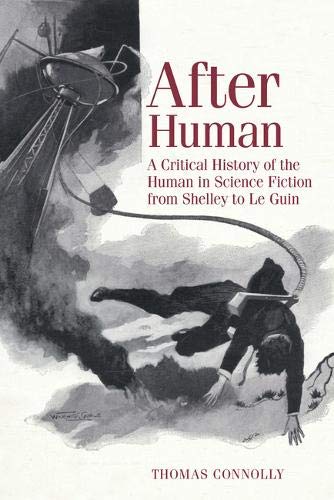
Thomas Connolly. After Human: A Critical History of the Human in Science Fiction from Shelley to Le Guin. Liverpool UP, 2021. Liverpool Science Fiction Texts and Studies 69. Hardcover. 240 pg. $119.15. ISBN 9781800348165.

Looking at critical theory as the body of work that defines our toolset as literary critics, in science fiction (sf) especially, one cannot but notice the dominant position that posthumanism has taken on ever since its rise to prominence in the 1980s. Donna J. Haraway’s “Cyborg Manifesto” (1985) belongs into the category of must-reads for any sf scholar and its ripple effect into our field cannot be overstated. And given its timing, coinciding with the emergence of cyberpunk as a central mode of sf, it is no wonder that posthumanist readings have grown from there, proliferating in contemporary sf studies. But, as Thomas Foster has pointed out so aptly, cyberpunk is not the literary “vanguard of a posthumanism assumed to be revolutionary in itself” (xiii). Instead, it is a multiplier of posthumanism, a prism that changes the theory and allows it to take diverse forms.

But what comes out as a variety of posthumanisms must have gone into this prism at some point. It is this realization that feeds Thomas Connolly’s study After Human, that much sf before the posthumanist turn must address these issues somehow, that “even the most avowedly humanist text raises posthumanist concerns” (20). Connolly argues that in its discussion of human interaction with technology and nature, historical text of sf will reveal their concern for posthumanist issues. He sees the ‘post’ of posthumanism as a feature within humanism itself, an admittance of “the constructed nature of human experiences of the world” (20). His study is, consequently, a critical history of sf texts that foreground human interaction, not with the inhuman (however that may be), but with technology and nature, and with other humans. 

Connolly then proceeds to explore the humanist-posthumanist spectrum and the ontological modes associated with it in the history of sf through four chapters, each detailing a specific period of writing. Starting with 19th century proto-sf in the works of Mary Shelley, Jules Verne, and H.G. Wells, Connolly sets up a comparison of the depiction of primitive pre-humanity in Sir Arthur Conan Doyle’s The Lost World and Jack London’s The Iron Heel, which contrasts with the humanist view of self-realization and centeredness. In the next chapter, on Aldous Huxley’s Brave New World and E.E. Smith’s Skylark series, Connolly then moves on to the relation of the human and technology, shifting the mirror from primitive pre-humanity towards a technologized trans-humanity. Here, more clearly than with the humanist-oriented narratives of the turn of the century, two distinct lines emerge: one that sees humanity “rendered powerless by technological systems beyond their control” and one that argues for a “utopic image of human self-actualization, evincing ever-greater technological control over the material world” (109).

In the 1950s, Connolly argues, a similar duality can be found not in a technological trans-humanity but in an evolved supra-humanity, which he explores in Isaac Asimov’s Foundation-series and Arthur C. Clarke’s The City and the Stars. Finally, in the 1970s, Connolly shifts from trans- or supra-humanity to a true post-humanity, in discussing the utopian project of J.G. Ballard’s The Crystal World and Ursula K. LeGuin’s The Dispossessed. All of the chapters analyze works that attempt to engage with new positions of the human, in developing with technological progress, in challenging the idea of individualism, or in decentering the human. But, as Connolly makes clear, many retreat back into their more humanist positions, not following through with fully embracing the posthumanism that they tease out. In his conclusion, Connolly sees these stories as positioned in a framework of how the non-human is approached, either “assimilative” (192) in that the human enfolds the non-human cognitively or culturally, or “transformative” (193) in that human cultural frames are challenged and changed. His analysis places the historical works discussed in this framework, thus allowing scholars of posthumanism to see the theoretical trajectories of the categories.

After Human thus cleverly uses the posthumanist scaffolding to re-read traditional science fiction and excavate positions of the human within it, tracing the development of posthumanist positions up to the 1980s. For those scholars interested to treat posthumanism not as a given of the 21st century, but as a development of the humanism and anti-humanism that came before, Connolly’s book is a valuable resource explaining the lines of thought in sf that have led up to, for example, the cyberpunk multiplication of posthumanism. After Human will help ground current work in contemporary posthumanist criticism by providing a historical perspective.  


Lars Schmeink is currently Leverhulme Visiting Professor at the University of Leeds. He has inaugurated the Gesellschaft für Fantastikforschung and has served as its president from 2010-19. He is the author of Biopunk Dystopias (2016) and the co-editor of Cyberpunk and Visual Culture (2018), The Routledge Companion to Cyberpunk Culture (2020), Fifty Key Figures in Cyberpunk (2022) and New Perspectives on Contemporary German Science Fiction (2022). 

Review of Black Utopias: Speculative Life and the Music of Other Worlds


Review of Black Utopias: Speculative Life and the Music of Other Worlds

John Rieder

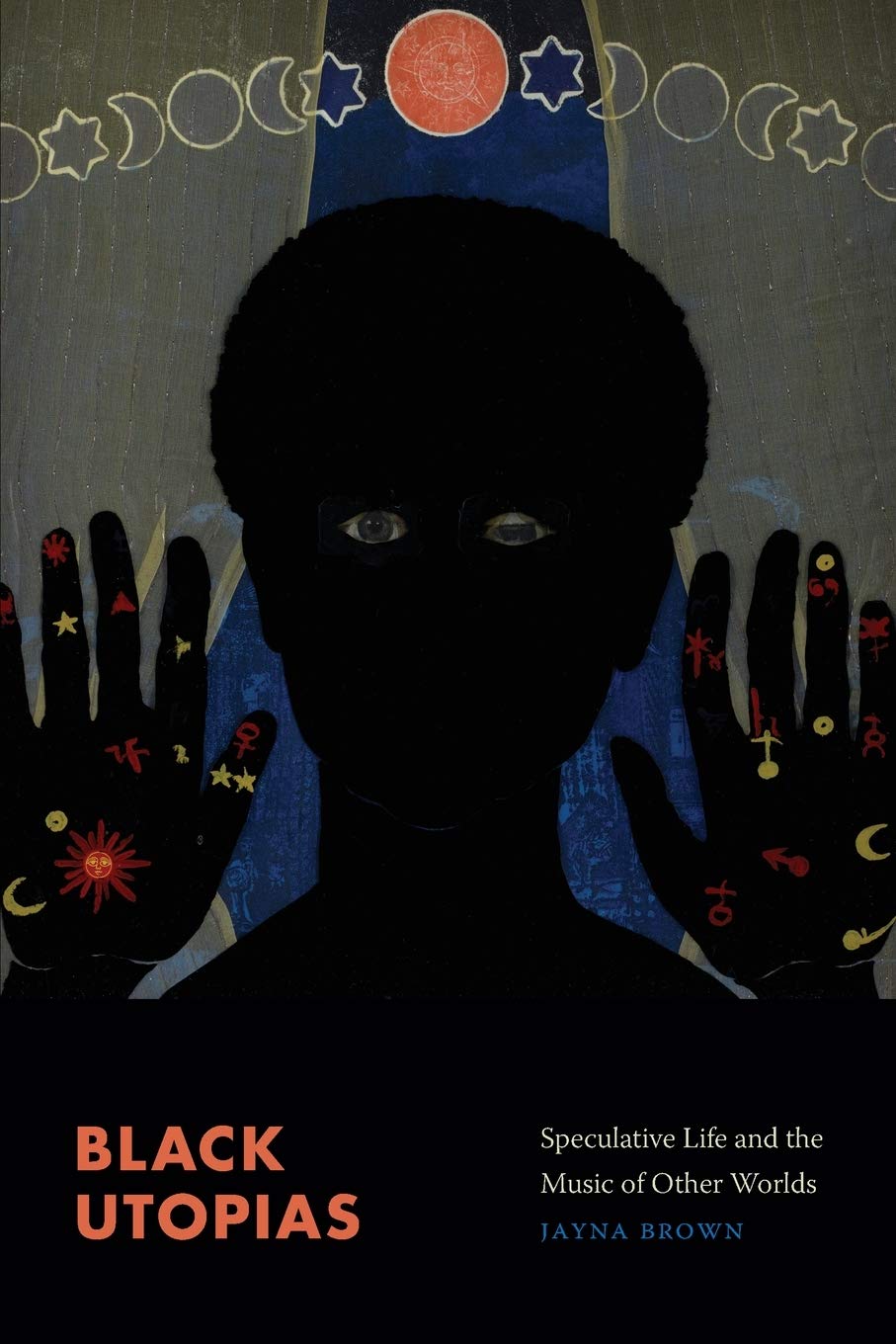
Jayna Brown. Black Utopias: Speculative Life and the Music of Other Worlds. Duke UP, 2021. Paperback. 224 pg. $25.95. ISBN 9781478011675. Ebook ISBN 9781478021230

Jayna Brown introduces her argument in Black Utopias with a short, moving section about her father, who was a poet, a Black Panther, a political exile, then a prisoner in the US, and finally, after his release, a self-proclaimed prophet in communication about the coming final days with a spirit named Golden Ray. Brown writes that struggling with what she considered her fatherʻs psychosis led her to ask questions about where one can draw the line betwen vision and madness. Perhaps, she wondered, one ought to listen more carefully to “mad souls.” The project of Black Utopias “is a way of residing in spaces of ambiguity” where the line between madness and prophetic vision cannot be confidently drawn (5). It is very worthwhile to follow her lead into exploring that uncanny space in this innovative, well-researched piece of scholarship.

Brown “use[s] the term utopia to signal the (im)possibilities for forms of subjectivity outside a recognizable ontological framework, and modes of existence conceived of in unfamiliar epistemes” (6). This is a very particular, narrow sense of what Lyman Tower Sargent, in one of the most widely cited essays in utopian studies, calls “the broad, general phenomenon of utopianism.” Sargent defines utopianism as “social dreaming—the dreams and nightmares that concern the ways in which groups of people arrange their lives and which usually envision a radically different society than the one in which the dreamers live” (Sargent 4). But the envisioning of radically different societies in, for example, the Back to Africa movement or Martin Luther Kingʻs non-violent protest, or implied by the critical dystopian features of Ralph Waldo Ellisonʻs Invisible Man (1952) or George Schuylerʻs Black No More (1931), are not part of the genealogy of black radicalism Brown constructs in this volume. Indeed the Harlem Renaissance is completely absent from Brownʻs essay, and Black nationalism is explicitly excluded from Brownʻs notion of utopianism because it seeks for recognition within the political and epistemological framework of white hegemony. Instead, says Brown, “the art and practices I consider involve a radical refusal of the terms by which selfhood and subjectivity are widely used and understood” (8). Brown wants to “redefine what the very term radical means” (26).

The version of radicalism that Brown delineates is indeed a stark departure from most received leftist, and especially Marxist, notions. She rejects dialectical thinking, which according to her remains inscribed within hierarchical practices that exclude black subjects from full participation in the category of the human. Nor are her radicals materialists in the scientific sense common to Enlightenment thought in general and most leftist critical theory in particular. Instead they embrace spiritualism and mysticism. Rather than rejecting life after death as an ideological soporific, they discover “radical forms of selfhood . . . produced in dream states, spirit, and temporal impulses not fettered by the cycle of life and death” (25). For the nineteenth century black woman preachers whose careers Brown describes, “The claim to life after death, while coded in the language of Christian belief, is a profoundly political claim by the living that they cannot ever truly be killed, enabling them to claim the space between life and death as another dimension of consciousness” (51). For jazz musician and poet Sun Ra, the subject of Brownʻs final chapter, civil rights activism was an illusory project because the only way to achieve peace and equality was to be dead. Therefore Ra often enjoined members of his audiences to “give up your death for me.”

The key category for Brownʻs redefinition of radicalism is the human. Her version of radicalism does not follow Marxist tradition or black nationalism in defining the goal of revolutionary activism as the seizure of state power, and it equally rejects civil rights protest’s goal of attaining equal treatment within the legal structure of state power. Brown’s radicals instead pursue something rooted in being itself, a sense of selfhood attainable only through “a complete break with time as we know it—an entirely new paradigm” (8). She argues that “black people’s existence is mythological in the first place. We don’t really exist, according the the logic of the human” (4). Readers familiar with the 1974 film Space Is the Place starring Sun Ra will surely hear echoes here of Raʻs film-opening declaration that time has officially ended, and of the speech Ra makes to a group of Oakland teenagers who challenge the outlandishly costumed musician whether he is for real. Ra replies: “I’m not real. I’m just like you. You don’t exist in this society. . . . I do not come to you as a reality; I come to you as a myth. Because that’s what black people are, myths.” What Brown adds to Raʻs position is an argument “that because black people have been excluded from the category human, we have a particular epistemic and ontological mobility” (7). There is “real power to be found in such an untethered state” because “those of us who are dislocated on the planet are perfectly positioned to break open the stubborn epistemological logics of human domination” (7). Brown accordingly places Sun Ra within a genealogy of black visionary radicalism that stretches back to the nineteenth century preachers Sojourner Truth, Rebecca Cox Jackson, Jarena Lee, and Zilpha Elaw, includes fellow mystic and jazz artist Alice Coltrane, and looks forward from them to the science fictional writing of Samuel R. Delany and Octavia E. Butler.

As the inclusion of preachers at one end of this history and writers of fiction at the other indicates, it is not music or any other sort of artistic form that unites these figures, but rather notions of the self and practices of community. It is the ritualistic, immersive character of Alice Coltraneʻs and Sun Raʻs performances that primarily attracts Brownʻs attention, rather than their innovations in the form of jazz (and both musicians could certainly afford rich material for a more formal approach). Brown says of Coltrane that her “mix of praise singing from the black Christian church, jazz, and Hindu worship songs” adds up to “a utopian practice of attunement with an infinite universe of aural vibratory phenomena” (60). Tellingly, Brown refers not to Coltraneʻs audience here but to her “congregation.” Brownʻs emphasis in the chapter on the four women preachers is less on any doctrinal position or rhetorical strategy than on their common investment and participation in alternative, non-heteronormative forms of community. Brown insists that the apolitical, otherworldly turn of the preachers and the musicians “also includes the concrete: the creation of community. Like Rebecca Cox Jacksonʻs Shaker community, Aliceʻs model could be considered escapist. But escape is an important trope in African American culture” (80). (Cf. Sun Ra: “If you find earth boring / Just the same old same thing / Come on and join us / At Outerspaceways Incorporated.”)

Brownʻs chapters on Octavia E. Butler and Samuel R. Delany are similarly focused on the way some of their fiction envisions forms of community. Her approach to Butlerʻs Parable series and Delanyʻs Triton (1976) shows little or no interest in literary devices such as plot or point of view or style. The focus in the Butler chapter is on the protagonist Olaminaʻs religious ideas for their own sake, not for the way they function within a literary fiction, and the same is mostly true for her attention to the setting of Delanyʻs Triton. For scholars of science fiction, perhaps the most pertinent aspect of her reading of Butler is her insistance, against what she calls a hagiographic tendency in Butler scholarship, on the “complexities and contradictions” introduced into Butlerʻs work “by a particularly grim version of Darwinism” that jostles uncomfortably alongside “biological forms of cooperation, symbiosis, and commensality” (84). For Brown, the utopian experiment that Olamina launches in the Parable novels remains heteronormative and deeply humanist—which are not, for Brown, good things. Finally, “the extent to which the texts can imagine evolutionary possibility is held back by a concept of change beholden to heteronormative ideas of a biological imperative” (107). Brownʻs argument has the considerable merit of emphasizing a set of issues within Butlerʻs work that is perhaps too often skirted or treated apologetically.

The pages Brown devotes to the nonfictional utopian writing of H. G. Wells are even more firmly set against critical evasion of what is problematic and disturbing in Wellsʻs writing. Brown argues that Wells “is revered as a foundational figure in science fiction while his frightening and horrific eugenicist ideas are ignored or minimized” (116). Within the structure of Brownʻs argument, Wells acts mostly as a foil to help introduce an analysis of the way Delany “explores the malleability of biological matter and frees it from normative determination” (127) in Babel-17 (1966) and The Einstein Intersection (1967). One of the main foci of Brownʻs reading of Delany is his treatment of desire, which, she says, Delany does not take in a Hegelian or Lacanian sense as something rooted in negation or lack, but rather in Deleuzean terms as “a productive and generative activity” (138). The point is the way this alters conceptions of the subject and the dependence of subject formation on relationality. This is the place in Brownʻs argument that relies most strongly and productively on queer theory, asserting that “transgender and transsexuality theories” show the way to “relaxation of the need for set and fixed gender and sexual identities and the embrace of fluid and expansive modes of being” (138).

Brownʻs final chapter is devoted to the person who seems to me to preside over the entire argument, Sun Ra. True to her approach to Butler, Brown avoids turning her analysis into a hagiography, facing squarely up to the authoritarianism of Raʻs band leadership. But she is more interested—and rightly so—in the way that “the homosocial space of the Ra houses was not modeled on that of a heterosexual family or compound of families. While they were based in discipline, they were not based in hierarchical rank or competition” (162). This kind of noncompetitive, nonmasculinist organization of the jazz orchestra runs counter to dominant practices of the music then and now, but for Brown it is more important that it is based on challenging the notion of the possessive individual and all that comes with it. In her reading of Sun Ra, Brown achieves the clearest enunciation of her profoundly non-Althusserian version of antihumanism. “For Ra,” she says, “being human is a state of ignorance and not a status we should be fighting for. . . . Black people have to let go of the idea of the human, which Ra sees as inseparable from the liberal terms that have defined it. . . . Raʻs call is not for a new genre of the human but a new genre of existence” (172-73).

Whether Brownʻs intervention into utopianism, black intellectual history, and the genealogy and significance of Afrofuturism will end up being judged boldly iconoclastic or merely interestingly idiosyncratic I do not presume to be able to say. But I can say with absolute certainty that I learned a lot from this book, and that I found it a fascinating and pleasurable read.


WORKS CITED

Sargent, Lyman Tower. “The Three Faces of Utopia Revisitied.” Utopian Studies, Vol. 5, No. 1 (1994), pp. 1-37.


John Rieder, an emeritus professor of English at the University of Hawai‘i at Mānoa, was the recipient of the SFRA Innovative Research Award in 2011 and the SFRA Lifetime Achievement Award in 2019. He is the author of Colonialism and the Emergence of Science Fiction (Wesleyan UP, 2008), Science Fiction and the Mass Cultural Genre System (Wesleyan UP, 2017), and Speculative Epistemologies: An Eccentric Account of SF from the 1960s to the Present (Liverpool UP, 2021). He has served on the editorial board of Extrapolation since 2010.

Review of Reverse Colonization: Science Fiction, Imperial Fantasy, and Alt-Victimhood


Review of Reverse Colonization: Science Fiction, Imperial Fantasy, and Alt-Victimhood

Jeremy Brett

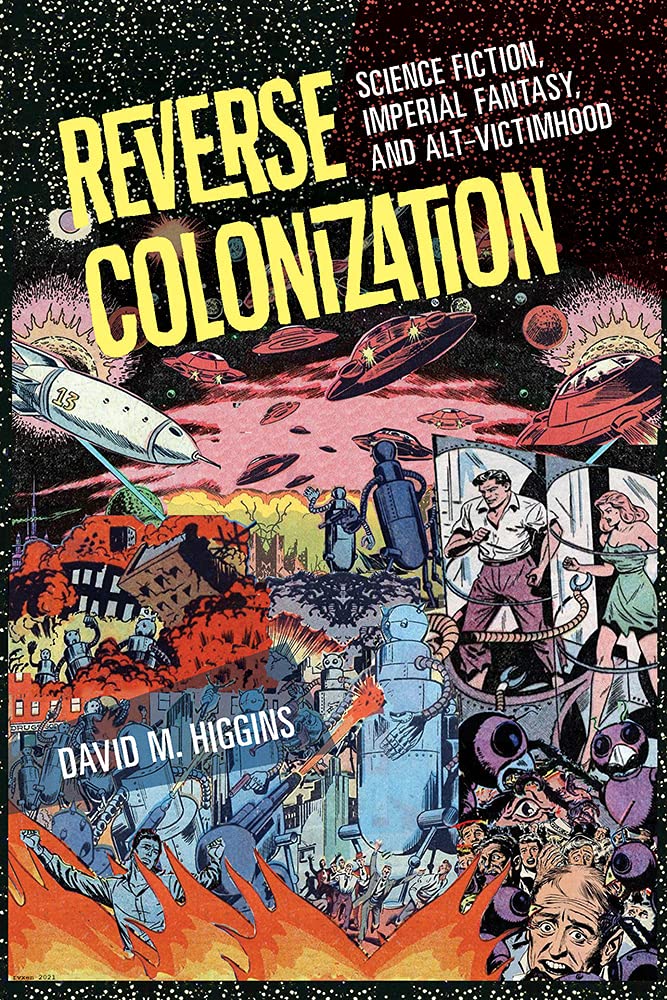
David M. Higgins. Reverse Colonization: Science Fiction, Imperial Fantasy, and Alt-Victimhood. University of Iowa Press, 2021. The New American Canon: The Iowa Series in Contemporary Literature and Culture. Paperback. 250 pg. $39.95. ISBN 9781609387846.

Reverse Colonization, David M. Higgins’s new work of clever, thoughtful textual analysis, has the unenviable privilege of being a necessary book for the dark and ominous times before us. Those times make the experience of reading the book sadly relevant when harried readers might have appreciated a more standard dive into the strictly and more comfortably theoretical. On the other hand, as the shrill, shallow, and twisted concerns of the Right infiltrate ever deeper into our culture—including the ongoing evolution and development of science fiction and fantasy—understanding how those concerns impact the writing and reception of these genres becomes almost a duty. We’re seeing it most recently in the ‘Puppygate’ kerfuffle of 2013-2017, in which a sad sack coalition of self-described revolutionaries led a backlash against perceived ‘injustices’ committed against ‘traditional’ (i.e., white, male, and cisgender) modes of science fiction storytelling. The irony is palpable—we see supporters of the Empire now think of themselves as the Rebel Alliance, and fans raised on and claiming to love Star Trek now decry perceived ‘wokeness’ in the utopian ideals of the United Federation of Planets. The phenomenon has become a veritable orgy of willful cultural misinterpretation.

But, as Higgins delineates so well in his study, that reactionary impulse, that “appropriation of righteous anti-imperial victimhood—the sense that white men, in particular, are somehow colonized victims fighting an insurgent resistance against an oppressive establishment—depends on a science fictional logic that achieved dominance in imperial fantasy during the 1960s and has continued to gain momentum ever since” (4). These dark and bad-faith interpretations have deep genre roots, in what Higgins calls the “imperial masochism” (2) that centers important SF&F works of the 1960s and 1970s. It behooves us, then, to have scholars like Higgins so deftly analyze the imperial masochism phenomenon, if only to better understand the ways in which beloved texts can be so disastrously misread, misused, or misdirected. But these kinds of projects also help readers and scholars alike uncover the evolution of bad-faith arguments from good-faith ones, for, as Higgins notes, the roots of reverse colonization narratives lie in soil of positive motivations.

Reverse colonization is no new concept in science fiction. Higgins offers a useful and well-written summary of its history in his introduction, along with an outline of its appropriation by nostalgic imperial fantasists and illiberal right wingers into narratives of imperial masochism. The ur story here is, of course, Wells’s The War of the Worlds (1897), in which Wells used the cover of a fictional Martian invasion to allow his readers—beneficiaries of the advantages of an aggressive world empire—to imagine themselves as the colonized victims. But over the next century, this perpetrator/victim reversal and appeals to reader empathy and to increasing anti-colonial sentiments mutated in some cases into Higgins’ imperial masochism, which he defines as a sort of dream logic in which the “subjects who enjoy the advantages of empire adopt the fantastical role of colonized victims to fortify and expand their agency.” The pleasures of imperial masochism lie in a conscious enjoyment of the “presumed moral superiority that fantasies of victimization enable” (2-3), Although right-wing positioning of reactionaries as social and cultural victims is not new, Higgins’s study is pioneering in its uncovering of what he calls “science fiction’s troubling complicity in the formation of modern imperial discourses and practices” (3) (and a concurrent adaptation and misuse of SF imagery: note, for example, how the “red pill” of The Matrix has become an important metaphor for many alt-right subcultures). Higgins also delves into the irony that the anti-imperial 1960s (when science fiction, as well as the greater culture, finally dismissed the idea of the noble conqueror or colonizer) produced several important works inadvertently fostering the notion that those with actual social, cultural, and political power are actually the powerless victims of evil conspiracies against them.

Higgins takes on a number of important mid-century texts (taking care, it should be noted, to explicitly deny any implication that the authors were working with deliberate reactionary intent), particularly in the book’s first chapter. Herbert’s Dune (1965, an inadvertently popular text among the alt-right), Heinlein’s Stranger in a Strange Land (1962), and Clarke’s novelization of 2001: A Space Odyssey (1968, based on his and Stanley Kubrick’s screenplay) are all offered up for their particular explorations of interior masculinity that replace—or seek to replace—the old Golden Age of Science Fiction imperial narratives of planetary settlement and conquest. All three works offer what can be read as optimistic portrayals of authoritarian Ubermensch fantasies. What is key to the appeal of these stories—what makes them feel heroic rather than oppressive—is the fact that Heinlein, Herbert, and Clarke frame their iconic supermen as victim-heroes struggling to achieve freedom, rather than as fascist heroes bent on domination. In particular, all three novels use the logic of reverse colonization to portray psychedelic awakening as a triumphant victory against empire (32).

In the tradition of the decade that spawned these works, the way to true liberation and true mastery is to free one’s mind and let the body follow. The true path to power in these texts lies in eschewing dreams of conquest (and the psychological barriers of internal colonization) in favor of real, lasting agency. This sounds reasonable enough, but Higgins argues that the result across the narratives is to invite white elite male heroes to identify as psychically colonized victims who must reject the passive consumer nature of their societies; these protagonists evolve greater forms of self-mastery and heroic masculinity that have unsettling parallels to fascist ideas of manhood and power. From these examples, it’s not hard to see how some readers may make a wrongheaded conceptual leap towards championing reactionary ideals while calling themselves ‘victims’ of an inferior society.

Higgins devotes a chapter to Philip K. Dick’s body of work and his narrative preoccupation with the idea of consensual reality as a “colonizing system of control” (66). Of course, Dick is rightly heralded for his explorations of the truth behind the realities we perceive, but Higgins thoughtfully dissects the potential pitfalls of this sort of mindset. Incel mass murderer Elliot Rodger (who constantly referenced examples from science fiction in his twisted self-reflections) is cited as an example of how disastrously narratives and authorial intent can be perverted. As Higgins notes, “(Rodger’s) autobiography reveals a disturbing engagement with an even deeper mode of science fictional thinking: the idea that reality itself is somewhat wrong, twisted, or broken, and that an insurgent revolution must be fought against such a false reality to create or restore a better world” (62). It is a seductively believable idea and falls into easy line with Dick’s 1960s-1970s stories that depict our perceived reality as a prison and our brains colonized by untruths and false beliefs. Higgins points out that Dick has been one of the preeminent creative minds of the genre in projecting the idea of a false reality obscuring the truth—neither Higgins nor we would blame Dick for the disastrous social situation that can arise from this (we’ve all been forced to bear witness to the Trumpian and right-wing strategies of discarding troublesome and inconvenient realities in favor of desired outcomes), but the seductiveness of the idea clearly has influence on today’s alt-right, and its science fictional groundings therefore deserve analysis and consideration. More specifically in this chapter, Higgins uses Dick’s alternate history classic The Man in the High Castle (1962, itself a story of a false reality within a larger truth) to explore the ambivalent tensions in reverse colonization texts between imperial critique (the dissection of imperial morality) and imperial masochism: these texts at once “ask audiences to identify with victims, yet they can also enable audiences to identify as victims” (69). The book does good work in encouraging its readers to sympathize with victims worldwide of oppression and injustice, but as Higgins explicates, it also fortifies feelings of imperial masochism by “inviting privileged male subjects to identify as victims struggling against internal and external domination” (ibid). Castle demonstrates that reverse colonization narratives often operate within a “contested imaginative terrain” (ibid) in which imperial masochisms can be both enabled or dismantled, which, of course, reinforces the complexity of texts and the foolhardiness of identifying singular interpretations.

False realities and mental prisons become real prisons in Higgins’s exploration of both the cult television show The Prisoner (1967-1968) and Thomas M. Disch’s 1969 literary adaptation of the series. The Prisoner, of course, is rooted in the concept of the integrity of the resisting individual standing against an all-encompassing system, and it is famous for championing free will over the oppression and conformity of social life. But Higgins makes the interesting argument that the show can also be read as a “carceral reverse colonization fantasy” (99), a work centered on the fantasy of an elite white male whose self-possession signifies a moral and emotional center invulnerable to lies or societal violation, and which promotes the secessionist dream of withdrawal (that, sadly, lies at the heart of much alt-right discourse). These types of carceral fantasies (including both Disch’s Prisoner and his 1968 novel Camp Concentration, also touched on here) “encourage and enable identification with imprisoned subjects and give force to liberatory, anti-imperial sentiments – for good or for ill” (123). Again we see the potential for texts to serve either (or multiple, to expand past the binary) sides in social and political rhetoric, strategy, and worldviews.

The next chapter is particularly thought-provoking in its focus on and creative use of the metaphor of entropy, sparked here by the idea among some commentators that pro-Brexit voters were motivated by the fears of “social entropy”, that is, the science fictional notion that the United Kingdom under the European Union and the continuing forces of globalization faced inevitable and approaching “heat death” (126): the destruction of everything that makes Britain Britain. Worries over this entropy drove the actions of nationalists and reactionaries to escape the prison of European control in favor of an ‘independent’ UK. Entropy is a central theme for many New Wave writers, and as a metaphor for the inevitable disintegration of empire it is key, says Higgins, to the early work of British New Wave writers J.G. Ballard and Michael Moorcock. Certainly Ballard and Moorcock are not fans of an inherently unjust and stratified British Empire, but Higgins presents their work as marking “the decline of empire with profoundly mixed feelings, because for them, empire frequently embodies the apex of civilization and human aspiration striving against entropy, decay, darkness, and savagery” (128). It’s certainly an interesting take, especially when one considers, say, the liberal and anti-establishment views of Moorcock, but Higgins makes a thoughtful case that both he and Ballard are writing reverse colonization stories that both attack the imperial idea while at the same moment “framing imperial elites as tragic and helpless victims of entropic decline” (128). Both authors use the inevitability of erosion and destruction to strike a fatalistic tone that sees empire’s fall less as a good in itself and something that can be manipulated to serve the underserved, and more as a troubling, regrettable and universal phenomenon that erases the great as well as the small and which inflicts a complete lack of agency on imperial participants. (The chapter ends on a more complex note by analyzing two New Worlds pieces—one fiction, one non—by David Harvey that complicate the notion of entropy and its more simplistic conceptions by some authors.)

Higgins concludes his study of texts with a look at Samuel R. Delany’s post-apocalyptic trilogy The Fall of the Towers (1963-1965) and its concern with the significance of objective information. Higgins describes Delany’s characters across the three books as “colonized prisoner-victims trapped in lies and illusions that exist to perpetuate imperial wars” (187), who must ultimately be liberated by an exposure to truth and the breadth of vital information. In doing so, victims’ consciousnesses are raised to a point where they may accurately engage with the accepted fantasies that power oppressive imperial systems and overcome them. The imperial project, built on lies and preconceptions, is too large for any one person to overturn, and none of Delany’s individual characters can apprehend the bigger picture, but a collective effort, a “difficult, tentative, and uncertain exploration of the world’s true complexity that must be undertaken despite the fact that perfect, ultimate knowledge will always, by necessity, remain forever out of reach” (188).

A commitment to an awareness of complex and objective truths is necessary, Delany argues, to obviating imperial exploitation, which can only occur because victims alone are too small to see how that exploitation functions. But that awareness must be tempered by the irreducibility of subjective experience. In this, Higgins sees Delany as a valuable corrective to an irreconcilable “opposition between modern and postmodern ideals of political consciousness. He therefore offers a much-needed model for what cognitive justice might look like in a post-truth era” (167). As an antidote to the simplification of empire, Delany provides a reverse colonization narrative that can be an effective imperial critique, on the grounds that the “more a reverse colonization narrative refuses to simplify empire and explores the complexities of imperialism in a thoughtful manner, the less traction such a narrative offers for misappropriation in service of imperial masochism” (167).

Higgins’s book is a valuable and important study, indeed, crucial in this time when science fictional ideas and narratives are worryingly turned to malignant purposes, many of them inspired by harmful imperial fantasies. As he notes, “I still believe that science fiction has a powerful capacity to function as a critical literature of empire…science fiction, I argue now, almost always takes empire as its central subject, but whether a given narrative perpetuates or challenges imperial discourse and practice (or does both simultaneously) depends very much on that particular narrative and the context of its production and reception” (200). Certainly he has made that clear in this volume. Although for the good of our relations with one another it is vital that narratives exist which provoke empathy in readers by letting them see through the eyes of others, it is equally important to realize that the possibility for harmful, destructive, even murderous misinterpretations of that enterprise exist. Such are the social complexities of the genre we all love.


Jeremy Brett is an Associate Librarian at Cushing Memorial Library & Archives, where he is both Processing Archivist and the Curator of the Science Fiction & Fantasy Research Collection. He has also worked at the University of Iowa, the University of Wisconsin-Milwaukee, the National Archives and Records Administration-Pacific Region, and the Wisconsin Historical Society. He received his MLS and his MA in History from the University of Maryland – College Park in 1999. His professional interests include science fiction, fan studies, and the intersection of libraries and social justice.

Review of Speculative Epistemologies: An Eccentric Account of SF from the 1960s to the Present


Review of Speculative Epistemologies: An Eccentric Account of SF from the 1960s to the Present

Paul Graham Raven

John Rieder. Speculative Epistemologies: An Eccentric Account of SF from the 1960s to the Present. Liverpool UP, 2021. Liverpool Science Fiction Texts and Studies, 70. Hardback. 192 pg. $125.00. ISBN 9781800855410.

John Rieder’s introduction to Speculative Epistemologies aims the book at the question of “truth effects in sf” and invokes the Harawayean expansion of those initials: the field of enquiry includes science fiction and speculative fiction, of course, but also “speculative feminism, science fantasy, speculative fabulation, science fact” (1-2). The book’s heart is six close readings of stories from the genre’s subcultural margins, which Rieder hopes will “trace a history of sf that captures the increasingly feminist, racially and ethnically diverse, philosophically ambitious, and politically engaged character of [sf’s] subcultural centers of gravity from the 1960s to the present” (2). The speculative epistemologies of the title are “counter-hegemonic ways of knowing” (2), while the eccentricity of the subtitle refers not to the substitution of Hawaiian shirts and a fedora for a personality, but rather to an engagement with “multiple centers of gravity,” resulting in non-Copernican orbits such as those of comets and the like.

In other words, this is a tour of the Oort cloud of the generic solar system. Perhaps that’s not the ideal metaphor, however, given Rieder here extends the model of genre (re)formation set out in his Science Fiction and the Mass Cultural Genre System (2017; SFMCGS hereafter): an Actor-Networkish approach which “resists any monolithic, centrally organised description” (3) in favour of exploring an ever-shifting assemblage of subnetworks through which the meaning of a term such as ‘science fiction’ is perpetually under (re)construction. Which is to say that ‘science fiction’ is not the simple category identifier that it’s sometimes taken to be, nor is it exactly like a solar system—unless, perhaps, we consider solar systems over a timescale for which our mayfly lifespans make us woefully unprepared.

Nonetheless, if that’s the map we’re taking for Rieder’s territory, then his navigational rubric is a popular aphorism pulled from Shapin and Schaffer’s Leviathan and the Air-Pump (1985), a landmark work in Science & Technology Studies (STS): “solutions to the problem of knowledge are solutions to the problem of social order” (3). To this claim Rieder adds a rider of his own: “the problem of knowledge/social order is therefore also, always, the problem of narrative or storytelling” (ibid).

The waystations on this journey are six sfnal texts that foreground the social struggles—and hence the alternative ways-of-knowing—of women, Indigenous communities, and queer communities: Pamela Zoline’s “The Heat Death of the Universe” (1967); Leslie Marmon Silko’s novel Ceremony (1977); Samuel R. Delany’s “The Tale of Plagues and Carnivals” (1985); Theodore Roszak’s The Memoirs of Elizabeth Frankenstein (1995); Albert Wendt’s The Adventures of Vela (2009); and “The Camille Stories” (2016) by the aforementioned Donna Haraway. Rieder’s itinerary is not intended to be exhaustive, but illustrative, taking in some exemplary texts which subvert the hegemonic culture—but also the hegemonic sf culture—of their time, resulting in “an enormously more significant realisation of the genre’s literary and ideological potential” (4). I will not presume to judge the suitability of Rieder’s choices, here, nor critique his analyses. For one thing, I have read only two of the texts (the Zoline and the Haraway) and know one more by repute (the Delany). For another, Rieder’s reputation as a wide and generous reader precedes him, and the chapters devoted to each work in this book are testament to a body of knowledge and experience that puts my own to shame. What I can say with certainty is that he provides ample reason to seek out the stories I haven’t read, and to return to those I have.

Therefore—and given my own position within (or is it my trajectory across?) the assemblage-of-assemblages that we think of as the academic disciplinary (solar-)system—I will instead concentrate on Rieder’s framing argument and conclusion. Though a critic and author of sf, and a regular (ab)user of the scholarly toolkit surrounding the genre, I would not presume to define myself as an sf scholar first and foremost. If I am legible at all to the disciplinary system, it is as some vigorously mutant species in which the genes of futures studies and STS got mixed up, perhaps by way of a comic-book villain’s experiments with a particle accelerator. This may serve to explain why Rieder’s work usually speaks clearly to me: the theory of genre advanced in SFMCGS, for instance, makes a lot of sense to someone who, in the words of their long-suffering doctoral supervisor, “has read more Latour than is necessarily helpful”. Throw in some Haraway (as theorist as well as fabulist), the foundational work of Shapin and Schaffer, a pinch of Bakhtin and Barad, and I’m in fairly familiar territory; to then be slung outward on a trajectory that traces that territory’s potential intersection with a (small-c) catholic conception of sf as an assemblage is a mission that feels, at times, like it was written just for me.

However, that feeling dissipates somewhat when Rieder reaches his conclusions. To explain why, I must attempt to sum up the theoretical framework that takes us there, which Rieder erects around the central issue of “truth effects” (1). This argument begins with the relationship—often claimed but, as here shown, most often honoured in the breach—between the epistemic bases of science fiction and the sciences for which it was (unwisely, and regrettably) named long ago. This part of Rieder’s argument includes a quick foray through the emergence of ‘hard’ sf—here shown to be driven by a cherry-picked nostalgia for an earlier sf which had hardly existed, and resulting in a “highly targeted storytelling practice, one that caters to a well-defined, narrow audience” (11)—and the ‘soft’ New Wave counterpoint that emerged within the genre; it is also the part of the argument which I assume will be canonical to most readers here. What interests me more is Rieder’s delineation of an epistemological chasm between the reality- and truth-claims of sf-as-fiction on the one hand and science-as-non-fiction on the other. Here, the vastly different effects (and perhaps also affects) of authority and plausibility must be (re)examined within what Rieder calls regimes of publicity: “the material practices of the production, circulation and reception of discourses” (12) wherein the boundaries and protocols of ‘genre’ are built, maintained and reconfigured over time.

For Rieder, this process requires focussing on the label ‘science fiction’ as commonly used rather than as expertly defined, thus resisting pressures to purify sf of its entanglement with mass culture, and with the inextricably related techniques of advertising and market research. The latter are connected by Rieder (quite rightly) to the “fake news” phenomena of the moment, produced by the “outrage industry” as part of an assault on “the authority of evidence-based truth” (12). Meanwhile, “the real, true ‘cognitive’ power of sf” must be found “by tracing its proliferating networks of influence and association,” rather than by the aforementioned process of purification (12): the broad church that the term now represents, and its indirect and polymorphous relationship to the episteme of scientific enquiry, is precisely the result of sub-subcultural struggles within the subculture of SF itself. This dynamic is how the idea of ‘hard’ SF emerged, and—first as tragedy, then as farce?—how the more recent Puppies crusades emerged, but it is also what gave rise to the far more inclusive and radical countercurrents which Rieder is charting in this book.

So far, so good. But early in his conclusion, Rieder turns toward drawing a hard and exclusionary line between, on the one hand, both the vernacular (and liberal-hegemonic) notion of ‘science fiction’ (for which his figure is the bloated monolith of the Marvel movies franchise) and the more radical tradition that the book focusses on, and on the other hand, the post-truth narratives of the MAGA movement. He rightly notes that, while the radical tradition with which Speculative Epistemologies is concerned takes a critical and oppositional attitude to the more ‘same old capitalist technoscience, but with slightly better minority representation draped over it’ position of the liberal mainstream, the two blocs are united by a science-like commitment to evidence as the foundation of truth claims, albeit a very instrumentalised lip-service one in the latter case; the fables of the outrage industry, meanwhile, have given up any such pretence in favour of that infamous coining, ‘alternative facts.’

This argument is eminently tenable, to be clear. But I struggle with a corollary that seems to suggest that the fabulatory futures of the post-truth episteme are thereby beyond the pale in terms of the genre dynamics he has described in this and earlier works: disconnected from the somewhat-more-sciencey speculations of SF and, furthermore, undeserving of any attempt at critical engagement.

I can see where Rieder is coming from, here, not least because he sets it out clearly, referencing the circumstances of his writing the conclusion against the backdrop of the January 6th insurrection at the US Capitol. Which is to say: I don’t blame him for getting on his soapbox. But I do feel that his argument is a poor fit with the book that precedes it. It’s not contradictory, exactly, but nonetheless: to go from detailed explorations of works which illustrate the long and close relation between radical sf and the academic regimes of publicity in particular, and then to hop-skip from there, over the mainstream movies of the commercial regime, and on to a regime that doesn’t even define itself as science fiction at all—even though I would argue its futurities are, contra Rieder, demonstrably no more ‘improbable’ than those of the Black Panther movie (2018), and to its fans distinctly less so—in order to dismiss the latter as illegible to analysis and undeserving of engagement… well, it feels like one hell of a leap.

I can see the logic in holding up MAGA futurism’s refusal to debate in good faith as a reason to “acknowledge, with regret, outrage’s own practice of putting itself outside of any meaningful dialogue” (157), both academically and politically. But politics and logic are not blood relatives… and my (admittedly limited) training in pedagogy leaves me wondering whether we are (to borrow a metaphor from William G. Perry) simply stonewalling the disruptive students who’ve finally cottoned on to the first solipsistic stages of epistemic multiplicity and leaving them to be swept up by demagogues.

And if we concede that debate is impossible, engagement pointless—what then? Because regretfully allowing these epistemes the exit from metaphysics (and hence analysis) whose impossibility forms the basis of our critique of them, and hoping it will just die out if we stop looking at it, doesn’t seem like a strategy that’s going to win over the long haul. Worse, our condemnation and dismissal of these alternative futurities is exactly the effect that their authors—because outrage futures definitely have authors, or at least curators, with political positions and agendas as well-defined as any author Rieder explores in this book—would most like them to achieve. The trap has long been built in: our dismissal of these speculative epistemes—justified by reference to names that post-truth fandoms will identify as ‘postmodern neoMarxists,’ and using five-dollar words aplenty—enacts the elite disdain that those narratives already claim to be all that can be expected of us, tweeting our wokenesses in the sacred groves of radical-leftist academe. Our rejection is prophesied; as a consequence, it will be celebrated, and the division deepened. For all our faith in our own epistemological foundations, we seem unable to escape the characterisation ascribed to us by theirs.

So surely seeking to understand these epistemes with the tools we have developed to that end is better than to shrug and retreat? Certainly, they differ hugely in their truth effects from the ones with which Rieder is here concerned, but—as he observes earlier in the book—they are shaped by the same media-systemic dynamics of niche and mainstream, of marketing and seriality. Indeed, the passing mention of the Puppies crusades could even form the basis for making the case that the sf subculture was a Ground Zero for the ‘culture wars’—and it would be of a piece with the book’s stated project of studying the effect of speculative epistemologies “on the formation of identities and communities” (back cover).

Other scholars seem to be pushing in this direction, too. David Higgins’s Reverse Colonisation (2021; reviewed elsewhere in this issue), for example, shows that sf media which, at the time, were artefacts of a radical leftist (or leftish?) subcultural scene, have gone on to provide rhetorical strategies of resentment to the post-truth meta-episteme. More recently still, Sherryl Vint has described a project in which she intends to treat the adherents of post-truth futurities exactly as fandoms—a move which gestures back to the deep history of sf fandom, prior even to the ’hard’ sf controversy, as a harbor for some irrational, deeply weird, and disturbingly reactionary narratives of futurity.

None of this political meta-talk should be seen as casting any aspersions on the deep readings that Rieder has collected in this book, nor the theoretical framework within which he arranges and executes them: these, as always from this author, are exemplary, and will doubtless join my core collection of references in the field. See my quibbles instead as an intervention in a debate still ongoing, concerning how a once-marginal field of scholarship, having become much more relevant, influential, and mainstream in recent years, should best go about extrapolating its analyses and conclusions into the context beyond the texts which are its core concern. I am in no doubt that such extrapolations are worth making; indeed, I make them in my own (much less notable or exemplary) work.

But we too are in the business of truth claims effects as are, perhaps, all authors, knowingly or not. Rieder notes that Derrida—a ‘postmodern neo-Marxist’ par excellence!—observed that there can be no exit from metaphysics, and this lack of exit informs, for instance, the feminist critical engagement with a male-hegemonic science whose episteme put women under erasure. MAGA futurism may have put truth under erasure, but that’s all the more reason for us to insist on seeking it there: the very commitment to truth that supposedly defines our opposition to it surely behooves us to seek it in our opposers. The alternative can only serve to sustain the destructive division which their imaginary dreams of making canon.


Dr. Paul Graham Raven is (at time of writing) a Marie Skłodowska-Curie Postdoctoral Fellow at Lund University, Sweden, where his research is concerned with how the stories we tell about times yet to come shape the lives we end up living. He’s also an author and critic of science fiction, an occasional journalist and essayist, a collaborator with designers and artists, and a (gratefully) lapsed consulting critical futurist. He currently lives in Malmö with a cat, some guitars, and sufficient books to constitute an insurance-invalidating fire hazard.

Review of Doctor Who and Science: Essays on Ideas, Identities and Ideologies in the Series


Review of Doctor Who and Science: Essays on Ideas, Identities and Ideologies in the Series

John McLoughlin

Marcus K. Harmes and Lindy A. Orthia, editors. Doctor Who and Science: Essays on Ideas, Identities and Ideologies in the Series, McFarland & Company Inc., 2021. Ebook. 235 pg. $39.95. ISBN 9781476642000.

This collection presents a distinctly interdisciplinary set of essays, the vast majority of which testify to the significant scholarly and personal investment of their authors in Doctor Who, both as a modern series and a historical institution. As the editors themselves note, “academics tend not to write about Doctor Who unless they are also fans or at least highly engaged viewers” (14). This particular set of expert fans includes physicists, translation professionals, media and cultural scholars, astronomers, geneticists, science communicators, literature specialists, historians and more, so the collection has an interesting variety of methodological approaches beyond those usually seen in traditional literary and cultural studies. Alongside critical analyses of Doctor Who episodes are quantitative analyses of public engagement, exposition of scientific norms and cutting-edge gender and identity discourses.

Despite this open-ended attitude to content, the curatorial approach is distinctly of the modern humanities, with an emphasis on explicating Doctor Who’s complex and often illuminating relationship with issues around gender, sexual and racial representation, and empire. The editors get the question of pronouns out of the way early, mandating the use of they/them when speaking of the Doctor generally, but allowing for gendered usage when referencing a specific incarnation. Despite the potential—acknowledged by the editors—for the odd instance of grammatical confusion, this two-pronged approach is largely effective and engages admirably with the show’s own development and modern innovations in gender inclusivity.

Focus is laid on the show’s function as a science communicator, rather than simply recording instances of scientific accuracy—or inaccuracy—in specific episodes; Doctor Who can, the editors argue, serve only to proselytize for science at the “macro” level, introducing reason and scientific method as general concepts (6). Despite this, essays do occasionally go as far as equating the show’s quality with its faithfulness to real science. Elizabeth Stanway’s “Who’s Moon” talks about the show’s “recklessly indifferent” attitude toward scientific fact (41) in the 2014 episode “Kill the Moon”; lack of faithfulness to microbiological and astrophysical reality, Stanway argues, indicates “a decline in the quality of scientific and educational representation of the Moon” (41), thus introducing one of the more interesting questions raised by the collection—to what extent Doctor Who must balance its responsibility to science communication with its nature as creative fiction. Stanway frames this within the show’s influence on audience’s attitudes towards science specifically, a perspective supported and built upon by Kristine Larsen’s analysis in the same volume of the “chilling effect” (127) such shows can have on women’s participation in STEM fields. Stanway’s analysis of Google search trends is far from conclusive when it comes to demonstrating the show’s impact on viewer interest, though the inclusion of real-world events alongside episode broadcast dates is an intelligent and necessary one.

Whether it be issues of climate change, space sovereignty or gender inclusivity, one of the collection’s most compelling arguments is that Doctor Who has, for better or worse and throughout its history, contributed to public perceptions of science and scientists. The collection does an admirable job of balancing its conclusions: while Doctor Who is not without flaws, sharing many of them with the culture which gave birth to it, nevertheless the authors seem to believe that it may still serve a vanguard function. Larsen’s own essay, “The Mad Scientist Wore Prada,” offers a balanced and intriguing analysis of Rosalynn Haynes’ catalogue of feminine stereotypes as they appear in Doctor Who. Larsen’s analyses of the Rani and the Master/ Missy are nuanced and thorough, extending far beyond a simple reiteration of Haynes’ initial list; sections dealing with Missy’s emotional response to the Doctor’s friendship and her own rehabilitation are particularly astute, noting the cart-before-the-horse nature of the writing; she asks whether such an emotionally charged Master would be possible in the Moffat era were they not so overtly feminine, and the reader is inclined to agree. Larsen’s conclusion, that the presence of these stereotypes harms inclusivity, is strengthened by the recorded instances of backlash to gender inclusion in the show from fans and critics, though Larsen does acknowledge that by approaching only the “mad scientist” characters, analysis is funneled towards characters whose depiction must—by necessity—be negative.

The collection’s more niche and episode-specific studies most demonstrate the strength of passion-driven scholarship; Harmes and Scully’s close study of the “Evil of the Daleks” serial and its depiction of Victorian-era science and pseudoscience offers fascinating insights into the production methodology of old Who, the real-life emergence of professional scientists, and the demise of the amateur, gentrified scientist. Essays like Natalie Ring’s regeneration piece and Halley and Bowker’s translation study offer fun and well-rounded explorations of the real-life parallels to Doctor Who’s soft-SF themes and ideas, whilst Mike Stack offers a nuanced and intricate study of the differences between sex and gender—all framed neatly by the regenerative process.

Editorial work is largely accurate, with tables and visual information presented appropriately. A small number of typographical and grammatical oddities remain, including incorrect punctuation usage in chapter titles. In all, readers will find in this volume a varied and thoroughly researched set of essays whose topical and enthusiastic approach demonstrates the versatility and longevity of Doctor Who scholarship.


John McLoughlin is a PhD researcher at Cardiff University studying the intersection between the Exegesis of Philip K. Dick and the literary and philosophical writing of Walter Benjamin. McLoughlin is interested in cultural detritus, nonlinear approaches to art and revelation, and alternative cultural and literary perspectives. Originally from Liverpool, John is a lifelong SF fan and fine artist with a keen interest in interdisciplinary studies, plus a passion for bringing unlikely sources of meaning together.

Review of Heroes Masked and Mythic: Echoes of Ancient Archetypes in Comic Book Characters


Review of Heroes Masked and Mythic: Echoes of Ancient Archetypes in Comic Book Characters

Vincent M. Gaine

Christopher Wood. Heroes Masked and Mythic: Echoes of Ancient Archetypes in Comic Book Characters. McFarland, 2021. Paperback. 264 pg. $39.95. ISBN: 9781476683157.

In Heroes Masked and Mythic, Christopher Wood performs a detailed analysis of the parallels between the heroes of Ancient Greece and comic book superheroes of the modern era. From Achilles to Captain America, Paris to Hawkeye, Troy to Gotham, Wood demonstrates that the concerns which informed the works of Homer and Virgil are alive and well in the works of Stan Lee, Bob Kane, and Kevin Feige. These concerns include, among others, the tension between personal honor and duty to family or community; the temperance of power with wisdom; and the dangers associated with being stronger, faster, more skilled than your contemporaries. Over the course of the book, Wood draws on various examples both from antiquity and today to establish and argue his central thesis.

Wood’s book arrives when it has become almost a cliché to describe superheroes as modern myths. Batman, Superman, Spider-Man and their ilk have proved highly malleable, adapted by various creators to different media as well as different periods, reflecting changing social, cultural and political concerns as well as industrial, aesthetic and technological developments since the late 1930s. As Wood might say, this adaptability echoes the oral traditions of the Greek epic, stories that could be and have been told and retold by multiple tellers over the centuries. Comic books and superheroes have a prominent role in contemporary popular culture, largely due to the multi-billion-dollar film franchises that dominate cinemas as well as streaming services. In response to this prominence, superhero studies is a growing area of academic research, both in terms of scholarly studies and student work. Wood therefore offers a timely intervention with this in-depth study of long-standing discourses that influence the construction of narratives and characters, whether they wear tunics and brass or capes and face masks, vulnerable either in the heel or to kryptonite.

Wood’s conceit allows him to consistently perform detailed analyses of his various case studies. Over the course of fourteen chapters, with such evocative titles as “Wonder Woman: Echoes of the Amazon Warrior” and “The Hand of Fate: The Infinity Gauntlet and the Moirai,” Wood delivers some striking insights. Early on, he traces the history of myth itself, including the Ancient Greek understanding of the term and the importance of Carl Jung and Joseph Campbell on our (and Wood’s specifically) contemporary understanding of the term. He also argues that the term “hero,” while seeming self-explanatory, is also highly contingent on historical, social and political context: “Heroes, multi-faceted as they generally are, serve to define our society” (Wood, 6). As Wood identifies, what it means to be a “hero” is something that many a ‘hero’ based text has explored over time.

In “Chapter I: Captain America: An Achilles for the Modern Age,” Wood draws attention to both heroes being the most noble warrior, identified by their shields and close relationships with their male comrades. Furthermore, Wood highlights the importance of both characters being “out of time” (46). This is an interesting notion that speaks to the centrality of heroes being outsiders and also liminal, a point Wood returns to in “Chapter VI – He Who Commands The Sea: Proteus, Scamander and Denizens of the Deep.” Here Wood expands the discussion beyond individual figures, demonstrating that the epic/superhero tale relies also upon physical and social spaces. The hybridity of the aquatic warrior manifests in the home of Proteus in Greek myth, “the island of Pharos, a liminal zone, neither completely on land nor beneath the sea” (Wood, 118) as well as Marvel’s Namor, the Sub-Mariner, who “bridges the physical reams of land and ocean” (Wood, 122). The attention to location continues in “Chapter VIII – Defending the Epic City: Gotham and Troy.” In this chapter, Wood highlights moral decline in tension with architectural strength, the strong structure of Troy juxtaposed against the waning nobility of its inhabitants. Despite the sturdy walls, mighty gate and lofty towers, Wood identifies that decadence and lavishness have made the people of Troy “weak” (Wood, 147) and indeed vulnerable to violation. Wood’s argument that the siege and ultimate sacking of Troy is a form of “sexual innuendo” (Wood, 148) is persuasive and intriguing.

Chapter VIII also highlights the main problem with Heroes Masked and Mythic. While Wood’s analyses of the classical texts are insightful, modern comic book texts and their adaptations do not receive the same level of attention. Wood argues that DC’s Gotham City is comparable to Troy in terms of its corruption, but his choice of evidence seems to contradict that. Citing Batman: Legends of the Dark Knight, Vol.1 #27 (February 1992) and Gates of Gotham, Vol.1 #2 (August 2011), Wood quotes the line, “I wished to lock evil out of men’s neighborhoods and hearts. I fear that instead I have given it the means to be locked in” (150). An analysis of Gotham, whether that be in comic book, film or TV form, reveals an insular environment with only minimal connection to the outside world. Gotham seems, therefore, very different from the role played by Troy in the Iliad, a city defined by its relationship to the invading forces of the Greeks. The protector role parallel between Hector and Batman is therefore dubious, since Hector, the literal prince of Troy, defends it against the external threat, while Batman, a vigilante, defends Gotham against its “home-grown criminal forces” (250). The forces at work within a Batman story seem distinct from those in the Iliad, including the “feminine and motherly” (151) aspects of the respective cities. While Troy is to be protected but ultimately violated, Gotham degenerates and regenerates, giving “new life to both heroes and villains within her realm” (151). Wood’s own argument suggests that Gotham is far more resilient than Troy, making his parallel between the two cities as well as their respective guardians unconvincing.

Wood’s tendency to pay greater attention to the historical than the contemporary texts undermines much of his argument. This problem is exacerbated by the book being rather one note: Wood establishes the parallel and then reiterates it across his chapters. The different case studies and contexts demonstrate a wide area of research, but the critical attention to the comic book texts and their adaptations is often superficial, describing the parallels rather than exploring possible unique qualities of the different media. Furthermore, Wood’s principal type of analysis is narrative, with the basic tenets of superhero stories identified and some storylines discussed briefly. Although some panels are reproduced (pp. 52, 67, 77, 97, 109, 166-7), analysis of these visual elements is limited at best, neglecting the unique qualities of the comic book medium. Furthermore, there is very little audio-visual analysis, which would be less of a problem if the book only focused on the comic book iterations of these characters. When a crucial scene in Captain America: The First Avenger (2011) receives only a narrative summary (p. 48), it seems remiss to exclude discussion of mise-en-scene, cinematography and editing.

This omission leaves Wood’s arguments incomplete. The media forms of comic books, film and television, not to mention animation and video games, rely as much on their visual and indeed audio composition as the narrative structures, character construction and use of archetypes. When Wood does perform visual analysis, it is of antiquarian relics, such as vases, mosaics, palace reliefs and figurines (pp. 41, 56, 73, 89, 105, 108, 117). Wood’s analyses of these ancient artefacts are effective and likely to open many a reader’s eyes to ways of understanding these materials. However, within the context of the book the very strength of this analysis is frustrating because of the unexplored avenues of different forms of visual storytelling. Arguably, the comic book format itself is a continuation of the embossed shield and painted vase, a point made in the postmodern and highly referential superhero film Unbreakable (2000):

I believe comics are our last link… to an ancient way of passing on history. The Egyptians drew on walls. Countries all over the world still pass on knowledge through pictorial forms. I believe comics are a form of history… that someone somewhere felt or experienced. 

To discuss ancient visual representation but to omit contemporary forms, is a missed opportunity for Wood, especially since he demonstrates great analytical skills and    draws together different examples to support his arguments. Imagine what he could have done with more attention to comic book and cinematic visual representation.

The different types of attention to different sources highlights Wood’s position as a classical scholar, here trying his hand at contemporary media discussion. His critical framework serves to highlight the continued relevance and indeed influence of ancient history and art. Heroes Masked and Mythic is certainly useful in this regard, and Wood’s committed study is likely to be useful for scholars and students of classicism looking for ways to trace historical developments and archetypes. For scholars of contemporary media, the book may work in dialogue with studies of comic books, film and television, but on its own it serves as little more than an introduction to classicism through the gateway of contemporary superheroes.


Dr Vincent M. Gaine is an academic, film critic and podcaster based at Lancaster University. His monograph, Existentialism and Social Engagement in the Films of Michael Mann, is published by Palgrave. He has published further articles and book chapters on filmmakers and genres in the Journal of Cinema and Media Studies, European Journal of American Culture and Journal of the Fantastic in the Arts, as well as reviews and interviews for the websites the Critical Movie Critics, the Geek Show and Moving Pictures Film Club, and also discusses film and media on the podcast Invasion of the Pody People. He specialises in the intersection of globalisation, liminality and identity politics in media, and is currently researching spies, superheroes and Boston.

Review of William Gibson and the Futures of Contemporary Culture


Review of William Gibson and the Futures of Contemporary Culture

Jonathan P. Lewis

Mitch R. Murray and Mathias Nilges, eds. William Gibson and the Futures of Contemporary Culture. Iowa UP, 2021. The New American Canon: The Iowa Series in Contemporary Literature and Culture. Paperback. 290 pages. $90.00. ISBN 9781609387488.

William Gibson and the Futures of Contemporary Culture is divided into three sections: “Gibson and Literary History,” “Gibson and the Question of Medium,” and “Gibson and the Problem of the Present.” Each section has strengths, particularly in putting Gibson’s work into context with cyberpunk, post-cyberpunk, steampunk, and other genres Gibson foments and subverts.

In the “Gibson and Literary History” section, Phillip E. Wegner opens the volume with a view of SF when Neuromancer  was published, along with, Wegner notes, Samuel Delany’s Stars in my Pocket Like Grains of Sand and Kim Stanley Robinson’s The Wild Shore (all 1984). Taken together, Wegner argues, these texts “mark the past, present, and future of the practice of science fiction and the notions of the literary more generally” (22). In “When it Changed: Science Fiction and the Literary Field, Circa 1984,” Wegner successfully places Gibson, Delaney, and Robinson’s novels in the context of Orwell’s Nineteen Eighty-Four and the cultural landscape of Reagan-era popular and literary culture, including film, indie and pop music, architecture, and cultural criticism. Wegner’s essay provides a useful opening for the volume in question as it firmly places Neuromancer along-side such touchstones as Jean-François Lyotard’s The Postmodern Condition (1979) and Michel Foucault’s second and third volumes of Histoire de la sexualité (1984). As well, Wegner interestingly locates Neuromancer as an experimental, albeit realist novel, in the tradition of Joyce’s Ulysses (1922).

The second essay in the collection, “No Future but the Alternative: Or, Temporal Leveling in the Work of William Gibson” by Kylie Korsnack, likewise sets a key tone for the book by examining Gibson’s use of time-travel and disembodiment in the first work in the Jackpot Trilogy, The Peripheral (2014), as well as in the graphic novel Archangel (2017) and the displacement in time experienced by Cayce Pollard in the first work in the Blue Ant Trilogy, Pattern Recognition (2005). Korsnack effectively navigates the complex play of time and history in these works to show that “readers find themselves occupying multiple temporalities simultaneously” (61). This fractured temporality demonstrates, in both the Blue Ant and Jackpot trilogies, how characters like Cayce in Pattern Recognition and Flynne in The Peripheral find “themselves split between body and mind” while living, not just in some future, as in the Sprawl and Bridge trilogies, but in the ever-confusing now (63). The “ever-confusing now” is an apt description of Gibson’s approach to modern life, as Korsnack’s essay demonstrates in full.

The third essay, “The Shelf Lives of Futures: Williams Gibson’s Short Fiction and the Temporality of Genre” by Nilges, is a highly useful inspection of Gibson’s short stories, starting with “Fragments of a Hologram Rose,” published in 1977, that connects Gibson’s turn to realism in the Blue Ant Trilogy, or, as Wegner argues, a turn that never occurred as Gibson has always written realistic fiction about nows that have not yet been. Nilges further argues effectively that, in 1981’s “The Gernsback Continuum,” “past futures continue to haunt and influence the present. . . . [A problem] that is crucial not only for writers of science fiction but for our ability to engage with and imagine alternatives to the problems of our present” (73). Nilges thus proposes that in Gibson’s short fiction, and one can surely argue his novels as well, the future is never not really present, albeit, as Gibson has said, not equally distributed.

The fourth and final chapter in the first section of the collection, Takayuki Tatsumi’s “The Difference Engine in a Post-Enlightenment Context: Franklin, Emerson, and Gibson and Sterling,” reads the novel through the end of the Cold War, situating The Difference Engine (1990) alongside Robert Zemeckis’s film Back to the Future 3 (1990) and Steven Spielberg’s film of Michael Crichton’s Jurassic Park (1993). This essay connects the end of the Cold War to the end of “territorial clear-cut binary opposition to temporal chaotic inconsistency” (83). Further, Tatsumi argues that The Difference Engine owes a great deal of its construction to Shelley’s Frankenstein (1818) and the writings of Franklin and Emerson. This reviewer would have liked a more nuanced reading of the novel in this essay, however.

Part Two of the collection opens with Andrew M. Butler’s “‘A New Rose Hotel is a New Rose Hotel is a New Rose Hotel’: Nonplaces in William Gibson’s Screen Adaptations.” Butler’s essay is a welcome one—not enough is made in the criticism of Gibson’s adaptions of “New Rose Hotel” and “Johnnie Mnemonic” and an original, unproduced script for Alien 3, or his successful scripts for The X-Files. Butler builds from his argument in Sherryl Vint and Graham Murphy’s Beyond Cyberpunk (2010) to say that cyberspace in Gibson’s screenplays is an “outopia or non-place” like the Los Angeles of Ripley Scott’s Blade Runner (1982). For Butler, Gibson’s adaptions and original pieces work because they place their protagonists “in cities and other nonplaces they can no longer read or navigate, overwhelmed by the semiotics and forms of representation at odds with their identities, relationships, and histories” (107). One can extrapolate this analysis to much of Gibson’s work, especially the Blue Ant and Jackpot trilogies.

Maria Alberto and Elizabeth Swanstrom’s “William Gibson, Science Fiction, and the Evolution of the Digital Humanities” explores this exciting development in textual and non-textual analysis, examining how Gibson’s work foments explorations of the digital, particularly, they write, “conversations his work has prompted regarding embodiment, cognition, gender, race, and so on” (121). What the digital humanities bring to studies of Gibson’s work, Alberto and Swanstrom argue, is how, e.g., his linguistic choices and innovations have impacted SF and SF studies, as they demonstrate through lexical dispersion plots. Such data mining is useful for showing how Gibson’s work “was of special interest to science fiction scholars thinking about these issues” (126). Alberto and Swanstrom readily admit that they are not “formally trained in computational linguistics,” but their findings are strongly suggestive that further explorations of Gibson’s semantic impact on SF will be profitable (128).

Next up is Roger Whitson’s “Time Critique and the Textures of Alternate History: Media Archaeology in The Difference Engine and The Peripheral”; Whitson argues that “Gibson’s media archaeology shows that computing fundamentally transforms our experience of alternate history by illustrating the links between the human social imagination and the infrastructure of branching processes found in networked computational logic” (135). In other words, Whitson says that by examining the plays with history in The Difference Engine and The Peripheral (and, one should add, its sequel Agency [2020]), one can see just how history and imaginative narratives unfold. Further, Whitson argues that the “interlacing of platform and governance—where what was once on the periphery becomes central, utopia becomes dystopia, future becomes past, alternative history becomes our history” to suggest that forms and contents merge (141). E.g., Gibson and Sterling’s play with Babbage’s Analytical Engine and Gibson’s play with the quantum server in Shanghai that creates “stubs” in history raise ontological questions about the experience of mediated reality. Whitson’s analysis is a highpoint in section two of the collection.

Sherryl Vint opens section three of the collection with “Too Big to Fail: The Blue Ant Trilogy and Our Productized Future.” Vint’s work here connects to Wegner’s opening chapter through Gibson’s apparent turn from SF to realism and argues that this turn shows that Gibson is “nostalgic for the power of art to resist capitalism’s infiltration of social and political life, now at such a point of saturation that commodity relations have replaced all social ties” (154). Vint’s argument is successful in demonstrating this saturation through Cayce Pollard, Hubertus Bigend, and other characters who, in the particular case of Bigend, work “actively to co-opt any social or creative activity that is not oriented toward market profitability and redirect it to that end” (154). Vint’s essay is especially strong in her connection of late capitalist advertising and Gibson’s characters’ attempts to recover an ever-receding, stable reality as they seek to “escape the commoditized society of the spectacle” (158). This essay is a highlight of the collection.

Amy J. Elias reads the first novel in Gibson’s apparent “return” to SF in “Realist Ontology in William Gibson’s The Peripheral.” The Jackpot Trilogy continued in Agency and will apparently conclude in The Jackpot (Gibson’s working title for the forthcoming novel), but Elias’s interest lies in the questions raised in The Peripheral about how we experience reality through “Hugh Everett III’s 1957 many-worlds interpretation in quantum mechanics (which claims that there are many parallel, noninteracting worlds that exist at the same space and time as our own …)” (168). As a scholar deeply interested in the application of Everett’s interpretation in contemporary SF, this chapter’s analysis is highly useful; yet beyond the personal, Elias’s work cogently places The Peripheral at the center of Gibson’s interest from his earliest fiction in how the ultra-rich “third-world” or colonize the past for resource extraction in their realities, separate from the rest of us poor saps.

Aron Pease’s “Cyberspace after Cyberpunk” dovetails with Vint’s chapter and continues the exploration of Gibson’s seeming abandonment of cyberspace for the present especially resulting from the complete commodification of the Internet by “transnational corporations” (179). And yet, Pease argues, Spook Country (2007), e. g., the concluding volume of the Blue Ant Trilogy, takes as givens such cyber inventions as GPS technology in its “locutive art” that “prompts wonder initially, but later bored familiarity” like so much of Internet culture (180). For Pease, Gibson has continued his exploration of cyberspace, but the world caught up to his initial visions because he imagined them. And thus it seems that Gibson’s later characters “disregard their devices almost as nuisances, exhibiting none of the cyberpunk’s romantic attachment to machines” (180). There is, in other words, a nostalgic desire for a world before cyberspace and yet a total need for cyberspace to find meaning in the world—as in Cayce Pollard’s quest for the creators of “the Footage” in Pattern Recognition, e.g. Finally, Pease argues that, like Elias, “the Blue Ant Trilogy thus captures the emerging space of empire that subsumes the spaces of the former colonial empires” (187). Pease finally states that this seizure explains Gibson’s move from “science fiction to the science fictionalized present,” a compelling conclusion to the chapter’s interests (194).

Finally, Christopher P. Haines concludes the volume with “‘Just a Game’: Biopolitics, Video Games, and William Gibson’s The Peripheral.” Haines argues that Gibson offers “one of the most incisive critiques of gaming and financialization” in the first novel in the Jackpot Trilogy. Further, Haines says that The Peripheral’s use of time-travel is best understood through the politics of the rich using the less fortunate, as the novel’s klepts gamify the exploitation of the lower classes and the extraction of technologies from the “stubs” that carry out research and development amidst their own destruction in the Jackpot. Haines also notes Gibson’s prose style in this novel as echoing the speed of his plots: “sentences are modular and clipped, dropping subjects or verbs, coining neologisms that collapse ideas together” (207).

Among the many reasons to appreciate the collection is the focus not just on Gibson’s three completed trilogies, but his short stories, his steampunk collaboration with Bruce Sterling, The Difference Engine, the graphic novel Archangel, completed screen plays for The X-Files and the unproduced Alien 3, and three essays on the first work in the in-progress “Jackpot Trilogy,” The Peripheral. The second volume, Agency, published just before the collection, is mentioned only tangentially.

Novelist Malka Order’s foreword centers Gibson’s work in contemporary literature and the broader culture that it both anticipates and realizes. Order sets the stage for the collection with the statement that the “sense of upheaval and disconnection… is what makes his books so apt for the modern world” (xii). The uncanny, the unfamiliar, and the strange settings that open Gibson’s works, Order argues, dislocate characters and readers from the conventional and make his work so ripe, so overdue, Murray and Nilges rightly argue, for this collective assessment. The pair convincingly argue that one of reasons for the previous lack of a collection like this one is Gibson’s turn from the wild speculative fiction of his early short fiction and the Sprawl Trilogy to a more realist aesthetic in the Bridge and Blue Ant trilogies.

All three sections of the work succeed in large part because of the nuanced close readings of Gibson’s works and situating the novels especially within the contexts of Gibson’s cyberpunk and post-cyberpunk poetics. The collection is therefore highly recommended for Gibson scholars and science fiction critics more broadly. There is a wealth of Gibson scholarship in Extrapolation, Foundation, and Science Fiction Studies as well as other leading journals, with essays appearing each year. This new collection is a welcome addition to this criticism and should be a starting point for students and scholars working on Gibson going forward, building on Gary Westfahl’s 2013 monograph for Illinois UP’s Modern Masters of Science Fiction series and the recently published Routledge Companion to Cyberpunk Culture (2019) edited by Anna MacFarland, Lars Schmeink, and Graham Murphy. Mitch Murray and Mathias Nilges have curated a much-needed assemblage of critics and responses examining Gibson’s short fiction, novels, and screenplays. This collection is an important new resource for Gibson studies and should be a touchstone for his work going forward.


Jonathan P. Lewis is Associate Professor of English at Troy University in Troy, Alabama. He has published essays on Neal Stephenson, William Gibson, and others in such journals as Extrapolation and Foundation. He teaches composition, World and American Literature, and SFF. He is currently at work on a monograph examining Hugh Everett III’s Many-Worlds Interpretation of Quantum Mechanics in contemporary SF.