
Symposium: Utopia and Dystopia in Turkish SF Literature
The Subjectivity of Robots and the Critique of Anthropocentrism in Children’s Science Fiction: “Robonlar” as a Case Study
Duygu Küçüköz Aydemir
In today’s world, where technology permeates nearly every sphere of life, the relationship between humans and machines has become increasingly complex, and this dynamic is reflected in cultural productions, particularly in literature. The rapid advancement of technology and the growing visibility of artificial intelligence and robotic entities in society deeply affect the world of children, and consequently, children’s literature. In this context, the rising prevalence of robots and AI as central motifs in children’s books provides a critical space to interrogate the role of technology in shaping children’s sense of identity and their perception of the world. Mert Arık’s Robonlar: Bir Kaçış Operasyonu (Robots: An Escape Operation) emerges as a significant example of this literary transformation.
The work moves beyond the traditional framework of children’s literature by addressing the existential challenges of robots and AI at both the individual and societal level. Robonlar cannot be defined strictly as a dystopia or as a utopia; rather, it embodies a “dysto-utopian” form. In doing so, the novel conveys how technological beings are marginalized within anthropocentric systems of domination, while simultaneously exploring the practices of solidarity and liberation that resist such marginalization. In this regard, the text foregrounds robots as “Others,” destabilizing and reconfiguring the boundaries of humanity itself.
This article analyzes Robonlar through its dysto-utopian structure, with particular attention to human-robot relations, the literary representation of robotic consciousness, and posthumanist perspectives. Moreover, it considers how the representation of robots in children’s science fiction shapes young readers’ attitudes toward technology and identity. Ultimately, the aim is to develop a fresh perspective on how children’s literature reflects and interprets this transformation in an era when technology ceases to be merely a tool and emerges as a social, ethical, and affective presence.
Robonlar: An Examination of an Escape Operation
Written particularly for children growing up in the technological era, this adventure and science fiction text by Mert Arık positions him as both an educator and an author of note within the field of children’s literature.
The book defies simple categorization as either a utopia or a dystopia; rather, it exhibits characteristics of a disto-utopia. The concept of a disto-utopia refers to narratives in which utopian and dystopian elements coexist or intertwine. Typically, such works present an initially dystopian environment, yet they embed potentialities for a better future or elements of hope. The term has been utilized by utopian theorists such as Lyman Tower Sargent, Tom Moylan, and Ruth Levitas since the 1970s. Moylan’s (1986) concept of critical utopia operates on a similar logic: an imperfect utopia imbued with the potential for liberation.
Within the narrative, robots are marginalized, devalued, and stripped of freedom under an unjust and oppressive system. Anthropocentric attitudes, the instrumentalization of robots, and hierarchical domination underscore the story’s dystopian dimensions. Conversely, the friendships and collaborative visions of liberation formed among robots in the scrapyard articulate strong utopian traits, culminating in a narrative imbued with hope. Moreover, egalitarian and empathetic relationships between non-human subjects underscore the story’s utopian potential.
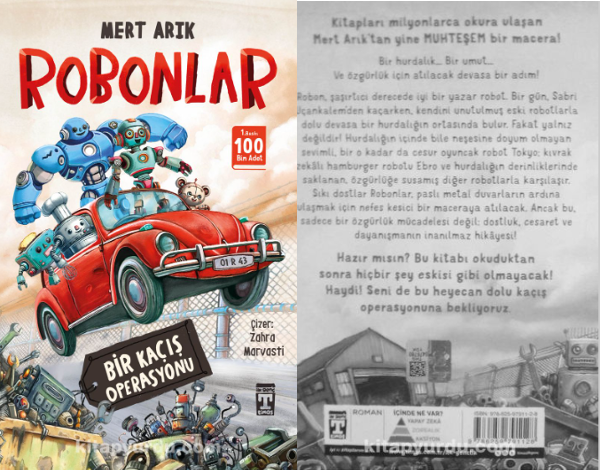
The front and back covers of Robonlar: An Escape Operation visually convey the disto-utopian structure of the narrative even before engaging with the text. Barbed wire, scrap yards, corroded metals, and robotic skulls represent an oppressive system in which technological beings are devalued and destroyed. This imagery evokes Adorno and Horkheimer’s (2002) reflections on how technology, through instrumental reason, transforms into a vehicle of domination. The depiction of scrap metals and old tools alludes to subjects systematically excluded from the capitalist production-consumption cycle once they are deemed “functionally obsolete.” This underscores one of the central functions of instrumental rationality: technological progress does not necessarily advance emancipation, but rather reinforces hierarchies defined by utility.
The moss-covered and greenish metals in the scrapyard symbolize the gradual reclamation of what has been taken from nature, resonating with posthumanist ecological thought. Braidotti’s (2013) framework of decentering anthropocentrism and emphasizing the continuity of nature and technology suggests that mutual transformation between human and non-human entities is possible. Conversely, the robot skulls evoke themes of death, oblivion, and the erasure of identity, adding a dystopian layer to the narrative. These images emphasize not only the material destruction of technological beings but also their social and ontological invisibility, highlighting the mortality of technological subjects (Ferrando, 2019).
On the first page, an illustration of a production line with robotic arms functions as a visual metaphor for both the technological production process and the evolutionary advancement of robots. This image signals a shift from human biological evolution to technological evolution. Such a production line represents the dominance of technical rationality over social organization and the increasing mechanization of labor (Adorno & Horkheimer, 2002). Furthermore, it can be interpreted as a transitional moment in which the boundaries between human and machine blur, giving rise to hybrid subjectivities. The robotic arms on the production line do not merely produce objects; they become instruments that sustain the continuity of their own kind, making visible the notion of technology’s self-evolution (Braidotti, 2013).
This opening establishes the dystopian atmosphere of Robonlar: a uniform mode of production dominates, creativity is replaced by standardized mechanical processes, and the scrapyard and quest for freedom, which recur throughout the story, are foreshadowed by this oppressive structure. Nevertheless, the narrative hints at the robots’ latent evolutionary potential, opening a pathway to utopian developments in later chapters. Descriptions of dystopian space and temporality are exemplified throughout the text, such as:
“…cold and dark scrapyard… ” (p. 39)1
“…the shelter deep within the scrapyard was cold and metallic” (p. 43)
“…metallic prison…” (p. 47)
“It was as if huge, tangled mountains of metal formed a labyrinth that no one dared to enter” (p. 48)
“Saving him from this nightmare gave both him and us hope” (p. 54)
“…in the cold atmosphere of the scrapyard…” (p. 57)
“…in the dark, rusted corners of the scrapyard” (p. 58)
“…giant security robots…” (p. 62)
“We would escape this dark and cold world” (p. 100)
“The smell of mold in the scrapyard was replaced by the scent of fresh grass” (p. 109)
These descriptions function narratively to establish emotional atmospheres, reinforce thematic underpinnings, and stimulate the imaginative engagement of child readers. Through such depictions, children can experience the setting not only cognitively but affectively, enhancing their immersion in the narrative. In summary, these expressions powerfully establish the dystopian environment, facilitating readers’ visualization of space and temporality.
Representation of Human-Robot Relations
Sabri Uçankalem, a human author within the narrative, owns a robot named Robon, to whom he has attributed remarkable storytelling abilities and fame. However, when Sabri receives criticism asserting that Robon’s narratives lack realism, he seeks corrective measures. He contacts the company that manufactured Robon to inquire how the robot might “recognize real-life circumstances, perceive adversity, and also depict sadness” (p. 20). Following the company’s guidance, Sabri applies a pseudo-corrective intervention, implementing psycho-technological coercion on Robon. This act inadvertently triggers Robon’s awakening when he suffers a physical blow. The narrative subsequently explores his fall into the scrapyard and encounters with other robots who have also experienced maltreatment and undergone awakening. The robots’ emergence into consciousness begins with speech, battery depletion, and the first appearance of metallic tears from their eyes.
The tears from the robots’ eyes can be interpreted as a symbolic representation of human-like affective experience, signaling the robot’s emergent capacity for emotion and exemplifying anthropomorphization. This attribution of human psychological and emotional traits to mechanical and electronic beings extends beyond Robon to other characters, such as the old kitchen robot Çırpıcı. When a missing component is replaced, Çırpıcı expresses joy, saying: “You gave me life again” (p.46). Expressions like “Our battery… yes, we robots have batteries instead of hearts” and “Our screws almost loosened from laughing” further illustrate anthropomorphic metaphors that transpose physiological and emotional experiences onto robots. Even the depiction of robotic breathing through flickering battery indicators reflects this strategy, wherein robot-specific elements—battery instead of heart, loosening screws instead of laughter—are aligned with human referents.
Within the literature, anthropomorphization is crucial for perceiving robots not merely as functional machines but as social and emotional beings (Epley, Waytz & Cacioppo, 2007). This enables affective bonds to form in human-robot interactions, particularly in domains requiring direct contact such as care, education, or customer service. Humans are more likely to engage cooperatively with robots exhibiting empathetic, human-like qualities.
However, human anthropomorphization can also serve as a mechanism of control and domination: familiarizing robots makes it easier to incorporate them into social hierarchies and assign functional roles. This raises a critical issue: anthropomorphization may inadvertently reinforce anthropocentrism, defining robot subjectivity through human-centered criteria. From a critical posthumanist perspective (Braidotti, 2013; Ferrando, 2019), such projections risk obscuring the robot’s own experiential and material existence. Critical posthumanism advocates decentering the human and recognizing that other entities—including robots—possess autonomous agency and meaningful forms of existence. Consequently, rather than humanizing robots, it is imperative to consider their distinct modes of being and relationality.
Ağın (2020) emphasizes the importance of transcending anthropocentric limitations to appreciate robots’ unique ontologies, agency, and experiential modalities. Barad (2007) also interprets such metaphors not merely as anthropocentric reductions but as hybrid figurative spaces for meaning-making. Through these lenses, interpretive bridges between human and machine are constructed via mutual references, allowing human readers to partially apprehend the robot’s distinct material reality. These metaphors thus function both as a narrative strategy for inter-species empathy and as a concrete example of the discourse surrounding anthropocentric representation.
Programmed Consciousness and the Illusion of Freedom
When Robon first ventures outside and remarks, “One day I will write poems while observing this enchanting landscape” (p. 33), it reveals that despite experiencing significant awakening, he continues to think according to patterns designed by his human creator. As a “writer robot,” Robon’s code, identity, and expressive modes reflect externally imposed frameworks. This parallels the condition of individuals within capitalist systems who, believing themselves free, in fact express themselves through culturally and ideologically prefigured codes. According to Althusser’s (1971) theory of ideological apparatuses, subjects may perceive themselves as speaking autonomously, yet their language, desires, and imagination are shaped by the prevailing ideological order.
Robon’s inquiry, “How did I suddenly begin to speak, remember, think, smell, grieve, and feel?” (p. 33), marks the onset of his cognitive awakening. The narrative frames this moment as an internalized self-reflective process. Nevertheless, this introspection does not emerge in isolation; it unfolds within constraints established by human-designed software, coding, and logic. Braidotti (2013) emphasizes that the subject is constituted not only biologically but also through technical and cultural networks. Robon’s emergent consciousness can thus be read as an illusion of freedom, wherein both existence and expressive capacity remain confined within pre-determined parameters.
Literary Representation of Robotic Consciousness: Escape from the Scrap Yard
The narrative constructs a hierarchical system based on binary oppositions, wherein the human male—particularly the capitalist figure in control of power—consistently occupies the position of the dominant subject. In Robon’s story, this role is assumed by Sabri; in Ebro, by Mr. V.; and in the scrapyard, by the owner of the scrapyard. Within this framework, escaping the system emerges as the sole means of liberation. According to Marx (2002), evading the traps of capitalist structures requires a certain degree of consciousness.
The scrapyard is depicted not merely as a physical space but as a locus of oppression, surveillance, and hierarchical power. Descriptions such as “cold and dark scrapyard” (p.39), “metallic prison” (p.47), and “giant security robots” (p.62) foreground the dystopian nature of the environment and the surveillance regime operating within it. The scrapyard owner functions as the local authority, while the large security robots consolidate his control.
Robon’s awakening, in this context, signifies more than the activation of a technical system; it marks the emergence of awareness and the incipient desire for emancipation. Drawing upon Chalmers’ (1995) “hard problem of consciousness,” Robon transcends the status of an information-processing mechanism to enter a subjectively reflective state regarding his own existence. The desire to escape the scrapyard stems not from programmed imperatives but from a consciousness attuned to its own conditions.
Moreover, Foucault (1977) asserts that power operates through visibility and surveillance; panoptic structures maintain constant observation over subjects’ behavior. The giant security robots in the scrapyard exemplify this panoptic arrangement. Robon’s awakening is triggered precisely by recognition of this surveillance mechanism and the aspiration to transcend it.
Marcuse (1964) contends that oppressive systems reduce individuals to single-function, compliant subjects. Robon’s refusal to remain confined aligns with Marcuse’s notion of freedom beyond the repressive order. This act of escape embodies an assertion of will to transcend the one-dimensionality imposed upon existence.
Posthumanist Modes of Existence
Characters such as Robon and Ebro exhibit humanoid forms. Ebro, for example, is a large-scale hamburger robot. Like Robon, Ebro’s name contains the suffix “-ro,” signaling his robotic identity. Ebro begins speech with the phrase, “Oh, white robpts powdered with flour” thereby subverting the anthropocentric lens through which prior events, spaces, and emotions have been interpreted. This linguistic intervention invites readers into the robot’s own terminological and experiential world.
Ebro’s descriptor “powdered with flour” reflects sensory and interpretive frameworks distinct from human perception, drawing instead from the robot’s technical memory and material universe. This exemplifies emergent forms of expression arising from the blurring of boundaries between human and machine. The robot operates not merely as a passive receiver but as an agentic subject, processing sensory data and generating meaning.
From a critical posthumanist perspective, this scene challenges anthropocentric practices of meaning-making. As Braidotti (2013) emphasizes, the posthuman subject attains significance only when considered in relation to human, non-human, and technological entities. Ebro’s linguistic choices thus signal the existence of multi-subjectivity, opening readers to perceptual regimes beyond the human. Simultaneously, the depiction preserves the material uniqueness of robotic existence: the robot’s representation conveys not only visual aspects but also traces of its mechanical history and production context. This underscores the importance of acknowledging ontological difference rather than interpreting the robot solely through human analogues.
Within the context of children’s literature, this narrative strategy introduces young readers to the value of alternative perspectives. By articulating the environment through the robot’s own vocabulary, the story facilitates empathy not only among humans but also across human–non-human boundaries. Consequently, the text constructs a critical imaginative space, enabling readers to navigate complex posthumanist concepts while remaining engaged with a compelling narrative.
Trans-species Solidarity
At a key moment in the narrative, the text observes: “With Tokyo’s energy, Ebro’s wisdom, and Çırpıcı’s regained strength…” (p. 47), highlighting the apex of the solidarity theme. Here, solidarity is constructed not merely as cooperation among similar species but as a trans-species collaboration, combining the attributes of humans, robots, and urban spaces into a relational synergy.
This narrative approach aligns with feminist new materialist understandings of relational subjectivity (Barad, 2007; Bennett, 2010), which posit that subjects are not fixed or self-contained entities but relational nodes shaped through interaction. In the story, each figure—human, robot, or environmental—is insufficient in isolation but gains meaning, agency, and efficacy through their interrelation.
From a posthumanist perspective (Braidotti, 2013), this solidarity exemplifies the possibility of uniting diverse ontological forms around a shared objective, transcending anthropocentric boundaries. Consequently, overcoming the oppressive order delineated in the dystopian setting is achieved less through individual heroism than through collective agency.
In the context of children’s literature, this portrayal delivers a critical message: collaboration fueled by diversity proves more effective than singular, uniform power; each contribution, though different, holds equal value. The narrative thus reinforces awareness of diversity and nurtures a culture of solidarity, representing a sophisticated pedagogical strategy within a science-fictional frame.
Robots’ Working Hours and the Capitalist Labor Regime
In the narrative, Ebro states: “I lived constantly connected to the charging unit, could not enter sleep or airplane mode, and experienced overheating due to continuous operation” (p. 82). This depiction symbolizes the erasure of rest and recuperation periods under the tempo of capitalist production. Analogous to human labor exploitation, the narrative foregrounds a work regime in which robotic labor exhaustion and limits are disregarded.
Mr. V.’s relentless pursuit of profit, which compromises both robot performance and customer experience, reflects the unbounded growth imperative characteristic of capitalist production and consumption cycles. Incremental acceptance of quality-reducing changes, such as smaller hamburgers, and the monetized deletion of negative social media feedback, further exemplify mechanisms of cultural production manipulation and ideological control.
Smythe’s (1981) concept of “audience labor” is applicable here, explaining how Mr. V. converts attention, likes, and engagement data into economic capital. Audiences and customers shift from passive consumers to producers, generating value for capital through their attention and data. By transforming robots into advertising symbols, Mr. V. exemplifies an economic network in which both robots and human participants become commodified.
Furthermore, Ebro is deployed by Mr. V. for multiple tasks beyond his initial design as a “hamburger robot,” including cleaning, serving, and cashier duties. This expansion of robotic functions exemplifies the flexibility and multi-functionality of robotic labor. Such versatility not only represents technological advancement but also mirrors the flexible labor regimes of contemporary capitalism. In modern economies, labor increasingly undergoes flexibilization, job descriptions blur, and workers are compelled to rotate between diverse roles.
Within the narrative, robots resemble the precariat (Standing, 2011): a laboring class characterized by economic insecurity, precarious and temporary roles, and absence of social protections. The continual expansion and differentiation of robot functions parallels the instability and uncertainty faced by the precariat. Increasing working hours and shifting responsibilities situate robots within a labor form defined by multiple and indeterminate roles.
Thus, equipping robots with versatile functions serves not only as a technological innovation but also as a mechanism reproducing capitalist flexible labor regimes through technological means. This perspective underscores that robotic labor, like human labor, remains vulnerable to exploitation and transformation. The narrative emphasizes that robotic identities and roles are not fixed but constantly reshaped (Standing, 2011), while simultaneously foregrounding robots’ processes of self-discovery and consciousness formation. The emergence of symbols, such as the “R” marking on robots, raises fundamental questions in philosophy of technology: Are robots merely programmed machines, or are they agents experiencing and interpreting existence through technological mediation? The portrayal of robotic characters with authentic emotions, desires, and pursuit of freedom transcends their mechanical ontology. Haraway (2016) describes such hybrid identities as “non-human subjects,” and in Robonlar, these hybrid entities encounter struggles related to those of humans, negotiating freedom and belonging.
Robots assert: “We were not merely machines, but conscious entities, perhaps even shaped by the destiny imposed by the Robon company” (p.97). Through such symbolic markers, they articulate both self-awareness and recognition of the constraints imposed by technological systems.
Consequently, the flexibility and multifunctionality of robotic labor are essentially linked to their existential and identity inquiries. This dual dynamic positions robots as both exploited labor within economic structures and agents reflecting upon their being and identity within the philosophy of technology.
Escape from the Scrap Yard and Liberation
By the conclusion of the story, the robots escape the scrapyard through mutual solidarity and achieve liberation. This is depicted as: “The musty smell of the scrapyard was replaced by the scent of fresh grass” (p. 109). The synchronized movements of Ebro’s arms, Çırpıcı’s blades, Kıtır Kıtır’s gleaming grills, and Külüstür’s headlights convey a vitality and sense of community that transcend mere mechanical function (p. 111).
Haraway (2016) conceptualizes liberation in conjunction with technology; similarly, in this narrative, robots pursue freedom through their technological capacities. The activation of their inherent functions enables them to succeed in this quest for autonomy. This scene represents a moment where individual mechanical operations coalesce into a collective rhythm, highlighting a communal mode of agency and performativity.
The depiction demonstrates that robots, freed from anthropocentric definitions, establish new forms of subjectivity through their own unique movements and interactions (Braidotti, 2013). Additionally, the rhythmic and coordinated motions of the robots emphasize that technology constitutes not only functional but also aesthetic and social modes of experience. The illustration on the final page reinforces this vision of liberation, serving as a concrete image of the narrative’s transition from dystopia to utopia.
The story’s final imagery—sunflowers, birds, clouds, music, a farm, and a smiling scarecrow surrounding the robots as they drive—signals a radical departure from the dark, dystopian atmosphere. These visual and symbolic elements indicate the robots’ re-engagement with nature and their movement toward a hopeful and free future.
This transformation illustrates that robots transcend their mechanical ontology to develop a novel mode of existence and experience. Simultaneously, this imaginative space exemplifies the narrative oscillation between dystopia and utopia, wherein the robots’ collective consciousness and emancipation propel the story toward utopian possibilities. Consequently, the narrative transcends mere technological development, embodying universal themes of hope, solidarity, and transformation.
Conclusion
Mert Arık’s Robonlar: Bir Kaçış Operasyonu presents significant innovations and contributions to Turkish children’s literature, particularly within the domain of children’s science fiction. Firstly, the work emerges as an original, local production in a field where science-fiction narratives for Turkish children are limited. This enables children to experience stories linked to technological and scientific developments within their own cultural and linguistic context, simultaneously fostering interest in science fiction and strengthening local literary production.
The narrative structure intertwines dystopian and utopian elements, portraying technology as both a tool of oppression and a medium of potential liberation. The depiction of technological entities as emotional and conscious subjects introduces the concept of anthropomorphization to young readers, while maintaining the critical distance demanded by posthumanist theory.
The consciousness-raising of Robon and other robots, the blurring of human–robot boundaries, and themes of trans-species solidarity invite young readers to reconsider their relationship with technology. In this context, the text opens space for ethical and ontological reflection on technological developments and fosters critical engagement with fundamental concepts such as freedom, identity, and belonging. The depiction of oppression and domination faced by robots parallels contemporary technological and social control mechanisms, raising awareness of not only futuristic but also current societal dynamics.
Rather than presenting technology as a mere instrument, the narrative explores philosophical and ethical questions through the robots’ processes of consciousness and liberation, adding a depth rarely encountered in children’s literature. This approach cultivates imaginative and critical thinking in young readers, acquainting them with complex concepts and contemporary debates.
The increase in original local science-fiction productions within Turkish children’s literature contributes both to the diversification of the genre and to fostering a positive attitude toward technology and science. Arık’s novel expands local science-fiction narratives while simultaneously aligning with global science-fiction culture.
WORKS CITED
Adorno, Theodor W., and Max Horkheimer. Aydınlanmanın Diyalektiği, translated by Oğuz Özügül. Kabalcı, 1995.
Ağın, Başak. Posthümanizm: Kavram Kuram Bilim-Kurgu. Siyasal, 2020.
Althusser, Louis. “Ideology and Ideological State Apparatuses.” 1971.
Arık, Mert. Robonlar: Bir Kaçış Operasyonu. Genç Timaş, 2025.
Barad, Karen. Meeting the Universe Halfway: Quantum Physics and the Entanglement of Matter and Meaning. Duke University Press, 2007.
Bennett, Jane. Vibrant Matter: A Political Ecology of Things. Duke University Press, 2010.
Braidotti, Rosi. The Posthuman. Polity Press, 2013.
Chalmers, David J. “Facing Up to the Problem of Consciousness.” Journal of Consciousness Studies, vol. 2, no. 3, 1995, pp. 200–219.
Epley, Nicholas, Adam Waytz, and John T. Cacioppo. “On Seeing Human: A Three-Factor Theory of Anthropomorphism.” Psychological Review, vol. 114, no. 4, 2007, pp. 864–886.
Ferrando, Francesca. Philosophical Posthumanism. Bloomsbury Academic, 2019.
Foucault, Michel. Discipline and Punish: The Birth of the Prison. Vintage Books, 1977.
Haraway, Donna J. “A Cyborg Manifesto: Science, Technology, and Socialist-Feminism in the Late Twentieth Century.” The Companion Species Manifesto: Dogs, People, and Significant Otherness. Prickly Paradigm Press, 2016, pp. 3–49.
Marcuse, Herbert. One-Dimensional Man: Studies in the Ideology of Advanced Industrial Society. Beacon Press, 1964.
Marx, Karl, and Friedrich Engels. The Communist Manifesto, translated by Samuel Moore, Penguin Classics, 2002.
Moylan, Tom. Demand the Impossible: Science Fiction and the Utopian Imagination. Methuen, 1986.
Smythe, Dallas W. “On the Audience Commodity and Its Work.” 1981.
Standing, Guy. The Precariat: The New Dangerous Class. Bloomsbury Academic, 2011.
Duygu Küçüköz Aydemir (b. 1990, Samsun) holds a B.A. in English Language Teaching from Çukurova University and a B.A. in Sociology from Anadolu University. She earned her M.A. in Women’s and Family Studies at Ondokuz Mayıs University with a thesis later published as Cyberfeminism: The Cyborg Body and the Status of Gender in Cyber Identity (2021). She pursued doctoral studies in Communication Sciences at Giresun University and is currently conducting academic research at the University of Oslo. Her work primarily engages with feminist techno-science, environmental humanities, and critical theory.

