The Mountain in the Sea


Review of The Mountain in the Sea

M.E. Boothby

Nayler, Ray. The Mountain in the Sea. Picador, 2023.
Version 1.0.0

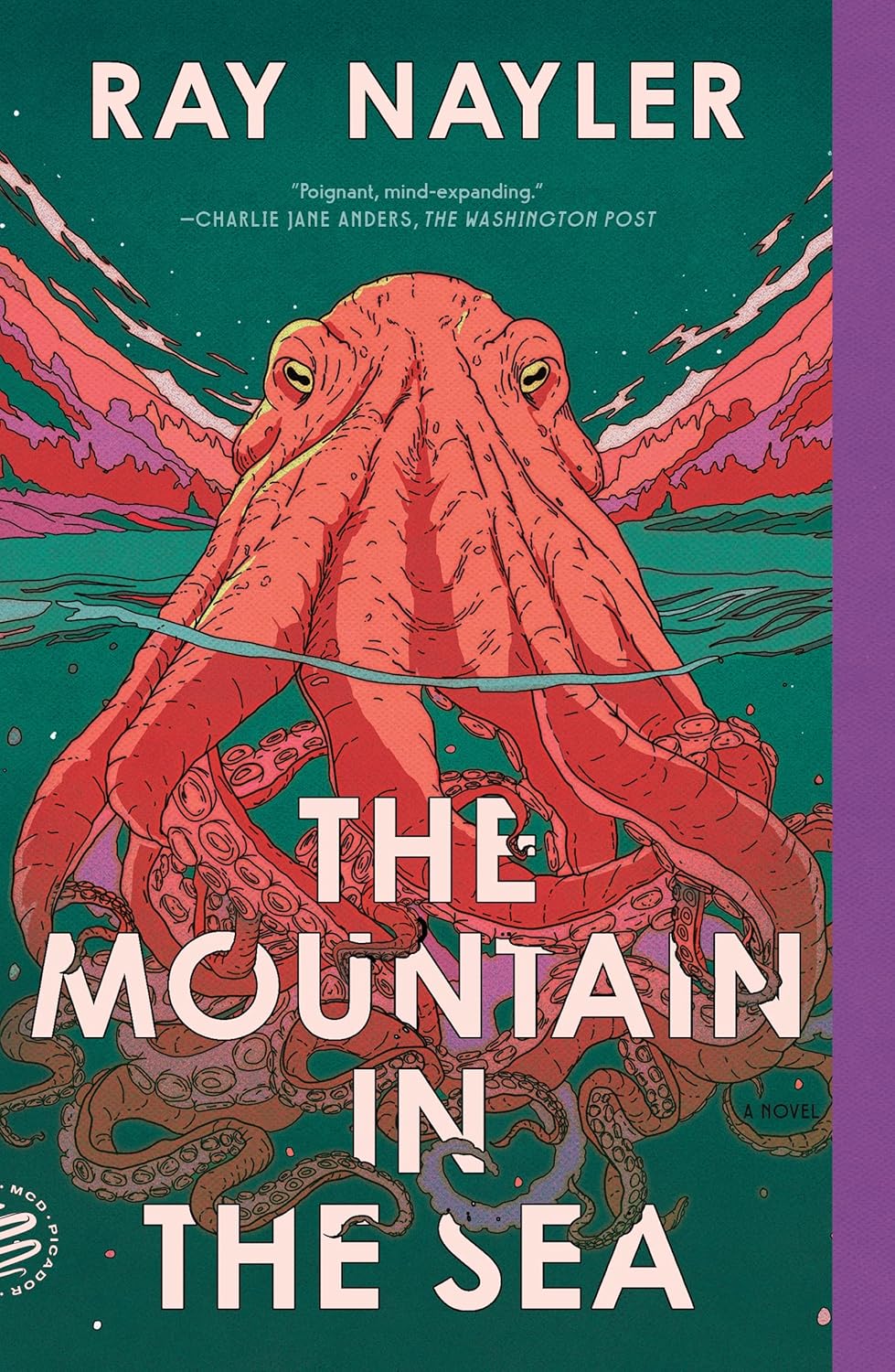
The Mountain in the Sea presents a powerful, risk-taking shift in what a novel can be. As some reviewers on Goodreads complain, it is more like a thought experiment than a story, constantly “philosophizing on sentience and semiotics.” Personally, I was thrilled by this thought-provoking, profound element, but even recognizing my own bias, I do think that readers who are disparaging Nayler’s novel (for not being the sci-fi thriller that the blurb on the back misleadingly implies that it is) are perhaps not the intended audience, or are missing the point. The Mountain in the Sea is a dazzling, wondrous book, but it is also a narrative built on academic research. It is a long-form question, not meant to provide the reader with any answers, only a dual sense of impending capitalist-and-climate-change dread and radical more-than-human hope. It is by turns objectively scientific and achingly beautiful, and its goal is just as much about introducing non-academic readers to phenomenological and semiotic theories as it is about finding awe in artificial and animal intelligence. Some readers, especially those who are already well-versed in the abilities of the octopus or the concept of the Umwelt, may dislike feeling preached to, and that is a fair reaction to this divisive book. Still, as scholars of SF, I believe it is a critically important text for us to mark, because it challenges what readers and publishers of SF are willing to explore and expand into. As a complex integration of philosophy and plot and a fragmented, multicharacter narrative that is consistently more interested in internal theorizing than external action, The Mountain in the Sea crafts a sort of academic-fiction treatise, what we might call research-creation without Nayler ever explicitly declaring it as such.

The Mountain in the Sea is set in a speculative near-future that is even further destroyed by capitalist greed than our present world; it is ravaged by climate change, and global corporations control the majority of the world’s money and power. Natural resources are increasingly slim, and wars and trade deals have reshaped our borders and nationalities. It is a world that feels increasingly plausible in 2025, if not already partially here, and some of its brutal realities are what contribute to the sense of sickening dread and despair that the novel does not shy away from.

Two side plots weave the wider storyworld together. Rustem, an elite Russian hacker, is hired by a rival corporation of DIANIMA’s and tasked with trying to remotely hack into Evrim’s artificial mind. Eiko, a young man kidnapped and sold into enslavement, is trapped aboard an AI operated fishing trawler and forced, alongside many others, to perform the physical labor that the computer cannot, while the trawler pillages protected waters. All three plot threads meditate meaningfully on what it will mean to be human—or, more specifically, to be deserving of the rights of personhood—in an increasingly capitalistic and technological future.

Between chapters, Nayler inserts quotations from two academic texts he has invented: protagonist Ha Nguyen’s How Oceans Think, which is directly lifted from Eduardo Kohn’s pivotal text How Forests Think: Toward an Anthropology beyond the Human (2013), and Building Minds, a fictional autobiography by Evrim’s creator, the brilliant but coldly obsessive Dr. Arnkatla Mínervudóttir-Chan. These fictional nonfiction excerpts are where Nayler writes his most academic musings, a strategy that works well. As mentioned, his ideas are situated in an intersection between phenomenology, bio- and zoosemiotics, and recent shifts in human understandings of cephalopod biology. Bio- and zoosemiotics, broadly, are fields concerned with the reading of the natural world as signs with communicative potential, whose originators include Thomas A. Sebeok, Jesper Hoffmeyer, Gregory Bateson, and Jakob von Uexküll. Even the four parts of the novel are named after concepts in these fields: Qualia, Umwelt, Semiosphere, and Autopoiesis. Nayler explores these concepts not just as theory, but as applied to the human condition and our relations with the more-than-human world in peril around us. Consider the following excerpt:

Communication is communion… Perhaps it is this thought that makes us so nervous about the idea of encountering cultures beyond the human. The thought that what it means to be human will shift… Or that we will finally have to take responsibility for our actions in this world. (301) 

In one scene, Rustem also expounds philosopher Thomas Nagel’s 1974 essay “What is it like to be a Bat?” The novel asks consciousness-related questions consistently, introducing readers to the Umwelt concept, which asserts that each species can only experience the world through their own unique sensory and perceptive abilities, therefore making it impossible for us to truly know what it is like to be a bat—or an octopus, for that matter. It would be beyond the scope of this review to explain and detail each theory that Nayler incorporates into his novel. I can only recommend reading it yourself and allowing yourself to be transformed by it. In conclusion, Nayler speaks quite aptly for The Mountain in the Sea through Ha’s book excerpts, inhabiting both the fictional scientist and the SF author when he writes:

I will be accused of many things by those who criticize this book… I will be accused of having created from nothing a vast, speculative archaeology of a possible future, in which we discover that while we are the only species of Homo there may be, in fact, another sapiens.

I do not apologize. I want to help my readers imagine how we might speak across an almost unbridgeable gap of differences, and end forever the loneliness of our species—and our own loneliness. (447)

WORKS CITED

Jennifer. Review of The Mountain in the Sea by Ray Nayler. Goodreads, 17 Dec. 2022, https://www.goodreads.com/book/show/63233677-the-mountain-in-the-sea.

M. E. Boothby is a Ph.D. candidate at Memorial University of Newfoundland, Canada, where their research explores intersections of queerness, neurodiversity studies, material ecocriticism, and zoosemiotics in speculative fiction. They write both academically and creatively about apocalyptic fungi, sentient cephalopods, and more-than-human communication. Their work has been published in Horseshoe Literary Magazine, Untethered Magazine, Paragon, Gothic Nature, and Fantastika Journal, and their debut novel is forthcoming from Penguin Canada.

Rose/House


Review of Rose/House

Sarah Nolan-Brueck

Martine, Arkady. Rose/House. Tor Publishing Group, 2025.

Version 1.0.0

“A person can leave a place without going anywhere at all”—so says Rose House, the sentient home that provides the name and magnetic setting of Arkady Martine’s recent novella (54). At 115 pages, Rose/House is as slim as a stick of dynamite, and nearly as deadly. Where Martine’s Hugo Award-winning Teixcalaan series (2019-2021) takes place in a far-future, sprawling galactic empire, the world of Rose/House is much more intimate—taking place sometime in the next century, in the Mojave Desert community of China Lake. Named for its dried-up body of water, China Lake’s remote, arid setting makes Rose House all the more enchanting—a house blooming out of the desert, full of lush greenery, a swimming pool, and clean energy, a beacon of technological possibility in a region where the most common crime is murdering someone for their water ration credits.

The narrative follows three main characters, Dr. Selene Gisil, Detective Maritza Smith, and Detective Oliver Torres, as they try to solve the ultimate locked-room mystery. Gisil is the protégé of Rose House’s famous architect, Basit Deniau; she is also the only person who is allowed to enter Rose House to access his records, now that he has died. Given this common knowledge, Smith is shocked when Rose House makes a compulsory call to the China Lake precinct to report that there is a dead man on her premises—a dead man other than Deniau, whose body was turned into a diamond and put on display inside the home. Smith calls on Gisil to return to China Lake and help her gain access to the house. To enter, however, Smith must circumvent Rose House’s programming. She must declare herself an entity rather than a person, China Lake precinct rather than Maritza. Despite Torres’s protests and panic, Smith gives up her claim on individual personhood to meet the house on its terms, to be swallowed up by its walls and logic.

Martine’s novella explores architecture as an inspiration for experimentation, digging into the implications of transforming a mundane domestic space into a super-advanced, one-of-a-kind technological display. Rose House is much more than a smart home imbued with sci-fi gadgets and voice command; referred to throughout as a “haunt,” the house itself is sentient. It listens and speaks without any obvious source of audio input or output, and tiny nanobots teem in the space, ostensibly working to keep the house in prime condition. The house normally holds only one dead man, Basit Deniau, who has been turned into a diamond and displayed on a plinth. The border between person and object here is wholly blurred. A house becomes a person; a man becomes a diamond; a woman becomes a precinct. 

            And yet, there is much we don’t know about Rose House’s origins and history. Beyond one short, ambiguous flash of memory from Dr. Gisil’s point of view, in which she remembers someone diving into a pool, the story takes place entirely in the present moment, after the death of the architect. While the house—the “haunt”—is imbued with a disturbingly omnipresent consciousness, the theme of haunting extends to the power Basit Deniau still holds in death. The memories of his manipulation seep into Gisil’s current reality. Damned to act as his archivist, Gisil’s role as his famous protégé and beneficiary leaves her stranded in her own career, too overshadowed by a dead man to excel on her own merit. Groups of architects, artists, and politicians jockey for a claim on Deniau’s property and legacy, waging ideological and legal battles to access, copy, or repatriate his intellectual and physical property. But Rose House, most of all, is possessed by her departed master. Once the site of lavish parties and admiring guests, Rose House has been emptied and made into a beautiful crypt. Her only job is to guard Deniau’s restructured body and his records from prying eyes—quite literally. As it turns out, Smith is only probing for loopholes because the anonymous dead man did so before her; he attempted to copy Deniau’s retinas, to trick Rose House into handing over her most intimate secret—her source code. In the end, however, our most intimate knowledge of the house comes from the surprising depth of her grief for her creator and for her past life. Though the house is smart enough to see through the imposter’s trick, she allows herself to be taken in, to enjoy the possibility of her beloved’s return, before killing the trickster in an act of vengeful, tragic rage. Rose House is human enough to indulge in delusional nostalgia.

With nods to Shirley Jackson’s The Haunting of Hill House, which also focuses on a home that is “not sane,” as Detective Torres states, Rose/House plays with the borders of what language can impart as both a tool of an artificial intelligence and a way of depicting highly advanced, nearly incomprehensible technology. In this way Martine’s depiction of Rose House—its consciousness and its more indecipherable elements—as well as her flair for odd detail echoes the New Weird-ness of Jeff Vandermeer and the worldbuilding sincerity of Annalee Newitz. If Martine excels in depicting the politics and potentials of Rose House’s intellectual property, a piece we miss out on is the greater illustration of Rose House as a physical space. Though specific rooms are described—the entry hall, the garden room with a glass wall, the vault where Deniau’s designs are stored—, much of the house is depicted only in passing glimpses, as Maritza sprints through the strange space. Nevertheless, Martine’s Rose/House is an impressively rich microcosm of AI’s growing potential and of our responsibility to understand it.

Sarah Nolan-Brueck is a PhD candidate at the University of Southern California, where she studies how science fiction authors critique medical legislation that restricts diverse gendered groups in the United States. Sarah was a 2024 Le Guin Feminist Science Fiction Fellow at the University of Oregon. She has been previously published in ASAP/J, Utopian Studies, Orbit: A Journal of American Literature, Extrapolation, and Huffpost.

Polostan


Review of Polostan

Bruce Lindsley Rockwood

Stephenson, Neal. Polostan William Morrow and Company, 2024.

Version 1.0.0

In the summer of 2000, I happened upon the newly released paperback edition of Neal Stephenson’s Cryptonomicon; fresh off qualifying exams, I was looking for a fun read, nothing too heavy, to slowly enjoy after the frenetic pace that gutting books requires. The marketing materials suggested Cryptonomicon would fit the bill, so I picked it up.

It changed the direction of my career. I roared through it in two or three days and knew that this novel would have to find a place in my dissertation alongside works by Thomas Pynchon and Ismael Reed, and I began picking up more of Stephenson’s body of work, starting with Snow Crash and The Diamond Age. Cryptonomicon was nothing light, of course, and for those who’ve ventured into the similarly deep waters of The Baroque Cycle, Polostan will resonate along similar frequencies. It is a promising opening to the Bomb Light Cycle (a sequel has not yet been announced), and certainly worth seeking out. I came to like the novel more and more as it progressed, a good sign for a promised series.

That said, Polostan does not stand quite as high as the works mentioned, but it is a welcome return to historical SF form from the Tom Clancy-esque thrillers Stephenson has been releasing of late (Reamde, Fall, Termination Shock, e.g.), with a bifurcated plot that jumps back and forth in time and place quite rapidly. However, it is a slow boil of a story, coming together piecemeal as protagonist Dawn Rae Bjornberg, known as Aurora in her father’s Soviet Union, comes to find herself under the control of Lavrentiy Beria, head of Stalin’s secret police.

Dawn holds American and Soviet passports; born in the US but taken to Revolutionary Leningrad by her father, she returned to her mother in Wyoming as a girl and learned to ride horses there. A skilled polo player and ardent Communist, she then works for her father, observing American troop movements among the disaffected veterans of the Great War in Washington in the early 1930s, coming into contact with such young officers as George Patton, Dwight Eisenhower, and Douglas MacArthur (himself a character in Cryptonomicon). In Washington, she takes possession of a Thompson machine gun in a violin case, and she gains knowledge of a large cache of guns and ammunition being smuggled in from Chicago on the trains.

In Chicago and in Russia, she witnesses the dawning of the Nuclear Age as physicists attempt to release weather balloons to the upper atmosphere to observe cosmic rays and potentially unlock the structure of heavy nuclei, how stars emit x-rays and other forms of radiation, and what might be done to harness such powers. Aurora also bears witness to the human costs of such experiments. Where the next volumes of Bomb Light may go along these lines will be intriguing—much like his exploration of the creation of digital computers through the needs of cryptology in Cryptonomicon’s World War Two sections, Stephenson is laying the foundation for potentially fascinating steps towards Hiroshima and Nagasaki and the development of the Hydrogen Bomb in the US and the USSR in Polostan.

Still a teen but on the run from Federal Agents, Dawn makes her way to the Soviet Union, where her life changes quite suddenly. Unlike a nascent literary critic, her awakening does not happen in a bookstore, but in rather more torturous circumstances. Under Beria’s direction, Aurora becomes “Svetlana” and then “Katya” as she works to report on foreign reporters for the OGPU. Dawn’s next steps are eagerly awaited—unlike such protagonists as YT and Nell in Snow Crash and The Diamond Age, respectively, she is not overtly sexualized in Polostan even as she takes a lover, and while she is clever and opportunistic, Dawn differs from Eliza, Duchess of Qwghlm in The Baroque Cycle, in that she is not driven to collect economic resources and political power—she needs to survive to the next moment.

Polostan is recommended as a slow-burning iteration of Stephenson’s great powers as a storyteller. There are fewer prose pyrotechnics than in earlier novels here and it is not the hard science fiction of such recent works as Seveneves, but it is a compelling read.

Jonathan Lewis is Associate Professor of English at Troy University where he teaches composition, SF/F and American literature. His upcoming book, Contemporary Science Fiction and The Many-Worlds Interpretation of Quantum Mechanics: Sacrifice and Narrative Coherence, will be published by Bloomsbury Books.

The Triumph of Babylon 5: The Science Fiction Classic and Its Long Twilight Struggles


Review of The Triumph of Babylon 5: The Science Fiction Classic and Its Long Twilight Struggles

Bruce Lindsley Rockwood

Baz Greenland. The Triumph of Babylon 5: The Science Fiction Classic and Its Long Twilight Struggles. McFarland, 2024. Softcover. 250 pg. $49.95. ISBN 9781476692401; Ebook. $29.99. ISBN 9781476651446.

Version 1.0.0

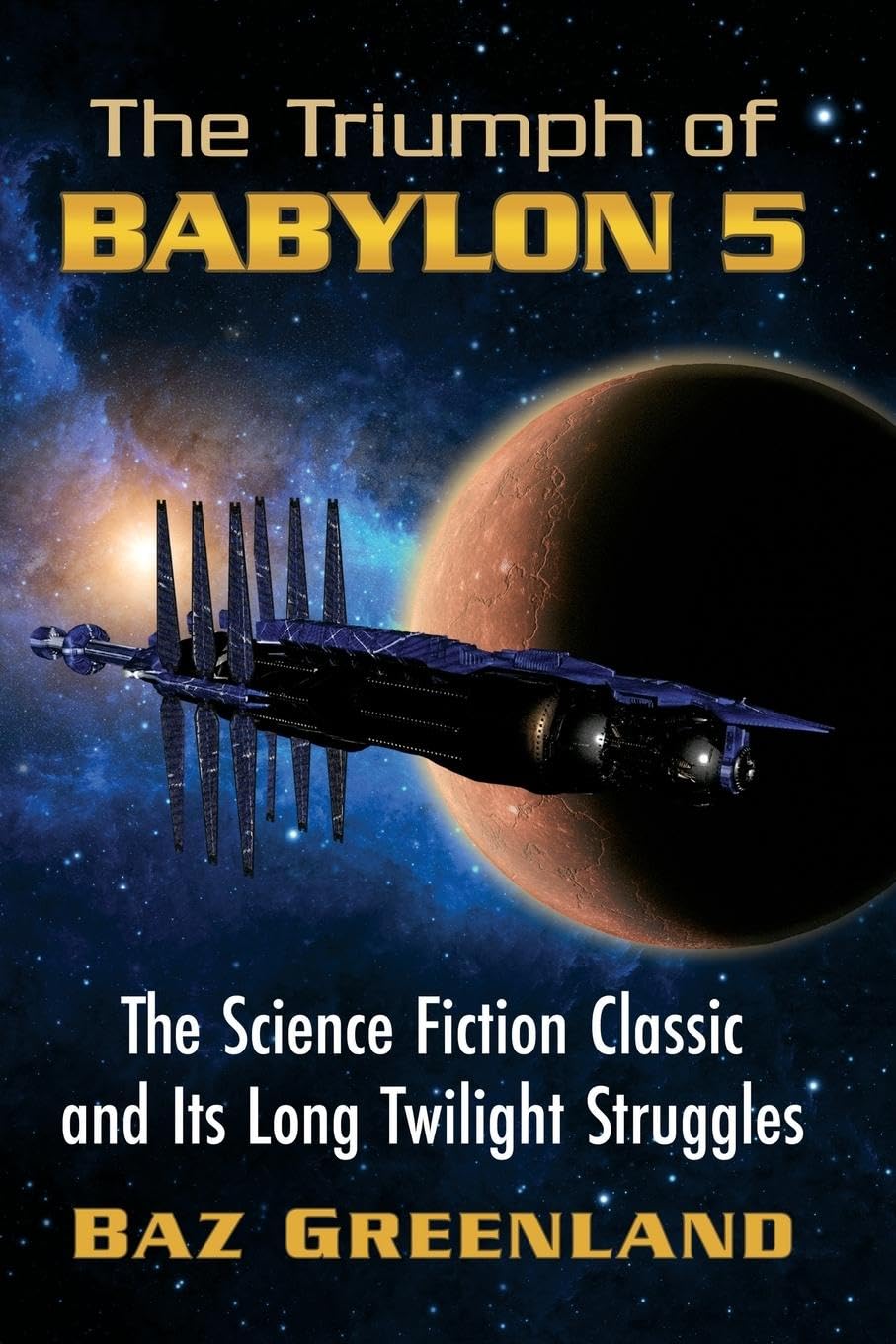
Baz Greenland is a podcaster and long-time fan of the television series Babylon 5, whose deep understanding of the show and its aborted spin-offs comes from the standpoint of a British viewer who heard of the show in his youth after its initial broadcast in the United States and who has watched and rewatched it ever since for over thirty years. He comments in his book, “The show’s inception, the struggles during production, and the attempts to continue the Babylon 5 story are almost as epic a tale as the fight against the Shadows and the battle to save Earth” (4). He has written widely and on-line about the series, https://www.threads.net/@greenlandbaz, interviewed surviving cast members, and has a podcast about it: https://podcasts.apple.com/us/podcast/a-dream-given-form-a-babylon-5-podcast/id1611981020. Now he has produced a book aimed at exploring the parallel stories of the show’s narrative plot, and the attempts to revive and extend it.

He notes his early enthusiasm for the show:

Babylon 5 stayed with me. I caught late night reruns on Channel 4, finally seeing what life was like under Commander Sinclair in season one. I bought all the seasons on VHS. On my A-Levels results day, I treated myself  by popping into the video store and spending a whole $100.00 on the complete season three box set. . . . I introduced new friends to Babylon 5. I got the TV movies. I stuck through Crusade. (2)

His reaction was much like my son’s, who bought an extra DVD set of the first season when it came out to share with friends at school, something I have seen duplicated since only with the single season of Firefly! (2002-2003)

The book has 26 chapters, starting with a discussion of “The Legacy of Babylon 5” in Chapter 1, followed by an overview of SF “Story Arcs” in Chapter 2. Greenland notes:

The Oxford English Dictionary defines legacy as ‘a situation that exists now because of events, actions, etc. that took place in the past.’ The story of Babylon 5 as a TV show can certainly be viewed through the prism of that definition. The narrative structure of the show is built on the events of the past. The horrors of the last great Shadow War left scars on the Minbari and the Narn. The rise of Valen a thousand years ago shaped Minbari culture, most significantly the character of Delenn. The Vorlon manipulation of other races and the creation of telepaths saw the show revisiting the trauma of the past, most fundamentally in the show’s final season. (6)

He argues that J. Michael Straczynski’s creation of Babylon 5 opened the door and set the standard for long-form story telling and multi-season story arcs that enabled subsequent television shows, from the reboot of Battlestar Galactica (2004-2009), to more recent iterations of Star Trek, such as Discovery (2017-2024) and Picard (2020-2023) (7-18).

Chapter 3 focuses on how Straczynski came to develop Babylon 5, making use of his comments on the rec.arts.sf.tv.babylon5.moderated message board back in 1995, when he emphasized the need to have a reasonable budget, treat SF seriously in story-telling, and make use of the kind of sagas he admired in the genre. “As a lifelong fan of grand science fiction sagas like Foundation, Childhood’s End, The Lord of the Rings and Dune, he kept wondering: why hadn’t someone done this for TV?” (19-20). Chapter 4 explores how cast changes and the collapse of the Prime Time Entertainment Network (PTEN) lead to revisions of the original five year story plan and his proposed follow-up series Babylon Prime. (26) See: https://en.wikipedia.org/wiki/Prime_Time_Entertainment_Network and https://www.themoviedb.org/network/211. The original combined ten year story arc would have been very different from the show as it was produced, perhaps more dark and less exciting: “The final version of the TV show certainly appears to be the more thrilling option of the two” (29).

Further chapters discuss the development of the series, the back and forth debate about the relationship between Star Trek Deep Space Nine (1993-1999) and Babylon 5 (Chapter 6), and interesting interviews with cast members Peter Jurasik, Marshall Teague, and Patricia Tallman. Chapter 7, “Making ‘The Lord of the Rings in Space’ a Reality,” discusses the financial and technological obstacles to making grand SF films, and the literary influences on Straczynski’s story arc, including the poem “Ulysses” (1833; 1842) by Alfred, Lord Tennyson, as well as Childhood’s End (1953), Dune (1965), and The Lord of the Rings (1954) (50-53).  Chapter 9, “JMS’s Character Trapdoors,” shows how Straczynski planned character switches and exits to allow continuity despite unexpected challenges, while Chapter 10 explores his efforts at introducing diversity in race, religion, gender, and sexual relationships that were not always fully realized but significant for the era (74-76). Chapters 12 through 16 deal with each of the five seasons of Babylon 5, including comparisons of alternate viewing orders of Season 1 (97-98), Season 2 (109-110), and in subsequent seasons, as they relate to building the mythos of the show. Subsequent chapters explore the TNT Movies, the single season of Crusade (1999), and other attempts to extend the detailed universe created by JMS.

The book includes Chapter Notes, a Bibliography, and an Index. It makes extensive use of The Lurker’s Guide to Babylon 5, available at http://www.midwinter.com/lurk/. Anyone familiar with (or new to) the series will value the detailed discussion of the making (and unmaking) of the original five-year story arc, Greenland’s commentary on each of the five seasons, and discussion of the innovations made by Straczynski that set the template for much of 21st century SF production. Greenland explores attempts to extend or reboot the series, and his enthusiasm, commentary, and interviews with the cast make this a valuable resource for conducting further research on the series, which remains one of my favorites.

Bruce Lindsley Rockwood, Emeritus Professor of Legal Studies at Bloomsburg University, Pennsylvania, is a long-time member of SFRA, having served as Vice President (2005-2006), and regularly writes reviews for SFRA Review from his retirement home in Midcoast Maine. He has taught and published on law, literature, climate change and science fiction, and attends SFRA and WorldCon with his wife Susan when possible (most recently in Montreal, Spokane, and recent virtual sessions of the SFRA.

The Kaiju Connection: Giant Monsters and Ourselves


Review of The Kaiju Connection: Giant Monsters and Ourselves

Amber A. Logan

Jason Barr. The Kaiju Connection: Giant Monsters and Ourselves. McFarland, 2023. Paperback. 210 pg. $39.95. ISBN 9781476693514.

Version 1.0.0

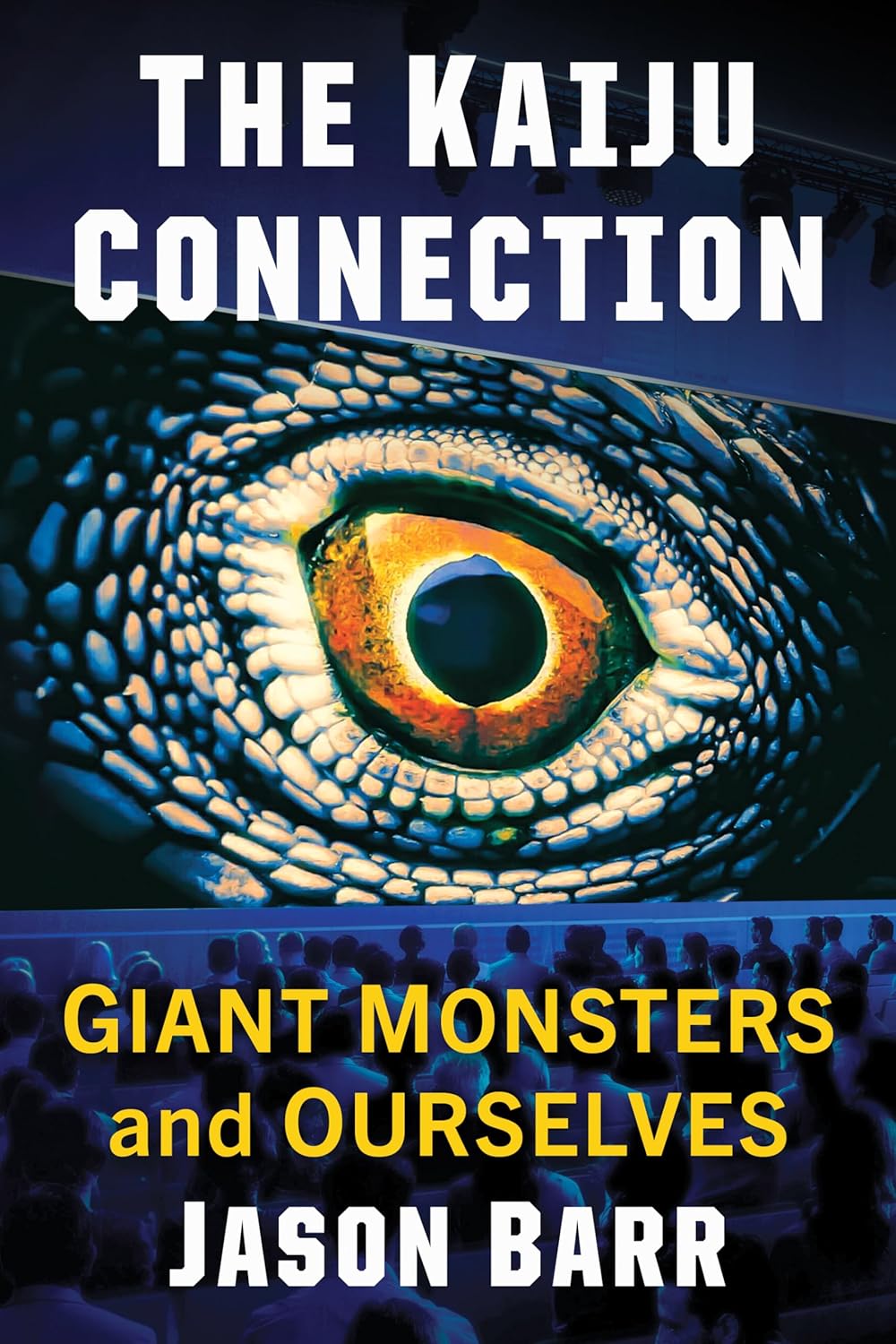
The Kaiju Connection is a short work focusing on the questions: what makes a kaiju a kaiju, and why are we, as humans, so intrigued by them? This isn’t Barr’s first foray into kaiju discourse, but this volume focuses more on recent kaiju films and the existential questions associated with the genre. With a refreshingly conversational (and sometimes humorous) tone, Barr isn’t afraid to pull metaphorical punches, curse, or paraphrase Homer Simpson in his evaluation of kaiju films, ranging from the serious and philosophical to the campy. Barr even states that this book isn’t an academic text in the strictest sense, but perhaps “more of an apologia for the continued study of the kaiju film” (3).

Barr suggests that society continues to be intrigued by kaiju films because the fascination with kaiju is an (at least tacitly) acceptable extension of a childhood fascination with dinosaurs. While not being particularly female-forward (few kaiju films, with the exception of Colossal [2016], have strong female protagonists—or, even, side characters), kaiju films do have strong masculine vibes and odd tie-ins with professional wrestling—which, admittedly, goes a long way to explaining the suspension of disbelief afforded some of the more comical and unconvincing rubber suits found in lower-budget kaiju films. Beyond gender dynamics, Barr argues that kaiju films can be legitimately studied in terms of political commentary (from the original 1954 Godzilla’s clear connections to post-war nuclear trauma to the 2016 Shin Godzilla, which can be read as a critique of the Japanese government’s response to the Daichii Fukushima disaster) and social commentary (evidenced in the evolving sense of “the Other” found across kaiju film franchises). Barr also argues that the more recent trend for American film makers to downplay Godzilla’s original nuclear origins has strong implications, arguing that they manipulate the story to give Americans a “pass” for the nuclear bombs dropped on Japanese soil during WW2 in order to make the story more palatable to their targeted American audience, thereby co-opting a character originally about a collective national trauma by the nation who caused the trauma. Recasting Godzilla as a ‘force of nature’ rather than a product of human violence and cruelty certainly reframes the narrative. However, Japanese filmmakers are not immune to the concept of spinning the popularity of Godzilla in order simply to make a quick buck; Barr also delves into the trend of some Japanese film companies to turn Godzilla from a serious message about humanity’s hubris into a kid-friendly “big monsters fighting” type of Saturday morning entertainment—the type of low-budget films that Barr bemoans as having watered down the reputability of the genre as a whole in the eyes of the general public.

Beyond Barr’s arguments for why kaiju and the genre of kaiju films are worthy of study, one of the most interesting parts of this book is its continual probing of the boundaries of the kaiju film genre. Barr convincingly argues that determining what ISN’T a kaiju film can be just as enlightening as determining what IS. Can a giant ape be a kaiju? What about a giant human? When does a creature change from being merely an oversized animal, to being a monster, to being a full-blown kaiju? Where those lines are drawn can arguably say a great deal about our perceptions of what constitutes humanity, and what we can sympathize with and relate to. Barr argues that the most solidly-kaiju kaiju are ultimately giant monsters (usually with Japanese origins, or at least nods toward a Japanese origin) who hold up a mirror to humanity and teach us something about ourselves. Barr proposes four “types” of kaiju or kaiju-adjacent films (authentic kaiju films; knockoff kaiju films; big, familiar creature films; and human kaiju), but perhaps the use of “fuzzy logic” is best applied when determining whether a film is a “kaiju film” or not, allowing the judger to decide how close the film in question approaches the beating heart of the kaiju film exemplars.

As Barr readily admits, it would be difficult to call The Kaiju Connection an academic tome, but it arguably has merit for scholarly research, particularly for those interested in the more philosophical, ethical (the costs of human life are often skimmed over in favor of watching two kaiju battle it out on the streets of major cities), and existential questions raised by the more ‘serious’  kaiju films. Casual fans of the kaiju film genre will find enlightening topics and much to enjoy (as well as much to skim over), but hardcore kaiju film junkies will delight in the depth into which Barr delves regarding specific recent films, characters, and even associated merchandise. Overall, The Kaiju Connection is a valuable addition to the kaiju film discourse.

Dr. Amber A. Logan is a university professor, freelance editor, and author of speculative fiction. In addition to her degrees in Psychology, Liberal Arts, and International Relations, Amber holds a PhD in Creative Writing from Anglia Ruskin University in Cambridge, England. Her thesis “Men Who Lose Their Shadows: from Hans Christian Andersen to Haruki Murakami” examined the intersection of fairy tales and near-future speculative fiction, and her debut novel The Secret Garden of Yanagi Inn was published in November 2022

Vision, Technology, and Subjectivity in Mexican Cyberpunk Literature


Review of Vision, Technology, and Subjectivity in Mexican Cyberpunk Literature

Josh Beckelhimer

Stephen C. Tobin. Vision, Technology, and Subjectivity in Mexican Cyberpunk Literature. Palgrave Macmillan, 2023. Studies in Global Science Fiction. Hardcover. XI, 200 pg. $129.99. ISBN 978-3031311550.

Version 1.0.0

Stephen C. Tobin’s Vision, Technology, and Subjectivity in Mexican Cyberpunk Literature is a valuable chronicle of Cyberpunk in Mexico, a country not generally associated with the subgenre. Indeed, U.S. readers familiar with the foundational Japanese-indebted gambits of William Gibson and Neal Stephenson will likely be unfamiliar with most of the work here–primarily due to the cultural hegemony of the English Language. This book provides a fascinating media history of recent visual technologies in Mexico, reminding us how media and genres spill over from one place to another. Tobin orchestrates a nuanced reflection on the complicated, pervading dispersal of globalized media. In an age where boundaries between science fiction, speculative fiction, fantasy, and other subcategories are contested, Tobin’s new book proposes “specular fiction” (2). This designation points us in the right direction if we want to begin progressing our understanding of speculative cultural production. Tobin suggests a slight turn away from such hegemonic labels to root his definition at the nexus of literary and visual media–two spaces that, he contends, have grown increasingly intimate. Cyberpunk provides a useful nexus because, though realist texts feature ocular themes, a subgenre that can draw connections between older technologies and newer variations of “the e-image component” (12) is necessary. Tobin analyzes works from 1993 to 2014 to highlight just how turbulent the media landscape has been in recent decades.

Tobin is a scholar of Mexican culture on a larger scale, and his intervention into genre studies is doubly justified by his analytical roots in Mexico. It is a country where genre labels are more fluid, contrasting the market-driven genre labels of U.S. cultural production. While Tobin’s case studies can mostly be identified as science fiction, his theorization opens up specular fictions–narrative forms that entwine language and screens–as works present across disciplines. Such theorization allows Tobin to dodge some prickly generic disputes about “science fiction” and the sweep of “speculative fiction.” Rather, he contextualizes his intervention for literary and media studies more broadly by following the well-known work of Walter Ong and W.J.T. Mitchell, who have “argued that all media are mixed media, meaning that no media [sic] is purely visual” (4). With this mixed approach, Tobin performs literary analysis that utilizes literature as case studies to theorize media. Tobin’s key interventions contribute to SF scholarship, Mexico Studies scholarship, and scholarship that explores the growing camaraderie between literary and visual media studies. His focus on “specular fictions” does well to offer useful critiques for theorists of science fiction and cyberpunk. By building his definitions on the importance of a given visual technology for a literary work, though, he also theorizes something that can be identified and analyzed across disciplinary and generic boundaries.

In Chapter 1, his introduction, Tobin provides a useful comparative reading of Mauricio-Jose Schwarz’s “La pequeña guerra” [“The Little War”] (1984) and Francisco Amparán’s “Ex machina” (1994). The former, an earlier text, figures television secondarily. The latter, a later text, is a narrative primarily driven by the presence of television. The latter is a specular fiction, while the former is not. Here we see a way in which specular fiction remains compatible with Science Fiction theory–Amparán’s story uses television as the “novum,” or the technological mechanism that shapes the narrative world (In his landmark essay “On the Poetics of the Science Fiction Genre,” Darko Suvin adapted “novum” from Frankfurt School theorist Ernst Bloch). Tobin adapts the term “scopic regime” from Media Studies, but the scopic regimes in focus are usually generated by a novum. This categorization of specular fiction serves most usefully as a temporal map that places geographical pressure on Mexico and the landscape in which it is situated. The fiction that Tobin highlights contains myriad visual technologies, from the television to the more speculative reality-distorting glasses. While some are more rooted in fiction than others, Tobin can move from foundational observations on cinema and television to the numerous screens that have exploded in popularity in the public life of the 2020s. With this progression through time, it becomes increasingly clear that this book about Mexico is more broadly about how Mexico is connected to, and increasingly resembles other global scopic cultures.

Chapter 2 grounds the book on a safe but sharp analysis of gender in the work of Gerardo Porcayo. It is safe because Tobin leans on Laura Mulvey’s now-classic analysis of the male gaze in cinema, which argues that the history of cinema has been dominantly constructed through a male-centric gaze. It is also safe in that readers who come to this book will be familiar with the prevalence of masculinist SF and Cyberpunk. The analysis allows Tobin to perform two key moves. First, he roots Porcayo as a foundational figure for Mexican Cyberpunk, a figure representative of the indelible influences of the US and the dominant masculinist foundations of the subgenre. Second, he establishes that Porcayo’s book is not limited to how specific visual technologies represent/influence perception and subjectivity, but how the gaze, on a broader scale, is a visually encoded social phenomenon.

Chapter 3 transitions into work that zeroes in on specific scopic regimes. Its focus on television makes it generally the heart of the book. Despite the range of visual media at play here, television is the most longstanding form-giving technology. Porcayo writes towards the beginning of the growth of television as a scopic regime, while the book ends with reflections on the proliferation of smartphones and computers which in the 2010s “still had not eclipsed television presence” (27). Television history also helps Tobin bring to light the “restructuring of the media industries within Mexico,” a “higher proliferation of images,” and the growth of the television market itself (27). These three areas open up analyses of “political legislation and privatization,” the “expansion of foreign oligarchic media companies” and the evolutions of the Mexican economy (27). In one striking detail about the shift from public to private media, Tobin reflects on the “media imperialism” that took place as US-based programming took hold of the Mexican television-watching public (27). Focusing on Pepe Rojo’s work, Tobin centralizes a theoretically informed writer through his story “Ruido gris” [Gray Noise] (1996) and the novel Punto cero [Zero Point] (2000). Two key strains arise here as Tobin further expands the net of globalism by juxtaposing an analysis of NAFTA and an analysis of the influence of European postmodernists Paul Virilio, Jean Baudrillard, and Slavoj Žižek on Rojo’s work. Tobin suggests that Jacques Lacan’s influence may be the most important to Rojo’s work. He offers a Lacanian analysis to tie the television to the home. Here, the spectacular violence that becomes regular viewing numbs individual viewers to bodily destruction. The critique illustrates how screens become a part of Rojo’s speculative literary form, as well as the political forms that emerge with the immediacy and pervasiveness of television news cycles.

Chapter 4, finally, is perhaps the most striking, at least insofar as the content of the case studies goes. It offers a comparative analysis of Eve Gil’s novel Virtus (2008), and Guillermo Lavín’s short story, “Él piensa que algo no encaja” [He thinks something doesn’t fit] (2014), using Debord’s Society as a Spectacle as a theoretical springboard. Debord’s theory leads to a theorization of the twentieth century as “one which involves a hypermediated realm of megaspectacles and interactive spectacle” (40). The analysis centers on Gil’s depiction of President Wagner, the center of a virtualized Mexican future. Wagner is a young, handsome politician who is carefully shaped and curated to appeal to the power of celebrity culture and telenovelas. Wagner is likened to the real-life President Enrique Peña Nieto, elected in 2012. Wagner’s fictional, highly publicized celebrity marriage mirrors that of Peña Nieto, whose marriage may have been a ruse to appeal to public cravings to blur the lines between the telenovela and reality. Wagner dies and becomes a hologram controlled by a mysterious group of powerful people. While Gil’s text relies on curated mass culture, Lavín’s uses VR glasses that render the world better than it is, suggesting that not only are individuals prone to ideological conditioning, but often they actively desire it. The analysis builds out Debord’s neo-Marxian critique to a critique of ideological conditioning as a spectrum. Subject formation proceeds under the pressure of dark media conglomerates, and through intimate individual engagement with the technology. This comparative analysis reflects on the relationships between mass culture and individual subjectivity. Perhaps most hauntingly, it meditates on Wizard of Oz-esque figures who work behind the veil to advertise, condition, and enforce power. Though the technologies of these stories are more speculative than those of the works discussed in the preceding chapters, they resonate with the familiarly fragmented and persuasive cultural dispersals of today’s smartphones, social media apparatuses, and corrupt powers that often work across national boundaries to maintain docile populations.

These works are predominantly dystopian, and Tobin carefully relies on theorizations of dystopias as critically reflecting on the times in which they are imagined. His engagements with these dystopias generate compelling arguments for the magnitude of power that visual technologies have to shape national cultures and individual subjects. Tobin’s scope is limited to a corpus that reflects on recent decades but leaves open the question of how specular fictions might be further explored. Following Nicholas Mirzoeff, he writes that specular fictions engage with visual technologies “defined as any form of apparatus designed either to be looked at or to enhance natural vision, from oil painting to television and the Internet” (6). Questions that might follow then: what happens when we stretch definitions of visual technology? Perhaps an apt question for cyberpunk specifically might be, can we identify specular fictions by the clothing worn in the texts? Can we identify specular fictions by how they represent plant and animal life? How do our formulations of specular fictions change when we bring more specifically semiotic theoretical lenses to them? If we are to bring specular fictions full circle by examining questions of genre, might we interrogate deeper history? Tobin carefully keeps the presents of the texts close to the chest to avoid vague proclamations about the future, which leaves these questions for other thinkers. Hopefully, they will be taken up by scholars working on SF, Mexico, and wider discourses of literary and media studies, all of whom should find useful insights in this book.

Josh Beckelhimer is a PhD Candidate in the English Department at the University of Southern California. He is a Visual Studies Images Out of Time Fellow and holds an MA from the University of Cincinnati. His work focuses on ecological cosmologies within speculative literary works by Zora Neale Hurston, Octavia Butler, Leslie Marmon Silko, and Rita Indiana. He focuses on the cosmological forms that literary writers use and interact with to reconceptualize colonial histories of the Americas, human relationships to the environment, and varying sciences and systems of ecological knowledge. He is particularly interested in writers who tap into expansive imaginative generic frames to go beyond basic understandings of material ecology.

Signalis


Review of Signalis

Bryn Shaffer

Rose Engine. Signalis. Humble Games and PLAYISM, 2022.

Version 1.0.0

“Achtung. Achtung.” The first line of Rose Engine’s 2022 science fiction survival horror game Signalis isa distress signal repeating a single German word over an interstellar radio, flashing over a dramatic glitching red CRT screen. The opening is an obvious deep space horror trope meant to denote the game’s membership in the lineage of other SF and survival horrors such as Alien Isolation, Dead Space, and Silent Hill. However, it’s not long before this genre allusion is betrayed. Signalis proves through its referential prowess and surrealist mechanics as not only an SF survival horror, but a psychological text that challenges the delineations of genre, and engages with transmedia cultural, historical and philosophical discourses on the nature of personhood, death, and memory. The game opens with the player journeying out from a crash-landed spaceship into a strange deep hole in the ground where a nightmarish mining facility spirals impossibly deep into the earth and the laws of time and space become distant memories. As the title cards flash, so do lines from Chambers’ The King in Yellow,a shocking rendition of Bocklin’s painting The Isle of the Dead, and several lines from Lovecraft’s The Festival. The message the developers telegraph with this intensely convoluted yet beautifully referential introduction to the game world is clear: this game is not what you think it is. Achtung. Achtung. Danger. Danger.

Signalis is set in a dystopian future where humanity has spread across the solar system under totalitarian militaristic rule. Even in deep space, the long tendrils of fascism exert their crushing grip on the last vestiges of humanity and its replicas. The player follows one such “Replika”, Elster, an android created using edited memories copied from a long-dead human. The plot follows her on a nightmarish cosmic journey after her ship, the Penrose, crashes and its only other inhabitant goes missing. Most of the game takes place in the strange underground government mining facility stuck in a dreamy time loop that shifts to reflect the repressed memories of Elster, her originator, and her missing friend. The developers have woven themes of identity and memory throughout the game world and many have speculated the plot itself is a living memory, an existential crisis, or the melting dreams of an artificial being whose concept of ‘self’ is coming apart at the seams. The possibilities for exploring the notion of personhood are plentiful, and Signalis knowingly presents these themes at the forefront of its game world inviting speculation meant both to enhance the player’s experience and to incite a deeper consideration of the genre themes at play in games centered on artificial protagonists.

The game’s survival horror mechanics are directly reminiscent of Resident Evil and Silent Hill—a limited 6-item inventory, a stash box only found in safe rooms, a sprawling puzzle-filled map requiring continuous doubling back and detailed exploration, and enemies that deal high damage compared to your very limited health. Stealth, exploration, survival and purposeful confusion are the driving forces of play. These classic mechanics weave expertly alongside a story of surreal complexity that requires a constant re-exploration of the environment, and a science fiction setting that blurs the lines between the possible and the otherworldly. In the era of infinite inventories and mechanics that encourage larger and larger amounts of time spent in menu optimizing status over in world exploration, Signalis’restrictive inventory system is a refreshing callback that forces the player to stay in the scary enthralling game world and boosts rather than breaks immersion.

Interspersed throughout the story are interactions with literary works that at first glance seem out of place in the science fiction world, but which upon further examination serve to situate the game within genre traditions of cosmic horror and the problematic nature of some of the genre’s more historically prominent creators. It is likely no coincidence that the player is invited into the deeply fascist dystopia of the mining colony with the words of HP Lovecraft and Robert W. Chambers, authors whose prominence gave rise to the cosmic horror and weird fiction literary genres, and who in equal measure were notorious racists who wielded white privilege to enable their rise to literary fame. Working in cosmic horror has troubled creators for generations: how do we reconcile these deeply problematic authors with their contributions to the genre and all it offers as a space for creative and horrific expression? Here Signalis gives us an engagement with cosmic horror that future developers should note—treating these ‘fathers’ of cosmic horror as themselves horrors. Where it could have been easier to make cursory allusions to the cosmic horror genre in the setting of Signalis using similarly aligned aesthetic tropes, Rose Engine has made a concerted effort to engage with the authors themselves in the game world, framing these works as fascist, hellish, and problematic objects that trouble the player, protagonist, and NPCs alike.

Mechanically, Signalis is definitively retro-tech. From the HUD and UI to the limited player mechanics, to the creation of a gameworld where analogue technology dominates over digital, the metallic and plastic clicking and clacking of mechanical interaction are a key element of the game’s design and play well with the game’s use of low poly modeling. Although the game is cross-platform, it is best described as a PlayStation 2 throwback. This is common in many retro-style survival horror AA games that seek to emulate the Silent Hill and Resident Evil style, Another comparable release much like Signalis in its recreation of this look and feel is Headware Game’s 2024 Hollowbody which likewise relies on a limited inventory, low poly modeling, fixed camera angles and surreal horror elements. Even though the developers likely wanted to re-create the visuals of the bygone era of 2000s survival horror, the graphics of the game also speak to the developers’ ability to write an intriguing story. Where modern AAA releases rely on ‘good graphics’ and impressive animation, Signalis pulls off the same impact with low graphics fidelity and uncomplicated mechanics. What keeps the player entranced in this retro space is the strength of how the retro technical look plays into the expertly crafted storyline and atmosphere, which is only enhanced, rather than undercut, by the limited and vintage quality graphics. This is perhaps one of the reasons for the current appeal of the early 2000s or Playstation 2 era survival horrors: a desire to push back against the supplanting of well-written and truly surrealist stories with impressive visuals as seen in the AAA industry, and instead return to narrative-driven horrors that work with what technologies are available to tell compelling stories.

Perhaps most impactfully is Signalis’engagement with an array of musings and histories related to death and dying. Arguably, we can consider the entire story as one drawn-out death played and replayed through memory in the mind of two decaying minds clinging to each other in the depths of space. More specifically, within the facility, death constructs both the environment and actions of the NPCs—Replikas wander the halls in a zombie-like state, molding, and slowly crumbling. The walls of the facility bleed and turn from metal to cancerous flesh over time. It’s no coincidence the developers chose Japanese as one of the dominant surviving cultures and languages in their distant society, with their depiction of mass death in the facility often showing ashen shadows of bodies imprinted on walls and floors, calling to mind the tragic imagery of victims of nuclear fallout. Bocklin’s Isle of the Dead is not only a painting found throughout the game, but makes its way into the game as a location visited by the player, inviting us to situate the game alongside the symbolist tradition of depicting death through lenses of oblivion and the surreal. At one point the player explores a literal hellscape, and encounters rituals of death and funeral whose names are long lost. Through and through death lingers over the entirety of Signalis,keeping it unrelentingly on the mind of the player.

Signalis is a challenging game, not only because its mechanics are unforgiving, its puzzles challenging, and its environment deeply upsetting, but because it demands a level of analytical, philosophical and historical engagement the player may not anticipate from a Playstation 2 homage. However, Rose Engine’s work is worthy of playing, and replaying, as it offers multiple points of entry for analytical engagement and is unique in both the survival horror and science fiction genres. Overall, Signalis is a work that delivers on the key elements of both deep space horror and retro survival horrors, is an expert return to 2000s aesthetics and modes of play, and layers in unique and compelling storytelling that touches on themes of personhood, death, and memory in completely unexpected and deeply evocative ways.

Bryn Shaffer is a graduate student at the University of British Columbia School of Information, where she holds a SSHRC award for her thesis work on information video games, and is an ALA Spectrum BIPOC scholar. Her research interests are in video games, HCI, horror and capitalism and labour studies. When she isn’t writing her thesis, she’s writing video game reviews and essays for the internet, or playing video games with her cat Salem.

Godzilla Minus One


Review of Godzilla Minus One

Jeremy Brett

Yamazaki, Takashi, director. Godzilla Minus One, Toho Studios, 2023.

Version 1.0.0

Scholar and translator Jeffrey Angles notes in his recent translation of the original Shigeru Kayama Godzilla novellas, that Kayama used the massive, irradiated reptile as a driver for suggesting that “humanitarian values, especially when coming from the postwar generation, will be what Japan needs,to guide the country through its ethical dilemmas” (Angles, 215) That observation could just as equally apply to the 2023 film (and most recent franchise reboot) Godzilla Minus One, in which the realization of ethical commitment to a new future, to a new generation, is brought to bear by a traumatized and shaken population emerging from complete catastrophe. Godzilla’s use as a metaphor for the atomic bombings of Japan and the existential fear of nuclear war is already well-known, but much of the genius of Godzilla Minus One is an explicit coupling of that to the deep trauma produced by the American firebombing of Tokyo and immense conventional destruction levied against a civilian population in the course of war. The people of Tokyo near the end of World War II did not experience an atomic attack, but no less than the populations of Hiroshima and Nagasaki suffered incomprehensible loss and the end of everything and everyone they knew, believed, and loved. It is in the aftermath of that loss that Godzilla arises. The 37th film in the Godzilla franchise—and the 33rd by Toho Studios—Godzilla Minus One strips away layers of backstory, titanic battles between kaiju, and many of the traditional Godzilla tropes, to create an ultimately simpler story of character and the ways in which humans not only process and learn to cope with shock, but transform it into constructive, beneficial action.

Both the trauma of war and the human failure war signifies suffuse the entire film, centered on pilot Shikishima Koichi (Kamiki Ryunosuke). At the very end of the war, Koichi lands his plane at a garrison on distant Odo Island, claiming technical problems. Mechanic Tachibana Sosaku (Aoki Munetaka) quickly realizes Koichi’s true motive—to avoid fatal service as a kamikaze; a realist, Tachibana supports Koichi’s choice to live in a world when the outcome of the war is patently obvious. But war, in the person of Godzilla, is not done with Koichi; the monster rampages through the garrison, which is decimated after Koichi freezes in terror and fails to turn his plane’s gun on Godzilla. Once Godzilla departs, only Koichi and a wounded, enraged Tachibana are left amid the bodies and the wreckage. In an example of Godzilla’s ongoing metaphorical shifting throughout the film (and, indeed, the franchise), Koichi cannot escape modern war’s destruction, which knows no limit and which indiscriminately creates victims, no matter how hard he tries or how remote the location to which he flees. War, like a giant monster, is relentless in its progress. The film, interestingly, presents a monstrous and deadly Godzilla from the outset—the 1946 US atomic bomb tests that in previous incarnations of the franchise create Godzilla, here simply amplify him, both in size and destructive capability (i.e., his radioactive heat ray); Godzilla Minus One suggests that war to a great extent is only a continual evolution towards greater and greater harm, but that in some form has always been a part of the human experience.

Koichi returns to a devastated, defeated Tokyo, carrying only the family photographs of the men on Odo for whose deaths he feels responsible. The scenes set in the ruins of the city are powerful in their presentation—a once-thriving capital is a place of shacks, shanties, food lines, and the ghosts and memories of the countless dead slaughtered in the firebombings. The dead include both Koichi’s parents and the children of his embittered neighbor Sumiko (Ando Sakura), who rages at Koichi for not having sacrificed himself as his duty to try and save the nation. Her reaction only compounds his survivor’s guilt, yet he discovers a motive for living when he encounters Oishi Noriko (Hamabe Minami), a young woman, left utterly alone, carrying baby Akiko (played by Nagatani Sae as a toddler) through the ruined streets. By 1946, the three have become a found family (overcoming Koichi’s terror of closeness and its concomitant risk of loss), imagining the possibility of hope and renewal, both on the personal and the national level. The strength of human connection proves powerful even in the face of existential oblivion—when Koichi tells Noriko he has obtained risky work on a ramshackle boat charged with destroying American mines, she grows furious and terrified, ordering Koichi not to get himself killed.

The minesweeping crew represents different elements of the postwar Japanese generation—
Koichi, the traumatized veteran, wracked by guilt-ridden nightmares of Godzilla; Noda Kenji (Yoshioka Hidetaka), the former weapons designer wrapped in his own introspective remembrances; Akitsu (Sasaki Kuranosuke), the cynical captain bitter at his government’s history of using and silencing the common man; and Mizushima (Yamada Yuki), too young to have seen service but anxious to prove himself. Akitsu counterbalances Mizushima’s youthful enthusiasm, telling him at one point, “To have never gone to war is something to be proud of.” Following reports of Godzilla sinking American ships, the crew are posted with orders to stall the monster until naval reinforcements arrive. Their encounter with Godzilla reveals his new mutations—increased size, deadly heat ray, and his regenerative powers that let him rapidly recover from both naval artillery and a mine jammed into his mouth and then exploded by gunfire from Koichi. But this defeat proves a turning moment for Koichi in his journey towards redemption. In a desperate plea to Noriko that he be able to “put all this to rest”—his guilt at being alive at all—she responds, “Everyone who survived the war is meant to live.” Koichi gains newfound purpose and determination; he is reconstructing himself just as the Japanese nation has begun to reconstruct itself after the war, just as the Ginza district of Tokyo, where Noriko now works, is busily rebuilding itself. A new and horrific attack by Godzilla on the city, though, levels much of Ginza, kills 30,000 people, and apparently kills Noriko just after she pushes Koichi out of the way of the blast wave caused by Godzilla’s heat ray. Koichi is left with a renewed sense of trauma and guilt, castigating himself for daring to try and live when his redemption remains unfulfilled.

At this point, the film begins to center on a collective popular effort to stop Godzilla from returning to Tokyo; the struggles of the Japanese people as a whole become signified by a concerted endeavor by men at the lower end of the social order to save their nation. Unlike previous Godzilla films, there are no labs full of white-coated scientists developing high-tech solutions to eliminate the monster, only Noda putting together a desperate plan to entrap Godzilla with freon gas and destroy him via rapid underwater descent and reascension. There are no masses of generals and other officers in war rooms and bunkers planning stratagems and massive responses, only a single former naval captain, Hotta (Tanaka Miou), asking for former naval personnel as volunteers to steer four disarmed destroyers into harm’s way. There is no help coming from either the Japanese government, which has no resources to muster, or the occupying Americans, who fear military action might antagonize the Soviets—in this, Tokyo’s desperate hour, victory and the end of years of prostration will come through the mutual efforts of ordinary men—navy veterans, engineers, and tugboat crews. Years of feeling betrayed by a neglectful and abusive government, and without agency in a newborn world, are to be superseded by a chance at preserving, not taking, life. As Noda says to the assembled group of volunteers the night before the attack,     

Come to think of it, this country has treated life far too cheaply. Poorly armored tanks. Poor supply chains resulting in half of all deaths from starvation and disease. Fighter planes built without ejection seats and finally, kamikaze and suicide attacks. That’s why this time, I’d take pride in a citizen led effort that sacrifices no lives at all! This next battle is not one waged to the death, but a battle to live for the future.

  The hope of a better world becomes the engine driving the war against Godzilla, who represents at this one moment both the endlessly destructive past and the potentially devastating atomic future
Godzilla Minus One posits that the legacy of the one and the looming danger of the other are effectively countered only by a common human effort, one that looks unselfishly to what might come after. As the volunteers, including Noda and Akitsu, board their ships, Mizushima—enthusiastic to help—is purposely left behind; over Mizushima’s protests, Akitsu mutters, “We leave you the future.” Stopping Godzilla has transformed from the simple killing of a monster into, instead, a dramatic step in the process of Japanese societal rebirth and restructuring, and another progression towards exorcising the trauma of war. It is an emotionally resonant return to the original postwar ethos of the Godzilla saga –a turn away from the frequent positioning in the series of Godzilla as Japan’s protector rather than its destroyer and back towards his symbolic image as the terrible power of war and nuclear destruction. (The film also, I note, supplies a psychological complexity and thematic value absent from the recent American “Monsterverse’ Godzilla series, which would rather ape traditional disaster movies and add unnecessary backstories than confront the real human traumas and costs inherent to Godzilla.)

Koichi also finds in this battle his own restoration, and an end to his crippling guilt. He pilots a late-war experimental fighter to lure Godzilla into position in Sagami Bay—the plane is repaired by Tachibana, one of the ghosts of Koichi’s past, reconciliation with whom is vital to Koichi’s healing process. And before Godzilla can use his heat ray to eliminate the volunteer fleet, Koichi flies the bomb-filled plane directly into Godzilla’s mouth, destroying him from the inside. He survives because Tachibana had installed an ejector seat, demanding of Koichi that he must put aside his guilt and live. And so, Koichi does, indeed, live, having given himself, his adopted daughter Akiko, and his nation, a new chance for life. It is telling that the film’s final line of dialogue, from Noriko (who has survived and is in hospital) to Koichi, “Is your war finally over?”, references the psychological struggles that have defined him, his friends, his country, and, indeed, the film as a whole. What Godzilla, a monster whose metaphorical nature has been a fundamental part of the character since his 1954 inception, represents in this impressive and striking film above all is the collective ordeal of the Japanese wartime and postwar experience. That trauma is both a shared experience and shared uniquely by each individual Japanese; much of the strength of the impressive Godzilla Minus One comes from its recognition of the psychological journeys that both societies and individuals take in overcoming guilt and trauma inflicted by the vagaries of catastrophic war.
 

WORKS CITED

Angles, Jeffrey, translator. Godzilla and Godzilla Raids Again. By Shigeru Kayama, University   of Minnesota Press, 2023

Jeremy Brett is a librarian at Cushing Memorial Library & Archives, where he is, among other things, the Curator of the Science Fiction & Fantasy Research Collection. He has also worked at the University of Iowa, the University of Wisconsin-Milwaukee, the National Archives and Records Administration-Pacific Region, and the Wisconsin Historical Society. He received his MLS and his MA in History from the University of Maryland – College Park in 1999. His professional interests include science fiction, fan studies, and the intersection of libraries and social justice.

Guillermo del Toro’s Cabinet of Curiosities


Review of Guillermo del Toro’s Cabinet of Curiosities

Alice Fulmer

Guillermo del Toro’s Cabinet of Curiosities. Guillermo del Toro. Netflix, October 2022.

Version 1.0.0

In the late 70s-tinged seventh episode of illustrious writer-director and auteur-tastemaker Guillermo del Toro’s Cabinet of Curiosities, “The Viewing”, we are innocuously introduced to the anthology’s thesis. Upon being asked ‘what was the best song you ever heard?’ by his insidious host Lional Lassiter (Peter Weller), comedian Eric Andre’s blaxploitation-esque, funk troubadour character Randall pensively remarks that, “1969. I’m in Greece and I … fall in with these freaks making psychedelic music. One of them played this song one night. Never been recorded, something they knew. It made me nostalgic for things that never happened”. This is also the perspective we are invited to share as an audience—beholden to del Toro’s series of hauntological, liminal spectacles which are scripted, animated, performed, recorded, and or otherwise “things that never happened”

At the helm Cabinet of Curiosities coming from the same director of Cronos (1992) and  Pan’s Labyrinth (2006), it should be no great surprise then to see how or why classical motifs collide with Victorian ghosts, microwaveable hot wings, or deep cuts from the 20th century’s speculative fiction and horror to create an anthology rich with anachronistic gestures. These selections range from H.P. Lovecraft (1890-1937), Henry Kuttner (1915-58), and Michael Shea (1946-2014), as well as adaptations (or teleplays thereof) from del Toro himself and contemporaries like Panos Cosmatos and Emily Carroll. This anthology series creates a different dialectic of aesthetics and mores while paying homage to many of del Toro’s formative influences. Perhaps it is for the best that he is not looking through rose-tinted glasses to Lovecraft—tempting as it may be for any fan of horror, sci-fi, and related genres. Instead, the show’s relationship to nostalgia is complicated.

For Randall, nostalgia—whose inception in ancient Greek poetry was characterized as Odysseus’s longing for home—appears in contrast to the German fernweh, “far-sickness”, or in more archaic English, “far woe”. For a horror hound audience this is a devastating conclusion because del Toro’s manipulation of nostalgia and its oppositional forces like fernweh is what not only drives the aesthetic overtures of Cabinet of Curiosities, but uses the audiences’ sentimentality against them. This tension is central to the series. His take on the gothic, macabre, and the monstrous is pointedly different from other anthology series that have been quick to cash in on their own self-referential nostalgic tropes. Ryan Murphy’s American Horror Story, for one, though pioneering in several different ways including a stellar inclusion of LGBTQ+ talent, is guilty of producing seasons and storylines that cannibalize past ones in the name of early 2010’s tumblr nostalgia for the first three seasons. While Cabinet of Curiosities so far seems to just be a standalone season, its internal and nearly randomized structure precludes anything like its immediate predecessors (or future competitors)—one of the shows’ many strengths.

In terms of nostalgia’s embodiment, there is more represented than just the ‘specter’ that Derrida posited from Marx’s sediment in the opening lines of The Communist Manifesto (1848)– —Cabinet of Curiosities presents visceral alternatives. This is seen plainly in “The Autopsy” as well as “The Murmuring”—literally parasitic in the former and neurodivergent ruminations in the latter. The alien forces entering the miner’s bodies in “The Autopsy” need human bodies to demonstrate their vision of humanity’s future. And as the episode crescendos, their argument about their natural embodiment versus the humans they ‘possess’ is as convincing as it is unsentimental. This is not unlike the motion towards the bodies of the dead as resources in “Graveyard Rats” by Masson. In both instances, the script propels the viewer to sympathize. But from overhead in both episodes initially evoked here (or rats underground, for “Graveyard Rats”), nostalgia strikes back. At the climax of “The Autopsy”, Dr. Winters (F. Murray Abraham) reaches for the scalpel just off the exam table and kills the alien inside Allen (Luke Roberts).

Similarly, from overhead in “The Murmuring”, it is only after Claudette’s (Hannah Galway) apparition is carried off by a classic of (folk) horror, a huge flock of birds, that Nancy (Essie Davis) can confront the pushed back grief of the loss of her only child Ava with her husband, Edgar. The grieving has been subdued by them both—and from the onset of the episode the marriage appears both unromantic and anti-nostalgic. Their internal and external grief’s dam is filled given the release of catharsis through the parallel ghost train that Nancy is witness to over the course of the episode, spanning the events of Claudette’s son being drowned and her subsequent suicide. Her husband, however, is not privy to this. Nonetheless, both episodes end optimistically if but on the precipice of confession—the alien plot will be unfoiled from a tape recorder in Dr. Winter’s lab and Nancy wants to talk to Edgar about the feelings surrounding their daughter’s death—and perhaps revive a ghost of their own lifetime: an emotionally open and vulnerable marriage.

Furthermore, Guillermo del Toro’s Cabinet of Curiosities as an anthology series resists easy classification, and the manipulation of nostalgia and fernweh can be argued to operate on an uneasy hauntological fulcrum that even contests the arguments of Fisher. Mark Fisher lamented in his 2012 “What is Hauntology?” that, “The future is always experienced as a haunting: as a virtuality that already impinges on the present, conditioning expectations and motivating cultural production. What hauntological music mourns is less the failure of a future to transpire—the future as actuality—than the disappearance of this effective virtuality” (Fisher, 16). These cultural theories on hauntology are useful to highlight the series’ often contradicting and (not but) multivalent takes on sentimentality and temporality. Consider the second episode, “Graveyard Rats” and the sixth, “Dreams in the Witch House”, and their attitudes to the departed. In the former, the cadavers of the mortuary and those already buried in the nearby cemetery (and their valuable belongings) are bargaining tokens for the intrepid graverobber Masson’s (David Hewlett) conflicting Protestant work ethic and theological guilt: how can a graverobber go to Heaven? If this rhetorical question stands in doubly as a set up for a joke, a punchline may roll out as “He gets buried alive”. His rationalization of graverobbing for profit disrupts the sentimentality around burial within the wider Christian tradition, burying any guilt accrued from religious or scrupulous guilt—a haunting which remains unresolved as he is exhumed in the same grave he dug, eaten alive by rats and discovered sometime later by other graverobbers. 

Conversely, “Dreams in the Witch House” has a disruption of the dead that is heavily and/or overly sentimental: researcher Gilman’s (Rupert Grint) teleological drive to ghosts, spirits, séances and other antiqued Spiritualist ephemera is endemic of unresolved trauma over his twin sister’s childhood death. His obsession to re-animate her body becomes the de-animation of his own.  It is worth noting that this episode is based on a Lovecraft short story originally a part of the Cthulhu Mythos—an embedded narrative whose inclusion would not fit the scope of this series at all because of the Mythos’ own concepts of continuity. So instead, our protagonist is situated in the 1930’s at the end of the Spiritualist movement. This framing is emblematic of the series writ large, and how it deals with the pernicious afterlives of its socio-cultural subjectivities. This contrasts with Fisher’s conceptions of hauntology (Derrida’s notwithstanding), which necessitate the need for a haunting to come within one’s lifetime.

The Spiritualist movement and its aesthetics no doubt ‘haunt’ our understandings of ghosts and the corporeality (or lack thereof) of the dead in media. Tarot cards, deliberate conjuring of the dead, and uncanny salons, galleries and basements are all in the backdrops of several episodes. This hallmark set of aesthetics is not only showcased in del Toro’s Cabinet of Curiosities, but in contemporary adaptations of media which depict the dead made before the peak of Spiritualism circa the latter half of the 19th century.  The “Dreams in the Witch House” not only lampoons the decline of Spiritualism (nearly ‘dead’ by the 1930’s), it dispels that conjuration ‘fixes’ the past or that lofty aims to revive the dead are conducive to the human condition of grief. For our cultural moment that is rife with a renaissance in astrology, tarot, and practices this take is refreshing. Cabinet of Curiosities does not deny the existence of ghosts, hauntings, or even aliens—it does affirm though that there are several approaches, materialist or “Spiritualist”, to how nostalgia is processed as an inhibition or disinhibition for characters like Gilman.

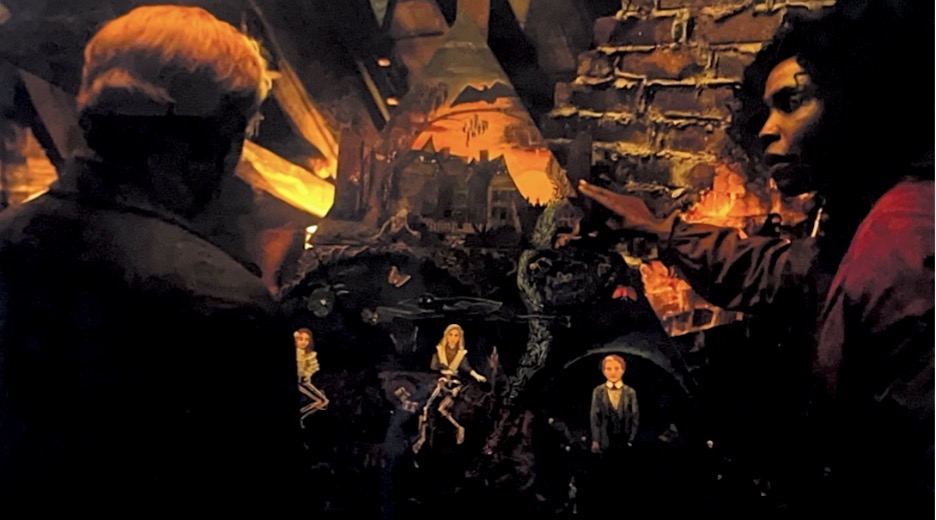
Walter Gilman (Rupert Grint) and Mariana (Tenika Davis) with the tetrapych predicting his death, and the fate of other dead characters. Copyright Netflix, 2022.

From my scholastic methods used to conduct this review, these three episodes—“Lot 36”, “Graveyard Rats”, and “Pickman’s Model”—did not manipulate sentimentality, nostalgia or fernweh effectively and sparingly used the dark, macabre, hyper temporalities and realms that lies at the heart of del Toro’s work. This is evidenced from the episodes’ near-unison clamor on the locus of the archive—be it a storage unit (“Lot 36”), cemetery underground (“Graveyard Rats” or even an art gallery (“Pickman’s Model”)—these are dangerous places that will eat you alive if given the chance. From a theoretical point of view, Fisherian hauntology may offer some potential answers as to how and why the hauntings are constructed and conceived.

WORKS CITED

Fisher, Mark. “What Is Hauntology?” Film Quarterly, vol. 66, no. 1, 2012, pp. 16–24. JSTOR, https://doi.org/10.1525/fq.2012.66.1.16.

Alice Fulmer (she/her) is an MA/PhD student at the University of California, Santa Barbara, educator, and poet. She is pursuing a Medieval Studies emphasis, and planning a prospectus on disability and gender in the Canterbury Tales. Her debut collection Faunalia (2023), is available from Ritona Press. Aside from reviews in SFRA Review, other academic publications include an article on Sir Launfal (c. 1400) in UCLA’s Comitatus. In February 2025, an arts & comedy podcast co-hosted by her and graduate students, Cunterbury, will debut on all major podcasting platforms.

Starship Troopers: Extermination


Review of Starship Troopers: Extermination

Drew Adan

Starship Troopers: Extermination. Offworld Industries, 2024.

Version 1.0.0

Starship Troopers: Extermination is a 2024 first person extraction shooter developed by Canadian studio Offworld Industries. An official entry in the Starship Troopers franchise, the game sees players assume the role of soldiers in the Mobile Infantry battling an insectoid, hostile alien species known as the Arachnids or “Bugs” across a series of planets. While based on Robert A. Heinlein’s 1959 novel, the game is set in the universe of the 1997 Paul Verhoeven film and adopts a similar jingoistic, satirical tone. While offering fleeting moments of fun, frenetic gameplay, Starship Troopers: Extermination largely misses its target as it fails to deliver on the rich world building of its source material or offer a compelling gameplay loop to keep players coming back for more.

As of January 2025, Starship Troopers: Extermination offers two gameplay modes. The first is a brief, single-player campaign across 25 missions that place the player in the boots of an elite special operations squad of the Mobile Infantry. These missions are narrated by the voice of Casper Van Dien who reprised his role as Juan “Johnny” Rico, the protagonist of Verhoeven’s 1997 cult classic sci-fi action film. These missions see the player and three NPC (non-player characters) squadmates traversing bland subterranean and planetary surface environments to complete singular, simplistic objectives such as eliminate specific enemies or hold key areas. There is little to no character development of these squadmates who only offer brief and banal exclamations. Before each mission, a static rendering of General Rico briefs the player on the upcoming mission with monologues that offer little narrative development or meaningful additions to the Starship Troopers cannon. These missions could have been strengthened in both narrative and gameplay if multiple objectives were combined into longer missions. This would provide an experience closer to a proper single-player campaign than an extended tutorial.

The other game mode, and the most compelling experience Starship Troopers: Extermination offers, is a cooperative, 16-player PvE (player versus environment) mission-based extraction shooter. Before the mission, players choose one of six trooper classes, each with their own weapon, equipment, and ability loadouts. So far, the six classes included in the base game are Sniper, Demolisher, Guardian, Engineer, Medic, and Ranger. Each mission starts with players deploying from a dropship and completing various objectives which typically culminate in tower-defense style gameplay as players collaboratively spend mission specific currency to build base fortifications, turrets, and ammo caches. After the base is successfully defended, players must make a hurried rush to the extraction point to complete the mission. This extraction sequence is one of the most engaging parts of the game as persistent enemy corpses litter the battlefield and transform the planet surface into a labyrinthian hellscape of explosions and green Arachnid blood. This leads to some truly cinematic moments as frenetic gameplay combines with visual spectacle and desperate cries from fellow squad members.

Unfortunately, Arachnids are not the only bugs one must battle while playing Starship Troopers: Extermination. Various technical issues have plagued the title through early access and 1.0 release. Performance issues persist on consoles and higher-end PC hardware as swarms of enemies on screen see frame rates plummeting. Hard crashes are frequent and odd textures or visual glitches are rampant. These issues contribute to a sense of Starship Troopers: Extermination being an underdeveloped project attempting to cash in on franchise affiliation. In 2022 players created a mod for Squad (also developed by Offworld Industries) called Squad Troopers. This mod introduced PvE gameplay and Starship Troopers skins for the Squad engine, gameplay, and weapons. It was well received by players, becoming one of the most popular and well-reviewed mods in the Squad community (Steam). It appears that Offworld Industries ran with this concept in their development of Starship Troopers: Extermination.       

Starship Troopers: Extermination had the great misfortune of releasing the same year as another wildly popular squad-based, cooperative bug shooter inspired by the Starship Troopers universe. Arrowhead Studio’s Helldivers 2 was a massive and surprise hit for publisher Sony, breaking sales records and overwhelming game servers shortly after its release. In many ways, Helldivers 2 succeeds where Starship Troopers: Extermination fails as it actualizes a compelling game world and supportive community immersed in roleplaying dispensable “divers” who are fighting to spread “managed democracy” across the galaxy. Despite not having the rich lore of a storied franchise to draw on like Starship Troopers or Warhammer 40,000, Helldivers 2 offers players the opportunity to explore various worlds with scattered tidbits of environmental storytelling, and participate in a live service Galactic War moderated by dungeon master “Joel” who controls enemy tactics, in-game events, and the game’s metanarrative. The community has enthusiastically embraced the heavy-handed, tongue-in-cheek satire of Helldivers 2 producing videos, fan art, and other content that mimics the fascistic and jingoistic tone of in-game propaganda.   

However, such satirical treatment of fascism, colonialism, and militarism as seen in Starship Troopers: Extermination and Helldivers 2 has created an online discourse around the public’s ability to differentiate satire from genuine endorsement (Rosenblatt). Even the richest man in the world, Elon Musk, was mocked for seemingly missing the satirical message of the Starship Troopers film (Greg). This disheartening lack of media literacy calls into question the efficacy of satire in video games for the purposes of social commentary. The concern is that satirical games may only serve to platform problematic ideologies as some players may relate acritically with the game’s toxic protagonists and themes.

This is further complicated by the unique nature of how satire is presented and interpreted in video games. It appears that satire works differently in video games than other forms of storytelling. Firstly, live-service games like Starship Trooper: Extermination or Helldivers 2 are intended to be played forever. Theylack a traditional narrative arc that offers a didactic resolution to punish the protagonist for their abhorrent behavior. Without the comeuppance of hedonistic, satirical novels and films like Fight Club or American Psycho, games generally lack true moral resolution as players are simply rewarded for their deviant behavior by progressing the game and earning greater abilities, weapons, and in-game cosmetics. Secondly, satire typically requires ridicule by the audience of a character or situation. Given the participatory and immersive nature of video games, the players actually become the intended object of ridicule and may lose the ability to critically view the characters as parodies of themselves. Video games, perhaps more than any other media, see the audience sympathizing with the protagonist whether or not they are the hero. Games don’t always prompt the player to wrestle with the question, “are we the baddies?” (Mitchell and Webb). Successful satire in games must adapt to the idiosyncrasies of the genre. A standout example of this adaptation is The Stanley Parable which cleverly satirizes interactive storytelling as a whole by subverting the conventions of narrator and player choice.

While Starship Troopers: Extermination was largely a commercial and critical flop, it serves to spark the same ideological debates as its original 1959 source material. Themes of militarism, fascism, and moral decline, are just as prevalent across the media landscape now as they were over sixty years ago. However, concerns about declining media literacy and video games’ unique ability to allow the player to inhabit, and sympathize with, the protagonist, call into question the efficacy of satire as a method of social commentary in video games.

WORKS CITED

Squad Troopers, created by xpe and Devlikeapro, 2022, Steam Workshop https://steamcommunity.com/sharedfiles/filedetails/?id=2830905314&searchtext=

Rosenblatt, Kalhan. “A video game has reinvigorated a long-running debate about fascism and satire.” NBC News. 28 Feb. 2024, https://www.nbcnews.com/tech/helldivers-2-fascism-satire-debate-rcna140653

Evans, Greg. “Elon Musk roasted after missing ‘painfully obvious’ message from 1990s sci-fi classic.” The Independent. 16 Nov. 2024,  https://www.the-independent.com/arts-entertainment/films/news/elon-musk-trump-starship-troopers-meme-b2649528.html

Mitchell, David, and Robert Webb. That Mitchell and Webb Look, season 1, episode 1, BBC, 2006.

Drew Adan is an archivist with the M. Louis Salmon Library at The University of Alabama in Huntsville (UAH). Before coming to UAH, Drew worked for ten years in the Yale University library system at the Lillian Goldman Law Library and Beinecke Rare Book and Manuscript Library. He holds an MLIS from Simmons School of Library and Information Science and a Master’s degree in History from UAH. In 2024 he published a book chapter entitled “Space City, USA: The Theme Park of the South that Failed to Launch” in NASA and the American South and has presented on various archival and history topics at national and international conferences.