Review of Fantasy and Myth in the Anthropocene


Review of Fantasy and Myth in the Anthropocene

T.S. Miller

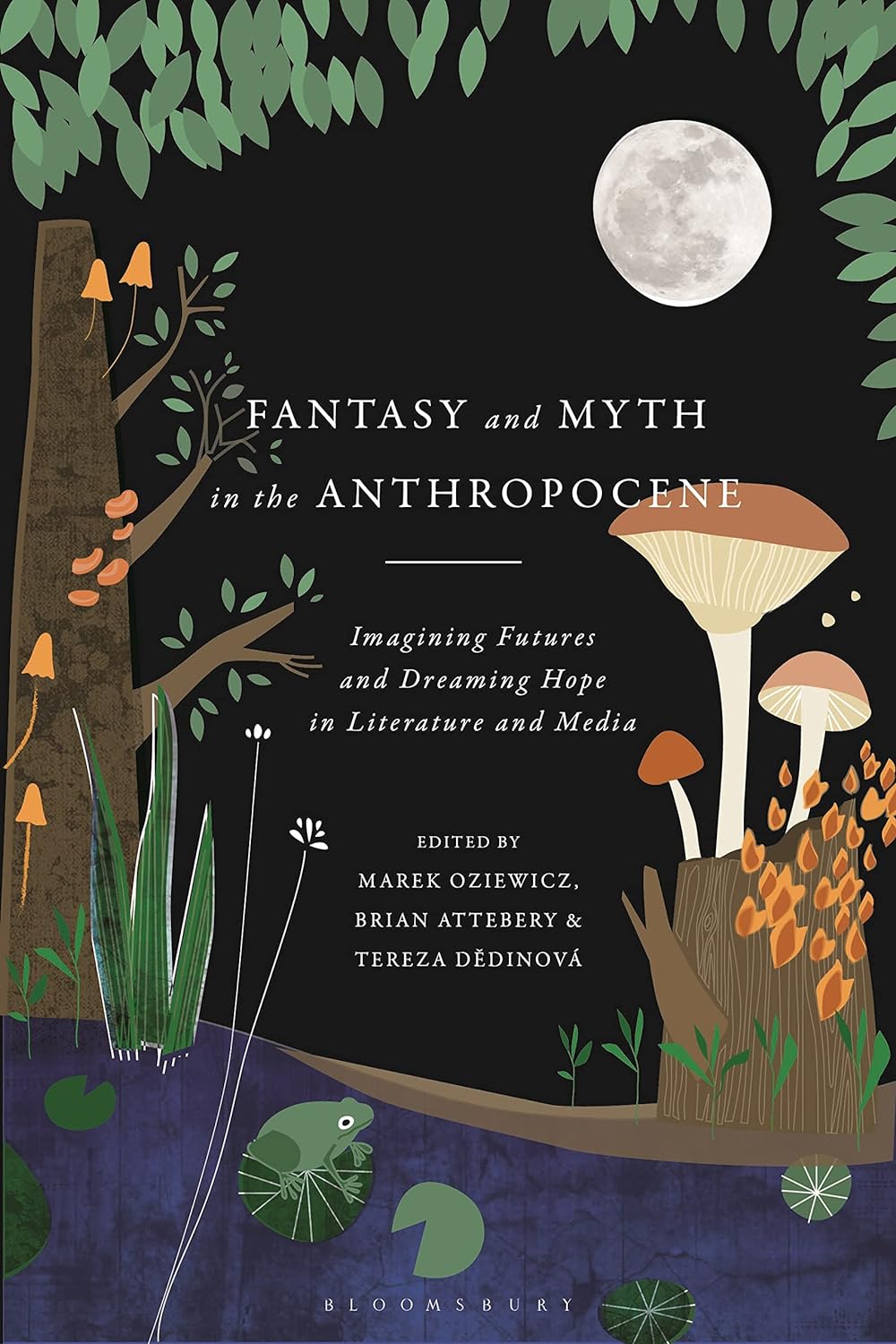
Marek Oziewicz, Brian Attebery, and Tereza Dědinová, eds. Fantasy and Myth in the Anthropocene: Imagining Futures and Dreaming Hope in Literature and Media. New York: Bloomsbury Academic, 2022. Paperback. 272 pg. $34.95, ISBN 9781350204164.

Fantasy and Myth in the Anthropocene represents a major and overdue intervention in fantasy studies: in contrast to the long presence of ecocriticism and environmentalist thought within science fiction studies, fantasy has received only sporadic and admittedly often superficial attention from such critical perspectives over the past few decades. At the same time, the book is also not a typical collection of academic essays, its highly heterogenous contents including, among many other surprises, a number of pieces of visual art; poetry from both Native storyteller Joseph Bruchac and Katherine Applegate of Animorphs fame; and short fiction by both leading scholar of Indigenous futurisms Grace Dillon and magisterial fantasy scholar Brian Attebery, the latter also being one of the book’s three editors. Attebery joins Czech scholar Tereza Dědinová—herself also a co-editor of the 2021 collection Images of the Anthropocene in Speculative Fiction: Narrating the Future—and noted scholar of literature for young people Marek Oziewicz, whose 2008 monograph One Earth, One People: The Mythopoeic Fantasy Series of Ursula K. Le Guin, Lloyd Alexander, Madeleine L’Engle, and Orson Scott Card broke considerable ground in bringing insights from ecocriticism to the study of genre fantasy. The three members of this editorial team obviously bring very different perspectives that have enhanced the range and depth of the collection, which as a whole pays more attention to children’s and young adult literature than we might expect, and—while covering mainly Anglophone literature—also works to move beyond Anglo-American traditions and conceptions of the fantastic, particularly via Indigenous imaginaries, a vital move for a project that aims to advocate for truly “planetarianist” thinking, to use one of Oziewicz’s key terms (58). While some of its individual essays naturally articulate more substantial or more compelling arguments than others, the collection deserves to be read by anyone interested in how non-realist genres have risen to the challenge of imagining other worlds in the shadow cast by human industrial civilization.

The volume contains 16 conventional academic essays by scholars and an even greater number of short contributions from artists and authors of ecofictional works—including Jane Yolen, Nisi Shawl, and Shaun Tan—which may take the form of poems and/or brief reflective essays. I should note at the outset that the different academics contributing to the book find the concept of the Anthropocene itself more or less useful to think with, often preferring one of the many alternative terms in ecocritical discourse that do not center the human (such as Donna Haraway’s Cthulhucene), or no such term at all; for example, Kim Hendrickx’s chapter “On Monsters and Other Matters of Housekeeping: Reading Jeff VanderMeer with Donna Haraway and Ursula K. Le Guin” concludes that “the ecology and story of the Southern Reach make a case against the Anthropocene as a concept to think with beyond its geological designation” (230). Oziewicz’s introduction likewise explains the editorial perspective: “In this book we invoke the Anthropocene at once as a synecdoche of human supremacist worldview and as a humbling recognition that the planet has been irrevocably altered by human activities” (3). Overall, Fantasy and Myth in the Anthropocene showcases a diversity of perspectives on a diversity of texts, although a few common points of reference soon emerge: Donna Haraway’s Staying with the Trouble (2016); Attebery’s own Stories about Stories (2014); Ursula Le Guin in her capacity as both theorist of fantasy and storyteller; N. K. Jemisin; Jeff VanderMeer; Rebecca Roanhorse; and even John Crowley’s Ka (2017), among other authors and texts referenced in more than one essay. Notable, too, is the near-absence of Tolkien, the fantasy author to have attracted the bulk of the existing scholarly attention when it comes to environmentalist concerns in the genre: more recent fantasies take pride of place here, and often those explicitly engaging with climate change, extraction, and other specific features of our own world’s Anthropocene.

Glancing through the index, one will in fact notice that among the longest entries are not individual authors or works, but abstractions such as “hope” and “responsibility,” the second often tied to Haraway’s concept of “response-ability.” (Haraway’s work occupies a place of such prominence in this book that one wonders if its blending of academic discourse, poetry, and parable emulates Haraway’s own inclusion of “The Camille Stories” in Staying with the Trouble.)Oziewicz’s polemical introduction and his later chapter most clearly articulate his own vision of a “fantasy for the Anthropocene” that might “assist us in the transition to an ecological civilization,” a kind of “applied hope articulated through stories” (64), but similar conceptions of fantasy as a technology of hope appear throughout the collection. Jacob Burg, for one, finds in fantasy and fantasy scholarship the potential for “the makings of an ideological resistance starter kit […] to conceptualize and, more importantly, act upon the Anthropocene” (209). Although its editors thus intend the collection as in part a celebration of fantasy’s capacity to imagine alternatives to and ways out of Anthropocenic and otherwise ecocidal patterns of thought and action, individual contributions prove perfectly willing to critique the limitations of some of the genre’s most beloved texts and authors in this arena, both historically (Tolkien) and much more recently (China Miéville in Un Lun Dun [2007] and even Jemisin herself).

By way of illustration, Derek J. Thiess’s “Convert or Kill: Disanthropocentric Systems and Religious Myth in Jemisin’s Broken Earth,” sure to be the book’s most controversial chapter, approaches Jemisin’s trilogy quite skeptically and understands it very differently from Burg, who frames it as a radical kin-making project at odds with Thiess’s assessment of its limitations: in Thiess’s reading, “by privileging our society’s dominant religious myths,” the novels “subvert their own disanthropocentrism and reinforce a Christian exclusionary religio-politics” (195). Burg’s chapter, by contrast, praises the works of four 21st-century fantasy authors, including Jemisin’s Broken Earth books, as “myths of (un)creation” that “adopt a salvaging spirit by articulating possibilities of life outside of the Anthropocene’s linear progress narratives and teleological thought” (208). While I personally find Burg’s analysis much more persuasive and am not certain that I would arrive at quite the same conclusions as Thiess—that for instance the novels run the risk of “re-entrenching the very divisions drawn in the colonial project” and “recreate mythic structures indistinguishable from the missionary Christian beliefs that have informed colonialism for centuries” (202, 205)—I agree with him that the relationship between Jemisin’s works (as well as other contemporary fantasies) with “mythic” Christian narrative structures merits more attention. More generally, this kind of against-the-grain reading strategy is one we need more of in fantasy studies, and also serves as but one example of how the collection as a whole does not engage in naïve or otherwise Pollyannaish polemic positioning of fantasy as some simple solution to the climate crisis. Burg articulates very well the more modest but still optimistic perspective that characterizes the book: “Of course, fantasy is not a magical balm for all of our planetary woes, but its ability to combat crisis comes just as much, paradoxically, from its ethical and imaginative failures as from its rich store of environmental symbols” (209).

Burg’s chapter also capably covers four authors and a substantial body of theoretical material in an impressively efficient manner, as, I came to notice, do so many of the other chapters. I suspect that the editors restricted contributions to a fairly tight word count, but the authors typically make excellent use of the length they have been allotted, whether their chapters require, for example, an explication of Indigenous epistemological frameworks alongside analysis of two contemporary retellings of niuhi mo‘olelo, or traditional stories about Hawaiian shark shapeshifters (Caryn Lesuma’s chapter); or an examination of a transhistorical, transcultural tradition of imagining “oceanic-chthonic hybrids” (150) spanning, among many more, Hans Christian Andersen’s version of “The Little Mermaid” (1837),Hayao Miyazaki’s Ponyo (2008),and Guillermo del Toro’s The Shape of Water (2017). In the latter case, Prema Arasu and Drew Thornton argue compellingly that “these films are part of the contemporary search for re-entangling humans with other forms of life, including those despised or monsterized” (150), although their chapter does represent an instance where I would have appreciated another thousand words or so in which the authors could have covered the contemporary fishman’s less sympathetic precursors, such as H. P. Lovecraft’s Deep Ones. As written, the chapter can mention Lovecraft’s name but little more, and the shadow of “Innsmouth” looms large over this otherwise excellent piece. Sometimes the challenge the contributors face is simply covering a big book in the depth it requires in a relatively short space, a challenge to which John Rieder’s unexpected piece on Kim Stanley Robinson’s New York 2140 (2017) rises particularly well. The inclusion of this notably realist piece of hard science fiction under the umbrella of fantasy and therefore in this volume may perplex, but Rieder examines how the novel “engages in rewriting one of Western culture’s founding myths, the myth of the Flood” (137), and argues that it concerns itself with the fantasies of capitalism and capitalism’s possible counter-fantasies, such that “its main thrust is counter-fantastic, not so much in its realistic detail as in its overarching project of undermining the fantastic inevitability of the neoliberal capitalist status quo” (146).

Other chapters cover a multitude of texts and subjects, including: the striking resonance between Terry Pratchett’s Tiffany Aching series and the principles of permaculture; a complex but finally misdirected critique of extraction as a driver of climate change in Disney’s Moana (2016); Nnedi Okorafor’s Akata Witch series (2011- ) and how both play and YA might address the crises of the Anthropocene; New Zealand YA author Margaret Mahy’s tree-filled fantasies from the perspective of critical plant studies; the “hopescapes” of the Harry Potter franchise and how we might understand even the theme parks to provide, in a limited way that I think I ultimately find yet more limited than the author does, “opportunities for ecological literacy” (103, 110); and the emergence of a fundamentally “queer ecology” in recent television shows that “model queer ecologies for their young viewers to learn from,” namely Steven Universe (2013-2020, She-Ra (2018-2020)­, and The Legend of Korra (2012-2014) (116-117). I would also highlight Alexander Popov’s chapter “Staying with the Singularity: Nonhuman Narrators and More-than-human Mythologies” as especially illuminating: with a charming narratological penchant for diagrams, Popov argues that some modern fantasies have begun processing the Anthropocene “by shifting nonhuman perspectivization and focalization from the supernatural to the natural” (41), a maneuver that allows works such as Crowley’s Ka to explore “the very possibility of inhabiting shared semiotic worlds” beyond the human (45). The collection also finishes strong with Markus Laukkanen’s valedictory chapter “Literalizing Hyperobjects: On (Mis)representing Global Warming in A Song of Ice and Fire and Game of Thrones.” Laukkanen deftly avoids simplistic readings of George R. R. Martin’s series that would declare it some kind of direct climate change allegory, instead mobilizing Timothy Morton’s concept of the hyperobject very persuasively in order to demonstrate that what the books may suggest about climate change they accomplish through a broader thematic emphasis on phenomena at the same incomprehensible scale: “[T]he books incorporate the logic of hyperobjects and thus render global warming available for representation and understanding” (242). Laukkanen judges the HBO adaptation to be increasingly less invested in such tremendous elemental forces in favor of the anthropocentric political intrigue to which its own new title gestures. While Attebery’s opening chapter on Ka and the variously anthropocentric and disanthropocentric trajectories of genre fantasy writ large matches Laukkanen’s well as the other solid bookend for the collection—and Attebery’s series of framing elemental parables interspersed throughout provide this collection with a productively disorienting character—it is Oziewicz’s writing that is finally the most forceful and indeed moving in its emphasis on what he diagnoses as “the ecocidal unconscious” and how fantasy might defuse it (58). His concept of “planetarianism,” defined as “at once, a biocentric philosophical commitment to standing up for the planet and an applied hope articulated through stories” stresses the need for a “hope-oriented imagination” to move us towards a biocentric future (58-59). If he is correct in his hope that “fantasy for the Anthropocene can disrupt the fantasy of the Anthropocene” (58), fantasy authors and fantasy scholars alike may have a larger role in bringing about a more just and inhabitable future than we think.

Review of Existential Science Fiction


Review of Existential Science Fiction

Jess Flarity

Ryan Lizardi. Existential Science Fiction. Lexington Books, 2022. Hardback. 170 pg. $95.00. ISBN 9781793647351. Ebook. $45.00. ISBN 9781793647368.

Ryan Lizardi’s Existential Science Fiction is an ambitious book with a misleading title, as the focus is on recent science fiction cinema with a brief two chapters on video games. A better title might be 21st Century Existential Science Fiction, and Lizardi inserts a self-critique in the introduction pointing out this discrepancy:

It is a weighting of sorts, as the two historical chapters each cover roughly fifty years of science fiction media content and the lion’s share of the rest of the book covers ten years, from 2010 to present. Any researcher who was so inclined could write an exploration of existential science fiction media and flip this imbalanced script… I embrace that criticism… (xii).

This book represents a single constellation of existential fiction when there’s a whole night sky to explore, but it could still be useful for those focusing on the major works covered: Solaris (1972, 2002), Gravity (2013), Ad Astra (2019), Interstellar (2014), Arrival (2016), Annihilation (2018), Legion (2017–19), Westworld (1973 movie and 2016–present tv series), and the video games Assassin’s Creed (2007–2020), BioShock (2007 –2013), SOMA (2015), and Death Stranding (2019). There is a logical underpinning to these selections, though a weakness inherent in existentialism is that it can be perceived in anything, as best evidenced by the dark hilarity of the comic strip Garfield Minus Garfield. Another issue with Lizardi’s approach is that he is applying a philosophy historically dominated by white men to a group of narratives largely by and about white men; even in places that lead to obviously more feminist interpretations, such as in Gravity and Annihilation, Lizardi ignores questions related to gender, as well as race, to focus on aspects of “human” responses. Intersectionalism has taught us that we need to be careful with such a universal flattening of experiences, as too often they are skewed towardness maleness and whiteness.

The book’s first chapter fast forwards past any mention of Kierkegaard or Nietzsche and gets immediately to the heart of Lizardi’s primary focus, film theory, starting with the existential themes in 1902’s A Trip to the Moon and 1927’s Metropolis. He quotes heavily from Bradley Schauer’s Escape Velocity: American Science Fiction Film 1950 – 1982 (2017) throughout this section, using Schauer’s arguments to highlight the 1951 film Destination Moon as the progenitor of modern science fiction movies, as he states it is “important to examine for its semantic genre elements and its syntactic existential characteristics,” and it has a “heavy reliance on verisimilitude and science over action and otherworldly antagonists” (8) which he proposes is a critical element of existentialist science fiction. After a brisk whirl through the cinema of the 1950’s, the second chapter posits 1968’s 2001: A Space Odyssey as the next major film in the existential megatext, as we well as both versions of Solaris (1972, 2002)and Blade Runner (1982, 2017), while discussing how other forms of non-human (alien, AI) intelligences create an existential crisis for humans. Lizardi is well-researched throughout this chapter; he balances direct evidence from the films, statements from their directors, and academic essays, in order to draw comparisons across decades of Hollywood cinema.

Jean-Paul Sartre finally makes his appearance in the third chapter on Gravity and Ad Astra, where Lizardi asserts one of his main theses: “I would also argue that this contrast [between the harsh reality of outer space and the precarity of life] is sometimes the most crucial element of existential science fiction, as it allows audiences to focus more intently on the philosophical elements without the distracting sensational and implausible action so prevalent in early science fiction media” (37). He uses Sartre to posit that the environment of outer space puts the human subject in an atheistic state of crisis, considering they are literally beyond the Earth but not in any kind of heaven or afterlife, and Lizardi convincingly claims that the astronaut symbolizes humanity at the edge of the technological sublime. However, it should be noted that he does not use time-stamp notations for any of his references throughout the entire book, so those looking to pinpoint specific moments in the films will have to look them up themselves.

The following chapter analyzes Arrival and Interstellar as the recent “smart” science fiction films; Lizardi theorizes their existentialist themes could not coexist with more traditional movie plots. He writes, “Their emphasis, however, is not on the antagonism present in so many other science fiction media that encounters other planets and aliens, but instead is on a deep dive into science” (49). Lizardi then compares Arrival to the film Contact (1997) while contrasting it to Independence Day (1996),and he has many useful observations relating to the Sapir-Whorf hypothesis in how these films approach communication with aliens. He also uses evidence from the original source material, Ted Chiang’s novella “Story of Your Life” (1998), something he doesn’t do with the earlier chapters, pointing out the existentialist themes related to the awareness of death in both mediums. He continues this approach in the next chapter on Annihilation, using sections from Jeff VanderMeer’s Southern Reach trilogy (2014) along with personal interviews from director Alex Garland, who used a unique method of adapting the book into the movie by purposefully incorporating ambiguity throughout the entire process.

The next chapter on the tv series Legion feels out of place compared to the previous ones, as the show is sourced from the X-Men comics and employs a much more slippery type of “comic book logic” than even mainstream sci-fi, yet it doesn’t really fit with his later video game chapters, either. The streaming revolution has launched dozens of science fiction tv series with notable existentialist themes in the past decade—several different shows from the same time period would have made more sense for analysis here—notably Orphan Black (2013-2017), Altered Carbon (2018-2020), Black Mirror (2011-2019), Humans (2015-2018), The Expanse (2015-2022), Stranger Things (2016- ), or Sense8 (2015-2018). Fortunately, Lizardi gets back on track with the following chapter on Westworld because he ties it to the existentialist themes in the original film while adding to his earlier observations on the uncanniness of artificial intelligence.

The final two chapters are on video games; the chapter on SOMA and Death Stranding is much more compelling and thematically appropriate than the one on Assassin’s Creed and BioShock. The latter two games are types of Alternative History, and Lizardi focuses on these games while ignoring related media and novels, such as the The Man in the High Castle (1962, 2015-2019), making the chapter feel like it belongs in a different book altogether. Also, while the earlier BioShock games are very atmospherically existentialist because of the post-apocalyptic, claustrophobia-inducing underwater setting, Lizardi’s arguments begin to break down into long sequences where he is doing little more than summarizing the game’s plot and providing casual observations. An example of this is from pages 116-121, where he goes into extensive detail surrounding the final installment of BioShock Infinite (2013) and the related downloadable (DLC) content, but he does not directly quote from the game or bring in the works of other scholars. This lack of rigor unfortunately causes the book to end in a wandering state of confusion rather than in a satisfying, Nietzschean cosmic apotheosis, but perhaps this makes it even more existential, after all? It is up to the reader to construct their own “bad faith” argument here.

In summation, Existential Science Fiction will be useful for anyone interested in tracing the genealogy of some modern existential science fiction films, but the inclusion of the tv series and videogames makes the latter half feel disjointed.

Jess Flarity is a fourth-year PhD candidate in Literature at the University of New Hampshire. His dissertation is tentatively titled The Splintered Man and seeks to track the fracturing of masculine identities in American and British fiction throughout the 20th century.

Review of Star Warriors of the Modern Raj: Materiality, Mythology and Technology of Indian Science Fiction


Review of Star Warriors of the Modern Raj: Materiality, Mythology and Technology of Indian Science Fiction

Jahnavi Gupta

Sami Ahmad Khan. Star Warriors of the Modern Raj: Materiality, Mythology and Technology of Indian Science Fiction. University of Wales Press, 2021. New Dimensions in Science Fiction. Ebook. 258 pg. $70.00. eISBN 9781786837639.

Sami Ahmad Khan’s Star Warriors of the Modern Raj was published in June 2021, and is, by its own admission, “a fan’s alternative,” “a beginner’s guide,” and “a critical catalogue” of twenty-first-century Indian Science Fiction originally written in English (ISFE) for the uninitiated with “SF, in general, and Indian SF in English, in particular” (xiii). The “catalogue” spans an impressive breadth of contemporary ISFE and abstains from engagement with the questions of aesthetics and literariness of ISFE as its “critical” focus is to lay bare the ideological/material, mythological, and technological forces that the 21st-century ISFE is imbricated in and engages with. Deeply conscious of the plurality that ISFE itself hosts and the “congruences and conflicts” (xiii) generated in transposing global SF structures onto India’s SF output, Khan not only “flits across [theoretical] vantage points that arise out of markedly different contexts” (xiv) but also offers an “IN situ Model” that frames his manuscript. The model and its three theses—“transMIT thesis,” “antekaal thesis” and “neoMONSTERS thesis”—are explained in text and through a flowchart in the second chapter of the introductory first section. Khan primarily employs the “transMIT thesis” in this monograph, which also informs its three core divisions—(Ideology/)Materiality, Mythology, Technology; these are bookended by a forty-page introduction and a short concluding chapter.

The first of the five sections is called SF-101 and has three chapters that lay the groundwork for the central three sections of the book. The first chapter, titled “Whoever Loses, SF Wins,” comprehensively charts the longstanding global debates about and difficulties in defining the genre of SF. It shows how the conversations have moved from understanding SF as a genre with fixed boundaries to a mode where the “actants” and “communities of practice” of SF keep it fluid and mutating (15). This chapter is quotation heavy but seamlessly woven together largely from Western critics’ works, contributions from Bodhisattva Chattopadhyay being the exception, to trace the movements and oscillations of SF criticism.

Chapter 3, “Prayers in the Rain,” employs reworked metaphors from Indian metaphysics (atman, paramatman, Vaikuntha), philosophy (dualism, manifestations, transcendence), and math (kilo, mega, yotta) in an attempt to define ISFE by identifying its various distinct features while also searching for its core/soul. The riot of metaphors in this short chapter demonstrates that the constituent components of ISFE—India, science, science fiction, and the English language—are themselves changing, contested, and escape easy definitions. Further, in a convoluted fashion, he recasts Roger Luckhurst’s argument in “The Many Deaths of Science Fiction: A Polemic” that Anglo-American science fiction is ashamed of its pulp origins and wishes to be legitimised by being accepted in the mainstream literary canon; Luckhurst calls this SF’s death wish. Khan expands Luckhurst’s argument by activating the metaphors of atman and paramatman and Plato’s theory of forms to state that all tangible manifestations of regional, national, and global SF aim to be merged with a higher transcendental conception/spirit of World Literature—essentially all SF, including ISFE, desires to leave its generic identity behind to meet and be validated by global literary standards.

The second section of the book, Materiality, has three chapters. This part outlines his classification of the three orders of Others/alterity that ISFE works with. Grade III, or the Civilizational Other, is an amalgam of India’s religious, political, and national threats outside the border; Grade II, or the Social Other, is the overlap of the internal class and caste structures; and Grade I, or the Gender(ed) Other, is constituted by the concerns raised in the sphere of sex and orientations. The three chapters in this section examine various ISFE texts and how these Others are “(re)interpreted and (re)created” (45).

The third section, Mythology, begins with Khan’s three portrayals of god(s) in ISFE—gods as extraterrestrials (from other planets), gods as socio-political indictments (from other temporal locations), and gods as hyperintelligences (from other technological axes) —and the first three of the four chapters of the section discuss ISFE texts relevant to these depictions.

The five chapters in the fourth section, Technology, deal with the broad areas of emerging technological advancement that occupy the Indian science fictional imagination and their varied uses in the selected narratives: genetic engineering; cyber threats; chemical, biological, radiological, and nuclear weapons; alien hyperintelligences; and global climate change.

The concluding chapter, “ISFE: A New Hope,” ties together the previous three sections, demonstrating that the post-2000 ISFE is conscious of and responding to the networks of power and discourses they are embroiled in. Despite having his transMIT thesis attested, Khan alerts readers against any essentialising qualities of ISFE and admits that many ISFE might not have any immediate political entanglements. 

The book’s three main sections progress in an orderly fashion, and their larger pattern of organisation becomes immediately perceptible to the reader. The chapters in these three sections include detailed summaries of the texts being discussed, enabling the readers to follow the argument. Broadly, too, the book is accessible, at times because of and at other times in spite of its easy gliding through SF theoretical terms and frames, Indian lexicon, popular western SF, and math and scientific references. Khan neatly delivers what he promises and additionally gives an overview of an indigenous critical framework for Indian SF, even though his incessant application of “science to SF criticism” (4) can be befuddling. His critical survey of Indian SF and its broad recurring themes is a timely and meaningful addition to the recent flood of the body of works on Indian SF, such as Shweta Khilnani and Ritwick Bhattacharjee’s Science Fiction in India: Parallel Worlds and Postcolonial Paradigms (2022), Urvashi Kuhad’s Science Fiction and Indian Women Writers (2021), Suparno Banerjee’s Indian Science Fiction: Patterns, History and Hybridity (2020), and Upamanyu Pablo Mukherjee’s Final Frontiers: Science Fiction and Techno-Science in Non-Aligned India (2020). Khan’s extant corpus of fictional and critical writings blooms with this work and will be a great beginning resource for readers and researchers looking to orient themselves with regard to twenty-first-century ISFE and its thematic engagements.


WORKS CITED

Luckhurst, Roger. “The Many Deaths of Science Fiction: A polemic.” 1994. Science Fiction Criticism: An Anthology of Essential Writings, e-book, edited by Rob Latham, Bloomsbury Academic, 2017, pp. 59-73.

Jahnavi Gupta is an M.Phil. graduate (awaiting viva) in literatures in English from the University of Delhi, India. Her research interests include speculative fiction, women’s writings, young-adult literature, and graphic novels. She has previously published in Guwahati University’s (India) journal Margins and in All About Ambedkar. Over the past two years, she has taught language and literature courses at various Indian universities and is currently working as an English Language Instructor at IIT Jammu, India.

Review of Out of This World: Speculative Fiction in Translation from the Cold War to the New Millennium


Review of Out of This World: Speculative Fiction in Translation from the Cold War to the New Millennium

Sara Martín

Rachel Cordasco. Out of This World: Speculative Fiction in Translation from the Cold War to the New Millennium. University of Illinois Press, 2021. Hardcover. 316 pg. $60.00. ISBN 9780252043987.

Rachel S. Cordasco’s Out of This World: Speculative Fiction in Translation from the Cold War to the New Millennium is an exceptional volume that can be at the same time overwhelming even for readers with a sound knowledge of speculative fiction. Reading Cordasco’s volume is proof that not even the most committed reader has a good grasp of the vast international dimension of an already enormous field, even if we think only of its Anglophone version.

Cordasco, an experienced writer, editor, reviewer and translator, has been running the website Speculative Fiction in Translation (https://www.sfintranslation.com/) since 2016 because, as she writes in the “About” section, “Speculative fiction offers us a unique perspective on the different peoples who call this planet home, and translation is itself a way of turning the alien into the familiar.” Her website continues the work done by Israeli SF author Lavie Tidhar in the World SF blog (2009-2013, https://worldsf.wordpress.com/), which he started, as he explains in his final post (“A Last Word”)  “partly as an excuse to promote my then-forthcoming anthology of international speculative fiction, The Apex Book of World SF—but mostly out of what can only be described as an ideological drive, a desire to highlight and promote voices seldom heard in genre fiction.” The impact of English-language original speculative fiction is massive (in this and in most genres), and both Cordasco and Tidhar set out to try to offer a more panoramic, truly cosmopolitan, vision. Cordasco’s website presents reviews, interviews, and, most interestingly the section SFT Source Language Lists (https://www.sfintranslation.com/?page_id=11605) which offers constantly updated bibliographies of SF translated into English from fifty-seven languages. This is a truly formidable task, and one must marvel that a single person can carry it out, even assuming she has many collaborators.

The website lists are the origin of Out of This World, which offers chapters for fourteen of these fifty-seven languages: Arabic, Chinese, Czech, Finnish, French, German, Hebrew, Italian, Japanese, Korean, Polish, Russian, Spanish and Swedish. These are the languages with a minimum of ten volume-length texts translated into English since the 1960s, the criteria Cordasco has followed, as she explains. In the “Introduction” Cordasco presents Out of This World as a reference volume and a guide, and warns that she is extending the field covered in her website to speculative fiction (rather than only SF), fantasy, and horror. Each chapter has an introduction by a guest writer from the linguistic area presented, who briefly surveys the history of SF, fantasy, and horror in their language. This is followed by a second survey by Cordasco of the texts translated into English, briefly describing their contents. Finally, each chapter offers a bibliography of translated primary sources in chronological order by original publication date, notes, and a bibliography of secondary sources.

Cordasco’s volume is, no doubt, a gem, and it cannot be sufficiently praised. At the same time, it is, as noted, a daunting book since it requires a type of reader willing to take in a torrent of information, or to use the volume as a guide to a years-long (if not decades-long) process of becoming familiar with other traditions. There is, besides, the doubt of whether the SFT Source Language Lists already mentioned fulfil the same purpose in better ways. The online lists lack the very helpful introduction or the insightful comments on each of the translated texts that the book chapters offer, being pure bibliography. Yet, I remain personally mystified by our insistence to publish as print or digital volumes information that might work best as an online resource, perhaps a database, or even an app.

Cordasco stresses that her purpose is to guide Anglophone readers curious about how their favorite genres work in other languages; though, of course, she is also helping non-native readers of English to reach other speculative fiction traditions. Cordasco supposedly wants readers to check her volume whenever they wish to read foreign authors unknown to them rather than read the book from beginning to end, just as nobody (or almost nobody) reads dictionaries. Yet, perhaps what is missing is a basic beginner’s list with, for example, just one work from each of the fourteen languages selected. Or clearer instructions about how to use the volume. Reference books are not reader-friendly and, arguably, cannot be so because of their very nature. In that sense, it is interesting to see how the website Worlds without End has transformed David Pringle’s popular guide Science Fiction: The 100 Best Novels into a user-friendly webpage (see https://www.worldswithoutend.com/novel.asp?id=8146).

Pringle’s selection, additionally, is based on a round figure, which is more or less manageable for a committed reader in small steps. In contrast, Cordasco’s volume mentions hundreds of books. It must be acknowledged, at any rate, that at least these books are mentioned because they are available in English. In contrast, Dale Knickerbocker’s equally excellent edited volume, Lingua Cosmica: Science Fiction from around the World (2018), also published by the University of Illinois Press, whets an appetite that often cannot be satisfied because of the lack of the corresponding translation into English. It is, in fact, advisable to read both volumes together to fully understand how much brilliant speculative fiction is still in need of translation into English and whether what is available is sufficiently representative.

To conclude, please give Rachel Cordasco’s Out of This World a warm welcome in your personal or college library, for it deserves it. Her invitation to enjoy the riches of many diverse speculative fiction traditions needs to be accepted, both regarding the fourteen languages dealt with in the volume or the fifty-seven of the website. It is actually very good news that her volume is so formidable, for this means that there are countless treasures in speculative fiction to be discovered by anyone who can read English. And if any publisher gets hold of the book, hopefully they will receive the message that the presence of the other traditions still underrepresented in English needs to be urgently increased.

Sara Martín is Senior Lecturer in English Literature and Cultural Studies at the Universitat Autònoma de Barcelona. Dr Martín specializes in Gender Studies, particularly Masculinities Studies, and in Science-Fiction Studies. Her most recent books are American Masculinities in Contemporary Documentary Film (2023) and Detoxing Masculinity in Anglophone Literature and Culture (2023, co-edited with M. Isabel Santaulària). Dr. Martín is the translator of Manuel de Pedrolo’s Catalan masterpiece Mecanoscrit del segon origen (Typescript of the Second Origin, 2018).

Review of American Cities in Post-Apocalyptic Science Fiction


Review of American Cities in Post-Apocalyptic Science Fiction

Allan Weiss

Robert Yeates. American Cities in Post-Apocalyptic Science Fiction. UCL Press, 2021. Modern Americas. Hardcover. 212 pg. $70.00. ISBN 9781800081000.

Robert Yeates’s study of the image of the American city is an ambitious book. It endeavors to analyze how American urban spaces are portrayed in science fiction, and not just in prose fiction but in various media: radio drama, film, comics, games, and the “transmedia franchise” (works that began in one medium and then have been adapted for others), as well as magazine fiction. Each chapter traces the depiction of the city in one or a few texts that Yeates treats as representative of the genre and the medium.

The book’s ambition is both its strength and its weakness, however. After an introduction laying out his theoretical foundations, and explaining why he moves beyond consideration of fiction alone, Yeates devotes about 150 pages to the texts themselves. There is good reason to look at how the various media treat the theme, especially given how much post-apocalyptic science fiction in the twenty-first century is in the form of movies and games, but it is quite a challenge to deal adequately with all this material in such a short study. The effort is certainly admirable, but practical considerations mean that in some cases only one or two texts must stand for many more that may or may not fit Yeates’s claims for the genre or medium as a whole.

Furthermore, some of Yeates’s textual choices are debatable, to say the least. Until film, games, and television came to greater prominence in post-apocalyptic SF, prose fiction offered numerous and varied visions of life after the near-end of humanity in both short stories and novels over a long period. Yeates shows some familiarity with early texts in the field, but provides a somewhat brief and derivative history of apocalyptic science fiction. He relies heavily on some sources, particularly W. Warren Wagar’s Terminal Visions, while not mentioning Martha Bartter’s important article “Nuclear Holocaust as Urban Renewal” at all in his literature review and only incorporating her insights in Chapter 3, where he discusses film. Giving prose fiction just one chapter gives short shrift to all that material from Mary Shelley’s The Last Man (1826) to current cli-fi. He focuses only on magazine fiction—that is, short stories—and of all the choices available he chose to look at Jack London’s hardly representative “The Scarlet Plague” (1912). The story undeniably deserves more attention than it has received, but what about Stephen Vincent Benét’s “By the Waters of Babylon” (1937) or Harlan Ellison’s “A Boy and His Dog” (1969), to name only two? Yeates discusses London’s story in the context of the pulps, but while it was published during the days of general-interest pulp magazines, it predates the science fiction pulp era and it first appeared in a British large-circulation magazine.

Other textual choices are equally questionable. In looking at radio drama he analyzes, in addition to original scripts, adaptations of stories like Ray Bradbury’s “There Will Come Soft Rains” (1950) and “Dwellers in Silence” (1949), both of which were later published in The Martian Chronicles (1950); one cannot help wondering why he did not study the original stories instead. More curiously, when he turns to film he devotes most of his chapter to two adaptations of novels by H. G. Wells on which George Pal worked, The War of the Worlds (1953) and The Time Machine (1960). While the first moves the action to Los Angeles, the second remains set in London, putting it well outside Yeates’s scope. He also discusses Things to Come (1933) more briefly—another film based on Wells and, as he acknowledges, set in London. Many more films could have been analyzed instead, including ones he names, like The World, the Flesh, and the Devil (1959) and Panic in the Year Zero! (1962) among the earlier nuclear-holocaust films by and about American cities, and innumerable later ones dealing with both nuclear and non-nuclear apocalyptic events. On the other hand, he does an excellent job of laying the theoretical groundwork for the study of visual representations of disaster and the post-apocalyptic city. He analyzes the way Los Angeles appears in Blade Runner (1982), although less in the original film than in the transmedia adaptations of it. 

There are some other gaps that he might have been filled in. For instance, the chapters seem somewhat disconnected; while some common motifs, like ruins and their effects on the audience, are traced through the various media, each chapter seems to offer a distinct argument, and less attention is paid to how the aural and visual media perpetuated tropes that had been established elsewhere. Also, a more comprehensive account of the city in fiction, as constituting the site of both corruption in tales going back centuries, and utopia in Plato and then the Renaissance and later, might have contextualized the science fiction better.


WORKS CITED

Bartter, Martha A. “Nuclear Holocaust as Urban Renewal.” Science Fiction Studies, vol. 13, no. 2, 1986, pp. 148-58.

Benét, Stephen Vincent. “By the Waters of Babylon.” Miller and Greenberg, pp. 240-52.

Blade Runner. Directed by Ridley Scott. Warner Brothers, 1982.

Bradbury, Ray. The Martian Chronicles. Doubleday, 1950.

Ellison, Harlan “A Boy and His Dog.” Miller and Greenberg, pp. 335-73.

London, Jack. The Scarlet Plague. Mills & Boon, 1915.

Miller, Jr., Walter M., and Martin H. Greenberg, editors. Beyond Armageddon: Twenty-One Sermons to the Dead. Donald I. Fine, 1985.

Panic in the Year Zero! Directed by Ray Milland. American International, 1962.

Shelley, Mary. The Last Man, edited by Anne McWhir, Broadview, 1996.

Things to Come. Directed by William Cameron Menzies. United Artists, 1933.

The Time Machine. Directed by George Pal. MGM, 1960.

Wagar, W. Warren. Terminal Visions: The Literature of Last Things. Bloomington: Indiana UP, 1982.

The War of the Worlds. Directed by Byron Haskin. Paramount, 1953.

The World, the Flesh, and the Devil. Directed by Ranald MacDougall. MGM, 1959.

Allan Weiss is Professor of English at York University in Toronto. His monographs The Routledge Introduction to Canadian Fantastic Literature and The Mini-Cycle appeared in 2021, and he is the author of articles and has given conference papers on Canadian and fantastic literature. He has been Chair of the biennial Academic Conference on Canadian Science Fiction and Fantasy since 1996, and has edited three volumes of proceedings from the conference. He has also published three short story collections, Living Room (2001), Making the Rounds (2016) and Telescope (2019), and stories in various journals and anthologies.  

Review of Twin Peaks


Review of Twin Peaks

Dominick Grace

Julie Grossman and Will Scheibel. Twin Peaks. Wayne State UP, 2020. TV Milestones Series. Paperback. 122 pg. $19.99. ISBN 9780814346228. Ebook ISBN 9780814346235.

Julie Grossman and Will Scheibel here offer a valuable addition to the TV Milestones series of short, affordably-priced studies of, well, TV milestones (though some may quibble about whether some of the shows selected for study merit that categorization, and one certainly should question the suggestion that most TV milestones are American, given the paucity of non-American shows considered in the series so far). Given that these books are typically short, and reduced further in word count by the inclusion of images, Grossman and Scheibel face a serious challenge. Though the original series consists of only 30 episodes (the pilot plus twenty-nine regular episodes), Grossman and Scheibel unquestionably had also to deal with the prequel movie Twin Peaks: Fire Walk With Me (1992), and the series reboot as Twin Peaks: The Reboot (2017), consisting of an additional 18 episodes, or Parts, as co-creator David Lynch prefers to define this project as a single work rather than a series of episodes. They have chosen as well to consider various connected works, from the movie version of the pilot (created for European distribution as a stand-alone film and therefore given an ending partly cannibalized for the series proper) to the numerous paratextual tie-ins, mostly books, that the series generated. Since their books consists of only 89 pages of text and two of notes, and since they acknowledge that “the Twin Peaks story world invites an exhaustive filling in that produces the illusion of completion; on the other hand, such filling in could be, in theory and perhaps actually, endless” (83), it is unsurprising that, for all of the book’s merits it perhaps leaves as much unsaid as do the various iterations of Twin Peaks.

This is not a criticism of this engaging and insightful book, or if it is, it is a minor one. Grossman and Scheibel demonstrate formidable knowledge of Twin Peaks and of the critical tradition it has inspired already, deftly referencing a significant amount of previous scholarship without descending into merely repeating what has been said before or overwhelming the reader with citations. Grossman and Scheibel address important questions about the show. Perhaps their most useful contribution to Twin Peaks scholarship comes in Chapter 3, “’I am dead, yet I live’: Femmes Fatales and the Women of Twin Peaks.” Lynch’s treatment of women in his work has often inspired criticism, but Grossman and Scheibel ably argue not only for the extent to which women as depicted in Twin Peaks are complexly grounded in various filmic traditions (notably film noir) but are also themselves depicted complexly and with both nuance and sympathy. Grossman and Scheibel are in agreement with the ongoing rehabilitation of the reputation of Twin Peaks: Fire Walk With Me,and its focus on Laura Palmer speaking insightfully to its sympathetic depiction of Laura and praising Sheryl Lee’s fearless performance. The book devotes a brief chapter to the depiction of three characters, Leland, Dale Cooper, and Laura, all of which are useful, but the one on Laura is a welcome reading of Lee’s bravura performance.

Less interesting (to me, anyway) is chapter 5, “Peaks Paratexts: Adaptation, Remediation, and Transmedia Storytelling.” While Grossman and Scheibel make a solid case for how Twin Peaks blurs not only generic and formal lines within film but also the lines between different media via the numerous paratextual materials (treated, it would seem, as canon), my own preference would have been for a few more pages of close analysis of the television show. The book grapples from the beginning with the extent to which Twin Peaks is seen very much as the work of David Lynch—which is of course significantly strengthened by both the prequel movie and 2017 reboot, all directed by Lynch and cowritten by Lynch—but they also point out that this construction of the show as a “’Lynchian’ text” comes “notwithstanding the inherently collaborative nature of television authorship” (10), which this auteurist view tends to overlook. However, the book itself tends to keep the focus primarily on Lynch or the Lynchian aspects of the show. For instance, the bulk of season two passes largely without comment. One might argue that this is justifiable given the generally lower esteem in which much of season two is held, but the book not only presents itself as focusing on Twin Peaks, not Lynch, in its title but also explicitly acknowledges that there is more to the show than Lynch. The paratext chapter is the clearest acknowledgement of this, but a deeper look at the non-Lynch and non-Lynchian components of the show itself would have offered a fruitful, because generally less-explored, direction for a chapter.

Nevertheless, this book is an easy read that offers both a useful overview of the show itself and the critical tradition surrounding it, and valuable insights in its own right. Fans of the show should find the style accessible (academic jargon and bafflegab is largely absent), while students and scholars will find both a useful refresher and intriguing lines of inquiry—again, notably in the way women (and the feminine generally) are handled. Recommended for any library with a Film/TV collection, and affordably priced for anyone interested in the show.

Dominick Grace is now an independent scholar, after 30 years in the academy. His primary area of research interest is popular culture, especially Canadian SF and comics. He is the author of The Science Fiction of Phyllis Gotlieb: A Critical Reading, co-editor of several books, including ones on Canadian comics and Canadian literature of the fantastic, and author of multiple essays on topics ranging from medieval to contemporary literature.

Review of A Sense of Tales Untold: Exploring the Edges of Tolkien’s Literary Canvas


Review of A Sense of Tales Untold: Exploring the Edges of Tolkien’s Literary Canvas

Russell A. Stepp

Peter Grybauskas. A Sense of Tales Untold: Exploring the Edges of Tolkien’s Literary Canvas. Kent State UP, 2021. Hardcover. 176 pg. $55.00. ISBN 9781606354308.

J.R.R. Tolkien is perhaps the best-known and most widely beloved author of fantasy literature. Additionally, his scholarly essays such as “On Fairy-Stories” (1947) and “Beowulf: The Monsters and the Critics” (1936) are key works in the theoretical development of speculative fiction. As Grybauskas rightly notes, “[t]o call Tolkien the father of modern fantasy may feel like a slight to earlier writers like Morris, Dunsany, and Eddison, yet his influence in this arena is plainly great; his works have been adopted as a blueprint for those who followed” (100). While criticisms of Tolkien’s pacing, characters, or writing style may be somewhat justified, where Tolkien’s fiction excels and establishes a nearly unparalleled model for those who follow is the depth of his worldbuilding. Tolkien’s world feels lived-in, with a history, literature, folklore, and languages that span millennia; his readers encounter this world through poetry, elusive references, and passing remarks which give Middle-earth a feeling of great depth. In A Sense of Tales Untold: Exploring the Edges of Tolkien’s Literary Canvas, Peter Grybauskas explores Tolkien’s worldbuilding through the lens of the untold tale – the story that is referenced or only briefly sketched out, but never explicitly retold as part of the narrative. 

The body of A Sense of Tales Untold measures in at 122 pages of dense but very readable prose, followed by twenty-five pages of detailed footnotes, an expansive bibliography, and a thorough index. Grybauskas’ book is clearly the work of both a devoted scholar and an avid fan. The detail of the work’s critical apparatus alone would make A Sense of Tales Untold a useful addition to the library of any Tolkien scholar or fan, but the content contained therein warrants a prominent place on the shelf for this book. 

Following a brief introduction to the question examined in his book, Grybauskas in chapter 1 dives straight into his analysis of the untold tale. He does not begin with Tolkien’s fiction, but with one of Tolkien’s favorite works: the Old-English poem Beowulf. Here, Grybauskas discusses the numerous other tales alluded to by the Beowulf poet, and how the richness of allusion gives the poem a sense of weight and history. This chapter outlines a key cornerstone of Grybauskas’s argument and demonstrates just how influential the poem was on Tolkien’s thinking, frequently referencing Tolkien’s own critical commentary on the poem. While Beowulf is the main emphasis of this chapter, Grybauskas shows his familiarity with the Anglo-Saxon literary corpus and makes frequent, supplementary references to other works in the literary canon.

The following two chapters dive into specific events in the history of Middle-Earth: The Last Alliance, formed to defeat Sauron at the end of the Second Age, and the Túrin saga, set in the distant First Age. While these two events are not the only moments in Middle-Earth’s history that Tolkien alludes to in The Lord of the Rings, they are two which frequently appear on the edges of Tolkien’s fiction and in which “Tolkien found a lifelong playground for untold stories” (xx). Details of these untold tales have been expounded by Tolkien’s son Christopher, in the decades following the elder Tolkien’s death, but there are still details left untold, the sense of which still shapes the experience of reading The Lord of the Rings.

Grybauskas’ fourth and fifth chapters depart from a direct analysis of The Lord of the Rings and instead focus on other areas of Tolkien’s fiction and on the “afterlives” of Tolkien’s legacy (xxi) and his influence on later literature, film, and video games. Chapter four deals principally with The Homecoming of Beorhtnoth, Tolkien’s fictional poem based on the Old-English poetic fragment The Battle of Maldon, and spends a considerable amount of text discussing Ernest Hemingway’s “iceberg theory”—an idea related to Grybauskas’ untold tale—that much of a story lies submerged below the surface. Grybauskas’ fifth chapter is one of the highlights in an already excellent study of Tolkien’s work due to the particular care he places on the analysis of video games as an expression of Tolkien’s legacy specifically and the genre’s importance to speculative fiction broadly. Plenty of critical attention has been paid to fantasy film and literature, but far too often scholarly study shies away from video games, a manifestation of fantasy which is increasingly becoming the most significant medium through which fans interact with the genre. It is refreshing to see a scholar such as Grybauskas treat it with the scholarly attention that it properly deserves. 

A Sense of Tales Untold is generally an excellent treatment, not just of Tolkien’s work, but of the theoretical groundwork of worldbuilding in speculative fiction. That is not to say that the book is without flaw. Grybauskas’ extensive knowledge of Anglo-Saxon literature is clearly demonstrated in the vast number of sources he references and the detailed treatment he gives to each. However, even though he acknowledges the influence of Norse, Celtic, and Finnish sources on Tolkien’s storytelling, it is equally clear that Grybauskas does not possess the same mastery of these literary traditions as he does of the Anglo-Saxon, and his work would have surely benefitted from more knowledge of these literary traditions. Additionally, his fourth chapter dealing with The Homecoming of Beorhtnoth falls somewhat flat and feels almost as though it were an afterthought added to the book rather than part of his comprehensive argument.

Those criticisms aside, A Sense of Tales Untold should almost be required reading for more than those with a broad interest in Tolkien or speculative fiction. The book is reminiscent of one of Tolkien’s most influential theoretical works, the essay “On Fairy-Stories,” in that it seeks to investigate the importance of worldbuilding in fantasy literature, and how successful authors craft fictional worlds which feel as alive and lived in as our own. It would not be a surprise if A Sense of Tales Untold becomes a classic text that will be studied for years to come.

Russell A. Stepp is a natural fit for speculative fiction. He holds a BS in Physics Astronomy, master’s degrees in Comparative Studies, Medieval Icelandic Studies, and Medieval Studies, and a PhD in Medieval studies. He has a particular interest in medieval Icelandic fornaldasögur and mythological poetry. He currently teaches AP Physics and Astronomy at Aristoi Classical Academy, a public charter school in Katy, Texas.

Review of Race in Young Adult Speculative Fiction


Review of Race in Young Adult Speculative Fiction

Laura Singeot

Meghan Gilbert-Hickey & Miranda A. Green-Barteet, eds. Race in Young Adult Speculative Fiction. University Press of Mississippi, 2021. Children’s Literature Association Series. Paperback. 280pg. $30.00. ISBN 9781496833822.

Race in Young Adult Speculative Fiction is noteworthy for the sheer variety of the novels that are under scrutiny, as well as for its large geographical scope. Though slightly imbalanced when it comes to the representation of Latinx and Asian communities, the volume’s inclusive intent is truly something to be acclaimed: the chapters take us from Nigeria to Australia, from Ireland to the US, while also exploring both Western writers’ and First Nations authors’ works. The genres of the novels examined are as varied as the definitions of ‘race’ they suggest since genres such as dystopian fiction, fairy tale, detective fiction, steampunk, Neo-Victorian fiction, Indigenous Futurism, and even BL (Boys Love) manga overlap and intersect.

Drawing from a strong body of theoretical works focusing on science fiction and YA fiction, as well as other topics such as the representation of women in such literature, the book also leaves ample room for the inclusion of the work of racialized theorists and academics, such as W.E.B. Du Bois’s concept of ‘double consciousness,’ Grace Dillon’s seminal work on defining Indigenous Futurism, or Kwaymullina’s take on decolonizing literature not only as a writer but also as a teacher. The wide range of the contributors’ status is also appreciable; authors range from established professors to PhD candidates, sometimes even current YA fiction writers. This range enhances a feeling of dynamism that matches the contemporary surge of attention concerning matters of race in both literature and scholarship and cannot but be telling regarding the growing contemporary interest in and demand for YA literature.

This collection is easy to navigate, with four clear and well-devised sections that emphasize the book’s obvious didacticism: I. Defining Diversity, II. Erasing Race, III. Lineages of Whiteness, IV. Racialized Identities. Those general topics are addressed, according to the different novels that are studied, without essentializing YA literature from one specific country, continent, or point of view (western, Indigenous, or racialized). For example, while focusing on representations of whiteness and their legacy when it comes to power relations, the third section contains three chapters that each adopt a different standpoint: one focuses on Cassandra Clare’s The Infernal Devices series’ intricate relations of domination and the depiction of Asian masculinity inspired by Chinese worldviews and culture, another explores disease-induced dis/ability in an American adventure that takes its origin in Chicago (the Divergent series by Veronica Roth), and the last chapter studies the rewriting of colonisation and its oppression of First Nations Peoples through stereotyping and appropriation (Chaos Walking, Patrick Ness).

Starting from racial representation and the question of the definition of the Other, the collection does not simply debunk racial stereotypes nor does it take for granted postracial worlds that could too easily be equated with utopias. By first questioning the treatment of whiteness and how it is reified in stories which mostly rely on white protagonists (even though they may debunk patriarchal hierarchies), it then moves to a reflection on what it really entails to set a story in a postracialized society; while warning against adopting a colorblind approach to racial issues, it emphasizes the erasure of race as dubious and even counter-productive as it more often than not re-establishes racist ideology and reproduces domination. In fact, erasing race appears to be complicit in neoliberalism’s systemic racism and reproduces structures of western colonialism and racism.

Talking about race is not as easy as advocating for a more diverse cast of characters, whether they be of different skin colors, backgrounds, ethnicities, species or classes. The chapters do not abide by a mere Manichean way of looking at the question of race in YA dystopian fiction, questioning and qualifying rather than asserting; they rather perfectly delineate it and do not shy away from tackling the shortcomings of the novels, informing their study with a critical reflection. A few examples would be the rewriting of white heteronormative and patriarchal power relations and hierarchy in Eoin Colfer’s Artemis Fowl series, the lack of LGBTQ diversity (ch.3&5), or of historical contextualization regarding imperial oppression. The use of English as universal language is also criticized as going against the wish for diversity, while picturing the Asian Other as one homogeneous whole recalls the 19th century’s anthropological considerations (ch.8).

Overall, Race in Young Adult Speculative Fiction makes a good effort at drawing attention to intersectionality: not only are racial hierarchies considered, so too are gender and sexual dynamics, strongly drawing from feminist and queer studies, as well as disability studies. Even though there is a noticeable intent to approach intersectionality, one mild reproach could be that rather than really grounding their study in intersectionality, some articles seem to use those topics as metaphors for racial concerns. A running dialogism between concepts—rather than a mere juxtaposition, considering them as if they were similar—could have helped the readers not to feel sometimes confused because the topic shifted from race to the representation of disability, for example. The threads weaving together those themes felt sometimes loose and could have been tightened a little more if the metaphors were pedagogically repeated and rearticulated throughout the chapters.

To conclude, this book’s targeted audience encompasses academics and students interested in YA fiction but also focusing on science fiction and speculative fiction, ranging from subgenres such as Neo-Victorian steampunk to Indigenous futurism. It could also be used to broaden the research fields of academics not particularly versed in YA fiction but showing interest in postcolonial and decolonial approaches, whose concerns would converge with the general theme of the book, that is to say the depiction of race and the struggles for self-representation and epistemological justice. Having said that, readers should be warned that there will surely be novels that will be added to their TBR list after closing Race in Young Adult Speculative Fiction.

Laura Singeot is an associate professor in Cultural and Visual studies at Reims University, France. She is interested in the representations of Indigeneity in contemporary Indigenous literatures from Australia and Aotearoa-New Zealand, from novels and poetry to dystopic Young Adult fiction and Sci-fi. She is also researching new museology and Indigenous visual art, especially digital and new media art, focusing on its integration into global networks of creation, curation and reception. Her methodology rests on a comparative transdisciplinary approach, drawing from concepts theorized in decolonial thought.

Review of Shakespeare and Science Fiction


Review of Shakespeare and Science Fiction

Dominick Grace

Sarah Annes Brown. Shakespeare and Science Fiction. Liverpool UP, 2021. Liverpool Science Fiction Texts and Studies, 71. Hardcover. 224 pg. $143.00. ISBN 9781800855434. eISBN 9781800857636.

Sarah Annes Brown is a scholar both of Shakespeare and of Science Fiction, among other literary subjects. She is especially interested in “patterns of influence and allusion,” according to her Anglia Ruskin University bio page. While no doubt many scholars are interested in Shakespeare, SF, and literary influence—and indeed, much has been written about Shakespeare’s presence in and influence on SF—Brown has provided an important addition to the study of Shakespeare in/and SF by giving us, as the book’s back cover blurb reports, “the first extended study of Shakespeare’s influence on the genre.” This book is essential reading for anyone interested in how Shakespeare has informed (and in some cases, how his works have been informed by) SF, both because of her own insights and because of the expertise with which she weaves together earlier scholarship on the subject.

This compact book (I would have been happy to have had an additional hundred pages to read) consists of an introduction that speaks to the reason Shakespeare may be of abiding interest to SF authors (beyond his general cultural capital and ubiquitous influence), followed by seven chapters exploring the interpenetration of Shakespeare and the following SF subcategories and conventions: time travel, alternate history, dystopian fiction, contact with aliens/travels to space, science and magic (a chapter focusing primarily on The Tempest [1610/11] and its SFnal elements/presence), posthumanism (including constructed beings such as robots—one section and illustration notes echoes of Hamlet holding Yorick’s skull with Chewbacca holding C-3PO’s head), and post-apocalyptic fiction. Throughout the book, Brown provides extensive references to prior work on Shakespeare and SF—indeed, she perhaps directs readers more to earlier texts than she builds her own analyses, which I will address further below—and cites a remarkable range of (mostly) SF texts. She identifies SF, and specifically written SF, as her primary interest, but does provide occasional discussion of non-SF and, more extensively and insightfully, the Shakespearean presence in filmic form, especially Dr. Who and Star Trek, with other notable examples (e.g. Forbidden Planet [1956]) thrown in. The main thematic through line is the tension between Shakespeare being depicted as a transcendent figure (perhaps most notably in works in which even aliens idolize Shakespeare, but in other contexts as well, such as Shakespeare’s frequent presence as a cultural touchstone in post-apocalyptic SF, or in alternate history stories in which his presence or absence changes the course of history), and a more skeptical/revisionist view of Shakespeare as having a reputation that exceeds his actual worth. She refers recurringly to Borges’s paradoxical construction of Shakespeare in “Everything and Nothing” (1964) as exactly that.

Brown tackles many of the obvious candidates for consideration, from books with Shakespeare actually in the title, such as Clifford D. Simak’s Shakespeare’s Planet (1976; I was a bit disappointed that she did not pick up on the fact that the figure of Oop is an evident echo of V. T. Hamlin’s famous time-travelling caveman, who encountered Shakespeare’s Macbeth in a story in 1953) to such obscure texts as John E. Muller’s (Lionel Fanthorpe) 1965 novel, Beyond the Void, a book I had never heard of. Even readers familiar with Shakespearean appearances and echoes in SF will probably find references here to texts about which they know little. That said, and as noted above, Brown also limits herself, generally, to SF, so one might quibble with which exceptions she chooses to address. I doubt anyone would argue against considering Neil Gaimin’s use of Shakespeare in his Sandman (original series 1989-1996, with several ancillary projects published since), as Brown does, though Shakespeare appears in only a handful of stories (albeit key ones), if for no other reason that the fact that in 1991, issue 19, which offers a take on A Midsummer Night’s Dream (1595/96), won the World Fantasy award for short fiction. However, one might argue that the comics series Kill Shakespeare (2010-2014, with several subsequent tie-in series), by Anthony Del Col and Conor McCreery, would have merited consideration, given its premise, and despite its aesthetic limitations. For entirely personal reasons, I would also have liked to see Brown say a bit more about Phyllis Gotlieb’s use of The Tempest in her 1976 novel O Master Caliban!.

The nature of the book, though, as well as its length, make comprehensiveness and deep dives, if not impossible, certainly difficult. Even within her defined limits, Brown has a lot of territory to cover, so she frequently offers only brief commentary on many works (few texts are given more than a handful of pages) and frequently directs readers to more detailed studies of the texts she references. Brown primarily hits the high points of how the works she considers reflect her thesis, with a fair bit of plot summary (often necessary, given the number of texts touched on; no reader is likely to be familiar with all of them) and relatively little detailed analysis or close reading. The book provides a very useful overview of significant texts that have invoked Shakespeare, often providing valuable insights, and Brown provides readers with the tools to track down studies of individual works.

Despite Brown’s scholarly rigor, this book is written in a clear and accessible style, and with no small degree of wit. While noting the difficulty SF authors face in trying to create a plausible voice for Shakespeare when they try to depict him, Brown herself demonstrates an admirable facility with language. While the book’s primary audience is academic, this book would be accessible to undergraduate students and probably advanced high school students, so it could serve as a useful recommended reading text for such audiences. Consequently, it would be a worthy acquisition for university, college, and even high school libraries, though its price point will probably dissuade potential readers from purchasing a copy.

Dominick Grace is the non-fiction reviews editor for SFRA Review. Occasionally, he takes advantage of that role to claim a book for himself. He also belongs to the group of those with a scholarly interest in both SF and Shakespeare.

Review of Science Fiction in Translation


Review of Science Fiction in Translation

Alice G. Fulmer

Ian Campbell, ed. Science Fiction in Translation: Perspectives on the Global Theory and Practice of Translation. Palgrave Macmillan, 2021. Studies in Global Science Fiction. eBook. 359 pages. $109.00. ISBN 9783030842086. Hardcover ISBN 9783030842079. Softcover ISBN 9783030842109.

Science fiction (often abbreviated throughout this volume as SF), as a genre, has far more potential than just to provide scaffolding for media franchises that have dominated Anglophone ‘fandom’ spheres, such as Doctor Who or Star Wars. Modern translation studies and its dissemination into other fields, such as SF, carries the tools to decenter and destabilize the Anglocentrism of these media ventures. And it is precisely at these intersections that Georgia State University’s Ian Campbell makes a powerful case for inclusivity in SF. A scholar of Arabic science fiction and its translation into English, he binds together articles incredibly diverse not only in language and/or place of origin, but in genre and across  time. Campbell dispenses this attitude readily to the intersection of SF and translations studies—a mission statement from the volume’s beginning:

SF as a genre evolved largely—though by no means exclusively—in English and in Anglophone cultures. In these cultures, even readers who don’t care for SF will likely have a clear understanding of the characteristics of the genre; they will be accustomed to the tropes and discourse of SF to an extent that readers in other cultures may not. There are many languages and cultures where SF has a firm presence: Russian and French at first, then Japanese, Spanish and Korean, and Chinese and some of the languages of the Indian subcontinent. There are still other cultures (notably, in sub-Saharan Africa) where literature is often written and read in English but where SF is a comparatively new phenomenon. This is in no way to say that people from such cultures cannot or do not understand SF: of course they can, and among other things, the expansion and distribution of SF film and television have gone a long way toward bridging that gap. (Campbell 7)

This volume does not show up empty handed or without evidence for Campbell’s vision for international science fiction. It does, though, fight for inclusion in a field dominated by ‘angloisms’ and by extension, one that has historically been white, misogynist, and queerphobic. Painfully so. An antidote is to bring attention to other canons, authors, ideas, and corpuses, moreso by introducing the Anglo world to non-Anglo SF instead of the other way around. Walt Disney Studios and its affiliates have that market cornered.

So in conducting a review for an essay anthology on translation, naturally I find myself trying to bring my own parable to the rather long and oblong table of discourse Campbell puts together neatly in Science Fiction in Translation: Perspectives on the Global Theory and Practice of Translation. To start, looking from my primary field of English medieval literature(s), I see the work of science fiction and translation both together and separately in this anthology as a reckoning of an irresistible force and immovable object, not unlike the most memorable section of Venerable Bede’s (c. 673-735) Ecclesiastical History of the English People. Therein, he sought to translate “Caedmon’s Hymn” (aka, the first ‘poem’ in English) from the Old English to Latin and subjects the reader to the force and object which complicate translation (signaled in bold, emphasis and translation mine):

Hic est sensus, non autem ordo ipse verborum quae dormiens ille canebat; neque enim possunt carmina, quamvis optime composita, ex alia in aliam linguam ad verbum sine detrimento sui decoris ac dignitatis transferri.

(This here is the sense, though not the order of the words themselves, of which he was singing while sleeping. Although they are not able to be “sung”, however excellently composed, out of one language to another, it is not possible to translate without hurting the charm and merit of them.)

In translation studies, then, from Bede to Campbell, there is the teleological battle between conveying the sensus verborum (sense of the words) and the methods transferri (to carry over, to translate). The tension between this ‘force(s)’ and ‘object(s)’, and the subsequent consequences of prioritizing one over the other, is the joy and angst inherent in works of translation. Now, applying the metaphor to science fiction and its speculative relatives, we, the initiates of this field, see a similar tension between the conventions of what is ‘hard’ or ‘soft’ SF, hard SF being speculative literature whose diegesis explicates the fiction in terms of mathematics, physics, engineering, or otherwise what may be construed as ‘STEM,’ while ‘soft SF’ may focus instead on the framings of psychology, sociology, history, or the legacy of literary lineages that converge onto the text.

On the whole, the wide array of science fiction materials may necessarily use both hard and soft SF in the development of worldbuilding, narrative scaffolding, and aesthetics, just as the translator carefully balances the sense of the words against how to translatus them—that is: “trans” (across) and “latus” (been carried). So then, the exegesistic direction across the essays—crafting theses on corpuses ranging from Swedish sci-fi epics to Cuban enslavement narratives in verse, feminist utopias found from Spain to Quebec, international translations of subversive Anglo SF tomes from Phillip K. Dick to A Clockwork Orange—runs along and around the political ramifications, consequences, and contexts surrounding the works of translation and precisely how they came to be.

Science fiction, famous for encompassing rich and original (and English-language-based) worlds such as those found inButler’s Dawn Trilogy and even the ill-fated Cyberpunk 2077, is shown in Campbell’s anthology to be more composite and diverse than the dichotomy of hard and soft SF. The breadth of geography and genres themselves expand in SF, together and separately, when ‘anglophonics’—that is the collocation of both Anglo and Americans literatures, media and mores – is no longer the dominant corpus that is expanded upon and invested into. Touching on the Swedish sci fi epic Aniara and its subsequent translations, Dr. Daniel Helsing, Linnaeus University, writes that:

[t]raditional poetic metaphors evoke images that are unspeakably insufficient to capture the universe, yet they may lead to a sense of comprehension. They are thus not only ineffective when trying to grasp the universe; they may also be misleading. In this sense, traditional metaphors can be said to use domesticizing strategies when translating the findings of science into any natural human language. (Helsing 86)

Traditional literary devices, systems, and ambitions, no less traditional audiences, is where SF and its international author base meets the hard work to convey the majestic sublime of space and all the hopes it can contain for the reader and author alike. However, staples of ‘the classics’ definitely do contain speculative and SF imaginings. I would, though, as a premodern scholar, further emphasize that speculative and science fiction has its origins long before Jules Verne. Geoffrey Chaucer’s Squire’s Tale (c. 1390s)  or Sir Thomas More’s Utopia (1516)are both powerful exempla of premodern speculative fiction—one in verse and one in prose. An understated job of translation is not only carrying over the sense of the words, but also being able to translate time: looking to the past and looking for the future within it. That is, traditional devices of literature do not have to exclude science fiction or international visions of it. In fact, they can help and historically have shaped speculation in literature. However, we are as critics also able to separate and diminish the mores of exclusion that movements of literature historically have. Science fiction has us looking to the stars—and they should be shining as brightly as possible.

Campbell’s volume is an indispensable collection of new voices and media spanning from at least the 1830s to the close of the 2010s, which not only makes the case for inclusion within the field but provides a tangible, though far reaching, web from which to choose a new vision for SF. This involves, for the casual reader or the adherent, letting go of certain attachments to what SF can and cannot be. It may involve breaking through at least two well-established binaries: the dichotomy of hard and soft SF, and from translation studies down from Bede’s time: the angst between sensus verborum (the sense of the words) and transferri (what is actually carried across from translations). In a world where the lenses of SF and conscious reality seem to blur more and more, Campbell’s volume and the authors included are a beacon of hope.

Alice Fulmer (she/her) is an MA/PhD student at the University of California, Santa Barbara, ESL teacher, and poet. She is pursuing a Medieval Studies emphasis, and planning a prospectus on digital cultures and late medieval British manuscript culture. Her debut collection Faunalia (2023), on Gods and Radicals/Ritona Press, is a love letter to the great god Pan.