Supernatural: A History of Television’s Unearthly Road Trip


Review of Supernatural: A History of Television’s Unearthly Road Trip

Dominck Grace

Erin Giannini. Supernatural: A History of Television’s Unearthly Road Trip. Rowman & Littlefield, 2021. Hardcover. 238 pg. $36.00. ISBN 9781538134498. EBook. $21.50. ISBN 9781538134504.


.

Cult TV phenomenon Supernatural, which ran for fifteen seasons (the longest run for a genre TV show, Giannini insists, though the definition she is using of “genre” would seem to narrow the concept to the fantastical, since westerns Gunsmoke [1955-1975] and Death Valley Days [1952-1970] both had longer runs and produced significantly more episodes—and one also would need to exclude medical dramas and crime shows from the “genre” category to give Supernatural the nod), has received a remarkable amount of critical attention, from monographs to essay collections, from scholarly studies to books for general audiences. Giannini’s history of the show has scholarly heft but a style that makes it accessible to general readers, and at a mere $36.00 for a hardcover book is also priced for a non-scholarly audience. It would probably be accurate (and I do not do so pejoratively) to describe Giannini as an aca-fan, engaging in serious study of a TV show she evidently loves. Features such as her “Highly Subjective List of 30 Must-See Supernatural episodes” in the Appendix speak as much to fandom as scholarship (and the fact that I would have weighted my own such list more heavily in favor of earlier seasons should make clear my own aca-fan propensities.

Giannini traces the genesis of the show in her introduction by contextualizing its origin in 2005 in the historical events of the time, and then devotes the first three chapters, in a section called “In the Beginning,” to the earlier television stew from which show creator Eric Kripke fished out ingredients and to the genesis of the show specifically, from Kripke’s own personal and work history. Part of the show’s richness can be traced to the diverse influences that shaped its development. Though Supernatural can be categorized as horror (as Giannini notes, always a tough sell on network TV, given the restrictions of the graphic and transgressive elements endemic to the genre), its influences are diverse, and perhaps thanks to the show’s fifteen-year run, it was able (sometimes gleefully) to employ a lot of generic slippage into its run. Indeed, Supernatural developed into a remarkably self-conscious show, including overtly meta episodes and ultimately a protracted and plot-central meditation on the complexities of the creative process and the relationship between fans, artists, and art itself. These chapters are especially useful for their careful and thorough grounding of the show in its historical and social context, a topic Giannini continues to explore in more detail in the balance of the book, as she tracks the show’s development across its fifteen-year run. This unit concludes with an overview of the show’s main characters, as well as of significant characters who appeared less frequently.

Part two consists of four chapters, under the section title “The Supernatural World.” The first of these chapters revisits somewhat the historical context elements of the preceding unit. Indeed, a feature of this book is a fairly modular construction, with individual chapters evidently designed to be read easily as single units. This does lead to some repetition. However, here Giannini makes some interesting interventions. Her detailed consideration of the show in relation to Buffy the Vampire Slayer (1997-2003), though strong in its own right, is hardly surprising. Surprising, and insightful, is Giannini’s subsequent detailed discussion of Supernatural in relation to Roseanne (1988-1997), as shows representing blue-collar life on screen. The other chapters delve into Supernatural’s other major influences, such as folklore and religion, throughout its run. Early seasons often built on urban legends, myths, and folk tales; later seasons created extended narrative arcs in which the Judeo-Christian god (primarily; others also appear) is central. The final chapter in this section considers the complex and shifting perspectives on politics across the show’s run, offering interesting readings of how the show’s politics shifted under different show-runners.

The final section, “’People Watch This?’ Supernatural’s Cultural Impact,” steps away from the show proper to consider its influence. The book therefore neatly turns from exploring what Supernatural emerged from to considering what has emerged from it. Giannini begins with a recap of the history of how television has been marketed and consumed, providing perhaps more detail than is really needed for her purpose, but she nevertheless offers useful insights into how the show capitalized on emerging technologies such as streaming to broaden its audience and develop a passionate fan base—and therefore to become a “tentpole” show for the CW, used to help grow audiences for other CW offerings The final chapter focuses on fandom and perhaps downplays the complexities and conflicts therein. Supernatural’s passionate fans have not always seen eye to eye, as Giannini’s chapter title suggests: “Beyond ‘Sam’ and ‘Dean’ Girls” refers to the division among fans of each of the two lead characters. Nevertheless, Supernatural fandom has been active in positive ways, to which Giannini draws appropriate attention. This real-world influence is perhaps a more important legacy than Supernatural’s status as “one of the texts that ushered in a golden age of television horror” (156) or as possibly one of the last long-form serials on TV (if one excludes shows such as soap operas, anyway); “its legacy, from content to distribution, continues to resonate” (156), Giannini concludes. One could do worse.

Dominick Grace is the Non-Fiction Reviews Editor for SFRA Review. He is co-editor, with Lisa Macklem, of Supernatural Out of the Box: Critical Essays on the Metatextuality of the Series (2020) and A Supernatural Politics: Essays on Social Engagement, Fandom and the Series (2021).

Women, Science and Fiction Revisited


Review of Women, Science and Fiction Revisited

Sarah Nolan-Brueck

Debra Benita Shaw. Women, Science and Fiction Revisited. Palgrave Macmillan, 2023. Palgrave Studies in Literature, Science and Medicine. Hardcover. 181 pg. $119.99. ISBN9783031251702. eBook ISBN 9783031251719. $89.00.

.

Debra Benita Shaw’s Women, Science and Fiction Revisited is an updated version of the author’s 2000 work, Women, Science, and Fiction: The Frankenstein Inheritance. Key differences between the volumes include the removal of some chapters focused on short stories that are now out of print, the reworking and addition of new commentary to others, and the addition of chapters on texts which were released since the original publication. Each chapter focuses on a main text or textual pairing; Shaw examines Charlotte Perkins Gilman’s Herland (1915), Katharine Burdekin’s Swatiska Night (1937), C. L. Moore’s “No Woman Born” (1944), James Tiptree, Jr.’s “Your Haploid Heart” (1969) and Ursula K. Le Guin’s The Left Hand of Darkness (1969), Margaret Atwood’s The Handmaid’s Tale (1985 novel and still-running 2017 TV show), Naomi Alderman’s The Power (2015), and finally, N. K. Jemisin’s The City We Became (2020). These texts, Shaw argues, showcase representative critiques that American, British, and Canadian female authors made of popular feminist ideas and contemporary trends in thinking around technology—hence the title, Women, Science and Fiction, rather than women in Science Fiction.

Shaw’s most radical claim is that “the time of sf is over” (9). She writes, “the criteria that distinguished the genre and which governed the mode in which extrapolation functioned are now no longer sustainable” (9).  In this assertion, Shaw is following a critical pathway to its extreme; while many have claimed that, in our age of technological intensification, the boundaries between the speculative and the real are breaking down, Shaw takes this contention to its logical end. Though she does not imagine SF to be dead, she does claim that the forms of SF which we’re most familiar with are no longer viable, and that the most productive speculative works are now those that trouble a traditional view of how SF operates; in other words, works that push at the boundaries of genre in a self-referential fashion. Further, Shaw sees the need to define SF in opposition to other, less logically ordered genres as the hanger-on of colonialism, and “the taxonomic ordering of the world which structured scientific imperialism” (9). This contention is most clear in Shaw’s discussions of The Left Hand of Darkness and The Handmaid’s Tale. Shaw argues that in our contemporary moment, both have taken on new resonances that change their narratives from extrapolations into allegories for our current crises of climate and bodily legislation, respectively.

As with genre, Shaw challenges her reader to forgo the distracting exercise of erecting rigid gendered definitions and boundaries. In her introduction, Shaw writes, “The question of who or what is a ‘woman’ and who is authorised to speak for and to women seems to be overwhelming the more important work of challenging the patriarchal social structures which, fundamentally, have defined these terms in the first place” (1). The more pressing mission, then, is avoiding definition in opposition to masculine ideals in general, which can lead to unintentional collusion in patriarchal projects of ideological, legal, and physical control. Shaw is careful to challenge ideas of essentialism that align the female figure with “Nature.” In chapter four, Shaw discusses Donna Haraway’s “The Cyborg Manifesto” as a response to a branch of feminism which equates women with nature—a dangerous conflation, Shaw states, because it gives patriarchy a powerful tool to align women with reproduction and commodify the female body. This formula is best articulated in a line Shaw uses to describe Swastika Night: “Hence the text extrapolates the appropriation of separatist consciousness and ecofeminist mythology by a patriarchal regime happy to collude with the idea that the future of the planet and the future of women are inherently linked” (117). Throughout, Shaw denies the proposal that a world made of women would be one without problems, or that a society built on unequal power dynamics could lead to equality.

Shaw’s work makes a strong case for the contemporary relevance of each text discussed, and for the ways that political and environmental changes have altered the way we read and understand several older texts. In marking this shift, Shaw turns to N. K. Jemisin’s The City We Became, which she seesas part of the “rise of the new weird,” a less “hopeful” and “naïve” turn which recognizes and challenges “the limitations of genre fiction” (172). Given that The City We Became is a fantastical, surrealist novel, which does not seem to engage with more traditional science fiction elements, its purported role as sign of development or shift in generic boundaries is somewhat questionable. In other words, I remain unconvinced that Jemisin’s novel is the best example for Shaw’s argument. The contention, however, that the execution and goal of extrapolation has been fundamentally altered does offer conceptual tools for examining fiction in a post-Trump, post-Covid-19, rise-of-AI era, in which future shock has taken on a whole new meaning. Shaw’s proposed shift in SF raises important questions as to how SF has served or challenged feminist ideologies in the past, and how these ideologies and their fictional outgrowths can remain critically relevant in an age when science fiction seems to be morphing into science fact with terrifying speed.

Sarah Nolan-Brueck is a PhD candidate at the University of Southern California, where she studies how science fiction interrogates gender. In particular, she examines the many ways SF authors question the medicolegal control of marginalized gendered groups in the United States, and how SF can support activism that refutes this control. Sarah is a graduate editorial assistant for Western American Literature. She has been previously published in Femspec, Huffpost, and has an article forthcoming in Orbit: A Journal of American Literature.

The Grey Chamber: Stories and Essays


Review of The Grey Chamber: Stories and Essays

Indu Ohri

José Alaniz. Resurrection: Comics in Post-Soviet Russia. Ohio State UP, 2022. Studies in Comics and Cartoons. Ebook. 248 pg. $37.95. ISBN: 9780814281925.

.

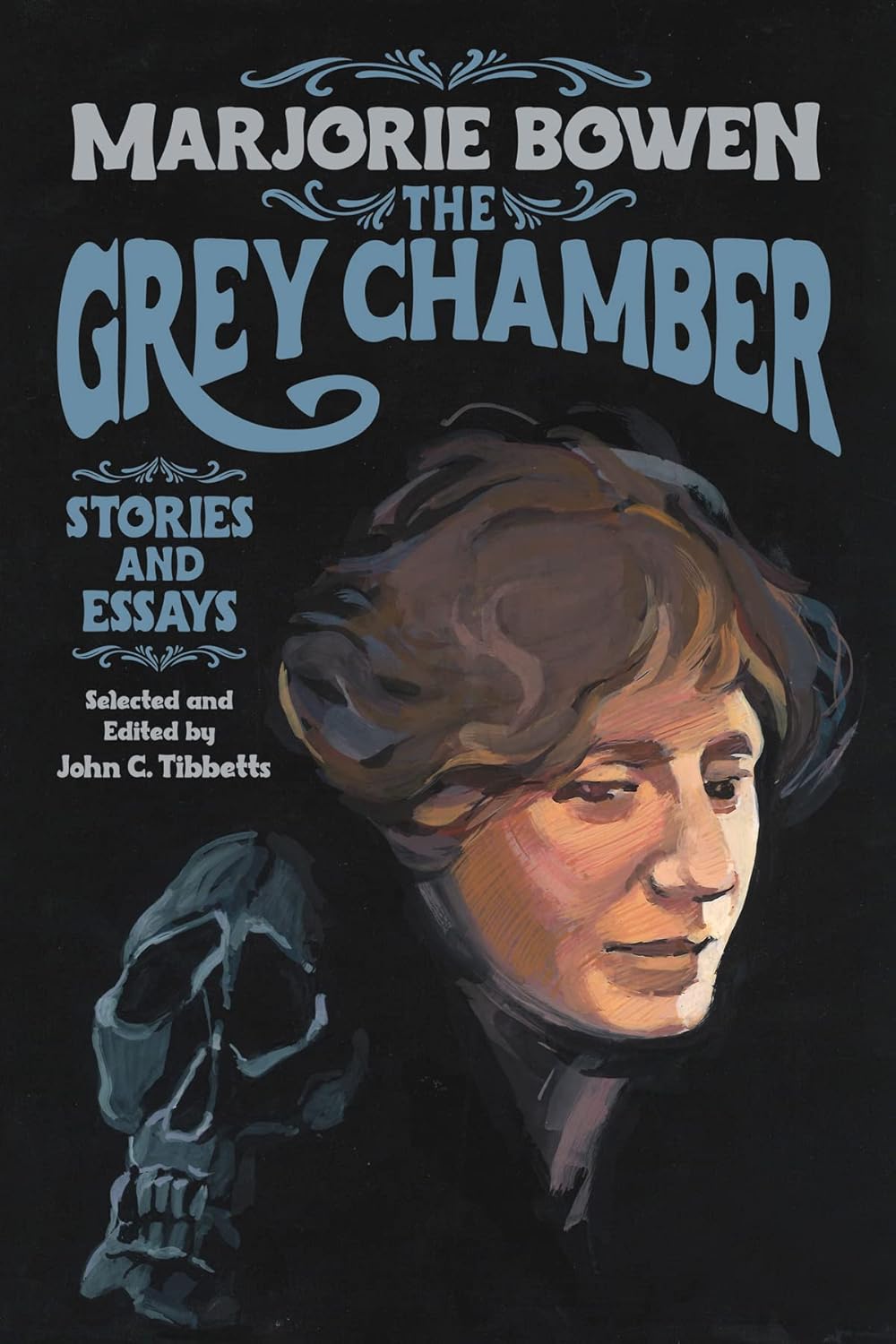
In Marjorie Bowen’s short story “A Famous Woman,” the protagonist, Tellow, grows fascinated with a statue of Gabrielle Buzot that he notices in a French village, but her history remains frustratingly unexplained to him. Tellow wonders, “surely among all those books there was some information about Gabrielle Buzot? A famous woman! What could she have been, what have accomplished to become famous? A beauty, a heroine, a great lover, a fearless patriot, a poetess?” (239). In a self-referential move, Margaret Gabrielle Vere Long—aka Marjorie Bowen—bestowed one of her names on a fictional woman whose claim to fame has been forgotten.

Like Gabrielle Buzot, Bowen’s accomplishments have been overlooked for decades, even though she published 150 novels and 200 short stories during a successful career spanning from 1906 to 1952. The result of five years of research into Bowen’s life, career, and oeuvre, John C. Tibbetts’s collection of her short stories and nonfiction, The Grey Chamber, is meant to demonstrate the versatility of her writing while still emphasizing her Weird Tales. Tibbetts has also released the first full-length scholarly study on Bowen, The Furies of Marjorie Bowen (2019), and the recent collection The Devil Snar’d: Novels, Appreciations, and Appendices (2023), which covers Bowen’s novels and critical reception. As the foremost expert on Bowen’s life and work, he builds on previous Bowen scholarship by Michael Sadleir, Edward Wagenknecht, and Jessica Amanda Salmonson in his collection. Overall, I think The Grey Chamber fulfills Tibbetts’s two goals of persuasively arguing for the recovery of Bowen’s literary works and exhibiting her writing in a variety of genres. Bowen’s modest description of her literary talents as “an inexhaustible fund of invention, a fluent and easy style, a certain gift for colour and drama, and such a passionate interest in certain periods of history that I was bound, in reproducing them, to give them a certain life” (307) holds true throughout the collection.

In the introduction, Tibbetts provides a biographical account of Bowen’s upbringing as an impoverished child with an unstable family life; despite these hardships, she succeeded through her persistence, hard work, and self-education. Bowen was a prolific author who wrote to support different family members at various times throughout her life: her abusive mother, sickly first husband, mysterious second husband, and three sons. Her works proved so popular that her historical fiction and true crime novels were adapted multiple times into well-regarded films. Along with outlining Bowen’s biography, the introduction offers literary background about her short stories and essays that Tibbetts repeats in the two forwards to each section, “Part One: Selected Short Stories” and “Part Two: Selected Essays.” Instead of repeating information found elsewhere, the introduction could have situated Bowen’s work and long career in the broader social, cultural, and historical contexts of her day. That being said, Tibbetts’s edition includes valuable paratextual materials such as a headnote before each nonfictional work, informative footnotes, and a timeline of Bowen’s life.

Part One features eighteen of Bowen’s short stories in different genres, among them ghost stories, contes cruels, social satires, historical fiction, and crime stories. Tibbetts deems her entire canon of short stories a “colossal achievement” that is “nothing less than Bowen’s own La Comédie Humaine. I can think of none of Bowen’s contemporaries—who can boast such an extensive, learned, and varied output” (32). His selections show the diversity of Bowen’s work across the aforementioned genres as well as the supernatural fiction for which she is remembered today. While the collection contains Bowen’s widely anthologized Weird Tales, I want to draw attention to her stories written in other genres. In the dreamlike fantasy “The Sign-Painter and the Crystal Fishes,” two eccentric characters are locked in mortal combat over a pair of magical fish. The dowager widower in “Madame Spitfire” evokes the ruthless women of Bowen’s true crime novels as she schemes to foil the romance between her late husband’s illegitimate daughter and her tenant. Finally, “An Initial Letter” displays Bowen’s gifts for writing historical fiction and comedy through its portrayal of members of John of Gaunt’s court (including Chaucer) as a cast of colorful medieval characters like those that inhabit the prologue of the Canterbury Tales.

Part Two presents Bowen’s essays on subjects such as Modernist women’s novels, Queen Elizabeth I’s astrologer John Dee, English royal coronations, William Hogarth’s artistry, Bowen’s unorthodox religious views, and her literary career. The essays nicely balance out the short stories in Part One by supplying her wide-ranging and unconventional opinions on different issues. The inclusion of both literary forms allows for a rich dialogue to emerge between Bowen’s views on topics such as the Weird and her representation of them in the short stories. For example, the autobiographical writings detail her childhood fear of ghosts, demons, and haunted houses, which likely explains why she often wrote about these entities in her later supernatural fiction. In her study of John Dee, Bowen observes that his communications with angels through a dubious medium, Edward Kelley, “might have been written today at any séance, save the language is more beautiful and the thought more noble than that usually employed or expressed by modern seekers after psychic knowledge” (324). Readers can trace how Bowen’s childhood fears and cultural movements such as Spiritualism shaped her Weird Tales such as “Scoured Silk,” “The Crown Plate Derby,” and “Florence Flannery.”

A comparison of the two sections uncovers a surprising contrast between the portrayal of female characters in Bowen’s short stories and her nonfictional reflections on being a woman writer in a male-dominated literary industry. This disparity suggests her complex attitude toward women’s rights: skepticism of political feminism’s effectiveness and yet sympathetic attunement to female oppression. In her memoir The Debate Continues (1939),Bowen recalls how her mother—a failed author—discouraged her from pursuing a literary career because Bowen’s first novelwas violent and tragic, which made it unsuitable for a female writer. Her stories “The World’s Gear,” “Scoured Silk,” “Madame Spitfire,” and “A Famous Woman” critique the social, financial, and professional inequities that women negotiated in the past and in Bowen’s day. The essay “Women in the Arts” celebrates Modernist women’s novels for “reveal[ing] with delicate precision the woman’s point of view, and analys[ing] with a tenderness, and yet a realism that no man could achieve, the woman’s heart, mind, and soul” (314-315). At the same time, Bowen claims that female authors such as Virginia Woolf, Dorothy Richardson, and Rosamond Lehmann lack the best male authors’ “genius.” She also insists that these authors should join the general Modernist revolt against human folly, rather than opposing the once-proclaimed wrongs of women” (316).

Instead of remaining obscure like Gabrielle Buzot’s history, Bowen’s life, short stories, and nonfiction writings, as carefully selected and contextualized by Tibbetts, evince that her work is worth rediscovering and will reward further scholarly inquiry. This collection does a superb job of recognizing her fame as a writer of Weird Tales and highlighting her achievements in other genres. It will make Bowen’s works easily accessible to students, general readers, and scholars so that they can learn more about this once “famous woman.”

Indu Ohri is a lecturer of Humanities in the College of General Studies at Boston University. Her current book project examines how the ghosts in women’s supernatural fiction reflect various unspeakable social concerns of late Victorian and early twentieth-century Britain. Her research and teaching interests include Victorian and Edwardian women’s ghost stories, Victorian authors of color across the British Empire, and the intersection between digital humanities and pedagogy. Her work appears in Victorians Institute Journal Digital AnnexPreternatureThe Wilkie Collins JournalVictorian Studies, and European Romantic Review

Resurrection: Comics in Post-Soviet Russia


Review of Resurrection: Comics in Post-Soviet Russia

Oskari Rantala

José Alaniz. Resurrection: Comics in Post-Soviet Russia. Ohio State UP, 2022. Studies in Comics and Cartoons. Ebook. 248 pg. $37.95. ISBN: 9780814281925.

.

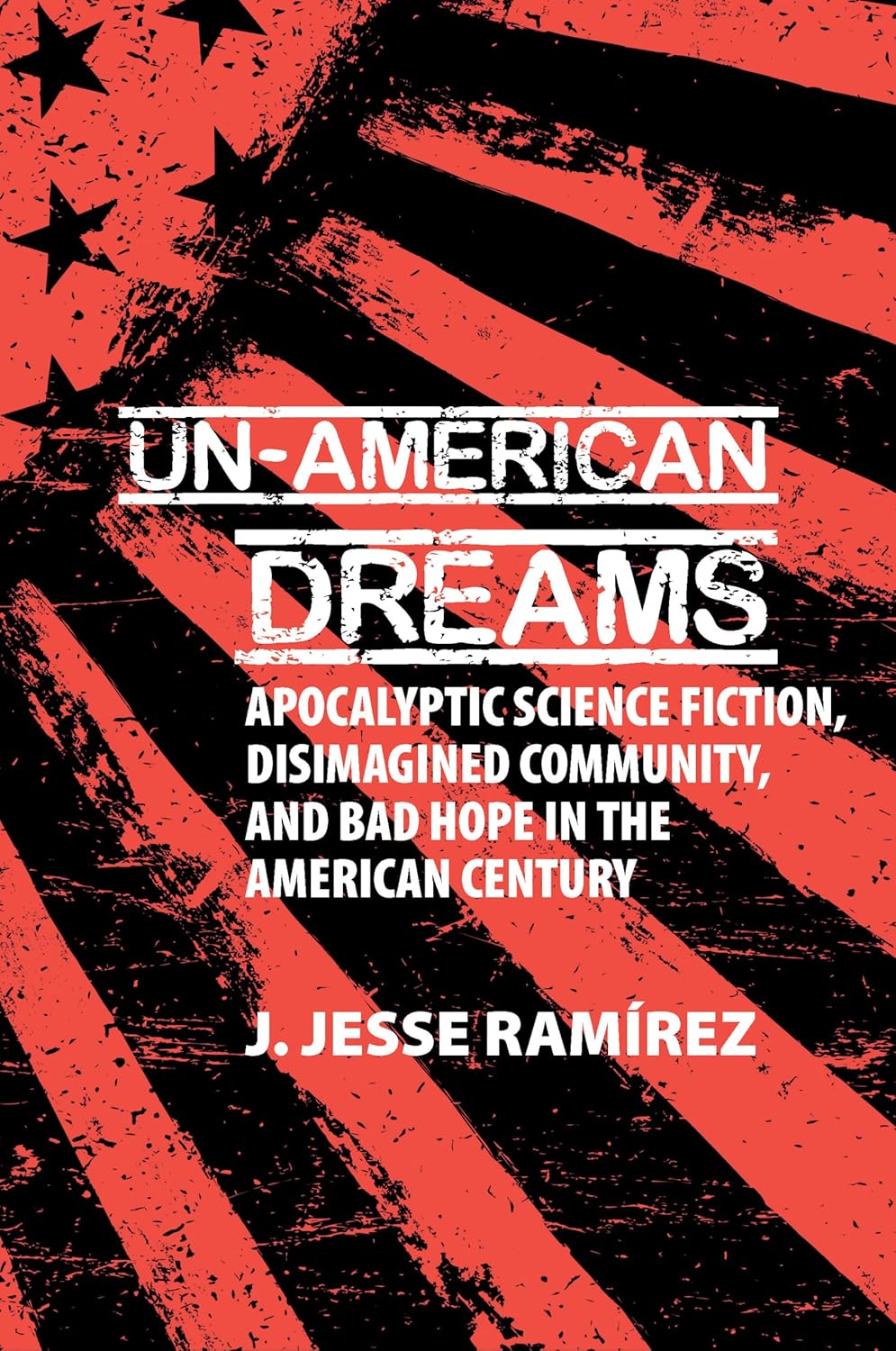
In his conclusion to Resurrection: Comics in Post-Soviet Russia, José Alaniz cites Alexander Kunin, the director of Moscow’s Center for Comics and Visual Culture. “We live in Russia,” Kunin says. “Here you never know what’s going to happen tomorrow” (210). Indeed, the same month Resurrection came out, a Russian tank column was approaching Ukraine’s capital, and young educated Russians were scrambling to get out of their home country.

The cover image of Resurrection, a collage artwork of the invasion’s architect, became accidentally more poignant than planned. In one of the panels, Putin stares coldy at the reader in front of Kremlin. In another one, he is clad in nationalistic white-blue-red superhero garb complete with the double-headed eagle—the imperial colors and emblems that replaced the communist ones in post-Soviet Russia. Next, we see Putin’s face covered by a colorful balaclava in the style of Pussy Riot and protesters marching with rainbow flags. Since then, demonstrations have been crushed and Russian courts have declared rainbow flags symbols of “an extremist organization”.

Putin is a good choice for the simple reason that he personifies the profound changes which Russia and Russian society have undergone in the past twenty years. Before his reign, there was no viable comics industry in a semi-developed country with close to 150 million literate people. Granted, comics were not a special case in the chaotic 1990s, and Russia lacked quite a few other viable industries as well. A number of interesting and innovative comics were being produced, but publishing them and making a living out of it was a near impossibility. This is where Alaniz’s last book on the subject, Komiks: Comic Art in Russia (2010), ended. With Resurrection, he takes the reader through the three post-Soviet decades of Russian comics.

He takes a closer look especially at Bubble, a company which succeeded in launching a profitable Russian mainstream comics line with a western business model: superpowered action characters sharing the same universe, multi-title crossover events, basing creative decisions on sales figures, and ultimately aiming to develop their properties for film deals. Alaniz offers an intriguing peek at the dynamics of the Russian comics field as he provides room for both the Bubble founder Artyom Gabrelyanov as well as the company’s critics.

Between the camps of art/indie and mainstream/superhero comics, there are some tensions which seem ultimately not very different than what is found in western comics circles, even though the debates might seem more heated in Russia. A similar point could be raised about the infamous Medinsky quote above. Comments along the same lines were common in the first half of the 20th century when comics caused moral panic on both sides of the Atlantic. There seems to be something universal in the ways in which literary cultures adopt visual narratives. For many readers, Russian society might seem quite alien, but on closer inspection the cultural currents are not that unfamiliar.

Resurrection is a scholarly but theory-light book. Most of it is perhaps best categorized as cultural history, but the concluding chapters on masculinity in superhero comics and representations of disability deal more with comics analysis. Both are interesting takes on multifaceted and diverse comics in a culture that is hyper-masculine and dominated by strong and capable men. At the same time, there are disabled comics artist producing innovative works about their own experiences, superhero Putin parodies, and mainstream comics that are almost impossible to distinguish from what is published for the American market.

As far as the cultural history side is concerned, Alaniz at times brings up bits of information that are not something that a foreign layperson would consider very significant: a letter published in a newspapers or something that one of his friends active in the comics scene has told him. As there are over 20,000 newspapers in Russia, what does it actually tell us if one of them publishes a letter holding some kind of a position on comics? My first reaction as a reader is “not very much,” and I would have appreciated a bit more convincing, even though there’s nothing suspect about the main arguments Alaniz puts forward. It is one of the strengths of the book that Alaniz has access to people who have had a major role in the Russian comics scene. In some instances, it is obvious that they are personal friends of the author, and another writer could have discussed their opinions through a more critical lens.

Alaniz places the moment when comics began “to matter” in Russia near the Victory Day celebrations on 2015 when it turned out that some bookstores had removed Maus from their shelves due to the swastika on the cover of Art Spiegelman’s anti-fascist masterpiece. According to Alaniz, comics had “earned the right to be banned” (xvi), even though it was not so much a case of censorship as an outright silly decision by bookstore staff. However, the incident was good for the sales and publicity of Maus—perhaps not what one would expect to happen in an authoritarian country.

Alaniz does not discuss to what extent the emergence of a comics industry and more organized comics fandom is connected to the modern nerd culture in general. Science fiction, urban fantasy, postapocalyptic narratives, and video games seem to be major cultural forces in Russia, judging by the success of authors such as Dmitry Glukhovsky and Sergei Lukyanenko or game franchises S.T.A.L.K.E.R. and Metro 2033 which have expanded into other media as well. Should Russian comics be thought of as a part this wider culture? That is a question that would have interested many speculative fiction scholars.

Oskari Rantala is working on their doctoral thesis in the University of Jyväskylä, Finland, researching medium-specific narrative strategies and medial self-awareness in the comics of Alan Moore. Their research interests include medium-specificity, (inter)mediality, comics and speculative fiction. Currently, Rantala is also the chair of Finfar, The Finnish Society for Science Fiction and Fantasy Research.

The Lion’s Country: C. S. Lewis’s Theory of the Real


Review of The Lion’s Country: C. S. Lewis’s Theory of the Real

James Hamby

Charlie W. Starr. The Lion’s Country: C. S. Lewis’s Theory of the Real. Kent State UP, 2022. Paperback. 160 pg. $18.95. ISBN 9781606354537.

.

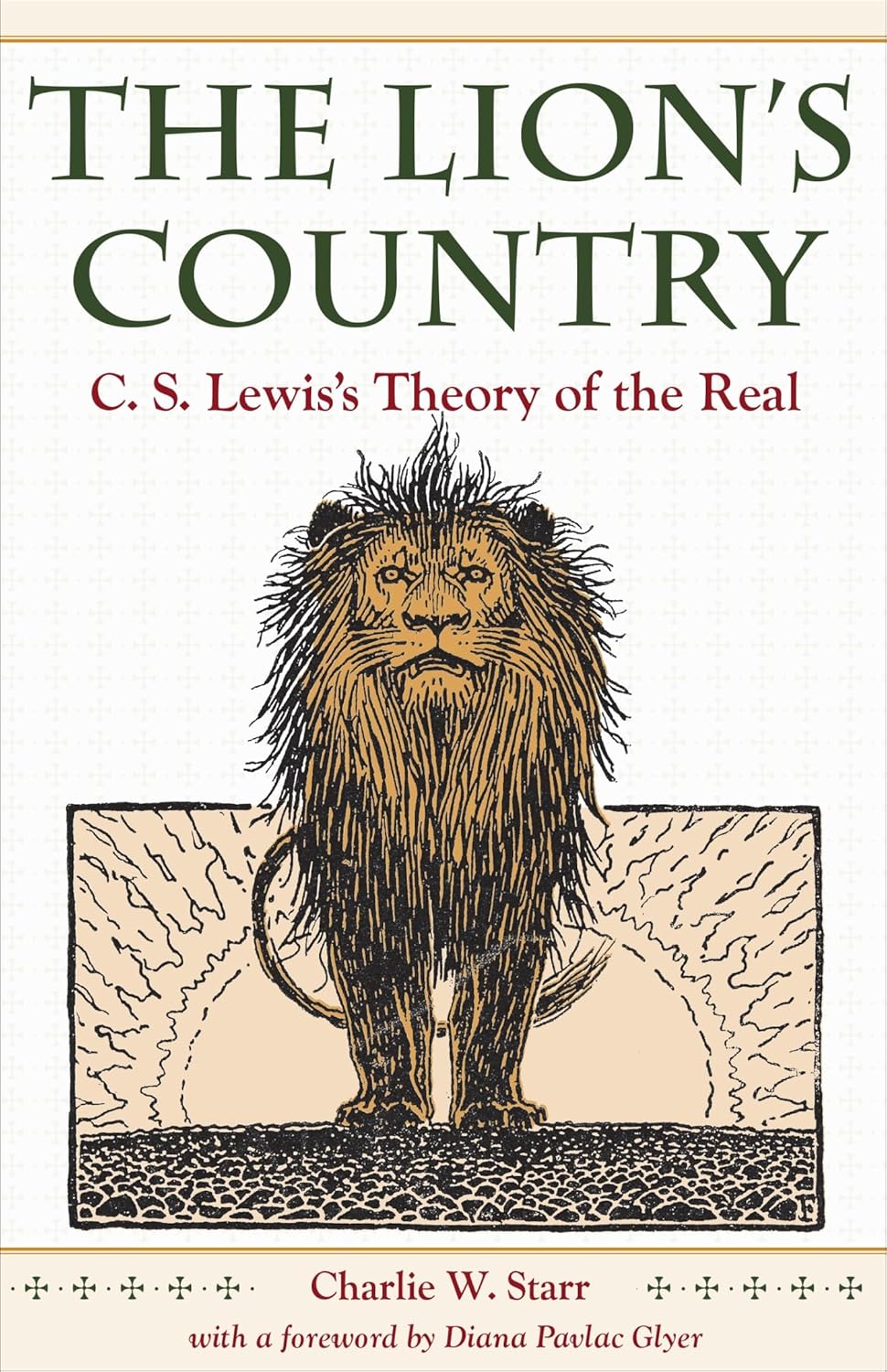
The works of C. S. Lewis are often discussed through the lens of Christian apologetics, but Lewis was influenced by more than just theology. In his study The Lion’s Country: C. S. Lewis’s Theory of the Real, Charles W. Starr examines the philosophical influences, particularlyIdealism, that Lewis incorporated into his fiction. Starr traces Lewis’s development from a materialist atheist to an idealist theist and finally to an orthodox Christian. Central to both this progression and to Lewis’s fiction is the question of what constitutes reality. The relationship between God and humanity, the meaning of experiences in the material world, and the nature of the afterlife illustrate Lewis’s theories of the real. Starr’s assessments offer a nuanced understanding of the progression of Lewis’s thought through the decades of his writing career.

The book is organized into ten chapters, each focusing on a particular component of Lewis’s concept of the real. Chapters include subjects such as desire, mystery, and transposition,  amongst other topics, and each chapter touches in some way on the development of Lewis’s thought. The book concludes with a never-before published manuscript by Lewis, a collection of notes for a book that was never completed entitled “Prayer Manuscript” that describes Lewis’s vision of what it is like for humans to gradually experience reality.

It is a commonplace in Lewis biographies to note that Lewis was an atheist as a young man, but Starr focuses more on Lewis’s materialism than his atheism at this point in his life. Starr observes that “Lewis the atheist makes himself visible in his earliest use of the term fact. In 1916, the young C. S. Lewis had been an atheist for several years and had become a demythologizer” (28). The word “fact,” Starr argues, is of central importance to Lewis, because it is synonymous with “reality” (23). Limiting his concept of reality to mere fact, however, was not enough for Lewis. Starr says that Lewis’s longing for something he could not quite understand made him seek something beyond fact: truth. This led to Lewis’s turn towards Idealism and theism (29). Convinced that Idealism would explain his longings, Lewis began to believe there was something beyond the material world. Starr says, “The move from Atheism to Idealism was no less than a recognition of the existence of spiritual reality—something really there that transcended the physical” (29). Yet, as Starr points out, what Lewis ultimately rejected about this viewpoint was his belief that all matter is evil. Once Lewis converted to Christianity, he saw a connection between the spiritual and the physical that suggested not only that matter was not evil, as he had previously thought, but that there was a hierarchy of reality. Starr suggests that “Lewis abandoned his own brand of idealism (which saw spirit as good and matter as evil) when he became a theist, thus adopting the third view “that there is a reality beyond nature” (87). Starr also notes Lewis’s change in thought concerning materialism when he says, “This younger Lewis is very different from the Christian convert who described transcendent reality as the most concrete existence there is. Lewis’s previous philosophical war with the flesh was not a part of his Christian way of thinking” (109).

One of the most important concepts in Lewis’s beliefs is the notion that there are different levels of reality. Starr points out this concept in his analysis of The Great Divorce. In this novel, the closer one gets to heaven, the more “real” things become. Conversely, as Starr explains, “Hell (the farthest place from God) is smaller than a pebble on Earth and smaller than an atom in heaven” (121). In contrast to the beliefs of his youth, the Christian supernaturalist Lewis sees the material world as the lowest part of a progression that eventually leads to the ultimate reality, God. Starr explains that in this core image of Lewis’s belief system, “heaven and heavenly beings are more solid than are we and the Earth we live on. We are ghosts and shadows and our world but a cheap copy of the heavenly one to come, like a landscape painting compared to the real place” (121). These same ideas may be seen in The Last Battle when the heroes of Narnia, after their deaths, keep going further up and further in to Narnia, thus discovering different layers of that magical land, each more real than the last. Starr comments that “each reality is hierarchically more real, somehow larger than the ones without” (89).

Using these biographical and philosophical backdrops, Starr discusses Lewis’s works. He typically comments on several of Lewis’s works in each chapter, and the books he most frequently references include The Silver Chair, The Last Battle, Mere Christianity, The Problem of Pain, A Grief Observed, The Screwtape Letters, The Great Divorce, and Till We Have Faces. Starr’s engagement with these texts is thoughtful and engaging, and his observations would certainly be helpful for both scholars and general readers. Starr’s tone wavers a bit between academic and conversational, and in some places he drops scholarly objectivism and speaks instead from a position of faith, making the book have more the feel of a popular religious book than an academic work. And though Starr clearly demonstrates his familiarity with both philosophy and Lewis scholarship, more engagement with both of these fields would have lent more weight to his discussion of Lewis’s texts. Incorporating more material on Idealist philosophers, particularly those who influenced Lewis’s thought as a young man, would have been enlightening. Furthermore, placing Lewis in conversation with these theorists would have blunted criticism that is sometimes made against Inkling scholarship that the field is too insular and does not connect the Inklings to other movements or authors. Additionally, the scholarship on Lewis that Starr does cite, while useful, is often too briefly considered and feels more like name-checking than genuine engagement. Since this is a relatively brief volume, adding more secondary sources would have fleshed out Starr’s discussion and made important connections.

This work is nevertheless a valuable contribution to Lewis studies. With engaging prose, Starr ably explains the difficult philosophical concepts behind Lewis’s fiction. Both scholars and general readers interested in Lewis should find this book appealing. This volume not only provides insight into Lewis’s world-building, but it also serves as a wonderful demonstration of how fantasy can be used to express the complexity of human experience.

James Hamby is the Associate Director of the Writing Center at Middle Tennessee State University, where he also teaches courses on composition and literature, including Victorian Science Fiction, Fantasy, and Fairy Tale. His dissertation, David Copperfield: Victorian Hero, explores how Charles Dickens created a new hero for the Victorian Age by reconceiving his own life through the prism of myths and fairy tales.

Robert Holdstock’s Mythago Wood


Review of Robert Holdstock’s Mythago Wood

Elizabeth Heckendorn Cook

Paul Kincaid. Robert Holdstock’s Mythago Wood. Palgrave, 2022. Palgrave Science Fiction and Fantasy: A New Canon. Ebook. 91 pg. $34.99. E-ISSN 2662-8570. ISBN 9783031103742.

I began drafting this review from a treefarm in the Salish Sea that used to be part of a vast swath of Pacific Coast temperate rain forest. Like much of the Pacific Northwest, the land was logged over at the beginning of the last century, grazed for several decades, then left alone aside from occasional selective harvesting. It’s now an expanse of same-aged 90-to-120-foot-high conifers, traversed by footpaths and a few dirt roads, with widely spaced, even-sized treeboles; light and rain filter down to low brush at the forest floor.

How different from Robert Holdstock’s impenetrably dense, insanely haunted, and topologically and chronotopically esheresque Ryhope Wood, composed of “primeval” woodland, “untouched forest from a time when all of the country was covered with deciduous forests of oak and ash and elder and rowan and hawthorn” at the end of the last ice age.1 Plugging into the fantasy topos of an unknown space that is impossibly bigger inside than outside, Ryhope Wood is also, as John Clute memorably termed it, an “abyssal chthonic resonator”: it generates—in psychic collaboration with the individuals who enter it—avatars of basic story patterns and experiences that are, in Jungian terms, universal among human beings—among which is surely the attraction to and fear of forests.2 Though my own experience of woodland, probably like that of many of Holdstock’s readers, is no more chthonic than the tree farm I’ve just described, his vision of a mysterious, unmappable, actively rebarbative wildwood in the heart of darkest Herefordshire is compelling.

Paul Kincaid has produced a concise but valuable companion to Mythago Wood (1984), the prize-winning first volume of the Mythago Wood series, with an introduction, three thematic chapters, and very brief coda. Given the dizzyingly nonlinear and recursive temporal structures of the narrative (not to mention how these are repeated and complicated in four subsequent novels), rather than attempting to offer a definitive interpretation or universal theory of Holdstock’s work(s), Kincaid sets himself an appropriately circumscribed goal: to suggest “something of the originality, the importance, and the downright strangeness” of the text.3 The novel’s complexities, recursivities, and echoic intertexts are derived from the premise that basic story patterns are immanent in every human consciousness; in the psycho-generative spaces of Ryhope Wood they play out differently for each traveler based on individual cultural contexts and memories, but they are recognizably familiar plots driven by such figures as the absent father, the quarreling siblings, the rescued child, the supernatural hunters, the hero’s journey to restore the Land.

Kincaid documents Mythago Wood’s impact and influence on fantasy-writing in the last decades of the twentieth century, noting that itwon both the British Science Fiction Award and the World Fantasy award and “has consistently been named as one of the best and most important works of fantasy from the twentieth century” (4). In 2012 the British Fantasy Society renamed their top prize the Robert Holdstock Award, in recognition, Kincaid asserts, of his “entirely new way of writing fantasy” (4). What’s new is Holdstock’s play with narrative temporality. Having explored time travel in earlier science-fiction novels, Holdstock brought to the fantasy genre a more complex model of narrative temporality that changed the kinds of stories it could engage. Before Holdstock, fantasy was associated with the ‘there and back again’ structure of the quest, in which time and the narrative move forward to the resolution of the hero’s journey:

… the structure of time commonly plays little or no part … : past and present are consistent, practically static. The idea that time might be layered, that the same myths might take radically different shapes, that the past might interpenetrate the present and the present might interpenetrate the past, has no part to play in stories of the rightful heir being restored and evil being defeated. (3)

With a new level of temporal complexity, Kincaid claims, “Mythago Wood remakes fantasy from the perspective of science fiction” (3) and effects “a reimagining of the whole fantasy landscape” (4).4 The impacts for both plot and character are significant: in Holdstock’s novel, “there is no return from [the] quest, the land is not healed, the hero is not restored,” and “there is no true hero just as there is no villain”; each character “is transformed utterly, and so everyone becomes both hero and villain of their own story, and neither” (4). In consequence, the narrative remains endlessly open: “what healing there is, is not the end of this story but rather the beginning of another story, a story which also cannot be ended” (8). The focus of the novel—as the reader gradually realizes—is the power and agency of the Wood as it collaborates with the traveler in shaping the story and transforming the teller. The Wood is the figure and engine of transformation.I offer here a brief summary of the novel to confirm Kincaid’s assessment of the work’s radical weirdness.

Part I: the narrator, Steven, returns from WWII service to his family’s home at the edge of Ryhope Wood. His distant, preoccupied father has died and his older brother Christian has developed a weird relationship to the Wood, which has never been surveyed or mapped. Christian has been pursuing their father’s research into the wood’s capacities to generate avatars of folklore and myths: the Night Hunters, Robin Hood, the warrior woman, Arthur, the shaman. Christian explains the basic premise in a useful expositional brain-dump:

“The old man believed that all life is surrounded by an energetic aura – you can see the human aura as a faint flow in certain light. In these ancient woodland, primary woodlands, the combined aura forms something far more powerful, a sort of creative field that can interact with our unconscious. And it’s in the unconscious that we carry what he calls the pre-mythago – that’s myth imago, the image of the idealized form of a myth creature. … The form of the idealized myth, the hero figure, alters with cultural changes, assuming the identity and technology of the time.” (original emphasis; 53-54)

The mythago emerges where a culture is under threat, fading when the hero figure is no longer needed but remaining “in our collective unconscious, [to be] transmitted through the generations” (53-54). Seeking to penetrate the Wood’s mysterious heart, the brothers encounter a huge boar/man in the Wood who clearly intends to kill them; Steven realizes this is, somehow, both a prehistoric demiurge and their father.

In Part II, Christian leaves to explore the Wood. Steven studies his father’s notes and maps and hires a fellow vet to attempt an aerial survey of the wood (blocked by bizarre winds). The Wood begins to grow into the house clearing, as if “a pseudopod of woodland” was “trying to drag the house itself into the aura of the main body” (95).5 Steven receives strange emissaries from the wood, including the avatar of Guiwenneth, a young red-haired woman-warrior who was raised by the Night Hunters.6 Different avatars of Guiwenneth had had relationships with Steven’s father and older brother, and now Christian re-emerges from the wood, almost entirely unrecognizable in his transformation into a violent warrior leader who appears to be decades older. His fighters seize Guiwenneth and disappear.

In Part III, Steven and his pilot friend plunge into the Wood to trace Christian and recover Guiwenneth. Christian had once imagined that if he could make it to the ‘heartwood,’ the icebound area behind the wall of fire called Lavondyss—the place of origin and possibly rebirth for the mythagos—he could emerge on its other side and return to ordinary life. But as Steven moves deeper into the Wood, he realizes from talking with different people they encounter that he and his brother are now part of a story that they don’t control—the story of a Kinsman who must kill his rogue relative, the Outsider destroying the land. As Kincaid writes, he must “abandon any hope of shaping his own story” (12): “there is no real world for [the brothers] to return to; they are both mythagos now, and mythagos cannot leave the wood” (13). In the final confrontation of the brothers, Steven believes he must kill Christian, according to the myth they are enacting, but Christian asks that they suspend the clash. He will use a shamanic ritual to pass through the fire and, he hopes. return to his previous life. Intending to send him a talisman for this journey home, Steven knocks him into the fire where, we infer, he dies. Guiwenneth arrives at the stone that marks her father’s grave, but she has been mortally wounded and dies in Steven’s arms. The father-monster re-appears and seems to tell Steven that Guiwenneth will return, before carrying her corpse into the fire. Two story-patterns are completed here—that of Cain and Abel and that of the kidnapped child—but the novel ends in a suspension: Steven settles in by the tomb of Guiwenneth’s father to await her return.

Kincaid’s single-word chapter titles, “War,” “Time,” and “Myth”, suggest his broadly thematic approach. “War” briefly discusses the WWI service of Holdstock’s grandfather, then turns to explore what it means that conflict is how mythagos are generated. George’s journal asserts that mythagos are formed at the intersections of conflicts between the cultures “of the invader, and the invaded”: “mythagos grow from the power of hate, and fear” (MW 51). Kinkaid concurs and points out the narrative implications: since mythagos “emerge from war and exist for no other reason than war …. (t)he hero figure, whatever hero might mean in this context, is a personification of the hate and fear of an invasion, and the cruelty of those invading” (25). On his reading, the end of the novel resolves the cycle of violence: “it is a novel in which war is what shapes and drives everything, but it is a novel in which peace and reconciliation is the only possible outcome” (30). Yet the end of the conflict does not allow Steven, any more than Christian, the ‘back again’ of the fantasy quest: instead, he will spend ‘the long years to come’ in a nearby village of “Neolithic peoples,” waiting for Guiwenneth to return.

In “Time,” Kincaid links Mythago Wood’s temporality to Holdstock’s earlier science fiction novels, which explored the fluidity and irregularity of time: “Time is, in a sense, the only continuing character in Holdstock’s work, yet it is never consistent” (34). Kincaid notes that the Wood is “not just … a confusion of all time; it is actively antagonistic to time as it is measured outside the wood” (41): Harry’s watch breaks when he enters the Wood; a reverse Rip Van Winkle effect ages Christian by decades more than his brother. Even as Steven encounters a kind of historical pageant of people who suggest the prehistoric past, Saxon England, the Middle Ages and Civil Wars, time is shown to be “a psychological rather than an ontological reality, working its changes and being changed by the imagination, by the very human force of story” (37). Kincaid borrows Stefan Ekman’s coinage “mythotopes” to describe the different time-space zones associated with different mythagos, and some readers have used these to create speculative maps of the wood, but the zones are unfixed and permeable, and the figures associated with them can turn up in other places and in other times.7 Poignantly, Christian imagines that if he can traverse the heartwood, he might be able to recover the time he has lost and the damage that has been done to his body, but the novel doesn’t confirm this possibility; nor do we find out whether, as the father-monster promises, Guiwenneth eventually returns to Steven. Carefully gathering up scattered narrative threads, Kincaid traces out the brain-bending temporal paradox of Mythago Wood: the prehistoric people tell Steven stories of the earliest mythagos, but these stories reflect the specific manifestations of the avatars that have been shaped by his own family’s engagement with the Wood. So which came first? Holdstock refuses to answer.
In “Myth,” Kincaid connects the “science fantasy” aspects of Mythago Wood with the cultural politics of early-twentieth-century (pseudo-)sciences. George’s journals employ a metabolic vocabulary of energies, vibrations, ley matrices, and auras to be mapped and measured. Alfred Watkins (1855-1935), the ley-line hunter, visits to show George his maps of the invisible tracks connecting spiritual power sites.8 The device George and his Oxford research pal create to boost his mythago-projecting abilities is “a sort of electrical bridge which seems to fuse elements from each half of the brain” (MW 55), involving a “curious” mask and “electric gadgetry” (MW 81) that Steven describes as “paraphernalia out of Frankenstein” (MW 83). Through these allusions, George is “plug[ged] directly into the conservative network of interwar archaeologists and folklorists” who longed to recover a glamorous national deep past (53). But Kincaid emphasizes that far from re-creating an English Golden Age of chivalrous knights and Merry Men, Mythago Wood “is deliberately designed to counter the familiar nationalist story” by highlighting the brutality and violence of the past and the indifference of Nature (55): it’s cold, dark, and nasty in there.

What’s more, once you go in, you can never come out. Steven’s friend Harry returns to the chicken/egg question: “If we do become legends to the various historical peoples scattered throughout the realm … [w]ill we somehow have become a real part of history? Will the real world have distorted talks of Steven and myself, and our quest to avenge the Outsider’s abduction?” (MW 225). As Kincaid points out, there can never be an answer to Harry’s question, because none of the characters ever return to life outside the wood. The implications for questions of agency and ethical responsibility are dissolved, not resolved, in the hallucinatory efflorescence of the narrative: although Kincaid asserts that Steven’s decision to wait for his lover’s return, “to become a part of the story of the valley ‘where the girl came back through the fire’” (67), is an act of free will, it’s hard to see how this decision is ontologically or ethically distinct from any actions he has taken since entering the Wood.

Kincaid’s exploration of Mythago Wood’s radical paradoxes culminates with his salute to Donald Morse’s proposition that Ryhope Wood, like the planet of Ursula K. Le Guin’s “Vaster than Empires” or our current nightmares about AI, is a self-aware agential entity—a “dream creature [that can] dream other creatures into being” (71).9 Turning the screw of indeterminacy to its extremest tension, Kincaid even suggests that in returning again and again to the stories of Mythago Wood, Holdstock as author was “as trapped … as George and Christian and Steven.” However, this “productive entrapment” (71) is what enables the series’ “startling intellectual examination of the very nature of story” (78). If after reading Holdstock via Kinkaid you are not convinced that a clutch of archetypes exists that all humans can recognize, at least it will mean that you will never see that grove of trees in your local park in quite the same way again.


NOTES

  1. Holdstock, Mythago Wood (Orb Edition, 1984), p. 27. Further page references are given in the text of the review.
  2. Clute, John. Look at the Evidence: Essays & Reviews (Liverpool University Press, 1995), p. 111.
  3. Kincaid, Robert Holdstock’s Mythago Wood, p. 13. Further page references are given in the text of the review.
  4. Holdstock’s science-fiction novel Where Time Winds Blow was published in 1981, the same year as the prize-winning novella “Mythago Wood,” which forms Part I of the novel Mythago Wood (1984).
  5. This detail is one of the reasons Farah Mendelson classifies MW as an Intrusion Fantasy rather than a Portal Fantasy in her taxonomy of fantasy types: yes, the Wood is an entrance into a mystery zone, but the Wood rather than the humans controls what happens: “In the portal fantasy the protagonist retains the upper hand over the otherworld. … In this novel, all the power is with the wood. It reaches out, disrupts; when it does draw the characters in, it is for purposes of its own” (Rhetorics of Fantasy, Wesleyan UP, 2008, p. 154). While MW may seem to be “resolving into a portal fantasy in the last third” of the novel, even then Steven and Christian are never the heroes: “[t]he protagonists and the reader are nakedly at the mercy of the intrusion, not in notional command of the adventure” (p. 156).
  6. As readers hear more about this attractive avatar with superb weapon skills, they may be reminded of Terry Pratchett’s parodies of 1980s sword-and-cape fantasy warrior women (Herrena the Henna-Haired Harridan; Conina, daughter of Cohen the Barbarian, etc.). In Lavondyss: Journey to an Unknown Region (1988), the second in the Mythago Woods series, Holdstock imagines a female character encountering Ryhope Wood.
  7. Ekman, Stefan. “Exploring the Habitats of Myths: the Spatiotemporal Structure of Ryhope Wood.” In The Mythic Fantasy of Robert Holdstock: Critical Essays on the Fiction (eds D. E. Morse & K. Matolcsy), McFarland, 2011, pp. 46-65.
  8. Watkins was a lifelong resident of Herefordshire.
  9. Morse, Donald E. “Introduction: Mythago Wood – ‘A Source of Visions and Adventure’” in The Mythic Fantasy of Robert Holdstock: Critical Essays on the Fiction (eds D. E. Morse and K. Matolcsy), McFarland, 2011, pp. 3-11.

Elizabeth Heckendorn Cook: I write about environmental ethics and early modern fictions exploring human / arboreal relations, and I teach courses on ecofictions and eighteenth-century literature in the English Department at the University of California, Santa Barbara. My article on Holdstock’s Lavondyss and Han Kang’s The Vegetarian, “Alternative Parturitions: Plant-Thinking and Human-Arboreal Assemblages in Holdstock and Han,” appears in Plants in Science Fiction: Speculative Vegetation, eds. Katherine E. Bishop, David Higgins, and Jerry Määttä (University of Wales Press, 2020). I visit the Salish Sea area whenever I can.

Life, Rescaled: The Biological Imagination in 21st-Century Literature and Performance


Review of Life, Rescaled: The Biological Imagination in 21st-Century Literature and Performance

Zak Breckenridge

Liliane Campos and Pierre-Louis Patoine, editors. Life, Rescaled: The Biological Imagination in 21st-Century Literature and Performance. OpenBook Publishers, 2022. Ebook. 418 pg. Open Access. ISBN 9781800647510.  Hardback. $52.95. ISBN 9781800647503.

The pervasive crises of our current historical moment unfold across many scales. Think of the two most prominent global crises of recent years: climate change and the COVID-19 pandemic. Both are difficult to understand and respond to, in part, because of their scalar complexity. On the one hand, they are global in scope, crossing national and ecological barriers to touch the lives of all humans (and many non-humans). On the other hand, these massive crises are driven by physical, chemical, and biological processes below the threshold of perception: the release of carbon molecules and other pollutants in the case of climate change, and the spread of viral microorganisms in the case of COVID-19. A new collection of scholarly essays—Life, Rescaled: The Biological Imagination in 21st-Century Literature and Performance, edited by Liliane Campos and Pierre-Louis Patoine—takes an expansive, multi-disciplinary, and multi-genre approach to the scalar dislocations of the present. Made up of contributions from an international cohort of European and North American scholars, the collection examines the complex interchanges between scientific knowledge and cultural production in the effort to represent contemporary human and nonhuman life across a range of aesthetic forms. The essays place mycology, ecology, epidemiology, neurology, demography, and geology in dialogue with novels, comics, and performances in order to grapple with the epistemological and ethical challenges of the Anthropocene. The climate crisis and the COVID-19 pandemic provide the collection’s organizing context; together, the essays inquire into the representational strategies we need in a rapidly changing world of many complex scales.

Life, Rescaled intervenes, broadly, in scholarly conversations about the relationship between scientific knowledge and literary representation. Previous science and literature scholarship has examined the rich interchanges between biology and literature in the Romantic and Victorian periods,1 but Campos and Patoine’s collection extends these investigations to the contemporary moment. The editors note in their introduction that biology’s central narrative and imaginary tropes have shifted in recent decades; the evolutionary tree and the double-helix of DNA, which dominated the twentieth-century biological imagination, have been displaced by the “wood-wide web” of mycelial networks and the spiky COVID-19 molecule, to name a few prominent examples. What representational strategies, the contributors ask, have artists in a range of media developed to grapple with the new images and narratives furnished by recent science? However, Campos and Patoine caution us against the tendency to assume that influence flows only in one direction, from sciences to the arts. Drawing from N. Katherine Hayles, they encourage us to attend to the “cross-currents” that move between science and artistic practice. Rather than tracing how science influences art, the collection explores “interdiscursivity and the cross-fertilizing of imaginaries between contemporary artistic work, popularizations of the life sciences, and philosophy” (5). Culture responds to changes in science and science is shaped, in part, by cultural concerns.

 “Science fiction” is therefore not a central term in Life, Rescaled, although several of the essays analyze works with “speculative” elements. Derek Woods reads current representations of fungal life through Jeff VanderMeer’s Annihilation (2014); Pieter Vermeulen examines the current “population unconscious” through Emily St. John Mandel’s Station Eleven (2014); and Rishi Goyal considers representations of empty pandemic cities through Ling Ma’s Severance (2018). The editors make it clear that the contributions do not privilege any particular genre; they do “not find one genre more suited to multi-scalar aesthetics than another. Rather than which genre, the key question is which forms may best attend to heterogeneous scales of life…and their disparate temporal scales” (21). Each essay attends to a particular interface between aesthetic form and biological scale. While some of the artworks under consideration speculate about future or alternative worlds, the collection’s unifying concern is faithful representation of the empirical world’s complexity. The works tend to be experimental, or to inhabit the limits and boundaries of established genres, as they grapple with the scalar conundrums of our crisis-ridden world.

The collection’s greatest strength is the range of geographies, genres, media, and scientific fields with which it engages. While no one reader will be riveted by every single essay, it has something to offer any scholar with even a passing interest in the environmental, medical, or scientific humanities. Life, Rescaled may be of the most interest to teachers because it gathers a wide range of texts, from speculative novels to popular-science comics and experimental performances. Collectively, the essays provide an illuminating cross-section of ecologically engaged contemporary cultural production in many genres and from many countries. The strongest essays—such as Woods’s analysis of fungi and Annihilation and Goyal’s exploration of pandemics through Severance—bring together pressing scientific problems and nuanced textual interpretations in ways that illuminate ongoing cultural conversations. The collection’s weaker entries, in contrast, can feel like catalogs of relevant artworks, such that analysis gets buried in summary. These essays may offer inspiration for a teacher constructing a syllabus, but they are thin on insight and interpretation. Most readers will probably find themselves hopping between the essays that interest them most, rather than reading the book from start to finish. Despite its few weak points, Life, Rescaled showcases the wide range of aesthetic responses to climate change, the COVID-19 pandemic, and recent scientific innovations. It will expand any reader’s range of reference.


NOTES

  1. See, for instance, Denise Gigante, Life: Organic Form and Romanticism and Gillian Beer, Darwin’s Plots: Evolutionary Narrative in Darwin, George Eliot, and Nineteenth-Century Fiction.

Zak Breckenridge is a Ph.D. candidate in English at the University of Southern California in Los Angeles, where he teaches in the Thematic Option Honors Program. His dissertation project approaches the twentieth-century environmental movement through the history of science and the sociology of literature. His other research interests include documentary film, science fiction, and the history of materialist thought. His writing has previously appeared in The Common, Colloquium Magazine, and The Salt Lake Tribune.

Review of Alfred Bester’s The Stars My Destination: A Critical Companion


Review of Alfred Bester’s The Stars My Destination: A Critical Companion

Michael Pitts

D. Harlan Wilson. Alfred Bester’s The Stars My Destination: A Critical Companion. Palgrave Macmillan, 2022. Palgrave Science Fiction and Fantasy: A NewCanon. Hardcover. 135 pg. $49.99. ISBN 978-3030969455.

The Palgrave Science Fiction and Fantasy: A New Canon series sets out, as described by its editors, to rethink science fiction and challenge traditional “notions of the canon, so long associated with privilege, power, class, and hegemony” (v). In pursuit of these goals, the series posits two key questions in relation to the specific texts under consideration: “Why does this text matter to SFF? and “Why does (or should) this text matter to SFF readers, scholars, and fans” (v-vi). D. Harlan Wilson’s contribution to the series, a critical companion to Alfred Bester’s The Stars My Destination (1956), skillfully answers these guiding questions through its focus upon Bester as a pivotal figure in the development of the New Wave and cyberpunk movements. As Wilson argues, Bester’s commitment to pushing science fiction beyond its pulp roots was fundamental to the development of the former subgenre while the particular novel in question acts as an early landmark of proto-cyberpunk fiction. In this way, Wilson’s critical companion emphasizes the radical impact of The Stars My Destination, which propelled the canon past the frequently childish inclinations of its earliest works and towards new terrain, including complex analyses of privilege, power, class, and hegemony.

Wilson’s critical companion centers upon the thesis that Bester’s novel “mapped new terrain in postwar SF” and that it “accomplishes what pre-1950s SF novels failed to do in terms of style, structure, and attitude” (17). It is divided into sections covering the author’s career and the novel’s historical context, intertextual relationships with earlier and later science fiction works, and the text’s coded commentary on class, gender, race, and religion. The first chapter focuses upon the inspiration and resulting legacy of Stars, provides a biography of Bester, illuminates his role as both a critical writer of SF and a harsh critic of its contributors, and underscores the recurring tropes of Bester’s fiction. After a synopsis of the novel in Wilson’s second chapter, chapter three explores the literary influences that shaped Bester’s writing style, which Wilson characterizes as dominated by literary tropes and allusions. It additionally considers how Bester’s fiction hints at the future of the genre. Focusing narrowly upon the intertextual parallels existing between the novel and Mary Shelley’s Frankenstein (1818), chapter four considers these novels’ mutual interest in “charismatic monsters and meta-referentially point to the inherent mad scientism of Shelley’s and Bester’s authorship as well as narrative itself” (17). The most pivotal of Wilson’s contributions in this chapter is his analysis of Stars as a palimpsest under which lie multiple undertexts whose relationships to Bester’s novel are worthy of consideration, including, in addition to Shelley’s novel, the archetypal monomyth and H.G. Wells’s The Island of Dr. Moreau (1896) (70).

Moving past these intertextual considerations, Wilson focuses his fifth and sixth chapters upon the commentary Bester includes in the subtext of his novel upon identity markers and religious belief. “Architectures of Psyche, Power, and Patriarchy” considers Bester’s social views and his encoding of them in Stars. Analyzing specifically the novel’s treatments of gender, race, and class, Wilson complicates readings of the text as simply conservative or, on the other hand, radically progressive. Through a careful analysis of the future Bester imagines and the ways the novel’s protagonist, Gully Foyle, embodies both this society’s values and capability of evolving, Wilson introduces welcomed nuance to his analysis of the novel’s subtext. As Wilson outlines, his key argument in this chapter is that Bester “was more evolved than his contemporaries and made strides toward greater equality despite his own construction and entitlement as a white male author” (75). In this way, he presents a balanced critique of Bester as a patriarchal reflection of the culture within which he wrote and as a writer who at times radically subverted widely accepted, conservative perspectives on race, class, and gender.

In the final chapter of Wilson’s text, he considers the pervasive nature of religion within the encoded message of Bester’s novel. In one particularly insightful segment of this analysis, Wilson outlines the textual and extratextual implications of Bester’s encoded critiques of religion as they relate to language. As the title of the chapter, “Speaking in Gutter Tongues,” signals, Wilson illuminates an important connection binding language and religion in Stars. More specifically, he illuminates how dialect and other linguistic elements signal religious affiliation in this imagined society. The protagonist’s “lower-class gutter tongue,” for example, underscores his lack of anti-religious identity (101). But, as Wilson keenly observes, this connection between religion and language works simultaneously as a reflection of Bester’s extratextual desires and intentions as a science fiction writer. Specifically, Bester, Wilson contends, takes on the religious mantle of an exorcist, a mantle similarly taken on by Foyle in the novel. Both Bester and his protagonist aspire to positively reshape “their respective worlds—one from the violence of upper-class tyranny and prejudice, the other from the limitations of SF writers who fail to live up to the genre’s great potential” (101). According to Wilson, language and religion remain, therefore, entwined both within and immediately outside of the novel. This underscoring of Bester’s commentary connecting language and religion within the novel’s plot and Bester’s perceived role as a linguistic exorcist of sorts makes up a pivotal strength of Wilson’s critical companion.

Alfred Bester’s The Stars My Destination: A Critical Companion is overall a valuable critical tool for a wide audience. It is well-suited both for students seeking a broad guide to Bester’s novel and scholars in search of an in-depth introductory analysis of its key themes, tropes, and encoded messages. Moving beyond a simple overview of Stars, Wilson utilizes theoretically sound and sophisticated critical approaches to interrogate the novel’s significance and impact upon the science fiction genre. With its emphasis upon the ways Stars challenged science fiction’s trajectory and conservative political messaging, Wilson’s critical companion is a strong addition to Palgrave’s New Canon series.


Michael Pitts is lecturer at the University of New York in Prague. His first monograph, Alternative Masculinities in Feminist Speculative Fiction: A New Man, was published by Lexington Books in 2021. His research interests are positioned at the intersection of gender theory, speculative fiction, and utopian studies.

Review of Gendered Defenders: Marvel’s Heroines in Transmedia Spaces


Review of Gendered Defenders: Marvel’s Heroines in Transmedia Spaces

Jeremy Brett

Bryan J. Carr & Meta G. Carstarphen, eds. Gendered Defenders: Marvel’s Heroines in Transmedia Spaces. New Suns: Race, Gender, and Sexuality. Columbus, OH: The Ohio University Press, 2022. Paperback. 216 pg. $36.95. ISBN 9780814258521.

Scholarly, analytical works such as Gendered Defenders demonstrate that, despite opinions in some quarters (including the already tiresome Internet hot takes about being “so exhausted by all the comic book movies”), superheroes have significant cultural value. They produce emotional attachments among their readers and viewers, and they truly do mean something to people. For generations, media consumers have seen their own desires for heroism and goodness reflected in Superman, their own psychological darknesses and conflicts in Batman, their identities as social outcasts and misfits in the X-Men, their belief in love and justice triumphant and the power of a female warrior in Wonder Woman, their frustration with the foibles and troubles of everyday living in Spider-Man, their joy and pride in the heroic Black experience in Black Panther. Whatever their origins, Earthly or cosmic, superheroes are part of our shared human identity. Carr and Carstarphen quote comic writer Grant Morrison in their book’s introduction, noting that Morrison speculates “that the superhero (regardless of gender) holds significant psychic resonance in a world without an optimistic view of the future, providing the reader a surrogate ‘spiritual leadership’; the best superheroines, for all their supernatural exploits, are connected to universal human experiences” (4). One of those experiences is that of gender, and thus Gendered Defenders was brought into being to examine how the Marvel Cinematic Universe has dealt with this most fundamental of human conditions and identities. The fact that the MCU does so, and that its varying treatment of superheroines has produced high levels of both dizzying excitement and high dudgeon (much of the latter inspired by Internet trolls), suggests the ongoing relevance of superhero media to the lived experiences of people. As the editors note, “[p]opular culture has value and power because it can be a conduit through which an individual adapts and forms their own identity…as well as a means of finding commonality and relationships with others and metaphors that provide strength and catharsis in one’s own life” (5).

The MCU looms particularly large in this ongoing phenomenon because of its highly visible and entrenched cultural presence. The MCU is one of the grandest examples of what Henry Jenkins calls ‘transmedia storytelling,’ a form of media production that involves using multiple channels of adaptation (films, comic books, novels, cartoons, games, and other tie-in products) to tell the integrated story of an integrated fictional world across both overlapping and separate narratives. (The editors note that the MCU, of course, is more problematic than traditionally reinvented and reimagined worlds such as the Arthurian cycle, because it is a wholly corporate owned- and directed product geared towards market share and profits at least as much as towards telling new or reinterpreted stories.) How the MCU portrays female characters has significant cultural impact, and—in the book’s core conceit—the evolution of Marvel superheroines over time “mirrors the development, struggles, and triumphs of women in the real world” (7). The MCU does not stand apart from the greater movements of human society, but gives us a reimagined mythology through which to view their evolution. There is great importance in that, and Carr and Carstarphen, in bringing together scholarly essays of thoughtfulness and deep social consideration, demonstrate that superheroines are not mere cultural confections or vehicles for selling toys, but are windows through which we might view ourselves and our treatment of gender.

The book’s opening section, with three essays by the editors, sets the stage, presenting the overall thesis as well as necessary context for understanding how Marvel has portrayed women in its past, and a call to examine Marvel heroines through the lens of a trans/linear feminism (a conceptual model coined by Carstarphen that allows for female agency to pass beyond traditional constraints in progressive personal journeys, obviating the old style master linear narrative). With all these considerations in mind, the majority of the essays in the book involve examinations and critiques of specific Marvel heroines and their relationships to expressions and emanations of power. J. Richard Stevens and Anna C. Turner analyze Carol Danvers (Captain Marvel), the first MCU heroine to be the center of her own film; the essay notes Carol’s evolving image (and problematic portrayals at times) over the decades in comics and her reworking into a figure of positive feminism in the 2019 film (and the comic books beyond, as part of the MCU transmedia experience) in which Carol takes control of her own past and her own identity. The book’s final essay also concerns Carol, examining her character via feminist trauma theory and characterizing her film as a trauma narrative that carries her from trauma to recovery to empowerment. Kathleen M. Turner Ledgerwood looks at the character of Agent Peggy Carter (the first MCU heroine to lead a television show) through the analytical lens of ‘standpoint feminist theory,’ that is, the framework that examines society from the points of view of women (as a marginalized group) in their everyday worlds and the ways in which women socially construct those worlds – it’s a particularly relevant frame for looking at Peggy, a character we see navigating her way through the white male-dominated and intensely gender-divided workplaces of the 1940s and evolving to connect viewers to subsequent waves of feminist thought and action. Amanda K. Kehrberg studies the complicated figure of Jessica Jones and the ways in which Jessica visually and vocally subverts and refuses not only the traditional hero role but the traditional binary concept of gender, particularly through her use (or NON-use) of the superhero costume.

In her essay, Rachel Grant examines the character of Shuri, T’Challa’s sister and the leader of her native Wakanda’s scientific endeavors. Shuri is an active example of an Afrofuturist counternarrative that prioritizes the heroism of intelligence and future thinking and promotes anti-colonialist (very explicitly, in Shuri’s case—viewers of Black Panther in the theater will well recall the many excited responses by audience members to her use of the term “colonizer” when speaking to white CIA agent Ross) structures and viewpoints. Grant notes that Shuri “defies gender stereotypes of Black women” and is “a role model that empowers women to be smart and innovative in fields dominated by the patriarchy” (102). Maryanne A. Rhett deftly analyzes Kamala Khan (Ms. Marvel) as a new type of cosmopolitan, even global, heroine, who embodies multiple and overlapping identities (woman, Muslim, teenager, feminist, daughter), none of which dominate her character but all of which define her in different ways. In an unusually constructed piece, Stephanie L. Sanders uses the character of police officer and cyborg Misty Knight to represent the possibilities for Black women to be change agents in dismantling unjust systems and presents Misty herself as a source of intersectionality “where gender, race, and power relations are hypervisible” (132).

Julia A. Davis and Robert Westerfelhaus look at the character of Natasha Romanoff (Black Widow), the first MCU heroine, her status as an “outsider” hero (as a Slav on a primarily American team of heroes and as a hero operating within a secret world of espionage) and her sometimes problematic depiction as a physically objectified figure. Mildred F. Perrault and Gregory P. Perrault examine Pepper Potts, her evolving role/increased presence in the MCU across a close reading of multiple examples of Marvel transmedia (films, animated TV, comics, video games), and how her gender and gender roles have been performed in these various media. And Carrielynn D. Reinhard presents a careful and complex analysis of the character Squirrel Girl (who has not yet appeared in an MCU film, though I remain hopeful) that centers on the various ways in which transmedia storytelling can affect and complicate the development and portrayal of a character. Squirrel Girl is a positive character, promoting dialogue over confrontation and friendly diplomacy over fighting, and who focuses on intelligence, friendship, and female empowerment. In doing so she embodies multiple iterations of feminism and the contradictions therein, but Reinhard suggests that the nature of her corporate transmedia existence allows her to reflect and express feminist values but never truly seek to subvert systems of power.

Gendered Defenders is a wonderfully varied collection of thought on a wonderfully varied collection of heroines, and it is a welcome addition to the body of scholarly study of superhero media. [I do admit that I was surprised not to see an essay on Wanda Maximoff, whose journey from Avengers: Age of Ultron through WandaVision, I think, would make for a fascinating examination of female trauma and power.] If it suffers at all, it is only because, of course, it must inevitably fall behind as the MCU marches on and characters continue to grow and change, and new ones to be introduced. It would be interesting to see how some of the writers might change their conclusions in light of new MCU developments: for example, Peggy Carter becoming an alternate Captain America, or Shuri becoming the new Black Panther. New series like Hawkeye (featuring Kate Bishop) or She-Hulk (with Jennifer Walters) have brought new iterations of superheroines to our attention and express new directions that Marvel is moving in with respect to its female heroes. A sequel to this volume—a Gendered Defenders 2­—would not only be thematically appropriate to studying a transmedia universe fueled by sequels but would provide new and welcome insights into the continuing evolution of the vitally significant cultural figure of the superheroine.


Jeremy Brett is an Associate Librarian at Cushing Memorial Library & Archives, where he is both Processing Archivist and the Curator of the Science Fiction & Fantasy Research Collection. He has also worked at the University of Iowa, the University of Wisconsin-Milwaukee, the National Archives and Records Administration-Pacific Region, and the Wisconsin Historical Society. He received his MLS and his MA in History from the University of Maryland – College Park in 1999. His professional interests include science fiction, fan studies, and the intersection of libraries and social justice.

Review of Science Fiction: Toward a World Literature


Review of Science Fiction: Toward a World Literature

Michael Larson

George Slusser. Science Fiction: Toward a World Literature. Edited by Gary Westfahl. Lexington Books, 2022. Hardcover. 350 pg. $120.00 ISBN 9781666905359.

            The eminent science fiction critic and long-time curator of the Eaton Collection of Science Fiction and Fantasy George Slusser died in 2014, leaving behind multiple versions of a manuscript about the history and development of science fiction. Gary Westfahl, Slusser’s former colleague at the University of California, Riverside, compiled and revised these materials into this posthumous volume, which, barring any major archival discoveries, marks Slusser’s final contribution to the field he dedicated his career to.

Like Adam Roberts’s The History of Science Fiction (2006) and Brian W. Aldiss and David Wingrove’s Trillion Year Spree: The History of Science Fiction (1973), this project aims not merely to define science fiction in a new way, but to locate the historical origins of the genre. After a brief introduction, the first chapter traces the emergence of science fiction, and, although Slusser does not go back as far as Roberts, who sees even Greek epics as a kind of proto-science fiction, both critics understand the Reformation as a key moment in the development of the genre.

Employing Isaac Asimov’s definition of science fiction as a “branch of literature which is concerned with the impact of scientific advance upon human beings” (“Social Science Fiction”), Slusser identifies a series of scientific revolutions that swept across Europe and the United States beginning in the 17th century, which would go on to shape key proto-science fiction texts. For Slusser, the story begins in France, where the anti-clerical rationalism of François Rabelais passes through Michel de Montaigne to René Descartes, whose Discourse on the Method (1637) represents the first of a series of scientific paradigm shifts. Slusser argues that this advancement had an impact on French writing, producing a unique form of fiction, first visible in Blaise Pascal’s Pensées (1670), with its fictional concepts of the “human condition” and the “thinking reed,” which Slusser identifies as “the first genuine works of science fiction” (25). From there, we move to Germany, where the paradigm shift brought about by Immanuel Kant’s influence, especially his “synthetic a priori,” influenced E.T.A. Hoffman’s “Der Sandmann” (1815). Interestingly, it is only after identifying these Continental origins that Slusser turns to British literature.

Unlike many English-language critics, Slusser sees British literature as reflecting the impact of Francis Bacon’s “new science” at a relatively late moment. Mary Shelley’s Frankenstein; or, the Modern Prometheus (1818), which is often cited as the first work of science fiction, is brushed aside for taking a posture that is “quite traditional in stigmatizing science” (39). Instead, Slusser identifies H.G. Wells’s The Time Machine (1895) as the first British work of fiction that shows science—in this case, the evolutionary theory of Charles Darwin’s Origin of Species (1859)—impacting human activity. The final paradigm shift occurs in the United States, stemming from the philosophical innovations of Ralph Waldo Emerson, although this is only arrived at toward the end of the text, after the key characteristics of science fiction have been investigated.

The middle chapters take up particular themes and markers of the genre. For Slusser, key attributes include the scientist as protagonist, a quest for intellectual liberty, seminal objects or inventions that play a key role in the narrative, and a story in some way concerned with humanity’s advancement towards a transcendent transhumanism, best exemplified by J.D. Bernal’s The World, the Flesh, the Devil: An Enquiry into the Three Enemies of the Rational Soul (1929). As with Roberts, Slusser sees space travel as a key setting for science fictional narrative, although his treatment of this subject primarily serves to underline the difference between the Anglo and French science fiction traditions, the latter of which he sees as bound up with the Cartesian conception of the cogito; although French travelers board rocketships and submersibles, just like their British counterparts, more often than not their journeys are actually explorations of a mental space that is simply reflected in the res extensa.

Throughout these investigations, Slusser does not shy away from controversy, and a number of established theorists and traditions come in for a heaping of criticism. Donna Haraway’s “A Cyborg Manifesto” (1985) can only “conjure the old specter of the human form grotesquely distorted, stillborn” (211), while China Miéville’s work is “a personal form of urban fantasy whose purpose, it seems, is to confound genre readers while delighting critics” (288). Marxism and Marxist theory are viewed in a skeptical light, and deconstructionism is frowned upon.

Of course, a critical lens can be also applied to Slusser’s text, and when it is, one begins to wonder about the meaning of “world literature,” a term that seems to define the manuscript even as it is never itself defined. A reader might be forgiven for observing that a series of national, European, science fiction traditions are interrogated, with minimal description of the significant interactions between them until the final chapters. In addition, some readers might echo the criticism of the original reviews of the manuscript, which Westfahl reports requested extensive revisions because the book “was devoting too much attention to authors and texts that were not really part of the genre of science fiction” (xi). Although Westfahl sees exactly this as Slusser’s innovation, some scholars may question the usefulness of giving so much attention to certain classics of European literature and philosophy—Descartes, Pascal, Kant, Aristotle, Balzac—in a study of science fiction.

However, on balance, even scholars who are not prepared to sign onto Slusser’s account of the history of science fiction are likely to find his efforts to understand the genre from a more international perspective to be worthwhile. Slusser’s thorough examination of non-Anglo traditions, especially French science fiction, will be edifying for those who are accustomed to thinking of science fiction as an exercise primarily conducted in English. Crucially, in the book’s conclusion, Slusser engages fruitfully with writing from India, China, Israel, East Germany, Romania, and other terrains of “Global SF” (286). Along with the aforementioned volumes by Roberts and Aldiss and Wingrove, Science Fiction: Toward a World Literature makes a valuable contribution to the critical understanding of science fiction’s origins and is a worthy capstone to a vaunted career.


Michael Larson is a visiting assistant professor at Keio University. He completed his PhD at the University of Wisconsin-Milwaukee and received a Fulbright Grant to research the 2011 Tohoku Earthquake and Tsunami in Japan, later writing a nonfiction account of the disaster When the Waves Came: Loss, Recovery, and the Great Tohoku Earthquake and Tsunami (Chin Music Press 2020). His current research focuses on science fiction and utopian studies and has been published in Poetics Today and Utopian Studies. In 2020, he received a three-year Young Researcher Grant from the Japan Society for the Promotion of Science.