Review of Star Wars after Lucas


SFRA Review, vol. 51, no. 2

Nonfiction Reviews


Review of Star Wars after Lucas: A Critical Guide to the Future of the Galaxy

Benjamin J. Robertson

Dan Golding.  Star Wars after Lucas: A Critical Guide to the Future of the Galaxy.  University of Minnesota Press, 2019. Hardcover. 264 pg. $21.95. ISBN 9781517905422.

In Star Wars after Lucas, Dan Golding implicitly and explicitly grapples with challenging questions scholars of that galaxy far, far away must consider when they attempt to make definitive statements about the franchise. How does one deal with more than forty years of Star Wars? How does a single person, in a single text (even a book-length one) identify and address an adequate sample of films, television shows, novels, comics, toys, video games, theme park attractions, and so on? How does one make sense of the relationship and interplay among the various groupings of narrative texts that make up the universe: the original trilogy, the prequel trilogy, the Disney trilogy, the films labeled as Star Wars stories, the de-canonized texts that make up Star Wars Legends, the new non-filmic texts that have replaced the Legends as canon, and so on? How does one account for the myriad historical moments in which they were produced and the various models that shaped their production, distribution, and reception? Perhaps most importantly, how does one say something about Star Wars now, in the present, when the inevitable progress of the franchise machine will make whatever one says about it obsolete in the very near future, perhaps even before one’s claims find their way to readers?

Star Wars After Lucas comprises an introduction and nine chapters, the bulk of which, as Golding’s title suggests, focus on the Disney era of the franchise, especially Star Wars Episode VII: The Force Awakens (2015). The introduction lays out the foundations for Golding’s subsequent discussion of the complex nostalgia Star Wars produces in its fans, a nostalgia that has become perhaps the franchise’s main thematic concern and narrative guide since at least 2015. Chapter one examines the politics of the original trilogy, the malleability thereof, and the consequences of this malleability with regard to the ongoingness of franchise. Chapter two turns to the Disney era, specifically to fan reaction to the announcement of new Star Wars films after the prequels—whose legacy has been, at best, problematic for the franchise—and the prospect of revitalizing Star Wars in such complex circumstances. Chapter three offers a strong reading of The Force Awakens by way of Golding’s conceptualization of the legacy film, whose goal is “to extend the life of a film series and renew it for a new era” by: bringing back actors/characters from earlier films, introducing new actors/characters, repeating and revising narrative strands and thematic concerns from earlier films, documenting a handoff from one franchise generation to the next, and using this handoff to shift the narrative focus from the older generation to the younger one (71). Chapter four stays with The Force Awakens to investigate the film’s politics, which shift away from the original trilogy’s concerns with colonialism and war in the aftermath of Vietnam and towards questions of diversity and representation appropriate to a decade when Black Lives Matter, #MeToo, and similar identitarian movements focused on marginalized voices have taken center stage in political debates. Chapter five, perhaps the most interesting in the book along with chapter three, also focuses on The Force Awakens and how the film’s score, by John L. Williams, plays a clear and important role in Disney’s nostalgic enterprise. In chapter six, Golding compares the nostalgia deployed by The Force Awakens to that deployed by the second film of the Disney era (and the first film to not be part of the episodic structure of the entire film franchise to that point), Rogue One (2016). Chapter seven then compares how Rogue One and the animated Star Wars Rebels television program take on fascism in their respective ways. Chapter eight turns away from engagements with specific films in order to think about how actors and the characters they play (specifically Carrie Fisher/Leia and Harrison Ford/Han Solo), by way of their mortality in the real world and their narrative weight in the storyworld, affect franchise production and reception. Finally, in chapter nine, Golding turns to Star Wars Episode VIII: The Last Jedi (2017) and how it responds to The Force Awakens and Rogue One “by questioning some of the fundamental questions about Star Wars that these films took for granted” (205). Such questioning, undoubtedly, will remain at the heart of the franchise for the foreseeable future.

As this summary suggests, Golding accomplishes a great deal in Star Wars after Lucas even as he continually faces the specific challenges Star Wars presents to critics, as discussed above. In some cases, he answers a challenge by doing what so many scholars of the franchise have already done. For example, he defines his object mainly in terms of the films, and privileges discussions of them over Star Wars in other media—a sensible move given the volume of material in other media and given the fact that the films will likely always remain canonical, and therefore central, for the Star Wars universe.  While this choice might appear merely standard, it allows Golding the opportunity for a very clear and focused discussion of the consequences of Disney’s 2012 acquisition of Lucasfilm for the recent rebirth and success of the Star Wars franchise through The Force Awakens and subsequent films. As Golding makes clear, this success derives from a complex relation the new material establishes with the older material, a complexity that the idea of the legacy film clarifies and makes available to further scholarship. For Golding, as for many other fans and critics, while The Force Awakens and subsequent films clearly recall beloved moments from the original trilogy, they also distance themselves from the prequel trilogy.  However, Golding takes a further, and much needed, step by making clear that we must not only consider how the Disney-era films relate themselves to the past, positively or negatively. We must also account for how these films do something new within the franchise itself: “For all that has been made about these new films’ ability to deliver something quintessentially ‘Star Wars-y,’ their atonement for past sins, and their renewal of the franchise, there are discontinuities here, too. […] Disney’s strategy in reviving Star Wars can tell us much about not just how American, global media functions today but also the power of the contemporary audience’s thirst for revisiting the past, and culture that deals with questions of legacy and myth” (3-4). In other words, Star Wars will always refer to its own past, but such reference goes beyond the valorization of what we like and denigration of what we don’t. It requires that Disney balance the weight of franchise history with the need for new narrative and thematic possibilities which can leverage the galaxy for further profit.

Here, however, we find a challenge that no critic of Star Wars will likely ever completely overcome. Just as Anakin Skywalker could not bring any final balance to the Force, no critic can ever make a final claim about how the franchise works. Because the franchise always carries on, and because this particular franchise (more than most, I think) so clearly concerns itself with a constant revision of its own history, future films (and television shows such as The Mandalorian [2019]) will not only provide new grist for the critical mill in and of themselves, they will also constantly affect how we understand all that has come before. With this point in mind, we can understand how any scholarly investigation into Star Wars will not only offer potential insights into what the franchise means (or has meant to date) and how it works (or has worked to date), but such statements will also provide a snapshot of Star Wars and its reception prior to some new revelation that might moot such statements. It is, of course, far too early to tell how, for example, Star Wars Episode IX: The Rise of Skywalker (2019) might undermine Golding’s arguments. Nonetheless, the fact that Golding could not have known the title of this film—revealed in April 2019; Golding refers to the film as “Episode IX”—hints at the franchise’s potential for such undermining. Along similar lines, Golding says very little about Solo: A Star Wars Story (2018) or the claims that its relatively poor performance at the box office caused Disney to cancel or delay previously announced Star Wars projects, including trilogies by The Last Jedi director Rian Johnson and Game of Thrones showrunners David Benioff and D.B. Weiss (both of which Golding mentions in his introduction as evidence of the robust future Disney imagines for the franchise). Finally, although Golding spends a whole chapter on The Last Jedi, his reading of the film does not seem to have much impact on his discussions of earlier films, perhaps because he could not wait for it to be released and integrate his reading of it into the rest of the book given academic publishing timelines.

I do not mean to suggest that Golding’s inability to see the future is a problem for this book so much as that every scholar’s inability to do so presents a problem for critical engagement with twenty-first century cultural production generally and the most prominent form of such production specifically. Insofar as Golding’s book both succeeds as an investigation of Star Wars in the Disney era and performs the limitations such investigations necessarily entail, it provides a useful and necessary account of contemporary, popular entertainment. It shows us that, as critics, we must make claims about what we know even when part of what we know involves the fact that knowledge, and therefore claims, will always remain radically provisional under contemporary capitalism and the forms it produces.


Benjamin J. Robertson is an assistant professor of English at the University of Colorado, Boulder, author of None of This is Normal: The Fiction of Jeff VanderMeer (2018), and editor, with Gerry Canavan, of a new book series from the University of Minnesota Press: Mass Markets: Studies in Franchise Culture.
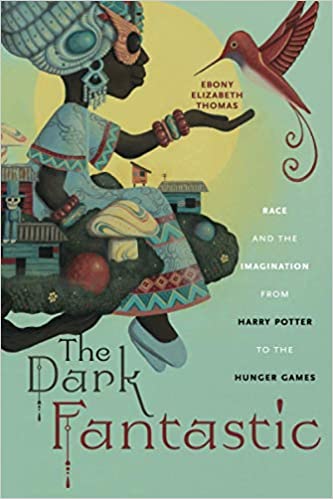
Review of The Dark Fantastic


SFRA Review, vol. 51, no. 2

Nonfiction Reviews


Review of The Dark Fantastic: Race and the Imagination from Harry Potter to the Hunger Games

Jonathan W. Thurston-Torres

Ebony Elizabeth Thomas. The Dark Fantastic: Race and the Imagination from Harry Potter to the Hunger Games. New York UP, 2019. Hardback, 240 pg. $28.00, ISBN 9781479800650.

Even as I am writing this review, I am wearing both a Slytherin tank top and a Slytherin scarf. I grew up in a generation in which J. K. Rowling’s famed Harry Potter book series was coming out; they were published during my middle and high school years. While I have seen the movies a few times, I have never gone back to read the original books. But, when I saw the title and subtitle for Ebony Elizabeth Thomas’s new book, I found myself thinking back to racial representation in the book series. I knew about the occasional person of color in the books, and I knew that representation was minimal. I remembered, too, the “scandal” in the media over the black Hermione in the stage production of Harry Potter and the Cursed Child (2016). But Thomas’s book pushes back against all of these preconceived notions of race in the Harry Potter books and other young adult literature, begging the question, “What about the space for young adult imagination?”

Thomas begins her book with the eponymous critical term for her work: “the dark fantastic.” She first defines it as “the role that racial difference plays in our fantastically storied imaginations” (7). In this introduction, she details how monstrous others in fantastic literature are “endarkened” and convey to “readers, hearers, and viewers of color” that they “are the villains […] the horde […] the enemies […]the monsters” (23). She gives numerous examples throughout the text to showcase the term more concretely, such as Rumpelstiltskin who becomes the “Dark One” in the TV series Once Upon a Time (2011-18), the Native American bestial werewolves of the Twilight series (2008-12), and the “majority of witches and warlocks” with “visible African ancestry” in the television show The Vampire Diaries (2009-17) (30-31). However, as the diversity of these examples shows, the “dark fantastic” is a murky term to define.

In his 2019 monograph The Paradox of Blackness in African American Vampire Fiction, Jerry Rafiki Jenkins summarizes and discusses race discourse around Bram Stoker’s Dracula (1897). In this description, he shows how while many scholars have argued that a dominant response to the novel is to empathize with the victims of the vampire, some race readers like Jewelle Gomez align more with Dracula himself as a form of “shared ‘suffering’” (24). What Jenkins creates here is an awareness that both darkness and othering are spectra in and of themselves, not to mention their intersections. Is Mina Harker capable of being a Dark Other for Thomas, or is only Dracula capable of that? As Thomas points out, being othered in literature often means being darkened, so, therefore, are all folkloric antagonist archetypes qualifiers for Dark Othering? All antiheroes?

When Thomas moves into case studies, she starts with representations of Rue in The Hunger Games (2008). This section begins with a solid analysis of construction of race and ethnicity in the series, showing how Rue was raced in the first book. While these representations are complex, Thomas excels at being able to focus the camera in at the line level and then zoom back out to show the larger picture: we see how specific phrases and sentences help to create a systematic construction of race, and that affects the ways that Rue “becomes” innocence in the novel. But, as Thomas shows, that innocence is “transferred” to Katniss by the end, and Rue “fades from the narrative” (57). The chapter wraps up with a survey analysis of social media responses to the black representation in the films, investigating what Thomas calls the “dark fantastic cycle,” a narrative cycle that tracks the role of the Dark Other in fantastic literature (60, 26). This cycle makes it so that cishet white men can read the work and not even notice these characters who just “happen to not be white.”

The next chapter reads closely representations of Gwen in BBC’s Merlin (2008-12). The chapter starts by showing how the mixed-race character of Gwen might disrupt the dark fantastic cycle, but, at each step of the analysis, while there is potential for disruption, Thomas shows how even this narrative follows the conventions, even if in more roundabout ways. The second half of the chapter is devoted to Thomas countering common trends in social media response to Gwen’s racialization. However, many of these analyses are really quoting various posts, putting them in conversation with each other, and then making a brief point that could have been explained more. In one section, Thomas traces the statement that “Gwen and Arthur [as a desired coupling] are heteronormative” (96). She sets up the context for this discourse, she shows some quotes, details how important an Arthur and Merlin shipping is for the LGBTQI community, gives more quotes, one of which says that race is important for characterizing Gwen, and then paraphrases that quote some more, and then moves on to the next assertion. The social media analysis throughout Thomas’s work signifies new ways to examine young adult literature and its reception, but I would have liked to see more critical analysis of it, rather than mostly summary.

In the final two chapters, Thomas examines blackness in The Vampire Diaries and the Harry Potter series. In each, she grounds the discussions in anecdotes of conversations with her family about race and racial representation, and these anecdotes showcase one of the strongest aspects of the book: this book is an essential text for anyone teaching young adult literature, especially in middle or high schools. Thomas models reading YA lit for race and encourages ways to teach not just reading but also analysis of social media reception of race in literature and film. Thomas’s work definitely needs to be in university libraries, educators’ hands, and scholars’ shelves. And for me at least, even as a proud Slytherin, I have new understandings of the Harry Potter series and the ways the dark fantastic cycle snakes its way into the narrative.


Jonathan W. Thurston-Torres is a PhD Candidate in English at Michigan State University, and their edited collection Animals & Race is scheduled to come out through MSU Press later this year. They specialize in early modern studies, animal-race theory, and HIV activism.

Review of EC Comics


SFRA Review, vol. 51, no. 2

Nonfiction Reviews


Review of EC Comics: Race, Shock, and Social Protest

Dominick Grace

Qiana Whitted. EC Comics: Race, Shock, and Social Protest. Rutgers, 2019. Comics Culture. Paperback. 196 pg. $29.95. ISBN 9780813566313. Ebook. ISBN 9780813573106.

Qiana Whitted’s EC Comics: Race, Shock, and Social Protest, the latest volume in Rutgers’s Comics Culture series, is of more value to comics scholars than to SF scholars, but it is nevertheless both eminently readable and a valuable addition to pop culture scholarship. As Whitted notes in her introduction, despite the general high regard in which EC comics are held, they have received relatively little scholarly attention. In this volume, Whitted focuses on the so-called “Preachies,” the stories in various EC titles (mainly Shock SuspenStories) that were “designed to challenge readers’ assumptions about racial, ethnic, and religious prejudice, Cold War paranoia, and other anxieties over social difference and American heterogeneity” (5). Whitted does not attempt to do a high-level survey of how EC stories addressed social concerns, and rightly notes that a great many of them have little or no (overt) social commentary. Indeed, she cites William Gaines’s testimony from the US Senate Subcommittee on Juvenile Delinquency hearings in 1954, in which he differentiated between the “preachies,” which carefully spelled out the messages readers were expected to receive, and stories designed merely to entertain. Instead, she focuses specifically on the more obvious examples of the “preachies,” notably the story “Judgment Day!” written by Al Feldstein and drawn by Joe Orlando, originally published in Weird Fantasy #18 in 1953 and reprinted in one of EC’s final comics, Incredible Science Fiction #33 (1956), as a poke in the eye to the Comics Code Authority. EC subsequently shuttered its comics division. While Whitted could have fruitfully expanded her study by looking more broadly at EC comics (I would especially have been interested in her take on New Direction titles such as MD and Psychoanalysis, the latter title especially, with its proselytizing for the benefits of psychotherapy), the focus on a few key stories allows her space not only for extensive and detailed historical context but also for deep dives into the stories on which she does focus.

For readers of SFRA Review, the most relevant chapter here is chapter four, “‘Battling, in the Sea of Comics’: EC’s Invisible Man and the Jim Crow Future of ‘Judgment Day!’” This famous story recounts the visit of Tarlton, representative of the Galactic Republic, to the planet Cybrinia, to determine whether its robot inhabitants, descended from (if robots can indeed descend from ancestors) robots first built on Earth. Tarlton discovers that there are two robot classes, orange and blue, and that the blues are treated as distinctly second-class, despite being identical in manufacture to the orange robots, except for the colors of their external shells. Tarlton determines that the robots are not yet ready for admission into the Galactic Republic. Probably unsurprisingly to readers today, but very much controversially when the story first appeared (this issue was the basis of the Comics Code Authority’s attempt to bar EC from reprinting the story in 1956), Tarlton, who has worn his space suit throughout the visit, is revealed in the final panel of the story to be Black. Whitted’s reading of this story is detailed, subtle, and nuanced. Especially beneficial are her detailed comments on the historical context of Jim Crow, other relevant comics stories of the time, and, most interestingly—for me, anyway—her linking of the story to Ralph Ellison’s novel Invisible Man, published in 1952, one year before this story was first printed. Whitted reads the imagery and dialogue (even its use of ellipses) closely and carefully to build a complex reading that acknowledges not only what makes the story important but also the ways in which its proselytizing intent is complicated by its own assumptions. This chapter alone makes the book of value for scholars of SF, especially those interested in issues of race and of colonialism as explored in SF.

The whole book, however, is of enormous value to comics scholars. While Whitted has little to say about the vast catalogue of other SF, fantasy, and horror stories published by EC (and there is indeed much room to consider the merely entertaining stories, as well as the “preachies,” through the lens Whitted applies), her study nevertheless engages deeply and insightfully with EC’s complex legacy as a comics publisher renowned for its overall quality while also at times criticized for its formulaic storytelling and often pat moralizing. Whitted assumes a middle ground, between EC idolatry and the tendency of some scholars to attempt to apply a corrective to the often uncritical admiration of EC via harsh critique. This book is especially valuable for comics scholars but also of use for SF scholars, especially ones interested in SF in visual media.


Dominick Grace is professor of English at Brescia University College in London, Ontario. He is the author of The Science Fiction of Phyllis Gotlieb: A Critical Reading and the co-editor of several books, many focusing on comics and graphic novels.

Review of Sideways in Time


SFRA Review, vol. 51, no. 2

Nonfiction Reviews


Review of Sideways in Time: Critical Essays on Alternate History Fiction

Carl Abbott

Glyn Morgan and C. Palmer-Patel, eds. Sideways in Time: Critical Essays on Alternate History Fiction. Liverpool UP, 2019. Hardback. 216 pg. $120.00. ISBN 9781789620139.

Sideways in Time collects essays derived from a 2015 conference at the University of Liverpool. It opens with a Foreword from prolific speculative fiction author Stephen Baxter and includes ten essays that are bookended by an Introduction and an Afterword by the editors. With a couple of exceptions, the contributors are based in Britain or have British academic connections.

That scaffolding described, the editors deserve a shout-out for their Introduction. In eleven pages they provide a quick and clear review of the critical literature on alternate history from H to G (Hellekson to Gallagher) and make a cogent argument for simple and direct terminology that avoids awkward coinages like allohistory and in-crowd references like Jonbar Hinge. Use “alternate history” and “point of divergence” and people will know what’s being  talked about. They also make a case for considering alternate history as its own genre or category that overlaps science fiction but also draws from counterfactual history and historical fiction, attracts mainstream writers, and morphs easily into television thriller mode.

The ten essays touch on some familiar landmarks of alternative history: Napoléon et la conquête du monde (1836), The Years of Rice and Salt (2002), The Man in the High Castle (TV version, 2015-19). Other contributors treat less frequently studied texts, such as short stories by Alfred Bester and John Wyndham, as well as introducing English-language readers to a Spanish novel from 1998 and a set of twenty-first century films and anime from Japan. All of the pieces offer interesting takes, and every reader will have their preferences. One of mine is Jonathan Rayner’s “Forever Being Yamato: Alternate Pacific War Histories in Japanese Film and Anime,” which explores a fascinating set of feature films and animations. It is a good start at developing a complement to the extensive analysis of alternate “Hitler wins, or doesn’t he?” fiction by Gavriel Rosenfeld and Catherine Gallagher. A second is Chris Pak’s “’It Is One Story’: Writing a Global Alternate History in Kim Stanley Robinson’s The Years of Rice and Salt.” A third is Karen Hellekson’s “Agency and Contingency in Televisual Alternate History Texts,” which energetically analyzes eight separate television series and mini-series (Maine winters must be good for bingeing).  As a group, the essays raise several questions about the character and boundaries of alternate history, which the editors interpret broadly.

A first issue is the tension between “timeline stories” and “lifeline stories.”  The former explore the social, political, and cultural effects of a divergence and work in the same realm as do the more abstract counterfactuals that historians sometimes propose. The latter focus on single individuals whose personal stories change through time travel interventions or passage to a parallel world. In very rough division, the essays in “Part I: Points of Divergence” deal with timelines and those in “Part II: Manipulating the Genre” with lifelines. The point of this boundary question is whether something to be called alternate history needs to dramatize counterfactuals with implications for social groups, societies, or nations. “Straight” alternate history hews to the plausible, whether its scope is as specific as Simone Zelitch’s Judenstaat (2016) or as broad and deep as The Years of Rice and Salt. Authors who work in this vein are interested in how their characters interact with the changed society, which remains “realistic” in that we can understand how things might get from the point of divergence to the society being described.  Some of the best examples, of course—Philip  Roth’s The Plot against America (2004) or Jo Walton’s “Small Change” trilogy (2006-08)—are able to span the two interests by placing compelling characters in alternate timelines where they have to cope with very interesting dynamics of politics and power.

A second issue involves the mechanisms that generate the alternate history. Is the divergence based on an event that is conceivable within the context of the time, such as the assassination of Elizabeth I or southern victory in the American Civil War without extra weapons from the future? In contrast, does the story depend on the speculative physics of parallel worlds with convenient portals tucked away in a basement? Or on equally speculative time travel scenarios in which a Japanese warship from the twenty-first century can materialize in 1942 (the manga series Zipang [2000-09]) or a history professor (!) joins the time patrol to save the world (Michael Crichton’s Timeless [1999])? Utilization of alternate physics offers abundant options for authors to play with but may thin the “history” part of the alternative. It also brings these sorts of alternate history firmly into the science fiction camp.

On a different side of the Venn diagram are stories that fall in the realm of fantasy with fully implausible, non-scientific premises. Stephen Baxter suggests distending the category to alternate cosmologies, favorably citing the flat Earth in Philip Jose Farmer’s “Sail On, Sail On!” (1952), Chloé Germaine Buckley’s essay explores Shadows over Baker Street (2003), edited by John Pelan and Michael Reaves; its contributors imagine Lovecraftian monsters, shape-shifters, and other supernatural phenomena perplexing reimagined versions of Sherlock Holmes. La locura de Dios (1999) by Juan Miguel Aguilera seems born from a kinky coupling of H. Rider Haggard, Dan Brown, and Erich von Daniken. The analysis in these essays is interesting, but I wonder if the texts are alternate history or some other category such as fantasy, fantastic adventure, or magical realism (the latter being perhaps the best slot for Colson Whitehead’s  alternate-historyish The Underground Railroad [2016]).            

There is a matter of intellectual interests behind these boundary issues, for different readers engage most deeply with different aspects of human experience. I’ve been studying, practicing, and writing “straight” history for multiple audiences for longer than I’ve been writing about speculative fiction, and find alternate history that engages the dynamics of societal change to be the most challenging and the most capable of imagining more just as well as more unjust societies. One might guess as much from the individual essays that I’ve cited. Readers of Sideways in Time whose predilection is for narratives that focus on the thoughts and emotions of individuals or that play with the weird and fantastic will have a different set of favorites. To paraphrase the editors, they will be drawn to the narratives that expand, stretch, subvert, and redefine the genre. For all of us, however, the collection is worth reading and consulting.


Carl Abbott retired after teaching Urban Studies and Planning at Portland State University in five decades (but not fifty years!). His book Imagining Urban Futures was recently published in Chinese translation.

Review of Theory for the World to Come


SFRA Review, vol. 51, no. 2

Nonfiction Reviews


Review of Theory for the World to Come: Speculative Fiction and Apocalyptic Anthropology

Gabriel A. Saldías Rossel

Matthew J. Wolf-Meyer. Theory for the World to Come: Speculative Fiction and Apocalyptic Anthropology. University of Minnesota Press, 2019.Forerunners: Ideas First. Paperback. 116 pg. $7.95. ISBN 9781517907808.

Apocalypse is never singular, but multiple. This is “Wyndham’s rule,” the main premise with which Matthew J. Wolf-Meyer opens Theory for the World to Come. Speculative Fiction and Apocalyptic Anthropology (the title of the first chapter and its contents detail what Wolf-Meyer means by the term), an interesting and thought-provoking study of the future and the conditions of possibility that make it happen.

This compact volume of just over 100 pages is, despite its brevity, is packed to the brim with contingent and at times even radical ideas on topics as widespread as catastrophe, city planning, race, human nature, and politics. This interest in seemingly disconnected topics also extends to Wolf-Meyer’s cross-disciplinary methodology, which groups speculative fiction, personal diaries, and social theory in a common effort to interrogate the many possible dimensions of our imagination about the future.

The future—and its limits—are exactly what lie at the heart of this book: the “world to come,” with all its problematic folds and inexplicable weirdness. How can we trace back the way our world has come to be, and understand its temporality as a complex continuum of historical variables? How can we develop new ways of comprehending what’s going to happen in the next few centuries if we haven’t yet absorbed the many undetermined possibilities of our present? And, more importantly, how can we deal with the idea of an “end” to what we’ve built? Can we change it, or should we resign ourselves to impending doom? These and other questions lead Wolf-Meyer to explore the ways in which twentieth and twenty-first century speculative fiction—in both literature and film—have  advanced different social theories that provide us with usually unorthodox as well as revealing answers about our past, present, and future.

The structure of the book follows a straightforward premise: if the threat of annihilation looms on the horizon, as Wyndham’s rule seems to suggest, then speculative fiction must address this notion and produce social theories relevant for a future at risk of never materializing. From this standpoint, the author identifies three different forms of narratological social theory under the guise of “future historiography” (19): extrapolation, intensification, and mutation. These modalities manifest themselves as narrative or even thematic devices designed to propel the conversation about the future beyond its commonly agreed limits and to advance discussion on alternative ways of portraying what’s to come. Accordingly, each chapter explores different fictions and ways of employing future historiography to produce coherent and relevant social theories.

The first three chapters after the introduction (“Detroit Diaries, 1992-1999,” “White Futures and Visceral Presents: Robocop and P-Funk,” and “The Revolutionary Horizons of Labor and Automation: Blue Collar and Player Piano”) deal with the idea of “intensification” (19), analyzing futures in which present issues are not really resolved, but rather expanded on, both in significance as well as spatial and social presence.

Images Wolf-Meyer brings forward during these first few pages include Robocop’s (1987) ultra-violence as an expression of repressed humanity and P-Funk’s music as an attempt to recover such lost humanity during the 80s; Player Piano’s (1952) representation of automation as a reflection on the meaning of labor, and Detroit as a city of technological promises degraded into a racially segregated sprawl. Each chapter is short and direct, not wasting any time to get to the main topics the author seeks to put into the spotlight: race politics, human nature, and the possibilities of automation in a posthuman age.

The following two chapters (“California Diaries, 2008-2015,” and “Extrapolating Neoliberalism in the Western Frontier: Octavia Butler’s Parables”) focus on extrapolation as a narrative device employed to represent present problems in scenarios radically different from our own. In his “California Diaries,” Wolf-Meyer reflects upon how living—and, particularly, buying a house—in California forced him to accept the fragility and indeterminacy of a future “so precarious, so subject to change” (53), where catastrophe is always around the corner, while his study of Octavia Butler’s work makes some interesting points about the inner logic of capitalism and its ever-consuming nature, revealed through extrapolation and a rather fascinating proclivity towards devastation and crisis, something the author also finds a characteristic feature of life in California.

The final three chapters of the books (“New York Diaries, 2015-2018,” “The Nihilism of Deep Time: Man after Man and After,” and “Mutating Temporalities: Slipstream Christopher Columbus”) deal with mutation, or the speculative expression of change as a chronological and temporal construct. This section opens with the “New York Diaries,” in which the author explores life in a secluded town where the future “never seems to come” (72), thus rendering thinking and worrying about it as unnecessary exercises in frustration.

This notion of an unmanifested future, precluded from experience, is also present in his study of “deep time” (82), which posits that in the larger scheme of things, human existence and humanity’s self-made so-called apocalypse, is not only circumstantial, but irrelevant altogether. This pessimistic conviction is then contested in the final chapter of the book, which turns its attention to the possibility of alternative futures, or “mutant temporalities” (91) that would allow, at least in theory, for possible “ways out” (100) of the unavoidable apocalypse that we, as humans, seem so stubbornly obsessed with bringing about.

In the end, this is indeed a book about the future and the many natural and artificial threats it faces; but it’s also a deep and well-researched study on the expression of hope through speculative fiction and social theory during the last fifty years. Through his analyses and account of personal experiences, Wolf-Meyer provides a panoramic view of the many attitudes towards the future we have developed over time: Should we fear it? Should we try to stop it?  Escape it? Transform it? The possibilities are numerous, and if there’s something to be taken from this book, it is the idea that an undetermined future is not necessarily a bad one. Indeterminacy means possibility, and possibility means opportunity for change. For Wolf-Meyer, this is the conviction that motivates speculative fiction to represent different scenarios and outcomes to problems we, today, might see as simply insurmountable. It also helps us to understand the trends that have brought us to where we are and, ideally, to try to remediate them before it’s too late, because any theory for the world to come should at least address our experience with time and space and project it beyond our imagination into—if not better, at least different—ways of experiencing reality.


Gabriel A. Saldías Rossel is an Assistant Professor at the Catholic University of Temuco in Temuco, Chile. He holds a PhD in Literary Theory and Comparative Literature. His areas of expertise include Latin American literature, utopian studies, politics of catastrophe, critical theory, science fiction and fantasy studies. Currently he is researching the utopian implications in the representations of catastrophe in current Latin American novels. 

Review of Utopia and Dystopia in the Age of Trump: Images from Literature and Visual Arts


Review of Utopia and Dystopia in the Age of Trump: Images from Literature and Visual Arts

Simon Spiegel

Brodman, Barbara, and James E. Doan, eds. Utopia and Dystopia in the Age of Trump: Images from Literature and Visual Arts. Fairleigh Dickinson UP, 2019. Hardcover. 244 pg. $95.00. ISBN 9781683931676. EBook ISBN 9781683931683.


The title of this collection is, without any doubt, catchy, and the dystopia part in particular feels very topical at the moment. While I am writing this review, in the midst of the COVID-19 crisis and the protests against the murder of George Floyd, Donald Trumpʼs unique blend of viciousness and ineptitude is reaching new heights (or lows). The images we see from Washington, with armed forces in front of the Lincoln memorial, certainly have a dystopian feel to them. But, as it so often goes with catchy phrases, the title proves on closer inspection also to be quite problematic.

The problem is twofold and really concerns both parts of the book’s title. First, surprisingly few of the fourteen essays collected in this volume actually deal with proper utopias or dystopias. While opinions among scholars differ about how loosely the concept of the positive utopia should be understood, dystopia is quite clear-cut as a genre. Dystopias deal with a society which is worse than the one we live in. But neither Hamlet (c. 1599-1601) nor Edgar Allan Poeʼs “The Fall of the House of Usher” (1839), which Christine Jackson analyzes in her article, are set in dystopian societies. It is, of course, legitimate to read Poe or Shakespeare against the backdrop of the Trump presidency (as Stephen Greenblatt has done so beautifully in Tyrant), but the mere fact that Claudius has murdered Hamlet’s father does not make him a dystopian ruler. Claudius may be a bad person, but there is little evidence that he is also a bad king.

Similarly, Daniel Adleman reads Bret Easton Ellisʼs notorious American Psycho (1991) as a critique “of the callous cultural logic that underpins the utopian ideology of the US neoliberal project”. (70) It certainly makes sense to see Ellis’s murderous protagonist Patrick Bateman as a kind of proto-Trumpist—as Adleman points out, there are more than thirty direct or indirect references to Trump in the novel—but again it is not really clear how this relates to the concepts of utopia and dystopia except in the most general way.

While some might consider this criticism to be narrow-minded genre policing, it is telling that the editors give only short summaries of the individual articles in their introduction, but fail to come up with any kind of conceptual framework which would help to explain or contextualize their selection.

Utopia and Dystopia in the Age of Trump is not targeted at scholars of utopias or sf. This becomes evident in Jeffrey Barber’s chapter, which is a compressed introduction to and history of sf and utopian writing with a special focus on the theme of sustainability that ends with thoughts on the Trump presidency. While the overview given might prove useful to readers not acquainted with sf theory, the link to contemporary US politics does not go much beyond the assessment that sales of Orwell’s Nineteen Eighty-Four (1949) have soared after Trump’s election.

And this brings us to the book’s second, more serious problem: The question of how much it can tell us about Trump which is enlightening or relevant. Much has been and is still being written on the 45th US President. An obvious disadvantage of an academic book like this is its long gestation time. Utopia and Dystopia in the Age of Trump was published in June 2019, which means that probably none of its chapters was written later than the end of 2018. Not surprisingly, some of the essays therefore already feel outdated. Sometimes painfully so, such as Tom Shapira’s chapter on Judge Dredd, in which he likens special counsel Robert Mueller to the comic’s eponymous protagonist. Like the judge, a member of a special unit who is police, judge, jury, and executioner in one person, Mueller is “an authoritarian figure, a straight and narrow professional, stern of gaze and relentless in his task”. (188) Shapira’s observation that even people for whom a character like Mueller used to be something short of a bogeyman suddenly rooted for the special counsel is intriguing, but the sad fact that the Mueller report amounted to nothing in the end gives his essay a quite unexpected punch line. Unfortunately, unlike in the comic, in real life the crazy President was not brought down by a disciplined servant of the state.

As an introduction to Judge Dredd—which unlike Hamlet really deals with dystopia—Shapira’s chapter works well, as do Matthew Paproth’s discussion of the TV series Black Mirror (2011- ) and Kate Waites’s chapter on Mad Max: Fury Road (2015) and the Hulu TV series adaptation of Margaret Atwood’s The Handmaids Tale (1985). But in each case the connection with Trump—which should be the whole point of the book—seems forced and not very productive. Waites’s contribution is typical in this regard. Hulu’s The Handmaid’s Tale (2016- ) is probably the first example that comes to mind when people think of dystopia in the age of Trump. The adaptation of Margaret Atwood’s novel does indeed feel very timely, and some of its iconic elements, like the handmaid’s red dresses and white winged hats, have become symbols of the #MeToo movement and of resistance against Trump in general. In her analysis, Waites concentrates on visual strategies of the show, though, and says little about Trump.

The already mentioned lack of a theoretical framing for the volume becomes particularly striking with David L. McNarron’s chapter, which closes the book. McNarron discusses Albert Camusʼs classic novel The Plague (1947)—which has gained new topicality thanks to the COVID-19 pandemic—and Jean Raspail’s The Camp of the Saints (1973), an obscure French book which has in recent years become a favorite among the alt-right. McNarron’s reading of the two novels ­– which manages to turn Camus’s deeply humanist novel into a plea for nationalism – culminates in a surprising call for strong borders and unabashed support for Trump’s policy.

What is the point of this chapter? Do the editors intend to bring some kind of balance to the selection of texts which are with the exception of McNarron’s decidedly anti-Trump? Is it meant as a refreshing provocation? Since the book lacks a coherent concept, the readers are left to wonder.

Review of The Twilight Zone (TV Milestones)


Review of The Twilight Zone

Dominick Grace

Barry Keith Grant. The Twilight Zone. Wayne State UP, 2020. TV Milestones. Paperback. 132 pg. $19.99. ISBN 9780814345788. Ebook. ISBN 9780814345795.


The Wayne State University Press has published nearly 40 volumes in the TV Milestones series; surprisingly, it has taken on The Twilight Zone, one of the most celebrated TV shows ever made (so much so that it has been rebooted three times, with limited success, as well as adapted into a feature film) and arguably the seminal show to make the fantastic legitimate adult fare on TV, only in 2020. Barry Keith Grant’s volume is as compact as the other entries in this series, and it is a quick and easy read. Non-academics should find this a perfectly accessible introduction/primer. However, the book is also thoroughly researched, well-grounded in the scholarly tradition associated with the show, and insightful in its own right. Anyone interested in The Twilight Zone, whether as a fan or scholar (or both) will find this book valuable.

Bookended between an introduction and a conclusion waggishly entitled “Zoning In” and “Zoning Out” are three chapters exploring, as Grant outlines his plan in the introduction, “the interrelated questions of authorship, genre, style, and ideology in the context of The Twilight Zone”. (14) Throughout the book, Grant balances relatively deep dives into key episodes with quick summaries of linked episodes. As a result, he manages to be comprehensive without being superficial.

The first chapter, “’Once Upon a Time’: The Twilight Zone and Genre,” focuses on “the place of The Twilight Zone within the various modes of the fantastic, showing how it combined them with other generic traditions to offer social criticism cast as moral fables”, (17) but crucially also explores in some detail how the show works as a hybrid of genres, folding in, notably, elements of film noir, as well as other genres (e.g. the then-popular on TV Western; several episodes of the series are explicitly Westerns or at least are set in the West).

Chapter Two, “’The Prime Mover’: The Twilight Zone and Authorship,” addresses the extent to which the show represents a unified vision. As Grant notes, the show is indelibly associated with Rod Serling, who created the show, oversaw the production (for the first few seasons, anyway), wrote a significant percentage of the episodes, and, most significantly perhaps, hosted the show, stamping his personality on each episode and himself becoming a TV icon as a result (so much so that he is folded into the final episode of the first season of the latest reboot). While Grant acknowledges the complexities of auteurist criticism, he makes a compelling case for Serling’s voice and characteristic concerns as the dominant elements of the series. 

Chapter Three, “’What’s in the Box’: The Twilight Zone and the Real World,” is perhaps the book’s most interesting chapter, delving as it does into The Twilight Zone’s hallmark social commentary. Grant carefully contextualizes the show historically, showing how it responds to current concerns and anxieties. He also deftly documents its own tensions, arguing that the conflicting condemnation of collective action as dangerous (the show’s famous “The Monsters Are Due on Maple Street” [1.22, March 4, 1960] being perhaps the paradigmatic example) weighed against the show’s consistent condemnation of selfishness, greed, and other dangerous manifestations of individualism constitutes the “thematic tension at the heart of the show” and “places it squarely within the debates that have informed American culture and political thought from the nation’s beginning”. (98)

Also central to Grant’s argument is his recognition of the tension between art and commerce, a tension he recognizes as built in to Serling’s own conflicted view of television as, on the one hand, a commercial medium reliant on formula and beholden to sponsors but, on the other, a popular medium that could be used artfully to engage in social commentary. Grant notes that The Twilight Zone “reveals the tensions between artistic ambition and commercial capitulation at a pivotal point in the history of the medium”, (100) but that Serling was largely successful (with some instances of unsuccessful episodes scrupulously noted): “With The Twilight Zone, Rod Serling joined the ranks of such otherwise very different American artists as Walt Whitman, Frank Capra, and Frederick Wiseman, all of whom have sought in their work to find ways to integrate the individual within the great democratic project of the nation”. (99)

This book is a valuable addition to Twilight Zone scholarship, acknowledging the work of previous scholars while also advancing the study of the show. Its clear and accessible style makes it ideal for undergraduate students, perhaps especially in media courses, but its depth and insight make it valuable for advanced scholars as well. I would recommend it for any library interested in remaining current with studies of the fantastic across media.

Review of The Twilight Zone and Philosophy: A Dangerous Dimension to Visit


Review of The Twilight Zone and Philosophy: A Dangerous Dimension to Visit

Robert Creedon

Heather L. Rivera and Alexander E. Hooke, eds. The Twilight Zone and Philosophy: A Dangerous Dimension to Visit. Popular Culture and Philosophy: Volume 121. Open Court, 2019. Paperback. 247 pg. $19.95. ISBN 9780812699890.


This book is a concise view of philosophical topics using the classic television series The Twilight Zone (1959-1964) as the basis of its explorations in 21 short essays. It follows the standard format for the series by having various authors explore concepts in short 9-14 page essays that allow the reader to delve into heavier material. Although being familiar with the series helps, it is not necessary, as detailed examples from the series are given to provide clarity for the reader. Readers will also find many episodes are discussed repeatedly, as they apply to numerous topics and concepts. Most of the chapters include direct references to the philosophers and their writings, documented and indexed for ease of reference. These essays are well divided into subsections under headings offering expansions on ideas from the main premise: “First Dimension: Facing the Zone”; “Second Dimension: Beyond the Boundaries of You and Me”; “Third Dimension: The Wondrous Land Called Truth”; “Fourth Dimension: As Vast as Space and Timeless as Infinity”; “Fifth Dimension: Our Twisted Imaginings”; and finally “The Dimension that Can’t Be Named or Numbered.”. Most readers should enjoy the bite-size nature of the information which is designed to make it more accessible to the general public and specifically to the fans of the series. This format is the same as has been used for other volumes of the Popular Culture and Philosophy series, giving continuing readers greater context and understanding.

What I found most interesting were the chapters that asked questions about the concept of the Twilight Zone as a shadow of our own world. The Twilight Zone was written by a group of horror writers from southern California in the late 50’s and early 60’s that as Matt Cardin says, “founded their sense of the fantastic in everyday reality and the experience of characters that might live next door” (quoted in “No Place Like a Non-Place,”by Fernando Gabriel Pagnoni Berns, Juan Ignacio Juvé and Emiliano Aguilar, pg. 131).  We also learn that except for just a couple of episodes, an element of supernatural, the future or aliens, was used to create twists or surprise endings. These thought plays provide ideal bases for the philosophical thought exercises in this book. The pairing is as natural as that between Candid Camera and sociology. Rod Serling and his associates created a series that created thought experiments that illustrate the great theories of the philosophers, although not by design. 

The chapters exploring specific theories are more interesting than the others, providing as they do a detailed framework including examples to aid the readers’ comprehension. Philosophers discussed range from Aristotle to recent philosophers so current that the writers provide timelines indicating when episodes came out between major works by these contemporary figures. Many of the essays require the reader to invest time to absorb and work through the ideas expressed after reading. My favourites include “No Place like a Non-Place,” by Fernando Gabriel Pagnoni Berns, Juan Ignacio Juvé and Emiliano Aguilar, in which they explain Marc Augé’s Non-Places: Introduction to an Anthropology Of Supermodernity via the episodesWill the Real Martian Please Step Up?”, “The Four of Us Are Dying,” “The Hitch-hiker,” “The After Hours,” “The Passersby,” “Passage on the Lady Anne,” and the classic “Nightmare at 20,000 Feet”;“The Twists and Turns of Second Chances,”by JohnV. Karavitis, describing Soren Kierkegaard’s Either/Or (which is about the aesthetic versus the ethical world) in episodes including “A Nice Place to Visit,” “A Game of Pool,” and “Devil’s Printer”; and “The Pleasure of the Twist,” by Stephen Scales, discussing Thomas Kuhn’s The Structure of Scientific Revolutions with references to “The Hitch-hiker,” “The Lateness of the Hour,” and the classic “To Serve Man.” The essay “The Science of Alternative Realities,” by David Morgan, is a wonderful treat for this science fiction and comic reader as it explores the theories of alternate dimensions and timelines. The book has enough layers to be read multiple times and remain on your bookshelf for years of reference and enjoyment. 

“Memories Are Made of This,” by Clara Nisley, mentions David Hume’s belief in continued existence briefly before moving into a consideration of  “And When the Sky Was Opened” and “The Trouble with Templeton”; the relevance of Hume could have been explored in more detail  Other chapters work better, such as  “Lost in Time,” by Elizabeth Rard, which discusses the time travel paradox with examples from the episodes “The Rip Van Winkle Caper,” “Last Flight,” and “No Time Like the Past.” “The Twilight Zone on Our Doorstep,” by Tim Jones, is most intriguing in its exploration of where The Twilight Zone actually existed. “A Shadowland Called the Twilight Zone,” by Trip McCrossin, on how Serling’s art mirrored the events of his time, showing his own opinions, will be of interest to film historians. Serling’s contribution to later movies is discussed in “The Science of AlternativeRealities,” by David Morgan, as Serling’s ideas can be seen in blockbusters and feature length movies, although Serling’s contributions were unaccredited. Many of the essays are well-developed persuasion pieces on the theory and the related episodes, and they serve as fine examples of how to form an argument.

Given The Twilight Zone’s popularity and reputation, I am surprised it was not covered earlier in the series. This book would be a great companion piece for any philosophy course if the instructor uses an episode or more to illustrate some philosophical theories. As someone who watched the Twilight Zone recently, I found that this book provided a great opportunity to explore theories in philosophy more easily than the complexity of the theories would indicate.  Reading these essays will encourage the reader to find the episodes online, or set up their PVRs. For those who enjoy some of the reincarnations such as Black Mirror and others, including the recent reboot of The Twilight Zone itself, this book connects well to a more innocent time in television that explored many concepts long before these recent imitations began to do so.

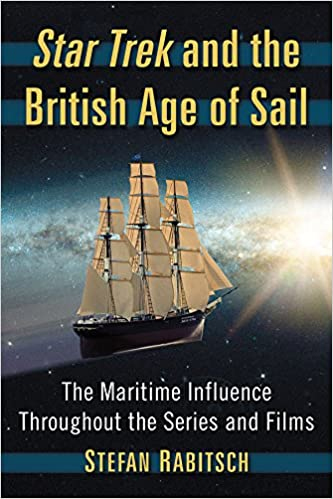
Review of Star Trek and the British Age of Sail: The Maritime Influence Throughout the Series and Films


Review of Star Trek and the British Age of Sail: The Maritime Influence Throughout the Series and Films

Russell Alexander Stepp

Stefan Rabitsch. Star Trek and the British Age of Sail: The Maritime Influence Throughout the Series and Films. Jefferson, NC: McFarland, 2019. Paperback, 279 pg. $45.00, ISBN 97814766-64637. EBook ISBN 9781476634197.


Since 1966, the Star Trek franchise has made significant contributions to popular culture, spanning six television series, one animated television series, thirteen full-length motion pictures, and numerous novels, comics, video games, and other media tie-ins. The franchise has frequently been described as “Wagon Train to the stars,” stemming from shared themes and a format with the television program Wagon Train, which follows the adventures of settlers in the American West during the nineteenth century as they travel from Missouri to California. The program was popular in the fifties and sixties just prior to the original Star Trek’s premiere on NBC in the fall of 1966. Wagon Train, like Star Trek, was episodic in nature, each week’s program taking place in a new location as the settlers moved West followed by a new location in the next week’s episode.

While much has been made of Star Trek’s connection to the genre Western and the mythos of the westward expansion of the United States, very little has been made of the franchise connections to a shared Anglo-American naval tradition. Stefan Rabitsch, in his book Star Trek and the British Age of Sail: The Maritime Influence Throughout the Series and Films, seeks to right that omission. This book is the first major publication to argue that Star Trek owes as much of its legacy to a trans-Atlantic naval tradition as it does to the American Western. It would be just as accurate, if not more so, to state that Star Trek is as much “Horatio Hornblower in space” as it is “Wagon Train to the stars.” The volume itself is divided into two major sections: “Elementary, Dear Trekker (A Primer)” consisting of three chapters, and “Rule, Britannia! Britannia Rules Outer Space in Star Trek! (A Voyage),” four chapters. The volume also includes a shorter preface, introduction, and conclusion, and an impressive bibliography and extensive endnotes.

Rabitsch’s approach is principally literary, rather than historical, and oriented in a post-colonial approach. He centers his argument on, but does not limit it to, C.S. Forester’s Horatio Hornblower novels, a series of novels centered on the career of a British naval officer in the Age of Sail, particularly during the Napoleonic wars. The novels were published between the late nineteen-thirties and mid-sixties, and thus were very much part of popular culture at the time that Star Trek was released. These novels were set at the height of British imperial power, and, as they were hugely popular on both sides of the Atlantic, tap into American interest into its own historical colonization and growing awareness of its increasing prominence on the world stage, as well as British notions of empire during the Age of Sail. Forester’s Hornblower was a combination of skilled strategist, charismatic leader, dedicated naturalist, and caring friend—the prototype for a Starfleet captain.

The author’s focus on Forester and his literary works should, in no way, be taken as a lack of intellectual rigor or scholarly attention. Rabitsch not only shows fluency in critical theory, but has also clearly mastered several literary corpora, which he has incorporated into his book. To begin with, Rabitsch is intimately familiar with the bulk of the Prime timeline in the Star Trek franchise consisting of the first five live-action series, the animated series, and the first ten theatrical films. He largely excludes Star Trek: Discovery, as the series was in its infancy at the time the volume was being prepared for publication, and the Kelvin timeline (i.e. the J.J. Abrams films). When necessary, Rabitsch also incorporates production notes and other archival texts related to the production and development of the franchise. His knowledge of Forester’s Hornblower corpus, as well as the life and writings of Horatio Nelson and James Cook, nineteenth century British naval officers on whom the character of Hornblower was largely based, is equally impressive. Furthermore, Rabitsch manages to interweave these various threads into his prose to create a compelling argument, frequently presenting an idea from Forester of historical accounts of the British navy, followed by a methodical analysis of the same point in each of the Star Trek series. The depth of Rabitsch’s analysis gives his work a feeling of completeness and elevates his argument that “Hornblower in space” is a much better description of the franchise than “Wagon Train to the stars.”

This is not to say that Rabitsch’s analysis is above reproach. At times, the author seems to be so concerned with his postcolonial analysis, in which he compares the Federation and Starfleet to British and American colonialism, that he ignores conflicting evidence that would undermine that narrative. This is particularly evident when it comes to Star Trek: Enterprise, which depicts a time in franchise history in which Earth was not among the more influential planets, prior to the foundation of the Federation. With this said, Star Trek and the British Age of Sail deserves praise for the quality of content, the depth of research, and the clarity of thought, and should be of value to any academic interested in the history of the Star Trek franchise.

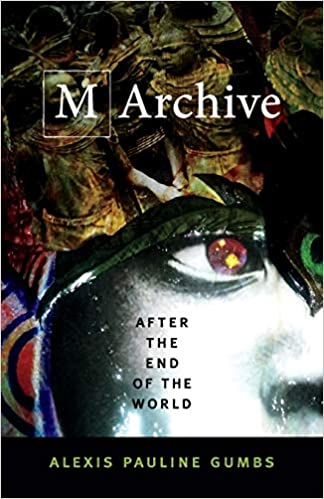
Review of M Archive: After the End of the World


SFRA Review, vol. 51, no. 1

Nonfiction Reviews


Review of M Archive: After the End of the World

Sarah Heidebrink-Bruno

Alexis Pauline Gumbs. M Archive: After the End of the World. Durham, North Carolina: Duke UP, 2018. Paperback, 248 pg. $24.95, ISBN 978-0822370840.


Alexis Pauline Gumbs’s M Archive is the second installment in a planned trilogy that explores a speculative future landscape, ravaged by the effects of late capitalism, environmental devastation, and the exploitation of black and brown bodies. In the introduction, Gumbs credits M. Jacqui Alexander’s Pedagogies of Crossing (2006) as a literary ancestor to M Archive. For Gumbs, the “M” in M Archive has a multitude of meanings—including magic, muscles, memory, and importantly, more. She describes her text as a “speculative documentary” (xi)—an inventive literary form that she imagines could be written by future survivors, who are witnesses to “the realities we are making possible or impossible with our present apocalypse” (xi). Fundamentally, Gumbs’s work is concerned with “black life, black feminist metaphysics, and the theoretical imperative of attending to Black bodies in a way that doesn’t seek to prove that Black people are human” (xi). In other words, Gumbs uses speculative documentary as a space in which to trace the possible impact of humanity’s exploitative labor and environmental policies, which rely on the subjugation of black and brown bodies—especially women of color—in order to create profits for others.

Just as Gumbs pays homage to Pedagogies of Crossing, she also references several other key intersectional feminists and scholars of color over the course of her narrative. Writing in lower case text, she resists the linguistic conventions one typically associates with scholarly works of theory. Instead, she subtly references her foremothers, such as bell hooks, who shift the standard linguistic paradigm to create new ways to engage with theory and praxis. The result is a text that is an intriguing mix of stream of consciousness, poetry, speculative fiction, and black feminist theory.

Furthermore, each section begins with a selection of the Periodic Table of Elements, in which Gumbs highlights different elements that set the tone for that portion of the text. Told from the perspective of a futuristic researcher, Gumbs’s text invites the reader to sift through layers of detritus to uncover the cultural artifacts below, in order to understand the harm that humanity has caused to itself and the planet as a whole. She breaks her book up into the Archive of Dirt, Archive of Sky, Archive of Fire, Archive of Ocean, and Baskets (Possible Futures Yet to be Woven). Each section then explores the cause and effect of the environmental catastrophe that Gumbs imagines ruined the planet and forced the surviving members of humanity to adapt and live underground to escape from the toxins on the surface of the planet after the ozone layer had been destroyed.

In Archive of Dirt, the speaker begins with a description of the capitalistic greed and disregard for other living beings that caused her ancestors (us) to treat everything as though it were expendable. Gumbs’s words pack a punch, leaving the reader with reverberating images of the body as containers for waste— “simply put, every piece of the planet was filled with trash. Our minds notwithstanding. Our bodies included”. (46) From there, she delves into the painful and traumatic process by which humanity had to give up the old ways of being in order to adapt to the harsh landscape in the post-apocalyptic future. The speaker discovers that in order to survive, humanity must become one with the Earth—both by reestablishing our connection to the planet that sustains us and by moving underground. In Archive of Ocean, Gumbs makes a powerful connection between science and spiritualism, reminding the reader that water is “the place where evolutionists and creationists agree that life began, the source of all the salt we breathed to get here, lives with us”. (11) Gumbs continues to advocate convincingly for the need for a belief in both science and the soul over the course of the text, ultimately showing the reader that humanity can survive only if it attends to both.

Finally, in Baskets, Gumbs further speculates on the limitations and possibilities that could define humanity. She rejects an individualistic way of thinking and encourages readers to think of themselves as part of a larger system. Yet, she cautions that any feeling of universalism must not overshadow the dark history of human exploitation (exemplified by the slave trade) or the need for intersectional thinking when describing the experiences of people of color. As Gumbs writes, “there did come a time when the species was united on the planet as human, but it was not what anyone had dreamt. And it was too late to truly benefit those of us who had been called alien. We who had nonconsensually generated the human across time” (171). In other words, universalism could potentially be just as problematic as individualism, if it erases the identities and hardships faced by cultural “others”.

Overall, I believe this text will be of particular interest to scholars and readers who appreciate literary forms that meld poetry and theory, such as Cherríe Moraga and Gloria Anzaldúa’s This Bridge Called My Back (1981) and (Gumbs’ earlier work) Revolutionary Mothering (2016). However, I would not recommend it as a primer into intersectionality or black feminist thought, as Gumbs takes for granted the readers’ familiarity with her many references to feminist concepts and black feminist writers, including bell hooks, Audre Lorde, and Octavia Butler, among others. In doing so, Gumbs shifts the onus onto the reader—to study foundational black feminist scholars and practitioners, and to learn from their theories, in order to avoid the future that M Archive uncovers.