Review of Science Fiction and Psychology


SFRA Review, vol. 52, no. 2

Nonfiction Reviews


Review of Science Fiction and Psychology

Sue Smith

Gavin Miller. Science Fiction and Psychology. Liverpool UP, 2020. Liverpool Science Fiction Texts and Studies 62. Hardback. 304 pg. $120.00. ISBN 9781789620603.E-Book ISBN 9781789624717.

In Science Fiction and Psychology, Gavin Miller explores the intersection of science fiction and psychological discourses as they change and shift across different historical moments. Starting with the late nineteenth century and the emergence of “science fiction as a type” and “psychology as a discipline” and ending with the “‘psychologicalization’ of Western society” in the 1990s, when the rise of neuroscience marked the “decade of the brain” (13-14), Miller covers five key schools of psychological thought and asks: what is psychology doing in science fiction, and conversely, what is science fiction doing in psychology? Within this framework of inquiry, Miller explores the importance of understanding the place of psychology in science fiction literature as well as the potential role of science fiction to narrativize psychology theory and practice (39). As Miller argues, it is science fiction’s kinship with psychology and its process of “cognitive estrangement” that the convergence of the two is crucial for realizing the impact of social oppression and its practices on human differences, such as gender and race (40).

Structured to cover the emergence and development of both disciplines, Science Fiction and Psychology consists of an Introduction and five chapters: Chapter 1 “Evolutionary Psychology,” Chapter 2 “Psychoanalytic Psychology,” Chapter 3 “Behaviourism and Social Constructionism,” Chapter 4 “Existential Humanistic Psychology,” Chapter 5 “Cognitive Psychology,” and finally the Conclusion, “Science Fiction in Psychology.” Testimony to Miller’s expertise in the field of psychology and science fiction, the Introduction carefully outlines the book’s purpose, which is to introduce and juxtapose dominant narratives of psychology with their alternative counter-narratives as they appear in science fiction. Miller explains that his book does not offer a comprehensive overview of the subject matter but should be treated as a starting point to stimulate further research. Chapters are sequenced in chronological order “in relation to each school as they emerged over time, from proto-psychologies to psychology as a newly emerging science” (41). 

The first chapter covers evolutionary psychology and references John Tooby and Leda Cosmides’s work on human selfishness, aggression, and survival of the fittest of the 1980s. Miller also looks to earlier schools such as Social Darwinism and socio-biology to examine the anti-utopian thread found in works such as H.G. Wells’s The Time Machine (1895) and Octavia Butler’s The Parable of the Talents (1998). Examined in these two texts is human progress hampered by a re-activated dormant evolutionary mechanism that destroys any hope for an idealised vision of a civilised society in the future. To offer a contrast to this view, Miller turns to Naomi Mitchison’s book, Memoirs of a Spacewoman (1962), whose take on evolutionary biology draws upon John Bowlby’s “attachment theory” to offer a “renewed feminist ethic of compassion” for “estranging our dominant ethical systems” (42). As Miller explains, Mitchison’s feminist interpretation offers a more hopeful vision of a human society that is open to others.

In the second chapter, Miller turns to the school of psychoanalytic psychology and Freud’s anti-utopian, Nietzschean idea of civilization as a thin fragile veneer “concealing displaced instinctual gratification” (42). Here Miller explores the edict that the human mind is incompatible with society as the psychological drive is to break free from social constraints to access unfettered desire (81). The science fiction works chosen for analysis are Barry N. Malzberg’s The Remaking of Sigmund Freud (1985), Ursula K. Le Guin’s The Word for World is Forest (1972), and Daniel Keyes’s Flowers for Algernon (1966) (42). In his analysis of these three narratives, Miller discusses the shift from Freud’s anti-utopian vision of humanity and the inability to change, to exploring the creative imagination of the collective consciousness in Le Guin’s Jungian text of connection and transformation. Finally, Miller focuses on Keyes’s examination of the social values attached to cognitive difference and intelligence in Flowers for Algernon and the consideration of the existential potential of being and becoming(81–123). At this point, Miller reveals how science fiction does not faithfully adopt psychology as it is presented in society but creatively sifts through and adapts elements for its own narrative purposes, challenging the discursive authority of Freud’s pessimistic prognosis of society (126).

In Chapter 3, “Behaviourism and Social Constructionism,” Miller discusses how science fiction is informed by two psychological paradigms that insist on the malleability of human psychology. Examining behaviourism, Miller explores B.F. Skinner’s near-future utopian novel, Walden Two (1948). Also questioning Skinner’s behaviourist model, Miller turns to Anthony Burgess’s A Clockwork Orange (1962), Ursula K. Le Guin’s The Lathe of Heaven (1971), and William Sleator’s House of Stairs (1974). Next, in considering social constructionism, Miller examines the issue of contingency and unpredictability alongside science fiction’s tendency to allow the experimental thought of dissolving present psychological and cultural givens into an alternate future scenario. Texts that typify such a thought experiment are Joanna Russ’s The Female Man (1975), Edmund Cooper’s 1972 novel Who Needs Men?, and Naomi Mitchison’s Solution Three (1974). As Miller explains, the three texts chosen explore utopian and dystopian reconstructions of gender relations, but remain troubled by issues of nature and cultural diversity (43).

In Chapter 4, Miller looks to “Existential-Humanistic Psychology” and its anti-systematic school of psychological thought that questions behaviourism and psychoanalysis for its reductionist accounts of humans governed by biological and instinctual drives. Miller’s discussion draws on the work of Viktor Frankl and Abraham Maslow to examine proto-discourses such as Vincent Hugh’s I Am Thinking of My Darling (1943), which critiques an “emerging ideal of personal authenticity” to question “the American Dream” in 1940s New York (44). A later postwar example that Miller examines is Marge Piercy’s Woman on the Edge of Time (1976), which critiques the instrumental tendencies of mainstream psychology.

In Chapter 5, “Cognitive Psychology,” Miller examines the founders of cognitive theory in psychology and science from George Miller and Noam Chomsky to Ulrich Neisser in order to look at Jack Finney’s Invasion of the Body Snatchers (1955), which uses earlier proto-cognitivist discourses to contend that “the mind as machine” operates like “a biased, limited capacity information processor” (44, 205). Looking further at science fiction texts that unsettle ideas about everyday perception, Miller analyses Ian Watson’s The Embedding (1973), Samuel R. Delany’s Babel-17 (1966), and Ted Chiang’s “Story of Your Life”(1998). The aim of focusing on these texts is to explore how science fiction has asked broader questions about “the nature and accessibility of ultimate reality” (44). In this chapter, Miller examines science fiction that asks whether we ever have access to an authentic reality or whether it is always in a process of construction and prone to faulty perception (203-204).

Finally, in the conclusion, “Science Fiction in Psychology,” Miller discusses the potential of deploying science fiction tropes within official psychological literature at a popular and scholarly level.  In particular, Miller examines the way science fiction can be exploited in psychology as a didactic tool, as he cites psychologists such as Sandra and Daryl Bem, Randy Thornhill and Craig Palmer, and Steven Pinker, who readily use speculative narratives of the future to “legitimate their particular psychological claims” (44).

To sum up, Science Fiction and Psychology is a rich, densely-argued study in how science fiction and psychology overlap and share the critical power to examine the human condition through the lens of historically situated psychological discourses and science fiction’s key concepts of the novum (plausible innovations) and cognitive estrangement.  It is a book for an academic audience, for students studying medicine and literature and/or the medical humanities and science fiction, as well as those interested in popular science fiction culture. Science Fiction and Psychology is incredibly detailed and painstakingly outlined in its aims and goals, which is to initiate an inquiry into the fruitful intersection of science fiction and psychology. Importantly, Miller’s work is perceptive about the potential of science fiction to foreground the shifting attitudes that accompanied new movements in psychology during different historical moments. In his account, science fiction does not slavishly adopt accepted views of psychology but instead, intended or not, Miller demonstrates how science fiction uses psychology in thought experiments that either reveal the inherent contradictions of social formations in modern society or plainly work to question and oppose them. As Miller affirms, “Wittingly, or unwittingly, psychology allows the telling and performance of narratives based on supposedly real, or imminent, psychological technologies–stories that, like those of literary science fiction, take the reader to an estranged, critically distanced, version of their own reality” (258).                  

Sue Smith’s interest is in disability in cyborg fiction.  She has written articles that primarily intersect the cyborg soldier, disability and medicine.  Her most recent article is an essay on Imperator Furiosa that features in JLCDS’s Science Fiction Special (14:4).


Review of Radical Botany: Plants and Speculative Fiction


SFRA Review, vol. 52, no. 2

Nonfiction Reviews


Review of Radical Botany: Plants and Speculative Fiction

Kelli Shermeyer

Natania Meeker and Antónia Szabari. Radical Botany: Plants and Speculative Fiction. Fordham UP, 2020. Paperback. 314 pg. $32.00. ISBN: 9780823286638.

For Natania Meeker and Antónia Szabari, plants are “engine[s] of social critique and speculation” (16), always already exceeding human categories and ways of being. In their argument, vegetality and speculative fiction share a foundational characteristic: a strangeness that both withdraws from human systems of meaning and fuels our imaginations, enabling us to contemplate possible futures.

The authors’ comparative archive, too, evades traditional categories of scholarly study, as they read texts across time, language, and medium, looking at cultural productions from early modern libertines, experimental filmmakers, critical theorists, and contemporary novelists. Meeker and Szabari uncover a genealogy of what they call “radical botany” that begins in the seventeenth century, demonstrating how the posthuman is already present in the early modern.

From radical departures from standard taxonomical orthodoxy to a reimagining of Romantic vitalism, the first several chapters of Radical Botany trace an emergent modernity anchored, as Meeker and Szabari argue, in shifts in the vegetal imaginary. The first chapter, “Radical Botany: An Introduction,” outlines the shape of their inquiry and how it relates to previous scholarship in critical plant studies, including that of Michael Marder, Jeffrey Nealon, and Natasha Myers, among other areas of critical theory. Meeker and Szabari argue that while theories and representations of “vegetal beings” (13) are significant to the rise of Western modernity, their influence has often been overlooked in favor of the animal model—hungry and desiring—that has dominated our perception of the modern subject.

The second chapter, “Libertine Botany and Vegetal Modernity,” demonstrates how Guy de La Brosse and Cyrano de Bergerac imagine plants as useful figures for a humankind that is now, post-Copernicus, coming to terms with the fact that it is not the center of the universe. For these writers, plants both undermine anthropocentric narratives and inspire curiosity (and, in the case of Cyrano’s work, enable various erotic encounters). Plants also activate utopian speculation, as Meeker and Szabari argue in Chapter Three, “Plant Societies and Enlightened Vegetality,” through the intermingling of science and fiction in eighteenth-century fictions that use plant life as “a basis for imagining a better human existence” (56). The authors find a nascent biopolitics embedded in Ludvig Holberg and Charles-François Tiphaigne de La Roche’s fictions, especially in the writers’ portrayals of natural and biological processes, including reproduction, as “objects of social control” (69). Plants in these fictions offer suggestive models for human society; however, their preoccupation with cultivation, growth, and manipulation engenders new forms of violence, as well.

Chapter Four, “The Inorganic Plant in the Romanic Garden,” crosses the pond to find in the work of Edgar Allen Poe and Charlotte Perkins Gilman an alternative to Romantic vitalism and its accompanying veneration of the garden as the model for interconnectedness and political community. In the Romantic garden, plants are essentially animalized and thus understood as containing some interior desire that draws them into economies of human sympathy and identification. In contrast, Poe’s “Fall of the House of Usher” (1839), the chapter’s primary focus, explores the horror of the inorganic plant, vegetal sentience utterly indifferent to humans yet capable of transforming our consciousness.

Rather than view the possibilities of vegetal vitality with horror, filmmakers Jean Epstein and Germaine Dulac, whose work is explored in the fifth chapter, “The End of the World by Other Means,” look with excitement toward how plants can be powerful tools for transforming audiences. For Epstein and Dulac, the plant is an avatar of modernity (139), a figure for cinema’s “alien logic” (116), or an embodiment of a queer perception, and (nonhuman) bodily geometry (138). The filmmakers share with writer Collette an interest in the time-lapse films of Jean Comandon, such as “La germination d’un grain de blé” (ca. 1922), which makes the germination of a grain of wheat perceptible to the human eye—at least through the mediation of the camera lens, which itself creates a hybrid of human/nonhuman points of view. In contrast to Epstein and Dulac, Collette sees horror in the instrumentalization of time-lapsed images of plants, which she argues removes them from the realm of human identification and “poetry” (142).

Collette’s ambivalence leads into Chapter Six, “Plant Horror: Love Your Own Pod,” which looks at Don Siegel’s and Philip Kaufman’s versions of Invasion of the Body Snatchers (1956 and 1978). Instead of reading the films as representations of paranoia about authoritarianism and standardization (146), Meeker and Szabari argue that they are connected to a longer speculative tradition that attributes to plants an inorganic vitality that cannot be captured by animal models of being.  The pods in both versions of Invasion bring about homogenization, but also, especially in Siegel’s version, allow us to explore desire outside of the bounds of the human and experience a “vegetal striving” that connect to plants’ capacity for proliferation. Here the authors return to Chapter Three’s interest in biopolitics, examining how plants can become “representatives of neoliberalism” (163) as the ability to intervene in the reproduction of life itself gives rise to economies focused on limitless growth. (Perhaps this point links Radical Botany to Rebekah Sheldon’s somatic capitalism, though the authors don’t cite her work). Despite that reading, the authors conclude that the Invasion films gesture toward a model of ecological thinking that postdates them—one where separations between self and other, or natural object and human subject, no longer organize our relationship to the world.

The final chapter, “Becoming Plant Nonetheless,” examines the way that thinkers, artists, and writers employ the plant to spur on feminist politics and a critique of capitalism: modes of inquiry ready and willing to challenge (if not dispose of) models of the self that reveal inherent sexism and heteronormativity. What if plants destabilize our world-making efforts rather than augment them? The chapter’s objects of study range widely and include Deleuze and Guattari’s rhizome as a radical botanical figure, artwork by Jessica Rath, and feminist speculative plant fictions by Anne Richter (“Un Sommeil de plante” [1967]), Ursula K. Le Guin “(Vaster than Empires and More Slow” [1971], The Word for World is Forest [1972]), and Han Kang (The Vegetarian [2007]). Meeker and Szabari conclude by reflecting on how the vision of hybridity that Jeff VanderMeer renders in his Southern Reach trilogy (2014) affirms ecologically committed, feminist, and antiracist political projects (200). Plants are, finally, our “guide to the end of the world” (201), ushering us toward political and social possibilities yet uncharted.

One of the book’s earliest moments—a discussion of the tension between plants’ apparent passivity and their ability to participate in the world—suggests a road not taken, or possible extension, for Radical Botany’s argument. Here Meeker and Szabari are in conversation with the field of performance and ecology, particularly with artist-activists like Beth Stephens and Annie Sprinkle (“Ecosex Manifesto”), and Genevieve Belleveau and Themba Alleyne, whose eco-fetishism shares Radical Botany‘s interest in the oscillation between plant agency and passivity. The relevance of Radical Botany to performance studies underscores one of my favorite aspects of Meeker and Szabari’s work: their rich and flexible archive that connects science, theories of art, visual and textual media, historical periods, and literary traditions and colorfully illustrates their vision of vegetal beings as enticing partners in lived experience that always retain an uncanny liveliness, never fully assimilable into human economies of meaning and desire.

This varied archive and the genealogy of speculative botanical texts it uncovers are the book’s most distinctive contributions to plant studies. The idea that nonhuman beings are both relevant to human world-imagining and a kind of impersonal materiality withdrawn from human concerns is not a new argument in posthuman theory, nor is the idea that speculative texts can aid us in imagining better worlds; however, the braid of speculative fiction, botanical texts, and the emergence of modernity is a compelling one and makes the book well worth reading and thinking with.  

Kelli Shermeyer is the visiting assistant professor of dramaturgy at the University of Oklahoma. Her current research focuses on the nonhuman in contemporary theater and performance.


Review of Planet Auschwitz: Holocaust Representation in Science Fiction and Horror Film and Television


SFRA Review, vol. 52, no. 2

Nonfiction Reviews


Review of Planet Auschwitz: Holocaust Representation in Science Fiction and Horror Film and Television

Vibeke R. Petersen

Brian E. Crim. Planet Auschwitz: Holocaust Representation in Science Fiction and Horror Film and Television. Rutgers University Press, 2020. Paperback. 280 pg. $37.50. ISBN 9781978801608. EBook ISBN 9781978801622.

Planet Auschwitz joins the many estimable works on the representation of the Holocaust, and it adds to the discussion about how to approach and partake in the grim repertoire of Holocaust imagery. The volume traces conversations among Holocaust scholars and survivors, particularly those that focus on the representations of the Holocaust, while it produces its own arguments grounded in thorough film and TV analyses. One of the unspoken questions Crim addresses in this work is “Who owns the Holocaust?” i.e. who can represent it?—a question that deserves much more attention than it commonly gets considering the pervasive use of its imagery.

Eli Wiesel acquiesced that media was indeed needed to educate future generations, but warned that the Holocaust was un-representable. Crim is of the opinion that integrating Holocaust imagery into genres of popular culture may be instrumental in engaging those audiences previously intimidated by the historical Holocaust (6), facilitating a useful reflection and discussion among non-witnesses.

Planet Auschwitz establishes early on that Weimar Culture was the fertile ground for Nazi anti-Semitism and that its films (Metropolis [1927] and Nosferatu [1922], in particular), created a repository of images for future uses. Crim is a historian, and the volume is about history—a particular part of history—and how its representations take on different shapes according to the current context.

The volume consists of an introduction, six chapters, a conclusion, notes, a bibliography, and an index. The first four chapters examine horror cinema and television and look at the way Holocaust imagery has been employed in plots that incorporate historical trauma and address injustice and great acts of cruelty.  In zombie movies like The Walking Dead (2010-), Crim employs Primo Levi’s concept of “Muselmann”—a camp prisoner whose humanity was systematically and deliberately rooted out—as a trope of the collapse of civilization and its rules. The Muselmann and the Holocaust appear as the lingering proof of trauma and violence in Sidney Lumet’s 1964 film The Pawnbroker, that is set in a society ignorant of and indifferent to the Holocaust—a returning accusation from Crim. HBO’s series The Leftovers (2014-17) is analyzed as a meditation on survivors’ guilt and discloses how historic traumas are mapped on the representation of survivors. Chapter Three, entitled “Nazi Monsters and the Return of History,” is a very convincing demonstration of the cross-fertilization between our un-mastered past, modernity’s complacency about this past, and our Holocaust-beset popular culture. The FX channel’s American Horror Story (2011- ) series is the example here. Characters lifted out of the Holocaust’s own horror stories, based on Josef Mengele, Ilse Koch, or SS officers, intersect with a passive humanity suffering from history amnesia. Many “heroes” are camp survivors or victims of similar atrocities. Nazi vampires are sentient monsters driven to turning the globe into a wasteland.

Obstinately persisting images of Third Reich horrors indicate that evil forces are lurking in the periphery of a seemingly restored world. According to Planet Auschwitz, American horror films such as The Omen (1976), Rosemary’s Baby (1968), and The Shining (1980) suggest that structural forces and institutions that supported the Third Reich are alive and well through our own complacency, powerlessness, and complicity (125). The end of the horror section presents us with an interesting reading of The Shining as Kubrick’s “ongoing struggle with the Holocaust” (140).

The final section of the volume, Chapters Five and Six, examines science fiction film and TV narratives, among them Starship Troopers (1997), the Star Wars franchise (1977- ), and The Man in the High Castle (Amazon 2015- ). These works demonstrate Astrofascism, that is, highly functional societies that have adopted fascist aesthetics and ideology (142). Crim proposes that science-fictional fascism often functions as “the other” (141), thus propping up the actual capitalist status quo, and he asks what consequences the consumption of fictional fascism may have. For example, Star Wars’s Empire perpetrates Holocausts as a matter of course, but it looks seductively good doing it.

Crim uses the Blade Runner and Terminator movies, Battlestar Galactica (2004-09) and Westworld (2016- ) TV series to explore humanity’s troubled and mediated relationship with cyborgs. It is perhaps the darkest of all the chapters, because it buttresses what his previous analyses have gradually made clear: humanity and whatever it shapes in its image, cannot, or perhaps even does not want to, escape its enduring legacies of slavery, colonialism, racism, and genocide.

There are few weaknesses in this volume. Not all of Crim’s analyses are equally convincing. I am thinking here of the section on Westworld. Moreover, there are too many extensive plot lines for this reviewer’s liking, and one finds a strangely unkind and out-of-character remark about Rosa Luxemburg on page 177. That apart, Planet Auschwitz is a decidedly timely work, appearing at a time when neo-fascist and neo-Nazi discourses are again circulating through Western culture, often, regrettably, unconstrained and with impunity. It tells a cautionary tale when it demonstrates, like other works on the same theme, that many users of Holocaust imagery are seduced by its spectacularity and monumentalism and prefer to cut the images off from their historical context. In most of the examined texts, Crim is quick to point out that what accompanies the monumentalism of the parades, uniforms, art, etc. is also an undressing of our current culture’s lack of compassion, absence of investment and accountability, and an always present racism—which brings us back to whether the Holocaust is representable at all. Crim’s insistence that Holocaust images, when embedded in popular culture, can facilitate cognizance of an event that otherwise just becomes a metaphor for horror is clearly laid out in this first-rate volume. His research is up-to-date and meticulous, demonstrating his long familiarity with the complexities and vicissitudes of modern German culture.

Dr. Vibeke Rützou Petersen (PhD German Studies, NYU, 1985) is Professor Emerita of Women’s Studies at Drake University. She has presented and  published extensively in areas of Weimar culture, German literature, New German Cinema, and German science fiction.


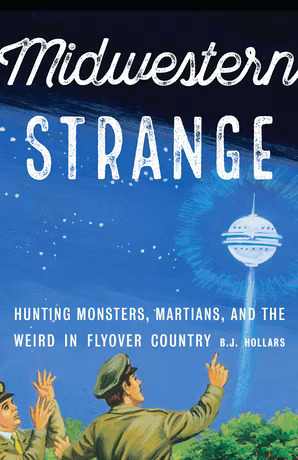
Review of Midwestern Strange: Hunting Monsters, Martians, and the Weird in Flyover Country


SFRA Review, vol. 52, no. 2

Nonfiction Reviews


Review of Midwestern Strange: Hunting Monsters, Martians, and the Weird in Flyover Country

Mark Soderstrom

B. J. Hollars. Midwestern Strange: Hunting Monsters, Martians, and the Weird in Flyover Country. U of Nebraska Press, 2019. Paperback. 224 pg. $19.95. ISBN 9781496215604.

I fell in love with the title of B. J. Hollars’s book Midwestern Strange, and am glad to review it as I also hail from the Midwest. Among other things, it’s the land of the big roadside attractions—the Corn Palace; the Largest Ball of Twine; and pop culture debutantes like the giant Paul Bunyan featured in the movie Fargo (1996) or the House on the Rock shown in Neil Gaiman’s American Gods (2001). Hollars here spins a charming narrative travelogue of his “year of living strangely” (1) detailing his visits to and researches into sites of the strange throughout the Midwest.

The book is divided into three sections: Monsters, UFOs, and The Weird. Each section is again divided into three case studies set up in procedural investigatory fashion. They include such tales as Oscar the Turtle, the Minot UFO sighting, and the grandaddy of Midwest controversies (one that divides families and actually has its own museum), the Kensington Runestone. Each case study provides historical context, a travelogue to the strange site in question, interviews with local informants and experts, as well as the author’s personal connection to the event. These personal memoirs are perhaps the most endearing aspect of the book. Here Hollars describes his childhood fear of Oscar the Turtle:

[By] the time I turned five I knew to fear northern Indiana’s murky lakes[…] . Where others saw nothing, I saw the dark and impenetrable water. And within it, an antediluvian monster, dead-eyed and licking his lips[…] . While my friends all believed their monsters lived under their beds, I knew mine lived just below the waterline. (37-38)

The personal memories and travel narratives restore to the reader the sense of wonder in the strange and unknowable. Similarly, the use of the prosaic Midwest as the site for fieldwork pokes gentle fun at the history of anthropology and exploration narratives. The author’s familial self portrait, with the author behind binoculars, his young son in a monster t-shirt, and younger daughter in swim goggles, is a gentle parody of the self portraits of the figurative “heroic colonial explorer” in the “native wilds.”

The sections are not equal in strength. The UFO section is the weakest, while the section on monsters and the finale of the Runestone were the strongest. It is not a coincidence that the strongest sections were those in which the local communities used the strange incidents to develop what public historian Tammy Gordon calls community and vernacular exhibitions: Turtle Days in Churubusco, Indiana; The Mothman Museum in Point Pleasant West Virginia (which Hollars admits is a bit far afield for those of us who are Midwestern purists); the appearance of the Hodag as a community icon in Rhinelander, Wisconsin; and the Runestone Museum in Alexandria, Minn. In the words of some of Hollars’s informants, these community celebrations of their respective strange heritages give their towns “a dot on the map.” (49) Hollars provides wonderful examples of community heritage practices and the process of memory and identity creation that are easily the book’s best folklife chapters.

The less compelling chapters are built around UFOs. The participants’ desire to prove UFOs’ existence and their desire to be taken seriously are less narratively gripping. Describing the followers of The X Files’ Mulder is not as engaging on the written page as showing them was on TV. Hollars’s wonderful wit is not as evident (save when he is joking about space pancakes). And unfortunately, some of Hollars’s larger assertions here about the nature of knowledge and science are troubling. While it is true that the communities of UFO adherents and other paranormal investigators engage in behaviors that are often similar to the practices of scientists (publishing, peer critique, conference presentations), such similarities do not necessarily make them “outsider” scientists. While a few years ago I might have been more charmed by the assertions that paranormal investigators are just unappreciated scientists yearning for recognition, in these days of anti-vaxxers, doubletalk defending disingenuous practices in COVID-19 prevention, and QAnon, I am calling on my knowledge of Thomas Kuhn, whose The Structure of Scientific Revolutions leads me to recognize that understanding scientific change and different knowledge paradigms does not make every such paradigm equal in scientific status or utility.

Still, Hollars’s observations on why we find the strange so compelling and how our embrace of curiosity and capacity for belief enhance our humanity are inspiring. In a book filled with tales about oddities such as a disappearing dinner-table-sized turtle, a reader might not expect such lofty observations on human nature and capacity.

The interdisciplinary nature of this project is its greatest strength. It is part history, part popular cultural studies, part folklore—it partakes in the forms of travel narrative, memoir, creative nonfiction, journalism, and ethnography. As someone who teaches in an interdisciplinary program, I admired its freedom and boldness in crossing boundaries. I will shelve this book with other authors like Sven Lundqvist, Tom Engelhardt, and Carol Spindel, whom I recommend as examples for my students wanting to do creative nonfiction/memoir projects.


Review of Pluriversal Politics: The Real and the Possible


SFRA Review, vol. 52, no. 2

Nonfiction Reviews


Review of Pluriversal Politics: The Real and the Possible

Pedro Ponce

Arturo Escobar. Pluriversal Politics: The Real and the Possible. Translated by David Frye. Duke UP, 2020. Cloth. 232 pg. $99.95. ISBN 9781478007937. Paper ISBN 9781478008460.

I was disappointed to learn that Arturo Escobar’s Pluriversal Politics is not a handbook for accessing alternate worlds—at least not in the familiar sense. Obliquely, this might be Escobar’s point. From Continuum (2012-2015) to 12 Monkeys (movie 1995; TV series 2015-2018) to The Man in the High Castle (2015-2019), the focus on narratives navigating multiple realities is searching for the right world, or the struggle to restore characters to their original place and time. Escobar begins with the assumption that we already inhabit a “pluriverse,” “the idea of multiple worlds but also to the idea of life as limitless flow” (26). If we fail to perceive this flow, it’s because alternate possibilities for existing are obscured by anthropocentrism, colonialism, and the manufactured needs of capitalism. While Escobar’s vision of co-existing, autonomous worlds never leaves Earth, readers will nevertheless be taken on a philosophical journey that will leave them sobered, at times perplexed, yet quite possibly inspired.

Escobar begins with a fundamental question: “are we really the autonomous individuals we imagine ourselves to be?” (5). Certainly, this is how many have learned to see the world. Development and progress, as global values, are predicated on individual choice—of work, living space, and products to consume. Over the course of subsequent chapters, Escobar convincingly demonstrates how modern individualism, far from being an innate condition of contemporary reality, is rather one possibility among many that has prevailed only because it forecloses other worldviews:

What does “being realistic” mean? It means believing that in the final analysis there is a single correct way to see and understand things (based on rationality and science); believing that these (our) universal truths must prevail against all others, which in our view are less correct, or false; being convinced that we live in a world made of a single world, and being shocked by the opposite possibility; and being sure that the truth of this single (usually Western) reality—which obviously we all share, as we should!—is the space from which we ought to promote our projects (whether they be for becoming very rich or for resisting capitalism). (6)

The problems we face as a planet, in other words, cannot be solved using the frameworks and practices that caused them in the first place. It’s not enough to resist if resistance is merely exchanging one form of individualism for another.

There are certainly precedents for thinking outside the individualist box. In Buddhism, for instance, there is no self, only being in relation to everything else: “nothing exists intrinsically; everything is mutually constituted” (19; Escobar’s italics). Other examples cited by Escobar implicate technology and the theorizing of Western knowledge. Cybernetics troubled the separation of observer and observed, implicating both in systemic relation: “This conclusion still remains at the center of debates about the real: to know is to transform yourself and the unfolding universe” (22). The developing field of political ontology “provides a space for studying the relationships between worlds, including the conflicts that result when different ontologies or worlds strive to preserve their existence in their interactions with other worlds, under asymmetric conditions of power” (25). And Foucault—an essential companion on this trip—discerned a fundamental structure to discourses, and in doing so illuminated possibilities beyond those that prevail, as in the example of discourse around Third World “development”: “What does it mean to assert that development began to function as a discourse; that is, that it created a space in which only certain things could be said or even imagined?” (51).

Ultimately, the precursors that most inform Escobar’s study/manifesto go all the way back to the beginnings of humanity as we know it:

inhabiting (habitar) can be defined as the recurrent associational interaction between living things and their environment, creating the conditions for well-being. For a good portion of their history, humans knew how to practice this form of inhabiting the habitats they found. This ethos began to crack with the Greek polis, with its geometrical forms and layouts, conceived by humans who had begun to think of themselves as superior to and apart from the natural world. Here began the long civilizational journey of the Western ontology of separation and dominion over the natural world; the habitat is transformed into ‘an out-of-focus, scarcely noticed background’ to the polis and its function of inhabiting. (154)

This prevailing ontology is contrasted with the knowledge it suppresses in order to circumscribe what passes for reality, what Escobar calls “the cosmovisions of the original peoples in many parts of the world” (15). These include groups in northwestern Colombia who practice “a relational ontology based on the idea that territories are living beings with memories, spaces in which the sacred and the everyday are lived experiences, possessing their own rights, which embody their relationships with other beings and the ways they interrelate with them” (16). In a narrative set piece, Escobar imagines a father and daughter navigating the Colombian rain forest via the Yurumanguí River, in a canoe made from the mangrove tree, using knowledge of the river’s tides, and traversing an environment rich in other species on their way home: “Ethnographers of these worlds describe it in terms of three contiguous worlds (el mundo de abajo, or infraworld; este mundo, or the human world; and el mundo de arriba, or spiritual/supraworld). There are comings and goings between these worlds, and particular places and beings connecting them, including ‘visions’ and spiritual beings” (71). Rather than treat such knowledge as an object of curiosity or “enlightened” dismissal, Escobar sees it as another form of ontology that calls instead for engagement, one pluriversal link among many that potentially impacts our collective history, politics, and culture. In contrasting one possible way of life with another, Escobar’s intent is not to romanticize these cultures, which is merely another form of centering modernity: “those who defend place, territory, and the Earth are neither romantics nor ‘infantile.’ They represent the cutting edge of thought, for they are attuned to the Earth and to justice, and they understand the central issue of our historical moment: the transitions to other models for living, toward a pluriverse of worlds” (44-45).

 (North) American readers may read Escobar with skepticism. If you’re reading this in the midst of 2021’s ongoing pandemic and political division, you might understandably have a problem with a scholar who encourages readers to think outside of science and the rational. In response, Escobar might remind us of what a pluriverse is: distinct worlds that co-exist as part of the same system. He might also respond with a simple question about our current state of individuality and consumption: How’s that working out for you?

Pedro Ponce is the author of The Devil and the Dairy Princess (Indiana University Press), winner of the 2020 Don Belton Fiction Prize. He teaches writing and literary theory at St. Lawrence University.


Review of Science Fiction and Catholicism: The Rise and Fall of the Robot Papacy


SFRA Review, vol. 52, no. 2

Nonfiction Reviews


Review of Science Fiction and Catholicism: The Rise and Fall of the Robot Papacy

Dominick Grace

Jim Clarke. Science Fiction and Catholicism: The Rise and Fall of the Robot Papacy. Gylphi, 2019. SF Storyworlds. Paperback. 292 pg. $29.99. ISBN 9781780240848.

Jim Clarke tackles an ambitious topic in Science Fiction and Catholicism; though he notes that “this study […] tracks a series of historical narratives about how Anglophone literary sf has dealt with Catholicism in the late twentieth century” (4), he in fact traces the overlap between Catholicism and SF back to the Middle Ages and provides a formidably-researched analysis of how ideological conflicts between Catholicism and Protestantism have (mis)informed the treatment/representation of Catholicism in SF. (He also considers a few texts that are arguably earlier than the “late twentieth century” framework.) His assertion in his conclusion, that Catholics, rather than representatives of other religions, have featured more prominently than representatives of other religions as rigid antagonists of irrational revelation is because of the “role which faux Catholicism has played in sf as the genre’s Other, a role foisted upon actual Catholicism by an anti-Catholic literary tradition which dates back to the post-Reformation pamphlet wars” (251). He argues that “Catholicism, perhaps of all the world’s faiths, has demonstrated the most interest in topics close to sf interests, most specifically the possibility of alien life. In return it has been rewarded with a significant though largely malign presence within the corpus of sf works” (251). While these might seem like tendentious claims—and indeed, Clarke has nothing to say about how non-Catholic manifestations of Christianity (e. g. the Gileadean regime in Atwood’s The Handmaid’s Tale [1985], to name but one example) also are common in SF—Clarke’s extensive exploration not only of SF but also of the history of the Catholic Church provides strong support for his arguments. The overlap between those deeply conversant with SF traditions and those with deep knowledge of European intellectual history is perhaps smaller than it should be. Those already well-steeped in both will not be surprised by much that Clarke says, but for those lacking such twin expertises, this is an eminently useful book.

Especially important here are Clarke’s introduction and the first chapter, “Critical Mass: How Catholicism Became Science Fiction’s Counter-Narrative,” which between them take up close to a quarter of the book, and in which he builds a well-researched and thorough exploration of how an understanding of the Reformation’s influence on how Catholicism came to be represented in literature (not only in SF but more generally, including in important antecedent genres such as the Gothic) lies beneath recurrent patterns in how Catholicism is treated in SF. Readers who know the SF but not the history will find these chapters extremely useful. Clarke follows with three further chapters, each focusing on a particular popular SF subject and considering examples of how Catholic perspectives on those issues have figured in SF, and how those perspective compare (or contrast) with what the Catholic Church has actually had to say on these subjects. Again, Clarke’s contextualization of SF representation with the Catholic Church’s actual positions is often very illuminating because his focus is not just on works of SF but on how they can be seen in dialogue (or debate) with actual Catholicism.

Chapter two provides the book’s subtitle: “The Rise and Fall of the Robot Papacy: Catholicism and Machine Intelligence.” Chapter three looks at “Missionaries to Alien Utopias: Exotheology and Catholicism in Science Fiction.” Chapter four, “Unwriting the Reformation: Anti-Catholic Uchronias in Science Fiction,” explores alternate versions of or analogues to the Catholic Church in alternate worlds narratives such as John Brunner’s Times without Number (1969), Keith Roberts’s Pavane (1968), Kingsley Amis’s The Alteration (1976), and most intriguingly, Robert Charles Wilson’s Julian Comstock: A Story of 22nd Century America (2009), among others. His discussion of Wilson is perhaps the most intriguing element of his book, as he sees in the novel “what may be a new juncture for sf—the depiction of a future made up entirely of allied or warring conservatisms” (247). For Clarke, Julian Comstock is a novel that “actively turns its back on the Enlightenment, progressive science and political liberalism, and additionally, rejects sf’s characterization of itself as a product of the Enlightenment in opposition to conservative Christianity” (248). Time will tell as to whether Clarke’s bold claim about how this novel may have established a new paradigm going forward for how SF deals with Catholicism plays out, but it makes for a rousing final argument in this insightful and readable book.

Libraries with extensive SF holdings should acquire a copy of this book. Teachers of courses on the intersection between SF and religion will find it a valuable resource. Scholars interested in the topic will also find much worth careful thought here, as well—and possibly, a few more SF books to add to their to-read pile. I know I did.

Dominick Grace is Professor of English at Brescia University College in London, Ontario. His main area of research interest is popular culture, especially comics and Science Fiction.


Review of American Utopia: Literature, Society, and the Human Use of Human Beings


SFRA Review, vol. 52, no. 2

Nonfiction Reviews


Review of American Utopia: Literature, Society, and the Human Use of Human Beings

Adam McLain

Peter Swirski. American Utopia: Literature, Society, and the Human Use of Human Beings. New York: Routledge, 2020.  Paperback, 256 pg. $44.95. ISBN-13: 978-0367144340. EBook ISBN-13: 9780429032004.

Peter Swirski’s American Utopia: Literature, Society, and the Human Use of Human Beings is a whirlwind journey through the many aspects of “utopia.”  Along with literature, Swirski brings in history, psychology, sociology, and economics to ground America’s long-lived utopian fantasy. Early in the book, Swirski introduces the authors on whom he focuses, his proclaimed four horses of the utopian apocalypse, as the authors “take on the mantle of social reformers by diagnosing the pitfalls of social reform” (39). Those authors are Thomas Disch, Bernard Malamud, Kurt Vonnegut, and Margaret Atwood.

The book is divided into five parts with each part consisting of three chapters. Part One: Utopia, Eutopia and Youtopia covers the history of the concept of “utopia” from Thomas More’s 16th century book to modern real world examples of utopian attempts, examines the history of utopia in America with a special focus on the 1960’s, and lays out the book’s thesis statement and the author’s methodology going forward. Swirski sees utopia as a diagnostic tool for society and not a prognostic tool as others in the past have treated it. In other words, utopia is a question for how society might function when various types of social engineering are applied, and not the answer to those experiments. His methodology is to ask questions regarding human nature vs. nurture, whether humans can be bioengineered to be better, and how Big Data might work with utopia in the 21st century. 

The remaining four parts of the book are each focused on one author. Each of the four authors serve as a different critique of utopia, starting with Disch’s social engineer who becomes Malamud’s social engineer stymied by biology. Vonnegut reverse-engineers humans, and Atwood bioengineers an entirely new species and abandons humans altogether. Within each of these sections, the first chapter is devoted to a biographical sketch of the author and a focused reading of a key work using utopia as a lens. The second chapter positions the work within its own literary context, highlighting influences and shared tropes. Finally, the third chapter of each section moves into the present by looking at current (or at least recent) American socio-political trends with the author’s work serving as a framework. 

Part Two: Dischtopia looks at Thomas Disch’s work 334 (1972). Swirski uses Disch’s utopia to highlight utopia’s often used trope of social engineering via education. Then he takes an interesting turn in the third part of the section when he ties social engineering to Big Data. It’s an unexpected examination of how the age of Big Data is successfully social engineering Americans on a large scale in a way that education has been unable to. Swirski argues that Big Data will eventually remove choice, or the need for choice, because an algorithm will decide everything, a type of utopian hedonism. Swirski sees the loss of decision-making agency as both utopian (the algorithm is never wrong because the data is the data) and hedonism (people are no longer tasked with making decisions for themselves) that could lead to a reduction in critical thinking and critical activity by privileging passive consumption. From here Swirski discusses what he sees as the fallacy of Universal Basic Income versus a Utopian Basic Income. A Universal Basic Income allows room for social engineering due to existing wage gaps, something akin to the Chinese Social Credit System.  A Utopian Basic Income would be based on a more equitable redistribution of wealth throughout all social classes that would remove wage gaps.  Finally, Swirski talks about how the US is the current example of the undemocratic democracy of Athens and that the US democracy is based on income inequality which adversely affects the happiness of the population. The discussion here is adventurous and highly enlightening.

Part Three: Pantopia introduces the reader to Bernard Malamud’s God’s Grace (1982). Here Malamud’s utopia examines the tribalism that is inherent when one pits social engineering against biology. To connect this to current America, Swirski discusses cultural memory and proverbs. Swirski’s interest in proverbs lies in their lasting power and how that longevity runs counter to our Snapchat world. Swirski posits that religion might be a by-product of adaptive biology in the brain. He further points out that the United States has a high level of religious participation and that a high level of religious engagement might be one of the causes of the extensive social problems plaguing the country because the human brain seeks to find agency, even supernatural agency, to explain away phenomena. Of the author discussions, this one might be the weakest. While the connections to proverbs and the novel are solid, it’s less clear how God’s Grace completely relates to American utopia.

Part Four: Uchronia focuses on Kurt Vonnegut’s Galapagos (1985) while also touching on Timequake (1997) and Cat’s Cradle (1963). It’s not always clear which novel Swirski is discussing, which could be very confusing for someone who isn’t well-versed in Vonnegut. Vonnegut’s utopia is about reverse engineering evolution in order to inspect the quality of the human brain. Swirski takes this opportunity to explore the tension between the individual and society at large. In order to facilitate the discussion, game theory is posited as the opposite of decision theory as a means of understanding the irrational versus rational when it comes to decision making. To further elucidate his discussion, Swirski introduces the game Prisoner’s Dilemma to highlight strategic give and take.  Players in the Prisoner’s Dilemma can work against one another or attempt to cooperate depending on the scenario. In terms of utopia, it becomes clear that cooperation is the best way to establish a utopia, but in America we undervalue niceness and tend to wield capitalism like a boot to the throat. While this does not make cooperation impossible, it makes it difficult. It is the way the country has evolved.

Part Five: Biotopia concentrates on Margaret Atwood’s Oryx and Crake (2003). Whereas Vonnegut reverse engineers evolution, Atwood’s utopia results in bioengineering an entirely new species. Not surprisingly, Swirski connects this to current technologies such as CRISPR, genetically modified food, clones, genetically modified animals, and humans pushing evolution. Part of Swirski’s point in this chapter is that we are unaware of the potential side-effects we may sow as we play with genetics, especially considering the history of eugenics. Humans are the agency for change and human nature will dictate the success or lack of success that a utopia might reach.

Overall, American Utopia: Literature, Society, and the Human Use of Human Beings is a fast-paced, highly informative read. The connections Swirski makes between the literary texts, utopia, and current American society are fascinating and varied. One minor quibble is that some of the section titles within the chapters can be confusing. Many of them are tongue-in-cheek literary references that aren’t explained in the context of the chapter or section. This book should appeal to those interested in the specific authors as well as those who are interested in utopia and utopia’s place in American culture.

Jennifer Kelso Farrell is an Associate Professor at the Milwaukee School of Engineering. She has degrees from the University of Montana, Montana State University, and Louisiana State University. Her writing has appeared in the Journal of Popular Culture and Foundations. Her book Lewis Carroll, Linguistic Nonsense, and Cyberpunk: An Alternate Genealogy for Science Fiction was published in 2008. Currently she resides in Milwaukee, WI with her husband and their three-legged cat, Bomba, who is a survivor of the Beirut explosion.


Review of Invoking Hope: Theory and Utopia in Dark Times


SFRA Review, vol. 52, no. 2

Nonfiction Reviews


Review of Invoking Hope: Theory and Utopia in Dark Times

Adam McLain

Phillip E. Wegner. Invoking Hope: Theory and Utopia in Dark Times. University of Minnesota Press, 2020. Paperback. 264 pg. $28.00. ISBN 9781517908867.

The hope of this review of Phillip E. Wegner’s Invoking Hope: Theory and Utopia in Dark Times, or rather this non-reading of Invoking Hope, is to not fall into the trap of the review, or the anti-reading, as the author states in his introduction: the moralizing criticism “aimed either at dissuading engagements on the part of later readers or, at least, narrowing and directing the avenues down which any future non-reading might travel” (9). Indeed, approaching a book that is so interwoven with theory and utopia can be rather daunting, for in reviewing such a delightfully dense and enjoyably ensconced text, I will most assuredly not touch on all the positive aspects of the project nor critique and construct as many future narratives and critical impositions as are possible. The main takeaway I have from Wegner’s work is that those interested in utopia, reading, or the world in general should read it; it is a book that crosses academic boundaries and allows us to refocus our efforts on striving for a better, even utopian, world.

As Wegner is very clear about in his introduction, Invoking Hope is written as a response to a(n) (un)certain time and a (non-)specific event: the 2016 inauguration of a media and real estate mogul as the President of the United States. Wegner does not necessarily make his book an anti-Trump text; instead, he weaves together a series of essays, split into two parts, that shows readers how to use utopia to (non-)read and then (non-)reading utopia through disparate texts. He wishes to show how an act of reading can be a utopian act that subverts and overcomes—by living through—even the darkest of times.

Wegner’s approach to utopia and the current moment is theoretical and philosophical rather than historical or practical (meaning a step-by-step instruction guide). This methodology is seen beautifully in the first chapter, in which he outlines a Greimas semiotic square, realized through the work of (and Wegner’s work on the work of) Fredric Jameson, to approach the Chicago school of New Critics; he then uses this approach to read with Alain Badiou’s Plato’s Republic (2013), itself a translation and re-reading (or re-writing/non-reading) of Plato, and collectively shows that one of the fundamental problems with democracy, especially in the United States, is its emphasis on individual economic prosperity rather than collective political good. Wegner, then, creates the theoretical apparatus needed to show how, with semiotic square and Lacanian orders mapped onto each other, he is able to read, or rather non-read, utopian genres in order to invoke hope.

Having established a semiotic approach to utopia, he further engages in this conundrum in chapter two by arguing for the art of non-reading, as formulated by Pierre Bayard and his reviewers. Non-reading, for Wegner, is what people do when they approach a text through literary criticism; they are at both times reading the text and remembering the text as they write their own text. He then proceeds to non-read More’s Utopia (1516) to show that “utopia is located in Utopia, More’s book itself, and most particularly in the figure of a dialogue it offers us” (84). This non-reading of Utopia echoes through the rest of the book as Wegner approaches texts as utopian inside and as the text itself, rather than attempting to create or formulate a utopian mindset or utopian way of approaching the world around them.

Establishing this practice of non-reading allows Wegner to move beyond an ethical reading, which he does in the subsequent chapters. Instead of trying to read morality out of a text, then, he is attempting to non-read utopia through the text. This effort is seen in his recapitulation of the Henry James–H. G. Wells debate during the modernist period, in which James considered novels to need strict rules, while Wells was open to more fluid motion within a text. While James, for some time, won this debate, which led, in Wegner’s argument, to the rise of ethical reading and the New Criticism discussed in the first chapter, he shows how his non-reading can overcome this approach to four specific genres: the universal history, the kunstlerroman or artist’s story, the comedy of the (re-)marriage, and the science fiction. He concludes that utopia is “never no-where, an imagined perfected future, but in fact always already potentially exists in the concrete now-here, in our collective fidelity to the project of making a world we so desire rather than a world we fear” (218): indeed, the hope of utopia that is invoked in the use of theory in the book is the striving toward the future that comes from non-reading, as Wegner shows as he non-reads such unique and seemingly unconnected texts as Du Bois, “Babette’s Feast” (1950), 50 First Dates (2004), 2312 (2013), and Cloud Atlas (2004).

While the theory in the book is astute, diverse, and vast, much of the book is rooted in and heavily relies on the work of Fredric Jameson. This reliance makes sense: Wegner’s career has been focused on Jameson’s work as the central thinker with whom he engages. And yet, it seemed as if Jameson had something to say about every single topic in which Wegner engaged. In this way, then, parts of the book feel to be utopia and theory through Jameson rather than through Wegner. Thus, I read Invoking Hope as a new and innovative text that synthesizes many literary and utopian schools of thought in brilliant ways, and it is a part of Wegner’s project, seen through his other work (Imaginary Communities [2002], Life Between Two Deaths [2009], Shockwaves of Possibility [2014], and Periodizing Jameson [2014]), that continues to develop Jameson’s (and Wegner’s) thinking together. The book does invoke the hope needed during dark days that have passed and the dark days of the future as we collectively move toward utopian ideals and theoretical advancements.

Adam McLain researches and writes on dystopian literature, legal theory, and sexual ethics. He is currently a Harvard Frank Knox Traveling Fellow, studying twentieth-century dystopian literature and the legal history of sexual violence in the UK. He has a bachelor’s degree in English from Brigham Young University and a master of theological studies from Harvard Divinity School.


Review of Hidden Wyndham: Life, Love, Letters


SFRA Review, vol. 52, no. 1

Nonfiction Reviews


Review of Hidden Wyndham: Life, Love, Letters

Dennis Wilson Wise

Binns, Amy. Hidden Wyndham: Life, Love, Letters. Grace Judson Press, 2019. Paperback. 276 pg. $14.95. ISBN 9780992756710.

At this point, it seems almost obligatory for anyone who mentions John Wyndham’s life to begin by quoting his reputation as science fiction’s “invisible man.” Although not as mysterious as Elena Ferrante, nor as reclusive as J. D. Salinger and Thomas Pynchon, Wyndham nonetheless let personal reticence become a defining feature of his public identity. In fact, his best comparison is probably to C. S. Lewis. For most of Lewis’s life, the Oxford fantasist cohabitated with a woman two decades his senior, the mother of a friend who died during the First World War, and neither friends nor his brother Warnie (with whom Lewis was quite close) ever knew the precise nature of their relationship. Considering Wyndham’s deep-set disdain for religion, this comparison with Lewis would probably have irked him. It remains apt, though, and so his “hidden” life thus forms the main subject for Amy Binns’s snappy new biography, Hidden Wyndham. For the most part, her research derives from the Wyndham Archive at the University of Liverpool. Among other documents and paraphernalia, this collection holds over 350 private letters between Wyndham and his long-term partner Grace Wilson. In addition, Binns puts her journalistic training to good use, especially when studying the earlier portions of Wyndham’s life. For example, she supplements her biography with primary source material from newspapers and court cases; these documents detail the bitter, contentious, and distressingly public legal wrangle that embroiled Wyndham’s self-destructive father George Harris against his (then) wife’s upper-middle-class family of “new money” industrialists. To this traumatic and shameful scandal Binns attributes much of Wyndham’s extreme personal reserve.

Overall, Binns’s biography paints a compelling picture. As much as newspaper gossip about familial conflict may have affected the young Wyndham, she also chronicles his equally traumatic education in the British public schooling system. After her divorce, Wyndham’s mother Gertrude spent her life living in hotels, and she consequently shunted her two sons—Jack and Vivian—through a series of boarding schools where pervasive bullying made their young lives almost unbearable. The only exception for Jack was Bedales, a “school for snowflakes” as Binns calls it (45), but still a desperately needed safe haven. While not terribly good at providing its students a quality education, Bedales created precisely the sort of nurturing, stable environment that Gertrude’s two children otherwise wholly lacked. This school would have a lasting influence on Wyndham. As Binns notes, the last name for the character Michael Beadley in The Day of the Triffids (1951) was created when Wyndham conflated the name “Bedales” with that of its visionary and highly progressive headmaster, J. H. Badley.

After her account of Bedales and a series of desultory and quickly abandoned careers, Binns then chronicles Wyndham’s move into the Penn Club at London—basically, a “slightly more adult version of Bedales” (65). There, Wyndham retained just enough money from his mother’s inheritance to drift along aimlessly as he tried, with mixed success, to break into the American pulp SF market. At the Penn Club in 1930, however, Wyndham also met Grace Wilson, a teacher and a major source of interest for Binns. The famous secrecy of Wyndham, says Binns, stems from more than just a scandalous family history—it also stems from the unusual nature of Wyndham and Grace’s relationship. Before marrying in 1963, they’d already been secret lovers for over a quarter century. As a teacher, Grace was legally barred from marrying until 1938, but neither person much respected the institution of marriage anyway. Wyndham in particular believed marriage had “a crippling effect on women’s personalities” (72), enforcing a dependency on men that was entirely anti-feminist. As proof, Binns points to Gordon Zellaby from The Midwich Cuckoos (1957), numerous short stories such as “Dumb Martian” (1952), but also to Wyndham’s mother Gertrude. For most of her life, Gertrude rotated between male protectors—from father, to husband, to father again—without once accomplishing anything worthwhile with her privilege. In fact, although “Jack never breathed a word against” his mother in hundreds of letters, Binns argues with some (though not complete) convincingness that Wyndham’s novels “tell a different story” (136)—namely, that Gertrude’s absenteeism explains the dearth of quality maternal figures in Wyndham’s work.

Still, Binns saves her most ambitious claim for the end of her book—the idea that Grace Wilson served as the inspiration for all of Wyndham’s pro-active, feminist heroines. On a rhetorical level, this reserve by Binns represents an interesting choice. I suspect it betokens her awareness that such a rigid, one-to-one biographical correspondence might strike some readers as a reach—a largely intuitive leap from the available evidence rather than a concrete, uncontestable fact. Yet, because she saves this claim for the end, readers need not trip themselves up with this claim as they’re reading. Nonetheless, the Grace thesis structures the entirety of Hidden Wyndham. As Binns’s subtitle indicates, her book focuses on “life, love, letters.” Although Binns cannot avoid discussing the novels and short fiction, literary criticism takes second stage to Wyndham’s long, monogamous romance with Grace. For instance, long portions of Part Two, which covers the years 1939–1945, are only reprinted extracts from Wyndham’s war letters to his lover, almost as if to demonstrate through an abundance of reproduced primary source material that Grace did, in fact, shape and center Wyndham’s emotional life. Indeed, much as with Binns’s belated forays into literary criticism, Part Two focuses less on the Second World War itself, which Binns avoids contextualizing or describing in detail, than on revealing the painful separation inaugurated by that war between Wyndham and Grace—an anguished, painful time for them both. Yet as the letters show, Grace undeniably served as Wyndham’s main psychological support.

Now, though, is probably a decent time to mention the elephant-in-the-room of Wyndham scholarship. Within SF circles it’s long been known that David Ketterer, an academic, has been writing a biography of Wyndham since the mid-1990s—in fact, the entry on Ketterer for The Encyclopedia of Science Fiction even drolly observes that this “full study is awaited with impatience” (Nicholls). Yet, throughout the entirely of Hidden Wyndham, Binns applies a certain cautious circumspection in regard to her fellow biographer. On one hand, she mentions Ketterer explicitly in her acknowledgements, citing his “excellent research” and his graciousness in allowing her to read “some” of Grace Wilson’s personal diaries (284; see also 79, n. 24). On the other hand, Binns cites relatively little of that “excellent research,” and when she does, she generally limits herself to purely factual details. The most glaring silence concerns Ketterer’s almost 9,000 word article on Wyndham for The Literary Encyclopedia. Any direct comparison between that article and Hidden Wyndham, however, quickly reveals why: Binns devotes large sections of her biography to challenging many of Ketterer’s key interpretations.

The most obvious sore point involves the status of Grace Wilson herself. For Ketterer, she and Wyndham were merely “good companions,” and he firmly denies that Grace was the love of Wyndham’s life. His main evidence stems from a comment in one of Wyndham’s rare interviews. In 1961, when asked why he has remained a bachelor so long, the author replied that although he’d met the right person twice, each time the lady had met someone “righter.” Ketterer takes this statement at face value, so he attempts to identify (however tentatively) those two “Mrs Rights.” Binns, however, considers Wyndham’s statement a red herring, a classic case of misdirection. After all, why would Wyndham blurt out the truth to a reporter after concealing it for decades, and when publicly revealing their unmarried relationship would cost Grace “her job and reputation” (218)? To my mind, the more plausible interpretation lies with Binns, but her disagreements with Ketterer hardly stop there. At one point, Binns admits to submitting Wyndham’s birth certificate to a professional genealogist, who verified its authenticity (36, n. 11). With deliberate vagueness, her footnote merely mentions that “another researcher” has questioned its validity, but she is clearly referring to Ketterer here, who asserts in his revised Literary Encyclopedia article that “90-something-per-cent proof” exists for Wyndham being born out of wedlock; a later article in the journal Foundation presents Ketterer’s reasoning in fuller detail. Obviously, Binns finds this reasoning unsubstantiated by the evidence.

From my outsider’s perspective, Binns’s need for critical discretion in Hidden Wyndham—her dancing around any direct challenge to Ketterer—recalls a little something of A. S. Byatt’s novel Possession (1990), a book that depicts the hotbed of tensions and jealousies that can sometimes arise between literary biographers. Notably, although Ketterer permitted Binns to read some of Grace Wilson’s diaries, he uncharitably refused her access to the entire collection. One can only hope that if Ketterer ever publishes a rebuttal to Hidden Wyndham—and I myself would consider a second biography worthwhile—that rebuttal would not avail itself, even partially, of information denied to Binns by Ketterer himself. In any event, Hidden Wyndham remains an edifying, highly readable account of one of British SF’s major 20th-century writers, and Binns does an admirable job in conveying the inner life of someone cagily reticent about that inner life. Even if the usefulness of a strict identification between Grace Wilson and Wyndham’s most ardently feminist heroines can be debated, especially in terms of literary criticism, Grace’s central importance to Wyndham himself seems undeniable. All told, any scholar interested in Wyndham’s work should be glad to have this valuable biography by Binns as a resource.

WORKS CITED

Ketterer, David. “John Wyndham.” The Literary Encyclopedia. First published 7 Nov. 2006, http://www.litencyc.com/php/speople.php?rec=true&UID=4820. Accessed 19 Dec. 2021.

—. “When and Where Was John Wyndham Born?” Foundation: The International Review of Science Fiction, vol. 42, no. 115, Summer 2012/2013, pp. 22–39.

Nicholls, Peter. “Ketterer, David.” The Encyclopedia of Science Fiction. Updated 25 Oct. 2021, https://sf-encyclopedia.com/entry/ketterer_david. Accessed 19 Dec. 1921.

Dennis Wilson Wise is a lecturer at the University of Arizona, and he studies the links between epic fantasy and political theory. Previous articles have appeared in journals like Tolkien Studies, Journal of the Fantastic in the ArtsGothic StudiesLaw & Literature, Extrapolation, and more. Currently, he’s assembling a critical anthology, now under advance contract from Fairleigh Dickinson University Press, called Speculative Poetry and the Modern Alliterative Revival. Wise is also the reviews editor for Fafnir, which in 2020 became the first academic journal to win a World Fantasy Award.


Review of Unstable Masks: Whiteness and American Superhero Comics


SFRA Review, vol. 52, no. 1

Nonfiction Reviews


Review of Unstable Masks: Whiteness and American Superhero Comics

Kristin Noone

Guynes, Sean and Martin Lund, eds. Unstable Masks: Whiteness and American Superhero Comics. Ohio State UP, 2020. New Suns: Race, Gender, and Sexuality in the Speculative. Paperback. 274 pg. $29.95. ISBN 9780814255636. PDF ISBN 9780814277508.

Unstable Masks: Whiteness and American Superhero Comics, edited by Sean Guynes and Martin Lund, sets out to discuss the interstitial relationship between whiteness, American culture, and comic book superheroes, considering the complex intersections of identity, representation, narrative, production and consumption, and historical and cultural contexts for the production of American superhero comics. In this powerful and timely collection of scholarship, contributors from a variety of backgrounds explore the production, audience, and reception of superhero comic books as a means to engage with questions of what it means to be American and to be heroic, how deeply the superhero figure remains imbricated within the discourses of whiteness in the United States in the twentieth and twenty-first centuries, and the great power and great responsibility of actively working to dismantle predominantly white cultural constructions of heroism.

Unstable Masks is divided into three sections, grouped by theme; each section focuses on a particular way of reading or historicizing the relationship of whiteness to the American superhero comics genre, and the sections build upon each other in a thoughtful and wide-ranging sequence. Frederick Luis Aldama’s Foreword, “Unmasking Whiteness: Re-Spacing the Speculative in Superhero Comics,” emphasizes the importance of speculative genres such as superhero narratives in shaking up complacent spaces and exploring questions of freedom and shared experiences, providing an overall context for the discussion to come; in their Introduction, “Not to Interpret, but to Abolish: Whiteness Studies and American Superhero Comics,” Sean Guynes and Martin Lund bring together comics scholarship, critical race studies and whiteness studies, the election of American President Donald Trump and the question of American “greatness,” and the Black Lives Matter movement to vividly demonstrate the critical importance of this discussion at this present cultural moment. Guynes and Lund invoke Frantz Fanon’s Black Skin, White Masks to explore masks as an ongoing metaphor (reflected in the title Unstable Masks): the identity nonwhite people must successfully perform in a white-dominated society becomes connected to the masks and performative identities of the superhero, examples of which will be examined in the following chapters.

The first section, “Outlining Superheroic Whiteness,” contains essays that work together to think about whiteness as inherent to, and also problematic for, American superhero comics; the essays in this section explore comparisons and constructions of characters across time and storylines in order to establish an overall sense of what “whiteness” means in relation to comics. Osvaldo Oyola’s essay “Marked for Failure: Whiteness, Innocence, and Power in Defining Captain America” performs a comparative reading of two versions of Captain America, Steve Rogers and Sam Wilson, to conclude that Sam is set up for failure in the role due to his inability to harness the symbolic whiteness of “Captain America,” suggesting that Sam Wilson’s story challenges readers to acknowledge the deep antiblackness inherent in American cultural systems, including the comics industry itself. In “The Whiteness of the Whale and the Darkness of the Dinosaur: The Africanist Presence in Superhero Comics from Black Lightning to Moon Girl,” Eric Berlatsky and Sika Dagbovie-Mullins read the first Black Lightning series (1977–1978) alongside the more contemporary Moon Girl and Devil Dinosaur (2016–2017) to conclude that even in supposedly postracial characterizations, stereotypes of primitivism, hypersexuality, and criminality persist, which serve to define heroism by contrast, aligning the superhero with whiteness. Jeremy M. Carnes continues this discussion of the savage/civilized binary, and its role as a tactic of settler colonialism, in “’The Original Enchantment’: Whiteness, Indigeneity, and Representational Logics in The New Mutants,” and Olivia Hicks’s contribution “Fearfully and Wonderfully Made: The Racial Politics of Cloak and Dagger” examines a specific example of the constructed nature of whiteness in the context of Reagan’s America, demonstrating the ways in which the idealized white femininity of the character Dagger showcases the form of American whiteness that has historically profited from yet also disavowed black labor. Following this close historical reading with an expansion into crossovers and status-changing comics events, Shamika Ann Mitchell argues in “Worlds Collide: Whiteness, Integration, and Diversity in the DC/Milestone Crossover” that even in an event meant to highlight diversity, in which DC’s heroes combine forces with the racially diverse superheroes of the Milestone universe, whiteness and white heroes remain centered and prioritized. Finally, José Alaniz concludes this section with “Whiteness and Superheroes in the Comix/Codices of Enrique Chagoya,” reading the politicized art of Enrique Chagoya in terms of Gloria Anzaldúa’s concept of “border consciousness,” the space of ambivalence created by a clash of cultures; in Chagoya’s art, Alaniz suggests, the repurposed superhero might function as a symbol of empowerment but also an implement for critique of both a dominant white culture and hypermasculinity.

The second section, “Reaching toward Whiteness,” expands the discussion by delving into the instability and contingency of whiteness, noting the ongoing and precarious negotiations of who gets to be considered white in America; essays in this section investigate the ways in which comics frame whiteness in relation to other articulations of race and ethnicity. Esther De Dauw’s “Seeing White: Normalization and Domesticity in Vision’s Cyborg Identity” focuses on the cyborg hero Vision, noting that the cyborg can perform white masculinity successfully, but the performance is always a construction, an active suppression of Otherness, that ultimately leads to failure and even potential villainy, which in turn suggests that only whiteness can achieve the truly moral lifestyle. In ““Beware the Fanatic!”: Jewishness, Whiteness, and Civil Rights in X-Men (1963–1970),” Martin Lund carries this investigation of morality and whiteness into early X-Men comics, concluding that these stories do attempt to engage with civil rights issues, particularly in Lee and Kirby’s awareness of the struggles of Jewish-American life, but follow a liberal assimilationist line rather than a radical one, fail to truly empathize with the oppressed, and ultimately read as a negotiation between different shades of whiteness. Similarly, Neil Shyminsky examines the storylines of “Decimation” (2006) and “Avengers vs. X-Men” (2012) to argue in “Mutation, Racialization, Decimation: The X-Men as White Men” that the X-Men remain privileged—predominantly white, wealthy or with access to wealthy mentorship, and physically attractive according to American cultural ideals—and remain indebted to a social order that privileges whiteness; if the X-Men or other mutants do attempt to reject the white American hegemony, Shyminksy observes, then they are necessarily figured as villains within the storyline. Finally, Sean Guynes, in “White Plasticity and Black Possibility in Darwyn Cooke’s DC: The New Frontier,” offers a detailed and eloquent reading of Cooke’s work as a form of critical nostalgia that attempts to re-envision the past and think through questions of DC Comics’s racial legacy, potentially opening up more possibilities for the black superhero, but simultaneously emphasizing the fundamental whiteness of existing superhero comics and characters.

The final section, “Whiteness by a Different Color,” links discussions of apprehension, negotiation, and acceptance to one of the most well-known superhero tropes: the secret identity. Essays in this section examine the secret identity in terms of fluidity and invisibility, as connected to whiteness and the privileges that being white can afford. Yvonne Chireau’s “White or Indian? Whiteness and Becoming the White Indian Comics Superhero” draws attention to the numerous white comics characters who become “White Indian” superheroes, arguing that these heroes reinforce white supremacy tropes by appropriating the Native American identity part of their transmutation into saviors. Continuing the discussion of cultural appropriation, Matthew Pustz examines the complicated legacy of white martial arts superheroes in “A True Son of K’un-Lun”: The Awkward Racial Politics of White Martial Arts Superheroes in the 1970s,” focusing on the characters of Iron Fist and Richard Dragon in the context of the 1970s explosion of interest in the martial arts in America to demonstrate the ways in which whiteness implicitly bestows flexibility, adaptability, hyper-competence, and true understanding, in contrast to a flattened and generic portrayal of Asian characters. Eric Sobel’s “The Whitest There Is at What I Do: Japanese Identity and the Unmarked Hero in Wolverine (1982)” carries this examination into Wolverine’s complex relationship with Japanese culture, observing that Chris Claremont and Frank Miller’s Wolverine is shown to more successfully embody qualities of an imagined Japan than any Japanese characters; while the storyline attempts to portray Wolverine as simply a worthy man who takes on non–culturally specific qualities of virtue, regardless of race, he is nevertheless always a white man in perfect health, morally and physically exceptional, making his connection to marginalized identities difficult to defend. Finally, in “The Dark Knight: Whiteness, Appropriation, Colonization, and Batman in the New 52 Era,” Jeffrey A. Brown concludes that the New 52 Batman comics, in particular Grant Morrison’s Batman Incorporated, offer a surface-level depiction of superhero diversity at a global level, but in fact perpetuate an ideology of white privilege through Bruce Wayne’s appropriation of exotic skills and Batman’s neocolonial approach to enlisting foreign heroes to serve as supporting characters in his personal vendetta, ending the section overall with a fitting critique of the way in which this narrative mirrors DC’s—and by extension the American capitalist—corporate attitude toward these foreign heroes, simply abandoning them once they had served their purpose for the wealthy white American hero.

Noah Berlatsky, in the Afterword “Empowerment for Some, or Tentacle Sex for All,” connects the films Birth of a Nation (1915) and Black Panther (2018) to Octavia Butler’s Xenogenesis trilogy to offer a poignant overview of the ways in which “superness” (259), like whiteness, has always been dependent on a world in which some people are more equal than others, and to suggest that if whiteness can be decentered and detached from superpowered heroes, then perhaps empowerment will be possible for everyone. This ending note of hope is precisely why Unstable Masks is an important and powerful book: wide-ranging in terms of texts and time periods, but eloquently connected to the present cultural moment in America (and beyond), and profoundly significant for thinking through how we might reconceptualize the heroes we construct for our future.

Kristin Noone is an English instructor and Writing Center faculty at Irvine Valley College; her research explores medievalism, adaptation, heterotemporalities, fantasy, and romance. In 2018 and 2019 she received the National Popular Culture Association’s Two-Year College Faculty Award, as well as the Kathleen Gilles Seidel Award, administered by the International Association for the Study of Popular Romance, for travel and research support in Australia. She is the editor of the essay collections Terry Pratchett’s Ethical Worlds (2020) and Welsh Mythology and Folklore in Popular Culture (2011),  and has published on subjects from Neil Gaiman’s many Beowulfs to depictions of witchcraft in Terry Pratchett’s Discworld to Arthurian references in World of Warcraft. She is currently working on a book-length study of Star Trek tie-in novels as sites of cross-media and cross-genre contact.