Review of Futuristic Cars and Space Bicycles: Contesting the Road in American Science Fiction


SFRA Review, vol. 52, no. 4

Nonfiction Reviews


Review of Futuristic Cars and Space Bicycles: Contesting the Road in American Science Fiction

Fred Motson

Jeremy Withers. Futuristic Cars and Space Bicycles: Contesting the Road in American Science Fiction. Liverpool UP, 2020. Hardcover. 256 pg. $120.00. ISBN 9781789621754.
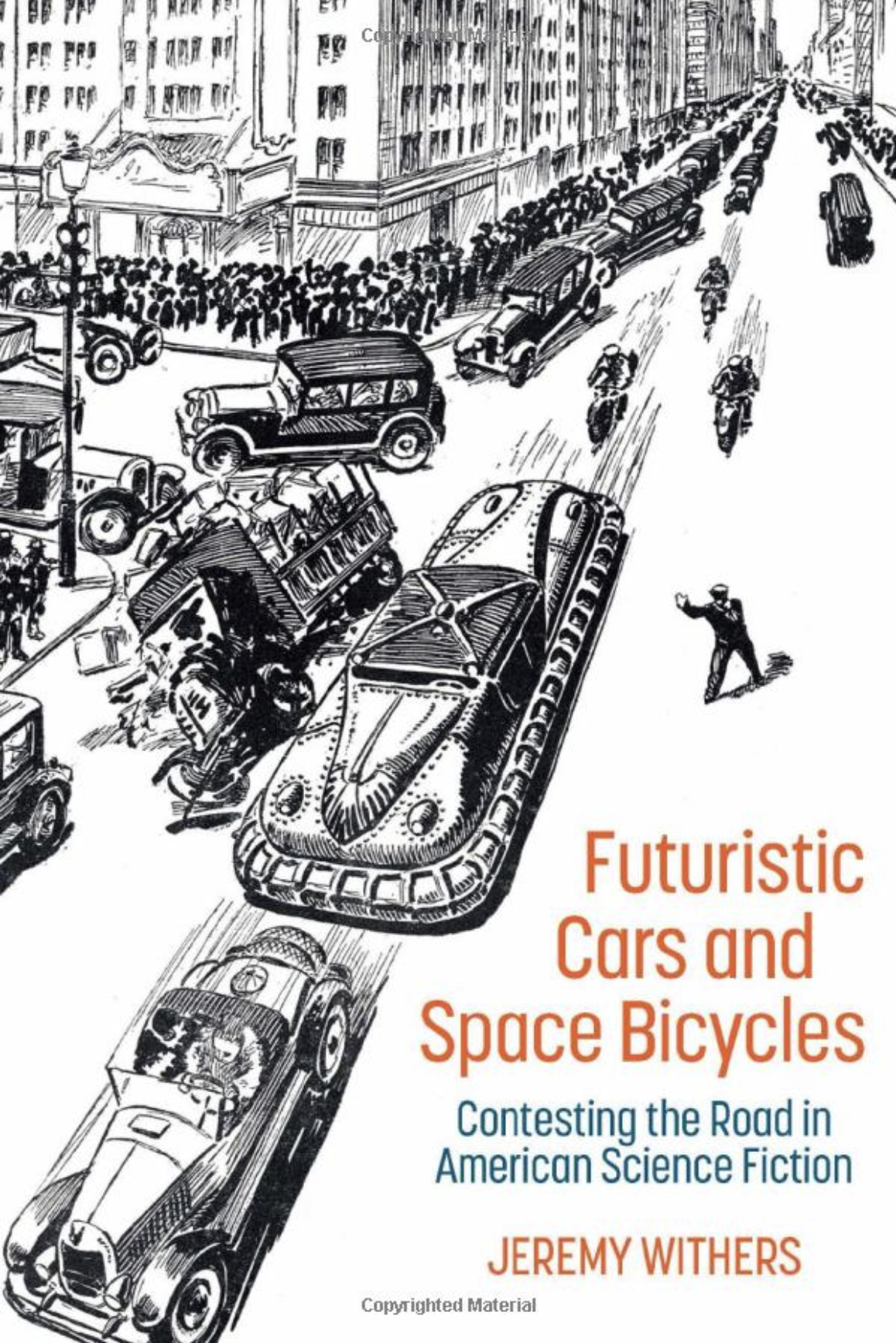
As technology continues to advance, it can increasingly feel as though the (first) world is coming ever closer to transportation methods from “science fiction.” Jeremy Withers’ Futuristic Cars and Space Bicycles: Contesting the Road in American Science Fiction provides a timely and wide-ranging survey of how many methods of transportation, but most predominantly the car and the bicycle, have been portrayed in the past century of speculative fiction.

Withers identifies six eras of speculative fiction, each of which has produced works which include representations of cars and/or bicycles. These eras are identified by Withers as: the pulp era (c. 1926-40); the ‘Golden Age’ of sf in the 1950s; the New Wave era (c. 1960-1975); postcyberpunk in the 1990s; and in recent times both postapocalyptic cli-fi and 1980s-nostalgia sf. For each of the six eras, Withers focuses on three exemplar works. The majority of the authors selected will be familiar to the sf enthusiast, although the specific works identified are not necessarily their best-known texts. Thus authors such as Hugo Gernsback, Ray Bradbury, Ursula K. Le Guin and William Gibson are represented, with a roughly even split in the texts examined between short stories and books. The final chapter goes beyond the written word to also consider film and television works.

In the introduction, Withers stresses the multidisciplinary nature of his studies, and while the theme of transportation vehicles is present throughout, it is difficult to categorise the book as belonging to a particular discipline. Withers himself suggests that it sits between ecocriticism, environmental humanities, and mobility studies. I would not underestimate the sociohistorical elements of the book either. Much of the discussion expressly draws connections between wider social concerns and the perspective taken in the texts discussed. This is done particularly well in relation to authors’ individual and often ill-fated histories with automobiles. Many of the authors examined in the book were avowed non-drivers, albeit for a wide range of reasons (Bradbury saw a shocking and gory car accident as a teenager; Octavia Butler was prevented by her dyslexia). Most shockingly of all, Hugo Gernsback’s three-year-old daughter was struck and killed by a taxi in 1928. The two factors which seem to arise again and again are the physical dangers of automobiles (especially to pedestrians) and their environmental impact.

As this might suggest, Withers’ own view is clear. “Two wheels good, four wheels bad” is perhaps an unfair reduction of the argument that pervades the book, but this is very much a critique of the automobile rather than a simple exploration of its portrayal. The methodical structure maintained throughout the book does mean that it is of considerable value in tracking how (some) sf has represented and interpreted the (futuristic) car and bicycle over time; but it should always be borne in mind that the author has chosen the examples to support the argument.

It is usually a mark of good writing when a reviewer would have appreciated a fuller treatment of the subject. Both elements of that sentence apply here. The book is engagingly-written and was an ideal companion for post-lockdown trips to the coffee shop: trips usually followed by a search for some of the lesser-known short stories discussed in the book (although do be aware that the discussion does contain plot spoilers). My one regret is that during the author’s necessarily limited tour of a hundred years of sf, there was not space for a little more reflection on the wider literary context of each era. As the book progressed, so did the scope, as skateboards, airships and tanks enter the scene. I felt that at times the narrative broadened to a more general comparison of ‘harmful’ and ‘benign’ (again, in the sense of safety and particularly environmental impact) methods of transport – an interesting discussion but arguably one better explored in a further book. A similar point could be made about the final substantive chapter relating to the increasingly iconic 1980s nostalgia trope of “kids on bikes.” Withers discusses these recent texts with some authority and raises some interesting points, particularly related to gender, but the chapter feels a little disconnected from what has come before. This is perhaps at least in part due to the fact that the bikes and cars involved in these texts are nostalgic representations of what was (at least in a certain idealised America) rather than futuristic representations of what may be.

Futuristic Cars and Space Bicycles is a valuable contribution to a wide range of fields which touch on transport and imagined futures. From my own legal perspective, I found sections on how regulation of various forms of futuristic transport has been portrayed in sf particularly interesting, especially given the ongoing debate as to how the law should react and adapt to advances such as autonomous vehicles and e-scooters. I would suggest that the book is of interest to a wide academic audience and while the (seemingly inevitable) price point of a hardback specialist academic work places it outside the budget of the general sf enthusiast, hopefully library access and perhaps a future paperback edition might ensure the book receives a deserved wider audience.

Fred Motson is a Lecturer in Law at the Open University, UK. Fred’s research interests include sports law, property law and environmental law. He has a particular interest in the intersection between law and technology, both in how technology can shape or change the practice of law and in how law responds to technological advances. Fred has a number of forthcoming projects exploring how representations of the law in sf can inform legal policy today.
Review of Reality, Magic, and Other Lies: Fairy-Tale Film Truths


SFRA Review, vol. 52, no. 4

Nonfiction Reviews


Review of Reality, Magic, and Other Lies: Fairy-Tale Film Truths

Megan Spring

Pauline Greenhill. Reality, Magic, and Other Lies: Fairy-Tale Film Truths. Wayne State University Press, 2020. Paperback. 268 pg. $32.99. ISBN 9780814342220.

In her book Reality, Magic, and Other Lies, Pauline Greenhill posits that while the terms “fantasy and reality,” and “magic and science” might seem mutually exclusive and at odds, the two sets of ideas should be considered, at times, synonymous. Greenhill equates the English verb lie as synonymous with “story, fairy tale, and folklore” in order to expose the nuance between how individuals perceive deceit and how they might perceive narrative in the form of fairytale and folklore (Greenhill 13). She plays on the conception of truth as it is revealed through fictional fairy stories—stories that require the audience to engage with some type of “lie” perpetuated by the creator in both film and book in order to attain truth.

Greenhill’s book is divided into two parts containing a total of eight chapters. Part one, “Studio, Director, and Writer Oeuvres,” discusses films with fairy tale-esque elements, each chapter dwelling explicitly on the relationship between the fantastic and the real world, always exposing the intersectionality between the two. In chapter two, Greenhill closely analyzes four films from LAIKA entertainment studios (Coraline [2009], ParaNorman [2012], The Boxtrolls [2014], and Kubo and the Two Strings [2016]), discussing the symbolic overlap between stop-motion animation and the malleable nature of human beings. She ultimately comes to the conclusion that “the linking of animation with reality also thematically connects it to real-world concepts—how films instantiate hegemonic or anti-hegemonic viewpoints, and sometimes both…” (65), thus nuancing her thesis that while fantastical in nature, fairytales speak more truth to the “real world” and its power structures than perhaps participants actually functioning in the real world.  In chapter three, she again highlights the intersectionality between the fantastic and reality. Greenhill progresses from animation to focus on live-action media (The Fall [2006], Mirror Mirror [2012], and Emerald City [2017]) by Tarsem. Greenhill focuses more specifically on the intersectionality of magic and science in this chapter, referring to claims she introduced early in the book that magic and science can be synonymous. Building upon her argument in chapter two, in which she posits the relationship between animation and reality as a means to express the relationship between fantasy and reality, in chapter 3 Greenhill presents issues of heterospatiality and heterotemporality as they are manifested in The Fall and Mirror Mirror respectively, in order to convey a synonymous relationship between magic and reality.  Similarly, she uses Emerald City as a means to further her initial claim that depending on one’s situated history, science can be seen as magic or vice versa, appealing to her argument that fantasy and reality are foundationally rooted together. Chapter four functions as Greenhill’s linchpin as she moves from animation to live-action and then finally includes herself in the action through a pseudo-autoethnographic study of Luc Picard’s work (Babine [2008] and Ésimésac [2012]), as she travels to Saint-Élie-de-Caxton to record and experience the real life and fictional aspects of Picard’s films, who quite literally creates fantastic tales based upon real people and events.

In part two, “Themes and Issues from Three Fairy Tales,” chapters five through seven shift from analysis of specific films to use of queer, feminist, and critical race theory to analyze modern renditions of the popular fairy tales “Hansel and Gretel,” “The Juniper Tree,” and “Cinderella,” respectively. Greenhill furthers her argument by looking at perpetuated narrative as a means to decode how reality is represented. Through her readings of the tales, she equates reality (manifested through accepted norms) with a type of fantasy in and of itself. She asserts that accepted reality exists as a means to deceive, as it perpetuates the fantasy of hetero, patriarchal, and Eurocentric norms. Her reading using the aforementioned literary theory adds another perspective to the fairytales, again muddying the line between fantasy and reality even further and, thus, evidencing her initial claim regarding the intersectionality between fantasy and reality, magic and science, deceit and truth. This section of the book answers the call put forth in the title to address the “Other Lies” perpetuated throughout society manifested through the relationship between fantasy and reality.

While no doubt the generally curious would benefit from reading this book, the text is best suited to those with an interest and background in folkloric studies, as some of the jargon and theory (especially in the second half) would require substantial supplementary reading for the lay reader. In addition, while the concept of narrative as fluid irrespective of medium furthers her argument regarding the transcendence of magic, some of Greenhill’s nuance could be lost on those not at least somewhat familiar with the films and stories presented throughout the book, even with her ritual plot synopses.

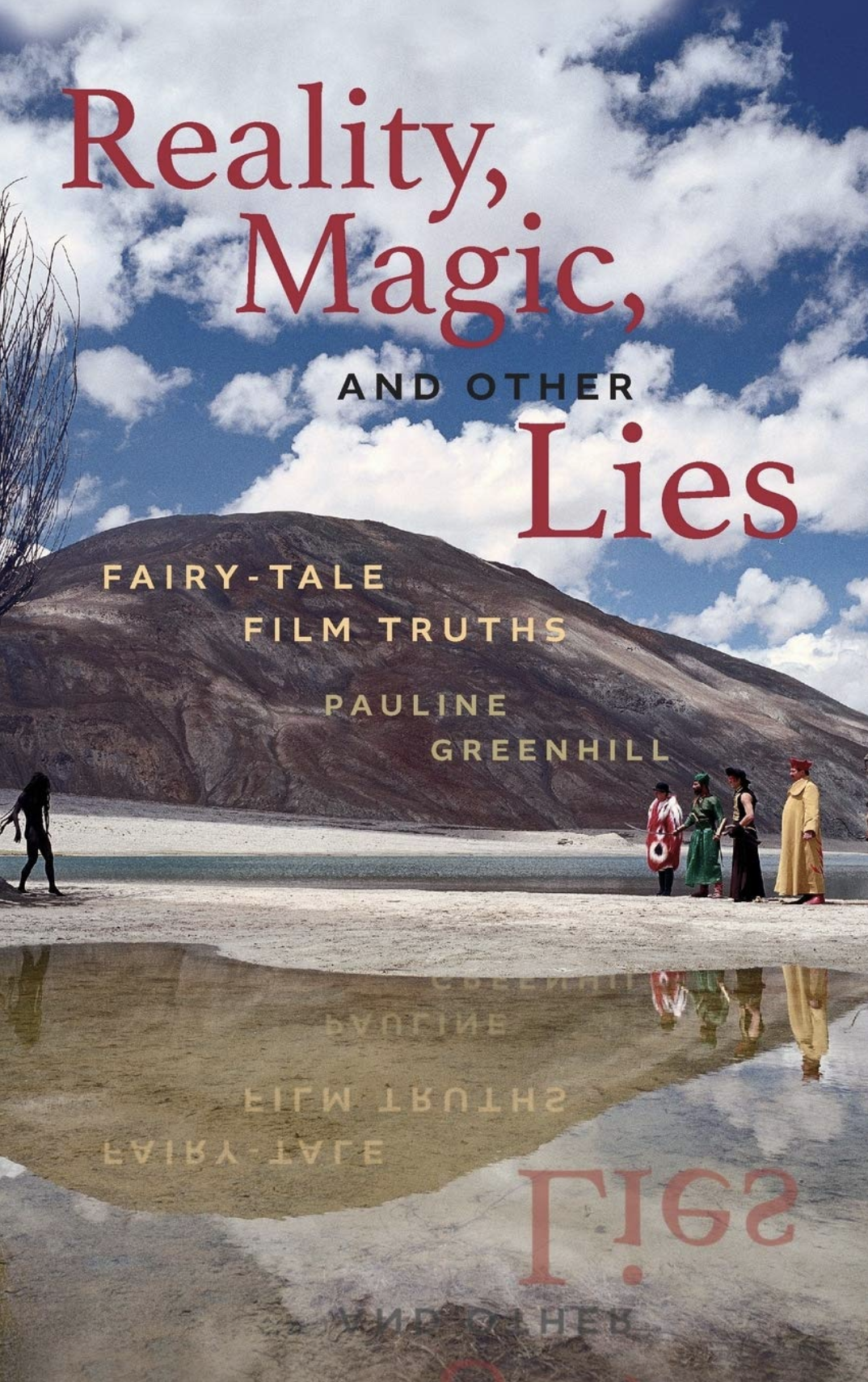
These synopses leave Greenhill’s style paradoxically brilliant and mundane, perhaps purposefully so, as her argument is founded on the paradoxically synonymous nature of the fantastic and reality. The self-referential nature of her overarching structure combined with the repeating structure within the actual chapters (she introduces the primary film/story, offers context, then plot summary, and concludes with analysis) serves to represent the repeated formula of fairy tale. While Greenhill’s writing can appear formulaic at times and, as a result, become a tad monotonous to wade through, the formulaic structure also serves to facilitate her argument rather brilliantly. Siphoned into two parts (each part containing three subsections) with an introductory and concluding chapter, Greenhill’s book essentially mirrors itself—an homage to her cover, which features a shallow pool reflecting the pictured landscape. She quite literally reflects her argument through her structure—fairytale reflects reality…or is it reality that reflects fairytale? Regardless of the question Greenhill leaves the reader to answer, one can conclude the two are the same. Her autoethnographic journey exploring a remote town in Canada in chapter four poses this question, as it symbolically functions as a portal, a “through the looking glass” scenario where the second half of the book mirrors the first, thus structurally mirroring her argument regarding the blurred boundaries between fantasy and reality, fiction and truth as she moves from animation to actual participant and scholar, getting closer to the fantasy she writes about and the questions she poses.

Megan Spring is a PhD student in Florida Atlantic University’s Comparative Study Program with a concentration in the intersectionality of language, literature, and culture. Her research interests include the dualistic binary that exists between folklore and literature, ghostlore and possession in American culture, and narrative structure within American literature. Megan’s creative contributions appear in the Cedarville Review. 

Review of Bradbury Beyond Apollo


SFRA Review, vol. 52, no. 4

Nonfiction Reviews


Review of Bradbury Beyond Apollo

Rafeeq O. McGiveron

Jonathan R. Eller. Bradbury Beyond Apollo. U of Illinois P, 2020.  Hardcover. 376 pg.  $34.95. ISBN 9780252043413. eBook ISBN 9780252052293.

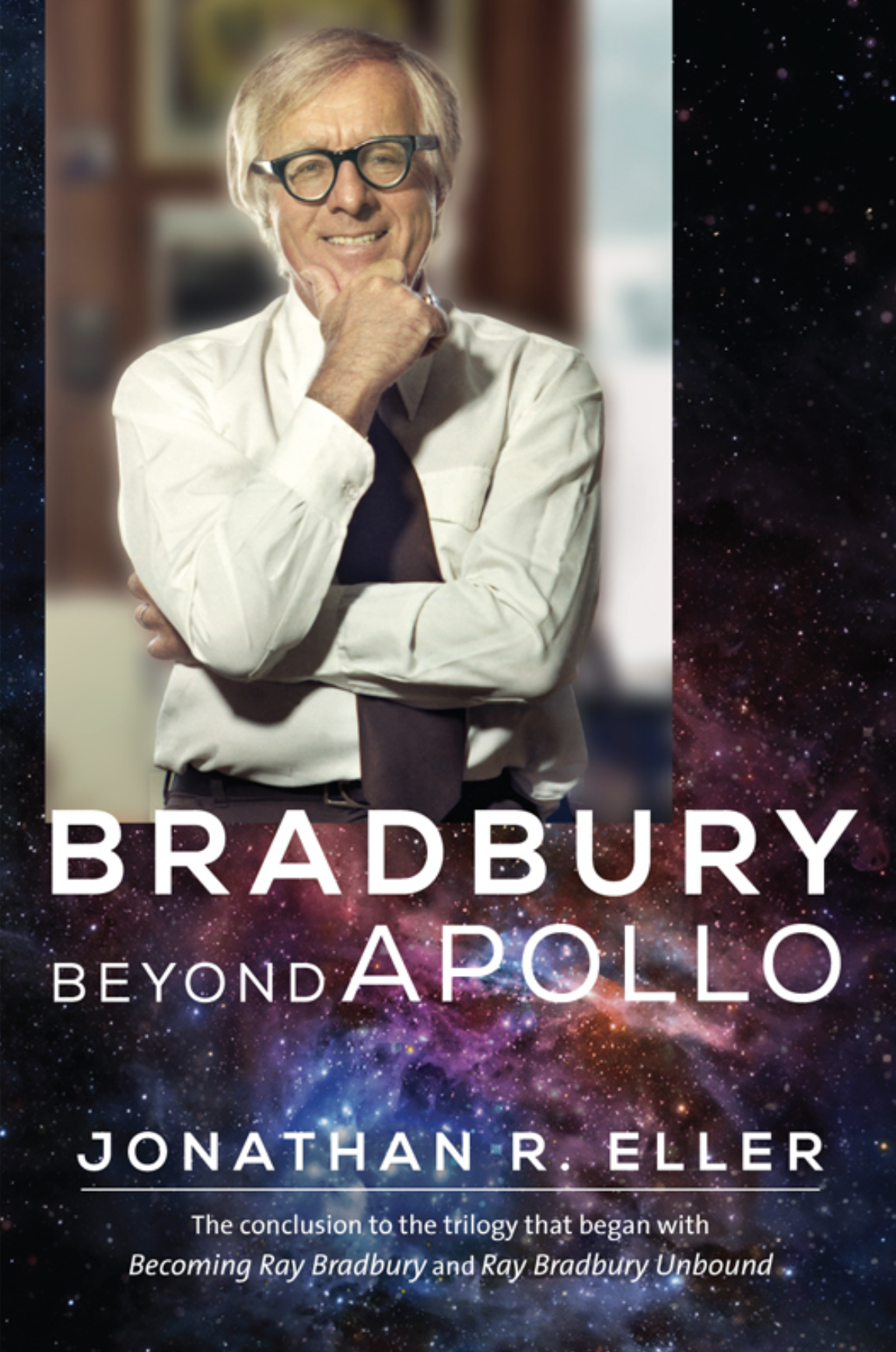
Jonathan R. Eller’s Bradbury Beyond Apollo completes a biographical trilogy begun a decade ago. The 2011 Becoming Ray Bradbury took us through the early 1950s, and the 2014 Ray Bradbury Unbound actually does touch upon the Apollo era and even Bradbury’s 2012 death, but it is the 2020 Bradbury Beyond Apollo that truly delves into Ray Bradbury’s work and life from the 1960s to the end. The tale is a wide-ranging and sometimes a frustrating and even sad one, told in detail with authority and with compassion and yet also with a true scholar’s evaluation and critical judgment. As with Eller’s previous two installments, the approach here falls somewhere between, say, that of the more theoretical and bibliographically encyclopedic 2004 Ray Bradbury: The Life of Fiction by Eller and William F. Touponce and that of a more popularly oriented biography such as Sam Weller’s 2005 The Bradbury Chronicles: The Life of Ray Bradbury.

The book is divided into five sections, each of which comprises easily approachable chapters generally between five to ten pages each. Part I, “The Inherited Wish,” covers the period of the late 1960s through the late 1970s, from Bradbury’s awe and joy at NASA’s crewed lunar landings through the Viking I robotic mission to Mars and the publication of Long After Midnight. “Beyond Eden” runs from 1977 through the mid-1980s, including Bradbury’s deepening friendship with Federico Fellini and his work on Disney’s EPCOT. Part III, “1984 Will Not Arrive,” discusses the period of the early 1980s through the early 1990s, in which Bradbury spent a great deal of effort on, among other projects, often-abortive film work, Death Is a Lonely Business, and cable television’s The Ray Bradbury Theater. “Graveyard for Lunatics” covers 1990 through the late ’90s, with projects such as the sequel to Bradbury’s previous mystery novel and Green Shadows, White Whale (1992), and ever more effort for non-print media, along with further NASA honors. “Closing the Book,” the last section, takes us from the late 1990s until Bradbury’s death in 2012, including further awards and honors, the author’s final novels, and ever more story collections as well.

No one can deny the wide-ranging creativity of Ray Bradbury’s efforts in many different genres across seventy-odd years. Certainly Bradbury’s name looms huge, not just in the fantasy and science fiction genres but in broader culture as well. Sought out by NASA “as a validating witness and celebrant—and also perhaps as a talisman”—during “key moments of exploration” (9), reprinted in his own “perennially popular collections” (104) and in school textbooks as well, and lauded with honors from awards for his writing to the naming of sites on the Moon (7) and Mars (1) and even of an asteroid (218), the difficult-to-pigeonhole Bradbury is remembered widely in a way that most other contemporary SF and fantasy greats are not. Three volumes of biography indeed may be necessary. And, Eller reminds us, this volume, like the previous two, covers not only familiar events of Bradbury’s life and career but also “a number of adventures that the public knows little about; yet these were things that he cared a great deal about, whether they succeeded in grand fashion or failed to reach the public eye at all” (2-3).

It is this unevenness of Bradbury’s output and the changes in trajectory of his creativity—a “story…so complex and so full of unrelenting (and sometimes uneven) creativity” (2), as Eller puts it—in the second half of his life that are perhaps the most eye-opening here. On the one hand, despite certain “significant” (3) and “enduring works” (308) appearing in these later decades, “the stories and fables that define Ray Bradbury’s twenty-first-century legacy were almost all written during the first two decades of his seventy-year career” (3). On the other hand, “Bradbury’s pace of writing never slowed, but most of his time at the typewriter was devoted to new adaptations of his stories for stage, television, and film. Newer versions of older adaptations inevitably involved a great deal of new writing as well” (41). Even pieces released brand-new to the public, though, nevertheless still “were often nourished from the safe harbors where he had crafted his earliest stories of fantasy and suspense” (308). Alongside “isolated but significant achievements” of the later part of Bradbury’s career, such as “The Toynbee Convector,” various essays, and The Ray Bradbury Theater (309), after all, stand “late-life fulfillments of major prose projects mapped out half a lifetime earlier, such as From the Dust Returned [2001], Farewell Summer [2006], Somewhere a Band Is Playing [2007], and Leviathan 99 [2013]…” (3).

For any reader or critic of Bradbury’s art, Eller’s investigation is well worthwhile. Bradbury Beyond Apollo is impressively comprehensive, covering not only print works but also “the constant parade of lectures, creative consultancies, and adaptations for stage, television, and films that bled off his once broad channel of original short story production” (308), along with personal and business dealings with a host of famous names throughout the United States and Europe as well. And at the same time that Eller through his thoroughgoing and meticulous research can detail with insight and appreciation the various topics like no other, he is no uncritical panegyrist. Whether it is with a judgment of “Bradbury’s sometimes unreasonable ego” (55) or of the fact that the author “was not always the best judge of his own stories” and in later collections often picked personal favorites “that lacked the tight, emotionally powerful plots of his best work” (105), or with an acknowledgement of the “blunt” critiques, to put it mildly, from “various experts” of the Air & Space section of the Smithsonian Institution to Bradbury’s proposal for a planetarium show (109) or of Thomas Disch’s scathing review of The Stories of Ray Bradbury (105-106), this text puts Bradbury’s work into perspective rather than on a pedestal.

Bradbury’s “true trajectory in the final four decades of his life,” we are told, “would be that of a visionary, asked over and over again to tell us why we desire to explore, why we should go to the stars, and what we might become when we get there” (310). For a widely renowned author whose “unusual brand of science fiction—powerfully emotional studies of the human heart and mind mounted on a barely perceptible armature of science and technology—had inspired many scientists, engineers, and astronauts” (9) right along with countless ordinary readers, this was a worthy undertaking. So, too, was the writing of Jonathan R. Eller’s Bradbury Beyond Apollo.

Rafeeq O. McGiveron has published articles, chapters, and reference entries on the works of authors ranging from Robert A. Heinlein and Ray Bradbury and George Orwell to Willa Cather and Truman Capote and Shakespeare.  His edited collections include Critical Insights: Fahrenheit 451 (2013), Critical Insights: Robert A. Heinlein (2015), and Critical Insights: Ray Bradbury (2017) from Salem Press.  His novel, Student Body, was released in 2014, and Tiger Hunts, Thunder Bay, and Treasure Chests: A Memoir of the Path to Fatherhood was published in 2020.

Review of Ethical Futures and Global Science Fiction


SFRA Review, vol. 52, no. 4

Nonfiction Reviews


Review of Ethical Futures and Global Science Fiction

Tristan Sheridan

Zachary Kendal, Aisling Smith, Giulia Champion, and Andrew Milner, editors. Ethical Futures and Global Science Fiction. Palgrave McMillan, 2020. Studies in Global Science Fiction. Ebook. 335 pg. $79.99. ISBN 9783030278939.

Ethical Futures and Global Science Fiction belongs to the Studies in Global Science Fiction series, edited by Anindita Banerjee, Rachel Haywood Ferreira, and Mark Bould. This particular entry emphasizes non-Anglophone literatures in its ethical examinations of futurity within the SF genre and builds off of existing scholarship within the cli-fi and utopian subgenres as well as postcolonial theory. From its first chapter, “Science Fiction’s Ethical Modes,” Ethical Futures seeks to examine the ethical underpinnings of the SF genre, raising the question of “whether SF has a predisposition to a particular ethical outlook” (3). While the author of the chapter, editor Zachary Kendal, acknowledges “the politically and socially regressive traditions of American pulp SF”—traditions often founded in colonialist and fascist ideologies—the collection as a whole stresses how vital SF is as “a primary mechanism—perhaps the primary mechanism—by which our culture imagines its possible futures, both positive and negative,” as Andrew Milner states in a later chapter, “Eutopia, Dystopia and Climate Change” (8, 77). Indeed, careful envisioning of the future may be more relevant now than ever given impending environmental catastrophe, a relevance that Ethical Futures seeks to emphasize, given its final chapter on the modern prevalence of dystopian narratives in contrast to utopian narratives: Nick Lawrence’s “Post-Capitalist Futures: A Report on Imagination.” If we look to fictionalized versions of the future as a guide when moving towards our own, as Ethical Futures purports, it becomes especially important to incorporate non-Anglophone literature and to decenter Western perspectives when conceptualizing futurity.

Divided into four parts—Ethics and the Other, Environmental Ethics, Postcolonial Ethics, and Ethics and Global Politics—Ethical Futures offers both historical overviews in reoccurring themes throughout SF futurisms, such as Joshua Bulleid’s “Vegetarianism and the Utopian Tradition,” as well as close readings of individual texts such as Jamil Nasir’s Tower of Dreams (1999) and Ahmed Kaled Towfik’s Utopia (2008) in Anna Madoeuf and Delphine Pagès-El Karoui’s “Cairo in 2015 and in 2023.” The collection does significant work to unseat the colonialist dogma that many of SF’s most prominent texts have historically operated under, building off of scholarship such as John Rieder’s Colonialism and the Emergence of Science Fiction (2008) in addition to Fredric Jameson’s work on utopian narratives. It does so not only by arguing for anti-colonial and anti-capitalist alternatives, but also by identifying the underlying commonalities between SF and other postcolonial efforts: both literatures “seek alternate futures for the human race, both look beyond the joint nightmare of colonial modernity, both are profoundly involved in future thinking, and both offer a clear platform for the utopian,” as Bill Ashcroft observes in “Postcolonial Science Fiction and the Ethics of Empire” (165). The range of literatures covered in Ethical Futures is extensive, including French, Macedonian, Haitian, Mexican, and Indian literature; however, they are frequently analyzed alongside those from the Anglosphere; futurism and ethics are what most tie this collection together.

The essays contained within Ethical Futures are in clear conversation with one another thematically, even across the differing sections, although these potential connections are often left unexplored more explicitly due to the nature of the collection and its lack of direct collaboration among authors. For instance, Ashcroft’s analysis of the Oankali’s ethical culture in Octavia Butler’s notable Xenogenesis series would have benefitted from Kendal’s own discussion of ethical obligation towards the other earlier in the book, as the alien Oankali and their drive to “seek [otherness], investigate it, manipulate it, sort it, use it” echoes the totalizing ideology that Kendal problematizes as violent and imperial in his critique of Asimov’s Foundation trilogy and Zamyatin’s Мы (We [1920-21]) (172). Even so, Ashcroft still reaches the conclusion that the Oankali are not as morally superior to humans as they initially appear to be on the basis of their lack of ethical “responsibility to otherness,” rather than their totalizing efforts towards the other (179). It is a strength of the collection nevertheless that its individual pieces have clear intersections and develop one anothers’ arguments, however inadvertently. Some essays could be more fully developed, such as Lara Choksey’s examination of Nalo Hopkinson’s Midnight Robber (2000) in relation to dependency work and the politics of care; her argument would have been improved had it explored—or even directly mentioned—the novel’s theme of labor as a practice which its protagonist turns to in order to heal from her trauma, in direct opposition to Hopkinson’s representation of the postcolonial state of Toussaint and its desire to avoid work altogether in the aftermath of slavery. This exploration would have neatly connected to Lawrence’s discussion of automation in the book’s concluding chapter, but it is worth noting that Choksey makes a compelling argument about the role of feminized labor in decolonial states.

On the whole, Ethical Futures makes meaningful contributions to the study of utopian and dystopian literatures and reminds its audience of the importance of collectively imagining a future that is less destructive than our present. Even as Ethical Futures contains thoughtful analysis of dystopian literature and does not begrudge said literature of its abilities to offer needed insights regarding our ethical responsibilities in the present, it is significant that Ethical Futures spends its concluding chapter on the relative absence of modern utopian literature. As Lawrence observes, “there is no outstanding example of utopian thought in the twenty-first century that has achieved success on a mass scale” (318). The final question that Ethical Futures raises, then, regards our seeming inability or unwillingness to imagine beyond the destructive systems under which we live and therefore our turn to dystopian fatalism over utopian hopefulness. In doing so, Ethical Futures marks itself as relevant not only to academic scholarship, but to all those who seek to imagine a better future than the one toward which we seem to be heading .

Review of Terry Pratchett’s Ethical Worlds: Essays on Identity and Narrative in Discworld and Beyond


SFRA Review, vol. 52, no. 4

Nonfiction Reviews


Review of Terry Pratchett’s Ethical Worlds: Essays on Identity and Narrative in Discworld and Beyond

Maria Alberto

Kristin Noone and Emily Lavin Leverett. Terry Pratchett’s Ethical Worlds: Essays on Identity and Narrative in Discworld and Beyond. McFarland, 2020. Paperback. 155 pg. $39.95. ISBN 978-1476674490.

There is no getting around this fact—Terry Pratchett’s work is funny. Powerfully amusing, we might even say, in every sense of the term. However, as any of his multitudinous readers could also report without a second’s hesitation, Terry Pratchett’s work is likewise thoughtful, deliberate, and nuanced, offering pointed satire, incisive social commentary, and gentle moral reflection filtered through the worldview of witches, watch-members, and other fantasy characters whose experiences both replicate and reveal our own.

Likewise, Kristin Noone and Emily Levin Leverett’s 2020 collection Terry Pratchett’s Ethical Worlds offers an illuminating—and, honestly, just plain fun to read—addition to the growing body of scholarly work on Pratchett’s oeuvre. Noone and Leverett characterize their work as an exploration of the means through which Pratchett “constructs an ethical stance that values and valorizes informed self-aware choice, knowledge of the world in which one makes those choices, the value of play and humor in crafting a compassionate worldview, and acts of continuous self-examination and creation” (2).  These four themes, the editors and their contributors find, run throughout Pratchett’s canon, from his well-known Discworld novels and co-authored Good Omens (1990) to more clearly science fiction works such as Strata (1981), the Long Earth series (2012-2016), and the less-discussed short story “#ifdef DEBUG + ‘world/enough’ + ‘time’” (1990). From the introduction onward, too, Pratchett’s interest in forms of intertextuality, identity, and genre-switching is also noted and explored (1-2). As Noone and Leverett point out, Pratchett constructs worlds and narratives “in which questions of identity, community, and relations between self and other may be productively discussed, debated, and reshaped” (4), in turn leading to their definition of the “ethical worlds” named in this collection’s title: rich, multifaceted “fantasies in which language always matters, stories resonate with the past and the future, and the choices characters make reflect the importance of self-aware and ongoing acts of compassion and creation” (4).

Overall, collection contributors build from a shared interest in Pratchett’s inventiveness and creation—of secondary world(s), of language, and of characters’ selves as well as our own—to offer nine chapters drawing from a diverse range of critical lenses and perspectives. Here readers will find highly-enjoyable pieces examining acts of creation in science fiction (ch. 1), hypermasculinity and adaptational influence (ch. 2), the ethics of choice (ch. 3), free will and growing up (ch. 4), Old English influences (ch. 5), identity construction through language (ch. 6), rhetoricity and magic (ch. 7), “golempunk” and ownership of the means of production (ch. 8), and grappling with the ethics of neomedievalism and aftershocks of colonialism (ch. 9).

In their introduction, Noone and Leverett identify three primary strands of Pratchett scholarship—one apiece focusing on his genre fiction writing, his YA authorship, and his Discworld stories (2)—and position this collection as an attempt to bring various elements of these strands together. In this light alone, the collection is a success. For one thing, while the Discworld novels do feature heavily here, most of Pratchett’s work also receives mention—and in many cases, full chapters—that are characterized by as much attention and detail as his most well-known work. Noone, for instance, looks to Pratchett’s early science fiction and its depictions of acts of creation, maintaining that these texts “offer insight not only into prototype versions of the later Discworld but into the evolution of Pratchett’s moral stance” as these develop across genres and narrative forms (3). As Noone correctly notes here, Pratchett’s work as a fantasy or a YA author, as often prioritized by those existing strands of scholarship, is greatly enriched when considered in light of his science fiction roots, where we find him first sketching out the ethical stances and foundations that he would build later works upon.

For another thing, the chapters that do focus on Pratchett’s best-developed and most extensive work, Discworld, also span a wonderful variety of the characters, narratives, and locations that readers encounter in Ankh-Morpork and beyond. This collection’s contributors bring their insights to familiar faces from Tiffany Aching and her community (friends and enemies alike) to Cohen the Barbarian and his complicated relationship with violence, the Watch and their different arbitrations of justice, and Moist von Lipwig and the technological advances he reluctantly shepherds into the big city. In so doing, the collection thus reiterates the sheer range of subjects to which Pratchett brought his stance on compassionate, self-aware, and humorous creation: capital-b Big topics that include gender roles, the dangers of sexual and gendered essentialism, war and warfare, the legal and justice systems, capitalism, and the all-too-common violence of minority communities’ integration into even heterogeneous societies. It is quite a balancing act, to give these topics the space and thoughtful treatment they deserve in the limited word count of single chapters—particularly while also extricating them from the writing and perspective of a cis, white male author from a former colonial world power, radical as his worldview was and beloved as he himself is—but this collection and its chapters do so admirably.

Finally, and very aptly indeed, I also found that this collection is just a delight to read. Its ambitious project and often complex topics are bolstered by contributors’ obvious enjoyment of the texts themselves, which shines through in the writing of just about every chapter. While definitely an academic work, complete with the criticism and bibliographic work that entails, Terry Pratchett’s Ethical Worlds: Essays on Identity and Narrative in Discworld and Beyond also struck me as accessible and exciting, one of those uncommon works of scholarship that I would also pick up on a rare day off just to enjoy seeing rich new perspectives on a favorite fantasy world.

All things considered, this collection’s emphasis on compassion, creation, and self-awareness, as Pratchett uses genre fiction and its attributes to broach such topics, is well worth a read. Those interested in examinations of the fantasy genre (and in particular, continuations of work by Farah Mendlesohn, Edward James, and John Clute) or seeking out complications of its science fiction counterparts will appreciate the collection’s focus, while those still keeping #TerryPratchettGNU alive and well will value its thoughtful revisitation of a gentle giant in the genre.

Maria Alberto is a PhD candidate in literature and cultural studies at the University of Utah. Her research interests include adaptation, popular culture, digital media, and fan studies, and her recent work includes essays in Mythlore, M/C Journal, and Transformative Works and Cultures, as well as forthcoming book chapters on digital-born romance, fan studies methodology, and queer readings of Tolkien’s legendarium. At this very moment, she is probably working on her dissertation on “canon” in popular culture texts or playing D&D. Either way, coffee is definitely involved.

Review of AKB48


SFRA Review, vol. 52, no. 4

Nonfiction Reviews


Review of AKB48

Amber A. Logan

Galbraith, Patrick W. and Jason G. Karlin. AKB48. Bloomsbury, 2020. Print. Paperback. 144 pg. $22.95. ISBN 97815013411379.

AKB48 is a short monograph that is part of the broader series of books called “33 1/3 Japan.” This series aims to provide a deep dive into contemporary Japanese popular music, ranging from the soundtrack of Cowboy Bebop (the classic anime series) to the music of Hatsune Miku (a vocaloid star). This particular volume provides an in-depth analysis of the girl group AKB48 (so named because of its origins in the Akihabara district in Tokyo, and the originally intended 48 group members). While the subject matter of the book is analyzed academically, the content is fascinating enough (and the size of the book small enough) to appeal to a more general audience—particularly if they are fans of the band, or of Japanese popular culture more generally.

Formed in 2005, AKB48 is now the most commercially successful female group in Japan (which is itself the second largest music market in the world). This popularity alone is not necessarily worth scholarly analysis, but clearly Patrick W. Galbraith and Jason G. Karlin, the authors of this book, saw behind the success of AKB48 a greater and more fascinating business model in contemporary Japanese pop culture. This business model relies upon the idols monetizing their fans’ enthusiasm and affection through personalized interactions and fan-led elections to determine which girl gets top billing. The authors then utilize critical theory to extrapolate beyond this specific idol group to speculate about Japanese culture and beyond.

From the group’s beginning, the idols cultivated a sense of personal connection with their audience; AKB48’s slogan is literally “idols that you can meet” (ai ni ikeru aidoru). Their humble beginnings were in a small Akihabara theater where live performances took place in front of intimate crowds where idols could make eye contact with individual fans. Fans are encouraged to see themselves as supporters of a specific idol by calling out her name at live events, buying her specific merchandise, and visiting her at the special hand-shaking events where fans can both see their favorite idol up-close-and-personal and be seen by her, as well. The catch? Hand-shaking may only be accessed with the purchase of CDs packaged with special tickets for the events. To take things even further, AKB48’s overseeing company designed a General Election which allows fans to vote on which idol gets the top spot in the group—not unlike the highly successful American television show American Idol, in which fans participate in voting for their favorite singer. Again, fans must purchase CDs with special ballots inside in order to participate in the General Election, allowing the group to monetize the fans’ devotion to their particular idol and their desire to support her—both emotionally and financially.

Galbraith and Karlin point out that this style of interactive support is a key example of affective economics, which involves harnessing the power of a relatively small number of enthusiastic loyalists to monetize the relationship between them and their objects of desire. Some fans will buy hundreds of copies of the same CD in order to buy the chance to vote for their favorite idol; the actual content of the CDs, the music product itself, becomes secondary or even trivial. In fact, the idols are not known for being skilled singers or performers; instead, they are beloved for their relatability, their vulnerabilities, their intense striving to do better—hence making them girls who need the fans’ support in order to succeed.

In essence, the idols are selling a relationship between themselves and their fans, similar to how in Japanese host clubs, the host (while actively convincing the patron to buy expensive food or drink) is selling the perceived relationship between host and patron, demonstrating yet another example of how affective economics are at play in Japanese culture. But even if the specific appeal of AKB48 seems largely limited to Japan, the rise of idol groups in South Korea demonstrates how this phenomenon is not specific to Japan.

AKB48 provides a fascinating look at the history of idols in Japan and how they led to the success of AKB48 in recent years. While the book clearly would appeal to fans of AKB48, pop idols, or the Japanese music scene in general, the authors do an excellent job of connecting the specifics of the band’s business model and social interactions to broader concepts of business, marketing, economics, psychology, and sociology. AKB48 could be used as an engaging case study for any of these fields, as well as for students of Japanese culture or music studies.

Amber A. Logan is a university instructor, freelance editor, and author of speculative fiction. In addition to her degrees in Psychology, Liberal Arts, and International Relations, Amber holds a PhD in Creative Writing from Anglia Ruskin University in Cambridge, England. Her thesis “Men Who Lose Their Shadows: from Hans Christian Andersen to Haruki Murakami” examines the intersection of fairy tales and near-future speculative fiction, and her debut novel The Secret Garden of Yanagi Inn will be published in October 2022.

Review of Child and Youth Agency in Science Fiction: Travel, Technology, Time


SFRA Review, vol. 52, no. 4

Nonfiction Reviews


Review of Child and Youth Agency in Science Fiction: Travel, Technology, Time

Adam McLain

Ingrid E. Castro and Jessica Clark, eds. Child and Youth Agency in Science Fiction: Travel, Technology, Time. Lexington, 2019. Hardback. 304 pg. $105.00. 9781498597388. Paperback. $42.99. 9781498597401. EBook. $40.50. 978149859739.

The conceptualization of children as agents has been an often-overlooked factor in academic conversations. This collection, edited by Ingrid E. Castro and Jessica Clark, contains twelve essays that serve as an excellent introductory point for those studying depictions of agency in science fiction. It also sets the stage for further development by beginning specific lines of inquiry and creates theoretical foundations by which future studies can interrogate cultural conception of the child and childhood. Although the collection lacks in its theoretical engagement with science fiction as a genre, favoring the application of sociological theories of agency and childhood to a chosen text, the essays provide arguments about child and youth agency that can be brought into many future studies of science fiction.

The introduction by editors Castro and Clark and the first chapter, Joseph Giunta writing about Stranger Things (2016- ), lay an excellent groundwork for the rest of the collection. Castro and Clark establish the dearth of scholarship on children in science fiction. Giunta’s chapter further elaborates this history of children’s agency by outlining the “‘new’ sociology of childhood, [which] embraces agentic youth and their active participation within hierarchies of social order” (25). This “new” sociology of childhood—that children are beings that fully act in and influence the world—is the foundation on which the essays engage with their chosen science fictional texts. Indeed, none of the essays argue that children do not have agency: a core supposition in each essay is that the actual agency of children is often overlooked, and therefore, almost all the essays outline how the characters in their chosen texts use agency. However, most of the essays don’t take the added step of detailing how the use of agency then affects the theory of agency or genre of science fiction.

For many of the essays, agency is most visible in oppositional acts. In Jessica Clark’s riveting assessment of masculinity and boyhood in the anime film Akira (1988), Clark declares that the use of agency shows that “adult status, political authority, and ideological principles are all questioned and transgressed” (123, emphasis mine). This transgression of strictures, systems, and hierarchies around the characters is what forms the ability to see the character’s agency at work. Similar to Clark, Megan McDonough argues that each book in Suzanne Collins’s Hunger Games trilogy (2008-2010) “culminates in one major agentically defiant act against the powerful government in charge” (134–35, emphasis mine); for McDonough, then, agency is about defiance and is thus a reaction to power. This approach to agency always already assumes agency as an act of opposition: a response rather than a decision. Essays like Clark’s and McDonough’s do well at showing agency, but in future studies, we must consider how an agency that emphasizes “impacting” or “subverting” rather than being in and of itself might hide some forms of agency.

Agency is also outlined in the relationship between child and parent. In Kip Kline’s chapter on Back to the Future (1985), Marty McFly is given power over not only himself but also his parents in a reading of his use of time travel as reversal of who determines whose futures: McFly becomes the metaphorical head of his family as he changes the past to align his present with his wants and desires. Kwasu David Tembo and Muireann B. Crowley look at the relationship between the X-Men characters Jubilee, X-23, and Wolverine, arguing that Jubilee and X-23 make agential actions but that those actions are always marked by Wolverine’s influence, the cultural experience of gender, or the influence of the bio-power of the controlling hegemonies. Whereas Tembo and Crowley find a frustration of agency within this relationship, other chapters, like Joaquin Muñoz’s chapter on Ender’s Game (1985) and Castro’s essay on David R. Palmer’s novel Emergence (1984), find agency in the rebellion against parents or figures of authority. Muñoz argues that in Ender’s Game, the protagonists “operationalize their agency for gaining power and control over their respective situations” (223); in other words, for Muñoz, the agency of children exists in an exerted influence on surroundings, contrary to what is controlled by the adult characters. In Emergence, Castro argues that the posthuman and biological relationships (e.g., with animals, with the surrounding world) is a place in which agency finds “purchase and context within their new intersectional and interdependent relationship” (259); in other words, a child’s agency is not determined only by a relationship with adults but by the child’s contextual world. The relationship of parent and child is also seen in Stephanie Thompson’s argument that youth agency in Ernest Cline’s Ready Player One (2011) and Neal Shusterman’s Unwind (2007) is found in the child’s transgression and subsumption of the adult’s role of home provider.

This relationship between child and adult as space for agency creation is navigated in different ways in Erin Kenny’s article on fanfiction of The 100 (2014-2020) and Jessica Kenty-Drane’s essay on Black Mirror (2011- ). Kerry’s article shows how the fanfiction communities that navigate and imagine diverse sexualities of youth characters in The 100 gain power over the narrative and their own sexualities by using their agency to pen alternative couplings than what the adult creators of The 100 intended. Kenty-Drane writes about how adult authors fear and speculate children’s use of technology as potentially binding of agency in two Black Mirror episodes. While these articles aren’t necessarily about how children gain power or voice through their use of agency, as in other articles, they do show agency as an interaction and conversations between adults and youths.

The collection is a good tool to establish one’s self in the conversation of agency in children and youth. However, even though the collection centers itself on science fiction, the theory of science fiction seems secondary to arguments about the conception of agency. While the texts considered in the collection are all science fictional in nature, the science fiction nature of the texts isn’t discussed. The collection favors describing agency and what that means to our cultural conceptions of agency to its engagement with science fiction as a field. This choice, then, leaves room for further investigations between conceptualizations of children’s agency and theorization about science fiction media, especially those that speak to science fiction studies and science fiction as genre.

Adam McLain is a MA/PhD student in English at the University of Connecticut. He researches and writes on dystopian literature, legal theory, and sexual ethics. He has a bachelor’s degree in English from Brigham Young University and a master of theological studies from Harvard University.

Review of Reconfiguring Human, Nonhuman and Posthuman in Literature and Culture


SFRA Review, vol. 52, no. 4

Nonfiction Reviews


Review of Reconfiguring Human, Nonhuman and Posthuman in Literature and Culture

Anelise Farris

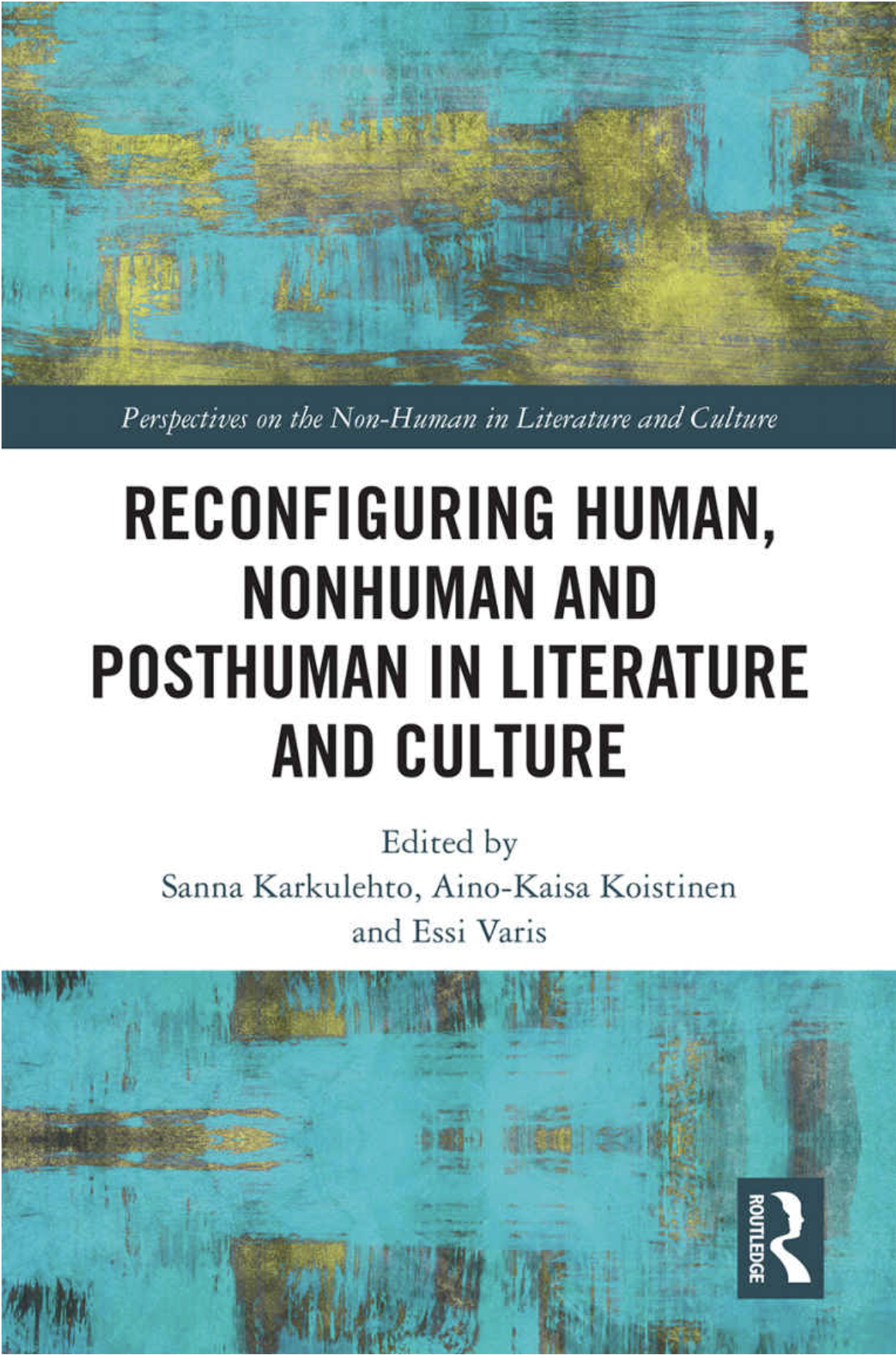
Sanna Karkulehto, Aino-Kaisa Koistinen, and Essi Varis, editors. Reconfiguring Human, Nonhuman and Posthuman in Literature and Culture. Routledge, 2019. Perspectives on the Non-Human in Literature and Culture. Hardcover. 400 pg. $160.00. ISBN 9780367197476.

A post-anthropocentric worldview rejects the primacy of human beings and seeks to encourage more ethical cohabitation between humans and nonhumans. In this vein, the anthology Reconfiguring Human, Nonhuman and Posthuman in Literature and Culture offers a collection of essays that aim to encourage serious reflection on the intra-action of various forms of matter.

The editors, Sanna Karkulehto, Aino-Kaisa Koistinen, and Essi Varis, acknowledge that this line of inquiry has become increasingly popular across disciplines as the destructive impact of human life on the planet can no longer be ignored (1-2). However, what sets this collection apart is its literary and cultural studies methodology and its subsequent attention to both real and imagined figures. They argue that art’s capacity to induce reflection on “subjective, embodied aspects of (nonhuman) experience…is likely to have notable epistemological and ethical repercussions” (5)—in ways that other disciplines are not able to achieve.  In addition to effectively demonstrating the need for such an approach, the editors’ introduction identifies the significance of narrative studies to the processes by which posthumanism, and by extension new materialism, interrogate forms of embodiment.

The anthology is divided into five sections. The first section contains essays that focus on theoretical and methodological concerns. In the opening chapter, Carole Guesse, questioning whether literature can ever really be posthumanist, ponders what a literary studies framework has to offer posthumanism. This chapter is followed by essays on the summoning of nonhuman entities through art and engaging in a mode of reading called “becoming-instrument” (57).  This latter chapter in particular, by Kaisa Kortekallio, offers a useful way for thinking through the essays in the second section, which reflect on the depiction of nonhuman characters in a variety of media: comic books, video games, and children’s literature. Each of these chapters posits that fictional characters “can be used as a tool for approaching other, actual or imaginary, nonhuman creatures” (Varis 87). In their chapter “Wild Things Squeezed in the Closet: Monsters of Children’s Literature as Nonhuman Others,” Marleena Mustola and Sanna Karkulehto conclude that such a tool (like a monster in a children’s book) reconfigures the boundaries between humans and nonhumans through the cultivation of empathy. The third section addresses the relationship between humans and nonhuman animals. Mikko Keskinen opens the section by positioning the deceased dog narrator in Charles Siebert’s Angus (2001) as a hybrid, “quasi-human character” (159). Similarly, the other chapters in this section examine the transboundary relationship between humans and pigs, as well as disabled humans and guide dogs.

The fourth section analyzes the agency afforded to human-created machines. Among calls for “renewed narratives about digital machines” (Collomb and Goyet 203) and “resisting the capitalist agenda of colonialism and docile subjectivity available for the player in Minecraft” (Huuhka 220), Patricia Flanagan and Raune Frankjœr offer the most distinctive chapter in the anthology: “Cyberorganic Wearables: Sociotechnical Misbehavior and the Evolution of Nonhuman Agency.” They contend that the “techno-genesis of the body [via wearable technology]…has the potential to foster interconnected ways of understanding our place within the Neganthropocene” (Flanagan and Frankjœr 236). The chapter is filled with images of cyberorganic technology like the Bamboo Whisper, and the authors make a compelling case for how such wearables force us to rethink what it means to be human, nonhuman, and everything in between. Thoughtfully placed, the final section, which consists solely of Juha Raipola’s “Unnarratable Matter: Emergence, Narrative, and Material Ecocriticism,” considers the limitations of seeking to understand that which is not human through a narrative lens. 

As evidenced by the range of content contained in this collection, the diverse texts and modes that are addressed is commendable. As with any anthology, some of the essays are stronger than others, but this is a collection that conveys a sense of cohesion, of each chapter being essential and in conversation with each other, in a way that anthologies don’t always achieve. If there’s a weakness, it’s that the contents vary in terms of their accessibility both stylistically and in their subject matter. Accordingly, this is a collection for the posthumanist scholar who is already well-versed in posthumanist thought. Despite the heavy subject matter, however, there is a refreshing sense of playfulness to Reconfiguring Human, Nonhuman and Posthuman in Literature and Culture that manages not to undermine the urgency of the topic but instead demonstrates the imaginative potential for more ethical cohabitation. Ultimately, this is a significant contribution that reminds us what art and literature have to offer an endangered planet.

Anelise Farris is an Assistant Professor of English at the College of Coastal Georgia, as well as the Faculty Advisor of Seaswells, the Art and Literary Magazine. Her research interests include genre fiction, disability studies, folklore and mythology, popular culture, and new media. She has presented her work internationally and actively publishes in her fields of study. She holds a PhD in English and the Teaching of English from Idaho State University, in addition to an MA, a BA, and a Graduate Certificate from George Mason University, where she studied literature and folklore.

Review of Science Fiction and Climate Change: A Sociological Approach


SFRA Review, vol. 52, no. 3

Nonfiction Reviews


Review of Science Fiction and Climate Change: A Sociological Approach

Jerome Winter

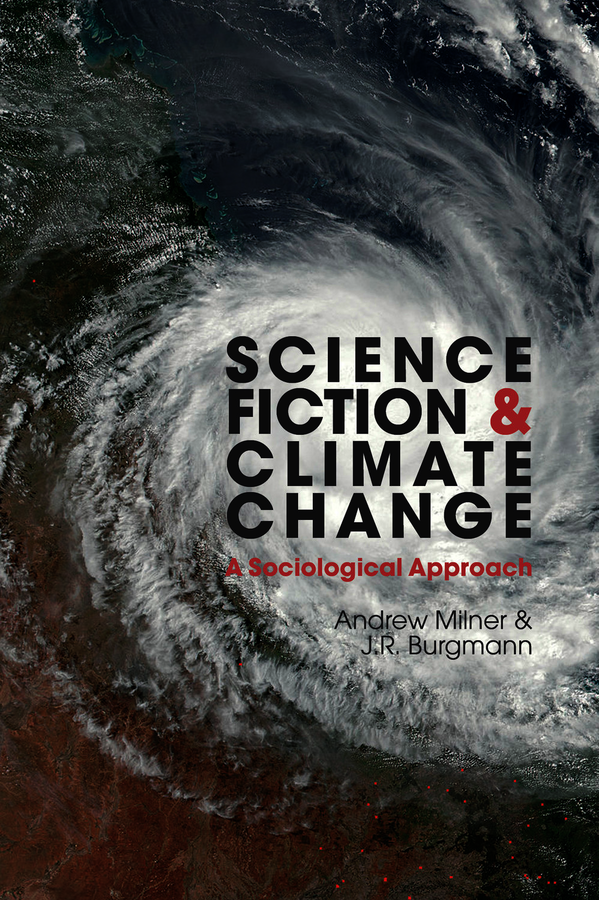
Andrew Milner and J.R. Burgmann. Science Fiction and Climate Change: A Sociological Approach. Liverpool UP, 2020. Liverpool Science Fiction Texts and Studies 63. Hardcover. 248 pg. $120.00. ISBN 9781789621723.

Andrew Milner and J.R. Burgmann’s Science Fiction and Climate Change: A Sociological Approach adds some vitally needed critical rigor to the burgeoning subgenre of SF literature and media Daniel Bloom has labelled “cli-fi,” that is, climate fiction. Some of the crucial distinctions the book contributes to scholarship include the distinction between theogenic (god-caused), geogenic (geology-caused), and anthropogenic (human-caused) climate fiction, the lattermost being only of recent vintage. Another useful categorization that Milner and Burgmann neatly add to the critical cli-fi conversation is the taxonomizing of works into ones that variously anticipate the fertile biosphere into the barren landscapes of a frozen world, a burning world, or a drowned world. Likewise, Burgmann and Milner divide their fourth and fifth chapters, on “classical” and “critical” dystopias (in Tom Moylan’s influential terminology), into cogent analyses of specific climate-fiction novels as exponents of a spectrum of ideological positions: namely, denial, mitigation, negative adaption, positive adaptation, and Gaia. There are also separate chapters on base reality climate fiction, fatalism in dystopian climate fiction, and a chapter on climate fiction as conjured in popular sonic and visual media.

A signal contribution of this timely book is its inclusion of a well-researched and globally oriented (if still primarily Western and European in origin) archive of climate fiction to illustrate this essential schema. Hence denialist climate fiction, i.e. fiction that avows skepticism about climate science, is exemplified through Sven Böttcher Prophezeiung (2011) as much as Ian McEwan’s Solar (2010). Mitigation climate fiction, or fiction that espouses techno-fixes and geo-engineering to address climate change, discusses Arthur Herzog’s Heat (1977) as well as Dirk Fleck’s MAEVA! (2011). Negative adaptation, that is, the minimizing of the deleterious consequences of climate change, is shown through Michel Houellebecq’ La The Possibility of an Island (2005) and Will Self’s The Book of Dave (2006). Positive adaptation, fiction that exploits opportunities afforded by climate change, is explored through Bernard Besson’s Groenland (2011) as much as Paolo Bacigalupi’s The Water Knife (2015). Gaian climate fiction, i.e. fiction that depicts the planet as operating according to a self-regulating balance, as theorized famously by James Lovelock, is typified via Jean-Marc Ligny’s climate trilogy of Exodes (2012), Semences (2015), and AquaTM (2006)as much as Brian Aldiss’s Helliconia trilogy (1982-1985). Burgmann and Milner discuss fatalistic cli-fi novels through the close reading of test cases of Antti Tuomainen’s Parantaja (2010) as well as Jeanette Winterson’s The Stone Gods (2007). In addition to a rich panoply of close readings of other miscellaneous climate fiction, this book also includes a long chapter that is labelled “Theoretical Interlude,” and which seeks to classify climate fiction broadly, according to excurses on Raymond Williams’s cultural materialism, Pierre Bourdieu’s sociology of culture, and Franco Moretti’s world-system theory.

There are three primary ways the theoretical interlude that underwrites the whole conceptual framework of this otherwise fascinatingly researched and critically valuable book are less than satisfying. Firstly, the blanket attacks on ecocriticism as damningly postmodern, ethereally post-structuralist, or covertly neoliberal seem rather skeletal and unconvincing, especially since the loose term “ecocriticism” has been so variably construed in literary scholarship over the last quarter of a century as to be rendered almost meaningless. The book could have benefited, for instance, from less tilting at these windmills and more direct and sustained engagement with the recent proliferation of literary criticism and ecocritical theory, loosely labelled, that does indeed engage with climate change as an environmental phenomenon, both in terms of science fiction and literary fiction and cultural politics more broadly. 

For instance, Timothy Morton’s theory of climate change as a baffling, contradictory “hyperobject,” even if rejected as flawed theorizing, might have added some more supple dimensions to the perhaps overly uncomplicated ideal typologies discussed in this book. Indeed, the absence of any sustained discussions of ecocriticism at all seems like a glaring critical gap given that the proliferation of discussions of climate change have been a bone of contention of much literary, cultural, and philosophical scholarship on the so-called Anthropocene. Secondly, some of the specific readings of climate fiction seem tendentious on a more basic interpretative level: taxonomizing Michael Crichton’s State of Fear (2004)as denialist is only fitting and well-marshalled; however, reading Cixin Liu’s hard-SF Remembrance of Earth’s Past (2008-2010) trilogy as “denialist” and symptomatic of a defunct communist Chinese ideological opposition to climate science jarringly stands out as an ungainly leap. Perhaps Cixin Liu in this trilogy does indeed cryptically and unreflectively endorse an anti-environmentalist message of hysterical crackdown, reinforcing a presumptive repression directed at radical deep ecology; however, not enough cogent evidence is provided to induce assent to this unconventional historicist reading of texts that never explicitly suggest this ideology, especially given that the passages in question found early in Cixin Liu’s trilogy seem on a surface level to be a stirring elegy of ecological dissent and even subversion, especially given the draconian publishing context. 

Lastly, and perhaps more substantively, the deeper theoretical assumption here is that literary fictional entertainment in general must conspicuously wear on its sleeves all its social and political positions, not to mention offer readers plausible predictions, explicit extrapolations, and realizable speculations to be ranked as serious or legitimate in its addressing of climate issues. Likewise, the assumption that it is the reductively didactic agenda of a work of fictional entertainment to provide a plausible template of pragmatic solutions to climate change saddles on often subtle literary texts outrageous expectations of literal forthrightness that can never be adequately met by even the most socially progressive writer or politically activist of audiences. Hence the critiques of works like Kim Stanley Robinson’s Green Earth (2015), 2312 (2012), Aurora (2015),or New York 2140 (2017) as absurdly unrealistic, or “utopian in the pejorative sense of hopelessly impractical” (165), deliberately overlook more granular allegorical interpretations of the novels as germinating an inchoate utopian impulse or unfulfilled fictive yearning for ecological change manifested in the complex problematics of the fictional scenarios. Such utopian allegory does not need to be taken as straightforward mimetic blueprint or programmatic recipe for lasting revolution to function effectively as an aesthetically and conceptually satisfying experience of counterhegemonic dissent and speculative-fantastic resistance. 

To be fair, and not to put too fine a point on this minor criticism, Milner and Burgmann do admit that this charge of “impracticality is a purely textual matter” (168), arguing that an otherwise sophisticated writer like Robinson, in these specifically discussed texts, as opposed to the more authentically turbulent changes depicted, for instance, in Margaret Atwood’s eco-dystopian Maddaddam trilogy (2003-2013), simply fail at representing a genuinely green revolution coherently and compellingly in the delimited space of the novels themselves. This line of analysis may be lucid and reasonable from its own particular sociological premises and critical perspectives, not to mention subjective reading experiences, and certainly represents some important scholarly responses to these climate-change fictions. The provocative critique only lacks enough theoretical insight and precise textual evidence to be persuasive for the larger argument that Milner and Burgmann are making about the intractability of either the nebulously nihilistic sentiments or the inanely sanguine tendencies of climate fiction. Milner and Burgmann themselves devoutly desire the publication of a deeply pessimistic climate-fiction equivalent of what Nevil Shute’s On the Beach (1957) was for anti-proliferation nuclear activists and that would have “practical effects on both elite leaderships and oppositional activists across the world” (191). Challenging the rote dismissal of uncritical dystopian fiction as unhelpful in galvanizing social movements, they earnestly conclude perhaps climate fiction will reach a critical mass of bleak and pessimistic representations of the ongoing climate apocalypse, and no singular landmark book is needed.

Milner and Burgmann therefore suggest that mitigation and adaptation novels, as much as Gaian, base-reality, or denialist climate fiction, are more or less uniformly prone to ingrained ideological blinkers in representing climate-change solutions, with Robinson’s utopian blindness being repeatedly invoked as exemplary in its refusal to depict “the organized working class as a social force most likely to prevent anthropogenic global warming” (192). However, even the test case for such a large and unwieldy generalization (Robinson’s own individual output is prolific) remains at best resistant to such sweeping interpretations, given the writer’s consistently nuanced depictions of splintering revolutionary factions of socialist-affiliated, labor-identified, and anti-capitalist organizations and the bewildering proliferation of micropolitical rivalries depicted in his densely ecopolitical novels. One idly wonders what Milner and Burgmann would make of Robinson’s more recent Ministry of the Future (2020), for instance, which depicts a perhaps more working-class radical and sociologically messier green revolution in response to climate change than his also clearly socialist earlier books. Regardless, Milner and Burgmann’s more evaluative, less taxonomizing views are not without their own merit or substance; Robinson’s science fiction, and perhaps mitigation and geoengineering novels in general, do indeed rely on carefully curated techniques of extrapolation (and perhaps as well the corresponding acts of reifying “world-reduction,” in Jameson’s famous phrase), and his critical utopian impulses certainly lay themselves open to complaints from skeptical readers who challenge such science-based speculations as naive and overoptimistic. To counter such irrational exuberance, a clarion call of relentlessly dystopian climate fiction may indeed be called for as a political-cultural bulwark against the equally dystopian rising tide of the world’s oceans.

Jerome Winter, PhD, is a full-time lecturer at the University of California, Riverside. His first book, Science Fiction, New Space Opera, and Neoliberal Globalism, was published by the University of Wales Press as part of their New Dimensions in Science Fiction series. His second book, Citizen Science Fiction, will be published in 2021. His scholarship has appeared in The Oxford Handbook of Science Fiction, Extrapolation, Journal of Fantastic and the Arts, the Los Angeles Review of Books, Foundation, SFRA Review, and Science Fiction Studies.   


Review of Jordan Peele’s Get Out: Political Horror


SFRA Review, vol. 52, no. 3

Nonfiction Reviews


Review of Jordan Peele’s Get Out: Political Horror

Rebecca Hankins

Dawn Keetley, ed. Jordan Peele’s Get Out: Political Horror. The Ohio State UP, 2020. New Suns: Race, Gender, and Sexuality in the Speculative. Paperback. 254 pg. $29.95. ISBN 9780814255803.

Dawn Keetley’s edited volume Jordan Peele’s Get Out: Political Horror is the best advertisement for the blockbuster debut film. The book provides viewers with a manual to investigate all of the film’s nuances, not only the overt but especially the hidden meanings elucidated throughout the sixteen essays. Keetley introduces the reader to the film’s storyline that centers on Chris Washington, a young Black man who encounters the family of his white girlfriend Rose Armitage. This encounter is the catalyst for the horror or, as Peele designates it, “social thriller” about race, racism, and society that inevitably leads to violence. Peele notes that those who wield power in society are often the purveyors of terror and horror, especially to those without power. As Stokely Carmichael notes, “If a white man wants to lynch me, that’s his problem. If he’s got the power to lynch me, that’s my problem.”[1] Peele’s Get Out represents an archetype of humans wielding power represented in the Armitage family and the Coagula Society, which becomes the horror for those without power, Black people generally and Chris Washington specifically.

Keetley situates the film in the long tradition of horror films in which humans are the monsters, e.g. The Texas Chain Saw Massacre (1974), American Psycho (2000), Hostel (2005), The Purge franchise (2013-18), and many others. The debate over whether human monsters depicted in political horror films, as opposed to a nonhuman monster, can be called horror continues. Keetley and Peele argue forcefully that his work is an extension of the social and political commentary that adds a layer of racial critique to this genre of horror. Following in the footsteps of social, political, and racial horror are the three films that Peele acknowledges were influences for Get Out, specifically Rosemary’s Baby (1968), Night of the Living Dead (1968), and The Stepford Wives (1975), each a critique of “societal structures-whether it be patriarchy or racism…-as the monster.” (4) 

The themes of the essays include those that influenced Peele’s film, e.g. zombies, body snatching, and a new Black gothic tradition that recognizes that “violence remains a part of everyday Black life” (120). Sarah Ilott’s “Racism that Grins: African American Gothic Realism and Systemic Critique” (Chapter 8) is reflective of those themes that allude to Georgina, Walter, and Logan’s “mask that grins” (Paul Lawrence Dunbar, “We Wear the Mask,” qtd on page 169).  Each of these characters has already endured the Coagula brain transformation, their bodies already snatched, but conversely, they continue to retain a fading recognition of their former selves.

There are also connections to contemporary themes such as gentrification, rural v. urban, and neighborhoods as place. The Armitage home represents the gothic plantation of the South, but Peele turns this notion on its head by locating the home in the liberal bastion of Upstate New York. There are a number of essays that discuss what Robin Means Coleman and Novotny Lawrence describe in their essay “A Peaceful Place Denied: Horror Film’s “Whitopias” (Chapter 3) as places where Black people feel conspicuously out of place. Andre Hayworth succinctly labels the setting as a “creepy ass suburb” (56) before he is snatched. These essays are particularly prescient for our current times with Trump’s recent tweet to those “living their Suburban Lifestyle Dream” that they will no longer have to be bothered by low income housing intruding in their neighborhoods as he rolls back another President Obama-era program designed to reduce racial segregation in American suburbs. For Trump it is the Whitopia that is “often prized for its segregation and homogeneity” (47).

Another group of chapters discuss Get Out’s connection to other historical and contemporary figures that include Othello, W. E. B. DuBois, Ira Levin (author of both Rosemary’s Baby and the Stepford Wives), and James Baldwin. Particularly noteworthy is Robert Larue’s “Holding onto Hulk Hogan: Contending with the Rape of the Black Male Psyche” (Chapter 12), which compares Missy Armitage’s hypnotizing Chris to police officer Darren Wilson’s explanation of his fatal 2014 encounter with teenager Michael Brown in Ferguson, Missouri. For Missy and Wilson, Black men are never children, they are always scary and in need of subduing. This chapter adds to our understanding of the Black male as vulnerable and targeted. We see that vulnerability as the camera focuses on Chris’s eyes as he is rendered into the Sunken Place, unable to move and awash in tears.

Another group of chapters, under the heading “The Horror of Politics,” includes Todd K. Platts’s and David L. Brunsma’s “Reviewing Get Out’s Reviews: What Critics Said and How Their Race Mattered” (Chapter 9), a chapter that offers some revelatory contrasts between how white reviews and reviews by people of color focus on very different elements of the film.  Other essays speak of scientific racism in how Coagula Society members poke, feel, and prod Chris, rarely discussing his intelligence or accomplishments. Their only interest is as it relates to his abilities, his stamina, his athleticism, and physical characteristics, their ultimate motive to learn his body’s suitability for the brain transplant.

The other essay that stands out is Kyle Brett’s “The Horror of the Photographic Eye” (Chapter 13),” which discusses “the eyes of horror” (188), both physical eyes and the white gaze that sees Chris as a vessel. The other “eyes of horror” are represented by the mechanical through the use of Chris’s camera phone. Brett discusses the white gaze of the Coagula Society’s Jim Hudson who covets Chris’s eyes to replace his blindness.  Chris uses his camera at the Armitages’ party to hide his uneasiness with the attention he receives. It is through his lens that he recognizes the Coagulated Logan and attempts to communicate their shared Blackness, but it is only after his camera accidentally flashes Logan that he screams at Chris to “Get Out.” It is also his camera phone that saves him after he flashes Walter, who shoots Rose and then commits suicide. This essay has relevance to our current state of police killings of Black men and women, e.g. George Floyd, Trayvon Martin, Breonna Taylor, Tamir Rice, Botham Jean, Eric Garner, and Mike Brown, and many more. It is this “horror” that is now captured on anyone’s cell phone and shareable worldwide that too often represents an exploitation of their deaths, but also an awareness that has resulted in investigations that would not have been possible in the past.

Keetley has compiled an excellent collection of essays on Jordan Peele’s Get Out. The book captures all of Peele’s influences and nuances; from his choice of music to his use of camera angles, every aspect has been theorized, imagined, speculated, and critiqued as horror, social horror and/or thriller, from its opening scene through to its conclusion. This book is an excellent text for graduate level film studies students. Scholars and students of Africana, Women’s and Gender Studies will be discussing the meaning, the methodology, the comparisons, and the film’s influence on new films that explore social horror or social thrillers for years to come. Can’t wait for the critique of Peele’s recent film US!


NOTES

[1] https://www.goodreads.com/quotes/7802915-if-a-white-man-wants-to-lynch-me-that-s-his

Rebecca Hankins is the Wendler Endowed Professor and certified archivist/librarian at Texas A&M University. United States President Barack Obama (2008-2016) appointed Hankins to the National Historical Publications and Records Commission (NHPRC), where she served from 2016-2020. She is an affiliated faculty and liaison in the Africana Studies, Women’s & Gender Studies, and Religious Studies programs. She has published widely in journals and book chapters and has presented all over the world.  Her most recent work is titled “Reel Bad African Americans Muslims,” published in Muslim American Hyphenations, edited by Dr. Mahwash Shoaib, 2021.